 The etiology of all human diseases can be
attributed to
• Genetic factors,
• Environmental factors
• Mixture of both
• The application of Genetics as a science and its
new post-modern extensions, the Molecular
Genetics and the Molecular Medicine, are critical
to all manners of diseases in all stages of life.
 Chromosomes are present in all nucleated
cells & contain DNA with its hereditary
information.
 Chromosomes are mostly studied in
peripheral blood lymphocytes, but also in any
growing tissue including bone marrow, skin
fibroblasts or amniotic fluid cells
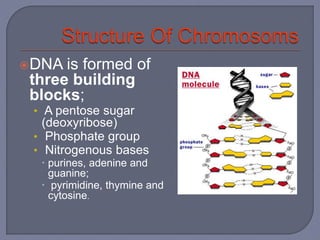
DNA is formed of
three building
blocks;
• A pentose sugar
(deoxyribose)
• Phosphate group
• Nitrogenous bases
 purines, adenine and
guanine;
 pyrimidine, thymine and
cytosine.
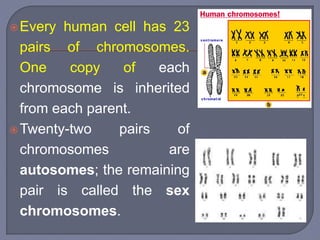
Every human cell has 23
pairs of chromosomes.
One copy of each
chromosome is inherited
from each parent.
Twenty-two pairs of
chromosomes are
autosomes; the remaining
pair is called the sex
chromosomes.
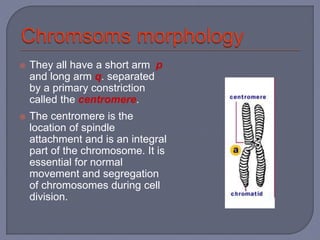
 They all have a short arm p
and long arm q. separated
by a primary constriction
called the centromere.
 The centromere is the
location of spindle
attachment and is an integral
part of the chromosome. It is
essential for normal
movement and segregation
of chromosomes during cell
division.
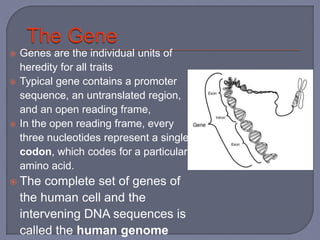
 Genes are the individual units of
heredity for all traits
 Typical gene contains a promoter
sequence, an untranslated region,
and an open reading frame,
 In the open reading frame, every
three nucleotides represent a single
codon, which codes for a particular
amino acid.
 The complete set of genes of
the human cell and the
intervening DNA sequences is
called the human genome
Each gene has a defined function
 Structural genes: synthesis of specific
polypeptide chains that conduct particular
metabolic function (enzymes, hormones,
immunoglobulins,….etc.
 Regulatory genes: regulate & control
functions of structural genes.
 Repair genes: keep structural integrity of
DNA & repair damage in it.
 Chromosome abnormalities usually occur
when there is an error in cell division during
meiosis or mitosis.
 There are many types of chromosome
abnormalities.
 They can be organized into two basic groups,
numerical and structural abnormalities.
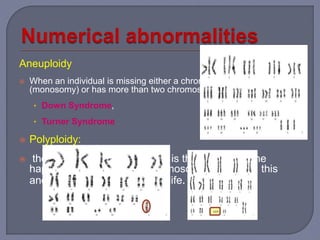
Aneuploidy
 When an individual is missing either a chromosome from a pair
(monosomy) or has more than two chromosomes of a pair (trisomy).
• Down Syndrome,
• Turner Syndrome
 Polyploidy:
 the number of chromosomes is the multiple of the
haploid number (i.e., 23 chromosomes). Usually, this
anomaly is incompatible with life.
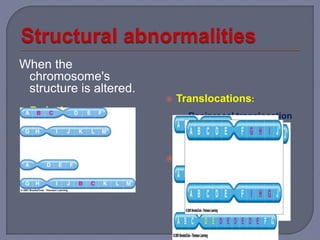
When the
chromosome's
structure is altered.
 Deletions
 Duplications
 Inversions
 Rings
 Translocations:
• Reciprocal translocation
• Robertsonian
Isochromosome
 Chromosome
instability
syndromes
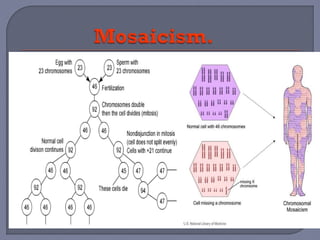
• It is the term used to describe an individual who has
two or more different cell lines derived from a single
zygote (fertilized egg). This usually arises during early
embryogenesis.
• Germ line mosaicism: refers to the presence of
mosaicism in germ cells found in gonads. In this case
there is an increases risk of recurrence of an affected
child.
 Most chromosome abnormalities occur as an
accident and are therefore not inherited.
 The abnormality is present in every cell of the
body.
 Some abnormalities, can happen after
conception, resulting in mosaicism
 Chromosome abnormalities can be inherited
from a parent or be "de novo".
Mendalian genes can be inherited in many ways:
 Autosomal dominant
 Autosomal recessive trait
 X-linked recessive traits
 X-linked dominant inheritance
 Mitochondrial inheritance
• Encephalopathy, myopathy
• Transmission exclusively through females (by ova)
Autosomal dominant disorders are those
disorders in which a single gene in the
heterozygous state is sufficient to cause
the phenotype.
Autosomal dominant disorders are often
caused by mutations in genes coding for a
structural protein.
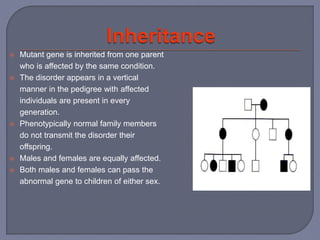
 Mutant gene is inherited from one parent
who is affected by the same condition.
 The disorder appears in a vertical
manner in the pedigree with affected
individuals are present in every
generation.
 Phenotypically normal family members
do not transmit the disorder their
offspring.
 Males and females are equally affected.
 Both males and females can pass the
abnormal gene to children of either sex.
 Affected individual passes the
mutant gene to 50% of their
offspring, (1:2 for each
pregnancy).
 In cases of fresh mutation the
recurrence risk is very low
Spherocytosis
Achondroplasia
Tuberous sclerosis
Marfan syndrome
Myotonic dystrophy
Neurofibromatosis I
Osteogenesis imperfecta
Autosomal recessive disorders are those
disorders in which two copies of the mutant
gene in the homozygous state are necessary
to cause the phenotype.
Autosomal recessive disorders are caused by
mutations that frequently affect genes
encoding for enzymes, i.e. result in metabolic
disease.
New mutation is less common than in
autosomal dominant disorders.
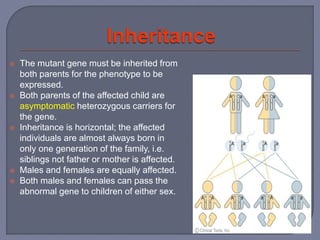
 The mutant gene must be inherited from
both parents for the phenotype to be
expressed.
 Both parents of the affected child are
asymptomatic heterozygous carriers for
the gene.
 Inheritance is horizontal; the affected
individuals are almost always born in
only one generation of the family, i.e.
siblings not father or mother is affected.
 Males and females are equally affected.
 Both males and females can pass the
abnormal gene to children of either sex.
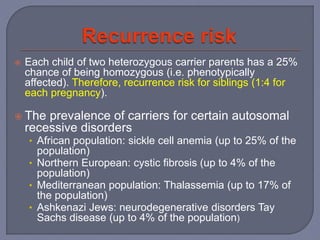
 Each child of two heterozygous carrier parents has a 25%
chance of being homozygous (i.e. phenotypically
affected). Therefore, recurrence risk for siblings (1:4 for
each pregnancy).
 The prevalence of carriers for certain autosomal
recessive disorders
• African population: sickle cell anemia (up to 25% of the
population)
• Northern European: cystic fibrosis (up to 4% of the
population)
• Mediterranean population: Thalassemia (up to 17% of
the population)
• Ashkenazi Jews: neurodegenerative disorders Tay
Sachs disease (up to 4% of the population)
•α1-antitrypsin
• Cystic fibrosis
• Sickle cell disease
• Thalassemias
• Storage diseases
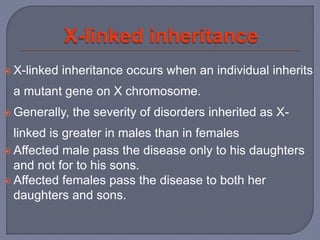
 X-linked inheritance occurs when an individual inherits
a mutant gene on X chromosome.
 Generally, the severity of disorders inherited as X-
linked is greater in males than in females
 Affected male pass the disease only to his daughters
and not for to his sons.
 Affected females pass the disease to both her
daughters and sons.
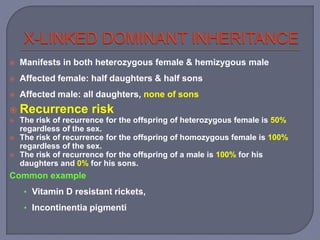
 Manifests in both heterozygous female & hemizygous male
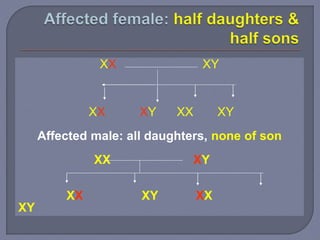
 Affected female: half daughters & half sons
 Affected male: all daughters, none of sons
 Recurrence risk
 The risk of recurrence for the offspring of heterozygous female is 50%
regardless of the sex.
 The risk of recurrence for the offspring of homozygous female is 100%
regardless of the sex.
 The risk of recurrence for the offspring of a male is 100% for his
daughters and 0% for his sons.
Common example
• Vitamin D resistant rickets,
• Incontinentia pigmenti
XX XY
XX XY XX XY
Affected male: all daughters, none of son
XX XY
XX XY XX
XY
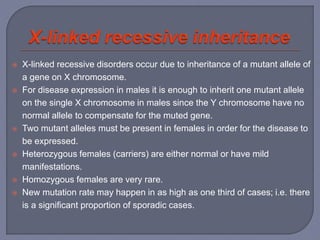
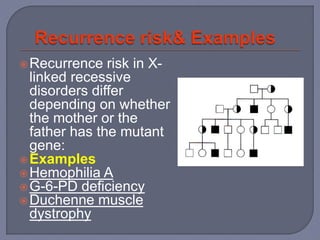
 X-linked recessive disorders occur due to inheritance of a mutant allele of
a gene on X chromosome.
 For disease expression in males it is enough to inherit one mutant allele
on the single X chromosome in males since the Y chromosome have no
normal allele to compensate for the muted gene.
 Two mutant alleles must be present in females in order for the disease to
be expressed.
 Heterozygous females (carriers) are either normal or have mild
manifestations.
 Homozygous females are very rare.
 New mutation rate may happen in as high as one third of cases; i.e. there
is a significant proportion of sporadic cases.
Recurrence risk in X-
linked recessive
disorders differ
depending on whether
the mother or the
father has the mutant
gene:
Examples
Hemophilia A
G-6-PD deficiency
Duchenne muscle
dystrophy
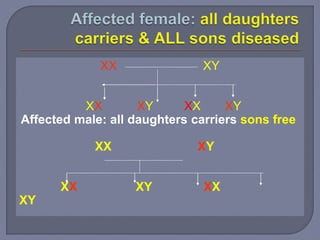
XX XY
XX XY XX XY
Affected male: all daughters carriers sons free
XX XY
XX XY XX
XY
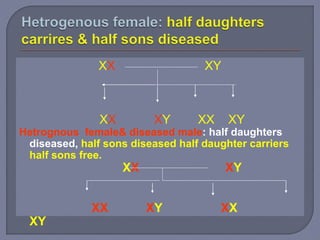
XX XY
XX XY XX XY
Hetrognous female& diseased male: half daughters
diseased, half sons diseased half daughter carriers
half sons free.
XX XY
XX XY XX
XY
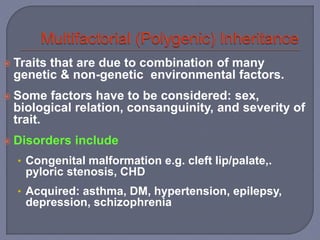
 Traits that are due to combination of many
genetic & non-genetic environmental factors.
 Some factors have to be considered: sex,
biological relation, consanguinity, and severity of
trait.
 Disorders include
• Congenital malformation e.g. cleft lip/palate,.
pyloric stenosis, CHD
• Acquired: asthma, DM, hypertension, epilepsy,
depression, schizophrenia
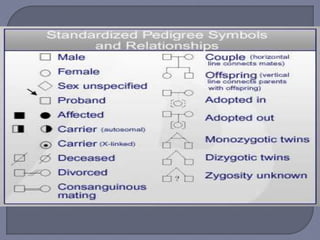
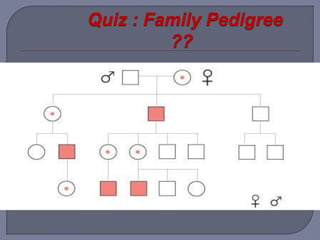
Family Pedigree
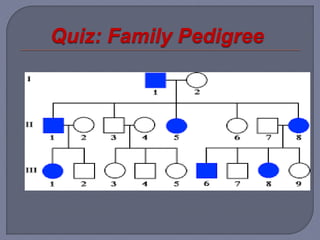
Quiz: Family Pedigree
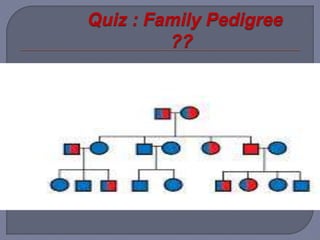
Quiz : Family Pedigree
??
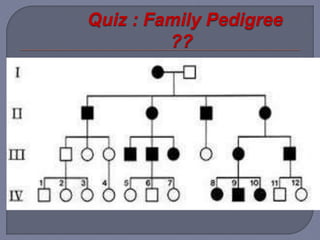
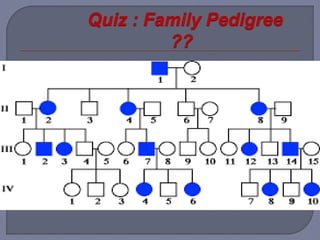
Quiz : Family Pedigree
??
Quiz : Family Pedigree
??
Quiz : Family Pedigree
??
3- human 3 genetics without genetic counseling.ppt

3- human 3 genetics without genetic counseling.ppt

  • 4.
     The etiologyof all human diseases can be attributed to • Genetic factors, • Environmental factors • Mixture of both • The application of Genetics as a science and its new post-modern extensions, the Molecular Genetics and the Molecular Medicine, are critical to all manners of diseases in all stages of life.
  • 5.
     Chromosomes arepresent in all nucleated cells & contain DNA with its hereditary information.  Chromosomes are mostly studied in peripheral blood lymphocytes, but also in any growing tissue including bone marrow, skin fibroblasts or amniotic fluid cells
  • 6.
    DNA is formedof three building blocks; • A pentose sugar (deoxyribose) • Phosphate group • Nitrogenous bases  purines, adenine and guanine;  pyrimidine, thymine and cytosine.
  • 7.
    Every human cellhas 23 pairs of chromosomes. One copy of each chromosome is inherited from each parent. Twenty-two pairs of chromosomes are autosomes; the remaining pair is called the sex chromosomes.
  • 8.
     They allhave a short arm p and long arm q. separated by a primary constriction called the centromere.  The centromere is the location of spindle attachment and is an integral part of the chromosome. It is essential for normal movement and segregation of chromosomes during cell division.
  • 9.
     Genes arethe individual units of heredity for all traits  Typical gene contains a promoter sequence, an untranslated region, and an open reading frame,  In the open reading frame, every three nucleotides represent a single codon, which codes for a particular amino acid.  The complete set of genes of the human cell and the intervening DNA sequences is called the human genome
  • 10.
    Each gene hasa defined function  Structural genes: synthesis of specific polypeptide chains that conduct particular metabolic function (enzymes, hormones, immunoglobulins,….etc.  Regulatory genes: regulate & control functions of structural genes.  Repair genes: keep structural integrity of DNA & repair damage in it.
  • 11.
     Chromosome abnormalitiesusually occur when there is an error in cell division during meiosis or mitosis.  There are many types of chromosome abnormalities.  They can be organized into two basic groups, numerical and structural abnormalities.
  • 12.
    Aneuploidy  When anindividual is missing either a chromosome from a pair (monosomy) or has more than two chromosomes of a pair (trisomy). • Down Syndrome, • Turner Syndrome  Polyploidy:  the number of chromosomes is the multiple of the haploid number (i.e., 23 chromosomes). Usually, this anomaly is incompatible with life.
  • 13.
    When the chromosome's structure isaltered.  Deletions  Duplications  Inversions  Rings  Translocations: • Reciprocal translocation • Robertsonian Isochromosome  Chromosome instability syndromes
  • 15.
    • It isthe term used to describe an individual who has two or more different cell lines derived from a single zygote (fertilized egg). This usually arises during early embryogenesis. • Germ line mosaicism: refers to the presence of mosaicism in germ cells found in gonads. In this case there is an increases risk of recurrence of an affected child.
  • 16.
     Most chromosomeabnormalities occur as an accident and are therefore not inherited.  The abnormality is present in every cell of the body.  Some abnormalities, can happen after conception, resulting in mosaicism  Chromosome abnormalities can be inherited from a parent or be "de novo".
  • 17.
    Mendalian genes canbe inherited in many ways:  Autosomal dominant  Autosomal recessive trait  X-linked recessive traits  X-linked dominant inheritance  Mitochondrial inheritance • Encephalopathy, myopathy • Transmission exclusively through females (by ova)
  • 18.
    Autosomal dominant disordersare those disorders in which a single gene in the heterozygous state is sufficient to cause the phenotype. Autosomal dominant disorders are often caused by mutations in genes coding for a structural protein.
  • 19.
     Mutant geneis inherited from one parent who is affected by the same condition.  The disorder appears in a vertical manner in the pedigree with affected individuals are present in every generation.  Phenotypically normal family members do not transmit the disorder their offspring.  Males and females are equally affected.  Both males and females can pass the abnormal gene to children of either sex.
  • 20.
     Affected individualpasses the mutant gene to 50% of their offspring, (1:2 for each pregnancy).  In cases of fresh mutation the recurrence risk is very low
  • 21.
    Spherocytosis Achondroplasia Tuberous sclerosis Marfan syndrome Myotonicdystrophy Neurofibromatosis I Osteogenesis imperfecta
  • 22.
    Autosomal recessive disordersare those disorders in which two copies of the mutant gene in the homozygous state are necessary to cause the phenotype. Autosomal recessive disorders are caused by mutations that frequently affect genes encoding for enzymes, i.e. result in metabolic disease. New mutation is less common than in autosomal dominant disorders.
  • 23.
     The mutantgene must be inherited from both parents for the phenotype to be expressed.  Both parents of the affected child are asymptomatic heterozygous carriers for the gene.  Inheritance is horizontal; the affected individuals are almost always born in only one generation of the family, i.e. siblings not father or mother is affected.  Males and females are equally affected.  Both males and females can pass the abnormal gene to children of either sex.
  • 24.
     Each childof two heterozygous carrier parents has a 25% chance of being homozygous (i.e. phenotypically affected). Therefore, recurrence risk for siblings (1:4 for each pregnancy).  The prevalence of carriers for certain autosomal recessive disorders • African population: sickle cell anemia (up to 25% of the population) • Northern European: cystic fibrosis (up to 4% of the population) • Mediterranean population: Thalassemia (up to 17% of the population) • Ashkenazi Jews: neurodegenerative disorders Tay Sachs disease (up to 4% of the population)
  • 25.
    •α1-antitrypsin • Cystic fibrosis •Sickle cell disease • Thalassemias • Storage diseases
  • 26.
     X-linked inheritanceoccurs when an individual inherits a mutant gene on X chromosome.  Generally, the severity of disorders inherited as X- linked is greater in males than in females  Affected male pass the disease only to his daughters and not for to his sons.  Affected females pass the disease to both her daughters and sons.
  • 27.
     Manifests inboth heterozygous female & hemizygous male  Affected female: half daughters & half sons  Affected male: all daughters, none of sons  Recurrence risk  The risk of recurrence for the offspring of heterozygous female is 50% regardless of the sex.  The risk of recurrence for the offspring of homozygous female is 100% regardless of the sex.  The risk of recurrence for the offspring of a male is 100% for his daughters and 0% for his sons. Common example • Vitamin D resistant rickets, • Incontinentia pigmenti
  • 28.
    XX XY XX XYXX XY Affected male: all daughters, none of son XX XY XX XY XX XY
  • 29.
     X-linked recessivedisorders occur due to inheritance of a mutant allele of a gene on X chromosome.  For disease expression in males it is enough to inherit one mutant allele on the single X chromosome in males since the Y chromosome have no normal allele to compensate for the muted gene.  Two mutant alleles must be present in females in order for the disease to be expressed.  Heterozygous females (carriers) are either normal or have mild manifestations.  Homozygous females are very rare.  New mutation rate may happen in as high as one third of cases; i.e. there is a significant proportion of sporadic cases.
  • 30.
    Recurrence risk inX- linked recessive disorders differ depending on whether the mother or the father has the mutant gene: Examples Hemophilia A G-6-PD deficiency Duchenne muscle dystrophy
  • 31.
    XX XY XX XYXX XY Affected male: all daughters carriers sons free XX XY XX XY XX XY
  • 32.
    XX XY XX XYXX XY Hetrognous female& diseased male: half daughters diseased, half sons diseased half daughter carriers half sons free. XX XY XX XY XX XY
  • 33.
     Traits thatare due to combination of many genetic & non-genetic environmental factors.  Some factors have to be considered: sex, biological relation, consanguinity, and severity of trait.  Disorders include • Congenital malformation e.g. cleft lip/palate,. pyloric stenosis, CHD • Acquired: asthma, DM, hypertension, epilepsy, depression, schizophrenia
  • 34.
  • 35.
  • 36.
    Quiz : FamilyPedigree ??
  • 37.
    Quiz : FamilyPedigree ??
  • 38.
    Quiz : FamilyPedigree ??
  • 39.
    Quiz : FamilyPedigree ??