Chapter 12 Managerial Decisions for Firms with Market Power
Market Power Ability of a firm to raise price without losing all its sales Any firm that faces downward sloping demand has market power Gives firm ability to raise price above average cost & earn economic profit  (if demand & cost conditions permit) 12-
Monopoly Single firm Produces & sells a good or service for which there are no good substitutes New firms are prevented from entering market because of a barrier to entry 12-
Measurement of Market Power Degree of market power inversely related to price elasticity of demand The less elastic the firm’s demand, the greater its degree of market power The fewer close substitutes for a firm’s product, the smaller the elasticity of demand (in absolute value) & the greater the firm’s market power When demand is perfectly elastic (demand is horizontal), the firm has no market power 12-
Measurement of Market Power Lerner index measures proportionate amount by which price exceeds marginal cost: 12-
Measurement of Market Power Lerner index Equals zero under perfect competition Increases as market power increases Also equals  –1/E , which shows that the index (& market power), vary inversely with elasticity The lower the elasticity of demand (absolute value), the greater the index & the degree of market power 12-
Measurement of Market Power If consumers view two goods as substitutes, cross-price elasticity of demand  (E XY )  is positive The higher the positive cross-price elasticity, the greater the substitutability between two goods, & the smaller the degree of market power for the two firms 12-
Determinants of Market Power Entry of new firms into a market erodes market power of existing firms by increasing the number of substitutes A firm can possess a high degree of market power only when  strong barriers to entry  exist Conditions that make it difficult for new firms to enter a market in which economic profits are being earned 12-
Common Entry Barriers Economies of scale When long-run average cost declines over a wide range of output relative to demand for the product, there may not be room for another large producer to enter market Barriers created by government Licenses, exclusive franchises 12-
Common Entry Barriers Input barriers One firm controls a crucial input in the production process Brand loyalties Strong customer allegiance to existing firms may keep new firms from finding enough buyers to make entry worthwhile 12-
Common Entry Barriers Consumer lock-in Potential entrants can be deterred if they believe high switching costs will keep them from inducing many consumers to change brands Network externalities Occur when value of a product increases as more consumers buy & use it Make it difficult for new firms to enter markets where firms have established a large network of buyers 12-
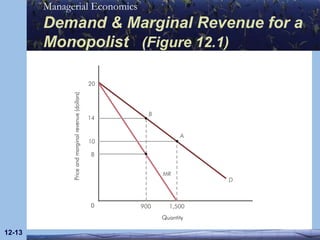
Demand & Marginal Revenue for a Monopolist Market demand curve is the firm’s demand curve Monopolist must lower price to sell additional units of output Marginal revenue is less than price for all but the first unit sold When  MR  is positive (negative), demand is elastic (inelastic) For linear demand,  MR  is also linear, has the same vertical intercept as demand, & is twice as steep 12-
Demand & Marginal Revenue for a Monopolist  (Figure 12.1) 12-
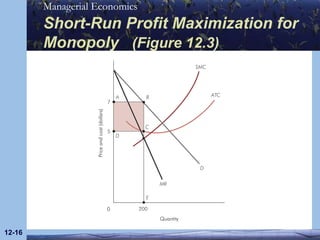
Short-Run Profit Maximization for Monopoly Monopolist will produce a positive output if some price on the demand curve exceeds average variable cost Profit maximization or loss minimization occurs by producing quantity for which  MR = MC 12-
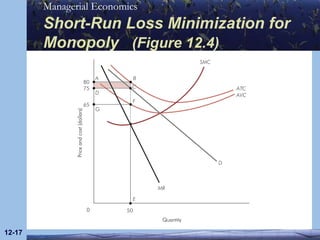
Short-Run Profit Maximization for Monopoly If  P  >  ATC , firm makes economic profit If  ATC  >  P  >  AVC , firm incurs loss, but continues to produce in short run If demand falls below AVC at every level of output, firm shuts down & loses only fixed costs 12-
Short-Run Profit Maximization for Monopoly  (Figure 12.3) 12-
Short-Run Loss Minimization for Monopoly  (Figure 12.4) 12-
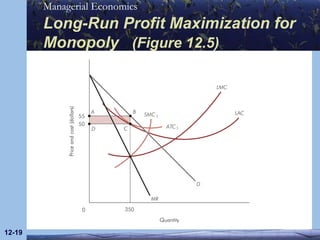
Long-Run Profit Maximization for Monopoly Monopolist maximizes profit by choosing to produce output where  MR = LMC , as long as  P    LAC Will exit industry if  P  <  LAC Monopolist will adjust plant size to the optimal level Optimal plant is where the short-run average cost curve is tangent to the long-run average cost at the profit-maximizing output level 12-
Long-Run Profit Maximization for Monopoly  (Figure 12.5) 12-
Profit-Maximizing Input Usage Profit-maximizing level of  input  usage produces exactly that level of  output  that maximizes profit 12-
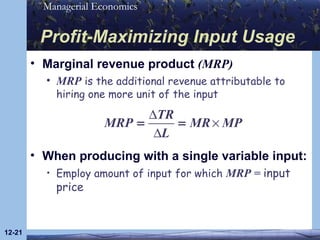
Profit-Maximizing Input Usage Marginal revenue product  (MRP) MRP  is the additional revenue attributable to hiring one more unit of the input 12- When producing with a single variable input: Employ amount of input for which  MRP =  input price
Profit-Maximizing Input Usage For a firm with market power, profit-maximizing conditions  MRP = w  and  MR = MC  are equivalent Whether Q or L is chosen to maximize profit, resulting levels of input usage, output, price, & profit are the same 12-
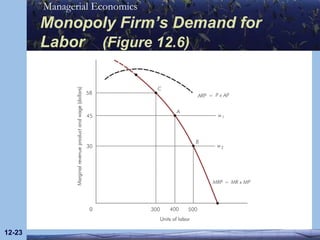
Monopoly Firm’s Demand for Labor  (Figure 12.6) 12-
Profit-Maximizing Input Usage For a firm with market power, profit-maximizing conditions  MRP = w  and  MR = MC  are equivalent Whether Q or L is chosen to maximize profit, resulting levels of input usage, output, price, & profit are the same 12-
Monopolistic Competition Large number of firms sell a differentiated product Products are close (not perfect) substitutes Market is monopolistic Product differentiation creates a degree of market power Market is competitive Large number of firms, easy entry 12-
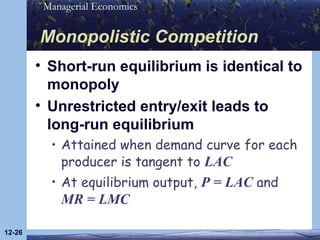
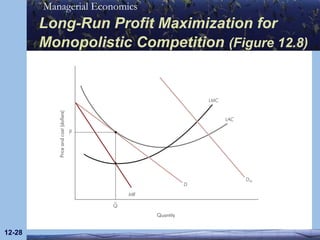
Monopolistic Competition Short-run equilibrium is identical to monopoly Unrestricted entry/exit leads to long-run equilibrium Attained when demand curve for each producer is tangent to  LAC At equilibrium output,  P = LAC  and  MR = LMC 12-
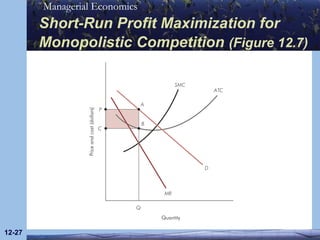
Short-Run Profit Maximization for Monopolistic Competition   (Figure 12.7) 12-
Long-Run Profit Maximization for Monopolistic Competition   (Figure 12.8) 12-

Chapter12 fi 2010

  • 1.
    Chapter 12 ManagerialDecisions for Firms with Market Power
  • 2.
    Market Power Abilityof a firm to raise price without losing all its sales Any firm that faces downward sloping demand has market power Gives firm ability to raise price above average cost & earn economic profit (if demand & cost conditions permit) 12-
  • 3.
    Monopoly Single firmProduces & sells a good or service for which there are no good substitutes New firms are prevented from entering market because of a barrier to entry 12-
  • 4.
    Measurement of MarketPower Degree of market power inversely related to price elasticity of demand The less elastic the firm’s demand, the greater its degree of market power The fewer close substitutes for a firm’s product, the smaller the elasticity of demand (in absolute value) & the greater the firm’s market power When demand is perfectly elastic (demand is horizontal), the firm has no market power 12-
  • 5.
    Measurement of MarketPower Lerner index measures proportionate amount by which price exceeds marginal cost: 12-
  • 6.
    Measurement of MarketPower Lerner index Equals zero under perfect competition Increases as market power increases Also equals –1/E , which shows that the index (& market power), vary inversely with elasticity The lower the elasticity of demand (absolute value), the greater the index & the degree of market power 12-
  • 7.
    Measurement of MarketPower If consumers view two goods as substitutes, cross-price elasticity of demand (E XY ) is positive The higher the positive cross-price elasticity, the greater the substitutability between two goods, & the smaller the degree of market power for the two firms 12-
  • 8.
    Determinants of MarketPower Entry of new firms into a market erodes market power of existing firms by increasing the number of substitutes A firm can possess a high degree of market power only when strong barriers to entry exist Conditions that make it difficult for new firms to enter a market in which economic profits are being earned 12-
  • 9.
    Common Entry BarriersEconomies of scale When long-run average cost declines over a wide range of output relative to demand for the product, there may not be room for another large producer to enter market Barriers created by government Licenses, exclusive franchises 12-
  • 10.
    Common Entry BarriersInput barriers One firm controls a crucial input in the production process Brand loyalties Strong customer allegiance to existing firms may keep new firms from finding enough buyers to make entry worthwhile 12-
  • 11.
    Common Entry BarriersConsumer lock-in Potential entrants can be deterred if they believe high switching costs will keep them from inducing many consumers to change brands Network externalities Occur when value of a product increases as more consumers buy & use it Make it difficult for new firms to enter markets where firms have established a large network of buyers 12-
  • 12.
    Demand & MarginalRevenue for a Monopolist Market demand curve is the firm’s demand curve Monopolist must lower price to sell additional units of output Marginal revenue is less than price for all but the first unit sold When MR is positive (negative), demand is elastic (inelastic) For linear demand, MR is also linear, has the same vertical intercept as demand, & is twice as steep 12-
  • 13.
    Demand & MarginalRevenue for a Monopolist (Figure 12.1) 12-
  • 14.
    Short-Run Profit Maximizationfor Monopoly Monopolist will produce a positive output if some price on the demand curve exceeds average variable cost Profit maximization or loss minimization occurs by producing quantity for which MR = MC 12-
  • 15.
    Short-Run Profit Maximizationfor Monopoly If P > ATC , firm makes economic profit If ATC > P > AVC , firm incurs loss, but continues to produce in short run If demand falls below AVC at every level of output, firm shuts down & loses only fixed costs 12-
  • 16.
    Short-Run Profit Maximizationfor Monopoly (Figure 12.3) 12-
  • 17.
    Short-Run Loss Minimizationfor Monopoly (Figure 12.4) 12-
  • 18.
    Long-Run Profit Maximizationfor Monopoly Monopolist maximizes profit by choosing to produce output where MR = LMC , as long as P  LAC Will exit industry if P < LAC Monopolist will adjust plant size to the optimal level Optimal plant is where the short-run average cost curve is tangent to the long-run average cost at the profit-maximizing output level 12-
  • 19.
    Long-Run Profit Maximizationfor Monopoly (Figure 12.5) 12-
  • 20.
    Profit-Maximizing Input UsageProfit-maximizing level of input usage produces exactly that level of output that maximizes profit 12-
  • 21.
    Profit-Maximizing Input UsageMarginal revenue product (MRP) MRP is the additional revenue attributable to hiring one more unit of the input 12- When producing with a single variable input: Employ amount of input for which MRP = input price
  • 22.
    Profit-Maximizing Input UsageFor a firm with market power, profit-maximizing conditions MRP = w and MR = MC are equivalent Whether Q or L is chosen to maximize profit, resulting levels of input usage, output, price, & profit are the same 12-
  • 23.
    Monopoly Firm’s Demandfor Labor (Figure 12.6) 12-
  • 24.
    Profit-Maximizing Input UsageFor a firm with market power, profit-maximizing conditions MRP = w and MR = MC are equivalent Whether Q or L is chosen to maximize profit, resulting levels of input usage, output, price, & profit are the same 12-
  • 25.
    Monopolistic Competition Largenumber of firms sell a differentiated product Products are close (not perfect) substitutes Market is monopolistic Product differentiation creates a degree of market power Market is competitive Large number of firms, easy entry 12-
  • 26.
    Monopolistic Competition Short-runequilibrium is identical to monopoly Unrestricted entry/exit leads to long-run equilibrium Attained when demand curve for each producer is tangent to LAC At equilibrium output, P = LAC and MR = LMC 12-
  • 27.
    Short-Run Profit Maximizationfor Monopolistic Competition (Figure 12.7) 12-
  • 28.
    Long-Run Profit Maximizationfor Monopolistic Competition (Figure 12.8) 12-