

Chapter 13 Strategic Decision Making in Oligopoly Markets
Oligopoly Markets Interdependence of firms’ profits Distinguishing feature of oligopoly Arises when number of firms in market is small enough that every firms’ price & output decisions affect demand & marginal revenue conditions of every other firm in market 13-
Strategic Decisions Strategic behavior Actions taken by firms to plan for & react to competition from rival firms Game theory Useful guidelines on behavior for strategic situations involving interdependence 13-
Simultaneous Decisions Occur when managers must make individual decisions without knowing their rivals’ decisions 13-
Dominant Strategies Always provide best outcome no matter what decisions rivals make When one exists, the rational decision maker always follows its dominant strategy Predict rivals will follow their dominant strategies, if they exist Dominant strategy equilibrium Exists when   when all decision makers have dominant strategies 13-
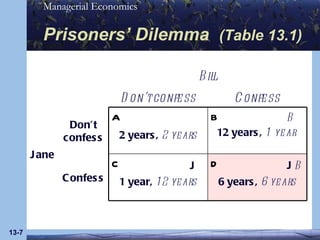
Prisoners’ Dilemma All rivals have dominant strategies In dominant strategy equilibrium, all are worse off than if they had cooperated in making their decisions 13-
Prisoners’ Dilemma  (Table 13.1) 13- J J B B Bill Don’t confess Confess Jane Don’t confess A 2 years,  2 years B 12 years,  1 year Confess C 1 year,  12 years D 6 years,  6 years
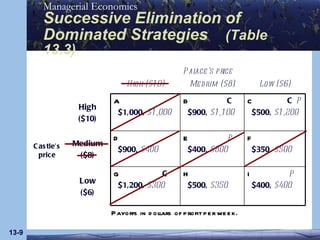
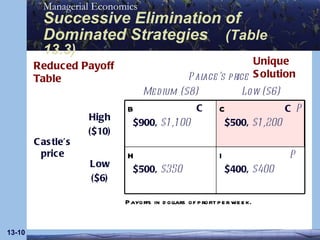
Dominated Strategies Never the best strategy, so never would be chosen & should be eliminated Successive elimination of dominated strategies should continue until none remain Search for dominant strategies first, then dominated strategies When neither form of strategic dominance exists, employ a different concept for making simultaneous decisions 13-
Successive Elimination of Dominated Strategies   (Table 13.3) 13- C P Payoffs in dollars of profit per week. C C P P Palace’s price High ($10) Medium ($8) Low ($6) Castle’s   price High ($10) A $1,000,  $1,000 B $900,  $1,100 C $500,  $1,200 Medium ($8) D $900,  $400 E $400,  $800 F $350,  $500 Low ($6) G $1,200,  $300 H $500,  $350 I $400,  $400
Successive Elimination of Dominated Strategies   (Table 13.3) 13- C P P C Reduced Payoff Table Payoffs in dollars of profit per week. Palace’s price Medium ($8) Low ($6) Castle’s price High ($10) B $900,  $1,100 C $500,  $1,200 Low ($6) H $500,  $350 I $400,  $400 Unique Solution
Making Mutually Best Decisions For all firms in an oligopoly to be predicting correctly each others’ decisions: All firms must be choosing individually best actions given the predicted actions of their rivals, which they can then believe are correctly predicted Strategically astute managers look for  mutually best decisions 13-
Nash Equilibrium Set of actions or decisions for which all managers are choosing their best actions given the actions they expect their rivals to choose Strategic stability No single firm can unilaterally make a different decision & do better 13-
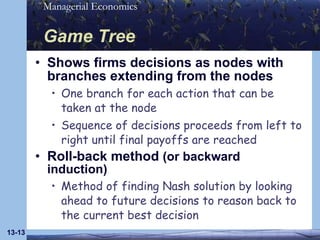
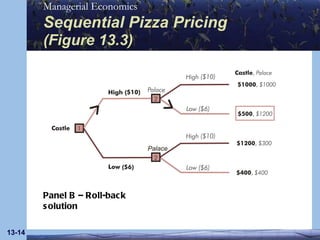
Game Tree Shows firms decisions as nodes with branches extending from the nodes One branch for each action that can be taken at the node Sequence of decisions proceeds from left to right until final payoffs are reached Roll-back method  (or backward induction) Method of finding Nash solution by looking ahead to future decisions to reason back to the current best decision 13-
Sequential Pizza Pricing   (Figure 13.3) 13- Panel B – Roll-back solution
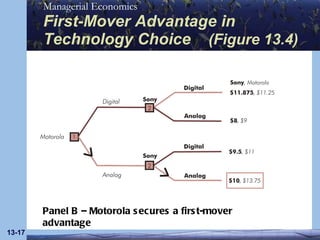
First-Mover & Second-Mover Advantages First-mover advantage If letting rivals know what you are doing by going first in a sequential decision increases your payoff Second-mover advantage If reacting to a decision already made by a rival increases your payoff 13-
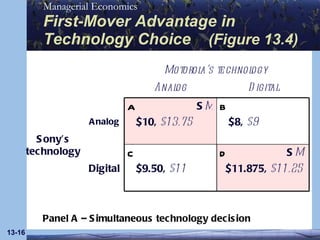
First-Mover Advantage in Technology Choice  (Figure 13.4) 13- Panel A – Simultaneous technology decision S S M M Motorola’s technology Analog Digital Sony’s technology Analog A $10,  $13.75 B $8,  $9 Digital C $9.50,  $11 D $11.875,  $11.25
First-Mover Advantage in Technology Choice  (Figure 13.4) 13- Panel B – Motorola secures a first-mover advantage
Cooperation in Repeated Strategic Decisions Cooperation occurs when oligopoly firms make individual decisions that make every firm better off than they would be in a (noncooperative) Nash equilibrium 13-
Cheating Making noncooperative decisions Does not imply that firms have made any agreement to cooperate One-time prisoners’ dilemmas Cooperation is not strategically stable No future consequences from cheating, so both firms  expect  the other to cheat Cheating is best response for each 13-
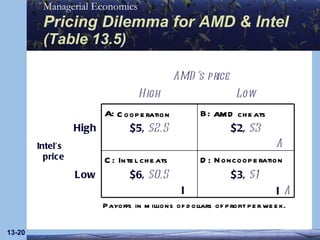
Pricing Dilemma for AMD & Intel  (Table 13.5) 13- I I A A Payoffs in millions of dollars of profit per week. Cooperation Noncooperation AMD’s price High Low Intel’s  price High A: $5,  $2.5 B: $2,  $3 Low C: $6,  $0.5 D: $3,  $1 AMD cheats Intel cheats
Cartels Most extreme form of cooperative oligopoly Explicit collusive agreement to drive up prices by restricting total market output Illegal in U.S., Canada, Mexico, Germany, & European Union 13-
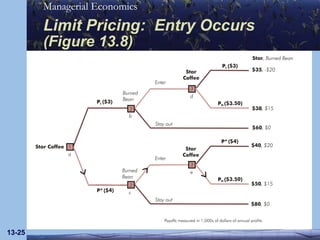
Strategic Entry Deterrence Established firm(s) makes strategic moves designed to discourage or prevent entry of new firm(s) into a market Two types of strategic moves Limit pricing Capacity expansion 13-
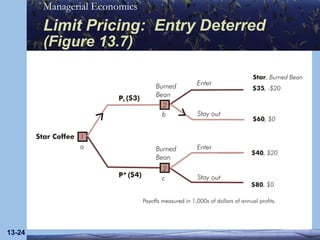
Limit Pricing Established firm(s) commits to setting price below profit-maximizing level to prevent entry Under certain circumstances, an oligopolist (or monopolist), may make a credible commitment to charge a lower price forever 13-
Limit Pricing:  Entry Deterred   (Figure 13.7) 13-
Limit Pricing:  Entry Occurs   (Figure 13.8) 13-
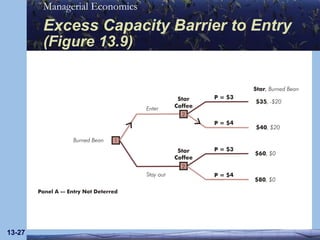
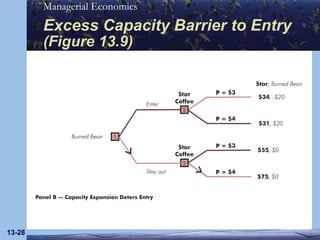
Capacity Expansion Established firm(s) can make the threat of a price cut credible by irreversibly increasing plant capacity When increasing capacity results in lower marginal costs of production, the established firm’s best response to entry of a new firm may be to increase its own level of production Requires established firm to cut its price to sell extra output 13-
Excess Capacity Barrier to Entry   (Figure 13.9) 13-

Chapter 13 fa1_2010

  • 1.
    Chapter 13 StrategicDecision Making in Oligopoly Markets
  • 2.
    Oligopoly Markets Interdependenceof firms’ profits Distinguishing feature of oligopoly Arises when number of firms in market is small enough that every firms’ price & output decisions affect demand & marginal revenue conditions of every other firm in market 13-
  • 3.
    Strategic Decisions Strategicbehavior Actions taken by firms to plan for & react to competition from rival firms Game theory Useful guidelines on behavior for strategic situations involving interdependence 13-
  • 4.
    Simultaneous Decisions Occurwhen managers must make individual decisions without knowing their rivals’ decisions 13-
  • 5.
    Dominant Strategies Alwaysprovide best outcome no matter what decisions rivals make When one exists, the rational decision maker always follows its dominant strategy Predict rivals will follow their dominant strategies, if they exist Dominant strategy equilibrium Exists when when all decision makers have dominant strategies 13-
  • 6.
    Prisoners’ Dilemma Allrivals have dominant strategies In dominant strategy equilibrium, all are worse off than if they had cooperated in making their decisions 13-
  • 7.
    Prisoners’ Dilemma (Table 13.1) 13- J J B B Bill Don’t confess Confess Jane Don’t confess A 2 years, 2 years B 12 years, 1 year Confess C 1 year, 12 years D 6 years, 6 years
  • 8.
    Dominated Strategies Neverthe best strategy, so never would be chosen & should be eliminated Successive elimination of dominated strategies should continue until none remain Search for dominant strategies first, then dominated strategies When neither form of strategic dominance exists, employ a different concept for making simultaneous decisions 13-
  • 9.
    Successive Elimination ofDominated Strategies (Table 13.3) 13- C P Payoffs in dollars of profit per week. C C P P Palace’s price High ($10) Medium ($8) Low ($6) Castle’s price High ($10) A $1,000, $1,000 B $900, $1,100 C $500, $1,200 Medium ($8) D $900, $400 E $400, $800 F $350, $500 Low ($6) G $1,200, $300 H $500, $350 I $400, $400
  • 10.
    Successive Elimination ofDominated Strategies (Table 13.3) 13- C P P C Reduced Payoff Table Payoffs in dollars of profit per week. Palace’s price Medium ($8) Low ($6) Castle’s price High ($10) B $900, $1,100 C $500, $1,200 Low ($6) H $500, $350 I $400, $400 Unique Solution
  • 11.
    Making Mutually BestDecisions For all firms in an oligopoly to be predicting correctly each others’ decisions: All firms must be choosing individually best actions given the predicted actions of their rivals, which they can then believe are correctly predicted Strategically astute managers look for mutually best decisions 13-
  • 12.
    Nash Equilibrium Setof actions or decisions for which all managers are choosing their best actions given the actions they expect their rivals to choose Strategic stability No single firm can unilaterally make a different decision & do better 13-
  • 13.
    Game Tree Showsfirms decisions as nodes with branches extending from the nodes One branch for each action that can be taken at the node Sequence of decisions proceeds from left to right until final payoffs are reached Roll-back method (or backward induction) Method of finding Nash solution by looking ahead to future decisions to reason back to the current best decision 13-
  • 14.
    Sequential Pizza Pricing (Figure 13.3) 13- Panel B – Roll-back solution
  • 15.
    First-Mover & Second-MoverAdvantages First-mover advantage If letting rivals know what you are doing by going first in a sequential decision increases your payoff Second-mover advantage If reacting to a decision already made by a rival increases your payoff 13-
  • 16.
    First-Mover Advantage inTechnology Choice (Figure 13.4) 13- Panel A – Simultaneous technology decision S S M M Motorola’s technology Analog Digital Sony’s technology Analog A $10, $13.75 B $8, $9 Digital C $9.50, $11 D $11.875, $11.25
  • 17.
    First-Mover Advantage inTechnology Choice (Figure 13.4) 13- Panel B – Motorola secures a first-mover advantage
  • 18.
    Cooperation in RepeatedStrategic Decisions Cooperation occurs when oligopoly firms make individual decisions that make every firm better off than they would be in a (noncooperative) Nash equilibrium 13-
  • 19.
    Cheating Making noncooperativedecisions Does not imply that firms have made any agreement to cooperate One-time prisoners’ dilemmas Cooperation is not strategically stable No future consequences from cheating, so both firms expect the other to cheat Cheating is best response for each 13-
  • 20.
    Pricing Dilemma forAMD & Intel (Table 13.5) 13- I I A A Payoffs in millions of dollars of profit per week. Cooperation Noncooperation AMD’s price High Low Intel’s price High A: $5, $2.5 B: $2, $3 Low C: $6, $0.5 D: $3, $1 AMD cheats Intel cheats
  • 21.
    Cartels Most extremeform of cooperative oligopoly Explicit collusive agreement to drive up prices by restricting total market output Illegal in U.S., Canada, Mexico, Germany, & European Union 13-
  • 22.
    Strategic Entry DeterrenceEstablished firm(s) makes strategic moves designed to discourage or prevent entry of new firm(s) into a market Two types of strategic moves Limit pricing Capacity expansion 13-
  • 23.
    Limit Pricing Establishedfirm(s) commits to setting price below profit-maximizing level to prevent entry Under certain circumstances, an oligopolist (or monopolist), may make a credible commitment to charge a lower price forever 13-
  • 24.
    Limit Pricing: Entry Deterred (Figure 13.7) 13-
  • 25.
    Limit Pricing: Entry Occurs (Figure 13.8) 13-
  • 26.
    Capacity Expansion Establishedfirm(s) can make the threat of a price cut credible by irreversibly increasing plant capacity When increasing capacity results in lower marginal costs of production, the established firm’s best response to entry of a new firm may be to increase its own level of production Requires established firm to cut its price to sell extra output 13-
  • 27.
    Excess Capacity Barrierto Entry (Figure 13.9) 13-
  • 28.
    Excess Capacity Barrierto Entry (Figure 13.9) 13-