Chapter 16Government Regulation of Business
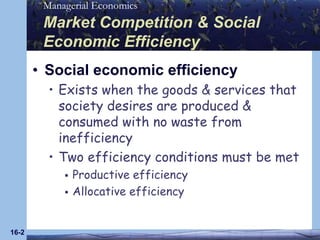
16-2Market Competition & Social Economic EfficiencySocial economic efficiencyExists when the goods & services that society desires are produced & consumed with no waste from inefficiencyTwo efficiency conditions must be metProductive efficiencyAllocative efficiency
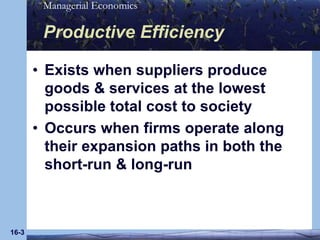
16-3Productive EfficiencyExists when suppliers produce goods & services at the lowest possible total cost to societyOccurs when firms operate along their expansion paths in both the short-run & long-run
16-4Allocative EfficiencyRequires businesses to supply optimal amounts of all goods & services demanded by societyAnd these units must be rationed to individuals who place the highest value on consuming themOptimal level of output is reached when the MB of another unit to consumers just equals the MC to society of producing another unitWhere P = MC  (marginal-cost-pricing)
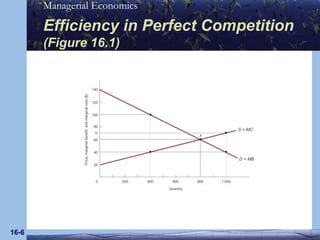
16-5Social Economic EfficiencyAchieved by markets in perfectly competitive equilibriumAt the intersection of demand & supply, conditions for productive & allocative efficiency are metAt the market-clearing price, buyers & sellers engage in voluntary exchange that maximizes social surplus
16-6Efficiency in Perfect Competition   (Figure 16.1)
16-7Market Failure & the Case for Government InterventionCompetitive markets can achieve social economic efficiency without government regulationBut, not all markets are competitive, and even competitive markets can sometimes fail to achieve maximum social surplusMarket failureWhen a market fails to achieve social economic efficiency and, consequently, fails to maximize social surplus
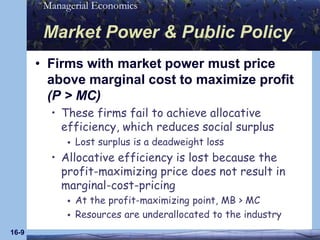
16-8Market Failure & the Case for Government InterventionSix forms of market failure can undermine economic efficiency:Monopoly powerNatural monopolyNegative (& positive) externalitiesCommon property resourcesPublic goodsInformation problems
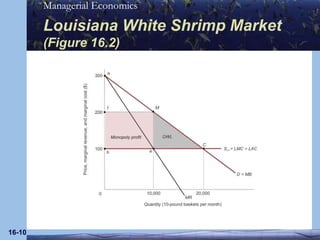
16-9Market Power & Public PolicyFirms with market power must price above marginal cost to maximize profit (P > MC)These firms fail to achieve allocative efficiency, which reduces social surplusLost surplus is a deadweight lossAllocative efficiency is lost because the profit-maximizing price does not result in marginal-cost-pricingAt the profit-maximizing point, MB > MCResources are underallocated to the industry
16-10Louisiana White Shrimp Market   (Figure 16.2)
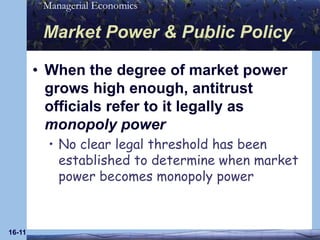
16-11Market Power & Public PolicyWhen the degree of market power grows high enough, antitrust officials refer to it legally as monopoly powerNo clear legal threshold has been established to determine when market power becomes monopoly power
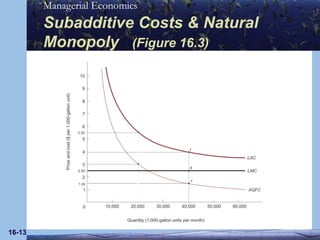
16-12Natural Monopoly & Market Failure Natural monopolyWhen a single firm can produce total consumer demand for a good or service at a lower long-run total cost than if two or more firms produce total industry outputLong-run costs are subadditive
16-13Subadditive Costs & Natural Monopoly   (Figure 16.3)
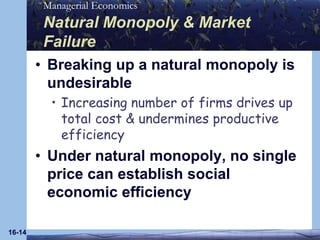
16-14Natural Monopoly & Market FailureBreaking up a natural monopoly is undesirableIncreasing number of firms drives up total cost & undermines productive efficiency Under natural monopoly, no single price can establish social economic efficiency
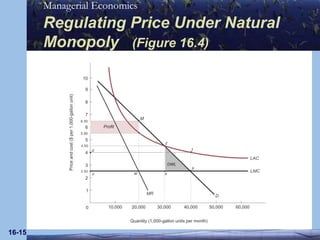
16-15Regulating Price Under Natural Monopoly   (Figure 16.4)
16-16Natural Monopoly & Market FailureWith economies of scale, marginal-cost-pricing results in a regulated natural monopoly earning negative economic profit Two-part pricing is a solution that can meet both efficiency conditions & maximize social surplus
16-17The Problem of Negative ExternalityExternalitiesWhen actions taken by market participants create either benefits or costs that spill over to other members of society Positive externalities occur when spillover effects are beneficial to societyNegative externalities occur when spillover effects are costly to society
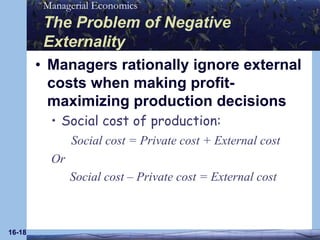
16-18The Problem of Negative ExternalityManagers rationally ignore external costs when making profit-maximizing production decisions Social cost of production:Social cost = Private cost + External costOr      Social cost – Private cost = External cost
16-19NonexcludabilityTwo kinds of market failure caused by nonexcludability:Common property resourcesPublic goods
16-20Common Property ResourcesResources for which property rights are absent or poorly definedNo one can effectively be excluded from such resourcesWithout government intervention, these resources are generally overexploited & undersupplied
16-21Public GoodsA public good is nonexcludable & nondepletableThe inability to exclude nonpayers creates a free-rider problem for the private provision of public goods
16-22Information & Market FailureMarket failure may also occur because consumers lack perfect knowledgePerfect knowledge includes knowledge about product prices, qualities, and any hazardsMarket power can emerge because of imperfectly informed consumers
16-23Information & Market FailureConsumers may over- or under-estimate quality of goods & servicesIf they over-value quality, they will demand too much product relative to the allocatively efficient amountIf they under-value quality, they will demand too little

Chapter 16 fi_2010

  • 1.
  • 2.
    16-2Market Competition &Social Economic EfficiencySocial economic efficiencyExists when the goods & services that society desires are produced & consumed with no waste from inefficiencyTwo efficiency conditions must be metProductive efficiencyAllocative efficiency
  • 3.
    16-3Productive EfficiencyExists whensuppliers produce goods & services at the lowest possible total cost to societyOccurs when firms operate along their expansion paths in both the short-run & long-run
  • 4.
    16-4Allocative EfficiencyRequires businessesto supply optimal amounts of all goods & services demanded by societyAnd these units must be rationed to individuals who place the highest value on consuming themOptimal level of output is reached when the MB of another unit to consumers just equals the MC to society of producing another unitWhere P = MC (marginal-cost-pricing)
  • 5.
    16-5Social Economic EfficiencyAchievedby markets in perfectly competitive equilibriumAt the intersection of demand & supply, conditions for productive & allocative efficiency are metAt the market-clearing price, buyers & sellers engage in voluntary exchange that maximizes social surplus
  • 6.
    16-6Efficiency in PerfectCompetition (Figure 16.1)
  • 7.
    16-7Market Failure &the Case for Government InterventionCompetitive markets can achieve social economic efficiency without government regulationBut, not all markets are competitive, and even competitive markets can sometimes fail to achieve maximum social surplusMarket failureWhen a market fails to achieve social economic efficiency and, consequently, fails to maximize social surplus
  • 8.
    16-8Market Failure &the Case for Government InterventionSix forms of market failure can undermine economic efficiency:Monopoly powerNatural monopolyNegative (& positive) externalitiesCommon property resourcesPublic goodsInformation problems
  • 9.
    16-9Market Power &Public PolicyFirms with market power must price above marginal cost to maximize profit (P > MC)These firms fail to achieve allocative efficiency, which reduces social surplusLost surplus is a deadweight lossAllocative efficiency is lost because the profit-maximizing price does not result in marginal-cost-pricingAt the profit-maximizing point, MB > MCResources are underallocated to the industry
  • 10.
    16-10Louisiana White ShrimpMarket (Figure 16.2)
  • 11.
    16-11Market Power &Public PolicyWhen the degree of market power grows high enough, antitrust officials refer to it legally as monopoly powerNo clear legal threshold has been established to determine when market power becomes monopoly power
  • 12.
    16-12Natural Monopoly &Market Failure Natural monopolyWhen a single firm can produce total consumer demand for a good or service at a lower long-run total cost than if two or more firms produce total industry outputLong-run costs are subadditive
  • 13.
    16-13Subadditive Costs &Natural Monopoly (Figure 16.3)
  • 14.
    16-14Natural Monopoly &Market FailureBreaking up a natural monopoly is undesirableIncreasing number of firms drives up total cost & undermines productive efficiency Under natural monopoly, no single price can establish social economic efficiency
  • 15.
    16-15Regulating Price UnderNatural Monopoly (Figure 16.4)
  • 16.
    16-16Natural Monopoly &Market FailureWith economies of scale, marginal-cost-pricing results in a regulated natural monopoly earning negative economic profit Two-part pricing is a solution that can meet both efficiency conditions & maximize social surplus
  • 17.
    16-17The Problem ofNegative ExternalityExternalitiesWhen actions taken by market participants create either benefits or costs that spill over to other members of society Positive externalities occur when spillover effects are beneficial to societyNegative externalities occur when spillover effects are costly to society
  • 18.
    16-18The Problem ofNegative ExternalityManagers rationally ignore external costs when making profit-maximizing production decisions Social cost of production:Social cost = Private cost + External costOr Social cost – Private cost = External cost
  • 19.
    16-19NonexcludabilityTwo kinds ofmarket failure caused by nonexcludability:Common property resourcesPublic goods
  • 20.
    16-20Common Property ResourcesResourcesfor which property rights are absent or poorly definedNo one can effectively be excluded from such resourcesWithout government intervention, these resources are generally overexploited & undersupplied
  • 21.
    16-21Public GoodsA publicgood is nonexcludable & nondepletableThe inability to exclude nonpayers creates a free-rider problem for the private provision of public goods
  • 22.
    16-22Information & MarketFailureMarket failure may also occur because consumers lack perfect knowledgePerfect knowledge includes knowledge about product prices, qualities, and any hazardsMarket power can emerge because of imperfectly informed consumers
  • 23.
    16-23Information & MarketFailureConsumers may over- or under-estimate quality of goods & servicesIf they over-value quality, they will demand too much product relative to the allocatively efficient amountIf they under-value quality, they will demand too little