EST 200 DESIGN A N D ENGINEERING:
M O D U L E 2
Module 2
2
Introduction to Design Thinking
Some of the world’s leading brands, such a s Apple,
Google, S a m s u n g and GE, have rapidly adopted the
design thinking approach. What’s more, design
thinking is being taught at leading universities
around the world.
But what is design thinking?
3
Introduction to Design Thinking
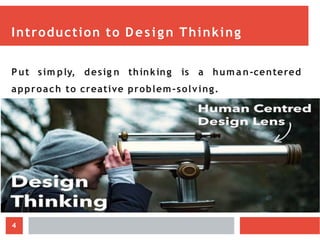
Put sim ply, desig n thinking is a hum a n-centered
approach to creative problem-solving.
4
Introduction to Design Thinking
Formally defined as:
Design thinking is an iterative process in which we
seek to understand the user, challenge assumptions,
and redefine problems in an attempt to identify
alternative strategies and solutions that might not
be instantly apparent with our initial level of
understanding.
5
Introduction to Design Thinking
Design Thinking: Wh y is it important?
Good desig n is characterized by buttery
user experience.
s m ooth
By thinking from the needs of the user, a design
thinking approach helps designers bridge the g a p
between something that just works and something
that solves a problem.
6
Introduction to Design Thinking
Design Thinking: W hy is it important?
The ‘Norman Door’ phenomenon might just be the best
illustration of why design thinking and a human-centred
approach are important.
‘Norman Door’ is a figurative term for any product that is
cumbersome to use and wa s designed poorly. A Norman
Door has a handle that you can grab, so you think that
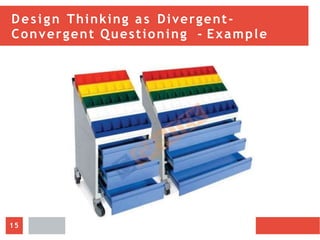
you need to pull it. But when you pull you realize it’s
actually a push.
7
Introduction to Design Thinking
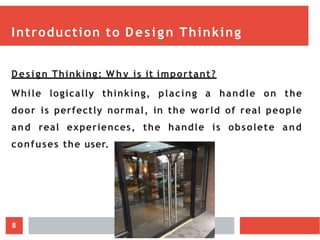
Design Thinking: Wh y is it important?
While logically thinking, placing a handle on the
door is perfectly normal, in the world of real people
and real experiences, the handle is obsolete and
confuses the user.
8
Introduction to Design Thinking
Design thinking revolves around a deep interest in
developing an understanding of the people for whom
we’re designing the products or services. It helps us
observe and develop empathy with the target user.
Design thinking helps us in the process of
questioning: questioning the problem, questioning
the assumptions, and questioning the implications.
9
Introduction to Design Thinking
D esign thinking is extremely us eful in tackling
problems that are ill defined
framing the problem in human-centric
or unknown, by re-
ways,
creating m a ny idea s in brains torm ing sessions , and
adopting a hands-onapproach in prototyping and
ong oing
testing ,
testing. Design thinking also involves
experimentation: sketching , prototyping ,
and trying out concepts and ideas.
10
Introduction to Design Thinking
The 3 pillars of design thinking are:
1. Empathy
2. Ideation
3. Experimentation
11
Introduction to Design Thinking
Pillars of design thinking
1. Empathy
Empathy is the foundation of design thinking. Unless
you get into the wants and needs of people you are
designing for, what you’re doing can’t be considered
design thinking.
12
Introduction to Design Thinking
Pillars of design thinking
2. Ideation
Ideation is the core of
desig n thinking process.
creative activitie s in the
S im ply put, it is when
m ultiple idea s are pitted a g ainst each other
, where
creativity is unleashed and innovation happens.
13
Introduction to Design Thinking
Pillars of design thinking
3. Experimentation
Are your assumptions correct? Did you hit the right
spot with your product? What are users thinking
about it? Don’t just guess – test it!
14
Design Thinking Phases
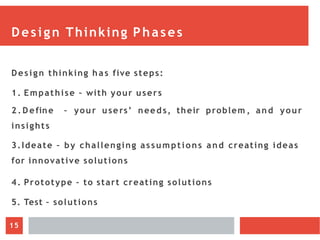
Design thinking has five steps:
1. Empathise – with your users
2 . D efine – your use rs’ nee d s, their problem , an d your
insights
3.Ideate – by challenging assumptions and creating ideas
for innovative solutions
4. Prototype – to start creating solutions
5. Test – solutions
15
Design Thinking Phases
16
Design Thinking Phases
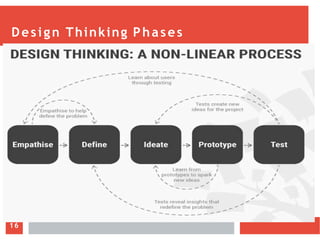
It is important to note that the five phases, stages,
or modes are not always sequential. They do not
have to follow any specific order. What’s more, they
can often occur in parallel and repeat iteratively. A s
such, you should not envision the phases a s a
hierarchal or step-by-step process.
17
Design Thinking Phases: 1. Empathise
The first stage of the Design Thinking process is to
gain an empathic understanding of the problem you
are trying to solve. This involves consulting experts to
find out more about the area of concern through
observing, engag ing and empathizing with people to
understand their experiences and motivations, a s well
a s immersing yourself in the physical environment so
you can gain a deeper personal understanding of the
issues involved.
18
Design Thinking Phases: 1. Empathise
Depending on time constraints, a substantial
amount of information is gathered at this stage to
use during the next stage and to develop the best
possible understanding of the users, their needs,
and the problems that underlie the development of
that particular product.
19
Design Thinking Phases: 2. Define
During the Define stage, you put together the
information you have created and gathered during
the Empathise stage. This is where you will analyse
your observations and synthesise them in order to
define the core problems that you and your team
have identified up to this point. You should seek to
define the problem a s a problem statement in a
human-centred manner.
20
Design Thinking Phases: 2. Define
To illustrate, instead of defining the problem a s your
own wish or a need of the company such as, “We
need to increase our food-product market share
a m o n g young teenage girls by 5%,” a much better
way to define the problem would be, “Teenage girls
need to eat nutritious food in order to thrive, be
healthy and grow.”
21
Design Thinking Phases: 2. Define
The perfect problem sta tement sh ould clearly
answer the following questions:
●What are we trying to solve?
●For whom are we trying to solve it?
●W hat are the different ways we can approach this
from?
●How can we act on it?
22
Design Thinking Phases: 3. Ideate
During the third stage of the Design Thinking
process, designers are ready to start generating
ideas. You’ve grown to understand your users and
their needs in the Empathise stage, and you’ve
analysed and synthesised your observations in the
Define stage, and ended up with a human-centered
problem statement.
23
Design Thinking Phases: 3. Ideate
It is im portant to g et
solutions a s po ssible
as m a ny ideas or problem
at the be ginning of the
Ideation phase. You should pick some other Ideation
techniques by the end of the Ideation phase to help
you investigate and test your ideas so you can find
the best way to either solve a problem or provide
the elements required to circumvent it.
24
Design Thinking Phases: 3. Ideate
What are the techniques for ideation?
●Brainstorming
●Bodystorming
●Lightning D emos
●4 Step Sketching
25
Design Thinking Phases: 4. Prototype
The design team will now produce a number of
inexpensive, scaled down versions of the product or
specific features found within the product, so they
can investigate the problem solutions generated in
the previous stage. Prototypes may be shared and
tested within the team itself, in other departments,
or on a small group of people outside the design
team.
26
Design Thinking Phases: 4. Prototype
This is an experimental phase, and the aim is to
identify the best possible solution for each of the
problems identified during the first three stages.
The solutions are implemented within the
prototypes, and, one by one, they are investigated
and either accepted, improved and re-examined, or
rejected on the basis of the users’ experiences.
27
Design Thinking Phases: 4. Prototype
By the end of this stage, the design team will have a
better
product
idea of the constraints inherent to the
and the proble m s that are present, and
have a clearer view of how real users would behave,
think, and feel when interacting with the end
product.
28
Design Thinking Phases: 5. Test
Designers or evaluators rigorously test the complete
product using the best solutions identified during the
prototyping phase. This is the final stage of the 5
stage-model, but in an iterative process, the results
generated during the testing phase are often used to
redefine one or more problems and inform the
understanding of the users, the conditions of use, how
people think, behave, and feel, and to empathise.
29
Design Thinking Phases: 5. Test
Even during this phase, alterations and refinements
are made in order to rule out problem solutions and
derive as deep an understanding of the product and
its users a s possible.
30
Design Thinking Phases: Non-linear
We may have outlined a direct and linear Design
Thinking process in which one stage seemingly leads
to the next with a logical conclusion at user testing.
However, in practice, the process is carried out in a
more flexible and non-linear fashion.
31
Design Thinking Phases: Non-linear
For example, different groups within the design team
may conduct more than one stage concurrently, or the
designers may collect information and prototype
during the entire project so as to enable them to bring
their ideas to life and visualise the problem solutions.
Also, results from the testing phase may reveal some
insights about users, which in turn may lead to
another brainstorming session (Ideate) or the
development of new prototypes (Prototype).
32
Design Thinking as Divergent-
Convergent Questioning
D iverg ent and converg ent
complementary methods to
thinking are two
explore ideas , work
challenges. In the
towards goals, and address
desig n world— where we’re constan tly em ploying
design thinking in our work—both approaches are
necessary and lead to unique solutions for
challenges that require exploration and creativity.
3
Design Thinking as Divergent-
Convergent Questioning
Divergent and convergent thinking are both
methods of thinking that are so deeply integrated
into what we do, we often don’t stop to think about
the theories behind them. We often rail against tired
concepts like “think outside the box,” yet we still try
to capture what that phrase meant before it became
a cliché.
4
Design Thinking as Divergent-
Convergent Questioning
What is Divergent Thinking?
Divergent thinking is taking a challenge and
attempting to identify all the possible drivers of that
challenge, then listing all of the ways those drivers
can be addressed.
5
Design Thinking as Divergent-
Convergent Questioning
What is Divergent Thinking?
D iverg ent thinking typically happens in open, free-
flowing, spontaneous environments where multiple
creative ideas can be shared and considered. Typically,
this m ean s that everyone involved in this type of thinking
will look for unexpected combinations and connections
between remote associations. Divergent thinking sparks
creativity specifically because of its spontaneous, non-
linear nature.
6
Design Thinking as Divergent-
Convergent Questioning
Divergent Thinking Examples
Designers practice divergent thinking in a few ways. We
use divergent thinking in the initial st ag es of ideation on
a project or t ask —when we have a challenge to solve
and we need to brainstorm or iterate on creative
solutions. We’ll also employ divergent thinking in the
process of thinking through, at a high level, how to help
make a client’s website, app, or digital tool more
competitive or innovative in the market.
7
Design Thinking as Divergent-
Convergent Questioning
What is Convergent Thinking?
Convergent thinking, on the other hand, is known a s
the practice of selecting the optimal solution from a
finite set of ideas collected from different sources in
order to solve a discrete challenge quickly and
efficiently.
8
Design Thinking as Divergent-
Convergent Questioning
What is Convergent Thinking?
Convergent thinking is best practiced at times when you
need an answer and you believe you have access to the
data and information you need to guide a decision or
solution. Convergent thinking typically calls for speed,
accuracy, and knowledge on a subject, so it’s best used
when the team h a s access to experts and relevant data.
The team will analyze and bring that information
together into an educated decision.
9
Design Thinking as Divergent-
Convergent Questioning
10
Design Thinking as Divergent-
Convergent Questioning
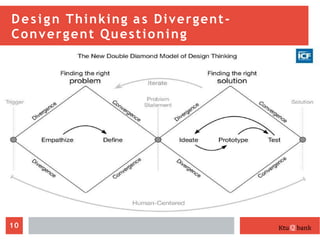
The design thinking process is ultimately a
divergent and convergent thinking process. To find
the right problem, design thinkers conduct a series
of studies to understand people and their problems,
and then translate all kinds of findings into one or a
few problem statements.
11
Design Thinking as Divergent-
Convergent Questioning
To find the best solution, a cross-disciplinary group
of design thinkers first brainstorm a variety of
potential solutions. Through the exercises of
evaluation, comparison, and consolidation, a limited
number of solutions are selected for prototyping and
testing. The final solution sometimes merges the
merits of several alternatives.
12
Design Thinking as Divergent-
Convergent Questioning - Assignment
Construct a number of possible designs and then
refine them to narrow down to the best design for a
drug trolley used in hospitals. Show how the
divergent-convergent thinking helps in the process.
Provide your rationale for each step by using hand
sketches only.
13
Design Thinking as Divergent-
Convergent Questioning - Example
drug trolleys are used in hospitals and care
homes to help staff deal with the distribution of
medicines.
14
Design Thinking as Divergent-
Convergent Questioning - Example
15

Design and Engineering Quality Index.pptx

  • 1.
    EST 200 DESIGNA N D ENGINEERING: M O D U L E 2
  • 2.
  • 3.
    Introduction to DesignThinking Some of the world’s leading brands, such a s Apple, Google, S a m s u n g and GE, have rapidly adopted the design thinking approach. What’s more, design thinking is being taught at leading universities around the world. But what is design thinking? 3
  • 4.
    Introduction to DesignThinking Put sim ply, desig n thinking is a hum a n-centered approach to creative problem-solving. 4
  • 5.
    Introduction to DesignThinking Formally defined as: Design thinking is an iterative process in which we seek to understand the user, challenge assumptions, and redefine problems in an attempt to identify alternative strategies and solutions that might not be instantly apparent with our initial level of understanding. 5
  • 6.
    Introduction to DesignThinking Design Thinking: Wh y is it important? Good desig n is characterized by buttery user experience. s m ooth By thinking from the needs of the user, a design thinking approach helps designers bridge the g a p between something that just works and something that solves a problem. 6
  • 7.
    Introduction to DesignThinking Design Thinking: W hy is it important? The ‘Norman Door’ phenomenon might just be the best illustration of why design thinking and a human-centred approach are important. ‘Norman Door’ is a figurative term for any product that is cumbersome to use and wa s designed poorly. A Norman Door has a handle that you can grab, so you think that you need to pull it. But when you pull you realize it’s actually a push. 7
  • 8.
    Introduction to DesignThinking Design Thinking: Wh y is it important? While logically thinking, placing a handle on the door is perfectly normal, in the world of real people and real experiences, the handle is obsolete and confuses the user. 8
  • 9.
    Introduction to DesignThinking Design thinking revolves around a deep interest in developing an understanding of the people for whom we’re designing the products or services. It helps us observe and develop empathy with the target user. Design thinking helps us in the process of questioning: questioning the problem, questioning the assumptions, and questioning the implications. 9
  • 10.
    Introduction to DesignThinking D esign thinking is extremely us eful in tackling problems that are ill defined framing the problem in human-centric or unknown, by re- ways, creating m a ny idea s in brains torm ing sessions , and adopting a hands-onapproach in prototyping and ong oing testing , testing. Design thinking also involves experimentation: sketching , prototyping , and trying out concepts and ideas. 10
  • 11.
    Introduction to DesignThinking The 3 pillars of design thinking are: 1. Empathy 2. Ideation 3. Experimentation 11
  • 12.
    Introduction to DesignThinking Pillars of design thinking 1. Empathy Empathy is the foundation of design thinking. Unless you get into the wants and needs of people you are designing for, what you’re doing can’t be considered design thinking. 12
  • 13.
    Introduction to DesignThinking Pillars of design thinking 2. Ideation Ideation is the core of desig n thinking process. creative activitie s in the S im ply put, it is when m ultiple idea s are pitted a g ainst each other , where creativity is unleashed and innovation happens. 13
  • 14.
    Introduction to DesignThinking Pillars of design thinking 3. Experimentation Are your assumptions correct? Did you hit the right spot with your product? What are users thinking about it? Don’t just guess – test it! 14
  • 15.
    Design Thinking Phases Designthinking has five steps: 1. Empathise – with your users 2 . D efine – your use rs’ nee d s, their problem , an d your insights 3.Ideate – by challenging assumptions and creating ideas for innovative solutions 4. Prototype – to start creating solutions 5. Test – solutions 15
  • 16.
  • 17.
    Design Thinking Phases Itis important to note that the five phases, stages, or modes are not always sequential. They do not have to follow any specific order. What’s more, they can often occur in parallel and repeat iteratively. A s such, you should not envision the phases a s a hierarchal or step-by-step process. 17
  • 18.
    Design Thinking Phases:1. Empathise The first stage of the Design Thinking process is to gain an empathic understanding of the problem you are trying to solve. This involves consulting experts to find out more about the area of concern through observing, engag ing and empathizing with people to understand their experiences and motivations, a s well a s immersing yourself in the physical environment so you can gain a deeper personal understanding of the issues involved. 18
  • 19.
    Design Thinking Phases:1. Empathise Depending on time constraints, a substantial amount of information is gathered at this stage to use during the next stage and to develop the best possible understanding of the users, their needs, and the problems that underlie the development of that particular product. 19
  • 20.
    Design Thinking Phases:2. Define During the Define stage, you put together the information you have created and gathered during the Empathise stage. This is where you will analyse your observations and synthesise them in order to define the core problems that you and your team have identified up to this point. You should seek to define the problem a s a problem statement in a human-centred manner. 20
  • 21.
    Design Thinking Phases:2. Define To illustrate, instead of defining the problem a s your own wish or a need of the company such as, “We need to increase our food-product market share a m o n g young teenage girls by 5%,” a much better way to define the problem would be, “Teenage girls need to eat nutritious food in order to thrive, be healthy and grow.” 21
  • 22.
    Design Thinking Phases:2. Define The perfect problem sta tement sh ould clearly answer the following questions: ●What are we trying to solve? ●For whom are we trying to solve it? ●W hat are the different ways we can approach this from? ●How can we act on it? 22
  • 23.
    Design Thinking Phases:3. Ideate During the third stage of the Design Thinking process, designers are ready to start generating ideas. You’ve grown to understand your users and their needs in the Empathise stage, and you’ve analysed and synthesised your observations in the Define stage, and ended up with a human-centered problem statement. 23
  • 24.
    Design Thinking Phases:3. Ideate It is im portant to g et solutions a s po ssible as m a ny ideas or problem at the be ginning of the Ideation phase. You should pick some other Ideation techniques by the end of the Ideation phase to help you investigate and test your ideas so you can find the best way to either solve a problem or provide the elements required to circumvent it. 24
  • 25.
    Design Thinking Phases:3. Ideate What are the techniques for ideation? ●Brainstorming ●Bodystorming ●Lightning D emos ●4 Step Sketching 25
  • 26.
    Design Thinking Phases:4. Prototype The design team will now produce a number of inexpensive, scaled down versions of the product or specific features found within the product, so they can investigate the problem solutions generated in the previous stage. Prototypes may be shared and tested within the team itself, in other departments, or on a small group of people outside the design team. 26
  • 27.
    Design Thinking Phases:4. Prototype This is an experimental phase, and the aim is to identify the best possible solution for each of the problems identified during the first three stages. The solutions are implemented within the prototypes, and, one by one, they are investigated and either accepted, improved and re-examined, or rejected on the basis of the users’ experiences. 27
  • 28.
    Design Thinking Phases:4. Prototype By the end of this stage, the design team will have a better product idea of the constraints inherent to the and the proble m s that are present, and have a clearer view of how real users would behave, think, and feel when interacting with the end product. 28
  • 29.
    Design Thinking Phases:5. Test Designers or evaluators rigorously test the complete product using the best solutions identified during the prototyping phase. This is the final stage of the 5 stage-model, but in an iterative process, the results generated during the testing phase are often used to redefine one or more problems and inform the understanding of the users, the conditions of use, how people think, behave, and feel, and to empathise. 29
  • 30.
    Design Thinking Phases:5. Test Even during this phase, alterations and refinements are made in order to rule out problem solutions and derive as deep an understanding of the product and its users a s possible. 30
  • 31.
    Design Thinking Phases:Non-linear We may have outlined a direct and linear Design Thinking process in which one stage seemingly leads to the next with a logical conclusion at user testing. However, in practice, the process is carried out in a more flexible and non-linear fashion. 31
  • 32.
    Design Thinking Phases:Non-linear For example, different groups within the design team may conduct more than one stage concurrently, or the designers may collect information and prototype during the entire project so as to enable them to bring their ideas to life and visualise the problem solutions. Also, results from the testing phase may reveal some insights about users, which in turn may lead to another brainstorming session (Ideate) or the development of new prototypes (Prototype). 32
  • 33.
    Design Thinking asDivergent- Convergent Questioning D iverg ent and converg ent complementary methods to thinking are two explore ideas , work challenges. In the towards goals, and address desig n world— where we’re constan tly em ploying design thinking in our work—both approaches are necessary and lead to unique solutions for challenges that require exploration and creativity. 3
  • 34.
    Design Thinking asDivergent- Convergent Questioning Divergent and convergent thinking are both methods of thinking that are so deeply integrated into what we do, we often don’t stop to think about the theories behind them. We often rail against tired concepts like “think outside the box,” yet we still try to capture what that phrase meant before it became a cliché. 4
  • 35.
    Design Thinking asDivergent- Convergent Questioning What is Divergent Thinking? Divergent thinking is taking a challenge and attempting to identify all the possible drivers of that challenge, then listing all of the ways those drivers can be addressed. 5
  • 36.
    Design Thinking asDivergent- Convergent Questioning What is Divergent Thinking? D iverg ent thinking typically happens in open, free- flowing, spontaneous environments where multiple creative ideas can be shared and considered. Typically, this m ean s that everyone involved in this type of thinking will look for unexpected combinations and connections between remote associations. Divergent thinking sparks creativity specifically because of its spontaneous, non- linear nature. 6
  • 37.
    Design Thinking asDivergent- Convergent Questioning Divergent Thinking Examples Designers practice divergent thinking in a few ways. We use divergent thinking in the initial st ag es of ideation on a project or t ask —when we have a challenge to solve and we need to brainstorm or iterate on creative solutions. We’ll also employ divergent thinking in the process of thinking through, at a high level, how to help make a client’s website, app, or digital tool more competitive or innovative in the market. 7
  • 38.
    Design Thinking asDivergent- Convergent Questioning What is Convergent Thinking? Convergent thinking, on the other hand, is known a s the practice of selecting the optimal solution from a finite set of ideas collected from different sources in order to solve a discrete challenge quickly and efficiently. 8
  • 39.
    Design Thinking asDivergent- Convergent Questioning What is Convergent Thinking? Convergent thinking is best practiced at times when you need an answer and you believe you have access to the data and information you need to guide a decision or solution. Convergent thinking typically calls for speed, accuracy, and knowledge on a subject, so it’s best used when the team h a s access to experts and relevant data. The team will analyze and bring that information together into an educated decision. 9
  • 40.
    Design Thinking asDivergent- Convergent Questioning 10
  • 41.
    Design Thinking asDivergent- Convergent Questioning The design thinking process is ultimately a divergent and convergent thinking process. To find the right problem, design thinkers conduct a series of studies to understand people and their problems, and then translate all kinds of findings into one or a few problem statements. 11
  • 42.
    Design Thinking asDivergent- Convergent Questioning To find the best solution, a cross-disciplinary group of design thinkers first brainstorm a variety of potential solutions. Through the exercises of evaluation, comparison, and consolidation, a limited number of solutions are selected for prototyping and testing. The final solution sometimes merges the merits of several alternatives. 12
  • 43.
    Design Thinking asDivergent- Convergent Questioning - Assignment Construct a number of possible designs and then refine them to narrow down to the best design for a drug trolley used in hospitals. Show how the divergent-convergent thinking helps in the process. Provide your rationale for each step by using hand sketches only. 13
  • 44.
    Design Thinking asDivergent- Convergent Questioning - Example drug trolleys are used in hospitals and care homes to help staff deal with the distribution of medicines. 14
  • 45.
    Design Thinking asDivergent- Convergent Questioning - Example 15