CHAPTER 1
Introduction of
design thinking
HUYNH DANG KHOA (MBA)
CONTENT:
1.1. History of design thinking
1.2. Definition of design thinking
1.3. Role of design thinking in business
1.4. Design thinking mindset
1.5. Design thinking skills
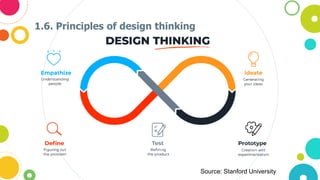
1.6. Principles of design thinking
2
History of design thinking
1.1
3
4
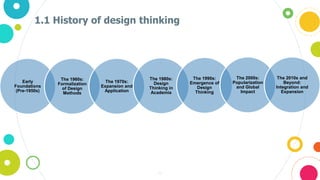
Early
Foundations
(Pre-1950s)
The 1960s:
Formalization
of Design
Methods
The 1970s:
Expansion and
Application
The 1980s:
Design
Thinking in
Academia
The 1990s:
Emergence of
Design
Thinking
The 2000s:
Popularization
and Global
Impact
The 2010s and
Beyond:
Integration and
Expansion
1.1 History of design thinking
◎ Early Foundations (Pre-1950s)
• Thomas Edison (1847-1931): Though not formally recognized as a
design thinker, Edison’s approach to invention, emphasizing user needs
and iterative prototyping, laid early groundwork for design thinking
principles.
• Bauhaus School (1919-1933): This German design school
emphasized the integration of art, craft, and technology, focusing on
functionality and human-centric design.
1.1 History of design thinking
◎ The 1960s: Formalization of Design Methods
• Herbert A. Simon: In his book "The Sciences of the Artificial" (1969),
Simon discussed design as a way of thinking and introduced the
concept of “bounded rationality,” influencing how problems and
solutions are approached in a structured way.
• L. Bruce Archer: Archer was instrumental in the development of
design methods. His work, particularly in the UK, contributed to the
establishment of design as a systematic process.
1.1 History of design thinking
◎ The 1970s: Expansion and Application
• Horst Rittel and Melvin Webber: In their 1973 paper, "Dilemmas in
a General Theory of Planning," Rittel and Webber introduced the
concept of "wicked problems," highlighting complex issues that are
difficult to define and solve, which design thinking aims to address.
• IDEO's Early Influences: The design firm IDEO, founded in 1991,
started to formalize design thinking processes during this time,
although its impact became more prominent in later years.
1.1 History of design thinking
◎ The 1980s: Design Thinking in Academia
• Donald Schön: In his influential book "The Reflective Practitioner"
(1983), Schön explored how professionals think in action, contributing
to the understanding of design thinking as a reflective practice.
• Stanford University's Influence: Stanford University began
incorporating design thinking into its curriculum, particularly through
the work of the Stanford Design Program and faculty like Rolf Faste,
who further developed the concept.
1.1 History of design thinking
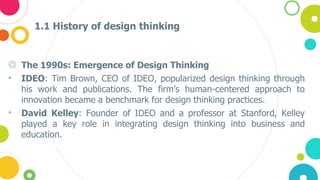
◎ The 1990s: Emergence of Design Thinking
• IDEO: Tim Brown, CEO of IDEO, popularized design thinking through
his work and publications. The firm’s human-centered approach to
innovation became a benchmark for design thinking practices.
• David Kelley: Founder of IDEO and a professor at Stanford, Kelley
played a key role in integrating design thinking into business and
education.
1.1 History of design thinking
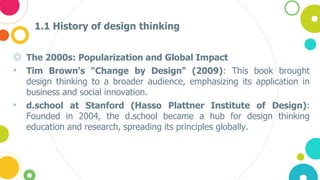
◎ The 2000s: Popularization and Global Impact
• Tim Brown's "Change by Design" (2009): This book brought
design thinking to a broader audience, emphasizing its application in
business and social innovation.
• d.school at Stanford (Hasso Plattner Institute of Design):
Founded in 2004, the d.school became a hub for design thinking
education and research, spreading its principles globally.
1.1 History of design thinking
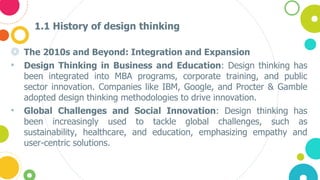
◎ The 2010s and Beyond: Integration and Expansion
• Design Thinking in Business and Education: Design thinking has
been integrated into MBA programs, corporate training, and public
sector innovation. Companies like IBM, Google, and Procter & Gamble
adopted design thinking methodologies to drive innovation.
• Global Challenges and Social Innovation: Design thinking has
been increasingly used to tackle global challenges, such as
sustainability, healthcare, and education, emphasizing empathy and
user-centric solutions.
Definition of design thinking
1.2
12
1.2 Definition of design thinking
◎ Tim Brown (IDEO CEO)
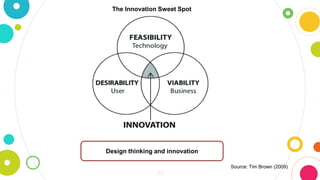
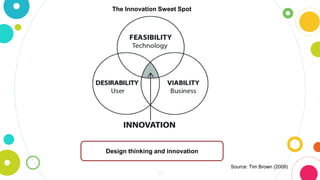
• "Design thinking is a human-centered approach to innovation that
draws from the designer's toolkit to integrate the needs of people, the
possibilities of technology, and the requirements for business success."
Source: Brown, T. (2008). Design Thinking. Harvard Business Review.
1.2 Definition of design thinking
◎ Hasso Plattner Institute of Design at Stanford (d.school)
• "Design thinking is a methodology for innovation that combines creative
and analytical approaches and requires collaboration across disciplines."
Source: d.school. (2023). An Introduction to Design Thinking. Hasso Plattner Institute of Design at
Stanford.
1.2 Definition of design thinking
◎ IDEO
• "Design thinking is a process for creative problem solving. It
encourages organizations to focus on the people they're creating for,
which leads to better products, services, and internal processes."
Source: IDEO. (n.d.). What Is Design Thinking?. IDEO.
1.2 Definition of design thinking
◎ Harvard Business Review
• "Design thinking is a methodology that imbues the full spectrum of
innovation activities with a human-centered design ethos."
Source: Liedtka, J. (2018). Why Design Thinking Works. Harvard Business Review.
1.2 Definition of design thinking
◎ MIT Sloan Management Review
• "Design thinking is a collaborative, human-centered approach to
solving complex problems that emphasizes empathy, ideation, and
experimentation."
Source: Beckman, S. L., & Barry, M. (2007). Innovation as a Learning Process: Embedding Design
Thinking. MIT Sloan Management Review.
1.2 Definition of design thinking
◎ The key aspects of design thinking:
• Human-centered design
• Emphasis on creativity and collaboration
• Iterative process for problem-solving
1.2 Definition of design thinking
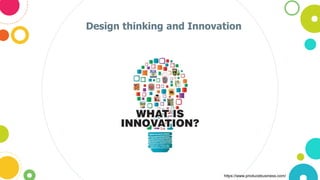
Design thinking and Innovation
https://www.producebusiness.com/
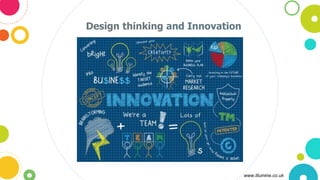
Design thinking and Innovation
www.illumine.co.uk
22
Design thinking and innovation
Source: Tim Brown (2009)
The Innovation Sweet Spot
Role of design thinking in
business
1.3
23
1.3. Role of design thinking in business
◎ Fostering Innovation:
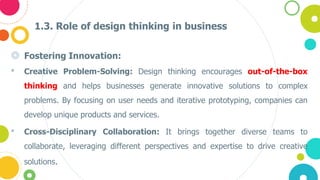
• Creative Problem-Solving: Design thinking encourages out-of-the-box
thinking and helps businesses generate innovative solutions to complex
problems. By focusing on user needs and iterative prototyping, companies can
develop unique products and services.
• Cross-Disciplinary Collaboration: It brings together diverse teams to
collaborate, leveraging different perspectives and expertise to drive creative
solutions.
1.3. Role of design thinking in business
◎ Enhancing Customer Experience:
• Empathy and User-Centric Approach: By prioritizing the needs,
preferences, and pain points of customers, businesses can create products and
services that resonate more deeply with their target audience.
• Iterative Feedback Loop: Prototyping and testing with real users ensure
continuous improvement based on direct feedback, leading to better user
experiences.
1.3. Role of design thinking in business
◎ Improving Processes:
• Streamlined Operations: Design thinking can be applied to internal
processes, identifying inefficiencies and developing more effective workflows.
• Employee Engagement: Engaging employees in design thinking workshops
and activities fosters a culture of innovation and ownership, leading to higher
job satisfaction and productivity.
1.3. Role of design thinking in business
◎ Driving Growth:
• Market Differentiation: Innovative, user-centered products and services help
businesses stand out in competitive markets.
• Adaptability and Agility: The iterative nature of design thinking enables
businesses to adapt quickly to market changes and emerging trends.
1.3. Role of design thinking in business
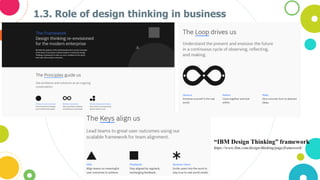
“IBM Design Thinking” framework
https://www.ibm.com/design/thinking/page/framework/
1.3. Role of design thinking in business
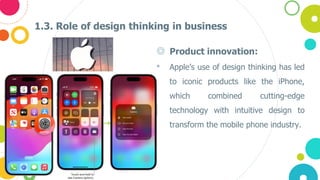
◎ Product innovation:
• Apple’s use of design thinking has led
to iconic products like the iPhone,
which combined cutting-edge
technology with intuitive design to
transform the mobile phone industry.
1.3. Role of design thinking in business
◎ Business Model Transformation:
• Faced with slow growth, Airbnb founders
used design thinking to deeply
understand their users' needs, leading to
major changes in their platform and
business model that significantly boosted
user engagement and growth.
1.3. Role of design thinking in business
◎ Organizational Change:
• By embedding design thinking into its
corporate culture, P&G developed more
innovative consumer products and
significantly improved their market
performance.
32
Design thinking mindset
1.4
33
34
Design thinking and innovation
Source: Tim Brown (2009)
The Innovation Sweet Spot
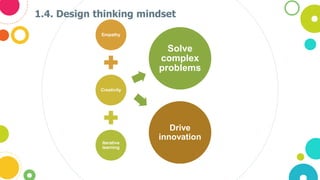
1.4. Design thinking mindset
Empathy
Creativity
Iterative
learning
Solve
complex
problems
Drive
innovation
Design thinking skills
1.5
36
1.5. Design thinking skills
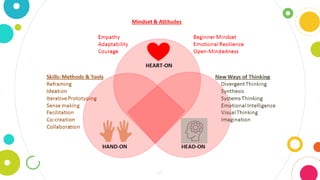
◎ A blend of various skills to effectively solve complex problems:
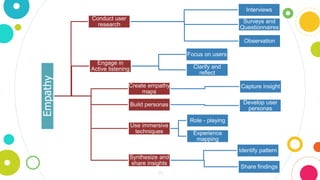
• Empathy: This is the ability to understand and share the feelings of others.
In design thinking, empathy involves immersing oneself in the user's
experience to gain a deep understanding of their needs and challenges.
This skill is crucial in the initial phase of the design thinking process, where
designers gather data about the problem and the user.
38
Empathy
Conduct user
research
Interviews
Surveys and
Questionnaires
Observation
Engage in
Active listening
Focus on users
Clarify and
reflect
Create empathy
maps
Capture insight
Build personas Develop user
personas
Use immersive
techniques
Role - playing
Experience
mapping
Synthesize and
share insights
Identify pattern
Share findings
1.5. Design thinking skills
◎ Creativity
• Creativity is at the heart of the ideation phase in design thinking.
It involves brainstorming, thinking outside the box, and generating
innovative ideas without immediately judging them.
This skill helps in exploring a wide range of potential solutions to a given
problem
1.5. Design thinking skills
◎ Collaboration
• Collaboration skills are essential to effectively communicate, share ideas, and
integrate diverse perspectives into the design process.
• This helps in developing well-rounded solutions that consider various aspects of
the problem.
1.5. Design thinking skills
◎ Prototyping and Testing
• The ability to create prototypes and test them is crucial in design thinking.
This skill involves building tangible models of potential solutions, experimenting
with them, and iterating based on feedback.
It helps in refining ideas and ensuring they are feasible and effective before full-
scale implementation​.
1.5. Design thinking skills
◎ Problem Framing and Reframing
• This skill involves defining and redefining the problem to ensure that the right
issue is being addressed.
• By framing the problem correctly, designers can focus on finding effective
solutions that address the underlying needs of users​.
1.5. Design thinking skills
◎ Analytical Thinking
• Alongside creativity, analytical thinking is necessary to evaluate ideas critically,
identify patterns, and make data-driven decisions.
• This balance of intuition and analysis ensures that the solutions are both
innovative and practical​.
1.5. Design thinking skills
◎ Iterative Development
• Iteration is a key principle in design thinking.
• It involves continuously refining and improving ideas through repeated cycles of
prototyping, testing, and feedback.
• This skill helps in developing robust solutions that are well-tested and user-
approved​.
45
Principles of design thinking
1.6
46
1.6. Principles of design thinking
Source: Stanford University
1.6. Principles of design thinking
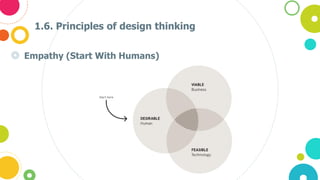
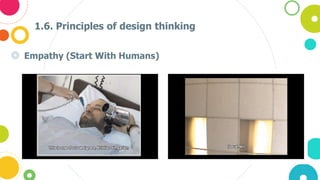
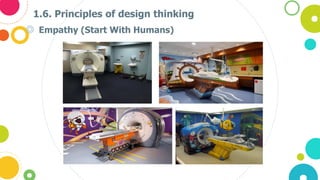
◎ Empathy (Start With Humans)
• User-Centric Approach: Empathy involves understanding the needs,
experiences, and emotions of the users. It is the foundation of design thinking,
as it helps to create solutions that truly address user needs.
• Techniques: Methods such as interviews, observation, and journey mapping
are used to gain deep insights into the user’s perspective​.
1.6. Principles of design thinking
◎ Empathy (Start With Humans)
1.6. Principles of design thinking
◎ Empathy (Start With Humans)
1.6. Principles of design thinking
◎ Empathy (Start With Humans)
1.6. Principles of design thinking
◎ Define problems (Define the real problem)
• Problem Framing: Clearly defining the problem based on insights gathered
during the empathy phase. This step involves synthesizing information to
formulate a clear problem statement.
• Focus: It helps in narrowing down the scope and ensures the team is
addressing the right issue​.
1.6. Principles of design thinking
◎ Ideation
• Creative Exploration: Generating a wide range of ideas and solutions. This
phase encourages thinking outside the box and considering multiple
perspectives.
• Brainstorming Techniques: Use of techniques like brainstorming, mind
mapping, and sketching to foster creativity and innovation​.
1.6. Principles of design thinking
◎ Prototyping
• The prototype stage in design thinking is a crucial phase where ideas
generated during the ideation stage are turned into tangible, testable
models.
• Prototyping Techniques: Use of physical or digital prototypes to explore
potential solutions and refine concepts based on user feedback.
1.6. Principles of design thinking
◎ Testing
• User Feedback: Testing prototypes with real users to gather feedback and
identify any issues or areas for improvement.
• Iterative Process: This phase is often repeated multiple times, incorporating
feedback and making necessary adjustments to enhance the solution​​.
Thanks!
Any questions?
56

Chapter 1. Introduction of design thinking.pdf

  • 1.
    CHAPTER 1 Introduction of designthinking HUYNH DANG KHOA (MBA)
  • 2.
    CONTENT: 1.1. History ofdesign thinking 1.2. Definition of design thinking 1.3. Role of design thinking in business 1.4. Design thinking mindset 1.5. Design thinking skills 1.6. Principles of design thinking 2
  • 3.
    History of designthinking 1.1 3
  • 4.
    4 Early Foundations (Pre-1950s) The 1960s: Formalization of Design Methods The1970s: Expansion and Application The 1980s: Design Thinking in Academia The 1990s: Emergence of Design Thinking The 2000s: Popularization and Global Impact The 2010s and Beyond: Integration and Expansion 1.1 History of design thinking
  • 5.
    1.1 History ofdesign thinking ◎ Early Foundations (Pre-1950s) • Thomas Edison (1847-1931): Though not formally recognized as a design thinker, Edison’s approach to invention, emphasizing user needs and iterative prototyping, laid early groundwork for design thinking principles. • Bauhaus School (1919-1933): This German design school emphasized the integration of art, craft, and technology, focusing on functionality and human-centric design.
  • 6.
    1.1 History ofdesign thinking ◎ The 1960s: Formalization of Design Methods • Herbert A. Simon: In his book "The Sciences of the Artificial" (1969), Simon discussed design as a way of thinking and introduced the concept of “bounded rationality,” influencing how problems and solutions are approached in a structured way. • L. Bruce Archer: Archer was instrumental in the development of design methods. His work, particularly in the UK, contributed to the establishment of design as a systematic process.
  • 7.
    1.1 History ofdesign thinking ◎ The 1970s: Expansion and Application • Horst Rittel and Melvin Webber: In their 1973 paper, "Dilemmas in a General Theory of Planning," Rittel and Webber introduced the concept of "wicked problems," highlighting complex issues that are difficult to define and solve, which design thinking aims to address. • IDEO's Early Influences: The design firm IDEO, founded in 1991, started to formalize design thinking processes during this time, although its impact became more prominent in later years.
  • 8.
    1.1 History ofdesign thinking ◎ The 1980s: Design Thinking in Academia • Donald Schön: In his influential book "The Reflective Practitioner" (1983), Schön explored how professionals think in action, contributing to the understanding of design thinking as a reflective practice. • Stanford University's Influence: Stanford University began incorporating design thinking into its curriculum, particularly through the work of the Stanford Design Program and faculty like Rolf Faste, who further developed the concept.
  • 9.
    1.1 History ofdesign thinking ◎ The 1990s: Emergence of Design Thinking • IDEO: Tim Brown, CEO of IDEO, popularized design thinking through his work and publications. The firm’s human-centered approach to innovation became a benchmark for design thinking practices. • David Kelley: Founder of IDEO and a professor at Stanford, Kelley played a key role in integrating design thinking into business and education.
  • 10.
    1.1 History ofdesign thinking ◎ The 2000s: Popularization and Global Impact • Tim Brown's "Change by Design" (2009): This book brought design thinking to a broader audience, emphasizing its application in business and social innovation. • d.school at Stanford (Hasso Plattner Institute of Design): Founded in 2004, the d.school became a hub for design thinking education and research, spreading its principles globally.
  • 11.
    1.1 History ofdesign thinking ◎ The 2010s and Beyond: Integration and Expansion • Design Thinking in Business and Education: Design thinking has been integrated into MBA programs, corporate training, and public sector innovation. Companies like IBM, Google, and Procter & Gamble adopted design thinking methodologies to drive innovation. • Global Challenges and Social Innovation: Design thinking has been increasingly used to tackle global challenges, such as sustainability, healthcare, and education, emphasizing empathy and user-centric solutions.
  • 12.
    Definition of designthinking 1.2 12
  • 13.
    1.2 Definition ofdesign thinking ◎ Tim Brown (IDEO CEO) • "Design thinking is a human-centered approach to innovation that draws from the designer's toolkit to integrate the needs of people, the possibilities of technology, and the requirements for business success." Source: Brown, T. (2008). Design Thinking. Harvard Business Review.
  • 14.
    1.2 Definition ofdesign thinking ◎ Hasso Plattner Institute of Design at Stanford (d.school) • "Design thinking is a methodology for innovation that combines creative and analytical approaches and requires collaboration across disciplines." Source: d.school. (2023). An Introduction to Design Thinking. Hasso Plattner Institute of Design at Stanford.
  • 15.
    1.2 Definition ofdesign thinking ◎ IDEO • "Design thinking is a process for creative problem solving. It encourages organizations to focus on the people they're creating for, which leads to better products, services, and internal processes." Source: IDEO. (n.d.). What Is Design Thinking?. IDEO.
  • 16.
    1.2 Definition ofdesign thinking ◎ Harvard Business Review • "Design thinking is a methodology that imbues the full spectrum of innovation activities with a human-centered design ethos." Source: Liedtka, J. (2018). Why Design Thinking Works. Harvard Business Review.
  • 17.
    1.2 Definition ofdesign thinking ◎ MIT Sloan Management Review • "Design thinking is a collaborative, human-centered approach to solving complex problems that emphasizes empathy, ideation, and experimentation." Source: Beckman, S. L., & Barry, M. (2007). Innovation as a Learning Process: Embedding Design Thinking. MIT Sloan Management Review.
  • 18.
    1.2 Definition ofdesign thinking ◎ The key aspects of design thinking: • Human-centered design • Emphasis on creativity and collaboration • Iterative process for problem-solving
  • 19.
    1.2 Definition ofdesign thinking
  • 20.
    Design thinking andInnovation https://www.producebusiness.com/
  • 21.
    Design thinking andInnovation www.illumine.co.uk
  • 22.
    22 Design thinking andinnovation Source: Tim Brown (2009) The Innovation Sweet Spot
  • 23.
    Role of designthinking in business 1.3 23
  • 24.
    1.3. Role ofdesign thinking in business ◎ Fostering Innovation: • Creative Problem-Solving: Design thinking encourages out-of-the-box thinking and helps businesses generate innovative solutions to complex problems. By focusing on user needs and iterative prototyping, companies can develop unique products and services. • Cross-Disciplinary Collaboration: It brings together diverse teams to collaborate, leveraging different perspectives and expertise to drive creative solutions.
  • 25.
    1.3. Role ofdesign thinking in business ◎ Enhancing Customer Experience: • Empathy and User-Centric Approach: By prioritizing the needs, preferences, and pain points of customers, businesses can create products and services that resonate more deeply with their target audience. • Iterative Feedback Loop: Prototyping and testing with real users ensure continuous improvement based on direct feedback, leading to better user experiences.
  • 26.
    1.3. Role ofdesign thinking in business ◎ Improving Processes: • Streamlined Operations: Design thinking can be applied to internal processes, identifying inefficiencies and developing more effective workflows. • Employee Engagement: Engaging employees in design thinking workshops and activities fosters a culture of innovation and ownership, leading to higher job satisfaction and productivity.
  • 27.
    1.3. Role ofdesign thinking in business ◎ Driving Growth: • Market Differentiation: Innovative, user-centered products and services help businesses stand out in competitive markets. • Adaptability and Agility: The iterative nature of design thinking enables businesses to adapt quickly to market changes and emerging trends.
  • 28.
    1.3. Role ofdesign thinking in business “IBM Design Thinking” framework https://www.ibm.com/design/thinking/page/framework/
  • 29.
    1.3. Role ofdesign thinking in business ◎ Product innovation: • Apple’s use of design thinking has led to iconic products like the iPhone, which combined cutting-edge technology with intuitive design to transform the mobile phone industry.
  • 30.
    1.3. Role ofdesign thinking in business ◎ Business Model Transformation: • Faced with slow growth, Airbnb founders used design thinking to deeply understand their users' needs, leading to major changes in their platform and business model that significantly boosted user engagement and growth.
  • 31.
    1.3. Role ofdesign thinking in business ◎ Organizational Change: • By embedding design thinking into its corporate culture, P&G developed more innovative consumer products and significantly improved their market performance.
  • 32.
  • 33.
  • 34.
    34 Design thinking andinnovation Source: Tim Brown (2009) The Innovation Sweet Spot
  • 35.
    1.4. Design thinkingmindset Empathy Creativity Iterative learning Solve complex problems Drive innovation
  • 36.
  • 37.
    1.5. Design thinkingskills ◎ A blend of various skills to effectively solve complex problems: • Empathy: This is the ability to understand and share the feelings of others. In design thinking, empathy involves immersing oneself in the user's experience to gain a deep understanding of their needs and challenges. This skill is crucial in the initial phase of the design thinking process, where designers gather data about the problem and the user.
  • 38.
    38 Empathy Conduct user research Interviews Surveys and Questionnaires Observation Engagein Active listening Focus on users Clarify and reflect Create empathy maps Capture insight Build personas Develop user personas Use immersive techniques Role - playing Experience mapping Synthesize and share insights Identify pattern Share findings
  • 39.
    1.5. Design thinkingskills ◎ Creativity • Creativity is at the heart of the ideation phase in design thinking. It involves brainstorming, thinking outside the box, and generating innovative ideas without immediately judging them. This skill helps in exploring a wide range of potential solutions to a given problem
  • 40.
    1.5. Design thinkingskills ◎ Collaboration • Collaboration skills are essential to effectively communicate, share ideas, and integrate diverse perspectives into the design process. • This helps in developing well-rounded solutions that consider various aspects of the problem.
  • 41.
    1.5. Design thinkingskills ◎ Prototyping and Testing • The ability to create prototypes and test them is crucial in design thinking. This skill involves building tangible models of potential solutions, experimenting with them, and iterating based on feedback. It helps in refining ideas and ensuring they are feasible and effective before full- scale implementation​.
  • 42.
    1.5. Design thinkingskills ◎ Problem Framing and Reframing • This skill involves defining and redefining the problem to ensure that the right issue is being addressed. • By framing the problem correctly, designers can focus on finding effective solutions that address the underlying needs of users​.
  • 43.
    1.5. Design thinkingskills ◎ Analytical Thinking • Alongside creativity, analytical thinking is necessary to evaluate ideas critically, identify patterns, and make data-driven decisions. • This balance of intuition and analysis ensures that the solutions are both innovative and practical​.
  • 44.
    1.5. Design thinkingskills ◎ Iterative Development • Iteration is a key principle in design thinking. • It involves continuously refining and improving ideas through repeated cycles of prototyping, testing, and feedback. • This skill helps in developing robust solutions that are well-tested and user- approved​.
  • 45.
  • 46.
    Principles of designthinking 1.6 46
  • 47.
    1.6. Principles ofdesign thinking Source: Stanford University
  • 48.
    1.6. Principles ofdesign thinking ◎ Empathy (Start With Humans) • User-Centric Approach: Empathy involves understanding the needs, experiences, and emotions of the users. It is the foundation of design thinking, as it helps to create solutions that truly address user needs. • Techniques: Methods such as interviews, observation, and journey mapping are used to gain deep insights into the user’s perspective​.
  • 49.
    1.6. Principles ofdesign thinking ◎ Empathy (Start With Humans)
  • 50.
    1.6. Principles ofdesign thinking ◎ Empathy (Start With Humans)
  • 51.
    1.6. Principles ofdesign thinking ◎ Empathy (Start With Humans)
  • 52.
    1.6. Principles ofdesign thinking ◎ Define problems (Define the real problem) • Problem Framing: Clearly defining the problem based on insights gathered during the empathy phase. This step involves synthesizing information to formulate a clear problem statement. • Focus: It helps in narrowing down the scope and ensures the team is addressing the right issue​.
  • 53.
    1.6. Principles ofdesign thinking ◎ Ideation • Creative Exploration: Generating a wide range of ideas and solutions. This phase encourages thinking outside the box and considering multiple perspectives. • Brainstorming Techniques: Use of techniques like brainstorming, mind mapping, and sketching to foster creativity and innovation​.
  • 54.
    1.6. Principles ofdesign thinking ◎ Prototyping • The prototype stage in design thinking is a crucial phase where ideas generated during the ideation stage are turned into tangible, testable models. • Prototyping Techniques: Use of physical or digital prototypes to explore potential solutions and refine concepts based on user feedback.
  • 55.
    1.6. Principles ofdesign thinking ◎ Testing • User Feedback: Testing prototypes with real users to gather feedback and identify any issues or areas for improvement. • Iterative Process: This phase is often repeated multiple times, incorporating feedback and making necessary adjustments to enhance the solution​​.
  • 56.