Civil Engineering
narendrakalbhor@gmail.com
VIT , khamshet .
Civil Engineering is Everywhere
 Civil Engineering is a
composite of many
disciplines.
– Structural
– Waste Treatment
– Transportation
– Geotechnical
– Water Management
– Construction
Management
– Quantity survey &
Valuation
Fluid mechanics
 Fluid mechanics is the branch of physics that studies fluids
(liquids, gases, and plasmas) and the forces on them.
 Fluid mechanics can be divided into fluid statics, the study of
fluids at rest.
 Fluid kinematics, the study of fluids in motion , and fluid
dynamics, the study of the effect of forces on fluid motion.
application
 To design closed conduits , open channels
 To analyze properties of fluid in motion before construction
 To analyze it’s( fluid in motion & at rest) effect on the structure
e. g. construction of dam , canal
surveying
 Surveying is the science & art of determining
relative positions of various points above & or
below the surface of earth.
 The relative positions are determined by measuring
hz distances, vertical distances ,hz angles & vr
angles accurately using various surveying int.
 Plans & maps are prepared in the office
 Also includes setting out the points on the ground
before starting the const. of bldgs ,roads ,bridges &
dams
 Requires great skill & practice to achieve accuracy
& economy
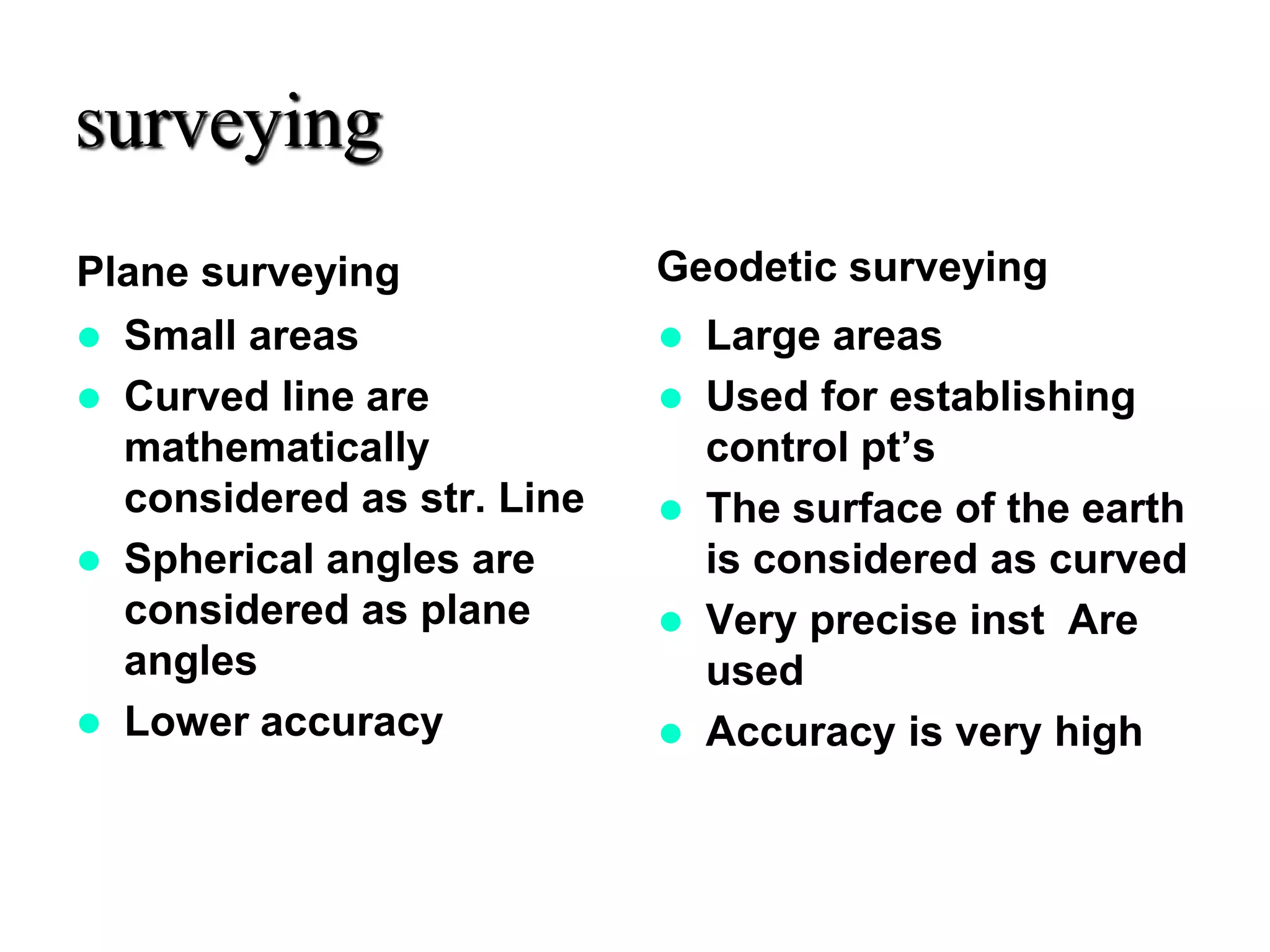
surveying
Plane surveying
 Small areas
 Curved line are
mathematically
considered as str. Line
 Spherical angles are
considered as plane
angles
 Lower accuracy
Geodetic surveying
 Large areas
 Used for establishing
control pt’s
 The surface of the earth
is considered as curved
 Very precise inst Are
used
 Accuracy is very high
Structural
engineering
 Structural engineers
design steel, concrete,
or timber framed
structures such as:
– Tall buildings & towers,
– Bridges,
– Dams,
– Retaining walls, &
foundations, &.
– Stadiums.
Waste Treatment & Environmental.
 Wastewater treatment
engineers are civil or
environmental engineers
trained to design or analyze
water treatment plants.
 Water treatment plants are
categorized as follows:
– Sanitary waste treatment
facilities,
– Industrial waste treatment
facilities,
– Potable (drinking) water
treatment facility.
Transportation
 Transportation
Engineers design and
analyze
– Highways,
– Railways,
– Airports,
– Urban and Suburban
Road Networks,
– Parking Lots, and
– Traffic Control Signal
Systems.
Geotechnical &
Soil Mechanics
 Geotechnical Engineers
analyze the subterranean rock
and soil to determine its
suitability to support extreme
loads.
 Proper geotechnical
engineering is essential for a
safe and secure
structure.
 Design of foundations ,
retaining walls , coffer
dams studied in this
course.
Hydraulics & Water Management
 Water management
involves the use of
hydrologic and hydraulic
principles to design:
– Drainage systems,
– Retention ponds,
– Navigational waterways, and
– Flood control levees, dams,
and lakes.
– Operation & maintenance of
dams , canals & reservoirs
Construction
Management
 Construction managers:
– Review contracts,
– Order materials,
– Hire and schedule sub-
contractors.
 The job of a construction
manager is to:
– Provide quality control and
insure project is completed on
time and.
– Within budget.
Quantity surveying & valution
 Preparation of estimates of structures
 Helps in advance to work out capital
cost
Valuation
 To determine cost of property ,
property tax
 To determine depreciation in the value
of a property with time
Earthquake engineering
 earthquake engineering is the
scientific field concerned with
protecting society, the natural
and the man-made environment
from earthquakes by limiting
the seismic risk to socio-
economically acceptable levels.
 Earthquake don’t
kill the people ,
but buildings do.
Contd….
 Every structure must be designed to
resist earthquake .
 Atomic power plant , oil & gas
refineries , assembly halls , dams,
bridges requires special care(should
resist e/q of magnitude 5.00 R.Scale)
Town planning
 Branch of civil engineering
concerned with grouping of city .
 Helpful in systematic planning of
city .
 Keeps eye on illegal construction .
 City areas are reserved for
industrial growth , institution ,
hospital , national highways , state
highways , airport , railways .
 Helpful to keep healthy env in the
city.
Role of civil engineers in the const. of
dams , bldgs ,expressways, bridges
 Preliminary survey
 Estimation – time , cost
 Planning – arranging various activities involved in
prj so that prj will complete within estimated time &
budget , keep eye on progress of prj, wastage of
materials
 Surveying - preparation of maps & plan , setting
out boundaries , column pts ,foundation pts
 Execution – actual construction & supervision &
approval for activities running on site.
Contd…..
 Quality control - inspection of cement , grade of
concrete , sand , max. size of aggregates , curing
period .
 Preparation of DLR , DMR , DPR (daily labor
report, daily measurement report , daily program
report )
 Billing – work out daily , amt of work done ,
wages to be payed to labors , contractor's bill
 Preparation of bar bending schedule
Reference (web site)
 The American Society of
Civil Engineers, a
professional organization
representing more than
120,000civil engineers.

intro. civil_engineering(1).ppt

  • 1.
  • 2.
    Civil Engineering isEverywhere  Civil Engineering is a composite of many disciplines. – Structural – Waste Treatment – Transportation – Geotechnical – Water Management – Construction Management – Quantity survey & Valuation
  • 3.
    Fluid mechanics  Fluidmechanics is the branch of physics that studies fluids (liquids, gases, and plasmas) and the forces on them.  Fluid mechanics can be divided into fluid statics, the study of fluids at rest.  Fluid kinematics, the study of fluids in motion , and fluid dynamics, the study of the effect of forces on fluid motion. application  To design closed conduits , open channels  To analyze properties of fluid in motion before construction  To analyze it’s( fluid in motion & at rest) effect on the structure e. g. construction of dam , canal
  • 4.
    surveying  Surveying isthe science & art of determining relative positions of various points above & or below the surface of earth.  The relative positions are determined by measuring hz distances, vertical distances ,hz angles & vr angles accurately using various surveying int.  Plans & maps are prepared in the office  Also includes setting out the points on the ground before starting the const. of bldgs ,roads ,bridges & dams  Requires great skill & practice to achieve accuracy & economy
  • 5.
    surveying Plane surveying  Smallareas  Curved line are mathematically considered as str. Line  Spherical angles are considered as plane angles  Lower accuracy Geodetic surveying  Large areas  Used for establishing control pt’s  The surface of the earth is considered as curved  Very precise inst Are used  Accuracy is very high
  • 6.
    Structural engineering  Structural engineers designsteel, concrete, or timber framed structures such as: – Tall buildings & towers, – Bridges, – Dams, – Retaining walls, & foundations, &. – Stadiums.
  • 7.
    Waste Treatment &Environmental.  Wastewater treatment engineers are civil or environmental engineers trained to design or analyze water treatment plants.  Water treatment plants are categorized as follows: – Sanitary waste treatment facilities, – Industrial waste treatment facilities, – Potable (drinking) water treatment facility.
  • 8.
    Transportation  Transportation Engineers designand analyze – Highways, – Railways, – Airports, – Urban and Suburban Road Networks, – Parking Lots, and – Traffic Control Signal Systems.
  • 9.
    Geotechnical & Soil Mechanics Geotechnical Engineers analyze the subterranean rock and soil to determine its suitability to support extreme loads.  Proper geotechnical engineering is essential for a safe and secure structure.  Design of foundations , retaining walls , coffer dams studied in this course.
  • 10.
    Hydraulics & WaterManagement  Water management involves the use of hydrologic and hydraulic principles to design: – Drainage systems, – Retention ponds, – Navigational waterways, and – Flood control levees, dams, and lakes. – Operation & maintenance of dams , canals & reservoirs
  • 11.
    Construction Management  Construction managers: –Review contracts, – Order materials, – Hire and schedule sub- contractors.  The job of a construction manager is to: – Provide quality control and insure project is completed on time and. – Within budget.
  • 12.
    Quantity surveying &valution  Preparation of estimates of structures  Helps in advance to work out capital cost Valuation  To determine cost of property , property tax  To determine depreciation in the value of a property with time
  • 13.
    Earthquake engineering  earthquakeengineering is the scientific field concerned with protecting society, the natural and the man-made environment from earthquakes by limiting the seismic risk to socio- economically acceptable levels.  Earthquake don’t kill the people , but buildings do.
  • 14.
    Contd….  Every structuremust be designed to resist earthquake .  Atomic power plant , oil & gas refineries , assembly halls , dams, bridges requires special care(should resist e/q of magnitude 5.00 R.Scale)
  • 15.
    Town planning  Branchof civil engineering concerned with grouping of city .  Helpful in systematic planning of city .  Keeps eye on illegal construction .  City areas are reserved for industrial growth , institution , hospital , national highways , state highways , airport , railways .  Helpful to keep healthy env in the city.
  • 16.
    Role of civilengineers in the const. of dams , bldgs ,expressways, bridges  Preliminary survey  Estimation – time , cost  Planning – arranging various activities involved in prj so that prj will complete within estimated time & budget , keep eye on progress of prj, wastage of materials  Surveying - preparation of maps & plan , setting out boundaries , column pts ,foundation pts  Execution – actual construction & supervision & approval for activities running on site.
  • 17.
    Contd…..  Quality control- inspection of cement , grade of concrete , sand , max. size of aggregates , curing period .  Preparation of DLR , DMR , DPR (daily labor report, daily measurement report , daily program report )  Billing – work out daily , amt of work done , wages to be payed to labors , contractor's bill  Preparation of bar bending schedule
  • 18.
    Reference (web site) The American Society of Civil Engineers, a professional organization representing more than 120,000civil engineers.