Dr. Suriapparao DV
Asst. Professor
Dept. of Chemical Engineering
Professional Ethics and Human
Values
1
Date: 23-08-2018
Lecture 1
Objectives
Identify the core values that shape the ethical
behaviour of an engineering professional
Awareness on professional ethics and human
values
To Know their role in technological development
To make you a good human being at home,
society and at work place
2
Unit 1: Human Values
Morals, Values and Ethics - Integrity - work Ethic - Service Learning - Civic Virtue - Respect for others - Living peacefully
- Caring - Sharing - Honesty - Courage - Valuing time - Co-operation - Commitment - Empathy - Self-Confidence -
Character - Spirituality
Unit 2: Engineering Ethics
Sense of 'Engineering Ethics' - Variety of moral issued - types of inquiry - moral dilemmas - moral autonomy - Kohlberg's
theory - Gilligan's theory - Consensus and controversy - Models of Professional Roles & Professionalism - theories about
right action - Self-interest - customs and religion - uses of ethical theories.
Unit 3: Engineering as experimentation
Engineers as responsible experimenters - Research ethics -Codes of ethics - Industrial Standard - Balanced outlook on law
- the challenger case study.
Unit 4: Safety and risk
Safety and risk - assessment of safety and risk - Risk benefit analysis and reducing risk - the three mile island and
Chernobyl case studies - Threat of Nuclear power - Collegiality and loyalty - respect for authority - collective bargaining -
Confidentiality - conflicts of interest - occupation crime - professional rights - employees’ rights - Intellectual Property
rights (IPR) - discrimination.
Unit 5: Global Issues
Multinational corporations - Business ethics - Environmental ethics - computer ethics - Role in Technological
Development - Weapons development - consulting engineers - engineers as expert witnesses and advisors - Engineering
council of India -Ethics and codes of business conduct in MNC
Course Content
3
Course Evaluation
Mid Semester Exam : 25 marks
End Semester Exam : 50 marks
Internal Assessment : 25 marks (Attendance, Assignment)
Lectures – 1 hr/week
Credits – 1
4
In real life examinations
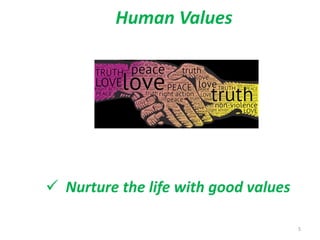
Human Values
5
 Nurture the life with good values
6
Human Values
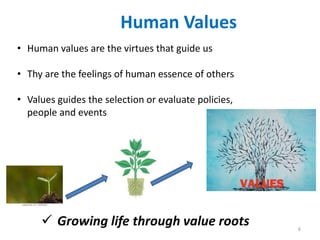
• Human values are the virtues that guide us
• Thy are the feelings of human essence of others
• Values guides the selection or evaluate policies,
people and events
 Growing life through value roots
7
Some Basic Human Values
• Self direction
• Stimulation
• Achievement
• Power
• Security
• Tradition
• Customs
• Benevolence
• Universalism
 Value addition to human life through basics
8
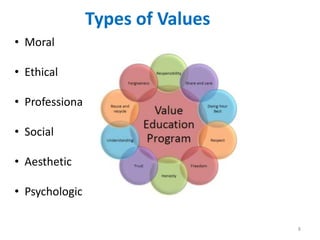
Types of Values
• Moral
• Ethical
• Professional
• Social
• Aesthetic
• Psychological
Morals
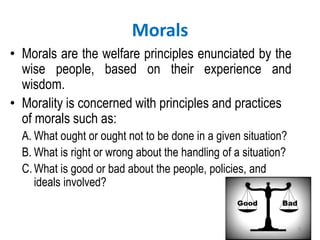
• Morals are the welfare principles enunciated by the
wise people, based on their experience and
wisdom.
• Morality is concerned with principles and practices
of morals such as:
A. What ought or ought not to be done in a given situation?
B. What is right or wrong about the handling of a situation?
C.What is good or bad about the people, policies, and
ideals involved?
9
10
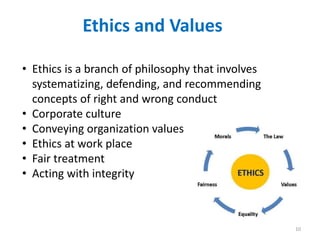
Ethics and Values
• Ethics is a branch of philosophy that involves
systematizing, defending, and recommending
concepts of right and wrong conduct
• Corporate culture
• Conveying organization values
• Ethics at work place
• Fair treatment
• Acting with integrity
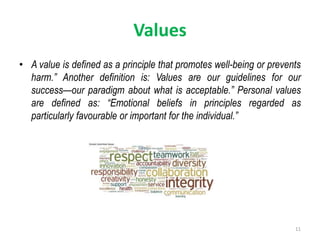
Values
• A value is defined as a principle that promotes well-being or prevents
harm.” Another definition is: Values are our guidelines for our
success—our paradigm about what is acceptable.” Personal values
are defined as: “Emotional beliefs in principles regarded as
particularly favourable or important for the individual.”
11
Values
12
13
14
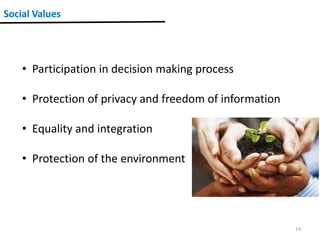
Social Values
• Participation in decision making process
• Protection of privacy and freedom of information
• Equality and integration
• Protection of the environment
Honesty
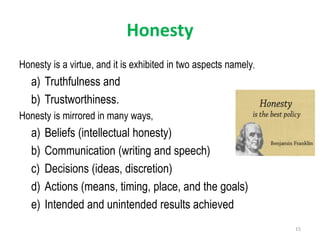
Honesty is a virtue, and it is exhibited in two aspects namely,
a) Truthfulness and
b) Trustworthiness.
Honesty is mirrored in many ways,
a) Beliefs (intellectual honesty)
b) Communication (writing and speech)
c) Decisions (ideas, discretion)
d) Actions (means, timing, place, and the goals)
e) Intended and unintended results achieved
15
Honesty cont.
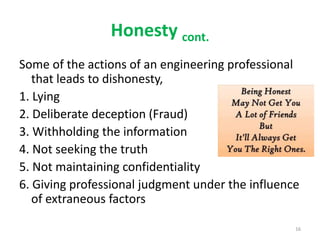
Some of the actions of an engineering professional
that leads to dishonesty,
1. Lying
2. Deliberate deception (Fraud)
3. Withholding the information
4. Not seeking the truth
5. Not maintaining confidentiality
6. Giving professional judgment under the influence
of extraneous factors
16
Courage
Courage is the tendency to accept and face risks and difficult
tasks in rational ways
• Courage is classified into three types, based on the types of
risks, namely
Physical courage: People with high adrenalin, may be prepared
to face challenges for the mere ‘thrill’
Social courage: involves the decisions and actions to change the
order requires leadership abilities
Intellectual courage: People through acquired knowledge,
experience, sports, education, and training
• Look before you leap. One should perform Strengths,
Weakness, Opportunities, and Threat (SWOT) analysis.
Calculate (estimate) the risks, compare with one’s strengths,
and anticipate the end results, while taking decisions and
before getting into action. 17
Courage cont.
The courageous people own and have shown the
following characteristics, in their professions:
• Perseverance (sustained hard work),
• Experimentation (preparedness to face the
challenges, that is, unexpected or unintended
results),
• Involvement (attitude, clear and firm resolve to
act), and
• Commitment (willing to get into action and to
reach the desired goals by any alternative but
ethical means).
18
Co-operation
Co-operation is activity among persons or sectors that aims at
integration of operations (synergy), while not sacrificing the
autonomy of either party
• Team-spirit present with every individual engaged in
engineering
• Working together ensures, coherence
– blending of different skills required towards common goals
The obstacle to successful co-operation are:
1. Clash of ego of individuals
2. Lack of leadership and motivation
3. Conflicts of interests, based on region, religion, language, and
caste.
4. Ignorance and lack of interest 19
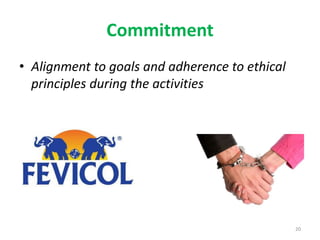
Commitment
• Alignment to goals and adherence to ethical
principles during the activities
20
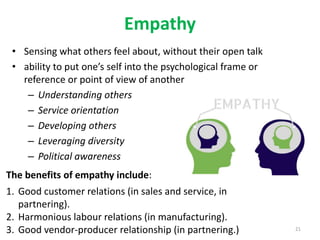
Empathy
• Sensing what others feel about, without their open talk
• ability to put one’s self into the psychological frame or
reference or point of view of another
– Understanding others
– Service orientation
– Developing others
– Leveraging diversity
– Political awareness
The benefits of empathy include:
1. Good customer relations (in sales and service, in
partnering).
2. Harmonious labour relations (in manufacturing).
3. Good vendor-producer relationship (in partnering.) 21
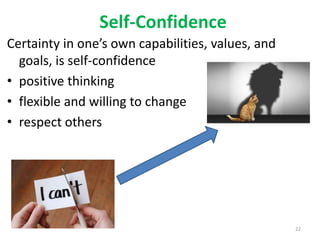
Self-Confidence
Certainty in one’s own capabilities, values, and
goals, is self-confidence
• positive thinking
• flexible and willing to change
• respect others
22
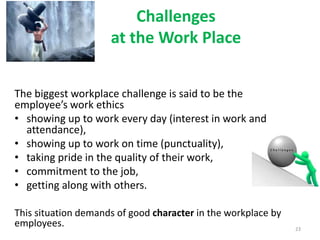
Challenges
at the Work Place
The biggest workplace challenge is said to be the
employee’s work ethics
• showing up to work every day (interest in work and
attendance),
• showing up to work on time (punctuality),
• taking pride in the quality of their work,
• commitment to the job,
• getting along with others.
This situation demands of good character in the workplace by
employees. 23
Character
• It is the property that defines the behaviour of an individual
• It is the pattern of virtues
• Character includes attributes that determine a person’s moral
and ethical actions and responses
• It is also the ground on which morals and values blossom
• The character is exhibited through conduct
• Character is determined by the expectations of society
• People are divided into several categories, according to
common tendencies such as ruthless, aggressiveness,
ambition, constricting selfishness, stinginess, cheerfulness,
generosity and goodwill, etc.
24
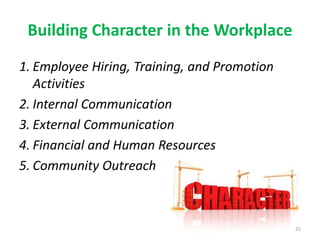
Building Character in the Workplace
1. Employee Hiring, Training, and Promotion
Activities
2. Internal Communication
3. External Communication
4. Financial and Human Resources
5. Community Outreach
25
‘Spirit’uality
• Spirituality is a way of living that emphasizes the constant
awareness and recognition of the spiritual dimension (mind
and its development) of nature and people, with a dynamic
balance between the material development and the spiritual
development.
• Sometimes, spirituality includes the faith or belief in
supernatural power/God, regarding the worldly events. It
functions as a fertilizer for the soil ‘character’ to blossom into
values and morals.
• Spirituality includes creativity, communication, recognition of
the individual as human being, respect to others, acceptance,
and partnership.
• Creativity in spirituality means conscious efforts to see things
differently, to break out of habits and outdated beliefs to find
new ways of thinking, doing and being. 26
‘Spirit’uality in the Workplace
Spirituality is promoted in the workplace by adhering to the
following activities:
1. Verbally respect the individuals as humans and recognize
their values in all decisions and actions.
2. Get to know the people with whom you work and know what
is important to them. Know their goals, desires, and dreams
too.
3. State your personal ethics and your beliefs clearly.
4. Support causes outside the business.
5. Encourage leaders to use value-based discretion in making
decisions.
6. Demonstrate your own self-knowledge and spirituality in all
your actions.
7. Do unto others as you would have them do unto you. 27
‘Spirit’uality for Corporate Excellence
• Self-awareness — Realization of self-potential.
• Holism — Holistic thinking, which means the welfare of the self,
family, organization and the society
• Compassion — Sympathy, empathy and concern for others.
• Respect for diversity — It means search for unity in diversity i.e.,
respect others and their views.
• Moral Autonomy — It means action based on rational and moral
judgment.
• Creative thinking and constant reasoning — Think if we can do
something new and if we can improve further?
• Positive views of adversity — Every threat is converted into
opportunity.
• Humility — The attitude to accept criticism
• Sense of vocation — Treat the duty as a service to society
28

professional ethics and human values

  • 1.
    Dr. Suriapparao DV Asst.Professor Dept. of Chemical Engineering Professional Ethics and Human Values 1 Date: 23-08-2018 Lecture 1
  • 2.
    Objectives Identify the corevalues that shape the ethical behaviour of an engineering professional Awareness on professional ethics and human values To Know their role in technological development To make you a good human being at home, society and at work place 2
  • 3.
    Unit 1: HumanValues Morals, Values and Ethics - Integrity - work Ethic - Service Learning - Civic Virtue - Respect for others - Living peacefully - Caring - Sharing - Honesty - Courage - Valuing time - Co-operation - Commitment - Empathy - Self-Confidence - Character - Spirituality Unit 2: Engineering Ethics Sense of 'Engineering Ethics' - Variety of moral issued - types of inquiry - moral dilemmas - moral autonomy - Kohlberg's theory - Gilligan's theory - Consensus and controversy - Models of Professional Roles & Professionalism - theories about right action - Self-interest - customs and religion - uses of ethical theories. Unit 3: Engineering as experimentation Engineers as responsible experimenters - Research ethics -Codes of ethics - Industrial Standard - Balanced outlook on law - the challenger case study. Unit 4: Safety and risk Safety and risk - assessment of safety and risk - Risk benefit analysis and reducing risk - the three mile island and Chernobyl case studies - Threat of Nuclear power - Collegiality and loyalty - respect for authority - collective bargaining - Confidentiality - conflicts of interest - occupation crime - professional rights - employees’ rights - Intellectual Property rights (IPR) - discrimination. Unit 5: Global Issues Multinational corporations - Business ethics - Environmental ethics - computer ethics - Role in Technological Development - Weapons development - consulting engineers - engineers as expert witnesses and advisors - Engineering council of India -Ethics and codes of business conduct in MNC Course Content 3
  • 4.
    Course Evaluation Mid SemesterExam : 25 marks End Semester Exam : 50 marks Internal Assessment : 25 marks (Attendance, Assignment) Lectures – 1 hr/week Credits – 1 4 In real life examinations
  • 5.
    Human Values 5  Nurturethe life with good values
  • 6.
    6 Human Values • Humanvalues are the virtues that guide us • Thy are the feelings of human essence of others • Values guides the selection or evaluate policies, people and events  Growing life through value roots
  • 7.
    7 Some Basic HumanValues • Self direction • Stimulation • Achievement • Power • Security • Tradition • Customs • Benevolence • Universalism  Value addition to human life through basics
  • 8.
    8 Types of Values •Moral • Ethical • Professional • Social • Aesthetic • Psychological
  • 9.
    Morals • Morals arethe welfare principles enunciated by the wise people, based on their experience and wisdom. • Morality is concerned with principles and practices of morals such as: A. What ought or ought not to be done in a given situation? B. What is right or wrong about the handling of a situation? C.What is good or bad about the people, policies, and ideals involved? 9
  • 10.
    10 Ethics and Values •Ethics is a branch of philosophy that involves systematizing, defending, and recommending concepts of right and wrong conduct • Corporate culture • Conveying organization values • Ethics at work place • Fair treatment • Acting with integrity
  • 11.
    Values • A valueis defined as a principle that promotes well-being or prevents harm.” Another definition is: Values are our guidelines for our success—our paradigm about what is acceptable.” Personal values are defined as: “Emotional beliefs in principles regarded as particularly favourable or important for the individual.” 11
  • 12.
  • 13.
  • 14.
    14 Social Values • Participationin decision making process • Protection of privacy and freedom of information • Equality and integration • Protection of the environment
  • 15.
    Honesty Honesty is avirtue, and it is exhibited in two aspects namely, a) Truthfulness and b) Trustworthiness. Honesty is mirrored in many ways, a) Beliefs (intellectual honesty) b) Communication (writing and speech) c) Decisions (ideas, discretion) d) Actions (means, timing, place, and the goals) e) Intended and unintended results achieved 15
  • 16.
    Honesty cont. Some ofthe actions of an engineering professional that leads to dishonesty, 1. Lying 2. Deliberate deception (Fraud) 3. Withholding the information 4. Not seeking the truth 5. Not maintaining confidentiality 6. Giving professional judgment under the influence of extraneous factors 16
  • 17.
    Courage Courage is thetendency to accept and face risks and difficult tasks in rational ways • Courage is classified into three types, based on the types of risks, namely Physical courage: People with high adrenalin, may be prepared to face challenges for the mere ‘thrill’ Social courage: involves the decisions and actions to change the order requires leadership abilities Intellectual courage: People through acquired knowledge, experience, sports, education, and training • Look before you leap. One should perform Strengths, Weakness, Opportunities, and Threat (SWOT) analysis. Calculate (estimate) the risks, compare with one’s strengths, and anticipate the end results, while taking decisions and before getting into action. 17
  • 18.
    Courage cont. The courageouspeople own and have shown the following characteristics, in their professions: • Perseverance (sustained hard work), • Experimentation (preparedness to face the challenges, that is, unexpected or unintended results), • Involvement (attitude, clear and firm resolve to act), and • Commitment (willing to get into action and to reach the desired goals by any alternative but ethical means). 18
  • 19.
    Co-operation Co-operation is activityamong persons or sectors that aims at integration of operations (synergy), while not sacrificing the autonomy of either party • Team-spirit present with every individual engaged in engineering • Working together ensures, coherence – blending of different skills required towards common goals The obstacle to successful co-operation are: 1. Clash of ego of individuals 2. Lack of leadership and motivation 3. Conflicts of interests, based on region, religion, language, and caste. 4. Ignorance and lack of interest 19
  • 20.
    Commitment • Alignment togoals and adherence to ethical principles during the activities 20
  • 21.
    Empathy • Sensing whatothers feel about, without their open talk • ability to put one’s self into the psychological frame or reference or point of view of another – Understanding others – Service orientation – Developing others – Leveraging diversity – Political awareness The benefits of empathy include: 1. Good customer relations (in sales and service, in partnering). 2. Harmonious labour relations (in manufacturing). 3. Good vendor-producer relationship (in partnering.) 21
  • 22.
    Self-Confidence Certainty in one’sown capabilities, values, and goals, is self-confidence • positive thinking • flexible and willing to change • respect others 22
  • 23.
    Challenges at the WorkPlace The biggest workplace challenge is said to be the employee’s work ethics • showing up to work every day (interest in work and attendance), • showing up to work on time (punctuality), • taking pride in the quality of their work, • commitment to the job, • getting along with others. This situation demands of good character in the workplace by employees. 23
  • 24.
    Character • It isthe property that defines the behaviour of an individual • It is the pattern of virtues • Character includes attributes that determine a person’s moral and ethical actions and responses • It is also the ground on which morals and values blossom • The character is exhibited through conduct • Character is determined by the expectations of society • People are divided into several categories, according to common tendencies such as ruthless, aggressiveness, ambition, constricting selfishness, stinginess, cheerfulness, generosity and goodwill, etc. 24
  • 25.
    Building Character inthe Workplace 1. Employee Hiring, Training, and Promotion Activities 2. Internal Communication 3. External Communication 4. Financial and Human Resources 5. Community Outreach 25
  • 26.
    ‘Spirit’uality • Spirituality isa way of living that emphasizes the constant awareness and recognition of the spiritual dimension (mind and its development) of nature and people, with a dynamic balance between the material development and the spiritual development. • Sometimes, spirituality includes the faith or belief in supernatural power/God, regarding the worldly events. It functions as a fertilizer for the soil ‘character’ to blossom into values and morals. • Spirituality includes creativity, communication, recognition of the individual as human being, respect to others, acceptance, and partnership. • Creativity in spirituality means conscious efforts to see things differently, to break out of habits and outdated beliefs to find new ways of thinking, doing and being. 26
  • 27.
    ‘Spirit’uality in theWorkplace Spirituality is promoted in the workplace by adhering to the following activities: 1. Verbally respect the individuals as humans and recognize their values in all decisions and actions. 2. Get to know the people with whom you work and know what is important to them. Know their goals, desires, and dreams too. 3. State your personal ethics and your beliefs clearly. 4. Support causes outside the business. 5. Encourage leaders to use value-based discretion in making decisions. 6. Demonstrate your own self-knowledge and spirituality in all your actions. 7. Do unto others as you would have them do unto you. 27
  • 28.
    ‘Spirit’uality for CorporateExcellence • Self-awareness — Realization of self-potential. • Holism — Holistic thinking, which means the welfare of the self, family, organization and the society • Compassion — Sympathy, empathy and concern for others. • Respect for diversity — It means search for unity in diversity i.e., respect others and their views. • Moral Autonomy — It means action based on rational and moral judgment. • Creative thinking and constant reasoning — Think if we can do something new and if we can improve further? • Positive views of adversity — Every threat is converted into opportunity. • Humility — The attitude to accept criticism • Sense of vocation — Treat the duty as a service to society 28