`
1
LECTURE NOTE
On
BASIC OF CIVIL ENGINEERING
COURSE CODE: BCE02001: 3.0.0 (CR 03)
Second Semester, B Tech, Civil Engineering
Dr. Saubhagya Kumar Panigrahi
Associate Professor
Deptt. of Civil Engg
VSSUT BURLA
`
2
Syllabus for Second Semester, B Tech, Civil Engineering
BASIC OF CIVIL ENGINEERING (BCE02001)
Module-I
Introduction to Civil Engineering – Various disciplines of Civil engineering, Importance of
Civil engineering in infrastructure development of the country.
Introduction to types of buildings as per NBC, Selection of site for buildings, Components of
a residential building and their functions, Introduction to Industrial buildings and types.
Building Planning – Basic requirements, elements, introduction to various building area
terms, computation of plinth area, carpet area.
Module-II
Surveying – Principle and objectives, Instruments used, Horizontal measurements, Ranging
(direct ranging only), Instruments used for ranging, Leveling – Definition, Principles,
Instruments, Preparation of level book, problems on leveling, Modern surveying instruments
– EDM, Total station, GPS (Brief discussion)
Building Materials – Bricks, properties and specifications, Cement – Types, properties,
grades, other types of cement and uses, Cement mortar – Constituents, Preparation, Concrete
– PCC and RCC, Grades, Steel – Use of steel in buildings, types.
Module-III
Building Construction – Foundations, Classification, Bearing Capacity of Soil and related
terms (definition only), Masonry Works – classifications, definition of different technical
terms, Brick masonry – types, bonds, general principle, Roofs – functional requirements,
basic technical terms, roof covering material, Floors – function, types, flooring materials
(brief discussion), Plastering and Painting – objectives, types, preparation and procedure of
application.
Module-IV
Basic Infrastructure services – air conditioning & purpose, fire protection & materials,
Ventilation, necessity & functional requirements, Lifts, Escalators.
Introduction to planning and design aspects of transportation engineering, Transportation
modes, Highway engineering – historical development, highway planning, classification of
highway, Railway Engineering – cross section of rail track, basic terminology, geometric
design parameter (brief discussion only).
Module-V
Airport engineering – development, types, definition, characteristics of aircraft, basic
terminology, Traffic engineering – traffic characteristics, traffic studies, traffic operations
(signals, signs, markings), Urban engineering – classification of urban road.
Irrigation & Water Supply Engineering – Introduction, Types of Irrigation, different types of
hydraulic structures, dam and weirs, types of dam, purpose and functions.
Text Books:
 Basic Civil engineering, Gopi, S., Pearson Publication
 Basic Civil Engineering, Bhavikatti, S. S., New Age.
Reference Books:
 Construction Technology, Chudley, R., Longman Group, England
 Basic Civil and Environmental Engineering, C.P. Kausik, New Age.
 American Society of Civil Engineers (2011) ASCE Code of Ethics – Principles Study and
Application
`
3
BASIC OF CIVIL ENGINEERING (BCE02001)
Module-I
Module I Syllabus
Introduction to Civil Engineering – Various disciplines of Civil engineering, Importance of
Civil engineering in infrastructure development of the country.
Introduction to types of buildings as per NBC, Selection of the site for buildings, Components
of a residential building and their functions, Introduction to Industrial buildings and types.
Building Planning – Basic requirements, elements, introduction to various building area
terms, computation of plinth area, carpet area.
Subject to Revision
`
4
1.1 INTRODUCTION TO CIVIL ENGINEERING :-
Civil engineering is a professional engineering discipline that deals with the design,
construction, and maintenance of the physical and naturally built environment, including
public works such as roads, bridges, canals, dams, airports, sewage systems, pipelines,
structural components of buildings, and railways.
Civil engineering is traditionally broken into a number of sub-disciplines. Civil engineering is
the application of physical and scientific principles for solving the problems of society, and
its history is intricately linked to advances in the understanding of physics and mathematics
throughout history. Because civil engineering is a broad profession, including several
specialized sub-disciplines, its history is linked to knowledge of structures, materials
science, geography, geology, soils, hydrology, environmental science, mechanics, project
management, and other fields.
1.2 DISCIPLINES OF CIVIL ENGINEERING-
The various disciplines of civil engineering are-
1. ARCHITECTURE AND TOWN PLANNING
An art of shaping and guiding the physical growth of the town creating buildings and
environments to meet the various needs such as social, cultural, economic and recreational
etc. and to provide healthy conditions for both rich and poor to live, to work, and to play
or relax, thus bringing about the social and economic well-being for the majority of
mankind is known as town planning.
`
5
OBJECTIVES OF TOWN PLANNING-
 To create and promote healthy conditions and environments for all the people.
 To make right use of the land for the right purpose by zoning
 To ensure orderly development
 To avoid encroachment of one zone over the other.
2. BUILDING MATERIALS TECHNOLOGY
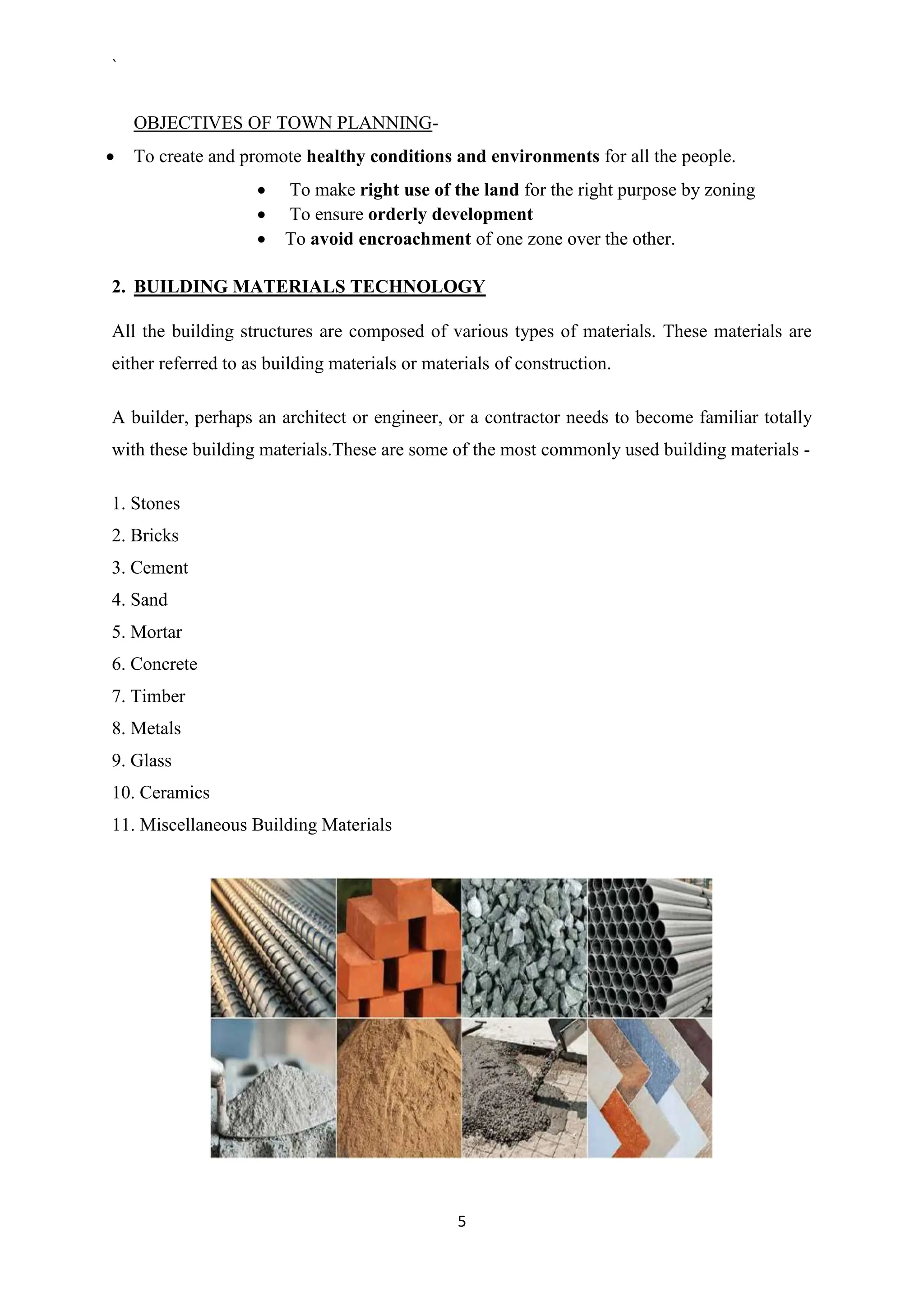
All the building structures are composed of various types of materials. These materials are
either referred to as building materials or materials of construction.
A builder, perhaps an architect or engineer, or a contractor needs to become familiar totally
with these building materials.These are some of the most commonly used building materials -
1. Stones
2. Bricks
3. Cement
4. Sand
5. Mortar
6. Concrete
7. Timber
8. Metals
9. Glass
10. Ceramics
11. Miscellaneous Building Materials
`
6
3. CONSTRUCTION TECHNOLOGY AND MANAGEMENT
It focuses on the knowledge and skills required for the planning, coordination and
successful implementation of large Projects such as design and construction of structures
and buildings, ship structures, aircraft, dams, roads, and bridges etc. It is a fusion of
engineering and management.
4. ENVIRONMENTAL ENGINEERING:-
 This field is concerned with the study of the necessary methods and techniques of
environment protection as well as the availability of the basic life elements such as
water and air with a specific level of quality to protect the mankind health and
environment.
 This includes design and construction of water distribution networks, wastewater and
storm water collection systems, water treatment plants and wastewater treatment
for reuse in industrial and agricultural fields.
 Environmental engineering involves also the study of the different techniques of
controlling air, water and soil pollution as well as the proper disposal or recycle of
solid and hazardous wastes.
5. GEOTECHNICAL ENGINEERING:-
 This field is concerned with the study of the soil properties of the construction site and
its bearing capacity.
 Geotechnical engineering is concerned also with the suitable solutions for any problem
in the soil as well as the choice of the best and secured methods of design and
construction of the foundation of engineering structures.
6. HYDRAULICS AND WATER RESOURCES ENGINEERING-
 This field covers the basic concepts of water science and its related theorems and
applications. This includes the methods of transporting water from sources to
distribution sites through channels and pipelines, water sources and storage system,
types of dams and their design methods.
 It involves also the study of seawater movements and shore protection.
`
7
 Hydraulic engineering consists of the application of fluid mechanics to water flowing in
an isolated environment (pipe, pump) or in an open channel (river, lake, ocean).
7. REMOTE SENSING ENGINEERING-
Remote sensing is the process of detecting and monitoring the physical characteristics of
an area by measuring its reflected and emitted radiation at a distance (typically from
satellite or aircraft).
Some specific uses of remotely sensed images of the Earth include:
 Large forest fires can be mapped from space, allowing rangers to see a much larger
area than from the ground.
 Tracking clouds to help predict the weather or watching erupting volcanoes, and help
watching for dust storms.
 Tracking the growth of a city and changes in farmland or forests over several
years or decades.
 Discovery and mapping of the rugged topography of the ocean floor (e.g., huge
mountain ranges, deep canyons, and the “magnetic striping” on the ocean floor).
8. STRUCTURAL ENGINEERING:-
 This discipline deals with the analysis and design of concrete and steel structures,
such as multi-story buildings, bridges, towers....etc. It deals also with the study of the
durability and resistibility of such structures for live loads, wind and earthquake.
 The study involves also the study of the properties of building materials according to the
international specifications.
9. SURVEYING:-
Surveying typically involves measurements of horizontal and vertical distances between
points. It also includes descriptions of the exact characteristics of the land structure and
surface.
A surveying engineer also works to:
 provide the proper design and development of infrastructure
 protect the surrounding natural environment
 maximize the efficiency of the proposed structures
`
8
10. TRANSPORTATION ENGINEERING:-
Transportation engineering is a branch of civil engineering that involves the planning,
design, operation, and maintenance of transportation systems to help build smart, safe,
and liveable communities.
Any system that moves people and goods from one place to another falls under the scope of
transportation engineering, which includes:
 Highways and roadways
 Railways
 Oil pipelines
 Public transport systems
 Traffic control systems
 Automated transport systems
 Space transport systems
1.3 Importance of Civil Engineering in Infrastructure Development of the Country:-
Civil Engineers play a major role in the infrastructure development of a country. All
structures constructed in the past exhibit the path of civilization and current infrastructures
development express the practices followed by civil engineers.
Infrastructure can be defined as activities that provide society with services necessary to
conduct daily life and to engage in productive activity and development in a country’s
economy.
In a country like India, the major infrastructural. Factors that are most significant in
accelerating the pace of economic development are energy, transport, irrigation, finance,
communications, education, and health.
The knowledge of basic areas of civil engineering can be of great use in providing the
infrastructural facilities where constructional aspects are involved for development of
regions.
 Good surface communication links such as tar or concrete rods.
 Provision of water supply distribution system i.e., construction of water storage
reservation or sumps, laying of underground pipes etc.
 Provision of a drainage system which may include construction of surface drains
as subsurface drains for the disposal of wastewater.
 Supply of electrical power for which construction of transmission line towers,
construction of electrical substations.
`
9
 Providing inland communications lines, i.e., telephone lines etc.
 Construction of recreational places e.g., gardens, parks etc.
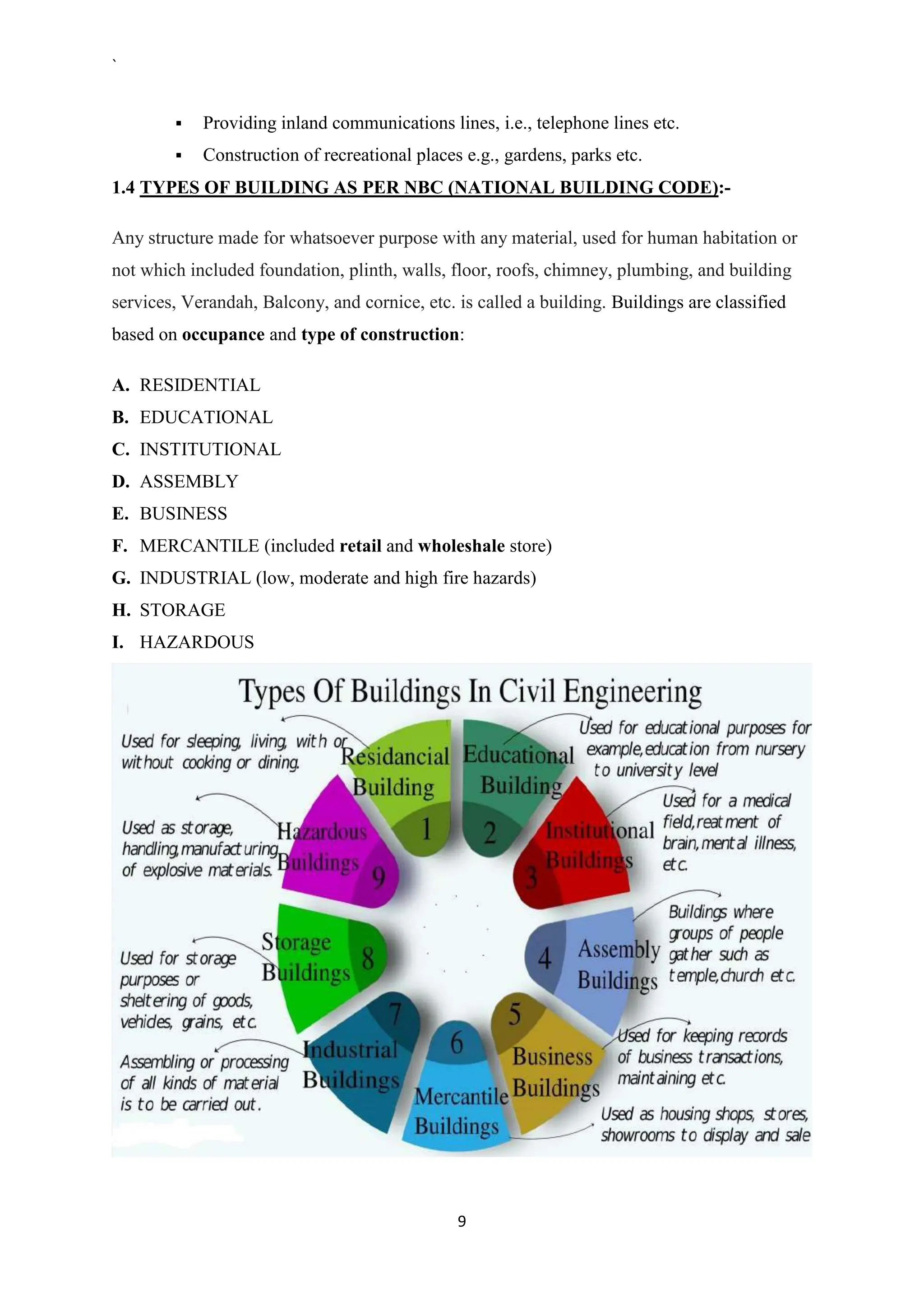
1.4 TYPES OF BUILDING AS PER NBC (NATIONAL BUILDING CODE):-
Any structure made for whatsoever purpose with any material, used for human habitation or
not which included foundation, plinth, walls, floor, roofs, chimney, plumbing, and building
services, Verandah, Balcony, and cornice, etc. is called a building. Buildings are classified
based on occupance and type of construction:
A. RESIDENTIAL
B. EDUCATIONAL
C. INSTITUTIONAL
D. ASSEMBLY
E. BUSINESS
F. MERCANTILE (included retail and wholeshale store)
G. INDUSTRIAL (low, moderate and high fire hazards)
H. STORAGE
I. HAZARDOUS
`
10
1. Residential Buildings-
Any building in which sleeping accommodation is provided for normal residential
purposes with or without cooking/dining. These are further classified as:
Group A-Residential
A1: Lodging or rooming houses.
A2: One or two-family private dwellings
A3: Dormitories
A4: Apartment houses
A5: Hotels (upto 4 star category)
A6: Hotels (Starred- five star and above)
(i) Lodging and rooming houses- These are buildings in which separate sleeping
accommodation with or without a dining facility but without a cooking
facility is provided. For instance, Inns, Clubs, Motels, and Guesthouses.
(ii) One or two-family private dwelling- A private dwelling which is occupied by
members of one or two-family. Maximum sleeping accommodation is provided
for 20 persons.
(iii) Dormitories- Any building in which group sleeping accommodation is provided
with or without dining facilities. e.g., School and College Dormitories, Hostels,
and Military Barracks.
(iv) Apartment Houses- Buildings in which living quarters are provided for three or
more families having independent cooking facilities and living independently of
each other. e.g., apartments, Mansions, and Chowls.
(v) Hotels -Buildings in which sleeping accommodation is provided with or without
dining facilities for up to four-star categories (hotels).
(vi) Hotels (Starred) Normally five star and above by local authority.
2. Educational Buildings
Any building used for school, college, and other training institutions having a
minimum of 20 students.
(i) Schools up to Senior Secondary level Minimum students should be 20.
(ii) All others/training institute Minimum students should be 100.
3. Institutional Buildings-
Buildings that are used for medical or other treatment, care of persons suffering from
physical and mental illness, care of infants, for inmates etc are called institutional buildings
`
11
(i) Hospital and Sanatoria -Any building which is used for the treatment of patients
e.g., hospitals, sanatoria, infirmaries, and nursing homes.
(ii) Custodial Institutions Any building used for custody and care of a person for
instance children, old age homes, orphanages, etc
(iii) Penal and mental institutions Any building which is used for housing persons
whose liberty is restricted e.g., jails, prisons, mental hospitals, etc.
4. Assembly Buildings
Any building in which a minimum of 50 persons gathers for recreational, amusement, social,
religious, patriotic purposes e.g., theatres, assembly halls, exhibition halls, museums,
estaurants, places of worship, etc.
These are classified into 7 types:
(i) The building having theatrical or motion pictures or any other stage having fixed
seats for over 1000 persons.
(ii) The building having theatrical or motion pictures or any other stage having fixed
seats for up to 1000 persons.
(iii) Buildings without a permanent stage having an accommodation for 300 or more
persons but no permanent seating arrangements.
(iv) All other structures including temporary structures designed for assembly of
peoples.
(v) Buildings having mixed occupancies of assembly and mercantile
(vi) Underground and elevated mass rapid transit system.
5. Business Buildings
Any buildings used for the transaction of business, professional establishments, service
facilities, etc. are termed as business buildings.
These are further divided into 5 types –
(i) Offices, banks, professional establishments etc.
(ii) Laboratories, clinics, research establishments and libraries etc.
(iii) IT parks, call centers etc.
(iv) Telephone exchange
(v) Broadcasting stations, TV stations and air traffic control towers.
`
12
6. Mercantile Buildings
Any building which is used as a shop, store, market, etc. is known as mercantile buildings.
These are further classified as:
(i) Shops, stores, departmental stores, markets (covered area up to 500 sq. m ).
(ii) Shops, stores, departmental stores, markets (covered area more than 500 sq. m).
(iii) Underground shopping centres, storage and service facilities
7. Industrial Buildings
Any building in which products or materials are fabricated, assembled, manufactured, or
processed. For instance, assembly plants, industrial laboratories, power plants, pumping
stations, etc.
 Buildings for low hazard industry –
 Buildings in which those things are manufactured that have low
combustibility.
 Buildings for moderate hazard industry-
 Buildings in which those things are manufactured which will burn with
moderate rapidity.
 Buildings for high hazard industry-
 Buildings in which those things are manufactured which will burn with
extreme rapidity and results in hazardous situations.
8. STORAGE BUILDINGS
 Any building which is used for storage of goods, ware or merchandise, vehicles or
animals. e.g., warehouse, cold storage, garages, stables, etc.
9. HAZARDOUS BUILDINGS
 Buildings which are used for storage, handling, manufacture, or processing of highly
combustible or explosive material. For instance, manufacture of explosives and
fireworks, storage of highly flammable liquids, storage of LPG, rocket propellants,
etc.
`
13
1.5 SELECTION OF SITE FOR BUILDINGS :-
1. The soil of site should have good bearing capacity. Hard strata should be available
at reasonable depth, around 1.2m to1.5m depth from ground level.
2. The site should be on elevated ground. It should have slope towards front street to
afford good facility of drainage.
3. Sites nearer to ponds ,pools of water, water logged areas must be avoided as they
remain in damp condition .
4. Sites near to high voltage power transmission lines are avoided.
5. Sites very nearer to big shopping complexes , markets, railway station ,airport are
avoided
6. The surrounding of site should be pleasing and calm.
7. The orientation of site should be such that it receives natural light and air in
plenty.
8. The location of site is such that the common facilities like school, transportation,
medical facilities etc are within reasonable range.
9. Sites in developed colonies should be preferred.
10. The layout of the colony should be approved by local authorities. This will help in
getting essential facilities like water , drainage ,electricity, telephone connection
etc easily.
1.6 COMPONENTS OF RESIDENTIAL BUILDING
Building component means any subsystem, subassembly, or other system designed for use in,
or as part of, a structure, which may include structural, electrical, mechanical, plumbing, and
fire protection systems and other systems affecting health and safety.
The basic function of a building is to provide structurally sound and environmentally
controlled spaces to house and protect occupants and contents.A building is combination of
various components. A Civil Engineer should have good knowledge of execution of each and
every component with respect to design layouts given by Architect.
`
14
The following are the basic component parts of a residential building:-
1. Foundation
2. Plinth
3. Walls and columns
4. Sills, lintels and chejjas
5. Doors and windows
6. Floors
7. Roofs
8. Steps, stairs and lifts
9. Finishing work
10. Building services.
11. Parapet
The functions of these elements and the main requirement of them are discussed below-
1. Foundation:
Foundation is the most important part of the building. Building activity starts
`
15
with digging the ground for foundation and then building it. It is the lower most part of the
building. It transfers the load of the building to the ground. Its main functions and
requirements are:
(a) Distribute the load from the structure to soil evenly and safely.
(b) To anchor the building to the ground so that under lateral loads building will not move.
(c) It prevents the building from overturning due to lateral forces.
(d) It gives level surface for the construction of super structure.
2. Plinth:
 The portion of the wall between the ground level and the ground floor level is called
plinth. It is usually of stone masonry. If the foundation is on piles, a plinth beam is cast to
support wall above floor level. At the top of plinth, a damp proof course is provided. It is
usually 75 mm thick plain concrete course.
 The function of the plinth is to keep the ground floor above ground level, free of
dampness. Its height is not less than 450 mm. It is required that plinth level is at
least 150 mm above the road level, so that connections to underground drainage
system can be made.
3.Walls and Columns:-
The function of walls and columns is to transfer the load of the structure vertically
downwards to transfer it to foundation. Apart from this wall performs the following functions
also:
(a) It encloses building area into different compartments and provides privacy.
(b) It provides safety from burglary and insects.
(c) It keeps the building warm in winter and cool in summer.
4. Sills, Lintels and Chejjas:-
 A window frame should not be directly placed over masonry. It is placed over 50
mm to 75 mm thick plain concrete course provided over the masonry. This course
is called as sill.
 Lintels are the R.C.C. or stone beams provided over the door and window
openings to transfer the load transversely so as to see that door or window frame is
not stressed unduly. The width of lintels is equal to the width of wall while
thickness to be provided depends upon the opening size.
`
16
 Chejja is the projection given outside the wall to protect doors and windows from
the rain. They are usually made with R.C.C. In low cost houses stone slabs are
provided as chejjas. The projection of chejja varies from 600 mm to 800 mm.
Sometimes drops are also provided to chejjas to improve aesthetic look and also to
get additional protection from sun and rain.
5. Doors and Windows:-
 The function of a door is to give access to different rooms in the building and to deny
the access whenever necessary. Number of doors should be minimum possible. The
size of the door should be of such dimension as will facilitate the movement of the
largest object likely to use the door.
 Windows are provided to get light and ventilation in the building. They are located at
a height of 0.75 m to 0.9 m from the floor level. In hot and humid regions, the
window area should be 15 to 20 per cent of the floor area. Another thumb rule used to
determine the size and the number of windows is for every 30 sq. m of inside volume
there should be 1 sq. m window opening.
6. Floors:-
 Floors are the important component of a building. They give working/useful area for
the occupants. The ground floor is prepared by filling brick bats, waste stones, gravel
and well compacted with not less than 100 mm sand layer on its top. A lean concrete
of 1 : 4 : 8, 100 mm thick is laid. On this a damp proof course may be provided. Then
floor finishing is done as per the requirement of the owner.
 Cheapest floor finish for a moderate house is with 20 to 25 mm rich mortar course
finished with red oxide. The costliest floor finish is mosaic or marble finishing. Other
floors are usually of R.C.C. finished as per the requirements of the owner.
7. Roof:-
 Roof is the top most portion of the building which provide top cover to the building. It
should be leak proof. Sloping roof like tiled and A.C. sheet give leak proof cover
easily. But they do not give provision for the construction of additional floor. Tiled
roof gives good thermal protection. Flat roofs give provision for additional floors.
Terrace adds to the comfort of occupants. Water tanks can be easily placed over the
flat roofs.
`
17
8. Step, Stairs and Lifts:-
 Steps give convenient access from ground level to ground floor level. They are
required at doors in the outer wall. 250 to 300 mm wide and 150 mm rise is ideal size
for steps. In no case the size of two consecutive steps be different. Number of steps
required depends upon the difference in the levels of the ground and the floor.
 Stairs give access from floor to floor. They should consist of steps of uniform sizes.
In all public buildings lifts are to be provided for the conveniences of old and
disabled persons.
 In hostels G + 3 floors can be without lifts. Lift is to be located near the entrance.
Size of the lift is decided by the number of users in peak hours. Lifts are available
with capacity 4 to 20 persons.
10. Finishing:-
 Bottom portion of slab (ceiling), walls and top of floor need smooth finishing
with plaster. Then they are provided with white wash, distemper or paints or tiles.
The function of finishing work is:
o Give protective cover
o Improve aesthetic view
o Rectify defective workmanship
o Finishing work for plinth consists in pointing while for floor it consists in
polishing.
 Building Services:-
 Water supply, sanitation and drainage works, electric supply work and
construction of cupboards and show cases constitute major building services.
 For storing water from municipal supply or from tanker a sump is built in the house
property near street. From the sump water is pumped to overhead tanks placed on or
above roof level so as to get water all the 24 hours. Plumbing work is made so as to
get water in kitchen, bathrooms, water closets, sinks and garden taps. For draining
rain water from roofs, down take pipes of at least 100 mm diameters should be used.
Proper slopes should be given to roof towards down take pipe. These pipes should be
fixed at 10 to 15 mm below the roof surface so that rain water is directed to the down
take pipe easily.
`
18
 The sanitary fittings are to be connected to stone ware pipes with suitable traps and
chambers. Stone ware pipes are then connected to underground drainage of municipal
lines or to the septic tank.
 Many carpentry works are required for building service. They are in the form of
showcases, cupboards, racks etc.
 Electric supply is essential part of building services. The building should be
provided with sufficient points for supply of lights, fans and other electric gadgets.
11.Parapet:-
 The parapet is a minor wall around the edge of a roof, balcony, terrace, or stairway,
usually covering the roof’s perimeter. It protects the top and pre-built structures from
corrosion and degradation.
`
19
1.7 INTRODUCTION TO INDUSTRIAL BUILDING AND TYPES-
 Any building structure used by the industry to store raw materials or for manufacturing
products of the industryis known as an industrial building.
 Industrial buildings are generally used for steel plants, automobile industries, utility
and process industries, thermal power stations, warehouse, assembly plants, storage,
garages, etc.
Factors Considered while Selecting Site For Industrial Building:-
 Site should be located on an arterial road.
 Local availability of raw material.
 Facilities like water supply, electricity
 Topography of an area
 Soil conditions with respect to foundation design
 Waste disposal facilities
 Transportation facilities
 Sufficient space for storage of raw materials
Types of Industrial Building
1. Warehouses
2. Cold Storage Buildings
`
20
3. Telecom Centres or Data Hosting Centres
4. Flex Buildings
5. Light Manufacturing Buildings
6. Research And Development Set up
1. Warehouse
 There are buildings that are used for storing goods on behalf of other companies.
These are called warehouses. Although warehouses can be of different sizes, they are
usually large and are located outside city limits. They can have more than one storey
and can have loading docks, huge parking lots of big trucks. They can also have a
small office set up inside the premises.
 These typical single-story warehouses range in size from 5,000 to hundreds of
thousands of square feet and are used for the storage and transport of goods. Ceilings
are generally at least 60 feet high because of the necessary racking and storage
systems concealed beneath its roof. Loading docks, big truck doors, and parking areas
for semi-trailers used for distribution are among the other important elements of an
industrial building.
`
21
2. Cold Storage Buildings-
 Refrigeration and cold storage facilities are distribution centres dedicated to food
items like meat, produce, and dairy. These buildings provide rooms for cooling and
freezing in order to maintain goods at the right temperatures before they are sent out.
Other key features include docks with special seals to keep products cool, as well as
insulated overhead doors that keep them frozen.
 These are especially built to store large amounts of food products and keep them
under refrigerated conditions for long periods. These buildings are located mostly
along state and national highways and in places where there is good supply of
electricity.
3. Telecom/Data Hosting Centers (Switching Centers, Cyber Centers, Web Hosting
Facilities, Telecom Centers )
 These highly specialized industrial buildings are located close to major
communications trunk lines to allow for access to an extremely large and redundant
power supply capable of powering extensive computer servers and telecom switching
equipment.
4. FLEX BUILDING:-
 This is the newest addition to the category of industrial segment of industrial real
estate and is a result of the evolving needs of modern times. These flex building have
more than one usage and can accommodate a Rand D facility, an office set up,
light manufacturing and even showroom spaces. They are flexible in nature and some
of the uses can be changed by making simple modifications.
`
22
 FLEX Building Systems is committed to providing flexible, superior building
systems for a variety of applications. Flex buildings often incorporate different areas
or spaces in a design, optimised for different purposes and needs. This can be either
an uninsulated or insulated warehouse, workshop, garage or even a showroom,
often in combination with one or more offices. The buildings often have to balance
complex solutions for production, cold storage and heating. Flex space buildings are
mainly of three types - Research and Development buildings, Data centre
buildings, and Show rooms.
5. LIGHT MANUFACTURING BUILDING:-
These buildings can be used in processing food items or assembly of light machinery like
fans, water pumps, gadgets, etc. These are generally small in size as compared to heavy
industrial buildings and do not have blast furnace, high capacity exhaust systems etc. These
`
23
buildings can sometimes find alternative uses like a unit making water pumps can be
converted in to assembly unit for gadget by making changes in the some of the installed
machinery.
6. RESEARCH AND DEVELOPMENT BUILDING:-
Research and Development (R&D) forms an integral part of many businesses and they like to
set up their own R&D centres which cater to their specific requirements. A lot of life sciences
companies have their R&D centres which are usually owned by them. These centres are
generally not in the centre of the city. Companies can house their scientists and other staff in
these centres and hence there are residential elements in this kind of a set up. There can also
be elements of office buildings in a R&D centre. Sometimes these centres run on rented
buildings also but the lease period is usually long.
7. SHOWROOM BUILDINGS:-
A showroom, also referred to as a gallery, is a large space used to display products or show
entertainment. A showroom is a large space used to display products for sale, such as
automobiles, furniture, appliances, carpet or apparel. It is a retail store of a company in which
products are on sale in a space created by their brand or company. There are many types of
showroom buildings like jewellery shops, malls, large vehicle showroom, furniture
showrooms etc.
`
24
`
25
1.8 BUILDING PLANNING AND BASIC REQUIREMENTS:-
Every family needs a building to reside in. Apart from residential purposes, buildings are
required for educational, institutional, business, assembly, and industrial purposes. Buildings
are necessary for the storage of materials also. This article will discuss the basic requirements
of a building concerning orientation, the utility of space, energy efficiency, and other
requirements,etc.
“The concept of positioning all the elements and units of a building in a systematic and
practical manner to have the maximum and best utilization of the available space, area
and facilities is termed as Principles of Building Planning.”
1.8.1 PRINCIPLES OF BUILDING PLANNING:-
“The concept of positioning all the elements and units of a building in a systematic and
practical manner to have the maximum and best utilization of the available space,
area and facilities is termed as Principles of Building Planning.”
There are several principles that affect the planning of a building. This article will give
you a brief knowledge of all those principles.
Factors Affecting Building Planning
1.8.2 FACTORS AFFECTING THE PLANNING OF THE BUILDING:
1. The function of the building e.g. residential, industrial, public, commercial, etc.
2. Shape and size of the plot
`
26
3. Topography
4. Climatic condition
5. Building by-Laws etc.
1.8.3 REQUIREMENTS OF BUILDING PLANNING AND THE CONSTRUCTION:
01. What is an ASPECT in building planning?
A building is a complete constitute of different rooms and blocks in it. All the rooms are
located according to the standard use of components considering the proper access of
natural resources, i.e., sunlight and wind. ASPECT is defined as a significant
arrangement of doors and windows in abuilding, which are enough and efficient to
provide sunlight, hygiene, wind, and eco-friendly environment. There must be
sufficient light and ventilation in each room and across the house.
The aspect of building can be achieved by arranging the rooms, kitchen, veranda, and
many other components in proper directions. The ways to cover the direction with
advisable aspect is given below:
`
27
The above diagram indicates the appropriate directions which should be preferred for the
positioning of various rooms in a house.
02. What are the PROSPECT principles in building planning?
In these modern times, all the buildings and constructions are aimed to achieve an
aesthetically appealing look from both exteriors and interior considerations. The
appearance of a house or a building is defined as PROSPECT.
The standards are raised to accomplish the building’s pleasant look by locating doors
and windows at an accurate location to view nature’s beauty and avoid unwanted
attributes from getting entry into the house.
One of the other factors of the prospect is to have a pleasant view outside a house from
doors, windows, balconies as clearly as possible, as shown in the above image.
03. What does the GROUPING mean in building planning?
GROUPING: It is to organize the different rooms in such a way that they are adequately
interconnected with each other to form a functional and practical layout of the house.
The accessibility of all the rooms is interlinked with each other, and this provision can
be satisfied by grouping.
`
28
To understand the theory of grouping, let us consider an example. In a simple sense, the
dining room should be near to the kitchen so that both the units can be easily used for the
service. Similarly, water closets should be close to the bedrooms and living room but not
close to the kitchen.
An idea of the grouping is applicable not only in a residential building but also applies to
commercial and industrial buildings. In industries, the storage rooms must be near the
road to ease the loading and unloading of the goods.
The above figure indicates the common groups of rooms, which should be combined
together while planning a residential building.
04. How ROOMINESS can be a principles of building planning?
 The meaning of ROOMINESS is to maximize the advantage of the available
space from the minimum dimension of a room. Both the size and shape of the
room play a vital role in providing roominess.
POINTS TO UNDERSTAND THE ROOMINES
 A square room seems small in size when compared to a rectangular room.
 It is always advisable to plan a rectangular room with a proportion of 1.2 to 1.5 times
the ratio of the length to the breadth. The increase in ratio due to length gives the
tunnel experience as it looks longer.
`
29
 Also, the height should neither be too high nor too less that the ceiling becomes a
hindrance.
 Floors, ceilings, walls, ceiling, lifts, furniture, and all such elements should be
appropriately placed to offer more space in the rooms.
05. How CIRCULATION act as a principle of building planning?
`
30
The internal access in a room in both ways i.e. in horizontal and vertical directions of a
building is defined as CIRCULATION. The movement from one room to another on the
same floor can be described as horizontal circulation. Likely, the movement from one floor
to the other floor is termed as vertical circulation. To have the efficient circulation in a
building, passages, corridors and foyer etc should be provided in such a way that these
elements are neither too narrow nor too large. They must have good lighting and
ventilation. Some better options are highlighted in the diagram which reflects the ways of
good circulation in a house.
06. What is Flexibility in building planning?
Flexibility means “to allow use of the particular element in another way possible to
fulfil a specific purpose. An element is initially designed for one particular reason, but
later the same element is used differently.”
Let us take an example to understand the concept of the flexibility. One storey
residential house has a dining and drawing hall on the ground floor, separated with a
fibre partition wall in it. For various events and gatherings, both dining and drawing
hall can be combined and converted into a banquet hall by removing partition wall.
Also, future expansions of converting one unit to another must be kept in mind as it is
one of the basic principles of construction.
07. What does Privacy means in building planning?
Privacy is an important factor that needs prior attention. Usually, the privacy can be
considered in two ways:
01. Internal Privacy: This deals with the privacy inside a house, amongst the rooms. It
covers the privacy between rooms and water closets, corridors, passage lobbies etc.
02. External Privacy: Privacy of a building with respect to other buildings and the
things outside the building- such as streets, roads, etc., is external privacy.
`
31
08. How FURNITURE influence principles of building planning?
According to rooms’ functions, the type of furniture varies. The architects and planner
must consider the furniture’s relative positions to avoid the congestion of space. The
furniture should match the purpose of the room and justify the effective use of a room
and furniture as well.
There are many points to consider while choosing furniture for your house.
09. What is SANITATION in building planning?
The hygiene maintenance in a building is crucial. Light, ventilation, and sanitary
conveniences, are essential factors that provide good sanitation in a building. Adequate
sanitation can be achieved by placing doors, windows, and ventilators appropriately.
Installing exhaust fans, lighting lamps, suitable absorbent flooring, and improvised
plumbing equipment can lead to better sanitation.
It is studied that for proper lighting, the least area of window should not be less than
1/10th of floor area in residential building. This ratio can be raised to 1/5th for
buildings other than residential ones.
`
32
11. What is the importance of ECONOMY in building planning?
The economy is also one of the major factors to keep in mind while planning a structure. The
building should not be too expensive. However, having said that, the cost cutting should not
happen by compromising on the safety and the building principles. Often, the cost of the
construction at the initial stage is higher as standard designs and materials are used, but it
reduces the cost of maintenance and repair in the future.
11. What is ELEGANCE in building planning?
The elegance has a direct connection with the appearance and layout of a plan. It has
become a trend nowadays to construct attractive elevations, which gives a pleasant
sense of visibility. Straight, it depends on the materials used for construction in the
exterior portion and relies on the positions of the door, windows, chhajja, balconies, and
many such factors. All these components aim to enhance the look and thus it is necessary
to give more footage to it while building planning.
`
33
12. What are the PRACTICAL CONSIDERATIONS in building planning?
While designing and planning a building, there are several practical points to be
considered for better results. These practical considerations are briefly mentioned as
follows:
Life of a Building:
Having considered all the above important attributes a common question that arises is
how long a building will survive and sustain and will remain serviceable? It is generally
said that, a building has a 100 years life, but this is not always true. The life of a
building does not only deal with the physical life but also focuses on economic as well
as functional life.
1.9 BUILDING AREA TERMS:-
Plot area:
The area which is surrounded by a boundary line (fencing) is called as Plot Area.
Plinth area or Built-up area
The total building area in plot area is referred as Built up area. In simple, Area excluding
empty space around the building is called Built up area or Plinth area.
Built up Area = Carpet area+ Thickness of All walls + balcony
`
34
The plinth area is the area that lies within the outer-to-outer dimensions of the walls of the
building and is obtained by multiplying the out-to-out dimensions of the building at any floor
level. The space covered by pillars, pilasters, and other intermediate support are not
calculated in the floor area.
The built-up area and plinth area may or may not same.
Carpet Area:
It is the area that can actually be covered by a carpet, or the area of the apartment
excluding the thickness of inner walls. Carpet area does not include the space covered by
common areas such as lobby, lift, stairs, play area, etc. Carpet area is usually around 70%
of the built-up area.
Setback area:
The empty space around the building is called Setback area. The setback area is decided by
Municipal Authority. In India, we leave 4 ft from all the sides of the building. The reason
behind leaving setback area is to make ease for moving vehicles, ventilation and during
emergency purposes. However set back area increases for High rise building and may go up
to several meters.
Setback area = Plot area – Built-up Area
Built-Up Area:
Built-up area is the area that comes after adding carpet area (70%) and wall area (30%).
Now, the wall area does not mean the surface area, but the thickness of the inner walls of a
unit. The area constituting the walls is around 20% of the built-up area and totally changes
the perspective.
The built-up area also consists of other areas mandated by the authorities, such as a dry
balcony, flower beds, etc., that add up to 10% of the built-up area. So, when you think about
it, the usable area (carpet area) is only 70% of the built-up area.
Super Built-Up Area:-
It is the area calculated by adding the built-up area and common area that includes the
corridor, lift lobby, lift, etc. In some cases, builders even include amenities such as a pool,
garden and clubhouse in the common area. A developer/builder charges you on the basis of
the super built-up area which is why it is also known as ‘saleable’ area.
`
35
COMPUTATION OF PLINTH AREA/BUILT UP AREA -
 Plinth area = building carpet area + wall area (both internal and exterior walls) +
parasitic area + elevator openings, etc.
 The plinth area is the space between the building’s exterior and outer bounds or its
walls.
 The plinth area is 10 to 20% greater than the carpet area.
`
36
COMPUTATION OF CARPET AREA/LIVABLE AREA-
 Calculated by subtracting the area of the outer and inner walls of the building from
the total floor area of the building. Carpet Area = Built-up area – Area of walls.
 For example, if the built area of a property is 2000 sq ft, then its carpet area would be
1400 sq ft.
 The carpet area is the sum of the actual areas of the rooms that you can carpet
 The carpet area is smaller than the plinth area by 10 to 20%.
#######################################
BASIC OF CIVIL ENGINEERING (BCE02001)
Module-II
Module II Syllabus
Surveying - Principle and objectives, Instruments used, Horizontal measurements, Ranging
(direct ranging only), Instruments used for ranging, Leveling – Definition, Principles,
Instruments, Preparation of level book, problems on leveling, Modern surveying instruments –
EDM, Total station, GPS (Brief discussion)
Building Materials - Bricks, properties, and specifications, Cement – Types, properties,
grades, other types of cement and uses, Cement mortar – Constituents, Preparation, Concrete
– PCC and RCC, Grades, Steel – Use of steel in buildings, types.
Subject to Revision
SURVEYING
Principle and objectives, Instruments used, Horizontal measurements,
Ranging (direct ranging only), Instruments used for ranging,
Leveling: Definition, Principles, Instruments, Preparation of level book, problems on leveling,
Modern surveying instruments – EDM, Total station, GPS (Brief discussion)
Surveying is the art of determining the relative positions on, beneath, or above the surface
of the ground or earth by the direct or indirect way of measurements of distance, direction,
and elevation.
Surveying principle:-
Two basic principles of surveying are:
• Always work from whole to the part
• To locate a new station by at least two measurements (Linear or angular) from a fixed
reference points. The area is first enclosed by main stations (i.e. Control stations) and main
survey lines.
Objectives of Surveying
Surveying is the means of determining the relative position of points and the relative
distances. It is very important in the field of Civil Engineering. We can find uses of
surveying in all civil engineering projects. The objectives of surveying may very depending on
the type of project. The main objectives of surveying are discussed below.
 To determine the relative position of any objects or points of the earth.
 To determine the distance and angle between different objects.
 To prepare a map or plan to represent an area on a horizontal plan.
 To develop methods through the knowledge of modern science and the technology and
use them in the field.
 To solve measurement problems in an optimal way.
Station: A definite point on the Earth whose location has been determined by surveying
methods. Usually, but not always, marked on the ground using a monument of special
construction, or by a natural or-artificial structure. The station's origin or purpose is usually
described in its name.
Datum: An assumed surface used as a reference for the measurement of heights and depths.
A line to which dimensions are referred on engineering drawings, and from which
measurements are calculated Horizontal datums measure positions (latitude and longitude)
on the surface of the Earth, while vertical datums are used to measure land elevations and
water depths.
Bench mark: A post or other permanent mark established at a known elevation that is used
as the basis for measuring the elevation of other topographical points.
Reduce level: Reduced level refers to equating elevations of survey points with reference
to a commonly assumed datum. It is a vertical distance above or below the datum plane. The
most common datum used is Mean Sea Level. This reduced level is the term used in levelling.
Surveying Instruments
Surveying instruments are used to assist in measuring land, including vertical distance,
horizontal distance, and volume of excavated material. A land surveyor uses surveying
instruments to make precise measurements of the earth's surface. Instruments used in
surveying include:
HORIZONTAL MEASUREMENTS
A. DIRECT LINEAR SURVEYING
B. SETTING OUT RIGHT ANGLES
C. SETTING OUT DIRECTIONS
D. SETTING OUT ANGLES
A. Instruments for DIRECT LINEAR SURVEYING
1. MEASURING TAPES
Measuring Tape
It is made up of cotton, coated linen, or any other synthetic material. Centimeters or
decimeters are marked on the tape.
They are available in lengths of 20, 30, or 50 meters.
Metallic tape: Available in lengths 2, 5, 10, 20, 30, and 50 meters. Except for 2 and 5-meter
tapes, other tapes have a small ring fastened at the ends which is of the same width as that of
the tape for protection and are supplied in a leather or metal case with a winding device.
Steel tape: Available in lengths 1, 2, 10, 20, 30, and 50 meters. Except for 1 and 2-meter
tapes, other tapes have a small brass ring fastened at the ends. These tapes are supplied in a
corrosion-resistant metal case or a leather case with a winding device.
Invar tape: Available in lengths of 20, 30, and 100 meters. Made up of an alloy of nickel and
steel with a low thermal coefficient of expansion.
Used for linear measurements that require high precision. It should be kept on reels of high
diameter as they can be easily bent and damaged.
2. SURVEYING CHAINS
Surveying Chains
Use
 The chain is used to measure the distance on the ground. It gives much more
accurate measurements as compared to tape.
 A chain is a surveying instrument that is made up of connecting links of galvanized
mild steel. The mild steel wire is bent into a ring and joined to each other with three
small circular or oval rings. Each connecting link measures 20 cm.
 A tally marker or a special joint is also installed sometimes to mark the distance of 5
meters.
 The total length of the chain is 20 meters or 30 meters, which also includes a brass
handle on each end. The handles are provided with swivel joints so they can be easily
turned during surveying without being twisted.
3. ARROW:-
Arrows
Use
 Arrows are used for marking and are made up of hardened, and tempered steel wire of
good quality.
 10 arrows are usually sold with a chain. Its length is about 25-50 cm. One of its ends is
sharpened while the other end is bent into a circular loop.
 To mark the chain length on the ground, an arrow is inserted at the end of the chain.
4. PEG
 Pegs are mostly made of timber. They are also used to mark out the locations on the
ground at terminal points or the end of the survey line.
 They are 2.5-3 square centimeters and are of 15cm length with a tapered end. A
hammer is used to drive the peg into the ground.
5. RANGING RODS
Ranging Rods
 Ranging rods are 2-3 meters in length and are painted with alternate bands of two
colors like white and black, red and white in succession. Each band is kept at a
length of 20 centimeters.
 Ranging rods are made of well-seasoned timber. Their cross-section is kept either
circular or octagonal with a 3 cm nominal diameter.
 They are used to range an intermediate point on a survey line.
6. OFFSET RODS
 It is similar to a ranging rod but is of a 3 m length. They are also wooden rods, circular
in cross-section. Its one end is pointed with an iron shoe and at the other, a notch or
hook is provided.
 It is used to take rough offsets in the nearby regions. Also, the right angles can be set
out with its help as it has two narrow slots at its center.
7. PLUMB BOB
 It is used to transfer the points to the ground on a slope while chaining. It is also used to
make the ranging poles vertical.
 In theodolites, compasses, plane tables, and other surveying instruments, it is used for
centering purposes.
Plumb Bob
B. Instruments for SETTING OUT RIGHT ANGLES
1. CROSS STAFF
It is the simplest instrument for setting out right angles on a survey line. It has a frame
containing two pairs of opposite slits mounted on a pole. The pole can be used to fix the
instrument on the ground.
Types of cross staff:
 Open cross-staff: Two pairs of vertical slits are present which gives two lines of sight at right
angles.
 French cross-staff: It has a hollow octagonal box set up on a pole. On each face, vertical slits
are cut in the middle for sighting. The lines of sight are at an angle of 45° to one another.
 Adjustable cross-staff: It has two cylinders of equal diameter with sighting slits placed on
each other. The upper box can be rotated and is provided with a vernier to take measurements.
The lower box has graduations of degrees and subdivisions. Any angle can be set out with the
help of this instrument.
2. OPTICAL SQUARE
Optical Square
 It is more accurate than a cross-staff. Also, it is convenient to use for setting out right
angles. It has a circular box with three slits.
 The instrument is set on the line whose perpendicular is to be set out. Two slits point
towards the ranging rod at the end of the survey line.
 Then another ranging rod is to be set at such a point that the two images coincide with
each other. This point is perpendicular to the initial line.
3. PRISM SQUARE
 The principle of the prism square is similar to that of the optical square. However, it is
more precise as compared to the optical square.
 It can be used in a similar manner as an optical square. Unlike the optical square,
adjustment is not required, as the angle between the reflecting surfaces does not
vary.
Prism Square
C. Instruments for SETTING OUT DIRECTIONS:
1. PRISMATIC COMPASS
It comprises a magnetic needle attached to a graduated circular ring made up of aluminum.
The needle orients itself to the magnetic meridian if it is on the pivot. Object vane and eye slit
are attached to the compass box and help in locating the line of sight.
It is a magnetic compass that measures the magnetic meridian (circle of constant longitude
passing through a given place on the earth's surface and the terrestrial poles). It is portable and
hence convenient too. It can be either used in the palm or fixed on a tripod.
Prismatic Compass
The south end corresponds to 0° while the west end corresponds to 90° and so on. Thus, the
north end is at 180° while the east end is at 270°.
2. SURVEYOR’S COMPASS
The graduated ring is directly attached to the box instead of the needle in the surveyor’s
compass. The needle is allowed to float freely over the pivot, but it does not orient itself to the
magnetic meridian as in the case of a prismatic compass.
Surveyor’s Compass
 The object vane and eye vane are similar to that of the prismatic compass, however, no
prism is provided. The instrument is to be fixed on a tripod.
 The readings through this compass are taken against the north end of the needle by
looking through the top glass vertically. When the line of sight coincides magnetic
meridian, the north and south ends are at 0°. While the east and west end corresponds
to 90°.
D. Instruments for SETTING OUT ANGLES
1. THEODOLITE
 It is the most precise instrument for the measurement of horizontal and vertical
angles. It is popular in various surveying applications.
 There are two types of theodolite- transit, and non-transit. non-transit theodolites
have become obsolete these days.
 Transit theodolite is such theodolite in which the telescope can be revolved by 180° in
the vertical plane.
2. TOTAL STATION
 It is an electronic transit theodolite with an electronic distance meter (EDM).
 The crosshairs on the reflector of TS are aligned to the ranging rod and the vertical and
horizontal angles are measured along with slope distances simultaneously.
Total Station
Total Station is used to take the measurement of-
1. Horizontal angles: The rotation of the optical axis of TS from the instrument north in a
horizontal plane gives the horizontal angle.
2. Vertical angle: The inclination of the optical axis of TS from the local vertical gives a vertical
angle.
3. Slope distance: The distance between TS and the target gives the slope distance.
TS can store data too as some have inbuilt internal electronic data storage, which can be
uploaded to the computer, and the data analysis can be done with the help of various
applications.
HORIZONTAL DISTANCE MEASUREMENT
Horizontal distance means the distance between two points measured at a zero percent slope.
Horizontal distance means the distance between two points measured at a 0% slope.
Method of horizontal distance measurements
Direct: using chain (chaining) or tape (taping)
Low precision work: chaining
High precision work: taping or bars
Engineer’s chain: 100 ft long, 100 links each 1 ft, at every 10 links brass tags are fastened.
Notches on the tag indicates the number of 10 link segment between th tag and the end of the
chain.
Gunter’s chain: 66 ft long, 100 links, each ft.
distances are recorded in chains and links.
Indirect: the distances are not measured directly on the field but are computed indirectly
using observed quantities.
EDM: electromagnetic distance measuring instrument.
The principal methods of measuring distance are the
 pacing.
 odometer.
 chain (chaining) or tape (taping)
 stadia(Tacheometer)
 optical range finder.
TAPING
Taping is the linear measurement of the horizontal distance between two points using a
surveyor's tape. Observation of horizontal distances by taping consists of. applying the known
length of a graduated tape directly to line a. number of times.
CURRENT TAPING EQUIPMENT
Surveyor's and Engineer's Steel Tapes
Standard lengths 100, 200, 300, and 500 ft
30, 60, 100, and 150 m
Other Tapes
 Builder's Tapes -- common construction tape measures, usually marked in feet and inches
 Cloth Tapes -- inexpensive linen with fine copper wires for strength, not for precise work
 Fiberglass Tapes -- inexpensive flexible tapes wound on a reel, used like steel tapes
 Invar Tapes -- made of 35% nickel/65% steel and do not expand as much as steel with heat,
but are 10X more expensive than steel tapes
TAPING ACCESSORIES
 Chaining/Taping Pins -- used to mark tape lengths, especially when it is required
to "break tape" or when measuring over 100 feet, usually painted red and white
 Hand Level -- helps to keep tape level over sloping or uneven ground
 Tension Handles -- helps you to hold on to tape when pulling it taut
 Pocket Thermometer -- helps you figure expansion and contraction of tape due to
temperature
 Range Poles -- long poles used to mark points over long distances to help keep tape
aligned properly
 Plumb Bobs -- help you locate tape directly over point being measured
SURVEYING
Surveying is a scientific method that determines the three-dimensional positions and angles of
relative points on the surface of the earth. Different types of surveying methods and their
classification are used in construction which is described below.
TYPES OF SURVEYING:
Surveying may be divided into two general categories.
1. Geodetic Surveying and
2. Plane Surveying.
1. Geodetic Surveying:
Geodetic surveying is a particular type of surveying where the curvature of the earth is
taken into account. Since the earth has a spherical shape, the line connecting any two points
on the earth’s surface is curved or is an arc.9 Best Things You Can Do for Your Yard This
Fall
Hence it involves spherical trigonometry. In geodetic surveying, large distances and areas are
measured and its degree of accuracy is comparatively high.
2. Plane Surveying:
Plane surveying is a specific type of surveying where the surface of the earth is considered
as a plane and the curvature of the earth is not taken into account. The line connecting any
two points is a straight line and the angles of polygons are plane angles.
This type of surveying is suitable for small and flat areas, and its degree of accuracy is
comparatively low. The limit for treating a surface as a plane is about 250 km2
.
CLASSIFICATION OF SURVEYING:
A. CLASSIFICATION BASED ON THE NATURE OF THE FIELD:
1. Land Surveying.
2. Marine Surveying.
3. Astronomical Surveying.
1. Land surveying can be sub-divided into the following categories:
 Topographical Surveys.
 Cadastral Surveys.
 City Surveys.
 Engineering Surveys.
 Topographic Surveying-It determining the relative locations of points (places)
on the earth's surface by measuring horizontal distances, differences in
elevation and directions.
 A cadastral survey is a classification of land surveying conducted to
determine the boundary of a location for a purpose. It specialize in the
establishment and re-establishment of real property boundaries. Hence,
cadastral survey is necessary for legal creation of properties.
 The engineering survey is the process used to determine the exact position of
objects on the Earth's surface (whether natural or artificial) by collecting,
evaluating and recording various data on the ground
NOTE-Land surveying mainly deals with the natural and artificial features of a country such
as hills, rivers, buildings, towns, villages, etc.
2. Marine Surveying: Marine or hydrographic survey deals with bodies of water for
purpose of navigation, water supply, harbor works or for determination of mean sea
level. The work consists in measurement of discharge of streams, making topographic
survey of shores and banks, taking and locating soundings to determine the depth of
water and observing the fluctuations of the ocean tide.
3. Astronomical Surveying: The astronomical survey offers the surveyor means of
determining the absolute location of any point or the absolute location of and direction
of any line on the surface of the earth. This consists in observations to the heavenly
bodies such as the sun or any fixed star.
B. CLASSIFICATION BASED ON THE OBJECT OF THE SURVEY:
1. Archaeological survey.
2. Geological Survey.
3. Mine Survey.
4. Military Survey.
C. CLASSIFICATION BASED ON THE INSTRUMENTS:
1. Chain Surveying:
Chain surveying is the simplest method of surveying in which linear measurements are
directly taken in the field and angular measurements are not taken. This type of surveying is
used over small and leveled areas.
2. Plane Table Surveying:
In plane table surveying, the fieldwork and plotting are done using a graphical method. It is
mostly adapted for small and medium scale mapping where great accuracy is not required.
3. Compass Surveying:
In this type of surveying, a compass is used to determine the direction of survey lines, and the
length of survey lines is measured by a chain or tape, or laser range finder. The compass is
generally used to run a traverse line. There are three types of compass used in surveying:
 Prismatic compass
 Surveyor’s compass
 Level compass
4. Tacheometric Surveying:
Tacheometric surveying is a method of surveying in which the horizontal and vertical
distances of relative points are determined without using any sophisticated instruments such as
chains, tape, etc.
5. Theodolite Surveying:
The theodolite is an instrument that is used to measure horizontal and vertical angles. It allows
surveyors to “triangulate” the position of objects in a specific area. Theodolite is two types i.e
transit theodolite and non-transit theodolite. Theodolite surveying is commonly used for
i) Prolongation of survey lines,
ii) Finding the difference in elevation, and
iii) Setting out engineering works that require higher precision, i.e., ranging highway and
railway curves, aligning tunnels, etc.
6. Photographic and Aerial Surveying:
These types of surveying are done by taking photographs from elevated ground stations. It
deals with the production of maps such as topographic or planimetric maps by compiling
number of photographs taken in that area.
D. CLASSIFICATION BASED ON THE METHODS OF SURVEY:
1. Triangulation Surveying
Triangulation is a method of surveying that measures the angles in a triangle formed by three
survey control points. Using the trigonometry formula and the measured one side’s length, the
other distances in the triangle are calculated respectively.
2. Traverse Surveying
It is also a well-known method of surveying. A traverse is a series of connected lines whose
lengths and directions are measured with the help of an angle measuring instrument and tape
or chain, respectively.
RANGING IN SURVEYING
<<Ranging (direct ranging only), Instruments used for ranging>>
The process of establishing an intermediate point on a straight line between two
endpoints is known as ranging.
It is used when a survey line is longer than a chain length. It is necessary to align
intermediate points on the chain line so that the measurements are along the line.
Ranging is the process of establishing many intermediate points to measure the survey lines
in linear measurement. This can be done by ranging rods, offset rods, and ranging poles. The
first step in any construction work is Surveying. Ranging is one of the important aspects of
Surveying.
When the length of the surveying line is longer than the length of the measuring chain, the line
can be measured by using intermediate points along with it by ranging.
Types of Ranging
Ranging can be of two types
1. Direct ranging: If two survey stations are inter-visible
2. Reciprocal or Indirect ranging: If two If two survey stations are not inter-visible
Direct ranging
Direct ranging is adopted when the two survey stations are inter-visible i.e. the two end
points of the survey line are visible. It can be further of two types
 Ranging by eye: It is done with the help of the eyes. For example, A and B are the two
inter-visible points at the survey end line. Surveyor stands at point A concerning
point B. Then, another person takes the ranging rod and fixes or establishes an
intermediate point C between the line AB. The surveyor at point A then signals
another person at the intermediate points so that the ranging rod is in perfect line
with the endpoints A and B. Hence, the intermediate points are determined.
 Ranging by line ranger: Here intermediate points are fixed directly utilizing an
instrument known as line ranger. The major advantage of this method over the eye
judgment method is that this method can be conducted easily by one person. The
accuracy achieved by this method is also higher.
Direct ranging and its types
INSTRUMENTS USED FOR RANGING
Ranging can be done by using the following instruments:
 Ranging rods
 Offset rods
 Chain or Tapes
 Line Ranger
RANGING ROD
 Ranging rods are vertical rods used to mark survey intermediate points on the
survey line having 2-3 m height. it is painted with bands of red and white 20 cm
each.
 The process of establishing an intermediate point on a straight line between two
endpoints is known as ranging. It is used when a survey line is longer than a
chain length. It is necessary to align intermediate points on the chain line so that
the measurements are along the line.
RANGING BY LINE RANGER
Ranging by Line Ranger is the type of direct ranging method in which the intermediate
points are fixed directly utilizing an instrument known as line ranger.
The line ranger is an instrument that has either two plane mirror arrangements or two
isosceles prisms that are placed one over the other
OFFSET ROD:
Offset rod in surveying is a tool used to make measurements at an angle or distance from a
reference point. It is usually composed of a pole or rod with a measuring stick attached at a
right angle. The offset rod is used to help surveyors measure accurate distances between
points or features on the ground.
Offset rod is similar to ranging rod except instead of flag, a hook is provided at the top for
pushing and pulling the chain or the tape. It is used too for measuring small offsets.
SURVEYING CHAINS TYPES
Following are the various types of chain in common use in surveying:
1. Metric chains (20m/65ft or 30 m/100ft)
2. Gunter's chain or surveyors chain (66ft)
3. Engineers chain (100ft)
4. Revenue chain (33ft)
1. Metric Chain:
 Metric chains are made in lengths 20m and 30m. Tallies are fixed at every five-meter
length and brass rings are provided at every meter length except where tallies are
attached.
2. Gunter’s Chain
 Length = 66’ (22 yards), No of links = 100, Each link = .66’
 Used for measuring distances in miles or furlongs (220 yards), acres (Area).
3. Engineer’s Chain
 Length = 100’, No of links = 100, Each link = 1’
 Used in all Engineering Surveys.
4. Revenue Chain
 Length = 33’, No of links = 16
 Commonly used for measuring fields in cadastral Survey i.e. Survey relating to
land boundaries.
Components of a chain
LEVELLING
<<Leveling: Definition, Principles, Instruments, Preparation of level book, problems on
levelling>>
The technique of determining the relative altitude of a point on the earth's surface or below
the earth's surface is called LEVELLING.
Levelling or leveling is a branch of surveying, the objective of which is to establish or verify
or measure the height of specified points relative to a datum.
It is widely used in cartography (the science or practice of drawing maps) to measure geodetic
height (height of a point on the physical surface of the earth above or below the ellipsoid,
measured along a line that passed through the point on the earth and is normal to the surface)
and in construction to measure height differences of construction artifacts (object made by a
human being, typically one of cultural or historical interest).
PRINCIPLE OF LEVELLING
The principle of levelling is to obtain a horizontal line of sight at which the vertical
distance of a point above or below this line of sight is found.
THE PURPOSE OF LEVELLING
The main purpose of balancing in the survey is:
 Find the heights of the given points in relation to the given data.
 Establishing points at given heights or at different heights in relation to given or
considered data.
Instruments used in levelling in surveying
1. Levels
A level is basically a telescope attached to an accurate leveling device, set upon a tripod so
that it can rotate horizontally through 360°. The following figure shows the level and its
components.
2. Tripod
The tripod consists of three legs and a head where the level instrument is mounted. The
tripod could be of aluminum or wood material. When leveling the level instrument, the
tripod head must be set approximately level beforehand by adjusting the tripod legs.
3. Leveling staff
The one of the main instrument used in levelling is levelling staff. The leveling staff is a box
section of aluminum or wood, which will extend to 3 or 5 m in height by telescoping, hinging
or addition of sections. One face has a graduated scale attached for reading with the cross-
hairs of the level telescope.
4. Staff bubbles
These are generally a small circular bubble on an angle plate which is held against one
corner of the staff to ensure that the staff is held in a vertical position. If the staff is not held
vertical, the reading will be too large and may be significantly in error.
Terms used in Levelling
1. DATUM:
Data plane refers to the arbitrary position of a level surface or other line or surface that
calculates any size.
2. REDUCED LEVEL (RL):
The height or depth of a point above or below the considered data is called the
reduced level.
3. BENCH MARK (BM):
B.M. is the fixed reference point of known height. It can be of the following types.
 GTS Benchmark (Geodetic Triangulation Survey): This benchmark is set by
state agencies such as the Survey of India. They are set to the highest precision. The
location and altitude above the MSL are listed in a special catalogue called GTS
Maps (100 km apart).
 Permanent Benchmark: This is a fixed reference point set by referring to the
GTS benchmark (10 km intervals).
 Arbitrary Benchmark: This is the reference point where the altitude is assumed
to be random. For most engineering projects, the elevation difference is more
significant than the reduced level with respect to the MSL provided in a special
catalogue known as GTS Maps (100 Km. Interval).
4. Mean Sea Level (M.S.L.):
Mean sea level is an average level of the surface of one or more of Earth's bodies of
water from which heights such as elevation may be measured.
5. Line of Collimation:
Line joining the intersection of the cross-hairs to the optical centre of the objective
and its continuation. It is also known as Line of sight.
6. Line of sight: is defined as the intersection of the crosshairs and the optical centre of the
objective lens.
6. Height of Instrument (HI):
The height of the line of sight with the considered data is called the HI.
7. Back sight (BS):
The first sight taken on a levelling staff held at a point of known elevation. BS enables
the surveyor to obtain HI or sight i.e. Height of Instrument or line of sight.
BS = HI – RL / BM
8. Fore Sight (F.S.):
It is the last staff reading taken from a setting of the level. It is also termed as minus
sight. Foresight is the sight taken on a levelling staff held at a point of unknown
elevation to ascertain the amount by which the point is above or below the line of sight.
This is also called minus sight as the foresight reading is always subtracted from the
height of the Instrument. FS / IS = HI - RL
9. Change Point (C.P.):
The point at which both foresight and rear view are taken during the levelling process
is called the change or shift point.
10. Intermediate Sight (IS):
The foresight taken on a levelling staff held at a point between two turning points, to
determine the elevation of that point, is known as intermediate sight.
PREPARATION OF LEVEL BOOK
Field Book or Level Book Calculations are carried out on the readings noted during a Survey
Operation called Levelling. We will first understand the Levelling process in detail and then
will look at how to calculate a reduced level in the Field book.
Field Book
All observations and measurements taken during chain surveying are to be recorded in a
standard field book. It is an oblong book of size 200 mm × 120 mm, which can be carried in
the pocket. There are two forms of the book
 single line
 double line.
The pages of a single line field book are having a red line along the length of the paper in
the middle of the width. It indicates the chain line. All chainages are written across it. The
space on either side of the line is used for sketching the object and for noting offset
distances.
In the double line book, there are two blue lines with a space of 15 to 20 mm in the middle of
each book. The space between the two lines is utilized for noting the chainages. Figure shows
typical pages of field books.
CLASSIFICATION OF LEVELLING
1. Simple Levelling
2. Differential Levelling
SIMPLE LEVELLING
Simple levelling can be defined as the operation of levelling used to determine the
difference in elevation between two points, if not too great apart and which are
visible from a single position of level.
Procedure of Simple Levelling:
Objective: Suppose points A and C are two points whose difference in elevation is required
with a level set up at B.
1. Instrument is correctly levelled at B.
2. Telescope is directed towards staff held at first point say A. It is properly focused to
obtain clear graduations.
3. Ensuring that bubble is central, reading is taken by observing where central horizontal
hair of diaphragm cuts the staff. (Back sight reading)
4. Staff is shifted to the other point, say C and focus the telescope on staff held at C.
5. Check if the bubble is central, if not it is adjusted by using foot screw nearest to the
telescope and micrometer screw in case of a tilting level.
Question 1 (simple levelling):
1. Two points A and C are visible from a single point on earth ‘B’. Keeping the
instrument at B, it is observed that staff readings on A and C are 2.855 and 0.525
respectively. If R.L of A is 500m what is the R.L. of B? Also find the difference of
elevation between the two points.
Solution
Difference in elevation between two points = 2.855- 0.525 = 2.330 m
R.L. of point A = 500 m
R.L. of line of sight = 500+2.855 = 502.855 m
So, R.L. of point B = 502.855-0.525 = 502.330 m
DIFFERENTIAL LEVELLING
 This method of levelling is used for determining the difference in elevation
between two points that too far apart, i.e. not visible from a single point on
earth or obstructed by intervening grounds.
 It is the process of measuring the vertical distances from a known elevation
point (bench mark) to find the elevation of unknown points.
 Here, the leveling instrument is set up at different points and the difference in
elevation between successive points is measured.
 This method of levelling is also known as fly, compound or continuous
levelling.
 Procedure of Differential Levelling:
Objective: Let two point A and B are too far apart and the difference in their
elevations is to be determined through differential levelling.
1. Set up the instrument at O1. Ensuring that it intersects with staff at A, take Back sight
reading at A. Let it be X1.
2. Shift the staff to C (equidistant from O1), such that A-O1 = O1-C ensuring that the
instrument is correctly levelled, take foresight reading at C. Let it be Y1.
3. Now, keeping the staff constant at C, the instrument is shifted to O2, and back sight
reading of C is taken. Let it be X2.
4. Staff is shifted to point D such that C-O2 = O2-D and take Foresight reading at D. Let it
be Y2.
5. The above procedure is repeated till final foresight reading at point B is observed.
6. Difference in elevation between points A and B can be given by,
Ʃ B.S readings – Ʃ F.S readings
= (X1 + X2 +....Xn) - (Y1 + Y2 +….Yn)
 Note:
 The points where two readings are taken at successive points C, D, E etc. are
called change points.
 Staff from a change point must not be removed till back sight reading is obtained
from next instrument station.
 Level must be set up on firm ground otherwise it may sink
There are two widely used methods for differential leveling: HI method, Rise and Fall
method
1. Rise and Fall method (RF method)
2. Height of Instrument method/ Height of collimation method (HI method)
1. RISE AND FALL METHOD
 In this method the difference of level between two consecutive points for each setting
of the instrument is obtained by comparing their staff readings.
 The difference between staff readings indicates a Rise if Back-sight reading is more
than Fore sight reading.
 The difference between staff readings indicates a Fall if Back-sight reading is less than
Fore sight reading.
 The rise and fall worked out for all points give the vertical distance of each point
relative to the preceding one.
 If R.L. of back staff point is known, then R.L. of following point may be obtained by
adding its rise or subtracting its fall from R.L. of preceding point.
 Arithmetic Checks
The difference between sum of back sights and sum of foresights should be
equal to difference of sum of rises and sum of falls. This must also be equal to
the difference between Last R.L. and First R.L.
 Note:
 BS > IS/FS = Rise
 IS/FS > BS = Fall
Questions 2: (Rise and fall method)
The following consecutive readings were taken with a dumpy level:
0.795, 1.655, 2.890, 3.015, 0.655, 0.625, 0.955, 0.255, 1.635, 0.860, 2.375
The instrument was shifted after the fourth and eighth readings. Rule out a page of level field
book and enter the following readings. Calculate the R.L. of stations by Rise and Fall method
if the first reading was taken on a B.M. whose R.L. is 550.605 meters. Also apply Arithmetic
checks.
Solution
First reading must be a back sight reading.
As instrument was shifted, Fourth and Eighth reading must be fore-sight readings.
So, Fifth and Ninth reading must be back sight readings.
ƩBS - ƩFS = Ʃ Rises – Ʃ Fall = Last R.L – First R.L.
Last reading must be a foresight reading.
SL.NO. B.S. I.S F.S. Rise Fall R.L. Remarks
1 0.795 550.605 B.M.
2 1.655 0.860 549.745
3 2.890 1.235 548.510
4 0.655 3.015 0.125 548.385 C.P.
5 0.625 0.03 548.415
6 0.955 0.33 548.085
7 1.635 0.255 0.7 548.785 C.P
8 0.86 0.775 549.560
9 2.375 1.515 548.045
TOTALS 3.085 5.645 1.505 4.065
ARITHMETIC CHECKS:
1. ƩBS – ƩFS = 3.085 – 5.465 = -2.560
2. Ʃ Rises – Ʃ Fall = 1.505 - 4.065 = -2.560
3. Last R.L – First R.L. = 548.065 – 550.605 = -2.560
So, ƩBS - ƩFS = Ʃ Rises – Ʃ Fall = Last R.L – First R.L. Hence, O.K.
2. HEIGHT OF INSTRUMENT METHOD
 In this method, height of instrument (H.I.) is obtained for each setting of the
instrument by adding the back sight to the elevation of Bench mark (B.M)
 The reduced level of first station is obtained by subtracting its foresight from
instrument height (H.I.).
 For the second setting of the instrument, height of instrument is obtained by
adding back sight taken on the first station to its R.L.
 The reduced level of last point is obtained by subtracting the fore sight of last point
from H.I. at the last setting.
 If an intermediate sight is observed to an intermediate station, its R.L. is obtained
by subtracting its FS from H.I. for that setting.
 Arithmetic Checks
The difference between sum of back sights and sum of foresights should be
equal to difference of the difference between R.L. of last station and R.L. of
first station.
In this method there is no check on intermediate sights.
Question 3: (Height of Instrument method)
The following consecutive readings were taken with a dumpy level and 4 m long levelling staff
on a continuously sloping ground.
0.755, 1.545, 2.335, 3.545, 3.655, 0.525, 1.275, 2.650, 2.895, 3.565, 0.345, 1.525, 1.850,
2.675, 3.775.
The first reading was taken on a bench mark whose R.L. is 200 meters. Rule out a page of
level field book and enter the following readings. Calculate the R.L. of stations by Height of
Instrument method. Also apply arithmetic checks.
Solution
As the ground is continuously sloping and maximum staff height is 4 m,
So, the readings 3.655, 3.565, 3.775 must all be foresight readings.
The first reading must be a back sight reading.
SL.NO. B.S I.S. F.S Height of
Instrument
R.L. Remarks
1 0.755 200.755 200 B.M.
2 1.545 . 199.210
3 2.335 . 198.420
4 3.545 . 197.210
5 0.525 3.655 197.625 197.100 C.P.
6 1.275 .. 196.350
7 2.650 .. 194.975
8 2.895 .. 194.730
9 0.345 3.565 194.405 194.060 C.P.
10 1.525 ... 192.880
11 1.850 ... 192.555
12 2.675 ... 191.730
13 3.775 ... 190.630
TOTALS 1.625 10.995
ƩBS - ƩFS = Last R.L – First R.L.
HI = RL / BM + BS
RL = HI – FS / IS
ARITHMETIC CHECKS:
1. ƩBS – ƩFS = 1.625 – 10.995 = -9.370
2. Last R.L – First R.L. = 190.630 – 200 = -9.370
So, ƩBS - ƩFS = Last R.L – First R.L. Hence, O.K.
 Comparison between Rise and Fall method and Height of Instrument method
HEIGHT OF INSTRUMENT METHOD RISE AND FALL METHOD
1. It is rapid and saves considerable
amount of time and labour.
1. It is laborious as staff reading of
each station is obtained to get a rise
or fall
2. It is well adopted for reduction of
levels for constructional works sucj
as longitudinal or cross sectional
levelling.
2. It is well adopted for determining
the difference of levels where
precision is required
3. There is no check on reduction of
levels on intermediate stations.
3. There is complete check on
reduction of levels on intermediate
stations.
4. There are two arithmetic checks. 4. There are three arithmetic checks.
5. Errors if any at intermediate sights
are not detected.
5. Errors if any at intermediate sights
are detected as they are used to find
rise or fall.
MODERN SURVEYING INSTRUMENTS
<<Modern surveying instruments: EDM, Total station, GPS (Brief discussion)>>
Following are the modern surveying instruments which are used for surveying:
 Electronic Distance Measurement (EDM) Instruments
 Total Station
 Global Positioning System (GPS)
ELECTRONIC DISTANCE MEASUREMENT (EDM) INSTRUMENTS
EDM is a method of determining the length between two points using electromagnetic
waves. EDM is commonly carried out with digital instruments called theodolites. EDM
instruments are highly reliable and convenient pieces of surveying equipment and can be used
to measure distances of up to 100 kilometers.
 An Electronic Distance Measurer (EDM) can be used to place objects or points in
three dimensions in relation to the unit. The EDM emits a beam of infrared light that is
controled at a controlled rate.
 Direct measurement of distances and their directions can be obtained by using
electronic instruments that rely on propagation, reflection and reception of either
light waves or radio waves. They may be broadly classified into three types: a.
Infrared wave instruments b. Light wave instruments c. Microwave instruments
a) Infrared Wave Instruments
 These instruments measure distances by using amplitude modulated infrared
waves. They include thermocouples, Bolometers, thermisters Golay cells, as well as
pyroelectric detectors. At the end of the line, prisms mounted on target are used to
reflect the waves. These instruments are light and economical and can be mounted
on theodolites for angular measurements. The range of such an instrument will be 3
km. It is a very small, compact EDM, particularly useful in building construction and
other Civil Engineering works, where distance measurements are less than 500 m. It is an
EDM that makes the measuring tape redundant. To measure the distance, one has to
simply point the instrument to the reflector, touch a key and read the result.

b. Visible Light Wave Instruments
Uses modulated light waves to measure up to a specific range.
 These are the instruments which measures distances based on propagation of
modulated light waves. The accuracy of such an instrument varies from 0.5 to 5 mm/
km distance and has range of nearly 3 km. Eg: Geodimeter.
 Geodimeter is an instrument which works based on the propagation of modulated light
waves. The instrument is more suitable for night time observations and requires a prism
system at the end of the line for reflecting the waves. It can be used both during day and
might. Eg. Tellurometer
c. Microwave Instruments
A microwave radiometer (MWR) is a radiometer that measures energy emitted at one
millimeter-to-metre wavelengths (frequencies of 0.3–300 GHz) known as microwaves.
Microwave radiometers are very sensitive receivers designed to measure thermally-emitted
electromagnetic radiation. The Microwave Instruments also called tellurometers, these
instruments use microwaves.
Tellurometer It is an EDM which uses high frequency radio waves (micro-waves) for
measuring distances. It is a highly portable instrument and can be worked with 12 to 24-volt
battery. For measuring distance, two Tellurometers are required, one to be stationed at each
end of the line, with two highly skilled persons, to take observations. One instrument is used
as a master unit and the other as a remote unit. Just by pressing a button a master can be
converted into remote unit and vice-versa. A speech facility (communication facility) is
provided to each operator to interact during measurement.
TOTAL STATION (TS)
A total station is an optical instrument used in modern surveying.
It is a combination of an electronic theodolite (transit), an electronic distance measuring
device (EDM) and software running on an external computer, such as a laptop or data
collector.
A total station (TS) or total station theodolite (TST) is an electronic/optical instrument used
for surveying and building construction. It is an electronic transit theodolite integrated
with electronic distance measurement (EDM) to measure both vertical and horizontal angles
and the slope distance from the instrument to a particular point, and an on-board computer to
collect data and perform triangulation calculations. Total Station can perform the following
functions:
 Distance measurement
 Angular measurement
 Data processing
 Digital display of point details
 Storing data is an electronic field book
The important features of total station are,
1. Keyboard-control - all the functions are controlled by operating key board.
2. Digital panel - the panel displays the values of distance, angle, height and the
coordinates of the observed point, where the reflector (target) is kept.
3. Remote height object - the heights of some inaccessible objects such as towers can be
read directly. The microprocessor provided in the instrument applies the correction for
earth’s curvature and mean refraction, automatically.
4. Traversing program - the coordinates of the reflector and the angle or bearing on the
reflector can be stored and can be recalled for next set up of instrument.
5. Setting out for distance direction and height -whenever a particular direction and
horizontal distance is to be entered for the purpose of locating the point on the ground
using a target, then the instrument displays the angle through which the theodolite has
to be turned and the distance by which the reflector should move.
GLOBAL POSITIONING SYSTEM (GPS)
The Global Positioning System (GPS), originally Navstar GPS, is a satellite-based
radionavigation system owned by the United States government and operated by the United
States Space Force. It is one of the global navigation satellite systems (GNSS) that
provides geolocation and time information to a GPS receiver anywhere on or near the Earth
where there is an unobstructed line of sight to four or more GPS satellites. It does not require
the user to transmit any data, and operates independently of any telephonic or Internet
reception, though these technologies can enhance the usefulness of the GPS positioning
information. It provides critical positioning capabilities to military, civil, and commercial
users around the world. Although the United States government created, controls and
maintains the GPS system, it is freely accessible to anyone with a GPS receiver.
Global Positioning System (GPS) is developed by U.S. Defense department and is called
Navigational System with Time and Ranging Global Positioning System (NAVSTAR GPS) or
simply GPS. For this purpose U.S. Air Force has stationed 24 satellites at an altitude of 20200
km above the earth’s surface. The satellites have been positioned in such a way, at least four
satellites will be visible from any point on earth.
The user needs a GPS receiver to locate the position of any point on ground. The receive
processes the signals received from the satellite and compute the position (latitude and
longitude) and elevation of a point with reference to datum.
The Global Positioning System (GPS) is a U.S.-owned utility that provides users with
positioning, navigation, and timing (PNT) services. This system consists of three segments:
the space segment, the control segment, and the user segment.
The Global Positioning System (GPS) has changed the way the world operates. This is
especially true for marine operations, including search and rescue. GPS provides the fastest
and most accurate method for mariners to navigate, measure speed, and determine location
.
BUILDING MATERIALS
Contents of Bricks: Properties and specifications
BRICK: A brick is a type of block used to build walls, pavements and other elements
in masonry construction. Properly, the term brick denotes a block composed of dried clay, but
is now also used informally to denote other chemically cured construction blocks. Bricks can
be joined using mortar, adhesives or by interlocking them. Bricks are produced in numerous
classes, types, materials, and sizes which vary with region and time period, and are produced
in bulk quantities.
Percentage of Constituents of Brick (Weight Basis)
There are six major ingredients of brick. The general percentage of these ingredients in brick
is given below:
Ingredient Percentage in brick
Silica (SiO2) 55%
Alumina (Al2O3) 30%
Iron Oxide (Fe2O3) 8%
Magnesia (MgO) 5%
Lime(CaO) 1%
Organic Matter 1%
Chief Ingredients of Brick and Their Functions
Silica (Sand) and Alumina (Clay), these two are the most prominent ingredients in brick
clay. When mixed with water in proper proportions, it gains plasticity. The plastic mass can
be easily molded and dried. It should not go through cracking, shrinkage or warping.
Alumina
Alumina is the main constituent of clay. It acts as a cementing material in raw brick. Brick
clay is plastic due to the presence of alumina. This plasticity ensures that bricks can be
molded. An excess amount of alumina in clay may cause the bricks to shrink, warp or crack on
drying and burning as any other cementing material.
Figure: Clay for Brick formation
Silica
Good quality bricks contain 50-60% silica. It is present in both free and combined form. As
frees sand, it remains mechanically mixed with clay. In combined form, it reacts with alumina
to form aluminosilicates. Silica prevents raw bricks from cracking, shrinking and warping.
The higher the proportion of sand, the more and shapely and uniform in texture will be the
brick. Although, excess silica destroys cohesion between the brick clay particles and makes
brick brittle and weak. The durability of bricks largely depends upon the proper proportion of
silica and alumina.
Figure: Sand
Lime
Bricks should contain a little amount of finely powdered lime. It enables silica (of a required
portion) to melt at the furnace temperature of 1650o
C and binds the particles of brick together
resulting in strong and durable bricks. At about 1100o
C, lime acts as a catalyst to elevate the
furnace temperature to 1650o
C at which silica fuses. This slightly fused silica works as a
strong cementing material. Excess lime in brick clay will cause vitrification of bricks. It
causes bricks to melt, as more than the required amount of silica will fuse. The bricks then
lose their shape and become disfigured.
Figure: Powdered Lime
Iron Oxide
Bricks contain a small quantity of Iron Oxide. Iron Oxide acts a flux like lime, thus helps
silica to fuse at low temperature. It imparts a red color to bricks upon burning. Iron also
increases the durability and impermeability of the bricks.
Figure: Iron Oxide powder
Magnesia
A small proportion of magnesium decreases shrinkage and gives a yellow tint to the bricks.
An excess amount of it causes bricks to decay.
Harmful Ingredients of Brick
Lime
Excess lime melts the bricks and disfigures it. If CaCO3 exists (in the purest form, i.e., if it
contains at least 95% CaO) in lime-lump in brick clay, it converts into quicklime on burning.
When these bricks come in contact with water, quicklime slakes and expands. And causes
disintegration of bricks.
Alkalis
Alkalis are mainly salt of Sodium (Na) and Potassium (K). It acts as a flux in the kiln and
causes fusion, warping, and twisting of bricks. Alkalis absorb moisture from the atmosphere
and cause dampness and efflorescence in bricks (because of the presence of hygroscopic
salts, e.g., CaCl2, MgCl2, etc.).
Pebbles, Stones & Gravels
Their presence does not allow thorough mixing of earth, thus the bricks produced are weaker.
Such bricks cannot be broken at the desired section and they break very irregularly.
Figure: Pebbles, Stones, and Gravels
Iron Pyrites (FeS)
Iron Pyrites causes crystallization and disintegration of bricks while burning. It discolors
bricks in the form of black slag.
Organic Matter
Organic matter in bricks makes bricks porous resulting in low density and weaker bricks.
CLASSIFICATION OF BRICKS:
 Sun-dried bricks
 Burnt clay bricks
 Fly ash bricks
 Concrete bricks
 Engineering bricks
 Calcium silicate bricks
 Eco bricks
Sun-dried bricks:
These are un-burnt bricks made of clay. They are moulded and left under the sun to dry.
Burnt clay bricks: These are made of clay and put into the kiln for burning. They are used for
building walls, foundations, and columns, among others. There are four different types of
burnt clay bricks:
 First class: Quality with excellent edges
 Second class: Ground moulded and a bit irregular in shape
 Third class: Rough-edged and ground moulded, used for temporary construction
 Fourth class: Over-burnt and highly irregular, dark in colour with no water resistance feature
Fly ash bricks:
Also called Self-cementing brick, these bricks contain Class F or Class C fly ash as a part of
the formula.
Concrete bricks:
These bricks are made using solid concrete. The concrete is prepared using sand, coarse
aggregates, water, and cement.
Engineering bricks:
This type of brick offers high compressive strength. They are used for construction where low
porosity, frost resistance, acid resistance, and strength are mandatory.
Calcium silicate bricks:
Also called sand lime bricks, they are made by mixing fly ash, lime, and sand. It is used for
masonry and ornamental works in different construction projects.
Eco bricks:
Porotherm hollow bricks are suitable walling solutions. They offer significant thermal
insulation and make walls stronger.
PROPERTIES OF BRICKS
1. Physical Properties of Bricks
These properties of bricks include shape, size, color, and density of a brick.
 Shape.
1. The standard shape of an ideal brick is truly rectangular. It has Well defined and sharp edges.
The surface of the bricks is regular and even.
2. These are generally modifications of rectangular shapes.
 Size.
1. The size of brick used in construction varies from country to country and from place to place
in the same country.
2. In India, the recommended standard size of an ideal brick is 19 x 9 x 9 cm which with mortar
joint gives net dimensions of 20 x 10 x 10 cm.
 Colour.
1. The most common color of building bricks falls under the class RED. It may vary from deep
red to light red to buff and purple.
2. Very dark shades of red indicate over burnt bricks whereas yellow color is often indicative of
under-burning.
 Density.
1. The density of bricks or weight per unit volume depends mostly on the type of clay used and
the method of brick molding (soft-mud, Stiff-mud, hard-pressed etc.).
2. In the case of standard bricks, density varies from 1600 kg/cubic meter to 1900 kg/cubic
meter.
2. Mechanical Brick Properties.
Under this heading of properties of bricks, compressive strength and flexure strength are
included.
 Compressive Strength of Bricks.
1. It is the most important property of bricks especially when they are used in
load-bearing walls.
2. The compressive strength of a brick depends on the composition of the clay and
degree of burning. It may vary from 35 kg/cm2
to more than 200 kg/cm2
in
India.
 Flexure Strength.
1. Bricks are often used in situations where bending loads are possible in a building. As
such, they should possess sufficient strength against transverse loads.
2. It is specified that the flexural strength of a common building brick shall not be less
than 10 kg/cm2
.
3. Best grade bricks often possess flexural strength over 20 kg/cm2
.
 Thermal Properties of Building Bricks.
1. . Besides being hard and strong, ideal bricks should also provide an adequate insulation
against heat, cold and noise.
2. The heat and sound conductivity of bricks vary greatly with their density and porosity.
3. Very dense and heavy bricks conduct heat and sound at a greater rate. They have,
therefore, poor thermal and acoustic (sound) insulation qualities.
4. For this reason, bricks should be so designed that they are light and strong and give
adequate insulation
 Specification of Bricks
A brick is small block of burnt clay with a size that can be held in one hand conveniently.
Brick should be thoroughly burnt, of uniform color, having plane rectangular faces, sharp
straight, right angle edges.
 Standard Modular size of common building brick is 190X90X90 mm
 The size of a Non-Modular brick is 9"X4-3/8"X2-11/16" (229X111X70 mm).But it is
specified as 230X110X70 mm.
 The weight of a brick is about 3 to 4 kg.
Recommended Sizes of Bricks
Type of Bricks Normal Size (mm) Actual Size (mm)
Modular Bricks 200x100x100 mm 190x90x90 mm
Non -Modular Bricks 229x114x70 mm 230x110x70 mm
Visual Characteristics of Brick
 Good bricks should be burnt thoroughly so that they become hard and durable.
 Satisfactory burning of the bricks is ascertained by hard ringing sound when two
bricks are struck together.
 The bricks should have smooth and rectangular shapes with sharp corners and uniform
colors.
 The bricks should be free from cracks, chips, warp age, large particles of lime and
organic matters.
Water Absorption of Brick
Average water absorption of bricks after 24 hours of immersion in cold water should not be
more than 20% of its own dry weight.
The acceptable water absorption for clay bricks are between 12% and 20%. If you are using
engineering bricks the closer you are to the 12% the better the result will be. When the water
absorption is too low, i.e. below 12%, it may be difficult to obtain a proper bond between the
mortar and the bricks.
Raw Materials for Brick
Sufficient samples of the earth available must be tested to check if the soil is suitable for
composition of bricks and available abundantly in neighborhood.
It is reasonable uniformity of composition in the soil. Mechanical composition of the soil may
preferably confirm the following requirements.
 Clay 20 to 35 %
 Silt 20 to 35%
 Sand 35 to 45 %
CEMENT
Contents: Cement Types, properties, grades, other types of cement and uses
A cement is a binder, a chemical substance used for construction that sets, hardens, and
adheres to other materials to bind them together.
The principal raw materials used in the manufacture of Ordinary Portland Cement are:
1. Argillaceous or silicates of alumina in the form of clays and shales.
2. Calcareous or calcium carbonate, in the form of limestone, chalk and marl which is a
mixture of clay and calcium carbonate.
Gypsum is added to control the “setting of cement”. If not added, the cement will set
immediately after mixing of water leaving no time for concrete placing.
Chemical Composition
Components Percentage of mass
Calcium Oxide (Cao) 66.33
Silica(Sio2) 18.6
Ferric Oxide(Fe2o3) 4.03
Alumina(Al2o3) 3.77
Sulphuric anhydride (SO3) 2.67
Magnesium oxide (MgO) 2.13
Sodium oxide (Na2O) 1.39
Potasium Oxide (K2O) 0.46
Properties of Cement
Physical Properties of Cement
Different blends of cement used in construction are characterized by their physical properties.
Some key parameters control the quality of cement. The physical properties of good cement
are based on:
 Fineness of cement
 Soundness
 Consistency
 Strength
 Setting time
 Heat of hydration
 Loss of ignition
 Bulk density
 Specific gravity (Relative density)
These physical properties are discussed in details in the following segment. Also, you will
find the test names associated with these physical properties.
Fineness of Cement
The size of the particles of the cement is its fineness. The required fineness of good cement is
achieved through grinding the clinker in the last step of cement production process. As
hydration rate of cement is directly related to the cement particle size, fineness of cement is
very important.
Soundness of Cement
Soundness refers to the ability of cement to not shrink upon hardening. Good quality cement
retains its volume after setting without delayed expansion, which is caused by excessive free
lime and magnesia.
Consistency of Cement
The ability of cement paste to flow is consistency.
It is measured by Vicat Test.
In Vicat Test Cement paste of normal consistency is taken in the Vicat Apparatus. The plunger
of the apparatus is brought down to touch the top surface of the cement. The plunger will
penetrate the cement up to a certain depth depending on the consistency. A cement is said to
have a normal consistency when the plunger penetrates 10±1 mm.
Strength of Cement
Three types of strength of cement are measured – compressive, tensile and flexural. Various
factors affect the strength, such as water-cement ratio, cement-fine aggregate ratio, curing
conditions, size and shape of a specimen, the manner of molding and mixing, loading
conditions and age. While testing the strength, the following should be considered:
Cement mortar strength and cement concrete strength are not directly related. Cement strength
is merely a quality control measure.
The tests of strength are performed on cement mortar mix, not on cement paste.
Cement gains strength over time, so the specific time of performing the test should be
mentioned.
Strength of Cement
Compressive Strength
It is the most common strength test. A test specimen (50mm) is taken and subjected to a
compressive load until failure. The loading sequence must be within 20 seconds and 80
seconds.
Tensile strength
Though this test used to be common during the early years of cement production, now it does
not offer any useful information about the properties of cement.
Flexural strength
This is actually a measure of tensile strength in bending. The test is performed in a 40 x40 x
160 mm cement mortar beam, which is loaded at its center point until failure.
Setting Time of Cement
Cement sets and hardens when water is added. This setting time can vary depending on
multiple factors, such as fineness of cement, cement-water ratio, chemical content, and
admixtures. Cement used in construction should have an initial setting time that is not too low
and a final setting time not too high. Hence, two setting times are measured:
Initial set: When the paste begins to stiffen noticeably (typically occurs within 30-45 minutes)
Final set: When the cement hardens, being able to sustain some load (occurs below 10 hours)
Again, setting time can also be an indicator of hydration rate.
Heat of Hydration
When water is added to cement, the reaction that takes place is called hydration. Hydration
generates heat, which can affect the quality of the cement and also be beneficial in
maintaining curing temperature during cold weather. On the other hand, when heat generation
is high, especially in large structures, it may cause undesired stress. The heat of hydration is
affected most by C3S and C3A present in cement, and also by water-cement ratio, fineness
and curing temperature. The heat of hydration of Portland cement is calculated by determining
the difference between the dry and the partially hydrated cement (obtained by comparing these
at 7th and 28th days).
Loss of Ignition
Heating a cement sample at 900 - 1000°C (that is, until a constant weight is obtained) causes
weight loss. This loss of weight upon heating is calculated as loss of ignition. Improper and
prolonged storage or adulteration during transport or transfer may lead to pre-hydration and
carbonation, both of which might be indicated by increased loss of ignition.
Bulk density
When cement is mixed with water, the water replaces areas where there would normally be
air. Because of that, the bulk density of cement is not very important. Cement has a varying
range of density depending on the cement composition percentage. The density of cement may
be any where from 3150 kg/ m3
.
Specific Gravity (Relative Density)
Specific gravity is generally used in mixture proportioning calculations. Portland cement has a
specific gravity of 3.15, but other types of cement (for example, portland-blast-furnace-slag
and portland-pozzolan cement) may have specific gravities of about 2.90.
Chemical Properties of Cement
The raw materials for cement production are limestone (calcium), sand or clay (silicon),
bauxite (aluminum) and iron ore, and may include shells, chalk, marl, shale, clay, blast
furnace slag, slate. Chemical analysis of cement raw materials provides insight into the
chemical properties of cement.
1. TricalciumAluminate(C3A)
Low content of C3A makes the cement sulfate-resistant. Gypsum reduces the hydration of
C3A, which liberates a lot of heat in the early stages of hydration. C3A does not provide any
more than a little amount of strength.
Type I cement: contains up to 3.5% SO3 (in cement having more than 8% C3A)
Type II cement: contains up to 3% SO3 (in cement having less than 8% C3A)
2. Tricalcium silicate (C3S)
C3S causes rapid hydration as well as hardening and is responsible for the cement’s early
strength gain an initial setting.
3. Dicalcium silicate (C2S)
As opposed to tricalcium silicate, which helps early strength gain, dicalcium silicate in cement
helps the strength gain after one week.
4. Ferrite (C4AF)
Ferrite is a fluxing agent. It reduces the melting temperature of the raw materials in the kiln
from 3,000°F to 2,600°F. Though it hydrates rapidly, it does not contribute much to the
strength of the cement.
5. Magnesia (MgO)
The manufacturing process of Portland cement uses magnesia as a raw material in dry process
plants. An excess amount of magnesia may make the cement unsound and expansive, but a
little amount of it can add strength to the cement. Production of MgO-based cement also
causes less CO2 emission. All cement is limited to a content of 6% MgO.
6. Sulphur trioxide
Sulfur trioxide in excess amount can make cement unsound.
7. Iron oxide/Ferric oxide
Aside from adding strength and hardness, iron oxide or ferric oxide is mainly responsible for
the color of the cement.
8. Alkalis
The amounts of potassium oxide (K2O) and sodium oxide (Na2O) determine the alkali content
of the cement. Cement containing large amounts of alkali can cause some difficulty in
regulating the setting time of cement. Low alkali cement, when used with calcium chloride in
concrete, can cause discoloration. In slag-lime cement, ground granulated blast furnace slag is
not hydraulic on its own but is "activated" by addition of alkalis. There is an optional limit in
total alkali content of 0.60%, calculated by the equation Na2O + 0.658 K2O.
9. Freelime
Free lime, which is sometimes present in cement, may cause expansion.
10. Silica fumes
Silica fume is added to cement concrete in order to improve a variety of properties, especially
compressive strength, abrasion resistance and bond strength. Though setting time is
prolonged by the addition of silica fume, it can grant exceptionally high strength. Hence,
Portland cement containing 5-20% silica fume is usually produced for Portland cement
projects that require high strength.
11. Alumina
Cement containing high alumina has the ability to withstand frigid temperatures since alumina
is chemical-resistant. It also quickens the setting but weakens the cement.
Mechanical Properties of Cement
The primary mechanical properties that determine the performance of concrete include
Compressive Strength: It describes the material’s capacity to withstand compression forces.
Young’s Modulus (Elastic Modulus): It describes the cement’s capacity to withstand persistent
deformation when pressure is applied.
Tensile Strength: It describes the capacity to withstand breaking when exposed to tension
forces.
Poisson’s Ratio: It describes the relationship between a material’s response to an applied force
in one direction (vertically) and a change in dimension in another direction (horizontal).
13 Types of Cement
 Ordinary Portland Cement (OPC)
 Portland Pozzolana Cement (PPC)
 Rapid Hardening Cement
 Quick setting cement
 Low Heat Cement
 Sulphate resisting cement
 Blast Furnace Slag Cement
 High Alumina Cement
 White Cement
 Colored cement
 Air Entraining Cement
 Expansive cement
 Hydrographic cement
Ordinary Portland Cement (OPC)
In usual construction work, Ordinary Portland Cement is widely used.
Portland cement clinker is a hydraulic material which shall consist of at least two-thirds by
mass of calcium silicates, (3 CaO·SiO2, and 2 CaO·SiO2), the remainder consisting of
aluminium- and iron-containing clinker phases and other compounds. The ratio of CaO to
SiO2 shall not be less than 2.0. The magnesium oxide content (MgO) shall not exceed 5.0%
by mass.
The composition of Ordinary Portland Cement:
 Argillaceous or silicates of alumina (clay and shale)
 Calcareous or calcium carbonate (limestone, chalk, and marl)
Uses of Ordinary Portland Cement
 It is used for general construction purposes.
 It is also used in most of the masonry works.
Portland Pozzolana Cement (PPC)
Pozzolans are natural or synthetic materials that contain silica in reactive forms. It reacts with
calcium hydroxide generated by hydrating cement to form additional cementations materials
when it is finely divided. The composition of Portland Pozzolana Cement:
 OPC clinker
 Gypsum
 Pozzolanic Materials (Fly ash, volcanic ash, and Calcined clay or silica fumes.)
Uses of Portland Pozzolana Cement
 PPC is usually used in hydraulic structures, marine structures, construction near the
seashore, dam construction, etc.
 It is also used in pre-stressed and post-tensioned concrete members.
 As it gives a better surface finish, it is used in decorative and art structures.
 It is also used in the manufacture of precast sewage pipes.
Rapid Hardening Cement
When finely grounded Tri-calcium silicate (C3S) is present in OPC with higher content, it
gains strength more quickly than OPC. This type of OPC is called Rapid Hardening Cement.
It’s initial Setting Time 30 minutes and Final Setting Time 600 minutes.
Uses of Rapid Hardening Cement
 Rapid hardening cement is mostly used where rapid construction is needed like the
construction of pavement.
 It also gives high strength.
We have published three articles on rapid hardening cement on our website. In case you want to
learn more about RHC, you can visit the following link.
Quick Setting Cement
Quick setting cement is the cement which sets in a very short time. The initial setting time is 5
minutes and the final setting time is 30 minutes. The composition of Quick Setting Cement:
 Clinker
 Aluminum sulfate (1% to 3% by weight of clinker)
 The aluminum sulfate increases the hydration rate of silicate.
Uses of Quick Setting Cement
 It is used in underwater construction.
 It is also used in rainy & cold weather conditions.
 It is used a higher temperature where water evaporates easily.
 Used for anchoring or rock bolt mining and tunnelling
Low Heat Cement
It is a spatial type of cement which produces low heat of hydration during the setting. Some
chemical composition of Ordinary Portland Cement is modified to reduce the heat of hydration.
The chemical composition of low heat cement:
 A low percentage (5%) of tricalcium aluminate (C3A)
 A higher percentage (46%) of declaiming silicate (C2S).
Uses of Low Heat Cement
 It is used for the construction of dam’s large footing, large raft slabs, and wind turbine
plinths.
 It is also used for the construction of chemical plants.
Sulphate Resisting Cement
Sulfate resisting cement is used to resist sulfate attacks in concrete. Due to the lower
percentage of Tricalcium aluminate, the production of calcium sulpho-aluminates gets
reduced.
Uses of Sulphates resisting Cement
 Construction in contact with soils or groundwater having more than 0.2% or 0.3 % g/l
sulfate salts respectively.
 Concrete surfaces subjected to alternate wetting and drying such as bridge piers,
concrete surface in the tidal zone, apron, Building near the seacoast.
 Effluent treatment plans, Chimney, Chemical industries, water storage, sumps,
drainage works, Cooling towers, Coastal protective works such as sea walls,
breakwaters, tetrapods, etc.
Blast Furnace Cement
Portland cement clinker and granulated blast furnace slag are intergraded to make blast
furnace cement. A maximum of 65 percent of the mixture could be comprised of blast furnace
slag.
Uses of Blast Furnace Cement
 It is highly sulfate resistant
 Frequently used in seawater construction.
High Alumina Cement
High Alumina cement is obtained by mixing calcining bauxite (it’s an aluminum ore) and
ordinary lime with clinker during the manufacture of OPC. In which the total amount of
alumina content should not be lesser than 32% and it should maintain the ratio by weight of
alumina to the lime between 0.85 to 1.30.
Uses of High Alumina Cement
 It is used where concrete structures are subjected to high temperatures like workshops,
refractory, foundries, etc.
 It also used where the concrete is subjected to frost and acidic action.
White Cement
White cement is quite similar to Ordinary Portland Cement except for color. Amounts of iron
oxide and manganese oxide are low in White Cement. It is expensive then OPC so not
economical for ordinary work.
Uses of White Cement
 It is usually used in decorative work.
 It can also use for traffic barriers, tile grouts, swimming pools, roof tiles patching
materials, and terrazzo surfaces.
Colored Cement
To make 5 to 10 percent of suitable pigments are ground with OPC. Types of pigments are
selected according to the desired color.
Uses of Colored Cement
 Colored cement is used for different decorative work.
Air Entraining Cement
It is seen that entrainment of air or formation of gas bubbles while applying cement increases
resistance to frost action, fire, scaling, and other similar defects. Air-entraining cement is a
special type of cement which entrains tinny air bubbles in concrete.
It is produced by grinding minute air entertaining materials with clinker by adding some
resinous materials e.g. vinsol resin to ordinary portland cement.
When the water in concrete gets frizzed due to low temperature, it expands. When air-
entraining cement, the air voids in concrete provides space for water to expand without
cracking concrete. But this type of cement does not provide high strength in concrete.
Uses of Air-Entraining Cement
 Especially it is used in areas where the temperature is very low.
 It also resists the Sulphet attack.
 It is used where the de-icing chemical is used.
Expansive Cement
In the hydration process, the expansive cement expands its volume. It can be possible to
overcome shrinkage loss by using expansive cement.
Uses of Expansive cement
 It is used in the construction of the pre-stressed concrete component.
 It is also used for sealing joints and grouting anchor bolt.
 In the construction of different hydraulic structures, this type of cement is used.
Hydrophobic Cement
To resist the hydration process in the transportation or storage stage, clinkers are ground with
water repellent film substance such as Oleic Acid or Stearic Acid. These chemicals form a
layer on the cement particle and do not allow water to mix and start the hydration process.
When cement and aggregate are thoroughly mixed in the mixer, protective layers break and
start normal hydration with some air-entrainment which increases workability.
Uses of Hydrophobic Cement
 Usually, it is used in the construction of water structures such as dams, spillways, or
other submerged structures.
 It is also used in the construction of underground structures like tunnel etc.
Uses of Cement
Following are the different uses of cement in construction works:
1. To prepare cement mortar
2. To prepare cement concrete
3. To build fire proof and thermal proof structures
4. To build hydrographic and frost resistant structures
5. To build chemical proof structures
6. As a grout material
7. To construct Cement concrete roads
8. To manufacture precast members
9. For aesthetic concrete construction
MORTAR
Contents: Cement mortar: Constituents, Preparation
Mortar is an intimate mixture of binding material, fine aggregate and water. When water is
added to the dry mixture of binding material and the inert material, binding material develops
the property that binds not only the inert material but also the surrounding stones and bricks.
TYPES OF MORTAR
 CEMENT MORTAR
 LIME MORTAR
 SURKI MORTAR
 GAUGED MORTAR
 MUD MORTAR
CEMENT MORTAR
Cement mortar composite has wide application in masonry work, plastering,repairing
damaged concrete, patching or filling, rendering, floor leveling, andthe development of precast
products.The composite is composed of binder,sand, water, and fibers with a maximum.size of
fine-grain material of 2 mm. The binder may be cement, mineral with polymeric or chemical
admixtures .
CONSTITUENTS OF CEMENT MORTAR:-
Cement mortar should be composed of cement, sand, and water, be well-mixed, and have the
proper consistency to obtain a dense, homogeneous lining that will adhere firmly to the
substances surface. Cement-mortar lining should be applied by spinning, mechanical
placement (line traveling), the pneumatic process (shotcrete or gunite), and hand troweling.
PREPARATION:-
 Selection of Raw Materials
 Proportion of cement mortar
 Mixing of ingredients
1.SELECTION OF RAW MATERIALS:-
 The production of cement mortar can be done with a variety of materials, but it is
important to choose the correct ones for the job based on the construction's kind and
intended use.
 Mortar is created using Portland cement. For most construction tasks, ordinary
Portland cement is best. Lime is Sand must be of good quality and devoid of
contaminants like clay, dust, iron oxide, etc. Before combining it with cement, it needs
to be thoroughly cleaned. used to make composite mortars.
 Sand gives concrete strength and resistance to breaking and shrinkage. It gives mortars
bulk, which makes it affordable. It would be not only very expensive but also useless
to use simply cement.
2.PROPORTION OF CEMENT MORTAR:-
The Proportion means the relative quantity of different components to be mixed to make good
mortar, or simply the ratio between different materials.
Following are the proportions of cement mortar which is commonly recommended for
different works:
01. Masonry Construction:-
 For ordinary masonry work with brick/ stone as a structural unit. – 1:3 to 1:6
 Forreinforced brick work – 1:2 to 1:3.
 For all work in moist situations – 1:3
 For Architectural work – 1:6
 For load bearing structures – 1:3 or 1:4
02. Plaster Work:-
 For External Plaster and Ceiling Plaster – 1:4
 Internal Plaster (If sand is not fine i.e. Fineness Modulus> 3) – 1:5
 For Internal Plaster (if fine sand is available) – 1:6
03. Flooring Work:
 Mortar ratio of 1:4 to 1:8 (cement: sand, water to be judgmental), for 5 to 7 times
thickness of verified tiles, should be given as bed between RCC floor and tiles.
04. Pointing Work:
 For pointing work proportion of cement mortar should be 1:1 to 1:3
3. MIXING OF INGREDIENTS:-
 Sand and cement are appropriately combined in a dry environment to create cement
mortar. After that, water is gradually added and combined using a shovel. Clay and
other pollutants should not be present in the water.Either manually (Hand Mixing) or
mechanically mixing cement mortar is an option (Machine Mixing). Hand mixing is
frequently employed in modest projects. When mortar is needed in big amounts and
must be used continuously, mechanical mixing is necessary.
CONCRETE
Contents: Concrete types:PCC and RCC, Grades of Concrete
Concrete is a composite material composed of fine and coarse aggregate bonded together with
a fluid cement (cement paste) that hardens (cures) over time. Concrete is the second-most-
used substance in the world after water, and is the most widely used building material.
PLAIN CEMENT CONCRETE
Plain concrete, also known as plain cement concrete or PCC, is most commonly used for
paving and flooring.
Major ingredients of concrete are:
 Binding materials (like cement, lime, polymer)
 Fine aggregate (sand)
 Coarse aggregate (crushed stone, jelly)
 Water
A small quantity of admixtures like air entraining agents, water proofing agents, workability
agents etc. may also be added to impart special properties to the plain concrete mixture.
The objective of plain cement concrete alias PCC is to arrange a firm impermeable bed to
RCC in the foundation where the soil is soft and flexible. It is mostly applied over brick flat
soling or devoid of brick flat soling. It is also known as Cement Concrete (CC) or Blinding
Concrete.
RCC
Reinforced concrete, concrete in which steel is embedded in such a manner that the two
materials act together in resisting forces. The reinforcing steel—rods, bars, or mesh—
absorbs the tensile, shear, and sometimes the compressive stresses in a concrete structure.
 Reinforced concrete is used for construction on a large scale, such as bridges, dams, piers,
tall buildings and stadiums. It is most commonly used in domestic construction for the
footings and foundations of smaller everyday dwellings.
 Reinforced concrete (RC), also called reinforced cement concrete (RCC) and
ferroconcrete, is a composite material in which concrete's relatively low tensile strength
and ductility are compensated for by the inclusion of reinforcement having higher tensile
strength or ductility.
NOTE
 Depending upon the proportion of ingredient, strength of concrete varies. It is possible to
determine the proportion of the ingredients for a particular strength by mix design
procedure. In the absence of mix design the ingredients are proportioned as 1:1:2, 1:3/2:3,
1:2:4, 1:3:6 and 1:4:8, which is the ratio of weights of cement sand to coarse aggregate.
 In proportioning of the concrete, it is kept in mind that voids in coarse aggregates are filled
with sand and the voids in sand are filled with cement.
 In terms of strength, naturally, RCC is stronger because the reinforcement helps in load-
carrying capacity. PCC is weaker and is only used for layering surfaces like plastering
work or flooring and most importantly in the layering if excavation to cast footings.
Concrete Grades
 Proportion of ingredients usually adopted for various works are shown in table below.
Functions of Various Ingredients
Concrete Ingredients
Concrete has been used as a building material for thousands of years. The main ingredients
have been the same, but new admixture technologies allow designers and engineers to finely
tune the final properties of the fully set concrete.
Four Main Ingredients
Concrete is made up of four main ingredients: water, Portland cement, aggregates, and air.
The ratio of the ingredients changes the properties of the final product, which allows the
engineer to design concrete that meets their specific needs. Admixtures are added to adjust the
concrete mixture for specific performance criteria.
Concrete ingredients: water, cement, aggregate, and air
Water
 The water in the concrete mix should be clean and free of impurities. The amount of
water relative to the amount of cement changes how easily the concrete flows, but also
affects the final strength of the concrete. More water makes for easier flowing
concrete, but also makes for lower strength concrete upon curing.
Portland Cement
 Cement hardens when mixed with water, which binds all of the ingredients together.
Portland cement is the most common cement used and is composed of alumina, silica,
lime, iron, and gypsum. Small amounts of other ingredients are also included.
Aggregates
 The majority of a concrete mixture is made up of both coarse and fine aggregates,
which help increase the strength of the concrete beyond what cement can provide on
its own. Sand, gravel, and crushed stone are used as aggregates. Recycled materials,
including blast furnace slag, glass (mostly for decorative purposes), and ground-up
concrete are starting to be used as concrete aggregates.
Air
 The fourth main ingredient of concrete is entrained air. While it usually isn't
considered an ingredient, the fact is that a concrete mix includes anywhere from 1% to
9% entrained air. Higher quantities of air should be included when the concrete will be
exposed to very cold or freezing conditions.
Admixtures
 Admixtures accomplish a variety of goals. This can be as simple as adding a pigment
to color the concrete. Other admixtures are used for faster curing times in cold
weather, creating extremely high-strength concrete, or for increasing the flowable
nature of concrete without compromising the strength. Unfortunately, admixtures can
generate unwanted results such as poor adhesion of finish-flooring. For this reason,
many structural engineers and architects are hesitant to use admixtutres. We have an
article that covers a number of different admixtures.
Hydration: A Chemical Reaction
 While the moisture content reduces as the concrete sets, it is important to know that
concrete doesn't "dry." Rather, concrete sets through a chemical reaction called
hydration. This is why concrete can be placed under water.
 The concrete starts to set as soon as water is added to the mix. Therefore, the mix
should be constantly moved to help keep the particles from binding together (thus
rotating concrete trucks.) Most job sites require the concrete to arrive and be placed
within 90 minutes from initial mixing, but admixtures can extend that time.
Green Concrete and Hardened concrete
 Concrete has completely different properties when it is in its plastic stage. Concrete in
its plastic stage is known as also green concrete.
 The properties of green concrete include:
1. Workability
2. Segregation
3. Bleeding
4. Harshness
The properties of hardened concrete include:
1. Strength
2. Resistance to wear
3. Dimensional changes
4. Durability
5. Impermeability
STEEL
Contents: Use of steel in buildings, types
Steel is an important alloy of iron and carbon. It is highly elastic, ductile, malleable and
weldable. Steel has high tensile and compressive strength and also stands wear and tear much
better.
USE OF STEEL IN BUILDING WORKS:
Steel can be used for various purposes in building works –
1. As structural material in trusses , beams, etc
2. As non-structural material for grills, doors, windows etc
3. In steel ,pipes , tanks etc
4. In sanitary and sewer fittings, rainwater goods etc
5. Corrugated sheets
6. As reinforcement for concrete
STEEL AS A REINFORCEMENT IN CONCRETE-
Although plain concrete is very strong in compression , it is very weak in tensile
strength .So, steel is being used in concrete reinforcement . It is equally strong in compression
and tension. The steel for reinforcing bars of other forms of round bars varying in diameter
from 5 to 40 mm , sometimes bars of other forms as mentioned above are also used.
Reinforced cement Concrete (RCC) is more rigid, highly durable and fire resistant. It posses
high tensile strength and it is economical in ultimate cost.
TYPES OF STEEL SECTION:
1.Mild Steel-
 It has a carbon content of about 0.23 -0.25% .
 For bars with a diameter of minimum 20mm, a higher value of this carbon content is
acceptable.
 Size ranges from 6mm up to 32mm (6,12,16,20,25 &32mm) depending on length and
diameter.
 The ultimate tensile strength is 250 N/mm^2 & young modulus is 2*10^5 N/mm^2 for
this material.
 Reinforcement in concrete was a typical usage for it window bars , grills & steel gates
are example of this type of materials.
2.HYSD bars-
 High yielding strength deformed bars
 Two types of HYSD bars termed as Fe-415 and Fe-500 tensile strength N/mm62.
 Have ribs on the surface make bond between concrete and steel greater.
 Bars come in diameter 8,10,12,16,20,22,25,28 & 32mm
 The bars are now being used as reinforcement instead of mild steel bar because their
higher strength in tensile & bond is stronger. These are called wind bars.
3.HIGH TENSILE BARS-
 Made with 0.8% carbon and .6% manganese as well as small amount of silicon,
sulphur, phosphorous to make them strong.
 The bars have tensile strength as high as 1400 to 1900 n/m^2 . The young modulus
steel is also same as that of mild steel.
 In prestressed concrete, reinforcing is provided by high tensile bars.
Fig- Types of steel
MARKET FORMS OF STEEL :
1.Angle Section-
Angle section may be of equal legs or unequal legs. Equal angles available in sizes
20mm*20mm*3mm to 200mm*200mm*25mm . The corresponding weights per meter lengths
are .95Kg to 73.60 kg. Unequal angles varies size forms 30mm*20mm*3mm to
200mm*150mm*18mm. Corresponding weights are from 1.10kg to 46.90 kg. Angle sections
are extremely used in structural steel work especially in the construction of steel roof trusses
and filler joist floors.
2.Channel Section –
Channel section consist of a web and two flanges. A channel section is designated by the
height of the web and width of flanges. It varies size from 100mm*45mm to 400mm*100mm .
The corresponding weight per meter length are respectively 5.80 kg to 49.40 kg. The ISI has
classified channel sections as junior channel, light channel and medium channel. It used as
structural members in steel framed structures.
3.Corrugated Sheets –
These are formed by passing steel sheets through grooves. These grooves bend and press steel
sheets and corrugations are formed on the sheets. They are usually galvanized and known as
GI sheets. They are usually used in roof covering.
4.Expanded metal –
This form of steel is available in different shapes and sizes. It is prepared from sheets of mild
steel, which are machine cut and drawn out or expanded. These are widely used for
reinforcing concrete in foundation , roads, floors and bridges etc.
5. Flat bars –
These are available in suitable widths varying from 10mm to 400mm with thickness varying
from 3mm to 40mm. They are widely used in construction of steel grillwork for windows and
gates.
6. I sections –
These are known as rolled steel joists and beams. The two flanges connected through a web.
They are available sizes from 75mm*50mm at 6.10kg to 600mm *210mm at 99.50Kg. Beams
are suitable for columns are available in H sections 150mm*100mm to 600mm*250mm size.
7.Plates-
The plate sections of steel varies from 5 to50 mm thickness. They are mainly used for
purposes-
 To connect steel beams for extension of the length
 To serve as tension members of steel roof truss.
 To form a built up sections of steel.
8.Ribbed torsteel beams-
They are varies from 6 to 50 mm size. They are widely use in reinforcement in concrete
structure such as buildings , bridges, roads, irrigation works. These bars have ribs on their
surface and they are produced by controlling twisting.
Fig- Various c/s of steel
9. T-sections –
It consists of flanges and web. They are available from size 20mm*20mm*3mm to
150mm*150mm*10mm size. These sections are widely used as members of steel root truss
and to form built up sections.
Fig- Steel T-Section
############################
BASIC OF CIVIL ENGINEERING (BCE02001)
Module-III
Module III Syllabus
Building Construction - Foundations, Classification, Bearing Capacity of Soil and related
terms (definition only), Masonry Works- Classifications, the definition of different technical
terms, Brick masonry- types, bonds, general principle, Roofs-Functional requirements, basic
technical terms, roof covering material, Floors- Function, types, flooring materials (brief
discussion), Plastering and Painting- Objectives, types, preparation, and procedure of
application.
Subject to Revision
FOUNDATION
<Foundations, Classification, Bearing Capacity of Soil and related terms (definition only)>
FOUNDATION:
It is a part of structural system that supports and anchors the superstructure of a building
and transmits its loads directly to the earth. Foundation of a building as the name implies is
the starting of a building construction on site really. Types of building, nature of soil and
environmental conditions are the major determinant of type of foundation. Choosing a kind of
foundation depends on, ground conditions, groundwater conditions, site – the environment (the
buildings nearby) and structure of our building.
Purpose:-
There are numerous reasons a foundation is provided, some of which are:
 The most crucial purpose of providing Foundation is Structural Stability. Strength of
the foundation determines the stability of the structure to be constructed.
 A properly designed and the constructed foundation provide an even surface for the
development of superstructure at a proper level at over a firm bed.
 A well-designed foundation prevents the lateral movement of the supporting material
(which is the soil in this case) and thus ensuring the safety of the superstructure from
the detrimental effects of the lateral movements of soil.
 The foundation serves the purpose of completely distributing the loads from the
structure to a large base area, and then the soil underneath. This uniform transfer of
loads helps in avoiding unequal settlement of the building, which is one of the
detrimental defects in building construction.
Types of Foundation:-
1. Shallow foundation: If the depth of foundation is less than the width of foundation then
it is known as Shallow or stepped Foundation. It can be used where the bearing capacity
of soil on which the structure is to be constructed is maximum. Minimum depth of this
Foundation is 800mm and maximum depth not to be taken more than 4 meters.
2. Deep foundation: If the depth of footing greater or equal to the Width of footing, it is
known as the deep Foundation. Deep Foundation is used where the bearing capacity of
the soil is very low. The load coming from the superstructure is further transmitted
vertically to the soil.
Difference between Foundation and Footing:
 Foundation is a structure which transfers the loads from the superstructure to the ground,
while footing is the foundation which is in contact with the earth.
 A foundation can be shallow and deep, while a footing is a type of a shallow foundation.
so, all footings are foundations but all foundations cannot be footings.
SHALLOW FOUNDATIONS
 They are usually located no more than 6 ft below the lowest finished floor.
 A shallow foundation system generally used when
 The soil closes the ground surface has sufficient bearing capacity
 Underlying weaker strata do not result in excessive settlement.
 The shallow foundations are commonly used most economical foundation systems
 Types of spread footing: (either for Column or for Wall)
a) Single pad footing.
b) Stepped footing for a column.
c) Sloped footing for a column.
d) Wall footing without step.
e) Stepped footing for walls.
f) Grillage foundation.
(a) Isolated spread footings under individual columns which can be square, rectangular or
circular.
(b) Wall footing is a continuous slab strip along the length of wall
(c) Combined footings support two or more columns. These can be rectangular or trapezoidal
in plan.
 A combined footing is necessary in following three reasons:
 Columns are placed very close to each other so that their individual footings overlap
each other
 When bearing capacity of soil is less so it is required to have a more spread area for
footing and so footing of adjacent column may overlap
 When external column is close to property line, it is not possible to provide isolated
footing for that column because it may be extended beyond the property line and so
combined footing solves the problem
Footing
Column
Footing
Wall
 The essential condition to satisfy in combined footing is that, centroid of footing area
should coincide with resultant of column loads so that soil pressure distribution is
uniform under soil.
 Types of combined footing:
 Combined footing (Rectangular):
 Combined footing (Trapezoidal):
If outer column near property line carries a heavier load
 Strap footing
 Raft / mat foundation
Combined footing
Footing
Columns
(d) Strap or Cantilever Footing
 Strap footings are similar to combined footings.
 Reasons for considering or choosing strap footing are identical to the combined one.
 In strap footing, the foundation under the columns is built individually and connected by
a strap beam.
 Generally, when the edge of the footing cannot be extended beyond the property line,
the exterior footing is connected by a strap beam with interior footing.
(e) Raft / mat foundation:
 This is a large continuous footing supporting all the columns of the structure.
 This is used when soil conditions are poor but piles are not used.
 Raft foundation is provided
 When load transmitted by columns are so heavy or allowable soil pressure are so
small that individual footings if provided would cover more than about half of the
area, then it is better to provide a continuous footing called raft foundation under all
columns and walls
 Raft foundations are used to reduce settlement of structure located above heavy
compressible deposits i.e. they control differential settlement
 Types of raft foundation:
 Solid raft (A continuous slab covering all the columns)
 Ribbed raft (mat with a central hollow region when all the columns are connected by
a continuous beam which gets supported on the raft slab
Raft foundation
Footing
Columns
DEEP FOUNDATION
1. PILE FOUNDATION
 A pile is a slender column provided with a cap to receive the column load and transfer
it to undelaying soil layer / layers.
 Pile foundation is a common type of deep foundation.
 Pile is a slender member with a small cross-sectional area compared to its length.
 It is used to transmit foundation loads to a deeper soil or rock strata when the bearing
capacity of soil near the surface is relatively low.
 Pile transmits load either by skin friction or bearing.
 Piles are also used to resist structures against uplift and provide structural stability against
lateral and overturning forces.
 They are used to reduce cost, and when as per soil condition considerations, it is desirable
to transmit loads to soil strata which are beyond the reach of shallow foundations.
 Pile foundations are economical when
Soil with higher bearing capacity is at a greater depth.
When the foundation is subjected to a heavily concentrated load
The foundation is subjected to strong uplift force
Lateral forces are relatively pre dominant
When there are chances of construction of irrigation canals in the nearby area.
Mat or Raft
Expansive soil like black cotton soil are present at the site
In marshy places where soil is wet soil/ soft soil/ water logged/ low laying area
When the topsoil layer is compressible in nature.
In the case of bridges, when the scouring is more in the river bed.
When it is very expensive to provide raft or grillage.
2. PIER FOUNDATION
 Pier is a deep foundation structure above ground level that transmits a more massive load,
which cannot be carried by shallow foundations.
 It is usually shallower than piles.
 Pier foundation is a cylindrical structural member that transfer heavy load from
superstructure to the soil by end bearing.
 Unlike piles, it can only transfer load by end bearing only and by not skin friction.
Difference between Pile and Pier foundation
Pile Pier
Piles are always below the ground level Piers are always above the ground
Larger in length and smaller in diameter Smaller in length and larger in diameter
Adopted when there is no hard bearing strata
of soil available at reasonable depth
Adopted when there is hard bearing strata of
soil available at reasonable depth but other
types of foundation construction is not
economical
Piles are driven through overburden soil into
load bearing strata
Pier is drilled by drilling machine
Transfers full load through both bearing and
friction action only
Transfers full load through bearing action
only
Constructed at greater depth Constructed at shallower depth
Resist greater intensity of load Resist smaller intensity of load
PIER foundation with PILE
3.WELL / CAISSON FOUNDATION
 Caisson foundation is a watertight retaining structure used as a bridge pier, construction
of the dam, etc.
 It is generally used in structures that require foundation beneath a river or similar water
bodies.
 The reason for choosing the caisson is that it can be floated to the desired location and then
sunk into place.
 Caisson foundation is a ready-made hollow cylinder depressed into the soil up to the
desired level and then filled with concrete, which ultimately converts to a foundation.
 It is mostly used as bridge piers.
 Caissons are sensitive to construction procedures and lack construction expertise.
 There are several types of caisson foundations.
1. Box Caissons.
2. Floating Caissons.
3. Pneumatic Caissons.
4. Open Caissons.
5. Sheeted Caissons.
6. Excavated Caissons.
CAISSON Foundation
DETAILS OF PILE AND PILE CAP
Classification of Pile foundation:
1. Based on Function or Use:
a) End Bearing Piles:
These are the pile used to transfer loads through water or soft soil to a suitable
bearing stratum.
b) Friction Piles:
This type of pile utilizes the frictional resistance force between the pile surface
and adjacent soil to transfer the superstructure load.
c) Combined end bearing and friction pile:
This pile transfers the super-imposed load both through side friction as well
as end bearing. Such piles are more common, especially when the end bearing
piles pass through granular soils.
d) Compactor Piles:
These are used to compact loose granular soil thus increasing their bearing
capacity.
e) Batter pile:
A pile driven at an angle with the vertical to resist a lateral force
f) Sheet Piles:
Used as impervious cut-off to reduce seepage and uplift under hydraulic
structures.
They are rarely used to furnish vertical support but are used to function as
retaining wall
g) Anchor pile:
It provides anchorage against horizontal pull from sheet piling
Anchor piles can transfer both compressive and tensile forces as well as
bending moments to the ground, making them ideal as anchors for offshore
moorings, basements, and tunnels, etc. Moored floating offshore structures
impose a variety of load conditions on the anchor system.
h) Tension/uplift pile:
It anchors down the structures subjected to uplift due to hydro static pressure,
seismic activity or due to overturning moment
2. Based on Materials:
a) Timber Piles
b) Concrete Piles
c) Steel Piles
d) Composite Piles
3. Based on construction process:
a) Bored Piling:
Bored piles are installed by auguring into the ground forming a hole into which
concrete can be poured, thereby casting the pile in position.
b) Driven Piling:
Driven piles are driven or hammered into the ground with the use of vibration
c) Screw Piling
Screw piles are wound into the ground, much like a screw is wound into wood.
This is an efficient means of installation and coupled with their mechanism of
dispersing load, provides effective in-ground performance in a range of soils,
including earthquake zones with liquefaction potential
d) Mini Piling
Mini piling is a variation on piling that uses a narrower diameter. This makes
them light and inexpensive whilst still being able to support considerably
heavy loads. For the most common type of mini piling a hollow steel shaft is
screwed or drilled into the ground
e) Sheet Piling
Sheet pile walls are retaining walls constructed to retain earth, water or any
other filling materials. These walls are thinner in section compared to masonry
walls. Sheet pile walls are generally used for following: Water front structures,
i.e. in building wharfs, quays and piers.
4. Classification of Piles based on the effect of Installation:
a) Displacement pile:(eg: Driven Cast in Situ concrete pile and Driven Precast
concrete pile)
b) Non- Displacement pile: (eg: Bored Cast in Situ concrete pile, Bored Precast
concrete pile)
5. Classification of Concrete piles:
a) Driven cast in-situ (CIS) piles (IS 2911-P1-S1-2010)
b) Bore cast in-situ (CIS) piles (IS 2911-P1-S2-2010)
c) Driven precast (PC) piles (IS 2911-P1-S3-2010)
d) Precast (PC) pile in pre bore hole (IS 2911-P1-S4-2010)
Pile foundation:
In this type of foundation, the load is transmitted by a vertical member. This vertical
member is known as a pile. These piles are generally made of steel, concrete and wooden.
These days precast members are used but we can create these members on site as well.
According to function pile foundation are of following types.
a) Bearing pile
b) Friction pile
Bearing pile:
They are driven till hard Strata or layer of Rock beds. The load is transmitted by columns to
the hard layer of soil.
Friction pile:
These piles are used where the soil is soft at a considerable depth. The load is transferred to the
soft soil due to the friction produced between the soft soil which is in contact with these piles.
According to material piles are as follow
a) Concrete pile
b) Wooden pile or Timber pile
c) Steel pile
d) Composite pile
Concrete pile:
These piles are made up of concrete. The diameter of these pile varies from 30 to 50 cm.
Minimum length of these pile is not taken less than 20 meters and maximum it can be taken till
30 meters. Concrete piles are manufactured either by precast or cast in situ method.
Wooden pile or Timber pile:
As the name suggests these piles are made up of wood. For these piles, seasonal Timber wood
is used. The diameter of the timber pile varies in between 20 to 50 cm. Length of a pipe is taken
20 times that of its diameter. The maintenance cost of these piles is more because as it is wood
if it comes in contact with water then it can be damaged by fungus or white ants. So care has
to be taken.
Steel pile:
These files are generally in shape of ‘I’ or hollow section. It can be easily driven in the soil
because it has a very small cross-sectional area. These piles can be used as a bearing pile but
cannot be used as friction piles because if we use them as a friction pile it can sunk in the soil
due to structural load.
Composite pile:
When the piles are made from more than one material they are known as composite pile. These
piles are made from concrete and wood. These piles are used in those areas where the water
table is up. These piles are used in such conditions just because concrete and wood both are
good water absorbers.
Bearing Capacity of Soil
 When subjected to stress from loading, the soil has a tendency to distort. The soil’s
ability to resist displacement is influenced by a number of different variables, including
its moisture content, relative density, internal friction angle and the way in which force
is transmitted to the soil.
 The term “bearing capacity of soil” refers to the maximum weight per unit area that
soil can support without succumbing or being displaced.
 If the soil underneath a building cannot support the weight of the structure being
constructed, the structure may become unstable, which can result in fractures and other
forms of damage.
 As a result, in order to circumvent this problem, the bearing capacity of soil must be
taken into consideration while designing the foundation.
 Types of Bearing Capacity of Soil
1. Ultimate bearing capacity (qu)
The gross pressure at the base of the foundation at which soil fails is called ultimate bearing
capacity.
2. Net ultimate bearing capacity (qnu)
By neglecting the overburden pressure from ultimate bearing capacity we will get net
ultimate bearing capacity.
3. Net safe bearing capacity (qns)
By considering only shear failure, net ultimate bearing capacity is divided by certain factor
of safety will give the net safe bearing capacity.
qns = qnu/ F
4. Gross safe bearing capacity (as)
When ultimate bearing capacity is divided by factor of safety it will give gross safe bearing
capacity.
qs = qu/F
5. Net safe settlement pressure (anp)
The pressure with which the soil can carry without exceeding the allowable settlement is called
net safe settlement pressure.
6. Net allowable bearing pressure (qna)
This is the pressure we can used for the design of foundations. This is equal to net safe bearing
pressure if gnp > qns. In the reverse case it is equal to net safe settlement pressure.
 Factors Affecting Bearing Capacity of Soil
1. Foundation width
Soil with little cohesiveness might have its bearing capacity reduced if the foundation is too
narrow. In cohesionless soil, where internal friction contributes significantly to soil shear
strength, a wider foundation will support a greater load. Soil with infinite depth, consistent
shear strength, and cohesive properties may support loads of any width foundation.
2. Foundation depth
A deeper foundation is necessary for increased bearing capacity. This is most noticeable in
cohesive-free soil when the texture is homogeneous. The opposite is true if the foundations are
pushed into a poor soil layer, which reduces their carrying ability.
Unless the building is anchored by under-consolidated soil or compressible soil that is
vulnerable to wetness, appropriate bearing capacity is typically assured by foundations set at
depths where the weight of the structure matches the weight of the displaced soil.
3. Surcharge and soil weight
One cannot exclude the bearing capacity contribution of water table-influenced surcharge and
subsurface soil. Construction, seepage, and elevation issues may be avoided if the water table
is kept below the foundation’s base. There will be no effect on the bearing capacity of soil from
water table levels below the failure surface.
4. Spacing between foundations
When designing a foundation, it is advised that a minimum separation between footings that is
1.5 times the width of the foundation be taken into consideration. This will help prevent a loss
in the foundation’s carrying capacity.
5. Dynamic motion and earthquake
The bearing capacity of soil might diminish due to repeated movement, which would raise pore
pressure. Earthquakes, vibrating equipment, and several other factors such as transportation,
explosion, and pile driving all contribute to cyclic motions.
When pore pressures are higher than the soil confining tension, the foundation soil may become
liquefied. The effective stress drops to zero due to liquefaction, leading to significant
deformation and a decrease in bearing capacity.
6. Frost action
Changes in the bearing capacity of soil may occur gradually over time due to frost heave in
particular soils that are in proximity to water and are exposed to subzero weather. Materials
with a low cohesiveness, such as those made up of a lot of silt-sized particles, are more
vulnerable to the effects of frost.
7. Subsurface voids
The bearing capacity of soil is diminished when subsurface voids are present within a crucial
depth under the foundation. The critical depth is determined by the depth at which the pressure
exerted by the foundation on the soil is no longer significant.
8. Collapsible and expansive soils
When the soil is somewhat dry, its sturdiness and bearing capacity may increase significantly,
despite its tendency to collapse and expand. However, because of changes in moisture content,
the proportion of these soils might shift. As a result, there will be shifts in the structure’s base
on a global and regional scale. Soil movement brought on by rain and dry spells may cause
long-term, severe damage to buildings.
9. Potential heave
Consolidometer testing, carried out in line with ASTM D 4546, may reveal the presence of a
possible heave. The findings of this test are taken into account when deciding how to prepare
the foundation soils so that they are better able to resist or isolate the anticipated soil heave.
10. Soil reinforcement
The bearing capacity of weak or soft soil may be significantly boosted by the installation of
different types of reinforcement in the soil. These reinforcements can take the shape of metal
links, strips, arrays, geotextile fabrics, or coarse aggregates.
11. Seepage and soil erosion
Seepage and erosion of the soil surrounding and beneath foundations may both lower the
bearing capacity of the foundation soil and ultimately lead to its collapse.
MASNORY WORKS
<Classifications, the definition of different technical terms>
 Masonry is used to indicate the art and craft of building and fabricating in stone, clay,
brick, or concrete block.
 The masonry wall is built of individual blocks of materials such as stones, bricks,
concrete, hollow blocks, cellular concrete and laterite, usually in horizontal courses
cemented together with some form of mortar.
 CLASSIFICATION OF MASONARY
1. Brick Masonry Construction
Brick is the most popular material for masonry. They are known to be durable, long lasting,
and have a classic look that has lasted the test of time. Bricks can come in a wide variety of
textures and colors. Due to the unique way that bricks are made, it can be difficult to match
color correctly.
2. Stone Masonry Construction
Stone is the most durable, strong and weather-resistant construction material compared with
any others. These are less affected by daily wear and tear. Masonry structures made out of
stone hence last for a longer period. It has a life period of 300 to 1000 plus years. Due to it’s
numerous advantageous, it is widely used in masonry construction.
Stone masonry can be either dressed or undressed. When undressed stone masonry is laid, it
has a less clean and irregular pattern but it provides an authentic and natural looks. When
dressed stone is laid, it looks much more like a pattern and comes in specific sizes.
3. Concrete Masonry Construction
In concrete masonry construction, the concrete blocks are pressed on the top of other similar
to brick masonry construction. This creates a staggered formation. The dimension of concrete
blocks is larger compared to bricks, so less time is required to lay concrete blocks.
4. Veneer Masonry Construction
This masonry construction is a type mainly used for remodeling and to provide interior finish.
It gives the appearance of a stone or brick wall with a better economy and insulation. Veneer
masonry units can be placed on the existing concrete wall giving a better appearance.
5. Gabion Masonry Construction
Gabions are baskets made out of zin protected steel or so-called galvanized steel that is filled
with medium-sized fractured stones. These gabions act as a single unit. It behaves like a
revetment or retaining walls.
6. Composite Masonry Construction
A composite masonry construction makes use of two or more types of building materials for
the construction. These masonry constructions are employed to increase the appearance of the
building and to use available material resources with the utmost economy.
 Various Terminologies
1. Face and Facing The outer or exposed face of the wall is called face and the material
used on the face is called facing.
2. Hearting and Filling The interior portion of wall between the face and back is called
hearting and filling.
3. Prepeds These are imaginary lines containing vertical joints of the masonry.
4. Voids These are spaces left between the blocks of stone in the masonry.
5. Spalls These are chips or stone pieces used for backing up or filling the interstices in
stone masonry.
6. Cornice It is the projecting ornamental course, usually moulded to add to the
appearance of the wall. A cornice is placed in a wall, at the junction of wall and roof.
7. Coping The top of a parapet wall is finished with a special course to protect it from
rain water.This course is called coping
8. Drip course To facilitate the drainage of water from the coping, a groove is cut on
the underside which is called drip course.
9. Parapet It is a low wall built round a terrace in the case of buildings with flat roofs.
It is intended primarily to act as a fence wall.
10. Course One horizontal layer of bricks or stones is called a course.
11. Jambs These are vertical sides of door and window openings on the back side. These
may be either square or splayed and are provided with recesses to receive door and
window frames.
12. Reveals These are exposed vertical surfaces which are left on the sides of an opening
in front of the door or window frame.
13. Sill This is the horizontal member of stone, concrete or timber provided to support the
vertical members of door or window frame.
14. Stretcher When the brick or stone block is laid in such a way that in the elevation its
length add thickness is visible, it is. Said to be lead as stretcher.
15. Header When the brick or block of stone is laid in such a way that its breadth and
thickness is visible, it is said to be laid as header.
16. Quoin The corner stone or brick is called quoin. This brick or stone block is used at
the corner of two walls meeting at light angles.
17. Queen closer It is the name given to the half brick which is provided just near the
quoin to displace perpends to provide the required lap at joints.
18. Brick Bat It is a half brick cut along its length.
19. King closer It is a brick cut in such a way that the width of one of its ends is half that
of a full brick.
BRICK MASONRY
<Types, bonds, general principle>
Brick masonry is a highly durable form of construction. The systematic arrangement of
laying bricks and bonding together with mortar to form a unique mass, which can transmit
the load without failure, is known as brick masonry.
 Brick masonry offers durability, fire protection and ease of construction while
maintaining a warm, decorative appearance.
 Types of Bricks used in Construction
There are different types of brick used in the construction of brick masonry which include:
1. Common Burnt Clay Bricks
2. Concrete Bricks
3. Sand Lime Bricks (Calcium Silicate Bricks)
4. Fly ash Clay Bricks
5. Engineering Bricks
6. Other Brick Types include bullnose, channel, coping, cownose and hollow bricks.
 Characteristics of good quality bricks
Some of the major properties of good quality bricks include:
1. Good bricks are sound, hard, and well burnt.
2. They have a fine compact texture and a uniform colour.
3. They have a metallic ringing sound when struck with a hammer or another brick.
4. They should not absorb more water than 20% of their own weight.
5. When dropped on another brick from a height of one metre, they should not break.
6. They should not contain any water-soluble sulphates or chlorides.
 Benefits Of Brick Masonry
1. Due to the relatively regular shape and size of the bricks, the construction process is
not a particularly difficult one. Consequently, there is no requirement for expert
workers for the building job.
2. Brick masonry often makes use of lightweight bricks because of the nature of the
material. In contrast to bricks made of clay, there are numerous types of bricks that may
be purchased on the market that have a low overall weight. They are constructed using
a variety of components, including fly ash, powdered aluminium, quartz sand, and so
on. Because of this, working with bricks on a building site is a lot less difficult than
working with stone when it comes to masonry.
3. Brick masonry has a lower dead load when contrasted with stone masonry and masonry
constructed from aerated concrete blocks.
4. In contrast to stone masonry, brick masonry makes it possible to create brick walls
that are far thinner.
5. Brick is among the most valuable assets that can be used in the building industry. Bricks
are often the material of choice in any kind of building activity. As a result, you
shouldn’t have any trouble tracking down the bricks in any part of the city. When
compared to stone masonry, they are only accessible in locations that have stone
quarries.
6. In comparison to other types of masonry construction, brick masonry often has fewer
mortar joints. As a result, the total cost is cut down by a significant amount. In
addition to this, they have a high resistance to both fire and severe weather. They
are suitable for use in any wall construction, including those that prohibit the use of
stones and concrete block masonry.
7. In a structure that is being constructed out of brick masonry, it is simple to cut
apertures for doorways and window openings throughout the construction process.
 Disadvantages of brick masonry
1. Masonry that is made of brick is not earthquake-resistant. It is vulnerable to the
destruction that an earthquake might wreak.
2. The building procedure is one that takes a lot of time. Bricks have been replaced by
Autoclave Aerated Concrete (AAC) blocks as the material of choice in situations
when quick building is required.
3. In contrast to stone masonry, it does not possess the same levels of strength and
durability.
4. Plastering is required in the context of brick masonry buildings in order to achieve a
smooth finish, which may lead to a rise in the amount of construction.
5. Bricks have a natural ability to absorb water; as a result, there is a chance of
moisture inside brick walls. Plaster and paint are vulnerable to deterioration as a
result of this factor.
 Types Of Brick Masonry:-
1. Brick Work in Mud
 The mud is used to fill up various joints brick masonry work.
 Thickness of the mortar joint is 12 mm.
 it is the cheapest type of brick masonry
 employed for construction of walls with maximum height of 4 m.
Fig. Brick work in mud
2. Brick Work in Cement
 This type of brick masonry is construction by laying bricks in cement mortar rather than
mud which is used in brick work in mud.
 There are three major classes of brick work in cement which are summarized in the
table below.
Classes Descriptions
First Class
1. Cement of lime mortar is used,
2. The surface and edges of bricks are sharp,
3. And the thickness of mortar joints doesn’t
exceed 10mm
Second Class
1. Ground moulded bricks are used,
2. Bricks are rough and shape is slightly
irregular,
3. The thickness of mortar joint is 12 mm.
Third Class
1. Bricks are not hard ,rough surface with
distorted shape,
2. Used for temporary structures,
3. Used in places where rainfall is not heavy.
Fig. Brick work in cement
 TYPES OF BONDS IN BRICK MASONRY
1. Stretcher bond
 The stretcher is the term used to describe the long section of the brick. With a stretcher
bond, just the portion of the bricks that will be used to extend the wall outward is
exposed to the mortar.
 Due to the fact that it has a constant running pattern, the Stretcher bond is also often
known as the running bond. Garden facades, retaining walls, dividing walls, chimney
stacks, etc., are often built using stretcher bonds as a foundation for the underlying
masonry structure. For reinforced concrete framed buildings, it may be utilised for
outside walls as well.
 Advantages:
i. It is simple and uncomplicated to put together.
ii. It is not necessary to use skills labourers in order to create a stretcher bond.
 Disadvantages:
i. Stretcher bond is only appropriate for walls that are one-half the thickness of a brick,
for example, the partition walls, thus it cannot be applied in the event of full-width brick
walls that are thick.
ii. It is not possible to build masonry walls by using a stretcher bond when the building
has a long span or a high height since this kind of bond cannot handle the loads that
are applied.
iii. Stretcher bond is not acceptable for use in landscape masonry construction or
architectural masonry building.
2. Header bond
 To create a header bond, the brick’s header face is used, as the name suggests. When
looking at a brick from above, the smaller square face is the header.
 Unlike the stretcher bond, in which the header portions of the bricks remain hidden, the
header bond displays the bricks’ header faces. Header bond, as opposed to stretcher
bond, is used for walls of full brick thickness.
 The term “header bond” is also sometimes used interchangeably with “heading bond.”
The bricks are laid out in such a way that the overlapping is approximately half of the
brick’s breadth. This is achieved by employing three-quarter brickbats for structural
features, which means that the offsets are created by utilising half a brick.
 Advantages:
 It is quick and straightforward to put together.
 It is not necessary to use skilled labour to complete the structure as you would with a
stretcher bond.
 Disadvantages:
 It lacks substantial power when pointed towards the wall.
 It’s not something you want to use while building visually significant masonry
structures.
3. English bond
 Bricks in English bonds are laid in a pattern with alternating header and stretcher
courses. The English bond crossover is made by placing a queen closer adjacent to a
quoin heading.
 It has two alternating courses of stretchers and headers.
 In comparison to the traditional header and stretcher bond, this one is much more
strong and long-lasting.
 Advantages:
 It has a high degree of tensile and shear strength.
 It is suitable for use in the building of masonry walls, including almost any thickness.
 Skilled labor not required
 Disadvantages:
 It does not have a very attractive visual appearance.
 A rather high cost is associated with the development of these types of bonds.
 There is a greater chance of moisture getting in via the traverse joints because of
this.
4. Flemish bond
 Flemish bond is a kind of brick bond in which the headers and stretchers of each
course are swapped. Consequently, the bond is established by alternating the
placing of the header face and also the stretcher face in mortar, with the quoin
header starting each alternate course.
 Quoin closer is positioned in opposite directions from the quoin header to create a
face lap. Using central support, the header face of a Flemish bond is held up above
the stretcher.
 Quoin header: A quoin which is a header in the face of a wall and a stretcher
in the face of the return wall.
 Queen closure: A closer that is less than half a brick. specifically : a brick of
full length and thickness but half width that is used at the end of a course next
to the quoin header
 Advantages:
 It is quite cost-effective.
 In terms of its visual attractiveness, it is of the highest calibre.
 Disadvantages:
 Skilled labor required.
 It doesn’t have the same strength as the English bond.
ROOFS AND ROOF COVERINGS
<Functional requirements, basic technical terms, roof covering material>
A roof may be defined as the uppermost structural element of a building provided to protect it
from the damaging effects of weather elements such as rain, wind, heat, snow, etc.
 Functions Of Roofs
 Functions of roofs are as follows.
1. To prevent from dampness, heat, sound, etc...
2. To carry loads from the roofs, live load and dead load.
3. To provide protection from weather for workers working under any
construction.
4. To allow light and air in and out of the building.
5. To place conduits.
6. Useful for future renovations.
 Classification of roofs
All roofs provide protection from the elements: sun, rain, wind, dust, heat, cold,and animals
and insects. But each different kind of roof protects against somethings better than others. In
addition the different roof styles vary in their durabilityand ease of construction.
 Roofs can be classified into three types.
1. Flat roofs
2. Sloped roofs
3. Curved roofs.
1. Flat Roof
 Flat roofs are suitable in plains where the rainfall is moderate and heat is great. A gentle
slope (say upto 10°) is given to the flat roof to drain away the rain water.
 The construction and maintenance of flat roofs is easy.
 They are fire resistant and have better insulating properties. They can resist high. wind
loads.
 The most commonly used flat roofs are Madras Terrace roof and R.C.C roof are
explained below.
i. Madras Terrace Roof
(i) It is an old type of flat roof and it is not constructed now-a-days. Since this type of
roofing was widely used in Madras it is called Madras Terrace Roof. The construction
of Madras Terrace Roof is explained below:
(ii) Wooden joists are placed over the walls or beams along the shorter span at a spacing of
450 mm to 500 mm. A course of well burnt terrace bricks of size 150mm x 50mm x
25mm is placed on edge in lime mortar laid diagonally across the joists.
(iii)After the brick course is set, brick bat concrete (3 parts of brick bats, one part of gravel
and sand and 50% of lime mortar by volume) is laid to a thickness of 100mm and is
then compacted to 75mm thickness by wooden hand beaters.
(iv)The surface is kept wet for about 3 days for curing. After the brick bat concrete has set,
three layers of flat tiles are laid in cement mortar 1:3 over the concrete. The top surface
is plastered with three coats of lime mortar and is polished. The bottom ceiling is
plastered with cement mortar 1:3 to a thickness of 12mm.
ii. Reinforced Cement Concrete Roof (R.C.C Roof)
 R.C.C. roof is becoming very popular now-a-days because of its strength and durability.
For small spans of roofs (upto 4m) a simple R.C.C. slab may be used. When the spans
are larger (more than 4m), the length is divided into bays and the slabs are stiffened
with beams at intervals.
 Construction of R.C.C. roof is carried out as follows:
(i) Centering sheets of steel or timber are placed over the supports
(ii) The reinforcement (steel rods) is placed in the form of grid on the centering
sheets. A minimum clear cover of 15 mm is maintained by using pre-cast cover
blocks made of cement mortar of mix at least 1: 2.
(iii)The cement concrete of mix 1:2:4 is mixed thoroughly and placed on the
reinforcement and is well consolidated by means of hand rammers or with
mechanical vibrator.
(iv)The concrete is cured for at least 7 days.
(v) After the concrete has sufficiently hardened, the centering sheets are removed.
R.C.C. roofs are required to be protected against weathering agencies such as rain,
snow, heat etc by providing a weathering course Weathering course consists of lime
concrete with broken brick aggregate in the ratio of 1:2.5 (1 part of lime and 2.5
parts of brick aggregate) and two course of flat files set in cement mortar of mix
1:3. The thickness of the weathering course is about 75 mm. This layer makes the
roof leak-proof.
.
2. Sloping or Pitched Roof



 Sloping roofs are suitable in those areas where rainfall is very heavy. The different
types of sloping roofs are;
(a) Single roofs
(b) Double or purlin roofs
(c) Trussed roofs
(a) Single roofs
Single roofs consist of only common rafters which support the roof covering material. The
types of single roofs are:
(i) Lean-to-roof
(ii) Coupled roof
(iii) Couple close roof
(iv) Collar beam roof
(i) Lean-to-roof :- Lean-to-roof consists of common rafters sloping to one side only. They are
supported on wall plates at both ends. Wooden battens are fixed to the rafters at about 150mm
c/c. The roof covering material is placed on the battens. The maximum span of this types of
roof is about 2.5m. These type of roofs are used for verandah and sheds.
(ii) Coupled roof: This type of roof consists of two rafters sloping upward from the walls
and they are connected at the top by means of a ridge piece. The ridge piece is wooden
member which runs horizontally at the apex. The maximum span of coupled roof is
about 3.5m.
(iii) Coupled close roof: Coupled close roof is similar to coupled roof except that the common
rafters are connected by a tie beam at the bottom. The tie beam prevents the common rafters
spreading from their supports. This type of roof is suitable for spans upto 4.2m.
(iv) Collar beam roof: In collar beam roof, the tie beam is raised to the middle of the rafters
to prevent the rafters from bending in the middle. Th type of roof is suitable for spans upto
5.0m.
(b) Double or Purlin roofs :-
These roofs consist of rafters and purlins. The purlins provide intermediate support to the
rafters. Each rafter is supported at three points
(i) at the bottom on the wall plate
(ii) (ii) at the middle by a purlin and
(iii) at the top by the ridge piece. This type of roof is suitable for spans upto 5.5m.
(c)
C)Trussed roofs:-
When the span of the roof exceeds 5m, it is preferable to use trusses in the sloped roofs. A
truss is a framework consisting of vertical, horizontal and inclined members. The spacing of
the wooden trusses is generally 3m. The various types of trusses in use are;
(i) King-post truss
(ii) Queen-post truss
(iii) Mansard truss
(iv) Bel-fast truss
(i) King-post truss: A king-post truss consists of a tie beam, two inclined
principal rafters, two struts and a vertical post (king-post) The spacing
of the king-post truss is about 3m. The struts are the compression members
which prevent the sagging of principal rafters. The king-post prevents the
sagging of the tie beam at its centre. The purlins are placed at certain interval
on the principal rafter to support the common rafters, King-post truss roof
is suitable for spans varying from 5 to 9m.
(ii) Queen post truss: Queen-post truss consists of two vertical posts (queen
posts) instead of one as in king-post truss. The queen posts are connected
at the top by a straining beam and at the bottom by a straining sill. The
straining sill is used to counteract the thrust from the inclined strut. Queen-
post trusses are suitable for spans upto 12m.
(iii)Mansard roof truss: It is a combination of king-post and queen-post
trusses, the upper portion consisting of king-post truss and the lower portion
of queen-post truss. These trusses are suitable for spans upto 18m.
(iv)Bel-fast roof truss: This truss consists of this section of timber, with its top
chord curved. The span of this type of truss is about 30m.
(v) Steel Sloping Roof Trusses :-
The use of steel trusses prove to be economical for spans greater than 12 metres. Steel trusses
are light in weight and can be fabricated in different shapes and sizes to suit the structural as
well as architectural requirements.
The erection of steel trusses is very easy, rapid and economical. Steel truss roofs are suitable
for factories, workshops, warehouses, etc.
The most suitable sections for steel truss roofs are angles, as they can effectively resist both
compression and tension stresses. The various shapes of steel trusses with their spans are given
below:
3. Curved Roof
 In order to provide architectural effects to buildings, the top surface of the roofs are
sometimes curved. Such roofs are termed as curved roofs.
 Cylindrical and parabolic shells, shell domes, doubly curved shells, etc are some of the
examples of curved roofs.
 These types of roofs are suitable for public buildings like libraries, theatres, recreation
centres etc.
 Components Of Roof
1. Ridge Board: A horizontal timber or metal resting at the peak of the roof. The
rafters and trusses are connected to the ridge board for a cohesive framework.
2. Solid Decking: A composite decking made of solid materials. It resembles real wood
and particularly strong and stable for bearing heavy load.
3. Felt Underlayment: It is a waterproofing layer made of regular felt, stacked above
the solid decking board and then completely covered by the shingles or other roofing
materials.
4. Shingles: Roof covering typically of flat and rectangular shapes and made of various
materials such as slate, wood, flagstone, plastic, metal and composite materials.
5. Vent Pipe Flashing: An external installation on the roof that uses the vent pipe
system to prevent water seeping in and create damage.
6. Skylight: A window installed on the roof or ceiling for the purpose of daylighting.
7. Chimney Flashing: A waterproofing seal installed at the intersection of the roof
and chimney and used to prevent moisture penetration.
8. Chimney: A vertical structure through the roof that ventilates smoke and
combustion gases from a fireplace, boiler or stove to the outside atmosphere.
9. Collar Beam: The horizontal beam connecting two rafters that intersect at the ridge.
10. Rafter: One of a series of diagonal members of the truss that meet at the apex in
order to support the roof deck and its loads.
11. Valley Flashing: A waterproofing seal installed along the roof’s valley line.
12. Valley Underlayment: A waterproofing layer that protects the roof valleys from
leaking.
13. Spaced Sheathing: Also called Skipped Decking, it refers to the installation of the flat
panels by spaces apart and results to a ladder-type appearance.
14. Fascia: The sheath covering the ends of the rafters.
15. Lookout: The horizontal joist projecting in cantilever from the wall plate.
16. Rake: The inclined sides of a gable end.
17. Gutter: A duct for water discharge system for a building.
18. Downspout: The channel that transports rainwater from the gutter.
19. Splash Block: Found underneath the downspout and used to transport the rainwater
from the gutter in a direction away from the house
 Roof Coverings
 A roof covering is a material which is placed over a sloping roof to safeguard the roof
against the weathering elements.
 The roof requires a cover to protect the house from adverse goods of the environment.
 The roof cover should be kept clear of leaves, accumulated dirt, etc. Metal roofing can
provide a home with the look of any other common roofing material. A roof must have
thermal sequestration, fire resistance, and sound sequestration the various types of
materials general in the markets in different shapes and sizes.
 There are several different types of roofs with pictures materials.
1. Thatch
2. Tiles
3. Solar shingles
4. Wood shingles
5. Asbestos cement sheet
1. Thatch covering: This is the cheapest roof-covering, commonly used in villages. It is
very light, but is highly combustible. It is unstable against high winds. It absorbs
moisture and is liable to decay.
 Advantages of Thatch Roof
• Thatched roofs give excellent sequestration.
• Thatched roofs are generally veritably durable and long-lasting.
• Thatch is one of the most environmentally pleasant accoutrements used for a roof
• Thatched roofs also progress veritably well and will shape into natural forms.
 Disadvantages of Thatch Roof
• Thatched roofs keep to regular conservation is needed. The quantum of conservation
demanded will depend on the accoutrements.
• Thatched roof is advanced Insurance because of the advanced threat of fire damage.
2. Tiles: Use of tiles for roofing is one of the oldest, and is still preferred for residential
buildings. Tiles are named according to their shapes and pattern. The different types of
tiles generally used are: Flat tiles, curved tiles, half-round country tiles, spanish tiles,
mangalore tiles etc.
 Advantages of Tile Roofs
1. Roof tiles are relatively a sight to see. They can transfigure a house into an
awful masterpiece with the beauty they give.
2. Roof tiles have a long life expectancy.
3. Pipe roofs offer protection against nonentity boring and rotting, which also helps to
promote.
4. Pipe roofs are made from a fire-resistant material.
 Disadvantages of Tile Roofs
1. Tiles roofs have a delicate. It isn’t recommended to walk on the pipe due to the
possibility of it breaking.
2. The pipe is known to be heavy. This is a major debit of getting a pipe roof.
3. Tiles roofs needed conservation.
4. One of the biggest problems with pipe roofs is the underlayment paper and the
proper ventilation.
3. Solar Roof tiles or Solar Shingles :Solar roof tiles are known as solar shingles, aren’t
only used as a roofing material but also generate electricity. Solar roof tiles or solar
shingles are photovoltaic modules, and it produces electricity by landing sun. These
tiles are commercially available in the request.
 Advantages of Solar Shingles
1. They look like regular shingles and come in numerous sizes and styles; they can round
nearly any structure scenery.
2. They exclude the need for a large installation area that traditional solar panels bear.
3. Installation is simple and hassle-free.
4. They can be combined with traditional shingles to cover large or complex roofs.
 Disadvantages of Solar Shingles
1. Solar shingles cannot store energy, and also they won’t give power at night or during
storms.
2. The roof may be at the correct angle for the shingles to catch the sun.
3. There must be sufficient face area to install solar shingles to collect enough light to
produce electricity.
4. Wood Shingles: Wood shingles are a thin timber board around 1 cm thick. They are
generally thick in shape. The length and breadth of this board vary from 30 to 40 cm
and6.5 cm to 25 cm singly. Shingles are not common paraphernalia for
the roof covering as they are liable to decay or crack under the atmospheric goods.This
type of roof covering material is mainly used in place of ducts or swaths and where it’s
available in a wide range.
 Advantages of Wood Shingles
1. This type of roof covers visually appealing roof styles.
2. Wood shingles have continuity and energy effectiveness.
3. Advantage of wood shingles resistant to severe storms.
 Disadvantages of Wood Shingles
1. One of the disadvantages of wood shingles needed regular conservation.
2. Wood shingles have been brought effectively.
5. Asbestos Cement sheets Asbestos cement sheets are another type of roof covering
material and are considerably used for the canted roof. It consists of an amalgamation
of cement and pulverized asbestos. This amalgamation is ultimately converted into a
thin distance or ducts, and it’s well known as asbestos cement sheets or A. C sheets.
 There are mainly two kinds of A. C sheets that are available in the request. One is the’
Big six type,’ and the other is ‘Trafford.’Asbestos sheets are available
in different lengths varying from1.5 to 3m.
 Advantages of Asbestos Cement Sheets
1. Asbestos cement sheets are a veritably good thermal insulator and increase the energy
effectiveness of the structure.
2. It’s largely resistant to fire and doesn’t burn fluently.
3. It formed a veritably strong material when mixed with cement and was used as a
cumulative to form a compound material called asbestos cement.
4. It’s a veritably affordable and veritably cost-effective material, hence extensively used.
5. It’s considerably used as a defensive roofing material in corrugated form.
6. It’s largely durable and rainfall evidence. It’s resistant to damage from termites.
7. Asbestos cement sheets are veritably easy to clean and maintain but delicate to repair.
 Disadvantages of Asbestos Cement Sheets
1. The major disadvantage of utilizing asbestos is that it’s seriously dangerous to health.
2. Due to this major disadvantage, new accouterments are being manufactured as a relief
to asbestos.
 Straw board
 Aluminum and sword
Floors
<Function, types, flooring materials (brief discussion)>
 Floor are the horizontal elements of a building structure which divide the building into
different levels for the purpose creating more accommodation within a limit space. The
floor consists of the following two components :-
1. A subfloor (or base course) – The purpose of this component is to impart strength and
stability to support floor covering and all other super imposed loads.
2. Floor covering (or flooring) – This is the covering over the subfloor and is meant to
provide a hard ,clean ,smooth, impervious,durable,and attractive surface to the
floor.
 Purpose of flooring is to get a good hard , level ,&beautiful surface for living. The floors
directly resting on the ground are known as ground floors while the floors of each storey
are known as upper floors.
 The selection of flooring can be made considering the following factors :-
i. Initial cost
ii. Thermal
insulation
iii. Appearance
iv. Smoothness
v. Cleanliness
vi. Hardness
vii. Durability
viii. Comfortability
ix. Damp
resistance
x. Fire resistance
xi. Sound
insulation
xii. Maintainance
 Functions Of Flooring:
1. Floors must withstand loads that will be imposed on them. The ground floor of
buildings, depending on whether it is for residential purpose (where the use is restricted
to persons and furnitures), or for industrial purposes (where much heavier loads from
equipment are anticipated), should be strong enough to withstand the loads. The
strength of ground floors is assured by the provision of hardcore bed which helps to
reduce the amount of rising water, provide clean surface for the concrete oversite and
impacts the floor with the required stability .
2. Floors must prevent the growth of vegetable matter inside the building, this is
achieved by the provision of an oversite concrete bed for the ground floor.
3. Floors must prevent damp penetrating inside the building. By the provision of DPM
of rubber emulsion and polyethene film sheets below the floor screed, damp is
eliminated from solid ground floors. In the case of suspended timber ground floor,
under floor ventilation is provided to prevent stagnant moist air accumulating below it.
4. Floors must provide thermal insulation. This is taken care of by incorporating a layer
of insulating material to reduce the heat loss into the ground below. The material which
is of high thermal resistance e.g. mineral fiber is incorporated below the DPM and the
floor screed.
5. Floors must provide an acceptable surface finish which will meet the needs of users
in terms of comfort, safety, cleanliness e.t.c. A floor screed will meet this requirement,
and as well provide falls for drainage purposes and give thermal insulation.
6. Floors must provide adequate sound insulation. The reduction in sound transmission
will depend on the mass of floor construction.
 Types Of Flooring :
The various types of commonly used ground floor finishes are as follows :-
1. Mud & Moorum Flooring - These floorings are used in low cost housing, specially
in villages. Over the hard layer of earth filling mud or moorum layer is provided. The
floor needs a thin wash of cow dung at least once a week.
2. Brick Flooring - This is also a cheap floor construction. It is commonly used in
godowns and factories. Bricks are laid flat or on edges. Bricks of good quality should
be used for the construction. Brick layer is provided on sand bed or on lean concrete (1
: 8 : 16) bed. In both cases joints are rendered flush and finished with cement mortar.
3. Stone Flooring - Laminated sand stones or slates of 20 mm to 40 mm thick in the
form of slabs of 300 mm × 300 mm or 450 mm × 450 mm or in the form of
rectangles of size 450 mm × 600 mm are used as floor finishes. The stone slabs are
laid on 20 to 25 mm thick mortar spread over concrete bed. The joints are to be finished
with rich mortar.
4. Concrete Flooring - It is modestly cheap and durable floor and hence commonly
used in residential, commercial and industrial buildings. It consists of two courses-base
course and wearing coat. Base course is laid over well compacted soil. Its thickness is
usually 75 mm to 100 mm. It consists of lean cement concrete mix (1 : 4 : 8) or lime
concrete containing 40% of 1 : 2 lime mortar and 60% of coarse aggregate of 40 mm
size. After base coarse is hardened wearing coat of 40 mm is laid. It consists of panels
of 1 m × 1 m, 2 m × 2 m or 1 m × 2 m. Alternate panels are laid with 1 : 2 : 4
concrete using wooden, glass or asbestos strip separators of 1.5 mm to 2.0 mm
thickness. To get good bond between base coarse and wearing coat cement slurry wash
is given before laying wearing coat panels. After 34 days of laying of one set of panel,
another alternate panels are laid. Top of these panels are finished by tamping the surface
with wooden floats and tapping with trowels, till cement slurry appears on top. It needs
curing for 7 to 14 days.
5. Granolithic Flooring - Granolithic is also known as granolithic paving and
granolithic concrete is a type of construction material composed of cement and fine
aggregates, such as granite or other resistant rocks.It is generally used as a floor or
paving. It has a similar appearance to concrete and is used to provide a durable surface,
where texture and appearance are generally not important.It is usually placed as a table.
Tables are a type of floor placed on top of the structural element to provide a level
surface on which the “worn floor” is placed.
6. Terrazzo Flooring - Terrazo finishing coat is applied over concrete flooring to get
pleasing appearance. Terrazo finish consists of 75 to 80% of surface marble chips
embedded in cement mortar.
7. Mosaic flooring - It consists of a finishing coat of small pieces of broken tiles of
China glazed or of marble arranged in different patterns set in lime-surkhi or cement
mortar. The base coarse is concrete flooring and on it 30 to 40 mm mortar layer is
provided. On this mortar layer broken pieces of China glazed or marble are set to get
different attractive patterns. After 20 to 24 hours of drying the top is rubbed with
carborundum stone to get smooth and polished surface.
8. Marble Flooring Marble slabs are cut to get marble tiles of 20 to 25 mm thickness.
They are laid on floors similar to other tiles. With power driven machine surface is
polished to get even and shining surface. This type of flooring is widely used in
hospitals and temples.
9. Wood Or Timber Flooring - Timber flooring are used in dancing halls and in
auditoriums. Timber plates may be directly placed on concrete bed or may be
provided over timber frame work. In latter case it is necessary to provide proper
ventilation below the floor. This flooring is costly.
10. Granite Flooring - When it comes to flooring types, granite is an elegant option. A
naturally occurring stone available in a variety of colours in the Indian market, granite
flooring can bring a note of sophistication to any setting. Due to its high stain-
resistance and durability, this is one of those types of flooring that is fairly easy to
maintain. You only need to protect it from scratches. The stone keeps cool for most
parts of the year, making it amongst the best flooring for house in India.
11. Asphalt Flooring - This floor is water-resistance, unclean, junction, acid-resistance
and charming in look and like pretty famous nowadays and this floor are even anti-skid
and soundless. Asphalt flooring is a flat plane coating produced from a combination of
asphalt, chrysotile, paint, and glass beads. It is generally about 1/8 or 3/16 inch flat and
is impenetrable, flameproof, low-price, and straightforward.Asphalt flooring will grow
for humid and basic guidelines, whereas linoleum does not take so long, and it is virus-
resistance, acidic and oils, and animal oil. It can apply where the floor climate is lower
than 80 degrees Fahrenheit.
FLOORING MATERIALS
Flooring is laid over the base floor. The different materials used for flooring are :-
 Mud and moorum
 Plastic or PVC
 Stones
 Tiles
 Bricks
 Rubber
 Wood and timber
 Linoleum
 Concrete
 Granolite
 Mosaic
 Cork
 Terrazzo
 Magnesite
 Asphalt
 Glass
 Marble
PLASTERING AND PAINTINGS
<Objectives, types, preparation, and procedure of application>
 PLASTERING
 Plastering work is a crucial part of construction projects; the reason for plastering in the
first place is to cover uneven surfaces of the blockwork or masonry work. The purpose
of the plastering is to cover blockwork, masonry work, columns & the structure of the
building with cement sand mortar.
 Plaster helps with the protection of the wall from fire, rainwater, leakages of water on
the ceiling area. Just like RCC & blockwork, Plastering plays an important role to make
a structure sustainable.
 Objectives Of Plastering:-
1. To provide an even, smooth, regular, clean and durable finished surface.
2. To protect the surfaces from atmosphere influenced by acting as protective layer.
3. To conceal defective workmanship and covers up cheap quality material.
4. To protect the internal surfaces against dust and vermin.
5. To form a good base for white washing, color washing, painting or distempering.
 IS Code For Used For Plastering Work:
Indian standards (BIS codes)
o IS 1661 : 1972 (reaffirmed 2001) : Code of practice for application of cement &
cement-lime plaster finishes.
o IS 1542 : 1992 (reaffirmed 2003) : Sand for plaster
o IS 1489 for portland pozzolona cement.
o IS 8112 for grade 43 OPC.
 Cement- Sand ratio used in Plastering
1:3 – Normally used for rich fill mortar which required to fill the cracks, repair work and
sometimes in first coat of external walls.
A. 1:4 – Usually used for external walls of the building
B. 1:5 & 1:6 – Usually used in internal plaster works.
 Types Of Plastering Mortar:-
1. Cement mortar: The ideal mortar for outdoor plastering work is cement mortar. It is
made out of cement, sand, water in a specific ratio. The typical cement mortar mix used
for plastering ranges from 1:4 to1:6.
2. Lime mortar: It is made up of right amount oof water, sand and either fat lime or
hydraulic lime
3. Cement-lime mortar: It contain properties of both the lime as well as cement mortar
4. Gypsum mortar plaster: White cementing material is made of gypsum or partly
dehydrated, usually added to special retarders or hardeners. Used in a plastic state (with
water), it hardens by setting the gypsum back into the water.
5. Clay plaster: It is a blend of clay and sand, making it a beautiful and environmentally
friendly alternative to conventional plaster and paint. It is natural, non-toxic, durable
and beautiful. Unlike most paints, it does not contain VOCs (harmful chemicals emitted
during and after use).
6. Water-proof mortar: It is composed of one part cement, two parts sand, and
12kg/m^3 of crushed alum. In addition to this soap water containing about 75 gm of
soft soap/litre of water, is added.
 Procedure Adopted For Plastering :-
 The surface that needs to be plastered needs to be thoroughly cleaned, degreased and
moistened for a few hours.
 One, two or three coatings of plaster can be put however two are usually sufficient.
Three coasts would be used only on wood or metal lathing on a very rough, uneven
back ground.
 The thickness of the first coat should be just sufficient to cover the entire surface. No
single coat should be thicker than 12mm. Lower coats should be thicker than upper
coats.
 Under coats must be allowed to completely dry before adding additional applications.
When applying another coat of plaster, the previous plastered surface should be
scratched or roughened before it is fully hardened to form a mechanical key.
PREPARATION
OF SURFACE
AREA
PREPARING
PLASTER MIX
WITH SAND
AND MORTAR
APPLYING BASE
COAT
APPLYING
FINAL COAT
 The method of application of mix influences the adhesion; if thrown on the mix will
stick better than applied by trowel. A trowel is used to polish the surface. After that the
plastered surface needs to cure for roughly seven days.
 PAINTING
Painting is the practice of applying paint, pigment, color or other medium to a solid
surface (called the "matrix" or "support"). The medium is commonly applied to the base
with a brush, but other equipments can be used.
 OBJECTIVES OF PAINTING:-
1. To protect the surface from the effects of weathering
2. To prevent wood from decay and metal from corrosion
3. To provide decorative finish and to obtain a clean, hygienic and healthy living
atmosphere.
 Types Of Paints In Civil Engineering
1) OIL PAINT:- Three layers of paint are used to cover these surfaces: primer, undercoat,
and finishing coat. The longevity of oil paint is negatively impacted by the presence of
moisture while applying the primer. This paint is inexpensive and simple to use.
2) ENAMEL PAINT:- White lead, oil, petroleum spirit, and resinous substance are all
present. Its surface offers excellent resistance to water, acids, and alkalis. Prior to
applying the layer of enamel, it is preferable to apply a coat of titanium white. It may
be utilized for both exterior and interior walls.
3) EMULSION PAINT:- It has binding materials including synthetic resins and
polyvinyl acetate, among others. It is simple to apply and dries in 1 ½ to 2 hours. It is
more resilient and washable with water. Cement paint should be applied to plastered
surfaces first, followed by the emulsion point. Sound surfaces are required for emulsion
paint.
4) CEMENT PAINT:- It is available in powder form. It consists of white cement,
pigment and other additives. It is durable and exhibits excellent decorative appearance.
It should be applied on rough surfaces rather than on smooth surfaces. It is applied in
two coats. First coat is applied on wet surface but free from excess water and allowed
to dry for 24 hours. The second coat is then applied which gives good appearance.
5) BITUMINOUS PAINT:- Asphalt or vegetable bitumen is dissolved in oil or petroleum
to create this sort of paint. It has a black colour. It is utilised for underwater painting of
iron works.
6) SYNTHETIC RUBBER PAINT:- Resins are used to make this paint. It dries rapidly
and is not significantly impacted by the sun or the environment. It holds up well against
chemical attack. Even newly laid concrete can receive this paint. It is reasonably priced
and simple to use.
7) ALUMINIUM PAINT:- Finely ground aluminium with oil or spirit varnish is present.
It is also noticeable in the dark. This paint does a good job of protecting steel and iron
surfaces. It is frequently used to paint water pipelines, oil tanks, and gas tanks.
8) ANTI-CORROSIVE PAINT:- Essentially, it is made up of lead or zinc chrome, finely
crushed sand, a powerful dier, and oil. It is cheap and resists corrosion well. It is black
in colour.
 Procedure Of Applying Paint
1. Priming the Surface: For certain surfaces (POP Punning zone and drywall), one layer
of primer is to be applied before the putty and painting. Due to the preliminary’s cement
quality, it makes the ideal surface for putty.
2. Coat of Putty: Wall Putty is a compound blend of certain components, for example,
white concrete, chalk, and so forth 2-3 layers of putty give a smooth base to the roof
and walls for painting.
3. Sanding the Uneven Surface:We utilize fine-grit sandpaper, as 150-grit or 180-grit,
and go over the walls daintily in a roundabout movement to expel the free and little
particles. At the point when the coarseness of one area gets secured with dust, we
change to an unused segment and proceed, after this, we wipe down the walls with a
dry material to expel any residue..
4. One Coat of Primer:Primer makes a smooth base for the last paint shading and it’s
likewise savvy to prime before painting. It prevents stains from seeping through. It
additionally improves paint attachment, bringing about diminished rankles and
stripping.
5. 2-3 Coats of Paint:We start painting the roof and walls later. We move rapidly starting
with one area and then onto the next to ensure the paint along the edge doesn’t dry
before we paint the adjoining segment. This causes us to dodge the laps marks. We need
to wait for the primary layer of paint to dry totally. We paint second and individual
coats with similar considerations and methods.
########################
BASIC OF CIVIL ENGINEERING (BCE02001)
Module-IV
Module IV Syllabus
Basic Infrastructure Services-Air conditioning and purpose, fire protection & materials,
Ventilation, necessity & functional requirements, Lifts, and Escalators.
Introduction to planning and design aspects of transportation engineering- Transportation
modes, Highway engineering – historical development, highway planning, classification of the
highway, Railway Engineering – a cross-section of rail track, basic terminology, geometric
design parameter (brief discussion only).
Subject to Revision
Basic Infrastructure Services
<Air conditioning and purpose>
< Fire protection and materials>
<Ventilation, necessity and functional requirements>
<Lifts, and Escalators>
(A) Air Conditioning and Purpose
 Air-conditioning is the process of treating air to maintain its temperature, humidity,
purity, and distribution simultaneously in order to fulfil the requirements of the
conditioned area, such as human comfort and health, industrial process needs, and
the efficient operation of commercial premises.
 An air conditioner provides cold air inside your home or enclosed space by actually
removing heat and humidity from the indoor air. It returns the cooled air to the indoor
space, and transfers the unwanted heat and humidity outside.
 Purpose of Air Conditioning
Below are the major functions of an air conditioning system in modern houses:
1. The primary purpose of air conditioning is to create a room climate comfortable for
humans.
2. Some special type of conditioning system is used to cool the temperature of electric
devices.
3. It controls the humidity of a room as 30 to 65% is permitted while the temperature
should be between 20 and 26 degrees Celsius.
4. Air conditioning system affects the room air to comfort people and their productivity
is not impeded.
5. The condition of the air is characterized by temperature, pressure and humidity.
The air pressure is not changed.
6. Air conditioning system can be for heating, dehumidifying, cooling, and humidifying.
 Types Of Air Conditioning
1. Ducted Air Conditioning.
2. Split System Air Conditioning.
3. Multi Split Air Conditioning.
4. Controls.
 Major Components of Air Conditioners
1. Compressor
2. Condenser coil
3. Thermostat
4. Evaporator
5. Air Handling and Machine unit
6. Valves
(B) Fire Protection and Materials
 Fire protection is the study and practice of mitigating the unwanted effects of
potentially destructive fires.
 It involves the study of the behaviour, compartmentalisation, suppression and
investigation of fire and its related emergencies, as well as the research and
development, production, testing and application of mitigating systems.
 Fire protection within a structure is a system that relies on all of its components. The
building is designed in compliance with the local building code and fire code by the
architect and other consultants.
 Modes of Fire Protection
Fire protection in land-based buildings, offshore construction or on board ships is typically
achieved via all of the following:
1. Passive fire protection - The installation of firewalls and fire rated floor assemblies
to form fire compartments intended to limit the spread of fire, high temperatures,
and smoke.
2. Active fire protection - Manual and automatic detection and suppression of fires,
such as fire sprinkler systems and (fire alarm) systems.
3. Education - The provision of information regarding passive and active fire protection
systems to building owners, operators, occupants, and emergency personnel so that they
have a working understanding of the intent of these systems and how they perform in
the fire safety plan.
 Basic Requirements of Buildings for Fire safety:
Regarding achieving resistance to fire, the basic requirements laid down in the codes are:
 The structure should not ignite easily.
 Building orientation should be such that spread of fire is slow.
 In case of fire, there should be means of easy access to vacate building quick.
The following points should be given due consideration for protecting the openings:
 (i) Solid timber doors having a minimum thickness of 4 cm should be used where
some degree of fire resistance is desired.
 (ii) All those openings which are used for communication, should have double fire-
proof doors and other openings may have single fire-proof doors. (Fire-proof doors
are considered to be of superior type when made of steel plate with a minimum
thickness of 6 mm and of inferior type when made of composite material, i.e., 4 cm
thick timber panel sandwiched by iron sheets of 3 mm on either side.
 (iii) Any window exposed to the roof of the structure should be protected by fire-proof
shutters.
 (iv) If any structure has a separation less than 6 metres from the adjoining structure,
then all doors, windows or exposed sides should be made of fire-proof construction.
 (v) All escape doors should be such as to provide free circulation to the persons in
passages, lobbies, corridors, stairs, entrances, etc. and be made of fire-proof materials.
 (vi) Windows, if carried down the floor, should have suitable barrier, like projecting
slab beyond the outer face of the building.
Materials for fire protection
 Wall and columns;
 2. Floor and roofs;
 3. Wall openings; and
 4. Building fire escape elements, e.g., stair, stair cases, corridors, entrances, etc.
Brick and Mortar
Stone
Timber
Steel
Concrete
Glass
Cast iron
(C) Ventilation
<Ventilation, necessity and functional requirements>
Ventilation is defined as a process of removing or supplying air by natural or mechanical
means to and from an air source or any space.
 Building ventilation has three basic elements/ Functional requirements:
1. Ventilation rate — The amount of outdoor air that is provided into the space, and the
quality of the outdoor air.
2. Airflow direction — The overall airflow direction in a building, which should be from
clean zones to dirty zones; and
3. Air distribution or airflow pattern — The external air should be delivered to each part
of the space in an efficient manner and the airborne pollutants generated in each part of
the space should also be removed in an efficient manner.
 Necessity of Ventilation
1. To prevent an undue concentration of body odours, fumes, dust, and other industrial
products
2. To prevent an undue concentration of bacteria carrying particles
3. To remove products of combustion, and to remove body heat and the heat liberated
by the operation of electrical and mechanical equipment.
4. To create air movement, to remove the circulated air and its replacement by the
fresh air.
5. To create healthy living conditions by preventing the undue accumulation of carbon
dioxide and moisture, and depletion of the oxygen content of the air. For comfortable
working conditions, the content of carbon dioxide should be limited to about 0.6%
volume (in air).
(D)Lifts, and Escalators
LIFTS
 An elevator or lift is a machine that vertically transports people or freight
between levels.
 They are typically powered by electric motors that drive traction cables and
counterweight systems such as a hoist, although some pump hydraulic fluid to
raise a cylindrical piston like a jack.
 Elevators are used in buildings having more than three storeys. They are
either electric traction elevators or hydraulic elevators.
 Electrical traction elevators are used exclusively in tall buildings.
 Hydraulic elevators are generally used for low-rise freight service till six
storeys.
 Various Design Parameters for Manufacturing of Lifts/Elevators
1. Population (The total building population & its future projections are required)
2. Quantity of service (Handling capacity- It is the measure passenger handling capacity)
3. Quality of service (or interval – time interval a passenger has to wait).
 Types of Lifts
1. Passenger lift
2. Hospital lift
3. Goods lift
4. Service lift
5. Fireman’s lift.
 Working Principle of an Elevator/Lift
 Basically, an elevator is a metal box in different shapes which is connected to
a very tough metal rope.
 The tough metal rope passes through a sheave on the elevator in the engine
room.
 The working principle of an elevator or lift is similar to the pulley system.
 Here a sheave is like a wheel in pulley system for clutching the metal rope
strongly. This system can be operated by a motor.
 When the switch is turned ON, the motor can be activated when the elevator
goes up and down or stops.
 ESCALATORS
 An escalator is a moving staircase which carries people between floors of a
building or structure. It consists of a motor-driven chain of individually
linked steps on a track which cycle on a pair of tracks which keep the step tread
horizontal.
 Escalators are often used around the world in places where lifts would be
impractical, or they can be used in conjunction with them.
 Principal areas of usage include department stores, shopping malls, airports,
transit systems (railway/railroad stations), convention centers, hotels, arenas,
stadiums and public buildings.
 Types of Escalator
1. Parallel
2. Crisscross
3. Multiple Parallel
4. Curved
 Working Principle of Escalators
 An escalator is made up of a set of interlocking steps, powered by an electric
motor.
 A pair of chains looped around two pairs of gears rotate to move the steps
along while a larger metal structure called a truss encases the entire mechanism
to connect the floors.
 The steps then move about like a conveyer belt, entering into a special guide
system at the top and bottom of the truss to create a level platform for passengers
to board or exit.
 They are generally operated at a speed of 0.5 to 0.75 m/s. Slope of stairs is
standardized at 300.
 For a given speed, the width of steps decides the capacity of the powered stairs.
Normally a design capacity of 3200 to 6400 person per hour is adopted
depending upon the width of the escalator.
Introduction to Planning and Design Aspects of Transportation Engineering
Transportation modes, Highway engineering – historical development, highway planning,
classification of the highway, Railway Engineering – a cross-section of rail track, basic
terminology, geometric design parameter (brief discussion only).
 Modes of transportation
 In general, transportation is used for moving of people, animals, and other goods
from one place to another.
 The different modes of transport are air, water, and land transport ( rails or railways,
highways and off-road transport).
 Components of a mode of transport
A transport mode is a combination of the following:
1. Transportation infrastructure: Thoroughfares, networks, hubs (stations, bus terminals,
airport terminals), etc.
2. Vehicles and containers: motor vehicles, automobiles, motorcycles, trucks, wagons,
trains, ships, and aircraft
3. A stationary or mobile workforce
4. Propulsion system and power supply (traction)
5. Operations: driving, management, traffic signals, railway signalling, air traffic control,
etc.
 Highway Engineering
<Historical development, highway planning, classification of the highway>
 Highway engineering is an engineering discipline branching from civil engineering
that involves the planning, design, construction, operation, and maintenance of
roads, bridges, and tunnels to ensure safe and effective transportation of people
and goods.
 Historical Highways
The beginning of road construction could be dated to the time of the Romans. With the
advancement of technology from carriages pulled by two horses to vehicles with power
equivalent to 100 horses, road development had to follow suit. The construction of modern
highways did not begin until the late 19th to early 20th century.
I. Roman Roads
 Romans recognized that the fundamentals of good road construction were to provide
good drainage, good material and good workmanship. Their roads were very
durable, and some are still existing. Roman roads were always constructed on a
formed subgrade, strengthened where necessary with wooden piles. The roads were
bordered on both sides by longitudinal drains.
 The next step was the construction of the agger. This was a raised formation up to
a 1-meter-high and 15 m wide and was constructed with materials excavated during
the side drain construction. This was then topped with a sand levelling course. The
agger contributed greatly to moisture control in the pavement.
 The pavement structure on the top of the agger varied greatly. In the case of heavy
track, a surface course of large 250 mm thick hexagonal ag stones were provided. The
main features of the Roman roads are that they were built straight regardless of
gradient and used heavy foundation stones at the bottom.
II. French Roads
 The next major development in the road construction occurred during the regime of
Napoleon. The significant contributions were given by Tresaguet in 1764. He
developed a cheaper method of construction than the lavish and locally unsuccessful
revival of Roman practice.
 The pavement used 200 mm pieces of quarried stone of a more compact form and
shaped such that they had at least one at side which was placed on a compact
formation. Smaller pieces of broken stones were then compacted into the spaces
between larger stones to provide a level surface.
 Finally the running layer was made with a layer of 25 mm sized broken stone. All this
structure was placed in a trench in order to keep the running surface level with the
surrounding country side. This created major drainage problems which were
counteracted by making the surface as impervious as possible, cambering the surface
and providing deep side ditches.
 They gave much importance for drainage. He also enunciated the necessity for
continuous organized maintenance, instead of intermittent repairs if the roads were to
be kept usable all times. For this he divided the roads between villages into sections
of such length that an entire road could be covered by maintenance men living nearby.
III. British Roads
 The British government also gave importance to road construction. The British engineer
John Macadam introduced what can be considered as the first scientific road
construction method. Stone size was an important element of Macadam recipe.
 By empirical observation of many roads, he came to realize that 250 mm layers of well
compacted broken angular stone would provide the same strength a better running
surface than an expensive pavement founded on large stone blocks. Thus he introduced
an economical method of road construction.
 Highway Planning and Development
 Highway planning involves the estimation of current and future traffic
volumes on a road network.
 The Highway planning is also a basic need for the Highway development.
 Highway engineers strive to predict and analyse all possible civil impacts of
highway systems.
 The Objectives of Highway Planning:
i. Planning a highway network for safe, efficient and fast movement of people and
goods.
ii. The overall cost of construction and maintenance of the roads in the network.
iii. Planning for future development and anticipated traffic needs for a specific design
period.
iv. Phasing road development programmes from considerations of utility and
importance as also of financial resources.
v. Evolving a financing system compatible with the cost and benefits.
 The Basic Principles Highway planning:
 The proposed road links should be a part of the planned road network for the
state/nation.
 The importance of the road shall be based on the traffic demand, and hence its type
should fall under the standard classification.
 The maintenance needs of the roads should receive prompt attention by setting aside
funds for this purpose.
 Statutory provisions for traffic regulation should be in place.
 Steps in Planning
1. Monitoring existing condition and forecasting future population and employment
growth, including assessing projected land uses in the region and identifying major
growth corridors.
2. Identifying current and projected future transportation problems and needs and
analysing through detailed planning studies.
3. Developing long range plans and short range programme of alternative capital
improved and operation strategic for moving people and goods
4. Estimating the impact recommended future improvements to the transportation system
on environment features, including air quality and
5. Developing a financial for security sufficient revenue to cover the costs of
implementing strategic.
 Classification of Highways
The Indian Road Congress or IRC is the prime body that looks over the road development in
the country. Established by the government in 1934, this apex body consists of qualified
highway engineers.
The IRC offers the following classification of roads in India.
 National highways
 State highways
 District roads
 Rural roads
1) National highways in India
 National highways are the roads that stretch between the cities in the country. These
are the main roads that connect the capitals of most states with each other. Some
national highways even connect India with other neighbouring countries and make
many famous tourist destinations easily accessible.
 A highway is typically a large-width, well-designed road with traffic signs, lights,
bridges, etc., at appropriate locations. These roads are indicated by “NH” with a
hyphen and a numeral code like “NH-1”, “NH-10”, etc.
 The following are the types of national highways in India.
 Single-lane highway
 Double-lane highway
 Four-lane highway
 Six-lane highway
 Eight-lane highway
 The following authorities take care of the development, management and
maintenance of national highways in India.
1. National Highways Authority of India or NHAI
2. National Highways and Infrastructure Development Corporation Limited or NHIDCL
2) State highways in India
 State highways include roads that connect all major cities in a state. At the same
time, they offer connectivity with neighbouring state highways and national
highways. These highways are indicated by “SH” along with a designated state code.
 Some of the largest shares of state highways are in Maharashtra, Karnataka, Gujarat,
Rajasthan, and Tamil Nadu. The development and maintenance of these highways fall
on the authorities of their respective states.
3) District roads in India
 District roads or urban roads in India connect different parts of a city. Hence, locals
use these roads to travel to offices, markets, educational institutions, hospitals, etc.
These roads also allow connectivity with neighbouring state/national highways.
 Based on the location and function, district roads are divided into major and minor
roads. Major roads in a district offer connectivity with the main locations of
neighbouring districts. On the other hand, minor roads in a district connect all major
areas inside that district.
4) Other district roads in India
 Some of the roads connect major parts of a rural area to a district.
 These roads are highly important to enable the transportation of goods and raw
materials required for people living in rural towns.
 Similarly, it allows farmers from rural towns to transport their produce to the markets
situated in neighbouring districts.
5) Village/rural roads in India
 The rural roads in India are found in the villages and rural towns.
 These are not as sophisticated as national or state highways but offer connectivity for
the villagers to commute to markets, farms, fields, offices, residences, etc.
 Railway Engineering
<A cross-section of rail track, basic terminology, geometric design parameter
(brief discussion only)>
 Components of a Railway Track
 A railway track is a combination of rails, sleepers, ballast, and subgrades. The
systematic rails fit on a number of sleepers. This sleeper rests on ballast supports
by subgrades.
1. Rails
The rail provide a hard, smooth and unchanging surface for the passage of heavy moving loads.
Rails are made of high carbon steel to withstand wear and tear. Flat footed rails are mostly
used in railway track.
 Function Of Rails
1. Rails provide a continuous and level surface for the movement of the trains with
minimum friction with steel wheels of the rolling stock
2. Rails provide strength, durability and lateral guidance to the track
3. Rails transmit the axle load to sleepers, which transfer the same load to the underlying
ballast and formation
4. Rails bear the stresses developed due to heavy vertical loads, breaking forces and
temperature variance.
2. Sleepers
The support which keeps the rails apart at required distance, supports the rail and distribute the
load to the ballast are called as sleepers. Sleepers are of different materials such as wood,
steel, cast iron, RCC and Prestressed concrete.
 Functions Of Sleepers
The important functions of sleepers are,
i. To hold the rails to proper gauge in all situations. That is, exact gauge along straights
and flat curves, slightly loose on sharp curves and slightly tight in diamond crossings.
ii. To support the rails firmly and evenly throughout
iii. To distribute the load transmitted through rails over large area of ballast underneath or
to the bridge girders.
iv. To hold the rails to proper level in turnouts and crossovers, and at 1 in 20 in ward slope
along straight tracks
v. To provide an elastic medium between the rails and ballast and also to absorb the
vibrations caused due to moving axle loads
vi. To maintain proper alignment of the track. On curves proper cant is provided by
raising the outer rail and tamping the required quantity of ballast below the rails
vii. To provide the general stability of the permanent way throughout
viii. To provide the insulation of track for the electrified for signaling
ix. To provide easy replacement of the rail fastenings without any serious traffic
disturbances.
3. Ballast
Ballast is the broken stone placed or packed below the sleepers to transmit load from sleeper
to the formation and at the same time allowing drainage of the track.
 Functions of Ballast
i. To provide firm and level bed for the sleepers to rest on
ii. To allow for maintaining correct track level without disturbing the rail road bed
iii. To drain off the water quickly and to keep the sleepers in dry conditions
iv. To discourage the growth of vegetation
v. To protect the surface of formation and to form an elastic bed
vi. To hold the sleepers in position during the passage of trains
vii. To transmit and distribute the loads from the sleepers to the formation
viii. To provide lateral stability to the track as a whole
4. Railway Fastenings
Fastening in railway is used to connect the rails and sleepers together in their proper positions.
The fixtures and fastening used in track fittings are:
 Fish plates
 Spike
 Bolts
 Chairs
 Blocks
 Keys
 Plates
 Functions of Fastening in Railway
i. Join the rails end to end to form full length of track
ii. To fix the rails to sleepers
iii. To maintain the correct alignment of the track
iv. To provide proper expansion gap between rails
v. To maintain the required tilt of rails
vi. To set the points and crossings in proper position.
5. Subgrade
 These are natural soils on the bottom of a track.
 These are the foundations of tracks.
 It holds rails, sleepers, ballast and the entire track together.
 It supports the railway track from the bottom layer.
 Basic Terminologies
1) Gauge:- Clear distance between two parallel rails, is termed as Gauge. Depending
on terrain condition the gauge may be classified as:
a) Standard gauge - 1435 mm.
b) Broad Gauge - 1676 mm or 1524 mm.
c) Cape Gauge - 1067 mm
d) Meter gauge - 1000 mm
e) Narrow gauge - 762 mm or 610 mm
2) Rails :- Rails are steel girders which provide the hard and smooth surface for
movement of wheels of a locomotive and railway vehicle.
3) Fish plates or fish bolts:- These are used to connect the rails from end to end.
4) Sleepers :- These are the transverse members over which the rails are firmly placed.
5) Ballast :- The sleepers are bedded and packed in a grannular material such as
broken stone, gravel etc. which is known as ballast.
6) Formation of subgrade :- Which may be constructed in embankment, cutting or at
ground level, according to the topography of the area.
7) Bearing plate :- The plates which are placed in between the flat footed rails and
wooden sleepers on a railway track are known as bearing plate.
8) Chairs :- The devices which are used for holding the double headed and bull
headed rails in the required positions are called chairs.
9) Bolts :- These are used to connect the fish plates to the rails at each joint, bearing
plates and chairs to wooden sleepers etc.
10) Broad Gauge :- The gauge of a track in which the distance between the running
faces of two track rails is 1.676 metres.
11) Metre Gauge :- The gauge of a track in which the distance between the running
faces of two track rails is 1 metre.
12) Coaches :- The passenger compartments are called coaches.
13) Wagons :- For transportation of goods, wagons are provided in a goods train.
14) Goods Yard – A yard in which goods wagons are shunted and sorted for loading
and unloading.
15) Level Crossing – A place where the road and railway line cross each other at the
same level.
16) Points & Crossing – These are provided to help transfer railway vehicles from one
track to another.
17) Adhesion of Wheels – It is the resistance offered by the friction between the metal
surface of the rail and the wheel.
18) Bearing Plates – To reduce the intensity of pressure, particularly on soft variety of
sleepers, a rectangular plate of mild steel or cast iron is introduced between the rails
and the sleepers.
19) Creep of Rail – Creep is the longitudinal Movement of rails in a track.
20) Cant or Super-elevation - is the amount by which one rail is raised above the
other rail. It is positive when the outer rail on a curved track is raised above inner
rail and is negative when the inner rail on a curved track is raised above the outer
rail.
PARAMETERS FOR GEOMETRIC DESIGN OF RAILWAYS
Geometric design of a railway track discusses all those parameters which affect the
geometry of the track.These parameters are as follows:
1. Gradients in the track including grade compensation, rising gradient, and falling
gradient.
2. Curvature of the track, including horizontal and vertical curves, transition curves,
sharpness of the curvein terms of radius or degree of the curve, cant or super elevation
on curves, etc.
3. Alignment of the track, including straight as well as curved alignment.
NECESSITY FOR GEOMETRIC DESIGN
It is very important for tracks to have proper geometric design in order to ensure the safe
and smoothrunning of trains at maximum permissible speeds, carrying the heaviest axle
loads. The speed and axle loadof the train are very important and sometimes are also
included as parameters to be considered while arriving at the geometric design of the track.
The need for proper geometric design of a track arises because of the following
considerations:
• To ensure the smooth and safe running of trains
• To achieve maximum speeds
• To carry heavy axle loads
• To avoid accidents and derailments due to a defective permanent way.
• To ensure that the track requires least maintenance
• For good aesthetic
The geometric design of a railway track includes all those parameters which determine or affect
the geometry of the track. These parameters are as follows.
1. GRADIENTS IN THE TRACK
Gradients are provided to negotiate the rise or fall in the level of the railway track. A
rising gradient isone in which the track rises in the direction of movement of traffic
and in a down or falling gradient the track loses elevation the direction of movement
of traffic.
A gradient is normally represented by the distance travelled for a rise or fall of one unit.
Sometimes the gradient is indicated as per cent rise or fall. For example, if there is a rise
of 1 m in 400 m, the gradient is 1in 400 or 0.25 per cent.
Gradients in the track, including grade compensation, rising gradient, and falling gradient.
Objectives of providing Gradients:
• To reach various stations at different elevations
• To follow the natural contours of the ground to the extent possible
• To reduce the cost of earthwork
The following types of gradients are used on the railways:
• Ruling gradient
• Pusher or helper gradient
• Momentum gradient
• Gradients in station yards
1. Curvature of the track, including horizontal and vertical curves, transition
curves, sharpness of the curve in terms of radius or degree of the curve, cant or
superelevation on curves, etc.
2. Alignment of the track, including straight as well as curved alignment.
3. The speed and axle load of the train are very important and sometimes are also
included as parameters to be considered while arriving at the geometric design of the
track.
RULING GRADIENT
The ruling gradient is the steepest gradient that exists in a section. It determines the
maximum load that can be hauled by a locomotive on that section. While deciding the ruling
gradient of a section, it isnot only the severity of the gradient, but also its length as well as
its position with respect to the gradients on both sides that have to be taken into
consideration. The power of the locomotive to be put into service on the track also plays an
important role in taking this decision, as the locomotive should have adequate power to haul
the entire load over the ruling gradient at the maximum permissible speed.
In plain terrain: 1 in 150 to 1 in 250
In hilly terrain: 1 in 100 to 1 in 150
Once a ruling gradient has been specified for a section, all other gradients provided in that
section shouldbe flatter than the ruling gradient after making due compensation for
curvature.
The extra force P required by a locomotive to pull a train of weight W on a radiant
with an angle of inclination q is
P =W Sin q = W tan q (approximately, as q is very small)
= W x gradient
MOMENTUM GRADIENT
The momentum gradient is also steeper than the ruling gradient and can be overcome by a
train because of the momentum it gathers while running on the section. In valleys, a falling
gradient is sometimes followed by a rising gradient. In such a situation, a train coming down
a falling gradient acquires good speed and momentum, which gives additional kinetic energy
to the train and allows it tonegotiate gradients steeper than the ruling gradient.
 In sections with momentum gradients there are no obstacles provided in the form of
signals, etc.,which may bring the train to a critical juncture.
 Steeper than ruling gradient, but do not determine the maximum load of train
 Train need to acquire sufficient momentum to negotiate this gradient before reaching it
 Signals should not be provided at momentum gradients
PUSHER OR HELPER GRADIENT
In hilly areas, the rate of rise of the terrain becomes very important when trying to reduce
the lengthof the railway line and, therefore, sometimes, gradients steeper than the ruling
gradient are provided to reduce the overall cost. In such situations, one locomotive is not
adequate to pull the entire load, and an extra locomotive is required.
When the gradient of the ensuing section is so steep as to necessitate the use of an extra
engine for pushing the train, it is known as a pusher or helper gradient.
Gradient steeper than ruling gradient requiring extra locomotive.
• It reduces the length of a railway section.
• It also reduces the overall cost.
GRADIENTS IN STATION YARDS
The gradients in station yards are quite flat due to the following reasons:
• It prevents standing vehicles from rolling and moving away from the yard due to the
combined effect ofgravity and strong winds.
• It reduces the additional resistive forces required to start a locomotive to the extent
possible. It may be mentioned here that generally, yards are not levelled completely and
certain flat gradients are provided in order to ensure good drainage. The maximum gradient
prescribed in station yards on Indian Railways is 1 in400, while the recommended gradient
is 1 in 1000.
GRADE COMPENSATION ON CURVES
• If a curve is provided on a track with with ruling gradient, the resistance of the
track will be increasedon this curve. In order to avoid resistance beyond the
allowable limits, the gradients are reduced on curves and this reduction in
gradient is known as grade compensation for curves.
In India, Compensation for curvature is given by.
• BG track: 0.04% per degree of curve
• MG track: 0.03 % per degree of curve
• NG track: 0.02 % per degree of curve
2. CURVATURE OF THE TRACK
The measurement of curvature of curved track is expressed in radius. The shorter the radius,
the sharper the curve is. For sharper curves, the speed limits are lower to prevent an outward
horizontal centrifugal force to overturn the trains by directing its weight toward the outside
rail.
Therefore, curvatures are provided inevitably on a railway track to bypass obstacles, to
provide longer and easily traversed gradients and to pass a railway line through desirable
location.
 Horizontal curves are provided when a change in the direction of the track
is required
 Vertical curves are provided at points where two gradients meet or where a gradient
meet level ground
DISADVANTAGE IN PROVIDING CURVATURE
 Restriction in speed, limiting the length of trains and prevent the use of
heavy type of locomotive
 Maintenance cost of track increases due to increase in the wear and tear
of parts of track
 Danger of collision, derailment or other form of accident is increased
 Running of train is not smooth
RESTRICTION OF PROVIDING CURVATURE
 Bridge and tunnel
 Approaches to bridges
 Steep gradient
 Stations and yards
 Level crossing
DEGREE OR RADIUOS OF CURVATURE
 A simple curve is designated either by its degree or by its radius
 The degree of a curve (θ) is the angle subtended at its centre by a chord of 30
m length
SUPER-ELEVATION OR CANT
 When a train is moving on a curved path, it has a constant radial
acceleration which produces centrifugal force.
 In order to counteract this force, the outer rail of the track is raised slightly higher
than the inner rail. This is known as Super-elevation or Cant.
PURPOSE OF PROVIDING SUPERELEVATION
 To ensure safe and smooth movements of passengers and goods on the track
 It counteracts the effect of the centrifugal force by producing centripetal
force on the train
 It prevents derailment and reduces the creep and as well as side wear of rails
 It provides equal distribution of wheel loads on two rails
 It results in the decrease of maintenance cost of the track
3. ALIGNMENT OF THE TRACK
The direction and position given to the centre line of the railway track on the ground is called
track alignment.
 Horizontal alignment refers to the direction of the railway track in the plan including
the straight path and the curves it follows.
Includes- Straight path, width, deviation in width, and horizontal curves.
 Vertical alignment refers to the direction it follows in a vertical plane including the
level track, gradients, and vertical curves.
Includes- Change in gradient and vertical curves
##########################
The direction and position given to the centre line of the railway track on the ground is
called the track alignment. The horizontal alignment includes the straight path, its width,
deviations in width and horizontal curves. The vertical alignment of a railway track includes
changes in gradients and
vertical curves. The direction and position given to the centre line of the railway track on
the ground is called the track alignment. The horizontal alignment includes the straight
path, its width, deviations in
BASIC OF CIVIL ENGINEERING (BCE02001)
Module-V
Module V Syllabus
Airport engineering- Development, types, definition, characteristics of aircraft, basic
terminology, Traffic engineering – traffic characteristics, traffic studies, traffic operations
(signals, signs, markings), Urban engineering – classification of urban road.
Irrigation and Water Supply Engineering – Introduction, Types of Irrigation, different types
of hydraulic structures, dam and weirs, types of dam, purpose, and functions.
Subject to Revision
AIRPORT ENGINEERING
<Development, types, definition, characteristics of aircraft, basic terminology>
 Airport engineering: It is the branch of civil engineering concerned with the planning,
designing, construction, operation, and maintenance of facilities such as landing and
take-off, loading and unloading, servicing, maintenance, and storage of aircraft.
 The major phases of airport engineering are airport planning, design, construction,
and aircraft operation and maintenance.
 Airport Engineers must consider the impact and demands of aircrafts in their design of
airport facilities.
 Airport: Itis the location where an aircraft takes off and lands, it connects both
passengers and cargo with other airports. Generally, airport has runways, hangars,
and terminal buildings.
 An airport must handle many different types ofaircrafts including light and heavy
aircrafts of both military and civilian segments.
 The technology, design and load carrying capacity of aircraft keeps improving rapidly
and the airport must improve its technological capability so as to stay side by side with
the current demand.
 DEVELOPMENT OF AIRPORTS IN INDIA
 The development of airports in India has been a significant undertaking over the past
few decades. India has one of the fastest-growing aviation markets in the world, and
the government has been investing heavily in modernizing and expanding its airport
infrastructure to keep up with the demand.
 The first airport in India was built in 1912 in Allahabad, and since then, the country
has come a long way. The Indian aviation industry has grown at a rapid pace in recent
years, with both domestic and international air traffic increasing substantially.
 In the early years of aviation in India, most airports were under the control of the Indian
Air Force and used for military purposes. However, with the growth of commercial
aviation, the government recognized the need for dedicated civil airports.
 The Airports Authority of India (AAI) was established in 1995 to manage and
develop civil airports in the country. Since then, the AAI has been responsible for the
development of airports across India, both in metropolitan cities and smaller towns.
 Over the years, the government has invested heavily in the modernization and
expansion of airports across the country. This has included the construction of new
terminals, runway extensions, and the installation of state-of-the-art technology and
equipment. Several airports have also undergone significant upgrades to meet
international standards.
 The Indian government has also launched the Regional Connectivity Scheme (RCS),
also known as UDAN (Ude Desh Ka Aam Naagrik), to improve air connectivity to
smaller towns and cities. Under this scheme, the government provides financial
incentives to airlines to operate flights to remote and underserved airports. This has led
to the development of several new airports in the country.
 In conclusion, the development of airports in India has been a significant undertaking,
and the country has come a long way in building world-class airport infrastructure. With
the growing demand for air travel in the country, the government's continued focus on
modernizing and expanding airports is crucial to ensure that India remains a major
player in the global aviation industry.
 Civil engineering has played a significant role in the development of airport
infrastructure, from the design of runways and terminals to the construction of
parking areas and the incorporation of sustainable technologies. The continued
advancement of civil engineering in airport development will be crucial in meeting the
growing demands of air travel and ensuring the safety and efficiency of airport
operations.
 HISTORY OF AIR TRANSPORT IN INDIA
1. 1911 – First Air flight in India was used to carry mail from Allahabad to
Nainital.
2. 1912 – Flight between Delhi and Karachi
3. 1927 – Civil Aviation department was established
4. 1932 – Tata Airways Ltd was set up.
5. 1946 – Air Transport Liaising board was established
6. 1947 – Tata changed its name to Air India Ltd.
7. 1972 – International Airport Authority of India (IAAI) was set up
8. 1994 – Airport Authority of India (AAI) was formed.
 TYPES OF AIRPORTS IN INDIA
i. International Airport
It has a connection with many other airports around the world and furnished with facilities like
customs and immigration. These airports are usually massive with longer runways and
larger aircraft.
ii. Domestic Airport
It is an airport which connects flights within the country, these airports have shorter runways
when compared with international airports with no facilities like customs and immigration.
iii. Regional Airports
A regional airport is an airport serving traffic within a relatively smallor lightly populated
geographical area. These airports tend to have smaller businessjets or private aircraft.
iv. Military Airports
An airport used by the military for training, transport, and other military-related activities.
v. Relief Airport
An airport built to relieve congestion at larger airports or to provide emergency landing
facilities in case of a disaster.
vi. Cargo Airport
An airport that specializes in handling cargo and freight operations.
 BASIC TERMINOLOGIES IN AIRPORT ENGINEERING
1. Runway: A paved strip of land on an airport used for aircraft take-off and landing.
2. Taxiway: A paved area used by aircraft to move between the runway and the
airport terminal or parking area.
3. Apron: A paved area on an airport used for parking, loading, and unloading of
aircraft.
4. Terminal Building: A building at the airport where passengers can check-in, wait
for their flights, and board the aircraft.
5. Air Traffic Control Tower (ATC): A tower on an airport from where air traffic
controllers monitor and manage air traffic movements.
6. Hangar: It is a large shed built at the airport to store and repair aircraft.
7. Airfield Lighting: Lighting installed on the airport's runways, taxiways, and aprons
to facilitate safe aircraft operations during the night and low visibility conditions.
8. Aircraft Parking Guidance System: A system that guides aircraft to the correct
parking area on the apron.
9. Jet Blast Deflector: A structure that helps to deflect the high-pressure air from
aircraft engines during take-off to protect ground personnel and other aircraft.
10. Instrument Landing System (ILS): A system that provides guidance to pilots during
the approach and landing phase of flight.
11. Aircraft Rescue and Firefighting (ARFF): A specialized emergency service at
airports that provides rapid response to aircraft accidents and fires.
12. Aerodromes are basic spaces where flight operations can function. Aerodromes include small
general aviation airfields, military airbases.
13. Airports include small local airports, heliports, large commercial airports, seaplane base
 CHARACTERISTICS OF AN AIRCRAFT FOR AIRPORT DESIGN
The following characteristics of aircraft can influence airport design, size, and type:
1. Size: Size of an aircraft is an important factor in airport designs. It includes:
 Span of Wings: It decides the width of the Taxiway, size of aprons and hangars.
 Height: It decides the height of the hangar gate andinstallations inside the hangar.
 Wheelbase: It decides the minimum taxiway radius.
 Tail width: Required for the size of the parking and apron.
2. Minimum turning radius: To determine the radii at the ends of the taxiways and to
ascertain the position on the loading apron.
3. Take-off and landing distances: These include several factors which influence the
take-off and landing distances such as:
 Altitude of the airport
 Gradient of the runway
 Direction and intensity of the wind, temperature
 The manner of landing and take-off.
4. Tyre Pressure and Contact Area: It governs the thickness of the pavement.
 KEY COMPONENTS OF AN AIRCRAFT
Aircraft are complex machines composed of many different parts, each with a specific function.
Here are some of the main parts of an aircraft:
1. Fuselage: The fuselage is the main body of the aircraft that houses the cockpit, passenger
cabin, cargo area, and other critical components. It is typically cylindrical in shape and
contains the wings, tail, and engines.
2. Wings: Wings are the primary lifting surfaces of an aircraft and are responsible for
generating lift that keeps the aircraft in the air. They are typically attached to the fuselage and
are shaped to produce the necessary lift.
3. Empennage: The empennage, also known as the tail section, includes the horizontal
stabilizer, vertical stabilizer, and rudder. These components provide stability and control for
the aircraft during flight.
4. Engines: The engines provide the power to propel the aircraft through the air. Depending
on the type of aircraft, it can have one or more engines mounted on the wings or fuselage.
5. Landing Gear: The landing gear is the system that supports the weight of the aircraft
during take-off, landing, and taxiing on the ground. It includes wheels, struts, and other
components that absorb the impact of landing and provide stability during ground operations.
6. Cockpit: The cockpit is the area of the aircraft where the pilots sit and control the aircraft's
flight. It contains the controls, instruments, and displays necessary to operate the aircraft safely.
7. Avionics: Avionics are the electronic systems used to operate an aircraft, including
communication, navigation, and surveillance systems. These systems are essential for the safe
and efficient operation of an aircraft.
8. Fuel System: The fuel system stores, distributes, and manages the fuel used to power the
aircraft's engines. It includes fuel tanks, pumps, filters, and other components.
9. Environmental Control System: The environmental control system maintains a
comfortable cabin environment by controlling temperature, pressure, humidity, and
ventilation. It includes air conditioning, heating, and pressurization systems.
10. Emergency Equipment: Emergency equipment, such as oxygen masks, life vests, and
emergency slides, are essential for the safety of passengers and crew in case of an emergency.
TRAFFIC ENGINEERING
<Traffic characteristics, traffic studies, traffic operations (signals, signs, markings)>
 Traffic engineering is that branch of civil engineering which deals with the application
of scientific principles tools techniques and findings for a safe rapid convenient
economic movement of people and goods.
 It focuses mainly on research for safe and efficient traffic flow, such as road geometry,
sidewalks and crosswalks cycling infrastructures traffic sign road surface parking and
traffic lights. Traffic engineering deals with the functional part of transportation system,
except the infrastructure provided.
 The basic object of traffic engineering is to achieve efficient, free and rapid flow of
traffic with least no of accidents.
 TRAFFIC CHARACTERISTICS AND STUDIES
 Characteristics and studies focus on data collection and analysis that is used
to characterize traffic, including (but not limited to) traffic volumes and
demands, speed and travel time, delay, accidents, origins and destinations,
modal use, and other variables.
 Traffic Characteristics:
 The traffic characteristics includes road user’s characteristics and vehicular
characteristics.
 Road user’s characteristics: The physical, mental and emotional
characteristics of human being are to be given particular attention.
 The vehicular characteristics include study of various parameters of vehicle like
dimensions, weight, maximum turning radius, speed barking system,
lighting system, tyres, etc.
 Generally, traffic characteristics are classified into 2 types such as:
i. Road user characteristics
ii. Vehicular Characteristics
1. Road User Characteristic:
Road user characteristics further classified into four types:
i. Physical characteristic – Vision, Hearing, Strength, Reaction to traffic
situation.
ii. Mental characteristics – knowledge, skill, intelligence, experience literacy.
iii. Physiological characteristics - emotional factors such as fear, anger, anxiety
iv. Environmental factors - traffic stream conditions, atmospheric condition,
facilities to the traffic locality etc.
2. Vehicular Characteristics:
Traffic which affects the design and traffic performance. For economic feasibility the
standards of vehicles should be kept uniform. The regular characteristics are classified
as:
i. Static characteristics - It involves dimensions of vehicles (length width and
height wheel base, departure and ramp angles the front rear and centre
clearance) weight and maximum turning angle.
ii. Dynamic characteristics–These are speed, acceleration, power and breaking
characteristics.
 Traffic Studies:
 Traffic studies or surveys are carried out to analyse the traffic characteristic. These
studies help in deciding the geometric design feature and traffic control for safe and
efficient traffic movements. The traffic surveys for collecting traffic data are also
called traffic census.
 Traffic studies also called as Traffic census or surveys.
 These studies help in deciding the geometric design features traffic control for safe and
efficient traffic movement.
 The following traffic studies are carried out in civil engineering:
1. Traffic volume study
 Traffic volume is the number of vehicles crossing a section of road per unit time at
any selected period. The unit for traffic count is generally taken as vehicles per day or
vehicles per hour.
 Traffic volume study are used for various purposes. They are used for road
improvement and expansion, traffic operation and control structural design of
payments, in geometric design planning and designing new facilities etc.
 Counting of traffic volume can be done in two ways-
i.) Mechanical counters
ii.) Manual Counts
2. Speed Studies:
 Speed studies are necessary because the actual speed of vehicles over a particular
may vary depending on various factors such as geometric features, traffic condition,
time, place, environment, and driver. Speed studies can be studied under the following
heads-
i. Travel time- is the reciprocal of speed and it simple measure of how well road
network is operating.
ii. Spot speed- is the instantaneous speed of a vehicle at specified section or
location.
iii. Average speed- is the average of spot speed of all the passing vehicles at a
given point on the highway.
iv. Running speed- is the average speed maintained by the vehicle over a particular
stretch of road, while the vehicle is in fast motion.
v. Overall speed and travel speed- is the effective speed with which a vehicle
transverse is a particular route between two terminals.
3. Origin and Destination Studies:
The origin and destination studies (OD) carried out mainly to:
 Plan the road network and other facility for vehicular traffic
 Plan the schedule of different modes of transportation for the trip demands of
commuters.
 The origin and destination give information like the actual direction of travel, section
of roads and length of the trips.
 It also provides the basic data for the determining the desired direction of the flow or
the desire lines.
4. Traffic Flow Characteristics:
 Traffic system generally has flow and counter flow along the common root unless the
stream is separated by one way flow by the proper design and regulation.
 The basic traffic manoeuvres are diverging merging and crossing.
 Study of traffic flow characteristics include both transverse and longitudinal
distribution of vehicles in the traffic stream and is useful in geometric design features
such as traffic capacity volume number of lanes and width of carriageways.
 The study is also very much needed to decide traffic regulatory measure for the design
of traffic control methods.
5. Traffic Capacity Studies:
 Traffic capacity is the ability of a road to accommodate traffic volume it is expressed
as the maximum number of vehicles in a lane or a road that can pass at a unit time.
capacity and volume are measures of traffic flow and half same units.
 Traffic volume is the number of vehicles moving in a specified direction on the given
lane or roadway that pass a given point or a cross section during says specified unit of
unit of time.
 Basic capacity is the maximum number of passenger cars that can pass a given point
on a lane or roadway during one hour under the most nearly ideal roadway and traffic
condition which can possibly be attend. Basic capacity is the theoretical capacity.
6. Parking Studies:
Parking studies are useful to evaluate the facilities available. Various aspects to be
investigated during parking studies
 Parking demand- this can be evaluated by the different methods.Parking studies is by
counting the number of vehicles in the park the area under study during different
periods of the day.
 Parking characteristics- the study is directed to note the present parking practices
prevalent in the area under consideration and general problem in parking.
 TRAFFIC OPERATIONS
 Traffic operation involves measures that influence overall operation of traffic
facilities, such as one-way street systems, transit operations, curb management,
and surveillance and network control systems.
 Traffic signs in India can be classified into three categories, mandatory signs,
cautionary signs, and informatory signs.
i. Mandatory signs are those that convey an obligatory instruction or a prohibition.
ii. Cautionary signs, indicate potential hazards or dangers that road users may
encounter.
iii. Informatory signs, as the name suggests, provide information about the
location, distance, and directions to specific destinations. Understanding the
different types of traffic signs is critical to ensuring the safety of all road users.
URBAN ENGINEERING
<Classification of urban road>
 Urban engineering can more properly be described as the branch of engineering that
covers all the civil and environmental engineering services related to the range of
complex problems associated with infrastructure, services, buildings,
environmental and land-use issues generally encountered in urban areas.
CLASSIFICATION OF URBAN ROADS:
 Urban roads can be classified based on their function, location, and design
characteristics. Here are some common classifications:
1. FREEWAYS:
These are high-speed roads with limited access points, designed to handle large
volumes of through-traffic. Freeways usually have multiple lanes in each direction
and are separated from other roads by barriers or medians.
2. EXPRESSWAYS:
Expressways are high-speed roads, for heavy traffic with limited access points, but
they may have fewer lanes or be designed for lower traffic volumes.
• For Speedy and heavy traffic.
• Pedestrians are not allowed.
• Connect main markets, important places
• Complete separation of opposite moving traffic by a divider or median.
• Level crossings, sharp curves, and steep gradients avoided
• Telephone facility, Highway Police, Servicing Stations, and Refreshment Facility
available at regular intervals
3. ARTERIAL STREETS:
These are major roads designed to handle high volumes of traffic and connect major
centres such as downtowns, commercial districts, and industrial areas. Arterial roads
usually have multiple lanes and traffic signals at intersections.
• For the heavy/important traffic inside the city.
• Usually along the expressways serving as principal network of traffic flow.
• Join the central business district with outside residential areas.
• Parking, loading, and unloading prohibited.
• Pedestrians are allowed to cross only at intersections.
4. SUB-ARTERIAL STREETS:
• Less traffic than arterial streets
• Pedestrians are allowed to cross only at intersections.
• Spacing varies from 0.5 km in central business areas to 3 to 5 km in residential
areas.
• Parking, loading, and unloading are usually restricted and controlled.
5. COLLECTOR STREETS:
These roads are designed to collect traffic from local streets and feed them into arterial
roads. Collector roads usually have one or two lanes and are typically found in
residential neighbourhoods.
• Meant for collecting the traffic from local streets to arterial streets.
• Full access allowed from properties alongside.
• Situated in residential, commercial, and industrial areas.
• Few parking restrictions except for peak hours.
6. LOCAL STREETS:
These are low-speed streets that provide access to individual properties and are
primarily used by local residents. Local streets usually have a single lane in each
direction and may have speed bumps or traffic calming measures to discourage
speeding.
• Open access from residents, businesses, or other properties.
• Does not carry a large volume of traffic.
• Unrestricted parking and pedestrians allowed.
7. BUS-ONLY LANES:
These are dedicated lanes for public transit vehicles, such as buses or streetcars.
They are typically located in the center of the roadway or along the side.
8. BICYCLE LANES: These are designated lanes for cyclists, typically separated from
motor vehicle traffic by a painted buffer or physical barrier.
9. PEDESTRIAN-ONLY STREETS: These are streets that are closed to motor vehicle
traffic and reserved for pedestrians. They are typically found in shopping districts or
tourist areas
 Recommended land width for different urban roads is shown below:
Category of street Recommend land width(m)
Expressways 50-60
Arterial streets 50-60
Sub-arterial streets 30-40
Collector streets 20-30
Local streets 10-20
IRRIGATION AND WATER SUPPLY ENGINEERING
<Introduction, Types of Irrigation, different types of hydraulic structures, dam and weirs,
types of dam, purpose, and functions>
 IRRIGATION
 The process of supplying water artificially to the crops in an adequate amount for
cultivation is known as Irrigation. Crops require water for their production at frequent
intervals but in a controlled manner.
 ASPECTS OF IRRIGATION
1. Engineering Aspects
i. Storage, diversion, lifting
ii. Conveyance of water to
field
iii. Water application in Field
iv. Drainage and relieving
water logging
v. Water power generation
2. Agricultural Aspects
i. Water depth maintenance in
crop field
ii. Uniform periodic water
distribution in field
iii. Irrigation with respect to
soil capacity
iv. Reclamation of waste and
alkaline land
 ADVANTAGES OF IRRIGATION
i. Increase in food production.
ii. Optimum benefits (max crop yield with minimum use of water)
iii. Elimination of mixed cropping
iv. General prosperity
v. Hydro power generation (Canal falls used for power generation)
vi. Domestic water supply
vii. Communication facilities (Irrigation channel with embankment and inspection
roads)
viii. Inland navigation
ix. Afforestation (Trees along river bank)
 DISADVANTAGES OF IRRIGATION
i. Pollution of ground water through seepage of nitrates, causing anaemia.
ii. Colder and damper climate, causing malaria.
iii. Water logging due to over irrigation
iv. Complex and expensive
 TYPES OF IRRIGATION
A. Surface irrigation consists of a broad class of irrigation methods in which water is
distributed over the soil surface by gravity flow. The irrigation water is introduced
into level or graded furrows[[Furrow is a long, narrow irrigation trench made in the
ground used for an optimal supply of water. Furrows can be level and are very similar
to long narrow basins. However, a minimum grade of 0.05% is recommended so that
effective drainage can occur following irrigation or excessive rainfall]] or basins,
using siphons, gated pipe, or turnout structures, and is allowed to advance across
the field. Surface irrigation is best suited to flat land slopes, and medium to fine
textured soil types which promote the lateral spread of water down the furrow row or
across the basin.
IRRIGATION
SURFACE
IRRIGATION
FLOW
IRRIGATION
PERRENIAL
IRRIGATION
DIRECT
IRRIGATION
STORAGE
IRRIGATION
FLOOD
IRRIGATION
FLOODING
METHOD
FURROW
METHOD
CONTOUR
METHOD
LIFT
IRRIGATION
SUBSURAFCE
IRRIGATION
NATURAL
METHOD
ARTIFICIAL
METHOD
MODERN
METHODS
SPRINKLER
IRRIGATION
DRIP
IRRIGATION
Fig. Surface Irrigation
 Surface Irrigation is further classified into two major types:
1. Flow irrigation: Here water is supplied from higher altitude to lower altitude
by the action of gravity. It can be further divided into two types:
 Perennial Irrigation: Here constant and continuous water supply is
available to crops throughout the crop period. It can be achieved in two ways:
i. Direct irrigation: When water is directed into canal by constructing weir or barrage
across the river. E.g.: Ganga canal system.
ii. Storage irrigation: When water is stored in dams with reservoir across the river,
and supplied through off taking channels during low flow. E.g.: Ram Ganga Dam.
 Flood irrigation: It is otherwise known as inundation irrigation. Soil is kept
submerged and thoroughly flooded with water.
2. Lift irrigation: Here water is lifted up by mechanical or manual means such as
pumps etc.
 Surface irrigation can be achieved by the following methods:
i. Flooding method :
It is most common form of irrigation where water is applied and distributed over the soil
surface by gravity. Three major types of flooding irrigation are level basin, furrow, and
border strip.
Fig. Flooding method
ii. Furrow method:
Its’s probably one of the oldest methods of irrigating fields, where farmers flow water down
small trenches running through their crops. Humans' first invention after learning how to grow
plants from seeds was probably a bucket.
Fig. Furrow method
iii. Contour method:
Helps evenly distribute the water in the soil between the furrows as the water runs slowly
and adequately. As the irrigation water runs off quite slowly but deeply into the furrows, it
makes the absorption of water in the soil much better.
Fig. Contour method
B. Subsurface irrigation consists of methods whereby irrigation water is applied below
the soil surface. The specific type of irrigation method varies depending on the depth
of the water table. When the water table is well below the surface, drip or trickle
irrigation emission devices can be buried below the soil surface (usually within the
plant root zone).
 This method can be further classified as:
i. Natural sub-surface irrigation:
Leakage water from sources of water such as streams, lakes, ponds, canals, etc. goes
underground and during the passage to the subsoil, it may irrigate crop by capillarity.
ii. Artificial sub-surface irrigation:
In this method, water is applied beneath the land surface through a network of buried
perforated or open jointed pipes. As water is passed under pressure in these pipes, it comes
out through open joints. The depth of pipes should not be less than 40 cm so that these do
not cause any interference to the cultivation. Evaporation losses are reduced. The method
is expensive because of the high cost of pipes and the installation. The water used should be
of good quality so the perforation does not get clogged.
Fig. Subsurface Irrigation
C. Modern Irrigation methods:
A. Sprinkler irrigation is a method of irrigation in which water is sprayed, or
sprinkled through the air in rain like drops. The spray and sprinkling devices
can be permanently set in place (solid set), temporarily set and then moved after
a given amount of water has been applied (portable set or intermittent
mechanical move), or they can be mounted on booms and pipelines that
continuously travel across the land surface (wheel roll, linear move, center
pivot).
Fig. Sprinkler Irrigation
B. Drip/trickle irrigation systems are methods of micro-irrigation wherein water
is applied through emitters to the soil surface as drops or small streams. The
discharge rate of the emitters is low so this irrigation method can be used on all
soil types.
(Trickle irrigation involves the slow release of water to each plant through
small plastic tubes. This technique is adapted both to field and to greenhouse
conditions)
Fig. Drip Irrigation
 TYPES OF HYDRAULIC STRUCTURES
 Hydraulic structures play an important role in drainage, irrigation, and hydraulic
projects. If hydraulic structures fail, it may cause serious damages of wealth,
properties, and environment as well as losses of life and injury to economy.
 Hydraulic structures can be classified, based on their functions as below:
1. Flow control structures:
They are used to regulate the flow and pass excess flow. They might be gates,
spillways, valves,or outlets.
2. Flow measurement structures:
They are used to measure discharge. They are weirs, orifices, flumes etc.
3. Division structures:
They are used to divert the main course of water flow. They are coffer dams, weirs,
canal headworks, intake works.
4. Conveyance structures:
They are used to guide the flow from one place to another. They areopen channels,
pressure conduit, pipes, canals and sewers.
5. Collection structures:
They are used to collect water for disposal. They are Drain inlets, infiltration galleries,
wells.
6. Energy dissipation structures:
They are used to prevent erosion and structural damage. They are stilling basins,
surge dams, check dams.
7. River training and water stabilizing structures:
They are used to maintain river channel and water transportation. Levees, cut-offs,
locks, piers, culverts
8. Sediment and quality control structures:
They are used to control or remove sediments and other pollutants. They are racks,
screens, traps, sedimentation tanks, filters, sluiceways.
9. Hydraulic machines:
They are used to convert energy from one form to another. They are turbines, pumps,
ramps
10. Storage structures:
They are used for the purpose of storage of water. These may be dams or tanks.
11. Shore protection structures:
They are used to protect banks. These are dikes, groins, jetties, revetments.
 DAM & WEIRS
 Dam: A dam is a barrier that restricts or stops the flow of water; helps suppress
floods, as well as providing irrigation, industrial, and aquaculture uses. A dam holds
water for later use, irrigation, navigation, hydroelectricity, flood control, fishing,
and recreation.
Fig. Schematic representation of Dam
Fig. Weir
 Weir: A weir is a small barrier built across a stream or river to raise the water level
slightly on the upstream side; essentially a small-scale dam. Weirs allow water to pool
behind them, while allowing water to flow steadily over top of the weir.
Additionally, the term weir can be used to refer to the crest of a spillway on a
large embankment dam.
 FUNCTIONS OF DAM
 Most of the dams are multipurpose. Almost all dams have at least some flood
mitigation effect in addition to their primary purpose. Flood control dams may
have some of their storage capacity kept empty to store excess water inflow
under flood conditions.
1. Water Supply
 Water stored in reservoirs of the dam is used to provide adequate amounts of
quality freshwater to residential, industrial facilities and mining sites.
 Dams can be used to regulate the flow of water in rivers. This is to say that water
can be released from the reservoir to support wildlife and ecosystems downstream
during a drought and water can be released for agricultural uses during the same
drought.
2. Irrigation
 In many countries, cropland irrigation is done using water stored behind dams.
 Example: Burrinjuck Dam, an irrigation dam of Australia, which was built as the main
headwater storage for the Murrumbidgee Irrigation Area in New South Wales.
3. Electrical Generation
 To generate electricity in hydroelectric power stations
 Hydropower is considered clean because it does not contribute to global warming, air
pollution, acid rain, or ozone depletion.
4. Flood Control
 For centuries, people have built dams to help control devastating floods. It helps to
prevent the loss of life and property.
 Flood control dams impound floodwaters and then either release them under control to
the river below the dam or store or divert the water for other uses.
5. Water Storage
 Dams create reservoirs that supply water for uses, including industrial, municipal, and
agricultural.
 Water captured during the wet season can be stored for use during the dry season.
6. Mine Tailings
 It allows the mining and processing of coal and other vital minerals while protecting
the environment.
 Mount Polley is a mine tailing dump of British Columbia, Canada.
7. Debris Control
 Dams provide enhanced environmental protection, such as the retention of hazardous
materials and detrimental sedimentation.
8. Navigation
 Dams and locks provide for a stable system of inland river transportation throughout
the heartland of the Nation.
 Bonneville Dam of Washington, USA is a river navigation dam.
9. Recreation
 Dams provide prime recreational facilities throughout the United States. Boating,
skiing, camping, picnic areas and boat launch facilities are all supported by dams.
 Scrivener Dam is a recreation dam of Canberra, Australia.
TYPES OF DAM:
 Based on the FUNCTIONS of dam, it can be classified as follows:
1 Storage dams: They are constructed to store water during the rainy season
when there is a large flow in the river. Many small dams impound the spring
runoff for later use in dry summers. Storage dams may also provide a water
supply, or improved habitat for fish and wildlife. They may store water for
hydroelectric power generation, irrigation or for a flood control project. Storage
dams are the most common type of dams and in general the dam means a storage
dam unless qualified otherwise.
2 Diversion dams: A diversion dam is constructed for the purpose of diverting
water of the river into an off-taking canal (or a conduit). They provide
sufficient pressure for pushing water into ditches, canals, or other conveyance
systems. Such shorter dams are used for irrigation, and for diversion from a
stream to a distant storage reservoir. A diversion dam is usually of low height
and has a small storage reservoir on its upstream. The diversion dam is a sort of
storage weir which also diverts water and has a small storage. Sometimes, the
terms weirs and diversion dams are used synonymously.
3 Detention dams: Detention dams are constructed for flood control. A
detention dam retards the flow in the river on its downstream during floods
by storing some flood water. Thus the effect of sudden floods is reduced to some
extent. The water retained in the reservoir is later released gradually at a
controlled rate according to the carrying capacity of the channel downstream of
the detention dam. Thus the area downstream of the dam is protected against
flood.
4 Debris dams: A debris dam is constructed to retain debris such as sand,
gravel, and drift wood flowing in the river with water. The water after passing
over a debris dam is relatively clear.
5 Coffer dams: It is an enclosure constructed around the construction site to
exclude water so that the construction can be done in dry. A cofferdam is thus
a temporary dam constructed for facilitating construction. A coffer dam is
usually constructed on the upstream of the main dam to divert water into a
diversion tunnel (or channel) during the construction of the dam. When the flow
in the river during construction of the dam is not much, the site is usually
enclosed by the coffer dam and pumped dry. Sometimes a coffer dam on the
downstream of the dam is also required.
 Based on HYDRAULIC DESIGN, dams can be classified as:
1. OVERFLOW & NON-OVERFLOW DAM
Overflow dams: An overflow dam is designed to act as an overflow structure. The
surplus water which cannot be retained in the reservoir is permitted to pass over the
crest of the overflow dam which acts as a spillway. The overflow dam is made of a
material that does not erode by the action of overflowing water. Generally, cement
concrete is used in overflow dams and spillways. Most of the gravity dams have
overflow sections for some length and the rest of the length as a non-overflow dam.
However, sometimes the entire length of the dam of low height is designed as an
overflow dam. The overflow dam is also called the spillway section.
Fig. Overflow dam
Non-overflow dams: A non-overflow dam is designed such that there is no flow over
it. Because there is no overflow, a non-overflow dam can be built of any material, such
as concrete, masonry, earth, rock fill, and timber. As already mentioned, the non-
overflow dam is usually provided in part of the total length of the dam. However,
sometimes the non-overflow dam is provided for the entire length, and a separate
spillway is provided in the flanks or in a saddle away from the dam.
Fig. Non-overflow dam
2. RIGID & NON-RIGID DAM:
Rigid dams: A rigid dam is quite stiff. It is constructed of stiff materials such as concrete,
masonry, steel and timber. These dams deflect and deform very little when subjected to
water pressure and other forces.
Non-rigid dams: A non-rigid dam is relatively less stiff compared to a rigid dam. The
dams constructed of earth and rock fill are non-rigid dams. There are relatively large
settlements and deformations in a non-rigid dam.
 Based on MATERIAL OF CONSTRUCTION dams can be classified as below:
A. Older Dams
 Earth dam: An earth dam is made of earth (usually local soils), it
resists the forces exerted upon it mainly due to shear strength of the
soil. Although the weight of the dam also helps in resisting the forces,
the structural behaviour of an earth dam is entirely different from that of
a gravity dam.
 Gravity/Solid Masonry Dam: resists the water pressure and other
forces due to its weight (or gravitational forces). Thus, the stability of a
gravity dam depends upon its weight. The gravity dams are usually made
of cement concrete. In the past, the gravity dams were made of stone
masonry, but now the masonry dams are rarely constructed, except for
very small heights.
 Rock fill Dam: It is made up of loose rocks and boulders piled on river
beds. RCC slab is used in upstream side to make water tight. The side
slopes of rock fill are usually kept equal to the angle of repose of rock,
which is usually taken as 1.4:1 (or 1.3:1).
B. Modern Dams
1. Arch Dam: An arch dam is curved in plan, with its convexity towards the upstream
side.
 Main Features of Arch Dam:
 An arch dam transfers the water pressure and other forces mainly to
the abutments by arch action.
 An arch dam is quite suitable for narrow canyons with strong
abutments which are capable of resisting the thrust produced by the arch
action.
 The section of an arch dam is approximately triangular like a gravity
dam but the section is comparatively thinner.
2. Steel Dams:
 These are used for major works.
 These are used as temporay coffer dams for construction of permanent dams.
 These are usually reinforced with timber or concrete.
3. Hollow masonry/Gravity dam: The design is the same as that of a solid masonry
gravity dam. It contains 35-40% less concrete or masonry.
4. Timber Dam: These are suitable for agricultural areas. These dams have a short life
span of less than 30 years as they deteriorate due to rotting.
 FACTORS AFFECTING DAM SITE SELECTION
The selection of the site for a dam is
1. Catchment Area
The catchment area should be able to contribute an adequate supply of water to the
reservoir of the dam
2. Foundation Soil
Sound foundation soil should be available at the site to carry a heavy load. For earth dams,
any type of foundation is suitable. however, for gravity or concrete or masonry dams, sound
rocks at the surface or within a reasonable depth, are essential. Foundation is important for
The selection of the site for a dam.
3. Ecology
The balance of ecology (means nature environment) should not be disturbed.
4. River Cross-Section at the site
The river cross-section at the site should have a narrow gorge (valley) to allow largely
should be minimum for the intended storage of water.
5. Height of the Dam
The dam cost is proportional to the square of the dam height. Therefore, the height
should be minimum for the intended storage of water.
6. Storage Capacity
The dam should provide adequate storage capacity for the reservoir
7. Costs
The dam should have minimum construction and maintenance costs.
8. Reservoir Silting
The site should be such that reservoir silting is minimum
9. Spillway
A suitable location for the spillway should be available in the near vicinity
10. Submergence
The value of the land submerged by the proposed dam should be as low as possible. It
should be less than the benefits expected from the dam. The rehabilitation of the people
displaced due to submergence is a problem to be tackled in the case of large dams.
11. Bed-Level
The bed level of the dam should preferably be on a higher level than that of the river
basin to facilitate drainage.
12. Watertight
The reservoir should be water-tight. Otherwise, the stored water may escape through its
bed and banks.
13. Topography
The topography of the site should be such that the length of the dam should be as small
as possible. Also, for a given height, the storage capacity should be as high as possible.
Therefore, the river valley at the site should be as narrow as possible for maximum storage
capacity.
 ADVANTAGES AND DISADVANTAGES OF DAM
 Advantages of Dams
1. Water can be stored and used for irrigation using dams.
2. Water can be distributed to the nearest places for drinking purposes.
3. Water stored in dams can be used for generating electricity.
4. During floods, dams can be used for storing or diverting water.
5. Dams also provide recreational areas like boating, parks, etc.
 Disadvantages of dams
1. When making dams much biodiversity near the dams are affected.
2. A huge amount of money is needed for construction as well as for the maintenance of the
dams.
3. Many inhabitants near the dam construction are displaced.
########################

Basic Of Civil Engineering Site knowledge

  • 1.
    ` 1 LECTURE NOTE On BASIC OFCIVIL ENGINEERING COURSE CODE: BCE02001: 3.0.0 (CR 03) Second Semester, B Tech, Civil Engineering Dr. Saubhagya Kumar Panigrahi Associate Professor Deptt. of Civil Engg VSSUT BURLA
  • 2.
    ` 2 Syllabus for SecondSemester, B Tech, Civil Engineering BASIC OF CIVIL ENGINEERING (BCE02001) Module-I Introduction to Civil Engineering – Various disciplines of Civil engineering, Importance of Civil engineering in infrastructure development of the country. Introduction to types of buildings as per NBC, Selection of site for buildings, Components of a residential building and their functions, Introduction to Industrial buildings and types. Building Planning – Basic requirements, elements, introduction to various building area terms, computation of plinth area, carpet area. Module-II Surveying – Principle and objectives, Instruments used, Horizontal measurements, Ranging (direct ranging only), Instruments used for ranging, Leveling – Definition, Principles, Instruments, Preparation of level book, problems on leveling, Modern surveying instruments – EDM, Total station, GPS (Brief discussion) Building Materials – Bricks, properties and specifications, Cement – Types, properties, grades, other types of cement and uses, Cement mortar – Constituents, Preparation, Concrete – PCC and RCC, Grades, Steel – Use of steel in buildings, types. Module-III Building Construction – Foundations, Classification, Bearing Capacity of Soil and related terms (definition only), Masonry Works – classifications, definition of different technical terms, Brick masonry – types, bonds, general principle, Roofs – functional requirements, basic technical terms, roof covering material, Floors – function, types, flooring materials (brief discussion), Plastering and Painting – objectives, types, preparation and procedure of application. Module-IV Basic Infrastructure services – air conditioning & purpose, fire protection & materials, Ventilation, necessity & functional requirements, Lifts, Escalators. Introduction to planning and design aspects of transportation engineering, Transportation modes, Highway engineering – historical development, highway planning, classification of highway, Railway Engineering – cross section of rail track, basic terminology, geometric design parameter (brief discussion only). Module-V Airport engineering – development, types, definition, characteristics of aircraft, basic terminology, Traffic engineering – traffic characteristics, traffic studies, traffic operations (signals, signs, markings), Urban engineering – classification of urban road. Irrigation & Water Supply Engineering – Introduction, Types of Irrigation, different types of hydraulic structures, dam and weirs, types of dam, purpose and functions. Text Books:  Basic Civil engineering, Gopi, S., Pearson Publication  Basic Civil Engineering, Bhavikatti, S. S., New Age. Reference Books:  Construction Technology, Chudley, R., Longman Group, England  Basic Civil and Environmental Engineering, C.P. Kausik, New Age.  American Society of Civil Engineers (2011) ASCE Code of Ethics – Principles Study and Application
  • 3.
    ` 3 BASIC OF CIVILENGINEERING (BCE02001) Module-I Module I Syllabus Introduction to Civil Engineering – Various disciplines of Civil engineering, Importance of Civil engineering in infrastructure development of the country. Introduction to types of buildings as per NBC, Selection of the site for buildings, Components of a residential building and their functions, Introduction to Industrial buildings and types. Building Planning – Basic requirements, elements, introduction to various building area terms, computation of plinth area, carpet area. Subject to Revision
  • 4.
    ` 4 1.1 INTRODUCTION TOCIVIL ENGINEERING :- Civil engineering is a professional engineering discipline that deals with the design, construction, and maintenance of the physical and naturally built environment, including public works such as roads, bridges, canals, dams, airports, sewage systems, pipelines, structural components of buildings, and railways. Civil engineering is traditionally broken into a number of sub-disciplines. Civil engineering is the application of physical and scientific principles for solving the problems of society, and its history is intricately linked to advances in the understanding of physics and mathematics throughout history. Because civil engineering is a broad profession, including several specialized sub-disciplines, its history is linked to knowledge of structures, materials science, geography, geology, soils, hydrology, environmental science, mechanics, project management, and other fields. 1.2 DISCIPLINES OF CIVIL ENGINEERING- The various disciplines of civil engineering are- 1. ARCHITECTURE AND TOWN PLANNING An art of shaping and guiding the physical growth of the town creating buildings and environments to meet the various needs such as social, cultural, economic and recreational etc. and to provide healthy conditions for both rich and poor to live, to work, and to play or relax, thus bringing about the social and economic well-being for the majority of mankind is known as town planning.
  • 5.
    ` 5 OBJECTIVES OF TOWNPLANNING-  To create and promote healthy conditions and environments for all the people.  To make right use of the land for the right purpose by zoning  To ensure orderly development  To avoid encroachment of one zone over the other. 2. BUILDING MATERIALS TECHNOLOGY All the building structures are composed of various types of materials. These materials are either referred to as building materials or materials of construction. A builder, perhaps an architect or engineer, or a contractor needs to become familiar totally with these building materials.These are some of the most commonly used building materials - 1. Stones 2. Bricks 3. Cement 4. Sand 5. Mortar 6. Concrete 7. Timber 8. Metals 9. Glass 10. Ceramics 11. Miscellaneous Building Materials
  • 6.
    ` 6 3. CONSTRUCTION TECHNOLOGYAND MANAGEMENT It focuses on the knowledge and skills required for the planning, coordination and successful implementation of large Projects such as design and construction of structures and buildings, ship structures, aircraft, dams, roads, and bridges etc. It is a fusion of engineering and management. 4. ENVIRONMENTAL ENGINEERING:-  This field is concerned with the study of the necessary methods and techniques of environment protection as well as the availability of the basic life elements such as water and air with a specific level of quality to protect the mankind health and environment.  This includes design and construction of water distribution networks, wastewater and storm water collection systems, water treatment plants and wastewater treatment for reuse in industrial and agricultural fields.  Environmental engineering involves also the study of the different techniques of controlling air, water and soil pollution as well as the proper disposal or recycle of solid and hazardous wastes. 5. GEOTECHNICAL ENGINEERING:-  This field is concerned with the study of the soil properties of the construction site and its bearing capacity.  Geotechnical engineering is concerned also with the suitable solutions for any problem in the soil as well as the choice of the best and secured methods of design and construction of the foundation of engineering structures. 6. HYDRAULICS AND WATER RESOURCES ENGINEERING-  This field covers the basic concepts of water science and its related theorems and applications. This includes the methods of transporting water from sources to distribution sites through channels and pipelines, water sources and storage system, types of dams and their design methods.  It involves also the study of seawater movements and shore protection.
  • 7.
    ` 7  Hydraulic engineeringconsists of the application of fluid mechanics to water flowing in an isolated environment (pipe, pump) or in an open channel (river, lake, ocean). 7. REMOTE SENSING ENGINEERING- Remote sensing is the process of detecting and monitoring the physical characteristics of an area by measuring its reflected and emitted radiation at a distance (typically from satellite or aircraft). Some specific uses of remotely sensed images of the Earth include:  Large forest fires can be mapped from space, allowing rangers to see a much larger area than from the ground.  Tracking clouds to help predict the weather or watching erupting volcanoes, and help watching for dust storms.  Tracking the growth of a city and changes in farmland or forests over several years or decades.  Discovery and mapping of the rugged topography of the ocean floor (e.g., huge mountain ranges, deep canyons, and the “magnetic striping” on the ocean floor). 8. STRUCTURAL ENGINEERING:-  This discipline deals with the analysis and design of concrete and steel structures, such as multi-story buildings, bridges, towers....etc. It deals also with the study of the durability and resistibility of such structures for live loads, wind and earthquake.  The study involves also the study of the properties of building materials according to the international specifications. 9. SURVEYING:- Surveying typically involves measurements of horizontal and vertical distances between points. It also includes descriptions of the exact characteristics of the land structure and surface. A surveying engineer also works to:  provide the proper design and development of infrastructure  protect the surrounding natural environment  maximize the efficiency of the proposed structures
  • 8.
    ` 8 10. TRANSPORTATION ENGINEERING:- Transportationengineering is a branch of civil engineering that involves the planning, design, operation, and maintenance of transportation systems to help build smart, safe, and liveable communities. Any system that moves people and goods from one place to another falls under the scope of transportation engineering, which includes:  Highways and roadways  Railways  Oil pipelines  Public transport systems  Traffic control systems  Automated transport systems  Space transport systems 1.3 Importance of Civil Engineering in Infrastructure Development of the Country:- Civil Engineers play a major role in the infrastructure development of a country. All structures constructed in the past exhibit the path of civilization and current infrastructures development express the practices followed by civil engineers. Infrastructure can be defined as activities that provide society with services necessary to conduct daily life and to engage in productive activity and development in a country’s economy. In a country like India, the major infrastructural. Factors that are most significant in accelerating the pace of economic development are energy, transport, irrigation, finance, communications, education, and health. The knowledge of basic areas of civil engineering can be of great use in providing the infrastructural facilities where constructional aspects are involved for development of regions.  Good surface communication links such as tar or concrete rods.  Provision of water supply distribution system i.e., construction of water storage reservation or sumps, laying of underground pipes etc.  Provision of a drainage system which may include construction of surface drains as subsurface drains for the disposal of wastewater.  Supply of electrical power for which construction of transmission line towers, construction of electrical substations.
  • 9.
    ` 9  Providing inlandcommunications lines, i.e., telephone lines etc.  Construction of recreational places e.g., gardens, parks etc. 1.4 TYPES OF BUILDING AS PER NBC (NATIONAL BUILDING CODE):- Any structure made for whatsoever purpose with any material, used for human habitation or not which included foundation, plinth, walls, floor, roofs, chimney, plumbing, and building services, Verandah, Balcony, and cornice, etc. is called a building. Buildings are classified based on occupance and type of construction: A. RESIDENTIAL B. EDUCATIONAL C. INSTITUTIONAL D. ASSEMBLY E. BUSINESS F. MERCANTILE (included retail and wholeshale store) G. INDUSTRIAL (low, moderate and high fire hazards) H. STORAGE I. HAZARDOUS
  • 10.
    ` 10 1. Residential Buildings- Anybuilding in which sleeping accommodation is provided for normal residential purposes with or without cooking/dining. These are further classified as: Group A-Residential A1: Lodging or rooming houses. A2: One or two-family private dwellings A3: Dormitories A4: Apartment houses A5: Hotels (upto 4 star category) A6: Hotels (Starred- five star and above) (i) Lodging and rooming houses- These are buildings in which separate sleeping accommodation with or without a dining facility but without a cooking facility is provided. For instance, Inns, Clubs, Motels, and Guesthouses. (ii) One or two-family private dwelling- A private dwelling which is occupied by members of one or two-family. Maximum sleeping accommodation is provided for 20 persons. (iii) Dormitories- Any building in which group sleeping accommodation is provided with or without dining facilities. e.g., School and College Dormitories, Hostels, and Military Barracks. (iv) Apartment Houses- Buildings in which living quarters are provided for three or more families having independent cooking facilities and living independently of each other. e.g., apartments, Mansions, and Chowls. (v) Hotels -Buildings in which sleeping accommodation is provided with or without dining facilities for up to four-star categories (hotels). (vi) Hotels (Starred) Normally five star and above by local authority. 2. Educational Buildings Any building used for school, college, and other training institutions having a minimum of 20 students. (i) Schools up to Senior Secondary level Minimum students should be 20. (ii) All others/training institute Minimum students should be 100. 3. Institutional Buildings- Buildings that are used for medical or other treatment, care of persons suffering from physical and mental illness, care of infants, for inmates etc are called institutional buildings
  • 11.
    ` 11 (i) Hospital andSanatoria -Any building which is used for the treatment of patients e.g., hospitals, sanatoria, infirmaries, and nursing homes. (ii) Custodial Institutions Any building used for custody and care of a person for instance children, old age homes, orphanages, etc (iii) Penal and mental institutions Any building which is used for housing persons whose liberty is restricted e.g., jails, prisons, mental hospitals, etc. 4. Assembly Buildings Any building in which a minimum of 50 persons gathers for recreational, amusement, social, religious, patriotic purposes e.g., theatres, assembly halls, exhibition halls, museums, estaurants, places of worship, etc. These are classified into 7 types: (i) The building having theatrical or motion pictures or any other stage having fixed seats for over 1000 persons. (ii) The building having theatrical or motion pictures or any other stage having fixed seats for up to 1000 persons. (iii) Buildings without a permanent stage having an accommodation for 300 or more persons but no permanent seating arrangements. (iv) All other structures including temporary structures designed for assembly of peoples. (v) Buildings having mixed occupancies of assembly and mercantile (vi) Underground and elevated mass rapid transit system. 5. Business Buildings Any buildings used for the transaction of business, professional establishments, service facilities, etc. are termed as business buildings. These are further divided into 5 types – (i) Offices, banks, professional establishments etc. (ii) Laboratories, clinics, research establishments and libraries etc. (iii) IT parks, call centers etc. (iv) Telephone exchange (v) Broadcasting stations, TV stations and air traffic control towers.
  • 12.
    ` 12 6. Mercantile Buildings Anybuilding which is used as a shop, store, market, etc. is known as mercantile buildings. These are further classified as: (i) Shops, stores, departmental stores, markets (covered area up to 500 sq. m ). (ii) Shops, stores, departmental stores, markets (covered area more than 500 sq. m). (iii) Underground shopping centres, storage and service facilities 7. Industrial Buildings Any building in which products or materials are fabricated, assembled, manufactured, or processed. For instance, assembly plants, industrial laboratories, power plants, pumping stations, etc.  Buildings for low hazard industry –  Buildings in which those things are manufactured that have low combustibility.  Buildings for moderate hazard industry-  Buildings in which those things are manufactured which will burn with moderate rapidity.  Buildings for high hazard industry-  Buildings in which those things are manufactured which will burn with extreme rapidity and results in hazardous situations. 8. STORAGE BUILDINGS  Any building which is used for storage of goods, ware or merchandise, vehicles or animals. e.g., warehouse, cold storage, garages, stables, etc. 9. HAZARDOUS BUILDINGS  Buildings which are used for storage, handling, manufacture, or processing of highly combustible or explosive material. For instance, manufacture of explosives and fireworks, storage of highly flammable liquids, storage of LPG, rocket propellants, etc.
  • 13.
    ` 13 1.5 SELECTION OFSITE FOR BUILDINGS :- 1. The soil of site should have good bearing capacity. Hard strata should be available at reasonable depth, around 1.2m to1.5m depth from ground level. 2. The site should be on elevated ground. It should have slope towards front street to afford good facility of drainage. 3. Sites nearer to ponds ,pools of water, water logged areas must be avoided as they remain in damp condition . 4. Sites near to high voltage power transmission lines are avoided. 5. Sites very nearer to big shopping complexes , markets, railway station ,airport are avoided 6. The surrounding of site should be pleasing and calm. 7. The orientation of site should be such that it receives natural light and air in plenty. 8. The location of site is such that the common facilities like school, transportation, medical facilities etc are within reasonable range. 9. Sites in developed colonies should be preferred. 10. The layout of the colony should be approved by local authorities. This will help in getting essential facilities like water , drainage ,electricity, telephone connection etc easily. 1.6 COMPONENTS OF RESIDENTIAL BUILDING Building component means any subsystem, subassembly, or other system designed for use in, or as part of, a structure, which may include structural, electrical, mechanical, plumbing, and fire protection systems and other systems affecting health and safety. The basic function of a building is to provide structurally sound and environmentally controlled spaces to house and protect occupants and contents.A building is combination of various components. A Civil Engineer should have good knowledge of execution of each and every component with respect to design layouts given by Architect.
  • 14.
    ` 14 The following arethe basic component parts of a residential building:- 1. Foundation 2. Plinth 3. Walls and columns 4. Sills, lintels and chejjas 5. Doors and windows 6. Floors 7. Roofs 8. Steps, stairs and lifts 9. Finishing work 10. Building services. 11. Parapet The functions of these elements and the main requirement of them are discussed below- 1. Foundation: Foundation is the most important part of the building. Building activity starts
  • 15.
    ` 15 with digging theground for foundation and then building it. It is the lower most part of the building. It transfers the load of the building to the ground. Its main functions and requirements are: (a) Distribute the load from the structure to soil evenly and safely. (b) To anchor the building to the ground so that under lateral loads building will not move. (c) It prevents the building from overturning due to lateral forces. (d) It gives level surface for the construction of super structure. 2. Plinth:  The portion of the wall between the ground level and the ground floor level is called plinth. It is usually of stone masonry. If the foundation is on piles, a plinth beam is cast to support wall above floor level. At the top of plinth, a damp proof course is provided. It is usually 75 mm thick plain concrete course.  The function of the plinth is to keep the ground floor above ground level, free of dampness. Its height is not less than 450 mm. It is required that plinth level is at least 150 mm above the road level, so that connections to underground drainage system can be made. 3.Walls and Columns:- The function of walls and columns is to transfer the load of the structure vertically downwards to transfer it to foundation. Apart from this wall performs the following functions also: (a) It encloses building area into different compartments and provides privacy. (b) It provides safety from burglary and insects. (c) It keeps the building warm in winter and cool in summer. 4. Sills, Lintels and Chejjas:-  A window frame should not be directly placed over masonry. It is placed over 50 mm to 75 mm thick plain concrete course provided over the masonry. This course is called as sill.  Lintels are the R.C.C. or stone beams provided over the door and window openings to transfer the load transversely so as to see that door or window frame is not stressed unduly. The width of lintels is equal to the width of wall while thickness to be provided depends upon the opening size.
  • 16.
    ` 16  Chejja isthe projection given outside the wall to protect doors and windows from the rain. They are usually made with R.C.C. In low cost houses stone slabs are provided as chejjas. The projection of chejja varies from 600 mm to 800 mm. Sometimes drops are also provided to chejjas to improve aesthetic look and also to get additional protection from sun and rain. 5. Doors and Windows:-  The function of a door is to give access to different rooms in the building and to deny the access whenever necessary. Number of doors should be minimum possible. The size of the door should be of such dimension as will facilitate the movement of the largest object likely to use the door.  Windows are provided to get light and ventilation in the building. They are located at a height of 0.75 m to 0.9 m from the floor level. In hot and humid regions, the window area should be 15 to 20 per cent of the floor area. Another thumb rule used to determine the size and the number of windows is for every 30 sq. m of inside volume there should be 1 sq. m window opening. 6. Floors:-  Floors are the important component of a building. They give working/useful area for the occupants. The ground floor is prepared by filling brick bats, waste stones, gravel and well compacted with not less than 100 mm sand layer on its top. A lean concrete of 1 : 4 : 8, 100 mm thick is laid. On this a damp proof course may be provided. Then floor finishing is done as per the requirement of the owner.  Cheapest floor finish for a moderate house is with 20 to 25 mm rich mortar course finished with red oxide. The costliest floor finish is mosaic or marble finishing. Other floors are usually of R.C.C. finished as per the requirements of the owner. 7. Roof:-  Roof is the top most portion of the building which provide top cover to the building. It should be leak proof. Sloping roof like tiled and A.C. sheet give leak proof cover easily. But they do not give provision for the construction of additional floor. Tiled roof gives good thermal protection. Flat roofs give provision for additional floors. Terrace adds to the comfort of occupants. Water tanks can be easily placed over the flat roofs.
  • 17.
    ` 17 8. Step, Stairsand Lifts:-  Steps give convenient access from ground level to ground floor level. They are required at doors in the outer wall. 250 to 300 mm wide and 150 mm rise is ideal size for steps. In no case the size of two consecutive steps be different. Number of steps required depends upon the difference in the levels of the ground and the floor.  Stairs give access from floor to floor. They should consist of steps of uniform sizes. In all public buildings lifts are to be provided for the conveniences of old and disabled persons.  In hostels G + 3 floors can be without lifts. Lift is to be located near the entrance. Size of the lift is decided by the number of users in peak hours. Lifts are available with capacity 4 to 20 persons. 10. Finishing:-  Bottom portion of slab (ceiling), walls and top of floor need smooth finishing with plaster. Then they are provided with white wash, distemper or paints or tiles. The function of finishing work is: o Give protective cover o Improve aesthetic view o Rectify defective workmanship o Finishing work for plinth consists in pointing while for floor it consists in polishing.  Building Services:-  Water supply, sanitation and drainage works, electric supply work and construction of cupboards and show cases constitute major building services.  For storing water from municipal supply or from tanker a sump is built in the house property near street. From the sump water is pumped to overhead tanks placed on or above roof level so as to get water all the 24 hours. Plumbing work is made so as to get water in kitchen, bathrooms, water closets, sinks and garden taps. For draining rain water from roofs, down take pipes of at least 100 mm diameters should be used. Proper slopes should be given to roof towards down take pipe. These pipes should be fixed at 10 to 15 mm below the roof surface so that rain water is directed to the down take pipe easily.
  • 18.
    ` 18  The sanitaryfittings are to be connected to stone ware pipes with suitable traps and chambers. Stone ware pipes are then connected to underground drainage of municipal lines or to the septic tank.  Many carpentry works are required for building service. They are in the form of showcases, cupboards, racks etc.  Electric supply is essential part of building services. The building should be provided with sufficient points for supply of lights, fans and other electric gadgets. 11.Parapet:-  The parapet is a minor wall around the edge of a roof, balcony, terrace, or stairway, usually covering the roof’s perimeter. It protects the top and pre-built structures from corrosion and degradation.
  • 19.
    ` 19 1.7 INTRODUCTION TOINDUSTRIAL BUILDING AND TYPES-  Any building structure used by the industry to store raw materials or for manufacturing products of the industryis known as an industrial building.  Industrial buildings are generally used for steel plants, automobile industries, utility and process industries, thermal power stations, warehouse, assembly plants, storage, garages, etc. Factors Considered while Selecting Site For Industrial Building:-  Site should be located on an arterial road.  Local availability of raw material.  Facilities like water supply, electricity  Topography of an area  Soil conditions with respect to foundation design  Waste disposal facilities  Transportation facilities  Sufficient space for storage of raw materials Types of Industrial Building 1. Warehouses 2. Cold Storage Buildings
  • 20.
    ` 20 3. Telecom Centresor Data Hosting Centres 4. Flex Buildings 5. Light Manufacturing Buildings 6. Research And Development Set up 1. Warehouse  There are buildings that are used for storing goods on behalf of other companies. These are called warehouses. Although warehouses can be of different sizes, they are usually large and are located outside city limits. They can have more than one storey and can have loading docks, huge parking lots of big trucks. They can also have a small office set up inside the premises.  These typical single-story warehouses range in size from 5,000 to hundreds of thousands of square feet and are used for the storage and transport of goods. Ceilings are generally at least 60 feet high because of the necessary racking and storage systems concealed beneath its roof. Loading docks, big truck doors, and parking areas for semi-trailers used for distribution are among the other important elements of an industrial building.
  • 21.
    ` 21 2. Cold StorageBuildings-  Refrigeration and cold storage facilities are distribution centres dedicated to food items like meat, produce, and dairy. These buildings provide rooms for cooling and freezing in order to maintain goods at the right temperatures before they are sent out. Other key features include docks with special seals to keep products cool, as well as insulated overhead doors that keep them frozen.  These are especially built to store large amounts of food products and keep them under refrigerated conditions for long periods. These buildings are located mostly along state and national highways and in places where there is good supply of electricity. 3. Telecom/Data Hosting Centers (Switching Centers, Cyber Centers, Web Hosting Facilities, Telecom Centers )  These highly specialized industrial buildings are located close to major communications trunk lines to allow for access to an extremely large and redundant power supply capable of powering extensive computer servers and telecom switching equipment. 4. FLEX BUILDING:-  This is the newest addition to the category of industrial segment of industrial real estate and is a result of the evolving needs of modern times. These flex building have more than one usage and can accommodate a Rand D facility, an office set up, light manufacturing and even showroom spaces. They are flexible in nature and some of the uses can be changed by making simple modifications.
  • 22.
    ` 22  FLEX BuildingSystems is committed to providing flexible, superior building systems for a variety of applications. Flex buildings often incorporate different areas or spaces in a design, optimised for different purposes and needs. This can be either an uninsulated or insulated warehouse, workshop, garage or even a showroom, often in combination with one or more offices. The buildings often have to balance complex solutions for production, cold storage and heating. Flex space buildings are mainly of three types - Research and Development buildings, Data centre buildings, and Show rooms. 5. LIGHT MANUFACTURING BUILDING:- These buildings can be used in processing food items or assembly of light machinery like fans, water pumps, gadgets, etc. These are generally small in size as compared to heavy industrial buildings and do not have blast furnace, high capacity exhaust systems etc. These
  • 23.
    ` 23 buildings can sometimesfind alternative uses like a unit making water pumps can be converted in to assembly unit for gadget by making changes in the some of the installed machinery. 6. RESEARCH AND DEVELOPMENT BUILDING:- Research and Development (R&D) forms an integral part of many businesses and they like to set up their own R&D centres which cater to their specific requirements. A lot of life sciences companies have their R&D centres which are usually owned by them. These centres are generally not in the centre of the city. Companies can house their scientists and other staff in these centres and hence there are residential elements in this kind of a set up. There can also be elements of office buildings in a R&D centre. Sometimes these centres run on rented buildings also but the lease period is usually long. 7. SHOWROOM BUILDINGS:- A showroom, also referred to as a gallery, is a large space used to display products or show entertainment. A showroom is a large space used to display products for sale, such as automobiles, furniture, appliances, carpet or apparel. It is a retail store of a company in which products are on sale in a space created by their brand or company. There are many types of showroom buildings like jewellery shops, malls, large vehicle showroom, furniture showrooms etc.
  • 24.
  • 25.
    ` 25 1.8 BUILDING PLANNINGAND BASIC REQUIREMENTS:- Every family needs a building to reside in. Apart from residential purposes, buildings are required for educational, institutional, business, assembly, and industrial purposes. Buildings are necessary for the storage of materials also. This article will discuss the basic requirements of a building concerning orientation, the utility of space, energy efficiency, and other requirements,etc. “The concept of positioning all the elements and units of a building in a systematic and practical manner to have the maximum and best utilization of the available space, area and facilities is termed as Principles of Building Planning.” 1.8.1 PRINCIPLES OF BUILDING PLANNING:- “The concept of positioning all the elements and units of a building in a systematic and practical manner to have the maximum and best utilization of the available space, area and facilities is termed as Principles of Building Planning.” There are several principles that affect the planning of a building. This article will give you a brief knowledge of all those principles. Factors Affecting Building Planning 1.8.2 FACTORS AFFECTING THE PLANNING OF THE BUILDING: 1. The function of the building e.g. residential, industrial, public, commercial, etc. 2. Shape and size of the plot
  • 26.
    ` 26 3. Topography 4. Climaticcondition 5. Building by-Laws etc. 1.8.3 REQUIREMENTS OF BUILDING PLANNING AND THE CONSTRUCTION: 01. What is an ASPECT in building planning? A building is a complete constitute of different rooms and blocks in it. All the rooms are located according to the standard use of components considering the proper access of natural resources, i.e., sunlight and wind. ASPECT is defined as a significant arrangement of doors and windows in abuilding, which are enough and efficient to provide sunlight, hygiene, wind, and eco-friendly environment. There must be sufficient light and ventilation in each room and across the house. The aspect of building can be achieved by arranging the rooms, kitchen, veranda, and many other components in proper directions. The ways to cover the direction with advisable aspect is given below:
  • 27.
    ` 27 The above diagramindicates the appropriate directions which should be preferred for the positioning of various rooms in a house. 02. What are the PROSPECT principles in building planning? In these modern times, all the buildings and constructions are aimed to achieve an aesthetically appealing look from both exteriors and interior considerations. The appearance of a house or a building is defined as PROSPECT. The standards are raised to accomplish the building’s pleasant look by locating doors and windows at an accurate location to view nature’s beauty and avoid unwanted attributes from getting entry into the house. One of the other factors of the prospect is to have a pleasant view outside a house from doors, windows, balconies as clearly as possible, as shown in the above image. 03. What does the GROUPING mean in building planning? GROUPING: It is to organize the different rooms in such a way that they are adequately interconnected with each other to form a functional and practical layout of the house. The accessibility of all the rooms is interlinked with each other, and this provision can be satisfied by grouping.
  • 28.
    ` 28 To understand thetheory of grouping, let us consider an example. In a simple sense, the dining room should be near to the kitchen so that both the units can be easily used for the service. Similarly, water closets should be close to the bedrooms and living room but not close to the kitchen. An idea of the grouping is applicable not only in a residential building but also applies to commercial and industrial buildings. In industries, the storage rooms must be near the road to ease the loading and unloading of the goods. The above figure indicates the common groups of rooms, which should be combined together while planning a residential building. 04. How ROOMINESS can be a principles of building planning?  The meaning of ROOMINESS is to maximize the advantage of the available space from the minimum dimension of a room. Both the size and shape of the room play a vital role in providing roominess. POINTS TO UNDERSTAND THE ROOMINES  A square room seems small in size when compared to a rectangular room.  It is always advisable to plan a rectangular room with a proportion of 1.2 to 1.5 times the ratio of the length to the breadth. The increase in ratio due to length gives the tunnel experience as it looks longer.
  • 29.
    ` 29  Also, theheight should neither be too high nor too less that the ceiling becomes a hindrance.  Floors, ceilings, walls, ceiling, lifts, furniture, and all such elements should be appropriately placed to offer more space in the rooms. 05. How CIRCULATION act as a principle of building planning?
  • 30.
    ` 30 The internal accessin a room in both ways i.e. in horizontal and vertical directions of a building is defined as CIRCULATION. The movement from one room to another on the same floor can be described as horizontal circulation. Likely, the movement from one floor to the other floor is termed as vertical circulation. To have the efficient circulation in a building, passages, corridors and foyer etc should be provided in such a way that these elements are neither too narrow nor too large. They must have good lighting and ventilation. Some better options are highlighted in the diagram which reflects the ways of good circulation in a house. 06. What is Flexibility in building planning? Flexibility means “to allow use of the particular element in another way possible to fulfil a specific purpose. An element is initially designed for one particular reason, but later the same element is used differently.” Let us take an example to understand the concept of the flexibility. One storey residential house has a dining and drawing hall on the ground floor, separated with a fibre partition wall in it. For various events and gatherings, both dining and drawing hall can be combined and converted into a banquet hall by removing partition wall. Also, future expansions of converting one unit to another must be kept in mind as it is one of the basic principles of construction. 07. What does Privacy means in building planning? Privacy is an important factor that needs prior attention. Usually, the privacy can be considered in two ways: 01. Internal Privacy: This deals with the privacy inside a house, amongst the rooms. It covers the privacy between rooms and water closets, corridors, passage lobbies etc. 02. External Privacy: Privacy of a building with respect to other buildings and the things outside the building- such as streets, roads, etc., is external privacy.
  • 31.
    ` 31 08. How FURNITUREinfluence principles of building planning? According to rooms’ functions, the type of furniture varies. The architects and planner must consider the furniture’s relative positions to avoid the congestion of space. The furniture should match the purpose of the room and justify the effective use of a room and furniture as well. There are many points to consider while choosing furniture for your house. 09. What is SANITATION in building planning? The hygiene maintenance in a building is crucial. Light, ventilation, and sanitary conveniences, are essential factors that provide good sanitation in a building. Adequate sanitation can be achieved by placing doors, windows, and ventilators appropriately. Installing exhaust fans, lighting lamps, suitable absorbent flooring, and improvised plumbing equipment can lead to better sanitation. It is studied that for proper lighting, the least area of window should not be less than 1/10th of floor area in residential building. This ratio can be raised to 1/5th for buildings other than residential ones.
  • 32.
    ` 32 11. What isthe importance of ECONOMY in building planning? The economy is also one of the major factors to keep in mind while planning a structure. The building should not be too expensive. However, having said that, the cost cutting should not happen by compromising on the safety and the building principles. Often, the cost of the construction at the initial stage is higher as standard designs and materials are used, but it reduces the cost of maintenance and repair in the future. 11. What is ELEGANCE in building planning? The elegance has a direct connection with the appearance and layout of a plan. It has become a trend nowadays to construct attractive elevations, which gives a pleasant sense of visibility. Straight, it depends on the materials used for construction in the exterior portion and relies on the positions of the door, windows, chhajja, balconies, and many such factors. All these components aim to enhance the look and thus it is necessary to give more footage to it while building planning.
  • 33.
    ` 33 12. What arethe PRACTICAL CONSIDERATIONS in building planning? While designing and planning a building, there are several practical points to be considered for better results. These practical considerations are briefly mentioned as follows: Life of a Building: Having considered all the above important attributes a common question that arises is how long a building will survive and sustain and will remain serviceable? It is generally said that, a building has a 100 years life, but this is not always true. The life of a building does not only deal with the physical life but also focuses on economic as well as functional life. 1.9 BUILDING AREA TERMS:- Plot area: The area which is surrounded by a boundary line (fencing) is called as Plot Area. Plinth area or Built-up area The total building area in plot area is referred as Built up area. In simple, Area excluding empty space around the building is called Built up area or Plinth area. Built up Area = Carpet area+ Thickness of All walls + balcony
  • 34.
    ` 34 The plinth areais the area that lies within the outer-to-outer dimensions of the walls of the building and is obtained by multiplying the out-to-out dimensions of the building at any floor level. The space covered by pillars, pilasters, and other intermediate support are not calculated in the floor area. The built-up area and plinth area may or may not same. Carpet Area: It is the area that can actually be covered by a carpet, or the area of the apartment excluding the thickness of inner walls. Carpet area does not include the space covered by common areas such as lobby, lift, stairs, play area, etc. Carpet area is usually around 70% of the built-up area. Setback area: The empty space around the building is called Setback area. The setback area is decided by Municipal Authority. In India, we leave 4 ft from all the sides of the building. The reason behind leaving setback area is to make ease for moving vehicles, ventilation and during emergency purposes. However set back area increases for High rise building and may go up to several meters. Setback area = Plot area – Built-up Area Built-Up Area: Built-up area is the area that comes after adding carpet area (70%) and wall area (30%). Now, the wall area does not mean the surface area, but the thickness of the inner walls of a unit. The area constituting the walls is around 20% of the built-up area and totally changes the perspective. The built-up area also consists of other areas mandated by the authorities, such as a dry balcony, flower beds, etc., that add up to 10% of the built-up area. So, when you think about it, the usable area (carpet area) is only 70% of the built-up area. Super Built-Up Area:- It is the area calculated by adding the built-up area and common area that includes the corridor, lift lobby, lift, etc. In some cases, builders even include amenities such as a pool, garden and clubhouse in the common area. A developer/builder charges you on the basis of the super built-up area which is why it is also known as ‘saleable’ area.
  • 35.
    ` 35 COMPUTATION OF PLINTHAREA/BUILT UP AREA -  Plinth area = building carpet area + wall area (both internal and exterior walls) + parasitic area + elevator openings, etc.  The plinth area is the space between the building’s exterior and outer bounds or its walls.  The plinth area is 10 to 20% greater than the carpet area.
  • 36.
    ` 36 COMPUTATION OF CARPETAREA/LIVABLE AREA-  Calculated by subtracting the area of the outer and inner walls of the building from the total floor area of the building. Carpet Area = Built-up area – Area of walls.  For example, if the built area of a property is 2000 sq ft, then its carpet area would be 1400 sq ft.  The carpet area is the sum of the actual areas of the rooms that you can carpet  The carpet area is smaller than the plinth area by 10 to 20%. #######################################
  • 37.
    BASIC OF CIVILENGINEERING (BCE02001) Module-II Module II Syllabus Surveying - Principle and objectives, Instruments used, Horizontal measurements, Ranging (direct ranging only), Instruments used for ranging, Leveling – Definition, Principles, Instruments, Preparation of level book, problems on leveling, Modern surveying instruments – EDM, Total station, GPS (Brief discussion) Building Materials - Bricks, properties, and specifications, Cement – Types, properties, grades, other types of cement and uses, Cement mortar – Constituents, Preparation, Concrete – PCC and RCC, Grades, Steel – Use of steel in buildings, types. Subject to Revision
  • 38.
    SURVEYING Principle and objectives,Instruments used, Horizontal measurements, Ranging (direct ranging only), Instruments used for ranging, Leveling: Definition, Principles, Instruments, Preparation of level book, problems on leveling, Modern surveying instruments – EDM, Total station, GPS (Brief discussion) Surveying is the art of determining the relative positions on, beneath, or above the surface of the ground or earth by the direct or indirect way of measurements of distance, direction, and elevation. Surveying principle:- Two basic principles of surveying are: • Always work from whole to the part • To locate a new station by at least two measurements (Linear or angular) from a fixed reference points. The area is first enclosed by main stations (i.e. Control stations) and main survey lines. Objectives of Surveying Surveying is the means of determining the relative position of points and the relative distances. It is very important in the field of Civil Engineering. We can find uses of surveying in all civil engineering projects. The objectives of surveying may very depending on the type of project. The main objectives of surveying are discussed below.  To determine the relative position of any objects or points of the earth.  To determine the distance and angle between different objects.  To prepare a map or plan to represent an area on a horizontal plan.  To develop methods through the knowledge of modern science and the technology and use them in the field.  To solve measurement problems in an optimal way.
  • 39.
    Station: A definitepoint on the Earth whose location has been determined by surveying methods. Usually, but not always, marked on the ground using a monument of special construction, or by a natural or-artificial structure. The station's origin or purpose is usually described in its name. Datum: An assumed surface used as a reference for the measurement of heights and depths. A line to which dimensions are referred on engineering drawings, and from which measurements are calculated Horizontal datums measure positions (latitude and longitude) on the surface of the Earth, while vertical datums are used to measure land elevations and water depths. Bench mark: A post or other permanent mark established at a known elevation that is used as the basis for measuring the elevation of other topographical points. Reduce level: Reduced level refers to equating elevations of survey points with reference to a commonly assumed datum. It is a vertical distance above or below the datum plane. The most common datum used is Mean Sea Level. This reduced level is the term used in levelling. Surveying Instruments Surveying instruments are used to assist in measuring land, including vertical distance, horizontal distance, and volume of excavated material. A land surveyor uses surveying instruments to make precise measurements of the earth's surface. Instruments used in surveying include: HORIZONTAL MEASUREMENTS A. DIRECT LINEAR SURVEYING B. SETTING OUT RIGHT ANGLES C. SETTING OUT DIRECTIONS D. SETTING OUT ANGLES
  • 40.
    A. Instruments forDIRECT LINEAR SURVEYING 1. MEASURING TAPES Measuring Tape It is made up of cotton, coated linen, or any other synthetic material. Centimeters or decimeters are marked on the tape. They are available in lengths of 20, 30, or 50 meters. Metallic tape: Available in lengths 2, 5, 10, 20, 30, and 50 meters. Except for 2 and 5-meter tapes, other tapes have a small ring fastened at the ends which is of the same width as that of the tape for protection and are supplied in a leather or metal case with a winding device. Steel tape: Available in lengths 1, 2, 10, 20, 30, and 50 meters. Except for 1 and 2-meter tapes, other tapes have a small brass ring fastened at the ends. These tapes are supplied in a corrosion-resistant metal case or a leather case with a winding device. Invar tape: Available in lengths of 20, 30, and 100 meters. Made up of an alloy of nickel and steel with a low thermal coefficient of expansion. Used for linear measurements that require high precision. It should be kept on reels of high diameter as they can be easily bent and damaged.
  • 41.
    2. SURVEYING CHAINS SurveyingChains Use  The chain is used to measure the distance on the ground. It gives much more accurate measurements as compared to tape.  A chain is a surveying instrument that is made up of connecting links of galvanized mild steel. The mild steel wire is bent into a ring and joined to each other with three small circular or oval rings. Each connecting link measures 20 cm.  A tally marker or a special joint is also installed sometimes to mark the distance of 5 meters.  The total length of the chain is 20 meters or 30 meters, which also includes a brass handle on each end. The handles are provided with swivel joints so they can be easily turned during surveying without being twisted. 3. ARROW:- Arrows
  • 42.
    Use  Arrows areused for marking and are made up of hardened, and tempered steel wire of good quality.  10 arrows are usually sold with a chain. Its length is about 25-50 cm. One of its ends is sharpened while the other end is bent into a circular loop.  To mark the chain length on the ground, an arrow is inserted at the end of the chain. 4. PEG  Pegs are mostly made of timber. They are also used to mark out the locations on the ground at terminal points or the end of the survey line.  They are 2.5-3 square centimeters and are of 15cm length with a tapered end. A hammer is used to drive the peg into the ground. 5. RANGING RODS Ranging Rods
  • 43.
     Ranging rodsare 2-3 meters in length and are painted with alternate bands of two colors like white and black, red and white in succession. Each band is kept at a length of 20 centimeters.  Ranging rods are made of well-seasoned timber. Their cross-section is kept either circular or octagonal with a 3 cm nominal diameter.  They are used to range an intermediate point on a survey line. 6. OFFSET RODS  It is similar to a ranging rod but is of a 3 m length. They are also wooden rods, circular in cross-section. Its one end is pointed with an iron shoe and at the other, a notch or hook is provided.  It is used to take rough offsets in the nearby regions. Also, the right angles can be set out with its help as it has two narrow slots at its center. 7. PLUMB BOB  It is used to transfer the points to the ground on a slope while chaining. It is also used to make the ranging poles vertical.  In theodolites, compasses, plane tables, and other surveying instruments, it is used for centering purposes. Plumb Bob
  • 44.
    B. Instruments forSETTING OUT RIGHT ANGLES 1. CROSS STAFF It is the simplest instrument for setting out right angles on a survey line. It has a frame containing two pairs of opposite slits mounted on a pole. The pole can be used to fix the instrument on the ground. Types of cross staff:  Open cross-staff: Two pairs of vertical slits are present which gives two lines of sight at right angles.  French cross-staff: It has a hollow octagonal box set up on a pole. On each face, vertical slits are cut in the middle for sighting. The lines of sight are at an angle of 45° to one another.  Adjustable cross-staff: It has two cylinders of equal diameter with sighting slits placed on each other. The upper box can be rotated and is provided with a vernier to take measurements. The lower box has graduations of degrees and subdivisions. Any angle can be set out with the help of this instrument. 2. OPTICAL SQUARE Optical Square
  • 45.
     It ismore accurate than a cross-staff. Also, it is convenient to use for setting out right angles. It has a circular box with three slits.  The instrument is set on the line whose perpendicular is to be set out. Two slits point towards the ranging rod at the end of the survey line.  Then another ranging rod is to be set at such a point that the two images coincide with each other. This point is perpendicular to the initial line. 3. PRISM SQUARE  The principle of the prism square is similar to that of the optical square. However, it is more precise as compared to the optical square.  It can be used in a similar manner as an optical square. Unlike the optical square, adjustment is not required, as the angle between the reflecting surfaces does not vary. Prism Square C. Instruments for SETTING OUT DIRECTIONS: 1. PRISMATIC COMPASS It comprises a magnetic needle attached to a graduated circular ring made up of aluminum. The needle orients itself to the magnetic meridian if it is on the pivot. Object vane and eye slit are attached to the compass box and help in locating the line of sight. It is a magnetic compass that measures the magnetic meridian (circle of constant longitude passing through a given place on the earth's surface and the terrestrial poles). It is portable and hence convenient too. It can be either used in the palm or fixed on a tripod.
  • 46.
    Prismatic Compass The southend corresponds to 0° while the west end corresponds to 90° and so on. Thus, the north end is at 180° while the east end is at 270°. 2. SURVEYOR’S COMPASS The graduated ring is directly attached to the box instead of the needle in the surveyor’s compass. The needle is allowed to float freely over the pivot, but it does not orient itself to the magnetic meridian as in the case of a prismatic compass. Surveyor’s Compass  The object vane and eye vane are similar to that of the prismatic compass, however, no prism is provided. The instrument is to be fixed on a tripod.  The readings through this compass are taken against the north end of the needle by looking through the top glass vertically. When the line of sight coincides magnetic meridian, the north and south ends are at 0°. While the east and west end corresponds to 90°. D. Instruments for SETTING OUT ANGLES 1. THEODOLITE  It is the most precise instrument for the measurement of horizontal and vertical angles. It is popular in various surveying applications.
  • 47.
     There aretwo types of theodolite- transit, and non-transit. non-transit theodolites have become obsolete these days.  Transit theodolite is such theodolite in which the telescope can be revolved by 180° in the vertical plane. 2. TOTAL STATION  It is an electronic transit theodolite with an electronic distance meter (EDM).  The crosshairs on the reflector of TS are aligned to the ranging rod and the vertical and horizontal angles are measured along with slope distances simultaneously. Total Station
  • 48.
    Total Station isused to take the measurement of- 1. Horizontal angles: The rotation of the optical axis of TS from the instrument north in a horizontal plane gives the horizontal angle. 2. Vertical angle: The inclination of the optical axis of TS from the local vertical gives a vertical angle. 3. Slope distance: The distance between TS and the target gives the slope distance. TS can store data too as some have inbuilt internal electronic data storage, which can be uploaded to the computer, and the data analysis can be done with the help of various applications. HORIZONTAL DISTANCE MEASUREMENT Horizontal distance means the distance between two points measured at a zero percent slope. Horizontal distance means the distance between two points measured at a 0% slope. Method of horizontal distance measurements Direct: using chain (chaining) or tape (taping) Low precision work: chaining High precision work: taping or bars Engineer’s chain: 100 ft long, 100 links each 1 ft, at every 10 links brass tags are fastened. Notches on the tag indicates the number of 10 link segment between th tag and the end of the chain. Gunter’s chain: 66 ft long, 100 links, each ft. distances are recorded in chains and links. Indirect: the distances are not measured directly on the field but are computed indirectly using observed quantities. EDM: electromagnetic distance measuring instrument. The principal methods of measuring distance are the  pacing.  odometer.  chain (chaining) or tape (taping)  stadia(Tacheometer)  optical range finder.
  • 49.
    TAPING Taping is thelinear measurement of the horizontal distance between two points using a surveyor's tape. Observation of horizontal distances by taping consists of. applying the known length of a graduated tape directly to line a. number of times. CURRENT TAPING EQUIPMENT Surveyor's and Engineer's Steel Tapes Standard lengths 100, 200, 300, and 500 ft 30, 60, 100, and 150 m Other Tapes  Builder's Tapes -- common construction tape measures, usually marked in feet and inches  Cloth Tapes -- inexpensive linen with fine copper wires for strength, not for precise work  Fiberglass Tapes -- inexpensive flexible tapes wound on a reel, used like steel tapes  Invar Tapes -- made of 35% nickel/65% steel and do not expand as much as steel with heat, but are 10X more expensive than steel tapes TAPING ACCESSORIES  Chaining/Taping Pins -- used to mark tape lengths, especially when it is required to "break tape" or when measuring over 100 feet, usually painted red and white  Hand Level -- helps to keep tape level over sloping or uneven ground  Tension Handles -- helps you to hold on to tape when pulling it taut  Pocket Thermometer -- helps you figure expansion and contraction of tape due to temperature  Range Poles -- long poles used to mark points over long distances to help keep tape aligned properly  Plumb Bobs -- help you locate tape directly over point being measured SURVEYING Surveying is a scientific method that determines the three-dimensional positions and angles of relative points on the surface of the earth. Different types of surveying methods and their classification are used in construction which is described below. TYPES OF SURVEYING: Surveying may be divided into two general categories. 1. Geodetic Surveying and 2. Plane Surveying.
  • 50.
    1. Geodetic Surveying: Geodeticsurveying is a particular type of surveying where the curvature of the earth is taken into account. Since the earth has a spherical shape, the line connecting any two points on the earth’s surface is curved or is an arc.9 Best Things You Can Do for Your Yard This Fall Hence it involves spherical trigonometry. In geodetic surveying, large distances and areas are measured and its degree of accuracy is comparatively high. 2. Plane Surveying: Plane surveying is a specific type of surveying where the surface of the earth is considered as a plane and the curvature of the earth is not taken into account. The line connecting any two points is a straight line and the angles of polygons are plane angles. This type of surveying is suitable for small and flat areas, and its degree of accuracy is comparatively low. The limit for treating a surface as a plane is about 250 km2 . CLASSIFICATION OF SURVEYING: A. CLASSIFICATION BASED ON THE NATURE OF THE FIELD: 1. Land Surveying. 2. Marine Surveying. 3. Astronomical Surveying. 1. Land surveying can be sub-divided into the following categories:  Topographical Surveys.  Cadastral Surveys.  City Surveys.  Engineering Surveys.  Topographic Surveying-It determining the relative locations of points (places) on the earth's surface by measuring horizontal distances, differences in elevation and directions.  A cadastral survey is a classification of land surveying conducted to determine the boundary of a location for a purpose. It specialize in the establishment and re-establishment of real property boundaries. Hence, cadastral survey is necessary for legal creation of properties.  The engineering survey is the process used to determine the exact position of objects on the Earth's surface (whether natural or artificial) by collecting, evaluating and recording various data on the ground
  • 51.
    NOTE-Land surveying mainlydeals with the natural and artificial features of a country such as hills, rivers, buildings, towns, villages, etc. 2. Marine Surveying: Marine or hydrographic survey deals with bodies of water for purpose of navigation, water supply, harbor works or for determination of mean sea level. The work consists in measurement of discharge of streams, making topographic survey of shores and banks, taking and locating soundings to determine the depth of water and observing the fluctuations of the ocean tide. 3. Astronomical Surveying: The astronomical survey offers the surveyor means of determining the absolute location of any point or the absolute location of and direction of any line on the surface of the earth. This consists in observations to the heavenly bodies such as the sun or any fixed star. B. CLASSIFICATION BASED ON THE OBJECT OF THE SURVEY: 1. Archaeological survey. 2. Geological Survey. 3. Mine Survey. 4. Military Survey. C. CLASSIFICATION BASED ON THE INSTRUMENTS: 1. Chain Surveying: Chain surveying is the simplest method of surveying in which linear measurements are directly taken in the field and angular measurements are not taken. This type of surveying is used over small and leveled areas. 2. Plane Table Surveying: In plane table surveying, the fieldwork and plotting are done using a graphical method. It is mostly adapted for small and medium scale mapping where great accuracy is not required. 3. Compass Surveying: In this type of surveying, a compass is used to determine the direction of survey lines, and the length of survey lines is measured by a chain or tape, or laser range finder. The compass is generally used to run a traverse line. There are three types of compass used in surveying:  Prismatic compass  Surveyor’s compass  Level compass 4. Tacheometric Surveying: Tacheometric surveying is a method of surveying in which the horizontal and vertical distances of relative points are determined without using any sophisticated instruments such as chains, tape, etc.
  • 52.
    5. Theodolite Surveying: Thetheodolite is an instrument that is used to measure horizontal and vertical angles. It allows surveyors to “triangulate” the position of objects in a specific area. Theodolite is two types i.e transit theodolite and non-transit theodolite. Theodolite surveying is commonly used for i) Prolongation of survey lines, ii) Finding the difference in elevation, and iii) Setting out engineering works that require higher precision, i.e., ranging highway and railway curves, aligning tunnels, etc. 6. Photographic and Aerial Surveying: These types of surveying are done by taking photographs from elevated ground stations. It deals with the production of maps such as topographic or planimetric maps by compiling number of photographs taken in that area. D. CLASSIFICATION BASED ON THE METHODS OF SURVEY: 1. Triangulation Surveying Triangulation is a method of surveying that measures the angles in a triangle formed by three survey control points. Using the trigonometry formula and the measured one side’s length, the other distances in the triangle are calculated respectively. 2. Traverse Surveying It is also a well-known method of surveying. A traverse is a series of connected lines whose lengths and directions are measured with the help of an angle measuring instrument and tape or chain, respectively.
  • 53.
    RANGING IN SURVEYING <<Ranging(direct ranging only), Instruments used for ranging>> The process of establishing an intermediate point on a straight line between two endpoints is known as ranging. It is used when a survey line is longer than a chain length. It is necessary to align intermediate points on the chain line so that the measurements are along the line. Ranging is the process of establishing many intermediate points to measure the survey lines in linear measurement. This can be done by ranging rods, offset rods, and ranging poles. The first step in any construction work is Surveying. Ranging is one of the important aspects of Surveying. When the length of the surveying line is longer than the length of the measuring chain, the line can be measured by using intermediate points along with it by ranging. Types of Ranging Ranging can be of two types 1. Direct ranging: If two survey stations are inter-visible 2. Reciprocal or Indirect ranging: If two If two survey stations are not inter-visible Direct ranging Direct ranging is adopted when the two survey stations are inter-visible i.e. the two end points of the survey line are visible. It can be further of two types  Ranging by eye: It is done with the help of the eyes. For example, A and B are the two inter-visible points at the survey end line. Surveyor stands at point A concerning point B. Then, another person takes the ranging rod and fixes or establishes an intermediate point C between the line AB. The surveyor at point A then signals another person at the intermediate points so that the ranging rod is in perfect line with the endpoints A and B. Hence, the intermediate points are determined.  Ranging by line ranger: Here intermediate points are fixed directly utilizing an instrument known as line ranger. The major advantage of this method over the eye judgment method is that this method can be conducted easily by one person. The accuracy achieved by this method is also higher.
  • 54.
    Direct ranging andits types INSTRUMENTS USED FOR RANGING Ranging can be done by using the following instruments:  Ranging rods  Offset rods  Chain or Tapes  Line Ranger
  • 55.
    RANGING ROD  Rangingrods are vertical rods used to mark survey intermediate points on the survey line having 2-3 m height. it is painted with bands of red and white 20 cm each.  The process of establishing an intermediate point on a straight line between two endpoints is known as ranging. It is used when a survey line is longer than a chain length. It is necessary to align intermediate points on the chain line so that the measurements are along the line. RANGING BY LINE RANGER Ranging by Line Ranger is the type of direct ranging method in which the intermediate points are fixed directly utilizing an instrument known as line ranger. The line ranger is an instrument that has either two plane mirror arrangements or two isosceles prisms that are placed one over the other
  • 56.
    OFFSET ROD: Offset rodin surveying is a tool used to make measurements at an angle or distance from a reference point. It is usually composed of a pole or rod with a measuring stick attached at a right angle. The offset rod is used to help surveyors measure accurate distances between points or features on the ground. Offset rod is similar to ranging rod except instead of flag, a hook is provided at the top for pushing and pulling the chain or the tape. It is used too for measuring small offsets. SURVEYING CHAINS TYPES Following are the various types of chain in common use in surveying: 1. Metric chains (20m/65ft or 30 m/100ft) 2. Gunter's chain or surveyors chain (66ft) 3. Engineers chain (100ft) 4. Revenue chain (33ft) 1. Metric Chain:  Metric chains are made in lengths 20m and 30m. Tallies are fixed at every five-meter length and brass rings are provided at every meter length except where tallies are attached.
  • 57.
    2. Gunter’s Chain Length = 66’ (22 yards), No of links = 100, Each link = .66’  Used for measuring distances in miles or furlongs (220 yards), acres (Area). 3. Engineer’s Chain  Length = 100’, No of links = 100, Each link = 1’  Used in all Engineering Surveys. 4. Revenue Chain  Length = 33’, No of links = 16  Commonly used for measuring fields in cadastral Survey i.e. Survey relating to land boundaries. Components of a chain
  • 58.
    LEVELLING <<Leveling: Definition, Principles,Instruments, Preparation of level book, problems on levelling>> The technique of determining the relative altitude of a point on the earth's surface or below the earth's surface is called LEVELLING. Levelling or leveling is a branch of surveying, the objective of which is to establish or verify or measure the height of specified points relative to a datum. It is widely used in cartography (the science or practice of drawing maps) to measure geodetic height (height of a point on the physical surface of the earth above or below the ellipsoid, measured along a line that passed through the point on the earth and is normal to the surface) and in construction to measure height differences of construction artifacts (object made by a human being, typically one of cultural or historical interest). PRINCIPLE OF LEVELLING The principle of levelling is to obtain a horizontal line of sight at which the vertical distance of a point above or below this line of sight is found. THE PURPOSE OF LEVELLING The main purpose of balancing in the survey is:  Find the heights of the given points in relation to the given data.  Establishing points at given heights or at different heights in relation to given or considered data.
  • 59.
    Instruments used inlevelling in surveying 1. Levels A level is basically a telescope attached to an accurate leveling device, set upon a tripod so that it can rotate horizontally through 360°. The following figure shows the level and its components. 2. Tripod The tripod consists of three legs and a head where the level instrument is mounted. The tripod could be of aluminum or wood material. When leveling the level instrument, the tripod head must be set approximately level beforehand by adjusting the tripod legs.
  • 60.
    3. Leveling staff Theone of the main instrument used in levelling is levelling staff. The leveling staff is a box section of aluminum or wood, which will extend to 3 or 5 m in height by telescoping, hinging or addition of sections. One face has a graduated scale attached for reading with the cross- hairs of the level telescope. 4. Staff bubbles These are generally a small circular bubble on an angle plate which is held against one corner of the staff to ensure that the staff is held in a vertical position. If the staff is not held vertical, the reading will be too large and may be significantly in error. Terms used in Levelling 1. DATUM: Data plane refers to the arbitrary position of a level surface or other line or surface that calculates any size.
  • 61.
    2. REDUCED LEVEL(RL): The height or depth of a point above or below the considered data is called the reduced level. 3. BENCH MARK (BM): B.M. is the fixed reference point of known height. It can be of the following types.  GTS Benchmark (Geodetic Triangulation Survey): This benchmark is set by state agencies such as the Survey of India. They are set to the highest precision. The location and altitude above the MSL are listed in a special catalogue called GTS Maps (100 km apart).  Permanent Benchmark: This is a fixed reference point set by referring to the GTS benchmark (10 km intervals).  Arbitrary Benchmark: This is the reference point where the altitude is assumed to be random. For most engineering projects, the elevation difference is more significant than the reduced level with respect to the MSL provided in a special catalogue known as GTS Maps (100 Km. Interval). 4. Mean Sea Level (M.S.L.): Mean sea level is an average level of the surface of one or more of Earth's bodies of water from which heights such as elevation may be measured. 5. Line of Collimation: Line joining the intersection of the cross-hairs to the optical centre of the objective and its continuation. It is also known as Line of sight. 6. Line of sight: is defined as the intersection of the crosshairs and the optical centre of the objective lens. 6. Height of Instrument (HI): The height of the line of sight with the considered data is called the HI. 7. Back sight (BS): The first sight taken on a levelling staff held at a point of known elevation. BS enables the surveyor to obtain HI or sight i.e. Height of Instrument or line of sight. BS = HI – RL / BM 8. Fore Sight (F.S.): It is the last staff reading taken from a setting of the level. It is also termed as minus sight. Foresight is the sight taken on a levelling staff held at a point of unknown elevation to ascertain the amount by which the point is above or below the line of sight. This is also called minus sight as the foresight reading is always subtracted from the height of the Instrument. FS / IS = HI - RL 9. Change Point (C.P.):
  • 62.
    The point atwhich both foresight and rear view are taken during the levelling process is called the change or shift point. 10. Intermediate Sight (IS): The foresight taken on a levelling staff held at a point between two turning points, to determine the elevation of that point, is known as intermediate sight. PREPARATION OF LEVEL BOOK Field Book or Level Book Calculations are carried out on the readings noted during a Survey Operation called Levelling. We will first understand the Levelling process in detail and then will look at how to calculate a reduced level in the Field book. Field Book All observations and measurements taken during chain surveying are to be recorded in a standard field book. It is an oblong book of size 200 mm × 120 mm, which can be carried in the pocket. There are two forms of the book  single line  double line. The pages of a single line field book are having a red line along the length of the paper in the middle of the width. It indicates the chain line. All chainages are written across it. The space on either side of the line is used for sketching the object and for noting offset distances. In the double line book, there are two blue lines with a space of 15 to 20 mm in the middle of each book. The space between the two lines is utilized for noting the chainages. Figure shows typical pages of field books.
  • 63.
    CLASSIFICATION OF LEVELLING 1.Simple Levelling 2. Differential Levelling SIMPLE LEVELLING Simple levelling can be defined as the operation of levelling used to determine the difference in elevation between two points, if not too great apart and which are visible from a single position of level. Procedure of Simple Levelling: Objective: Suppose points A and C are two points whose difference in elevation is required with a level set up at B. 1. Instrument is correctly levelled at B. 2. Telescope is directed towards staff held at first point say A. It is properly focused to obtain clear graduations. 3. Ensuring that bubble is central, reading is taken by observing where central horizontal hair of diaphragm cuts the staff. (Back sight reading) 4. Staff is shifted to the other point, say C and focus the telescope on staff held at C. 5. Check if the bubble is central, if not it is adjusted by using foot screw nearest to the telescope and micrometer screw in case of a tilting level.
  • 64.
    Question 1 (simplelevelling): 1. Two points A and C are visible from a single point on earth ‘B’. Keeping the instrument at B, it is observed that staff readings on A and C are 2.855 and 0.525 respectively. If R.L of A is 500m what is the R.L. of B? Also find the difference of elevation between the two points. Solution Difference in elevation between two points = 2.855- 0.525 = 2.330 m R.L. of point A = 500 m R.L. of line of sight = 500+2.855 = 502.855 m So, R.L. of point B = 502.855-0.525 = 502.330 m DIFFERENTIAL LEVELLING  This method of levelling is used for determining the difference in elevation between two points that too far apart, i.e. not visible from a single point on earth or obstructed by intervening grounds.  It is the process of measuring the vertical distances from a known elevation point (bench mark) to find the elevation of unknown points.  Here, the leveling instrument is set up at different points and the difference in elevation between successive points is measured.  This method of levelling is also known as fly, compound or continuous levelling.  Procedure of Differential Levelling: Objective: Let two point A and B are too far apart and the difference in their elevations is to be determined through differential levelling.
  • 65.
    1. Set upthe instrument at O1. Ensuring that it intersects with staff at A, take Back sight reading at A. Let it be X1. 2. Shift the staff to C (equidistant from O1), such that A-O1 = O1-C ensuring that the instrument is correctly levelled, take foresight reading at C. Let it be Y1. 3. Now, keeping the staff constant at C, the instrument is shifted to O2, and back sight reading of C is taken. Let it be X2. 4. Staff is shifted to point D such that C-O2 = O2-D and take Foresight reading at D. Let it be Y2. 5. The above procedure is repeated till final foresight reading at point B is observed. 6. Difference in elevation between points A and B can be given by, Ʃ B.S readings – Ʃ F.S readings = (X1 + X2 +....Xn) - (Y1 + Y2 +….Yn)  Note:  The points where two readings are taken at successive points C, D, E etc. are called change points.  Staff from a change point must not be removed till back sight reading is obtained from next instrument station.  Level must be set up on firm ground otherwise it may sink There are two widely used methods for differential leveling: HI method, Rise and Fall method 1. Rise and Fall method (RF method) 2. Height of Instrument method/ Height of collimation method (HI method)
  • 66.
    1. RISE ANDFALL METHOD  In this method the difference of level between two consecutive points for each setting of the instrument is obtained by comparing their staff readings.  The difference between staff readings indicates a Rise if Back-sight reading is more than Fore sight reading.  The difference between staff readings indicates a Fall if Back-sight reading is less than Fore sight reading.  The rise and fall worked out for all points give the vertical distance of each point relative to the preceding one.  If R.L. of back staff point is known, then R.L. of following point may be obtained by adding its rise or subtracting its fall from R.L. of preceding point.  Arithmetic Checks The difference between sum of back sights and sum of foresights should be equal to difference of sum of rises and sum of falls. This must also be equal to the difference between Last R.L. and First R.L.  Note:  BS > IS/FS = Rise  IS/FS > BS = Fall Questions 2: (Rise and fall method) The following consecutive readings were taken with a dumpy level: 0.795, 1.655, 2.890, 3.015, 0.655, 0.625, 0.955, 0.255, 1.635, 0.860, 2.375 The instrument was shifted after the fourth and eighth readings. Rule out a page of level field book and enter the following readings. Calculate the R.L. of stations by Rise and Fall method if the first reading was taken on a B.M. whose R.L. is 550.605 meters. Also apply Arithmetic checks. Solution First reading must be a back sight reading. As instrument was shifted, Fourth and Eighth reading must be fore-sight readings. So, Fifth and Ninth reading must be back sight readings. ƩBS - ƩFS = Ʃ Rises – Ʃ Fall = Last R.L – First R.L.
  • 67.
    Last reading mustbe a foresight reading. SL.NO. B.S. I.S F.S. Rise Fall R.L. Remarks 1 0.795 550.605 B.M. 2 1.655 0.860 549.745 3 2.890 1.235 548.510 4 0.655 3.015 0.125 548.385 C.P. 5 0.625 0.03 548.415 6 0.955 0.33 548.085 7 1.635 0.255 0.7 548.785 C.P 8 0.86 0.775 549.560 9 2.375 1.515 548.045 TOTALS 3.085 5.645 1.505 4.065 ARITHMETIC CHECKS: 1. ƩBS – ƩFS = 3.085 – 5.465 = -2.560 2. Ʃ Rises – Ʃ Fall = 1.505 - 4.065 = -2.560 3. Last R.L – First R.L. = 548.065 – 550.605 = -2.560 So, ƩBS - ƩFS = Ʃ Rises – Ʃ Fall = Last R.L – First R.L. Hence, O.K. 2. HEIGHT OF INSTRUMENT METHOD  In this method, height of instrument (H.I.) is obtained for each setting of the instrument by adding the back sight to the elevation of Bench mark (B.M)  The reduced level of first station is obtained by subtracting its foresight from instrument height (H.I.).  For the second setting of the instrument, height of instrument is obtained by adding back sight taken on the first station to its R.L.  The reduced level of last point is obtained by subtracting the fore sight of last point from H.I. at the last setting.  If an intermediate sight is observed to an intermediate station, its R.L. is obtained by subtracting its FS from H.I. for that setting.  Arithmetic Checks The difference between sum of back sights and sum of foresights should be equal to difference of the difference between R.L. of last station and R.L. of first station.
  • 68.
    In this methodthere is no check on intermediate sights. Question 3: (Height of Instrument method) The following consecutive readings were taken with a dumpy level and 4 m long levelling staff on a continuously sloping ground. 0.755, 1.545, 2.335, 3.545, 3.655, 0.525, 1.275, 2.650, 2.895, 3.565, 0.345, 1.525, 1.850, 2.675, 3.775. The first reading was taken on a bench mark whose R.L. is 200 meters. Rule out a page of level field book and enter the following readings. Calculate the R.L. of stations by Height of Instrument method. Also apply arithmetic checks. Solution As the ground is continuously sloping and maximum staff height is 4 m, So, the readings 3.655, 3.565, 3.775 must all be foresight readings. The first reading must be a back sight reading. SL.NO. B.S I.S. F.S Height of Instrument R.L. Remarks 1 0.755 200.755 200 B.M. 2 1.545 . 199.210 3 2.335 . 198.420 4 3.545 . 197.210 5 0.525 3.655 197.625 197.100 C.P. 6 1.275 .. 196.350 7 2.650 .. 194.975 8 2.895 .. 194.730 9 0.345 3.565 194.405 194.060 C.P. 10 1.525 ... 192.880 11 1.850 ... 192.555 12 2.675 ... 191.730 13 3.775 ... 190.630 TOTALS 1.625 10.995 ƩBS - ƩFS = Last R.L – First R.L. HI = RL / BM + BS RL = HI – FS / IS
  • 69.
    ARITHMETIC CHECKS: 1. ƩBS– ƩFS = 1.625 – 10.995 = -9.370 2. Last R.L – First R.L. = 190.630 – 200 = -9.370 So, ƩBS - ƩFS = Last R.L – First R.L. Hence, O.K.  Comparison between Rise and Fall method and Height of Instrument method HEIGHT OF INSTRUMENT METHOD RISE AND FALL METHOD 1. It is rapid and saves considerable amount of time and labour. 1. It is laborious as staff reading of each station is obtained to get a rise or fall 2. It is well adopted for reduction of levels for constructional works sucj as longitudinal or cross sectional levelling. 2. It is well adopted for determining the difference of levels where precision is required 3. There is no check on reduction of levels on intermediate stations. 3. There is complete check on reduction of levels on intermediate stations. 4. There are two arithmetic checks. 4. There are three arithmetic checks. 5. Errors if any at intermediate sights are not detected. 5. Errors if any at intermediate sights are detected as they are used to find rise or fall.
  • 70.
    MODERN SURVEYING INSTRUMENTS <<Modernsurveying instruments: EDM, Total station, GPS (Brief discussion)>> Following are the modern surveying instruments which are used for surveying:  Electronic Distance Measurement (EDM) Instruments  Total Station  Global Positioning System (GPS) ELECTRONIC DISTANCE MEASUREMENT (EDM) INSTRUMENTS EDM is a method of determining the length between two points using electromagnetic waves. EDM is commonly carried out with digital instruments called theodolites. EDM instruments are highly reliable and convenient pieces of surveying equipment and can be used to measure distances of up to 100 kilometers.  An Electronic Distance Measurer (EDM) can be used to place objects or points in three dimensions in relation to the unit. The EDM emits a beam of infrared light that is controled at a controlled rate.  Direct measurement of distances and their directions can be obtained by using electronic instruments that rely on propagation, reflection and reception of either light waves or radio waves. They may be broadly classified into three types: a. Infrared wave instruments b. Light wave instruments c. Microwave instruments
  • 71.
    a) Infrared WaveInstruments  These instruments measure distances by using amplitude modulated infrared waves. They include thermocouples, Bolometers, thermisters Golay cells, as well as pyroelectric detectors. At the end of the line, prisms mounted on target are used to reflect the waves. These instruments are light and economical and can be mounted on theodolites for angular measurements. The range of such an instrument will be 3 km. It is a very small, compact EDM, particularly useful in building construction and other Civil Engineering works, where distance measurements are less than 500 m. It is an EDM that makes the measuring tape redundant. To measure the distance, one has to simply point the instrument to the reflector, touch a key and read the result.  b. Visible Light Wave Instruments Uses modulated light waves to measure up to a specific range.  These are the instruments which measures distances based on propagation of modulated light waves. The accuracy of such an instrument varies from 0.5 to 5 mm/ km distance and has range of nearly 3 km. Eg: Geodimeter.
  • 72.
     Geodimeter isan instrument which works based on the propagation of modulated light waves. The instrument is more suitable for night time observations and requires a prism system at the end of the line for reflecting the waves. It can be used both during day and might. Eg. Tellurometer c. Microwave Instruments A microwave radiometer (MWR) is a radiometer that measures energy emitted at one millimeter-to-metre wavelengths (frequencies of 0.3–300 GHz) known as microwaves. Microwave radiometers are very sensitive receivers designed to measure thermally-emitted electromagnetic radiation. The Microwave Instruments also called tellurometers, these instruments use microwaves. Tellurometer It is an EDM which uses high frequency radio waves (micro-waves) for measuring distances. It is a highly portable instrument and can be worked with 12 to 24-volt battery. For measuring distance, two Tellurometers are required, one to be stationed at each end of the line, with two highly skilled persons, to take observations. One instrument is used as a master unit and the other as a remote unit. Just by pressing a button a master can be converted into remote unit and vice-versa. A speech facility (communication facility) is provided to each operator to interact during measurement. TOTAL STATION (TS) A total station is an optical instrument used in modern surveying. It is a combination of an electronic theodolite (transit), an electronic distance measuring device (EDM) and software running on an external computer, such as a laptop or data collector. A total station (TS) or total station theodolite (TST) is an electronic/optical instrument used for surveying and building construction. It is an electronic transit theodolite integrated with electronic distance measurement (EDM) to measure both vertical and horizontal angles and the slope distance from the instrument to a particular point, and an on-board computer to collect data and perform triangulation calculations. Total Station can perform the following functions:  Distance measurement  Angular measurement  Data processing  Digital display of point details  Storing data is an electronic field book
  • 73.
    The important featuresof total station are, 1. Keyboard-control - all the functions are controlled by operating key board. 2. Digital panel - the panel displays the values of distance, angle, height and the coordinates of the observed point, where the reflector (target) is kept. 3. Remote height object - the heights of some inaccessible objects such as towers can be read directly. The microprocessor provided in the instrument applies the correction for earth’s curvature and mean refraction, automatically. 4. Traversing program - the coordinates of the reflector and the angle or bearing on the reflector can be stored and can be recalled for next set up of instrument. 5. Setting out for distance direction and height -whenever a particular direction and horizontal distance is to be entered for the purpose of locating the point on the ground using a target, then the instrument displays the angle through which the theodolite has to be turned and the distance by which the reflector should move. GLOBAL POSITIONING SYSTEM (GPS) The Global Positioning System (GPS), originally Navstar GPS, is a satellite-based radionavigation system owned by the United States government and operated by the United States Space Force. It is one of the global navigation satellite systems (GNSS) that provides geolocation and time information to a GPS receiver anywhere on or near the Earth where there is an unobstructed line of sight to four or more GPS satellites. It does not require the user to transmit any data, and operates independently of any telephonic or Internet reception, though these technologies can enhance the usefulness of the GPS positioning information. It provides critical positioning capabilities to military, civil, and commercial
  • 74.
    users around theworld. Although the United States government created, controls and maintains the GPS system, it is freely accessible to anyone with a GPS receiver. Global Positioning System (GPS) is developed by U.S. Defense department and is called Navigational System with Time and Ranging Global Positioning System (NAVSTAR GPS) or simply GPS. For this purpose U.S. Air Force has stationed 24 satellites at an altitude of 20200 km above the earth’s surface. The satellites have been positioned in such a way, at least four satellites will be visible from any point on earth. The user needs a GPS receiver to locate the position of any point on ground. The receive processes the signals received from the satellite and compute the position (latitude and longitude) and elevation of a point with reference to datum. The Global Positioning System (GPS) is a U.S.-owned utility that provides users with positioning, navigation, and timing (PNT) services. This system consists of three segments: the space segment, the control segment, and the user segment. The Global Positioning System (GPS) has changed the way the world operates. This is especially true for marine operations, including search and rescue. GPS provides the fastest and most accurate method for mariners to navigate, measure speed, and determine location
  • 75.
  • 76.
    BUILDING MATERIALS Contents ofBricks: Properties and specifications BRICK: A brick is a type of block used to build walls, pavements and other elements in masonry construction. Properly, the term brick denotes a block composed of dried clay, but is now also used informally to denote other chemically cured construction blocks. Bricks can be joined using mortar, adhesives or by interlocking them. Bricks are produced in numerous classes, types, materials, and sizes which vary with region and time period, and are produced in bulk quantities. Percentage of Constituents of Brick (Weight Basis) There are six major ingredients of brick. The general percentage of these ingredients in brick is given below: Ingredient Percentage in brick Silica (SiO2) 55% Alumina (Al2O3) 30% Iron Oxide (Fe2O3) 8% Magnesia (MgO) 5% Lime(CaO) 1% Organic Matter 1%
  • 77.
    Chief Ingredients ofBrick and Their Functions Silica (Sand) and Alumina (Clay), these two are the most prominent ingredients in brick clay. When mixed with water in proper proportions, it gains plasticity. The plastic mass can be easily molded and dried. It should not go through cracking, shrinkage or warping. Alumina Alumina is the main constituent of clay. It acts as a cementing material in raw brick. Brick clay is plastic due to the presence of alumina. This plasticity ensures that bricks can be molded. An excess amount of alumina in clay may cause the bricks to shrink, warp or crack on drying and burning as any other cementing material. Figure: Clay for Brick formation Silica Good quality bricks contain 50-60% silica. It is present in both free and combined form. As frees sand, it remains mechanically mixed with clay. In combined form, it reacts with alumina to form aluminosilicates. Silica prevents raw bricks from cracking, shrinking and warping. The higher the proportion of sand, the more and shapely and uniform in texture will be the brick. Although, excess silica destroys cohesion between the brick clay particles and makes brick brittle and weak. The durability of bricks largely depends upon the proper proportion of silica and alumina.
  • 78.
    Figure: Sand Lime Bricks shouldcontain a little amount of finely powdered lime. It enables silica (of a required portion) to melt at the furnace temperature of 1650o C and binds the particles of brick together resulting in strong and durable bricks. At about 1100o C, lime acts as a catalyst to elevate the furnace temperature to 1650o C at which silica fuses. This slightly fused silica works as a strong cementing material. Excess lime in brick clay will cause vitrification of bricks. It causes bricks to melt, as more than the required amount of silica will fuse. The bricks then lose their shape and become disfigured. Figure: Powdered Lime Iron Oxide Bricks contain a small quantity of Iron Oxide. Iron Oxide acts a flux like lime, thus helps silica to fuse at low temperature. It imparts a red color to bricks upon burning. Iron also increases the durability and impermeability of the bricks.
  • 79.
    Figure: Iron Oxidepowder Magnesia A small proportion of magnesium decreases shrinkage and gives a yellow tint to the bricks. An excess amount of it causes bricks to decay. Harmful Ingredients of Brick Lime Excess lime melts the bricks and disfigures it. If CaCO3 exists (in the purest form, i.e., if it contains at least 95% CaO) in lime-lump in brick clay, it converts into quicklime on burning. When these bricks come in contact with water, quicklime slakes and expands. And causes disintegration of bricks. Alkalis Alkalis are mainly salt of Sodium (Na) and Potassium (K). It acts as a flux in the kiln and causes fusion, warping, and twisting of bricks. Alkalis absorb moisture from the atmosphere and cause dampness and efflorescence in bricks (because of the presence of hygroscopic salts, e.g., CaCl2, MgCl2, etc.). Pebbles, Stones & Gravels Their presence does not allow thorough mixing of earth, thus the bricks produced are weaker. Such bricks cannot be broken at the desired section and they break very irregularly. Figure: Pebbles, Stones, and Gravels
  • 80.
    Iron Pyrites (FeS) IronPyrites causes crystallization and disintegration of bricks while burning. It discolors bricks in the form of black slag. Organic Matter Organic matter in bricks makes bricks porous resulting in low density and weaker bricks. CLASSIFICATION OF BRICKS:  Sun-dried bricks  Burnt clay bricks  Fly ash bricks  Concrete bricks  Engineering bricks  Calcium silicate bricks  Eco bricks Sun-dried bricks: These are un-burnt bricks made of clay. They are moulded and left under the sun to dry. Burnt clay bricks: These are made of clay and put into the kiln for burning. They are used for building walls, foundations, and columns, among others. There are four different types of burnt clay bricks:  First class: Quality with excellent edges  Second class: Ground moulded and a bit irregular in shape  Third class: Rough-edged and ground moulded, used for temporary construction  Fourth class: Over-burnt and highly irregular, dark in colour with no water resistance feature Fly ash bricks: Also called Self-cementing brick, these bricks contain Class F or Class C fly ash as a part of the formula. Concrete bricks: These bricks are made using solid concrete. The concrete is prepared using sand, coarse aggregates, water, and cement. Engineering bricks: This type of brick offers high compressive strength. They are used for construction where low porosity, frost resistance, acid resistance, and strength are mandatory.
  • 81.
    Calcium silicate bricks: Alsocalled sand lime bricks, they are made by mixing fly ash, lime, and sand. It is used for masonry and ornamental works in different construction projects. Eco bricks: Porotherm hollow bricks are suitable walling solutions. They offer significant thermal insulation and make walls stronger. PROPERTIES OF BRICKS 1. Physical Properties of Bricks These properties of bricks include shape, size, color, and density of a brick.  Shape. 1. The standard shape of an ideal brick is truly rectangular. It has Well defined and sharp edges. The surface of the bricks is regular and even. 2. These are generally modifications of rectangular shapes.  Size. 1. The size of brick used in construction varies from country to country and from place to place in the same country. 2. In India, the recommended standard size of an ideal brick is 19 x 9 x 9 cm which with mortar joint gives net dimensions of 20 x 10 x 10 cm.  Colour. 1. The most common color of building bricks falls under the class RED. It may vary from deep red to light red to buff and purple. 2. Very dark shades of red indicate over burnt bricks whereas yellow color is often indicative of under-burning.  Density. 1. The density of bricks or weight per unit volume depends mostly on the type of clay used and the method of brick molding (soft-mud, Stiff-mud, hard-pressed etc.). 2. In the case of standard bricks, density varies from 1600 kg/cubic meter to 1900 kg/cubic meter. 2. Mechanical Brick Properties.
  • 82.
    Under this headingof properties of bricks, compressive strength and flexure strength are included.  Compressive Strength of Bricks. 1. It is the most important property of bricks especially when they are used in load-bearing walls. 2. The compressive strength of a brick depends on the composition of the clay and degree of burning. It may vary from 35 kg/cm2 to more than 200 kg/cm2 in India.  Flexure Strength. 1. Bricks are often used in situations where bending loads are possible in a building. As such, they should possess sufficient strength against transverse loads. 2. It is specified that the flexural strength of a common building brick shall not be less than 10 kg/cm2 . 3. Best grade bricks often possess flexural strength over 20 kg/cm2 .  Thermal Properties of Building Bricks. 1. . Besides being hard and strong, ideal bricks should also provide an adequate insulation against heat, cold and noise. 2. The heat and sound conductivity of bricks vary greatly with their density and porosity. 3. Very dense and heavy bricks conduct heat and sound at a greater rate. They have, therefore, poor thermal and acoustic (sound) insulation qualities. 4. For this reason, bricks should be so designed that they are light and strong and give adequate insulation  Specification of Bricks A brick is small block of burnt clay with a size that can be held in one hand conveniently. Brick should be thoroughly burnt, of uniform color, having plane rectangular faces, sharp straight, right angle edges.  Standard Modular size of common building brick is 190X90X90 mm  The size of a Non-Modular brick is 9"X4-3/8"X2-11/16" (229X111X70 mm).But it is specified as 230X110X70 mm.  The weight of a brick is about 3 to 4 kg. Recommended Sizes of Bricks
  • 83.
    Type of BricksNormal Size (mm) Actual Size (mm) Modular Bricks 200x100x100 mm 190x90x90 mm Non -Modular Bricks 229x114x70 mm 230x110x70 mm Visual Characteristics of Brick  Good bricks should be burnt thoroughly so that they become hard and durable.  Satisfactory burning of the bricks is ascertained by hard ringing sound when two bricks are struck together.  The bricks should have smooth and rectangular shapes with sharp corners and uniform colors.  The bricks should be free from cracks, chips, warp age, large particles of lime and organic matters. Water Absorption of Brick Average water absorption of bricks after 24 hours of immersion in cold water should not be more than 20% of its own dry weight. The acceptable water absorption for clay bricks are between 12% and 20%. If you are using engineering bricks the closer you are to the 12% the better the result will be. When the water absorption is too low, i.e. below 12%, it may be difficult to obtain a proper bond between the mortar and the bricks. Raw Materials for Brick Sufficient samples of the earth available must be tested to check if the soil is suitable for composition of bricks and available abundantly in neighborhood. It is reasonable uniformity of composition in the soil. Mechanical composition of the soil may preferably confirm the following requirements.  Clay 20 to 35 %  Silt 20 to 35%  Sand 35 to 45 %
  • 85.
    CEMENT Contents: Cement Types,properties, grades, other types of cement and uses A cement is a binder, a chemical substance used for construction that sets, hardens, and adheres to other materials to bind them together. The principal raw materials used in the manufacture of Ordinary Portland Cement are: 1. Argillaceous or silicates of alumina in the form of clays and shales. 2. Calcareous or calcium carbonate, in the form of limestone, chalk and marl which is a mixture of clay and calcium carbonate. Gypsum is added to control the “setting of cement”. If not added, the cement will set immediately after mixing of water leaving no time for concrete placing. Chemical Composition Components Percentage of mass Calcium Oxide (Cao) 66.33 Silica(Sio2) 18.6 Ferric Oxide(Fe2o3) 4.03 Alumina(Al2o3) 3.77 Sulphuric anhydride (SO3) 2.67 Magnesium oxide (MgO) 2.13 Sodium oxide (Na2O) 1.39 Potasium Oxide (K2O) 0.46 Properties of Cement
  • 86.
    Physical Properties ofCement Different blends of cement used in construction are characterized by their physical properties. Some key parameters control the quality of cement. The physical properties of good cement are based on:  Fineness of cement  Soundness  Consistency  Strength  Setting time  Heat of hydration  Loss of ignition  Bulk density  Specific gravity (Relative density) These physical properties are discussed in details in the following segment. Also, you will find the test names associated with these physical properties. Fineness of Cement The size of the particles of the cement is its fineness. The required fineness of good cement is achieved through grinding the clinker in the last step of cement production process. As hydration rate of cement is directly related to the cement particle size, fineness of cement is very important.
  • 87.
    Soundness of Cement Soundnessrefers to the ability of cement to not shrink upon hardening. Good quality cement retains its volume after setting without delayed expansion, which is caused by excessive free lime and magnesia. Consistency of Cement The ability of cement paste to flow is consistency. It is measured by Vicat Test. In Vicat Test Cement paste of normal consistency is taken in the Vicat Apparatus. The plunger of the apparatus is brought down to touch the top surface of the cement. The plunger will penetrate the cement up to a certain depth depending on the consistency. A cement is said to have a normal consistency when the plunger penetrates 10±1 mm. Strength of Cement Three types of strength of cement are measured – compressive, tensile and flexural. Various factors affect the strength, such as water-cement ratio, cement-fine aggregate ratio, curing conditions, size and shape of a specimen, the manner of molding and mixing, loading conditions and age. While testing the strength, the following should be considered: Cement mortar strength and cement concrete strength are not directly related. Cement strength is merely a quality control measure. The tests of strength are performed on cement mortar mix, not on cement paste. Cement gains strength over time, so the specific time of performing the test should be mentioned. Strength of Cement
  • 88.
    Compressive Strength It isthe most common strength test. A test specimen (50mm) is taken and subjected to a compressive load until failure. The loading sequence must be within 20 seconds and 80 seconds. Tensile strength Though this test used to be common during the early years of cement production, now it does not offer any useful information about the properties of cement. Flexural strength This is actually a measure of tensile strength in bending. The test is performed in a 40 x40 x 160 mm cement mortar beam, which is loaded at its center point until failure. Setting Time of Cement Cement sets and hardens when water is added. This setting time can vary depending on multiple factors, such as fineness of cement, cement-water ratio, chemical content, and admixtures. Cement used in construction should have an initial setting time that is not too low and a final setting time not too high. Hence, two setting times are measured: Initial set: When the paste begins to stiffen noticeably (typically occurs within 30-45 minutes) Final set: When the cement hardens, being able to sustain some load (occurs below 10 hours) Again, setting time can also be an indicator of hydration rate.
  • 89.
    Heat of Hydration Whenwater is added to cement, the reaction that takes place is called hydration. Hydration generates heat, which can affect the quality of the cement and also be beneficial in maintaining curing temperature during cold weather. On the other hand, when heat generation is high, especially in large structures, it may cause undesired stress. The heat of hydration is affected most by C3S and C3A present in cement, and also by water-cement ratio, fineness and curing temperature. The heat of hydration of Portland cement is calculated by determining the difference between the dry and the partially hydrated cement (obtained by comparing these at 7th and 28th days). Loss of Ignition Heating a cement sample at 900 - 1000°C (that is, until a constant weight is obtained) causes weight loss. This loss of weight upon heating is calculated as loss of ignition. Improper and prolonged storage or adulteration during transport or transfer may lead to pre-hydration and carbonation, both of which might be indicated by increased loss of ignition. Bulk density When cement is mixed with water, the water replaces areas where there would normally be air. Because of that, the bulk density of cement is not very important. Cement has a varying range of density depending on the cement composition percentage. The density of cement may be any where from 3150 kg/ m3 . Specific Gravity (Relative Density) Specific gravity is generally used in mixture proportioning calculations. Portland cement has a specific gravity of 3.15, but other types of cement (for example, portland-blast-furnace-slag and portland-pozzolan cement) may have specific gravities of about 2.90. Chemical Properties of Cement The raw materials for cement production are limestone (calcium), sand or clay (silicon), bauxite (aluminum) and iron ore, and may include shells, chalk, marl, shale, clay, blast furnace slag, slate. Chemical analysis of cement raw materials provides insight into the chemical properties of cement. 1. TricalciumAluminate(C3A) Low content of C3A makes the cement sulfate-resistant. Gypsum reduces the hydration of C3A, which liberates a lot of heat in the early stages of hydration. C3A does not provide any
  • 90.
    more than alittle amount of strength. Type I cement: contains up to 3.5% SO3 (in cement having more than 8% C3A) Type II cement: contains up to 3% SO3 (in cement having less than 8% C3A) 2. Tricalcium silicate (C3S) C3S causes rapid hydration as well as hardening and is responsible for the cement’s early strength gain an initial setting. 3. Dicalcium silicate (C2S) As opposed to tricalcium silicate, which helps early strength gain, dicalcium silicate in cement helps the strength gain after one week. 4. Ferrite (C4AF) Ferrite is a fluxing agent. It reduces the melting temperature of the raw materials in the kiln from 3,000°F to 2,600°F. Though it hydrates rapidly, it does not contribute much to the strength of the cement. 5. Magnesia (MgO) The manufacturing process of Portland cement uses magnesia as a raw material in dry process plants. An excess amount of magnesia may make the cement unsound and expansive, but a little amount of it can add strength to the cement. Production of MgO-based cement also causes less CO2 emission. All cement is limited to a content of 6% MgO. 6. Sulphur trioxide Sulfur trioxide in excess amount can make cement unsound. 7. Iron oxide/Ferric oxide Aside from adding strength and hardness, iron oxide or ferric oxide is mainly responsible for the color of the cement. 8. Alkalis The amounts of potassium oxide (K2O) and sodium oxide (Na2O) determine the alkali content of the cement. Cement containing large amounts of alkali can cause some difficulty in regulating the setting time of cement. Low alkali cement, when used with calcium chloride in concrete, can cause discoloration. In slag-lime cement, ground granulated blast furnace slag is not hydraulic on its own but is "activated" by addition of alkalis. There is an optional limit in total alkali content of 0.60%, calculated by the equation Na2O + 0.658 K2O. 9. Freelime Free lime, which is sometimes present in cement, may cause expansion. 10. Silica fumes Silica fume is added to cement concrete in order to improve a variety of properties, especially compressive strength, abrasion resistance and bond strength. Though setting time is
  • 91.
    prolonged by theaddition of silica fume, it can grant exceptionally high strength. Hence, Portland cement containing 5-20% silica fume is usually produced for Portland cement projects that require high strength. 11. Alumina Cement containing high alumina has the ability to withstand frigid temperatures since alumina is chemical-resistant. It also quickens the setting but weakens the cement. Mechanical Properties of Cement The primary mechanical properties that determine the performance of concrete include Compressive Strength: It describes the material’s capacity to withstand compression forces. Young’s Modulus (Elastic Modulus): It describes the cement’s capacity to withstand persistent deformation when pressure is applied. Tensile Strength: It describes the capacity to withstand breaking when exposed to tension forces. Poisson’s Ratio: It describes the relationship between a material’s response to an applied force in one direction (vertically) and a change in dimension in another direction (horizontal). 13 Types of Cement  Ordinary Portland Cement (OPC)  Portland Pozzolana Cement (PPC)  Rapid Hardening Cement  Quick setting cement  Low Heat Cement  Sulphate resisting cement  Blast Furnace Slag Cement  High Alumina Cement  White Cement  Colored cement  Air Entraining Cement  Expansive cement  Hydrographic cement Ordinary Portland Cement (OPC) In usual construction work, Ordinary Portland Cement is widely used. Portland cement clinker is a hydraulic material which shall consist of at least two-thirds by mass of calcium silicates, (3 CaO·SiO2, and 2 CaO·SiO2), the remainder consisting of aluminium- and iron-containing clinker phases and other compounds. The ratio of CaO to
  • 92.
    SiO2 shall notbe less than 2.0. The magnesium oxide content (MgO) shall not exceed 5.0% by mass. The composition of Ordinary Portland Cement:  Argillaceous or silicates of alumina (clay and shale)  Calcareous or calcium carbonate (limestone, chalk, and marl) Uses of Ordinary Portland Cement  It is used for general construction purposes.  It is also used in most of the masonry works. Portland Pozzolana Cement (PPC) Pozzolans are natural or synthetic materials that contain silica in reactive forms. It reacts with calcium hydroxide generated by hydrating cement to form additional cementations materials when it is finely divided. The composition of Portland Pozzolana Cement:  OPC clinker  Gypsum  Pozzolanic Materials (Fly ash, volcanic ash, and Calcined clay or silica fumes.) Uses of Portland Pozzolana Cement  PPC is usually used in hydraulic structures, marine structures, construction near the seashore, dam construction, etc.  It is also used in pre-stressed and post-tensioned concrete members.  As it gives a better surface finish, it is used in decorative and art structures.  It is also used in the manufacture of precast sewage pipes. Rapid Hardening Cement When finely grounded Tri-calcium silicate (C3S) is present in OPC with higher content, it gains strength more quickly than OPC. This type of OPC is called Rapid Hardening Cement. It’s initial Setting Time 30 minutes and Final Setting Time 600 minutes. Uses of Rapid Hardening Cement  Rapid hardening cement is mostly used where rapid construction is needed like the construction of pavement.
  • 93.
     It alsogives high strength. We have published three articles on rapid hardening cement on our website. In case you want to learn more about RHC, you can visit the following link. Quick Setting Cement Quick setting cement is the cement which sets in a very short time. The initial setting time is 5 minutes and the final setting time is 30 minutes. The composition of Quick Setting Cement:  Clinker  Aluminum sulfate (1% to 3% by weight of clinker)  The aluminum sulfate increases the hydration rate of silicate. Uses of Quick Setting Cement  It is used in underwater construction.  It is also used in rainy & cold weather conditions.  It is used a higher temperature where water evaporates easily.  Used for anchoring or rock bolt mining and tunnelling Low Heat Cement It is a spatial type of cement which produces low heat of hydration during the setting. Some chemical composition of Ordinary Portland Cement is modified to reduce the heat of hydration. The chemical composition of low heat cement:  A low percentage (5%) of tricalcium aluminate (C3A)  A higher percentage (46%) of declaiming silicate (C2S). Uses of Low Heat Cement  It is used for the construction of dam’s large footing, large raft slabs, and wind turbine plinths.  It is also used for the construction of chemical plants.
  • 94.
    Sulphate Resisting Cement Sulfateresisting cement is used to resist sulfate attacks in concrete. Due to the lower percentage of Tricalcium aluminate, the production of calcium sulpho-aluminates gets reduced. Uses of Sulphates resisting Cement  Construction in contact with soils or groundwater having more than 0.2% or 0.3 % g/l sulfate salts respectively.  Concrete surfaces subjected to alternate wetting and drying such as bridge piers, concrete surface in the tidal zone, apron, Building near the seacoast.  Effluent treatment plans, Chimney, Chemical industries, water storage, sumps, drainage works, Cooling towers, Coastal protective works such as sea walls, breakwaters, tetrapods, etc. Blast Furnace Cement Portland cement clinker and granulated blast furnace slag are intergraded to make blast furnace cement. A maximum of 65 percent of the mixture could be comprised of blast furnace slag. Uses of Blast Furnace Cement  It is highly sulfate resistant  Frequently used in seawater construction. High Alumina Cement High Alumina cement is obtained by mixing calcining bauxite (it’s an aluminum ore) and ordinary lime with clinker during the manufacture of OPC. In which the total amount of alumina content should not be lesser than 32% and it should maintain the ratio by weight of alumina to the lime between 0.85 to 1.30. Uses of High Alumina Cement  It is used where concrete structures are subjected to high temperatures like workshops, refractory, foundries, etc.  It also used where the concrete is subjected to frost and acidic action.
  • 95.
    White Cement White cementis quite similar to Ordinary Portland Cement except for color. Amounts of iron oxide and manganese oxide are low in White Cement. It is expensive then OPC so not economical for ordinary work. Uses of White Cement  It is usually used in decorative work.  It can also use for traffic barriers, tile grouts, swimming pools, roof tiles patching materials, and terrazzo surfaces. Colored Cement To make 5 to 10 percent of suitable pigments are ground with OPC. Types of pigments are selected according to the desired color. Uses of Colored Cement  Colored cement is used for different decorative work. Air Entraining Cement It is seen that entrainment of air or formation of gas bubbles while applying cement increases resistance to frost action, fire, scaling, and other similar defects. Air-entraining cement is a special type of cement which entrains tinny air bubbles in concrete. It is produced by grinding minute air entertaining materials with clinker by adding some resinous materials e.g. vinsol resin to ordinary portland cement. When the water in concrete gets frizzed due to low temperature, it expands. When air- entraining cement, the air voids in concrete provides space for water to expand without cracking concrete. But this type of cement does not provide high strength in concrete. Uses of Air-Entraining Cement  Especially it is used in areas where the temperature is very low.  It also resists the Sulphet attack.  It is used where the de-icing chemical is used.
  • 96.
    Expansive Cement In thehydration process, the expansive cement expands its volume. It can be possible to overcome shrinkage loss by using expansive cement. Uses of Expansive cement  It is used in the construction of the pre-stressed concrete component.  It is also used for sealing joints and grouting anchor bolt.  In the construction of different hydraulic structures, this type of cement is used. Hydrophobic Cement To resist the hydration process in the transportation or storage stage, clinkers are ground with water repellent film substance such as Oleic Acid or Stearic Acid. These chemicals form a layer on the cement particle and do not allow water to mix and start the hydration process. When cement and aggregate are thoroughly mixed in the mixer, protective layers break and start normal hydration with some air-entrainment which increases workability. Uses of Hydrophobic Cement  Usually, it is used in the construction of water structures such as dams, spillways, or other submerged structures.  It is also used in the construction of underground structures like tunnel etc. Uses of Cement Following are the different uses of cement in construction works: 1. To prepare cement mortar 2. To prepare cement concrete 3. To build fire proof and thermal proof structures 4. To build hydrographic and frost resistant structures 5. To build chemical proof structures 6. As a grout material 7. To construct Cement concrete roads 8. To manufacture precast members 9. For aesthetic concrete construction
  • 97.
    MORTAR Contents: Cement mortar:Constituents, Preparation Mortar is an intimate mixture of binding material, fine aggregate and water. When water is added to the dry mixture of binding material and the inert material, binding material develops the property that binds not only the inert material but also the surrounding stones and bricks. TYPES OF MORTAR  CEMENT MORTAR  LIME MORTAR  SURKI MORTAR  GAUGED MORTAR  MUD MORTAR CEMENT MORTAR Cement mortar composite has wide application in masonry work, plastering,repairing damaged concrete, patching or filling, rendering, floor leveling, andthe development of precast products.The composite is composed of binder,sand, water, and fibers with a maximum.size of fine-grain material of 2 mm. The binder may be cement, mineral with polymeric or chemical admixtures .
  • 98.
    CONSTITUENTS OF CEMENTMORTAR:- Cement mortar should be composed of cement, sand, and water, be well-mixed, and have the proper consistency to obtain a dense, homogeneous lining that will adhere firmly to the substances surface. Cement-mortar lining should be applied by spinning, mechanical placement (line traveling), the pneumatic process (shotcrete or gunite), and hand troweling. PREPARATION:-  Selection of Raw Materials  Proportion of cement mortar  Mixing of ingredients
  • 99.
    1.SELECTION OF RAWMATERIALS:-  The production of cement mortar can be done with a variety of materials, but it is important to choose the correct ones for the job based on the construction's kind and intended use.  Mortar is created using Portland cement. For most construction tasks, ordinary Portland cement is best. Lime is Sand must be of good quality and devoid of contaminants like clay, dust, iron oxide, etc. Before combining it with cement, it needs to be thoroughly cleaned. used to make composite mortars.  Sand gives concrete strength and resistance to breaking and shrinkage. It gives mortars bulk, which makes it affordable. It would be not only very expensive but also useless to use simply cement. 2.PROPORTION OF CEMENT MORTAR:- The Proportion means the relative quantity of different components to be mixed to make good mortar, or simply the ratio between different materials. Following are the proportions of cement mortar which is commonly recommended for different works: 01. Masonry Construction:-  For ordinary masonry work with brick/ stone as a structural unit. – 1:3 to 1:6  Forreinforced brick work – 1:2 to 1:3.  For all work in moist situations – 1:3  For Architectural work – 1:6  For load bearing structures – 1:3 or 1:4 02. Plaster Work:-  For External Plaster and Ceiling Plaster – 1:4  Internal Plaster (If sand is not fine i.e. Fineness Modulus> 3) – 1:5  For Internal Plaster (if fine sand is available) – 1:6 03. Flooring Work:  Mortar ratio of 1:4 to 1:8 (cement: sand, water to be judgmental), for 5 to 7 times thickness of verified tiles, should be given as bed between RCC floor and tiles. 04. Pointing Work:  For pointing work proportion of cement mortar should be 1:1 to 1:3
  • 100.
    3. MIXING OFINGREDIENTS:-  Sand and cement are appropriately combined in a dry environment to create cement mortar. After that, water is gradually added and combined using a shovel. Clay and other pollutants should not be present in the water.Either manually (Hand Mixing) or mechanically mixing cement mortar is an option (Machine Mixing). Hand mixing is frequently employed in modest projects. When mortar is needed in big amounts and must be used continuously, mechanical mixing is necessary.
  • 101.
    CONCRETE Contents: Concrete types:PCCand RCC, Grades of Concrete Concrete is a composite material composed of fine and coarse aggregate bonded together with a fluid cement (cement paste) that hardens (cures) over time. Concrete is the second-most- used substance in the world after water, and is the most widely used building material. PLAIN CEMENT CONCRETE Plain concrete, also known as plain cement concrete or PCC, is most commonly used for paving and flooring. Major ingredients of concrete are:  Binding materials (like cement, lime, polymer)  Fine aggregate (sand)  Coarse aggregate (crushed stone, jelly)  Water A small quantity of admixtures like air entraining agents, water proofing agents, workability agents etc. may also be added to impart special properties to the plain concrete mixture. The objective of plain cement concrete alias PCC is to arrange a firm impermeable bed to RCC in the foundation where the soil is soft and flexible. It is mostly applied over brick flat soling or devoid of brick flat soling. It is also known as Cement Concrete (CC) or Blinding Concrete.
  • 102.
    RCC Reinforced concrete, concretein which steel is embedded in such a manner that the two materials act together in resisting forces. The reinforcing steel—rods, bars, or mesh— absorbs the tensile, shear, and sometimes the compressive stresses in a concrete structure.  Reinforced concrete is used for construction on a large scale, such as bridges, dams, piers, tall buildings and stadiums. It is most commonly used in domestic construction for the footings and foundations of smaller everyday dwellings.  Reinforced concrete (RC), also called reinforced cement concrete (RCC) and ferroconcrete, is a composite material in which concrete's relatively low tensile strength and ductility are compensated for by the inclusion of reinforcement having higher tensile strength or ductility. NOTE  Depending upon the proportion of ingredient, strength of concrete varies. It is possible to determine the proportion of the ingredients for a particular strength by mix design procedure. In the absence of mix design the ingredients are proportioned as 1:1:2, 1:3/2:3, 1:2:4, 1:3:6 and 1:4:8, which is the ratio of weights of cement sand to coarse aggregate.  In proportioning of the concrete, it is kept in mind that voids in coarse aggregates are filled with sand and the voids in sand are filled with cement.  In terms of strength, naturally, RCC is stronger because the reinforcement helps in load- carrying capacity. PCC is weaker and is only used for layering surfaces like plastering work or flooring and most importantly in the layering if excavation to cast footings.
  • 103.
    Concrete Grades  Proportionof ingredients usually adopted for various works are shown in table below. Functions of Various Ingredients Concrete Ingredients Concrete has been used as a building material for thousands of years. The main ingredients have been the same, but new admixture technologies allow designers and engineers to finely tune the final properties of the fully set concrete. Four Main Ingredients Concrete is made up of four main ingredients: water, Portland cement, aggregates, and air. The ratio of the ingredients changes the properties of the final product, which allows the engineer to design concrete that meets their specific needs. Admixtures are added to adjust the concrete mixture for specific performance criteria.
  • 104.
    Concrete ingredients: water,cement, aggregate, and air Water  The water in the concrete mix should be clean and free of impurities. The amount of water relative to the amount of cement changes how easily the concrete flows, but also affects the final strength of the concrete. More water makes for easier flowing concrete, but also makes for lower strength concrete upon curing. Portland Cement  Cement hardens when mixed with water, which binds all of the ingredients together. Portland cement is the most common cement used and is composed of alumina, silica, lime, iron, and gypsum. Small amounts of other ingredients are also included. Aggregates  The majority of a concrete mixture is made up of both coarse and fine aggregates, which help increase the strength of the concrete beyond what cement can provide on its own. Sand, gravel, and crushed stone are used as aggregates. Recycled materials, including blast furnace slag, glass (mostly for decorative purposes), and ground-up concrete are starting to be used as concrete aggregates. Air  The fourth main ingredient of concrete is entrained air. While it usually isn't considered an ingredient, the fact is that a concrete mix includes anywhere from 1% to 9% entrained air. Higher quantities of air should be included when the concrete will be exposed to very cold or freezing conditions. Admixtures  Admixtures accomplish a variety of goals. This can be as simple as adding a pigment to color the concrete. Other admixtures are used for faster curing times in cold
  • 105.
    weather, creating extremelyhigh-strength concrete, or for increasing the flowable nature of concrete without compromising the strength. Unfortunately, admixtures can generate unwanted results such as poor adhesion of finish-flooring. For this reason, many structural engineers and architects are hesitant to use admixtutres. We have an article that covers a number of different admixtures. Hydration: A Chemical Reaction  While the moisture content reduces as the concrete sets, it is important to know that concrete doesn't "dry." Rather, concrete sets through a chemical reaction called hydration. This is why concrete can be placed under water.  The concrete starts to set as soon as water is added to the mix. Therefore, the mix should be constantly moved to help keep the particles from binding together (thus rotating concrete trucks.) Most job sites require the concrete to arrive and be placed within 90 minutes from initial mixing, but admixtures can extend that time. Green Concrete and Hardened concrete  Concrete has completely different properties when it is in its plastic stage. Concrete in its plastic stage is known as also green concrete.  The properties of green concrete include: 1. Workability 2. Segregation 3. Bleeding 4. Harshness The properties of hardened concrete include: 1. Strength 2. Resistance to wear 3. Dimensional changes 4. Durability 5. Impermeability
  • 106.
    STEEL Contents: Use ofsteel in buildings, types Steel is an important alloy of iron and carbon. It is highly elastic, ductile, malleable and weldable. Steel has high tensile and compressive strength and also stands wear and tear much better. USE OF STEEL IN BUILDING WORKS: Steel can be used for various purposes in building works – 1. As structural material in trusses , beams, etc 2. As non-structural material for grills, doors, windows etc 3. In steel ,pipes , tanks etc 4. In sanitary and sewer fittings, rainwater goods etc 5. Corrugated sheets 6. As reinforcement for concrete STEEL AS A REINFORCEMENT IN CONCRETE- Although plain concrete is very strong in compression , it is very weak in tensile strength .So, steel is being used in concrete reinforcement . It is equally strong in compression and tension. The steel for reinforcing bars of other forms of round bars varying in diameter from 5 to 40 mm , sometimes bars of other forms as mentioned above are also used. Reinforced cement Concrete (RCC) is more rigid, highly durable and fire resistant. It posses high tensile strength and it is economical in ultimate cost. TYPES OF STEEL SECTION: 1.Mild Steel-  It has a carbon content of about 0.23 -0.25% .  For bars with a diameter of minimum 20mm, a higher value of this carbon content is acceptable.  Size ranges from 6mm up to 32mm (6,12,16,20,25 &32mm) depending on length and diameter.  The ultimate tensile strength is 250 N/mm^2 & young modulus is 2*10^5 N/mm^2 for this material.  Reinforcement in concrete was a typical usage for it window bars , grills & steel gates are example of this type of materials.
  • 107.
    2.HYSD bars-  Highyielding strength deformed bars  Two types of HYSD bars termed as Fe-415 and Fe-500 tensile strength N/mm62.  Have ribs on the surface make bond between concrete and steel greater.  Bars come in diameter 8,10,12,16,20,22,25,28 & 32mm  The bars are now being used as reinforcement instead of mild steel bar because their higher strength in tensile & bond is stronger. These are called wind bars. 3.HIGH TENSILE BARS-  Made with 0.8% carbon and .6% manganese as well as small amount of silicon, sulphur, phosphorous to make them strong.  The bars have tensile strength as high as 1400 to 1900 n/m^2 . The young modulus steel is also same as that of mild steel.  In prestressed concrete, reinforcing is provided by high tensile bars. Fig- Types of steel MARKET FORMS OF STEEL : 1.Angle Section-
  • 108.
    Angle section maybe of equal legs or unequal legs. Equal angles available in sizes 20mm*20mm*3mm to 200mm*200mm*25mm . The corresponding weights per meter lengths are .95Kg to 73.60 kg. Unequal angles varies size forms 30mm*20mm*3mm to 200mm*150mm*18mm. Corresponding weights are from 1.10kg to 46.90 kg. Angle sections are extremely used in structural steel work especially in the construction of steel roof trusses and filler joist floors. 2.Channel Section – Channel section consist of a web and two flanges. A channel section is designated by the height of the web and width of flanges. It varies size from 100mm*45mm to 400mm*100mm . The corresponding weight per meter length are respectively 5.80 kg to 49.40 kg. The ISI has classified channel sections as junior channel, light channel and medium channel. It used as structural members in steel framed structures. 3.Corrugated Sheets – These are formed by passing steel sheets through grooves. These grooves bend and press steel sheets and corrugations are formed on the sheets. They are usually galvanized and known as GI sheets. They are usually used in roof covering. 4.Expanded metal – This form of steel is available in different shapes and sizes. It is prepared from sheets of mild steel, which are machine cut and drawn out or expanded. These are widely used for reinforcing concrete in foundation , roads, floors and bridges etc. 5. Flat bars – These are available in suitable widths varying from 10mm to 400mm with thickness varying from 3mm to 40mm. They are widely used in construction of steel grillwork for windows and gates. 6. I sections – These are known as rolled steel joists and beams. The two flanges connected through a web. They are available sizes from 75mm*50mm at 6.10kg to 600mm *210mm at 99.50Kg. Beams are suitable for columns are available in H sections 150mm*100mm to 600mm*250mm size. 7.Plates- The plate sections of steel varies from 5 to50 mm thickness. They are mainly used for purposes-
  • 109.
     To connectsteel beams for extension of the length  To serve as tension members of steel roof truss.  To form a built up sections of steel. 8.Ribbed torsteel beams- They are varies from 6 to 50 mm size. They are widely use in reinforcement in concrete structure such as buildings , bridges, roads, irrigation works. These bars have ribs on their surface and they are produced by controlling twisting. Fig- Various c/s of steel 9. T-sections – It consists of flanges and web. They are available from size 20mm*20mm*3mm to 150mm*150mm*10mm size. These sections are widely used as members of steel root truss and to form built up sections. Fig- Steel T-Section ############################
  • 110.
    BASIC OF CIVILENGINEERING (BCE02001) Module-III Module III Syllabus Building Construction - Foundations, Classification, Bearing Capacity of Soil and related terms (definition only), Masonry Works- Classifications, the definition of different technical terms, Brick masonry- types, bonds, general principle, Roofs-Functional requirements, basic technical terms, roof covering material, Floors- Function, types, flooring materials (brief discussion), Plastering and Painting- Objectives, types, preparation, and procedure of application. Subject to Revision
  • 111.
    FOUNDATION <Foundations, Classification, BearingCapacity of Soil and related terms (definition only)> FOUNDATION: It is a part of structural system that supports and anchors the superstructure of a building and transmits its loads directly to the earth. Foundation of a building as the name implies is the starting of a building construction on site really. Types of building, nature of soil and environmental conditions are the major determinant of type of foundation. Choosing a kind of foundation depends on, ground conditions, groundwater conditions, site – the environment (the buildings nearby) and structure of our building. Purpose:- There are numerous reasons a foundation is provided, some of which are:  The most crucial purpose of providing Foundation is Structural Stability. Strength of the foundation determines the stability of the structure to be constructed.  A properly designed and the constructed foundation provide an even surface for the development of superstructure at a proper level at over a firm bed.  A well-designed foundation prevents the lateral movement of the supporting material (which is the soil in this case) and thus ensuring the safety of the superstructure from the detrimental effects of the lateral movements of soil.  The foundation serves the purpose of completely distributing the loads from the structure to a large base area, and then the soil underneath. This uniform transfer of loads helps in avoiding unequal settlement of the building, which is one of the detrimental defects in building construction. Types of Foundation:- 1. Shallow foundation: If the depth of foundation is less than the width of foundation then it is known as Shallow or stepped Foundation. It can be used where the bearing capacity of soil on which the structure is to be constructed is maximum. Minimum depth of this Foundation is 800mm and maximum depth not to be taken more than 4 meters. 2. Deep foundation: If the depth of footing greater or equal to the Width of footing, it is known as the deep Foundation. Deep Foundation is used where the bearing capacity of the soil is very low. The load coming from the superstructure is further transmitted vertically to the soil. Difference between Foundation and Footing:  Foundation is a structure which transfers the loads from the superstructure to the ground, while footing is the foundation which is in contact with the earth.
  • 112.
     A foundationcan be shallow and deep, while a footing is a type of a shallow foundation. so, all footings are foundations but all foundations cannot be footings. SHALLOW FOUNDATIONS  They are usually located no more than 6 ft below the lowest finished floor.  A shallow foundation system generally used when  The soil closes the ground surface has sufficient bearing capacity  Underlying weaker strata do not result in excessive settlement.  The shallow foundations are commonly used most economical foundation systems  Types of spread footing: (either for Column or for Wall) a) Single pad footing. b) Stepped footing for a column. c) Sloped footing for a column. d) Wall footing without step. e) Stepped footing for walls. f) Grillage foundation.
  • 113.
    (a) Isolated spreadfootings under individual columns which can be square, rectangular or circular. (b) Wall footing is a continuous slab strip along the length of wall (c) Combined footings support two or more columns. These can be rectangular or trapezoidal in plan.  A combined footing is necessary in following three reasons:  Columns are placed very close to each other so that their individual footings overlap each other  When bearing capacity of soil is less so it is required to have a more spread area for footing and so footing of adjacent column may overlap  When external column is close to property line, it is not possible to provide isolated footing for that column because it may be extended beyond the property line and so combined footing solves the problem Footing Column Footing Wall
  • 114.
     The essentialcondition to satisfy in combined footing is that, centroid of footing area should coincide with resultant of column loads so that soil pressure distribution is uniform under soil.  Types of combined footing:  Combined footing (Rectangular):  Combined footing (Trapezoidal): If outer column near property line carries a heavier load  Strap footing  Raft / mat foundation Combined footing Footing Columns
  • 115.
    (d) Strap orCantilever Footing  Strap footings are similar to combined footings.  Reasons for considering or choosing strap footing are identical to the combined one.  In strap footing, the foundation under the columns is built individually and connected by a strap beam.  Generally, when the edge of the footing cannot be extended beyond the property line, the exterior footing is connected by a strap beam with interior footing. (e) Raft / mat foundation:  This is a large continuous footing supporting all the columns of the structure.  This is used when soil conditions are poor but piles are not used.  Raft foundation is provided  When load transmitted by columns are so heavy or allowable soil pressure are so small that individual footings if provided would cover more than about half of the area, then it is better to provide a continuous footing called raft foundation under all columns and walls  Raft foundations are used to reduce settlement of structure located above heavy compressible deposits i.e. they control differential settlement  Types of raft foundation:  Solid raft (A continuous slab covering all the columns)  Ribbed raft (mat with a central hollow region when all the columns are connected by a continuous beam which gets supported on the raft slab Raft foundation Footing Columns
  • 116.
    DEEP FOUNDATION 1. PILEFOUNDATION  A pile is a slender column provided with a cap to receive the column load and transfer it to undelaying soil layer / layers.  Pile foundation is a common type of deep foundation.  Pile is a slender member with a small cross-sectional area compared to its length.  It is used to transmit foundation loads to a deeper soil or rock strata when the bearing capacity of soil near the surface is relatively low.  Pile transmits load either by skin friction or bearing.  Piles are also used to resist structures against uplift and provide structural stability against lateral and overturning forces.  They are used to reduce cost, and when as per soil condition considerations, it is desirable to transmit loads to soil strata which are beyond the reach of shallow foundations.  Pile foundations are economical when Soil with higher bearing capacity is at a greater depth. When the foundation is subjected to a heavily concentrated load The foundation is subjected to strong uplift force Lateral forces are relatively pre dominant When there are chances of construction of irrigation canals in the nearby area. Mat or Raft
  • 117.
    Expansive soil likeblack cotton soil are present at the site In marshy places where soil is wet soil/ soft soil/ water logged/ low laying area When the topsoil layer is compressible in nature. In the case of bridges, when the scouring is more in the river bed. When it is very expensive to provide raft or grillage. 2. PIER FOUNDATION  Pier is a deep foundation structure above ground level that transmits a more massive load, which cannot be carried by shallow foundations.  It is usually shallower than piles.  Pier foundation is a cylindrical structural member that transfer heavy load from superstructure to the soil by end bearing.  Unlike piles, it can only transfer load by end bearing only and by not skin friction. Difference between Pile and Pier foundation Pile Pier Piles are always below the ground level Piers are always above the ground Larger in length and smaller in diameter Smaller in length and larger in diameter Adopted when there is no hard bearing strata of soil available at reasonable depth Adopted when there is hard bearing strata of soil available at reasonable depth but other types of foundation construction is not economical Piles are driven through overburden soil into load bearing strata Pier is drilled by drilling machine Transfers full load through both bearing and friction action only Transfers full load through bearing action only Constructed at greater depth Constructed at shallower depth Resist greater intensity of load Resist smaller intensity of load
  • 118.
    PIER foundation withPILE 3.WELL / CAISSON FOUNDATION  Caisson foundation is a watertight retaining structure used as a bridge pier, construction of the dam, etc.  It is generally used in structures that require foundation beneath a river or similar water bodies.  The reason for choosing the caisson is that it can be floated to the desired location and then sunk into place.  Caisson foundation is a ready-made hollow cylinder depressed into the soil up to the desired level and then filled with concrete, which ultimately converts to a foundation.  It is mostly used as bridge piers.
  • 119.
     Caissons aresensitive to construction procedures and lack construction expertise.  There are several types of caisson foundations. 1. Box Caissons. 2. Floating Caissons. 3. Pneumatic Caissons. 4. Open Caissons. 5. Sheeted Caissons. 6. Excavated Caissons. CAISSON Foundation DETAILS OF PILE AND PILE CAP Classification of Pile foundation: 1. Based on Function or Use: a) End Bearing Piles: These are the pile used to transfer loads through water or soft soil to a suitable bearing stratum. b) Friction Piles: This type of pile utilizes the frictional resistance force between the pile surface and adjacent soil to transfer the superstructure load. c) Combined end bearing and friction pile: This pile transfers the super-imposed load both through side friction as well as end bearing. Such piles are more common, especially when the end bearing piles pass through granular soils. d) Compactor Piles:
  • 120.
    These are usedto compact loose granular soil thus increasing their bearing capacity. e) Batter pile: A pile driven at an angle with the vertical to resist a lateral force f) Sheet Piles: Used as impervious cut-off to reduce seepage and uplift under hydraulic structures. They are rarely used to furnish vertical support but are used to function as retaining wall g) Anchor pile: It provides anchorage against horizontal pull from sheet piling Anchor piles can transfer both compressive and tensile forces as well as bending moments to the ground, making them ideal as anchors for offshore moorings, basements, and tunnels, etc. Moored floating offshore structures impose a variety of load conditions on the anchor system. h) Tension/uplift pile: It anchors down the structures subjected to uplift due to hydro static pressure, seismic activity or due to overturning moment 2. Based on Materials: a) Timber Piles b) Concrete Piles c) Steel Piles d) Composite Piles 3. Based on construction process: a) Bored Piling: Bored piles are installed by auguring into the ground forming a hole into which concrete can be poured, thereby casting the pile in position. b) Driven Piling: Driven piles are driven or hammered into the ground with the use of vibration c) Screw Piling Screw piles are wound into the ground, much like a screw is wound into wood. This is an efficient means of installation and coupled with their mechanism of dispersing load, provides effective in-ground performance in a range of soils, including earthquake zones with liquefaction potential d) Mini Piling Mini piling is a variation on piling that uses a narrower diameter. This makes them light and inexpensive whilst still being able to support considerably heavy loads. For the most common type of mini piling a hollow steel shaft is screwed or drilled into the ground e) Sheet Piling Sheet pile walls are retaining walls constructed to retain earth, water or any other filling materials. These walls are thinner in section compared to masonry walls. Sheet pile walls are generally used for following: Water front structures, i.e. in building wharfs, quays and piers. 4. Classification of Piles based on the effect of Installation:
  • 121.
    a) Displacement pile:(eg:Driven Cast in Situ concrete pile and Driven Precast concrete pile) b) Non- Displacement pile: (eg: Bored Cast in Situ concrete pile, Bored Precast concrete pile) 5. Classification of Concrete piles: a) Driven cast in-situ (CIS) piles (IS 2911-P1-S1-2010) b) Bore cast in-situ (CIS) piles (IS 2911-P1-S2-2010) c) Driven precast (PC) piles (IS 2911-P1-S3-2010) d) Precast (PC) pile in pre bore hole (IS 2911-P1-S4-2010) Pile foundation: In this type of foundation, the load is transmitted by a vertical member. This vertical member is known as a pile. These piles are generally made of steel, concrete and wooden. These days precast members are used but we can create these members on site as well. According to function pile foundation are of following types. a) Bearing pile b) Friction pile Bearing pile: They are driven till hard Strata or layer of Rock beds. The load is transmitted by columns to the hard layer of soil. Friction pile: These piles are used where the soil is soft at a considerable depth. The load is transferred to the soft soil due to the friction produced between the soft soil which is in contact with these piles.
  • 122.
    According to materialpiles are as follow a) Concrete pile b) Wooden pile or Timber pile c) Steel pile d) Composite pile Concrete pile: These piles are made up of concrete. The diameter of these pile varies from 30 to 50 cm. Minimum length of these pile is not taken less than 20 meters and maximum it can be taken till 30 meters. Concrete piles are manufactured either by precast or cast in situ method. Wooden pile or Timber pile: As the name suggests these piles are made up of wood. For these piles, seasonal Timber wood is used. The diameter of the timber pile varies in between 20 to 50 cm. Length of a pipe is taken 20 times that of its diameter. The maintenance cost of these piles is more because as it is wood
  • 123.
    if it comesin contact with water then it can be damaged by fungus or white ants. So care has to be taken. Steel pile: These files are generally in shape of ‘I’ or hollow section. It can be easily driven in the soil because it has a very small cross-sectional area. These piles can be used as a bearing pile but cannot be used as friction piles because if we use them as a friction pile it can sunk in the soil due to structural load. Composite pile: When the piles are made from more than one material they are known as composite pile. These piles are made from concrete and wood. These piles are used in those areas where the water table is up. These piles are used in such conditions just because concrete and wood both are good water absorbers.
  • 125.
    Bearing Capacity ofSoil  When subjected to stress from loading, the soil has a tendency to distort. The soil’s ability to resist displacement is influenced by a number of different variables, including its moisture content, relative density, internal friction angle and the way in which force is transmitted to the soil.  The term “bearing capacity of soil” refers to the maximum weight per unit area that soil can support without succumbing or being displaced.  If the soil underneath a building cannot support the weight of the structure being constructed, the structure may become unstable, which can result in fractures and other forms of damage.  As a result, in order to circumvent this problem, the bearing capacity of soil must be taken into consideration while designing the foundation.  Types of Bearing Capacity of Soil 1. Ultimate bearing capacity (qu) The gross pressure at the base of the foundation at which soil fails is called ultimate bearing capacity.
  • 126.
    2. Net ultimatebearing capacity (qnu) By neglecting the overburden pressure from ultimate bearing capacity we will get net ultimate bearing capacity. 3. Net safe bearing capacity (qns) By considering only shear failure, net ultimate bearing capacity is divided by certain factor of safety will give the net safe bearing capacity. qns = qnu/ F 4. Gross safe bearing capacity (as) When ultimate bearing capacity is divided by factor of safety it will give gross safe bearing capacity. qs = qu/F 5. Net safe settlement pressure (anp) The pressure with which the soil can carry without exceeding the allowable settlement is called net safe settlement pressure. 6. Net allowable bearing pressure (qna) This is the pressure we can used for the design of foundations. This is equal to net safe bearing pressure if gnp > qns. In the reverse case it is equal to net safe settlement pressure.  Factors Affecting Bearing Capacity of Soil 1. Foundation width Soil with little cohesiveness might have its bearing capacity reduced if the foundation is too narrow. In cohesionless soil, where internal friction contributes significantly to soil shear strength, a wider foundation will support a greater load. Soil with infinite depth, consistent shear strength, and cohesive properties may support loads of any width foundation. 2. Foundation depth A deeper foundation is necessary for increased bearing capacity. This is most noticeable in cohesive-free soil when the texture is homogeneous. The opposite is true if the foundations are pushed into a poor soil layer, which reduces their carrying ability.
  • 127.
    Unless the buildingis anchored by under-consolidated soil or compressible soil that is vulnerable to wetness, appropriate bearing capacity is typically assured by foundations set at depths where the weight of the structure matches the weight of the displaced soil. 3. Surcharge and soil weight One cannot exclude the bearing capacity contribution of water table-influenced surcharge and subsurface soil. Construction, seepage, and elevation issues may be avoided if the water table is kept below the foundation’s base. There will be no effect on the bearing capacity of soil from water table levels below the failure surface. 4. Spacing between foundations When designing a foundation, it is advised that a minimum separation between footings that is 1.5 times the width of the foundation be taken into consideration. This will help prevent a loss in the foundation’s carrying capacity. 5. Dynamic motion and earthquake The bearing capacity of soil might diminish due to repeated movement, which would raise pore pressure. Earthquakes, vibrating equipment, and several other factors such as transportation, explosion, and pile driving all contribute to cyclic motions. When pore pressures are higher than the soil confining tension, the foundation soil may become liquefied. The effective stress drops to zero due to liquefaction, leading to significant deformation and a decrease in bearing capacity. 6. Frost action Changes in the bearing capacity of soil may occur gradually over time due to frost heave in particular soils that are in proximity to water and are exposed to subzero weather. Materials with a low cohesiveness, such as those made up of a lot of silt-sized particles, are more vulnerable to the effects of frost. 7. Subsurface voids The bearing capacity of soil is diminished when subsurface voids are present within a crucial depth under the foundation. The critical depth is determined by the depth at which the pressure exerted by the foundation on the soil is no longer significant.
  • 128.
    8. Collapsible andexpansive soils When the soil is somewhat dry, its sturdiness and bearing capacity may increase significantly, despite its tendency to collapse and expand. However, because of changes in moisture content, the proportion of these soils might shift. As a result, there will be shifts in the structure’s base on a global and regional scale. Soil movement brought on by rain and dry spells may cause long-term, severe damage to buildings. 9. Potential heave Consolidometer testing, carried out in line with ASTM D 4546, may reveal the presence of a possible heave. The findings of this test are taken into account when deciding how to prepare the foundation soils so that they are better able to resist or isolate the anticipated soil heave. 10. Soil reinforcement The bearing capacity of weak or soft soil may be significantly boosted by the installation of different types of reinforcement in the soil. These reinforcements can take the shape of metal links, strips, arrays, geotextile fabrics, or coarse aggregates. 11. Seepage and soil erosion Seepage and erosion of the soil surrounding and beneath foundations may both lower the bearing capacity of the foundation soil and ultimately lead to its collapse.
  • 129.
    MASNORY WORKS <Classifications, thedefinition of different technical terms>  Masonry is used to indicate the art and craft of building and fabricating in stone, clay, brick, or concrete block.  The masonry wall is built of individual blocks of materials such as stones, bricks, concrete, hollow blocks, cellular concrete and laterite, usually in horizontal courses cemented together with some form of mortar.  CLASSIFICATION OF MASONARY 1. Brick Masonry Construction Brick is the most popular material for masonry. They are known to be durable, long lasting, and have a classic look that has lasted the test of time. Bricks can come in a wide variety of textures and colors. Due to the unique way that bricks are made, it can be difficult to match color correctly. 2. Stone Masonry Construction Stone is the most durable, strong and weather-resistant construction material compared with any others. These are less affected by daily wear and tear. Masonry structures made out of stone hence last for a longer period. It has a life period of 300 to 1000 plus years. Due to it’s numerous advantageous, it is widely used in masonry construction.
  • 130.
    Stone masonry canbe either dressed or undressed. When undressed stone masonry is laid, it has a less clean and irregular pattern but it provides an authentic and natural looks. When dressed stone is laid, it looks much more like a pattern and comes in specific sizes. 3. Concrete Masonry Construction In concrete masonry construction, the concrete blocks are pressed on the top of other similar to brick masonry construction. This creates a staggered formation. The dimension of concrete blocks is larger compared to bricks, so less time is required to lay concrete blocks. 4. Veneer Masonry Construction This masonry construction is a type mainly used for remodeling and to provide interior finish. It gives the appearance of a stone or brick wall with a better economy and insulation. Veneer masonry units can be placed on the existing concrete wall giving a better appearance. 5. Gabion Masonry Construction Gabions are baskets made out of zin protected steel or so-called galvanized steel that is filled with medium-sized fractured stones. These gabions act as a single unit. It behaves like a revetment or retaining walls. 6. Composite Masonry Construction A composite masonry construction makes use of two or more types of building materials for the construction. These masonry constructions are employed to increase the appearance of the building and to use available material resources with the utmost economy.  Various Terminologies 1. Face and Facing The outer or exposed face of the wall is called face and the material used on the face is called facing. 2. Hearting and Filling The interior portion of wall between the face and back is called hearting and filling. 3. Prepeds These are imaginary lines containing vertical joints of the masonry. 4. Voids These are spaces left between the blocks of stone in the masonry. 5. Spalls These are chips or stone pieces used for backing up or filling the interstices in stone masonry.
  • 131.
    6. Cornice Itis the projecting ornamental course, usually moulded to add to the appearance of the wall. A cornice is placed in a wall, at the junction of wall and roof. 7. Coping The top of a parapet wall is finished with a special course to protect it from rain water.This course is called coping 8. Drip course To facilitate the drainage of water from the coping, a groove is cut on the underside which is called drip course. 9. Parapet It is a low wall built round a terrace in the case of buildings with flat roofs. It is intended primarily to act as a fence wall. 10. Course One horizontal layer of bricks or stones is called a course. 11. Jambs These are vertical sides of door and window openings on the back side. These may be either square or splayed and are provided with recesses to receive door and window frames. 12. Reveals These are exposed vertical surfaces which are left on the sides of an opening in front of the door or window frame. 13. Sill This is the horizontal member of stone, concrete or timber provided to support the vertical members of door or window frame. 14. Stretcher When the brick or stone block is laid in such a way that in the elevation its length add thickness is visible, it is. Said to be lead as stretcher. 15. Header When the brick or block of stone is laid in such a way that its breadth and thickness is visible, it is said to be laid as header. 16. Quoin The corner stone or brick is called quoin. This brick or stone block is used at the corner of two walls meeting at light angles. 17. Queen closer It is the name given to the half brick which is provided just near the quoin to displace perpends to provide the required lap at joints. 18. Brick Bat It is a half brick cut along its length. 19. King closer It is a brick cut in such a way that the width of one of its ends is half that of a full brick.
  • 132.
    BRICK MASONRY <Types, bonds,general principle> Brick masonry is a highly durable form of construction. The systematic arrangement of laying bricks and bonding together with mortar to form a unique mass, which can transmit the load without failure, is known as brick masonry.  Brick masonry offers durability, fire protection and ease of construction while maintaining a warm, decorative appearance.  Types of Bricks used in Construction There are different types of brick used in the construction of brick masonry which include: 1. Common Burnt Clay Bricks 2. Concrete Bricks 3. Sand Lime Bricks (Calcium Silicate Bricks) 4. Fly ash Clay Bricks 5. Engineering Bricks 6. Other Brick Types include bullnose, channel, coping, cownose and hollow bricks.  Characteristics of good quality bricks Some of the major properties of good quality bricks include: 1. Good bricks are sound, hard, and well burnt.
  • 133.
    2. They havea fine compact texture and a uniform colour. 3. They have a metallic ringing sound when struck with a hammer or another brick. 4. They should not absorb more water than 20% of their own weight. 5. When dropped on another brick from a height of one metre, they should not break. 6. They should not contain any water-soluble sulphates or chlorides.  Benefits Of Brick Masonry 1. Due to the relatively regular shape and size of the bricks, the construction process is not a particularly difficult one. Consequently, there is no requirement for expert workers for the building job. 2. Brick masonry often makes use of lightweight bricks because of the nature of the material. In contrast to bricks made of clay, there are numerous types of bricks that may be purchased on the market that have a low overall weight. They are constructed using a variety of components, including fly ash, powdered aluminium, quartz sand, and so on. Because of this, working with bricks on a building site is a lot less difficult than working with stone when it comes to masonry. 3. Brick masonry has a lower dead load when contrasted with stone masonry and masonry constructed from aerated concrete blocks. 4. In contrast to stone masonry, brick masonry makes it possible to create brick walls that are far thinner. 5. Brick is among the most valuable assets that can be used in the building industry. Bricks are often the material of choice in any kind of building activity. As a result, you shouldn’t have any trouble tracking down the bricks in any part of the city. When compared to stone masonry, they are only accessible in locations that have stone quarries. 6. In comparison to other types of masonry construction, brick masonry often has fewer mortar joints. As a result, the total cost is cut down by a significant amount. In addition to this, they have a high resistance to both fire and severe weather. They are suitable for use in any wall construction, including those that prohibit the use of stones and concrete block masonry. 7. In a structure that is being constructed out of brick masonry, it is simple to cut apertures for doorways and window openings throughout the construction process.
  • 134.
     Disadvantages ofbrick masonry 1. Masonry that is made of brick is not earthquake-resistant. It is vulnerable to the destruction that an earthquake might wreak. 2. The building procedure is one that takes a lot of time. Bricks have been replaced by Autoclave Aerated Concrete (AAC) blocks as the material of choice in situations when quick building is required. 3. In contrast to stone masonry, it does not possess the same levels of strength and durability. 4. Plastering is required in the context of brick masonry buildings in order to achieve a smooth finish, which may lead to a rise in the amount of construction. 5. Bricks have a natural ability to absorb water; as a result, there is a chance of moisture inside brick walls. Plaster and paint are vulnerable to deterioration as a result of this factor.  Types Of Brick Masonry:- 1. Brick Work in Mud  The mud is used to fill up various joints brick masonry work.  Thickness of the mortar joint is 12 mm.  it is the cheapest type of brick masonry  employed for construction of walls with maximum height of 4 m. Fig. Brick work in mud
  • 135.
    2. Brick Workin Cement  This type of brick masonry is construction by laying bricks in cement mortar rather than mud which is used in brick work in mud.  There are three major classes of brick work in cement which are summarized in the table below. Classes Descriptions First Class 1. Cement of lime mortar is used, 2. The surface and edges of bricks are sharp, 3. And the thickness of mortar joints doesn’t exceed 10mm Second Class 1. Ground moulded bricks are used, 2. Bricks are rough and shape is slightly irregular, 3. The thickness of mortar joint is 12 mm. Third Class 1. Bricks are not hard ,rough surface with distorted shape, 2. Used for temporary structures, 3. Used in places where rainfall is not heavy.
  • 136.
    Fig. Brick workin cement  TYPES OF BONDS IN BRICK MASONRY 1. Stretcher bond  The stretcher is the term used to describe the long section of the brick. With a stretcher bond, just the portion of the bricks that will be used to extend the wall outward is exposed to the mortar.  Due to the fact that it has a constant running pattern, the Stretcher bond is also often known as the running bond. Garden facades, retaining walls, dividing walls, chimney stacks, etc., are often built using stretcher bonds as a foundation for the underlying masonry structure. For reinforced concrete framed buildings, it may be utilised for outside walls as well.  Advantages: i. It is simple and uncomplicated to put together. ii. It is not necessary to use skills labourers in order to create a stretcher bond.  Disadvantages: i. Stretcher bond is only appropriate for walls that are one-half the thickness of a brick, for example, the partition walls, thus it cannot be applied in the event of full-width brick walls that are thick. ii. It is not possible to build masonry walls by using a stretcher bond when the building has a long span or a high height since this kind of bond cannot handle the loads that are applied. iii. Stretcher bond is not acceptable for use in landscape masonry construction or architectural masonry building.
  • 137.
    2. Header bond To create a header bond, the brick’s header face is used, as the name suggests. When looking at a brick from above, the smaller square face is the header.  Unlike the stretcher bond, in which the header portions of the bricks remain hidden, the header bond displays the bricks’ header faces. Header bond, as opposed to stretcher bond, is used for walls of full brick thickness.  The term “header bond” is also sometimes used interchangeably with “heading bond.” The bricks are laid out in such a way that the overlapping is approximately half of the brick’s breadth. This is achieved by employing three-quarter brickbats for structural features, which means that the offsets are created by utilising half a brick.  Advantages:  It is quick and straightforward to put together.  It is not necessary to use skilled labour to complete the structure as you would with a stretcher bond.  Disadvantages:  It lacks substantial power when pointed towards the wall.  It’s not something you want to use while building visually significant masonry structures.
  • 138.
    3. English bond Bricks in English bonds are laid in a pattern with alternating header and stretcher courses. The English bond crossover is made by placing a queen closer adjacent to a quoin heading.  It has two alternating courses of stretchers and headers.  In comparison to the traditional header and stretcher bond, this one is much more strong and long-lasting.  Advantages:  It has a high degree of tensile and shear strength.  It is suitable for use in the building of masonry walls, including almost any thickness.  Skilled labor not required  Disadvantages:  It does not have a very attractive visual appearance.  A rather high cost is associated with the development of these types of bonds.  There is a greater chance of moisture getting in via the traverse joints because of this.
  • 139.
    4. Flemish bond Flemish bond is a kind of brick bond in which the headers and stretchers of each course are swapped. Consequently, the bond is established by alternating the placing of the header face and also the stretcher face in mortar, with the quoin header starting each alternate course.  Quoin closer is positioned in opposite directions from the quoin header to create a face lap. Using central support, the header face of a Flemish bond is held up above the stretcher.  Quoin header: A quoin which is a header in the face of a wall and a stretcher in the face of the return wall.  Queen closure: A closer that is less than half a brick. specifically : a brick of full length and thickness but half width that is used at the end of a course next to the quoin header  Advantages:  It is quite cost-effective.  In terms of its visual attractiveness, it is of the highest calibre.  Disadvantages:  Skilled labor required.  It doesn’t have the same strength as the English bond.
  • 140.
    ROOFS AND ROOFCOVERINGS <Functional requirements, basic technical terms, roof covering material> A roof may be defined as the uppermost structural element of a building provided to protect it from the damaging effects of weather elements such as rain, wind, heat, snow, etc.  Functions Of Roofs  Functions of roofs are as follows. 1. To prevent from dampness, heat, sound, etc... 2. To carry loads from the roofs, live load and dead load. 3. To provide protection from weather for workers working under any construction. 4. To allow light and air in and out of the building. 5. To place conduits. 6. Useful for future renovations.  Classification of roofs All roofs provide protection from the elements: sun, rain, wind, dust, heat, cold,and animals and insects. But each different kind of roof protects against somethings better than others. In addition the different roof styles vary in their durabilityand ease of construction.  Roofs can be classified into three types. 1. Flat roofs 2. Sloped roofs 3. Curved roofs.
  • 141.
    1. Flat Roof Flat roofs are suitable in plains where the rainfall is moderate and heat is great. A gentle slope (say upto 10°) is given to the flat roof to drain away the rain water.  The construction and maintenance of flat roofs is easy.  They are fire resistant and have better insulating properties. They can resist high. wind loads.  The most commonly used flat roofs are Madras Terrace roof and R.C.C roof are explained below. i. Madras Terrace Roof (i) It is an old type of flat roof and it is not constructed now-a-days. Since this type of roofing was widely used in Madras it is called Madras Terrace Roof. The construction of Madras Terrace Roof is explained below: (ii) Wooden joists are placed over the walls or beams along the shorter span at a spacing of 450 mm to 500 mm. A course of well burnt terrace bricks of size 150mm x 50mm x 25mm is placed on edge in lime mortar laid diagonally across the joists. (iii)After the brick course is set, brick bat concrete (3 parts of brick bats, one part of gravel and sand and 50% of lime mortar by volume) is laid to a thickness of 100mm and is then compacted to 75mm thickness by wooden hand beaters. (iv)The surface is kept wet for about 3 days for curing. After the brick bat concrete has set, three layers of flat tiles are laid in cement mortar 1:3 over the concrete. The top surface is plastered with three coats of lime mortar and is polished. The bottom ceiling is plastered with cement mortar 1:3 to a thickness of 12mm.
  • 142.
    ii. Reinforced CementConcrete Roof (R.C.C Roof)  R.C.C. roof is becoming very popular now-a-days because of its strength and durability. For small spans of roofs (upto 4m) a simple R.C.C. slab may be used. When the spans are larger (more than 4m), the length is divided into bays and the slabs are stiffened with beams at intervals.  Construction of R.C.C. roof is carried out as follows: (i) Centering sheets of steel or timber are placed over the supports (ii) The reinforcement (steel rods) is placed in the form of grid on the centering sheets. A minimum clear cover of 15 mm is maintained by using pre-cast cover blocks made of cement mortar of mix at least 1: 2. (iii)The cement concrete of mix 1:2:4 is mixed thoroughly and placed on the reinforcement and is well consolidated by means of hand rammers or with mechanical vibrator. (iv)The concrete is cured for at least 7 days. (v) After the concrete has sufficiently hardened, the centering sheets are removed. R.C.C. roofs are required to be protected against weathering agencies such as rain, snow, heat etc by providing a weathering course Weathering course consists of lime concrete with broken brick aggregate in the ratio of 1:2.5 (1 part of lime and 2.5 parts of brick aggregate) and two course of flat files set in cement mortar of mix 1:3. The thickness of the weathering course is about 75 mm. This layer makes the roof leak-proof. .
  • 143.
    2. Sloping orPitched Roof     Sloping roofs are suitable in those areas where rainfall is very heavy. The different types of sloping roofs are; (a) Single roofs (b) Double or purlin roofs
  • 144.
    (c) Trussed roofs (a)Single roofs Single roofs consist of only common rafters which support the roof covering material. The types of single roofs are: (i) Lean-to-roof (ii) Coupled roof (iii) Couple close roof (iv) Collar beam roof (i) Lean-to-roof :- Lean-to-roof consists of common rafters sloping to one side only. They are supported on wall plates at both ends. Wooden battens are fixed to the rafters at about 150mm c/c. The roof covering material is placed on the battens. The maximum span of this types of roof is about 2.5m. These type of roofs are used for verandah and sheds. (ii) Coupled roof: This type of roof consists of two rafters sloping upward from the walls and they are connected at the top by means of a ridge piece. The ridge piece is wooden member which runs horizontally at the apex. The maximum span of coupled roof is about 3.5m.
  • 145.
    (iii) Coupled closeroof: Coupled close roof is similar to coupled roof except that the common rafters are connected by a tie beam at the bottom. The tie beam prevents the common rafters spreading from their supports. This type of roof is suitable for spans upto 4.2m. (iv) Collar beam roof: In collar beam roof, the tie beam is raised to the middle of the rafters to prevent the rafters from bending in the middle. Th type of roof is suitable for spans upto 5.0m.
  • 146.
    (b) Double orPurlin roofs :- These roofs consist of rafters and purlins. The purlins provide intermediate support to the rafters. Each rafter is supported at three points (i) at the bottom on the wall plate (ii) (ii) at the middle by a purlin and (iii) at the top by the ridge piece. This type of roof is suitable for spans upto 5.5m.
  • 147.
    (c) C)Trussed roofs:- When thespan of the roof exceeds 5m, it is preferable to use trusses in the sloped roofs. A truss is a framework consisting of vertical, horizontal and inclined members. The spacing of the wooden trusses is generally 3m. The various types of trusses in use are; (i) King-post truss (ii) Queen-post truss (iii) Mansard truss (iv) Bel-fast truss (i) King-post truss: A king-post truss consists of a tie beam, two inclined principal rafters, two struts and a vertical post (king-post) The spacing of the king-post truss is about 3m. The struts are the compression members which prevent the sagging of principal rafters. The king-post prevents the sagging of the tie beam at its centre. The purlins are placed at certain interval on the principal rafter to support the common rafters, King-post truss roof is suitable for spans varying from 5 to 9m.
  • 148.
    (ii) Queen posttruss: Queen-post truss consists of two vertical posts (queen posts) instead of one as in king-post truss. The queen posts are connected at the top by a straining beam and at the bottom by a straining sill. The straining sill is used to counteract the thrust from the inclined strut. Queen- post trusses are suitable for spans upto 12m.
  • 149.
    (iii)Mansard roof truss:It is a combination of king-post and queen-post trusses, the upper portion consisting of king-post truss and the lower portion of queen-post truss. These trusses are suitable for spans upto 18m. (iv)Bel-fast roof truss: This truss consists of this section of timber, with its top chord curved. The span of this type of truss is about 30m.
  • 150.
    (v) Steel SlopingRoof Trusses :- The use of steel trusses prove to be economical for spans greater than 12 metres. Steel trusses are light in weight and can be fabricated in different shapes and sizes to suit the structural as well as architectural requirements. The erection of steel trusses is very easy, rapid and economical. Steel truss roofs are suitable for factories, workshops, warehouses, etc. The most suitable sections for steel truss roofs are angles, as they can effectively resist both compression and tension stresses. The various shapes of steel trusses with their spans are given below:
  • 151.
    3. Curved Roof In order to provide architectural effects to buildings, the top surface of the roofs are sometimes curved. Such roofs are termed as curved roofs.  Cylindrical and parabolic shells, shell domes, doubly curved shells, etc are some of the examples of curved roofs.  These types of roofs are suitable for public buildings like libraries, theatres, recreation centres etc.  Components Of Roof
  • 152.
    1. Ridge Board:A horizontal timber or metal resting at the peak of the roof. The rafters and trusses are connected to the ridge board for a cohesive framework. 2. Solid Decking: A composite decking made of solid materials. It resembles real wood and particularly strong and stable for bearing heavy load. 3. Felt Underlayment: It is a waterproofing layer made of regular felt, stacked above the solid decking board and then completely covered by the shingles or other roofing materials. 4. Shingles: Roof covering typically of flat and rectangular shapes and made of various materials such as slate, wood, flagstone, plastic, metal and composite materials. 5. Vent Pipe Flashing: An external installation on the roof that uses the vent pipe system to prevent water seeping in and create damage. 6. Skylight: A window installed on the roof or ceiling for the purpose of daylighting. 7. Chimney Flashing: A waterproofing seal installed at the intersection of the roof and chimney and used to prevent moisture penetration. 8. Chimney: A vertical structure through the roof that ventilates smoke and combustion gases from a fireplace, boiler or stove to the outside atmosphere. 9. Collar Beam: The horizontal beam connecting two rafters that intersect at the ridge. 10. Rafter: One of a series of diagonal members of the truss that meet at the apex in order to support the roof deck and its loads. 11. Valley Flashing: A waterproofing seal installed along the roof’s valley line. 12. Valley Underlayment: A waterproofing layer that protects the roof valleys from leaking. 13. Spaced Sheathing: Also called Skipped Decking, it refers to the installation of the flat panels by spaces apart and results to a ladder-type appearance. 14. Fascia: The sheath covering the ends of the rafters. 15. Lookout: The horizontal joist projecting in cantilever from the wall plate. 16. Rake: The inclined sides of a gable end. 17. Gutter: A duct for water discharge system for a building. 18. Downspout: The channel that transports rainwater from the gutter. 19. Splash Block: Found underneath the downspout and used to transport the rainwater from the gutter in a direction away from the house
  • 153.
     Roof Coverings A roof covering is a material which is placed over a sloping roof to safeguard the roof against the weathering elements.  The roof requires a cover to protect the house from adverse goods of the environment.  The roof cover should be kept clear of leaves, accumulated dirt, etc. Metal roofing can provide a home with the look of any other common roofing material. A roof must have thermal sequestration, fire resistance, and sound sequestration the various types of materials general in the markets in different shapes and sizes.  There are several different types of roofs with pictures materials. 1. Thatch 2. Tiles 3. Solar shingles 4. Wood shingles 5. Asbestos cement sheet 1. Thatch covering: This is the cheapest roof-covering, commonly used in villages. It is very light, but is highly combustible. It is unstable against high winds. It absorbs moisture and is liable to decay.  Advantages of Thatch Roof • Thatched roofs give excellent sequestration. • Thatched roofs are generally veritably durable and long-lasting. • Thatch is one of the most environmentally pleasant accoutrements used for a roof
  • 154.
    • Thatched roofsalso progress veritably well and will shape into natural forms.  Disadvantages of Thatch Roof • Thatched roofs keep to regular conservation is needed. The quantum of conservation demanded will depend on the accoutrements. • Thatched roof is advanced Insurance because of the advanced threat of fire damage. 2. Tiles: Use of tiles for roofing is one of the oldest, and is still preferred for residential buildings. Tiles are named according to their shapes and pattern. The different types of tiles generally used are: Flat tiles, curved tiles, half-round country tiles, spanish tiles, mangalore tiles etc.  Advantages of Tile Roofs 1. Roof tiles are relatively a sight to see. They can transfigure a house into an awful masterpiece with the beauty they give. 2. Roof tiles have a long life expectancy. 3. Pipe roofs offer protection against nonentity boring and rotting, which also helps to promote. 4. Pipe roofs are made from a fire-resistant material.  Disadvantages of Tile Roofs 1. Tiles roofs have a delicate. It isn’t recommended to walk on the pipe due to the possibility of it breaking. 2. The pipe is known to be heavy. This is a major debit of getting a pipe roof. 3. Tiles roofs needed conservation.
  • 155.
    4. One ofthe biggest problems with pipe roofs is the underlayment paper and the proper ventilation. 3. Solar Roof tiles or Solar Shingles :Solar roof tiles are known as solar shingles, aren’t only used as a roofing material but also generate electricity. Solar roof tiles or solar shingles are photovoltaic modules, and it produces electricity by landing sun. These tiles are commercially available in the request.  Advantages of Solar Shingles 1. They look like regular shingles and come in numerous sizes and styles; they can round nearly any structure scenery. 2. They exclude the need for a large installation area that traditional solar panels bear. 3. Installation is simple and hassle-free. 4. They can be combined with traditional shingles to cover large or complex roofs.  Disadvantages of Solar Shingles 1. Solar shingles cannot store energy, and also they won’t give power at night or during storms. 2. The roof may be at the correct angle for the shingles to catch the sun. 3. There must be sufficient face area to install solar shingles to collect enough light to produce electricity.
  • 156.
    4. Wood Shingles:Wood shingles are a thin timber board around 1 cm thick. They are generally thick in shape. The length and breadth of this board vary from 30 to 40 cm and6.5 cm to 25 cm singly. Shingles are not common paraphernalia for the roof covering as they are liable to decay or crack under the atmospheric goods.This type of roof covering material is mainly used in place of ducts or swaths and where it’s available in a wide range.  Advantages of Wood Shingles 1. This type of roof covers visually appealing roof styles. 2. Wood shingles have continuity and energy effectiveness. 3. Advantage of wood shingles resistant to severe storms.  Disadvantages of Wood Shingles 1. One of the disadvantages of wood shingles needed regular conservation. 2. Wood shingles have been brought effectively. 5. Asbestos Cement sheets Asbestos cement sheets are another type of roof covering material and are considerably used for the canted roof. It consists of an amalgamation of cement and pulverized asbestos. This amalgamation is ultimately converted into a thin distance or ducts, and it’s well known as asbestos cement sheets or A. C sheets.
  • 157.
     There aremainly two kinds of A. C sheets that are available in the request. One is the’ Big six type,’ and the other is ‘Trafford.’Asbestos sheets are available in different lengths varying from1.5 to 3m.  Advantages of Asbestos Cement Sheets 1. Asbestos cement sheets are a veritably good thermal insulator and increase the energy effectiveness of the structure. 2. It’s largely resistant to fire and doesn’t burn fluently. 3. It formed a veritably strong material when mixed with cement and was used as a cumulative to form a compound material called asbestos cement. 4. It’s a veritably affordable and veritably cost-effective material, hence extensively used. 5. It’s considerably used as a defensive roofing material in corrugated form. 6. It’s largely durable and rainfall evidence. It’s resistant to damage from termites. 7. Asbestos cement sheets are veritably easy to clean and maintain but delicate to repair.  Disadvantages of Asbestos Cement Sheets 1. The major disadvantage of utilizing asbestos is that it’s seriously dangerous to health. 2. Due to this major disadvantage, new accouterments are being manufactured as a relief to asbestos.  Straw board  Aluminum and sword
  • 158.
    Floors <Function, types, flooringmaterials (brief discussion)>  Floor are the horizontal elements of a building structure which divide the building into different levels for the purpose creating more accommodation within a limit space. The floor consists of the following two components :- 1. A subfloor (or base course) – The purpose of this component is to impart strength and stability to support floor covering and all other super imposed loads. 2. Floor covering (or flooring) – This is the covering over the subfloor and is meant to provide a hard ,clean ,smooth, impervious,durable,and attractive surface to the floor.  Purpose of flooring is to get a good hard , level ,&beautiful surface for living. The floors directly resting on the ground are known as ground floors while the floors of each storey are known as upper floors.  The selection of flooring can be made considering the following factors :- i. Initial cost ii. Thermal insulation iii. Appearance iv. Smoothness v. Cleanliness vi. Hardness vii. Durability viii. Comfortability ix. Damp resistance x. Fire resistance xi. Sound insulation xii. Maintainance  Functions Of Flooring: 1. Floors must withstand loads that will be imposed on them. The ground floor of buildings, depending on whether it is for residential purpose (where the use is restricted to persons and furnitures), or for industrial purposes (where much heavier loads from equipment are anticipated), should be strong enough to withstand the loads. The
  • 159.
    strength of groundfloors is assured by the provision of hardcore bed which helps to reduce the amount of rising water, provide clean surface for the concrete oversite and impacts the floor with the required stability . 2. Floors must prevent the growth of vegetable matter inside the building, this is achieved by the provision of an oversite concrete bed for the ground floor. 3. Floors must prevent damp penetrating inside the building. By the provision of DPM of rubber emulsion and polyethene film sheets below the floor screed, damp is eliminated from solid ground floors. In the case of suspended timber ground floor, under floor ventilation is provided to prevent stagnant moist air accumulating below it. 4. Floors must provide thermal insulation. This is taken care of by incorporating a layer of insulating material to reduce the heat loss into the ground below. The material which is of high thermal resistance e.g. mineral fiber is incorporated below the DPM and the floor screed. 5. Floors must provide an acceptable surface finish which will meet the needs of users in terms of comfort, safety, cleanliness e.t.c. A floor screed will meet this requirement, and as well provide falls for drainage purposes and give thermal insulation. 6. Floors must provide adequate sound insulation. The reduction in sound transmission will depend on the mass of floor construction.  Types Of Flooring : The various types of commonly used ground floor finishes are as follows :- 1. Mud & Moorum Flooring - These floorings are used in low cost housing, specially in villages. Over the hard layer of earth filling mud or moorum layer is provided. The floor needs a thin wash of cow dung at least once a week.
  • 160.
    2. Brick Flooring- This is also a cheap floor construction. It is commonly used in godowns and factories. Bricks are laid flat or on edges. Bricks of good quality should be used for the construction. Brick layer is provided on sand bed or on lean concrete (1 : 8 : 16) bed. In both cases joints are rendered flush and finished with cement mortar. 3. Stone Flooring - Laminated sand stones or slates of 20 mm to 40 mm thick in the form of slabs of 300 mm × 300 mm or 450 mm × 450 mm or in the form of rectangles of size 450 mm × 600 mm are used as floor finishes. The stone slabs are laid on 20 to 25 mm thick mortar spread over concrete bed. The joints are to be finished with rich mortar.
  • 161.
    4. Concrete Flooring- It is modestly cheap and durable floor and hence commonly used in residential, commercial and industrial buildings. It consists of two courses-base course and wearing coat. Base course is laid over well compacted soil. Its thickness is usually 75 mm to 100 mm. It consists of lean cement concrete mix (1 : 4 : 8) or lime concrete containing 40% of 1 : 2 lime mortar and 60% of coarse aggregate of 40 mm size. After base coarse is hardened wearing coat of 40 mm is laid. It consists of panels of 1 m × 1 m, 2 m × 2 m or 1 m × 2 m. Alternate panels are laid with 1 : 2 : 4 concrete using wooden, glass or asbestos strip separators of 1.5 mm to 2.0 mm thickness. To get good bond between base coarse and wearing coat cement slurry wash is given before laying wearing coat panels. After 34 days of laying of one set of panel, another alternate panels are laid. Top of these panels are finished by tamping the surface with wooden floats and tapping with trowels, till cement slurry appears on top. It needs curing for 7 to 14 days. 5. Granolithic Flooring - Granolithic is also known as granolithic paving and granolithic concrete is a type of construction material composed of cement and fine aggregates, such as granite or other resistant rocks.It is generally used as a floor or paving. It has a similar appearance to concrete and is used to provide a durable surface, where texture and appearance are generally not important.It is usually placed as a table.
  • 162.
    Tables are atype of floor placed on top of the structural element to provide a level surface on which the “worn floor” is placed. 6. Terrazzo Flooring - Terrazo finishing coat is applied over concrete flooring to get pleasing appearance. Terrazo finish consists of 75 to 80% of surface marble chips embedded in cement mortar. 7. Mosaic flooring - It consists of a finishing coat of small pieces of broken tiles of China glazed or of marble arranged in different patterns set in lime-surkhi or cement mortar. The base coarse is concrete flooring and on it 30 to 40 mm mortar layer is provided. On this mortar layer broken pieces of China glazed or marble are set to get
  • 163.
    different attractive patterns.After 20 to 24 hours of drying the top is rubbed with carborundum stone to get smooth and polished surface. 8. Marble Flooring Marble slabs are cut to get marble tiles of 20 to 25 mm thickness. They are laid on floors similar to other tiles. With power driven machine surface is polished to get even and shining surface. This type of flooring is widely used in hospitals and temples. 9. Wood Or Timber Flooring - Timber flooring are used in dancing halls and in auditoriums. Timber plates may be directly placed on concrete bed or may be
  • 164.
    provided over timberframe work. In latter case it is necessary to provide proper ventilation below the floor. This flooring is costly. 10. Granite Flooring - When it comes to flooring types, granite is an elegant option. A naturally occurring stone available in a variety of colours in the Indian market, granite flooring can bring a note of sophistication to any setting. Due to its high stain- resistance and durability, this is one of those types of flooring that is fairly easy to maintain. You only need to protect it from scratches. The stone keeps cool for most parts of the year, making it amongst the best flooring for house in India. 11. Asphalt Flooring - This floor is water-resistance, unclean, junction, acid-resistance and charming in look and like pretty famous nowadays and this floor are even anti-skid
  • 165.
    and soundless. Asphaltflooring is a flat plane coating produced from a combination of asphalt, chrysotile, paint, and glass beads. It is generally about 1/8 or 3/16 inch flat and is impenetrable, flameproof, low-price, and straightforward.Asphalt flooring will grow for humid and basic guidelines, whereas linoleum does not take so long, and it is virus- resistance, acidic and oils, and animal oil. It can apply where the floor climate is lower than 80 degrees Fahrenheit. FLOORING MATERIALS Flooring is laid over the base floor. The different materials used for flooring are :-  Mud and moorum  Plastic or PVC  Stones  Tiles  Bricks  Rubber  Wood and timber  Linoleum  Concrete  Granolite  Mosaic  Cork  Terrazzo  Magnesite  Asphalt  Glass  Marble
  • 166.
    PLASTERING AND PAINTINGS <Objectives,types, preparation, and procedure of application>  PLASTERING  Plastering work is a crucial part of construction projects; the reason for plastering in the first place is to cover uneven surfaces of the blockwork or masonry work. The purpose of the plastering is to cover blockwork, masonry work, columns & the structure of the building with cement sand mortar.  Plaster helps with the protection of the wall from fire, rainwater, leakages of water on the ceiling area. Just like RCC & blockwork, Plastering plays an important role to make a structure sustainable.  Objectives Of Plastering:- 1. To provide an even, smooth, regular, clean and durable finished surface. 2. To protect the surfaces from atmosphere influenced by acting as protective layer. 3. To conceal defective workmanship and covers up cheap quality material. 4. To protect the internal surfaces against dust and vermin. 5. To form a good base for white washing, color washing, painting or distempering.
  • 167.
     IS CodeFor Used For Plastering Work: Indian standards (BIS codes) o IS 1661 : 1972 (reaffirmed 2001) : Code of practice for application of cement & cement-lime plaster finishes. o IS 1542 : 1992 (reaffirmed 2003) : Sand for plaster o IS 1489 for portland pozzolona cement. o IS 8112 for grade 43 OPC.  Cement- Sand ratio used in Plastering 1:3 – Normally used for rich fill mortar which required to fill the cracks, repair work and sometimes in first coat of external walls. A. 1:4 – Usually used for external walls of the building B. 1:5 & 1:6 – Usually used in internal plaster works.  Types Of Plastering Mortar:- 1. Cement mortar: The ideal mortar for outdoor plastering work is cement mortar. It is made out of cement, sand, water in a specific ratio. The typical cement mortar mix used for plastering ranges from 1:4 to1:6. 2. Lime mortar: It is made up of right amount oof water, sand and either fat lime or hydraulic lime 3. Cement-lime mortar: It contain properties of both the lime as well as cement mortar 4. Gypsum mortar plaster: White cementing material is made of gypsum or partly dehydrated, usually added to special retarders or hardeners. Used in a plastic state (with water), it hardens by setting the gypsum back into the water. 5. Clay plaster: It is a blend of clay and sand, making it a beautiful and environmentally friendly alternative to conventional plaster and paint. It is natural, non-toxic, durable and beautiful. Unlike most paints, it does not contain VOCs (harmful chemicals emitted during and after use).
  • 168.
    6. Water-proof mortar:It is composed of one part cement, two parts sand, and 12kg/m^3 of crushed alum. In addition to this soap water containing about 75 gm of soft soap/litre of water, is added.  Procedure Adopted For Plastering :-  The surface that needs to be plastered needs to be thoroughly cleaned, degreased and moistened for a few hours.  One, two or three coatings of plaster can be put however two are usually sufficient. Three coasts would be used only on wood or metal lathing on a very rough, uneven back ground.  The thickness of the first coat should be just sufficient to cover the entire surface. No single coat should be thicker than 12mm. Lower coats should be thicker than upper coats.  Under coats must be allowed to completely dry before adding additional applications. When applying another coat of plaster, the previous plastered surface should be scratched or roughened before it is fully hardened to form a mechanical key. PREPARATION OF SURFACE AREA PREPARING PLASTER MIX WITH SAND AND MORTAR APPLYING BASE COAT APPLYING FINAL COAT
  • 169.
     The methodof application of mix influences the adhesion; if thrown on the mix will stick better than applied by trowel. A trowel is used to polish the surface. After that the plastered surface needs to cure for roughly seven days.  PAINTING Painting is the practice of applying paint, pigment, color or other medium to a solid surface (called the "matrix" or "support"). The medium is commonly applied to the base with a brush, but other equipments can be used.  OBJECTIVES OF PAINTING:- 1. To protect the surface from the effects of weathering 2. To prevent wood from decay and metal from corrosion 3. To provide decorative finish and to obtain a clean, hygienic and healthy living atmosphere.  Types Of Paints In Civil Engineering 1) OIL PAINT:- Three layers of paint are used to cover these surfaces: primer, undercoat, and finishing coat. The longevity of oil paint is negatively impacted by the presence of moisture while applying the primer. This paint is inexpensive and simple to use.
  • 170.
    2) ENAMEL PAINT:-White lead, oil, petroleum spirit, and resinous substance are all present. Its surface offers excellent resistance to water, acids, and alkalis. Prior to applying the layer of enamel, it is preferable to apply a coat of titanium white. It may be utilized for both exterior and interior walls. 3) EMULSION PAINT:- It has binding materials including synthetic resins and polyvinyl acetate, among others. It is simple to apply and dries in 1 ½ to 2 hours. It is more resilient and washable with water. Cement paint should be applied to plastered surfaces first, followed by the emulsion point. Sound surfaces are required for emulsion paint. 4) CEMENT PAINT:- It is available in powder form. It consists of white cement, pigment and other additives. It is durable and exhibits excellent decorative appearance. It should be applied on rough surfaces rather than on smooth surfaces. It is applied in two coats. First coat is applied on wet surface but free from excess water and allowed to dry for 24 hours. The second coat is then applied which gives good appearance. 5) BITUMINOUS PAINT:- Asphalt or vegetable bitumen is dissolved in oil or petroleum to create this sort of paint. It has a black colour. It is utilised for underwater painting of iron works. 6) SYNTHETIC RUBBER PAINT:- Resins are used to make this paint. It dries rapidly and is not significantly impacted by the sun or the environment. It holds up well against chemical attack. Even newly laid concrete can receive this paint. It is reasonably priced and simple to use. 7) ALUMINIUM PAINT:- Finely ground aluminium with oil or spirit varnish is present. It is also noticeable in the dark. This paint does a good job of protecting steel and iron surfaces. It is frequently used to paint water pipelines, oil tanks, and gas tanks. 8) ANTI-CORROSIVE PAINT:- Essentially, it is made up of lead or zinc chrome, finely crushed sand, a powerful dier, and oil. It is cheap and resists corrosion well. It is black in colour.  Procedure Of Applying Paint 1. Priming the Surface: For certain surfaces (POP Punning zone and drywall), one layer of primer is to be applied before the putty and painting. Due to the preliminary’s cement quality, it makes the ideal surface for putty.
  • 171.
    2. Coat ofPutty: Wall Putty is a compound blend of certain components, for example, white concrete, chalk, and so forth 2-3 layers of putty give a smooth base to the roof and walls for painting. 3. Sanding the Uneven Surface:We utilize fine-grit sandpaper, as 150-grit or 180-grit, and go over the walls daintily in a roundabout movement to expel the free and little particles. At the point when the coarseness of one area gets secured with dust, we change to an unused segment and proceed, after this, we wipe down the walls with a dry material to expel any residue.. 4. One Coat of Primer:Primer makes a smooth base for the last paint shading and it’s likewise savvy to prime before painting. It prevents stains from seeping through. It additionally improves paint attachment, bringing about diminished rankles and stripping. 5. 2-3 Coats of Paint:We start painting the roof and walls later. We move rapidly starting with one area and then onto the next to ensure the paint along the edge doesn’t dry before we paint the adjoining segment. This causes us to dodge the laps marks. We need to wait for the primary layer of paint to dry totally. We paint second and individual coats with similar considerations and methods. ########################
  • 172.
    BASIC OF CIVILENGINEERING (BCE02001) Module-IV Module IV Syllabus Basic Infrastructure Services-Air conditioning and purpose, fire protection & materials, Ventilation, necessity & functional requirements, Lifts, and Escalators. Introduction to planning and design aspects of transportation engineering- Transportation modes, Highway engineering – historical development, highway planning, classification of the highway, Railway Engineering – a cross-section of rail track, basic terminology, geometric design parameter (brief discussion only). Subject to Revision
  • 173.
    Basic Infrastructure Services <Airconditioning and purpose> < Fire protection and materials> <Ventilation, necessity and functional requirements> <Lifts, and Escalators> (A) Air Conditioning and Purpose  Air-conditioning is the process of treating air to maintain its temperature, humidity, purity, and distribution simultaneously in order to fulfil the requirements of the conditioned area, such as human comfort and health, industrial process needs, and the efficient operation of commercial premises.  An air conditioner provides cold air inside your home or enclosed space by actually removing heat and humidity from the indoor air. It returns the cooled air to the indoor space, and transfers the unwanted heat and humidity outside.  Purpose of Air Conditioning Below are the major functions of an air conditioning system in modern houses: 1. The primary purpose of air conditioning is to create a room climate comfortable for humans. 2. Some special type of conditioning system is used to cool the temperature of electric devices. 3. It controls the humidity of a room as 30 to 65% is permitted while the temperature should be between 20 and 26 degrees Celsius. 4. Air conditioning system affects the room air to comfort people and their productivity is not impeded. 5. The condition of the air is characterized by temperature, pressure and humidity. The air pressure is not changed. 6. Air conditioning system can be for heating, dehumidifying, cooling, and humidifying.
  • 174.
     Types OfAir Conditioning 1. Ducted Air Conditioning. 2. Split System Air Conditioning. 3. Multi Split Air Conditioning. 4. Controls.  Major Components of Air Conditioners 1. Compressor 2. Condenser coil 3. Thermostat 4. Evaporator 5. Air Handling and Machine unit 6. Valves
  • 175.
    (B) Fire Protectionand Materials  Fire protection is the study and practice of mitigating the unwanted effects of potentially destructive fires.  It involves the study of the behaviour, compartmentalisation, suppression and investigation of fire and its related emergencies, as well as the research and development, production, testing and application of mitigating systems.  Fire protection within a structure is a system that relies on all of its components. The building is designed in compliance with the local building code and fire code by the architect and other consultants.  Modes of Fire Protection Fire protection in land-based buildings, offshore construction or on board ships is typically achieved via all of the following: 1. Passive fire protection - The installation of firewalls and fire rated floor assemblies to form fire compartments intended to limit the spread of fire, high temperatures, and smoke. 2. Active fire protection - Manual and automatic detection and suppression of fires, such as fire sprinkler systems and (fire alarm) systems. 3. Education - The provision of information regarding passive and active fire protection systems to building owners, operators, occupants, and emergency personnel so that they have a working understanding of the intent of these systems and how they perform in the fire safety plan.  Basic Requirements of Buildings for Fire safety: Regarding achieving resistance to fire, the basic requirements laid down in the codes are:  The structure should not ignite easily.  Building orientation should be such that spread of fire is slow.  In case of fire, there should be means of easy access to vacate building quick.
  • 176.
    The following pointsshould be given due consideration for protecting the openings:  (i) Solid timber doors having a minimum thickness of 4 cm should be used where some degree of fire resistance is desired.  (ii) All those openings which are used for communication, should have double fire- proof doors and other openings may have single fire-proof doors. (Fire-proof doors are considered to be of superior type when made of steel plate with a minimum thickness of 6 mm and of inferior type when made of composite material, i.e., 4 cm thick timber panel sandwiched by iron sheets of 3 mm on either side.  (iii) Any window exposed to the roof of the structure should be protected by fire-proof shutters.  (iv) If any structure has a separation less than 6 metres from the adjoining structure, then all doors, windows or exposed sides should be made of fire-proof construction.  (v) All escape doors should be such as to provide free circulation to the persons in passages, lobbies, corridors, stairs, entrances, etc. and be made of fire-proof materials.  (vi) Windows, if carried down the floor, should have suitable barrier, like projecting slab beyond the outer face of the building. Materials for fire protection  Wall and columns;  2. Floor and roofs;  3. Wall openings; and  4. Building fire escape elements, e.g., stair, stair cases, corridors, entrances, etc. Brick and Mortar Stone Timber Steel Concrete Glass Cast iron
  • 177.
    (C) Ventilation <Ventilation, necessityand functional requirements> Ventilation is defined as a process of removing or supplying air by natural or mechanical means to and from an air source or any space.  Building ventilation has three basic elements/ Functional requirements: 1. Ventilation rate — The amount of outdoor air that is provided into the space, and the quality of the outdoor air. 2. Airflow direction — The overall airflow direction in a building, which should be from clean zones to dirty zones; and 3. Air distribution or airflow pattern — The external air should be delivered to each part of the space in an efficient manner and the airborne pollutants generated in each part of the space should also be removed in an efficient manner.  Necessity of Ventilation 1. To prevent an undue concentration of body odours, fumes, dust, and other industrial products 2. To prevent an undue concentration of bacteria carrying particles 3. To remove products of combustion, and to remove body heat and the heat liberated by the operation of electrical and mechanical equipment. 4. To create air movement, to remove the circulated air and its replacement by the fresh air. 5. To create healthy living conditions by preventing the undue accumulation of carbon dioxide and moisture, and depletion of the oxygen content of the air. For comfortable working conditions, the content of carbon dioxide should be limited to about 0.6% volume (in air).
  • 178.
    (D)Lifts, and Escalators LIFTS An elevator or lift is a machine that vertically transports people or freight between levels.  They are typically powered by electric motors that drive traction cables and counterweight systems such as a hoist, although some pump hydraulic fluid to raise a cylindrical piston like a jack.  Elevators are used in buildings having more than three storeys. They are either electric traction elevators or hydraulic elevators.  Electrical traction elevators are used exclusively in tall buildings.  Hydraulic elevators are generally used for low-rise freight service till six storeys.  Various Design Parameters for Manufacturing of Lifts/Elevators 1. Population (The total building population & its future projections are required) 2. Quantity of service (Handling capacity- It is the measure passenger handling capacity) 3. Quality of service (or interval – time interval a passenger has to wait).  Types of Lifts 1. Passenger lift 2. Hospital lift 3. Goods lift 4. Service lift 5. Fireman’s lift.  Working Principle of an Elevator/Lift  Basically, an elevator is a metal box in different shapes which is connected to a very tough metal rope.  The tough metal rope passes through a sheave on the elevator in the engine room.  The working principle of an elevator or lift is similar to the pulley system.  Here a sheave is like a wheel in pulley system for clutching the metal rope strongly. This system can be operated by a motor.
  • 179.
     When theswitch is turned ON, the motor can be activated when the elevator goes up and down or stops.  ESCALATORS  An escalator is a moving staircase which carries people between floors of a building or structure. It consists of a motor-driven chain of individually linked steps on a track which cycle on a pair of tracks which keep the step tread horizontal.  Escalators are often used around the world in places where lifts would be impractical, or they can be used in conjunction with them.  Principal areas of usage include department stores, shopping malls, airports, transit systems (railway/railroad stations), convention centers, hotels, arenas, stadiums and public buildings.  Types of Escalator 1. Parallel 2. Crisscross 3. Multiple Parallel 4. Curved  Working Principle of Escalators  An escalator is made up of a set of interlocking steps, powered by an electric motor.
  • 180.
     A pairof chains looped around two pairs of gears rotate to move the steps along while a larger metal structure called a truss encases the entire mechanism to connect the floors.  The steps then move about like a conveyer belt, entering into a special guide system at the top and bottom of the truss to create a level platform for passengers to board or exit.  They are generally operated at a speed of 0.5 to 0.75 m/s. Slope of stairs is standardized at 300.  For a given speed, the width of steps decides the capacity of the powered stairs. Normally a design capacity of 3200 to 6400 person per hour is adopted depending upon the width of the escalator.
  • 181.
    Introduction to Planningand Design Aspects of Transportation Engineering Transportation modes, Highway engineering – historical development, highway planning, classification of the highway, Railway Engineering – a cross-section of rail track, basic terminology, geometric design parameter (brief discussion only).  Modes of transportation  In general, transportation is used for moving of people, animals, and other goods from one place to another.  The different modes of transport are air, water, and land transport ( rails or railways, highways and off-road transport).  Components of a mode of transport A transport mode is a combination of the following: 1. Transportation infrastructure: Thoroughfares, networks, hubs (stations, bus terminals, airport terminals), etc. 2. Vehicles and containers: motor vehicles, automobiles, motorcycles, trucks, wagons, trains, ships, and aircraft 3. A stationary or mobile workforce 4. Propulsion system and power supply (traction) 5. Operations: driving, management, traffic signals, railway signalling, air traffic control, etc.
  • 182.
     Highway Engineering <Historicaldevelopment, highway planning, classification of the highway>  Highway engineering is an engineering discipline branching from civil engineering that involves the planning, design, construction, operation, and maintenance of roads, bridges, and tunnels to ensure safe and effective transportation of people and goods.  Historical Highways The beginning of road construction could be dated to the time of the Romans. With the advancement of technology from carriages pulled by two horses to vehicles with power equivalent to 100 horses, road development had to follow suit. The construction of modern highways did not begin until the late 19th to early 20th century. I. Roman Roads  Romans recognized that the fundamentals of good road construction were to provide good drainage, good material and good workmanship. Their roads were very durable, and some are still existing. Roman roads were always constructed on a formed subgrade, strengthened where necessary with wooden piles. The roads were bordered on both sides by longitudinal drains.  The next step was the construction of the agger. This was a raised formation up to a 1-meter-high and 15 m wide and was constructed with materials excavated during the side drain construction. This was then topped with a sand levelling course. The agger contributed greatly to moisture control in the pavement.  The pavement structure on the top of the agger varied greatly. In the case of heavy track, a surface course of large 250 mm thick hexagonal ag stones were provided. The main features of the Roman roads are that they were built straight regardless of gradient and used heavy foundation stones at the bottom.
  • 183.
    II. French Roads The next major development in the road construction occurred during the regime of Napoleon. The significant contributions were given by Tresaguet in 1764. He developed a cheaper method of construction than the lavish and locally unsuccessful revival of Roman practice.  The pavement used 200 mm pieces of quarried stone of a more compact form and shaped such that they had at least one at side which was placed on a compact formation. Smaller pieces of broken stones were then compacted into the spaces between larger stones to provide a level surface.  Finally the running layer was made with a layer of 25 mm sized broken stone. All this structure was placed in a trench in order to keep the running surface level with the surrounding country side. This created major drainage problems which were counteracted by making the surface as impervious as possible, cambering the surface and providing deep side ditches.  They gave much importance for drainage. He also enunciated the necessity for continuous organized maintenance, instead of intermittent repairs if the roads were to be kept usable all times. For this he divided the roads between villages into sections of such length that an entire road could be covered by maintenance men living nearby. III. British Roads  The British government also gave importance to road construction. The British engineer John Macadam introduced what can be considered as the first scientific road construction method. Stone size was an important element of Macadam recipe.  By empirical observation of many roads, he came to realize that 250 mm layers of well compacted broken angular stone would provide the same strength a better running surface than an expensive pavement founded on large stone blocks. Thus he introduced an economical method of road construction.
  • 184.
     Highway Planningand Development  Highway planning involves the estimation of current and future traffic volumes on a road network.  The Highway planning is also a basic need for the Highway development.  Highway engineers strive to predict and analyse all possible civil impacts of highway systems.  The Objectives of Highway Planning: i. Planning a highway network for safe, efficient and fast movement of people and goods. ii. The overall cost of construction and maintenance of the roads in the network. iii. Planning for future development and anticipated traffic needs for a specific design period. iv. Phasing road development programmes from considerations of utility and importance as also of financial resources. v. Evolving a financing system compatible with the cost and benefits.  The Basic Principles Highway planning:  The proposed road links should be a part of the planned road network for the state/nation.  The importance of the road shall be based on the traffic demand, and hence its type should fall under the standard classification.  The maintenance needs of the roads should receive prompt attention by setting aside funds for this purpose.  Statutory provisions for traffic regulation should be in place.
  • 185.
     Steps inPlanning 1. Monitoring existing condition and forecasting future population and employment growth, including assessing projected land uses in the region and identifying major growth corridors. 2. Identifying current and projected future transportation problems and needs and analysing through detailed planning studies. 3. Developing long range plans and short range programme of alternative capital improved and operation strategic for moving people and goods 4. Estimating the impact recommended future improvements to the transportation system on environment features, including air quality and 5. Developing a financial for security sufficient revenue to cover the costs of implementing strategic.  Classification of Highways The Indian Road Congress or IRC is the prime body that looks over the road development in the country. Established by the government in 1934, this apex body consists of qualified highway engineers. The IRC offers the following classification of roads in India.  National highways  State highways  District roads  Rural roads 1) National highways in India  National highways are the roads that stretch between the cities in the country. These are the main roads that connect the capitals of most states with each other. Some national highways even connect India with other neighbouring countries and make many famous tourist destinations easily accessible.
  • 186.
     A highwayis typically a large-width, well-designed road with traffic signs, lights, bridges, etc., at appropriate locations. These roads are indicated by “NH” with a hyphen and a numeral code like “NH-1”, “NH-10”, etc.  The following are the types of national highways in India.  Single-lane highway  Double-lane highway  Four-lane highway  Six-lane highway  Eight-lane highway  The following authorities take care of the development, management and maintenance of national highways in India. 1. National Highways Authority of India or NHAI 2. National Highways and Infrastructure Development Corporation Limited or NHIDCL 2) State highways in India  State highways include roads that connect all major cities in a state. At the same time, they offer connectivity with neighbouring state highways and national highways. These highways are indicated by “SH” along with a designated state code.  Some of the largest shares of state highways are in Maharashtra, Karnataka, Gujarat, Rajasthan, and Tamil Nadu. The development and maintenance of these highways fall on the authorities of their respective states. 3) District roads in India  District roads or urban roads in India connect different parts of a city. Hence, locals use these roads to travel to offices, markets, educational institutions, hospitals, etc. These roads also allow connectivity with neighbouring state/national highways.  Based on the location and function, district roads are divided into major and minor roads. Major roads in a district offer connectivity with the main locations of neighbouring districts. On the other hand, minor roads in a district connect all major areas inside that district.
  • 187.
    4) Other districtroads in India  Some of the roads connect major parts of a rural area to a district.  These roads are highly important to enable the transportation of goods and raw materials required for people living in rural towns.  Similarly, it allows farmers from rural towns to transport their produce to the markets situated in neighbouring districts. 5) Village/rural roads in India  The rural roads in India are found in the villages and rural towns.  These are not as sophisticated as national or state highways but offer connectivity for the villagers to commute to markets, farms, fields, offices, residences, etc.
  • 188.
     Railway Engineering <Across-section of rail track, basic terminology, geometric design parameter (brief discussion only)>  Components of a Railway Track  A railway track is a combination of rails, sleepers, ballast, and subgrades. The systematic rails fit on a number of sleepers. This sleeper rests on ballast supports by subgrades. 1. Rails The rail provide a hard, smooth and unchanging surface for the passage of heavy moving loads. Rails are made of high carbon steel to withstand wear and tear. Flat footed rails are mostly used in railway track.
  • 189.
     Function OfRails 1. Rails provide a continuous and level surface for the movement of the trains with minimum friction with steel wheels of the rolling stock 2. Rails provide strength, durability and lateral guidance to the track 3. Rails transmit the axle load to sleepers, which transfer the same load to the underlying ballast and formation 4. Rails bear the stresses developed due to heavy vertical loads, breaking forces and temperature variance. 2. Sleepers The support which keeps the rails apart at required distance, supports the rail and distribute the load to the ballast are called as sleepers. Sleepers are of different materials such as wood, steel, cast iron, RCC and Prestressed concrete.  Functions Of Sleepers The important functions of sleepers are, i. To hold the rails to proper gauge in all situations. That is, exact gauge along straights and flat curves, slightly loose on sharp curves and slightly tight in diamond crossings. ii. To support the rails firmly and evenly throughout iii. To distribute the load transmitted through rails over large area of ballast underneath or to the bridge girders.
  • 190.
    iv. To holdthe rails to proper level in turnouts and crossovers, and at 1 in 20 in ward slope along straight tracks v. To provide an elastic medium between the rails and ballast and also to absorb the vibrations caused due to moving axle loads vi. To maintain proper alignment of the track. On curves proper cant is provided by raising the outer rail and tamping the required quantity of ballast below the rails vii. To provide the general stability of the permanent way throughout viii. To provide the insulation of track for the electrified for signaling ix. To provide easy replacement of the rail fastenings without any serious traffic disturbances. 3. Ballast Ballast is the broken stone placed or packed below the sleepers to transmit load from sleeper to the formation and at the same time allowing drainage of the track.  Functions of Ballast i. To provide firm and level bed for the sleepers to rest on ii. To allow for maintaining correct track level without disturbing the rail road bed iii. To drain off the water quickly and to keep the sleepers in dry conditions iv. To discourage the growth of vegetation v. To protect the surface of formation and to form an elastic bed vi. To hold the sleepers in position during the passage of trains vii. To transmit and distribute the loads from the sleepers to the formation viii. To provide lateral stability to the track as a whole
  • 191.
    4. Railway Fastenings Fasteningin railway is used to connect the rails and sleepers together in their proper positions. The fixtures and fastening used in track fittings are:  Fish plates  Spike  Bolts  Chairs  Blocks  Keys  Plates  Functions of Fastening in Railway i. Join the rails end to end to form full length of track ii. To fix the rails to sleepers iii. To maintain the correct alignment of the track iv. To provide proper expansion gap between rails v. To maintain the required tilt of rails vi. To set the points and crossings in proper position. 5. Subgrade  These are natural soils on the bottom of a track.  These are the foundations of tracks.
  • 192.
     It holdsrails, sleepers, ballast and the entire track together.  It supports the railway track from the bottom layer.  Basic Terminologies 1) Gauge:- Clear distance between two parallel rails, is termed as Gauge. Depending on terrain condition the gauge may be classified as: a) Standard gauge - 1435 mm. b) Broad Gauge - 1676 mm or 1524 mm. c) Cape Gauge - 1067 mm d) Meter gauge - 1000 mm e) Narrow gauge - 762 mm or 610 mm 2) Rails :- Rails are steel girders which provide the hard and smooth surface for movement of wheels of a locomotive and railway vehicle. 3) Fish plates or fish bolts:- These are used to connect the rails from end to end. 4) Sleepers :- These are the transverse members over which the rails are firmly placed. 5) Ballast :- The sleepers are bedded and packed in a grannular material such as broken stone, gravel etc. which is known as ballast. 6) Formation of subgrade :- Which may be constructed in embankment, cutting or at ground level, according to the topography of the area. 7) Bearing plate :- The plates which are placed in between the flat footed rails and wooden sleepers on a railway track are known as bearing plate. 8) Chairs :- The devices which are used for holding the double headed and bull headed rails in the required positions are called chairs. 9) Bolts :- These are used to connect the fish plates to the rails at each joint, bearing plates and chairs to wooden sleepers etc. 10) Broad Gauge :- The gauge of a track in which the distance between the running faces of two track rails is 1.676 metres. 11) Metre Gauge :- The gauge of a track in which the distance between the running faces of two track rails is 1 metre. 12) Coaches :- The passenger compartments are called coaches. 13) Wagons :- For transportation of goods, wagons are provided in a goods train. 14) Goods Yard – A yard in which goods wagons are shunted and sorted for loading and unloading.
  • 193.
    15) Level Crossing– A place where the road and railway line cross each other at the same level. 16) Points & Crossing – These are provided to help transfer railway vehicles from one track to another. 17) Adhesion of Wheels – It is the resistance offered by the friction between the metal surface of the rail and the wheel. 18) Bearing Plates – To reduce the intensity of pressure, particularly on soft variety of sleepers, a rectangular plate of mild steel or cast iron is introduced between the rails and the sleepers. 19) Creep of Rail – Creep is the longitudinal Movement of rails in a track. 20) Cant or Super-elevation - is the amount by which one rail is raised above the other rail. It is positive when the outer rail on a curved track is raised above inner rail and is negative when the inner rail on a curved track is raised above the outer rail. PARAMETERS FOR GEOMETRIC DESIGN OF RAILWAYS Geometric design of a railway track discusses all those parameters which affect the geometry of the track.These parameters are as follows: 1. Gradients in the track including grade compensation, rising gradient, and falling gradient. 2. Curvature of the track, including horizontal and vertical curves, transition curves, sharpness of the curvein terms of radius or degree of the curve, cant or super elevation on curves, etc. 3. Alignment of the track, including straight as well as curved alignment. NECESSITY FOR GEOMETRIC DESIGN It is very important for tracks to have proper geometric design in order to ensure the safe and smoothrunning of trains at maximum permissible speeds, carrying the heaviest axle loads. The speed and axle loadof the train are very important and sometimes are also included as parameters to be considered while arriving at the geometric design of the track. The need for proper geometric design of a track arises because of the following considerations: • To ensure the smooth and safe running of trains • To achieve maximum speeds
  • 194.
    • To carryheavy axle loads • To avoid accidents and derailments due to a defective permanent way. • To ensure that the track requires least maintenance • For good aesthetic The geometric design of a railway track includes all those parameters which determine or affect the geometry of the track. These parameters are as follows. 1. GRADIENTS IN THE TRACK Gradients are provided to negotiate the rise or fall in the level of the railway track. A rising gradient isone in which the track rises in the direction of movement of traffic and in a down or falling gradient the track loses elevation the direction of movement of traffic. A gradient is normally represented by the distance travelled for a rise or fall of one unit. Sometimes the gradient is indicated as per cent rise or fall. For example, if there is a rise of 1 m in 400 m, the gradient is 1in 400 or 0.25 per cent. Gradients in the track, including grade compensation, rising gradient, and falling gradient. Objectives of providing Gradients: • To reach various stations at different elevations • To follow the natural contours of the ground to the extent possible • To reduce the cost of earthwork The following types of gradients are used on the railways: • Ruling gradient • Pusher or helper gradient • Momentum gradient • Gradients in station yards
  • 195.
    1. Curvature ofthe track, including horizontal and vertical curves, transition curves, sharpness of the curve in terms of radius or degree of the curve, cant or superelevation on curves, etc. 2. Alignment of the track, including straight as well as curved alignment. 3. The speed and axle load of the train are very important and sometimes are also included as parameters to be considered while arriving at the geometric design of the track. RULING GRADIENT The ruling gradient is the steepest gradient that exists in a section. It determines the maximum load that can be hauled by a locomotive on that section. While deciding the ruling gradient of a section, it isnot only the severity of the gradient, but also its length as well as its position with respect to the gradients on both sides that have to be taken into consideration. The power of the locomotive to be put into service on the track also plays an important role in taking this decision, as the locomotive should have adequate power to haul the entire load over the ruling gradient at the maximum permissible speed. In plain terrain: 1 in 150 to 1 in 250 In hilly terrain: 1 in 100 to 1 in 150 Once a ruling gradient has been specified for a section, all other gradients provided in that section shouldbe flatter than the ruling gradient after making due compensation for curvature. The extra force P required by a locomotive to pull a train of weight W on a radiant with an angle of inclination q is P =W Sin q = W tan q (approximately, as q is very small) = W x gradient MOMENTUM GRADIENT The momentum gradient is also steeper than the ruling gradient and can be overcome by a train because of the momentum it gathers while running on the section. In valleys, a falling gradient is sometimes followed by a rising gradient. In such a situation, a train coming down a falling gradient acquires good speed and momentum, which gives additional kinetic energy to the train and allows it tonegotiate gradients steeper than the ruling gradient.  In sections with momentum gradients there are no obstacles provided in the form of signals, etc.,which may bring the train to a critical juncture.  Steeper than ruling gradient, but do not determine the maximum load of train
  • 196.
     Train needto acquire sufficient momentum to negotiate this gradient before reaching it  Signals should not be provided at momentum gradients PUSHER OR HELPER GRADIENT In hilly areas, the rate of rise of the terrain becomes very important when trying to reduce the lengthof the railway line and, therefore, sometimes, gradients steeper than the ruling gradient are provided to reduce the overall cost. In such situations, one locomotive is not adequate to pull the entire load, and an extra locomotive is required. When the gradient of the ensuing section is so steep as to necessitate the use of an extra engine for pushing the train, it is known as a pusher or helper gradient. Gradient steeper than ruling gradient requiring extra locomotive. • It reduces the length of a railway section. • It also reduces the overall cost. GRADIENTS IN STATION YARDS The gradients in station yards are quite flat due to the following reasons: • It prevents standing vehicles from rolling and moving away from the yard due to the combined effect ofgravity and strong winds. • It reduces the additional resistive forces required to start a locomotive to the extent possible. It may be mentioned here that generally, yards are not levelled completely and certain flat gradients are provided in order to ensure good drainage. The maximum gradient prescribed in station yards on Indian Railways is 1 in400, while the recommended gradient is 1 in 1000. GRADE COMPENSATION ON CURVES • If a curve is provided on a track with with ruling gradient, the resistance of the track will be increasedon this curve. In order to avoid resistance beyond the allowable limits, the gradients are reduced on curves and this reduction in gradient is known as grade compensation for curves. In India, Compensation for curvature is given by. • BG track: 0.04% per degree of curve • MG track: 0.03 % per degree of curve • NG track: 0.02 % per degree of curve
  • 197.
    2. CURVATURE OFTHE TRACK The measurement of curvature of curved track is expressed in radius. The shorter the radius, the sharper the curve is. For sharper curves, the speed limits are lower to prevent an outward horizontal centrifugal force to overturn the trains by directing its weight toward the outside rail. Therefore, curvatures are provided inevitably on a railway track to bypass obstacles, to provide longer and easily traversed gradients and to pass a railway line through desirable location.  Horizontal curves are provided when a change in the direction of the track is required  Vertical curves are provided at points where two gradients meet or where a gradient meet level ground DISADVANTAGE IN PROVIDING CURVATURE  Restriction in speed, limiting the length of trains and prevent the use of heavy type of locomotive  Maintenance cost of track increases due to increase in the wear and tear of parts of track  Danger of collision, derailment or other form of accident is increased  Running of train is not smooth RESTRICTION OF PROVIDING CURVATURE  Bridge and tunnel  Approaches to bridges  Steep gradient  Stations and yards  Level crossing DEGREE OR RADIUOS OF CURVATURE  A simple curve is designated either by its degree or by its radius  The degree of a curve (θ) is the angle subtended at its centre by a chord of 30 m length SUPER-ELEVATION OR CANT  When a train is moving on a curved path, it has a constant radial acceleration which produces centrifugal force.
  • 198.
     In orderto counteract this force, the outer rail of the track is raised slightly higher than the inner rail. This is known as Super-elevation or Cant. PURPOSE OF PROVIDING SUPERELEVATION  To ensure safe and smooth movements of passengers and goods on the track  It counteracts the effect of the centrifugal force by producing centripetal force on the train  It prevents derailment and reduces the creep and as well as side wear of rails  It provides equal distribution of wheel loads on two rails  It results in the decrease of maintenance cost of the track 3. ALIGNMENT OF THE TRACK The direction and position given to the centre line of the railway track on the ground is called track alignment.  Horizontal alignment refers to the direction of the railway track in the plan including the straight path and the curves it follows. Includes- Straight path, width, deviation in width, and horizontal curves.  Vertical alignment refers to the direction it follows in a vertical plane including the level track, gradients, and vertical curves. Includes- Change in gradient and vertical curves ########################## The direction and position given to the centre line of the railway track on the ground is called the track alignment. The horizontal alignment includes the straight path, its width, deviations in width and horizontal curves. The vertical alignment of a railway track includes changes in gradients and vertical curves. The direction and position given to the centre line of the railway track on the ground is called the track alignment. The horizontal alignment includes the straight path, its width, deviations in
  • 199.
    BASIC OF CIVILENGINEERING (BCE02001) Module-V Module V Syllabus Airport engineering- Development, types, definition, characteristics of aircraft, basic terminology, Traffic engineering – traffic characteristics, traffic studies, traffic operations (signals, signs, markings), Urban engineering – classification of urban road. Irrigation and Water Supply Engineering – Introduction, Types of Irrigation, different types of hydraulic structures, dam and weirs, types of dam, purpose, and functions. Subject to Revision
  • 200.
    AIRPORT ENGINEERING <Development, types,definition, characteristics of aircraft, basic terminology>  Airport engineering: It is the branch of civil engineering concerned with the planning, designing, construction, operation, and maintenance of facilities such as landing and take-off, loading and unloading, servicing, maintenance, and storage of aircraft.  The major phases of airport engineering are airport planning, design, construction, and aircraft operation and maintenance.  Airport Engineers must consider the impact and demands of aircrafts in their design of airport facilities.  Airport: Itis the location where an aircraft takes off and lands, it connects both passengers and cargo with other airports. Generally, airport has runways, hangars, and terminal buildings.  An airport must handle many different types ofaircrafts including light and heavy aircrafts of both military and civilian segments.  The technology, design and load carrying capacity of aircraft keeps improving rapidly and the airport must improve its technological capability so as to stay side by side with the current demand.  DEVELOPMENT OF AIRPORTS IN INDIA  The development of airports in India has been a significant undertaking over the past few decades. India has one of the fastest-growing aviation markets in the world, and the government has been investing heavily in modernizing and expanding its airport infrastructure to keep up with the demand.  The first airport in India was built in 1912 in Allahabad, and since then, the country has come a long way. The Indian aviation industry has grown at a rapid pace in recent years, with both domestic and international air traffic increasing substantially.
  • 201.
     In theearly years of aviation in India, most airports were under the control of the Indian Air Force and used for military purposes. However, with the growth of commercial aviation, the government recognized the need for dedicated civil airports.  The Airports Authority of India (AAI) was established in 1995 to manage and develop civil airports in the country. Since then, the AAI has been responsible for the development of airports across India, both in metropolitan cities and smaller towns.  Over the years, the government has invested heavily in the modernization and expansion of airports across the country. This has included the construction of new terminals, runway extensions, and the installation of state-of-the-art technology and equipment. Several airports have also undergone significant upgrades to meet international standards.  The Indian government has also launched the Regional Connectivity Scheme (RCS), also known as UDAN (Ude Desh Ka Aam Naagrik), to improve air connectivity to smaller towns and cities. Under this scheme, the government provides financial incentives to airlines to operate flights to remote and underserved airports. This has led to the development of several new airports in the country.  In conclusion, the development of airports in India has been a significant undertaking, and the country has come a long way in building world-class airport infrastructure. With the growing demand for air travel in the country, the government's continued focus on modernizing and expanding airports is crucial to ensure that India remains a major player in the global aviation industry.  Civil engineering has played a significant role in the development of airport infrastructure, from the design of runways and terminals to the construction of parking areas and the incorporation of sustainable technologies. The continued advancement of civil engineering in airport development will be crucial in meeting the growing demands of air travel and ensuring the safety and efficiency of airport operations.  HISTORY OF AIR TRANSPORT IN INDIA 1. 1911 – First Air flight in India was used to carry mail from Allahabad to Nainital. 2. 1912 – Flight between Delhi and Karachi 3. 1927 – Civil Aviation department was established
  • 202.
    4. 1932 –Tata Airways Ltd was set up. 5. 1946 – Air Transport Liaising board was established 6. 1947 – Tata changed its name to Air India Ltd. 7. 1972 – International Airport Authority of India (IAAI) was set up 8. 1994 – Airport Authority of India (AAI) was formed.  TYPES OF AIRPORTS IN INDIA i. International Airport It has a connection with many other airports around the world and furnished with facilities like customs and immigration. These airports are usually massive with longer runways and larger aircraft. ii. Domestic Airport It is an airport which connects flights within the country, these airports have shorter runways when compared with international airports with no facilities like customs and immigration. iii. Regional Airports A regional airport is an airport serving traffic within a relatively smallor lightly populated geographical area. These airports tend to have smaller businessjets or private aircraft. iv. Military Airports An airport used by the military for training, transport, and other military-related activities. v. Relief Airport An airport built to relieve congestion at larger airports or to provide emergency landing facilities in case of a disaster. vi. Cargo Airport An airport that specializes in handling cargo and freight operations.  BASIC TERMINOLOGIES IN AIRPORT ENGINEERING 1. Runway: A paved strip of land on an airport used for aircraft take-off and landing.
  • 203.
    2. Taxiway: Apaved area used by aircraft to move between the runway and the airport terminal or parking area. 3. Apron: A paved area on an airport used for parking, loading, and unloading of aircraft. 4. Terminal Building: A building at the airport where passengers can check-in, wait for their flights, and board the aircraft.
  • 204.
    5. Air TrafficControl Tower (ATC): A tower on an airport from where air traffic controllers monitor and manage air traffic movements. 6. Hangar: It is a large shed built at the airport to store and repair aircraft. 7. Airfield Lighting: Lighting installed on the airport's runways, taxiways, and aprons to facilitate safe aircraft operations during the night and low visibility conditions. 8. Aircraft Parking Guidance System: A system that guides aircraft to the correct parking area on the apron.
  • 205.
    9. Jet BlastDeflector: A structure that helps to deflect the high-pressure air from aircraft engines during take-off to protect ground personnel and other aircraft. 10. Instrument Landing System (ILS): A system that provides guidance to pilots during the approach and landing phase of flight. 11. Aircraft Rescue and Firefighting (ARFF): A specialized emergency service at airports that provides rapid response to aircraft accidents and fires. 12. Aerodromes are basic spaces where flight operations can function. Aerodromes include small general aviation airfields, military airbases. 13. Airports include small local airports, heliports, large commercial airports, seaplane base  CHARACTERISTICS OF AN AIRCRAFT FOR AIRPORT DESIGN The following characteristics of aircraft can influence airport design, size, and type: 1. Size: Size of an aircraft is an important factor in airport designs. It includes:  Span of Wings: It decides the width of the Taxiway, size of aprons and hangars.  Height: It decides the height of the hangar gate andinstallations inside the hangar.  Wheelbase: It decides the minimum taxiway radius.  Tail width: Required for the size of the parking and apron. 2. Minimum turning radius: To determine the radii at the ends of the taxiways and to ascertain the position on the loading apron. 3. Take-off and landing distances: These include several factors which influence the take-off and landing distances such as:  Altitude of the airport  Gradient of the runway  Direction and intensity of the wind, temperature  The manner of landing and take-off. 4. Tyre Pressure and Contact Area: It governs the thickness of the pavement.  KEY COMPONENTS OF AN AIRCRAFT Aircraft are complex machines composed of many different parts, each with a specific function. Here are some of the main parts of an aircraft:
  • 206.
    1. Fuselage: Thefuselage is the main body of the aircraft that houses the cockpit, passenger cabin, cargo area, and other critical components. It is typically cylindrical in shape and contains the wings, tail, and engines. 2. Wings: Wings are the primary lifting surfaces of an aircraft and are responsible for generating lift that keeps the aircraft in the air. They are typically attached to the fuselage and are shaped to produce the necessary lift. 3. Empennage: The empennage, also known as the tail section, includes the horizontal stabilizer, vertical stabilizer, and rudder. These components provide stability and control for the aircraft during flight. 4. Engines: The engines provide the power to propel the aircraft through the air. Depending on the type of aircraft, it can have one or more engines mounted on the wings or fuselage. 5. Landing Gear: The landing gear is the system that supports the weight of the aircraft during take-off, landing, and taxiing on the ground. It includes wheels, struts, and other components that absorb the impact of landing and provide stability during ground operations. 6. Cockpit: The cockpit is the area of the aircraft where the pilots sit and control the aircraft's flight. It contains the controls, instruments, and displays necessary to operate the aircraft safely.
  • 207.
    7. Avionics: Avionicsare the electronic systems used to operate an aircraft, including communication, navigation, and surveillance systems. These systems are essential for the safe and efficient operation of an aircraft. 8. Fuel System: The fuel system stores, distributes, and manages the fuel used to power the aircraft's engines. It includes fuel tanks, pumps, filters, and other components. 9. Environmental Control System: The environmental control system maintains a comfortable cabin environment by controlling temperature, pressure, humidity, and ventilation. It includes air conditioning, heating, and pressurization systems. 10. Emergency Equipment: Emergency equipment, such as oxygen masks, life vests, and emergency slides, are essential for the safety of passengers and crew in case of an emergency.
  • 208.
    TRAFFIC ENGINEERING <Traffic characteristics,traffic studies, traffic operations (signals, signs, markings)>  Traffic engineering is that branch of civil engineering which deals with the application of scientific principles tools techniques and findings for a safe rapid convenient economic movement of people and goods.  It focuses mainly on research for safe and efficient traffic flow, such as road geometry, sidewalks and crosswalks cycling infrastructures traffic sign road surface parking and traffic lights. Traffic engineering deals with the functional part of transportation system, except the infrastructure provided.  The basic object of traffic engineering is to achieve efficient, free and rapid flow of traffic with least no of accidents.  TRAFFIC CHARACTERISTICS AND STUDIES  Characteristics and studies focus on data collection and analysis that is used to characterize traffic, including (but not limited to) traffic volumes and demands, speed and travel time, delay, accidents, origins and destinations, modal use, and other variables.  Traffic Characteristics:  The traffic characteristics includes road user’s characteristics and vehicular characteristics.  Road user’s characteristics: The physical, mental and emotional characteristics of human being are to be given particular attention.  The vehicular characteristics include study of various parameters of vehicle like dimensions, weight, maximum turning radius, speed barking system, lighting system, tyres, etc.  Generally, traffic characteristics are classified into 2 types such as: i. Road user characteristics ii. Vehicular Characteristics 1. Road User Characteristic: Road user characteristics further classified into four types:
  • 209.
    i. Physical characteristic– Vision, Hearing, Strength, Reaction to traffic situation. ii. Mental characteristics – knowledge, skill, intelligence, experience literacy. iii. Physiological characteristics - emotional factors such as fear, anger, anxiety iv. Environmental factors - traffic stream conditions, atmospheric condition, facilities to the traffic locality etc. 2. Vehicular Characteristics: Traffic which affects the design and traffic performance. For economic feasibility the standards of vehicles should be kept uniform. The regular characteristics are classified as: i. Static characteristics - It involves dimensions of vehicles (length width and height wheel base, departure and ramp angles the front rear and centre clearance) weight and maximum turning angle. ii. Dynamic characteristics–These are speed, acceleration, power and breaking characteristics.  Traffic Studies:  Traffic studies or surveys are carried out to analyse the traffic characteristic. These studies help in deciding the geometric design feature and traffic control for safe and efficient traffic movements. The traffic surveys for collecting traffic data are also called traffic census.  Traffic studies also called as Traffic census or surveys.  These studies help in deciding the geometric design features traffic control for safe and efficient traffic movement.  The following traffic studies are carried out in civil engineering: 1. Traffic volume study  Traffic volume is the number of vehicles crossing a section of road per unit time at any selected period. The unit for traffic count is generally taken as vehicles per day or vehicles per hour.  Traffic volume study are used for various purposes. They are used for road improvement and expansion, traffic operation and control structural design of payments, in geometric design planning and designing new facilities etc.  Counting of traffic volume can be done in two ways-
  • 210.
    i.) Mechanical counters ii.)Manual Counts 2. Speed Studies:  Speed studies are necessary because the actual speed of vehicles over a particular may vary depending on various factors such as geometric features, traffic condition, time, place, environment, and driver. Speed studies can be studied under the following heads- i. Travel time- is the reciprocal of speed and it simple measure of how well road network is operating. ii. Spot speed- is the instantaneous speed of a vehicle at specified section or location. iii. Average speed- is the average of spot speed of all the passing vehicles at a given point on the highway. iv. Running speed- is the average speed maintained by the vehicle over a particular stretch of road, while the vehicle is in fast motion. v. Overall speed and travel speed- is the effective speed with which a vehicle transverse is a particular route between two terminals. 3. Origin and Destination Studies: The origin and destination studies (OD) carried out mainly to:  Plan the road network and other facility for vehicular traffic  Plan the schedule of different modes of transportation for the trip demands of commuters.  The origin and destination give information like the actual direction of travel, section of roads and length of the trips.  It also provides the basic data for the determining the desired direction of the flow or the desire lines. 4. Traffic Flow Characteristics:  Traffic system generally has flow and counter flow along the common root unless the stream is separated by one way flow by the proper design and regulation.  The basic traffic manoeuvres are diverging merging and crossing.
  • 211.
     Study oftraffic flow characteristics include both transverse and longitudinal distribution of vehicles in the traffic stream and is useful in geometric design features such as traffic capacity volume number of lanes and width of carriageways.  The study is also very much needed to decide traffic regulatory measure for the design of traffic control methods. 5. Traffic Capacity Studies:  Traffic capacity is the ability of a road to accommodate traffic volume it is expressed as the maximum number of vehicles in a lane or a road that can pass at a unit time. capacity and volume are measures of traffic flow and half same units.  Traffic volume is the number of vehicles moving in a specified direction on the given lane or roadway that pass a given point or a cross section during says specified unit of unit of time.  Basic capacity is the maximum number of passenger cars that can pass a given point on a lane or roadway during one hour under the most nearly ideal roadway and traffic condition which can possibly be attend. Basic capacity is the theoretical capacity. 6. Parking Studies: Parking studies are useful to evaluate the facilities available. Various aspects to be investigated during parking studies  Parking demand- this can be evaluated by the different methods.Parking studies is by counting the number of vehicles in the park the area under study during different periods of the day.  Parking characteristics- the study is directed to note the present parking practices prevalent in the area under consideration and general problem in parking.  TRAFFIC OPERATIONS  Traffic operation involves measures that influence overall operation of traffic facilities, such as one-way street systems, transit operations, curb management, and surveillance and network control systems.  Traffic signs in India can be classified into three categories, mandatory signs, cautionary signs, and informatory signs.
  • 212.
    i. Mandatory signsare those that convey an obligatory instruction or a prohibition. ii. Cautionary signs, indicate potential hazards or dangers that road users may encounter.
  • 213.
    iii. Informatory signs,as the name suggests, provide information about the location, distance, and directions to specific destinations. Understanding the different types of traffic signs is critical to ensuring the safety of all road users.
  • 214.
    URBAN ENGINEERING <Classification ofurban road>  Urban engineering can more properly be described as the branch of engineering that covers all the civil and environmental engineering services related to the range of complex problems associated with infrastructure, services, buildings, environmental and land-use issues generally encountered in urban areas. CLASSIFICATION OF URBAN ROADS:  Urban roads can be classified based on their function, location, and design characteristics. Here are some common classifications: 1. FREEWAYS: These are high-speed roads with limited access points, designed to handle large volumes of through-traffic. Freeways usually have multiple lanes in each direction and are separated from other roads by barriers or medians. 2. EXPRESSWAYS: Expressways are high-speed roads, for heavy traffic with limited access points, but they may have fewer lanes or be designed for lower traffic volumes. • For Speedy and heavy traffic. • Pedestrians are not allowed. • Connect main markets, important places • Complete separation of opposite moving traffic by a divider or median. • Level crossings, sharp curves, and steep gradients avoided • Telephone facility, Highway Police, Servicing Stations, and Refreshment Facility available at regular intervals 3. ARTERIAL STREETS:
  • 215.
    These are majorroads designed to handle high volumes of traffic and connect major centres such as downtowns, commercial districts, and industrial areas. Arterial roads usually have multiple lanes and traffic signals at intersections. • For the heavy/important traffic inside the city. • Usually along the expressways serving as principal network of traffic flow. • Join the central business district with outside residential areas. • Parking, loading, and unloading prohibited. • Pedestrians are allowed to cross only at intersections. 4. SUB-ARTERIAL STREETS: • Less traffic than arterial streets • Pedestrians are allowed to cross only at intersections. • Spacing varies from 0.5 km in central business areas to 3 to 5 km in residential areas. • Parking, loading, and unloading are usually restricted and controlled. 5. COLLECTOR STREETS: These roads are designed to collect traffic from local streets and feed them into arterial roads. Collector roads usually have one or two lanes and are typically found in residential neighbourhoods. • Meant for collecting the traffic from local streets to arterial streets. • Full access allowed from properties alongside. • Situated in residential, commercial, and industrial areas. • Few parking restrictions except for peak hours. 6. LOCAL STREETS: These are low-speed streets that provide access to individual properties and are primarily used by local residents. Local streets usually have a single lane in each direction and may have speed bumps or traffic calming measures to discourage speeding. • Open access from residents, businesses, or other properties. • Does not carry a large volume of traffic. • Unrestricted parking and pedestrians allowed.
  • 216.
    7. BUS-ONLY LANES: Theseare dedicated lanes for public transit vehicles, such as buses or streetcars. They are typically located in the center of the roadway or along the side. 8. BICYCLE LANES: These are designated lanes for cyclists, typically separated from motor vehicle traffic by a painted buffer or physical barrier. 9. PEDESTRIAN-ONLY STREETS: These are streets that are closed to motor vehicle traffic and reserved for pedestrians. They are typically found in shopping districts or tourist areas  Recommended land width for different urban roads is shown below: Category of street Recommend land width(m) Expressways 50-60 Arterial streets 50-60 Sub-arterial streets 30-40 Collector streets 20-30 Local streets 10-20
  • 217.
    IRRIGATION AND WATERSUPPLY ENGINEERING <Introduction, Types of Irrigation, different types of hydraulic structures, dam and weirs, types of dam, purpose, and functions>  IRRIGATION  The process of supplying water artificially to the crops in an adequate amount for cultivation is known as Irrigation. Crops require water for their production at frequent intervals but in a controlled manner.  ASPECTS OF IRRIGATION 1. Engineering Aspects i. Storage, diversion, lifting ii. Conveyance of water to field iii. Water application in Field iv. Drainage and relieving water logging v. Water power generation 2. Agricultural Aspects i. Water depth maintenance in crop field ii. Uniform periodic water distribution in field iii. Irrigation with respect to soil capacity iv. Reclamation of waste and alkaline land  ADVANTAGES OF IRRIGATION i. Increase in food production. ii. Optimum benefits (max crop yield with minimum use of water) iii. Elimination of mixed cropping iv. General prosperity v. Hydro power generation (Canal falls used for power generation) vi. Domestic water supply vii. Communication facilities (Irrigation channel with embankment and inspection roads) viii. Inland navigation ix. Afforestation (Trees along river bank)
  • 218.
     DISADVANTAGES OFIRRIGATION i. Pollution of ground water through seepage of nitrates, causing anaemia. ii. Colder and damper climate, causing malaria. iii. Water logging due to over irrigation iv. Complex and expensive  TYPES OF IRRIGATION A. Surface irrigation consists of a broad class of irrigation methods in which water is distributed over the soil surface by gravity flow. The irrigation water is introduced into level or graded furrows[[Furrow is a long, narrow irrigation trench made in the ground used for an optimal supply of water. Furrows can be level and are very similar to long narrow basins. However, a minimum grade of 0.05% is recommended so that effective drainage can occur following irrigation or excessive rainfall]] or basins, using siphons, gated pipe, or turnout structures, and is allowed to advance across the field. Surface irrigation is best suited to flat land slopes, and medium to fine textured soil types which promote the lateral spread of water down the furrow row or across the basin. IRRIGATION SURFACE IRRIGATION FLOW IRRIGATION PERRENIAL IRRIGATION DIRECT IRRIGATION STORAGE IRRIGATION FLOOD IRRIGATION FLOODING METHOD FURROW METHOD CONTOUR METHOD LIFT IRRIGATION SUBSURAFCE IRRIGATION NATURAL METHOD ARTIFICIAL METHOD MODERN METHODS SPRINKLER IRRIGATION DRIP IRRIGATION
  • 219.
    Fig. Surface Irrigation Surface Irrigation is further classified into two major types: 1. Flow irrigation: Here water is supplied from higher altitude to lower altitude by the action of gravity. It can be further divided into two types:  Perennial Irrigation: Here constant and continuous water supply is available to crops throughout the crop period. It can be achieved in two ways: i. Direct irrigation: When water is directed into canal by constructing weir or barrage across the river. E.g.: Ganga canal system. ii. Storage irrigation: When water is stored in dams with reservoir across the river, and supplied through off taking channels during low flow. E.g.: Ram Ganga Dam.  Flood irrigation: It is otherwise known as inundation irrigation. Soil is kept submerged and thoroughly flooded with water. 2. Lift irrigation: Here water is lifted up by mechanical or manual means such as pumps etc.  Surface irrigation can be achieved by the following methods: i. Flooding method : It is most common form of irrigation where water is applied and distributed over the soil surface by gravity. Three major types of flooding irrigation are level basin, furrow, and border strip.
  • 220.
    Fig. Flooding method ii.Furrow method: Its’s probably one of the oldest methods of irrigating fields, where farmers flow water down small trenches running through their crops. Humans' first invention after learning how to grow plants from seeds was probably a bucket. Fig. Furrow method iii. Contour method: Helps evenly distribute the water in the soil between the furrows as the water runs slowly and adequately. As the irrigation water runs off quite slowly but deeply into the furrows, it makes the absorption of water in the soil much better. Fig. Contour method
  • 221.
    B. Subsurface irrigationconsists of methods whereby irrigation water is applied below the soil surface. The specific type of irrigation method varies depending on the depth of the water table. When the water table is well below the surface, drip or trickle irrigation emission devices can be buried below the soil surface (usually within the plant root zone).  This method can be further classified as: i. Natural sub-surface irrigation: Leakage water from sources of water such as streams, lakes, ponds, canals, etc. goes underground and during the passage to the subsoil, it may irrigate crop by capillarity. ii. Artificial sub-surface irrigation: In this method, water is applied beneath the land surface through a network of buried perforated or open jointed pipes. As water is passed under pressure in these pipes, it comes out through open joints. The depth of pipes should not be less than 40 cm so that these do not cause any interference to the cultivation. Evaporation losses are reduced. The method is expensive because of the high cost of pipes and the installation. The water used should be of good quality so the perforation does not get clogged. Fig. Subsurface Irrigation C. Modern Irrigation methods: A. Sprinkler irrigation is a method of irrigation in which water is sprayed, or sprinkled through the air in rain like drops. The spray and sprinkling devices can be permanently set in place (solid set), temporarily set and then moved after a given amount of water has been applied (portable set or intermittent
  • 222.
    mechanical move), orthey can be mounted on booms and pipelines that continuously travel across the land surface (wheel roll, linear move, center pivot). Fig. Sprinkler Irrigation B. Drip/trickle irrigation systems are methods of micro-irrigation wherein water is applied through emitters to the soil surface as drops or small streams. The discharge rate of the emitters is low so this irrigation method can be used on all soil types. (Trickle irrigation involves the slow release of water to each plant through small plastic tubes. This technique is adapted both to field and to greenhouse conditions) Fig. Drip Irrigation
  • 223.
     TYPES OFHYDRAULIC STRUCTURES  Hydraulic structures play an important role in drainage, irrigation, and hydraulic projects. If hydraulic structures fail, it may cause serious damages of wealth, properties, and environment as well as losses of life and injury to economy.  Hydraulic structures can be classified, based on their functions as below: 1. Flow control structures: They are used to regulate the flow and pass excess flow. They might be gates, spillways, valves,or outlets. 2. Flow measurement structures: They are used to measure discharge. They are weirs, orifices, flumes etc. 3. Division structures: They are used to divert the main course of water flow. They are coffer dams, weirs, canal headworks, intake works. 4. Conveyance structures: They are used to guide the flow from one place to another. They areopen channels, pressure conduit, pipes, canals and sewers. 5. Collection structures: They are used to collect water for disposal. They are Drain inlets, infiltration galleries, wells. 6. Energy dissipation structures: They are used to prevent erosion and structural damage. They are stilling basins, surge dams, check dams. 7. River training and water stabilizing structures: They are used to maintain river channel and water transportation. Levees, cut-offs, locks, piers, culverts 8. Sediment and quality control structures: They are used to control or remove sediments and other pollutants. They are racks, screens, traps, sedimentation tanks, filters, sluiceways. 9. Hydraulic machines: They are used to convert energy from one form to another. They are turbines, pumps, ramps 10. Storage structures: They are used for the purpose of storage of water. These may be dams or tanks. 11. Shore protection structures:
  • 224.
    They are usedto protect banks. These are dikes, groins, jetties, revetments.  DAM & WEIRS  Dam: A dam is a barrier that restricts or stops the flow of water; helps suppress floods, as well as providing irrigation, industrial, and aquaculture uses. A dam holds water for later use, irrigation, navigation, hydroelectricity, flood control, fishing, and recreation. Fig. Schematic representation of Dam Fig. Weir  Weir: A weir is a small barrier built across a stream or river to raise the water level slightly on the upstream side; essentially a small-scale dam. Weirs allow water to pool behind them, while allowing water to flow steadily over top of the weir.
  • 225.
    Additionally, the termweir can be used to refer to the crest of a spillway on a large embankment dam.  FUNCTIONS OF DAM  Most of the dams are multipurpose. Almost all dams have at least some flood mitigation effect in addition to their primary purpose. Flood control dams may have some of their storage capacity kept empty to store excess water inflow under flood conditions. 1. Water Supply  Water stored in reservoirs of the dam is used to provide adequate amounts of quality freshwater to residential, industrial facilities and mining sites.  Dams can be used to regulate the flow of water in rivers. This is to say that water can be released from the reservoir to support wildlife and ecosystems downstream during a drought and water can be released for agricultural uses during the same drought. 2. Irrigation  In many countries, cropland irrigation is done using water stored behind dams.  Example: Burrinjuck Dam, an irrigation dam of Australia, which was built as the main headwater storage for the Murrumbidgee Irrigation Area in New South Wales. 3. Electrical Generation  To generate electricity in hydroelectric power stations  Hydropower is considered clean because it does not contribute to global warming, air pollution, acid rain, or ozone depletion.
  • 226.
    4. Flood Control For centuries, people have built dams to help control devastating floods. It helps to prevent the loss of life and property.  Flood control dams impound floodwaters and then either release them under control to the river below the dam or store or divert the water for other uses. 5. Water Storage  Dams create reservoirs that supply water for uses, including industrial, municipal, and agricultural.  Water captured during the wet season can be stored for use during the dry season. 6. Mine Tailings  It allows the mining and processing of coal and other vital minerals while protecting the environment.  Mount Polley is a mine tailing dump of British Columbia, Canada. 7. Debris Control  Dams provide enhanced environmental protection, such as the retention of hazardous materials and detrimental sedimentation. 8. Navigation  Dams and locks provide for a stable system of inland river transportation throughout the heartland of the Nation.  Bonneville Dam of Washington, USA is a river navigation dam. 9. Recreation  Dams provide prime recreational facilities throughout the United States. Boating, skiing, camping, picnic areas and boat launch facilities are all supported by dams.  Scrivener Dam is a recreation dam of Canberra, Australia.
  • 227.
    TYPES OF DAM: Based on the FUNCTIONS of dam, it can be classified as follows: 1 Storage dams: They are constructed to store water during the rainy season when there is a large flow in the river. Many small dams impound the spring runoff for later use in dry summers. Storage dams may also provide a water supply, or improved habitat for fish and wildlife. They may store water for hydroelectric power generation, irrigation or for a flood control project. Storage dams are the most common type of dams and in general the dam means a storage dam unless qualified otherwise.
  • 228.
    2 Diversion dams:A diversion dam is constructed for the purpose of diverting water of the river into an off-taking canal (or a conduit). They provide sufficient pressure for pushing water into ditches, canals, or other conveyance systems. Such shorter dams are used for irrigation, and for diversion from a stream to a distant storage reservoir. A diversion dam is usually of low height and has a small storage reservoir on its upstream. The diversion dam is a sort of storage weir which also diverts water and has a small storage. Sometimes, the terms weirs and diversion dams are used synonymously. 3 Detention dams: Detention dams are constructed for flood control. A detention dam retards the flow in the river on its downstream during floods by storing some flood water. Thus the effect of sudden floods is reduced to some extent. The water retained in the reservoir is later released gradually at a controlled rate according to the carrying capacity of the channel downstream of the detention dam. Thus the area downstream of the dam is protected against flood.
  • 229.
    4 Debris dams:A debris dam is constructed to retain debris such as sand, gravel, and drift wood flowing in the river with water. The water after passing over a debris dam is relatively clear. 5 Coffer dams: It is an enclosure constructed around the construction site to exclude water so that the construction can be done in dry. A cofferdam is thus a temporary dam constructed for facilitating construction. A coffer dam is usually constructed on the upstream of the main dam to divert water into a diversion tunnel (or channel) during the construction of the dam. When the flow in the river during construction of the dam is not much, the site is usually enclosed by the coffer dam and pumped dry. Sometimes a coffer dam on the downstream of the dam is also required.
  • 230.
     Based onHYDRAULIC DESIGN, dams can be classified as: 1. OVERFLOW & NON-OVERFLOW DAM Overflow dams: An overflow dam is designed to act as an overflow structure. The surplus water which cannot be retained in the reservoir is permitted to pass over the crest of the overflow dam which acts as a spillway. The overflow dam is made of a material that does not erode by the action of overflowing water. Generally, cement concrete is used in overflow dams and spillways. Most of the gravity dams have overflow sections for some length and the rest of the length as a non-overflow dam. However, sometimes the entire length of the dam of low height is designed as an overflow dam. The overflow dam is also called the spillway section. Fig. Overflow dam Non-overflow dams: A non-overflow dam is designed such that there is no flow over it. Because there is no overflow, a non-overflow dam can be built of any material, such as concrete, masonry, earth, rock fill, and timber. As already mentioned, the non- overflow dam is usually provided in part of the total length of the dam. However, sometimes the non-overflow dam is provided for the entire length, and a separate spillway is provided in the flanks or in a saddle away from the dam.
  • 231.
    Fig. Non-overflow dam 2.RIGID & NON-RIGID DAM: Rigid dams: A rigid dam is quite stiff. It is constructed of stiff materials such as concrete, masonry, steel and timber. These dams deflect and deform very little when subjected to water pressure and other forces. Non-rigid dams: A non-rigid dam is relatively less stiff compared to a rigid dam. The dams constructed of earth and rock fill are non-rigid dams. There are relatively large settlements and deformations in a non-rigid dam.  Based on MATERIAL OF CONSTRUCTION dams can be classified as below: A. Older Dams  Earth dam: An earth dam is made of earth (usually local soils), it resists the forces exerted upon it mainly due to shear strength of the soil. Although the weight of the dam also helps in resisting the forces, the structural behaviour of an earth dam is entirely different from that of a gravity dam.  Gravity/Solid Masonry Dam: resists the water pressure and other forces due to its weight (or gravitational forces). Thus, the stability of a gravity dam depends upon its weight. The gravity dams are usually made of cement concrete. In the past, the gravity dams were made of stone
  • 232.
    masonry, but nowthe masonry dams are rarely constructed, except for very small heights.  Rock fill Dam: It is made up of loose rocks and boulders piled on river beds. RCC slab is used in upstream side to make water tight. The side slopes of rock fill are usually kept equal to the angle of repose of rock, which is usually taken as 1.4:1 (or 1.3:1). B. Modern Dams 1. Arch Dam: An arch dam is curved in plan, with its convexity towards the upstream side.  Main Features of Arch Dam:  An arch dam transfers the water pressure and other forces mainly to the abutments by arch action.  An arch dam is quite suitable for narrow canyons with strong abutments which are capable of resisting the thrust produced by the arch action.  The section of an arch dam is approximately triangular like a gravity dam but the section is comparatively thinner. 2. Steel Dams:  These are used for major works.  These are used as temporay coffer dams for construction of permanent dams.  These are usually reinforced with timber or concrete. 3. Hollow masonry/Gravity dam: The design is the same as that of a solid masonry gravity dam. It contains 35-40% less concrete or masonry. 4. Timber Dam: These are suitable for agricultural areas. These dams have a short life span of less than 30 years as they deteriorate due to rotting.  FACTORS AFFECTING DAM SITE SELECTION The selection of the site for a dam is 1. Catchment Area The catchment area should be able to contribute an adequate supply of water to the reservoir of the dam 2. Foundation Soil Sound foundation soil should be available at the site to carry a heavy load. For earth dams, any type of foundation is suitable. however, for gravity or concrete or masonry dams, sound
  • 233.
    rocks at thesurface or within a reasonable depth, are essential. Foundation is important for The selection of the site for a dam. 3. Ecology The balance of ecology (means nature environment) should not be disturbed. 4. River Cross-Section at the site The river cross-section at the site should have a narrow gorge (valley) to allow largely should be minimum for the intended storage of water. 5. Height of the Dam The dam cost is proportional to the square of the dam height. Therefore, the height should be minimum for the intended storage of water. 6. Storage Capacity The dam should provide adequate storage capacity for the reservoir 7. Costs The dam should have minimum construction and maintenance costs. 8. Reservoir Silting The site should be such that reservoir silting is minimum 9. Spillway A suitable location for the spillway should be available in the near vicinity 10. Submergence The value of the land submerged by the proposed dam should be as low as possible. It should be less than the benefits expected from the dam. The rehabilitation of the people displaced due to submergence is a problem to be tackled in the case of large dams. 11. Bed-Level The bed level of the dam should preferably be on a higher level than that of the river basin to facilitate drainage. 12. Watertight The reservoir should be water-tight. Otherwise, the stored water may escape through its bed and banks. 13. Topography The topography of the site should be such that the length of the dam should be as small as possible. Also, for a given height, the storage capacity should be as high as possible. Therefore, the river valley at the site should be as narrow as possible for maximum storage capacity.
  • 234.
     ADVANTAGES ANDDISADVANTAGES OF DAM  Advantages of Dams 1. Water can be stored and used for irrigation using dams. 2. Water can be distributed to the nearest places for drinking purposes. 3. Water stored in dams can be used for generating electricity. 4. During floods, dams can be used for storing or diverting water. 5. Dams also provide recreational areas like boating, parks, etc.  Disadvantages of dams 1. When making dams much biodiversity near the dams are affected. 2. A huge amount of money is needed for construction as well as for the maintenance of the dams. 3. Many inhabitants near the dam construction are displaced. ########################