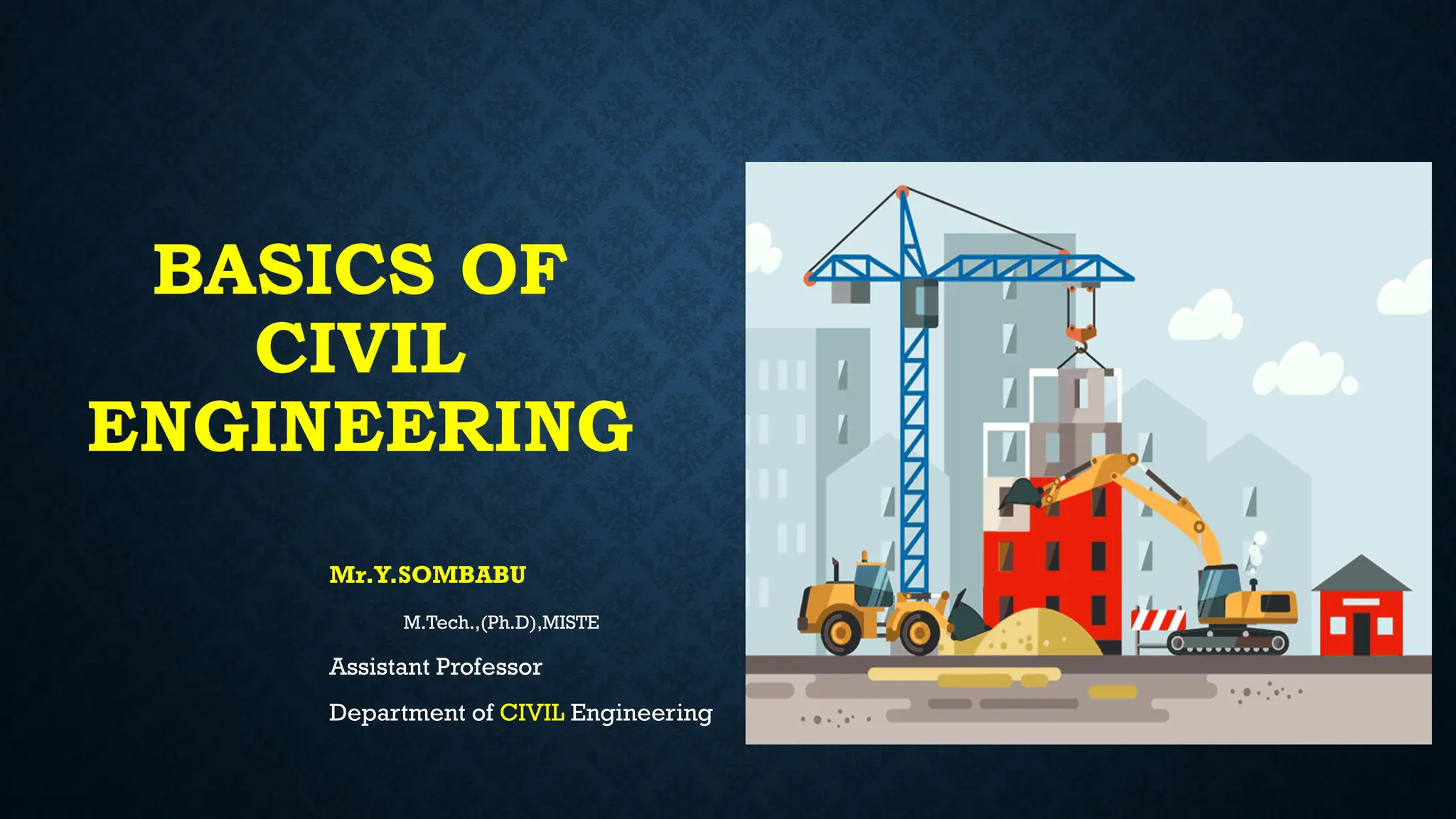
BASICS OF
CIVIL
ENGINEERING
Mr.Y.SOMBABU
M.Tech.,(Ph.D),MISTE
Assistant Professor
Department of CIVIL Engineering
SYLLABUS
• Basics of Civil Engineering: Role of Civil Engineers in Society- Various Disciplines
of Civil Engineering-Structural Engineering- Geo-technical Engineering-
Transportation Engineering - Hydraulics and Water Resources Engineering –
Environmental Engineering-Scope of each discipline
• Construction Materials: Cement –Aggregate – Bricks - Cement concrete – Steel -
different types of masonry - Component parts of a building -Their functions.
Wonder Place
Chichen Itza Mexico
Colosseum Italy
Christ the
Redeemer
Brazil
Great Wall of
China
China
Machu
Pichu
Peru
Petra Jordan
Taj Mahal India
ROLE OF CIVIL ENGINEERS IN SOCIETY
Civil engineering is a professional engineering discipline that deals with the design,
construction, and maintenance of the physical and naturally built environment, including
public works such as roads, bridges, canals, dams, airports, sewage systems, pipelines,
structural components of buildings, and railways.
ROLE OF CIVIL ENGINEERS IN SOCIETY
• Main role of Civil engineers is in surveying, planning, designing, estimation and execution of structures
• To solve different engineering problems with the help of field experience
• To implement management techniques for better management of man, material, machine and moneyTo
carry out soil investigation for design of foundations of structures.
• To invite tenders and to select contractor for the work.
• To carry out surveying and levelling and fixing the alignments (center-line) of roads, railways, canals,
tunnels, pipes etc.
• To carry out planning of buildings as per its functional needs and also has role in town and regional
planning.
• To carry out the design of structures as per the principles of structural analysis and design. Civil
engineer should ensure that design is safe, durable and economic
• To supervise the work during execution and to ensure progress of work.
• To carry out valuation of land or building for the purpose of finding its sale or purchase price or
taxation.
SCOPE OF CIVIL ENGINEERING
• The main scope of civil engineering is planning, designing, estimating, supervising,
managing and maintenance of structures like building, roads, bridges, dams etc.
• Civil engineering is the art of directing the great sources of power in nature for the use and
convenience of man. Basically, it is concerned with planning, design and construction for
environmental control, development of natural resource, buildings, transportation facilities
and other structures required for health, welfare, safety, employment and pleasure of
mankind.
• Civil engineering is a wide field and includes many types of structures such as residential
buildings, public buildings, industrial buildings, roads, bridges, tunnels, railways, dams,
canals, airports, harbours, waste water treatment plants, water supply networks and drainage
networks, drainage networks etc
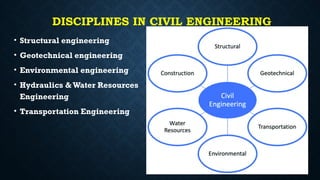
DISCIPLINES IN CIVIL ENGINEERING
• Structural engineering
• Geotechnical engineering
• Environmental engineering
• Hydraulics &Water Resources
Engineering
• Transportation Engineering
STRUCTURAL ENGINEERING
Structural engineering is a branch of civil
engineering that is concerned with the structural
design of man-made structures. Often described
as designing the ‘bones and muscles’ of
structures, these engineers need to understand the
rigidity, stability and strength of both buildings
and non-building structures. This includes factors
such as loading and susceptibility to earthquakes.
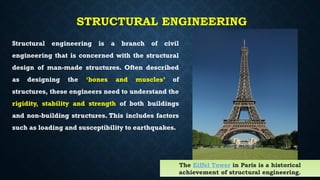
The Eiffel Tower in Paris is a historical
achievement of structural engineering.
STRUCTURAL ENGINEERING
• Structural engineers are the unsung heroes behind the strength and stability of buildings and bridges.
Discover their crucial role in this blog. Understanding the role and importance of structural engineers
in construction projects.
• A structural engineer is a professional who specialises in the design, analysis, and construction of
buildings, bridges, and other structures.
• They are responsible for ensuring the safety, stability, and integrity
• Structural engineers work closely with architects, contractors, and other professionals to develop
structural designs that meet specific requirements and codes.
• The structural engineer ensures that the design meets all safety standards, codes, and regulations
while providing structural stability and integrity.
• Another role of a structural engineer is to use advanced software and analytical tools to analyse the
behaviour of complex structural systems and materials.
GEO-TECHNICAL ENGINEERING
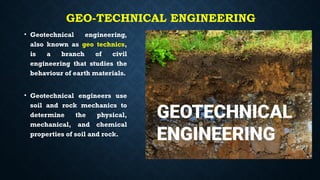
• Geotechnical engineering,
also known as geo technics,
is a branch of civil
engineering that studies the
behaviour of earth materials.
• Geotechnical engineers use
soil and rock mechanics to
determine the physical,
mechanical, and chemical
properties of soil and rock.
GEO TECHNICAL ENGINEERING
• Geotechnical engineers also work on: temporary excavation support, route selection for railways
and highways, landfill disposal of wastes, and groundwater contamination.
• They apply this knowledge to design foundations, retaining walls, earth dams, clay liners, and
geo-synthetics for waste containment
• Geotechnical engineering uses principles of soil mechanics, rock mechanics, and engineering
geology to solve engineering problems and is applied to civil engineering construction, the
extractive industries, and environmental
• Preservation Recent computational and computer advances are extending our ability to predict
the behaviour of soil and soil-water systems under a wide variety of conditions.
• Geo environmental engineers design strategies for the clean-up of contaminated soils and
groundwater and develop management systems for contaminated sites
• The geotechnical engineer is involved in field and laboratory investigations
TRANSPORTATION ENGINEERING
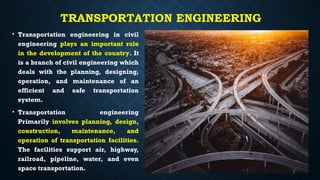
• Transportation engineering in civil
engineering plays an important role
in the development of the country. It
is a branch of civil engineering which
deals with the planning, designing,
operation, and maintenance of an
efficient and safe transportation
system.
• Transportation engineering
Primarily involves planning, design,
construction, maintenance, and
operation of transportation facilities.
The facilities support air, highway,
railroad, pipeline, water, and even
space transportation.
TRANSPORTATION ENGINEERING
• Professionals in transportation engineering careers play a pivotal role in the implementation of
transportation advancements by combining technical knowledge and creative thinking skills
• Government agencies, industry companies, and engineering firms all need insights from
professionals that can guide the development of transportation projects.
• A master’s in civil engineering with a focus in transportation engineering will prepare you to design
and preserve the next generation of transportation infrastructure.
• Transportation engineering is a branch of civil engineering that involves the planning, design,
operation, and maintenance of transportation systems to help build smart, safe, and liveable
communities.
• Any system that moves people and goods from one place to another falls under the scope of
transportation engineering, which includes:
• Highways and roadways
• Railways
• Oil pipelines
• Public transport systems
• Traffic control systems
• Automated transport systems
• Space transport systems
TYPES OF ROADS IN INDIA
The location, utility, and availability of materials determine the kind
of road that can be found in an area. There are seven different types
of roads in India, as listed below, each with a specific function.
 National Highways
 Expressways
 State Highways
 District Roads
 Village Roads
 Border Roads
 International Highways
HYDRAULICS AND WATER RESOURCES
ENGINEERING
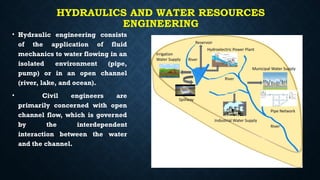
• Hydraulic engineering consists
of the application of fluid
mechanics to water flowing in an
isolated environment (pipe,
pump) or in an open channel
(river, lake, and ocean).
• Civil engineers are
primarily concerned with open
channel flow, which is governed
by the interdependent
interaction between the water
and the channel.
HYDRAULICS AND WATER RESOURCES
ENGINEERING
• Water resources engineering is the quantitative study of the hydrologic cycle -- the
distribution and circulation of water linking the earth's atmosphere, land and oceans.
• Surface runoff is measured as the difference between precipitation and abstractions,
such as infiltration (which replenishes groundwater flow), surface storage and
evaporation.
• Applications include the management of the urban water supply, the design of urban
storm-sewer systems, and flood forecasting.
• Hydraulic engineering is the application of the principles of fluid mechanics to
problems dealing with the collection, storage, control, transport, regulation,
measurement, and use of water. Before beginning a hydraulic engineering project
• Water Resource Engineering is the application of fluid mechanics principles to
problems dealing with the collection, storage, control, transport, regulation,
measurement, and use of water.
ENVIRONMENTAL ENGINEERING
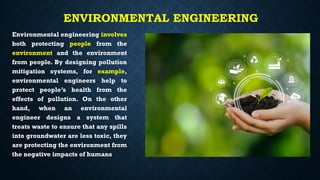
Environmental engineering involves
both protecting people from the
environment and the environment
from people. By designing pollution
mitigation systems, for example,
environmental engineers help to
protect people’s health from the
effects of pollution. On the other
hand, when an environmental
engineer designs a system that
treats waste to ensure that any spills
into groundwater are less toxic, they
are protecting the environment from
the negative impacts of humans
ENVIRONMENTAL ENGINEERING
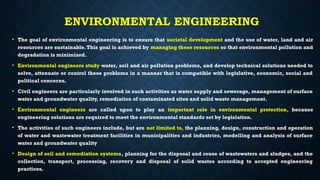
• The goal of environmental engineering is to ensure that societal development and the use of water, land and air
resources are sustainable.This goal is achieved by managing these resources so that environmental pollution and
degradation is minimized.
• Environmental engineers study water, soil and air pollution problems, and develop technical solutions needed to
solve, attenuate or control these problems in a manner that is compatible with legislative, economic, social and
political concerns.
• Civil engineers are particularly involved in such activities as water supply and sewerage, management of surface
water and groundwater quality, remediation of contaminated sites and solid waste management.
• Environmental engineers are called upon to play an important role in environmental protection, because
engineering solutions are required to meet the environmental standards set by legislation.
• The activities of such engineers include, but are not limited to, the planning, design, construction and operation
of water and wastewater treatment facilities in municipalities and industries, modelling and analysis of surface
water and groundwater quality
• Design of soil and remediation systems, planning for the disposal and reuse of wastewaters and sludges, and the
collection, transport, processing, recovery and disposal of solid wastes according to accepted engineering
practices.
CONSTRUCTION MATERIALS
A construction building material is any substance used in building a structure.
There are various kinds of materials used for building in the construction industry.We use
different materials depending on their structural capabilities. In different regions, local and
national standards govern building materials in construction.
Concrete
Steel
Wood
Stone
Brick/Masonry
CEMENT
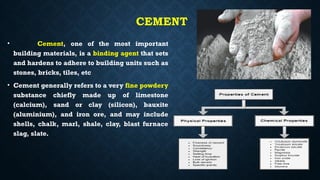
• Cement, one of the most important
building materials, is a binding agent that sets
and hardens to adhere to building units such as
stones, bricks, tiles, etc
• Cement generally refers to a very fine powdery
substance chiefly made up of limestone
(calcium), sand or clay (silicon), bauxite
(aluminium), and iron ore, and may include
shells, chalk, marl, shale, clay, blast furnace
slag, slate.
TYPES OF CEMENT
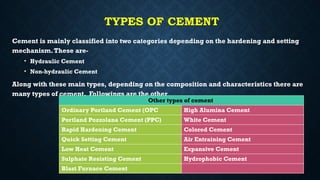
Cement is mainly classified into two categories depending on the hardening and setting
mechanism.These are-
• Hydraulic Cement
• Non-hydraulic Cement
Along with these main types, depending on the composition and characteristics there are
many types of cement. Followings are the other
Other types of cement
Ordinary Portland Cement (OPC High Alumina Cement
Portland Pozzolana Cement (PPC) White Cement
Rapid Hardening Cement Colored Cement
Quick Setting Cement Air Entraining Cement
Low Heat Cement Expansive Cement
Sulphate Resisting Cement Hydrophobic Cement
Blast Furnace Cement
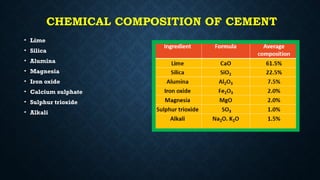
CHEMICAL COMPOSITION OF CEMENT
• Lime
• Silica
• Alumina
• Magnesia
• Iron oxide
• Calcium sulphate
• Sulphur trioxide
• Alkali
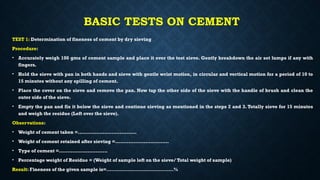
BASIC TESTS ON CEMENT
TEST 1: Determination of fineness of cement by dry sieving
Procedure:
• Accurately weigh 100 gms of cement sample and place it over the test sieve. Gently breakdown the air set lumps if any with
fingers.
• Hold the sieve with pan in both hands and sieve with gentle wrist motion, in circular and vertical motion for a period of 10 to
15 minutes without any spilling of cement.
• Place the cover on the sieve and remove the pan. Now tap the other side of the sieve with the handle of brush and clean the
outer side of the sieve.
• Empty the pan and fix it below the sieve and continue sieving as mentioned in the steps 2 and 3. Totally sieve for 15 minutes
and weigh the residue (Left over the sieve).
Observations:
• Weight of cement taken =...................................
• Weight of cement retained after sieving =................................
• Type of cement =.............................
• Percentage weight of Residue = (Weight of sample left on the sieve/ Total weight of sample)
Result: Fineness of the given sample is=……………………………………%
BASIC TESTS ON CEMENT
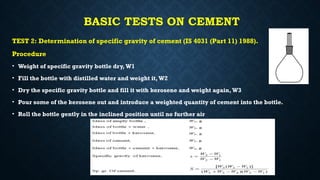
TEST 2: Determination of specific gravity of cement (IS 4031 (Part 11) 1988).
Procedure
• Weight of specific gravity bottle dry, W1
• Fill the bottle with distilled water and weight it, W2
• Dry the specific gravity bottle and fill it with kerosene and weight again,W3
• Pour some of the kerosene out and introduce a weighted quantity of cement into the bottle.
• Roll the bottle gently in the inclined position until no further air
AGGREGATE
• Aggregates are coarse particulate rock-like material consisting of a collection of particles
ranging in size from < 0.1 mm to > 50 mm. It includes gravel, crushed rock, sand, and
recycled concrete, slag, and synthetic aggregate.
• Aggregate is a granular material, such as sand, gravel, crushed stone, crushed hydraulic-
cement concrete, or iron blast-furnace slag, used with a hydraulic cementing medium to
produce either concrete or mortar
TYPES OF AGGREGATE
Coarse Aggregate
• Coarse-grained aggregates will not pass through a sieve with 4.75 mm openings (No. 4).
• Those particles that are predominantly retained on the 4.75 mm (No. 4) sieve and will pass through 3-
inch screen, are called Coarse Aggregates.The coarser the aggregate, the more economical the mix.
• Larger pieces offer less surface area of the particles than an equivalent volume of small pieces. Use of
the largest permissible maximum size of coarse aggregate permits a reduction in cement and water
requirements.
Fine Aggregate
• The other type of aggregates are those particles passing the 9.5 mm (3/8 in.) sieve, almost entirely
passing the 4.75 mm (No. 4) sieve, and predominantly retained on the 75 µm (No. 200) sieve are called
fine aggregate.
• For increased workability and for economy as reflected by use of less cement, the fine aggregate should
have a rounded shape.The purpose of the fine aggregate is to fill the voids in the coarse aggregate and
to act as a workability agent.
BASIC TESTS ON AGGREGATE
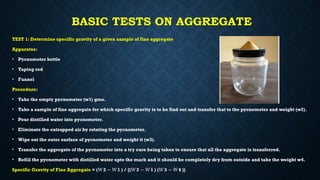
TEST 1: Determine specific gravity of a given sample of fine aggregate
Apparatus:
• Pycnometer bottle
• Taping rod
• Funnel
Procedure:
• Take the empty pycnometer (w1) gms.
• Take a sample of fine aggregate for which specific gravity is to be find out and transfer that to the pycnometer and weight (w2).
• Pour distilled water into pycnometer.
• Eliminate the entrapped air by rotating the pycnometer.
• Wipe out the outer surface of pycnometer and weight it (w3).
• Transfer the aggregate of the pycnometer into a try care being taken to ensure that all the aggregate is transferred.
• Refill the pycnometer with distilled water upto the mark and it should be completely dry from outside and take the weight w4.
Specific Gravity of Fine Aggregate = ( 2 1 ) / {( 2 1 ) ( 3 4 )}
𝑊 − 𝑊 𝑊 − 𝑊 𝑊 − 𝑊
BASIC TESTS ON AGGREGATE
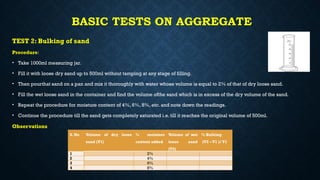
TEST 2: Bulking of sand
Procedure:
• Take 1000ml measuring jar.
• Fill it with loose dry sand up to 500ml without tamping at any stage of filling.
• Then pourthat sand on a pan and mix it thoroughly with water whose volume is equal to 2% of that of dry loose sand.
• Fill the wet loose sand in the container and find the volume ofthe sand which is in excess of the dry volume of the sand.
• Repeat the procedure for moisture content of 4%, 6%, 8%, etc. and note down the readings.
• Continue the procedure till the sand gets completely saturated i.e. till it reaches the original volume of 500ml.
Observations
S. No Volume of dry loose
sand (V1)
% moisture
content added
Volume of wet
loose sand
(V2)
% Bulking
(V2 –V1 )/V1
1 2%
2 4%
3 6%
4 8%
BRICKS
A brick is a type of construction material used to build walls, pavements and other elements in
masonry construction.
Classification of Bricks
• Clay bricks are classified as first class, second class, third class and fourth class based on their
physical and mechanical properties
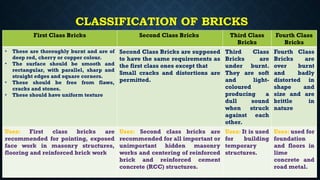
CLASSIFICATION OF BRICKS
First Class Bricks Second Class Bricks Third Class
Bricks
Fourth Class
Bricks
• These are thoroughly burnt and are of
deep red, cherry or copper colour.
• The surface should be smooth and
rectangular, with parallel, sharp and
straight edges and square corners.
• These should be free from flaws,
cracks and stones.
• These should have uniform texture
Second Class Bricks are supposed
to have the same requirements as
the first class ones except that
Small cracks and distortions are
permitted.
Third Class
Bricks are
under burnt.
They are soft
and light-
coloured
producing a
dull sound
when struck
against each
other.
Fourth Class
Bricks are
over burnt
and badly
distorted in
shape and
size and are
brittle in
nature
Uses: First class bricks are
recommended for pointing, exposed
face work in masonry structures,
flooring and reinforced brick work
Uses: Second class bricks are
recommended for all important or
unimportant hidden masonry
works and centering of reinforced
brick and reinforced cement
concrete (RCC) structures.
Uses: It is used
for building
temporary
structures.
Uses: used for
foundation
and floors in
lime
concrete and
road metal.
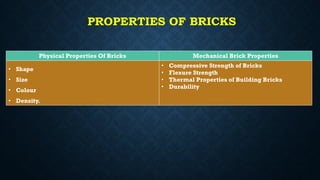
PROPERTIES OF BRICKS
Physical Properties Of Bricks Mechanical Brick Properties
• Shape
• Size
• Colour
• Density.
• Compressive Strength of Bricks
• Flexure Strength
• Thermal Properties of Building Bricks
• Durability
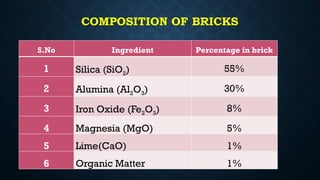
COMPOSITION OF BRICKS
S.No Ingredient Percentage in brick
1 Silica (SiO2) 55%
2 Alumina (Al2O3) 30%
3 Iron Oxide (Fe2O3) 8%
4 Magnesia (MgO) 5%
5 Lime(CaO) 1%
6 Organic Matter 1%
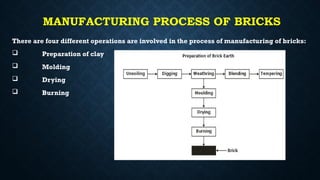
MANUFACTURING PROCESS OF BRICKS
There are four different operations are involved in the process of manufacturing of bricks:
 Preparation of clay
 Molding
 Drying
 Burning
MANUFACTURING PROCESS OF BRICKS-PREPARATION OF CLAY
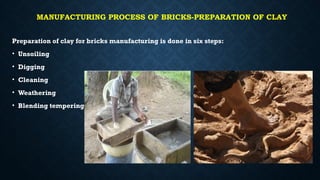
Preparation of clay for bricks manufacturing is done in six steps:
• Unsoiling
• Digging
• Cleaning
• Weathering
• Blending tempering
MANUFACTURING PROCESS OF BRICKS-MOULDING
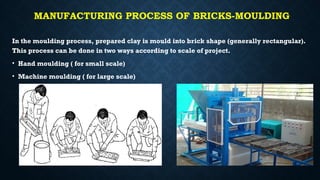
In the moulding process, prepared clay is mould into brick shape (generally rectangular).
This process can be done in two ways according to scale of project.
• Hand moulding ( for small scale)
• Machine moulding ( for large scale)
MANUFACTURING PROCESS OF BRICKS-
DRYING
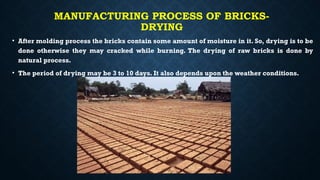
• After molding process the bricks contain some amount of moisture in it. So, drying is to be
done otherwise they may cracked while burning. The drying of raw bricks is done by
natural process.
• The period of drying may be 3 to 10 days. It also depends upon the weather conditions.
MANUFACTURING PROCESS OF BRICKS-
BURNING
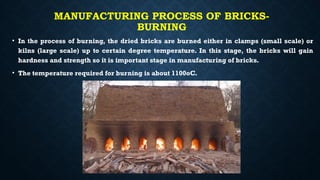
• In the process of burning, the dried bricks are burned either in clamps (small scale) or
kilns (large scale) up to certain degree temperature. In this stage, the bricks will gain
hardness and strength so it is important stage in manufacturing of bricks.
• The temperature required for burning is about 1100oC.
TYPES OF BONDS IN BRICK MASONRY WALL
CONSTRUCTION
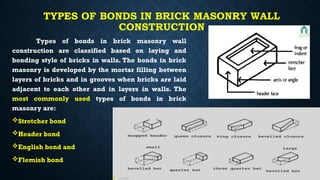
Types of bonds in brick masonry wall construction are classified based on laying
and bonding style of bricks in walls.The bonds in brick masonry is developed by the mortar
filling between layers of bricks and in grooves when bricks are laid adjacent to each other
and in layers in walls. Mostly used material for bonds in brick masonry is cement mortar.
Lime mortar and mud mortar are also used.
The most commonly used types of bonds in brick masonry are:
Stretcher bond
Header bond
English bond and
Flemish bond
TYPES OF BONDS IN BRICK MASONRY WALL
CONSTRUCTION
Types of bonds in brick masonry wall
construction are classified based on laying and
bonding style of bricks in walls. The bonds in brick
masonry is developed by the mortar filling between
layers of bricks and in grooves when bricks are laid
adjacent to each other and in layers in walls. The
most commonly used types of bonds in brick
masonry are:
Stretcher bond
Header bond
English bond and
Flemish bond
TYPES OF BONDS - STRETCHER BOND
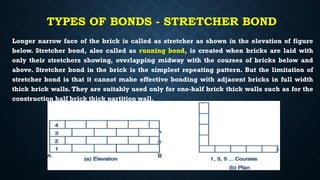
Longer narrow face of the brick is called as stretcher as shown in the elevation of figure
below. Stretcher bond, also called as running bond, is created when bricks are laid with
only their stretchers showing, overlapping midway with the courses of bricks below and
above. Stretcher bond in the brick is the simplest repeating pattern. But the limitation of
stretcher bond is that it cannot make effective bonding with adjacent bricks in full width
thick brick walls. They are suitably used only for one-half brick thick walls such as for the
construction half brick thick partition wall.
TYPES OF BONDS - HEADER BOND
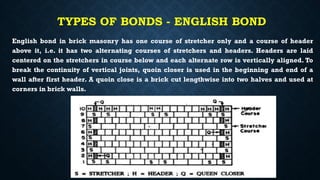
Header is the shorter square face of the brick which measures 9cm x 9cm. Header bond is
also known as heading bond. In header bonds, all bricks in each course are placed as
headers on the faces of the walls.While Stretcher bond is used for the construction of walls
of half brick thickness whereas header bond is used for the construction of walls with full
brick thickness which measures 18cm.
TYPES OF BONDS - ENGLISH BOND
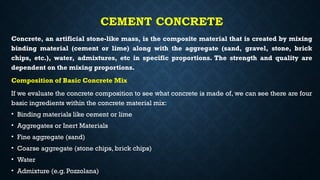
English bond in brick masonry has one course of stretcher only and a course of header
above it, i.e. it has two alternating courses of stretchers and headers. Headers are laid
centered on the stretchers in course below and each alternate row is vertically aligned. To
break the continuity of vertical joints, quoin closer is used in the beginning and end of a
wall after first header. A quoin close is a brick cut lengthwise into two halves and used at
corners in brick walls.
TYPES OF BONDS - FLEMISH BOND
Flemish bond, also known as Dutch bond, is created by laying alternate headers and
stretchers in a single course. The next course of brick is laid such that header lies in the
middle of the stretcher in the course below, i.e. the alternate headers of each course are
centered on the stretcher of course below. Every alternate course of Flemish bond starts
with header at the corner
CEMENT CONCRETE
Concrete, an artificial stone-like mass, is the composite material that is created by mixing
binding material (cement or lime) along with the aggregate (sand, gravel, stone, brick
chips, etc.), water, admixtures, etc in specific proportions. The strength and quality are
dependent on the mixing proportions.
Composition of Basic Concrete Mix
If we evaluate the concrete composition to see what concrete is made of, we can see there are four
basic ingredients within the concrete material mix:
• Binding materials like cement or lime
• Aggregates or Inert Materials
• Fine aggregate (sand)
• Coarse aggregate (stone chips, brick chips)
• Water
• Admixture (e.g. Pozzolana)
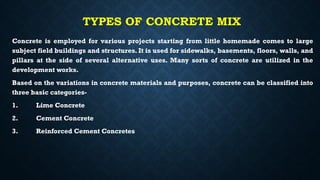
TYPES OF CONCRETE MIX
Concrete is employed for various projects starting from little homemade comes to large
subject field buildings and structures. It is used for sidewalks, basements, floors, walls, and
pillars at the side of several alternative uses. Many sorts of concrete are utilized in the
development works.
Based on the variations in concrete materials and purposes, concrete can be classified into
three basic categories-
1. Lime search Concrete
2. Cement Concrete
3. Reinforced Cement Concretes
TYPES OF CONCRETE MIX
Concrete is employed for various projects starting from little homemade comes to large
subject field buildings and structures. It is used for sidewalks, basements, floors, walls, and
pillars at the side of several alternative uses. Many sorts of concrete are utilized in the
development works.
Based on the variations in concrete materials and purposes, concrete can be classified into
three basic categories-
1. Lime Concrete
2. Cement Concrete
3. Reinforced Cement Concretes
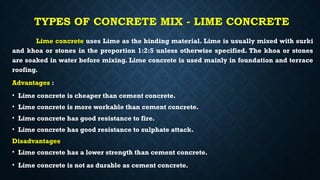
TYPES OF CONCRETE MIX - LIME CONCRETE
Lime concrete uses Lime as the binding material. Lime is usually mixed with surki
and khoa or stones in the proportion 1:2:5 unless otherwise specified. The khoa or stones
are soaked in water before mixing. Lime concrete is used mainly in foundation and terrace
roofing.
Advantages :
• Lime concrete is cheaper than cement concrete.
• Lime concrete is more workable than cement concrete.
• Lime concrete has good resistance to fire.
• Lime concrete has good resistance to sulphate attack.
Disadvantages
• Lime concrete has a lower strength than cement concrete.
• Lime concrete is not as durable as cement concrete.
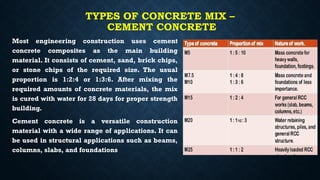
TYPES OF CONCRETE MIX –
CEMENT CONCRETE
Most engineering construction uses cement
concrete composites as the main building
material. It consists of cement, sand, brick chips,
or stone chips of the required size. The usual
proportion is 1:2:4 or 1:3:6. After mixing the
required amounts of concrete materials, the mix
is cured with water for 28 days for proper strength
building.
Cement concrete is a versatile construction
material with a wide range of applications. It can
be used in structural applications such as beams,
columns, slabs, and foundations
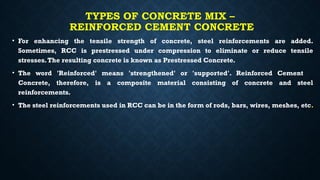
TYPES OF CONCRETE MIX –
REINFORCED CEMENT CONCRETE
• For enhancing the tensile strength of concrete, steel reinforcements are added.
Sometimes, RCC is prestressed under compression to eliminate or reduce tensile
stresses.The resulting concrete is known as Prestressed Concrete.
• The word 'Reinforced' means 'strengthened' or 'supported'. Reinforced Cement
Concrete, therefore, is a composite material consisting of concrete and steel
reinforcements.
• The steel reinforcements used in RCC can be in the form of rods, bars, wires, meshes, etc.
STEEL
• Steel, in its simplest form, is iron metal that’s been alloyed with less than 2% carbon.
However, many other elements can be added as well to create multiple grades of steel
alloys with varying properties. Common alloying elements include chromium,
manganese, and nickel..
Characteristics of Steel
• Strength
• Durability
• Versatility
• Machinability
• Weld ability
• Corrosion resistance
• Conductivity
• Recycling
STEEL- DIFFERENT TYPES
Stainless Steel
Broadly speaking, stainless steel is defined by chromium in its composition. The austenitic stainless steels (18/8
and 18/10, or 304 and 316) are the most popular and contain chromium and nickel
Carbon Steel
Carbon steel generally refers to the simplest steel alloys of carbon and iron, with small amounts of manganese,
phosphorus, and sulphur present.
Alloy Steel
Alloy steel is a broad term applied to steel that contains additional alloying elements (over and above carbon) such
as: chromium, nickel, molybdenum, manganese, boron, silicon, and vanadium.
Tool Steel
Tool steel is a range of steel grades carefully developed to function well as tools. It is extremely hard, durable, and
abrasion-resistant
Electrical Steel
Electrical steel is alloyed with silicon (generally in the range of 2-3.5%) and has uniform magnetic properties.
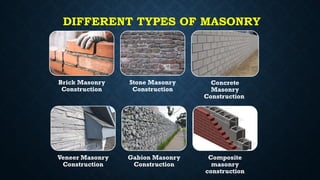
DIFFERENT TYPES OF MASONRY
Brick Masonry
Construction
Stone Masonry
Construction
Concrete
Masonry
Construction
Veneer Masonry
Construction
Gabion Masonry
Construction
Composite
masonry
construction
DIFFERENT TYPES OF MASONRY
Brick Masonry Construction
Brick masonry construction makes use of first-class burnt clay bricks. For less important
construction, third class bricks are used in masonry. Second class bricks are best for masonry
construction that is plastered as it lacks finish compared with first class bricks.
Stone Masonry Construction
Stone is the most durable, strong and weather-resistant construction material compared with any
others. These are less affected by daily wear and tear. Masonry structures made out of stone hence
last for a longer period. It has a life period of 300 to 1000 plus years. Due to it's numerous
advantageous, it is widely used in masonry construction.
Concrete Masonry Construction
In concrete masonry construction, the concrete blocks are pressed on the top of other similar to brick
masonry construction.This creates a staggered formation.The dimension of concrete blocks is larger
compared to bricks, so less time is required to lay concrete blocks.
DIFFERENT TYPES OF MASONRY
Veneer Masonry Construction
This masonry construction is a type mainly used for remodeling and to provide interior
finish. It gives the appearance of a stone or brick wall with a better economy and insulation. Veneer
masonry units can be placed on the existing concrete wall giving a better appearance.
Gabion Masonry Construction
Gabions are baskets made out of zin protected steel or so-called galvanized steel that is filled
with medium-sized fractured stones.These gabions act as a single unit. It behaves like a revetment or
retaining walls.
Composite Masonry Construction
A composite masonry construction makes use of two or more types of building materials for
the construction. These masonry constructions are employed to increase the appearance of the
building.
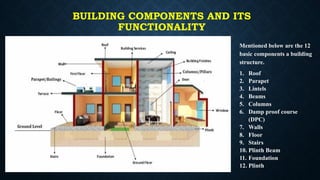
BUILDING COMPONENTS AND ITS
FUNCTIONALITY
Mentioned below are the 12
basic components a building
structure.
1. Roof
2. Parapet
3. Lintels
4. Beams
5. Columns
6. Damp proof course
(DPC)
7. Walls
8. Floor
9. Stairs
10. Plinth Beam
11. Foundation
12. Plinth
BUILDING COMPONENTS AND ITS
FUNCTIONALITY
Roof:
The roof forms the topmost component of a building structure. It covers the top face of the building. Roofs can be
either flat or sloped based on the location and weather conditions of the area.
Parapet:
Parapets are short walls extended above the roof slab. Parapets are installed for flat roofs. It acts as a safety wall for
people using the roof.
Lintels:
Lintels are constructed above the wall openings like doors, windows, etc.These structures support the weight of the
wall coming over the opening
Beams and slabs:
Beams and slabs form the horizontal members in a building. For a single storey building, the top slab forms the
roof. In case of a multi-storey building
Columns: Columns are vertical members constructed above the ground level. Columns can be of two types:
Architectural columns and structural columns
BUILDING COMPONENTS AND ITS
FUNCTIONALITY
Damp Proof Course (DPC)
DPC is a layer of waterproofing material applied on the basement level to prevent the rise of surface water into the
walls.The walls are constructed over the DPC.
Walls: Walls are vertical elements which support the roof. It can be made from stones, bricks, concrete blocks, etc.
Floors:
The floor is the surface laid on the plinth level. Flooring can be done by a variety of materials like tiles, granites,
marbles
Stairs: A stair is a sequence of steps that connects different floors in a building structure. 10. Plinth Beam
Plinth
The plinth is constructed above the ground level. It is a cement-mortar layer lying between the substructure and
the superstructure.
Foundation
The Foundation is a structural unit that uniformly distributes the load from the superstructure to the underlying
soil
Mr.Y.SOMBABU
M.Tech.,(Ph.D),MISTE
Assistant Professor
Department of CIVIL Engineering

Basic Civil and Mechanical Engineering UNIT I PPT.pptx

  • 1.
  • 2.
    SYLLABUS • Basics ofCivil Engineering: Role of Civil Engineers in Society- Various Disciplines of Civil Engineering-Structural Engineering- Geo-technical Engineering- Transportation Engineering - Hydraulics and Water Resources Engineering – Environmental Engineering-Scope of each discipline • Construction Materials: Cement –Aggregate – Bricks - Cement concrete – Steel - different types of masonry - Component parts of a building -Their functions.
  • 3.
    Wonder Place Chichen ItzaMexico Colosseum Italy Christ the Redeemer Brazil Great Wall of China China Machu Pichu Peru Petra Jordan Taj Mahal India
  • 4.
    ROLE OF CIVILENGINEERS IN SOCIETY Civil engineering is a professional engineering discipline that deals with the design, construction, and maintenance of the physical and naturally built environment, including public works such as roads, bridges, canals, dams, airports, sewage systems, pipelines, structural components of buildings, and railways.
  • 5.
    ROLE OF CIVILENGINEERS IN SOCIETY • Main role of Civil engineers is in surveying, planning, designing, estimation and execution of structures • To solve different engineering problems with the help of field experience • To implement management techniques for better management of man, material, machine and moneyTo carry out soil investigation for design of foundations of structures. • To invite tenders and to select contractor for the work. • To carry out surveying and levelling and fixing the alignments (center-line) of roads, railways, canals, tunnels, pipes etc. • To carry out planning of buildings as per its functional needs and also has role in town and regional planning. • To carry out the design of structures as per the principles of structural analysis and design. Civil engineer should ensure that design is safe, durable and economic • To supervise the work during execution and to ensure progress of work. • To carry out valuation of land or building for the purpose of finding its sale or purchase price or taxation.
  • 6.
    SCOPE OF CIVILENGINEERING • The main scope of civil engineering is planning, designing, estimating, supervising, managing and maintenance of structures like building, roads, bridges, dams etc. • Civil engineering is the art of directing the great sources of power in nature for the use and convenience of man. Basically, it is concerned with planning, design and construction for environmental control, development of natural resource, buildings, transportation facilities and other structures required for health, welfare, safety, employment and pleasure of mankind. • Civil engineering is a wide field and includes many types of structures such as residential buildings, public buildings, industrial buildings, roads, bridges, tunnels, railways, dams, canals, airports, harbours, waste water treatment plants, water supply networks and drainage networks, drainage networks etc
  • 7.
    DISCIPLINES IN CIVILENGINEERING • Structural engineering • Geotechnical engineering • Environmental engineering • Hydraulics &Water Resources Engineering • Transportation Engineering
  • 8.
    STRUCTURAL ENGINEERING Structural engineeringis a branch of civil engineering that is concerned with the structural design of man-made structures. Often described as designing the ‘bones and muscles’ of structures, these engineers need to understand the rigidity, stability and strength of both buildings and non-building structures. This includes factors such as loading and susceptibility to earthquakes. The Eiffel Tower in Paris is a historical achievement of structural engineering.
  • 9.
    STRUCTURAL ENGINEERING • Structuralengineers are the unsung heroes behind the strength and stability of buildings and bridges. Discover their crucial role in this blog. Understanding the role and importance of structural engineers in construction projects. • A structural engineer is a professional who specialises in the design, analysis, and construction of buildings, bridges, and other structures. • They are responsible for ensuring the safety, stability, and integrity • Structural engineers work closely with architects, contractors, and other professionals to develop structural designs that meet specific requirements and codes. • The structural engineer ensures that the design meets all safety standards, codes, and regulations while providing structural stability and integrity. • Another role of a structural engineer is to use advanced software and analytical tools to analyse the behaviour of complex structural systems and materials.
  • 10.
    GEO-TECHNICAL ENGINEERING • Geotechnicalengineering, also known as geo technics, is a branch of civil engineering that studies the behaviour of earth materials. • Geotechnical engineers use soil and rock mechanics to determine the physical, mechanical, and chemical properties of soil and rock.
  • 11.
    GEO TECHNICAL ENGINEERING •Geotechnical engineers also work on: temporary excavation support, route selection for railways and highways, landfill disposal of wastes, and groundwater contamination. • They apply this knowledge to design foundations, retaining walls, earth dams, clay liners, and geo-synthetics for waste containment • Geotechnical engineering uses principles of soil mechanics, rock mechanics, and engineering geology to solve engineering problems and is applied to civil engineering construction, the extractive industries, and environmental • Preservation Recent computational and computer advances are extending our ability to predict the behaviour of soil and soil-water systems under a wide variety of conditions. • Geo environmental engineers design strategies for the clean-up of contaminated soils and groundwater and develop management systems for contaminated sites • The geotechnical engineer is involved in field and laboratory investigations
  • 12.
    TRANSPORTATION ENGINEERING • Transportationengineering in civil engineering plays an important role in the development of the country. It is a branch of civil engineering which deals with the planning, designing, operation, and maintenance of an efficient and safe transportation system. • Transportation engineering Primarily involves planning, design, construction, maintenance, and operation of transportation facilities. The facilities support air, highway, railroad, pipeline, water, and even space transportation.
  • 13.
    TRANSPORTATION ENGINEERING • Professionalsin transportation engineering careers play a pivotal role in the implementation of transportation advancements by combining technical knowledge and creative thinking skills • Government agencies, industry companies, and engineering firms all need insights from professionals that can guide the development of transportation projects. • A master’s in civil engineering with a focus in transportation engineering will prepare you to design and preserve the next generation of transportation infrastructure. • Transportation engineering is a branch of civil engineering that involves the planning, design, operation, and maintenance of transportation systems to help build smart, safe, and liveable communities. • Any system that moves people and goods from one place to another falls under the scope of transportation engineering, which includes: • Highways and roadways • Railways • Oil pipelines • Public transport systems • Traffic control systems • Automated transport systems • Space transport systems
  • 14.
    TYPES OF ROADSIN INDIA The location, utility, and availability of materials determine the kind of road that can be found in an area. There are seven different types of roads in India, as listed below, each with a specific function.  National Highways  Expressways  State Highways  District Roads  Village Roads  Border Roads  International Highways
  • 15.
    HYDRAULICS AND WATERRESOURCES ENGINEERING • Hydraulic engineering consists of the application of fluid mechanics to water flowing in an isolated environment (pipe, pump) or in an open channel (river, lake, and ocean). • Civil engineers are primarily concerned with open channel flow, which is governed by the interdependent interaction between the water and the channel.
  • 16.
    HYDRAULICS AND WATERRESOURCES ENGINEERING • Water resources engineering is the quantitative study of the hydrologic cycle -- the distribution and circulation of water linking the earth's atmosphere, land and oceans. • Surface runoff is measured as the difference between precipitation and abstractions, such as infiltration (which replenishes groundwater flow), surface storage and evaporation. • Applications include the management of the urban water supply, the design of urban storm-sewer systems, and flood forecasting. • Hydraulic engineering is the application of the principles of fluid mechanics to problems dealing with the collection, storage, control, transport, regulation, measurement, and use of water. Before beginning a hydraulic engineering project • Water Resource Engineering is the application of fluid mechanics principles to problems dealing with the collection, storage, control, transport, regulation, measurement, and use of water.
  • 17.
    ENVIRONMENTAL ENGINEERING Environmental engineeringinvolves both protecting people from the environment and the environment from people. By designing pollution mitigation systems, for example, environmental engineers help to protect people’s health from the effects of pollution. On the other hand, when an environmental engineer designs a system that treats waste to ensure that any spills into groundwater are less toxic, they are protecting the environment from the negative impacts of humans
  • 18.
    ENVIRONMENTAL ENGINEERING • Thegoal of environmental engineering is to ensure that societal development and the use of water, land and air resources are sustainable.This goal is achieved by managing these resources so that environmental pollution and degradation is minimized. • Environmental engineers study water, soil and air pollution problems, and develop technical solutions needed to solve, attenuate or control these problems in a manner that is compatible with legislative, economic, social and political concerns. • Civil engineers are particularly involved in such activities as water supply and sewerage, management of surface water and groundwater quality, remediation of contaminated sites and solid waste management. • Environmental engineers are called upon to play an important role in environmental protection, because engineering solutions are required to meet the environmental standards set by legislation. • The activities of such engineers include, but are not limited to, the planning, design, construction and operation of water and wastewater treatment facilities in municipalities and industries, modelling and analysis of surface water and groundwater quality • Design of soil and remediation systems, planning for the disposal and reuse of wastewaters and sludges, and the collection, transport, processing, recovery and disposal of solid wastes according to accepted engineering practices.
  • 19.
    CONSTRUCTION MATERIALS A constructionbuilding material is any substance used in building a structure. There are various kinds of materials used for building in the construction industry.We use different materials depending on their structural capabilities. In different regions, local and national standards govern building materials in construction. Concrete Steel Wood Stone Brick/Masonry
  • 20.
    CEMENT • Cement, oneof the most important building materials, is a binding agent that sets and hardens to adhere to building units such as stones, bricks, tiles, etc • Cement generally refers to a very fine powdery substance chiefly made up of limestone (calcium), sand or clay (silicon), bauxite (aluminium), and iron ore, and may include shells, chalk, marl, shale, clay, blast furnace slag, slate.
  • 21.
    TYPES OF CEMENT Cementis mainly classified into two categories depending on the hardening and setting mechanism.These are- • Hydraulic Cement • Non-hydraulic Cement Along with these main types, depending on the composition and characteristics there are many types of cement. Followings are the other Other types of cement Ordinary Portland Cement (OPC High Alumina Cement Portland Pozzolana Cement (PPC) White Cement Rapid Hardening Cement Colored Cement Quick Setting Cement Air Entraining Cement Low Heat Cement Expansive Cement Sulphate Resisting Cement Hydrophobic Cement Blast Furnace Cement
  • 22.
    CHEMICAL COMPOSITION OFCEMENT • Lime • Silica • Alumina • Magnesia • Iron oxide • Calcium sulphate • Sulphur trioxide • Alkali
  • 23.
    BASIC TESTS ONCEMENT TEST 1: Determination of fineness of cement by dry sieving Procedure: • Accurately weigh 100 gms of cement sample and place it over the test sieve. Gently breakdown the air set lumps if any with fingers. • Hold the sieve with pan in both hands and sieve with gentle wrist motion, in circular and vertical motion for a period of 10 to 15 minutes without any spilling of cement. • Place the cover on the sieve and remove the pan. Now tap the other side of the sieve with the handle of brush and clean the outer side of the sieve. • Empty the pan and fix it below the sieve and continue sieving as mentioned in the steps 2 and 3. Totally sieve for 15 minutes and weigh the residue (Left over the sieve). Observations: • Weight of cement taken =................................... • Weight of cement retained after sieving =................................ • Type of cement =............................. • Percentage weight of Residue = (Weight of sample left on the sieve/ Total weight of sample) Result: Fineness of the given sample is=……………………………………%
  • 24.
    BASIC TESTS ONCEMENT TEST 2: Determination of specific gravity of cement (IS 4031 (Part 11) 1988). Procedure • Weight of specific gravity bottle dry, W1 • Fill the bottle with distilled water and weight it, W2 • Dry the specific gravity bottle and fill it with kerosene and weight again,W3 • Pour some of the kerosene out and introduce a weighted quantity of cement into the bottle. • Roll the bottle gently in the inclined position until no further air
  • 25.
    AGGREGATE • Aggregates arecoarse particulate rock-like material consisting of a collection of particles ranging in size from < 0.1 mm to > 50 mm. It includes gravel, crushed rock, sand, and recycled concrete, slag, and synthetic aggregate. • Aggregate is a granular material, such as sand, gravel, crushed stone, crushed hydraulic- cement concrete, or iron blast-furnace slag, used with a hydraulic cementing medium to produce either concrete or mortar
  • 26.
    TYPES OF AGGREGATE CoarseAggregate • Coarse-grained aggregates will not pass through a sieve with 4.75 mm openings (No. 4). • Those particles that are predominantly retained on the 4.75 mm (No. 4) sieve and will pass through 3- inch screen, are called Coarse Aggregates.The coarser the aggregate, the more economical the mix. • Larger pieces offer less surface area of the particles than an equivalent volume of small pieces. Use of the largest permissible maximum size of coarse aggregate permits a reduction in cement and water requirements. Fine Aggregate • The other type of aggregates are those particles passing the 9.5 mm (3/8 in.) sieve, almost entirely passing the 4.75 mm (No. 4) sieve, and predominantly retained on the 75 µm (No. 200) sieve are called fine aggregate. • For increased workability and for economy as reflected by use of less cement, the fine aggregate should have a rounded shape.The purpose of the fine aggregate is to fill the voids in the coarse aggregate and to act as a workability agent.
  • 27.
    BASIC TESTS ONAGGREGATE TEST 1: Determine specific gravity of a given sample of fine aggregate Apparatus: • Pycnometer bottle • Taping rod • Funnel Procedure: • Take the empty pycnometer (w1) gms. • Take a sample of fine aggregate for which specific gravity is to be find out and transfer that to the pycnometer and weight (w2). • Pour distilled water into pycnometer. • Eliminate the entrapped air by rotating the pycnometer. • Wipe out the outer surface of pycnometer and weight it (w3). • Transfer the aggregate of the pycnometer into a try care being taken to ensure that all the aggregate is transferred. • Refill the pycnometer with distilled water upto the mark and it should be completely dry from outside and take the weight w4. Specific Gravity of Fine Aggregate = ( 2 1 ) / {( 2 1 ) ( 3 4 )} 𝑊 − 𝑊 𝑊 − 𝑊 𝑊 − 𝑊
  • 28.
    BASIC TESTS ONAGGREGATE TEST 2: Bulking of sand Procedure: • Take 1000ml measuring jar. • Fill it with loose dry sand up to 500ml without tamping at any stage of filling. • Then pourthat sand on a pan and mix it thoroughly with water whose volume is equal to 2% of that of dry loose sand. • Fill the wet loose sand in the container and find the volume ofthe sand which is in excess of the dry volume of the sand. • Repeat the procedure for moisture content of 4%, 6%, 8%, etc. and note down the readings. • Continue the procedure till the sand gets completely saturated i.e. till it reaches the original volume of 500ml. Observations S. No Volume of dry loose sand (V1) % moisture content added Volume of wet loose sand (V2) % Bulking (V2 –V1 )/V1 1 2% 2 4% 3 6% 4 8%
  • 29.
    BRICKS A brick isa type of construction material used to build walls, pavements and other elements in masonry construction. Classification of Bricks • Clay bricks are classified as first class, second class, third class and fourth class based on their physical and mechanical properties
  • 30.
    CLASSIFICATION OF BRICKS FirstClass Bricks Second Class Bricks Third Class Bricks Fourth Class Bricks • These are thoroughly burnt and are of deep red, cherry or copper colour. • The surface should be smooth and rectangular, with parallel, sharp and straight edges and square corners. • These should be free from flaws, cracks and stones. • These should have uniform texture Second Class Bricks are supposed to have the same requirements as the first class ones except that Small cracks and distortions are permitted. Third Class Bricks are under burnt. They are soft and light- coloured producing a dull sound when struck against each other. Fourth Class Bricks are over burnt and badly distorted in shape and size and are brittle in nature Uses: First class bricks are recommended for pointing, exposed face work in masonry structures, flooring and reinforced brick work Uses: Second class bricks are recommended for all important or unimportant hidden masonry works and centering of reinforced brick and reinforced cement concrete (RCC) structures. Uses: It is used for building temporary structures. Uses: used for foundation and floors in lime concrete and road metal.
  • 31.
    PROPERTIES OF BRICKS PhysicalProperties Of Bricks Mechanical Brick Properties • Shape • Size • Colour • Density. • Compressive Strength of Bricks • Flexure Strength • Thermal Properties of Building Bricks • Durability
  • 32.
    COMPOSITION OF BRICKS S.NoIngredient Percentage in brick 1 Silica (SiO2) 55% 2 Alumina (Al2O3) 30% 3 Iron Oxide (Fe2O3) 8% 4 Magnesia (MgO) 5% 5 Lime(CaO) 1% 6 Organic Matter 1%
  • 33.
    MANUFACTURING PROCESS OFBRICKS There are four different operations are involved in the process of manufacturing of bricks:  Preparation of clay  Molding  Drying  Burning
  • 34.
    MANUFACTURING PROCESS OFBRICKS-PREPARATION OF CLAY Preparation of clay for bricks manufacturing is done in six steps: • Unsoiling • Digging • Cleaning • Weathering • Blending tempering
  • 35.
    MANUFACTURING PROCESS OFBRICKS-MOULDING In the moulding process, prepared clay is mould into brick shape (generally rectangular). This process can be done in two ways according to scale of project. • Hand moulding ( for small scale) • Machine moulding ( for large scale)
  • 36.
    MANUFACTURING PROCESS OFBRICKS- DRYING • After molding process the bricks contain some amount of moisture in it. So, drying is to be done otherwise they may cracked while burning. The drying of raw bricks is done by natural process. • The period of drying may be 3 to 10 days. It also depends upon the weather conditions.
  • 37.
    MANUFACTURING PROCESS OFBRICKS- BURNING • In the process of burning, the dried bricks are burned either in clamps (small scale) or kilns (large scale) up to certain degree temperature. In this stage, the bricks will gain hardness and strength so it is important stage in manufacturing of bricks. • The temperature required for burning is about 1100oC.
  • 38.
    TYPES OF BONDSIN BRICK MASONRY WALL CONSTRUCTION Types of bonds in brick masonry wall construction are classified based on laying and bonding style of bricks in walls.The bonds in brick masonry is developed by the mortar filling between layers of bricks and in grooves when bricks are laid adjacent to each other and in layers in walls. Mostly used material for bonds in brick masonry is cement mortar. Lime mortar and mud mortar are also used. The most commonly used types of bonds in brick masonry are: Stretcher bond Header bond English bond and Flemish bond
  • 39.
    TYPES OF BONDSIN BRICK MASONRY WALL CONSTRUCTION Types of bonds in brick masonry wall construction are classified based on laying and bonding style of bricks in walls. The bonds in brick masonry is developed by the mortar filling between layers of bricks and in grooves when bricks are laid adjacent to each other and in layers in walls. The most commonly used types of bonds in brick masonry are: Stretcher bond Header bond English bond and Flemish bond
  • 40.
    TYPES OF BONDS- STRETCHER BOND Longer narrow face of the brick is called as stretcher as shown in the elevation of figure below. Stretcher bond, also called as running bond, is created when bricks are laid with only their stretchers showing, overlapping midway with the courses of bricks below and above. Stretcher bond in the brick is the simplest repeating pattern. But the limitation of stretcher bond is that it cannot make effective bonding with adjacent bricks in full width thick brick walls. They are suitably used only for one-half brick thick walls such as for the construction half brick thick partition wall.
  • 41.
    TYPES OF BONDS- HEADER BOND Header is the shorter square face of the brick which measures 9cm x 9cm. Header bond is also known as heading bond. In header bonds, all bricks in each course are placed as headers on the faces of the walls.While Stretcher bond is used for the construction of walls of half brick thickness whereas header bond is used for the construction of walls with full brick thickness which measures 18cm.
  • 42.
    TYPES OF BONDS- ENGLISH BOND English bond in brick masonry has one course of stretcher only and a course of header above it, i.e. it has two alternating courses of stretchers and headers. Headers are laid centered on the stretchers in course below and each alternate row is vertically aligned. To break the continuity of vertical joints, quoin closer is used in the beginning and end of a wall after first header. A quoin close is a brick cut lengthwise into two halves and used at corners in brick walls.
  • 43.
    TYPES OF BONDS- FLEMISH BOND Flemish bond, also known as Dutch bond, is created by laying alternate headers and stretchers in a single course. The next course of brick is laid such that header lies in the middle of the stretcher in the course below, i.e. the alternate headers of each course are centered on the stretcher of course below. Every alternate course of Flemish bond starts with header at the corner
  • 44.
    CEMENT CONCRETE Concrete, anartificial stone-like mass, is the composite material that is created by mixing binding material (cement or lime) along with the aggregate (sand, gravel, stone, brick chips, etc.), water, admixtures, etc in specific proportions. The strength and quality are dependent on the mixing proportions. Composition of Basic Concrete Mix If we evaluate the concrete composition to see what concrete is made of, we can see there are four basic ingredients within the concrete material mix: • Binding materials like cement or lime • Aggregates or Inert Materials • Fine aggregate (sand) • Coarse aggregate (stone chips, brick chips) • Water • Admixture (e.g. Pozzolana)
  • 45.
    TYPES OF CONCRETEMIX Concrete is employed for various projects starting from little homemade comes to large subject field buildings and structures. It is used for sidewalks, basements, floors, walls, and pillars at the side of several alternative uses. Many sorts of concrete are utilized in the development works. Based on the variations in concrete materials and purposes, concrete can be classified into three basic categories- 1. Lime search Concrete 2. Cement Concrete 3. Reinforced Cement Concretes
  • 46.
    TYPES OF CONCRETEMIX Concrete is employed for various projects starting from little homemade comes to large subject field buildings and structures. It is used for sidewalks, basements, floors, walls, and pillars at the side of several alternative uses. Many sorts of concrete are utilized in the development works. Based on the variations in concrete materials and purposes, concrete can be classified into three basic categories- 1. Lime Concrete 2. Cement Concrete 3. Reinforced Cement Concretes
  • 47.
    TYPES OF CONCRETEMIX - LIME CONCRETE Lime concrete uses Lime as the binding material. Lime is usually mixed with surki and khoa or stones in the proportion 1:2:5 unless otherwise specified. The khoa or stones are soaked in water before mixing. Lime concrete is used mainly in foundation and terrace roofing. Advantages : • Lime concrete is cheaper than cement concrete. • Lime concrete is more workable than cement concrete. • Lime concrete has good resistance to fire. • Lime concrete has good resistance to sulphate attack. Disadvantages • Lime concrete has a lower strength than cement concrete. • Lime concrete is not as durable as cement concrete.
  • 48.
    TYPES OF CONCRETEMIX – CEMENT CONCRETE Most engineering construction uses cement concrete composites as the main building material. It consists of cement, sand, brick chips, or stone chips of the required size. The usual proportion is 1:2:4 or 1:3:6. After mixing the required amounts of concrete materials, the mix is cured with water for 28 days for proper strength building. Cement concrete is a versatile construction material with a wide range of applications. It can be used in structural applications such as beams, columns, slabs, and foundations
  • 49.
    TYPES OF CONCRETEMIX – REINFORCED CEMENT CONCRETE • For enhancing the tensile strength of concrete, steel reinforcements are added. Sometimes, RCC is prestressed under compression to eliminate or reduce tensile stresses.The resulting concrete is known as Prestressed Concrete. • The word 'Reinforced' means 'strengthened' or 'supported'. Reinforced Cement Concrete, therefore, is a composite material consisting of concrete and steel reinforcements. • The steel reinforcements used in RCC can be in the form of rods, bars, wires, meshes, etc.
  • 50.
    STEEL • Steel, inits simplest form, is iron metal that’s been alloyed with less than 2% carbon. However, many other elements can be added as well to create multiple grades of steel alloys with varying properties. Common alloying elements include chromium, manganese, and nickel.. Characteristics of Steel • Strength • Durability • Versatility • Machinability • Weld ability • Corrosion resistance • Conductivity • Recycling
  • 51.
    STEEL- DIFFERENT TYPES StainlessSteel Broadly speaking, stainless steel is defined by chromium in its composition. The austenitic stainless steels (18/8 and 18/10, or 304 and 316) are the most popular and contain chromium and nickel Carbon Steel Carbon steel generally refers to the simplest steel alloys of carbon and iron, with small amounts of manganese, phosphorus, and sulphur present. Alloy Steel Alloy steel is a broad term applied to steel that contains additional alloying elements (over and above carbon) such as: chromium, nickel, molybdenum, manganese, boron, silicon, and vanadium. Tool Steel Tool steel is a range of steel grades carefully developed to function well as tools. It is extremely hard, durable, and abrasion-resistant Electrical Steel Electrical steel is alloyed with silicon (generally in the range of 2-3.5%) and has uniform magnetic properties.
  • 52.
    DIFFERENT TYPES OFMASONRY Brick Masonry Construction Stone Masonry Construction Concrete Masonry Construction Veneer Masonry Construction Gabion Masonry Construction Composite masonry construction
  • 53.
    DIFFERENT TYPES OFMASONRY Brick Masonry Construction Brick masonry construction makes use of first-class burnt clay bricks. For less important construction, third class bricks are used in masonry. Second class bricks are best for masonry construction that is plastered as it lacks finish compared with first class bricks. Stone Masonry Construction Stone is the most durable, strong and weather-resistant construction material compared with any others. These are less affected by daily wear and tear. Masonry structures made out of stone hence last for a longer period. It has a life period of 300 to 1000 plus years. Due to it's numerous advantageous, it is widely used in masonry construction. Concrete Masonry Construction In concrete masonry construction, the concrete blocks are pressed on the top of other similar to brick masonry construction.This creates a staggered formation.The dimension of concrete blocks is larger compared to bricks, so less time is required to lay concrete blocks.
  • 54.
    DIFFERENT TYPES OFMASONRY Veneer Masonry Construction This masonry construction is a type mainly used for remodeling and to provide interior finish. It gives the appearance of a stone or brick wall with a better economy and insulation. Veneer masonry units can be placed on the existing concrete wall giving a better appearance. Gabion Masonry Construction Gabions are baskets made out of zin protected steel or so-called galvanized steel that is filled with medium-sized fractured stones.These gabions act as a single unit. It behaves like a revetment or retaining walls. Composite Masonry Construction A composite masonry construction makes use of two or more types of building materials for the construction. These masonry constructions are employed to increase the appearance of the building.
  • 55.
    BUILDING COMPONENTS ANDITS FUNCTIONALITY Mentioned below are the 12 basic components a building structure. 1. Roof 2. Parapet 3. Lintels 4. Beams 5. Columns 6. Damp proof course (DPC) 7. Walls 8. Floor 9. Stairs 10. Plinth Beam 11. Foundation 12. Plinth
  • 56.
    BUILDING COMPONENTS ANDITS FUNCTIONALITY Roof: The roof forms the topmost component of a building structure. It covers the top face of the building. Roofs can be either flat or sloped based on the location and weather conditions of the area. Parapet: Parapets are short walls extended above the roof slab. Parapets are installed for flat roofs. It acts as a safety wall for people using the roof. Lintels: Lintels are constructed above the wall openings like doors, windows, etc.These structures support the weight of the wall coming over the opening Beams and slabs: Beams and slabs form the horizontal members in a building. For a single storey building, the top slab forms the roof. In case of a multi-storey building Columns: Columns are vertical members constructed above the ground level. Columns can be of two types: Architectural columns and structural columns
  • 57.
    BUILDING COMPONENTS ANDITS FUNCTIONALITY Damp Proof Course (DPC) DPC is a layer of waterproofing material applied on the basement level to prevent the rise of surface water into the walls.The walls are constructed over the DPC. Walls: Walls are vertical elements which support the roof. It can be made from stones, bricks, concrete blocks, etc. Floors: The floor is the surface laid on the plinth level. Flooring can be done by a variety of materials like tiles, granites, marbles Stairs: A stair is a sequence of steps that connects different floors in a building structure. 10. Plinth Beam Plinth The plinth is constructed above the ground level. It is a cement-mortar layer lying between the substructure and the superstructure. Foundation The Foundation is a structural unit that uniformly distributes the load from the superstructure to the underlying soil
  • 58.