Summer Semester Training ” 2018”
By: Dr. Ezzat El-Sayed G. SALEH
Engineering is your Future
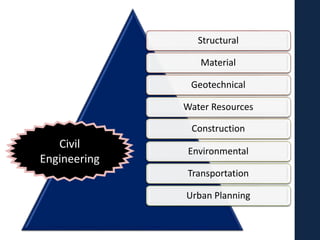
Structural
Material
Geotechnical
Water Resources
Construction
Environmental
Transportation
Urban Planning
Civil
Engineering
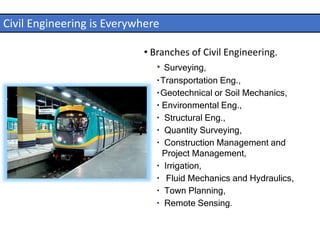
• Branches of Civil Engineering.
Surveying,
Transportation Eng.,
Geotechnical or Soil Mechanics,
Environmental Eng.,
Structural Eng.,
Quantity Surveying,
Construction Management and
Project Management,
Irrigation,
Fluid Mechanics and Hydraulics,
Town Planning,
Remote Sensing.
Civil Engineering is Everywhere
Engineering is your Future
The Chicago spire 609m tall building
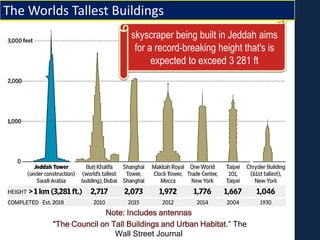
Note: Includes antennas
“The Council on Tall Buildings and Urban Habitat.” The
Wall Street Journal
skyscraper being built in Jeddah aims
for a record-breaking height that's is
expected to exceed 3 281 ft
The Worlds Tallest Buildings
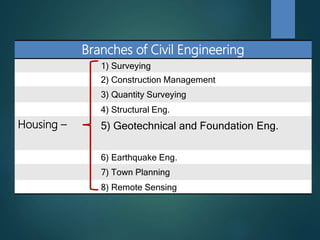
Branches of Civil Engineering
1) Surveying
2) Construction Management
3) Quantity Surveying
4) Structural Eng.
Housing – 5) Geotechnical and Foundation Eng.
6) Earthquake Eng.
7) Town Planning
8) Remote Sensing
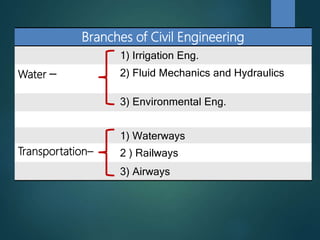
Branches of Civil Engineering
1) Irrigation Eng.
Water – 2) Fluid Mechanics and Hydraulics
3) Environmental Eng.
1) Waterways
Transportation– 2 ) Railways
3) Airways
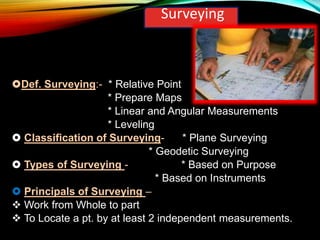
Surveying
Def. Surveying:- * Relative Point
* Prepare Maps
* Linear and Angular Measurements
* Leveling
 Classification of Surveying- * Plane Surveying
* Geodetic Surveying
 Types of Surveying - * Based on Purpose
* Based on Instruments
 Principals of Surveying –
 Work from Whole to part
 To Locate a pt. by at least 2 independent measurements.
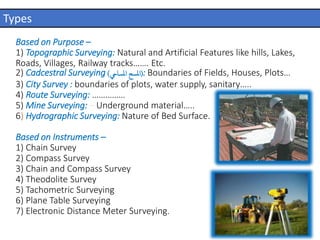
Based on Purpose –
1) Topographic Surveying: Natural and Artificial Features like hills, Lakes,
Roads, Villages, Railway tracks……. Etc.
2) Cadcestral Surveying (
‫املسايح‬ ‫املسح‬
) : Boundaries of Fields, Houses, Plots…
3) City Survey : boundaries of plots, water supply, sanitary…..
4) Route Surveying: ……………
5) Mine Surveying: – Underground material…..
6) Hydrographic Surveying: Nature of Bed Surface.
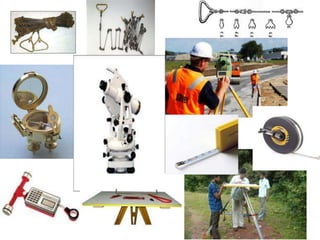
Based on Instruments –
1) Chain Survey
2) Compass Survey
3) Chain and Compass Survey
4) Theodolite Survey
5) Tachometric Surveying
6) Plane Table Surveying
7) Electronic Distance Meter Surveying.
Types
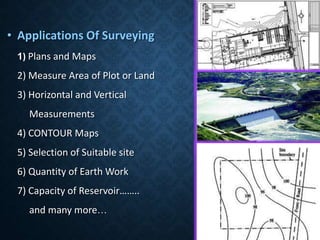
• Applications Of Surveying
1) Plans and Maps
2) Measure Area of Plot or Land
3) Horizontal and Vertical
Measurements
4) CONTOUR Maps
5) Selection of Suitable site
6) Quantity of Earth Work
7) Capacity of Reservoir……..
and many more…
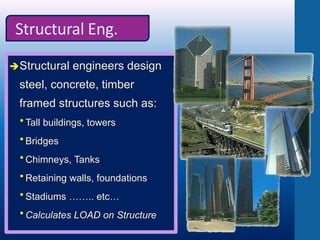
Structural Eng.
Structural engineers design
steel, concrete, timber
framed structures such as:
Tall buildings, towers
Bridges
Chimneys, Tanks
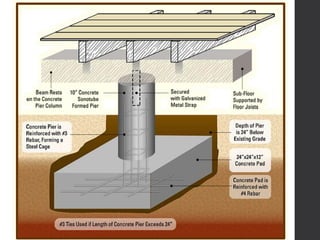
Retaining walls, foundations
Stadiums …….. etc…
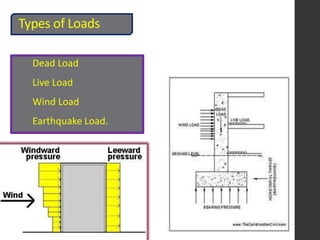
Calculates LOAD on Structure
Types of Loads
1) Dead Load
2) Live Load
3) Wind Load
4) Earthquake Load.
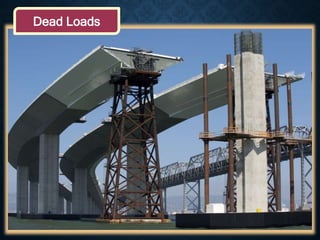
Dead Loads
Dead Load “DL”:
 Loads that make up the weight of the structure, such as
wall, floors, roofs and any permanently fixed loads such
as furnace, air conditioneror otherservice equipment.
 Materials that makes up the walls, such as studs,
plywood, insulation, sheet rock, nails, glue, etc. are “DL”
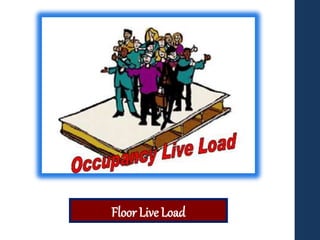
Floor LiveLoad
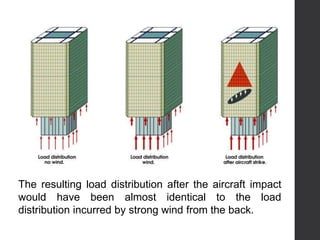
The resulting load distribution after the aircraft impact
would have been almost identical to the load
distribution incurred by strong wind from the back.
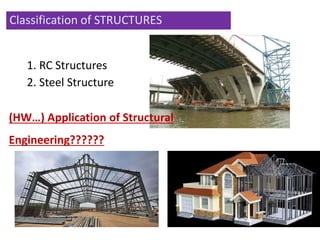
Classification of STRUCTURES
1. 1. RC Structures
2. 2. Steel Structure
(HW…) Application of Structural
Engineering??????
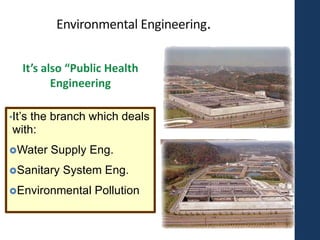
Environmental Engineering.
•It’s the branch which deals
with:
Water Supply Eng.
Sanitary System Eng.
Environmental Pollution
Applications of Environmental Eng.
1) Testing Quality of Water for different purposes.
2) Design – Water Treatment Plant.
3) Design – Sewage Treatment Plant.
4) Study Population and design proposed projects.
5) Control and Reduce POLLUTION
6) Dispose Waste….etc..
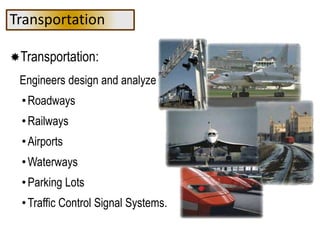
Transportation
Transportation:
Engineers design and analyze
•Roadways
•Railways
•Airports
•Waterways
•Parking Lots
•Traffic Control Signal Systems.
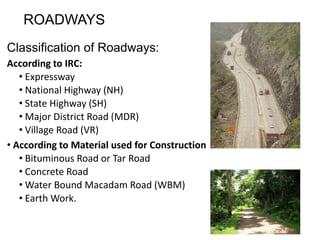
ROADWAYS
Classification of Roadways:
According to IRC:
• Expressway
• National Highway (NH)
• State Highway (SH)
• Major District Road (MDR)
• Village Road (VR)
• According to Material used for Construction
• Bituminous Road or Tar Road
• Concrete Road
• Water Bound Macadam Road (WBM)
• Earth Work.
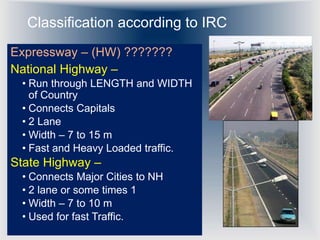
Classification according to IRC
Expressway – (HW) ???????
National Highway –
• Run through LENGTH and WIDTH
of Country
• Connects Capitals
• 2 Lane
• Width – 7 to 15 m
• Fast and Heavy Loaded traffic.
State Highway –
• Connects Major Cities to NH
• 2 lane or some times 1
• Width – 7 to 10 m
• Used for fast Traffic.
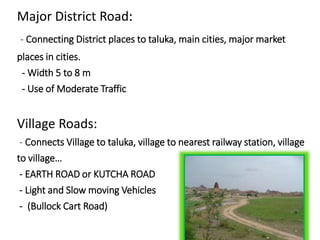
Major District Road:
- Connecting District places to taluka, main cities, major market
places in cities.
- Width 5 to 8 m
- Use of Moderate Traffic
Village Roads:
- Connects Village to taluka, village to nearest railway station, village
to village…
- EARTH ROAD or KUTCHA ROAD
- Light and Slow moving Vehicles
- (Bullock Cart Road)
WHAT IS ROAD AND PAVEMENT
?
 Road is an open, generally public way for the passage
of vehicles, people, and animals.
 Pavement is finished with a hard smooth surface. It
helped make them durable and able to withstand traffic
and the environment. They have a life span of between 20 –
30 years.
FUNCTIONS
One of the primary functions of pavement is load
distribution. It can be characterized by the tire loads, tire
configurations, repetition of loads, and distribution of traffic
across the pavement, and vehicle speed.
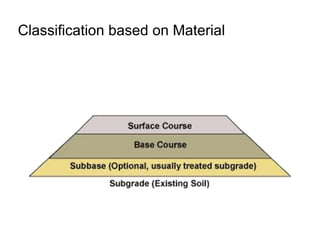
Classification based on Material
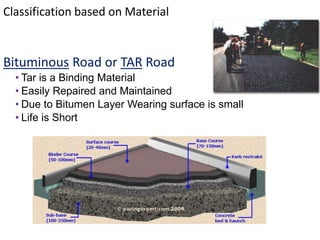
Bituminous Road or TAR Road
• Tar is a Binding Material
• Easily Repaired and Maintained
• Due to Bitumen Layer Wearing surface is small
• Life is Short
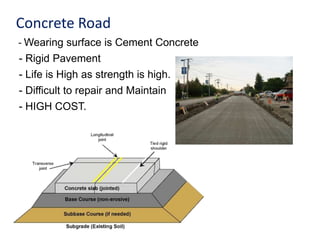
Concrete Road
- Wearing surface is Cement Concrete
- Rigid Pavement
- Life is High as strength is high.
- Difficult to repair and Maintain
- HIGH COST.
Water Bound Macadam Road -
• Base Course of Bitumen or Concrete
• Constructed with 2 to 3 layers of aggregates and soil
material
• Normally provided on VILLAGE ROAD
Earth Road –
•Earth material is main Constituent of the road,
•Kutcha road (Loacally available material),
•Formed by trace passers or bullock carts….
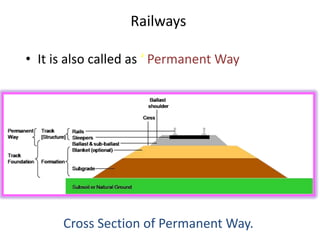
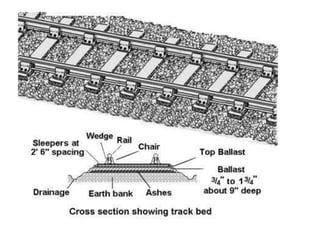
Railways
• It is also called as ‘ Permanent Way
Cross Section of Permanent Way.
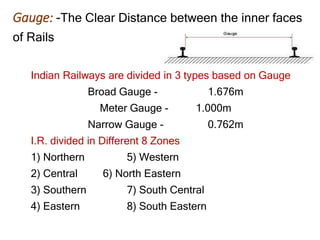
Gauge: -The Clear Distance between the inner faces
of Rails
Indian Railways are divided in 3 types based on Gauge
Broad Gauge - 1.676m
Meter Gauge - 1.000m
Narrow Gauge - 0.762m
I.R. divided in Different 8 Zones
1) Northern 5) Western
2) Central 6) North Eastern
3) Southern 7) South Central
4) Eastern 8) South Eastern
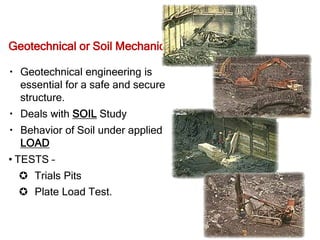
Geotechnical or Soil Mechanics
Geotechnical engineering is
essential for a safe and secure
structure.
Deals with SOIL Study
Behavior of Soil under applied
LOAD
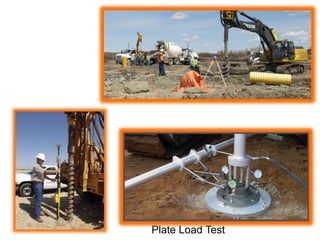
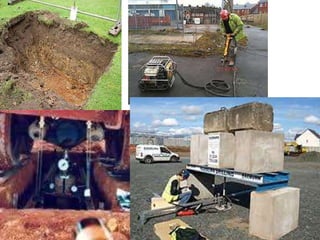
• TESTS –
 Trials Pits
 Plate Load Test.
Plate Load Test
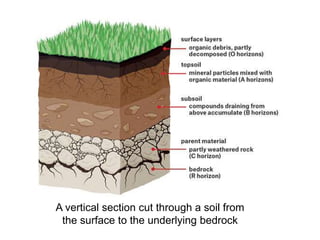
A vertical section cut through a soil from
the surface to the underlying bedrock
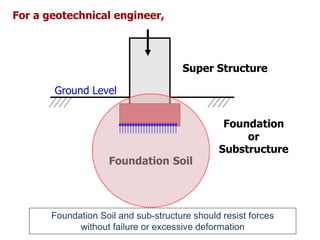
For a geotechnical engineer,
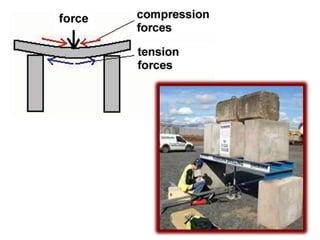
Foundation Soil and sub-structure should resist forces
without failure or excessive deformation
Foundation Soil
Super Structure
Foundation
or
Substructure
Ground Level
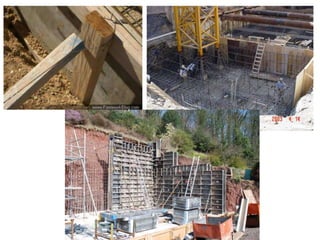
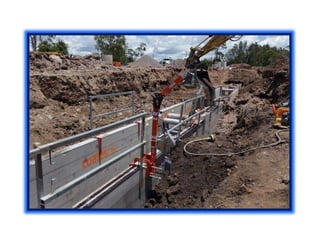
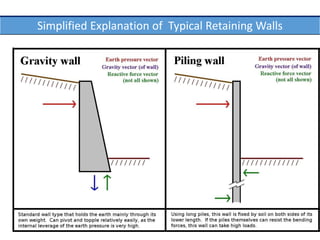
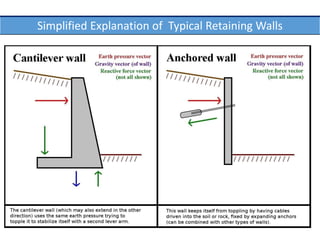
Simplified Explanation of Typical Retaining Walls
1) Properties of Soil.
2) Classification of Soil.
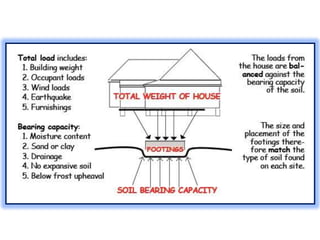
3) Bearing Capacity of Soil.
4) Design of Earth Dam ------EG??????
5) Study of different SOIL STRATA.
6) Capability of SUB- GRADE of road.
7) Design of FOUNDATION in any type of soil.
8) Analyze the WATER SEEPAGE for Dams.
Application of Geotechnical Eng.
Quantity Surveying
•Deals with measuring various Quantities and Probable
cost of Construction.
•CLASSICATION:-
Quantity Surveying
ESTIMATE VALUATION
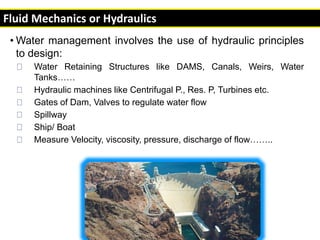
• Water management involves the use of hydraulic principles
to design:
Water Retaining Structures like DAMS, Canals, Weirs, Water
Tanks……
Hydraulic machines like Centrifugal P., Res. P, Turbines etc.
Gates of Dam, Valves to regulate water flow
Spillway
Ship/ Boat
Measure Velocity, viscosity, pressure, discharge of flow……..
Fluid Mechanics or Hydraulics
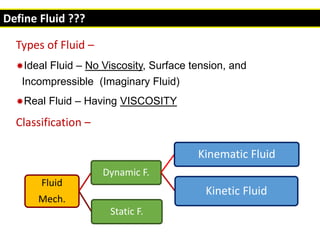
Types of Fluid –
Ideal Fluid – No Viscosity, Surface tension, and
Incompressible (Imaginary Fluid)
Real Fluid – Having VISCOSITY
Classification –
Fluid
Mech.
Dynamic F.
Kinematic Fluid
Kinetic Fluid
Static F.
Define Fluid ???
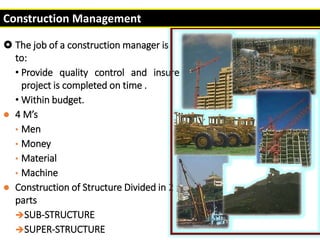
 The job of a construction manager is
to:
• Provide quality control and insure
project is completed on time .
• Within budget.
 4 M’s
• Men
• Money
• Material
• Machine
 Construction of Structure Divided in 2
parts
SUB-STRUCTURE
SUPER-STRUCTURE
Construction Management
1) Use of Modern Techniques, Machinery for SAFE and
SPEEDY work.
2) Use od Modern Material in Special Construction Work like
DAMS and TUNNELS
3) Plan the project and decided the sequence
4) Control Labours
5) Economical
6) Good Quality of Work.
Applications..........
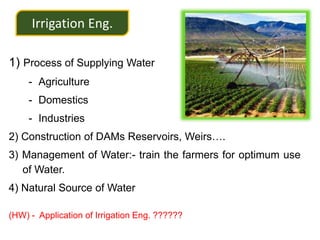
1) Process of Supplying Water for:
- Agriculture
- Domestics
- Industries
2) Construction of DAMs Reservoirs, Weirs….
3) Management of Water:- train the farmers for optimum use
of Water.
4) Natural Source of Water
(HW) - Application of Irrigation Eng. ??????
Irrigation Eng.
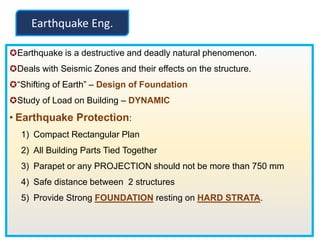
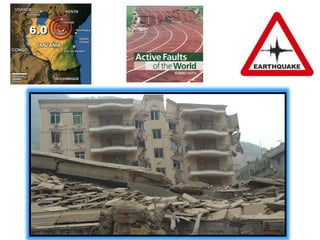
Earthquake is a destructive and deadly natural phenomenon.
Deals with Seismic Zones and their effects on the structure.
“Shifting of Earth” – Design of Foundation
Study of Load on Building – DYNAMIC
• Earthquake Protection:
1) Compact Rectangular Plan
2) All Building Parts Tied Together
3) Parapet or any PROJECTION should not be more than 750 mm
4) Safe distance between 2 structures
5) Provide Strong FOUNDATION resting on HARD STRATA.
Earthquake Eng.
• ROLE OF CIVIL ENGINEER IN DIFFERENT
CONSTRUCTIONWORKS…..
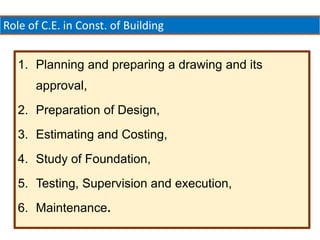
1. Planning and preparing a drawing and its
approval,
2. Preparation of Design,
3. Estimating and Costing,
4. Study of Foundation,
5. Testing, Supervision and execution,
6. Maintenance.
Role of C.E. in Const. of Building
1) Site Selection,
2) Conduct various Surveys and Collection of Various Data,
3) Study of Foundation,
4) Study of Catchment Area,
5) Reservoir Capacity,
6) Selection of DAM,
7) Structural and Hydraulic Design,
8) Estimate,
9) Testing Supervision Execution and maintenances,
10) Socio Economic ROLE ‫ادلور‬
‫إقتصادى‬‫ل‬‫ا‬
‫إجامتعي‬‫ل‬‫ا‬ (Political and
Social).
Role of C.E. in Const. of Dam’s
1) Planning and Surveying,
2) Alignment of Road,
3) Contour Plan,
4) Design of Road and Pavement,
5) Estimate of Road,
6) Construction and testing of Express Way,
7) Maintenance.
Role of C.E. in Const. of Express Ways
Summer  training

Summer training

  • 1.
    Summer Semester Training” 2018” By: Dr. Ezzat El-Sayed G. SALEH
  • 2.
  • 4.
  • 5.
    • Branches ofCivil Engineering. Surveying, Transportation Eng., Geotechnical or Soil Mechanics, Environmental Eng., Structural Eng., Quantity Surveying, Construction Management and Project Management, Irrigation, Fluid Mechanics and Hydraulics, Town Planning, Remote Sensing. Civil Engineering is Everywhere
  • 6.
  • 7.
    The Chicago spire609m tall building
  • 8.
    Note: Includes antennas “TheCouncil on Tall Buildings and Urban Habitat.” The Wall Street Journal skyscraper being built in Jeddah aims for a record-breaking height that's is expected to exceed 3 281 ft The Worlds Tallest Buildings
  • 9.
    Branches of CivilEngineering 1) Surveying 2) Construction Management 3) Quantity Surveying 4) Structural Eng. Housing – 5) Geotechnical and Foundation Eng. 6) Earthquake Eng. 7) Town Planning 8) Remote Sensing
  • 10.
    Branches of CivilEngineering 1) Irrigation Eng. Water – 2) Fluid Mechanics and Hydraulics 3) Environmental Eng. 1) Waterways Transportation– 2 ) Railways 3) Airways
  • 11.
    Surveying Def. Surveying:- *Relative Point * Prepare Maps * Linear and Angular Measurements * Leveling  Classification of Surveying- * Plane Surveying * Geodetic Surveying  Types of Surveying - * Based on Purpose * Based on Instruments  Principals of Surveying –  Work from Whole to part  To Locate a pt. by at least 2 independent measurements.
  • 12.
    Based on Purpose– 1) Topographic Surveying: Natural and Artificial Features like hills, Lakes, Roads, Villages, Railway tracks……. Etc. 2) Cadcestral Surveying ( ‫املسايح‬ ‫املسح‬ ) : Boundaries of Fields, Houses, Plots… 3) City Survey : boundaries of plots, water supply, sanitary….. 4) Route Surveying: …………… 5) Mine Surveying: – Underground material….. 6) Hydrographic Surveying: Nature of Bed Surface. Based on Instruments – 1) Chain Survey 2) Compass Survey 3) Chain and Compass Survey 4) Theodolite Survey 5) Tachometric Surveying 6) Plane Table Surveying 7) Electronic Distance Meter Surveying. Types
  • 14.
    • Applications OfSurveying 1) Plans and Maps 2) Measure Area of Plot or Land 3) Horizontal and Vertical Measurements 4) CONTOUR Maps 5) Selection of Suitable site 6) Quantity of Earth Work 7) Capacity of Reservoir…….. and many more…
  • 15.
    Structural Eng. Structural engineersdesign steel, concrete, timber framed structures such as: Tall buildings, towers Bridges Chimneys, Tanks Retaining walls, foundations Stadiums …….. etc… Calculates LOAD on Structure
  • 16.
    Types of Loads 1)Dead Load 2) Live Load 3) Wind Load 4) Earthquake Load.
  • 19.
  • 20.
    Dead Load “DL”: Loads that make up the weight of the structure, such as wall, floors, roofs and any permanently fixed loads such as furnace, air conditioneror otherservice equipment.  Materials that makes up the walls, such as studs, plywood, insulation, sheet rock, nails, glue, etc. are “DL”
  • 21.
  • 22.
    The resulting loaddistribution after the aircraft impact would have been almost identical to the load distribution incurred by strong wind from the back.
  • 23.
    Classification of STRUCTURES 1.1. RC Structures 2. 2. Steel Structure (HW…) Application of Structural Engineering??????
  • 25.
    Environmental Engineering. •It’s thebranch which deals with: Water Supply Eng. Sanitary System Eng. Environmental Pollution
  • 26.
    Applications of EnvironmentalEng. 1) Testing Quality of Water for different purposes. 2) Design – Water Treatment Plant. 3) Design – Sewage Treatment Plant. 4) Study Population and design proposed projects. 5) Control and Reduce POLLUTION 6) Dispose Waste….etc..
  • 27.
    Transportation Transportation: Engineers design andanalyze •Roadways •Railways •Airports •Waterways •Parking Lots •Traffic Control Signal Systems.
  • 29.
    ROADWAYS Classification of Roadways: Accordingto IRC: • Expressway • National Highway (NH) • State Highway (SH) • Major District Road (MDR) • Village Road (VR) • According to Material used for Construction • Bituminous Road or Tar Road • Concrete Road • Water Bound Macadam Road (WBM) • Earth Work.
  • 30.
    Classification according toIRC Expressway – (HW) ??????? National Highway – • Run through LENGTH and WIDTH of Country • Connects Capitals • 2 Lane • Width – 7 to 15 m • Fast and Heavy Loaded traffic. State Highway – • Connects Major Cities to NH • 2 lane or some times 1 • Width – 7 to 10 m • Used for fast Traffic.
  • 31.
    Major District Road: -Connecting District places to taluka, main cities, major market places in cities. - Width 5 to 8 m - Use of Moderate Traffic Village Roads: - Connects Village to taluka, village to nearest railway station, village to village… - EARTH ROAD or KUTCHA ROAD - Light and Slow moving Vehicles - (Bullock Cart Road)
  • 33.
    WHAT IS ROADAND PAVEMENT ?  Road is an open, generally public way for the passage of vehicles, people, and animals.  Pavement is finished with a hard smooth surface. It helped make them durable and able to withstand traffic and the environment. They have a life span of between 20 – 30 years. FUNCTIONS One of the primary functions of pavement is load distribution. It can be characterized by the tire loads, tire configurations, repetition of loads, and distribution of traffic across the pavement, and vehicle speed.
  • 34.
  • 35.
    Classification based onMaterial Bituminous Road or TAR Road • Tar is a Binding Material • Easily Repaired and Maintained • Due to Bitumen Layer Wearing surface is small • Life is Short
  • 36.
    Concrete Road - Wearingsurface is Cement Concrete - Rigid Pavement - Life is High as strength is high. - Difficult to repair and Maintain - HIGH COST.
  • 37.
    Water Bound MacadamRoad - • Base Course of Bitumen or Concrete • Constructed with 2 to 3 layers of aggregates and soil material • Normally provided on VILLAGE ROAD Earth Road – •Earth material is main Constituent of the road, •Kutcha road (Loacally available material), •Formed by trace passers or bullock carts….
  • 38.
    Railways • It isalso called as ‘ Permanent Way Cross Section of Permanent Way.
  • 40.
    Gauge: -The ClearDistance between the inner faces of Rails Indian Railways are divided in 3 types based on Gauge Broad Gauge - 1.676m Meter Gauge - 1.000m Narrow Gauge - 0.762m I.R. divided in Different 8 Zones 1) Northern 5) Western 2) Central 6) North Eastern 3) Southern 7) South Central 4) Eastern 8) South Eastern
  • 41.
    Geotechnical or SoilMechanics Geotechnical engineering is essential for a safe and secure structure. Deals with SOIL Study Behavior of Soil under applied LOAD • TESTS –  Trials Pits  Plate Load Test.
  • 43.
  • 46.
    A vertical sectioncut through a soil from the surface to the underlying bedrock
  • 47.
    For a geotechnicalengineer, Foundation Soil and sub-structure should resist forces without failure or excessive deformation Foundation Soil Super Structure Foundation or Substructure Ground Level
  • 48.
    Simplified Explanation ofTypical Retaining Walls
  • 49.
    Simplified Explanation ofTypical Retaining Walls
  • 52.
    1) Properties ofSoil. 2) Classification of Soil. 3) Bearing Capacity of Soil. 4) Design of Earth Dam ------EG?????? 5) Study of different SOIL STRATA. 6) Capability of SUB- GRADE of road. 7) Design of FOUNDATION in any type of soil. 8) Analyze the WATER SEEPAGE for Dams. Application of Geotechnical Eng.
  • 53.
    Quantity Surveying •Deals withmeasuring various Quantities and Probable cost of Construction. •CLASSICATION:- Quantity Surveying ESTIMATE VALUATION
  • 54.
    • Water managementinvolves the use of hydraulic principles to design: Water Retaining Structures like DAMS, Canals, Weirs, Water Tanks…… Hydraulic machines like Centrifugal P., Res. P, Turbines etc. Gates of Dam, Valves to regulate water flow Spillway Ship/ Boat Measure Velocity, viscosity, pressure, discharge of flow…….. Fluid Mechanics or Hydraulics
  • 55.
    Types of Fluid– Ideal Fluid – No Viscosity, Surface tension, and Incompressible (Imaginary Fluid) Real Fluid – Having VISCOSITY Classification – Fluid Mech. Dynamic F. Kinematic Fluid Kinetic Fluid Static F. Define Fluid ???
  • 56.
     The jobof a construction manager is to: • Provide quality control and insure project is completed on time . • Within budget.  4 M’s • Men • Money • Material • Machine  Construction of Structure Divided in 2 parts SUB-STRUCTURE SUPER-STRUCTURE Construction Management
  • 57.
    1) Use ofModern Techniques, Machinery for SAFE and SPEEDY work. 2) Use od Modern Material in Special Construction Work like DAMS and TUNNELS 3) Plan the project and decided the sequence 4) Control Labours 5) Economical 6) Good Quality of Work. Applications..........
  • 58.
    1) Process ofSupplying Water for: - Agriculture - Domestics - Industries 2) Construction of DAMs Reservoirs, Weirs…. 3) Management of Water:- train the farmers for optimum use of Water. 4) Natural Source of Water (HW) - Application of Irrigation Eng. ?????? Irrigation Eng.
  • 59.
    Earthquake is adestructive and deadly natural phenomenon. Deals with Seismic Zones and their effects on the structure. “Shifting of Earth” – Design of Foundation Study of Load on Building – DYNAMIC • Earthquake Protection: 1) Compact Rectangular Plan 2) All Building Parts Tied Together 3) Parapet or any PROJECTION should not be more than 750 mm 4) Safe distance between 2 structures 5) Provide Strong FOUNDATION resting on HARD STRATA. Earthquake Eng.
  • 61.
    • ROLE OFCIVIL ENGINEER IN DIFFERENT CONSTRUCTIONWORKS…..
  • 62.
    1. Planning andpreparing a drawing and its approval, 2. Preparation of Design, 3. Estimating and Costing, 4. Study of Foundation, 5. Testing, Supervision and execution, 6. Maintenance. Role of C.E. in Const. of Building
  • 63.
    1) Site Selection, 2)Conduct various Surveys and Collection of Various Data, 3) Study of Foundation, 4) Study of Catchment Area, 5) Reservoir Capacity, 6) Selection of DAM, 7) Structural and Hydraulic Design, 8) Estimate, 9) Testing Supervision Execution and maintenances, 10) Socio Economic ROLE ‫ادلور‬ ‫إقتصادى‬‫ل‬‫ا‬ ‫إجامتعي‬‫ل‬‫ا‬ (Political and Social). Role of C.E. in Const. of Dam’s
  • 64.
    1) Planning andSurveying, 2) Alignment of Road, 3) Contour Plan, 4) Design of Road and Pavement, 5) Estimate of Road, 6) Construction and testing of Express Way, 7) Maintenance. Role of C.E. in Const. of Express Ways