Microbiology
Samipta Singh
Contents to discuss
• Introduction
• A brief History of Microbiology
• Microbes In Human Welfare
• Culture Techniques
• Growth Pattern
• Human defense Method (Immunology)
• Normal Flora
• Introduction, Common problem related to the following (discussing
anti microbial agents for)
== Bacteriology
== Mycology
== Virology
== Parasitology
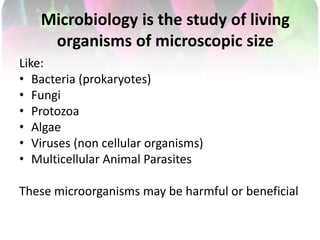
Microbiology is the study of living
organisms of microscopic size
Like:
• Bacteria (prokaryotes)
• Fungi
• Protozoa
• Algae
• Viruses (non cellular organisms)
• Multicellular Animal Parasites
These microorganisms may be harmful or beneficial
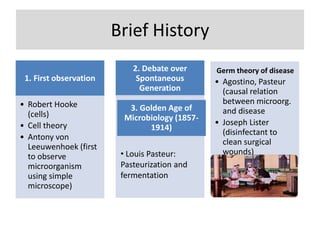
Brief History
1. First observation
• Robert Hooke
(cells)
• Cell theory
• Antony von
Leeuwenhoek (first
to observe
microorganism
using simple
microscope)
2. Debate over
Spontaneous
Generation
3. Golden Age of
Microbiology (1857-
1914)
• Agostino, Pasteur
(causal relation
between microorg.
and disease
• Joseph Lister
(disinfectant to
clean surgical
wounds)• Louis Pasteur:
Pasteurization and
fermentation
Germ theory of disease
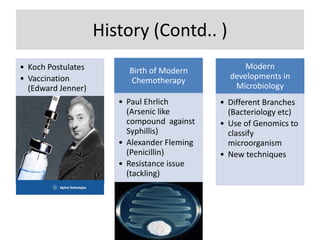
History (Contd.. )
• Koch Postulates
• Vaccination
(Edward Jenner)
Birth of Modern
Chemotherapy
• Paul Ehrlich
(Arsenic like
compound against
Syphillis)
• Alexander Fleming
(Penicillin)
• Resistance issue
(tackling)
Modern
developments in
Microbiology
• Different Branches
(Bacteriology etc)
• Use of Genomics to
classify
microorganism
• New techniques
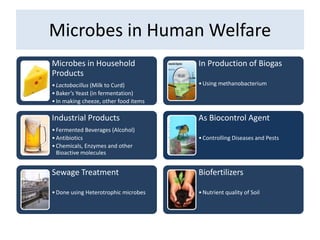
Microbes in Human Welfare
Microbes in Household
Products
•Lactobacillus (Milk to Curd)
•Baker’s Yeast (in fermentation)
•In making cheeze, other food items
Industrial Products
•Fermented Beverages (Alcohol)
•Antibiotics
•Chemicals, Enzymes and other
Bioactive molecules
Sewage Treatment
•Done using Heterotrophic microbes
In Production of Biogas
•Using methanobacterium
As Biocontrol Agent
•Controlling Diseases and Pests
Biofertilizers
•Nutrient quality of Soil
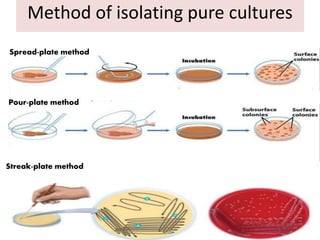
Method of isolating pure cultures
Streak-plate method
Pour-plate method
Spread-plate method
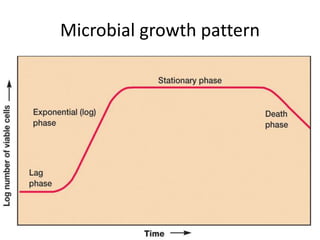
Microbial growth pattern
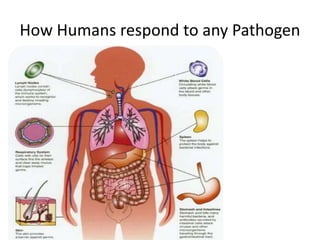
How Humans respond to any Pathogen
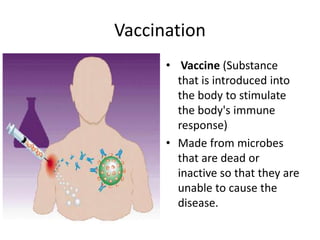
Vaccination
• Vaccine (Substance
that is introduced into
the body to stimulate
the body's immune
response)
• Made from microbes
that are dead or
inactive so that they are
unable to cause the
disease.
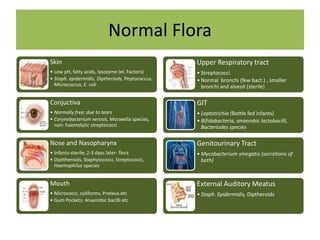
Normal Flora
Skin
• Low pH, fatty acids, lysozyme (el. Factors)
• Staph. epidermidis, Diptheriods, Peptococcus,
Micrococcus, E. coli
Conjuctiva
• Normally free; due to tears
• Corynebacterium xerosis, Moraxella species,
non- haemolytic streptococci
Nose and Nasopharynx
• Infants-sterile; 2-3 days later- flora
• Dipttheroids, Staphylococci, Streptococci,
Haemophilus species
Mouth
• Micrococci, coliforms, Proteus etc
• Gum Pockets: Anaerobic bacilli etc
Upper Respiratory tract
• Streptococci
• Normal bronchi (few bact.) , smaller
bronchi and alveoli (sterile)
GIT
• Leptotrichia (Bottle fed infants)
• Bifidobacteria, anaerobic lactobacilli,
Bacteriodes species
Genitourinary Tract
• Mycobacterium smegatis (secretions of
both)
External Auditory Meatus
• Staph. Epidermidis, Diptheroids
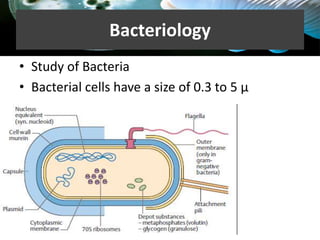
Bacteriology
• Study of Bacteria
• Bacterial cells have a size of 0.3 to 5 µ
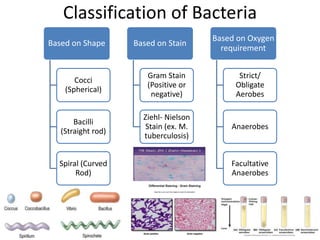
Classification of Bacteria
Based on Shape
Cocci
(Spherical)
Bacilli
(Straight rod)
Spiral (Curved
Rod)
Based on Stain
Gram Stain
(Positive or
negative)
Ziehl- Nielson
Stain (ex. M.
tuberculosis)
Based on Oxygen
requirement
Strict/
Obligate
Aerobes
Anaerobes
Facultative
Anaerobes
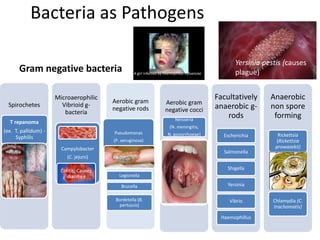
Bacteria as Pathogens
Gram negative bacteria
Spirochetes
T repanoma
(ex. T. pallidum) -
Syphilis
Microaerophilic
Vibrioid g-
bacteria
Campylobacter
(C. jejuni)
Colitis; Causes
diarrhea
Aerobic gram
negative rods
Pseudomonas
(P. aeruginosa)
Legionella
Brucella
Bordetella (B.
pertussis)
Aerobic gram
negative cocci
Neisseria
(N. meningitis,
N. gonorrhoeae)
Facultatively
anaerobic g-
rods
Escherichia
Salmonella
Shigella
Yersinia
Vibrio
Haemophillus
Anaerobic
non spore
forming
Rickettsia
(Rickettsia
prowazekii)
Chlamydia (C.
trachomatis)
A girl infected by Haemophilus influenzae
Yersinia pestis (causes
plague)
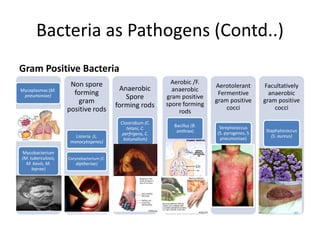
Bacteria as Pathogens (Contd..)
Gram Positive Bacteria
Mycoplasmas (M.
pneumoniae)
Mycobacterium
(M. tuberculosis,
M. bovis, M.
leprae)
Non spore
forming
gram
positive rods
Listeria (L.
monocytogenes)
Corynebacterium (C.
diptheriae)
Anaerobic
Spore
forming rods
Clostridium (C.
tetani, C.
perfrigens, C.
botunalism)
Aerobic /F.
anaerobic
gram positive
spore forming
rods
Bacillus (B.
anthrax)
Aerotolerant
Fermentive
gram positive
cocci
Streptococcus
(S. pyrogenes, S
pneumoniae)
Facultatively
anaerobic
gram positive
cocci
Staphylococcus
(S. aureus)
Anti-bacterial agents
• Sulfonamides :Sulfadiazine
• Diaminopyrimidines
• Quinolones: Ciprofloxacin,
Gatifloxacin
• Β-Lactam Antibiotics:
Penicillins, Cephalosporins,
Carbapenems
• Tetracyclines: Minocycline
• Chloramphenicol
• Aminoglycosides
• Macrolides: Azithromycin
(Azilide/Bactoclab),
• Lincosamides: Clindamycin
• Glycopeptides: Vancomycin
• Oxazolidine
• Polypeptide
• Nitrofuran: Furazolidone
• Nicotinic Acid derivatives:
Isoniazid
• Polyenes: Nystatin,
Amphotericin-B
• Anti-tubercular
• Anti-leprotic
Mycology
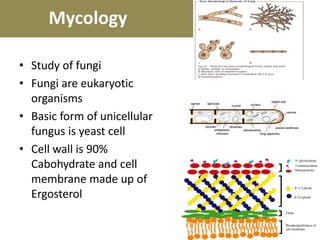
• Study of fungi
• Fungi are eukaryotic
organisms
• Basic form of unicellular
fungus is yeast cell
• Cell wall is 90%
Cabohydrate and cell
membrane made up of
Ergosterol
Problems caused by fungus
• Problems Caused by Fungus: Fungal Allergies,
Mycotoxicosis, Infection
• Fungus as microbial agent of Disease
(Classification)
Sub cutaneous mycoses
Dermatomycoses or Cutaneous
mycoses
Systemic mycoses
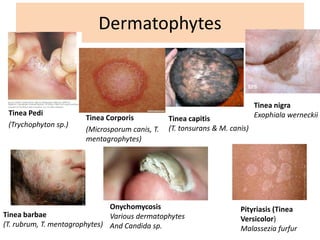
Dermatophytes
Tinea Pedi
(Trychophyton sp.)
Tinea Corporis
(Microsporum canis, T.
mentagrophytes)
Tinea capitis
(T. tonsurans & M. canis)
Tinea barbae
(T. rubrum, T. mentagrophytes)
Onychomycosis
Various dermatophytes
And Candida sp.
Pityriasis (Tinea
Versicolor)
Malassezia furfur
Tinea nigra
Exophiala werneckii
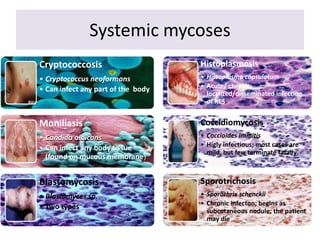
Systemic mycoses
Cryptococcosis
• Cryptococcus neoformans
• Can infect any part of the body
Moniliasis
• Candida albicans
• Can infect any body tissue
(found on mucous membrane)
Blastomycosis
• Blastomyces sp.
• Two types
Histoplasmosis
• Histoplasma capsulatum
• Acute/ chronic;
localized/disseminated infection
of RES
Coccidiomycosis
• Coccioides immitis
• Higly infectious; most cases are
mild, but few terminate fatally
Sporotrichosis
• Sporothrix schenckii
• Chronic infecton; begins as
subcutaneous nodule; the patient
may die
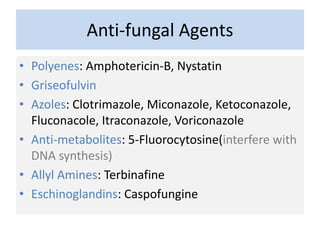
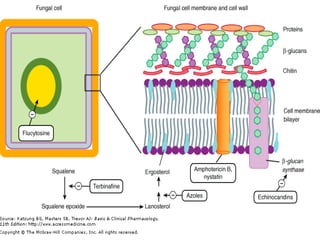
Anti-fungal Agents
• Polyenes: Amphotericin-B, Nystatin
• Griseofulvin
• Azoles: Clotrimazole, Miconazole, Ketoconazole,
Fluconacole, Itraconazole, Voriconazole
• Anti-metabolites: 5-Fluorocytosine(interfere with
DNA synthesis)
• Allyl Amines: Terbinafine
• Eschinoglandins: Caspofungine
Parasitology
• Scientific study of parasitic protozoa and worms
• Parasites are classified into 2 sub-kingdoms:
== Protozoa (unicellular)
== Metazoa (multicellular)
• Protozoan parasites are classified according to
morphology and means of locomotion. There are 45,000
protozoa species.
• Metazoans include the worms (helminths) and arthropoda
(posses an external skeleton) e.g. ticks, lice
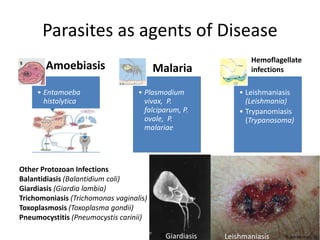
Parasites as agents of Disease
• Entamoeba
histolytica
• Plasmodium
vivax, P.
falciparum, P.
ovale, P.
malariae
• Leishmaniasis
(Leishmania)
• Trypanomiasis
(Trypanosoma)
Amoebiasis Malaria
Hemoflagellate
infections
Other Protozoan Infections
Balantidiasis (Balantidium coli)
Giardiasis (Giardia lambia)
Trichomoniasis (Trichomonas vaginalis)
Toxoplasmosis (Toxoplasma gondii)
Pneumocystitis (Pneumocystis carinii)
GGiardiasis Leishmaniasis
Anti- Parasitic Agents
Antihelmintic
preparations
• Abamectin
• Diethylcarbamazine
• Niclosamide
• Ivermectin
• Benzimidazines:
Thiabendazole, Albendazole,
Mebendazole,
Triclabendazole, Flubendazole
• Praziquantel
Antimalarial drugs
• Chloroquine, Primaquine, etc
• Biguanides
• Pyrimethamine
• Tetracyclines
• Artimisinin
Anti- amoebic drugs
• Metronidazole
• Tinidazole
• Diloxamide
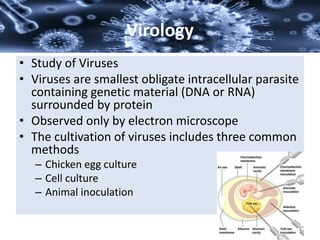
Virology
• Study of Viruses
• Viruses are smallest obligate intracellular parasite
containing genetic material (DNA or RNA)
surrounded by protein
• Observed only by electron microscope
• The cultivation of viruses includes three common
methods
– Chicken egg culture
– Cell culture
– Animal inoculation
• Viruses have an inner core of nucleic acid
surrounded by protein coat known as an envelope
• Size range = 20 – 250 nanometers
• Replication: within a host cell while utilizing the host
cell’s nucleic acids
• Prions: Infectious proteins without any detectable
nucleic acid
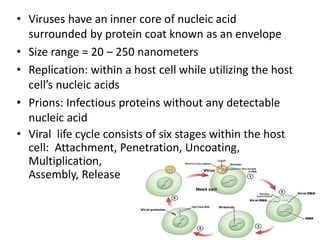
• Viral life cycle consists of six stages within the host
cell: Attachment, Penetration, Uncoating,
Multiplication,
Assembly, Release
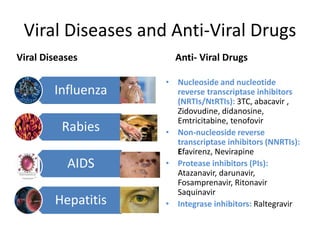
Viral Diseases and Anti-Viral Drugs
Viral Diseases
Influenza
Rabies
AIDS
Hepatitis
Anti- Viral Drugs
• Nucleoside and nucleotide
reverse transcriptase inhibitors
(NRTIs/NtRTIs): 3TC, abacavir ,
Zidovudine, didanosine,
Emtricitabine, tenofovir
• Non-nucleoside reverse
transcriptase inhibitors (NNRTIs):
Efavirenz, Nevirapine
• Protease inhibitors (PIs):
Atazanavir, darunavir,
Fosamprenavir, Ritonavir
Saquinavir
• Integrase inhibitors: Raltegravir
References
• Tortora, G.J; Funke, B.R; Case, C.L. “Microbiology- An
Introduction” 10th Ed, Pearson,2010
• Pelczar, M.J; Chan, E.C.S; Krieg, N.R. “Microbiology” 5th
Ed, Tata McGraw Hill Publishing Company Limited,
2009, 788-875
• Baveja, C.P. “Textbook of Microbiology” 3rd Ed, Arya
Publications, 2010, 418-419
• Tripathi, K.D. “Essentials of Medical Pharmacology”
Jaypee Brothers Medical Publishers Pvt Ltd.,2009, 668
• http://www.countrysideinfo.co.uk/fungi/importce.htm
“Microbes are the normal part of
our universe. They may be harmful,
may also be beneficial. We humans
have find our ways to tackle with
harmful ones. Still dealing with it.
No matter how resistant you
become, we will find our ways to
Survive”
-Samipta Singh

Microbiology ppt

  • 1.
  • 2.
    Contents to discuss •Introduction • A brief History of Microbiology • Microbes In Human Welfare • Culture Techniques • Growth Pattern • Human defense Method (Immunology) • Normal Flora • Introduction, Common problem related to the following (discussing anti microbial agents for) == Bacteriology == Mycology == Virology == Parasitology
  • 3.
    Microbiology is thestudy of living organisms of microscopic size Like: • Bacteria (prokaryotes) • Fungi • Protozoa • Algae • Viruses (non cellular organisms) • Multicellular Animal Parasites These microorganisms may be harmful or beneficial
  • 4.
    Brief History 1. Firstobservation • Robert Hooke (cells) • Cell theory • Antony von Leeuwenhoek (first to observe microorganism using simple microscope) 2. Debate over Spontaneous Generation 3. Golden Age of Microbiology (1857- 1914) • Agostino, Pasteur (causal relation between microorg. and disease • Joseph Lister (disinfectant to clean surgical wounds)• Louis Pasteur: Pasteurization and fermentation Germ theory of disease
  • 5.
    History (Contd.. ) •Koch Postulates • Vaccination (Edward Jenner) Birth of Modern Chemotherapy • Paul Ehrlich (Arsenic like compound against Syphillis) • Alexander Fleming (Penicillin) • Resistance issue (tackling) Modern developments in Microbiology • Different Branches (Bacteriology etc) • Use of Genomics to classify microorganism • New techniques
  • 6.
    Microbes in HumanWelfare Microbes in Household Products •Lactobacillus (Milk to Curd) •Baker’s Yeast (in fermentation) •In making cheeze, other food items Industrial Products •Fermented Beverages (Alcohol) •Antibiotics •Chemicals, Enzymes and other Bioactive molecules Sewage Treatment •Done using Heterotrophic microbes In Production of Biogas •Using methanobacterium As Biocontrol Agent •Controlling Diseases and Pests Biofertilizers •Nutrient quality of Soil
  • 7.
    Method of isolatingpure cultures Streak-plate method Pour-plate method Spread-plate method
  • 8.
  • 9.
    How Humans respondto any Pathogen
  • 10.
    Vaccination • Vaccine (Substance thatis introduced into the body to stimulate the body's immune response) • Made from microbes that are dead or inactive so that they are unable to cause the disease.
  • 11.
    Normal Flora Skin • LowpH, fatty acids, lysozyme (el. Factors) • Staph. epidermidis, Diptheriods, Peptococcus, Micrococcus, E. coli Conjuctiva • Normally free; due to tears • Corynebacterium xerosis, Moraxella species, non- haemolytic streptococci Nose and Nasopharynx • Infants-sterile; 2-3 days later- flora • Dipttheroids, Staphylococci, Streptococci, Haemophilus species Mouth • Micrococci, coliforms, Proteus etc • Gum Pockets: Anaerobic bacilli etc Upper Respiratory tract • Streptococci • Normal bronchi (few bact.) , smaller bronchi and alveoli (sterile) GIT • Leptotrichia (Bottle fed infants) • Bifidobacteria, anaerobic lactobacilli, Bacteriodes species Genitourinary Tract • Mycobacterium smegatis (secretions of both) External Auditory Meatus • Staph. Epidermidis, Diptheroids
  • 12.
    Bacteriology • Study ofBacteria • Bacterial cells have a size of 0.3 to 5 µ
  • 13.
    Classification of Bacteria Basedon Shape Cocci (Spherical) Bacilli (Straight rod) Spiral (Curved Rod) Based on Stain Gram Stain (Positive or negative) Ziehl- Nielson Stain (ex. M. tuberculosis) Based on Oxygen requirement Strict/ Obligate Aerobes Anaerobes Facultative Anaerobes
  • 14.
    Bacteria as Pathogens Gramnegative bacteria Spirochetes T repanoma (ex. T. pallidum) - Syphilis Microaerophilic Vibrioid g- bacteria Campylobacter (C. jejuni) Colitis; Causes diarrhea Aerobic gram negative rods Pseudomonas (P. aeruginosa) Legionella Brucella Bordetella (B. pertussis) Aerobic gram negative cocci Neisseria (N. meningitis, N. gonorrhoeae) Facultatively anaerobic g- rods Escherichia Salmonella Shigella Yersinia Vibrio Haemophillus Anaerobic non spore forming Rickettsia (Rickettsia prowazekii) Chlamydia (C. trachomatis) A girl infected by Haemophilus influenzae Yersinia pestis (causes plague)
  • 15.
    Bacteria as Pathogens(Contd..) Gram Positive Bacteria Mycoplasmas (M. pneumoniae) Mycobacterium (M. tuberculosis, M. bovis, M. leprae) Non spore forming gram positive rods Listeria (L. monocytogenes) Corynebacterium (C. diptheriae) Anaerobic Spore forming rods Clostridium (C. tetani, C. perfrigens, C. botunalism) Aerobic /F. anaerobic gram positive spore forming rods Bacillus (B. anthrax) Aerotolerant Fermentive gram positive cocci Streptococcus (S. pyrogenes, S pneumoniae) Facultatively anaerobic gram positive cocci Staphylococcus (S. aureus)
  • 16.
    Anti-bacterial agents • Sulfonamides:Sulfadiazine • Diaminopyrimidines • Quinolones: Ciprofloxacin, Gatifloxacin • Β-Lactam Antibiotics: Penicillins, Cephalosporins, Carbapenems • Tetracyclines: Minocycline • Chloramphenicol • Aminoglycosides • Macrolides: Azithromycin (Azilide/Bactoclab), • Lincosamides: Clindamycin • Glycopeptides: Vancomycin • Oxazolidine • Polypeptide • Nitrofuran: Furazolidone • Nicotinic Acid derivatives: Isoniazid • Polyenes: Nystatin, Amphotericin-B • Anti-tubercular • Anti-leprotic
  • 17.
    Mycology • Study offungi • Fungi are eukaryotic organisms • Basic form of unicellular fungus is yeast cell • Cell wall is 90% Cabohydrate and cell membrane made up of Ergosterol
  • 18.
    Problems caused byfungus • Problems Caused by Fungus: Fungal Allergies, Mycotoxicosis, Infection • Fungus as microbial agent of Disease (Classification) Sub cutaneous mycoses Dermatomycoses or Cutaneous mycoses Systemic mycoses
  • 19.
    Dermatophytes Tinea Pedi (Trychophyton sp.) TineaCorporis (Microsporum canis, T. mentagrophytes) Tinea capitis (T. tonsurans & M. canis) Tinea barbae (T. rubrum, T. mentagrophytes) Onychomycosis Various dermatophytes And Candida sp. Pityriasis (Tinea Versicolor) Malassezia furfur Tinea nigra Exophiala werneckii
  • 20.
    Systemic mycoses Cryptococcosis • Cryptococcusneoformans • Can infect any part of the body Moniliasis • Candida albicans • Can infect any body tissue (found on mucous membrane) Blastomycosis • Blastomyces sp. • Two types Histoplasmosis • Histoplasma capsulatum • Acute/ chronic; localized/disseminated infection of RES Coccidiomycosis • Coccioides immitis • Higly infectious; most cases are mild, but few terminate fatally Sporotrichosis • Sporothrix schenckii • Chronic infecton; begins as subcutaneous nodule; the patient may die
  • 21.
    Anti-fungal Agents • Polyenes:Amphotericin-B, Nystatin • Griseofulvin • Azoles: Clotrimazole, Miconazole, Ketoconazole, Fluconacole, Itraconazole, Voriconazole • Anti-metabolites: 5-Fluorocytosine(interfere with DNA synthesis) • Allyl Amines: Terbinafine • Eschinoglandins: Caspofungine
  • 23.
    Parasitology • Scientific studyof parasitic protozoa and worms • Parasites are classified into 2 sub-kingdoms: == Protozoa (unicellular) == Metazoa (multicellular) • Protozoan parasites are classified according to morphology and means of locomotion. There are 45,000 protozoa species. • Metazoans include the worms (helminths) and arthropoda (posses an external skeleton) e.g. ticks, lice
  • 24.
    Parasites as agentsof Disease • Entamoeba histolytica • Plasmodium vivax, P. falciparum, P. ovale, P. malariae • Leishmaniasis (Leishmania) • Trypanomiasis (Trypanosoma) Amoebiasis Malaria Hemoflagellate infections Other Protozoan Infections Balantidiasis (Balantidium coli) Giardiasis (Giardia lambia) Trichomoniasis (Trichomonas vaginalis) Toxoplasmosis (Toxoplasma gondii) Pneumocystitis (Pneumocystis carinii) GGiardiasis Leishmaniasis
  • 25.
    Anti- Parasitic Agents Antihelmintic preparations •Abamectin • Diethylcarbamazine • Niclosamide • Ivermectin • Benzimidazines: Thiabendazole, Albendazole, Mebendazole, Triclabendazole, Flubendazole • Praziquantel Antimalarial drugs • Chloroquine, Primaquine, etc • Biguanides • Pyrimethamine • Tetracyclines • Artimisinin Anti- amoebic drugs • Metronidazole • Tinidazole • Diloxamide
  • 26.
    Virology • Study ofViruses • Viruses are smallest obligate intracellular parasite containing genetic material (DNA or RNA) surrounded by protein • Observed only by electron microscope • The cultivation of viruses includes three common methods – Chicken egg culture – Cell culture – Animal inoculation
  • 27.
    • Viruses havean inner core of nucleic acid surrounded by protein coat known as an envelope • Size range = 20 – 250 nanometers • Replication: within a host cell while utilizing the host cell’s nucleic acids • Prions: Infectious proteins without any detectable nucleic acid • Viral life cycle consists of six stages within the host cell: Attachment, Penetration, Uncoating, Multiplication, Assembly, Release
  • 28.
    Viral Diseases andAnti-Viral Drugs Viral Diseases Influenza Rabies AIDS Hepatitis Anti- Viral Drugs • Nucleoside and nucleotide reverse transcriptase inhibitors (NRTIs/NtRTIs): 3TC, abacavir , Zidovudine, didanosine, Emtricitabine, tenofovir • Non-nucleoside reverse transcriptase inhibitors (NNRTIs): Efavirenz, Nevirapine • Protease inhibitors (PIs): Atazanavir, darunavir, Fosamprenavir, Ritonavir Saquinavir • Integrase inhibitors: Raltegravir
  • 29.
    References • Tortora, G.J;Funke, B.R; Case, C.L. “Microbiology- An Introduction” 10th Ed, Pearson,2010 • Pelczar, M.J; Chan, E.C.S; Krieg, N.R. “Microbiology” 5th Ed, Tata McGraw Hill Publishing Company Limited, 2009, 788-875 • Baveja, C.P. “Textbook of Microbiology” 3rd Ed, Arya Publications, 2010, 418-419 • Tripathi, K.D. “Essentials of Medical Pharmacology” Jaypee Brothers Medical Publishers Pvt Ltd.,2009, 668 • http://www.countrysideinfo.co.uk/fungi/importce.htm
  • 30.
    “Microbes are thenormal part of our universe. They may be harmful, may also be beneficial. We humans have find our ways to tackle with harmful ones. Still dealing with it. No matter how resistant you become, we will find our ways to Survive” -Samipta Singh

Editor's Notes

  • #11 A vaccine is a substance that is introduced into the body to stimulate the body’s immune response. It is given to prevent an infectious disease from developing and the person becoming ill. Vaccines are made from microbes that are dead or inactive so that they are unable to cause the disease. The antigen in the vaccine is the same as the antigen on the surface of the disease-causing microbe. The vaccine stimulates the body to produce antibodies against the antigen in the vaccine. The antibodies created will be the same as those produced if the person was exposed to the pathogen. If the vaccinated person then comes into contact with the disease-causing microbe, the immune system remembers the antibodies it made to the vaccine and can make them faster. The person is said to be immune to the pathogen. Vaccines are usually given by an injection. The measles vaccine is combined with the mumps and rubella (German measles) vaccines and is given as a single injection at 12 – 18 months and again at 4 years. It is called the MMR vaccine. When enough people are vaccinated against a disease it is possible for that disease to be eliminated from the world e.g. in 1980 The World Health Organization announced that smallpox had been eradicated.