Chapter 1
Introduction to AI
By - Suraj Awal
Definition of AI:
Intelligence:
- Ability to create, understand, learn, plan and reason.
- Examples of Intelligent Behaviour : recognition, interpretation, playing logical
games, proving mathematical theorems, analysis and so on.
Definition of AI:
What Actually is Artificial Intelligence:
- Branch of Computer science that deals with design of intelligent systems.
- Science of creating a system that could acquire knowledge and use that
base for reasoning.
Categories of AI:
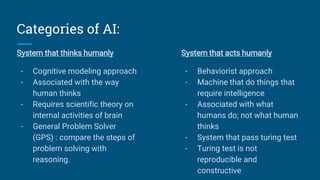
System that thinks humanly
- Cognitive modeling approach
- Associated with the way
human thinks
- Requires scientific theory on
internal activities of brain
- General Problem Solver
(GPS) : compare the steps of
problem solving with
reasoning.
System that acts humanly
- Behaviorist approach
- Machine that do things that
require intelligence
- Associated with what
humans do; not what human
thinks
- System that pass turing test
- Turing test is not
reproducible and
constructive
Categories of AI:
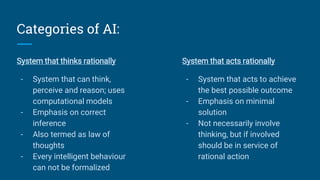
System that thinks rationally
- System that can think,
perceive and reason; uses
computational models
- Emphasis on correct
inference
- Also termed as law of
thoughts
- Every intelligent behaviour
can not be formalized
System that acts rationally
- System that acts to achieve
the best possible outcome
- Emphasis on minimal
solution
- Not necessarily involve
thinking, but if involved
should be in service of
rational action
Turing Test:
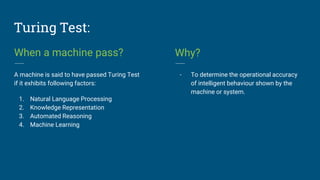
When a machine pass?
A machine is said to have passed Turing Test
if it exhibits following factors:
1. Natural Language Processing
2. Knowledge Representation
3. Automated Reasoning
4. Machine Learning
Why?
- To determine the operational accuracy
of intelligent behaviour shown by the
machine or system.
Turing Test:
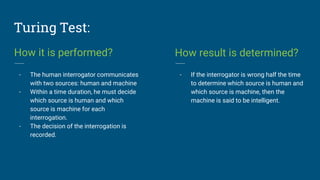
How it is performed?
- The human interrogator communicates
with two sources: human and machine
- Within a time duration, he must decide
which source is human and which
source is machine for each
interrogation.
- The decision of the interrogation is
recorded.
How result is determined?
- If the interrogator is wrong half the time
to determine which source is human and
which source is machine, then the
machine is said to be intelligent.
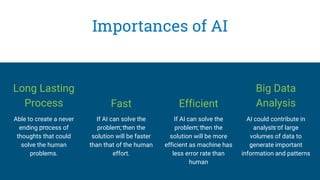
Importances of AI
Long Lasting
Process
Able to create a never
ending process of
thoughts that could
solve the human
problems.
Fast
If AI can solve the
problem, then the
solution will be faster
than that of the human
effort.
Efficient
If AI can solve the
problem, then the
solution will be more
efficient as machine has
less error rate than
human
Big Data
Analysis
AI could contribute in
analysis of large
volumes of data to
generate important
information and patterns
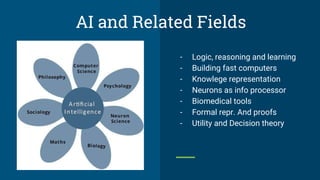
AI and Related Fields
- Logic, reasoning and learning
- Building fast computers
- Knowlege representation
- Neurons as info processor
- Biomedical tools
- Formal repr. And proofs
- Utility and Decision theory
History of AI:
- McCulloch and Pitts (1943) proposed a boolean circuit of
brain.
- Turing (1950) proposed computing machinery and
intelligence
- In 1956, Dartmouth conference was held and AI was
officially adopted.
- In 1950’s, early AI programs were devised such as
Samuel’s checker; Newell and Simon’s Logic Theorist
History of AI:
- Between 1955 - 1965:
# General Problem Solver (Newell and Simon)
# Geometry Theorem Prover (Gelertner)
# Invention of LISP (McCarthy)
- Between 1966 - 1973, AI support funds were cancelled
as no any significant results are achieved
- Between 1969 - 1985, knowledge based system and rule
based expert system (DENDRAL, MYCIN) are devised.
But, they did not scale well in practice
History of AI:
- In 1986, machine learning was implemented
- In 1995, AI was implemented as a science used in vision,
language, learning, reasoning and knowledge
representation.
Real World Applications of AI:
1. Virtual Personal Assistants
- Help to find useful informations when you instructs
- Learns about the user
- Develop ability to anticipate user’s needs
- Eg: SIRI, Google Now, Cortana
- A new groundbreaking development at Google I/O 2018
(Duplex)
Real World Applications of AI:
2. Gaming
- Games with characters that learn your behaviour
- Respond to stimuli
- React in unpredictable ways
- Eg: Chess, Call of Duty
Real World Applications of AI:
3. Fraud Detection
- System that monitors frauds
- By providing large samples of fraudulent and non-
fraudulent activities and then making it learn about the
activity based on signs and indications
- Eg: Confirmation mail sent by bank on purchase
Real World Applications of AI:
4. Online Customer Support
- Real time chat system provided by websites to their
users to interact as a customer support
- Mostly, AI is deployed at the backend as a automated
responder
Real World Applications of AI:
5. Security Surveillance
- Security algorithms take input from security cameras and
determine it as a threat or not
- Supervised training is used in general
- May respond to threat by itself with some automatic
threat control system or by alerting to the human security
officers
Real World Applications of AI:
6. Recommendation System
- Generate recommended list based on interests made in
the past or interests shared by similar users
- Eg: Video recommendation by Youtube, Group or Event
recommendation by Facebook, Item recommendation by
e-commerce sites
End of Chapter 1
Query Section for
Introduction to Artificial Intelligence
???

Introduction To Artificial Intelligence

  • 1.
    Chapter 1 Introduction toAI By - Suraj Awal
  • 2.
    Definition of AI: Intelligence: -Ability to create, understand, learn, plan and reason. - Examples of Intelligent Behaviour : recognition, interpretation, playing logical games, proving mathematical theorems, analysis and so on.
  • 3.
    Definition of AI: WhatActually is Artificial Intelligence: - Branch of Computer science that deals with design of intelligent systems. - Science of creating a system that could acquire knowledge and use that base for reasoning.
  • 4.
    Categories of AI: Systemthat thinks humanly - Cognitive modeling approach - Associated with the way human thinks - Requires scientific theory on internal activities of brain - General Problem Solver (GPS) : compare the steps of problem solving with reasoning. System that acts humanly - Behaviorist approach - Machine that do things that require intelligence - Associated with what humans do; not what human thinks - System that pass turing test - Turing test is not reproducible and constructive
  • 5.
    Categories of AI: Systemthat thinks rationally - System that can think, perceive and reason; uses computational models - Emphasis on correct inference - Also termed as law of thoughts - Every intelligent behaviour can not be formalized System that acts rationally - System that acts to achieve the best possible outcome - Emphasis on minimal solution - Not necessarily involve thinking, but if involved should be in service of rational action
  • 6.
    Turing Test: When amachine pass? A machine is said to have passed Turing Test if it exhibits following factors: 1. Natural Language Processing 2. Knowledge Representation 3. Automated Reasoning 4. Machine Learning Why? - To determine the operational accuracy of intelligent behaviour shown by the machine or system.
  • 7.
    Turing Test: How itis performed? - The human interrogator communicates with two sources: human and machine - Within a time duration, he must decide which source is human and which source is machine for each interrogation. - The decision of the interrogation is recorded. How result is determined? - If the interrogator is wrong half the time to determine which source is human and which source is machine, then the machine is said to be intelligent.
  • 8.
    Importances of AI LongLasting Process Able to create a never ending process of thoughts that could solve the human problems. Fast If AI can solve the problem, then the solution will be faster than that of the human effort. Efficient If AI can solve the problem, then the solution will be more efficient as machine has less error rate than human Big Data Analysis AI could contribute in analysis of large volumes of data to generate important information and patterns
  • 9.
    AI and RelatedFields - Logic, reasoning and learning - Building fast computers - Knowlege representation - Neurons as info processor - Biomedical tools - Formal repr. And proofs - Utility and Decision theory
  • 10.
    History of AI: -McCulloch and Pitts (1943) proposed a boolean circuit of brain. - Turing (1950) proposed computing machinery and intelligence - In 1956, Dartmouth conference was held and AI was officially adopted. - In 1950’s, early AI programs were devised such as Samuel’s checker; Newell and Simon’s Logic Theorist
  • 11.
    History of AI: -Between 1955 - 1965: # General Problem Solver (Newell and Simon) # Geometry Theorem Prover (Gelertner) # Invention of LISP (McCarthy) - Between 1966 - 1973, AI support funds were cancelled as no any significant results are achieved - Between 1969 - 1985, knowledge based system and rule based expert system (DENDRAL, MYCIN) are devised. But, they did not scale well in practice
  • 12.
    History of AI: -In 1986, machine learning was implemented - In 1995, AI was implemented as a science used in vision, language, learning, reasoning and knowledge representation.
  • 13.
    Real World Applicationsof AI: 1. Virtual Personal Assistants - Help to find useful informations when you instructs - Learns about the user - Develop ability to anticipate user’s needs - Eg: SIRI, Google Now, Cortana - A new groundbreaking development at Google I/O 2018 (Duplex)
  • 14.
    Real World Applicationsof AI: 2. Gaming - Games with characters that learn your behaviour - Respond to stimuli - React in unpredictable ways - Eg: Chess, Call of Duty
  • 15.
    Real World Applicationsof AI: 3. Fraud Detection - System that monitors frauds - By providing large samples of fraudulent and non- fraudulent activities and then making it learn about the activity based on signs and indications - Eg: Confirmation mail sent by bank on purchase
  • 16.
    Real World Applicationsof AI: 4. Online Customer Support - Real time chat system provided by websites to their users to interact as a customer support - Mostly, AI is deployed at the backend as a automated responder
  • 17.
    Real World Applicationsof AI: 5. Security Surveillance - Security algorithms take input from security cameras and determine it as a threat or not - Supervised training is used in general - May respond to threat by itself with some automatic threat control system or by alerting to the human security officers
  • 18.
    Real World Applicationsof AI: 6. Recommendation System - Generate recommended list based on interests made in the past or interests shared by similar users - Eg: Video recommendation by Youtube, Group or Event recommendation by Facebook, Item recommendation by e-commerce sites
  • 19.
    End of Chapter1 Query Section for Introduction to Artificial Intelligence ???