
BY,
MIHIR SHAH
INTRODUCTION
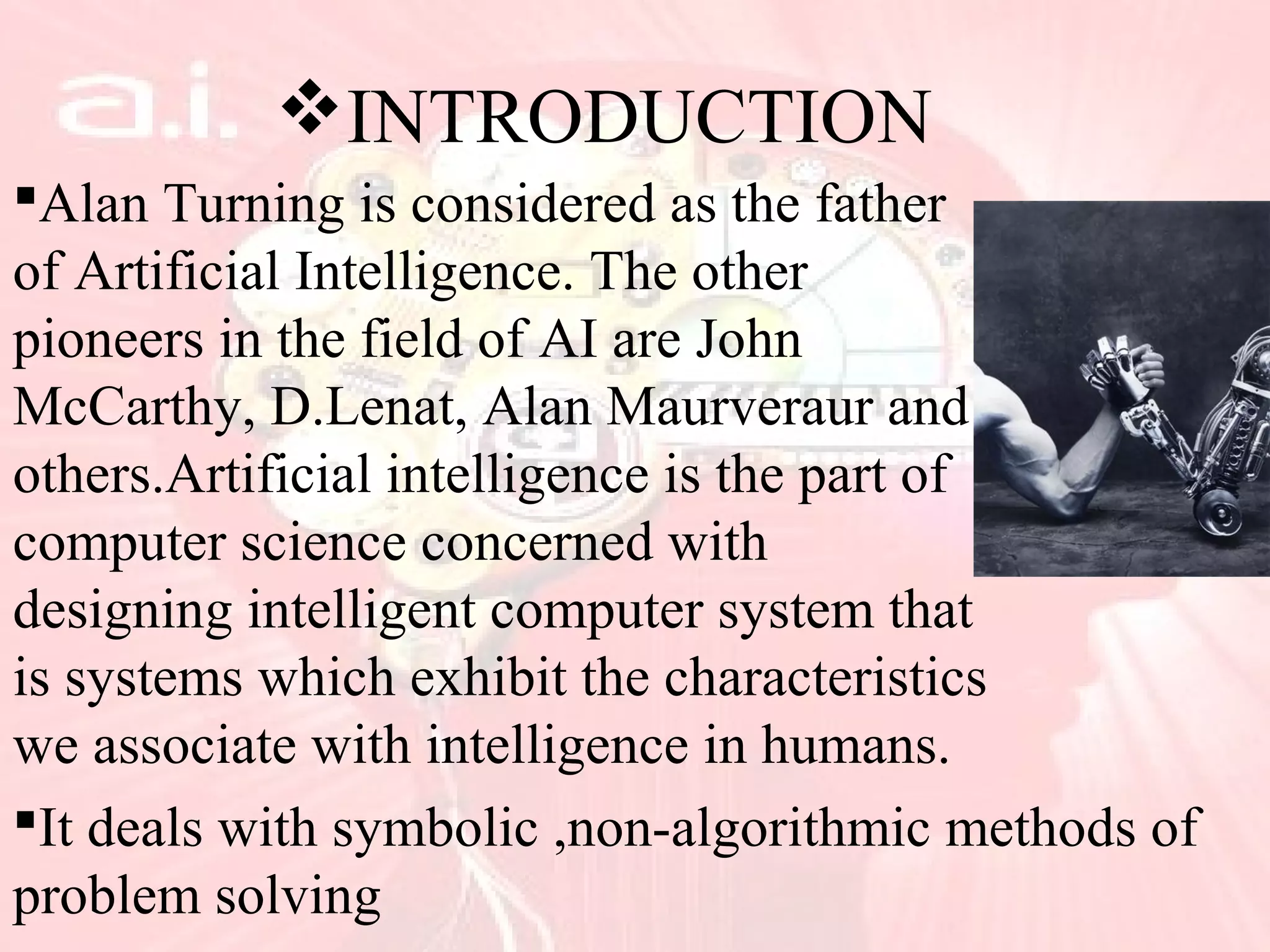
Alan Turning is considered as the father
of Artificial Intelligence. The other
pioneers in the field of AI are John
McCarthy, D.Lenat, Alan Maurveraur and
others.Artificial intelligence is the part of
computer science concerned with
designing intelligent computer system that
is systems which exhibit the characteristics
we associate with intelligence in humans.
It deals with symbolic ,non-algorithmic methods of
problem solving
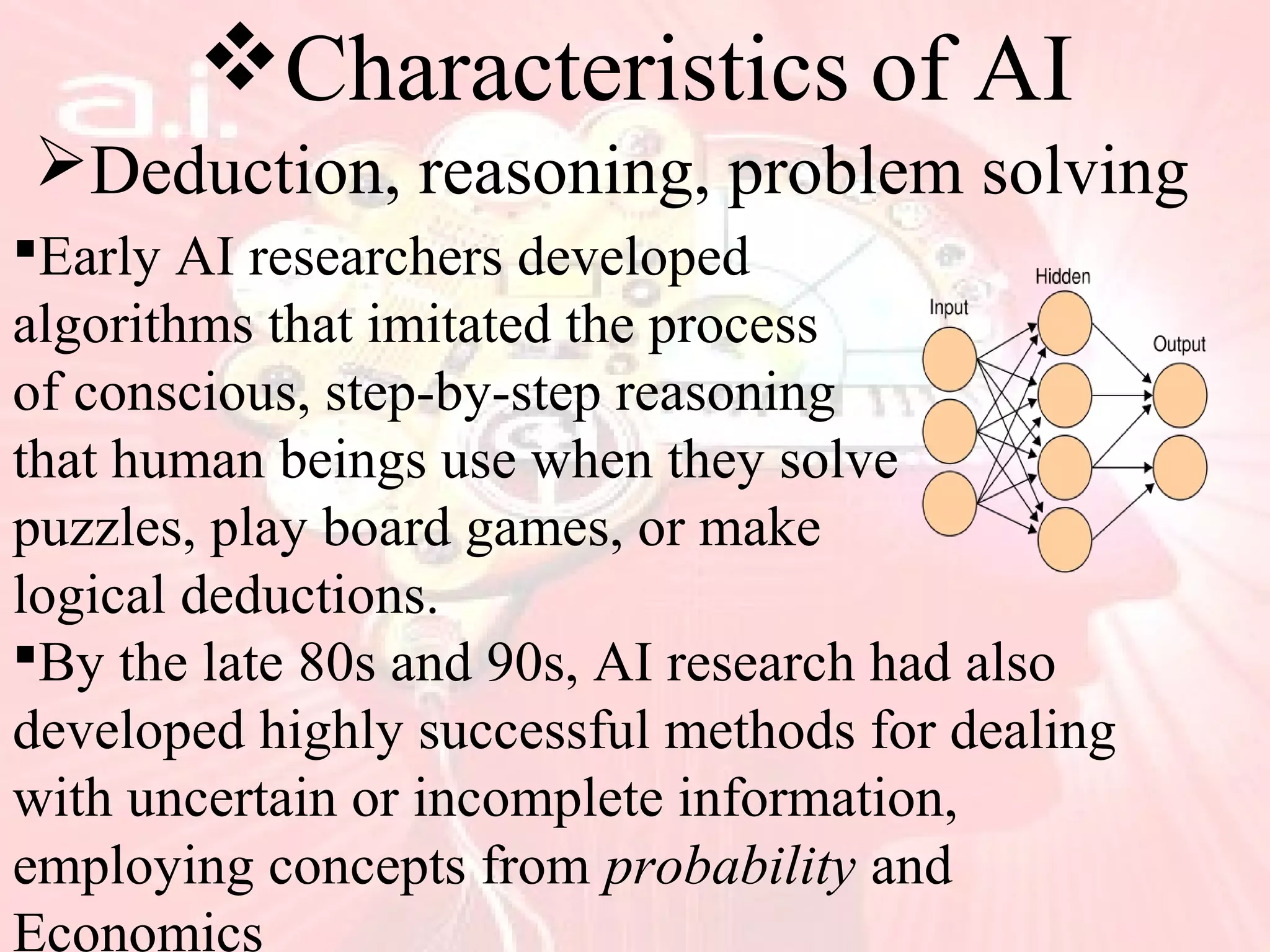
Neural Network and Artificial
Intelligence
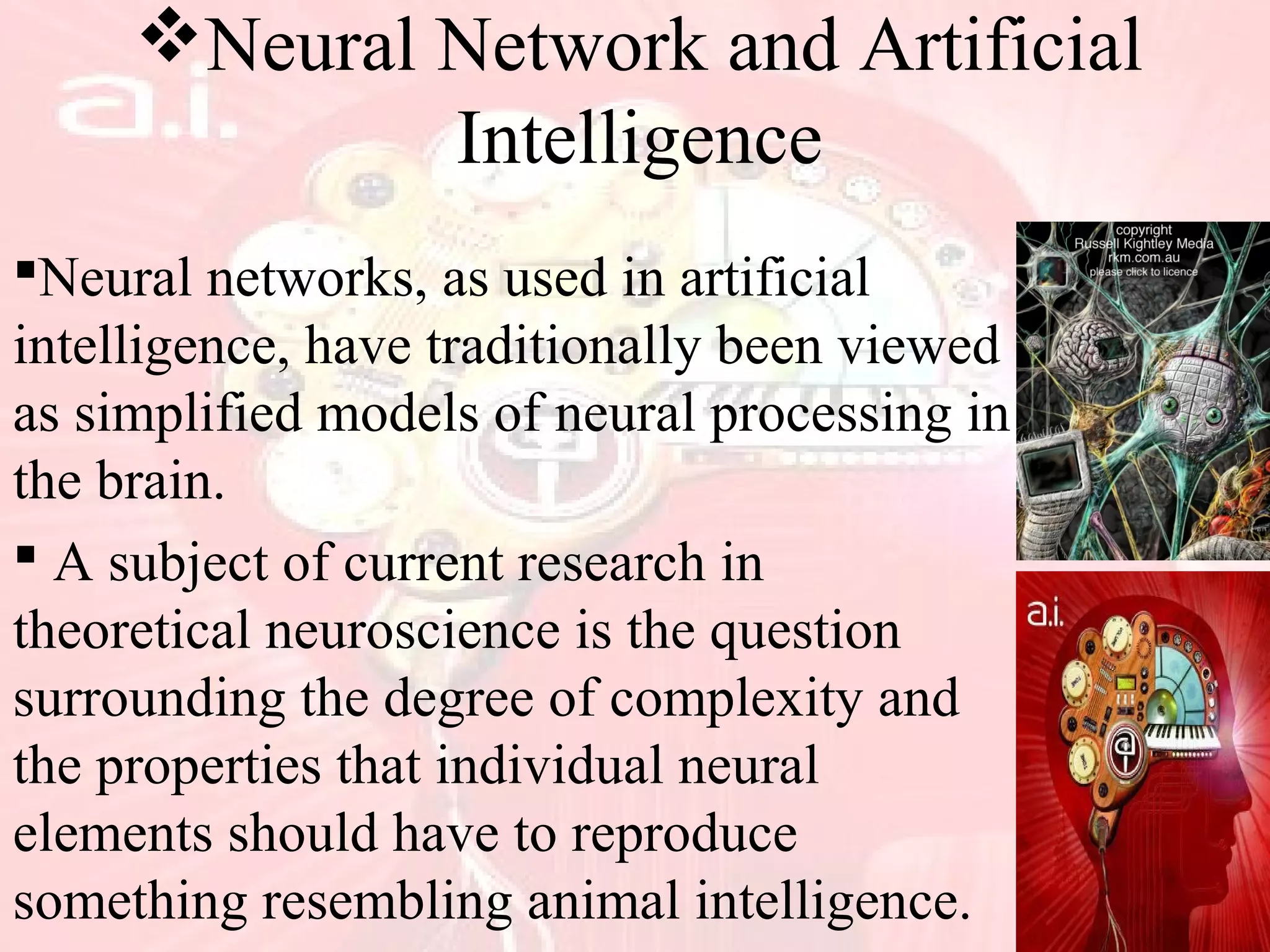
Neural networks, as used in artificial
intelligence, have traditionally been viewed
as simplified models of neural processing in
the brain.
 A subject of current research in
theoretical neuroscience is the question
surrounding the degree of complexity and
the properties that individual neural
elements should have to reproduce
something resembling animal intelligence.
Fuzzy Logic
Fuzzy logic is a form of multi-valued
logic derived from fuzzy set theory to
deal with reasoning that is approximate
rather than precise. Just as in fuzzy set
theory the set membership value is in
range of 0 to 1, in fuzzy logic the degree
of truth of a statement can range
between 0 and 1 and is not constrained
as in classic predicate logic.
When linguistic variables are used,
these degrees may be managed by some
specific functions.
Characteristics of AI
Deduction, reasoning, problem solving
Early AI researchers developed
algorithms that imitated the process
of conscious, step-by-step reasoning
that human beings use when they solve
puzzles, play board games, or make
logical deductions.
By the late 80s and 90s, AI research had also
developed highly successful methods for dealing
with uncertain or incomplete information,
employing concepts from probability and
Economics
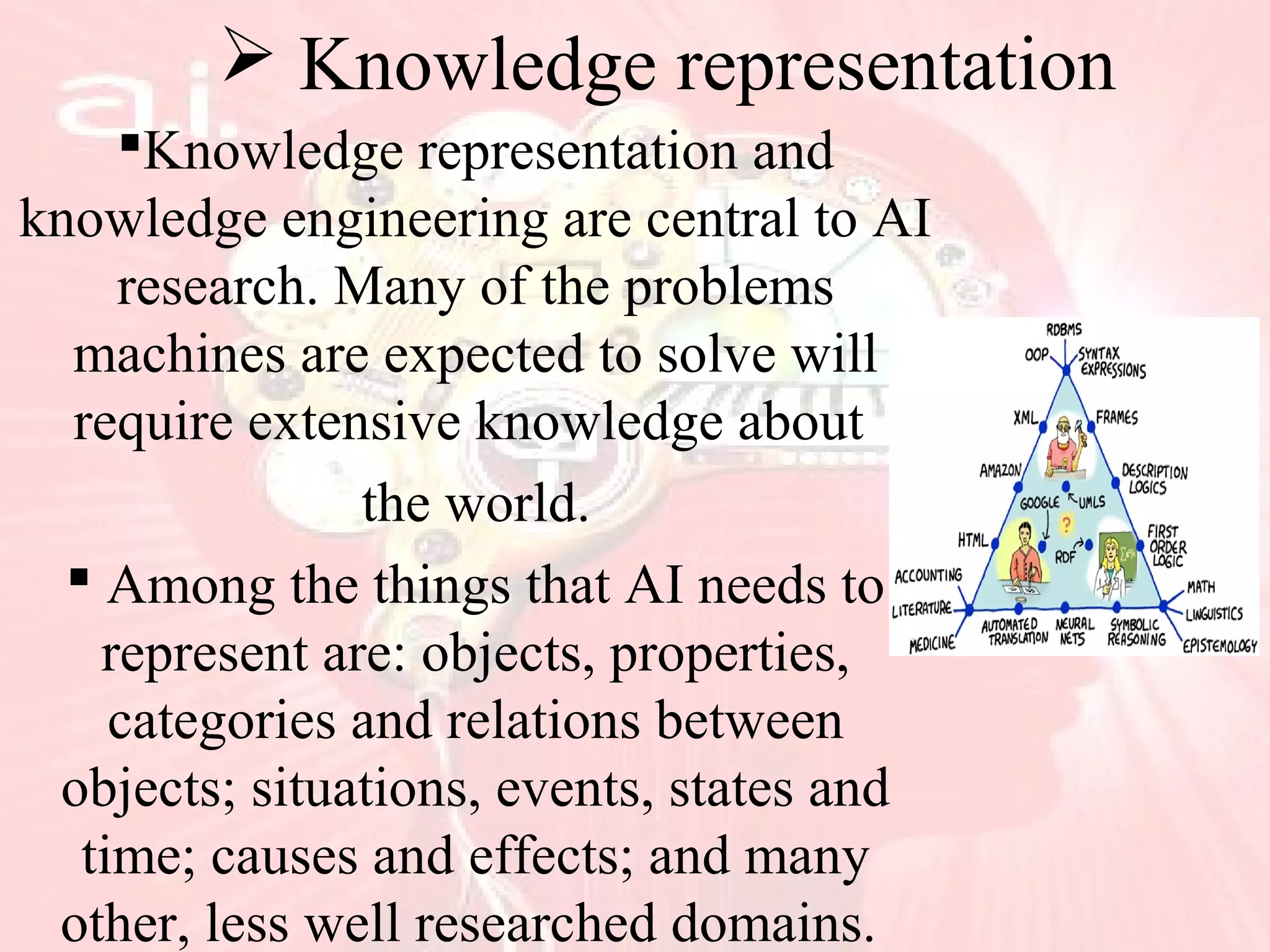
 Knowledge representation
Knowledge representation and
knowledge engineering are central to AI
research. Many of the problems
machines are expected to solve will
require extensive knowledge about
the world.
 Among the things that AI needs to
represent are: objects, properties,
categories and relations between
objects; situations, events, states and
time; causes and effects; and many
other, less well researched domains.
Planning
Intelligent agents must be able to set
goals and achieve them. They need a way
to visualize the future and be able to
make choices that maximize the utility of
the available choices.
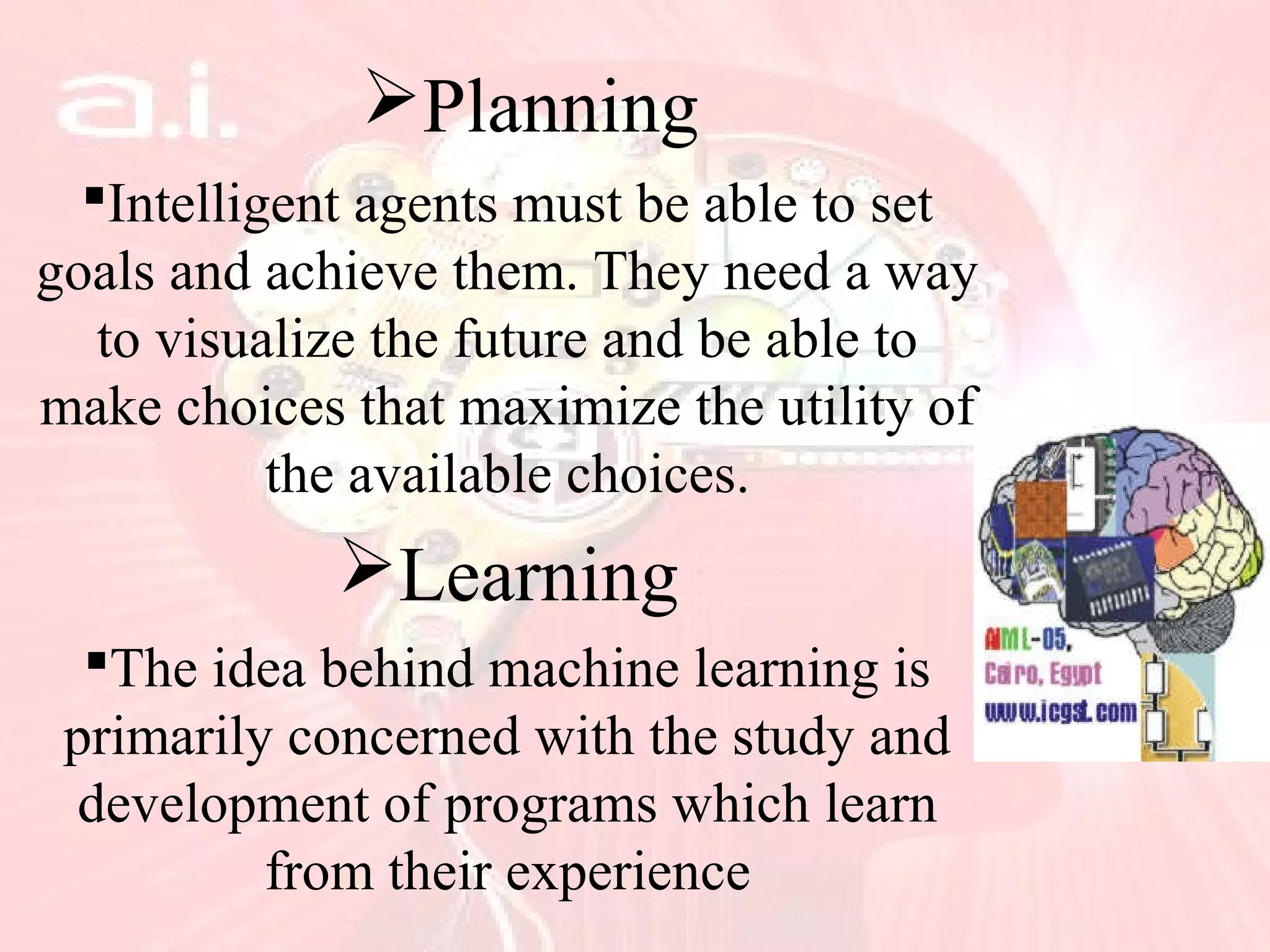
Learning
The idea behind machine learning is
primarily concerned with the study and
development of programs which learn
from their experience
Natural language processing
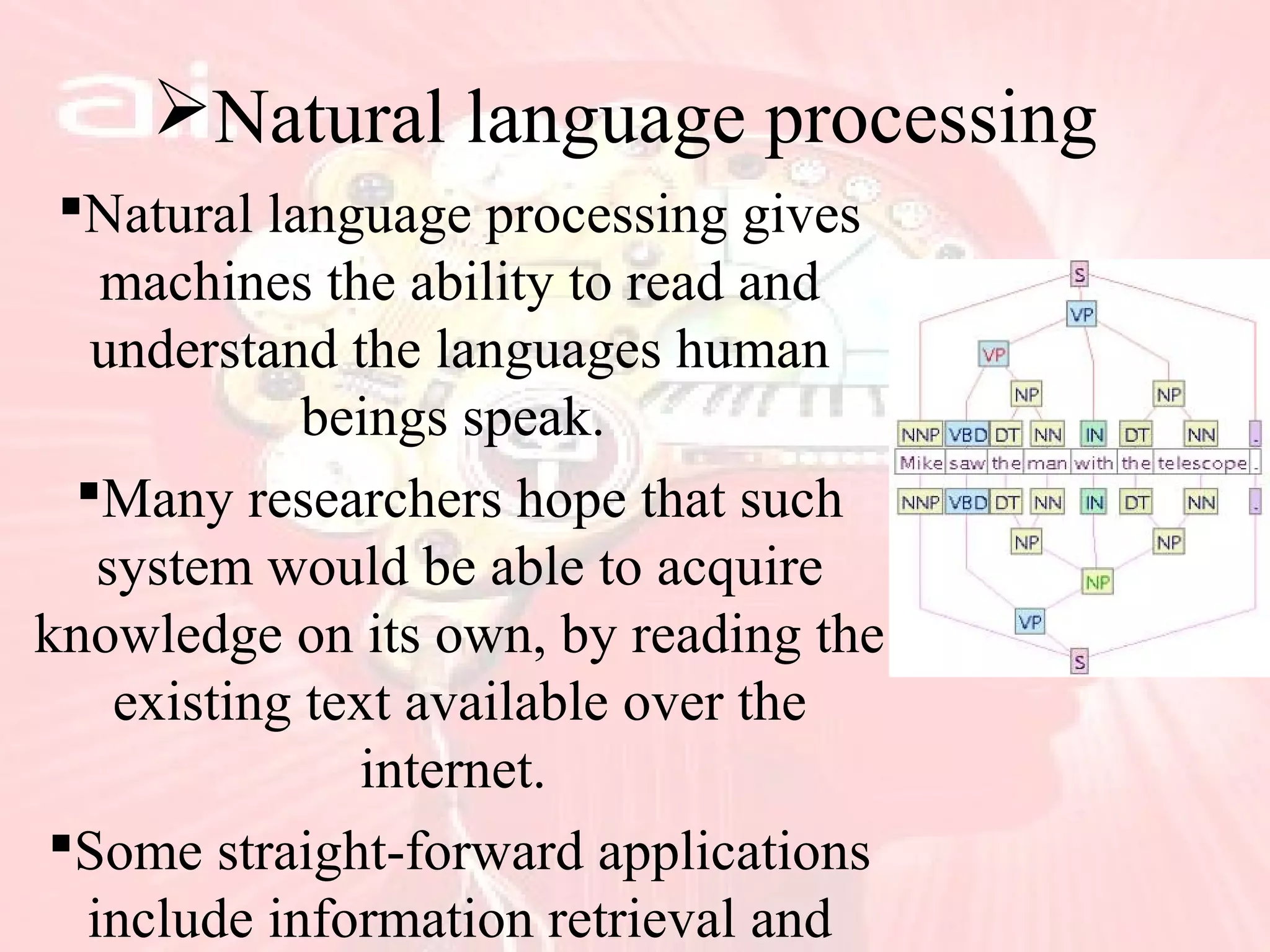
Natural language processing gives
machines the ability to read and
understand the languages human
beings speak.
Many researchers hope that such
system would be able to acquire
knowledge on its own, by reading the
existing text available over the
internet.
Some straight-forward applications
include information retrieval and
Perception
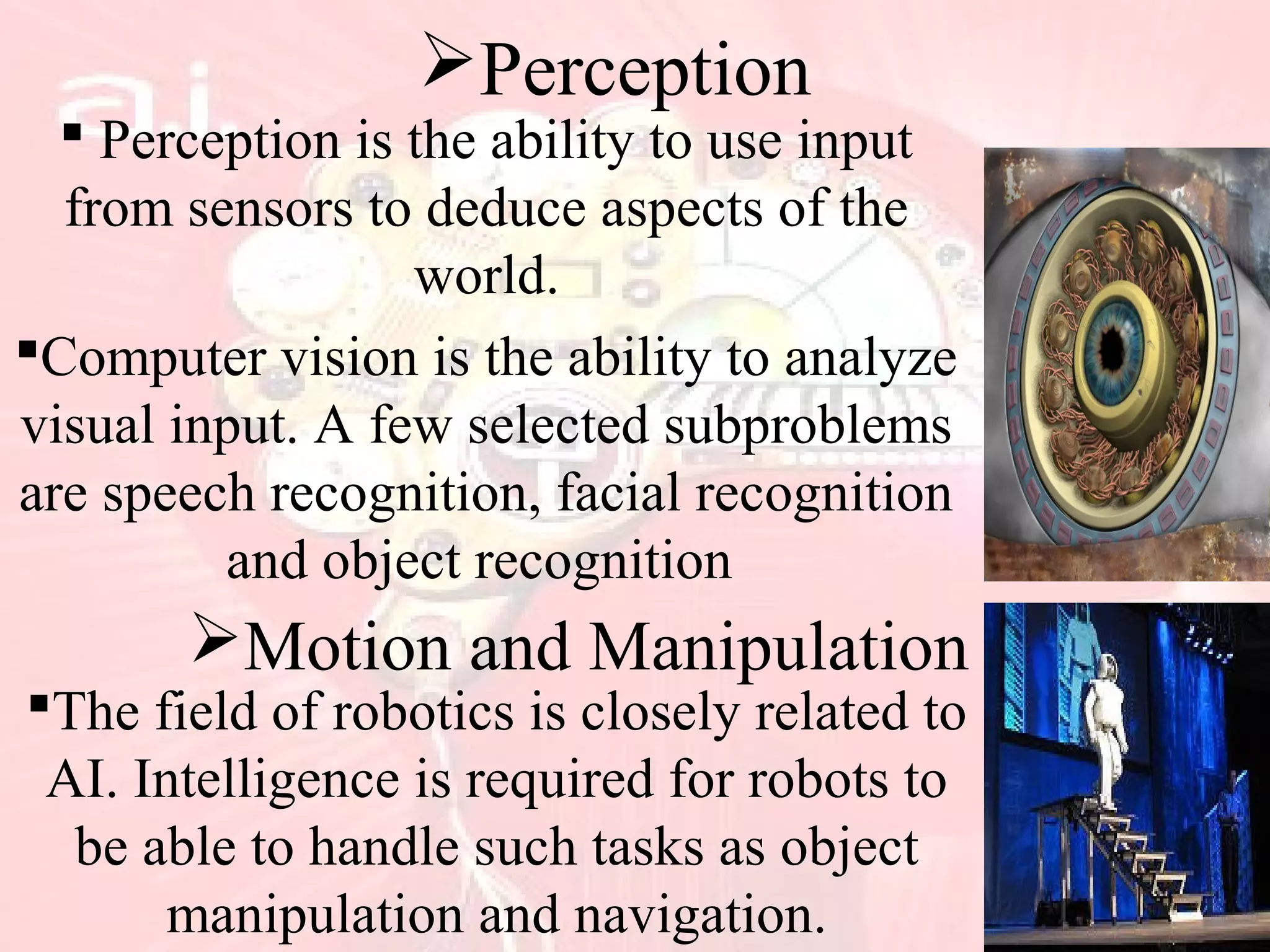
 Perception is the ability to use input
from sensors to deduce aspects of the
world.
Computer vision is the ability to analyze
visual input. A few selected subproblems
are speech recognition, facial recognition
and object recognition
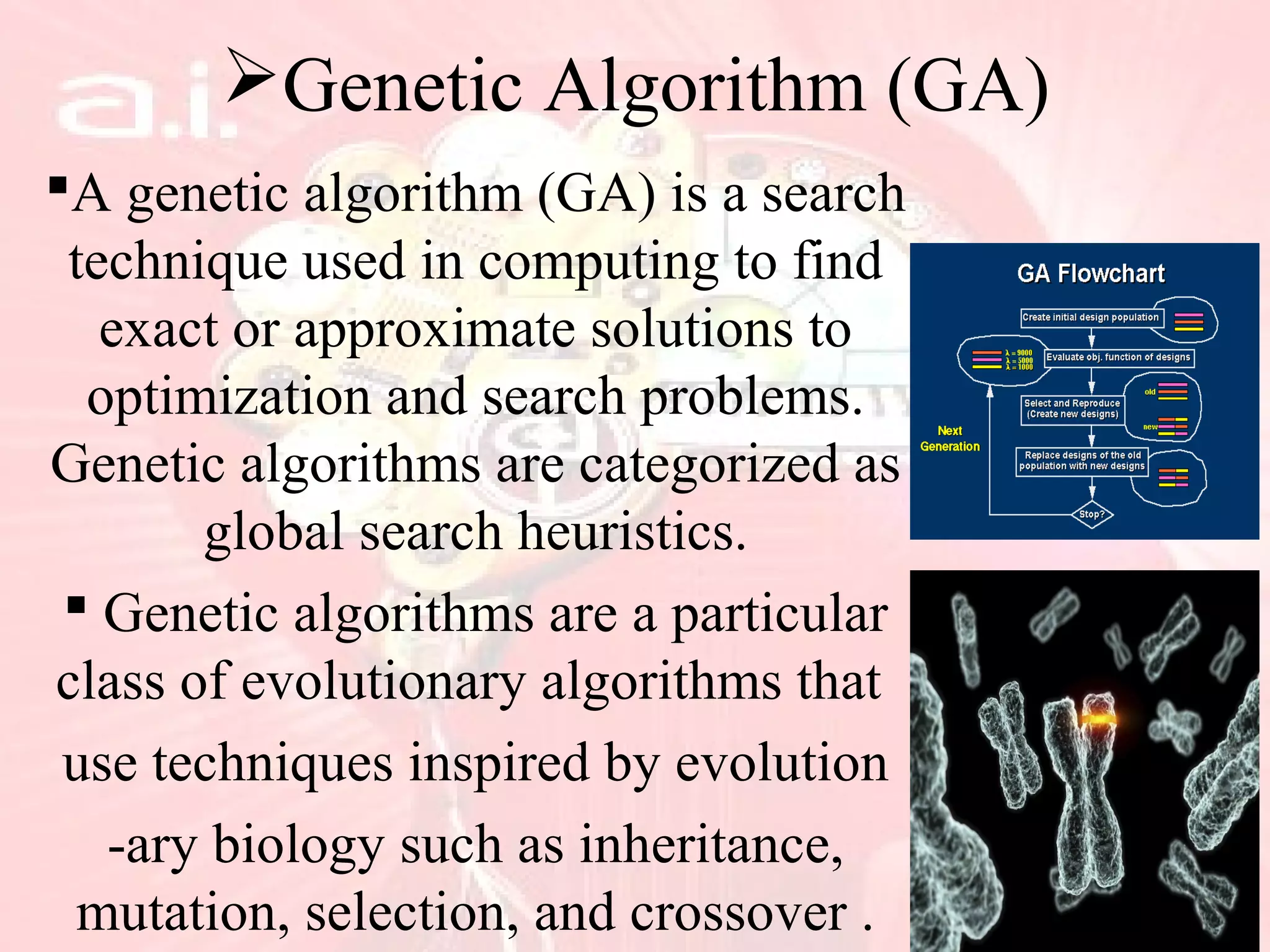
Motion and Manipulation
The field of robotics is closely related to
AI. Intelligence is required for robots to
be able to handle such tasks as object
manipulation and navigation.
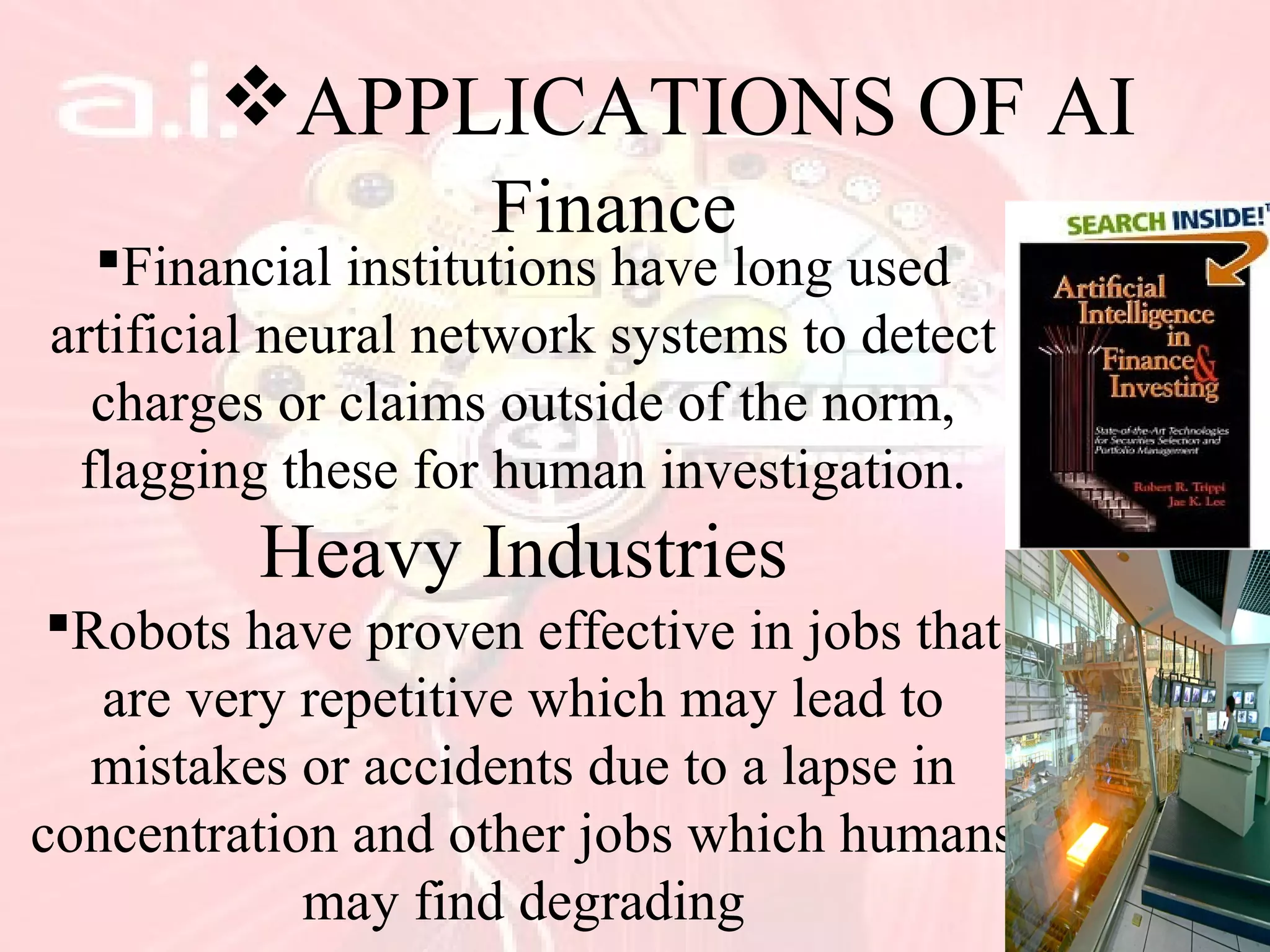
Genetic Algorithm (GA)
A genetic algorithm (GA) is a search
technique used in computing to find
exact or approximate solutions to
optimization and search problems.
Genetic algorithms are categorized as
global search heuristics.
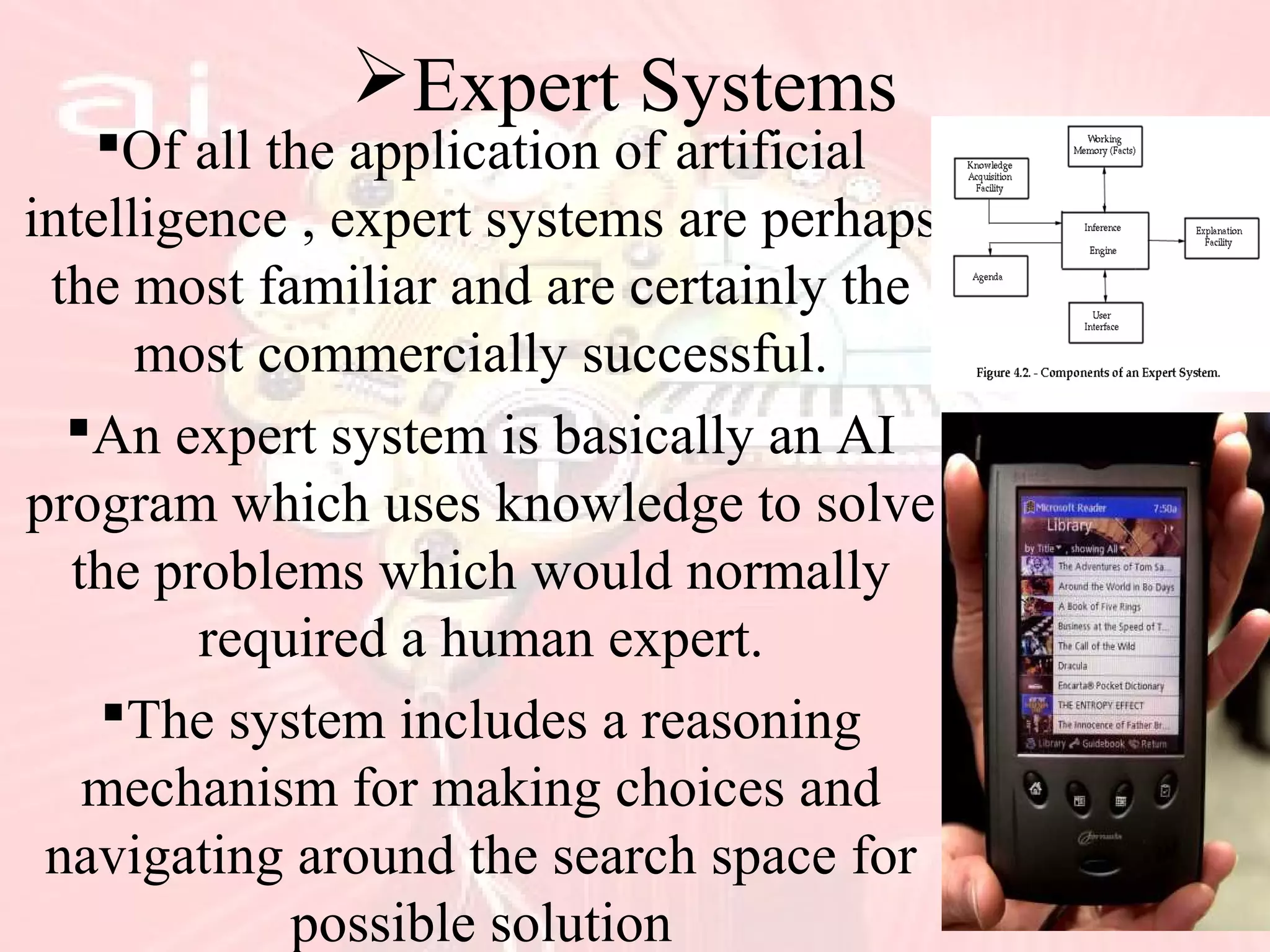
 Genetic algorithms are a particular
class of evolutionary algorithms that
use techniques inspired by evolution
-ary biology such as inheritance,
mutation, selection, and crossover .
APPLICATIONS OF AI
Finance
Financial institutions have long used
artificial neural network systems to detect
charges or claims outside of the norm,
flagging these for human investigation.
Heavy Industries
Robots have proven effective in jobs that
are very repetitive which may lead to
mistakes or accidents due to a lapse in
concentration and other jobs which humans
may find degrading
Expert Systems
Of all the application of artificial
intelligence , expert systems are perhaps
the most familiar and are certainly the
most commercially successful.
An expert system is basically an AI
program which uses knowledge to solve
the problems which would normally
required a human expert.
The system includes a reasoning
mechanism for making choices and
navigating around the search space for
possible solution
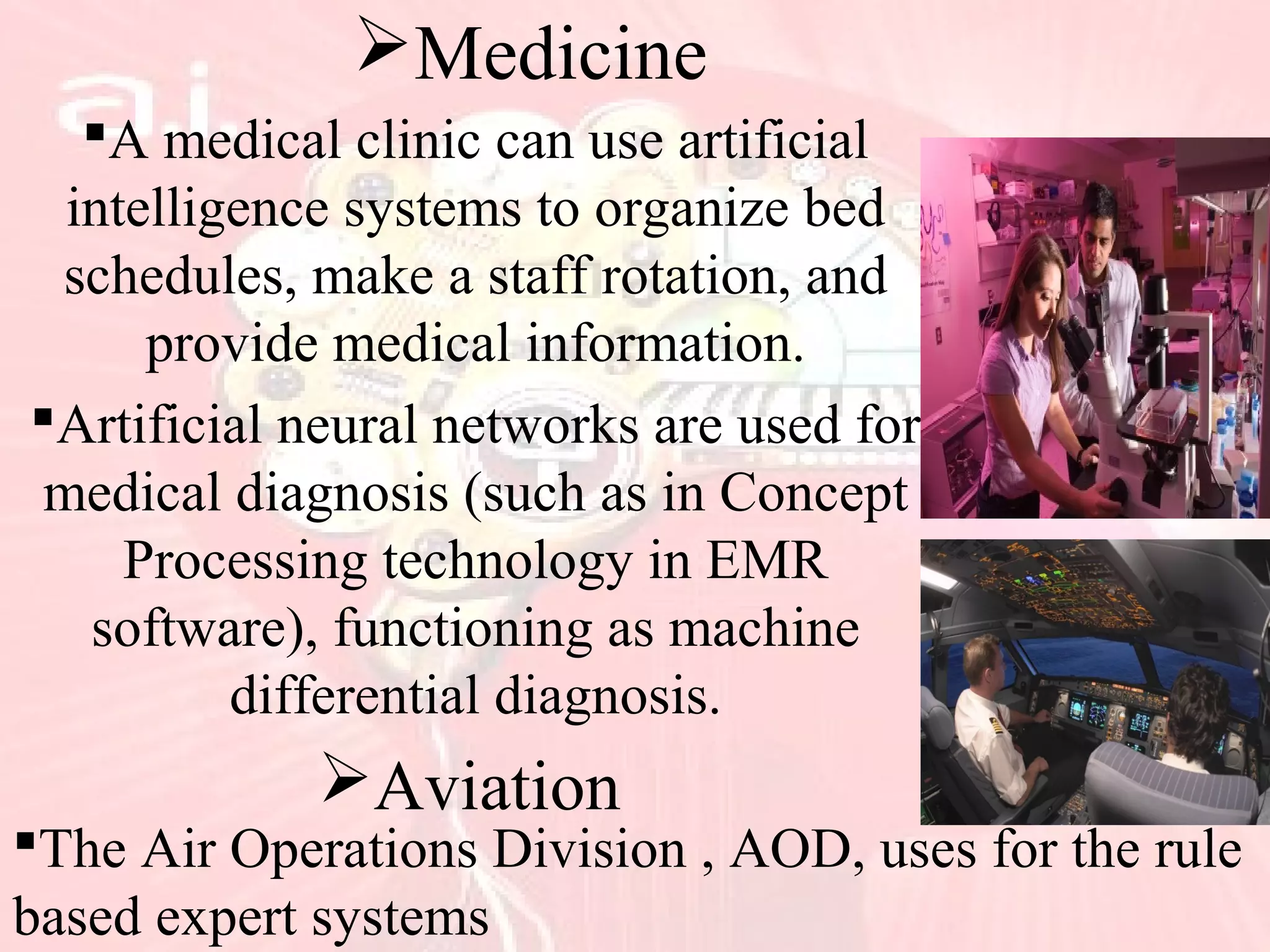
Medicine
A medical clinic can use artificial
intelligence systems to organize bed
schedules, make a staff rotation, and
provide medical information.
Artificial neural networks are used for
medical diagnosis (such as in Concept
Processing technology in EMR
software), functioning as machine
differential diagnosis.
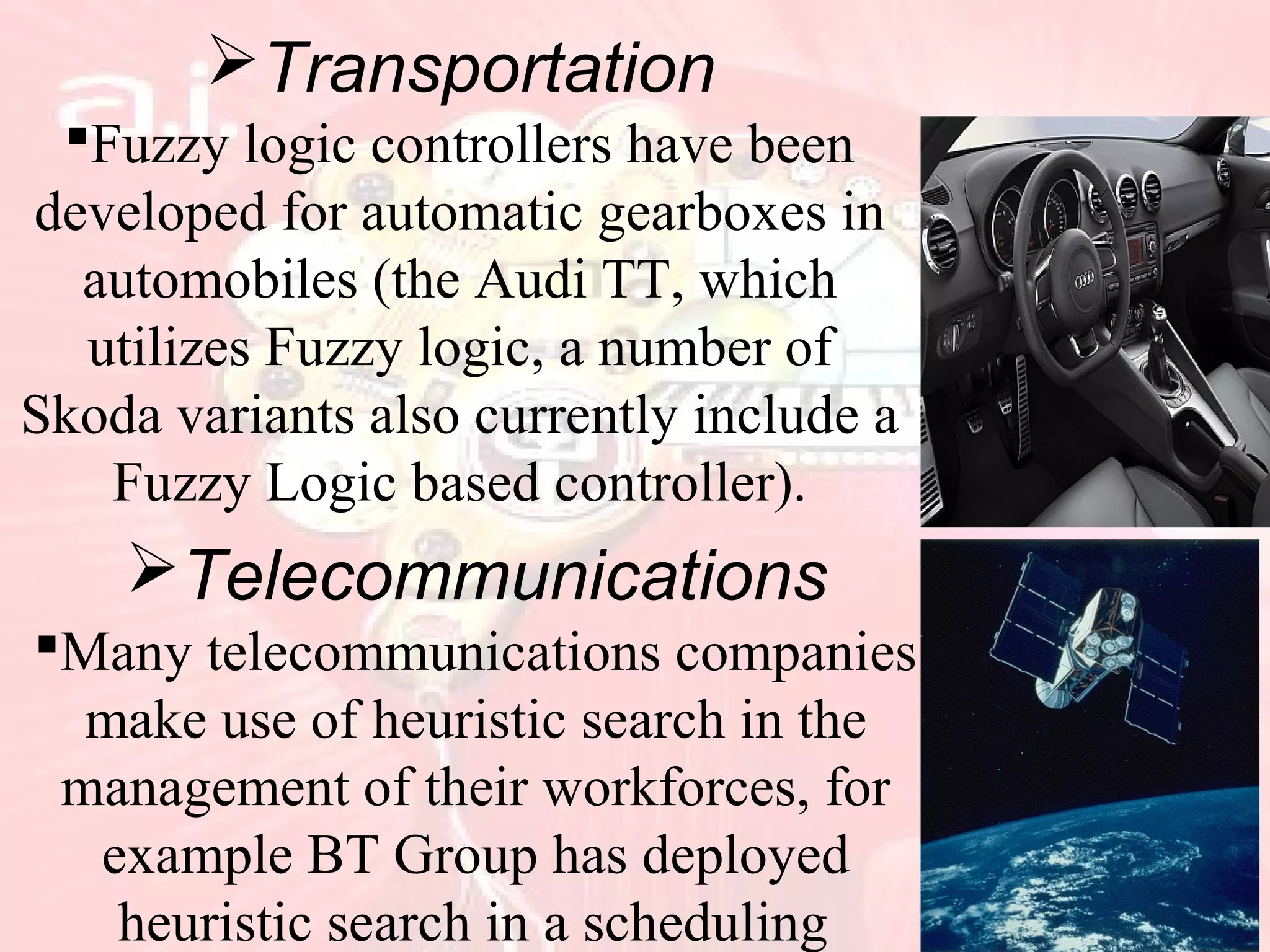
Aviation
The Air Operations Division , AOD, uses for the rule
based expert systems
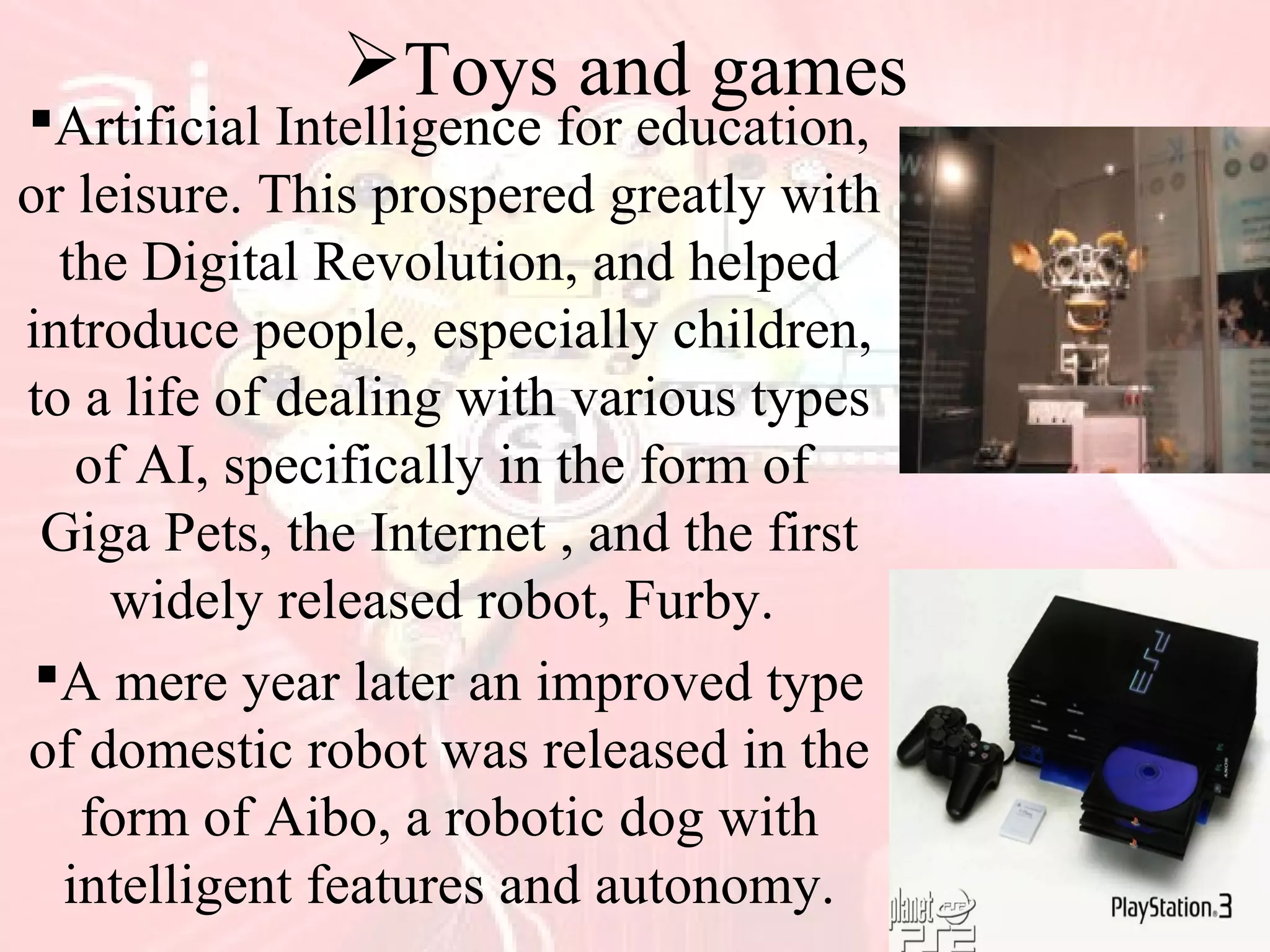
Transportation
Fuzzy logic controllers have been
developed for automatic gearboxes in
automobiles (the Audi TT, which
utilizes Fuzzy logic, a number of
Skoda variants also currently include a
Fuzzy Logic based controller).
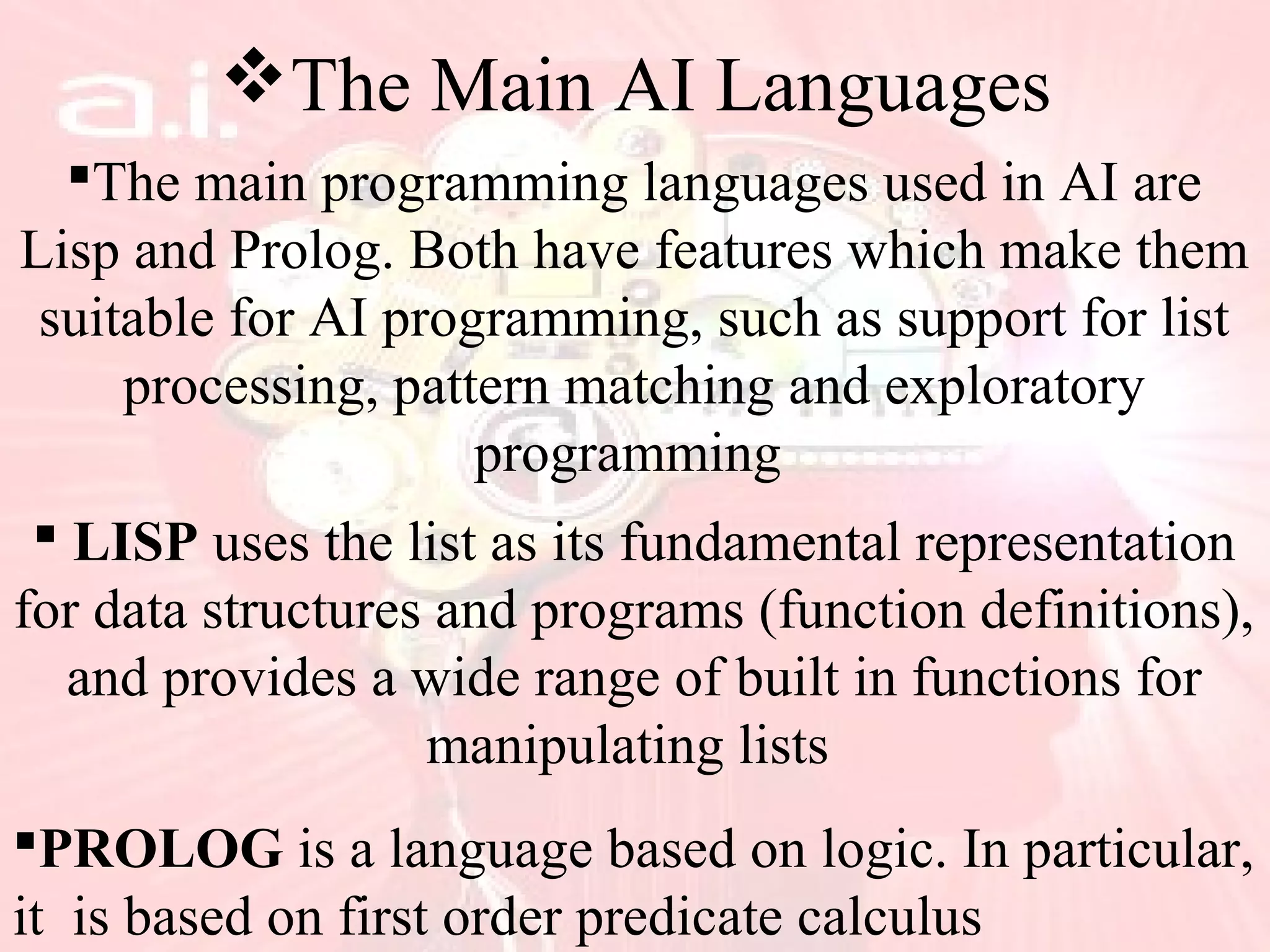
Telecommunications
Many telecommunications companies
make use of heuristic search in the
management of their workforces, for
example BT Group has deployed
heuristic search in a scheduling
Toys and games
Artificial Intelligence for education,
or leisure. This prospered greatly with
the Digital Revolution, and helped
introduce people, especially children,
to a life of dealing with various types
of AI, specifically in the form of
Giga Pets, the Internet , and the first
widely released robot, Furby.
A mere year later an improved type
of domestic robot was released in the
form of Aibo, a robotic dog with
intelligent features and autonomy.
The Main AI Languages
The main programming languages used in AI are
Lisp and Prolog. Both have features which make them
suitable for AI programming, such as support for list
processing, pattern matching and exploratory
programming
 LISP uses the list as its fundamental representation
for data structures and programs (function definitions),
and provides a wide range of built in functions for
manipulating lists
PROLOG is a language based on logic. In particular,
it is based on first order predicate calculus
CONCLUSION
It can be concluded that in spite of impressive
achievements , on the hardware and software fronts it
has not been possible to produce coordinated
autonomous system which possess some of the basic
abilities of a three year old child.
 Information creation, Autonomy, Situated ness
can be regarded as focuses for the AI research and
development in future. In order to come up to these
challenges, a lot of single methods have to be
integrated into greater systems.
Artificial intelligence

Artificial intelligence

  • 1.
  • 2.
    INTRODUCTION Alan Turning isconsidered as the father of Artificial Intelligence. The other pioneers in the field of AI are John McCarthy, D.Lenat, Alan Maurveraur and others.Artificial intelligence is the part of computer science concerned with designing intelligent computer system that is systems which exhibit the characteristics we associate with intelligence in humans. It deals with symbolic ,non-algorithmic methods of problem solving
  • 3.
    Neural Network andArtificial Intelligence Neural networks, as used in artificial intelligence, have traditionally been viewed as simplified models of neural processing in the brain.  A subject of current research in theoretical neuroscience is the question surrounding the degree of complexity and the properties that individual neural elements should have to reproduce something resembling animal intelligence.
  • 4.
    Fuzzy Logic Fuzzy logicis a form of multi-valued logic derived from fuzzy set theory to deal with reasoning that is approximate rather than precise. Just as in fuzzy set theory the set membership value is in range of 0 to 1, in fuzzy logic the degree of truth of a statement can range between 0 and 1 and is not constrained as in classic predicate logic. When linguistic variables are used, these degrees may be managed by some specific functions.
  • 5.
    Characteristics of AI Deduction,reasoning, problem solving Early AI researchers developed algorithms that imitated the process of conscious, step-by-step reasoning that human beings use when they solve puzzles, play board games, or make logical deductions. By the late 80s and 90s, AI research had also developed highly successful methods for dealing with uncertain or incomplete information, employing concepts from probability and Economics
  • 6.
     Knowledge representation Knowledgerepresentation and knowledge engineering are central to AI research. Many of the problems machines are expected to solve will require extensive knowledge about the world.  Among the things that AI needs to represent are: objects, properties, categories and relations between objects; situations, events, states and time; causes and effects; and many other, less well researched domains.
  • 7.
    Planning Intelligent agents mustbe able to set goals and achieve them. They need a way to visualize the future and be able to make choices that maximize the utility of the available choices. Learning The idea behind machine learning is primarily concerned with the study and development of programs which learn from their experience
  • 8.
    Natural language processing Naturallanguage processing gives machines the ability to read and understand the languages human beings speak. Many researchers hope that such system would be able to acquire knowledge on its own, by reading the existing text available over the internet. Some straight-forward applications include information retrieval and
  • 9.
    Perception  Perception isthe ability to use input from sensors to deduce aspects of the world. Computer vision is the ability to analyze visual input. A few selected subproblems are speech recognition, facial recognition and object recognition Motion and Manipulation The field of robotics is closely related to AI. Intelligence is required for robots to be able to handle such tasks as object manipulation and navigation.
  • 10.
    Genetic Algorithm (GA) Agenetic algorithm (GA) is a search technique used in computing to find exact or approximate solutions to optimization and search problems. Genetic algorithms are categorized as global search heuristics.  Genetic algorithms are a particular class of evolutionary algorithms that use techniques inspired by evolution -ary biology such as inheritance, mutation, selection, and crossover .
  • 11.
    APPLICATIONS OF AI Finance Financialinstitutions have long used artificial neural network systems to detect charges or claims outside of the norm, flagging these for human investigation. Heavy Industries Robots have proven effective in jobs that are very repetitive which may lead to mistakes or accidents due to a lapse in concentration and other jobs which humans may find degrading
  • 12.
    Expert Systems Of allthe application of artificial intelligence , expert systems are perhaps the most familiar and are certainly the most commercially successful. An expert system is basically an AI program which uses knowledge to solve the problems which would normally required a human expert. The system includes a reasoning mechanism for making choices and navigating around the search space for possible solution
  • 13.
    Medicine A medical cliniccan use artificial intelligence systems to organize bed schedules, make a staff rotation, and provide medical information. Artificial neural networks are used for medical diagnosis (such as in Concept Processing technology in EMR software), functioning as machine differential diagnosis. Aviation The Air Operations Division , AOD, uses for the rule based expert systems
  • 14.
    Transportation Fuzzy logic controllershave been developed for automatic gearboxes in automobiles (the Audi TT, which utilizes Fuzzy logic, a number of Skoda variants also currently include a Fuzzy Logic based controller). Telecommunications Many telecommunications companies make use of heuristic search in the management of their workforces, for example BT Group has deployed heuristic search in a scheduling
  • 15.
    Toys and games ArtificialIntelligence for education, or leisure. This prospered greatly with the Digital Revolution, and helped introduce people, especially children, to a life of dealing with various types of AI, specifically in the form of Giga Pets, the Internet , and the first widely released robot, Furby. A mere year later an improved type of domestic robot was released in the form of Aibo, a robotic dog with intelligent features and autonomy.
  • 16.
    The Main AILanguages The main programming languages used in AI are Lisp and Prolog. Both have features which make them suitable for AI programming, such as support for list processing, pattern matching and exploratory programming  LISP uses the list as its fundamental representation for data structures and programs (function definitions), and provides a wide range of built in functions for manipulating lists PROLOG is a language based on logic. In particular, it is based on first order predicate calculus
  • 17.
    CONCLUSION It can beconcluded that in spite of impressive achievements , on the hardware and software fronts it has not been possible to produce coordinated autonomous system which possess some of the basic abilities of a three year old child.  Information creation, Autonomy, Situated ness can be regarded as focuses for the AI research and development in future. In order to come up to these challenges, a lot of single methods have to be integrated into greater systems.