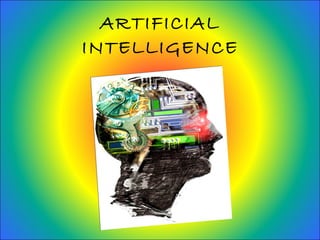
ARTIFICIAL INTELLIGENCE
What is intelligence? The capacity to learn and solve problems. In particular, # The ability to solve novel problems # The ability to act rationally # The ability to act like humans
WHAT IS THE MEANING OF ARTIFICIAL INTELLIGENCE ? It is the intelligence of machines and the branch of computer science that aims to create it. Textbooks define the field as “the study and design of intelligent machines”.
What is involved in Intelligence? Ability to interact with the real world #  to perceive, understand, and act -  e.g., speech recognition and understanding and synthesis -  e.g., image understanding - e.g., ability to take actions, have an effect Reasoning and Planning #  modeling the external world, given input #  solving new problems, planning, and making decisions #  ability to deal with unexpected problems, uncertainties  Learning and Adaptation #  we are continuously learning and adapting our internal models are always being “updated” - e.g., a baby learning to categorize and recognize animals
History of AI 1943: early beginnings McCulloch & Pitts: Boolean circuit model of brain 1950: Turing  Turing's "Computing Machinery and Intelligence“ 1956: birth of AI Dartmouth meeting: "Artificial Intelligence“ name adopted 1950s: initial promise Early AI programs, including  Samuel's checkers program  Newell & Simon's Logic Theorist 1955-65: “great enthusiasm” Newell and Simon: GPS, general problem solver Gelertner: Geometry Theorem Prover McCarthy: invention of LISP
History of AI 1966—73: Reality dawns Realization that many AI problems are intractable Limitations of existing neural network methods identified Neural network research almost disappears 1969—85: Adding domain knowledge Development of knowledge-based systems Success of rule-based expert systems, E.g., DENDRAL, MYCIN But were brittle and did not scale well in practice 1986--  Rise of machine learning Neural networks return to popularity Major advances in machine learning algorithms and applications 1990--  Role of uncertainty Bayesian networks as a knowledge representation framework 1995-- AI as Science Integration of learning, reasoning, knowledge representation AI methods used in vision, language, data mining, etc
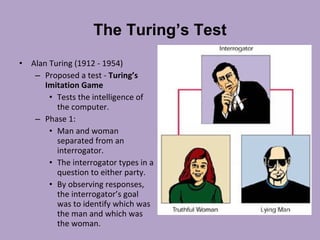
The Turing’s Test Alan Turing (1912 - 1954)  Proposed a test -  Turing’s Imitation Game Tests the intelligence of the computer. Phase 1:  Man and woman separated from an interrogator. The interrogator types in a question to either party. By observing responses, the interrogator’s goal was to identify which was the man and which was the woman.
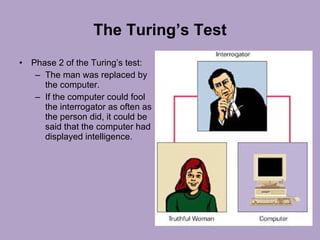
The Turing’s Test Phase 2 of the Turing’s test: The man was replaced by the computer. If the computer could fool the interrogator as often as the person did, it could be said that the computer had displayed intelligence.
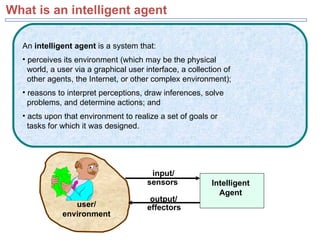
What is an intelligent agent Intelligent Agent user/ environment output/ sensors effectors input/ An  intelligent agent  is a system that:  perceives its environment (which may be the physical    world, a user via a graphical user interface, a collection of    other agents, the Internet, or other complex environment);  reasons to interpret perceptions, draw inferences, solve    problems, and determine actions; and acts upon that environment to realize a set of goals or    tasks for which it was designed.
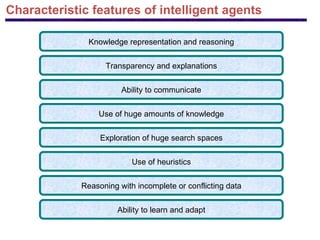
Characteristic features of intelligent agents Knowledge representation and reasoning Transparency and explanations Ability to communicate Use of huge amounts of knowledge Exploration of huge search spaces Use of heuristics Reasoning with incomplete or conflicting data Ability to learn and adapt
artificial intelligence: research areas Knowledge Representation Programming Languages Natural Language (e.g., Story) Understanding Speech Understanding Vision Robotics Machine Learning Expert Systems Qualitative Simulation Planning
Can Computers Talk? This is known as “speech synthesis” translate text to phonetic form e.g., “fictitious”  -> fik-tish-es use pronunciation rules to map phonemes to actual sound e.g., “tish”  -> sequence of basic audio sounds Difficulties sounds made by this “lookup” approach sound unnatural sounds are not independent e.g., “act” and “action” modern systems (e.g., at AT&T) can handle this pretty well a harder problem is emphasis, emotion, etc humans understand what they are saying machines don’t: so they sound unnatural Conclusion:  NO,   for complete sentences YES, for individual words
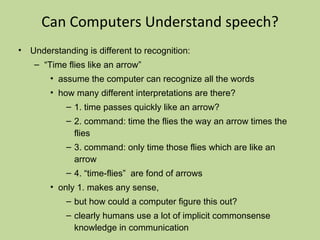
Can Computers Understand speech? Understanding is different to recognition: “ Time flies like an arrow” assume the computer can recognize all the words how many different interpretations are there? 1. time passes quickly like an arrow? 2. command: time the flies the way an arrow times the flies 3. command: only time those flies which are like an arrow 4. “time-flies”  are fond of arrows only 1. makes any sense,  but how could a computer figure this out? clearly humans use a lot of implicit commonsense knowledge in communication Conclusion: NO, much of what we say is beyond the capabilities of a computer to understand at present
Can Computers Learn and Adapt ? Learning and Adaptation consider a computer learning to drive on the freeway we could teach it lots of rules about what to do or we could let it drive and steer it back on course when it heads for the embankment systems like this are under development (e.g., Daimler Benz) e.g., RALPH at CMU in mid 90’s it drove 98% of the way from Pittsburgh to San Diego without any human assistance machine learning  allows computers to learn to do things without explicit programming many successful applications: requires some “set-up”: does not mean your PC can learn to forecast the stock market or become a brain surgeon Conclusion: YES, computers can learn and adapt, when presented with information in the appropriate way
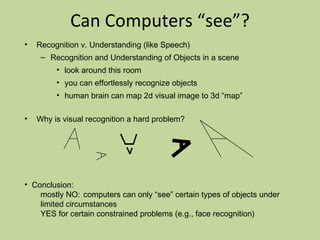
Recognition v. Understanding (like Speech) Recognition and Understanding of Objects in a scene look around this room you can effortlessly recognize objects human brain can map 2d visual image to 3d “map”  Why is visual recognition a hard problem? Can Computers “see”? Conclusion:  mostly NO:   computers can only “see” certain types of objects under limited circumstances YES for certain constrained problems (e.g., face recognition)
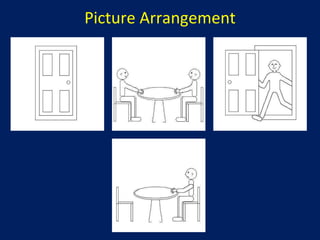
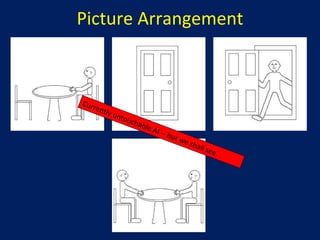
Picture Arrangement
Picture Arrangement Currently untouchable AI -- but we shall see.
Can computers plan and make optimal decisions? Intelligence involves solving problems and making decisions and plans e.g., you want to take a holiday in Brazil you need to decide on dates, flights you need to get to the airport, etc involves a sequence of decisions, plans, and actions What makes planning hard? the world is not predictable: your flight is canceled there are a potentially huge number of details do you consider all flights? all dates? no: commonsense constrains your solutions AI systems are only successful in constrained planning problems Conclusion: NO, real-world planning and decision-making is still beyond the capabilities of modern computers  exception: very well-defined, constrained problems
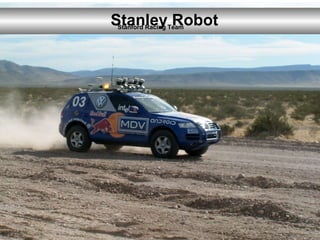
Success Stories Deep Blue defeated the reigning world chess champion Garry Kasparov in 1997  AI program proved a mathematical conjecture (Robbins conjecture) unsolved for decades  During the 1991 Gulf War, US forces deployed an AI logistics planning and scheduling program that involved up to 50,000 vehicles, cargo, and people  NASA's on-board autonomous planning program controlled the scheduling of operations for a spacecraft  Proverb solves crossword puzzles better than most humans Robot driving: DARPA grand challenge 2003-2007 2006: face recognition software available in consumer cameras
Stanley Robot Stanford Racing Team
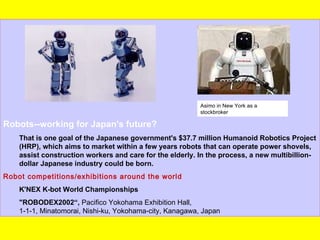
Robots--working for Japan's future? That is one goal of the Japanese government's $37.7 million Humanoid Robotics Project (HRP), which aims to market within a few years robots that can operate power shovels, assist construction workers and care for the elderly. In the process, a new multibillion-dollar Japanese industry could be born. Robot competitions/exhibitions around the world  K'NEX K-bot World Championships "ROBODEX2002“,  Pacifico Yokohama Exhibition Hall, 1-1-1, Minatomorai, Nishi-ku, Yokohama-city, Kanagawa, Japan Asimo in New York as a stockbroker
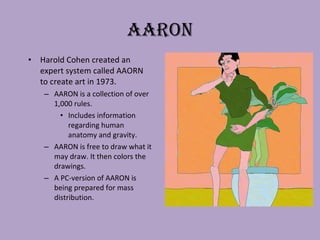
AARON Harold Cohen created an expert system called AAORN to create art in 1973. AARON is a collection of over 1,000 rules. Includes information regarding human anatomy and gravity.  AARON is free to draw what it may draw. It then colors the drawings. A PC-version of AARON is being prepared for mass distribution.
Problems of AI The problem of simulating (or creating) intelligence has been broken down into a number of specific sub-problems.
Deduction, reasoning, problem solving   Early AI researchers developed Algorithms that initiated  the step-by-step reasoning that human beings use when they solve puzzles, play board games or make logical deductions.  2 .  Knowledge Representation Many of the problems machines are expected  to solve will require extensive knowledge about the world.
3.  Planning Intelligent agents must be able to set goals and achieve them. They need a way to visualize the future and be able to make choices that maximize the utility (or "value") of the available choices. 4 .  Learning Machine learning has been central to AI research from the beginning. The mathematical analysis of machine learning algorithms and their performance is a branch of theoretical computer science known as computational learning theory
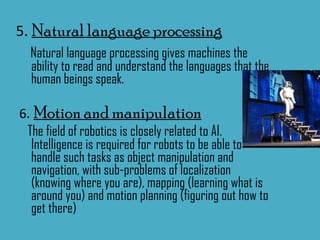
5.  Natural language processing Natural language processing gives machines the ability to read and understand the languages that the human beings speak. 6.   Motion and manipulation The field of robotics is closely related to AI. Intelligence is required for robots to be able to handle such tasks as object manipulation and navigation, with sub-problems of localization (knowing where you are), mapping (learning what is around you) and motion planning (figuring out how to get there)
7 .  Creativity A sub-field of AI addresses creativity both theoretically (from a philosophical and psychological perspective) and practically (via specific implementations of systems that generate outputs that can be considered creative).
 
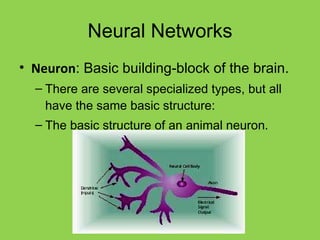
Neural Networks Neuron : Basic building-block of the brain. There are several specialized types, but all have the same basic structure: The basic structure of an animal neuron .
Neural Networks Artificial models of the brain are of two distinct types: Electronic: Has electronic circuits that act like neurons. Software: This version runs a program on the computer that stimulates the action of the neurons.
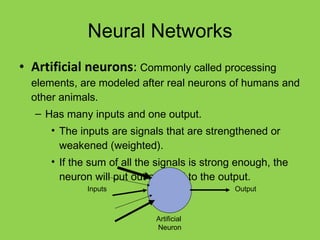
Neural Networks Artificial neurons :  Commonly called processing elements, are modeled after real neurons of humans and other animals. Has many inputs and one output. The inputs are signals that are strengthened or weakened (weighted). If the sum of all the signals is strong enough, the neuron will put out a signal to the output. Output Artificial  Neuron Inputs
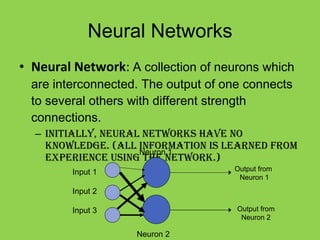
Neural Networks Neural Network :  A collection of neurons which are interconnected. The output of one connects to several others with different strength connections. Initially, neural networks have no knowledge. (All information is learned from experience using the network.) Input 1 Input 2 Input 3 Neuron 1 Neuron 2 Output from  Neuron 1 Output from Neuron 2
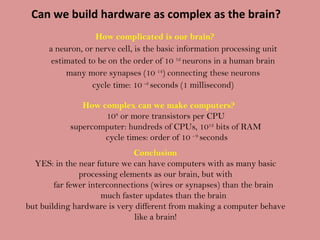
Can we build hardware as complex as the brain? How complicated is our brain? a neuron, or nerve cell, is the basic information processing unit estimated to be on the order of 10  12  neurons in a human brain many more synapses (10  14 ) connecting these neurons cycle time: 10  -3  seconds (1 millisecond) How complex can we make computers? 10 8  or more transistors per CPU  supercomputer: hundreds of CPUs, 10 12  bits of RAM  cycle times: order of 10  - 9  seconds Conclusion YES: in the near future we can have computers with as many basic processing elements as our brain, but with far fewer interconnections (wires or synapses) than the brain much faster updates than the brain but building hardware is very different from making a computer behave like a brain!
THA NK   YOU PRESENTED BY : NAME: INDRANIL CHOWDHURY

Artificial intelligence

  • 1.
  • 2.
    What is intelligence?The capacity to learn and solve problems. In particular, # The ability to solve novel problems # The ability to act rationally # The ability to act like humans
  • 3.
    WHAT IS THEMEANING OF ARTIFICIAL INTELLIGENCE ? It is the intelligence of machines and the branch of computer science that aims to create it. Textbooks define the field as “the study and design of intelligent machines”.
  • 4.
    What is involvedin Intelligence? Ability to interact with the real world # to perceive, understand, and act - e.g., speech recognition and understanding and synthesis - e.g., image understanding - e.g., ability to take actions, have an effect Reasoning and Planning # modeling the external world, given input # solving new problems, planning, and making decisions # ability to deal with unexpected problems, uncertainties Learning and Adaptation # we are continuously learning and adapting our internal models are always being “updated” - e.g., a baby learning to categorize and recognize animals
  • 5.
    History of AI1943: early beginnings McCulloch & Pitts: Boolean circuit model of brain 1950: Turing Turing's "Computing Machinery and Intelligence“ 1956: birth of AI Dartmouth meeting: "Artificial Intelligence“ name adopted 1950s: initial promise Early AI programs, including Samuel's checkers program Newell & Simon's Logic Theorist 1955-65: “great enthusiasm” Newell and Simon: GPS, general problem solver Gelertner: Geometry Theorem Prover McCarthy: invention of LISP
  • 6.
    History of AI1966—73: Reality dawns Realization that many AI problems are intractable Limitations of existing neural network methods identified Neural network research almost disappears 1969—85: Adding domain knowledge Development of knowledge-based systems Success of rule-based expert systems, E.g., DENDRAL, MYCIN But were brittle and did not scale well in practice 1986-- Rise of machine learning Neural networks return to popularity Major advances in machine learning algorithms and applications 1990-- Role of uncertainty Bayesian networks as a knowledge representation framework 1995-- AI as Science Integration of learning, reasoning, knowledge representation AI methods used in vision, language, data mining, etc
  • 7.
    The Turing’s TestAlan Turing (1912 - 1954) Proposed a test - Turing’s Imitation Game Tests the intelligence of the computer. Phase 1: Man and woman separated from an interrogator. The interrogator types in a question to either party. By observing responses, the interrogator’s goal was to identify which was the man and which was the woman.
  • 8.
    The Turing’s TestPhase 2 of the Turing’s test: The man was replaced by the computer. If the computer could fool the interrogator as often as the person did, it could be said that the computer had displayed intelligence.
  • 9.
    What is anintelligent agent Intelligent Agent user/ environment output/ sensors effectors input/ An intelligent agent is a system that: perceives its environment (which may be the physical world, a user via a graphical user interface, a collection of other agents, the Internet, or other complex environment); reasons to interpret perceptions, draw inferences, solve problems, and determine actions; and acts upon that environment to realize a set of goals or tasks for which it was designed.
  • 10.
    Characteristic features ofintelligent agents Knowledge representation and reasoning Transparency and explanations Ability to communicate Use of huge amounts of knowledge Exploration of huge search spaces Use of heuristics Reasoning with incomplete or conflicting data Ability to learn and adapt
  • 11.
    artificial intelligence: researchareas Knowledge Representation Programming Languages Natural Language (e.g., Story) Understanding Speech Understanding Vision Robotics Machine Learning Expert Systems Qualitative Simulation Planning
  • 12.
    Can Computers Talk?This is known as “speech synthesis” translate text to phonetic form e.g., “fictitious” -> fik-tish-es use pronunciation rules to map phonemes to actual sound e.g., “tish” -> sequence of basic audio sounds Difficulties sounds made by this “lookup” approach sound unnatural sounds are not independent e.g., “act” and “action” modern systems (e.g., at AT&T) can handle this pretty well a harder problem is emphasis, emotion, etc humans understand what they are saying machines don’t: so they sound unnatural Conclusion: NO, for complete sentences YES, for individual words
  • 13.
    Can Computers Understandspeech? Understanding is different to recognition: “ Time flies like an arrow” assume the computer can recognize all the words how many different interpretations are there? 1. time passes quickly like an arrow? 2. command: time the flies the way an arrow times the flies 3. command: only time those flies which are like an arrow 4. “time-flies” are fond of arrows only 1. makes any sense, but how could a computer figure this out? clearly humans use a lot of implicit commonsense knowledge in communication Conclusion: NO, much of what we say is beyond the capabilities of a computer to understand at present
  • 14.
    Can Computers Learnand Adapt ? Learning and Adaptation consider a computer learning to drive on the freeway we could teach it lots of rules about what to do or we could let it drive and steer it back on course when it heads for the embankment systems like this are under development (e.g., Daimler Benz) e.g., RALPH at CMU in mid 90’s it drove 98% of the way from Pittsburgh to San Diego without any human assistance machine learning allows computers to learn to do things without explicit programming many successful applications: requires some “set-up”: does not mean your PC can learn to forecast the stock market or become a brain surgeon Conclusion: YES, computers can learn and adapt, when presented with information in the appropriate way
  • 15.
    Recognition v. Understanding(like Speech) Recognition and Understanding of Objects in a scene look around this room you can effortlessly recognize objects human brain can map 2d visual image to 3d “map” Why is visual recognition a hard problem? Can Computers “see”? Conclusion: mostly NO: computers can only “see” certain types of objects under limited circumstances YES for certain constrained problems (e.g., face recognition)
  • 16.
  • 17.
    Picture Arrangement Currentlyuntouchable AI -- but we shall see.
  • 18.
    Can computers planand make optimal decisions? Intelligence involves solving problems and making decisions and plans e.g., you want to take a holiday in Brazil you need to decide on dates, flights you need to get to the airport, etc involves a sequence of decisions, plans, and actions What makes planning hard? the world is not predictable: your flight is canceled there are a potentially huge number of details do you consider all flights? all dates? no: commonsense constrains your solutions AI systems are only successful in constrained planning problems Conclusion: NO, real-world planning and decision-making is still beyond the capabilities of modern computers exception: very well-defined, constrained problems
  • 19.
    Success Stories DeepBlue defeated the reigning world chess champion Garry Kasparov in 1997 AI program proved a mathematical conjecture (Robbins conjecture) unsolved for decades During the 1991 Gulf War, US forces deployed an AI logistics planning and scheduling program that involved up to 50,000 vehicles, cargo, and people NASA's on-board autonomous planning program controlled the scheduling of operations for a spacecraft Proverb solves crossword puzzles better than most humans Robot driving: DARPA grand challenge 2003-2007 2006: face recognition software available in consumer cameras
  • 20.
  • 21.
    Robots--working for Japan'sfuture? That is one goal of the Japanese government's $37.7 million Humanoid Robotics Project (HRP), which aims to market within a few years robots that can operate power shovels, assist construction workers and care for the elderly. In the process, a new multibillion-dollar Japanese industry could be born. Robot competitions/exhibitions around the world K'NEX K-bot World Championships "ROBODEX2002“, Pacifico Yokohama Exhibition Hall, 1-1-1, Minatomorai, Nishi-ku, Yokohama-city, Kanagawa, Japan Asimo in New York as a stockbroker
  • 22.
    AARON Harold Cohencreated an expert system called AAORN to create art in 1973. AARON is a collection of over 1,000 rules. Includes information regarding human anatomy and gravity. AARON is free to draw what it may draw. It then colors the drawings. A PC-version of AARON is being prepared for mass distribution.
  • 23.
    Problems of AIThe problem of simulating (or creating) intelligence has been broken down into a number of specific sub-problems.
  • 24.
    Deduction, reasoning, problemsolving Early AI researchers developed Algorithms that initiated the step-by-step reasoning that human beings use when they solve puzzles, play board games or make logical deductions. 2 . Knowledge Representation Many of the problems machines are expected to solve will require extensive knowledge about the world.
  • 25.
    3. PlanningIntelligent agents must be able to set goals and achieve them. They need a way to visualize the future and be able to make choices that maximize the utility (or "value") of the available choices. 4 . Learning Machine learning has been central to AI research from the beginning. The mathematical analysis of machine learning algorithms and their performance is a branch of theoretical computer science known as computational learning theory
  • 26.
    5. Naturallanguage processing Natural language processing gives machines the ability to read and understand the languages that the human beings speak. 6. Motion and manipulation The field of robotics is closely related to AI. Intelligence is required for robots to be able to handle such tasks as object manipulation and navigation, with sub-problems of localization (knowing where you are), mapping (learning what is around you) and motion planning (figuring out how to get there)
  • 27.
    7 . Creativity A sub-field of AI addresses creativity both theoretically (from a philosophical and psychological perspective) and practically (via specific implementations of systems that generate outputs that can be considered creative).
  • 28.
  • 29.
    Neural Networks Neuron: Basic building-block of the brain. There are several specialized types, but all have the same basic structure: The basic structure of an animal neuron .
  • 30.
    Neural Networks Artificialmodels of the brain are of two distinct types: Electronic: Has electronic circuits that act like neurons. Software: This version runs a program on the computer that stimulates the action of the neurons.
  • 31.
    Neural Networks Artificialneurons : Commonly called processing elements, are modeled after real neurons of humans and other animals. Has many inputs and one output. The inputs are signals that are strengthened or weakened (weighted). If the sum of all the signals is strong enough, the neuron will put out a signal to the output. Output Artificial Neuron Inputs
  • 32.
    Neural Networks NeuralNetwork : A collection of neurons which are interconnected. The output of one connects to several others with different strength connections. Initially, neural networks have no knowledge. (All information is learned from experience using the network.) Input 1 Input 2 Input 3 Neuron 1 Neuron 2 Output from Neuron 1 Output from Neuron 2
  • 33.
    Can we buildhardware as complex as the brain? How complicated is our brain? a neuron, or nerve cell, is the basic information processing unit estimated to be on the order of 10 12 neurons in a human brain many more synapses (10 14 ) connecting these neurons cycle time: 10 -3 seconds (1 millisecond) How complex can we make computers? 10 8 or more transistors per CPU supercomputer: hundreds of CPUs, 10 12 bits of RAM cycle times: order of 10 - 9 seconds Conclusion YES: in the near future we can have computers with as many basic processing elements as our brain, but with far fewer interconnections (wires or synapses) than the brain much faster updates than the brain but building hardware is very different from making a computer behave like a brain!
  • 34.
    THA NK YOU PRESENTED BY : NAME: INDRANIL CHOWDHURY

Editor's Notes

  • #23 Chapter 12 The Computer Continuum
  • #30 Chapter 12 The Computer Continuum
  • #31 Chapter 12 The Computer Continuum
  • #32 Chapter 12 The Computer Continuum
  • #33 Chapter 12 The Computer Continuum