What Really is Artificial Intelligence about?
Harmony Kwawu
hkwawu@aol.com
Introduction
Stephen Hawking, is perhaps the most eminent
scientist alive today, so when he speaks, it’s
important to sit up and listen. In 2014, Professor
Hawking warned that: The development of (true)
artificial intelligence could spell the end of the
human race, (Cellan-Jones, Technology
correspondent, BBC).
In a follow up later this month, he is again
reported as saying that artificial intelligence
could be humanity's greatest disaster
Surely enough, Professor Hawking’s observations
have unleashed questions and arguments from AI
experts and non experts alike.
There is no doubt, AI systems are growing. But
what is AI, where did the idea behind it come
from, what is intelligence, how does expert level
intelligence work, and perhaps most importantly,
would AI systems eventually make human beings
redundant?
Introduction Con’t
Providing answers to questions such as these
will require many rounds of articles. But in
these three highly simplified lecturers, I hope to
explore and share some light on them.
Those who wish to explore the subject in depth
would find at the end of each slide links to far
richer coverage elsewhere
Introduction Con’t
Topics
Examine a number of definitions for AI
Briefly explain the meaning of the term Intelligence
Briefly examine the purposes of AI technology
Sources of the idea behind AI
AI in the news
Benefits and challenges posed by AI
Further Reading
So what is AI?
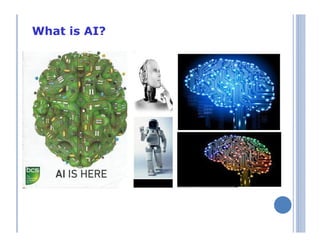
What is AI?
A working definition of AI
Two simple words, but many different definitions:
The word artificial simply put means, a human creation as
oppose to something natural.
Artificial Intelligence is machine or computer based
intelligence as oppose to human intelligence. It refers to a
specific computer program that attempt to emulate
human cognitive ability and behaviour
The field of Artificial Intelligence is dedicated to the study
and replication of human brain in machines, thus enabling
them to perform cognitive based activities.
AI imitate human behaviour in areas of problem Solving,
Speech recognition, decision making, Learning and
Planning.
So what is Intelligence?
There is no universally agreed view on what constitute
human intelligence. Understanding of human intelligence is
very much a work in progress
Most definition of intelligence however, suggest that
intelligence is brain base or cognitive process performed by
individuals and machines when solving problems
But for our purpose, intelligence is simply defined as ability
to think, understand and learn. The question is can a
machine be classified as intelligent?
Later in the second part of this piece, we shall see how
expert systems perform processes such as reasoning and
problem solving
What is Machine Intelligence anyway
As noted in the previous slide, the term intelligence is
commonly associated with high level cognitive traits
possessed by humans and non humans alike.
Intelligence can be gleaned from cognitive behaviour or
performance of a complex task. This include task such as:
Logical Reasoning
Decision making
Problem Solving
Complex Communication
Recognition and extension of patterns
Ability to read, write and learn autonomously
What is Machine Intelligence anyway
A machine is said to be intelligent if it’s able to
perform some of the human functions, like,
learning, decision making and pattern recognition
Purpose of AI Technology
The ultimate goal of AI is to create computer programs
(algorithms) that are capable of solving complex problems,
achieve and exceed human level expertise
Experts in the field dedicate themselves to learning about
and creating computers programs that simulate thinking
and do things that would require intelligent human beings
to do.
The origin of an idea
How new are the concepts behind AI?
The origins of ideas behind AI and subsequent
developments can be traced back to the British
mathematician, Alan Turing.
Two of Turin’s work in particular, the imitation game,
(Turing, 1936) and computing machinery and intelligence
(Turing, 1950) help set the scene for AI Today.
From 1950 through to mid 1980s, the fundamental
questions posed by Alan Turing inspired others such as:
Warrant McCulloch and Walter Pitt in 1943 to produce the
first artificial Neuron Network
The invention of the stored program computer
The modern store program computer developed
by John Von Neumann and colleagues is also
based on the concepts of Artificial Intelligence
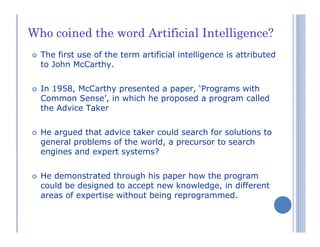
Who coined the word Artificial Intelligence?
The first use of the term artificial intelligence is attributed
to John McCarthy.
In 1958, McCarthy presented a paper, ‘Programs with
Common Sense’, in which he proposed a program called
the Advice Taker
He argued that advice taker could search for solutions to
general problems of the world, a precursor to search
engines and expert systems?
He demonstrated through his paper how the program
could be designed to accept new knowledge, in different
areas of expertise without being reprogrammed.
The Field of Artificial Intelligence
Today
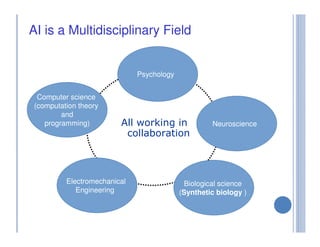
All working in
collaboration
Computer science
(computation theory
and
programming) Neuroscience
Electromechanical
Engineering
Biological science
(Synthetic biology )
Psychology
AI is a Multidisciplinary Field
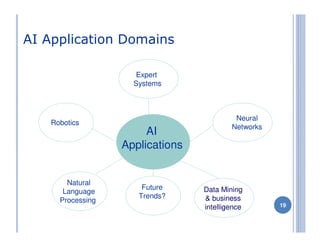
AI Application Domains
AI
Applications
Robotics
Expert
Systems
Future
Trends?
Data Mining
& business
intelligence
Neural
Networks
Natural
Language
Processing
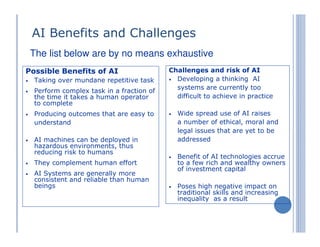
AI Benefits and Challenges
Possible Benefits of AI
• Taking over mundane repetitive task
• Perform complex task in a fraction of
the time it takes a human operator
to complete
• Producing outcomes that are easy to
understand
• AI machines can be deployed in
hazardous environments, thus
reducing risk to humans
• They complement human effort
• AI Systems are generally more
consistent and reliable than human
beings
Challenges and risk of AI
• Developing a thinking AI
systems are currently too
difficult to achieve in practice
• Wide spread use of AI raises
a number of ethical, moral and
legal issues that are yet to be
addressed
• Benefit of AI technologies accrue
to a few rich and wealthy owners
of investment capital
• Poses high negative impact on
traditional skills and increasing
inequality as a result
The list below are by no means exhaustive
AI in the News
AI in the News:
Artificial intelligence (AI)
http://www.theguardian.com/technology/artificialintelligenceai
The coming rise of AI means humanity will need to
grow up: http://thenextweb.com/insider/2015/01/18/coming-rise-
ai-means-humanity-will-need-grow/
Ultra-realistic Dental Training Android Robot:
https://www.youtube.com/watch?v=WhzbFaNueKU
Are We Approaching Robotic Consciousnesses? It’s
no longer a question of if but when
https://www.youtube.com/watch?v=JTOMNkZJRao
AI in the News:
Stephen Hawkings on how AI could end manking:
http://www.bbc.co.uk/news/technology-30290540
He also warn how they could be best or worst thing
for humanity:
https://www.theguardian.com/science/2016/oct/19/stephen-
hawking-ai-best-or-worst-thing-for-humanity-cambridge
Hermosathe Robot can even perform at concert
https://www.youtube.com/watch?v=kIgdbfZDtRE
Some thought provoking questions
about AI
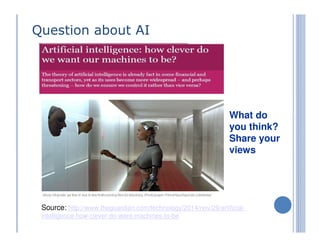
Question about AI
What do
you think?
Share your
views
Source: http://www.theguardian.com/technology/2014/nov/29/artificial-
intelligence-how-clever-do-want-machines-to-be
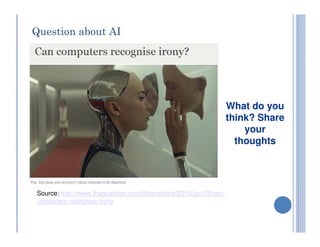
Question about AI
What do you
think? Share
your
thoughts
Source: http://www.theguardian.com/lifeandstyle/2015/jan/28/can-
computers-recognise-irony
Can Robots ever learn to think?
Yes and No – Depending on what you mean by
thinking:
They can understand us
http://www.mirror.co.uk/news/world-news/advanced-
robot-can-understand-how-9135903
The robots that think: China's most advanced
assistants go on show
http://www.dailymail.co.uk/sciencetech/article-3879454/The-robots-think-
China-s-advanced-assistants-show.html
Additional sources of information
Michael Negnevitsky, (2002), AI A guide to
Intelligence Systems covers extensively the
history of AI and important concepts
Please read it, it’s highly informative
Thanks for reading
Keep in touch and let
me know what you
think

What really is Artificial Intelligence about?

  • 1.
    What Really isArtificial Intelligence about? Harmony Kwawu hkwawu@aol.com
  • 2.
    Introduction Stephen Hawking, isperhaps the most eminent scientist alive today, so when he speaks, it’s important to sit up and listen. In 2014, Professor Hawking warned that: The development of (true) artificial intelligence could spell the end of the human race, (Cellan-Jones, Technology correspondent, BBC). In a follow up later this month, he is again reported as saying that artificial intelligence could be humanity's greatest disaster
  • 3.
    Surely enough, ProfessorHawking’s observations have unleashed questions and arguments from AI experts and non experts alike. There is no doubt, AI systems are growing. But what is AI, where did the idea behind it come from, what is intelligence, how does expert level intelligence work, and perhaps most importantly, would AI systems eventually make human beings redundant? Introduction Con’t
  • 4.
    Providing answers toquestions such as these will require many rounds of articles. But in these three highly simplified lecturers, I hope to explore and share some light on them. Those who wish to explore the subject in depth would find at the end of each slide links to far richer coverage elsewhere Introduction Con’t
  • 5.
    Topics Examine a numberof definitions for AI Briefly explain the meaning of the term Intelligence Briefly examine the purposes of AI technology Sources of the idea behind AI AI in the news Benefits and challenges posed by AI Further Reading
  • 6.
  • 7.
  • 8.
    A working definitionof AI Two simple words, but many different definitions: The word artificial simply put means, a human creation as oppose to something natural. Artificial Intelligence is machine or computer based intelligence as oppose to human intelligence. It refers to a specific computer program that attempt to emulate human cognitive ability and behaviour The field of Artificial Intelligence is dedicated to the study and replication of human brain in machines, thus enabling them to perform cognitive based activities. AI imitate human behaviour in areas of problem Solving, Speech recognition, decision making, Learning and Planning.
  • 9.
    So what isIntelligence? There is no universally agreed view on what constitute human intelligence. Understanding of human intelligence is very much a work in progress Most definition of intelligence however, suggest that intelligence is brain base or cognitive process performed by individuals and machines when solving problems But for our purpose, intelligence is simply defined as ability to think, understand and learn. The question is can a machine be classified as intelligent? Later in the second part of this piece, we shall see how expert systems perform processes such as reasoning and problem solving
  • 10.
    What is MachineIntelligence anyway As noted in the previous slide, the term intelligence is commonly associated with high level cognitive traits possessed by humans and non humans alike. Intelligence can be gleaned from cognitive behaviour or performance of a complex task. This include task such as: Logical Reasoning Decision making Problem Solving Complex Communication Recognition and extension of patterns Ability to read, write and learn autonomously
  • 11.
    What is MachineIntelligence anyway A machine is said to be intelligent if it’s able to perform some of the human functions, like, learning, decision making and pattern recognition
  • 12.
    Purpose of AITechnology The ultimate goal of AI is to create computer programs (algorithms) that are capable of solving complex problems, achieve and exceed human level expertise Experts in the field dedicate themselves to learning about and creating computers programs that simulate thinking and do things that would require intelligent human beings to do.
  • 13.
  • 14.
    How new arethe concepts behind AI? The origins of ideas behind AI and subsequent developments can be traced back to the British mathematician, Alan Turing. Two of Turin’s work in particular, the imitation game, (Turing, 1936) and computing machinery and intelligence (Turing, 1950) help set the scene for AI Today. From 1950 through to mid 1980s, the fundamental questions posed by Alan Turing inspired others such as: Warrant McCulloch and Walter Pitt in 1943 to produce the first artificial Neuron Network
  • 15.
    The invention ofthe stored program computer The modern store program computer developed by John Von Neumann and colleagues is also based on the concepts of Artificial Intelligence
  • 16.
    Who coined theword Artificial Intelligence? The first use of the term artificial intelligence is attributed to John McCarthy. In 1958, McCarthy presented a paper, ‘Programs with Common Sense’, in which he proposed a program called the Advice Taker He argued that advice taker could search for solutions to general problems of the world, a precursor to search engines and expert systems? He demonstrated through his paper how the program could be designed to accept new knowledge, in different areas of expertise without being reprogrammed.
  • 17.
    The Field ofArtificial Intelligence Today
  • 18.
    All working in collaboration Computerscience (computation theory and programming) Neuroscience Electromechanical Engineering Biological science (Synthetic biology ) Psychology AI is a Multidisciplinary Field
  • 19.
    AI Application Domains AI Applications Robotics Expert Systems Future Trends? DataMining & business intelligence Neural Networks Natural Language Processing
  • 20.
    AI Benefits andChallenges Possible Benefits of AI • Taking over mundane repetitive task • Perform complex task in a fraction of the time it takes a human operator to complete • Producing outcomes that are easy to understand • AI machines can be deployed in hazardous environments, thus reducing risk to humans • They complement human effort • AI Systems are generally more consistent and reliable than human beings Challenges and risk of AI • Developing a thinking AI systems are currently too difficult to achieve in practice • Wide spread use of AI raises a number of ethical, moral and legal issues that are yet to be addressed • Benefit of AI technologies accrue to a few rich and wealthy owners of investment capital • Poses high negative impact on traditional skills and increasing inequality as a result The list below are by no means exhaustive
  • 21.
  • 22.
    AI in theNews: Artificial intelligence (AI) http://www.theguardian.com/technology/artificialintelligenceai The coming rise of AI means humanity will need to grow up: http://thenextweb.com/insider/2015/01/18/coming-rise- ai-means-humanity-will-need-grow/ Ultra-realistic Dental Training Android Robot: https://www.youtube.com/watch?v=WhzbFaNueKU Are We Approaching Robotic Consciousnesses? It’s no longer a question of if but when https://www.youtube.com/watch?v=JTOMNkZJRao
  • 23.
    AI in theNews: Stephen Hawkings on how AI could end manking: http://www.bbc.co.uk/news/technology-30290540 He also warn how they could be best or worst thing for humanity: https://www.theguardian.com/science/2016/oct/19/stephen- hawking-ai-best-or-worst-thing-for-humanity-cambridge Hermosathe Robot can even perform at concert https://www.youtube.com/watch?v=kIgdbfZDtRE
  • 24.
    Some thought provokingquestions about AI
  • 25.
    Question about AI Whatdo you think? Share your views Source: http://www.theguardian.com/technology/2014/nov/29/artificial- intelligence-how-clever-do-want-machines-to-be
  • 26.
    Question about AI Whatdo you think? Share your thoughts Source: http://www.theguardian.com/lifeandstyle/2015/jan/28/can- computers-recognise-irony
  • 27.
    Can Robots everlearn to think? Yes and No – Depending on what you mean by thinking: They can understand us http://www.mirror.co.uk/news/world-news/advanced- robot-can-understand-how-9135903 The robots that think: China's most advanced assistants go on show http://www.dailymail.co.uk/sciencetech/article-3879454/The-robots-think- China-s-advanced-assistants-show.html
  • 28.
    Additional sources ofinformation Michael Negnevitsky, (2002), AI A guide to Intelligence Systems covers extensively the history of AI and important concepts Please read it, it’s highly informative
  • 29.
    Thanks for reading Keepin touch and let me know what you think