THE IOT ACADEMY
Summary
 What is Artificial Intelligence?
 modeling humans thinking, acting, should think, should act.
 History of AI
 Intelligent agents
 We want to build agents that act rationally
 Real-World Applications of AI
 AI is alive and well in various “every day” applications
 many products, systems, have AI components
What is Artificial Intelligence
 What is artificial intelligence?
 It is the science and engineering of making intelligent machines, especially
intelligent computer programs. It is related to the similar task of using computers to
understand human intelligence, but AI does not have to confine itself to methods
that are biologically observable.
 Yes, but what is intelligence?
 Intelligence is the computational part of the ability to achieve goals in the world.
Varying kinds and degrees of intelligence occur in people, many animals and some
machines.
 Isn't there a solid definition of intelligence that doesn't depend on relating it
to human intelligence?
 Not yet. The problem is that we cannot yet characterize in general what kinds of
computational procedures we want to call intelligent. We understand some of the
mechanisms of intelligence and not others.
What is Artificial Intelligence?
 Human-like (“How to simulate humans intellect and behavior on by a
machine.)
 Mathematical problems (puzzles, games, theorems)
 Common-sense reasoning (if there is parking-space, probably illegal to
park)
 Expert knowledge: lawyers, medicine, diagnosis
 Social behavior
 Rational-like:
 achieve goals, have performance measure
What is Artificial Intelligence
 Thought processes
 “The exciting new effort to make computers think .. Machines with minds, in
the full and literal sense” (Haugeland, 1985)
 Behavior
 “The study of how to make computers do things at which, at the moment,
people are better.” (Rich, and Knight, 1991)
What is AI?
 Turing test (1950)
 Requires:
 Natural language
 Knowledge representation
 automated reasoning
 machine learning
 (vision, robotics.) for full test
 Thinking humanly:
 Introspection, the general problem solver (Newell and Simon 1961)
 Cognitive sciences
 Thinking rationally:
 Logic
 Problems: how to represent and reason in a domain
 Acting rationally:
 Agents: Perceive and act
Why AI?
One of major divisions in AI (and you can see it in the
definitions on the previous slide) is between
• Those who think AI is the only serious way of finding
out how we work (since opening heads does not yet
give much insight into this) and
 Those who want computers to do very smart
things, independently of how we work.
This is the important distinction between
Cognitive Scientists vs. Engineers.
History of AI
 McCulloch and Pitts (1943)
 Neural networks that learn
 Minsky (1951)
 Built a neural net computer
 Darmouth conference (1956):
 McCarthy, Minsky, Newell, Simon met,
 Logic theorist (LT)- proves a theorem in Principia Mathematica-Russel.
 The name “Artificial Intelligence” was coined.
 1952-1969
 GPS- Newell and Simon
 Geometry theorem prover - Gelernter (1959)
 Samuel Checkers that learns (1952)
 McCarthy - Lisp (1958), Advice Taker, Robinson’s resolution
 Microworlds: Integration, block-worlds.
 1962- the perceptron convergence (Rosenblatt)
Abridged history of AI
 1943 McCulloch & Pitts: Boolean circuit model of brain
 1950 Turing's "Computing Machinery and Intelligence"
 1956 Dartmouth meeting: "Artificial Intelligence" adopted
 1952—69 Look, Ma, no hands!
 1950s Early AI programs, including Samuel's checkers
program, Newell & Simon's Logic Theorist,
Gelernter's Geometry Engine
 1965 Robinson's complete algorithm for logical reasoning
 1966—73 AI discovers computational complexity
Neural network research almost disappears
 1969—79 Early development of knowledge-based systems
 1980-- AI becomes an industry
 1986-- Neural networks return to popularity
 1987-- AI becomes a science
 1995-- The emergence of intelligent agents
History, continued
 1966-1974 a dose of reality
 Problems with computation
 1969-1979 Knowledge-based systems
 Weak vs. strong methods
 Expert systems:
 Dendral:Inferring molecular structures
 Mycin: diagnosing blood infections
 Prospector: recommending exploratory drilling (Duda).
 Roger Shank: no syntax only semantics
 1980-1988: AI becomes an industry
 R1: Mcdermott, 1982, order configurations of computer systems
 1981: Fifth generation
 1986-present: return to neural networks
 Recent event:
 AI becomes a science: HMMs, planning, belief network
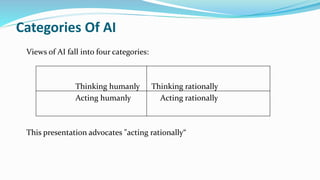
Categories Of AI
Views of AI fall into four categories:
Thinking humanly Thinking rationally
Acting humanly Acting rationally
This presentation advocates "acting rationally“
AI examples
Common sense reasoning
 Tweety
 Yale Shooting problem
Update vs revise knowledge
 The OR gate example: A or B - C
 Observe C=0, vs Do C=0
Chaining theories of actions
Looks-like(P)  is(P)
Make-looks-like(P)  Looks-like(P)
----------------------------------------
Makes-looks-like(P) --- is(P) ???
Garage-door example: garage door not included.
 Planning benchmarks
 8-puzzle, 8-queen, block world, grid-space world
Abduction: cambridge parking example
The Birthplace of
“Artificial Intelligence”, 1956
 Darmouth workshop, 1956: historical meeting of the perceived founders of AI met: John
McCarthy, Marvin Minsky, Alan Newell, and Herbert Simon.
 A Proposal for the Dartmouth Summer Research Project on Artificial Intelligence. J. McCarthy,
M. L. Minsky, N. Rochester, and C.E. Shannon. August 31, 1955. "We propose that a 2 month, 10
man study of artificial intelligence be carried out during the summer of 1956 at Dartmouth
College in Hanover, New Hampshire. The study is to proceed on the basis of the conjecture that
every aspect of learning or any other feature of intelligence can in principle be so precisely
described that a machine can be made to simulate it." And this marks the debut of the term
"artificial intelligence.“
 50 anniversery of Darmouth workshop
State of the art
 Deep Blue defeated the reigning world chess champion Garry Kasparov in 1997
 Proved a mathematical conjecture (Robbins conjecture) unsolved for decades
 No hands across America (driving autonomously 98% of the time from
Pittsburgh to San Diego)
 During the 1991 Gulf War, US forces deployed an AI logistics planning and
scheduling program that involved up to 50,000 vehicles, cargo, and people
 NASA's on-board autonomous planning program controlled the scheduling of
operations for a spacecraft
 Proverb solves crossword puzzles better than most humans
 DARPA grand challenge 2003-2005, Robocup
Course Description
 This course introduces:
 Representations
 Techniques
 Architectures
 This course also explores applications of:
 Rule chaining
 Heuristic search
 Constraint propagation
 Constrained search
 Decision trees
 Knowledge representation
 Knowledge-based systems
 Natural-language processing
Objectives of the course
 The general objectives of the course can be summarized as:
 To identify the kind of problems that can be solved using AI
techniques; to know the relation between AI and other areas of
computer science.
 To have knowledge of generic problem-solving methods in AI.
 To understand the role of knowledge in present IA; to know the basic
techniques of knowledge representation and their use.
 To be able to apply basic AI techniques as support for the solution of
practical problems.
 To be able to navigate the basic bibliography of AI.
Approaches to AI
 Systems that act like humans
 The study of how to obtain that computers perform tasks at which, at the moment,
people are better (Rich and Knight, 1991)
 Systems that think like humans
 The effort to make computers think... machines with minds in the full and literal
sense (Haugeland, 1985)
 Systems that think rationally
 The study of the mental faculties through the study of computational models
(Charniak and McDermott, 1985)
 Systems that act rationally
 The effort to explain and emulate the intelligent behavior in terms of
computational processes (Shalkoff, 1990)
Other approaches to AI
 Good Old-Fashioned Artificial Intelligence (GOFAI) (Douglas Lenat: Cyc)
 Cramming a computer full of knowledge about the real world and methods
to manipulate it
 Intelligence intimately tied up with having and being able to use knowledge
 “It’s worth to go to school”
 Robotic insects example
 Legs controlled by a central computer that has a detailed 3D map of the terrain and
knows all the relevant laws of physics and strategies
18
18
Other approaches to AI
 Learning through experience (Rodney Brooks: Cog, Kismet)
 Machines that experience the world in much the way human beings do
 “You can learn stuff on your own”
 Robotic insects example
 Each leg containing a small circuit that tells it about basic movements
 All local computation physically coupled through the body, with gait emerging
spontaneously from circuits’ interaction
19
19
Areas of work in AI
 Theory
 Philosophy
 Applications
Dimensions in AI Definitions
 Build intelligent artifacts vs. understanding human behavior.
 Does it matter how I built it as long as it does the job well?
 Should the system behave like a human or behave intelligently?
The Turing Test
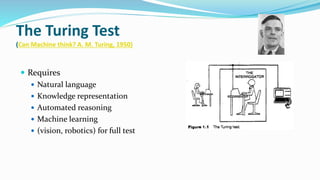
The Turing Test
(Can Machine think? A. M. Turing, 1950)
 Requires
 Natural language
 Knowledge representation
 Automated reasoning
 Machine learning
 (vision, robotics) for full test
Turing Machines
Turing machines inspired the construction of the first
computers, which were based on the von-Neumann
architecture.
Here, digital memory stores the program and data,
including the machine state.
A Central Processing Unit (CPU) sequentially executes
individual instructions in the program through memory read
and write operations.
This fundamental architecture is still shared by most of
today’s computers.
What Does AI Really Do?
 Knowledge Representation (how does a program
represent its domain of discourse?)
 Automated reasoning.
 Planning (get the robot to find the bananas in the
other room).
 Machine Learning (adapt to new circumstances).
 Natural language understanding.
 Machine vision, speech recognition, finding data
on the web, robotics, and much more.
Recent Events: 1987-Present
 AI turns more scientific, relies on more mathematically sophisticated
tools:
 Hidden Markov models (for speech recognition)
 Belief networks (see Office 97).
 Focus turns to building useful artifacts as opposed to solving the grand AI
problem.
 The victory of the neats over the scruffies?
Recent AI Successes
 Deep Blue beats Kasparov (AI?)
 Theorem provers proved an unknown theorem.
 Expert systems: medical, diagnosis, design
 Speech recognition applications (in limited domains).
 Robots controlling quality in factories.
 Intelligent agents on board Deep Space 1.
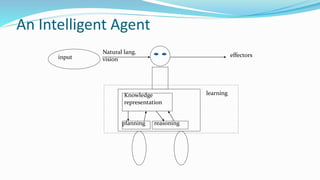
An Intelligent Agent
Knowledge
representation
reasoningplanning
learning
input
Natural lang.
vision
effectors
Outline of the Course
 Search: the fundamental tool of AI programs.
 Lisp briefing.
 Knowledge representation:
 propositional logic
 first-order logic
 inference (soundness and completeness)
 specialized formalisms: Horn rules, description logic.
 Non-monotonic reasoning
 Reasoning with uncertainty
 Planning
 Machine learning
 Natural language understanding
 More, as time allows.
AI – The Achievements
• Computers land 200 ton jumbo jets unaided every few
minutes.
• Search systems like Google are not perfect but provide very
effective information retrieval.
• Robots cut slots for hip joints better than surgeons.
• The chess program Deep Blue beat world champion
Kasparov in 1997.
• Medical expert systems can outperform doctors in many
areas of diagnosis
• Self-driving cars are beginning to enter the market.
• IBM’s Watson beats humans at Jeopardy.
• Programs such as Siri communicate via natural language.
Artificial vs. Human Intelligence
Today’s computers can do many well-defined tasks (for
example, arithmetic operations), much faster and more
accurate than human beings.
However, the computers’ interaction with their environment
is not very sophisticated yet.
How can we test whether a computer has reached the
general intelligence level of a human being?
Turing Test: Can a computer convince a human
interrogator that it is a human?
But before thinking of such advanced kinds of machines, we
will start developing our own extremely simple “intelligent”
machines.
Symbolism vs. Connectionism
There is another major division in the field of Artificial
Intelligence:
• Symbolic AI represents information through
symbols and their relationships. Specific Algorithms
are used to process these symbols to solve
problems or deduce new knowledge.
• Connectionist AI represents information in a
distributed, less explicit form within a network.
Biological processes underlying learning, task
performance, and problem solving are imitated.
Paradigms of Computation
You all know the Turing machine, conceived by Alan Turing
as a theoretical Model of automatic computation.
It uses a tape head that reads and writes symbols on an infinite
tape.
Based on the currently read symbol and the machine’s current
state, the head moves to the left or right or writes a new
symbol, and the state is updated.
These state transition rules constitute the program.
It is believed (but has not been proven) that this machine can
compute all functions that can be computed in principle.
The IOT Academy Training for Artificial Intelligence ( AI)

The IOT Academy Training for Artificial Intelligence ( AI)

  • 1.
  • 2.
    Summary  What isArtificial Intelligence?  modeling humans thinking, acting, should think, should act.  History of AI  Intelligent agents  We want to build agents that act rationally  Real-World Applications of AI  AI is alive and well in various “every day” applications  many products, systems, have AI components
  • 3.
    What is ArtificialIntelligence  What is artificial intelligence?  It is the science and engineering of making intelligent machines, especially intelligent computer programs. It is related to the similar task of using computers to understand human intelligence, but AI does not have to confine itself to methods that are biologically observable.  Yes, but what is intelligence?  Intelligence is the computational part of the ability to achieve goals in the world. Varying kinds and degrees of intelligence occur in people, many animals and some machines.  Isn't there a solid definition of intelligence that doesn't depend on relating it to human intelligence?  Not yet. The problem is that we cannot yet characterize in general what kinds of computational procedures we want to call intelligent. We understand some of the mechanisms of intelligence and not others.
  • 4.
    What is ArtificialIntelligence?  Human-like (“How to simulate humans intellect and behavior on by a machine.)  Mathematical problems (puzzles, games, theorems)  Common-sense reasoning (if there is parking-space, probably illegal to park)  Expert knowledge: lawyers, medicine, diagnosis  Social behavior  Rational-like:  achieve goals, have performance measure
  • 5.
    What is ArtificialIntelligence  Thought processes  “The exciting new effort to make computers think .. Machines with minds, in the full and literal sense” (Haugeland, 1985)  Behavior  “The study of how to make computers do things at which, at the moment, people are better.” (Rich, and Knight, 1991)
  • 6.
    What is AI? Turing test (1950)  Requires:  Natural language  Knowledge representation  automated reasoning  machine learning  (vision, robotics.) for full test  Thinking humanly:  Introspection, the general problem solver (Newell and Simon 1961)  Cognitive sciences  Thinking rationally:  Logic  Problems: how to represent and reason in a domain  Acting rationally:  Agents: Perceive and act
  • 7.
    Why AI? One ofmajor divisions in AI (and you can see it in the definitions on the previous slide) is between • Those who think AI is the only serious way of finding out how we work (since opening heads does not yet give much insight into this) and  Those who want computers to do very smart things, independently of how we work. This is the important distinction between Cognitive Scientists vs. Engineers.
  • 8.
    History of AI McCulloch and Pitts (1943)  Neural networks that learn  Minsky (1951)  Built a neural net computer  Darmouth conference (1956):  McCarthy, Minsky, Newell, Simon met,  Logic theorist (LT)- proves a theorem in Principia Mathematica-Russel.  The name “Artificial Intelligence” was coined.  1952-1969  GPS- Newell and Simon  Geometry theorem prover - Gelernter (1959)  Samuel Checkers that learns (1952)  McCarthy - Lisp (1958), Advice Taker, Robinson’s resolution  Microworlds: Integration, block-worlds.  1962- the perceptron convergence (Rosenblatt)
  • 9.
    Abridged history ofAI  1943 McCulloch & Pitts: Boolean circuit model of brain  1950 Turing's "Computing Machinery and Intelligence"  1956 Dartmouth meeting: "Artificial Intelligence" adopted  1952—69 Look, Ma, no hands!  1950s Early AI programs, including Samuel's checkers program, Newell & Simon's Logic Theorist, Gelernter's Geometry Engine  1965 Robinson's complete algorithm for logical reasoning  1966—73 AI discovers computational complexity Neural network research almost disappears  1969—79 Early development of knowledge-based systems  1980-- AI becomes an industry  1986-- Neural networks return to popularity  1987-- AI becomes a science  1995-- The emergence of intelligent agents
  • 10.
    History, continued  1966-1974a dose of reality  Problems with computation  1969-1979 Knowledge-based systems  Weak vs. strong methods  Expert systems:  Dendral:Inferring molecular structures  Mycin: diagnosing blood infections  Prospector: recommending exploratory drilling (Duda).  Roger Shank: no syntax only semantics  1980-1988: AI becomes an industry  R1: Mcdermott, 1982, order configurations of computer systems  1981: Fifth generation  1986-present: return to neural networks  Recent event:  AI becomes a science: HMMs, planning, belief network
  • 11.
    Categories Of AI Viewsof AI fall into four categories: Thinking humanly Thinking rationally Acting humanly Acting rationally This presentation advocates "acting rationally“
  • 12.
    AI examples Common sensereasoning  Tweety  Yale Shooting problem Update vs revise knowledge  The OR gate example: A or B - C  Observe C=0, vs Do C=0 Chaining theories of actions Looks-like(P)  is(P) Make-looks-like(P)  Looks-like(P) ---------------------------------------- Makes-looks-like(P) --- is(P) ??? Garage-door example: garage door not included.  Planning benchmarks  8-puzzle, 8-queen, block world, grid-space world Abduction: cambridge parking example
  • 13.
    The Birthplace of “ArtificialIntelligence”, 1956  Darmouth workshop, 1956: historical meeting of the perceived founders of AI met: John McCarthy, Marvin Minsky, Alan Newell, and Herbert Simon.  A Proposal for the Dartmouth Summer Research Project on Artificial Intelligence. J. McCarthy, M. L. Minsky, N. Rochester, and C.E. Shannon. August 31, 1955. "We propose that a 2 month, 10 man study of artificial intelligence be carried out during the summer of 1956 at Dartmouth College in Hanover, New Hampshire. The study is to proceed on the basis of the conjecture that every aspect of learning or any other feature of intelligence can in principle be so precisely described that a machine can be made to simulate it." And this marks the debut of the term "artificial intelligence.“  50 anniversery of Darmouth workshop
  • 14.
    State of theart  Deep Blue defeated the reigning world chess champion Garry Kasparov in 1997  Proved a mathematical conjecture (Robbins conjecture) unsolved for decades  No hands across America (driving autonomously 98% of the time from Pittsburgh to San Diego)  During the 1991 Gulf War, US forces deployed an AI logistics planning and scheduling program that involved up to 50,000 vehicles, cargo, and people  NASA's on-board autonomous planning program controlled the scheduling of operations for a spacecraft  Proverb solves crossword puzzles better than most humans  DARPA grand challenge 2003-2005, Robocup
  • 15.
    Course Description  Thiscourse introduces:  Representations  Techniques  Architectures  This course also explores applications of:  Rule chaining  Heuristic search  Constraint propagation  Constrained search  Decision trees  Knowledge representation  Knowledge-based systems  Natural-language processing
  • 16.
    Objectives of thecourse  The general objectives of the course can be summarized as:  To identify the kind of problems that can be solved using AI techniques; to know the relation between AI and other areas of computer science.  To have knowledge of generic problem-solving methods in AI.  To understand the role of knowledge in present IA; to know the basic techniques of knowledge representation and their use.  To be able to apply basic AI techniques as support for the solution of practical problems.  To be able to navigate the basic bibliography of AI.
  • 17.
    Approaches to AI Systems that act like humans  The study of how to obtain that computers perform tasks at which, at the moment, people are better (Rich and Knight, 1991)  Systems that think like humans  The effort to make computers think... machines with minds in the full and literal sense (Haugeland, 1985)  Systems that think rationally  The study of the mental faculties through the study of computational models (Charniak and McDermott, 1985)  Systems that act rationally  The effort to explain and emulate the intelligent behavior in terms of computational processes (Shalkoff, 1990)
  • 18.
    Other approaches toAI  Good Old-Fashioned Artificial Intelligence (GOFAI) (Douglas Lenat: Cyc)  Cramming a computer full of knowledge about the real world and methods to manipulate it  Intelligence intimately tied up with having and being able to use knowledge  “It’s worth to go to school”  Robotic insects example  Legs controlled by a central computer that has a detailed 3D map of the terrain and knows all the relevant laws of physics and strategies 18 18
  • 19.
    Other approaches toAI  Learning through experience (Rodney Brooks: Cog, Kismet)  Machines that experience the world in much the way human beings do  “You can learn stuff on your own”  Robotic insects example  Each leg containing a small circuit that tells it about basic movements  All local computation physically coupled through the body, with gait emerging spontaneously from circuits’ interaction 19 19
  • 20.
    Areas of workin AI  Theory  Philosophy  Applications
  • 21.
    Dimensions in AIDefinitions  Build intelligent artifacts vs. understanding human behavior.  Does it matter how I built it as long as it does the job well?  Should the system behave like a human or behave intelligently? The Turing Test
  • 22.
    The Turing Test (CanMachine think? A. M. Turing, 1950)  Requires  Natural language  Knowledge representation  Automated reasoning  Machine learning  (vision, robotics) for full test
  • 23.
    Turing Machines Turing machinesinspired the construction of the first computers, which were based on the von-Neumann architecture. Here, digital memory stores the program and data, including the machine state. A Central Processing Unit (CPU) sequentially executes individual instructions in the program through memory read and write operations. This fundamental architecture is still shared by most of today’s computers.
  • 24.
    What Does AIReally Do?  Knowledge Representation (how does a program represent its domain of discourse?)  Automated reasoning.  Planning (get the robot to find the bananas in the other room).  Machine Learning (adapt to new circumstances).  Natural language understanding.  Machine vision, speech recognition, finding data on the web, robotics, and much more.
  • 25.
    Recent Events: 1987-Present AI turns more scientific, relies on more mathematically sophisticated tools:  Hidden Markov models (for speech recognition)  Belief networks (see Office 97).  Focus turns to building useful artifacts as opposed to solving the grand AI problem.  The victory of the neats over the scruffies?
  • 26.
    Recent AI Successes Deep Blue beats Kasparov (AI?)  Theorem provers proved an unknown theorem.  Expert systems: medical, diagnosis, design  Speech recognition applications (in limited domains).  Robots controlling quality in factories.  Intelligent agents on board Deep Space 1.
  • 27.
  • 28.
    Outline of theCourse  Search: the fundamental tool of AI programs.  Lisp briefing.  Knowledge representation:  propositional logic  first-order logic  inference (soundness and completeness)  specialized formalisms: Horn rules, description logic.  Non-monotonic reasoning  Reasoning with uncertainty  Planning  Machine learning  Natural language understanding  More, as time allows.
  • 29.
    AI – TheAchievements • Computers land 200 ton jumbo jets unaided every few minutes. • Search systems like Google are not perfect but provide very effective information retrieval. • Robots cut slots for hip joints better than surgeons. • The chess program Deep Blue beat world champion Kasparov in 1997. • Medical expert systems can outperform doctors in many areas of diagnosis • Self-driving cars are beginning to enter the market. • IBM’s Watson beats humans at Jeopardy. • Programs such as Siri communicate via natural language.
  • 30.
    Artificial vs. HumanIntelligence Today’s computers can do many well-defined tasks (for example, arithmetic operations), much faster and more accurate than human beings. However, the computers’ interaction with their environment is not very sophisticated yet. How can we test whether a computer has reached the general intelligence level of a human being? Turing Test: Can a computer convince a human interrogator that it is a human? But before thinking of such advanced kinds of machines, we will start developing our own extremely simple “intelligent” machines.
  • 31.
    Symbolism vs. Connectionism Thereis another major division in the field of Artificial Intelligence: • Symbolic AI represents information through symbols and their relationships. Specific Algorithms are used to process these symbols to solve problems or deduce new knowledge. • Connectionist AI represents information in a distributed, less explicit form within a network. Biological processes underlying learning, task performance, and problem solving are imitated.
  • 32.
    Paradigms of Computation Youall know the Turing machine, conceived by Alan Turing as a theoretical Model of automatic computation. It uses a tape head that reads and writes symbols on an infinite tape. Based on the currently read symbol and the machine’s current state, the head moves to the left or right or writes a new symbol, and the state is updated. These state transition rules constitute the program. It is believed (but has not been proven) that this machine can compute all functions that can be computed in principle.