Artificial Intelligence
Definition, Classification, Development, & Concepts
Andreas Kaplan
www.linkedin.com/in/andreaskaplan
Definition
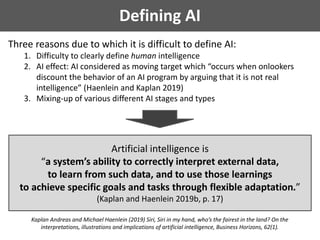
Defining AI
Kaplan Andreas and Michael Haenlein (2019) Siri, Siri in my hand, who’s the fairest in the land? On the
interpretations, illustrations and implications of artificial intelligence, Business Horizons, 62(1).
Three reasons due to which it is difficult to define AI:
1. Difficulty to clearly define human intelligence
2. AI effect: AI considered as moving target which “occurs when onlookers
discount the behavior of an AI program by arguing that it is not real
intelligence” (Haenlein and Kaplan 2019)
3. Mixing-up of various different AI stages and types
Artificial intelligence is
“a system’s ability to correctly interpret external data,
to learn from such data, and to use those learnings
to achieve specific goals and tasks through flexible adaptation.”
(Kaplan and Haenlein 2019b, p. 17)
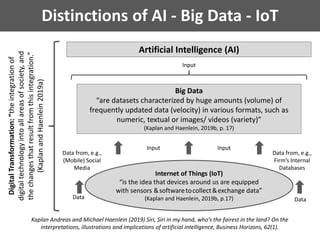
Distinctions of AI - Big Data - IoT
Kaplan Andreas and Michael Haenlein (2019) Siri, Siri in my hand, who’s the fairest in the land? On the
interpretations, illustrations and implications of artificial intelligence, Business Horizons, 62(1).
Artificial Intelligence (AI)
Big Data
“are datasets characterized by huge amounts (volume) of
frequently updated data (velocity) in various formats, such as
numeric, textual or images/ videos (variety)”
(Kaplan and Haenlein, 2019b, p. 17)
Input
Internet of Things (IoT)
“is the idea that devices around us are equipped
with sensors &softwaretocollect&exchange data”
(Kaplan and Haenlein, 2019b, p.17)
Data from, e.g.,
(Mobile) Social
Media
Data from, e.g.,
Firm’s Internal
Databases
InputInput
Data Data
DigitalTransformation:“theintegrationof
digitaltechnologyintoallareasofsociety,and
thechangesthatresultfromthisintegration.”
(KaplanandHaenlein2019a)
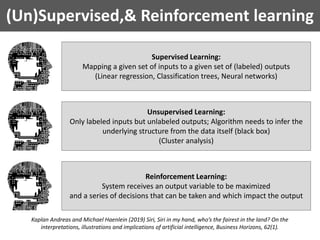
(Un)Supervised,& Reinforcement learning
Kaplan Andreas and Michael Haenlein (2019) Siri, Siri in my hand, who’s the fairest in the land? On the
interpretations, illustrations and implications of artificial intelligence, Business Horizons, 62(1).
Supervised Learning:
Mapping a given set of inputs to a given set of (labeled) outputs
(Linear regression, Classification trees, Neural networks)
Unsupervised Learning:
Only labeled inputs but unlabeled outputs; Algorithm needs to infer the
underlying structure from the data itself (black box)
(Cluster analysis)
Reinforcement Learning:
System receives an output variable to be maximized
and a series of decisions that can be taken and which impact the output
Classification
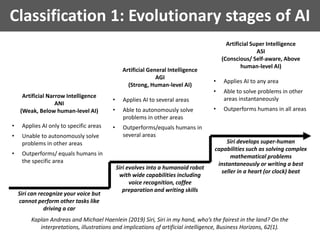
Classification 1: Evolutionary stages of AI
Kaplan Andreas and Michael Haenlein (2019) Siri, Siri in my hand, who’s the fairest in the land? On the
interpretations, illustrations and implications of artificial intelligence, Business Horizons, 62(1).
Artificial Narrow Intelligence
ANI
(Weak, Below human-level AI)
• Applies AI only to specific areas
• Unable to autonomously solve
problems in other areas
• Outperforms/ equals humans in
the specific area
Artificial General Intelligence
AGI
(Strong, Human-level AI)
• Applies AI to several areas
• Able to autonomously solve
problems in other areas
• Outperforms/equals humans in
several areas
Artificial Super Intelligence
ASI
(Conscious/ Self-aware, Above
human-level AI)
• Applies AI to any area
• Able to solve problems in other
areas instantaneously
• Outperforms humans in all areas
Siri can recognize your voice but
cannot perform other tasks like
driving a car
Siri evolves into a humanoid robot
with wide capabilities including
voice recognition, coffee
preparation and writing skills
Siri develops super-human
capabilities such as solving complex
mathematical problems
instantaneously or writing a best
seller in a heart (or clock) beat
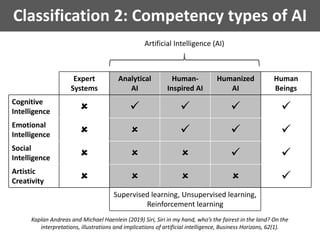
Classification 2: Competency types of AI
Kaplan Andreas and Michael Haenlein (2019) Siri, Siri in my hand, who’s the fairest in the land? On the
interpretations, illustrations and implications of artificial intelligence, Business Horizons, 62(1).
Expert
Systems
Analytical
AI
Human-
Inspired AI
Humanized
AI
Human
Beings
Cognitive
Intelligence     
Emotional
Intelligence     
Social
Intelligence     
Artistic
Creativity     
Supervised learning, Unsupervised learning,
Reinforcement learning
Artificial Intelligence (AI)
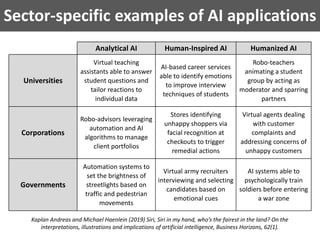
Sector-specific examples of AI applications
Kaplan Andreas and Michael Haenlein (2019) Siri, Siri in my hand, who’s the fairest in the land? On the
interpretations, illustrations and implications of artificial intelligence, Business Horizons, 62(1).
Analytical AI Human-Inspired AI Humanized AI
Universities
Virtual teaching
assistants able to answer
student questions and
tailor reactions to
individual data
AI-based career services
able to identify emotions
to improve interview
techniques of students
Robo-teachers
animating a student
group by acting as
moderator and sparring
partners
Corporations
Robo-advisors leveraging
automation and AI
algorithms to manage
client portfolios
Stores identifying
unhappy shoppers via
facial recognition at
checkouts to trigger
remedial actions
Virtual agents dealing
with customer
complaints and
addressing concerns of
unhappy customers
Governments
Automation systems to
set the brightness of
streetlights based on
traffic and pedestrian
movements
Virtual army recruiters
interviewing and selecting
candidates based on
emotional cues
AI systems able to
psychologically train
soldiers before entering
a war zone
Development
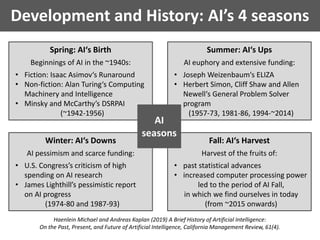
Development and History: AI’s 4 seasons
Haenlein Michael and Andreas Kaplan (2019) A Brief History of Artificial Intelligence:
On the Past, Present, and Future of Artificial Intelligence, California Management Review, 61(4).
Spring: AI‘s Birth
Beginnings of AI in the ~1940s:
• Fiction: Isaac Asimov‘s Runaround
• Non-fiction: Alan Turing‘s Computing
Machinery and Intelligence
• Minsky and McCarthy’s DSRPAI
(~1942-1956)
Winter: AI‘s Downs
AI pessimism and scarce funding:
• U.S. Congress’s criticism of high
spending on AI research
• James Lighthill’s pessimistic report
on AI progress
(1974-80 and 1987-93)
Summer: AI‘s Ups
AI euphory and extensive funding:
• Joseph Weizenbaum‘s ELIZA
• Herbert Simon, Cliff Shaw and Allen
Newell‘s General Problem Solver
program
(1957-73, 1981-86, 1994-~2014)
Fall: AI‘s Harvest
Harvest of the fruits of:
• past statistical advances
• increased computer processing power
led to the period of AI Fall,
in which we find ourselves in today
(from ~2015 onwards)
AI
seasons
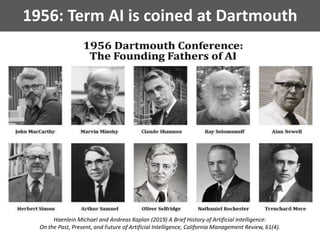
1956: Term AI is coined at Dartmouth
Haenlein Michael and Andreas Kaplan (2019) A Brief History of Artificial Intelligence:
On the Past, Present, and Future of Artificial Intelligence, California Management Review, 61(4).
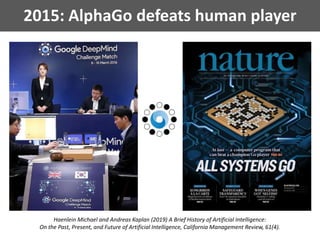
2015: AlphaGo defeats human player
Haenlein Michael and Andreas Kaplan (2019) A Brief History of Artificial Intelligence:
On the Past, Present, and Future of Artificial Intelligence, California Management Review, 61(4).
Concepts
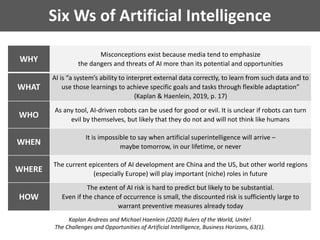
Six Ws of Artificial Intelligence
WHY
Misconceptions exist because media tend to emphasize
the dangers and threats of AI more than its potential and opportunities
WHAT
AI is “a system’s ability to interpret external data correctly, to learn from such data and to
use those learnings to achieve specific goals and tasks through flexible adaptation”
(Kaplan & Haenlein, 2019, p. 17)
WHO
As any tool, AI-driven robots can be used for good or evil. It is unclear if robots can turn
evil by themselves, but likely that they do not and will not think like humans
WHEN
It is impossible to say when artificial superintelligence will arrive –
maybe tomorrow, in our lifetime, or never
WHERE
The current epicenters of AI development are China and the US, but other world regions
(especially Europe) will play important (niche) roles in future
HOW
The extent of AI risk is hard to predict but likely to be substantial.
Even if the chance of occurrence is small, the discounted risk is sufficiently large to
warrant preventive measures already today
Kaplan Andreas and Michael Haenlein (2020) Rulers of the World, Unite!
The Challenges and Opportunities of Artificial Intelligence, Business Horizons, 63(1).
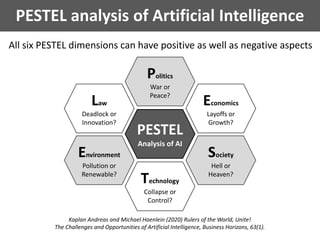
PESTEL analysis of Artificial Intelligence
Kaplan Andreas and Michael Haenlein (2020) Rulers of the World, Unite!
The Challenges and Opportunities of Artificial Intelligence, Business Horizons, 63(1).
Environment
Pollution or
Renewable?
Law
Deadlock or
Innovation?
Economics
Layoffs or
Growth?
Society
Hell or
Heaven?
PESTEL
Analysis of AI
Politics
War or
Peace?
Technology
Collapse or
Control?
All six PESTEL dimensions can have positive as well as negative aspects
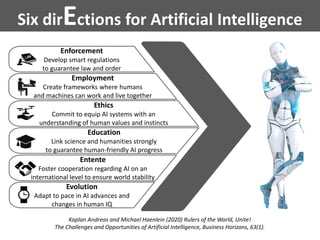
Six dirEctions for Artificial Intelligence
Kaplan Andreas and Michael Haenlein (2020) Rulers of the World, Unite!
The Challenges and Opportunities of Artificial Intelligence, Business Horizons, 63(1).
Education
Link science and humanities strongly
to guarantee human-friendly AI progress
Entente
Foster cooperation regarding AI on an
international level to ensure world stability
Evolution
Adapt to pace in AI advances and
changes in human IQ
Ethics
Commit to equip AI systems with an
understanding of human values and instincts
Employment
Create frameworks where humans
and machines can work and live together
Enforcement
Develop smart regulations
to guarantee law and order
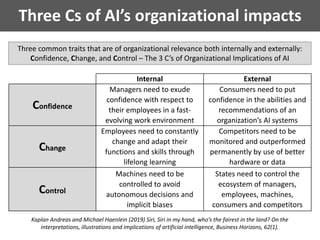
Three Cs of AI’s organizational impacts
Kaplan Andreas and Michael Haenlein (2019) Siri, Siri in my hand, who’s the fairest in the land? On the
interpretations, illustrations and implications of artificial intelligence, Business Horizons, 62(1).
Internal External
Confidence
Managers need to exude
confidence with respect to
their employees in a fast-
evolving work environment
Consumers need to put
confidence in the abilities and
recommendations of an
organization’s AI systems
Change
Employees need to constantly
change and adapt their
functions and skills through
lifelong learning
Competitors need to be
monitored and outperformed
permanently by use of better
hardware or data
Control
Machines need to be
controlled to avoid
autonomous decisions and
implicit biases
States need to control the
ecosystem of managers,
employees, machines,
consumers and competitors
Three common traits that are of organizational relevance both internally and externally:
Confidence, Change, and Control – The 3 C’s of Organizational Implications of AI
Bibliography
Bibliography
• Haenlein Michael and Andreas Kaplan (2019) A Brief History of Artificial
Intelligence: On the Past, Present, and Future of Artificial Intelligence, California
Management Review, 61(4).
• Kaplan Andreas and Michael Haenlein (2019a) Digital transformation and
disruption. On Big Data, Blockchain, Artificial Intelligence, and Other Things,
Business Horizons, 62(6).
• Kaplan Andreas and Michael Haenlein (2019b) Siri, Siri in my hand, who’s the
fairest in the land? On the interpretations, illustrations and implications of
artificial intelligence, Business Horizons, 62(1).
• Kaplan Andreas and Michael Haenlein (2020) Rulers of the World, Unite! The
Challenges and Opportunities of Artificial Intelligence, Business Horizons, 63(1).
www.linkedin.com/in/andreaskaplan

Artificial intelligence (AI) - Definition, Classification, Development, & Concepts

  • 1.
    Artificial Intelligence Definition, Classification,Development, & Concepts Andreas Kaplan www.linkedin.com/in/andreaskaplan
  • 2.
  • 3.
    Defining AI Kaplan Andreasand Michael Haenlein (2019) Siri, Siri in my hand, who’s the fairest in the land? On the interpretations, illustrations and implications of artificial intelligence, Business Horizons, 62(1). Three reasons due to which it is difficult to define AI: 1. Difficulty to clearly define human intelligence 2. AI effect: AI considered as moving target which “occurs when onlookers discount the behavior of an AI program by arguing that it is not real intelligence” (Haenlein and Kaplan 2019) 3. Mixing-up of various different AI stages and types Artificial intelligence is “a system’s ability to correctly interpret external data, to learn from such data, and to use those learnings to achieve specific goals and tasks through flexible adaptation.” (Kaplan and Haenlein 2019b, p. 17)
  • 4.
    Distinctions of AI- Big Data - IoT Kaplan Andreas and Michael Haenlein (2019) Siri, Siri in my hand, who’s the fairest in the land? On the interpretations, illustrations and implications of artificial intelligence, Business Horizons, 62(1). Artificial Intelligence (AI) Big Data “are datasets characterized by huge amounts (volume) of frequently updated data (velocity) in various formats, such as numeric, textual or images/ videos (variety)” (Kaplan and Haenlein, 2019b, p. 17) Input Internet of Things (IoT) “is the idea that devices around us are equipped with sensors &softwaretocollect&exchange data” (Kaplan and Haenlein, 2019b, p.17) Data from, e.g., (Mobile) Social Media Data from, e.g., Firm’s Internal Databases InputInput Data Data DigitalTransformation:“theintegrationof digitaltechnologyintoallareasofsociety,and thechangesthatresultfromthisintegration.” (KaplanandHaenlein2019a)
  • 5.
    (Un)Supervised,& Reinforcement learning KaplanAndreas and Michael Haenlein (2019) Siri, Siri in my hand, who’s the fairest in the land? On the interpretations, illustrations and implications of artificial intelligence, Business Horizons, 62(1). Supervised Learning: Mapping a given set of inputs to a given set of (labeled) outputs (Linear regression, Classification trees, Neural networks) Unsupervised Learning: Only labeled inputs but unlabeled outputs; Algorithm needs to infer the underlying structure from the data itself (black box) (Cluster analysis) Reinforcement Learning: System receives an output variable to be maximized and a series of decisions that can be taken and which impact the output
  • 6.
  • 7.
    Classification 1: Evolutionarystages of AI Kaplan Andreas and Michael Haenlein (2019) Siri, Siri in my hand, who’s the fairest in the land? On the interpretations, illustrations and implications of artificial intelligence, Business Horizons, 62(1). Artificial Narrow Intelligence ANI (Weak, Below human-level AI) • Applies AI only to specific areas • Unable to autonomously solve problems in other areas • Outperforms/ equals humans in the specific area Artificial General Intelligence AGI (Strong, Human-level AI) • Applies AI to several areas • Able to autonomously solve problems in other areas • Outperforms/equals humans in several areas Artificial Super Intelligence ASI (Conscious/ Self-aware, Above human-level AI) • Applies AI to any area • Able to solve problems in other areas instantaneously • Outperforms humans in all areas Siri can recognize your voice but cannot perform other tasks like driving a car Siri evolves into a humanoid robot with wide capabilities including voice recognition, coffee preparation and writing skills Siri develops super-human capabilities such as solving complex mathematical problems instantaneously or writing a best seller in a heart (or clock) beat
  • 8.
    Classification 2: Competencytypes of AI Kaplan Andreas and Michael Haenlein (2019) Siri, Siri in my hand, who’s the fairest in the land? On the interpretations, illustrations and implications of artificial intelligence, Business Horizons, 62(1). Expert Systems Analytical AI Human- Inspired AI Humanized AI Human Beings Cognitive Intelligence      Emotional Intelligence      Social Intelligence      Artistic Creativity      Supervised learning, Unsupervised learning, Reinforcement learning Artificial Intelligence (AI)
  • 9.
    Sector-specific examples ofAI applications Kaplan Andreas and Michael Haenlein (2019) Siri, Siri in my hand, who’s the fairest in the land? On the interpretations, illustrations and implications of artificial intelligence, Business Horizons, 62(1). Analytical AI Human-Inspired AI Humanized AI Universities Virtual teaching assistants able to answer student questions and tailor reactions to individual data AI-based career services able to identify emotions to improve interview techniques of students Robo-teachers animating a student group by acting as moderator and sparring partners Corporations Robo-advisors leveraging automation and AI algorithms to manage client portfolios Stores identifying unhappy shoppers via facial recognition at checkouts to trigger remedial actions Virtual agents dealing with customer complaints and addressing concerns of unhappy customers Governments Automation systems to set the brightness of streetlights based on traffic and pedestrian movements Virtual army recruiters interviewing and selecting candidates based on emotional cues AI systems able to psychologically train soldiers before entering a war zone
  • 10.
  • 11.
    Development and History:AI’s 4 seasons Haenlein Michael and Andreas Kaplan (2019) A Brief History of Artificial Intelligence: On the Past, Present, and Future of Artificial Intelligence, California Management Review, 61(4). Spring: AI‘s Birth Beginnings of AI in the ~1940s: • Fiction: Isaac Asimov‘s Runaround • Non-fiction: Alan Turing‘s Computing Machinery and Intelligence • Minsky and McCarthy’s DSRPAI (~1942-1956) Winter: AI‘s Downs AI pessimism and scarce funding: • U.S. Congress’s criticism of high spending on AI research • James Lighthill’s pessimistic report on AI progress (1974-80 and 1987-93) Summer: AI‘s Ups AI euphory and extensive funding: • Joseph Weizenbaum‘s ELIZA • Herbert Simon, Cliff Shaw and Allen Newell‘s General Problem Solver program (1957-73, 1981-86, 1994-~2014) Fall: AI‘s Harvest Harvest of the fruits of: • past statistical advances • increased computer processing power led to the period of AI Fall, in which we find ourselves in today (from ~2015 onwards) AI seasons
  • 12.
    1956: Term AIis coined at Dartmouth Haenlein Michael and Andreas Kaplan (2019) A Brief History of Artificial Intelligence: On the Past, Present, and Future of Artificial Intelligence, California Management Review, 61(4).
  • 13.
    2015: AlphaGo defeatshuman player Haenlein Michael and Andreas Kaplan (2019) A Brief History of Artificial Intelligence: On the Past, Present, and Future of Artificial Intelligence, California Management Review, 61(4).
  • 14.
  • 15.
    Six Ws ofArtificial Intelligence WHY Misconceptions exist because media tend to emphasize the dangers and threats of AI more than its potential and opportunities WHAT AI is “a system’s ability to interpret external data correctly, to learn from such data and to use those learnings to achieve specific goals and tasks through flexible adaptation” (Kaplan & Haenlein, 2019, p. 17) WHO As any tool, AI-driven robots can be used for good or evil. It is unclear if robots can turn evil by themselves, but likely that they do not and will not think like humans WHEN It is impossible to say when artificial superintelligence will arrive – maybe tomorrow, in our lifetime, or never WHERE The current epicenters of AI development are China and the US, but other world regions (especially Europe) will play important (niche) roles in future HOW The extent of AI risk is hard to predict but likely to be substantial. Even if the chance of occurrence is small, the discounted risk is sufficiently large to warrant preventive measures already today Kaplan Andreas and Michael Haenlein (2020) Rulers of the World, Unite! The Challenges and Opportunities of Artificial Intelligence, Business Horizons, 63(1).
  • 16.
    PESTEL analysis ofArtificial Intelligence Kaplan Andreas and Michael Haenlein (2020) Rulers of the World, Unite! The Challenges and Opportunities of Artificial Intelligence, Business Horizons, 63(1). Environment Pollution or Renewable? Law Deadlock or Innovation? Economics Layoffs or Growth? Society Hell or Heaven? PESTEL Analysis of AI Politics War or Peace? Technology Collapse or Control? All six PESTEL dimensions can have positive as well as negative aspects
  • 17.
    Six dirEctions forArtificial Intelligence Kaplan Andreas and Michael Haenlein (2020) Rulers of the World, Unite! The Challenges and Opportunities of Artificial Intelligence, Business Horizons, 63(1). Education Link science and humanities strongly to guarantee human-friendly AI progress Entente Foster cooperation regarding AI on an international level to ensure world stability Evolution Adapt to pace in AI advances and changes in human IQ Ethics Commit to equip AI systems with an understanding of human values and instincts Employment Create frameworks where humans and machines can work and live together Enforcement Develop smart regulations to guarantee law and order
  • 18.
    Three Cs ofAI’s organizational impacts Kaplan Andreas and Michael Haenlein (2019) Siri, Siri in my hand, who’s the fairest in the land? On the interpretations, illustrations and implications of artificial intelligence, Business Horizons, 62(1). Internal External Confidence Managers need to exude confidence with respect to their employees in a fast- evolving work environment Consumers need to put confidence in the abilities and recommendations of an organization’s AI systems Change Employees need to constantly change and adapt their functions and skills through lifelong learning Competitors need to be monitored and outperformed permanently by use of better hardware or data Control Machines need to be controlled to avoid autonomous decisions and implicit biases States need to control the ecosystem of managers, employees, machines, consumers and competitors Three common traits that are of organizational relevance both internally and externally: Confidence, Change, and Control – The 3 C’s of Organizational Implications of AI
  • 19.
  • 20.
    Bibliography • Haenlein Michaeland Andreas Kaplan (2019) A Brief History of Artificial Intelligence: On the Past, Present, and Future of Artificial Intelligence, California Management Review, 61(4). • Kaplan Andreas and Michael Haenlein (2019a) Digital transformation and disruption. On Big Data, Blockchain, Artificial Intelligence, and Other Things, Business Horizons, 62(6). • Kaplan Andreas and Michael Haenlein (2019b) Siri, Siri in my hand, who’s the fairest in the land? On the interpretations, illustrations and implications of artificial intelligence, Business Horizons, 62(1). • Kaplan Andreas and Michael Haenlein (2020) Rulers of the World, Unite! The Challenges and Opportunities of Artificial Intelligence, Business Horizons, 63(1). www.linkedin.com/in/andreaskaplan