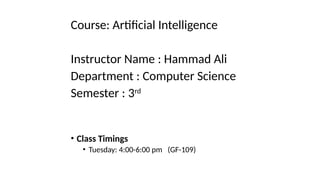
Course: Artificial Intelligence
Instructor Name : Hammad Ali
Department : Computer Science
Semester : 3rd
• Class Timings
• Tuesday: 4:00-6:00 pm (GF-109)
3
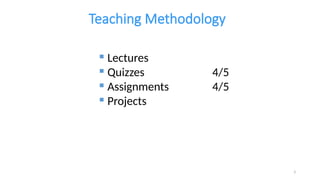
Teaching Methodology
 Lectures
 Quizzes 4/5
 Assignments 4/5
 Projects
Tentative Evaluation Breakdown
Content
• History
• Introduction to Artificial Intelligence
• Advantages & Disadvantages of Artificial
Intelligence
• Domains of AI
• Applications of AI
Era Key Events & Milestones
1950s — Birth of the AI Dream
• 1950: Alan Turing proposes the "Turing Test" to measure machine intelligence.
• 1956: The Dartmouth Conference coins the term "Artificial Intelligence," establishing it as a formal
field.
1960s–70s: Early Steps & Reality Checks
• 1966: ELIZA, the first chatbot, is created to simulate conversation.
• 1969: Shakey the Robot is developed, the first to combine mobility, perception, and problem-solving.
1980s–1990s: Revival & Public Wins
• 1980s: The rise of Expert Systems, which capture human knowledge in specific domains, leads to a
commercial revival.
2000s–2020s: AI Enters Daily Life
• 2011: Apple launches Siri, putting an AI-powered virtual assistant into millions of pockets.
• 2012: Major breakthroughs in deep learning algorithms ignite an exponential boom in AI capabilities,
especially in image recognition.
2020s: Generative & Agentic AI
• 2022: OpenAI releases ChatGPT, making advanced generative AI widely accessible to the public.
• 2023: Generative AI tools for text, images, and code become integrated into many aspects of daily life
and work.
• 2025 (Projection): The rise of Agentic AI (e.g., AutoGPT) marks a shift towards more autonomous AI
systems that can independently execute complex, multi-step tasks.
HISTORY
The Ultimate Evolution of Artificial Intelligence Tools
AI Tool Categories (2020 - May 2025)
1. Generative AI (Text, Image, Video, Code)
2. AI Audio & Voice Tools
3. AI Productivity & Business
4. AI for E-commerce & Sales
5. AI in Search & Research
6. AI Coding & Development
7. AI for Design & Creativity
8. AI Social & Personal Assistants
9. AI for Healthcare
10. Emerging & Agentic AI
Artificial Intelligence
• Intelligence can be considered as:
• Problem Understanding
• Problem solving skills
• Ability to learn
• Decision making abilities etc.
• Intelligence is an intangible part of our brain
which is a combination of learning, problem-
solving, decision making, perception,
sensing, etc.
“It is a branch of computer science by which we
can create intelligent machines which can behave
like a human, think like humans, and able to make
decisions."
Artificial Intelligence
Artificial Intelligence is composed of two words:
Artificial and Intelligence
where Artificial defines "man-made," and Intelligence defines
"thinking power“.
Hence AI means "a man-made thinking power.“
• Learning − Learning means gaining knowledge or skill through studying, practice, teaching, or
experience.
In AI: A machine "learns" when it improves its performance on a task after being trained with
data.
• Problem Solving − Problem solving is the process of finding a way to reach a goal from the
current situation, even if there are obstacles.
In AI: Machines use problem-solving techniques to make decisions or achieve goals.
• Decision making − Choosing the best option among many available alternatives..
In AI: Decision-making algorithms help machines select the best path or action.
• Perception − Perception is the process of collecting information through senses (like eyes, ears,
etc.), interpreting it, and organizing it to understand the world.
In AI: Sensors (like cameras, microphones) collect data. The AI then interprets this data to
understand the environment.
• Linguistic Intelligence − It’s the ability to understand, speak, read, and write language. It’s
crucial for communication.
In AI: Natural Language Processing (NLP) enables machines to understand and generate human
language.
Artificial Intelligence
Why Artificial
Intelligence?
Following are some main reasons to learn about AI:
• With the help of AI, you can create such software or
devices which can solve real-world problems very easily
and with accuracy such as health issues, marketing, traffic
issues, etc.
• With the help of AI, you can create your personal
virtual Assistant, such as Google Assistant, Siri, etc.
• With the help of AI, you can build such Robots which can
work in an environment where survival of humans can be at
risk.
• AI opens a path for other new technologies, new devices,
and new Opportunities.
Advantages of Artificial Intelligence
• High Accuracy with less errors: AI machines or systems are prone to less errors and high accuracy
as it takes decisions as per pre-experience or information.
• High-Speed: AI systems can be of very high-speed and fast-decision making
• High reliability: AI machines are highly reliable and can perform the same action multiple
times with high accuracy.
• Digital Assistant: AI can be very useful to provide digital assistant to the users such as AI
technology is currently used by various E-commerce websites to show the products as per customer
requirement.
• Useful as a public utility: AI can be very useful for public utilities such as a self-driving car which
can make our journey safer and hassle-free, facial recognition for security purpose, Natural language
processing to communicate with the human in human-language, etc.
Disadvantages of Artificial
Intelligence
• High Cost: The hardware and software requirement of AI is very costly as it requires lots
of maintenance to meet current world requirements.
• No feelings and emotions: AI machines can be an outstanding performer, but still it does not
have the feeling so it cannot make any kind of emotional attachment with human, and may
sometime be harmful for users if the proper care is not taken.
• Increase dependency on machines: With the increment of technology, people are getting
more dependent on devices and hence they are losing their mental capabilities.
• No Original Creativity: As humans are so creative and can imagine some new ideas but still
AI machines cannot beat this power of human intelligence and cannot be creative and
imaginative
Domains of Artificial Intelligence
• Perception (Computer vision, NLP, Touch
sensation)
• Robotics
• Planning
• Expert System
• Theorem Proving
• Gaming
• Drones
• Machine Learning
• Neural Networks
• Deep Learning
• Data Sciences
Domains of Artificial Intelligence
Perception: Giving machines senses to understand the world.
 Computer Vision: Interpreting images and videos.
 NLP: Understanding human language.
 Touch Sensation: Feeling and handling objects.
Robotics: Designing and building robots that can perform tasks in the physical world.
Planning: The ability of an AI to set goals and determine a sequence of actions to achieve them, like a
GPS finding the best route.
Expert System: AI that mimics the decision-making of a human expert in a specific field using a set of
rules (e.g., medical diagnosis).
Theorem Proving: Using AI to automatically prove mathematical statements.
Domains of Artificial Intelligence
Gaming: Creating intelligent non-player characters (NPCs) in video games that can react to and challenge
human players.
Drones: Applying AI to unmanned aerial vehicles for autonomous flight, navigation, and object tracking.
Machine Learning (ML): The science of getting computers to learn and act from data without being
explicitly programmed.
 Neural Networks: A key technique in ML, inspired by the human brain, used to recognize
complex patterns.
Deep Learning: A subfield of ML that uses large, multi-layered neural networks to solve highly complex
problems, like advanced image recognition.
Data Science: The field of extracting knowledge and insights from data, which heavily uses AI and ML as
tools.
Applications of AI
Healthcare
AI is transforming healthcare
through predictive analytics,
personalized medicine, and
robotic surgeries, enhancing
patient outcomes and
operational efficiency.
Finance
In finance, AI is used for fraud
detection, algorithmic trading,
and risk management,
improving accuracy and speed
of financial transactions.
Transportation
AI powers autonomous
vehicles and smart traffic
management systems,
promising to reduce accidents
and enhance urban mobility.
Thank
You

INTRODUCTION to Artificial Intelligence.pptx

  • 2.
    Course: Artificial Intelligence InstructorName : Hammad Ali Department : Computer Science Semester : 3rd • Class Timings • Tuesday: 4:00-6:00 pm (GF-109)
  • 3.
    3 Teaching Methodology  Lectures Quizzes 4/5  Assignments 4/5  Projects
  • 4.
  • 6.
    Content • History • Introductionto Artificial Intelligence • Advantages & Disadvantages of Artificial Intelligence • Domains of AI • Applications of AI
  • 7.
    Era Key Events& Milestones 1950s — Birth of the AI Dream • 1950: Alan Turing proposes the "Turing Test" to measure machine intelligence. • 1956: The Dartmouth Conference coins the term "Artificial Intelligence," establishing it as a formal field. 1960s–70s: Early Steps & Reality Checks • 1966: ELIZA, the first chatbot, is created to simulate conversation. • 1969: Shakey the Robot is developed, the first to combine mobility, perception, and problem-solving. 1980s–1990s: Revival & Public Wins • 1980s: The rise of Expert Systems, which capture human knowledge in specific domains, leads to a commercial revival. 2000s–2020s: AI Enters Daily Life • 2011: Apple launches Siri, putting an AI-powered virtual assistant into millions of pockets. • 2012: Major breakthroughs in deep learning algorithms ignite an exponential boom in AI capabilities, especially in image recognition. 2020s: Generative & Agentic AI • 2022: OpenAI releases ChatGPT, making advanced generative AI widely accessible to the public. • 2023: Generative AI tools for text, images, and code become integrated into many aspects of daily life and work. • 2025 (Projection): The rise of Agentic AI (e.g., AutoGPT) marks a shift towards more autonomous AI systems that can independently execute complex, multi-step tasks. HISTORY
  • 8.
    The Ultimate Evolutionof Artificial Intelligence Tools AI Tool Categories (2020 - May 2025) 1. Generative AI (Text, Image, Video, Code) 2. AI Audio & Voice Tools 3. AI Productivity & Business 4. AI for E-commerce & Sales 5. AI in Search & Research 6. AI Coding & Development 7. AI for Design & Creativity 8. AI Social & Personal Assistants 9. AI for Healthcare 10. Emerging & Agentic AI
  • 9.
    Artificial Intelligence • Intelligencecan be considered as: • Problem Understanding • Problem solving skills • Ability to learn • Decision making abilities etc. • Intelligence is an intangible part of our brain which is a combination of learning, problem- solving, decision making, perception, sensing, etc.
  • 10.
    “It is abranch of computer science by which we can create intelligent machines which can behave like a human, think like humans, and able to make decisions." Artificial Intelligence Artificial Intelligence is composed of two words: Artificial and Intelligence where Artificial defines "man-made," and Intelligence defines "thinking power“. Hence AI means "a man-made thinking power.“
  • 11.
    • Learning −Learning means gaining knowledge or skill through studying, practice, teaching, or experience. In AI: A machine "learns" when it improves its performance on a task after being trained with data. • Problem Solving − Problem solving is the process of finding a way to reach a goal from the current situation, even if there are obstacles. In AI: Machines use problem-solving techniques to make decisions or achieve goals. • Decision making − Choosing the best option among many available alternatives.. In AI: Decision-making algorithms help machines select the best path or action. • Perception − Perception is the process of collecting information through senses (like eyes, ears, etc.), interpreting it, and organizing it to understand the world. In AI: Sensors (like cameras, microphones) collect data. The AI then interprets this data to understand the environment. • Linguistic Intelligence − It’s the ability to understand, speak, read, and write language. It’s crucial for communication. In AI: Natural Language Processing (NLP) enables machines to understand and generate human language. Artificial Intelligence
  • 12.
    Why Artificial Intelligence? Following aresome main reasons to learn about AI: • With the help of AI, you can create such software or devices which can solve real-world problems very easily and with accuracy such as health issues, marketing, traffic issues, etc. • With the help of AI, you can create your personal virtual Assistant, such as Google Assistant, Siri, etc. • With the help of AI, you can build such Robots which can work in an environment where survival of humans can be at risk. • AI opens a path for other new technologies, new devices, and new Opportunities.
  • 13.
    Advantages of ArtificialIntelligence • High Accuracy with less errors: AI machines or systems are prone to less errors and high accuracy as it takes decisions as per pre-experience or information. • High-Speed: AI systems can be of very high-speed and fast-decision making • High reliability: AI machines are highly reliable and can perform the same action multiple times with high accuracy. • Digital Assistant: AI can be very useful to provide digital assistant to the users such as AI technology is currently used by various E-commerce websites to show the products as per customer requirement. • Useful as a public utility: AI can be very useful for public utilities such as a self-driving car which can make our journey safer and hassle-free, facial recognition for security purpose, Natural language processing to communicate with the human in human-language, etc.
  • 14.
    Disadvantages of Artificial Intelligence •High Cost: The hardware and software requirement of AI is very costly as it requires lots of maintenance to meet current world requirements. • No feelings and emotions: AI machines can be an outstanding performer, but still it does not have the feeling so it cannot make any kind of emotional attachment with human, and may sometime be harmful for users if the proper care is not taken. • Increase dependency on machines: With the increment of technology, people are getting more dependent on devices and hence they are losing their mental capabilities. • No Original Creativity: As humans are so creative and can imagine some new ideas but still AI machines cannot beat this power of human intelligence and cannot be creative and imaginative
  • 15.
    Domains of ArtificialIntelligence • Perception (Computer vision, NLP, Touch sensation) • Robotics • Planning • Expert System • Theorem Proving • Gaming • Drones • Machine Learning • Neural Networks • Deep Learning • Data Sciences
  • 16.
    Domains of ArtificialIntelligence Perception: Giving machines senses to understand the world.  Computer Vision: Interpreting images and videos.  NLP: Understanding human language.  Touch Sensation: Feeling and handling objects. Robotics: Designing and building robots that can perform tasks in the physical world. Planning: The ability of an AI to set goals and determine a sequence of actions to achieve them, like a GPS finding the best route. Expert System: AI that mimics the decision-making of a human expert in a specific field using a set of rules (e.g., medical diagnosis). Theorem Proving: Using AI to automatically prove mathematical statements.
  • 17.
    Domains of ArtificialIntelligence Gaming: Creating intelligent non-player characters (NPCs) in video games that can react to and challenge human players. Drones: Applying AI to unmanned aerial vehicles for autonomous flight, navigation, and object tracking. Machine Learning (ML): The science of getting computers to learn and act from data without being explicitly programmed.  Neural Networks: A key technique in ML, inspired by the human brain, used to recognize complex patterns. Deep Learning: A subfield of ML that uses large, multi-layered neural networks to solve highly complex problems, like advanced image recognition. Data Science: The field of extracting knowledge and insights from data, which heavily uses AI and ML as tools.
  • 18.
    Applications of AI Healthcare AIis transforming healthcare through predictive analytics, personalized medicine, and robotic surgeries, enhancing patient outcomes and operational efficiency. Finance In finance, AI is used for fraud detection, algorithmic trading, and risk management, improving accuracy and speed of financial transactions. Transportation AI powers autonomous vehicles and smart traffic management systems, promising to reduce accidents and enhance urban mobility.
  • 19.