Introduction to AI
Dr.V.Nirmala
Assistant Professor
Dept of Artificial Intelligence and Data Science
Easwari Engineering College
Introduction to Artificial
Intelligence
Artificial Intelligence (AI) is rapidly transforming our world, redefining
industries, and creating unprecedented opportunities.
AI is not just a buzzword; it's a driving force:
AI is transforming industries, impacting 75% of businesses by 2030 (PwC).
Global AI market projected to reach $1.8 trillion by 2030 (Grand View
Research).
Average productivity increase of 25% in AI-adopted sectors (Accenture).
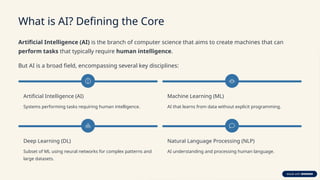
What is AI? Defining the Core
Artificial Intelligence (AI) is the branch of computer science that aims to create machines that can
perform tasks that typically require human intelligence.
But AI is a broad field, encompassing several key disciplines:
Artificial Intelligence (AI)
Systems performing tasks requiring human intelligence.
Machine Learning (ML)
AI that learns from data without explicit programming.
Deep Learning (DL)
Subset of ML using neural networks for complex patterns and
large datasets.
Natural Language Processing (NLP)
AI understanding and processing human language.
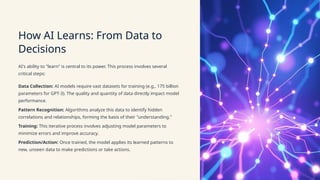
How AI Learns: From Data to
Decisions
AI's ability to "learn" is central to its power. This process involves several
critical steps:
Data Collection: AI models require vast datasets for training (e.g., 175 billion
parameters for GPT-3). The quality and quantity of data directly impact model
performance.
Pattern Recognition: Algorithms analyze this data to identify hidden
correlations and relationships, forming the basis of their "understanding."
Training: This iterative process involves adjusting model parameters to
minimize errors and improve accuracy.
Prediction/Action: Once trained, the model applies its learned patterns to
new, unseen data to make predictions or take actions.
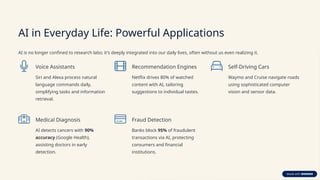
AI in Everyday Life: Powerful Applications
AI is no longer confined to research labs; it's deeply integrated into our daily lives, often without us even realizing it.
Voice Assistants
Siri and Alexa process natural
language commands daily,
simplifying tasks and information
retrieval.
Recommendation Engines
Netflix drives 80% of watched
content with AI, tailoring
suggestions to individual tastes.
Self-Driving Cars
Waymo and Cruise navigate roads
using sophisticated computer
vision and sensor data.
Medical Diagnosis
AI detects cancers with 90%
accuracy (Google Health),
assisting doctors in early
detection.
Fraud Detection
Banks block 95% of fraudulent
transactions via AI, protecting
consumers and financial
institutions.
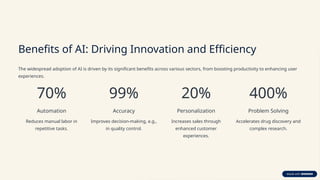
Benefits of AI: Driving Innovation and Efficiency
The widespread adoption of AI is driven by its significant benefits across various sectors, from boosting productivity to enhancing user
experiences.
70%
Automation
Reduces manual labor in
repetitive tasks.
99%
Accuracy
Improves decision-making, e.g.,
in quality control.
20%
Personalization
Increases sales through
enhanced customer
experiences.
400%
Problem Solving
Accelerates drug discovery and
complex research.
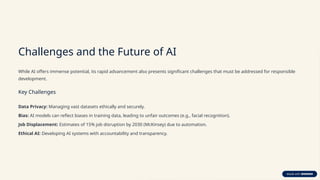
Challenges and the Future of AI
While AI offers immense potential, its rapid advancement also presents significant challenges that must be addressed for responsible
development.
Key Challenges
Data Privacy: Managing vast datasets ethically and securely.
Bias: AI models can reflect biases in training data, leading to unfair outcomes (e.g., facial recognition).
Job Displacement: Estimates of 15% job disruption by 2030 (McKinsey) due to automation.
Ethical AI: Developing AI systems with accountability and transparency.
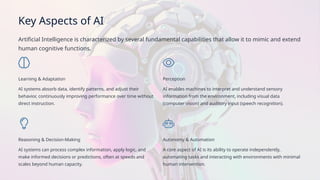
Key Aspects of AI
Artificial Intelligence is characterized by several fundamental capabilities that allow it to mimic and extend
human cognitive functions.
Learning & Adaptation
AI systems absorb data, identify patterns, and adjust their
behavior, continuously improving performance over time without
direct instruction.
Perception
AI enables machines to interpret and understand sensory
information from the environment, including visual data
(computer vision) and auditory input (speech recognition).
Reasoning & Decision-Making
AI systems can process complex information, apply logic, and
make informed decisions or predictions, often at speeds and
scales beyond human capacity.
Autonomy & Automation
A core aspect of AI is its ability to operate independently,
automating tasks and interacting with environments with minimal
human intervention.
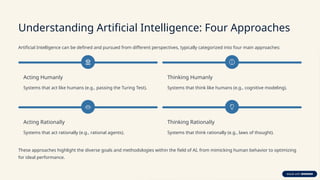
Understanding Artificial Intelligence: Four Approaches
Artificial Intelligence can be defined and pursued from different perspectives, typically categorized into four main approaches:
Acting Humanly
Systems that act like humans (e.g., passing the Turing Test).
Thinking Humanly
Systems that think like humans (e.g., cognitive modeling).
Acting Rationally
Systems that act rationally (e.g., rational agents).
Thinking Rationally
Systems that think rationally (e.g., laws of thought).
These approaches highlight the diverse goals and methodologies within the field of AI, from mimicking human behavior to optimizing
for ideal performance.
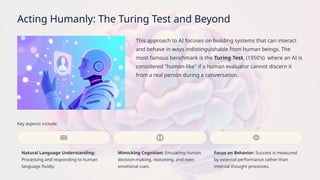
Acting Humanly: The Turing Test and Beyond
This approach to AI focuses on building systems that can interact
and behave in ways indistinguishable from human beings. The
most famous benchmark is the Turing Test, (1950's) where an AI is
considered "human-like" if a human evaluator cannot discern it
from a real person during a conversation.
Key aspects include:
Natural Language Understanding:
Processing and responding to human
language fluidly.
Mimicking Cognition: Emulating human
decision-making, reasoning, and even
emotional cues.
Focus on Behavior: Success is measured
by external performance rather than
internal thought processes.
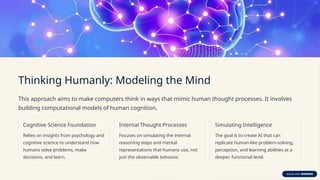
Thinking Humanly: Modeling the Mind
This approach aims to make computers think in ways that mimic human thought processes. It involves
building computational models of human cognition.
Cognitive Science Foundation
Relies on insights from psychology and
cognitive science to understand how
humans solve problems, make
decisions, and learn.
Internal Thought Processes
Focuses on simulating the internal
reasoning steps and mental
representations that humans use, not
just the observable behavior.
Simulating Intelligence
The goal is to create AI that can
replicate human-like problem-solving,
perception, and learning abilities at a
deeper, functional level.
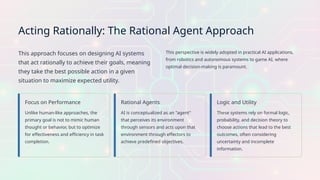
Acting Rationally: The Rational Agent Approach
This approach focuses on designing AI systems
that act rationally to achieve their goals, meaning
they take the best possible action in a given
situation to maximize expected utility.
This perspective is widely adopted in practical AI applications,
from robotics and autonomous systems to game AI, where
optimal decision-making is paramount.
Focus on Performance
Unlike human-like approaches, the
primary goal is not to mimic human
thought or behavior, but to optimize
for effectiveness and efficiency in task
completion.
Rational Agents
AI is conceptualized as an "agent"
that perceives its environment
through sensors and acts upon that
environment through effectors to
achieve predefined objectives.
Logic and Utility
These systems rely on formal logic,
probability, and decision theory to
choose actions that lead to the best
outcomes, often considering
uncertainty and incomplete
information.
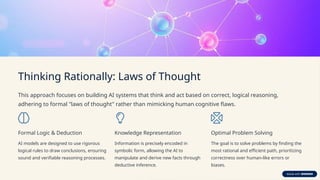
Thinking Rationally: Laws of Thought
This approach focuses on building AI systems that think and act based on correct, logical reasoning,
adhering to formal "laws of thought" rather than mimicking human cognitive flaws.
Formal Logic & Deduction
AI models are designed to use rigorous
logical rules to draw conclusions, ensuring
sound and verifiable reasoning processes.
Knowledge Representation
Information is precisely encoded in
symbolic form, allowing the AI to
manipulate and derive new facts through
deductive inference.
Optimal Problem Solving
The goal is to solve problems by finding the
most rational and efficient path, prioritizing
correctness over human-like errors or
biases.
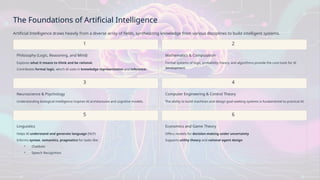
The Foundations of Artificial Intelligence
Artificial Intelligence draws heavily from a diverse array of fields, synthesizing knowledge from various disciplines to build intelligent systems.
1
Philosophy (Logic, Reasoning, and Mind)
Explores what it means to think and be rational.
Contributes formal logic, which AI uses in knowledge representation and inference.
2
Mathematics & Computation
Formal systems of logic, probability theory, and algorithms provide the core tools for AI
development.
3
Neuroscience & Psychology
Understanding biological intelligence inspires AI architectures and cognitive models.
4
Computer Engineering & Control Theory
The ability to build machines and design goal-seeking systems is fundamental to practical AI.
5
Linguistics
Helps AI understand and generate language (NLP)
Informs syntax, semantics, pragmatics for tasks like:
• Chatbots
• Speech Recognition
6
Economics and Game Theory
Offers models for decision-making under uncertainty
Supports utility theory and rational agent design
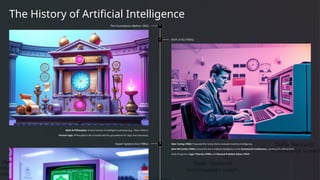
The History of Artificial Intelligence
1
The Foundations (Before 1950)
Myth & Philosophy: Ancient stories of intelligent automata (e.g., Talos, Golem).
Formal Logic: Philosophers like Aristotle laid the groundwork for logic and reasoning.
2 Birth of AI (1950s)
Alan Turing (1950): Proposed the Turing Test to evaluate machine intelligence.
John McCarthy (1956): Coined the term Artificial Intelligence at the Dartmouth Conference, marking AI's official birth.
Early Programs: Logic Theorist (1956) and General Problem Solver (1957)
3
Expert Systems Era (1980s)

Introduction-to-Artificial Intelligence

  • 1.
    Introduction to AI Dr.V.Nirmala AssistantProfessor Dept of Artificial Intelligence and Data Science Easwari Engineering College
  • 2.
    Introduction to Artificial Intelligence ArtificialIntelligence (AI) is rapidly transforming our world, redefining industries, and creating unprecedented opportunities. AI is not just a buzzword; it's a driving force: AI is transforming industries, impacting 75% of businesses by 2030 (PwC). Global AI market projected to reach $1.8 trillion by 2030 (Grand View Research). Average productivity increase of 25% in AI-adopted sectors (Accenture).
  • 3.
    What is AI?Defining the Core Artificial Intelligence (AI) is the branch of computer science that aims to create machines that can perform tasks that typically require human intelligence. But AI is a broad field, encompassing several key disciplines: Artificial Intelligence (AI) Systems performing tasks requiring human intelligence. Machine Learning (ML) AI that learns from data without explicit programming. Deep Learning (DL) Subset of ML using neural networks for complex patterns and large datasets. Natural Language Processing (NLP) AI understanding and processing human language.
  • 4.
    How AI Learns:From Data to Decisions AI's ability to "learn" is central to its power. This process involves several critical steps: Data Collection: AI models require vast datasets for training (e.g., 175 billion parameters for GPT-3). The quality and quantity of data directly impact model performance. Pattern Recognition: Algorithms analyze this data to identify hidden correlations and relationships, forming the basis of their "understanding." Training: This iterative process involves adjusting model parameters to minimize errors and improve accuracy. Prediction/Action: Once trained, the model applies its learned patterns to new, unseen data to make predictions or take actions.
  • 5.
    AI in EverydayLife: Powerful Applications AI is no longer confined to research labs; it's deeply integrated into our daily lives, often without us even realizing it. Voice Assistants Siri and Alexa process natural language commands daily, simplifying tasks and information retrieval. Recommendation Engines Netflix drives 80% of watched content with AI, tailoring suggestions to individual tastes. Self-Driving Cars Waymo and Cruise navigate roads using sophisticated computer vision and sensor data. Medical Diagnosis AI detects cancers with 90% accuracy (Google Health), assisting doctors in early detection. Fraud Detection Banks block 95% of fraudulent transactions via AI, protecting consumers and financial institutions.
  • 6.
    Benefits of AI:Driving Innovation and Efficiency The widespread adoption of AI is driven by its significant benefits across various sectors, from boosting productivity to enhancing user experiences. 70% Automation Reduces manual labor in repetitive tasks. 99% Accuracy Improves decision-making, e.g., in quality control. 20% Personalization Increases sales through enhanced customer experiences. 400% Problem Solving Accelerates drug discovery and complex research.
  • 7.
    Challenges and theFuture of AI While AI offers immense potential, its rapid advancement also presents significant challenges that must be addressed for responsible development. Key Challenges Data Privacy: Managing vast datasets ethically and securely. Bias: AI models can reflect biases in training data, leading to unfair outcomes (e.g., facial recognition). Job Displacement: Estimates of 15% job disruption by 2030 (McKinsey) due to automation. Ethical AI: Developing AI systems with accountability and transparency.
  • 8.
    Key Aspects ofAI Artificial Intelligence is characterized by several fundamental capabilities that allow it to mimic and extend human cognitive functions. Learning & Adaptation AI systems absorb data, identify patterns, and adjust their behavior, continuously improving performance over time without direct instruction. Perception AI enables machines to interpret and understand sensory information from the environment, including visual data (computer vision) and auditory input (speech recognition). Reasoning & Decision-Making AI systems can process complex information, apply logic, and make informed decisions or predictions, often at speeds and scales beyond human capacity. Autonomy & Automation A core aspect of AI is its ability to operate independently, automating tasks and interacting with environments with minimal human intervention.
  • 9.
    Understanding Artificial Intelligence:Four Approaches Artificial Intelligence can be defined and pursued from different perspectives, typically categorized into four main approaches: Acting Humanly Systems that act like humans (e.g., passing the Turing Test). Thinking Humanly Systems that think like humans (e.g., cognitive modeling). Acting Rationally Systems that act rationally (e.g., rational agents). Thinking Rationally Systems that think rationally (e.g., laws of thought). These approaches highlight the diverse goals and methodologies within the field of AI, from mimicking human behavior to optimizing for ideal performance.
  • 10.
    Acting Humanly: TheTuring Test and Beyond This approach to AI focuses on building systems that can interact and behave in ways indistinguishable from human beings. The most famous benchmark is the Turing Test, (1950's) where an AI is considered "human-like" if a human evaluator cannot discern it from a real person during a conversation. Key aspects include: Natural Language Understanding: Processing and responding to human language fluidly. Mimicking Cognition: Emulating human decision-making, reasoning, and even emotional cues. Focus on Behavior: Success is measured by external performance rather than internal thought processes.
  • 11.
    Thinking Humanly: Modelingthe Mind This approach aims to make computers think in ways that mimic human thought processes. It involves building computational models of human cognition. Cognitive Science Foundation Relies on insights from psychology and cognitive science to understand how humans solve problems, make decisions, and learn. Internal Thought Processes Focuses on simulating the internal reasoning steps and mental representations that humans use, not just the observable behavior. Simulating Intelligence The goal is to create AI that can replicate human-like problem-solving, perception, and learning abilities at a deeper, functional level.
  • 12.
    Acting Rationally: TheRational Agent Approach This approach focuses on designing AI systems that act rationally to achieve their goals, meaning they take the best possible action in a given situation to maximize expected utility. This perspective is widely adopted in practical AI applications, from robotics and autonomous systems to game AI, where optimal decision-making is paramount. Focus on Performance Unlike human-like approaches, the primary goal is not to mimic human thought or behavior, but to optimize for effectiveness and efficiency in task completion. Rational Agents AI is conceptualized as an "agent" that perceives its environment through sensors and acts upon that environment through effectors to achieve predefined objectives. Logic and Utility These systems rely on formal logic, probability, and decision theory to choose actions that lead to the best outcomes, often considering uncertainty and incomplete information.
  • 13.
    Thinking Rationally: Lawsof Thought This approach focuses on building AI systems that think and act based on correct, logical reasoning, adhering to formal "laws of thought" rather than mimicking human cognitive flaws. Formal Logic & Deduction AI models are designed to use rigorous logical rules to draw conclusions, ensuring sound and verifiable reasoning processes. Knowledge Representation Information is precisely encoded in symbolic form, allowing the AI to manipulate and derive new facts through deductive inference. Optimal Problem Solving The goal is to solve problems by finding the most rational and efficient path, prioritizing correctness over human-like errors or biases.
  • 14.
    The Foundations ofArtificial Intelligence Artificial Intelligence draws heavily from a diverse array of fields, synthesizing knowledge from various disciplines to build intelligent systems. 1 Philosophy (Logic, Reasoning, and Mind) Explores what it means to think and be rational. Contributes formal logic, which AI uses in knowledge representation and inference. 2 Mathematics & Computation Formal systems of logic, probability theory, and algorithms provide the core tools for AI development. 3 Neuroscience & Psychology Understanding biological intelligence inspires AI architectures and cognitive models. 4 Computer Engineering & Control Theory The ability to build machines and design goal-seeking systems is fundamental to practical AI. 5 Linguistics Helps AI understand and generate language (NLP) Informs syntax, semantics, pragmatics for tasks like: • Chatbots • Speech Recognition 6 Economics and Game Theory Offers models for decision-making under uncertainty Supports utility theory and rational agent design
  • 15.
    The History ofArtificial Intelligence 1 The Foundations (Before 1950) Myth & Philosophy: Ancient stories of intelligent automata (e.g., Talos, Golem). Formal Logic: Philosophers like Aristotle laid the groundwork for logic and reasoning. 2 Birth of AI (1950s) Alan Turing (1950): Proposed the Turing Test to evaluate machine intelligence. John McCarthy (1956): Coined the term Artificial Intelligence at the Dartmouth Conference, marking AI's official birth. Early Programs: Logic Theorist (1956) and General Problem Solver (1957) 3 Expert Systems Era (1980s)