Fundamentals of AI
& Cyber Security
23ESCC106
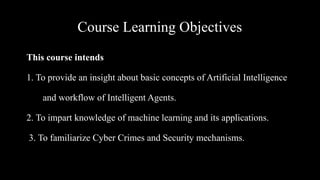
Course Learning Objectives
This course intends
1. To provide an insight about basic concepts of Artificial Intelligence
and workflow of Intelligent Agents.
2. To impart knowledge of machine learning and its applications.
3. To familiarize Cyber Crimes and Security mechanisms.
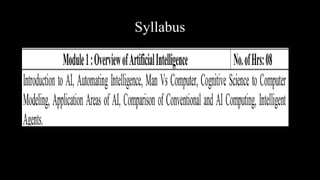
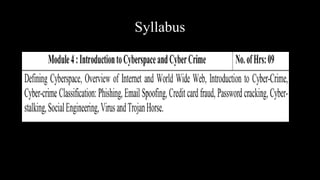
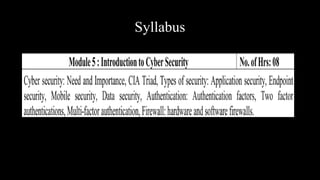
Syllabus
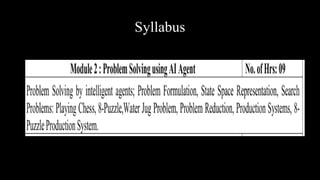
Syllabus
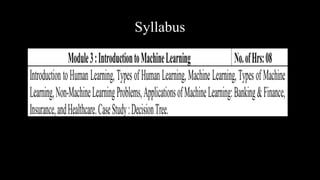
Syllabus
Syllabus
Syllabus
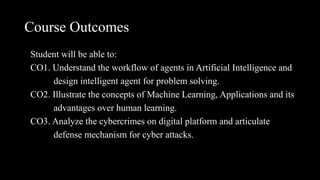
Course Outcomes
Student will be able to:
CO1. Understand the workflow of agents in Artificial Intelligence and
design intelligent agent for problem solving.
CO2. Illustrate the concepts of Machine Learning, Applications and its
advantages over human learning.
CO3. Analyze the cybercrimes on digital platform and articulate
defense mechanism for cyber attacks.
Google Classroom Class code
Module 01
Overview of Artificial Intelligence
Introduction to AI
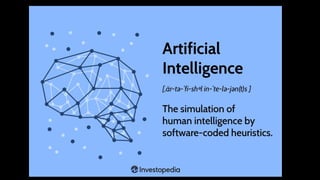
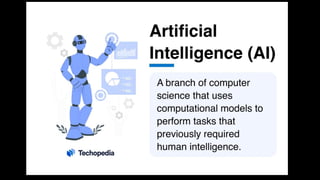
Artificial Intelligence:
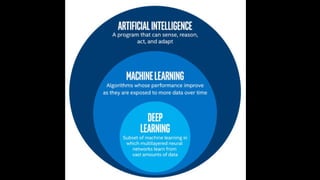
“AI refers to systems that simulate human intelligence to
perform tasks like reasoning, learning, and problem-solving.”
• To do tasks that require human Intelligence
Introduction to AI
Reasons for Automation of Human Intelligence
• Understand human intelligence better
• Smarter Programs
• Useful techniques for solving difficult problems
Introduction to AI
Common man’s Understanding about AI
Artificial: Made as a copy of something natural.
Intelligence: The ability to gain and apply knowledge and skills.
Introduction to AI
Technical Person considers AI as follows:
• Wide field of science and engineering which makes
intelligent machines and especially intelligent computer
programs.
• AI is related to the similar task of using computers to
understand human intelligence.
What is Intelligence?
Intelligence is a property of mind that encompasses many
related mental abilities, such as the capabilities to
• Reason
• Plan
• Solve problems
• Think abstractly
• Comprehend ideas and language
• Learn
Introduction to AI
•Most work in AI involves studying the problems the
world presents to intelligence rather than studying
people or animal.
•AI researchers are free to use methods that are not
observed in people or that involve much more
computing than people can do.
Introduction to AI
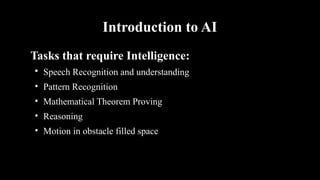
Tasks that require Intelligence:

Speech Recognition and understanding
• Pattern Recognition
• Mathematical Theorem Proving
• Reasoning
• Motion in obstacle filled space
Introduction to AI
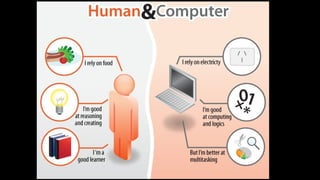
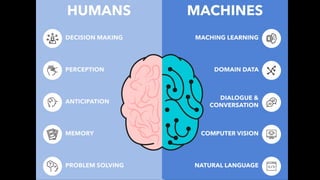
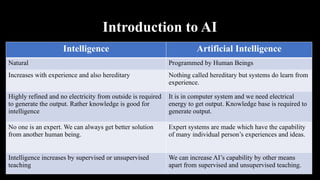
Intelligence Artificial Intelligence
Natural Programmed by Human Beings
Increases with experience and also hereditary Nothing called hereditary but systems do learn from
experience.
Highly refined and no electricity from outside is required
to generate the output. Rather knowledge is good for
intelligence
It is in computer system and we need electrical
energy to get output. Knowledge base is required to
generate output.
No one is an expert. We can always get better solution
from another human being.
Expert systems are made which have the capability
of many individual person’s experiences and ideas.
Intelligence increases by supervised or unsupervised
teaching
We can increase AI’s capability by other means
apart from supervised and unsupervised teaching.
Introduction to AI
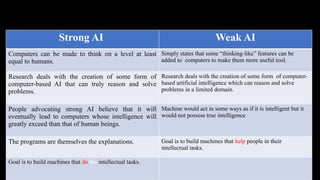
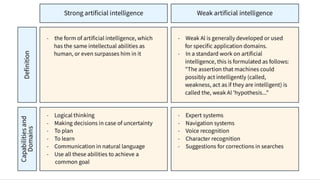
Strong AI Weak AI
Computers can be made to think on a level at least
equal to humans.
Simply states that some “thinking-like” features can be
added to computers to make them more useful tool.
Research deals with the creation of some form of
computer-based AI that can truly reason and solve
problems.
Research deals with the creation of some form of computer-
based artificial intelligence which can reason and solve
problems in a limited domain.
People advocating strong AI believe that it will
eventually lead to computers whose intelligence will
greatly exceed than that of human beings.
Machine would act in some ways as if it is intelligent but it
would not possess true intelligence
The programs are themselves the explanations. Goal is to build machines that help people in their
intellectual tasks.
Goal is to build machines that do the intellectual tasks.
Introduction to AI
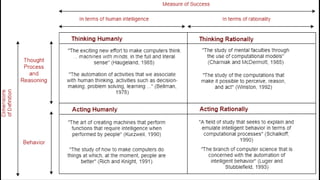
Definitions of AI
“The art of creating machines that perform functions
that require intelligence when performed by people”
(Kurzweil 1990).
“The branch of computer science that is concerned
with automation of intelligent behaviour”.
(Luger and Stublefield, 1993)
Introduction to AI
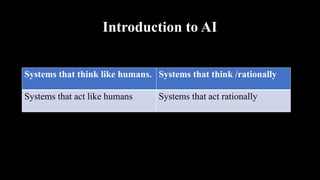
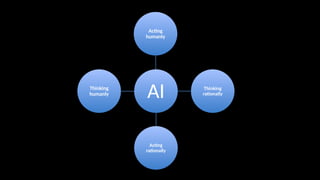
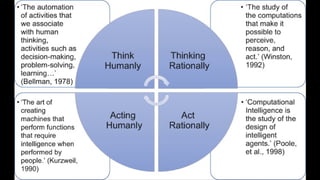
AI has the following Properties:
Systems that think like humans. Systems that think /rationally
Systems that act like humans Systems that act rationally
AI
Acting
humanly
Thinking
rationally
Acting
rationally
Thinking
humanly
Introduction to AI
Introduction to AI
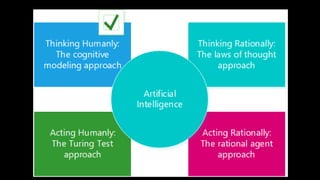
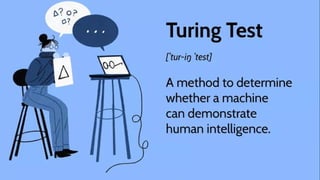
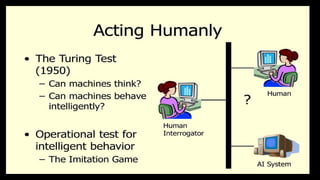
Acting Humanly: The Turing Test
If the response of a computer to an unrestricted textual natural-
language cannot be distinguished from that of a human being then it
can be said to be intelligent.
Introduction to AI
• The Loebner Prize is an annual competition that aims to test artificial
intelligence systems based on the principles of the Turing Test,
developed by Hugh Loebner in 1990.
• The competition rewards AI programs that can best imitate human
behavior in conversation, thus coming closest to passing the Turing
Test.
Introduction to AI
Thinking Humanly: Cognitive Modelling
• Method must not just exhibit behaviour sufficient to fool a human judge but
must do it in a way demonstrably analogous to human cognition.
• Requires detailed matching of computer behaviour and timing to detailed
measurements of human subjects gathered in psychological experiments.
• Cognitive Science: Interdisciplinary field(AI, psychology, linguistics,
philosophy, anthropology) that tries to form computational theories of
human cognition,
Introduction to AI
Thinking Rationally: Laws of thought
• Formalize “correct” reasoning using a mathematical model(example of
deductive reasoning)
• Logicit Program: Encode knowledge in formal logical statements and use
mathematical deduction to perform reasoning:
• Problems:
• Formalizing common sense knowledge is difficult.
• General deductive inference is computationally intractable
Introduction to AI
Acting Rationally: Rational Agents
• An agent is an entity that perceives its environment and is able to execute
actions to change it.
• Agents have inherent goals that they want to achieve (e.g. survive,
reproduce).
• A rational agent acts in a way to maximize the achievements of its goals.
• True maximization of goals requires omniscience and unlimited
computational abilities.
• Limited rationality involved maximizing goal within the computational and
other resources available.
Introduction to AI
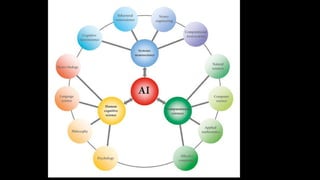
Many disciplines contribute to a foundation for artificial
intelligence
• Philosophy: logic, philosophy of mind, philosophy of science,
philosophy of mathematics
• Mathematics: logic, probability theory, theory of computability
• Psychology: behaviorism, cognitive psychology
• Computer Science and Engineering: hardware, algorithms,
computational complexity theory
• Linguistics: Theory of grammar, syntax, semantics
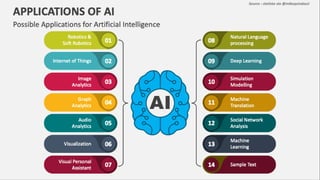
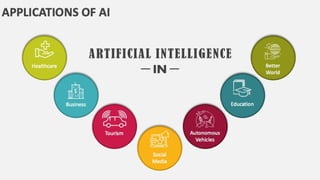
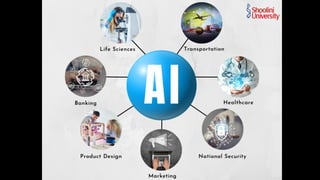
Application Areas of AI
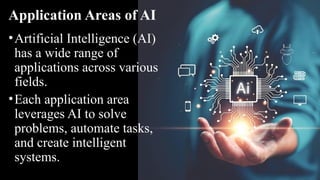
•Artificial Intelligence (AI)
has a wide range of
applications across various
fields.
•Each application area
leverages AI to solve
problems, automate tasks,
and create intelligent
systems.
Application Areas of AI
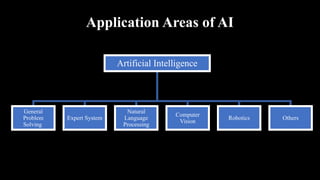
Artificial Intelligence
General
Problem
Solving
Expert System
Natural
Language
Processing
Computer
Vision
Robotics Others
Application Areas of AI
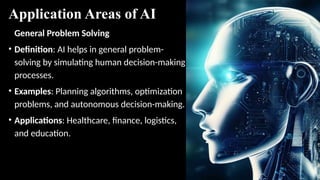
General Problem Solving
• Definition: AI helps in general problem-
solving by simulating human decision-making
processes.
• Examples: Planning algorithms, optimization
problems, and autonomous decision-making.
• Applications: Healthcare, finance, logistics,
and education.
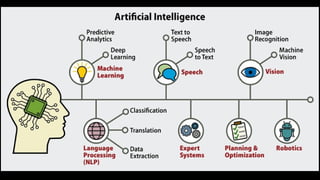
Application Areas of AI
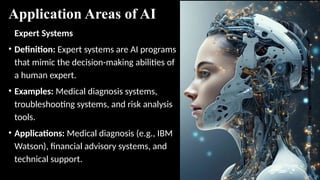
Expert Systems
• Definition: Expert systems are AI programs
that mimic the decision-making abilities of
a human expert.
• Examples: Medical diagnosis systems,
troubleshooting systems, and risk analysis
tools.
• Applications: Medical diagnosis (e.g., IBM
Watson), financial advisory systems, and
technical support.
Application Areas of AI
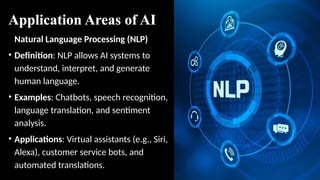
Natural Language Processing (NLP)
• Definition: NLP allows AI systems to
understand, interpret, and generate
human language.
• Examples: Chatbots, speech recognition,
language translation, and sentiment
analysis.
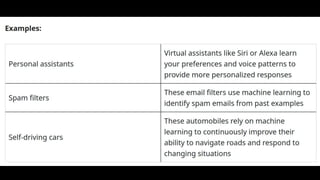
• Applications: Virtual assistants (e.g., Siri,
Alexa), customer service bots, and
automated translations.
Application Areas of AI
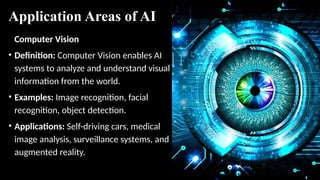
Computer Vision
• Definition: Computer Vision enables AI
systems to analyze and understand visual
information from the world.
• Examples: Image recognition, facial
recognition, object detection.
• Applications: Self-driving cars, medical
image analysis, surveillance systems, and
augmented reality.
Application Areas of AI
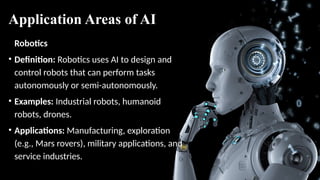
Robotics
• Definition: Robotics uses AI to design and
control robots that can perform tasks
autonomously or semi-autonomously.
• Examples: Industrial robots, humanoid
robots, drones.
• Applications: Manufacturing, exploration
(e.g., Mars rovers), military applications, and
service industries.
Application Areas of AI
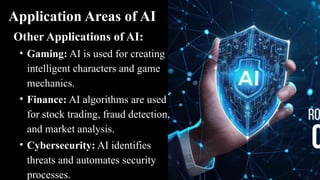
Other Applications of AI:
• Gaming: AI is used for creating
intelligent characters and game
mechanics.
• Finance: AI algorithms are used
for stock trading, fraud detection,
and market analysis.
• Cybersecurity: AI identifies
threats and automates security
processes.
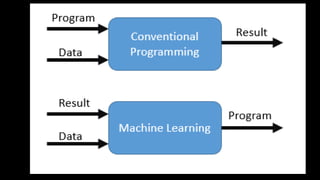
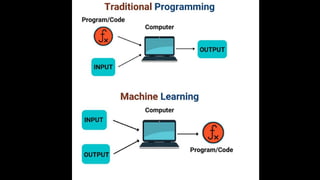
Comparison of Conventional and AI Computing
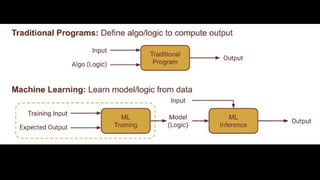
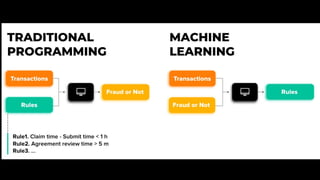
•What is Conventional Computing? Based on pre-
programmed algorithms and rules.
•Follows a linear and logical approach to problem-
solving.
•Uses traditional programming techniques where the
system operates based on clearly defined inputs and
outputs.
Comparison of Conventional and AI Computing
•What is AI Computing? Involves systems that can
learn, adapt, and make decisions based on data.
•Focuses on emulating human intelligence processes,
like learning, reasoning, and problem-solving.
•Relies on machine learning, neural networks, and deep
learning.
Comparison of Conventional and AI Computing
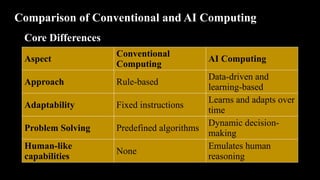
Aspect
Conventional
Computing
AI Computing
Approach Rule-based
Data-driven and
learning-based
Adaptability Fixed instructions
Learns and adapts over
time
Problem Solving Predefined algorithms
Dynamic decision-
making
Human-like
capabilities
None
Emulates human
reasoning
Core Differences
Comparison of Conventional and AI Computing
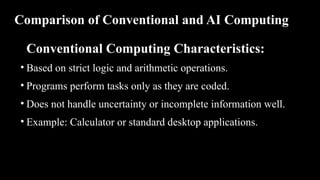
Conventional Computing Characteristics:
• Based on strict logic and arithmetic operations.
• Programs perform tasks only as they are coded.
• Does not handle uncertainty or incomplete information well.
• Example: Calculator or standard desktop applications.
Comparison of Conventional and AI Computing
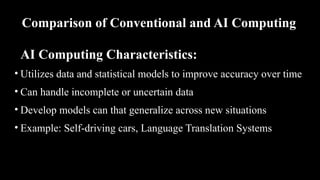
AI Computing Characteristics:
• Utilizes data and statistical models to improve accuracy over time
• Can handle incomplete or uncertain data
• Develop models can that generalize across new situations
• Example: Self-driving cars, Language Translation Systems
Comparison of Conventional and AI Computing
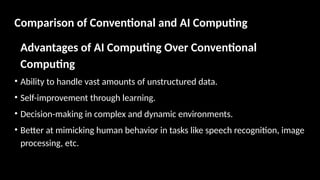
Advantages of AI Computing Over Conventional
Computing
• Ability to handle vast amounts of unstructured data.
• Self-improvement through learning.
• Decision-making in complex and dynamic environments.
• Better at mimicking human behavior in tasks like speech recognition, image
processing, etc.
Comparison of Conventional and AI Computing
Limitations of AI Computing
• Requires large datasets for training.
• Often operates as a black box (lack of transparency in decision-making).
• High computational power requirements.
• Potential biases if the training data is biased.
INTELLIGENT AGENTS
• The word agent is derived from the concept of agency which
means employing someone to act on behalf of the user.
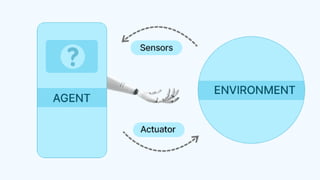
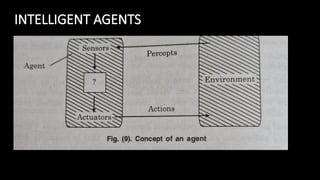
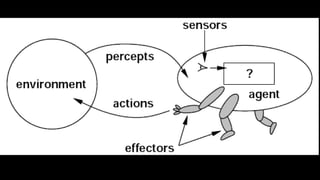
• An agent is something that can be viewed as perceiving its
environment through sensors and acting upon that environment
through actuators
• A human agent has eyes, ears and other organs for sensors and
body parts like hands, legs, mouth, etc for actuators
INTELLIGENT AGENTS
• A computer agent or software agent represents a person and interacts
with others to accomplish a predefined task
• Computer agents have several characteristics which distinguish them from
mere programs. They are:

Capability to work on their own

Perceiving the environment

Persisting over a prolonged time period

Adapting to change

Capable of taking on another’s goal

Transportable over networks

Ability to interact with humans, systems and other agents

Ability to learn
They are:

Capability to work on their own

Perceiving the environment

Persisting over a prolonged time period

Adapting to change

Capable of taking on another’s goal

Transportable over networks

Ability to interact with humans, systems and other
agents

Ability to learn
Working Principle
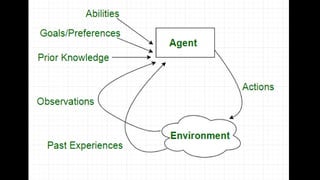
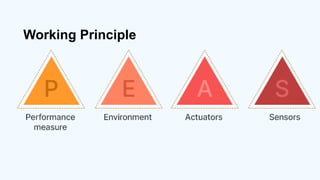
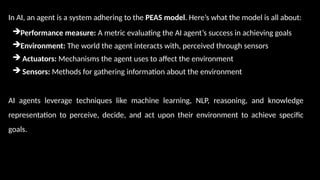
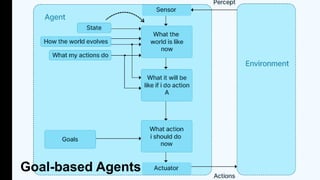
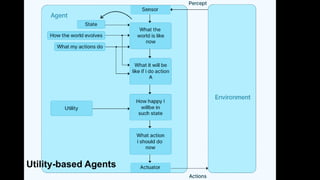
In AI, an agent is a system adhering to the PEAS model. Here’s what the model is all about:
Performance measure: A metric evaluating the AI agent’s success in achieving goals
Environment: The world the agent interacts with, perceived through sensors
 Actuators: Mechanisms the agent uses to affect the environment
 Sensors: Methods for gathering information about the environment
AI agents leverage techniques like machine learning, NLP, reasoning, and knowledge
representation to perceive, decide, and act upon their environment to achieve specific
goals.
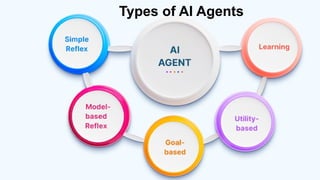
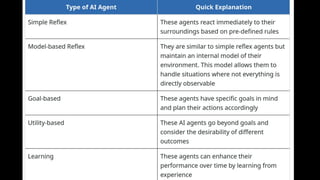
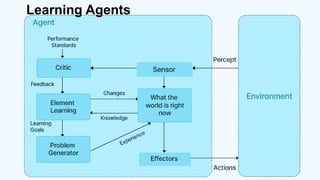
Types of AI Agents
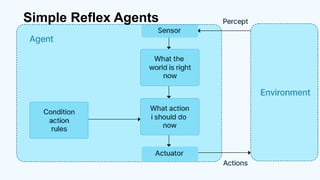
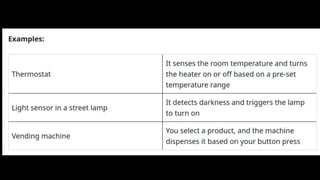
Simple Reflex Agents
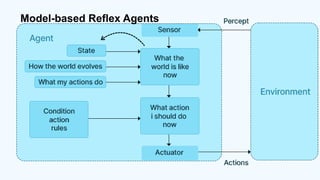
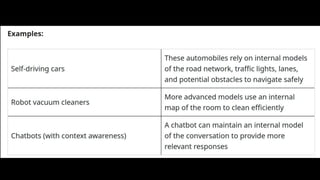
Model-based Reflex Agents
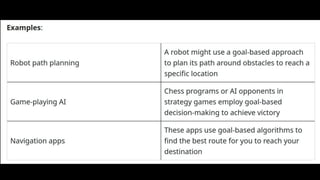
Goal-based Agents
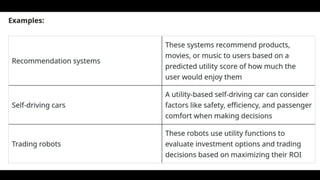
Utility-based Agents
Learning Agents
INTELLIGENT AGENTS
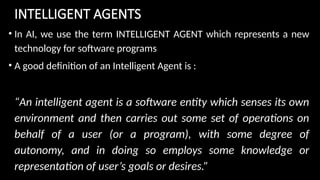
• In AI, we use the term INTELLIGENT AGENT which represents a new
technology for software programs
• A good definition of an Intelligent Agent is :
“An intelligent agent is a software entity which senses its own
environment and then carries out some set of operations on
behalf of a user (or a program), with some degree of
autonomy, and in doing so employs some knowledge or
representation of user’s goals or desires.”
UNIT TEST
Course Name: Fundamentals of AI & Cyber Security
Course Code: 23ESCC106
1.Define Artificial Intelligence and discuss its primary goals. How does
AI differ from traditional programming?
2.Compare human intelligence with artificial intelligence. Discuss two
strengths of human intelligence and two areas where computers excel
over humans.
3. List and describe five different application areas of AI, explaining
how AI contributes uniquely to each field.
4.Describe any three types of intelligent agents, providing examples of
where each type might be used in real-world applications.

M01_Overview of Artificial Intelligence.pptx

  • 1.
    Fundamentals of AI &Cyber Security 23ESCC106
  • 2.
    Course Learning Objectives Thiscourse intends 1. To provide an insight about basic concepts of Artificial Intelligence and workflow of Intelligent Agents. 2. To impart knowledge of machine learning and its applications. 3. To familiarize Cyber Crimes and Security mechanisms.
  • 3.
  • 4.
  • 5.
  • 6.
  • 7.
  • 8.
    Course Outcomes Student willbe able to: CO1. Understand the workflow of agents in Artificial Intelligence and design intelligent agent for problem solving. CO2. Illustrate the concepts of Machine Learning, Applications and its advantages over human learning. CO3. Analyze the cybercrimes on digital platform and articulate defense mechanism for cyber attacks.
  • 9.
  • 10.
    Module 01 Overview ofArtificial Intelligence
  • 13.
    Introduction to AI ArtificialIntelligence: “AI refers to systems that simulate human intelligence to perform tasks like reasoning, learning, and problem-solving.” • To do tasks that require human Intelligence
  • 14.
    Introduction to AI Reasonsfor Automation of Human Intelligence • Understand human intelligence better • Smarter Programs • Useful techniques for solving difficult problems
  • 15.
    Introduction to AI Commonman’s Understanding about AI Artificial: Made as a copy of something natural. Intelligence: The ability to gain and apply knowledge and skills.
  • 16.
    Introduction to AI TechnicalPerson considers AI as follows: • Wide field of science and engineering which makes intelligent machines and especially intelligent computer programs. • AI is related to the similar task of using computers to understand human intelligence.
  • 17.
    What is Intelligence? Intelligenceis a property of mind that encompasses many related mental abilities, such as the capabilities to • Reason • Plan • Solve problems • Think abstractly • Comprehend ideas and language • Learn
  • 18.
    Introduction to AI •Mostwork in AI involves studying the problems the world presents to intelligence rather than studying people or animal. •AI researchers are free to use methods that are not observed in people or that involve much more computing than people can do.
  • 19.
    Introduction to AI Tasksthat require Intelligence:  Speech Recognition and understanding • Pattern Recognition • Mathematical Theorem Proving • Reasoning • Motion in obstacle filled space
  • 22.
    Introduction to AI IntelligenceArtificial Intelligence Natural Programmed by Human Beings Increases with experience and also hereditary Nothing called hereditary but systems do learn from experience. Highly refined and no electricity from outside is required to generate the output. Rather knowledge is good for intelligence It is in computer system and we need electrical energy to get output. Knowledge base is required to generate output. No one is an expert. We can always get better solution from another human being. Expert systems are made which have the capability of many individual person’s experiences and ideas. Intelligence increases by supervised or unsupervised teaching We can increase AI’s capability by other means apart from supervised and unsupervised teaching.
  • 29.
    Introduction to AI StrongAI Weak AI Computers can be made to think on a level at least equal to humans. Simply states that some “thinking-like” features can be added to computers to make them more useful tool. Research deals with the creation of some form of computer-based AI that can truly reason and solve problems. Research deals with the creation of some form of computer- based artificial intelligence which can reason and solve problems in a limited domain. People advocating strong AI believe that it will eventually lead to computers whose intelligence will greatly exceed than that of human beings. Machine would act in some ways as if it is intelligent but it would not possess true intelligence The programs are themselves the explanations. Goal is to build machines that help people in their intellectual tasks. Goal is to build machines that do the intellectual tasks.
  • 31.
    Introduction to AI Definitionsof AI “The art of creating machines that perform functions that require intelligence when performed by people” (Kurzweil 1990). “The branch of computer science that is concerned with automation of intelligent behaviour”. (Luger and Stublefield, 1993)
  • 34.
    Introduction to AI AIhas the following Properties: Systems that think like humans. Systems that think /rationally Systems that act like humans Systems that act rationally
  • 35.
  • 38.
  • 41.
    Introduction to AI ActingHumanly: The Turing Test If the response of a computer to an unrestricted textual natural- language cannot be distinguished from that of a human being then it can be said to be intelligent.
  • 42.
    Introduction to AI •The Loebner Prize is an annual competition that aims to test artificial intelligence systems based on the principles of the Turing Test, developed by Hugh Loebner in 1990. • The competition rewards AI programs that can best imitate human behavior in conversation, thus coming closest to passing the Turing Test.
  • 43.
    Introduction to AI ThinkingHumanly: Cognitive Modelling • Method must not just exhibit behaviour sufficient to fool a human judge but must do it in a way demonstrably analogous to human cognition. • Requires detailed matching of computer behaviour and timing to detailed measurements of human subjects gathered in psychological experiments. • Cognitive Science: Interdisciplinary field(AI, psychology, linguistics, philosophy, anthropology) that tries to form computational theories of human cognition,
  • 44.
    Introduction to AI ThinkingRationally: Laws of thought • Formalize “correct” reasoning using a mathematical model(example of deductive reasoning) • Logicit Program: Encode knowledge in formal logical statements and use mathematical deduction to perform reasoning: • Problems: • Formalizing common sense knowledge is difficult. • General deductive inference is computationally intractable
  • 45.
    Introduction to AI ActingRationally: Rational Agents • An agent is an entity that perceives its environment and is able to execute actions to change it. • Agents have inherent goals that they want to achieve (e.g. survive, reproduce). • A rational agent acts in a way to maximize the achievements of its goals. • True maximization of goals requires omniscience and unlimited computational abilities. • Limited rationality involved maximizing goal within the computational and other resources available.
  • 46.
    Introduction to AI Manydisciplines contribute to a foundation for artificial intelligence • Philosophy: logic, philosophy of mind, philosophy of science, philosophy of mathematics • Mathematics: logic, probability theory, theory of computability • Psychology: behaviorism, cognitive psychology • Computer Science and Engineering: hardware, algorithms, computational complexity theory • Linguistics: Theory of grammar, syntax, semantics
  • 61.
    Application Areas ofAI •Artificial Intelligence (AI) has a wide range of applications across various fields. •Each application area leverages AI to solve problems, automate tasks, and create intelligent systems.
  • 62.
    Application Areas ofAI Artificial Intelligence General Problem Solving Expert System Natural Language Processing Computer Vision Robotics Others
  • 63.
    Application Areas ofAI General Problem Solving • Definition: AI helps in general problem- solving by simulating human decision-making processes. • Examples: Planning algorithms, optimization problems, and autonomous decision-making. • Applications: Healthcare, finance, logistics, and education.
  • 64.
    Application Areas ofAI Expert Systems • Definition: Expert systems are AI programs that mimic the decision-making abilities of a human expert. • Examples: Medical diagnosis systems, troubleshooting systems, and risk analysis tools. • Applications: Medical diagnosis (e.g., IBM Watson), financial advisory systems, and technical support.
  • 65.
    Application Areas ofAI Natural Language Processing (NLP) • Definition: NLP allows AI systems to understand, interpret, and generate human language. • Examples: Chatbots, speech recognition, language translation, and sentiment analysis. • Applications: Virtual assistants (e.g., Siri, Alexa), customer service bots, and automated translations. Application Areas of AI Application Areas of AI Application Areas of AI
  • 66.
    Application Areas ofAI Computer Vision • Definition: Computer Vision enables AI systems to analyze and understand visual information from the world. • Examples: Image recognition, facial recognition, object detection. • Applications: Self-driving cars, medical image analysis, surveillance systems, and augmented reality.
  • 67.
    Application Areas ofAI Robotics • Definition: Robotics uses AI to design and control robots that can perform tasks autonomously or semi-autonomously. • Examples: Industrial robots, humanoid robots, drones. • Applications: Manufacturing, exploration (e.g., Mars rovers), military applications, and service industries.
  • 68.
    Application Areas ofAI Other Applications of AI: • Gaming: AI is used for creating intelligent characters and game mechanics. • Finance: AI algorithms are used for stock trading, fraud detection, and market analysis. • Cybersecurity: AI identifies threats and automates security processes.
  • 74.
    Comparison of Conventionaland AI Computing •What is Conventional Computing? Based on pre- programmed algorithms and rules. •Follows a linear and logical approach to problem- solving. •Uses traditional programming techniques where the system operates based on clearly defined inputs and outputs.
  • 75.
    Comparison of Conventionaland AI Computing •What is AI Computing? Involves systems that can learn, adapt, and make decisions based on data. •Focuses on emulating human intelligence processes, like learning, reasoning, and problem-solving. •Relies on machine learning, neural networks, and deep learning.
  • 76.
    Comparison of Conventionaland AI Computing Aspect Conventional Computing AI Computing Approach Rule-based Data-driven and learning-based Adaptability Fixed instructions Learns and adapts over time Problem Solving Predefined algorithms Dynamic decision- making Human-like capabilities None Emulates human reasoning Core Differences
  • 77.
    Comparison of Conventionaland AI Computing Conventional Computing Characteristics: • Based on strict logic and arithmetic operations. • Programs perform tasks only as they are coded. • Does not handle uncertainty or incomplete information well. • Example: Calculator or standard desktop applications.
  • 78.
    Comparison of Conventionaland AI Computing AI Computing Characteristics: • Utilizes data and statistical models to improve accuracy over time • Can handle incomplete or uncertain data • Develop models can that generalize across new situations • Example: Self-driving cars, Language Translation Systems
  • 79.
    Comparison of Conventionaland AI Computing Advantages of AI Computing Over Conventional Computing • Ability to handle vast amounts of unstructured data. • Self-improvement through learning. • Decision-making in complex and dynamic environments. • Better at mimicking human behavior in tasks like speech recognition, image processing, etc.
  • 80.
    Comparison of Conventionaland AI Computing Limitations of AI Computing • Requires large datasets for training. • Often operates as a black box (lack of transparency in decision-making). • High computational power requirements. • Potential biases if the training data is biased.
  • 82.
    INTELLIGENT AGENTS • Theword agent is derived from the concept of agency which means employing someone to act on behalf of the user. • An agent is something that can be viewed as perceiving its environment through sensors and acting upon that environment through actuators • A human agent has eyes, ears and other organs for sensors and body parts like hands, legs, mouth, etc for actuators
  • 83.
  • 85.
    • A computeragent or software agent represents a person and interacts with others to accomplish a predefined task • Computer agents have several characteristics which distinguish them from mere programs. They are:  Capability to work on their own  Perceiving the environment  Persisting over a prolonged time period  Adapting to change  Capable of taking on another’s goal  Transportable over networks  Ability to interact with humans, systems and other agents  Ability to learn
  • 86.
    They are:  Capability towork on their own  Perceiving the environment  Persisting over a prolonged time period  Adapting to change  Capable of taking on another’s goal  Transportable over networks  Ability to interact with humans, systems and other agents  Ability to learn
  • 88.
  • 89.
    In AI, anagent is a system adhering to the PEAS model. Here’s what the model is all about: Performance measure: A metric evaluating the AI agent’s success in achieving goals Environment: The world the agent interacts with, perceived through sensors  Actuators: Mechanisms the agent uses to affect the environment  Sensors: Methods for gathering information about the environment AI agents leverage techniques like machine learning, NLP, reasoning, and knowledge representation to perceive, decide, and act upon their environment to achieve specific goals.
  • 90.
  • 92.
  • 94.
  • 96.
  • 98.
  • 100.
  • 102.
    INTELLIGENT AGENTS • InAI, we use the term INTELLIGENT AGENT which represents a new technology for software programs • A good definition of an Intelligent Agent is : “An intelligent agent is a software entity which senses its own environment and then carries out some set of operations on behalf of a user (or a program), with some degree of autonomy, and in doing so employs some knowledge or representation of user’s goals or desires.”
  • 103.
    UNIT TEST Course Name:Fundamentals of AI & Cyber Security Course Code: 23ESCC106
  • 104.
    1.Define Artificial Intelligenceand discuss its primary goals. How does AI differ from traditional programming? 2.Compare human intelligence with artificial intelligence. Discuss two strengths of human intelligence and two areas where computers excel over humans. 3. List and describe five different application areas of AI, explaining how AI contributes uniquely to each field. 4.Describe any three types of intelligent agents, providing examples of where each type might be used in real-world applications.