Artificial Intelligence (AI)
Title: Artificial Intelligence: Introduction, History, Turing Test,
Applications, and Future Trends
Presented by: Miss Asma Abubakar
What is Artificial Intelligence (AI)
•Definition:
AI refers to the development of computer systems that can
perform tasks typically requiring human intelligence, such as
understanding language, recognizing patterns, solving problems
and making decisions.
Key Characteristics:
Adaptability: AI systems learn from experience and adapt to new situations.
Automation: Ability to automate complex processes.
Autonomy: AI can operate independently with minimal human intervention.
Subfields of AI:
Artificial Narrow Intelligence (ANI): Specialized in one area.
Artificial General Intelligence (AGI): General human-like intelligence.
Artificial Superintelligence (ASI): Surpasses human intelligence.
Subfields of AI:
Artificial Narrow Intelligence (ANI): Specialized in one area.
Artificial General Intelligence (AGI): General human-like intelligence.
Artificial Superintelligence (ASI): Surpasses human intelligence.
Key Components of AI
Machine Learning (ML):
Supervised Learning: Learning with labeled data (e.g., classification, regression).
Unsupervised Learning: Learning without labeled data (e.g., clustering, dimensionality reduction)
Reinforcement Learning: Learning by trial and error (e.g., game AI).
Deep Learning:
Neural Networks: Layers of interconnected nodes (neurons) inspired by the human brain.
Convolutional Neural Networks (CNNs): Used for image processing.
Recurrent Neural Networks (RNNs): Used for sequential data (e.g., language models).
Natural Language Processing (NLP):
Text Analysis: Sentiment analysis, language translation.
Speech Recognition: Converting spoken language to text.
Language Generation: Creating human-like text (e.g., GPT models).
Computer Vision:
Image Recognition: Identifying objects in images (e.g., face recognition).
Object Detection: Locating objects in images.
Image Generation: Creating realistic images (e.g., GANs).
Robotics:
Autonomous Navigation: Self-driving cars, drones.
Manipulation: Robot arms in manufacturing.
Human-Robot Interaction: Social robots, AI assistants.
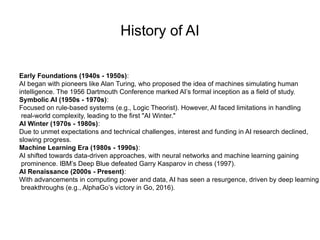
History of AI
Early Foundations (1940s - 1950s):
AI began with pioneers like Alan Turing, who proposed the idea of machines simulating human
intelligence. The 1956 Dartmouth Conference marked AI’s formal inception as a field of study.
Symbolic AI (1950s - 1970s):
Focused on rule-based systems (e.g., Logic Theorist). However, AI faced limitations in handling
real-world complexity, leading to the first "AI Winter."
AI Winter (1970s - 1980s):
Due to unmet expectations and technical challenges, interest and funding in AI research declined,
slowing progress.
Machine Learning Era (1980s - 1990s):
AI shifted towards data-driven approaches, with neural networks and machine learning gaining
prominence. IBM’s Deep Blue defeated Garry Kasparov in chess (1997).
AI Renaissance (2000s - Present):
With advancements in computing power and data, AI has seen a resurgence, driven by deep learning
breakthroughs (e.g., AlphaGo’s victory in Go, 2016).
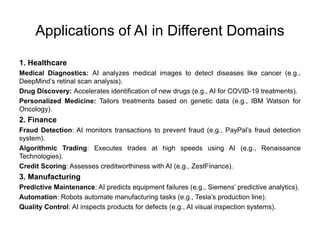
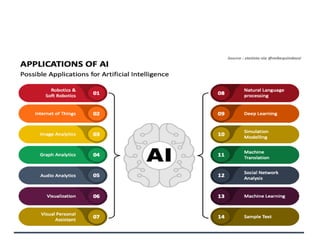
Applications of AI in Different Domains
1. Healthcare
Medical Diagnostics: AI analyzes medical images to detect diseases like cancer (e.g.,
DeepMind’s retinal scan analysis).
Drug Discovery: Accelerates identification of new drugs (e.g., AI for COVID-19 treatments).
Personalized Medicine: Tailors treatments based on genetic data (e.g., IBM Watson for
Oncology).
2. Finance
Fraud Detection: AI monitors transactions to prevent fraud (e.g., PayPal’s fraud detection
system).
Algorithmic Trading: Executes trades at high speeds using AI (e.g., Renaissance
Technologies).
Credit Scoring: Assesses creditworthiness with AI (e.g., ZestFinance).
3. Manufacturing
Predictive Maintenance: AI predicts equipment failures (e.g., Siemens’ predictive analytics).
Automation: Robots automate manufacturing tasks (e.g., Tesla’s production line).
Quality Control: AI inspects products for defects (e.g., AI visual inspection systems).
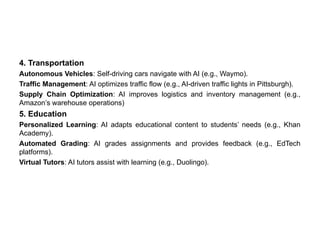
4. Transportation
Autonomous Vehicles: Self-driving cars navigate with AI (e.g., Waymo).
Traffic Management: AI optimizes traffic flow (e.g., AI-driven traffic lights in Pittsburgh).
Supply Chain Optimization: AI improves logistics and inventory management (e.g.,
Amazon’s warehouse operations)
5. Education
Personalized Learning: AI adapts educational content to students’ needs (e.g., Khan
Academy).
Automated Grading: AI grades assignments and provides feedback (e.g., EdTech
platforms).
Virtual Tutors: AI tutors assist with learning (e.g., Duolingo).
Turing Test
The Turing Test is a concept in artificial intelligence (AI) proposed by the British
mathematician and computer scientist Alan Turing in 1950. It is designed to assess a
machine's ability to exhibit intelligent behavior equivalent to, or indistinguishable from,
that of a human.
Concept:
The Turing Test evaluates whether a machine can mimic human responses so
convincingly that a human evaluator cannot reliably distinguish between the machine and
a human. If the evaluator cannot tell which is the machine, the AI is said to have passed
the test.
How it Works:
The test involves a human judge interacting with both a human and a machine through a
computer interface (usually via text communication, to avoid giving away non-verbal
clues). The judge's task is to determine which respondent is the human and which is the
machine.
Lecture-AI-1.ppt Advanced Technology real world

Lecture-AI-1.ppt Advanced Technology real world

  • 2.
    Artificial Intelligence (AI) Title:Artificial Intelligence: Introduction, History, Turing Test, Applications, and Future Trends Presented by: Miss Asma Abubakar
  • 3.
    What is ArtificialIntelligence (AI) •Definition: AI refers to the development of computer systems that can perform tasks typically requiring human intelligence, such as understanding language, recognizing patterns, solving problems and making decisions.
  • 4.
    Key Characteristics: Adaptability: AIsystems learn from experience and adapt to new situations. Automation: Ability to automate complex processes. Autonomy: AI can operate independently with minimal human intervention. Subfields of AI: Artificial Narrow Intelligence (ANI): Specialized in one area. Artificial General Intelligence (AGI): General human-like intelligence. Artificial Superintelligence (ASI): Surpasses human intelligence. Subfields of AI: Artificial Narrow Intelligence (ANI): Specialized in one area. Artificial General Intelligence (AGI): General human-like intelligence. Artificial Superintelligence (ASI): Surpasses human intelligence.
  • 5.
    Key Components ofAI Machine Learning (ML): Supervised Learning: Learning with labeled data (e.g., classification, regression). Unsupervised Learning: Learning without labeled data (e.g., clustering, dimensionality reduction) Reinforcement Learning: Learning by trial and error (e.g., game AI). Deep Learning: Neural Networks: Layers of interconnected nodes (neurons) inspired by the human brain. Convolutional Neural Networks (CNNs): Used for image processing. Recurrent Neural Networks (RNNs): Used for sequential data (e.g., language models). Natural Language Processing (NLP): Text Analysis: Sentiment analysis, language translation. Speech Recognition: Converting spoken language to text. Language Generation: Creating human-like text (e.g., GPT models). Computer Vision: Image Recognition: Identifying objects in images (e.g., face recognition). Object Detection: Locating objects in images. Image Generation: Creating realistic images (e.g., GANs). Robotics: Autonomous Navigation: Self-driving cars, drones. Manipulation: Robot arms in manufacturing. Human-Robot Interaction: Social robots, AI assistants.
  • 6.
    History of AI EarlyFoundations (1940s - 1950s): AI began with pioneers like Alan Turing, who proposed the idea of machines simulating human intelligence. The 1956 Dartmouth Conference marked AI’s formal inception as a field of study. Symbolic AI (1950s - 1970s): Focused on rule-based systems (e.g., Logic Theorist). However, AI faced limitations in handling real-world complexity, leading to the first "AI Winter." AI Winter (1970s - 1980s): Due to unmet expectations and technical challenges, interest and funding in AI research declined, slowing progress. Machine Learning Era (1980s - 1990s): AI shifted towards data-driven approaches, with neural networks and machine learning gaining prominence. IBM’s Deep Blue defeated Garry Kasparov in chess (1997). AI Renaissance (2000s - Present): With advancements in computing power and data, AI has seen a resurgence, driven by deep learning breakthroughs (e.g., AlphaGo’s victory in Go, 2016).
  • 7.
    Applications of AIin Different Domains 1. Healthcare Medical Diagnostics: AI analyzes medical images to detect diseases like cancer (e.g., DeepMind’s retinal scan analysis). Drug Discovery: Accelerates identification of new drugs (e.g., AI for COVID-19 treatments). Personalized Medicine: Tailors treatments based on genetic data (e.g., IBM Watson for Oncology). 2. Finance Fraud Detection: AI monitors transactions to prevent fraud (e.g., PayPal’s fraud detection system). Algorithmic Trading: Executes trades at high speeds using AI (e.g., Renaissance Technologies). Credit Scoring: Assesses creditworthiness with AI (e.g., ZestFinance). 3. Manufacturing Predictive Maintenance: AI predicts equipment failures (e.g., Siemens’ predictive analytics). Automation: Robots automate manufacturing tasks (e.g., Tesla’s production line). Quality Control: AI inspects products for defects (e.g., AI visual inspection systems).
  • 9.
    4. Transportation Autonomous Vehicles:Self-driving cars navigate with AI (e.g., Waymo). Traffic Management: AI optimizes traffic flow (e.g., AI-driven traffic lights in Pittsburgh). Supply Chain Optimization: AI improves logistics and inventory management (e.g., Amazon’s warehouse operations) 5. Education Personalized Learning: AI adapts educational content to students’ needs (e.g., Khan Academy). Automated Grading: AI grades assignments and provides feedback (e.g., EdTech platforms). Virtual Tutors: AI tutors assist with learning (e.g., Duolingo).
  • 10.
    Turing Test The TuringTest is a concept in artificial intelligence (AI) proposed by the British mathematician and computer scientist Alan Turing in 1950. It is designed to assess a machine's ability to exhibit intelligent behavior equivalent to, or indistinguishable from, that of a human. Concept: The Turing Test evaluates whether a machine can mimic human responses so convincingly that a human evaluator cannot reliably distinguish between the machine and a human. If the evaluator cannot tell which is the machine, the AI is said to have passed the test. How it Works: The test involves a human judge interacting with both a human and a machine through a computer interface (usually via text communication, to avoid giving away non-verbal clues). The judge's task is to determine which respondent is the human and which is the machine.