An Introductory on
MATLAB and Simulink
MNS UET MULTAN
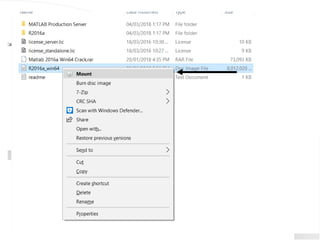
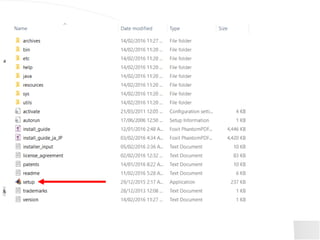
How To install MATLAB in
PC/Laptops!
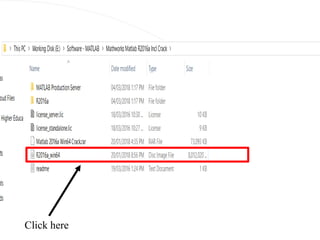
Click here
Introduction to
MATLAB and Simulink
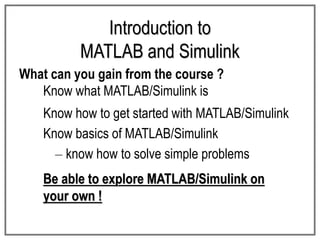
What can you gain from the course ?
Know basics of MATLAB/Simulink
– know how to solve simple problems
Know what MATLAB/Simulink is
Know how to get started with MATLAB/Simulink
Be able to explore MATLAB/Simulink on
your own !
Introduction to
MATLAB and Simulink
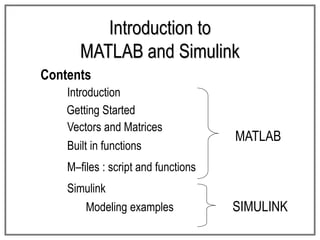
Contents
Built in functions
Getting Started
Vectors and Matrices
Introduction
Simulink
Modeling examples
MATLAB
SIMULINK
M–files : script and functions
Introduction
MATLAB – MATrix LABoratory
– Initially developed by a lecturer in 1970’s to help students
learn linear algebra.
– It was later marketed and further developed under
MathWorks Inc. (founded in 1984) – www.mathworks.com
– Matlab is a software package which can be used to perform
analysis and solve mathematical and engineering problems.
– It has excellent programming features and graphics capability
– easy to learn and flexible.
– Available in many operating systems – Windows, Macintosh,
Unix, DOS
– It has several tooboxes to solve specific problems.
Introduction
Simulink
– Used to model, analyze and simulate dynamic
systems using block diagrams.
– Fully integrated with MATLAB , easy and fast to
learn and flexible.
– It has comprehensive block library which can be
used to simulate linear, non–linear or discrete
systems – excellent research tools.
– C codes can be generated from Simulink models for
embedded applications and rapid prototyping of
control systems.
Getting Started
Run MATLAB from Start  Programs  MATLAB
Depending on version used, several windows appear
• For example in Release 13 (Ver 6), there are several
windows – command history, command, workspace, etc
• For Matlab Student – only command window
Command window
• Main window – where commands are entered
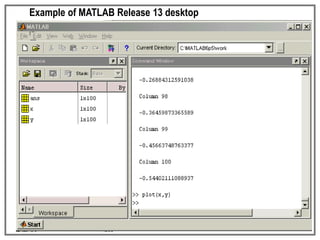
Example of MATLAB Release 13 desktop
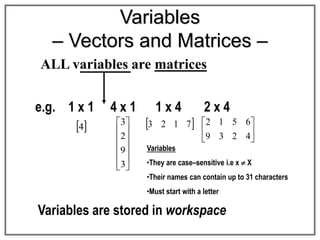
Variables
– Vectors and Matrices –
ALL variables are matrices
Variables
•They are case–sensitive i.e x  X
•Their names can contain up to 31 characters
•Must start with a letter
Variables are stored in workspace
e.g. 1 x 1 4 x 1 1 x 4 2 x 4






4239
6512 7123












3
9
2
3
 4
Vectors and Matrices
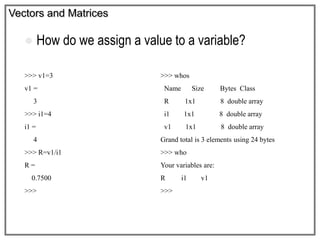
 How do we assign a value to a variable?
>>> v1=3
v1 =
3
>>> i1=4
i1 =
4
>>> R=v1/i1
R =
0.7500
>>>
>>> whos
Name Size Bytes Class
R 1x1 8 double array
i1 1x1 8 double array
v1 1x1 8 double array
Grand total is 3 elements using 24 bytes
>>> who
Your variables are:
R i1 v1
>>>
Vectors and Matrices

















18
16
14
12
10
B
 How do we assign values to vectors?
>>> A = [1 2 3 4 5]
A =
1 2 3 4 5
>>>
>>> B = [10;12;14;16;18]
B =
10
12
14
16
18
>>>
A row vector –
values are
separated by
spaces
A column
vector –
values are
separated by
semi–colon
(;)
 54321A 
Vectors and Matrices
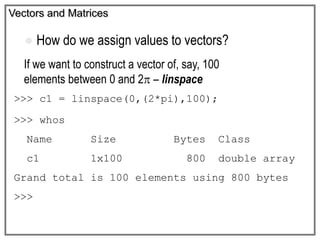
If we want to construct a vector of, say, 100
elements between 0 and 2 – linspace
>>> c1 = linspace(0,(2*pi),100);
>>> whos
Name Size Bytes Class
c1 1x100 800 double array
Grand total is 100 elements using 800 bytes
>>>
 How do we assign values to vectors?
Vectors and Matrices
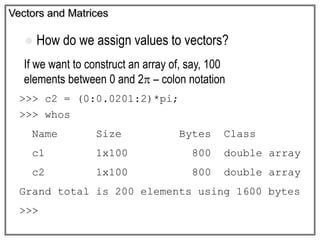
 How do we assign values to vectors?
If we want to construct an array of, say, 100
elements between 0 and 2 – colon notation
>>> c2 = (0:0.0201:2)*pi;
>>> whos
Name Size Bytes Class
c1 1x100 800 double array
c2 1x100 800 double array
Grand total is 200 elements using 1600 bytes
>>>
Vectors and Matrices
 How do we assign values to matrices ?
Columns separated by
space or a comma
Rows separated by
semi-colon
>>> A=[1 2 3;4 5 6;7 8 9]
A =
1 2 3
4 5 6
7 8 9
>>> 









987
654
321
Vectors and Matrices
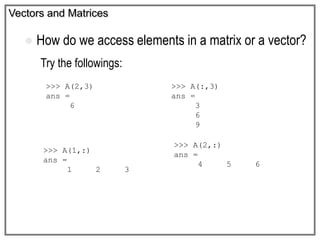
 How do we access elements in a matrix or a vector?
Try the followings:
>>> A(2,3)
ans =
6
>>> A(:,3)
ans =
3
6
9
>>> A(1,:)
ans =
1 2 3
>>> A(2,:)
ans =
4 5 6
Vectors and Matrices
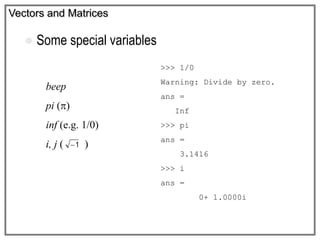
 Some special variables
beep
pi ()
inf (e.g. 1/0)
i, j ( )1
>>> 1/0
Warning: Divide by zero.
ans =
Inf
>>> pi
ans =
3.1416
>>> i
ans =
0+ 1.0000i
Vectors and Matrices
 Arithmetic operations – Matrices
Performing operations to every entry in a matrix
Add and subtract>>> A=[1 2 3;4 5 6;7 8
9]
A =
1 2 3
4 5 6
7 8 9
>>>
>>> A+3
ans =
4 5 6
7 8 9
10 11 12
>>> A-2
ans =
-1 0 1
2 3 4
5 6 7
Vectors and Matrices
 Arithmetic operations – Matrices
Performing operations to every entry in a matrix
Multiply and divide>>> A=[1 2 3;4 5 6;7 8 9]
A =
1 2 3
4 5 6
7 8 9
>>>
>>> A*2
ans =
2 4 6
8 10 12
14 16 18
>>> A/3
ans =
0.3333 0.6667 1.0000
1.3333 1.6667 2.0000
2.3333 2.6667 3.0000
Vectors and Matrices
 Arithmetic operations – Matrices
Performing operations to every entry in a matrix
Power
>>> A=[1 2 3;4 5 6;7 8 9]
A =
1 2 3
4 5 6
7 8 9
>>>
A^2 = A * A
To square every element in A, use
the element–wise operator .^
>>> A.^2
ans =
1 4 9
16 25 36
49 64 81
>>> A^2
ans =
30 36 42
66 81 96
102 126 150
Vectors and Matrices
 Arithmetic operations – Matrices
Performing operations between matrices
>>> A=[1 2 3;4 5 6;7 8 9]
A =
1 2 3
4 5 6
7 8 9
>>> B=[1 1 1;2 2 2;3 3 3]
B =
1 1 1
2 2 2
3 3 3
A*B 



















333
222
111
987
654
321
A.*B










3x93x83x7
2x62x52x4
1x31x21x1










272421
12108
321
=
=










505050
323232
141414
Vectors and Matrices
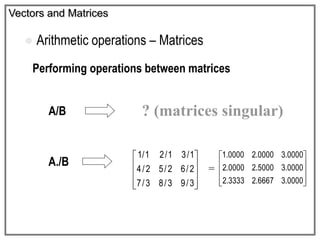
 Arithmetic operations – Matrices
Performing operations between matrices
A/B
A./B










0000.36667.23333.2
0000.35000.20000.2
0000.30000.20000.1
=
? (matrices singular)










3/93/83/7
2/62/52/4
1/31/21/1
Vectors and Matrices
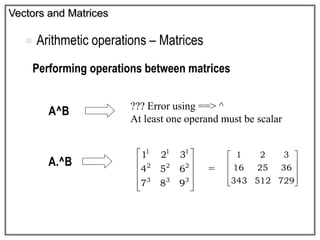
 Arithmetic operations – Matrices
Performing operations between matrices
A^B
A.^B










729512343
362516
321
=
??? Error using ==> ^
At least one operand must be scalar










333
222
111
987
654
321
Built in functions
(commands)
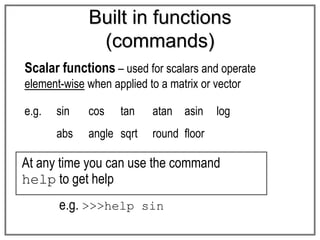
Scalar functions – used for scalars and operate
element-wise when applied to a matrix or vector
e.g. sin cos tan atan asin log
abs angle sqrt round floor
At any time you can use the command
help to get help
e.g. >>>help sin
Built in functions (commands)
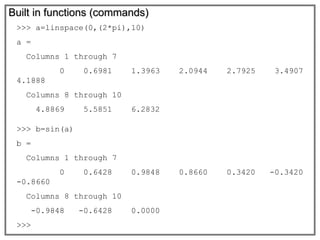
>>> a=linspace(0,(2*pi),10)
a =
Columns 1 through 7
0 0.6981 1.3963 2.0944 2.7925 3.4907
4.1888
Columns 8 through 10
4.8869 5.5851 6.2832
>>> b=sin(a)
b =
Columns 1 through 7
0 0.6428 0.9848 0.8660 0.3420 -0.3420
-0.8660
Columns 8 through 10
-0.9848 -0.6428 0.0000
>>>
Built in functions (commands)
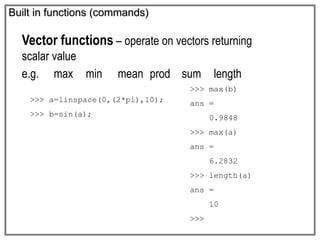
Vector functions – operate on vectors returning
scalar value
e.g. max min mean prod sum length
>>> max(b)
ans =
0.9848
>>> max(a)
ans =
6.2832
>>> length(a)
ans =
10
>>>
>>> a=linspace(0,(2*pi),10);
>>> b=sin(a);
Built in functions (commands)
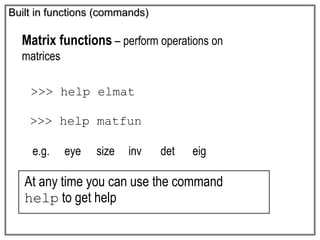
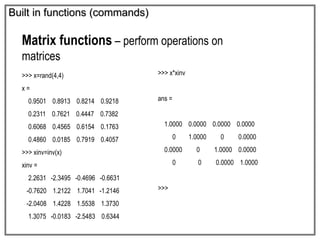
Matrix functions – perform operations on
matrices
>>> help elmat
>>> help matfun
e.g. eye size inv det eig
At any time you can use the command
help to get help
Built in functions (commands)
Matrix functions – perform operations on
matrices
>>> x=rand(4,4)
x =
0.9501 0.8913 0.8214 0.9218
0.2311 0.7621 0.4447 0.7382
0.6068 0.4565 0.6154 0.1763
0.4860 0.0185 0.7919 0.4057
>>> xinv=inv(x)
xinv =
2.2631 -2.3495 -0.4696 -0.6631
-0.7620 1.2122 1.7041 -1.2146
-2.0408 1.4228 1.5538 1.3730
1.3075 -0.0183 -2.5483 0.6344
>>> x*xinv
ans =
1.0000 0.0000 0.0000 0.0000
0 1.0000 0 0.0000
0.0000 0 1.0000 0.0000
0 0 0.0000 1.0000
>>>
Built in functions (commands)
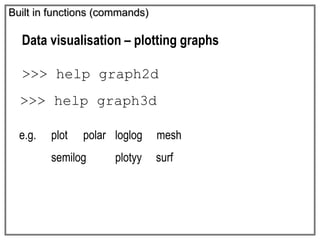
Data visualisation – plotting graphs
>>> help graph2d
>>> help graph3d
e.g. plot polar loglog mesh
semilog plotyy surf
Built in functions (commands)
Data visualisation – plotting graphs
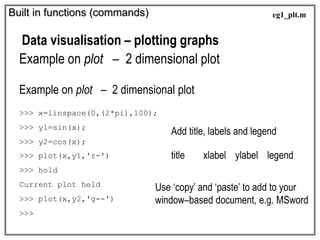
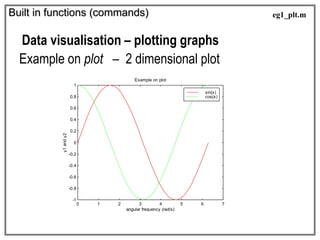
Example on plot – 2 dimensional plot
>>> x=linspace(0,(2*pi),100);
>>> y1=sin(x);
>>> y2=cos(x);
>>> plot(x,y1,'r-')
>>> hold
Current plot held
>>> plot(x,y2,'g--')
>>>
Add title, labels and legend
title xlabel ylabel legend
Use ‘copy’ and ‘paste’ to add to your
window–based document, e.g. MSword
eg1_plt.m
Built in functions (commands)
Data visualisation – plotting graphs
0 1 2 3 4 5 6 7
-1
-0.8
-0.6
-0.4
-0.2
0
0.2
0.4
0.6
0.8
1
angular frequency (rad/s)
y1andy2
Example on plot
sin(x)
cos(x)
Example on plot – 2 dimensional plot
eg1_plt.m
Built in functions (commands)
Data visualisation – plotting graphs
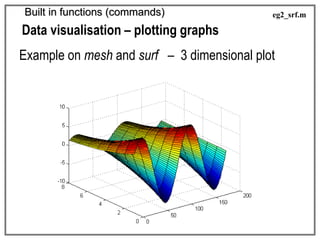
Example on mesh and surf – 3 dimensional plot
>>> [t,a] = meshgrid(0.1:.01:2, 0.1:0.5:7);
>>> f=2;
>>> Z = 10.*exp(-a.*0.4).*sin(2*pi.*t.*f);
>>> surf(Z);
>>> figure(2);
>>> mesh(Z);
Supposed we want to visualize a function
Z = 10e(–0.4a) sin (2ft) for f = 2
when a and t are varied from 0.1 to 7 and 0.1 to 2, respectively
eg2_srf.m
Built in functions (commands)
Data visualisation – plotting graphs
Example on mesh and surf – 3 dimensional plot
eg2_srf.m
Built in functions (commands)
Data visualisation – plotting graphs
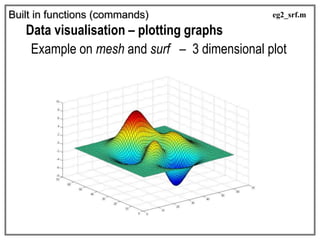
Example on mesh and surf – 3 dimensional plot
>>> [x,y] = meshgrid(-3:.1:3,-3:.1:3);
>>> z = 3*(1-x).^2.*exp(-(x.^2) - (y+1).^2) ...
- 10*(x/5 - x.^3 - y.^5).*exp(-x.^2-y.^2) ...
- 1/3*exp(-(x+1).^2 - y.^2);
>>> surf(z);
eg3_srf.m
Built in functions (commands)
Data visualisation – plotting graphs
Example on mesh and surf – 3 dimensional plot
eg2_srf.m
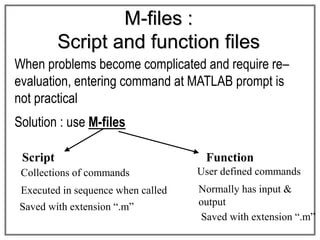
Solution : use M-files
M-files :
Script and function files
When problems become complicated and require re–
evaluation, entering command at MATLAB prompt is
not practical
Collections of commands
Executed in sequence when called
Saved with extension “.m”
Script Function
User defined commands
Normally has input &
output
Saved with extension “.m”
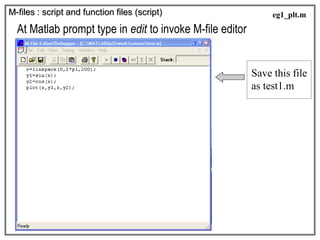
M-files : script and function files (script)
At Matlab prompt type in edit to invoke M-file editor
Save this file
as test1.m
eg1_plt.m
M-files : script and function files (script)
To run the M-file, type in the name of the file at the
prompt e.g. >>> test1
Type in matlabpath to check the list of directories
listed in the path
Use path editor to add the path: File  Set path …
It will be executed provided that the saved file is in the
known path
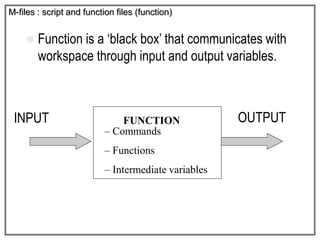
 Function is a ‘black box’ that communicates with
workspace through input and output variables.
INPUT OUTPUTFUNCTION
– Commands
– Functions
– Intermediate variables
M-files : script and function files (function)
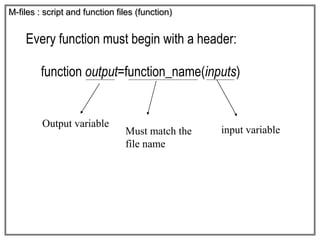
Every function must begin with a header:
M-files : script and function files (function)
function output=function_name(inputs)
Output variable
Must match the
file name
input variable
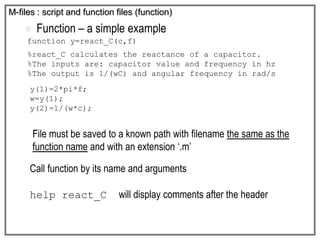
 Function – a simple example
function y=react_C(c,f)
%react_C calculates the reactance of a capacitor.
%The inputs are: capacitor value and frequency in hz
%The output is 1/(wC) and angular frequency in rad/s
y(1)=2*pi*f;
w=y(1);
y(2)=1/(w*c);
M-files : script and function files (function)
File must be saved to a known path with filename the same as the
function name and with an extension ‘.m’
Call function by its name and arguments
help react_C will display comments after the header
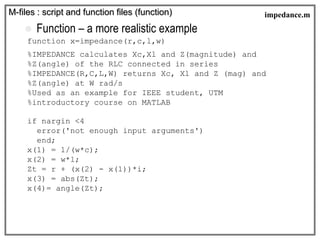
 Function – a more realistic example
function x=impedance(r,c,l,w)
%IMPEDANCE calculates Xc,Xl and Z(magnitude) and
%Z(angle) of the RLC connected in series
%IMPEDANCE(R,C,L,W) returns Xc, Xl and Z (mag) and
%Z(angle) at W rad/s
%Used as an example for IEEE student, UTM
%introductory course on MATLAB
if nargin <4
error('not enough input arguments')
end;
x(1) = 1/(w*c);
x(2) = w*l;
Zt = r + (x(2) - x(1))*i;
x(3) = abs(Zt);
x(4)= angle(Zt);
M-files : script and function files (function) impedance.m
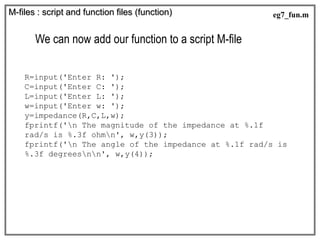
We can now add our function to a script M-file
R=input('Enter R: ');
C=input('Enter C: ');
L=input('Enter L: ');
w=input('Enter w: ');
y=impedance(R,C,L,w);
fprintf('n The magnitude of the impedance at %.1f
rad/s is %.3f ohmn', w,y(3));
fprintf('n The angle of the impedance at %.1f rad/s is
%.3f degreesnn', w,y(4));
M-files : script and function files (function) eg7_fun.m
Simulink
Used to model, analyze and simulate dynamic
systems using block diagrams.
Provides a graphical user interface for constructing
block diagram of a system – therefore is easy to use.
However modeling a system is not necessarily easy !
Simulink
Model – simplified representation of a system – e.g. using
mathematical equation
We simulate a model to study the behavior of a system –
need to verify that our model is correct – expect results
Knowing how to use Simulink or MATLAB does not
mean that you know how to model a system

Introduction of MatLab

  • 1.
    An Introductory on MATLABand Simulink MNS UET MULTAN
  • 2.
    How To installMATLAB in PC/Laptops!
  • 3.
  • 6.
    Introduction to MATLAB andSimulink What can you gain from the course ? Know basics of MATLAB/Simulink – know how to solve simple problems Know what MATLAB/Simulink is Know how to get started with MATLAB/Simulink Be able to explore MATLAB/Simulink on your own !
  • 7.
    Introduction to MATLAB andSimulink Contents Built in functions Getting Started Vectors and Matrices Introduction Simulink Modeling examples MATLAB SIMULINK M–files : script and functions
  • 8.
    Introduction MATLAB – MATrixLABoratory – Initially developed by a lecturer in 1970’s to help students learn linear algebra. – It was later marketed and further developed under MathWorks Inc. (founded in 1984) – www.mathworks.com – Matlab is a software package which can be used to perform analysis and solve mathematical and engineering problems. – It has excellent programming features and graphics capability – easy to learn and flexible. – Available in many operating systems – Windows, Macintosh, Unix, DOS – It has several tooboxes to solve specific problems.
  • 9.
    Introduction Simulink – Used tomodel, analyze and simulate dynamic systems using block diagrams. – Fully integrated with MATLAB , easy and fast to learn and flexible. – It has comprehensive block library which can be used to simulate linear, non–linear or discrete systems – excellent research tools. – C codes can be generated from Simulink models for embedded applications and rapid prototyping of control systems.
  • 10.
    Getting Started Run MATLABfrom Start  Programs  MATLAB Depending on version used, several windows appear • For example in Release 13 (Ver 6), there are several windows – command history, command, workspace, etc • For Matlab Student – only command window Command window • Main window – where commands are entered
  • 11.
    Example of MATLABRelease 13 desktop
  • 12.
    Variables – Vectors andMatrices – ALL variables are matrices Variables •They are case–sensitive i.e x  X •Their names can contain up to 31 characters •Must start with a letter Variables are stored in workspace e.g. 1 x 1 4 x 1 1 x 4 2 x 4       4239 6512 7123             3 9 2 3  4
  • 13.
    Vectors and Matrices How do we assign a value to a variable? >>> v1=3 v1 = 3 >>> i1=4 i1 = 4 >>> R=v1/i1 R = 0.7500 >>> >>> whos Name Size Bytes Class R 1x1 8 double array i1 1x1 8 double array v1 1x1 8 double array Grand total is 3 elements using 24 bytes >>> who Your variables are: R i1 v1 >>>
  • 14.
    Vectors and Matrices                  18 16 14 12 10 B How do we assign values to vectors? >>> A = [1 2 3 4 5] A = 1 2 3 4 5 >>> >>> B = [10;12;14;16;18] B = 10 12 14 16 18 >>> A row vector – values are separated by spaces A column vector – values are separated by semi–colon (;)  54321A 
  • 15.
    Vectors and Matrices Ifwe want to construct a vector of, say, 100 elements between 0 and 2 – linspace >>> c1 = linspace(0,(2*pi),100); >>> whos Name Size Bytes Class c1 1x100 800 double array Grand total is 100 elements using 800 bytes >>>  How do we assign values to vectors?
  • 16.
    Vectors and Matrices How do we assign values to vectors? If we want to construct an array of, say, 100 elements between 0 and 2 – colon notation >>> c2 = (0:0.0201:2)*pi; >>> whos Name Size Bytes Class c1 1x100 800 double array c2 1x100 800 double array Grand total is 200 elements using 1600 bytes >>>
  • 17.
    Vectors and Matrices How do we assign values to matrices ? Columns separated by space or a comma Rows separated by semi-colon >>> A=[1 2 3;4 5 6;7 8 9] A = 1 2 3 4 5 6 7 8 9 >>>           987 654 321
  • 18.
    Vectors and Matrices How do we access elements in a matrix or a vector? Try the followings: >>> A(2,3) ans = 6 >>> A(:,3) ans = 3 6 9 >>> A(1,:) ans = 1 2 3 >>> A(2,:) ans = 4 5 6
  • 19.
    Vectors and Matrices Some special variables beep pi () inf (e.g. 1/0) i, j ( )1 >>> 1/0 Warning: Divide by zero. ans = Inf >>> pi ans = 3.1416 >>> i ans = 0+ 1.0000i
  • 20.
    Vectors and Matrices Arithmetic operations – Matrices Performing operations to every entry in a matrix Add and subtract>>> A=[1 2 3;4 5 6;7 8 9] A = 1 2 3 4 5 6 7 8 9 >>> >>> A+3 ans = 4 5 6 7 8 9 10 11 12 >>> A-2 ans = -1 0 1 2 3 4 5 6 7
  • 21.
    Vectors and Matrices Arithmetic operations – Matrices Performing operations to every entry in a matrix Multiply and divide>>> A=[1 2 3;4 5 6;7 8 9] A = 1 2 3 4 5 6 7 8 9 >>> >>> A*2 ans = 2 4 6 8 10 12 14 16 18 >>> A/3 ans = 0.3333 0.6667 1.0000 1.3333 1.6667 2.0000 2.3333 2.6667 3.0000
  • 22.
    Vectors and Matrices Arithmetic operations – Matrices Performing operations to every entry in a matrix Power >>> A=[1 2 3;4 5 6;7 8 9] A = 1 2 3 4 5 6 7 8 9 >>> A^2 = A * A To square every element in A, use the element–wise operator .^ >>> A.^2 ans = 1 4 9 16 25 36 49 64 81 >>> A^2 ans = 30 36 42 66 81 96 102 126 150
  • 23.
    Vectors and Matrices Arithmetic operations – Matrices Performing operations between matrices >>> A=[1 2 3;4 5 6;7 8 9] A = 1 2 3 4 5 6 7 8 9 >>> B=[1 1 1;2 2 2;3 3 3] B = 1 1 1 2 2 2 3 3 3 A*B                     333 222 111 987 654 321 A.*B           3x93x83x7 2x62x52x4 1x31x21x1           272421 12108 321 = =           505050 323232 141414
  • 24.
    Vectors and Matrices Arithmetic operations – Matrices Performing operations between matrices A/B A./B           0000.36667.23333.2 0000.35000.20000.2 0000.30000.20000.1 = ? (matrices singular)           3/93/83/7 2/62/52/4 1/31/21/1
  • 25.
    Vectors and Matrices Arithmetic operations – Matrices Performing operations between matrices A^B A.^B           729512343 362516 321 = ??? Error using ==> ^ At least one operand must be scalar           333 222 111 987 654 321
  • 26.
    Built in functions (commands) Scalarfunctions – used for scalars and operate element-wise when applied to a matrix or vector e.g. sin cos tan atan asin log abs angle sqrt round floor At any time you can use the command help to get help e.g. >>>help sin
  • 27.
    Built in functions(commands) >>> a=linspace(0,(2*pi),10) a = Columns 1 through 7 0 0.6981 1.3963 2.0944 2.7925 3.4907 4.1888 Columns 8 through 10 4.8869 5.5851 6.2832 >>> b=sin(a) b = Columns 1 through 7 0 0.6428 0.9848 0.8660 0.3420 -0.3420 -0.8660 Columns 8 through 10 -0.9848 -0.6428 0.0000 >>>
  • 28.
    Built in functions(commands) Vector functions – operate on vectors returning scalar value e.g. max min mean prod sum length >>> max(b) ans = 0.9848 >>> max(a) ans = 6.2832 >>> length(a) ans = 10 >>> >>> a=linspace(0,(2*pi),10); >>> b=sin(a);
  • 29.
    Built in functions(commands) Matrix functions – perform operations on matrices >>> help elmat >>> help matfun e.g. eye size inv det eig At any time you can use the command help to get help
  • 30.
    Built in functions(commands) Matrix functions – perform operations on matrices >>> x=rand(4,4) x = 0.9501 0.8913 0.8214 0.9218 0.2311 0.7621 0.4447 0.7382 0.6068 0.4565 0.6154 0.1763 0.4860 0.0185 0.7919 0.4057 >>> xinv=inv(x) xinv = 2.2631 -2.3495 -0.4696 -0.6631 -0.7620 1.2122 1.7041 -1.2146 -2.0408 1.4228 1.5538 1.3730 1.3075 -0.0183 -2.5483 0.6344 >>> x*xinv ans = 1.0000 0.0000 0.0000 0.0000 0 1.0000 0 0.0000 0.0000 0 1.0000 0.0000 0 0 0.0000 1.0000 >>>
  • 31.
    Built in functions(commands) Data visualisation – plotting graphs >>> help graph2d >>> help graph3d e.g. plot polar loglog mesh semilog plotyy surf
  • 32.
    Built in functions(commands) Data visualisation – plotting graphs Example on plot – 2 dimensional plot Example on plot – 2 dimensional plot >>> x=linspace(0,(2*pi),100); >>> y1=sin(x); >>> y2=cos(x); >>> plot(x,y1,'r-') >>> hold Current plot held >>> plot(x,y2,'g--') >>> Add title, labels and legend title xlabel ylabel legend Use ‘copy’ and ‘paste’ to add to your window–based document, e.g. MSword eg1_plt.m
  • 33.
    Built in functions(commands) Data visualisation – plotting graphs 0 1 2 3 4 5 6 7 -1 -0.8 -0.6 -0.4 -0.2 0 0.2 0.4 0.6 0.8 1 angular frequency (rad/s) y1andy2 Example on plot sin(x) cos(x) Example on plot – 2 dimensional plot eg1_plt.m
  • 34.
    Built in functions(commands) Data visualisation – plotting graphs Example on mesh and surf – 3 dimensional plot >>> [t,a] = meshgrid(0.1:.01:2, 0.1:0.5:7); >>> f=2; >>> Z = 10.*exp(-a.*0.4).*sin(2*pi.*t.*f); >>> surf(Z); >>> figure(2); >>> mesh(Z); Supposed we want to visualize a function Z = 10e(–0.4a) sin (2ft) for f = 2 when a and t are varied from 0.1 to 7 and 0.1 to 2, respectively eg2_srf.m
  • 35.
    Built in functions(commands) Data visualisation – plotting graphs Example on mesh and surf – 3 dimensional plot eg2_srf.m
  • 36.
    Built in functions(commands) Data visualisation – plotting graphs Example on mesh and surf – 3 dimensional plot >>> [x,y] = meshgrid(-3:.1:3,-3:.1:3); >>> z = 3*(1-x).^2.*exp(-(x.^2) - (y+1).^2) ... - 10*(x/5 - x.^3 - y.^5).*exp(-x.^2-y.^2) ... - 1/3*exp(-(x+1).^2 - y.^2); >>> surf(z); eg3_srf.m
  • 37.
    Built in functions(commands) Data visualisation – plotting graphs Example on mesh and surf – 3 dimensional plot eg2_srf.m
  • 38.
    Solution : useM-files M-files : Script and function files When problems become complicated and require re– evaluation, entering command at MATLAB prompt is not practical Collections of commands Executed in sequence when called Saved with extension “.m” Script Function User defined commands Normally has input & output Saved with extension “.m”
  • 39.
    M-files : scriptand function files (script) At Matlab prompt type in edit to invoke M-file editor Save this file as test1.m eg1_plt.m
  • 40.
    M-files : scriptand function files (script) To run the M-file, type in the name of the file at the prompt e.g. >>> test1 Type in matlabpath to check the list of directories listed in the path Use path editor to add the path: File  Set path … It will be executed provided that the saved file is in the known path
  • 41.
     Function isa ‘black box’ that communicates with workspace through input and output variables. INPUT OUTPUTFUNCTION – Commands – Functions – Intermediate variables M-files : script and function files (function)
  • 42.
    Every function mustbegin with a header: M-files : script and function files (function) function output=function_name(inputs) Output variable Must match the file name input variable
  • 43.
     Function –a simple example function y=react_C(c,f) %react_C calculates the reactance of a capacitor. %The inputs are: capacitor value and frequency in hz %The output is 1/(wC) and angular frequency in rad/s y(1)=2*pi*f; w=y(1); y(2)=1/(w*c); M-files : script and function files (function) File must be saved to a known path with filename the same as the function name and with an extension ‘.m’ Call function by its name and arguments help react_C will display comments after the header
  • 44.
     Function –a more realistic example function x=impedance(r,c,l,w) %IMPEDANCE calculates Xc,Xl and Z(magnitude) and %Z(angle) of the RLC connected in series %IMPEDANCE(R,C,L,W) returns Xc, Xl and Z (mag) and %Z(angle) at W rad/s %Used as an example for IEEE student, UTM %introductory course on MATLAB if nargin <4 error('not enough input arguments') end; x(1) = 1/(w*c); x(2) = w*l; Zt = r + (x(2) - x(1))*i; x(3) = abs(Zt); x(4)= angle(Zt); M-files : script and function files (function) impedance.m
  • 45.
    We can nowadd our function to a script M-file R=input('Enter R: '); C=input('Enter C: '); L=input('Enter L: '); w=input('Enter w: '); y=impedance(R,C,L,w); fprintf('n The magnitude of the impedance at %.1f rad/s is %.3f ohmn', w,y(3)); fprintf('n The angle of the impedance at %.1f rad/s is %.3f degreesnn', w,y(4)); M-files : script and function files (function) eg7_fun.m
  • 46.
    Simulink Used to model,analyze and simulate dynamic systems using block diagrams. Provides a graphical user interface for constructing block diagram of a system – therefore is easy to use. However modeling a system is not necessarily easy !
  • 47.
    Simulink Model – simplifiedrepresentation of a system – e.g. using mathematical equation We simulate a model to study the behavior of a system – need to verify that our model is correct – expect results Knowing how to use Simulink or MATLAB does not mean that you know how to model a system