KINEMATIC AND DYNAMIC SIMULATION ANALYSIS OF 
HIGH­SPEED ARC CONTOUR CUTTING DEVICE  
 
Compared with Flame Cutting Machining which has low efficiency, poor quality and complex                         
manipulating process, and Water Jet Machining which cannot handle difficult­to­process materials,                     
WEDM(Wire Electric Discharge Machining) can solve the problem of machining difficult­to­process                     
material with large­thickness in aerospace, aviation and military field in a better way. However, the                             
lack of flushing which leads to insufficient chip­removal and inadequate electrode cooling makes the                           
electrode easy to damage or break. In addition, the thicker and harder the material is, the lower                                 
efficiency WEDM can achieve. Therefore, to solve these problems and improve machining efficiency,                         
the team came up with a new machining method called High­speed Arc Contour Cutting, and                             
designed the device corresponding to this method, High­speed Arc Contour Cutting Device.  
 
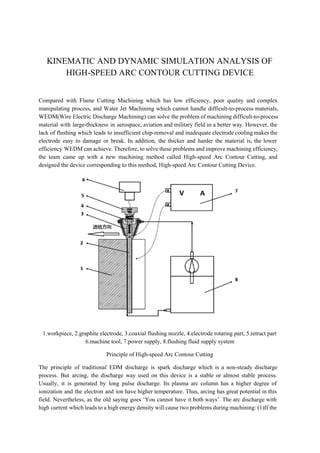
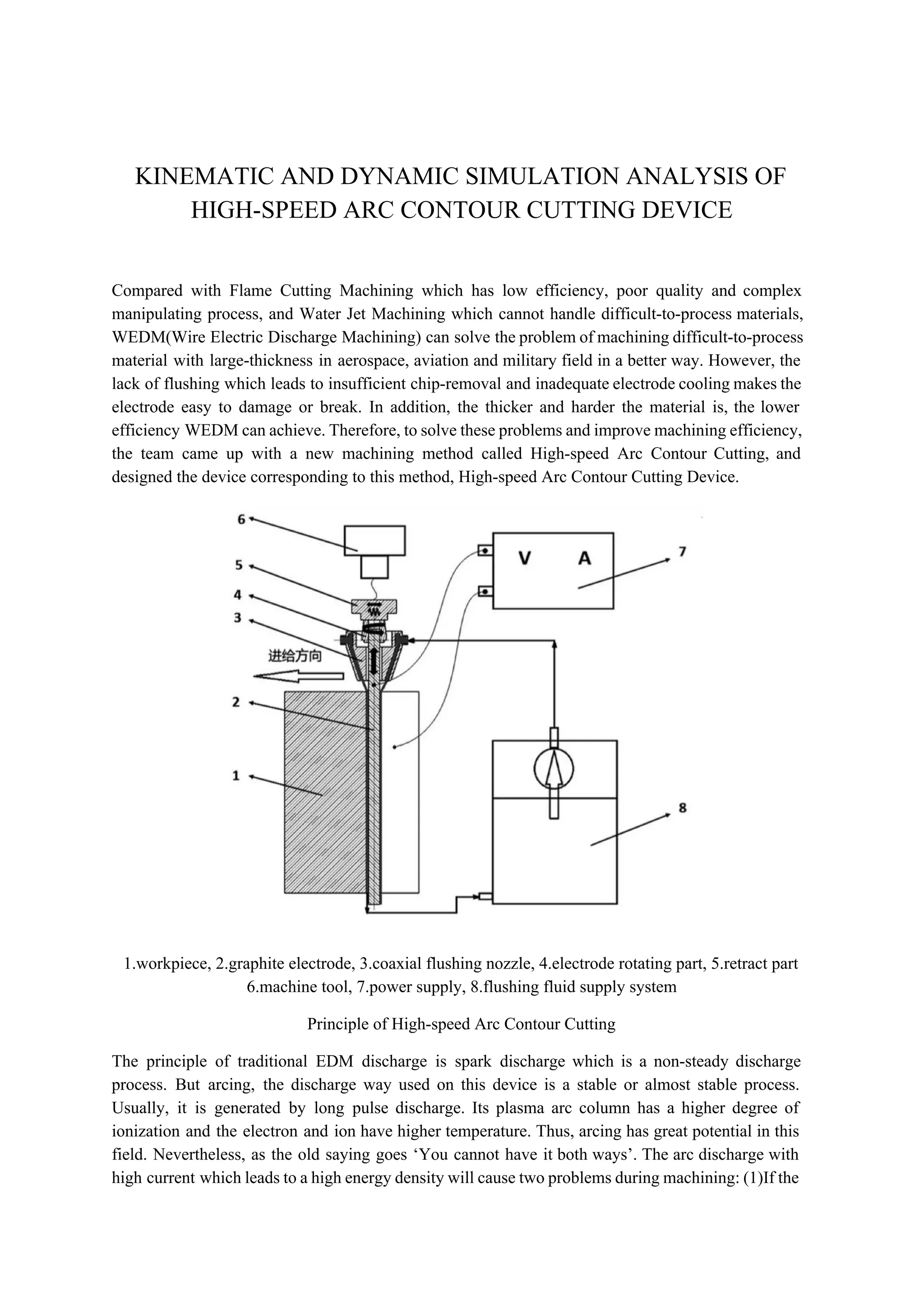
1.workpiece, 2.graphite electrode, 3.coaxial flushing nozzle, 4.electrode rotating part, 5.retract part 
6.machine tool, 7.power supply, 8.flushing fluid supply system 
Principle of High­speed Arc Contour Cutting 
The principle of traditional EDM discharge is spark discharge which is a non­steady discharge                           
process. But arcing, the discharge way used on this device is a stable or almost stable process.                                 
Usually, it is generated by long pulse discharge. Its plasma arc column has a higher degree of                                 
ionization and the electron and ion have higher temperature. Thus, arcing has great potential in this                               
field. Nevertheless, as the old saying goes ‘You cannot have it both ways’. The arc discharge with                                 
high current which leads to a high energy density will cause two problems during machining: (1)If the                                 
discharge arc column lasts too long, it will burn the internal organization of the material and cause                                 
damage to the workpiece which may result in machining failure. (2)There is only a hundreds­microns                             
narrow discharge gap between the electrode and the workpiece. For large thickness workpiece, the                           
large amount of chip generated by electrolytic corrosion during the machining will accumulate and                           
jam the gap. Once those chip are not removed effectively, the circuit between electrode and workpiece                               
will short immediately and the cutting process will fail.  
Aiming at solving these two problems, High­speed Arc Contour Cutting Device can interrupt arc                           
effectively and remove chip efficiently using the following two methods. First one is Mechanical                           
Kinematic Arc Interruption Method which is implemented by electrode rotation combined with                       
reciprocation generated by two motors separately. The mechanism behind this method is that                         
electrode movement along the tangential direction of the arc weakens the arc column, even pulls it off.                                 
The other method is Fluid Dynamic Arc Interruption Method which is implemented by coaxial                           
flushing. There will be an offset of the arc column along the direction of flow if there is a high­speed                                       
flow field with at least 10m/s in the gap. When the length of arc increases, the impedance increases as                                     
well. Once the impedance is large enough that discharge can no longer maintain, the arc column will                                 
be interrupted. Taking advantage of these two methods, duration and intensity of the arc discharge can                               
be controlled strictly to avoid long­last arc column so that the damage caused by arc discharge can be                                   
reduced to a minimum value. 
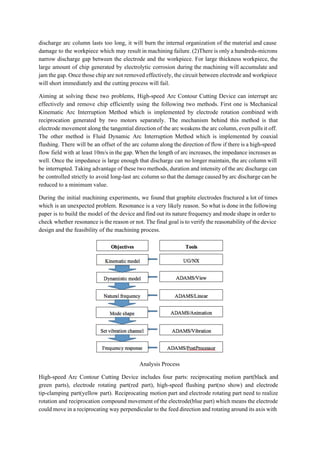
During the initial machining experiments, we found that graphite electrodes fractured a lot of times                             
which is an unexpected problem. Resonance is a very likely reason. So what is done in the following                                   
paper is to build the model of the device and find out its nature frequency and mode shape in order to                                         
check whether resonance is the reason or not. The final goal is to verify the reasonability of the device                                     
design and the feasibility of the machining process. 
 
Analysis Process 
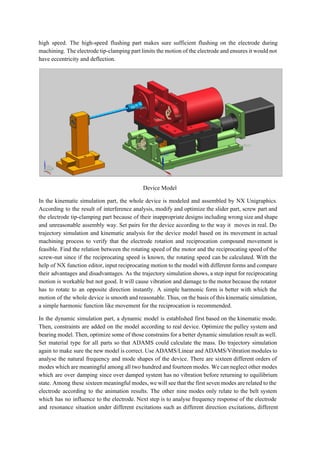
High­speed Arc Contour Cutting Device includes four parts: reciprocating motion part(black and                       
green parts), electrode rotating part(red part), high­speed flushing part(no show) and electrode                       
tip­clamping part(yellow part). Reciprocating motion part and electrode rotating part need to realize                         
rotation and reciprocation compound movement of the electrode(blue part) which means the electrode                         
could move in a reciprocating way perpendicular to the feed direction and rotating around its axis with                                 
high speed. The high­speed flushing part makes sure sufficient flushing on the electrode during                           
machining. The electrode tip­clamping part limits the motion of the electrode and ensures it would not                               
have eccentricity and deflection.  
 
Device Model 
In the kinematic simulation part, the whole device is modeled and assembled by NX Unigraphics.                             
According to the result of interference analysis, modify and optimize the slider part, screw part and                               
the electrode tip­clamping part because of their inappropriate designs including wrong size and shape                           
and unreasonable assembly way. Set pairs for the device according to the way it moves in real. Do                                   
trajectory simulation and kinematic analysis for the device model based on its movement in actual                             
machining process to verify that the electrode rotation and reciprocation compound movement is                         
feasible. Find the relation between the rotating speed of the motor and the reciprocating speed of the                                 
screw­nut since if the reciprocating speed is known, the rotating speed can be calculated. With the                               
help of NX function editor, input reciprocating motion to the model with different forms and compare                               
their advantages and disadvantages. As the trajectory simulation shows, a step input for reciprocating                           
motion is workable but not good. It will cause vibration and damage to the motor because the rotator                                   
has to rotate to an opposite direction instantly. A simple harmonic form is better with which the                                 
motion of the whole device is smooth and reasonable. Thus, on the basis of this kinematic simulation,                                 
a simple harmonic function like movement for the reciprocation is recommended.  
In the dynamic simulation part, a dynamic model is established first based on the kinematic mode.                               
Then, constraints are added on the model according to real device. Optimize the pulley system and                               
bearing model. Then, optimize some of those constrains for a better dynamic simulation result as well.                               
Set material type for all parts so that ADAMS could calculate the mass. Do trajectory simulation                               
again to make sure the new model is correct. Use ADAMS/Linear and ADAMS/Vibration modules to                             
analyse the natural frequency and mode shapes of the device. There are sixteen different orders of                               
modes which are meaningful among all two hundred and fourteen modes. We can neglect other modes                               
which are over damping since over damped system has no vibration before returning to equilibrium                             
state. Among these sixteen meaningful modes, we will see that the first seven modes are related to the                                   
electrode according to the animation results. The other nine modes only relate to the belt system                               
which has no influence to the electrode. Next step is to analyse frequency response of the electrode                                 
and resonance situation under different excitations such as different direction excitations, different                       
location excitations and different form excitations. In addition, compare the influence of using                         
electrode tip­clamping device or not, simulate the effect of eccentricity and deflection of the electrode.                             
As the analysis results show, a recommended working rotating speed range is from 600rpm to                             
6000rpm. It is not hard to find that the actual working rotating speed range which is from 800rpm to                                     
3000rpm is included in this safe range and it does not overlap with any natural frequency of the                                   
device. So it proves that there is no resonance going to happen during machining and the design of                                   
this device is reasonable. Also deflection is proved to be an important influence which may lead to                                 
poor machining quality. Therefore, using electrode tip­clamping part in the real machining process is                           
highly recommended.  
After that, a real machining experiment is conducted to compare the results with simulation under                             
different conditions. The first experiment sets working current as 200A and the cutting depth as 2mm                               
with feeding speed 0.25mm/min. During the machining, the discharge is not continuous because of                           
the low feed rate. There is no circuit short happening since the electrode got adequate flushing fluid.                                 
But the end of the electrode is overheated and turns red. Because the cutting which has low feed rate                                     
and discontinuous discharge is not deep inside the workpiece, there is only a small amount loss of the                                   
graphite on electrode, and the workpiece surface after machining is smooth without erosion. For the                             
second experiment, those three parameters mentioned before are set larger and the discharge process                           
becomes continuous. Then, a ten millimeter deep groove machining on 45# steel with fifty­five                           
millimeter thickness is realized. It successfully verifies the feasibility of the high­speed arc contour                           
cutting method as well as the reasonability of the design of the device. However, during the                               
experiment, the deflection on the tip of the electrode does influence the machining quality which is                               
the same with what theoretical simulation result shows. So the electrode tip­clamping device should                           
be used in order to avoid unnecessary vibration. What’s more, a simple vibration experiment is                             
conducted and it verifies that there is no resonance in the range of working rotating speed.  
As regard to the whole research of this device, my work is just a beginning. From design to testing,                                     
from optimization to real product, there is still a long way to go. What is done in this paper is to prove                                           
resonance is not the reason of electorde fracture and verify the reasonability of the device design and                                 
the feasibility of the machining process, so that people could keep working on the study of this device.                                   
Except the results have already showed, there is something else which is worth to consider and use for                                   
reference in the further research. First of all, even though this research helps a lot on optimizing                                 
high­speed contour cutting device, comparing with the actual complex machining situation, some                       
errors exist in the entire simulation process. So applying results or implementing data should be                             
careful rather than blindly follow. Second, whenever update the structure of the device, such as                             
installing retract part in the latest optimizing, both kinematic and dynamic simulation should be run                             
again to make sure the new part will not lead to any poor performance. In addition, a rigid­flexible                                   
hybrid modeling could be used in the future analysis so that the simulation result could be better.  
 

Introduction of HACCD

  • 1.
      KINEMATIC AND DYNAMIC SIMULATION ANALYSIS OF  HIGH­SPEED ARC CONTOUR CUTTING DEVICE     Compared with FlameCutting Machining which has low efficiency, poor quality and complex                          manipulating process, and Water Jet Machining which cannot handle difficult­to­process materials,                      WEDM(Wire Electric Discharge Machining) can solve the problem of machining difficult­to­process                      material with large­thickness in aerospace, aviation and military field in a better way. However, the                              lack of flushing which leads to insufficient chip­removal and inadequate electrode cooling makes the                            electrode easy to damage or break. In addition, the thicker and harder the material is, the lower                                  efficiency WEDM can achieve. Therefore, to solve these problems and improve machining efficiency,                          the team came up with a new machining method called High­speed Arc Contour Cutting, and                              designed the device corresponding to this method, High­speed Arc Contour Cutting Device.     1.workpiece, 2.graphite electrode, 3.coaxial flushing nozzle, 4.electrode rotating part, 5.retract part  6.machine tool, 7.power supply, 8.flushing fluid supply system  Principle of High­speed Arc Contour Cutting  The principle of traditional EDM discharge is spark discharge which is a non­steady discharge                            process. But arcing, the discharge way used on this device is a stable or almost stable process.                                  Usually, it is generated by long pulse discharge. Its plasma arc column has a higher degree of                                  ionization and the electron and ion have higher temperature. Thus, arcing has great potential in this                                field. Nevertheless, as the old saying goes ‘You cannot have it both ways’. The arc discharge with                                  high current which leads to a high energy density will cause two problems during machining: (1)If the                                 
  • 2.
    discharge arc columnlasts too long, it will burn the internal organization of the material and cause                                  damage to the workpiece which may result in machining failure. (2)There is only a hundreds­microns                              narrow discharge gap between the electrode and the workpiece. For large thickness workpiece, the                            large amount of chip generated by electrolytic corrosion during the machining will accumulate and                            jam the gap. Once those chip are not removed effectively, the circuit between electrode and workpiece                                will short immediately and the cutting process will fail.   Aiming at solving these two problems, High­speed Arc Contour Cutting Device can interrupt arc                            effectively and remove chip efficiently using the following two methods. First one is Mechanical                            Kinematic Arc Interruption Method which is implemented by electrode rotation combined with                        reciprocation generated by two motors separately. The mechanism behind this method is that                          electrode movement along the tangential direction of the arc weakens the arc column, even pulls it off.                                  The other method is Fluid Dynamic Arc Interruption Method which is implemented by coaxial                            flushing. There will be an offset of the arc column along the direction of flow if there is a high­speed                                        flow field with at least 10m/s in the gap. When the length of arc increases, the impedance increases as                                      well. Once the impedance is large enough that discharge can no longer maintain, the arc column will                                  be interrupted. Taking advantage of these two methods, duration and intensity of the arc discharge can                                be controlled strictly to avoid long­last arc column so that the damage caused by arc discharge can be                                    reduced to a minimum value.  During the initial machining experiments, we found that graphite electrodes fractured a lot of times                              which is an unexpected problem. Resonance is a very likely reason. So what is done in the following                                    paper is to build the model of the device and find out its nature frequency and mode shape in order to                                          check whether resonance is the reason or not. The final goal is to verify the reasonability of the device                                      design and the feasibility of the machining process.    Analysis Process  High­speed Arc Contour Cutting Device includes four parts: reciprocating motion part(black and                        green parts), electrode rotating part(red part), high­speed flushing part(no show) and electrode                        tip­clamping part(yellow part). Reciprocating motion part and electrode rotating part need to realize                          rotation and reciprocation compound movement of the electrode(blue part) which means the electrode                          could move in a reciprocating way perpendicular to the feed direction and rotating around its axis with                                 
  • 3.
    high speed. Thehigh­speed flushing part makes sure sufficient flushing on the electrode during                            machining. The electrode tip­clamping part limits the motion of the electrode and ensures it would not                                have eccentricity and deflection.     Device Model  In the kinematic simulation part, the whole device is modeled and assembled by NX Unigraphics.                              According to the result of interference analysis, modify and optimize the slider part, screw part and                                the electrode tip­clamping part because of their inappropriate designs including wrong size and shape                            and unreasonable assembly way. Set pairs for the device according to the way it moves in real. Do                                    trajectory simulation and kinematic analysis for the device model based on its movement in actual                              machining process to verify that the electrode rotation and reciprocation compound movement is                          feasible. Find the relation between the rotating speed of the motor and the reciprocating speed of the                                  screw­nut since if the reciprocating speed is known, the rotating speed can be calculated. With the                                help of NX function editor, input reciprocating motion to the model with different forms and compare                                their advantages and disadvantages. As the trajectory simulation shows, a step input for reciprocating                            motion is workable but not good. It will cause vibration and damage to the motor because the rotator                                    has to rotate to an opposite direction instantly. A simple harmonic form is better with which the                                  motion of the whole device is smooth and reasonable. Thus, on the basis of this kinematic simulation,                                  a simple harmonic function like movement for the reciprocation is recommended.   In the dynamic simulation part, a dynamic model is established first based on the kinematic mode.                                Then, constraints are added on the model according to real device. Optimize the pulley system and                                bearing model. Then, optimize some of those constrains for a better dynamic simulation result as well.                                Set material type for all parts so that ADAMS could calculate the mass. Do trajectory simulation                                again to make sure the new model is correct. Use ADAMS/Linear and ADAMS/Vibration modules to                              analyse the natural frequency and mode shapes of the device. There are sixteen different orders of                                modes which are meaningful among all two hundred and fourteen modes. We can neglect other modes                                which are over damping since over damped system has no vibration before returning to equilibrium                              state. Among these sixteen meaningful modes, we will see that the first seven modes are related to the                                    electrode according to the animation results. The other nine modes only relate to the belt system                                which has no influence to the electrode. Next step is to analyse frequency response of the electrode                                  and resonance situation under different excitations such as different direction excitations, different                       
  • 4.
    location excitations anddifferent form excitations. In addition, compare the influence of using                          electrode tip­clamping device or not, simulate the effect of eccentricity and deflection of the electrode.                              As the analysis results show, a recommended working rotating speed range is from 600rpm to                              6000rpm. It is not hard to find that the actual working rotating speed range which is from 800rpm to                                      3000rpm is included in this safe range and it does not overlap with any natural frequency of the                                    device. So it proves that there is no resonance going to happen during machining and the design of                                    this device is reasonable. Also deflection is proved to be an important influence which may lead to                                  poor machining quality. Therefore, using electrode tip­clamping part in the real machining process is                            highly recommended.   After that, a real machining experiment is conducted to compare the results with simulation under                              different conditions. The first experiment sets working current as 200A and the cutting depth as 2mm                                with feeding speed 0.25mm/min. During the machining, the discharge is not continuous because of                            the low feed rate. There is no circuit short happening since the electrode got adequate flushing fluid.                                  But the end of the electrode is overheated and turns red. Because the cutting which has low feed rate                                      and discontinuous discharge is not deep inside the workpiece, there is only a small amount loss of the                                    graphite on electrode, and the workpiece surface after machining is smooth without erosion. For the                              second experiment, those three parameters mentioned before are set larger and the discharge process                            becomes continuous. Then, a ten millimeter deep groove machining on 45# steel with fifty­five                            millimeter thickness is realized. It successfully verifies the feasibility of the high­speed arc contour                            cutting method as well as the reasonability of the design of the device. However, during the                                experiment, the deflection on the tip of the electrode does influence the machining quality which is                                the same with what theoretical simulation result shows. So the electrode tip­clamping device should                            be used in order to avoid unnecessary vibration. What’s more, a simple vibration experiment is                              conducted and it verifies that there is no resonance in the range of working rotating speed.   As regard to the whole research of this device, my work is just a beginning. From design to testing,                                      from optimization to real product, there is still a long way to go. What is done in this paper is to prove                                            resonance is not the reason of electorde fracture and verify the reasonability of the device design and                                  the feasibility of the machining process, so that people could keep working on the study of this device.                                    Except the results have already showed, there is something else which is worth to consider and use for                                    reference in the further research. First of all, even though this research helps a lot on optimizing                                  high­speed contour cutting device, comparing with the actual complex machining situation, some                        errors exist in the entire simulation process. So applying results or implementing data should be                              careful rather than blindly follow. Second, whenever update the structure of the device, such as                              installing retract part in the latest optimizing, both kinematic and dynamic simulation should be run                              again to make sure the new part will not lead to any poor performance. In addition, a rigid­flexible                                    hybrid modeling could be used in the future analysis so that the simulation result could be better.