ELECTRICAL DISCHARGE
MACHINING
SEMINAR-1
BY,
G. DHINAHAR.
Objectives
• Define electrical discharge machining
and state its principle
• Summarize the EDM process
• Identify the advantages and the
limitations of electrical discharge
machining
• Name the main operating systems of
wire-cut electrical discharge machines
95-3
Electrical Discharge Machining
• Commonly known as EDM
• Proved valuable in machining of super
touch new space-age alloys
• Made it relatively simple to machine
intricate shapes
• Used extensively in plastics industry to
produce cavities in steel molds
95-4
Controlled spark removes metal during
electrical discharge machining
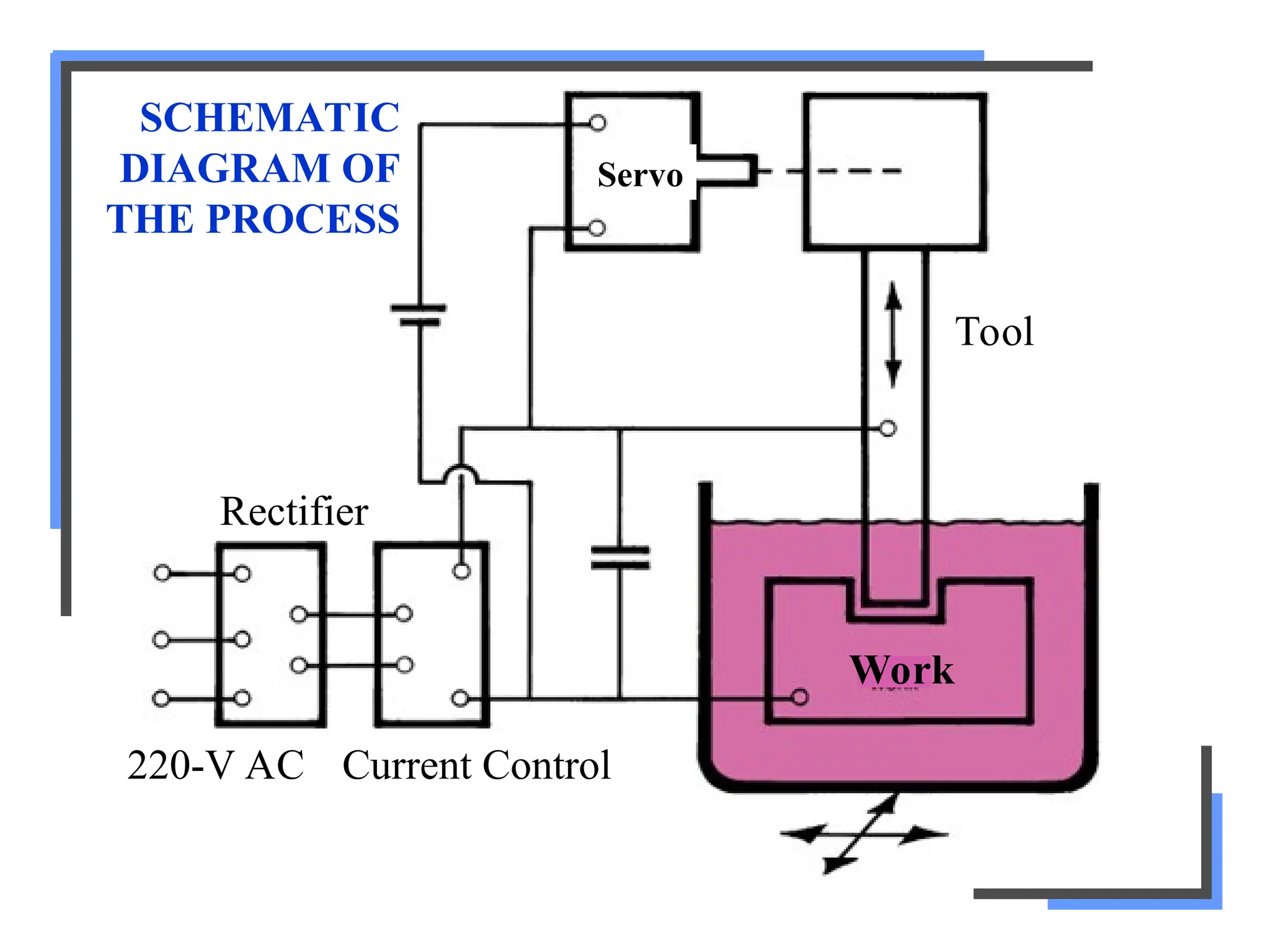
SCHEMATIC
DIAGRAM OF
THE PROCESS
Work
Tool
Servo
Rectifier
Current Control
220-V AC
Principle of EDM
• Controlled metal-removal technique where
electric spark used to cut (erode) workpiece
– Takes shape opposite to that of cutting tool
• Electrode (cutting tool) made from electrically
conductive material
• Dielectric fluid surrounds both tool and work
• Servo mechanism gives gap .005 to .001 in.
between work and tool
• Direct current of low voltage and high
amperage
Types of EDM Circuits
• Several types of electrical discharge power
supply used for EDM
• Two most common types of power supplies:
– Resistance-capacitance power supply
• Widely used on first EDM machines
• Capacitor charge through resistance from direct-
current voltage source
– Pulse-type power supply
Resistance-Capacitance Circuits
• Combination of low frequency, high
voltage, high capacitance, and high
amperage results:
– Rather coarse surface finish
– Large overcut around tool
– Larger metal particles being removed and more
space to flush out particles
• Advantages of resistance-capacitance power
– Circuit simple and reliable
– Works well at low amperages
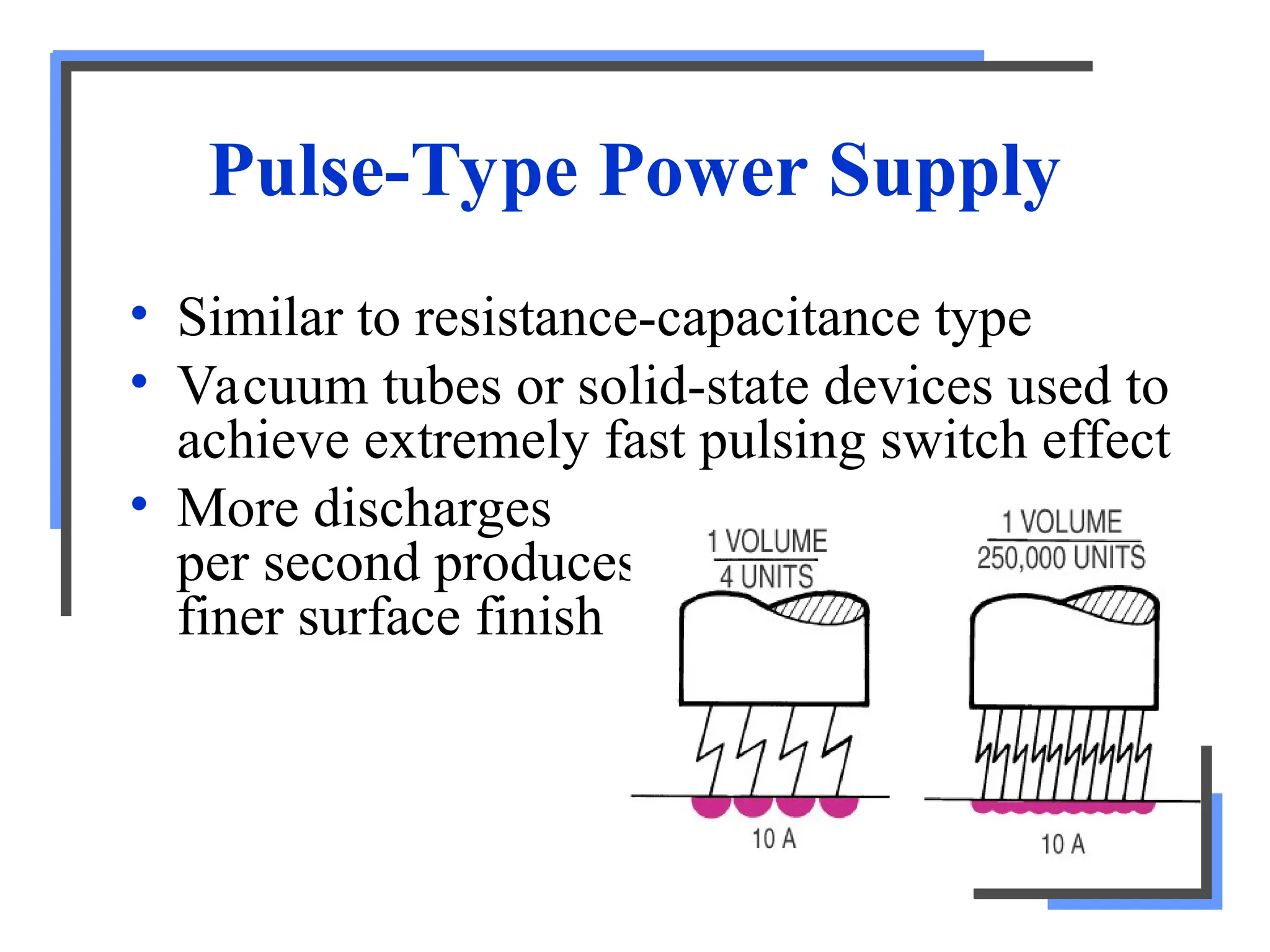
Pulse-Type Power Supply
• Similar to resistance-capacitance type
• Vacuum tubes or solid-state devices used to
achieve extremely fast pulsing switch effect
• More discharges
per second produces
finer surface finish
Main Advantages of
Pulse-Type Circuit
• Versatile and can be accurately controlled
for roughing and finishing cuts
• Better surface finish produced as less metal
removed per spark
– Many sparks per unit of time
• Less overcut around electrode (tool)
The Electrode
• Formed to shape of cavity desired
• Characteristics of good electrode materials:
– Be good conductors of electricity and heat
– Be easily machined to shape at reasonable cost
– Produce efficient metal removal from work
– Resist deformation during erosion process
– Exhibit low electrode (tool) wear rates
Electrode
• Common materials (not general-purpose)
– Graphite, cooper, copper graphite, copper tungsten,
brass, and steel
• Yellow brass used for pulse-type circuits
– Good machinability, electrical conductivity
• Copper used in resistance-capacitance circuits
with higher voltages
• Graphite
– Gaining acceptance, relatively inexpensive
– Tool wear rate less and high metal-removal rate almost
double of other materials
EDM Process
• Servo mechanism
– Automatically maintains constant gap ~.0005
to .001 in. between electrode and work
– Advance tool into workpiece, senses and corrects
any shorted condition by rapidly retracting tool
(vertical movement)
– Feed control applied to table for horizontal moves
• EDM power supply
– Provides direct current electrical energy for
electrical discharges between tool and work
Characteristics of
Pulse-Type Circuits
1. Low voltages
• Normally about 70 V, drops to 20 V after
spark initiated
2. Low capacitance
• About 50 mF or less
3. High frequencies
• Usually 20,000 to 30,000 Hz
4. Low-energy spark levels
The Discharge Process
• Dielectric fluid changes into gas when
sufficient electrical energy applied
• Allows heavy discharge of current to flow
through ionized path and strike workpiece
• Heat between electrode and work surface
causes small pool of molten metal to form
on work surface
• Current stopped (microseconds), molten
metal particles solidify and washed away
• Electrical discharges occur at rate of 20,000
to 30,000 Hz
– Each discharge removes minute amount of
metal
– Voltage constant so amount of metal removed
will be proportional to amount of charge
between electrode and work
• Current maintained but frequency increased,
results in smaller craters and better surface
Main Functions of
Dielectric Fluid
1. Serves as insulator between tool and
workpiece until required voltage reached
2. Vaporizes (ionizes) to initiate spark
between electrode and workpiece
3. Confines spark path to narrow channel
4. Flushes away metal particles to prevent
shorting
5. Acts as coolant for both electrode and
workpiece
Types of Dielectrics
• Must be able to ionize and deionize rapidly
and have low viscosity
– Allow them to be pumped through narrow
machining gap
• Most common have been various petroleum
products
– Light lubricating oils, transformer oils, silicon-
base oils and kerosene
• Selection of dielectric important since it
affects metal-removal rate and electrode
wear
Methods of Circulating
Dielectrics
• Must be circulated under constant pressure
• Pressure used generally begins with 5 psi
and increased until optimum cutting
obtained
• Four methods to circulate dielectric fluid
– All must use fine filters in system to remove
metal particles so they are not recirculated
Down Through the Electrode
Pressure
• Hole drilled through electrode and dielectric
fluid forced through electrode
and between it and work
 Rapidly flushes away
metal particles
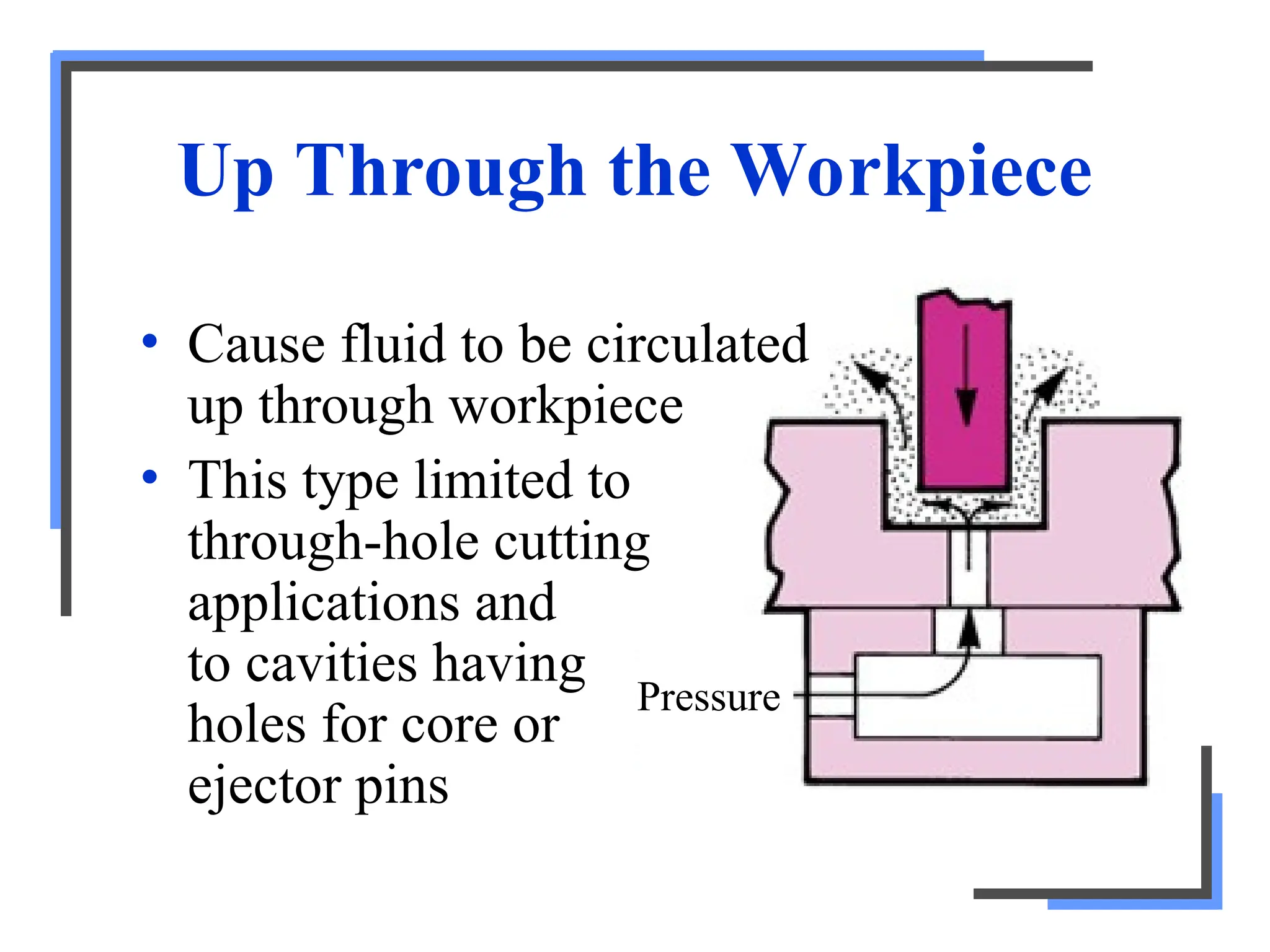
Up Through the Workpiece
Pressure
• Cause fluid to be circulated
up through workpiece
• This type limited to
through-hole cutting
applications and
to cavities having
holes for core or
ejector pins
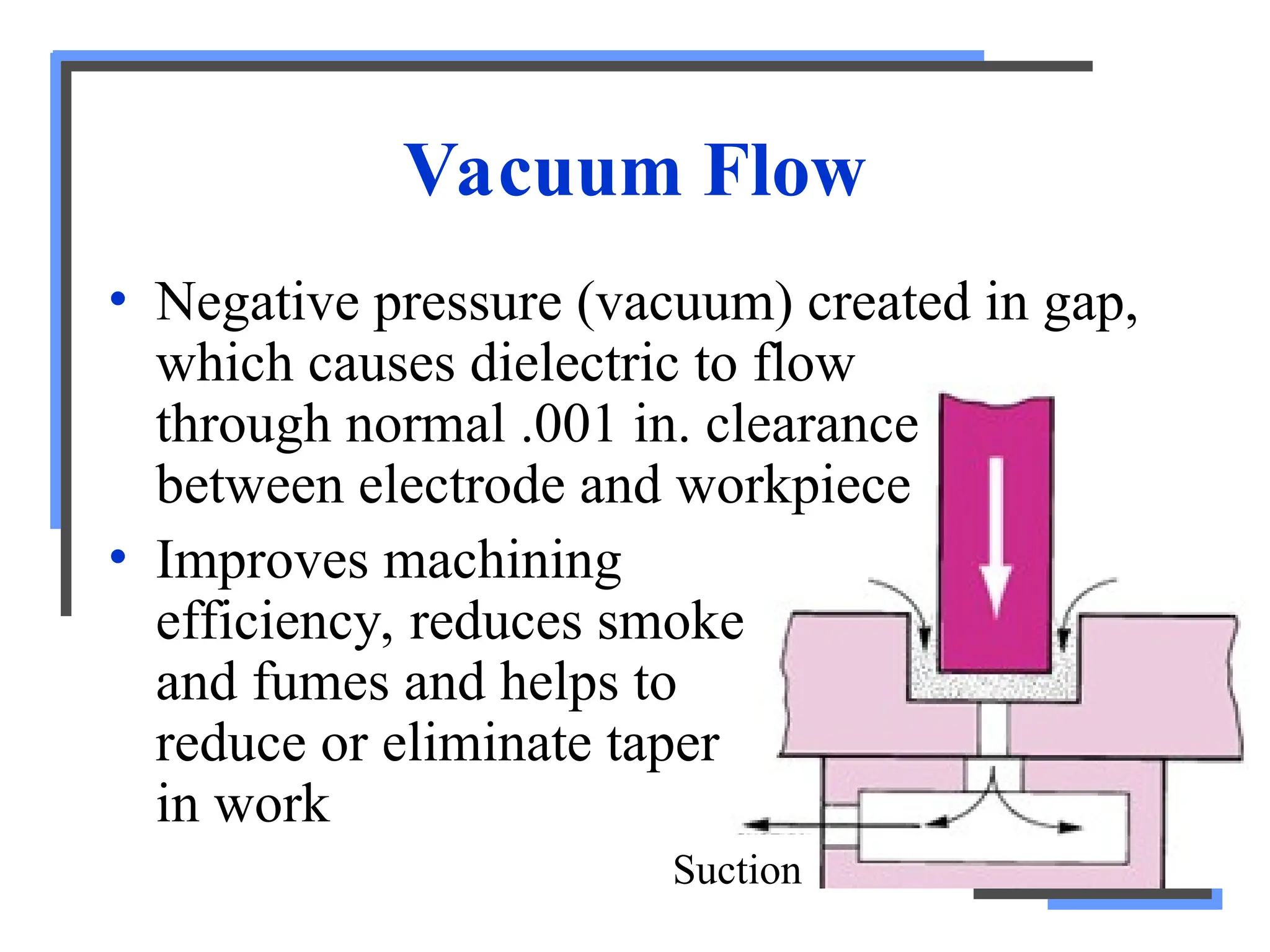
Vacuum Flow
Suction
• Negative pressure (vacuum) created in gap,
which causes dielectric to flow
through normal .001 in. clearance
between electrode and workpiece
• Improves machining
efficiency, reduces smoke
and fumes and helps to
reduce or eliminate taper
in work
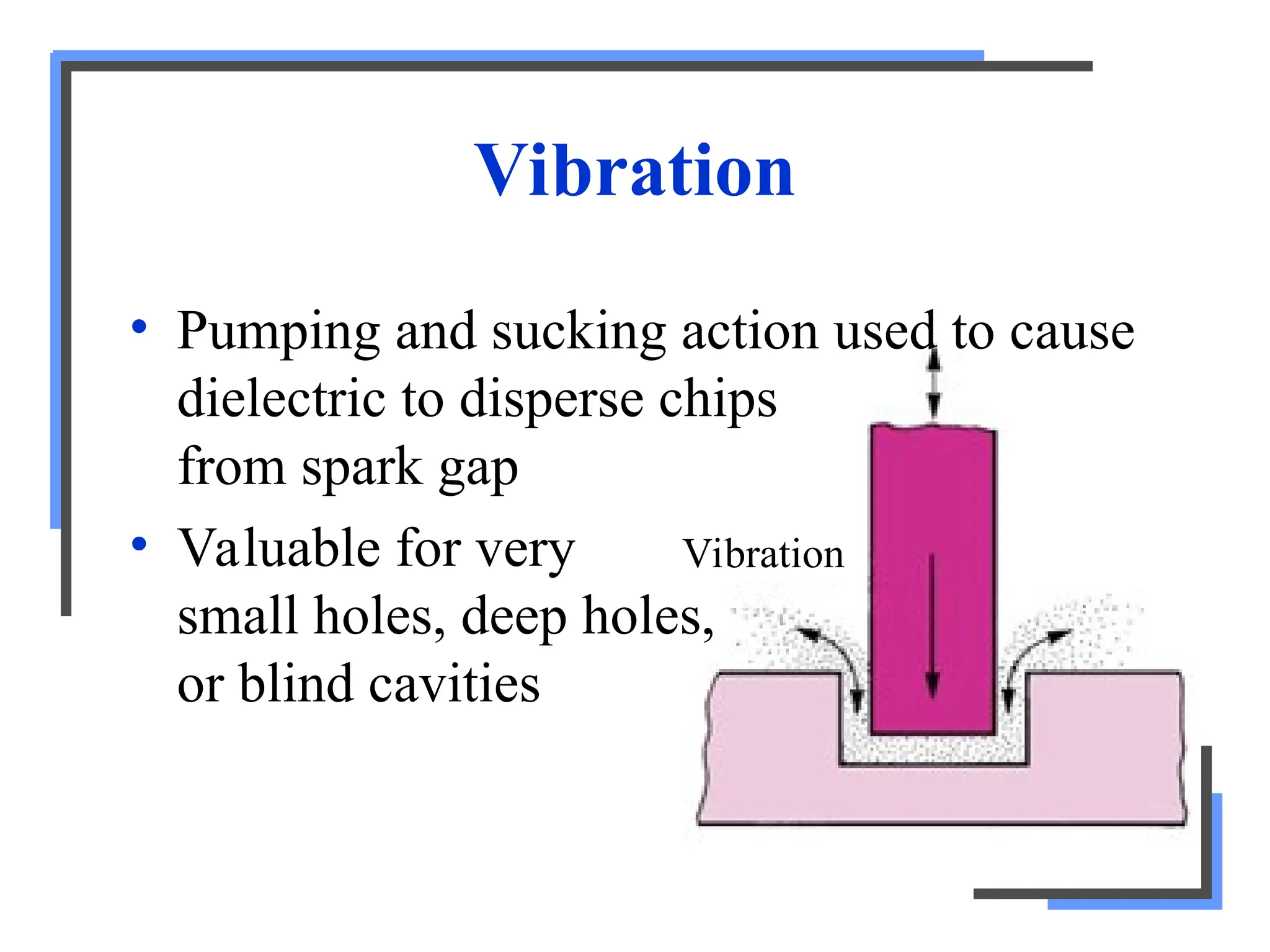
Vibration
Vibration
• Pumping and sucking action used to cause
dielectric to disperse chips
from spark gap
• Valuable for very
small holes, deep holes,
or blind cavities
Metal-Removal Rates
• Rate dependent on following factors:
– Amount of current in each discharge
– Frequency of discharge
– Electrode material
– Workpiece material
– Dielectric flushing conditions
• Normal metal-removal rate ~1 in3
work
material per hour for every 20 A of current
Electrode (Tool) Wear
• During discharge process, tool subject to
wear or erosion
• Difficult to hold close tolerances as tool
gradually loses its shape during machining
operation
• Average wear ratio of workpiece to
electrode is 3:1 for metallic tools
– Graphite electrodes wear ratio 10:1
Reverse-Polarity Machining
• New development that promises to be major
breakthrough in reducing electrode wear
• Molten metal from workpiece deposited on
graphite electrode about as fast as electrode
worn away
• Operates best on low spark-discharge
frequencies and high amperage
• Improves metal-removal rates and reduces
electrode wear
Overcut
• Amount the cavity in the workpiece is cut
larger than the size of electrode used in
machining process
• Distance between surface of work and
surface of electrode (overcut) is equal to
length of sparks discharged
– Constant over all areas of electrode
• Amount ranges from .0002 to .007 in. and
dependent on amount of gap voltage
95-28
Overcut
• Amount varied to suit metal-removal rate
and surface finish required
– Determines size of chip removal
• Size of chip removed important factor in
setting amount of overcut because:
1. Chip in space between electrode and work
serve as conductors for electrical discharges
2. Large chips produced with higher amperages
require larger gap to enable them to be flushed
out effectively
Surface Finish
• Low metal-removal rates, surface finishes of 2 to
4 µin. possible
• High metal-removal rates, finishes of
1000 µin. produced
• Fast metal removal (roughing cuts)
– High amperage, low frequency, high capacitance and
minimum gap voltage required
• Slow metal removal (finish cut)
– Low amperage, high frequency, low capacitance and
highest gap voltage required
Advantages of EDM
• Any material that is electrically conductive
can be cut, regardless of its hardness
• Work can be machined in hardened state,
thereby overcoming deformation caused by
hardening process
• Broken taps or drills can readily be removed
from workpieces
• Does not create stresses in work material,
since tool never comes into contact with work
• Process is burr-free
• Thin, fragile sections easily machined without
deforming
• Process is automatic – servo mechanism
advances electrode into work as metal
removed
• One person can operate several EDM
machines at one time
• Intricate shapes, impossible to produce by
conventional means, are cut out of a solid
with relative ease
• Better dies and molds can be produced at
lower cost
• A die punch can be used as electrode to
reproduce its shape in matching die plate,
complete with necessary clearance
Limitations of EDM
• Metal-removal rates are low
• Material to be machined must be electrically
conductive
• Cavities produced are slightly tapered but
can be controlled for most applications to as
little as .0001 in. in every .250 in.
• Rapid electrode wear can be come costly in
some types of EDM equipment
• Electrodes smaller than .003 in. in diameter
are impractical
• Work surface is damaged to depth of
.0002 in. but is easily removed
• Slight case hardening occurs
– However, may be classed as advantage in some
instances
Wire-Cut EDM Machine
• Uses thin brass or copper wire as electrode
• Makes possible cutting most shapes and
contours from flat plate materials
– Complex shapes: tapers, involutes, parabolas,
and ellipses
• Process commonly used for:
– Machining tungsten carbide, polycrystalline
diamond, polycrystalline cubic boron nitride,
pure molybdenum, difficult-to-machine material
The Process
• Uses CNC to move workpiece along X and Y
axes in horizontal plane toward vertically
moving wire electrode
• Electrode does not contact workpiece but
operates in stream of dielectric fluid
– Directed to spark area between work and
electrode
– When in operation, dielectric fluid in spark area
breaks down, forming gas that permits spark to
jump between workpiece and electrode
– Eroded material caused by spark washed away
Operating Systems
• Four main operating systems of wire-cut
electrical discharge machines
– Servo mechanism
– Dielectric fluid
– Electrode
– Machine control unit
Servo Mechanism
• Controls cutting current levels, feed rate of
drive motors, and traveling speed of wire
• Automatically maintains constant gap of .001
to .002 in. between wire and workpiece
– Important there be no physical contact
• Advances workpiece into wire, senses work-
wire spacing, and slows or speeds up drive
motors to maintain proper arc gap
Dielectric Fluid
• Usually deionized water
• Serves several functions:
1. Helps initiate spark between wire and work
2. Serves as insulator between wire and work
3. Flushes away particles of disintegrated wire
and work from gap to prevent shorting
4. Acts as coolant for both wire and workpiece
Electrode
• Spool of brass, copper, tungsten,
molybdenum, or zinc wire ranging from .002
to .012 in. in diameter (2 to 100 lb)
– Continuously travels from supply spool to
takeup spool so new wire always in spark area
• Both electrode wear and material-removal
rate from workpiece depend on:
– Material's electrical and thermal conductivity, its
melting point and duration and intensity of
electrical pulses
Characteristics of
Electrode Materials
1. Be good conductor of electricity
2. Have high melting point
3. Have high tensile strength
4. Have good thermal conductivity
5. Produce efficient metal removal from
workpiece
Machine Control Unit
• Separated into three individual operator
panels
– Control panel for setting cutting conditions
(servo mechanism)
– Control panel for machine setup and data
required to produce part (numerical control)
– Control panel for manual data input (MDI) and
cathode ray tube display
THANK YOU

N.M.P. mechanical engineering electric discharge machining

  • 1.
  • 2.
    Objectives • Define electricaldischarge machining and state its principle • Summarize the EDM process • Identify the advantages and the limitations of electrical discharge machining • Name the main operating systems of wire-cut electrical discharge machines
  • 3.
    95-3 Electrical Discharge Machining •Commonly known as EDM • Proved valuable in machining of super touch new space-age alloys • Made it relatively simple to machine intricate shapes • Used extensively in plastics industry to produce cavities in steel molds
  • 4.
    95-4 Controlled spark removesmetal during electrical discharge machining
  • 5.
  • 6.
    Principle of EDM •Controlled metal-removal technique where electric spark used to cut (erode) workpiece – Takes shape opposite to that of cutting tool • Electrode (cutting tool) made from electrically conductive material • Dielectric fluid surrounds both tool and work • Servo mechanism gives gap .005 to .001 in. between work and tool • Direct current of low voltage and high amperage
  • 7.
    Types of EDMCircuits • Several types of electrical discharge power supply used for EDM • Two most common types of power supplies: – Resistance-capacitance power supply • Widely used on first EDM machines • Capacitor charge through resistance from direct- current voltage source – Pulse-type power supply
  • 8.
    Resistance-Capacitance Circuits • Combinationof low frequency, high voltage, high capacitance, and high amperage results: – Rather coarse surface finish – Large overcut around tool – Larger metal particles being removed and more space to flush out particles • Advantages of resistance-capacitance power – Circuit simple and reliable – Works well at low amperages
  • 9.
    Pulse-Type Power Supply •Similar to resistance-capacitance type • Vacuum tubes or solid-state devices used to achieve extremely fast pulsing switch effect • More discharges per second produces finer surface finish
  • 10.
    Main Advantages of Pulse-TypeCircuit • Versatile and can be accurately controlled for roughing and finishing cuts • Better surface finish produced as less metal removed per spark – Many sparks per unit of time • Less overcut around electrode (tool)
  • 11.
    The Electrode • Formedto shape of cavity desired • Characteristics of good electrode materials: – Be good conductors of electricity and heat – Be easily machined to shape at reasonable cost – Produce efficient metal removal from work – Resist deformation during erosion process – Exhibit low electrode (tool) wear rates
  • 12.
    Electrode • Common materials(not general-purpose) – Graphite, cooper, copper graphite, copper tungsten, brass, and steel • Yellow brass used for pulse-type circuits – Good machinability, electrical conductivity • Copper used in resistance-capacitance circuits with higher voltages • Graphite – Gaining acceptance, relatively inexpensive – Tool wear rate less and high metal-removal rate almost double of other materials
  • 13.
    EDM Process • Servomechanism – Automatically maintains constant gap ~.0005 to .001 in. between electrode and work – Advance tool into workpiece, senses and corrects any shorted condition by rapidly retracting tool (vertical movement) – Feed control applied to table for horizontal moves • EDM power supply – Provides direct current electrical energy for electrical discharges between tool and work
  • 14.
    Characteristics of Pulse-Type Circuits 1.Low voltages • Normally about 70 V, drops to 20 V after spark initiated 2. Low capacitance • About 50 mF or less 3. High frequencies • Usually 20,000 to 30,000 Hz 4. Low-energy spark levels
  • 15.
    The Discharge Process •Dielectric fluid changes into gas when sufficient electrical energy applied • Allows heavy discharge of current to flow through ionized path and strike workpiece • Heat between electrode and work surface causes small pool of molten metal to form on work surface
  • 16.
    • Current stopped(microseconds), molten metal particles solidify and washed away • Electrical discharges occur at rate of 20,000 to 30,000 Hz – Each discharge removes minute amount of metal – Voltage constant so amount of metal removed will be proportional to amount of charge between electrode and work • Current maintained but frequency increased, results in smaller craters and better surface
  • 17.
    Main Functions of DielectricFluid 1. Serves as insulator between tool and workpiece until required voltage reached 2. Vaporizes (ionizes) to initiate spark between electrode and workpiece 3. Confines spark path to narrow channel 4. Flushes away metal particles to prevent shorting 5. Acts as coolant for both electrode and workpiece
  • 18.
    Types of Dielectrics •Must be able to ionize and deionize rapidly and have low viscosity – Allow them to be pumped through narrow machining gap • Most common have been various petroleum products – Light lubricating oils, transformer oils, silicon- base oils and kerosene • Selection of dielectric important since it affects metal-removal rate and electrode wear
  • 19.
    Methods of Circulating Dielectrics •Must be circulated under constant pressure • Pressure used generally begins with 5 psi and increased until optimum cutting obtained • Four methods to circulate dielectric fluid – All must use fine filters in system to remove metal particles so they are not recirculated
  • 20.
    Down Through theElectrode Pressure • Hole drilled through electrode and dielectric fluid forced through electrode and between it and work  Rapidly flushes away metal particles
  • 21.
    Up Through theWorkpiece Pressure • Cause fluid to be circulated up through workpiece • This type limited to through-hole cutting applications and to cavities having holes for core or ejector pins
  • 22.
    Vacuum Flow Suction • Negativepressure (vacuum) created in gap, which causes dielectric to flow through normal .001 in. clearance between electrode and workpiece • Improves machining efficiency, reduces smoke and fumes and helps to reduce or eliminate taper in work
  • 23.
    Vibration Vibration • Pumping andsucking action used to cause dielectric to disperse chips from spark gap • Valuable for very small holes, deep holes, or blind cavities
  • 24.
    Metal-Removal Rates • Ratedependent on following factors: – Amount of current in each discharge – Frequency of discharge – Electrode material – Workpiece material – Dielectric flushing conditions • Normal metal-removal rate ~1 in3 work material per hour for every 20 A of current
  • 25.
    Electrode (Tool) Wear •During discharge process, tool subject to wear or erosion • Difficult to hold close tolerances as tool gradually loses its shape during machining operation • Average wear ratio of workpiece to electrode is 3:1 for metallic tools – Graphite electrodes wear ratio 10:1
  • 26.
    Reverse-Polarity Machining • Newdevelopment that promises to be major breakthrough in reducing electrode wear • Molten metal from workpiece deposited on graphite electrode about as fast as electrode worn away • Operates best on low spark-discharge frequencies and high amperage • Improves metal-removal rates and reduces electrode wear
  • 27.
    Overcut • Amount thecavity in the workpiece is cut larger than the size of electrode used in machining process • Distance between surface of work and surface of electrode (overcut) is equal to length of sparks discharged – Constant over all areas of electrode • Amount ranges from .0002 to .007 in. and dependent on amount of gap voltage
  • 28.
    95-28 Overcut • Amount variedto suit metal-removal rate and surface finish required – Determines size of chip removal • Size of chip removed important factor in setting amount of overcut because: 1. Chip in space between electrode and work serve as conductors for electrical discharges 2. Large chips produced with higher amperages require larger gap to enable them to be flushed out effectively
  • 29.
    Surface Finish • Lowmetal-removal rates, surface finishes of 2 to 4 µin. possible • High metal-removal rates, finishes of 1000 µin. produced • Fast metal removal (roughing cuts) – High amperage, low frequency, high capacitance and minimum gap voltage required • Slow metal removal (finish cut) – Low amperage, high frequency, low capacitance and highest gap voltage required
  • 30.
    Advantages of EDM •Any material that is electrically conductive can be cut, regardless of its hardness • Work can be machined in hardened state, thereby overcoming deformation caused by hardening process • Broken taps or drills can readily be removed from workpieces
  • 31.
    • Does notcreate stresses in work material, since tool never comes into contact with work • Process is burr-free • Thin, fragile sections easily machined without deforming • Process is automatic – servo mechanism advances electrode into work as metal removed • One person can operate several EDM machines at one time
  • 32.
    • Intricate shapes,impossible to produce by conventional means, are cut out of a solid with relative ease • Better dies and molds can be produced at lower cost • A die punch can be used as electrode to reproduce its shape in matching die plate, complete with necessary clearance
  • 33.
    Limitations of EDM •Metal-removal rates are low • Material to be machined must be electrically conductive • Cavities produced are slightly tapered but can be controlled for most applications to as little as .0001 in. in every .250 in.
  • 34.
    • Rapid electrodewear can be come costly in some types of EDM equipment • Electrodes smaller than .003 in. in diameter are impractical • Work surface is damaged to depth of .0002 in. but is easily removed • Slight case hardening occurs – However, may be classed as advantage in some instances
  • 35.
    Wire-Cut EDM Machine •Uses thin brass or copper wire as electrode • Makes possible cutting most shapes and contours from flat plate materials – Complex shapes: tapers, involutes, parabolas, and ellipses • Process commonly used for: – Machining tungsten carbide, polycrystalline diamond, polycrystalline cubic boron nitride, pure molybdenum, difficult-to-machine material
  • 36.
    The Process • UsesCNC to move workpiece along X and Y axes in horizontal plane toward vertically moving wire electrode • Electrode does not contact workpiece but operates in stream of dielectric fluid – Directed to spark area between work and electrode – When in operation, dielectric fluid in spark area breaks down, forming gas that permits spark to jump between workpiece and electrode – Eroded material caused by spark washed away
  • 37.
    Operating Systems • Fourmain operating systems of wire-cut electrical discharge machines – Servo mechanism – Dielectric fluid – Electrode – Machine control unit
  • 38.
    Servo Mechanism • Controlscutting current levels, feed rate of drive motors, and traveling speed of wire • Automatically maintains constant gap of .001 to .002 in. between wire and workpiece – Important there be no physical contact • Advances workpiece into wire, senses work- wire spacing, and slows or speeds up drive motors to maintain proper arc gap
  • 39.
    Dielectric Fluid • Usuallydeionized water • Serves several functions: 1. Helps initiate spark between wire and work 2. Serves as insulator between wire and work 3. Flushes away particles of disintegrated wire and work from gap to prevent shorting 4. Acts as coolant for both wire and workpiece
  • 40.
    Electrode • Spool ofbrass, copper, tungsten, molybdenum, or zinc wire ranging from .002 to .012 in. in diameter (2 to 100 lb) – Continuously travels from supply spool to takeup spool so new wire always in spark area • Both electrode wear and material-removal rate from workpiece depend on: – Material's electrical and thermal conductivity, its melting point and duration and intensity of electrical pulses
  • 41.
    Characteristics of Electrode Materials 1.Be good conductor of electricity 2. Have high melting point 3. Have high tensile strength 4. Have good thermal conductivity 5. Produce efficient metal removal from workpiece
  • 42.
    Machine Control Unit •Separated into three individual operator panels – Control panel for setting cutting conditions (servo mechanism) – Control panel for machine setup and data required to produce part (numerical control) – Control panel for manual data input (MDI) and cathode ray tube display
  • 43.