2 December 2005
Advanced Topics in Information Systems
Introduction
Prof. Beat Signer
Department of Computer Science
Vrije Universiteit Brussel
http://www.beatsigner.com
Beat Signer - Department of Computer Science - bsigner@vub.ac.be 2February 13, 2018
Seminar Organisation
 Prof. Beat Signer
Vrije Universiteit Brussel
PL9.3.43 (Pleinlaan 9)
+32 2 629 1239
bsigner@vub.ac.be
 Audrey Sanctorum
Vrije Universiteit Brussel
PL9.3.39 (Pleinlaan 9)
+32 2 629 3749
asanctor@vub.ac.be
Beat Signer - Department of Computer Science - bsigner@vub.ac.be 3February 13, 2018
Seminar Organisation ...
 Payam Ebrahimi
Vrije Universiteit Brussel
PL9.3.41 (Pleinlaan 9)
+32 2 629 3487
pebrahim@vub.be
 Reinout Roels
Vrije Universiteit Brussel
PL9.3.39 (Pleinlaan 9)
+32 2 629 3749
rroels@vub.ac.be
Beat Signer - Department of Computer Science - bsigner@vub.ac.be 4February 13, 2018
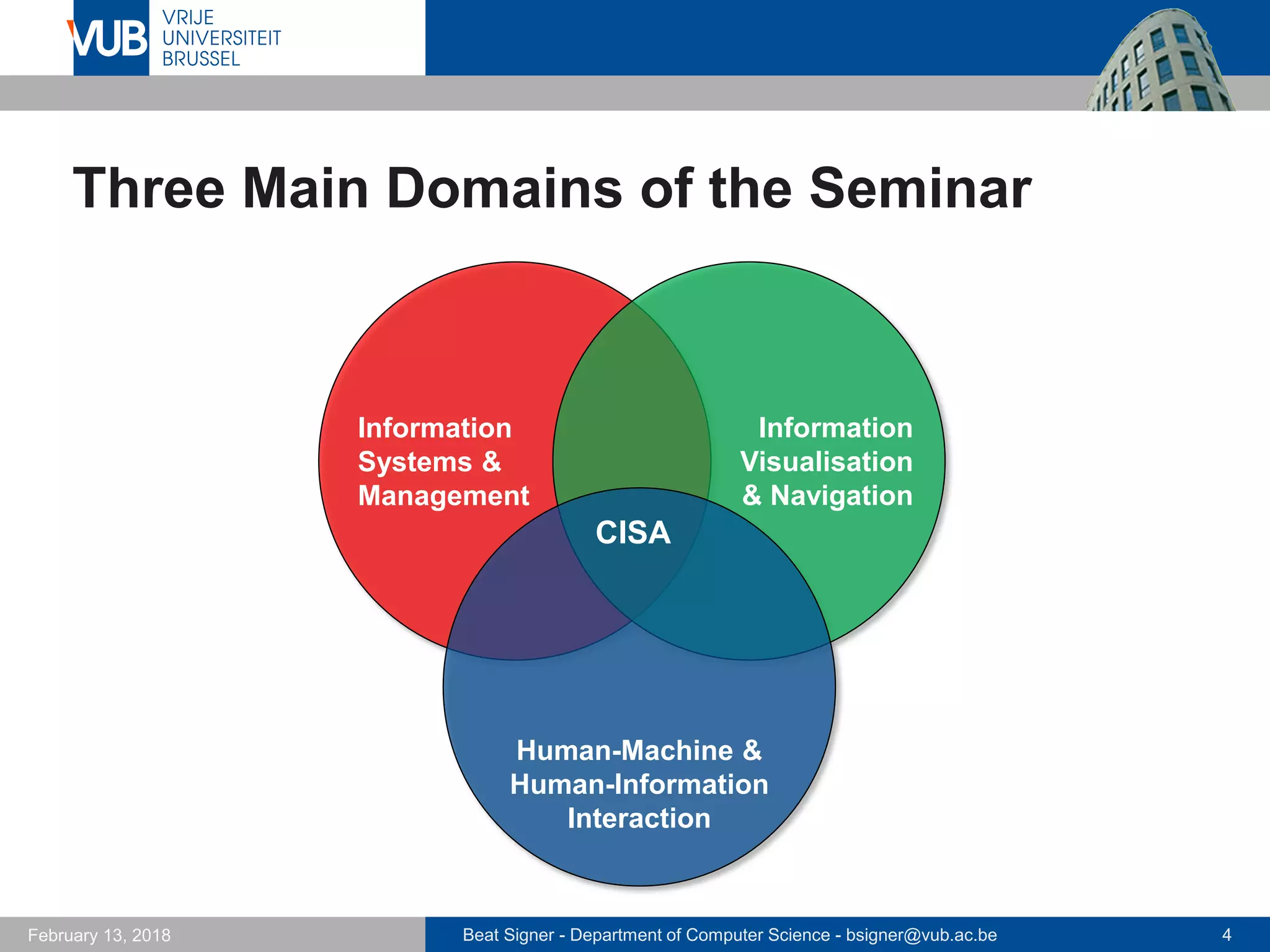
Three Main Domains of the Seminar
Information
Systems &
Management
Information
Visualisation
& Navigation
Information
Visualisation
nd NavigationHuman-Machine &
Human-Information
Interaction
CISA
Beat Signer - Department of Computer Science - bsigner@vub.ac.be 5February 13, 2018
"As We May Think" (1945)
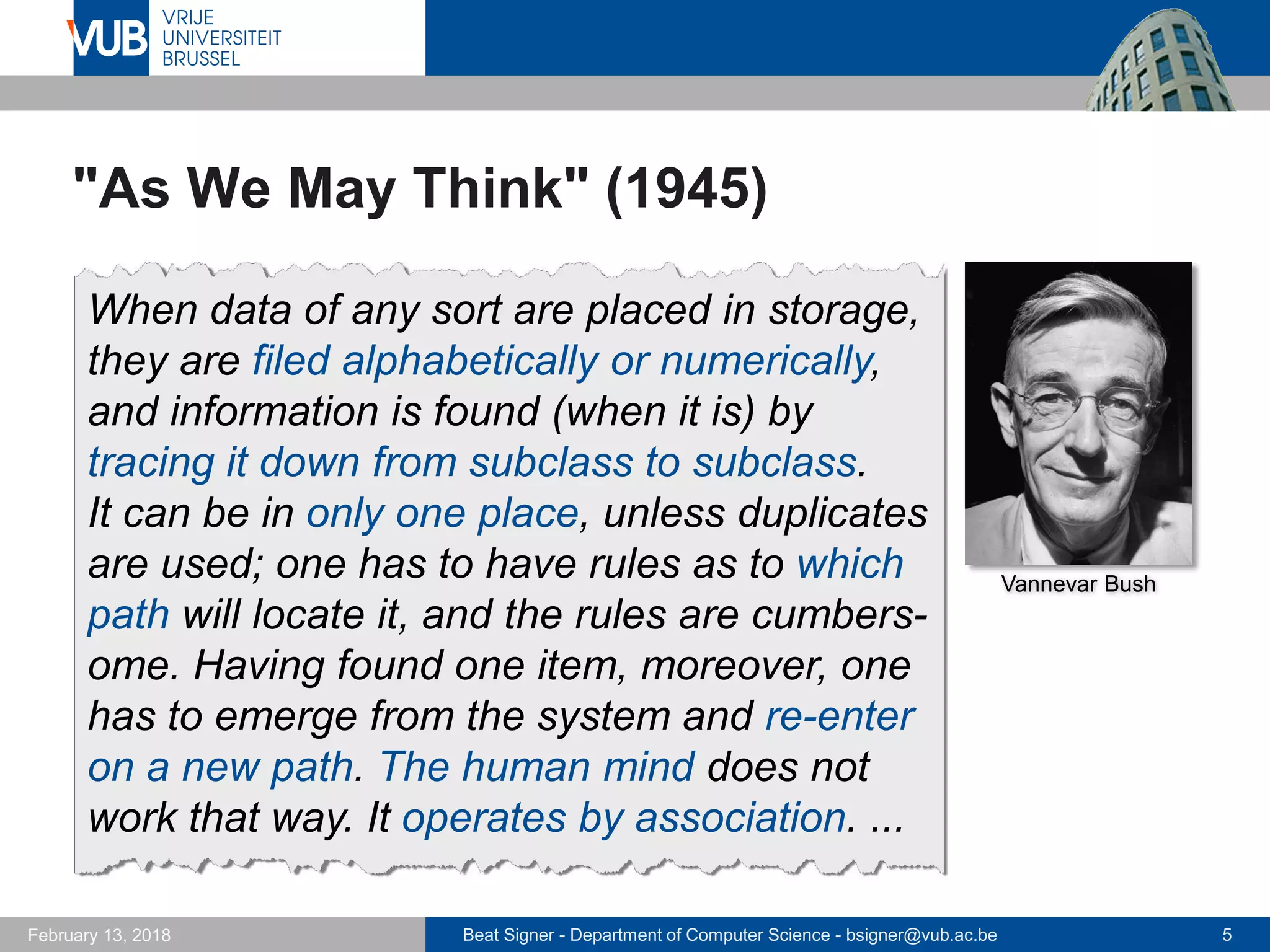
When data of any sort are placed in storage,
they are filed alphabetically or numerically,
and information is found (when it is) by
tracing it down from subclass to subclass.
It can be in only one place, unless duplicates
are used; one has to have rules as to which
path will locate it, and the rules are cumbers-
ome. Having found one item, moreover, one
has to emerge from the system and re-enter
on a new path. The human mind does not
work that way. It operates by association. ...
Vannevar Bush
Beat Signer - Department of Computer Science - bsigner@vub.ac.be 6February 13, 2018
"As We May Think" (1945) …
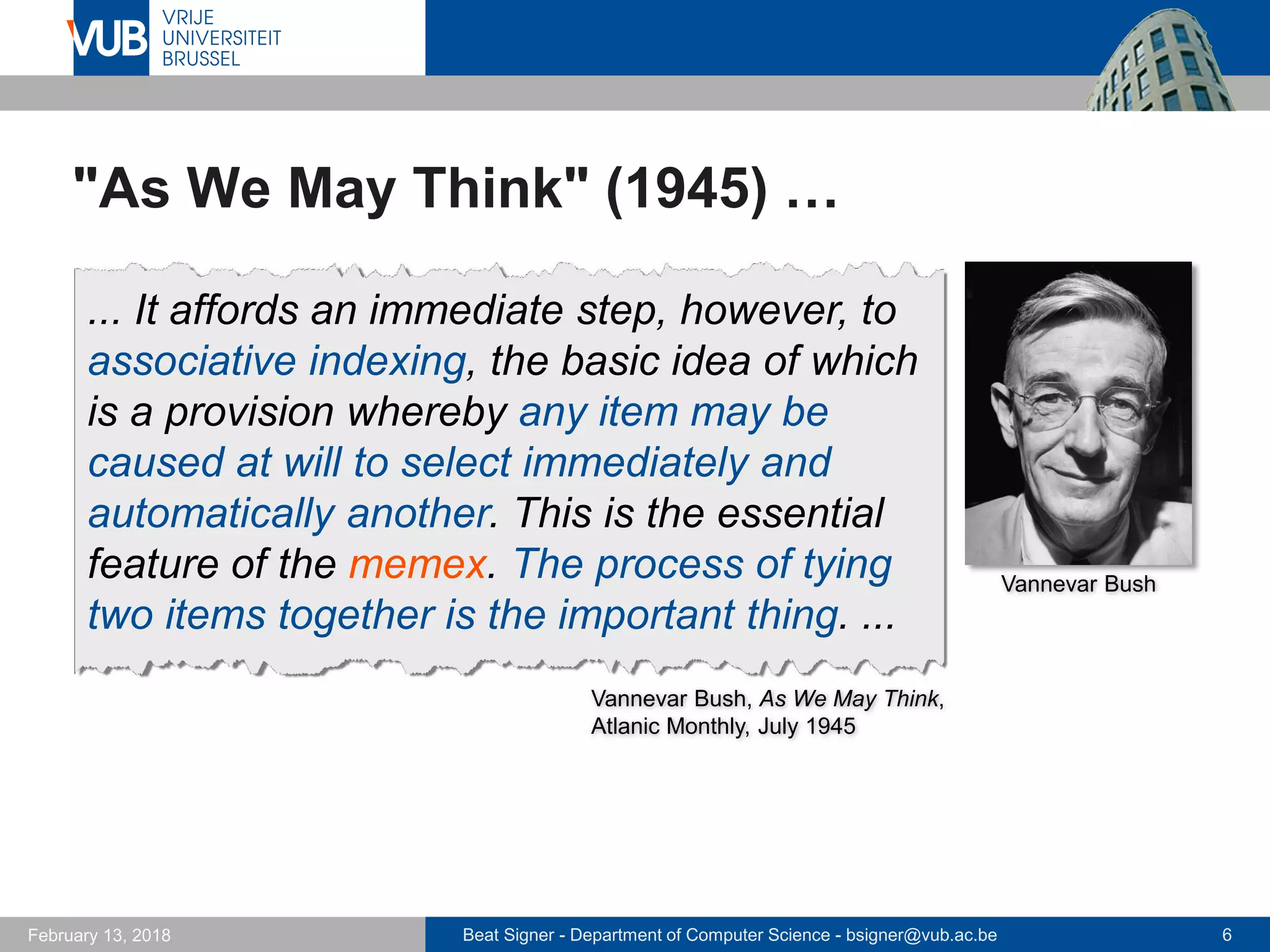
... It affords an immediate step, however, to
associative indexing, the basic idea of which
is a provision whereby any item may be
caused at will to select immediately and
automatically another. This is the essential
feature of the memex. The process of tying
two items together is the important thing. ...
Vannevar Bush, As We May Think,
Atlanic Monthly, July 1945
Vannevar Bush
Beat Signer - Department of Computer Science - bsigner@vub.ac.be 7February 13, 2018
"As We May Think" (1945) …
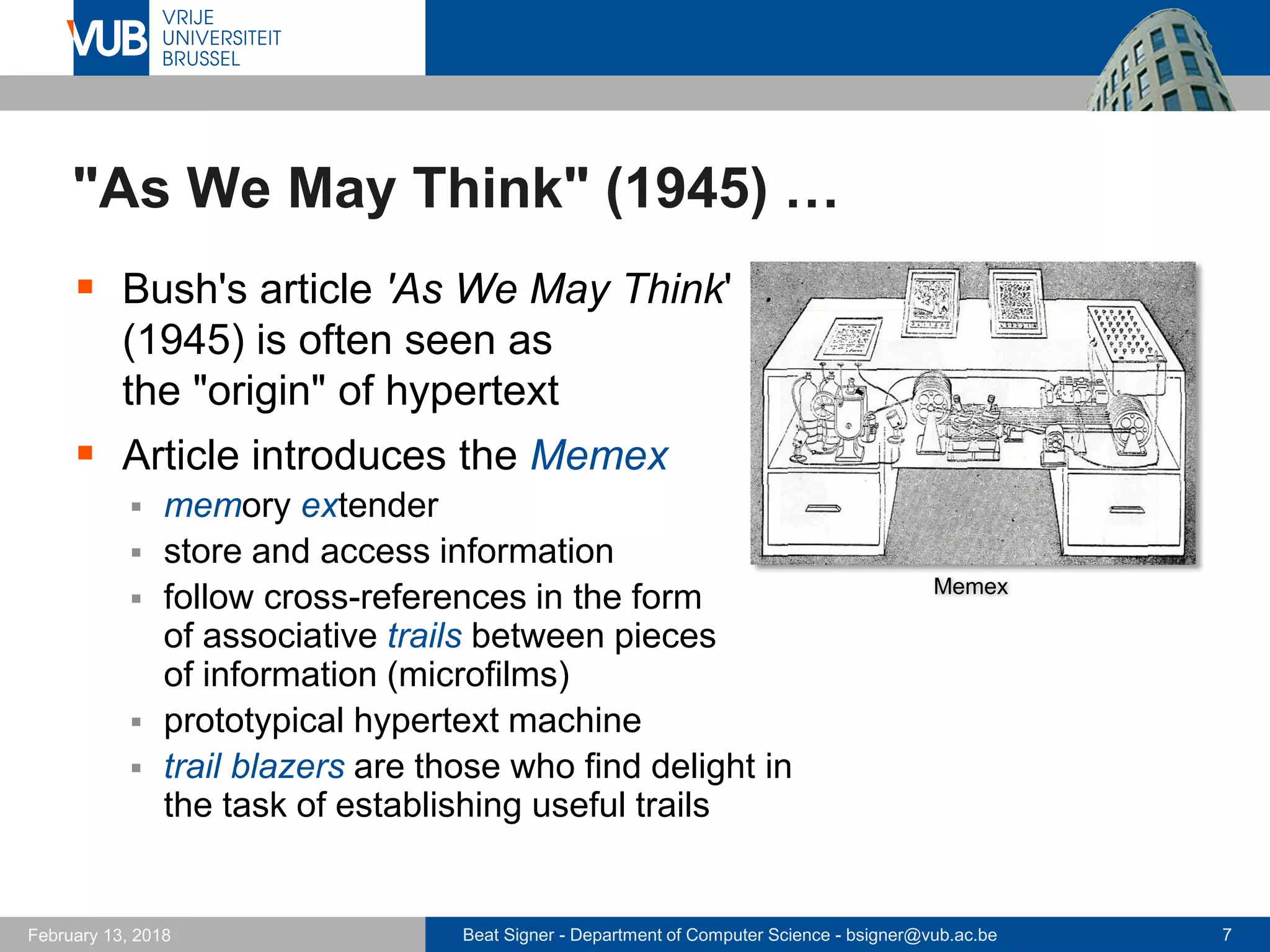
 Bush's article 'As We May Think'
(1945) is often seen as
the "origin" of hypertext
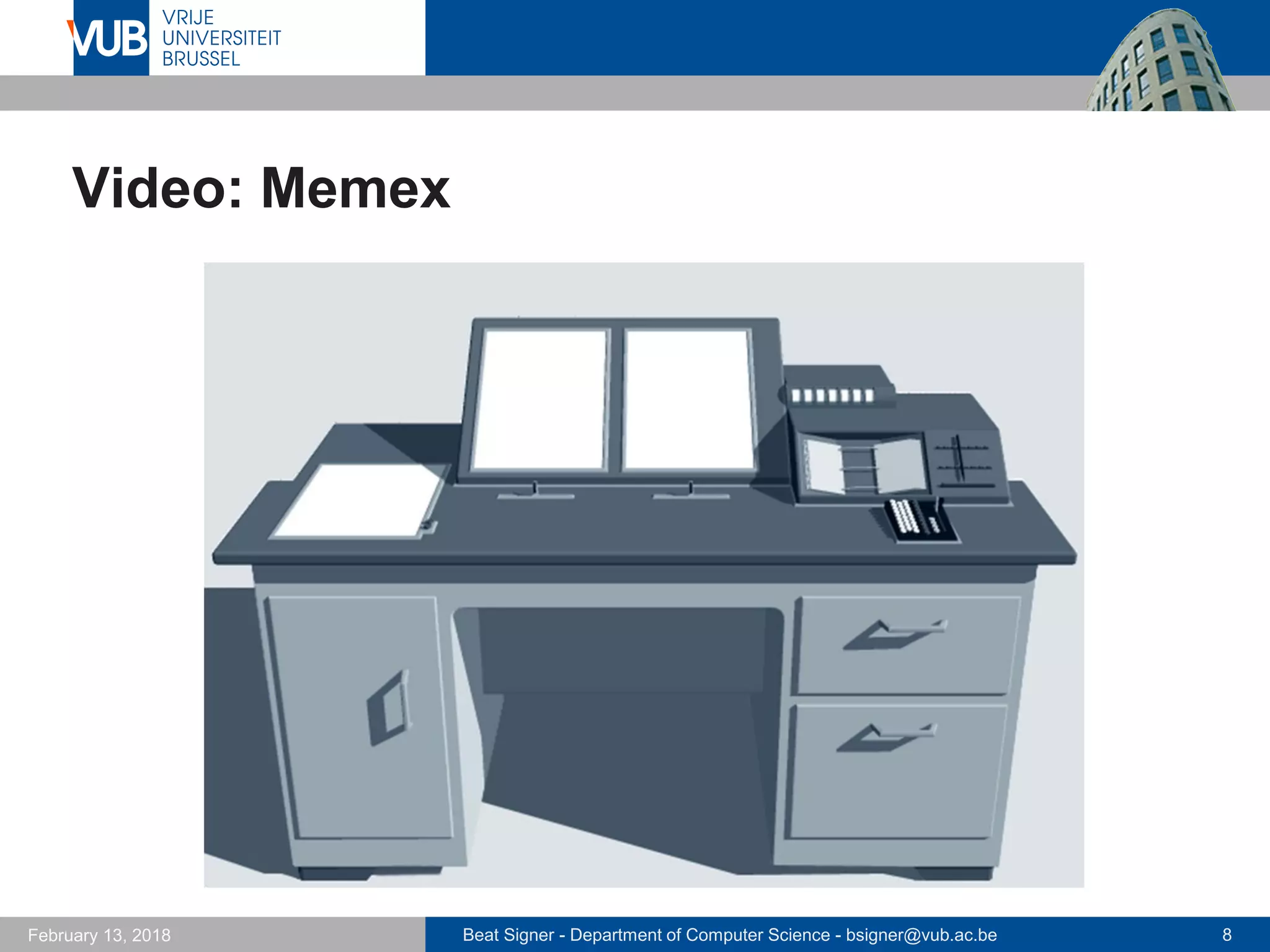
 Article introduces the Memex
 memory extender
 store and access information
 follow cross-references in the form
of associative trails between pieces
of information (microfilms)
 prototypical hypertext machine
 trail blazers are those who find delight in
the task of establishing useful trails
Memex
Beat Signer - Department of Computer Science - bsigner@vub.ac.be 8February 13, 2018
Video: Memex
Beat Signer - Department of Computer Science - bsigner@vub.ac.be 9February 13, 2018
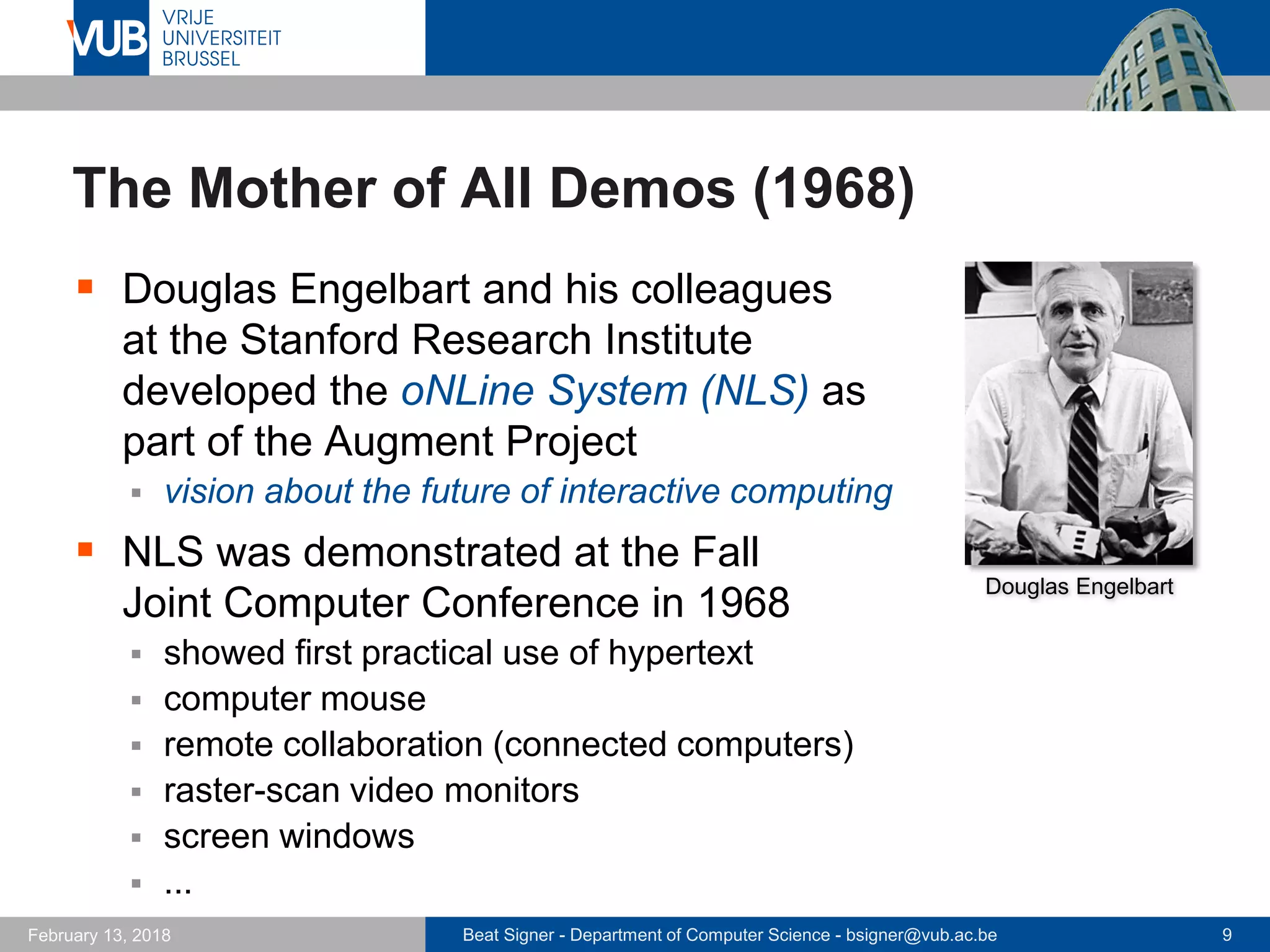
The Mother of All Demos (1968)
 Douglas Engelbart and his colleagues
at the Stanford Research Institute
developed the oNLine System (NLS) as
part of the Augment Project
 vision about the future of interactive computing
 NLS was demonstrated at the Fall
Joint Computer Conference in 1968
 showed first practical use of hypertext
 computer mouse
 remote collaboration (connected computers)
 raster-scan video monitors
 screen windows
 ...
Douglas Engelbart
Beat Signer - Department of Computer Science - bsigner@vub.ac.be 10February 13, 2018
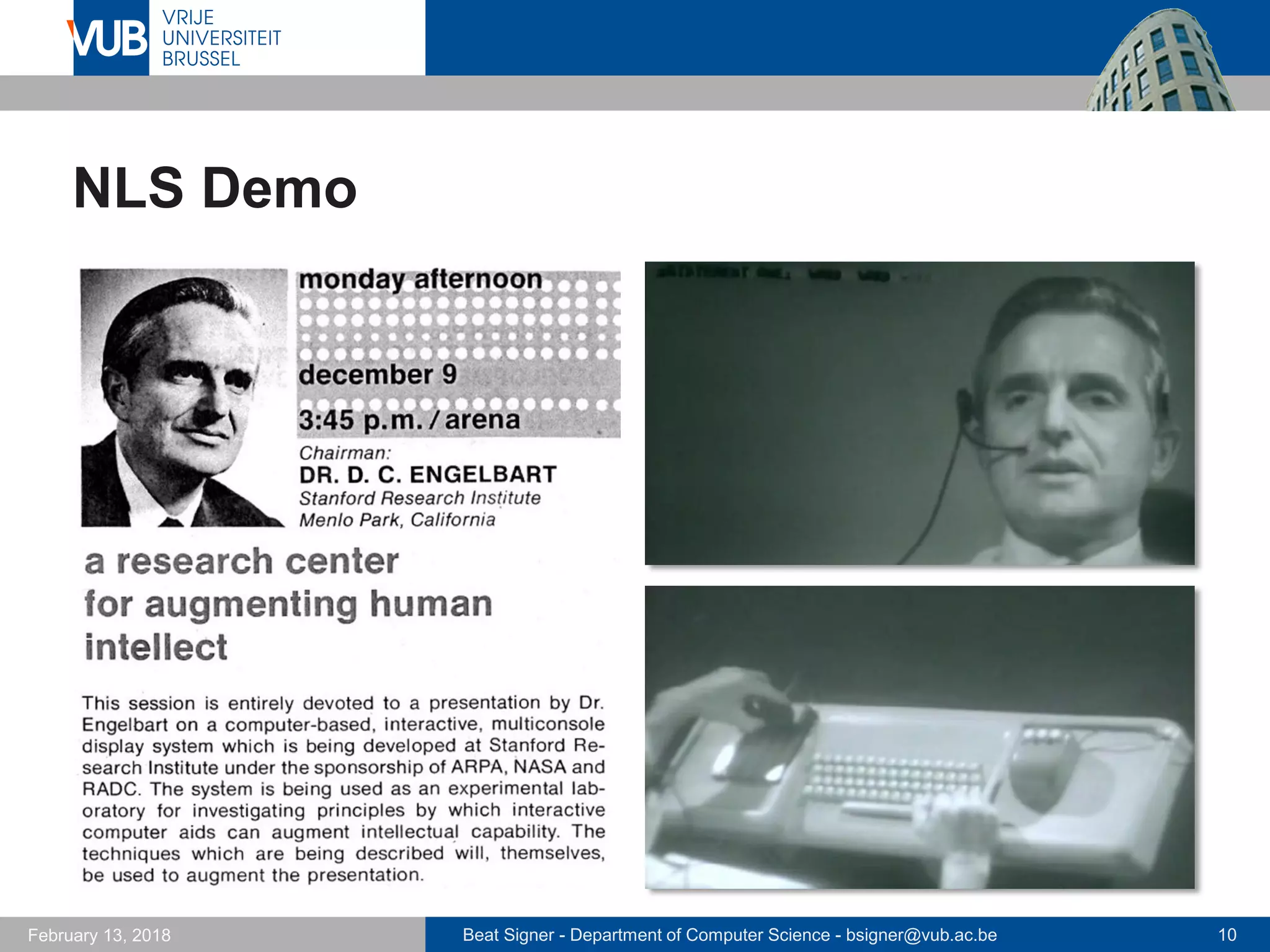
NLS Demo
Beat Signer - Department of Computer Science - bsigner@vub.ac.be 11February 13, 2018
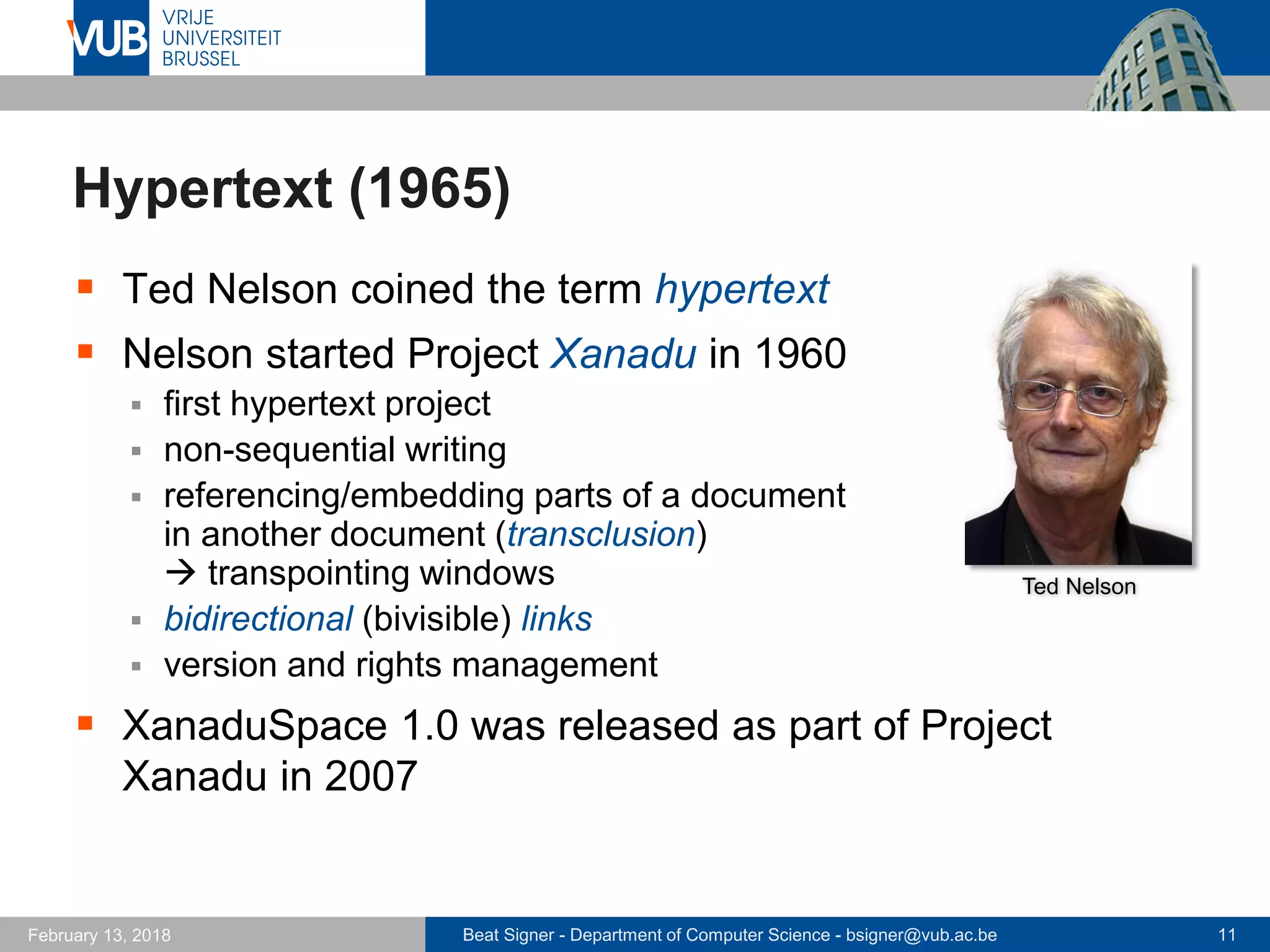
Hypertext (1965)
 Ted Nelson coined the term hypertext
 Nelson started Project Xanadu in 1960
 first hypertext project
 non-sequential writing
 referencing/embedding parts of a document
in another document (transclusion)
 transpointing windows
 bidirectional (bivisible) links
 version and rights management
 XanaduSpace 1.0 was released as part of Project
Xanadu in 2007
Ted Nelson
Beat Signer - Department of Computer Science - bsigner@vub.ac.be 12February 13, 2018
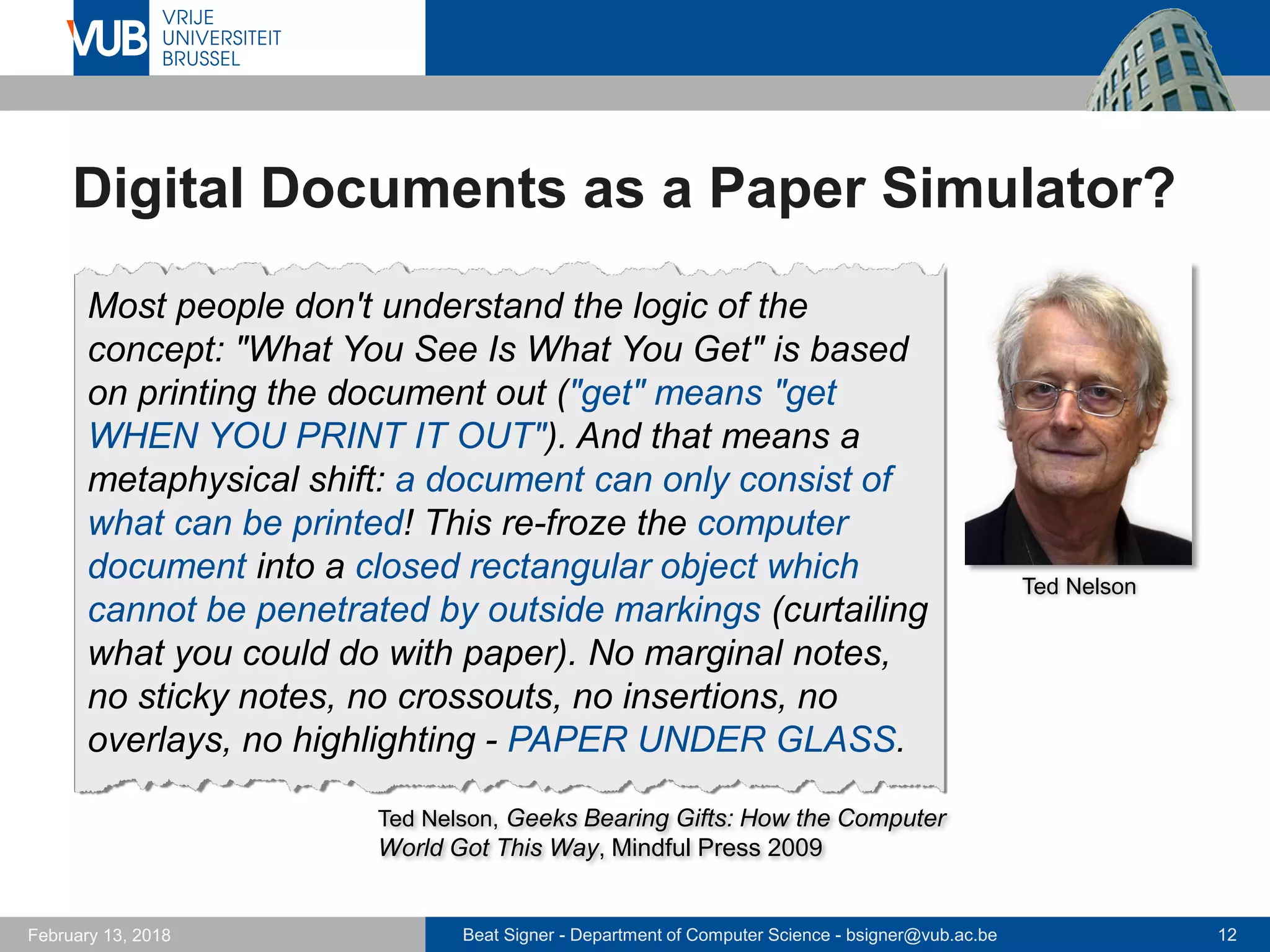
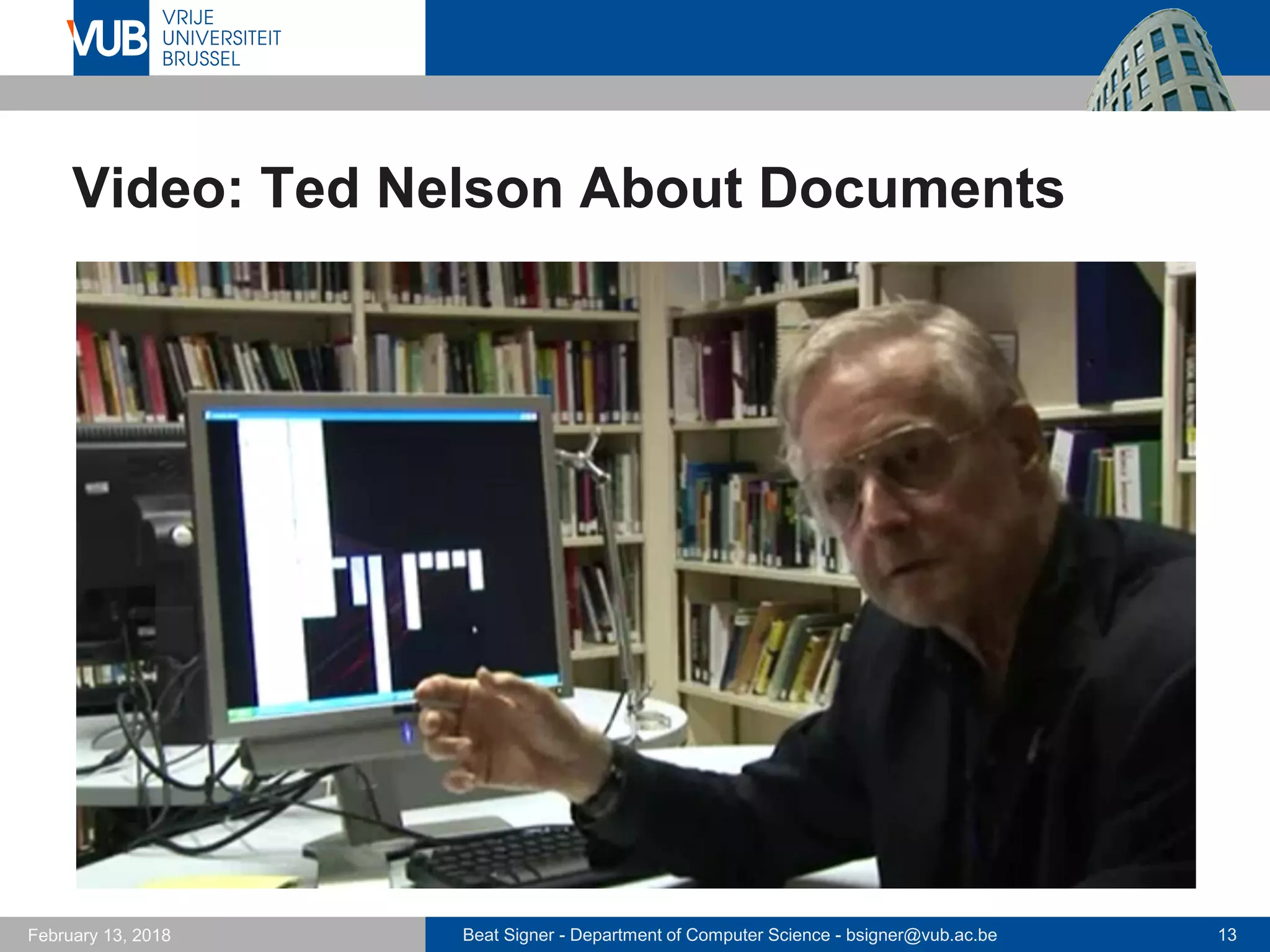
Digital Documents as a Paper Simulator?
Most people don't understand the logic of the
concept: "What You See Is What You Get" is based
on printing the document out ("get" means "get
WHEN YOU PRINT IT OUT"). And that means a
metaphysical shift: a document can only consist of
what can be printed! This re-froze the computer
document into a closed rectangular object which
cannot be penetrated by outside markings (curtailing
what you could do with paper). No marginal notes,
no sticky notes, no crossouts, no insertions, no
overlays, no highlighting - PAPER UNDER GLASS.
Ted Nelson, Geeks Bearing Gifts: How the Computer
World Got This Way, Mindful Press 2009
Ted Nelson
Beat Signer - Department of Computer Science - bsigner@vub.ac.be 13February 13, 2018
Video: Ted Nelson About Documents
Beat Signer - Department of Computer Science - bsigner@vub.ac.be 14February 13, 2018
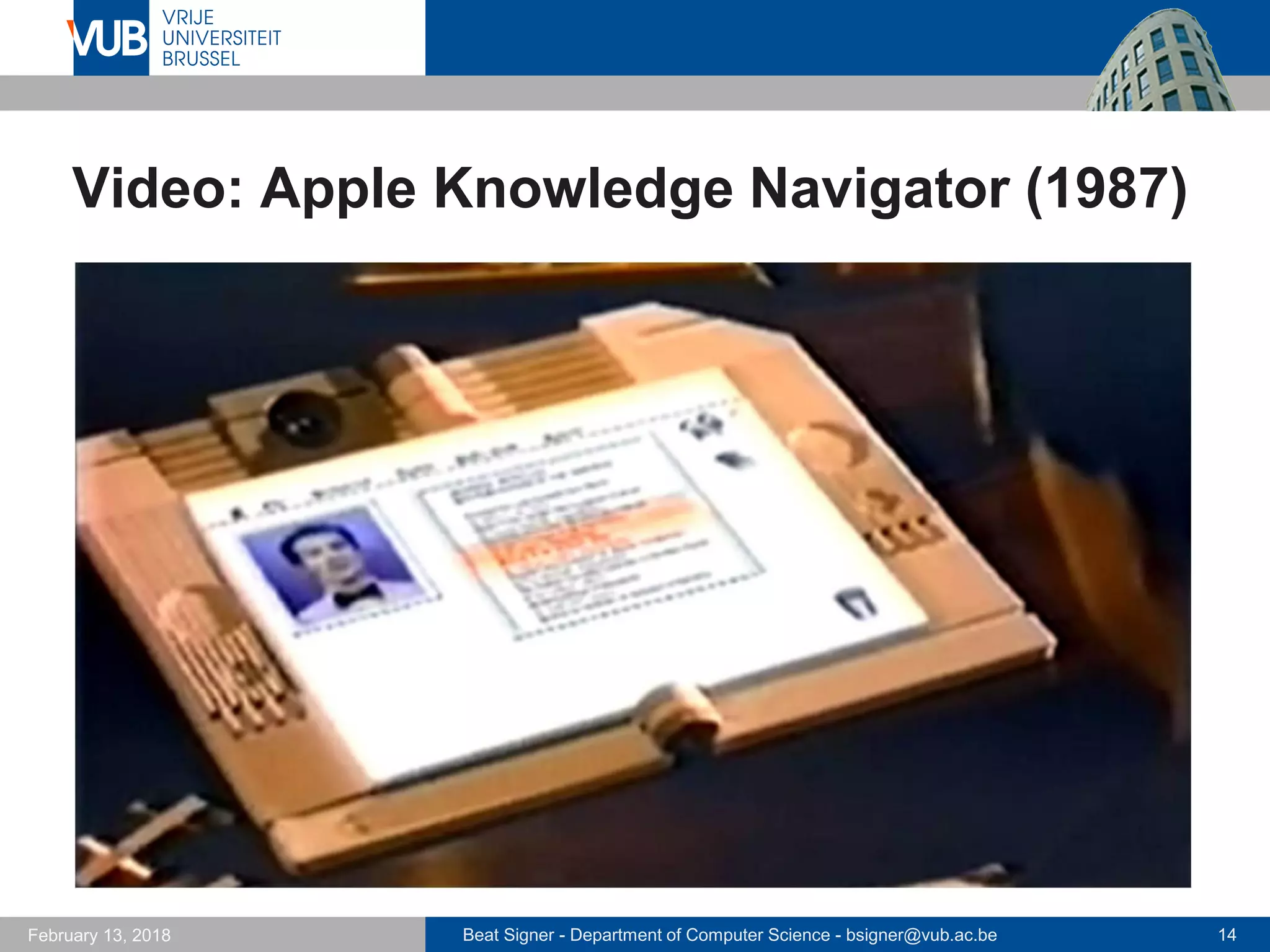
Video: Apple Knowledge Navigator (1987)
Beat Signer - Department of Computer Science - bsigner@vub.ac.be 15February 13, 2018
Video: Sun Microsystems' Starfire (1994)
Beat Signer - Department of Computer Science - bsigner@vub.ac.be 16February 13, 2018
Video: Microsoft Office Labs Vision 2019
Beat Signer - Department of Computer Science - bsigner@vub.ac.be 17February 13, 2018
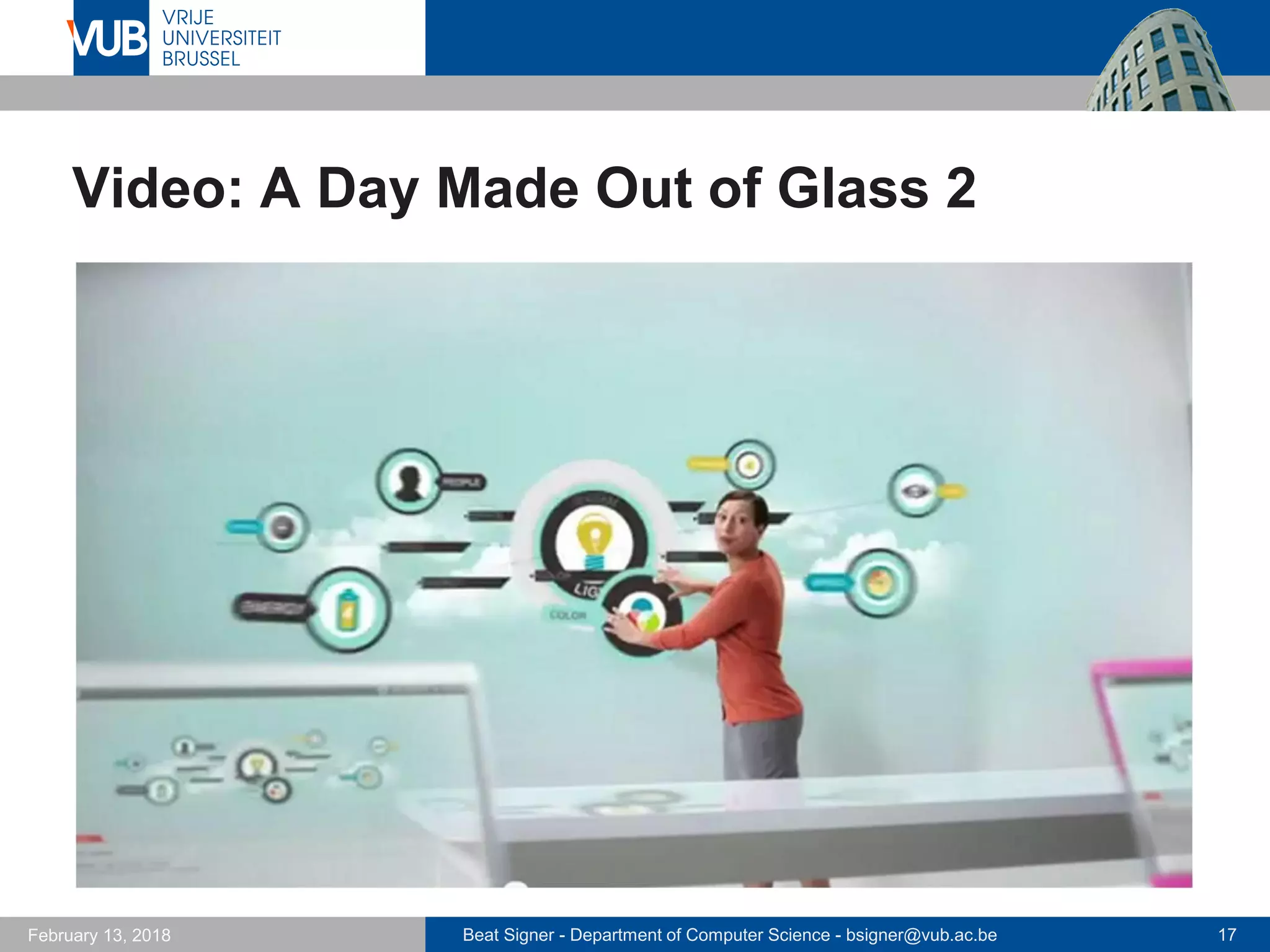
Video: A Day Made Out of Glass 2
Beat Signer - Department of Computer Science - bsigner@vub.ac.be 18February 13, 2018
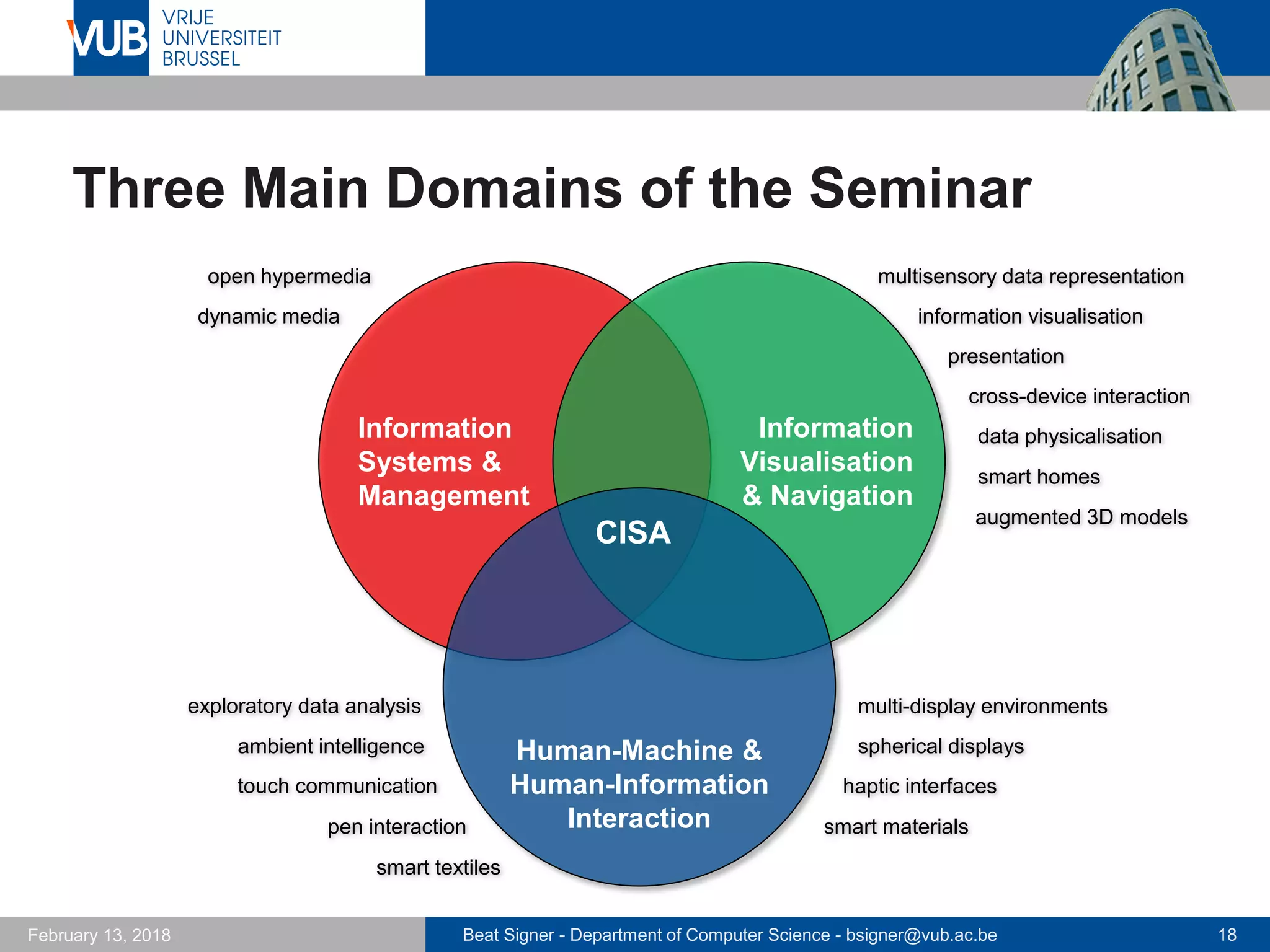
Three Main Domains of the Seminar
Information
Systems &
Management
Information
Visualisation
& Navigation
Information
Visualisation
nd NavigationHuman-Machine &
Human-Information
Interaction
CISA
open hypermedia
information visualisation
multisensory data representation
cross-device interaction
dynamic media
smart homes
data physicalisation
presentation
multi-display environments
spherical displaysambient intelligence
haptic interfaces
smart materials
touch communication
pen interaction
smart textiles
exploratory data analysis
augmented 3D models
Beat Signer - Department of Computer Science - bsigner@vub.ac.be 19February 13, 2018
Seminar Topics
1. Information Visualisation
 TouchPivot: Blending WIMP & Post-WIMP Interfaces for Data
Exploration on Tablet Devices, Jaemin Jo, Sehi L'Yi, Bongshin Lee and
Jinwook Se. Proceedings of CHI 2017, Conference on Human Factors in
Computing Systems, Denver, USA, May 2017. [Jo2017.pdf]
2. Exploratory Data Analysis
 Variolite: Supporting Exploratory Programming by Data Scientists, Mary
Beth Kery, Amber Horvath and Brad Myers. Proceedings of CHI 2017,
Conference on Human Factors in Computing Systems, Denver, USA,
May 2017. [Kery2017.pdf]
Beat Signer - Department of Computer Science - bsigner@vub.ac.be 20February 13, 2018
Seminar Topics ...
3. Presentation
 Interactive Concert Programs for Live Performances: A Presentation
Software, Raffaele Cipriano. Proceedings HT 2017, 28th ACM
Conference on Hypertext and Social Media, Prague, Czech Republic,
July 2017. [Cipriano2017.pdf]
4. Cross-Device Interaction
 Investigating Cross-Device Interaction between a Handheld Device and a
Large Display, Jeni Paay, Dimitrios Raptis, Jesper Kjeldskov, Mikael B.
Skov, Eric V. Ruder and Bjarke M. Lauridsen. Proceedings of CHI 2017,
Conference on Human Factors in Computing Systems, Denver, USA,
May 2017. [Paay2017.pdf]
Beat Signer - Department of Computer Science - bsigner@vub.ac.be 21February 13, 2018
Seminar Topics ...
5. Multi-Display Environments
 TDome: A Touch-Enabled 6DOF Interactive Device for Multi-Display
Environments, Houssem Saidi, Marcos Serrano, Pourang Irani and
Emmanuel Dubois. Proceedings of CHI 2017, Conference on Human
Factors in Computing Systems, Denver, USA, May 2017. [Saidi2017.pdf]
6. Dynamic Media
 Webstrates: Shareable Dynamic Media, Clemens Klokmose, James
Eagan, Siemen Baader, Wendy Mackay and Michel Beaudouin-Lafon,
Proceedings of UIST 2015, 28th Annual ACM Symposium on User
Interface Software and Technology, Charlotte, USA, November 2015.
[Klokmose2015.pdf]
Beat Signer - Department of Computer Science - bsigner@vub.ac.be 22February 13, 2018
Seminar Topics ...
7. Open Hypermedia
 Revisiting Hypertext Infrastructure, Proceedings of HT 2017, 28th ACM
Conference on Hypertext and Social Media, Prague, Czech Republic,
July 2017. [Atzenbeck2017.pdf]
8. Smart Homes
 What Happened in my Home?: An End-User Development Approach for
Smart Home Data Visualization, Nico Castelli, Corinna Ogonowski, Timo
Jakobi, Martin Stein, Gunnar Stevens and Volker Wulf. Proceedings of
CHI 2017, Conference on Human Factors in Computing Systems,
Denver, USA, May 2017. [Castelli2017.pdf]
Beat Signer - Department of Computer Science - bsigner@vub.ac.be 23February 13, 2018
Seminar Topics ...
9. Ambient Intelligence
 Rule-based Tools for the Configuration of Ambient Intelligence Systems:
A Comparative User Study, Federico Cabitza, Daniela Fogli, Rosa
Lanzilotti and Antonio Piccinno. Multimedia Tools and Applications 76(4),
February 2017. [Cabitza2017.pdf]
10.Pen Interaction
 FlexStylus: Leveraging Bend Input for Pen Interaction, Nicholas Fellion,
Thomas Pietrzak and Audrey Girouard. Proceedings of UIST 2017, 30th
Annual ACM Symposium on User Interface Software and Technology,
Quebec City, Canada, October 2017. [Fellion2017.pdf]
Beat Signer - Department of Computer Science - bsigner@vub.ac.be 24February 13, 2018
Seminar Topics ...
11.Spherical Displays
 Qoom: An Interactive Omnidirectional Ball Display, Shio Miyafuji, Toshiki
Sato, Zhengqing Li and Hideki Koike. Proceedings of UIST 2017, 30th
Annual ACM Symposium on User Interface Software and Technology,
Quebec City, Canada, October 2017. [Miyafuji2017.pdf]
12.Data Physicalisation
 Embedded Data Representations, Wesley Willett, Yvonne Jansen and
Pierre Dragicevic. IEEE Transactions on Visualization and Computer
Graphics, Institute of Electrical and Electronics Engineers, 2017.
[Willett2017.pdf]
Beat Signer - Department of Computer Science - bsigner@vub.ac.be 25February 13, 2018
Seminar Topics ...
13.Multisensory Data Representation
 Towards a Design Space for Multisensory Data Representation, Trevor
Hogan and Eva Hornecker, Interacting With Computers 29(2), March
2017. [Hogan2017.pdf]
14.Smart Materials
 BlowFab: Rapid Prototyping for Rigid and Reusable Objects using
Inflation of Laser-cut Surfaces, Junichi Yamaoka, Ryuma Niiyama and
Yasuaki Kakehi. Proceedings of UIST 2017, 30th Annual ACM
Symposium on User Interface Software and Technology, Quebec City,
Canada, October 2017. [Yamaoka2017.pdf]
Beat Signer - Department of Computer Science - bsigner@vub.ac.be 26February 13, 2018
Seminar Topics ...
15.Haptic Interfaces
 Grabity: A Wearable Haptic Interface for Simulating Weight and Grasping
in Virtual Reality, Inrak Choi, Heather Culbertson, Mark R. Miller, Alex
Olwal and Sean Follmer. Proceedings of UIST 2017, 30th Annual ACM
Symposium on User Interface Software and Technology, Quebec City,
Canada, October 2017. [Choi2017.pdf]
16.Smart Textiles
 SmartSleeve: Real-time Sensing of Surface and Deformation Gestures
on Flexible, Interactive Textiles, using a Hybrid Gesture Detection
Pipeline, Patrick Parzer, Adwait Sharma, Anita Vogl, Jürgen Steimle,
Alex Olwal and Michael Haller. Proceedings of UIST 2017, 30th Annual
ACM Symposium on User Interface Software and Technology, Quebec
City, Canada, October 2017. [Parzer2017.pdf]
Beat Signer - Department of Computer Science - bsigner@vub.ac.be 27February 13, 2018
Seminar Topics ...
17.Augmented 3D Models
 Markit and Talkit: A Low-Barrier Toolkit to Augment 3D Printed Models
with Audio Annotations, Lei Shi, Yuhang Zhao and Shiri Azenkot.
Proceedings of UIST 2017, 30th Annual ACM Symposium on User
Interface Software and Technology, Quebec City, Canada, October
2017. [Shi2017.pdf]
18.Touch Communication
 EM-Comm: Touch-based Communication via Modulated Electromagnetic
Emissions, Chouchang Jack Yang and Alanson P. Sample. Proceedings
of the ACM on Interactive, Mobile, Wearable and Ubiquitous
Technologies (IMWUT) 1(3), September 2017. [Yang2017.pdf]
Beat Signer - Department of Computer Science - bsigner@vub.ac.be 28February 13, 2018
Assignment of Topics
 Select 3 topics/papers from the presented list and mark
them (with A, B and C) according to your preferences
 Send an email with your choices (e.g. 6A, 8B, 14C) to
asanctor@vub.ac.be no later than February 16
 Each student will be assigned a paper that has to be
presented in the seminar and the final seminar schedule
will be made available by next week
Beat Signer - Department of Computer Science - bsigner@vub.ac.be 29February 13, 2018
Seminar Organisation
 Presentation should be 30 minutes long (not longer but
also not much shorter!)
 make use of the available time
 have some backup slides/material in case you finish too early and
for the Q&A
 Structure of your presentation
 introduction of topic and problem statement (5-10 mins)
 proposed approach (15-20 mins)
 review (5 mins)
- critical analysis
- at least two positive and two negative points about the paper
Beat Signer - Department of Computer Science - bsigner@vub.ac.be 30February 13, 2018
Seminar Organisation …
 Send a draft of your presentation to your supervisor no
later than one week before the presentation and arrange
a meeting with your supervisor
 you will get feedback about the structure and content of your
presentation
 Immediately after your presentation, please send us
(asanctor@vub.ac.be) your slides in order that we can
make them available for your colleagues on PointCarré
Beat Signer - Department of Computer Science - bsigner@vub.ac.be 31February 13, 2018
Seminar Organisation …
 Each student has to write a report about their presented
paper/topic
 same structure as presentation
- introduction of topic and problem statement
- proposed approach
- review
 no longer than 5 pages
 send a draft to your supervisor to get some feedback
- arrange a meeting with your supervisor
 deadline for final report: 22.5.2018
Beat Signer - Department of Computer Science - bsigner@vub.ac.be 32February 13, 2018
Seminar Organisation …
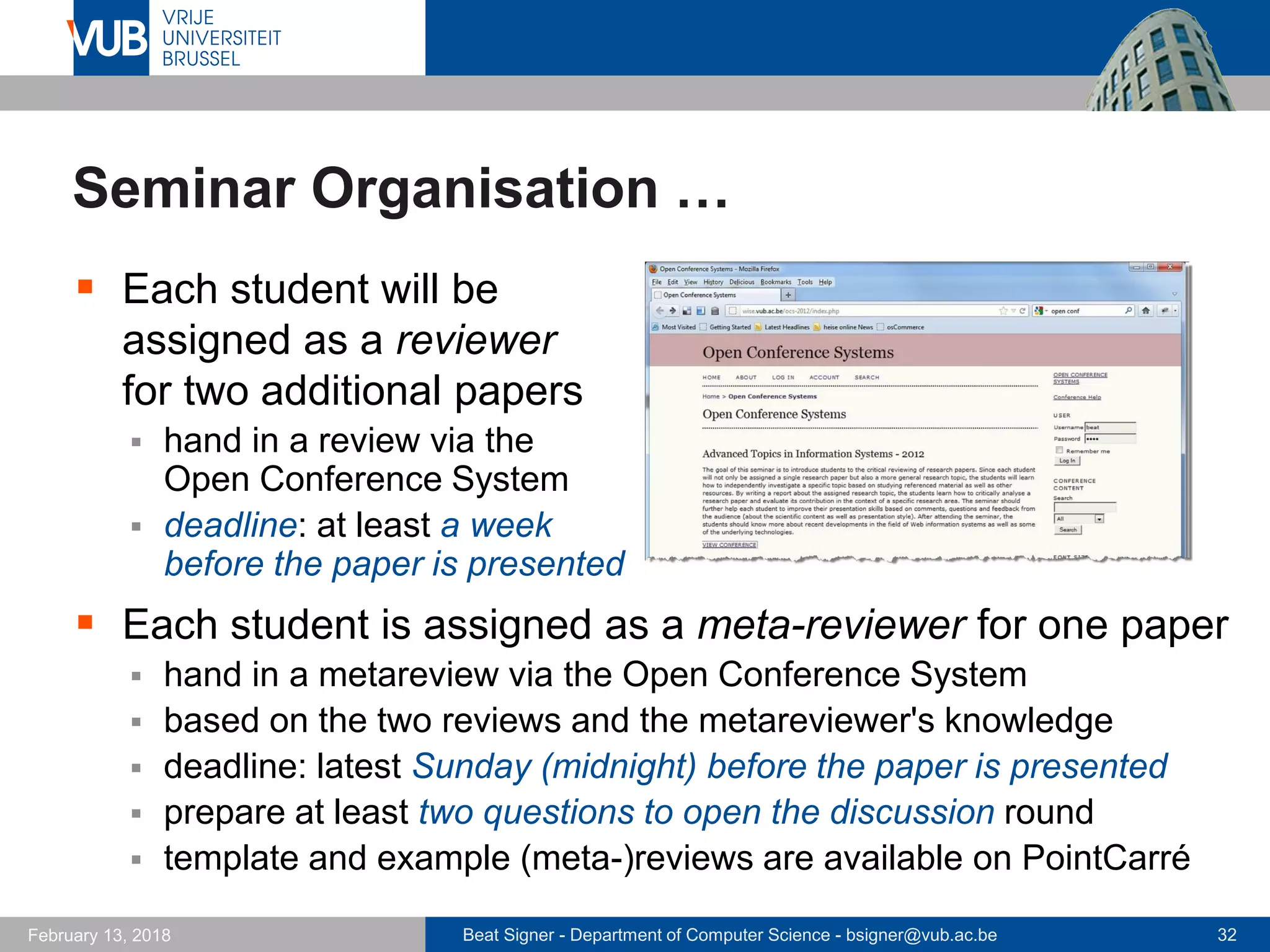
 Each student will be
assigned as a reviewer
for two additional papers
 hand in a review via the
Open Conference System
 deadline: at least a week
before the paper is presented
 Each student is assigned as a meta-reviewer for one paper
 hand in a metareview via the Open Conference System
 based on the two reviews and the metareviewer's knowledge
 deadline: latest Sunday (midnight) before the paper is presented
 prepare at least two questions to open the discussion round
 template and example (meta-)reviews are available on PointCarré
Beat Signer - Department of Computer Science - bsigner@vub.ac.be 33February 13, 2018
Seminar Organisation …
 Each student has to read the papers to be presented
every week before the seminar takes place and submit
two questions via an online form by latest Sunday
(midnight) before the lecture
 http://wise.vub.ac.be/atis/
Beat Signer - Department of Computer Science - bsigner@vub.ac.be 34February 13, 2018
Seminar Organisation …
 Final grade is based on
 presentation (70%)
 written report
 reviews and metareview
 active participation in the seminar and submitted questions
 Everybody is expected to read the papers before the
lecture takes place!
 after each presentation, there is enough time for questions and a
discussion about the topic and content of the paper
 Attendance to all presentations is mandatory!
 Schedule will be made available on PointCarré
 first presentations: 13.3.2018
Beat Signer - Department of Computer Science - bsigner@vub.ac.be 35February 13, 2018
References
 Vannevar Bush, As We May Think,
Atlanic Monthly, July 1945
 http://www.theatlantic.com/doc/194507/bush/
 http://sloan.stanford.edu/MouseSite/Secondary.html
 http://www.youtube.com/watch?v=c539cK58ees
 NLS demo
 http://sloan.stanford.edu/MouseSite/1968Demo.html
 Project Xanadu
 http://xanadu.com
 Ted Nelson demonstrates Xanadu Space
 http://www.youtube.com/watch?v=En_2T7KH6RA
Beat Signer - Department of Computer Science - bsigner@vub.ac.be 36February 13, 2018
References ...
 Apple Knowledge Navigator (1987)
 http://www.youtube.com/watch?v=xp4aRpcX5So
 Sun Microsystems' Starfire (1994)
 http://www.youtube.com/watch?v=h5LQgi15M1M
 Microsoft Office Labs Vision 2019
 http://www.youtube.com/watch?v=Zp-_oUwdSeY#!
 A Day Made Out of Glass 2, Corning Inc.
 http://www.youtube.com/watch?v=jZkHpNnXLB0
2 December 2005
Next Week
Assign Topics and Answer Questions
Some Tips for the Presentation
Open Conference System

Introduction - Lecture 1 - Advanced Topics in Information Systems (4016792ENR)

  • 1.
    2 December 2005 AdvancedTopics in Information Systems Introduction Prof. Beat Signer Department of Computer Science Vrije Universiteit Brussel http://www.beatsigner.com
  • 2.
    Beat Signer -Department of Computer Science - bsigner@vub.ac.be 2February 13, 2018 Seminar Organisation  Prof. Beat Signer Vrije Universiteit Brussel PL9.3.43 (Pleinlaan 9) +32 2 629 1239 bsigner@vub.ac.be  Audrey Sanctorum Vrije Universiteit Brussel PL9.3.39 (Pleinlaan 9) +32 2 629 3749 asanctor@vub.ac.be
  • 3.
    Beat Signer -Department of Computer Science - bsigner@vub.ac.be 3February 13, 2018 Seminar Organisation ...  Payam Ebrahimi Vrije Universiteit Brussel PL9.3.41 (Pleinlaan 9) +32 2 629 3487 pebrahim@vub.be  Reinout Roels Vrije Universiteit Brussel PL9.3.39 (Pleinlaan 9) +32 2 629 3749 rroels@vub.ac.be
  • 4.
    Beat Signer -Department of Computer Science - bsigner@vub.ac.be 4February 13, 2018 Three Main Domains of the Seminar Information Systems & Management Information Visualisation & Navigation Information Visualisation nd NavigationHuman-Machine & Human-Information Interaction CISA
  • 5.
    Beat Signer -Department of Computer Science - bsigner@vub.ac.be 5February 13, 2018 "As We May Think" (1945) When data of any sort are placed in storage, they are filed alphabetically or numerically, and information is found (when it is) by tracing it down from subclass to subclass. It can be in only one place, unless duplicates are used; one has to have rules as to which path will locate it, and the rules are cumbers- ome. Having found one item, moreover, one has to emerge from the system and re-enter on a new path. The human mind does not work that way. It operates by association. ... Vannevar Bush
  • 6.
    Beat Signer -Department of Computer Science - bsigner@vub.ac.be 6February 13, 2018 "As We May Think" (1945) … ... It affords an immediate step, however, to associative indexing, the basic idea of which is a provision whereby any item may be caused at will to select immediately and automatically another. This is the essential feature of the memex. The process of tying two items together is the important thing. ... Vannevar Bush, As We May Think, Atlanic Monthly, July 1945 Vannevar Bush
  • 7.
    Beat Signer -Department of Computer Science - bsigner@vub.ac.be 7February 13, 2018 "As We May Think" (1945) …  Bush's article 'As We May Think' (1945) is often seen as the "origin" of hypertext  Article introduces the Memex  memory extender  store and access information  follow cross-references in the form of associative trails between pieces of information (microfilms)  prototypical hypertext machine  trail blazers are those who find delight in the task of establishing useful trails Memex
  • 8.
    Beat Signer -Department of Computer Science - bsigner@vub.ac.be 8February 13, 2018 Video: Memex
  • 9.
    Beat Signer -Department of Computer Science - bsigner@vub.ac.be 9February 13, 2018 The Mother of All Demos (1968)  Douglas Engelbart and his colleagues at the Stanford Research Institute developed the oNLine System (NLS) as part of the Augment Project  vision about the future of interactive computing  NLS was demonstrated at the Fall Joint Computer Conference in 1968  showed first practical use of hypertext  computer mouse  remote collaboration (connected computers)  raster-scan video monitors  screen windows  ... Douglas Engelbart
  • 10.
    Beat Signer -Department of Computer Science - bsigner@vub.ac.be 10February 13, 2018 NLS Demo
  • 11.
    Beat Signer -Department of Computer Science - bsigner@vub.ac.be 11February 13, 2018 Hypertext (1965)  Ted Nelson coined the term hypertext  Nelson started Project Xanadu in 1960  first hypertext project  non-sequential writing  referencing/embedding parts of a document in another document (transclusion)  transpointing windows  bidirectional (bivisible) links  version and rights management  XanaduSpace 1.0 was released as part of Project Xanadu in 2007 Ted Nelson
  • 12.
    Beat Signer -Department of Computer Science - bsigner@vub.ac.be 12February 13, 2018 Digital Documents as a Paper Simulator? Most people don't understand the logic of the concept: "What You See Is What You Get" is based on printing the document out ("get" means "get WHEN YOU PRINT IT OUT"). And that means a metaphysical shift: a document can only consist of what can be printed! This re-froze the computer document into a closed rectangular object which cannot be penetrated by outside markings (curtailing what you could do with paper). No marginal notes, no sticky notes, no crossouts, no insertions, no overlays, no highlighting - PAPER UNDER GLASS. Ted Nelson, Geeks Bearing Gifts: How the Computer World Got This Way, Mindful Press 2009 Ted Nelson
  • 13.
    Beat Signer -Department of Computer Science - bsigner@vub.ac.be 13February 13, 2018 Video: Ted Nelson About Documents
  • 14.
    Beat Signer -Department of Computer Science - bsigner@vub.ac.be 14February 13, 2018 Video: Apple Knowledge Navigator (1987)
  • 15.
    Beat Signer -Department of Computer Science - bsigner@vub.ac.be 15February 13, 2018 Video: Sun Microsystems' Starfire (1994)
  • 16.
    Beat Signer -Department of Computer Science - bsigner@vub.ac.be 16February 13, 2018 Video: Microsoft Office Labs Vision 2019
  • 17.
    Beat Signer -Department of Computer Science - bsigner@vub.ac.be 17February 13, 2018 Video: A Day Made Out of Glass 2
  • 18.
    Beat Signer -Department of Computer Science - bsigner@vub.ac.be 18February 13, 2018 Three Main Domains of the Seminar Information Systems & Management Information Visualisation & Navigation Information Visualisation nd NavigationHuman-Machine & Human-Information Interaction CISA open hypermedia information visualisation multisensory data representation cross-device interaction dynamic media smart homes data physicalisation presentation multi-display environments spherical displaysambient intelligence haptic interfaces smart materials touch communication pen interaction smart textiles exploratory data analysis augmented 3D models
  • 19.
    Beat Signer -Department of Computer Science - bsigner@vub.ac.be 19February 13, 2018 Seminar Topics 1. Information Visualisation  TouchPivot: Blending WIMP & Post-WIMP Interfaces for Data Exploration on Tablet Devices, Jaemin Jo, Sehi L'Yi, Bongshin Lee and Jinwook Se. Proceedings of CHI 2017, Conference on Human Factors in Computing Systems, Denver, USA, May 2017. [Jo2017.pdf] 2. Exploratory Data Analysis  Variolite: Supporting Exploratory Programming by Data Scientists, Mary Beth Kery, Amber Horvath and Brad Myers. Proceedings of CHI 2017, Conference on Human Factors in Computing Systems, Denver, USA, May 2017. [Kery2017.pdf]
  • 20.
    Beat Signer -Department of Computer Science - bsigner@vub.ac.be 20February 13, 2018 Seminar Topics ... 3. Presentation  Interactive Concert Programs for Live Performances: A Presentation Software, Raffaele Cipriano. Proceedings HT 2017, 28th ACM Conference on Hypertext and Social Media, Prague, Czech Republic, July 2017. [Cipriano2017.pdf] 4. Cross-Device Interaction  Investigating Cross-Device Interaction between a Handheld Device and a Large Display, Jeni Paay, Dimitrios Raptis, Jesper Kjeldskov, Mikael B. Skov, Eric V. Ruder and Bjarke M. Lauridsen. Proceedings of CHI 2017, Conference on Human Factors in Computing Systems, Denver, USA, May 2017. [Paay2017.pdf]
  • 21.
    Beat Signer -Department of Computer Science - bsigner@vub.ac.be 21February 13, 2018 Seminar Topics ... 5. Multi-Display Environments  TDome: A Touch-Enabled 6DOF Interactive Device for Multi-Display Environments, Houssem Saidi, Marcos Serrano, Pourang Irani and Emmanuel Dubois. Proceedings of CHI 2017, Conference on Human Factors in Computing Systems, Denver, USA, May 2017. [Saidi2017.pdf] 6. Dynamic Media  Webstrates: Shareable Dynamic Media, Clemens Klokmose, James Eagan, Siemen Baader, Wendy Mackay and Michel Beaudouin-Lafon, Proceedings of UIST 2015, 28th Annual ACM Symposium on User Interface Software and Technology, Charlotte, USA, November 2015. [Klokmose2015.pdf]
  • 22.
    Beat Signer -Department of Computer Science - bsigner@vub.ac.be 22February 13, 2018 Seminar Topics ... 7. Open Hypermedia  Revisiting Hypertext Infrastructure, Proceedings of HT 2017, 28th ACM Conference on Hypertext and Social Media, Prague, Czech Republic, July 2017. [Atzenbeck2017.pdf] 8. Smart Homes  What Happened in my Home?: An End-User Development Approach for Smart Home Data Visualization, Nico Castelli, Corinna Ogonowski, Timo Jakobi, Martin Stein, Gunnar Stevens and Volker Wulf. Proceedings of CHI 2017, Conference on Human Factors in Computing Systems, Denver, USA, May 2017. [Castelli2017.pdf]
  • 23.
    Beat Signer -Department of Computer Science - bsigner@vub.ac.be 23February 13, 2018 Seminar Topics ... 9. Ambient Intelligence  Rule-based Tools for the Configuration of Ambient Intelligence Systems: A Comparative User Study, Federico Cabitza, Daniela Fogli, Rosa Lanzilotti and Antonio Piccinno. Multimedia Tools and Applications 76(4), February 2017. [Cabitza2017.pdf] 10.Pen Interaction  FlexStylus: Leveraging Bend Input for Pen Interaction, Nicholas Fellion, Thomas Pietrzak and Audrey Girouard. Proceedings of UIST 2017, 30th Annual ACM Symposium on User Interface Software and Technology, Quebec City, Canada, October 2017. [Fellion2017.pdf]
  • 24.
    Beat Signer -Department of Computer Science - bsigner@vub.ac.be 24February 13, 2018 Seminar Topics ... 11.Spherical Displays  Qoom: An Interactive Omnidirectional Ball Display, Shio Miyafuji, Toshiki Sato, Zhengqing Li and Hideki Koike. Proceedings of UIST 2017, 30th Annual ACM Symposium on User Interface Software and Technology, Quebec City, Canada, October 2017. [Miyafuji2017.pdf] 12.Data Physicalisation  Embedded Data Representations, Wesley Willett, Yvonne Jansen and Pierre Dragicevic. IEEE Transactions on Visualization and Computer Graphics, Institute of Electrical and Electronics Engineers, 2017. [Willett2017.pdf]
  • 25.
    Beat Signer -Department of Computer Science - bsigner@vub.ac.be 25February 13, 2018 Seminar Topics ... 13.Multisensory Data Representation  Towards a Design Space for Multisensory Data Representation, Trevor Hogan and Eva Hornecker, Interacting With Computers 29(2), March 2017. [Hogan2017.pdf] 14.Smart Materials  BlowFab: Rapid Prototyping for Rigid and Reusable Objects using Inflation of Laser-cut Surfaces, Junichi Yamaoka, Ryuma Niiyama and Yasuaki Kakehi. Proceedings of UIST 2017, 30th Annual ACM Symposium on User Interface Software and Technology, Quebec City, Canada, October 2017. [Yamaoka2017.pdf]
  • 26.
    Beat Signer -Department of Computer Science - bsigner@vub.ac.be 26February 13, 2018 Seminar Topics ... 15.Haptic Interfaces  Grabity: A Wearable Haptic Interface for Simulating Weight and Grasping in Virtual Reality, Inrak Choi, Heather Culbertson, Mark R. Miller, Alex Olwal and Sean Follmer. Proceedings of UIST 2017, 30th Annual ACM Symposium on User Interface Software and Technology, Quebec City, Canada, October 2017. [Choi2017.pdf] 16.Smart Textiles  SmartSleeve: Real-time Sensing of Surface and Deformation Gestures on Flexible, Interactive Textiles, using a Hybrid Gesture Detection Pipeline, Patrick Parzer, Adwait Sharma, Anita Vogl, Jürgen Steimle, Alex Olwal and Michael Haller. Proceedings of UIST 2017, 30th Annual ACM Symposium on User Interface Software and Technology, Quebec City, Canada, October 2017. [Parzer2017.pdf]
  • 27.
    Beat Signer -Department of Computer Science - bsigner@vub.ac.be 27February 13, 2018 Seminar Topics ... 17.Augmented 3D Models  Markit and Talkit: A Low-Barrier Toolkit to Augment 3D Printed Models with Audio Annotations, Lei Shi, Yuhang Zhao and Shiri Azenkot. Proceedings of UIST 2017, 30th Annual ACM Symposium on User Interface Software and Technology, Quebec City, Canada, October 2017. [Shi2017.pdf] 18.Touch Communication  EM-Comm: Touch-based Communication via Modulated Electromagnetic Emissions, Chouchang Jack Yang and Alanson P. Sample. Proceedings of the ACM on Interactive, Mobile, Wearable and Ubiquitous Technologies (IMWUT) 1(3), September 2017. [Yang2017.pdf]
  • 28.
    Beat Signer -Department of Computer Science - bsigner@vub.ac.be 28February 13, 2018 Assignment of Topics  Select 3 topics/papers from the presented list and mark them (with A, B and C) according to your preferences  Send an email with your choices (e.g. 6A, 8B, 14C) to asanctor@vub.ac.be no later than February 16  Each student will be assigned a paper that has to be presented in the seminar and the final seminar schedule will be made available by next week
  • 29.
    Beat Signer -Department of Computer Science - bsigner@vub.ac.be 29February 13, 2018 Seminar Organisation  Presentation should be 30 minutes long (not longer but also not much shorter!)  make use of the available time  have some backup slides/material in case you finish too early and for the Q&A  Structure of your presentation  introduction of topic and problem statement (5-10 mins)  proposed approach (15-20 mins)  review (5 mins) - critical analysis - at least two positive and two negative points about the paper
  • 30.
    Beat Signer -Department of Computer Science - bsigner@vub.ac.be 30February 13, 2018 Seminar Organisation …  Send a draft of your presentation to your supervisor no later than one week before the presentation and arrange a meeting with your supervisor  you will get feedback about the structure and content of your presentation  Immediately after your presentation, please send us (asanctor@vub.ac.be) your slides in order that we can make them available for your colleagues on PointCarré
  • 31.
    Beat Signer -Department of Computer Science - bsigner@vub.ac.be 31February 13, 2018 Seminar Organisation …  Each student has to write a report about their presented paper/topic  same structure as presentation - introduction of topic and problem statement - proposed approach - review  no longer than 5 pages  send a draft to your supervisor to get some feedback - arrange a meeting with your supervisor  deadline for final report: 22.5.2018
  • 32.
    Beat Signer -Department of Computer Science - bsigner@vub.ac.be 32February 13, 2018 Seminar Organisation …  Each student will be assigned as a reviewer for two additional papers  hand in a review via the Open Conference System  deadline: at least a week before the paper is presented  Each student is assigned as a meta-reviewer for one paper  hand in a metareview via the Open Conference System  based on the two reviews and the metareviewer's knowledge  deadline: latest Sunday (midnight) before the paper is presented  prepare at least two questions to open the discussion round  template and example (meta-)reviews are available on PointCarré
  • 33.
    Beat Signer -Department of Computer Science - bsigner@vub.ac.be 33February 13, 2018 Seminar Organisation …  Each student has to read the papers to be presented every week before the seminar takes place and submit two questions via an online form by latest Sunday (midnight) before the lecture  http://wise.vub.ac.be/atis/
  • 34.
    Beat Signer -Department of Computer Science - bsigner@vub.ac.be 34February 13, 2018 Seminar Organisation …  Final grade is based on  presentation (70%)  written report  reviews and metareview  active participation in the seminar and submitted questions  Everybody is expected to read the papers before the lecture takes place!  after each presentation, there is enough time for questions and a discussion about the topic and content of the paper  Attendance to all presentations is mandatory!  Schedule will be made available on PointCarré  first presentations: 13.3.2018
  • 35.
    Beat Signer -Department of Computer Science - bsigner@vub.ac.be 35February 13, 2018 References  Vannevar Bush, As We May Think, Atlanic Monthly, July 1945  http://www.theatlantic.com/doc/194507/bush/  http://sloan.stanford.edu/MouseSite/Secondary.html  http://www.youtube.com/watch?v=c539cK58ees  NLS demo  http://sloan.stanford.edu/MouseSite/1968Demo.html  Project Xanadu  http://xanadu.com  Ted Nelson demonstrates Xanadu Space  http://www.youtube.com/watch?v=En_2T7KH6RA
  • 36.
    Beat Signer -Department of Computer Science - bsigner@vub.ac.be 36February 13, 2018 References ...  Apple Knowledge Navigator (1987)  http://www.youtube.com/watch?v=xp4aRpcX5So  Sun Microsystems' Starfire (1994)  http://www.youtube.com/watch?v=h5LQgi15M1M  Microsoft Office Labs Vision 2019  http://www.youtube.com/watch?v=Zp-_oUwdSeY#!  A Day Made Out of Glass 2, Corning Inc.  http://www.youtube.com/watch?v=jZkHpNnXLB0
  • 37.
    2 December 2005 NextWeek Assign Topics and Answer Questions Some Tips for the Presentation Open Conference System