Beat Signer - Department of Computer Science - bsigner@vub.ac.be 1December 19, 2014 2 December 2005
Web Information Systems
Future Trends and Summary
Prof. Beat Signer
Department of Computer Science
Vrije Universiteit Brussel
http://www.beatsigner.com
Beat Signer - Department of Computer Science - bsigner@vub.ac.be 2December 19, 2014
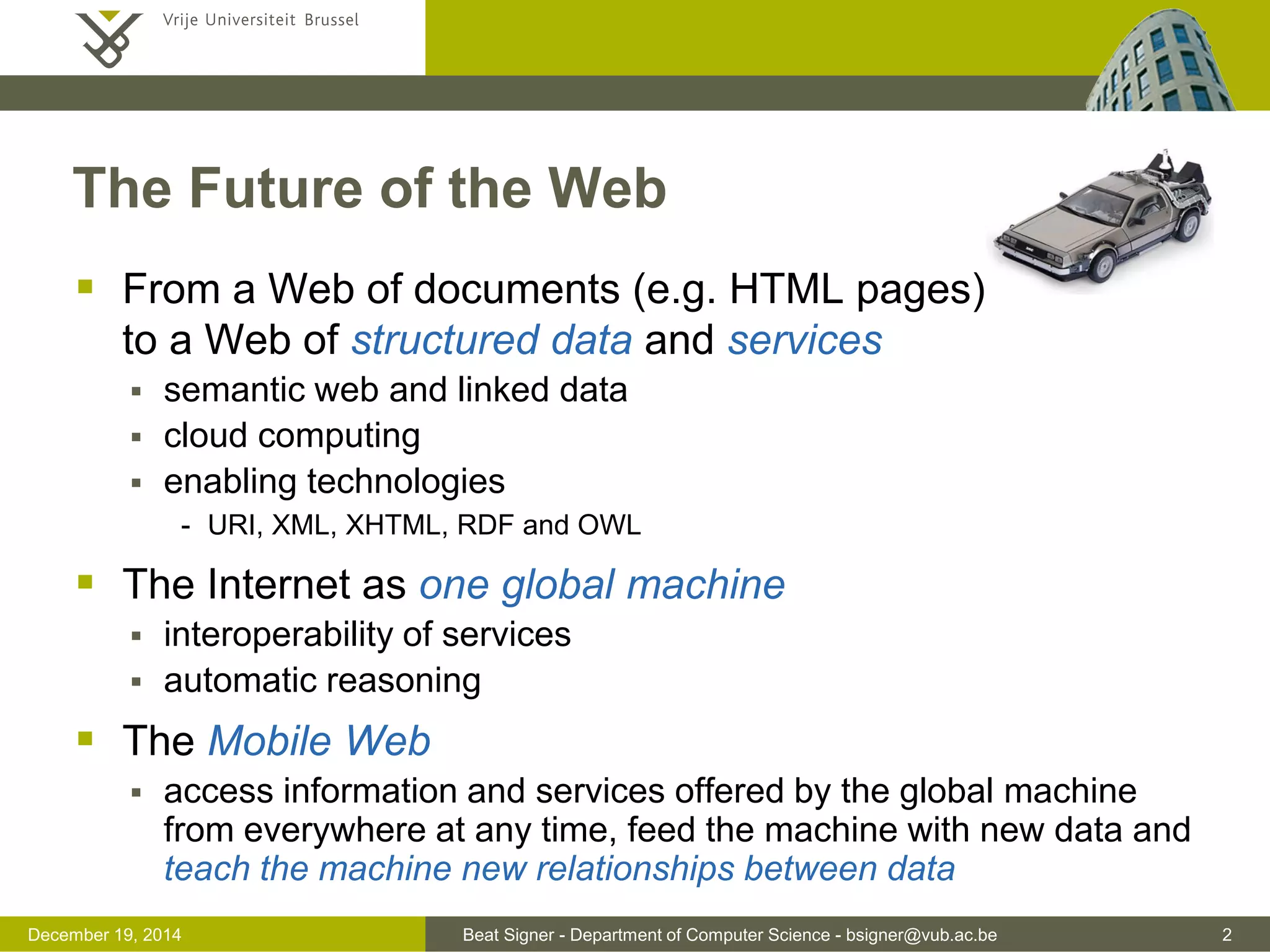
The Future of the Web
 From a Web of documents (e.g. HTML pages)
to a Web of structured data and services
 semantic web and linked data
 cloud computing
 enabling technologies
- URI, XML, XHTML, RDF and OWL
 The Internet as one global machine
 interoperability of services
 automatic reasoning
 The Mobile Web
 access information and services offered by the global machine
from everywhere at any time, feed the machine with new data and
teach the machine new relationships between data
Beat Signer - Department of Computer Science - bsigner@vub.ac.be 3December 19, 2014
The Future of the Web ...
 Internet of Things
 integration of physical objects with the global machine
 physical world gets reflected in digital space via sensor input data
- RFID, GPS, temperature, ...
 information and services managed by the global machine get
projected into the physical space via augmented reality
 Personal data that is nowadays stored in folders on
personal computers might move to the global machine
 User interfaces for the global machine
 personalised filtering and recommendation of related information
based on user profiling and AI technologies
 cross-media browsers
Beat Signer - Department of Computer Science - bsigner@vub.ac.be 4December 19, 2014
The Future of the Web ...
 How will documents look like in the future?
 graph of linked data
 documents as structural view of the linked data
 will we still distinguish between data (document) and metadata?
 How are the presented ideas related to approaches
introduced earlier in the course?
 e.g. Bush's Memex or Nelson's Xanadu
 Do we need new publishing models for the creation of
linked data to be managed by the global machine?
 Finally, it is not only about connecting our data, services
and machines but we are the machine
Beat Signer - Department of Computer Science - bsigner@vub.ac.be 5December 19, 2014
Structured Data
 Web of data instead of Web of documents
 Semantic Web
 linked data as part of the Semantic Web
- based on URI, HTTP and RDF
 various applications already make use of structured data on
the Web
- search engines start to process microformats (e.g. hproduct) or RDFa markup
[http://upload.wikimedia.org/wikipedia/commons/2/23/Lod-datasets_2010-09-22_colored.png]
Beat Signer - Department of Computer Science - bsigner@vub.ac.be 6December 19, 2014
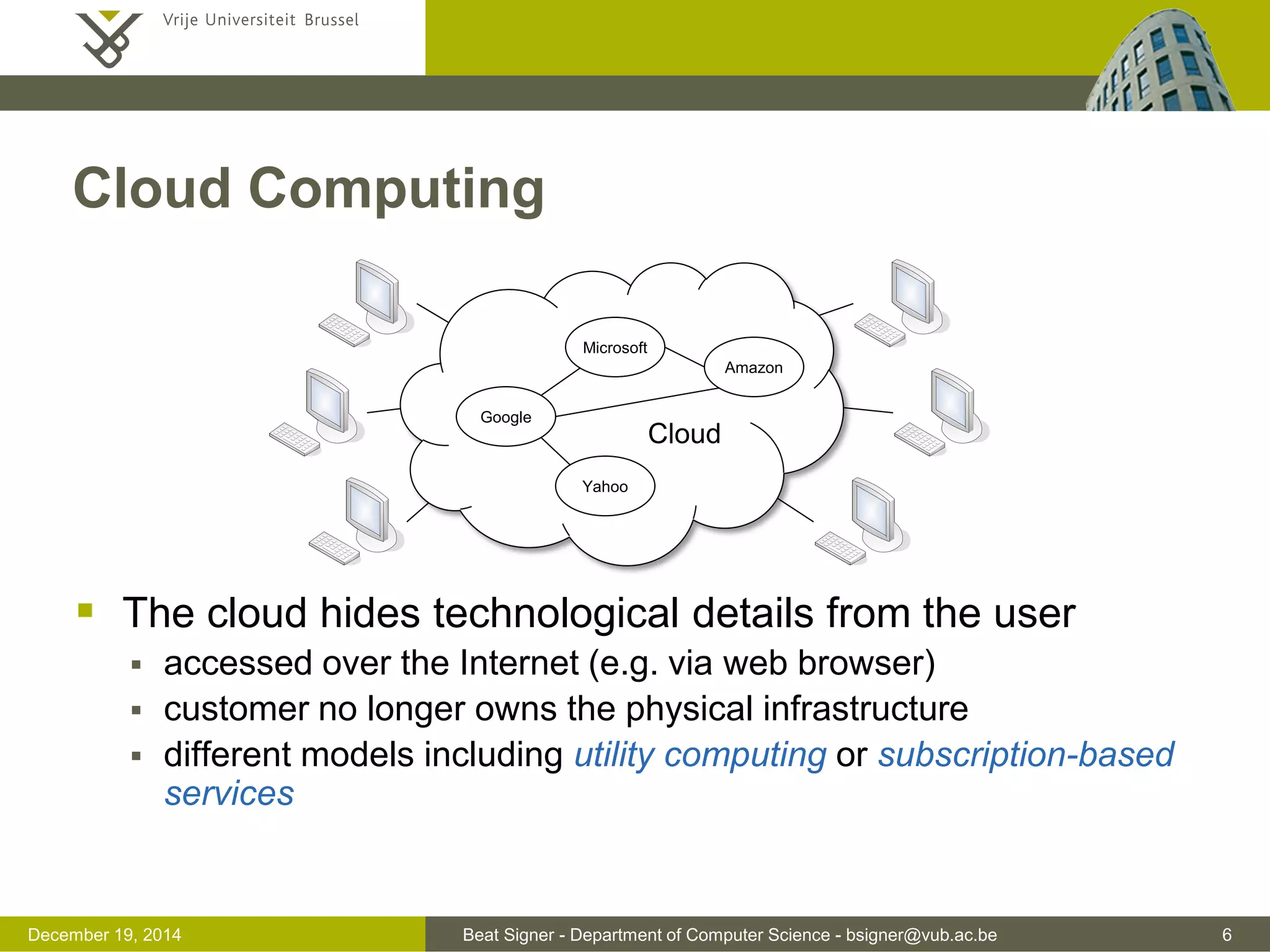
Cloud Computing
 The cloud hides technological details from the user
 accessed over the Internet (e.g. via web browser)
 customer no longer owns the physical infrastructure
 different models including utility computing or subscription-based
services
Microsoft
Google
Yahoo
Amazon
Cloud
Beat Signer - Department of Computer Science - bsigner@vub.ac.be 7December 19, 2014
Cloud Computing ...
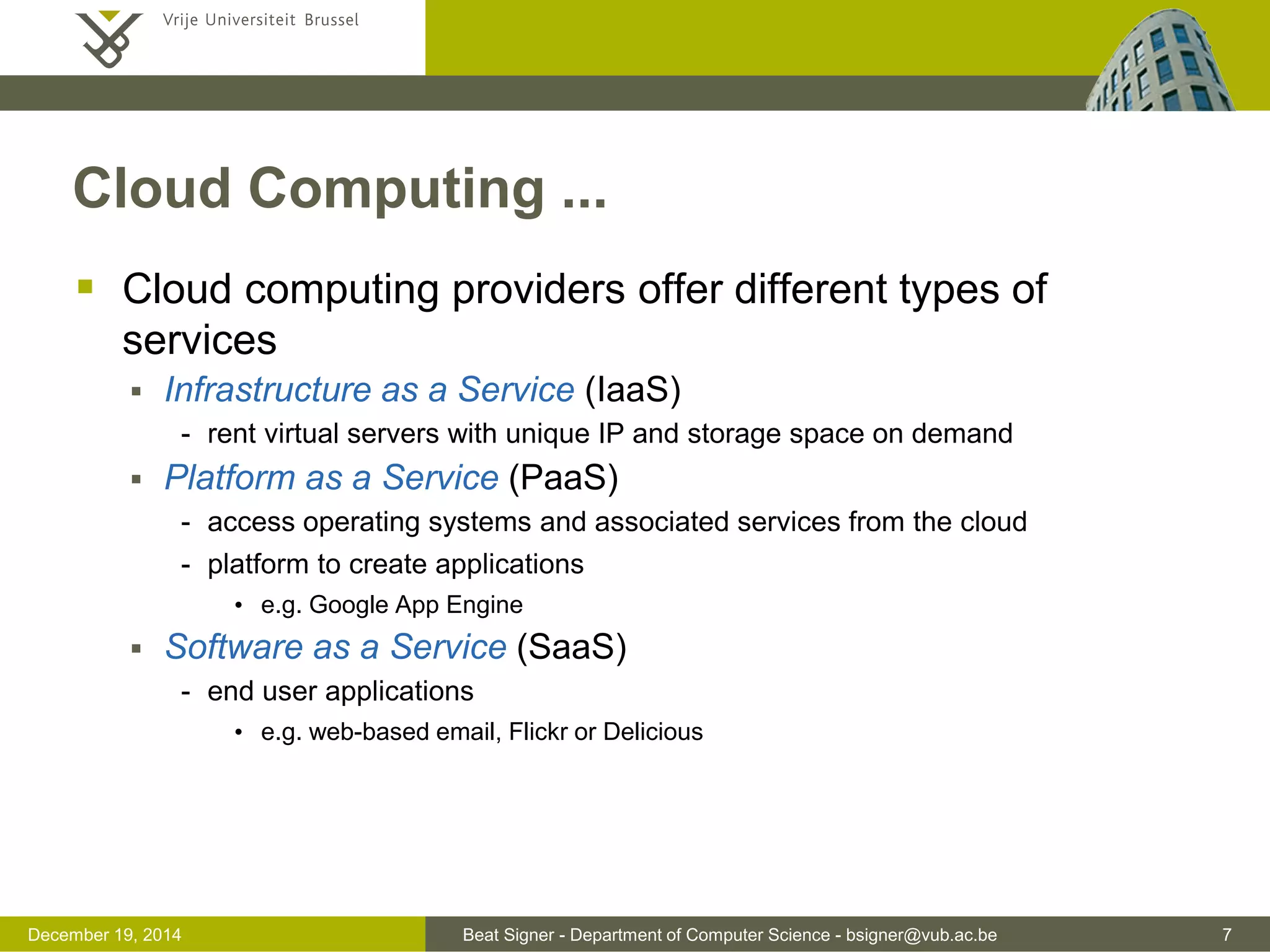
 Cloud computing providers offer different types of
services
 Infrastructure as a Service (IaaS)
- rent virtual servers with unique IP and storage space on demand
 Platform as a Service (PaaS)
- access operating systems and associated services from the cloud
- platform to create applications
• e.g. Google App Engine
 Software as a Service (SaaS)
- end user applications
• e.g. web-based email, Flickr or Delicious
Beat Signer - Department of Computer Science - bsigner@vub.ac.be 8December 19, 2014
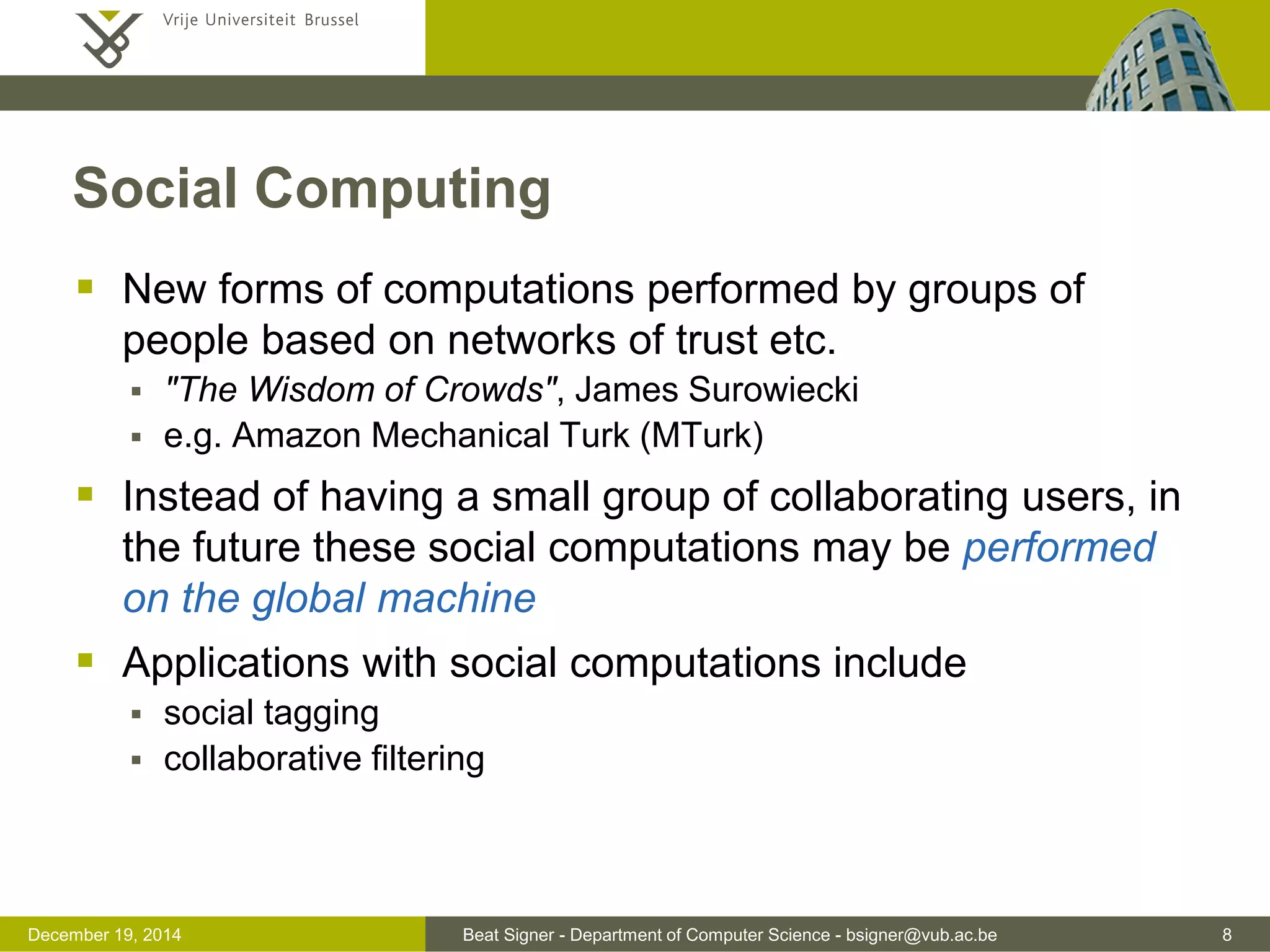
Social Computing
 New forms of computations performed by groups of
people based on networks of trust etc.
 "The Wisdom of Crowds", James Surowiecki
 e.g. Amazon Mechanical Turk (MTurk)
 Instead of having a small group of collaborating users, in
the future these social computations may be performed
on the global machine
 Applications with social computations include
 social tagging
 collaborative filtering
Beat Signer - Department of Computer Science - bsigner@vub.ac.be 9December 19, 2014
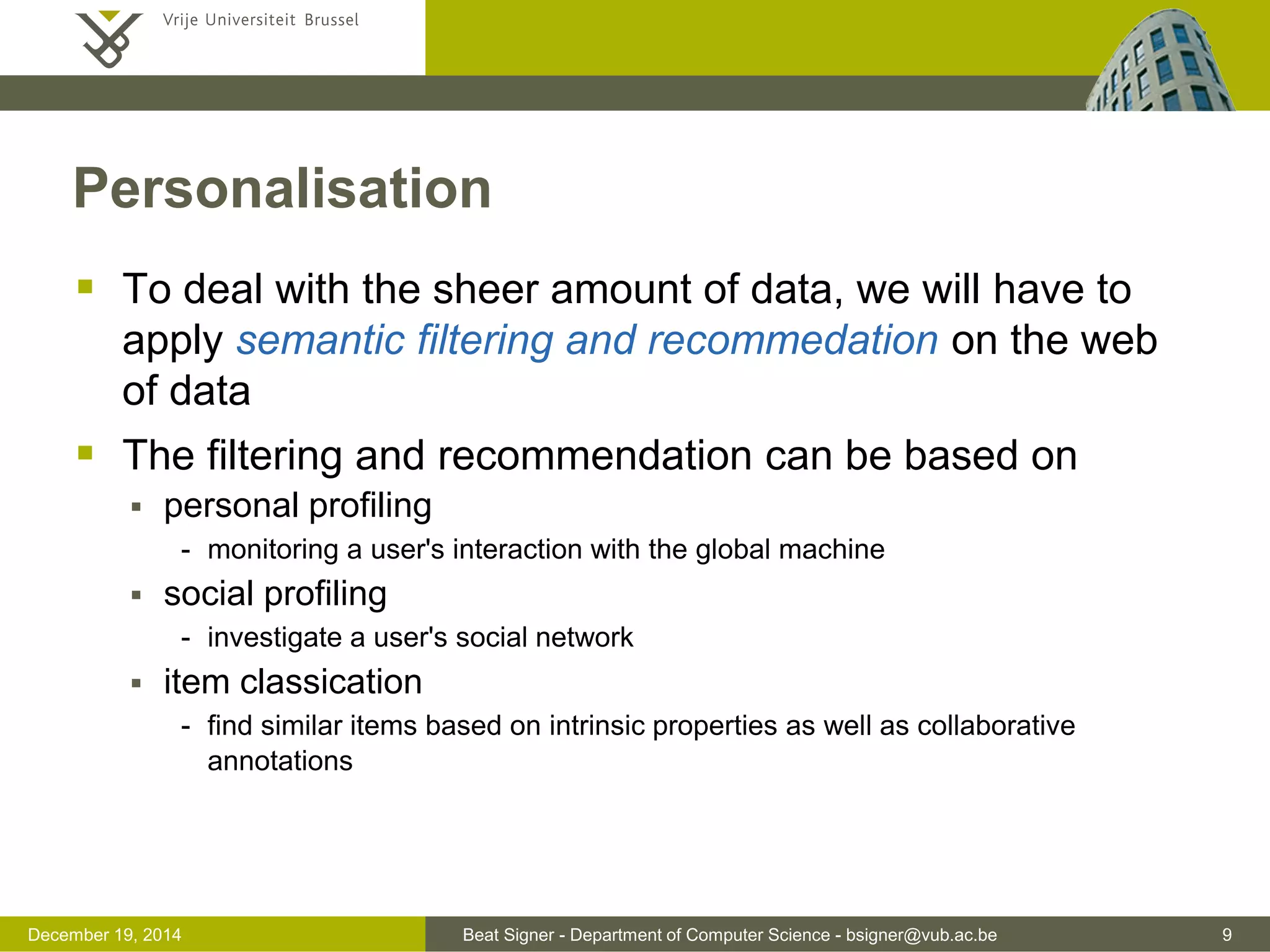
Personalisation
 To deal with the sheer amount of data, we will have to
apply semantic filtering and recommedation on the web
of data
 The filtering and recommendation can be based on
 personal profiling
- monitoring a user's interaction with the global machine
 social profiling
- investigate a user's social network
 item classication
- find similar items based on intrinsic properties as well as collaborative
annotations
Beat Signer - Department of Computer Science - bsigner@vub.ac.be 10December 19, 2014
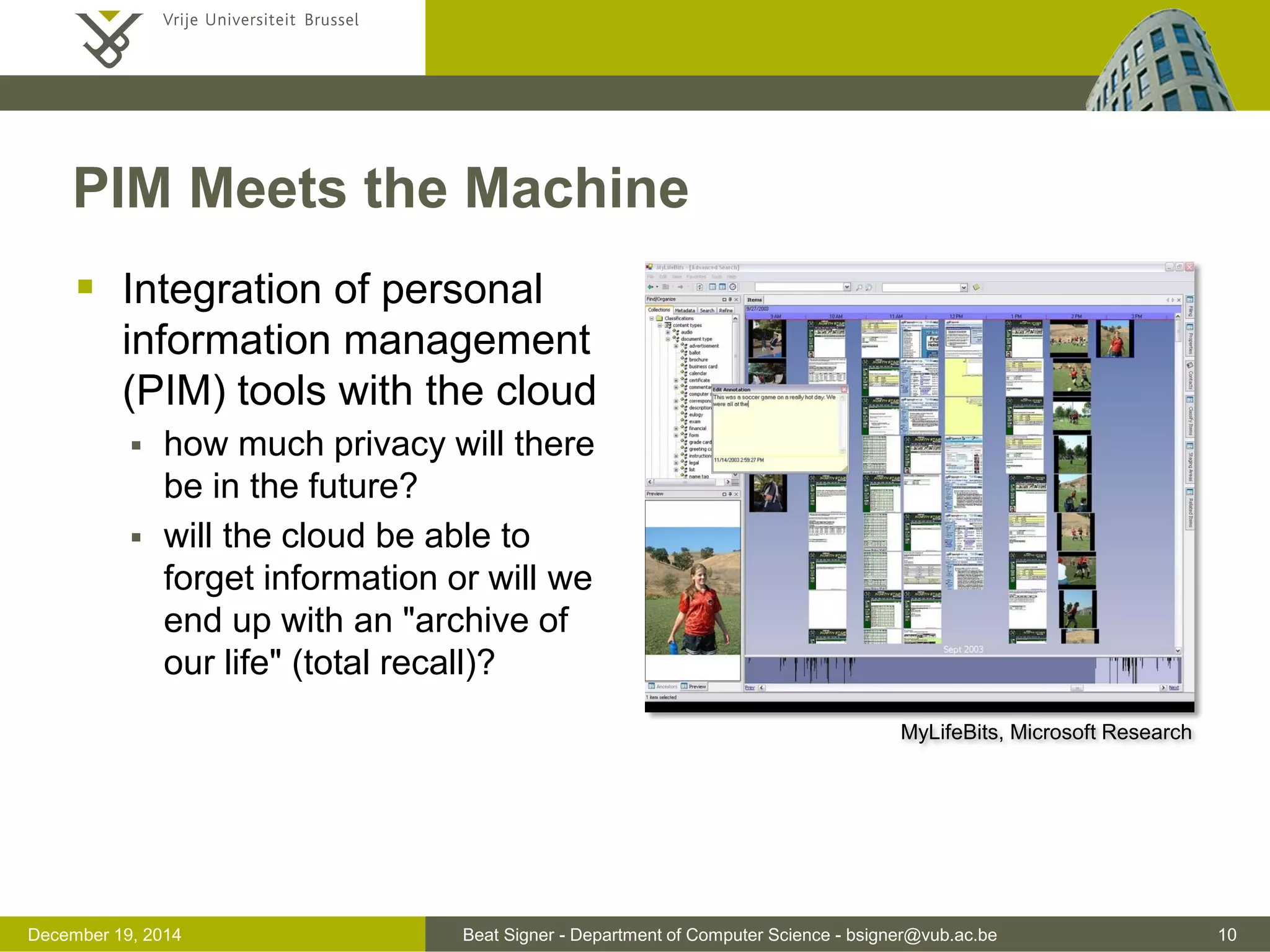
PIM Meets the Machine
 Integration of personal
information management
(PIM) tools with the cloud
 how much privacy will there
be in the future?
 will the cloud be able to
forget information or will we
end up with an "archive of
our life" (total recall)?
MyLifeBits, Microsoft Research
Beat Signer - Department of Computer Science - bsigner@vub.ac.be 11December 19, 2014
Internet of Things
 In the future we will see more and more network- or
Internet-enabled physical objects
 Physical objects get linked to digital information and
services offered by the cloud
 How many objects will there be?
 estimates of 100'000 billion and more objects
 Is simple object tagging via RFID tags enough?
 what if only a part of an object should be linked to the cloud?
 we need a flexible addressing mechanism for physical resources
 Is the simple mapping to a web presence (URI) enough?
Beat Signer - Department of Computer Science - bsigner@vub.ac.be 12December 19, 2014
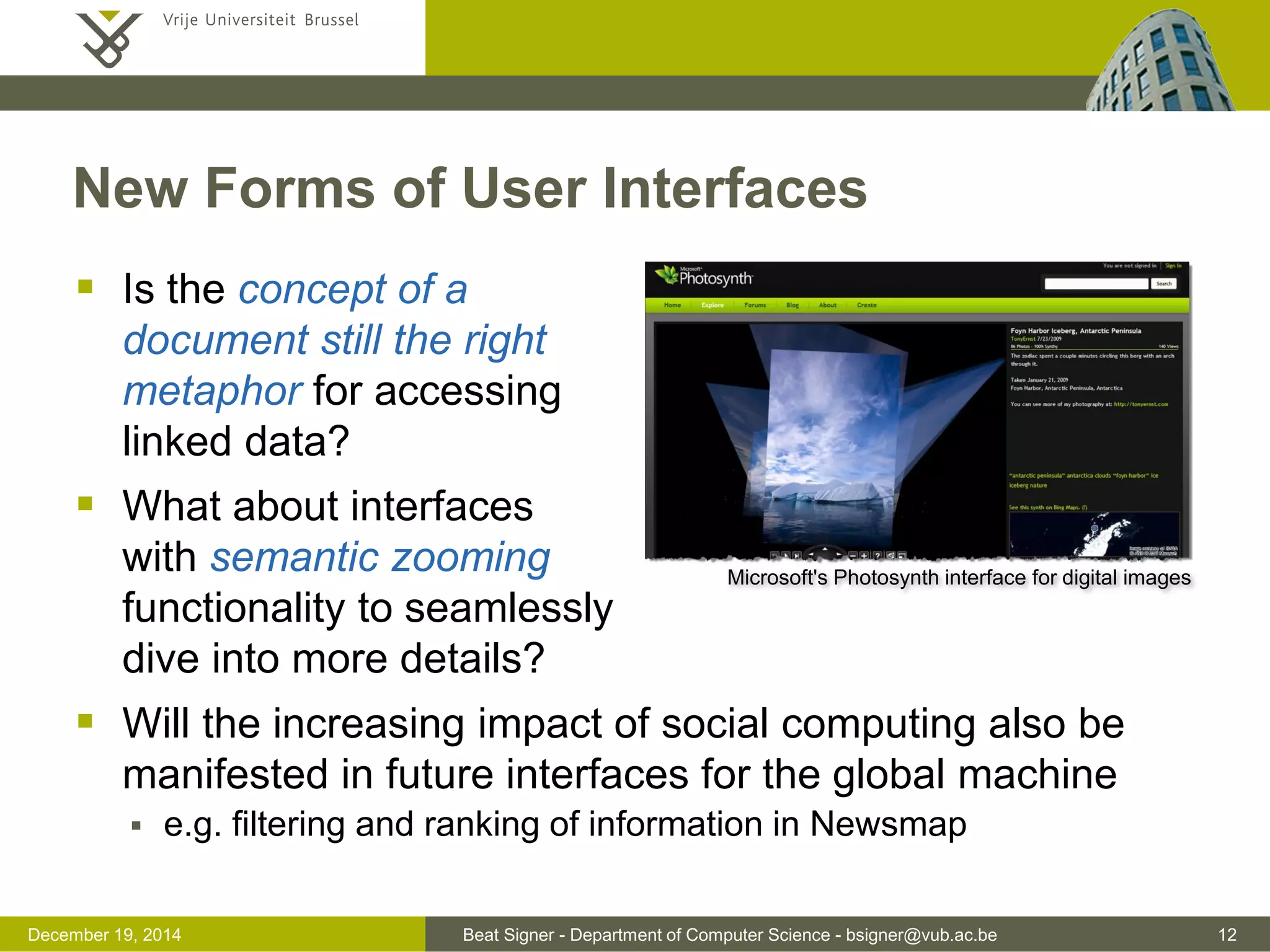
New Forms of User Interfaces
 Is the concept of a
document still the right
metaphor for accessing
linked data?
 What about interfaces
with semantic zooming
functionality to seamlessly
dive into more details?
 Will the increasing impact of social computing also be
manifested in future interfaces for the global machine
 e.g. filtering and ranking of information in Newsmap
Microsoft's Photosynth interface for digital images
Beat Signer - Department of Computer Science - bsigner@vub.ac.be 13December 19, 2014
New Forms of User Interfaces ...
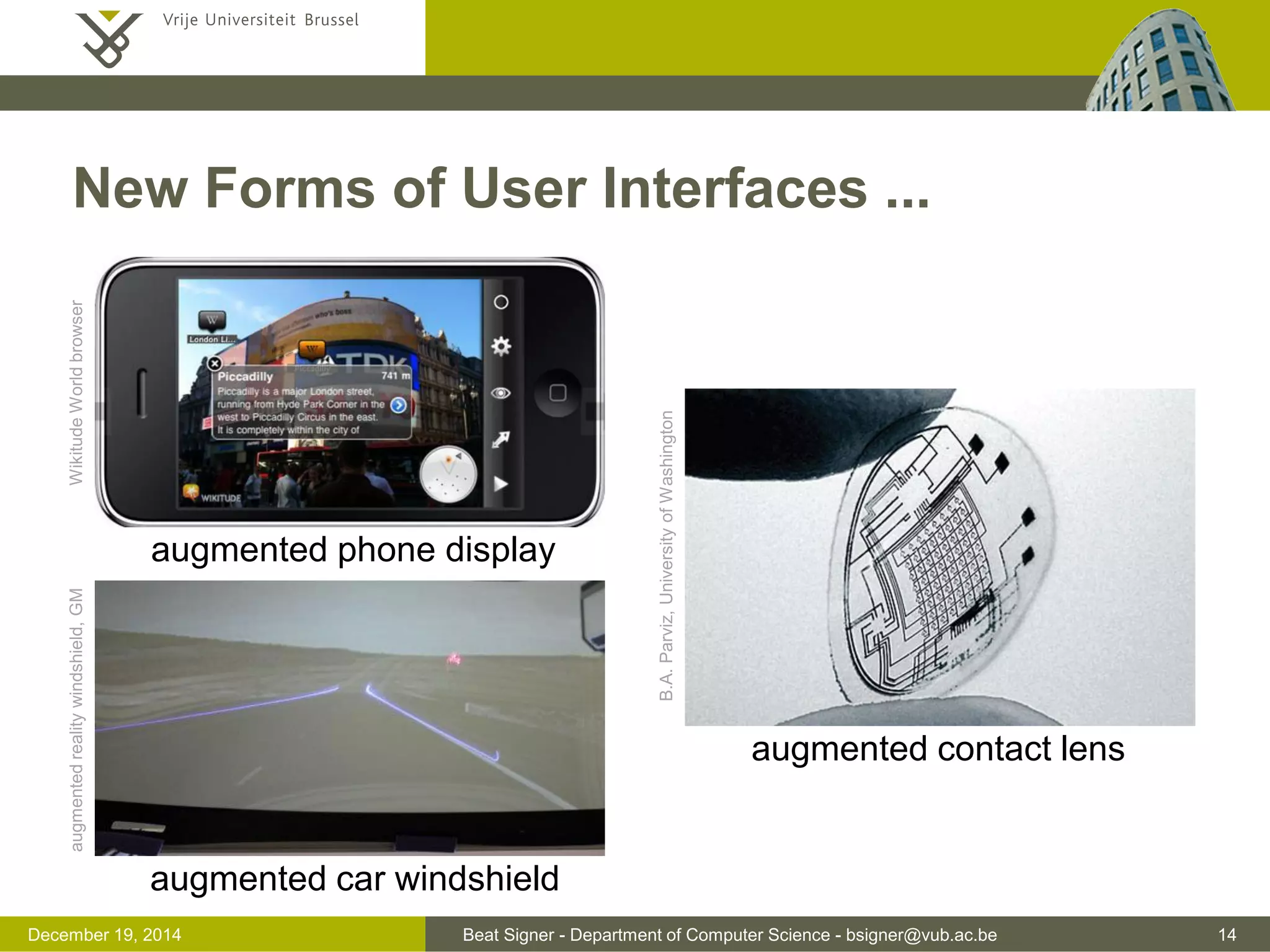
 In the future we will no longer just access information
from the machine via a web browser but augment and
use the physical environment as natural user interface
 e.g. augmented reality interfaces as presented in one of the
previous lectures
 The use of linked data could help to overcome some the
limitations of existing document-centric desktop
interfaces
 files as ultimate level of granularity
 no links (associations) between files or parts of files
 missing content annotation functionality
Beat Signer - Department of Computer Science - bsigner@vub.ac.be 14December 19, 2014
New Forms of User Interfaces ...
augmented contact lens
augmented car windshield
augmented phone display
WikitudeWorldbrowser
B.A.Parviz,UniversityofWashington
augmentedrealitywindshield,GM
Beat Signer - Department of Computer Science - bsigner@vub.ac.be 15December 19, 2014
Social Implications
 What are the effects of the remediation of print on digital
natives?
 in longterm studies it has been shown that the frequent use of the
Web has a negative impact on a person's deep reading skills
 a recent study by King's College London (KCL) has shown the
negative effects of information overload
- "Information Overload Harms Concentration More than Marijuana"
 What is the trade-off between personalisation and
privacy?
 will we still be able to control all the captured data or will we be
continously monitored and profiled by smart objects?
 Transparency and trust will become even more important
issues!
Beat Signer - Department of Computer Science - bsigner@vub.ac.be 16December 19, 2014
The Future of the Internet
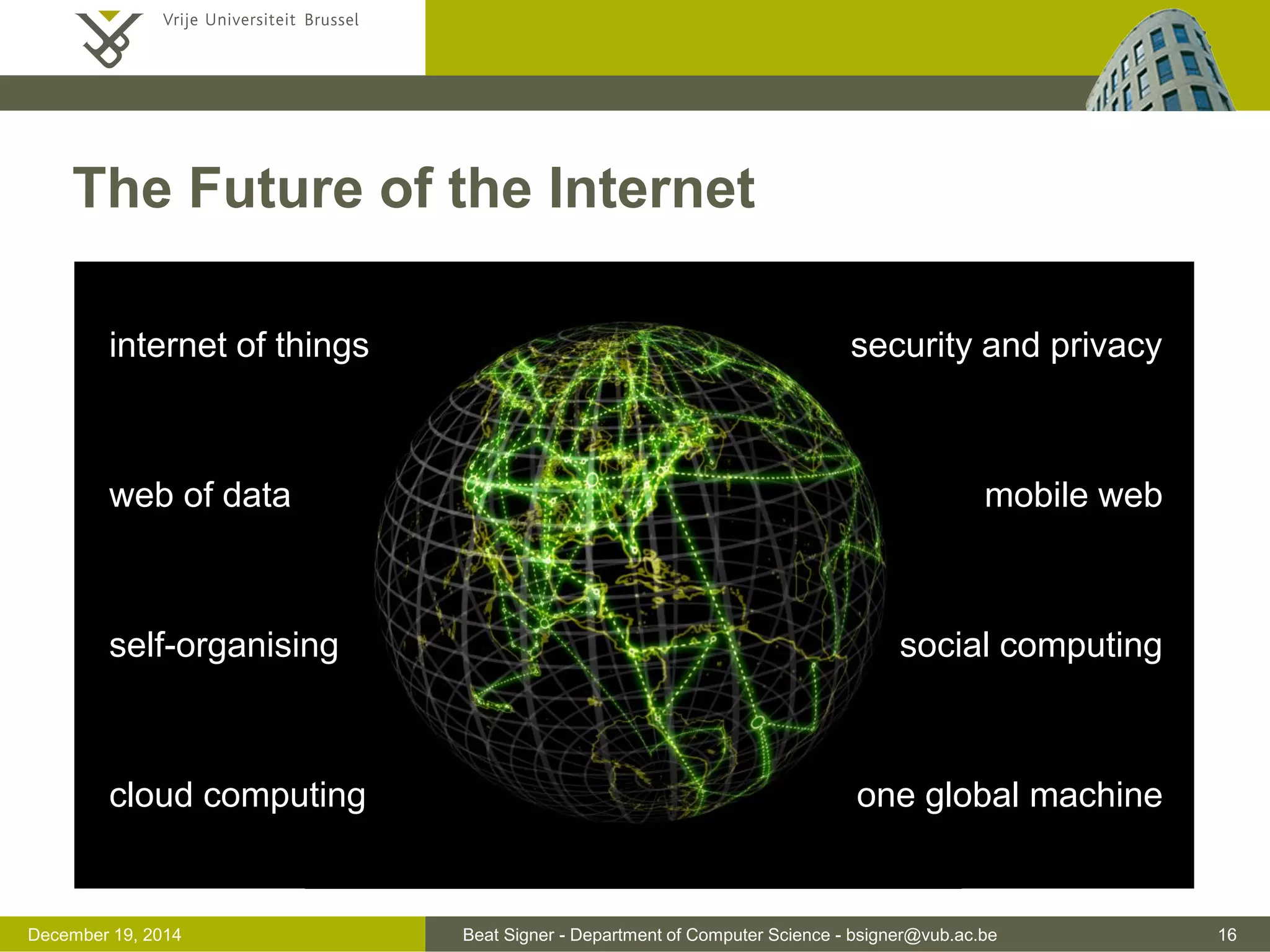
internet of things
web of data
self-organising
cloud computing
security and privacy
mobile web
social computing
one global machine
Beat Signer - Department of Computer Science - bsigner@vub.ac.be 17December 19, 2014
01001000100
0101001100010010100010010
0100100010010001000100001001000
100010001100001001000110010101010110
1100010010100010010010010100010101011001
101001100001100 101010100
00101000100 110101010101
00100 01010101000
1001 1111111111
111 0000000010
0 11111111
0101001011
010101010
111010101
001010010110
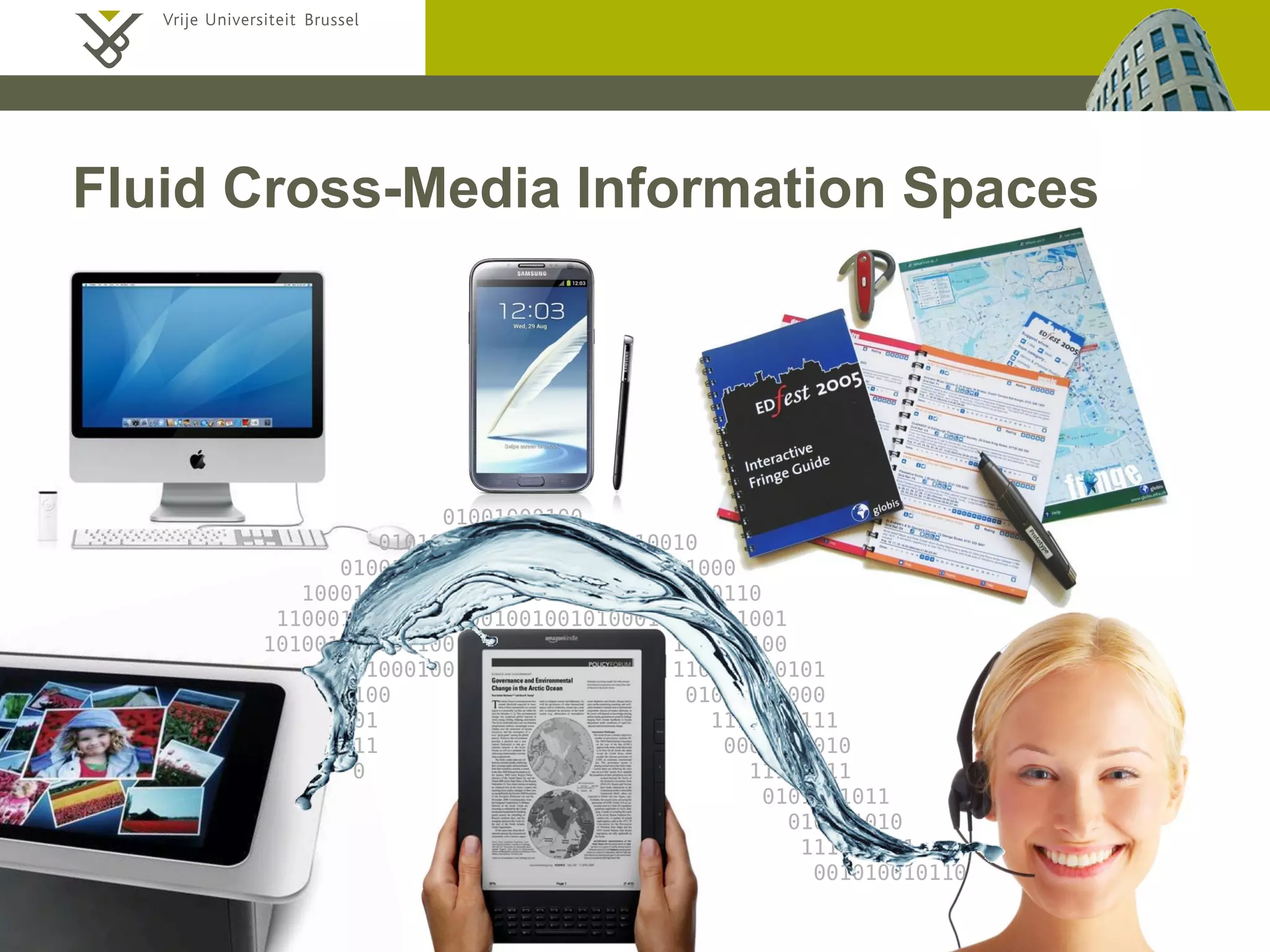
Fluid Cross-Media Information Spaces
Beat Signer - Department of Computer Science - bsigner@vub.ac.be 18December 19, 2014
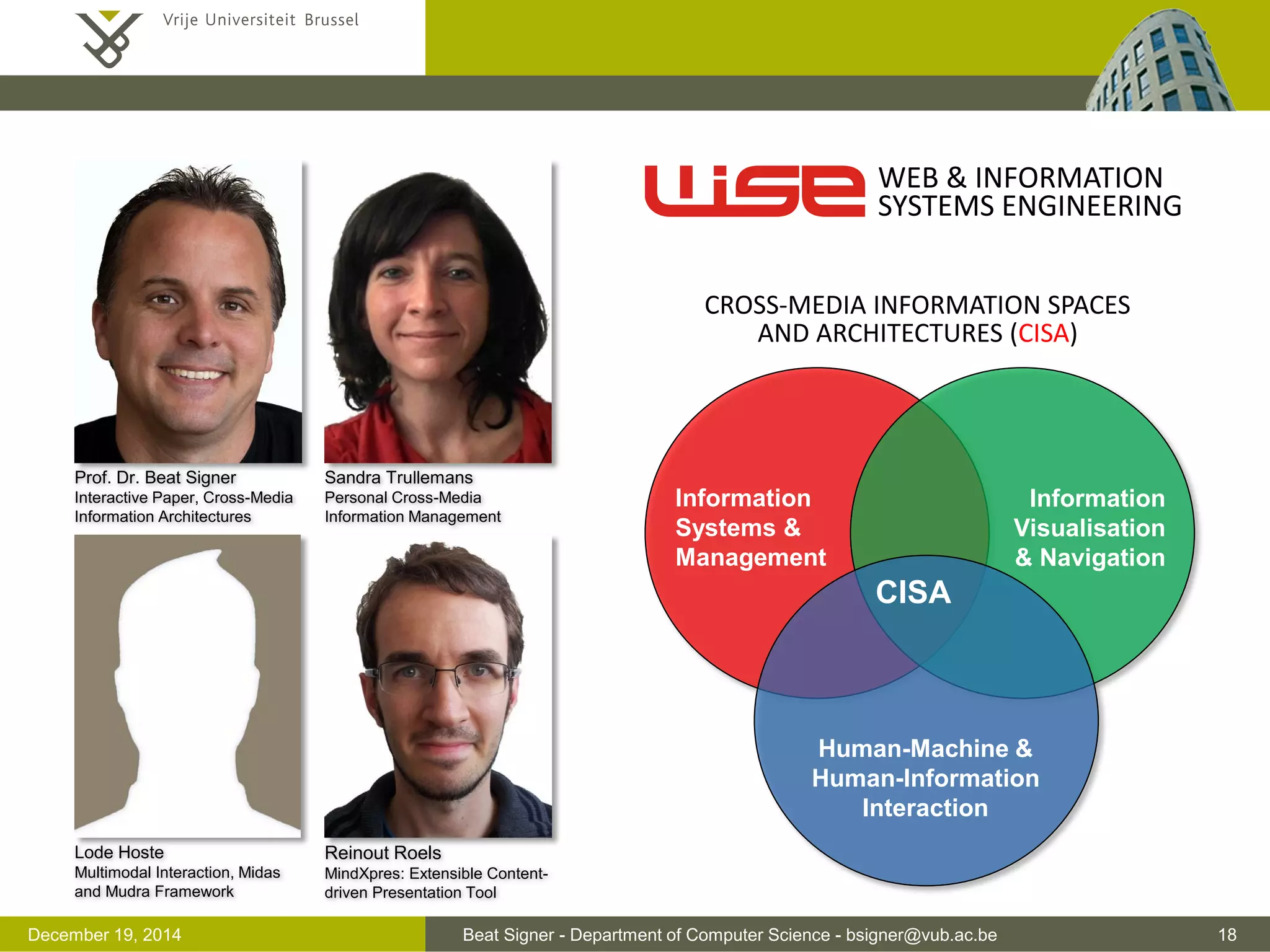
Prof. Dr. Beat Signer
Interactive Paper, Cross-Media
Information Architectures
Sandra Trullemans
Personal Cross-Media
Information Management
Lode Hoste
Multimodal Interaction, Midas
and Mudra Framework
Reinout Roels
MindXpres: Extensible Content-
driven Presentation Tool
CISA
Human-Machine &
Human-Information
Interaction
Information
Systems &
Management
Information
Visualisation
& Navigation
WEB & INFORMATION
SYSTEMS ENGINEERING
CROSS-MEDIA INFORMATION SPACES
AND ARCHITECTURES (CISA)
Beat Signer - Department of Computer Science - bsigner@vub.ac.be 19December 19, 2014
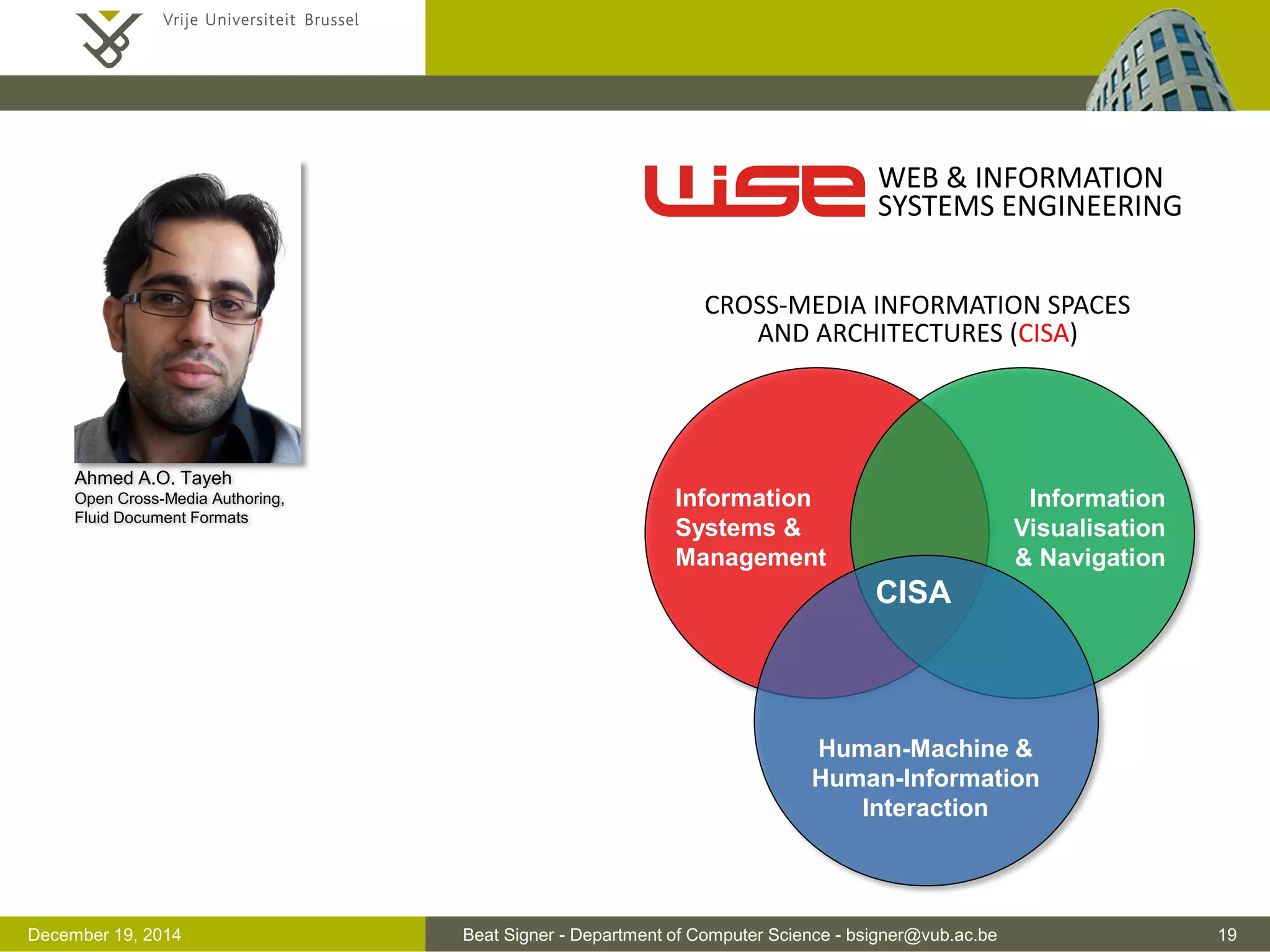
Ahmed A.O. Tayeh
Open Cross-Media Authoring,
Fluid Document Formats
WEB & INFORMATION
SYSTEMS ENGINEERING
CISA
Human-Machine &
Human-Information
Interaction
Information
Systems &
Management
Information
Visualisation
& Navigation
CROSS-MEDIA INFORMATION SPACES
AND ARCHITECTURES (CISA)
Beat Signer - Department of Computer Science - bsigner@vub.ac.be 20December 19, 2014
Digital Documents as a Paper Simulator?
Vannevar Bush
Ted Nelson
Most people don't understand the logic of the
concept: "What You See Is What You Get" is
based on printing the document out ("get"
means "get WHEN YOU PRINT IT OUT"). And that
means a metaphysical shift: a document can
only consist of what can be printed! [...] No
overlays [...] – PAPER UNDER GLASS.
When data of any sort are placed in storage,
they are filed alphabetically or numerically,
and information is found (when it is) by
tracing it down from subclass to subclass. It
can be in only one place, unless duplicates
are used [...] The human mind does not work
that way. It operates by association.
As We May Think, Atlantic Monthly, July 1945
Geeks Bearing Gifts: How the Computer World Got This Way, Mindful Press 2009
Beat Signer - Department of Computer Science - bsigner@vub.ac.be 21December 19, 2014
What is Wrong with Digital Documents?
 Existing document formats are based on the simulation
of paper affordances on desktop computers
 How to manage mixed-media "documents" in open and
fluid cross-media information spaces?
 on the data level
- context-sensitive adapatation
- cross-media transclusion
 on the visualisation and navigation level
- zoomable user interfaces
 on the cross-media interaction level
- fluid multimodal cross-media interfaces
 Remediation of the "paper simulation" approach
 WYSIWYG is only one out of many options!
Beat Signer - Department of Computer Science - bsigner@vub.ac.be 22December 19, 2014
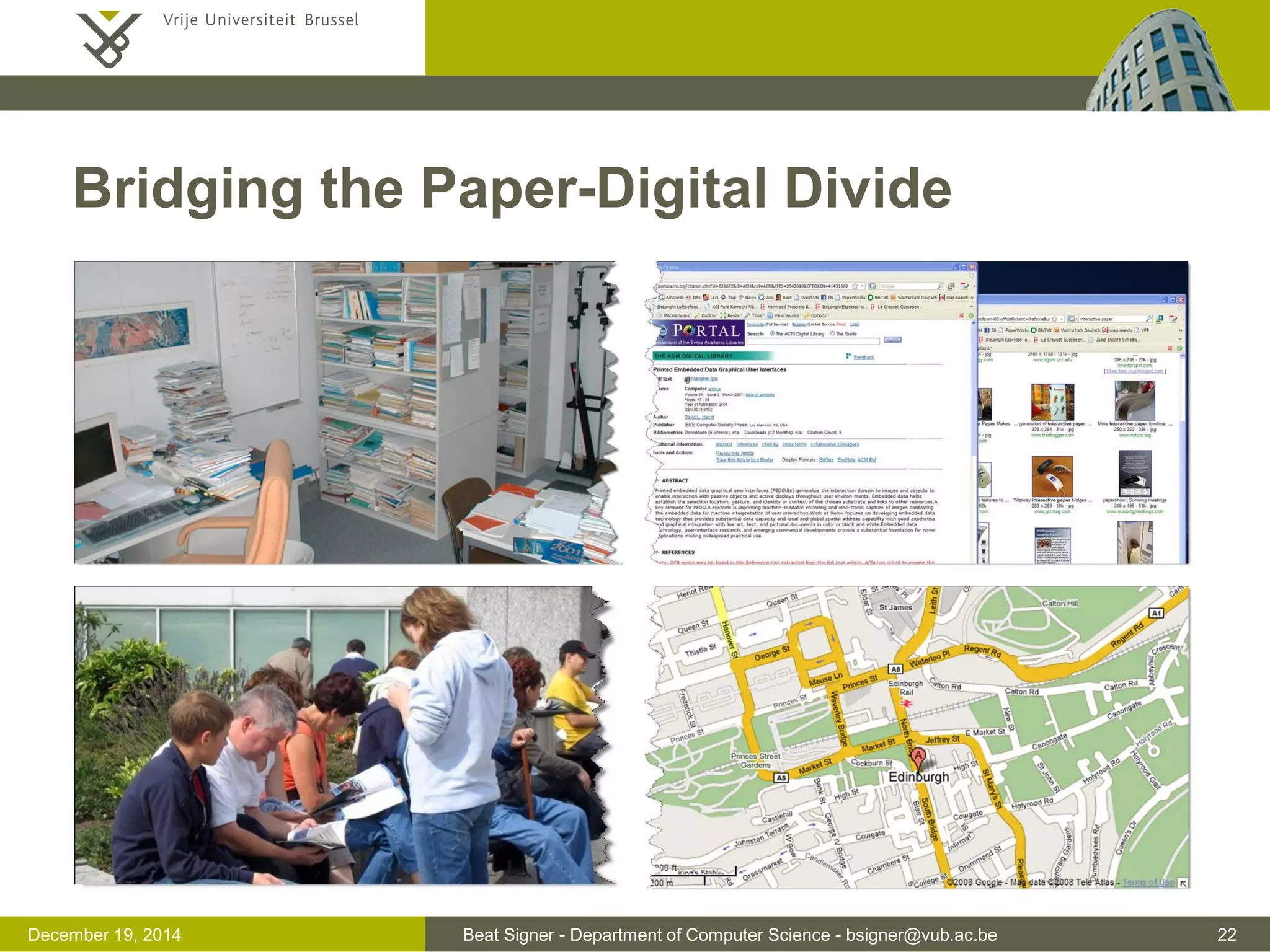
Bridging the Paper-Digital Divide
Beat Signer - Department of Computer Science - bsigner@vub.ac.be 23December 19, 2014
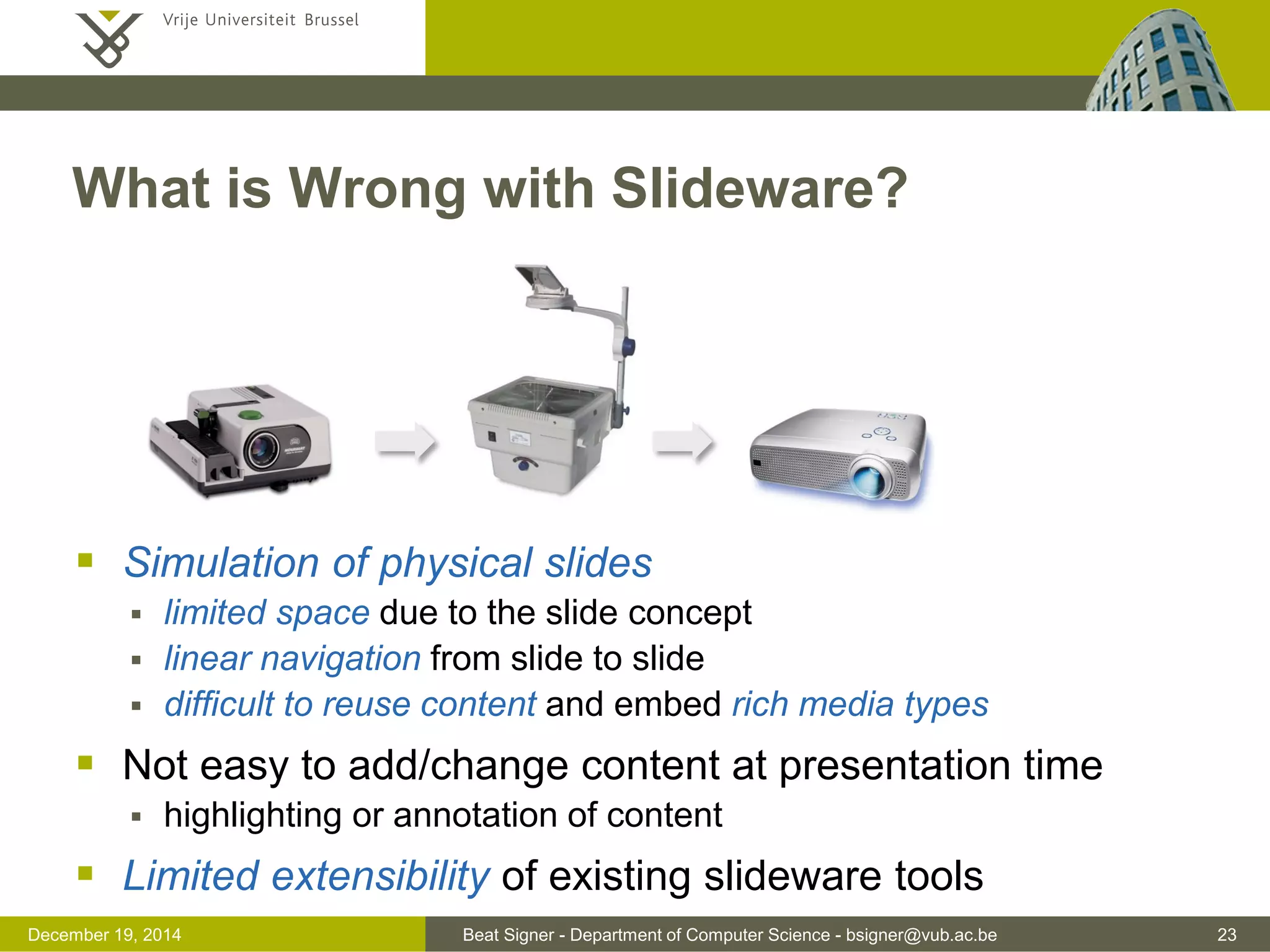
What is Wrong with Slideware?
 Simulation of physical slides
 limited space due to the slide concept
 linear navigation from slide to slide
 difficult to reuse content and embed rich media types
 Not easy to add/change content at presentation time
 highlighting or annotation of content
 Limited extensibility of existing slideware tools
Beat Signer - Department of Computer Science - bsigner@vub.ac.be 24December 19, 2014
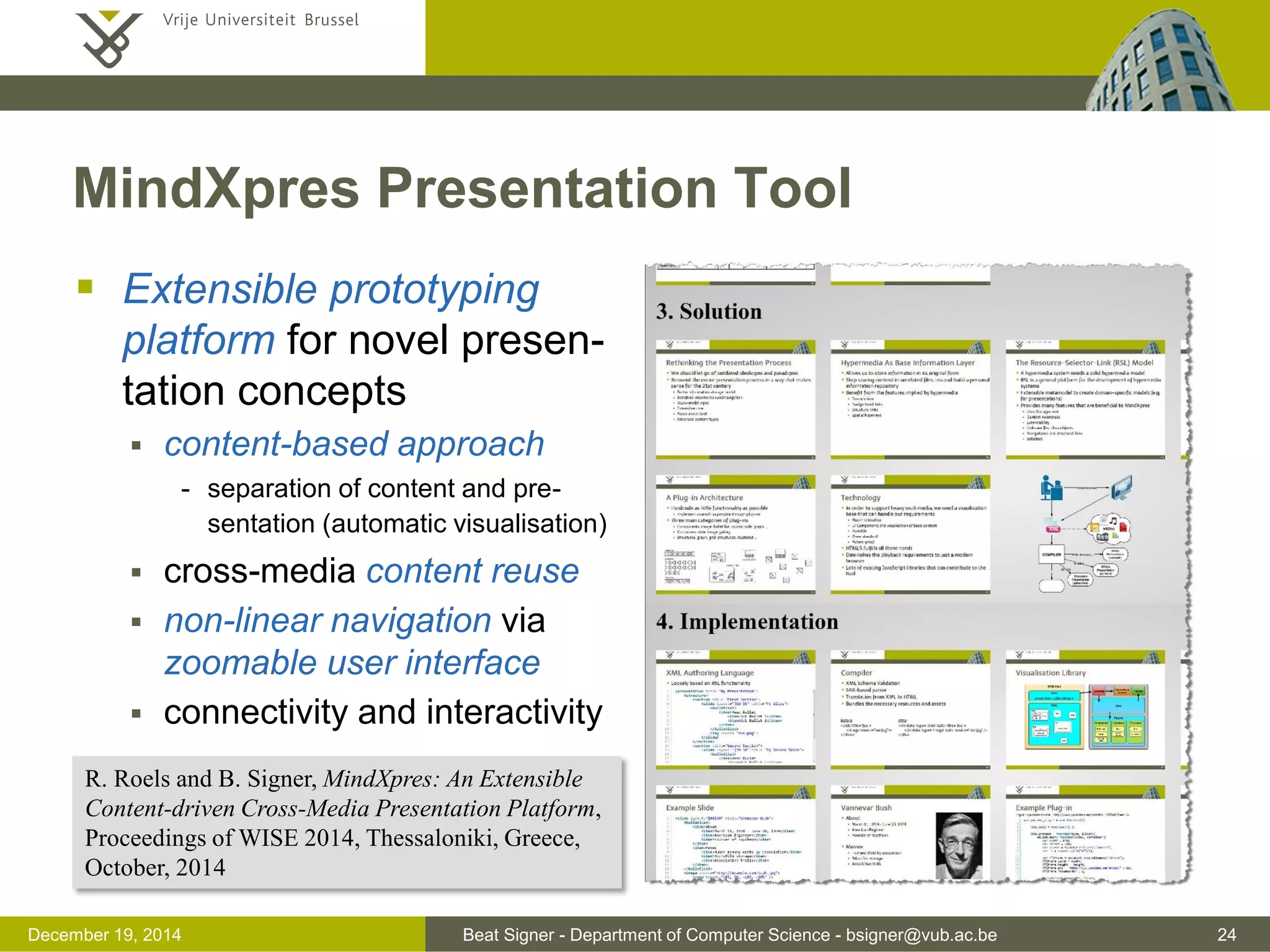
MindXpres Presentation Tool
 Extensible prototyping
platform for novel presen-
tation concepts
 content-based approach
- separation of content and pre-
sentation (automatic visualisation)
 cross-media content reuse
 non-linear navigation via
zoomable user interface
 connectivity and interactivity
R. Roels and B. Signer, MindXpres: An Extensible
Content-driven Cross-Media Presentation Platform,
Proceedings of WISE 2014, Thessaloniki, Greece,
October, 2014
25
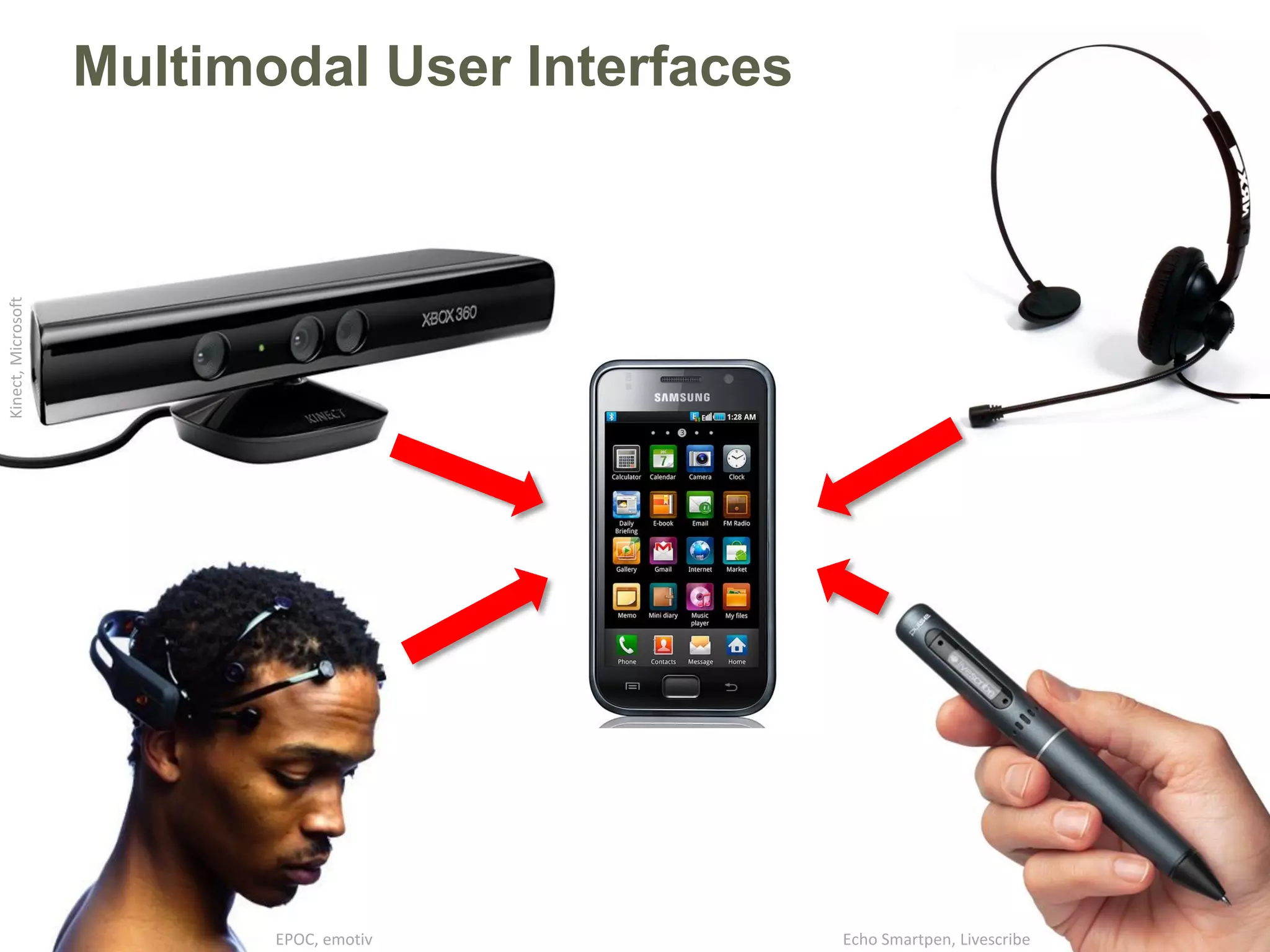
Multimodal User Interfaces
EPOC, emotiv Echo Smartpen, Livescribe
Kinect,Microsoft
Beat Signer - Department of Computer Science - bsigner@vub.ac.be 26December 19, 2014
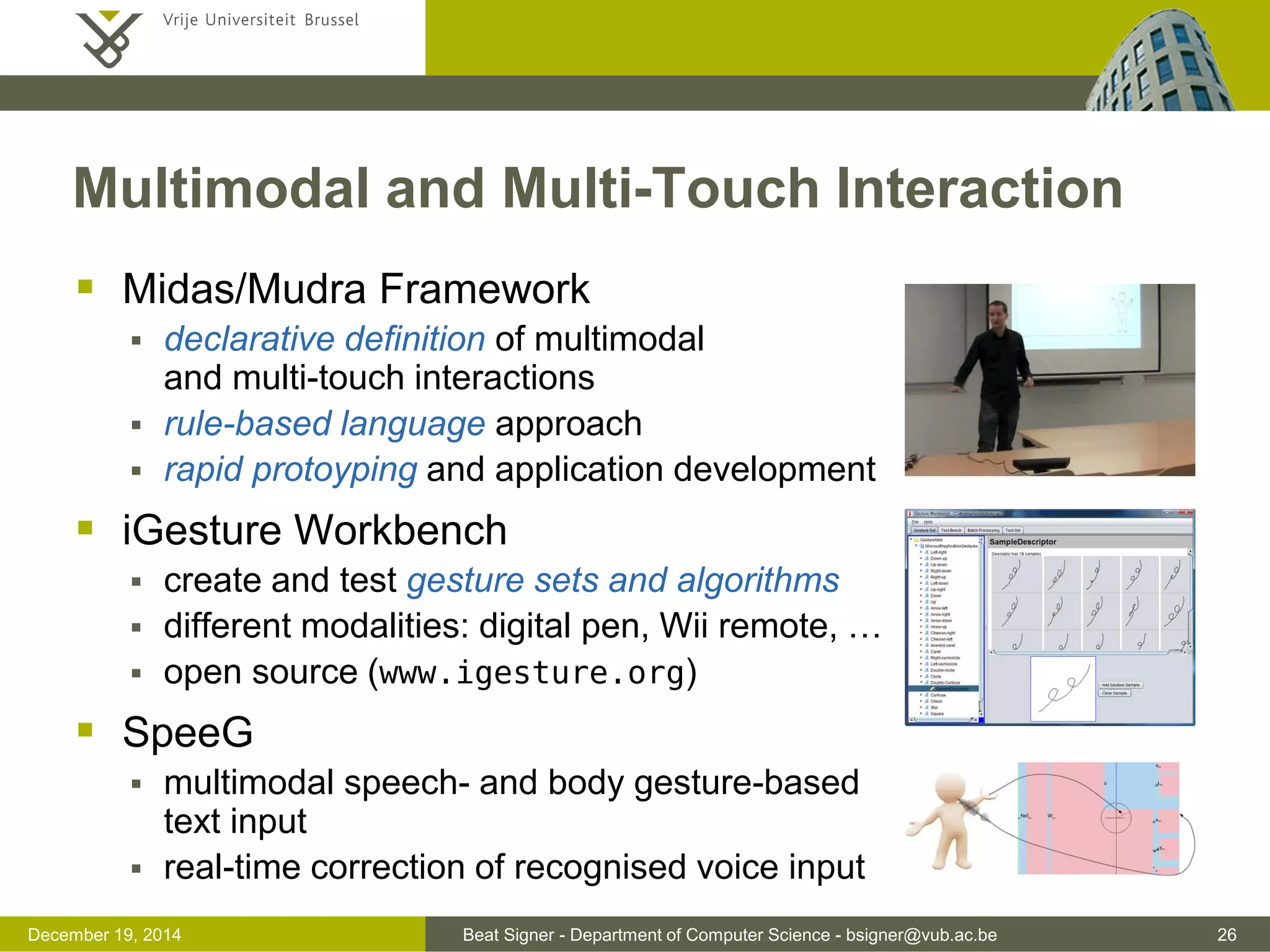
 Midas/Mudra Framework
 declarative definition of multimodal
and multi-touch interactions
 rule-based language approach
 rapid protoyping and application development
 iGesture Workbench
 create and test gesture sets and algorithms
 different modalities: digital pen, Wii remote, …
 open source (www.igesture.org)
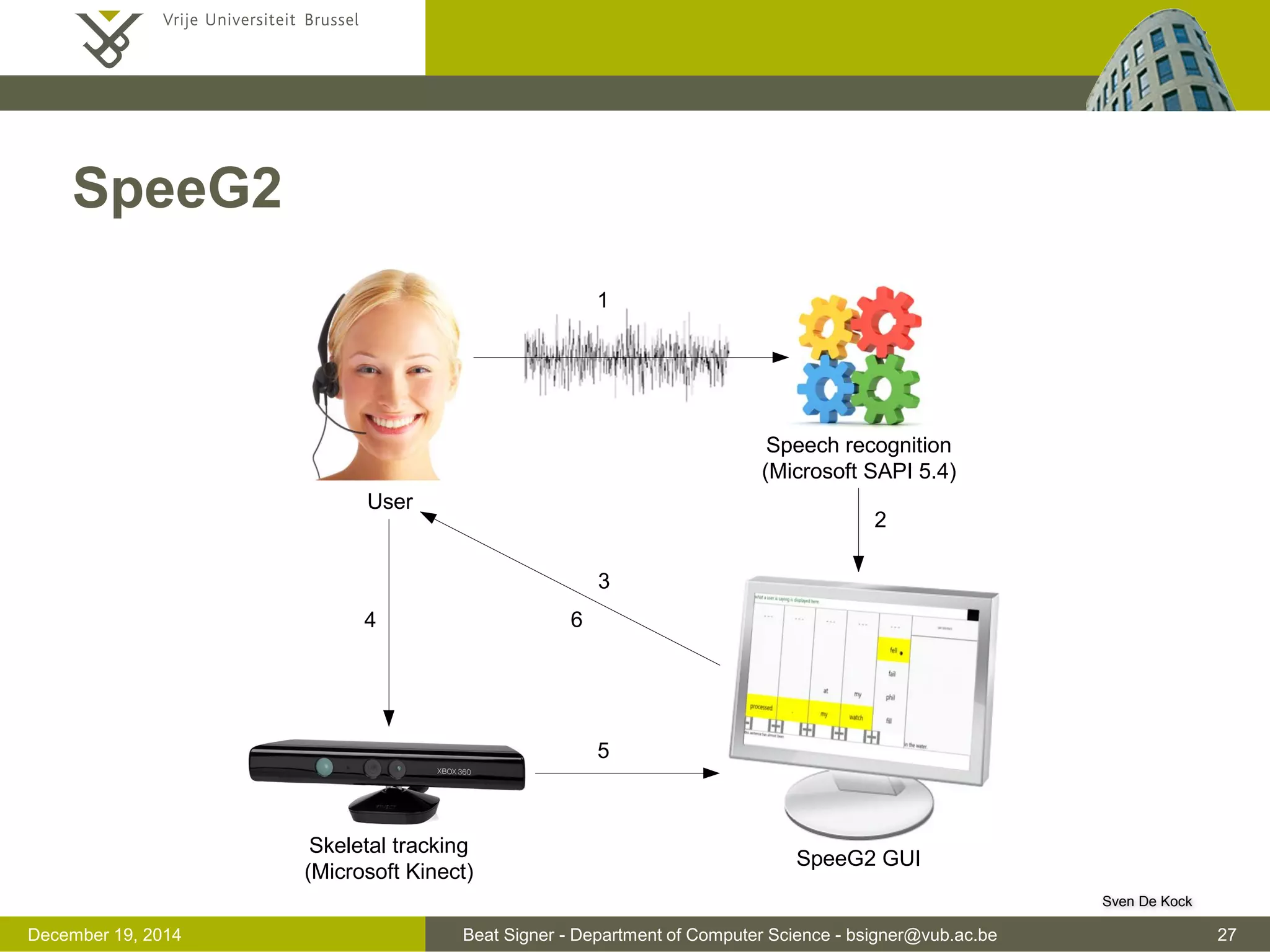
 SpeeG
 multimodal speech- and body gesture-based
text input
 real-time correction of recognised voice input
Multimodal and Multi-Touch Interaction
Beat Signer - Department of Computer Science - bsigner@vub.ac.be 27December 19, 2014
SpeeG2
User
Speech recognition
(Microsoft SAPI 5.4)
Skeletal tracking
(Microsoft Kinect)
5
4
2
3
SpeeG2 GUI
6
1
Sven De Kock
Beat Signer - Department of Computer Science - bsigner@vub.ac.be 28December 19, 2014
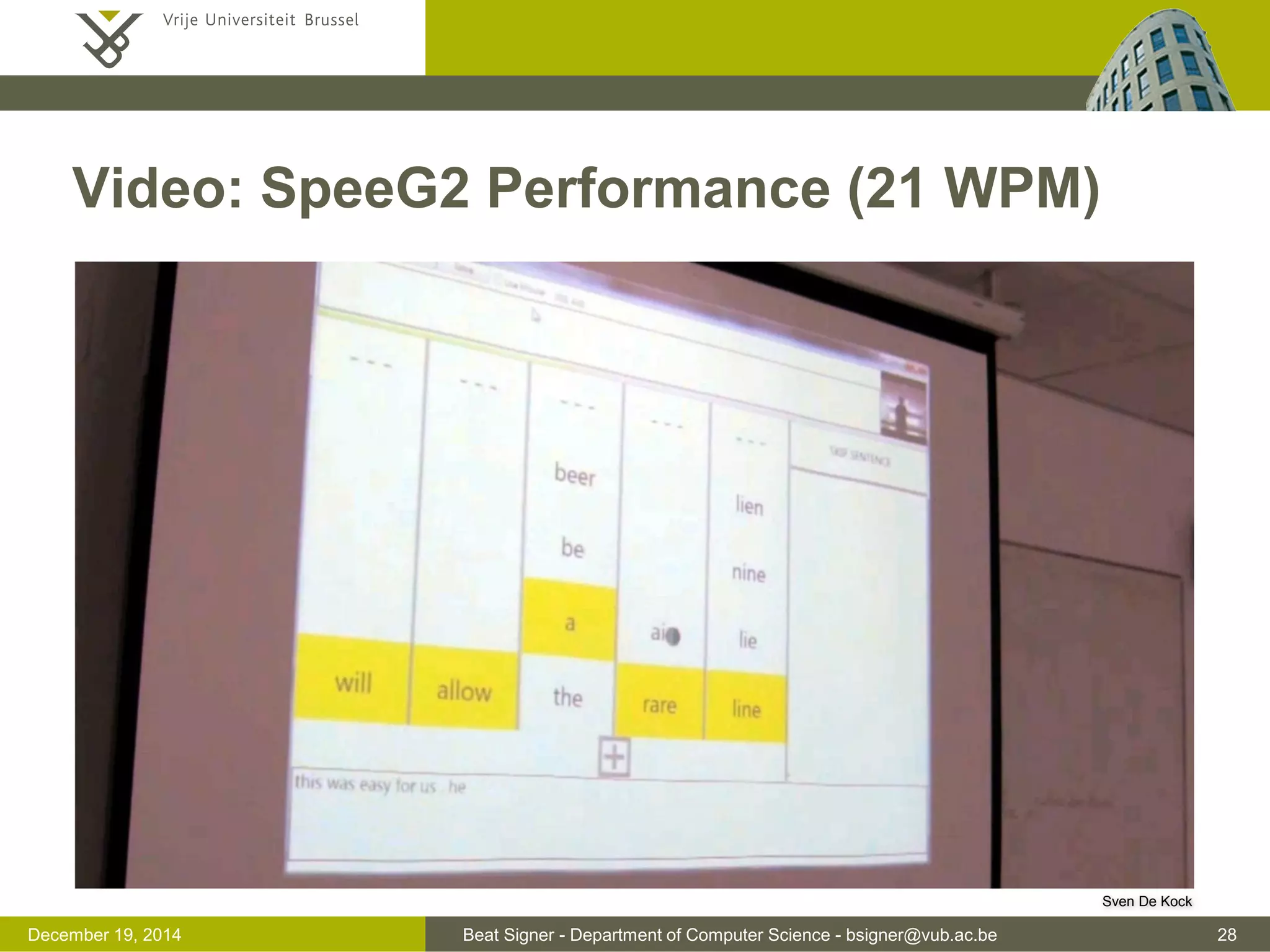
Video: SpeeG2 Performance (21 WPM)
Sven De Kock
Beat Signer - Department of Computer Science - bsigner@vub.ac.be 29December 19, 2014
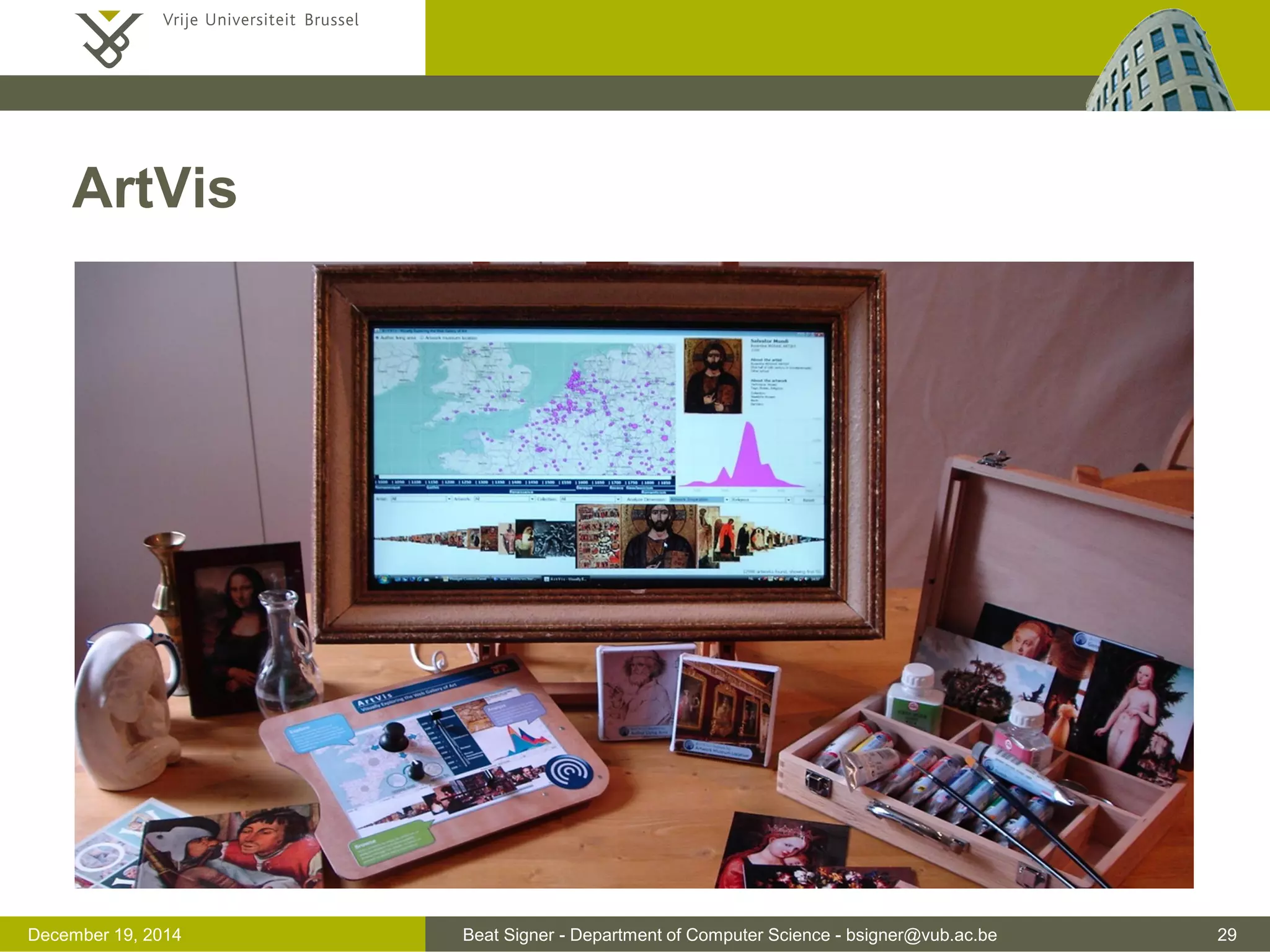
ArtVis
Beat Signer - Department of Computer Science - bsigner@vub.ac.be 30December 19, 2014
WISE Student Projects
 Cross-Media Information Spaces and
Architectures
 fluid cross-media document formats
 personal information management (PIM)
 MindXpres presentation tool, the office of the future, ...
 Multimodal and Multi-touch Interaction
 next generation text input devices (e.g. combine voice and Kinect)
 multimodal mobile interaction
 Interactive paper and augmented reality
 If you should be interested in one of these topics
(or if you have your own ideas) please contact us!
 http://wise.vub.ac.be/thesis_proposals
Beat Signer - Department of Computer Science - bsigner@vub.ac.be 31December 19, 2014
Other Courses
 Advanced Topics in Information Systems
 seminar about recent developments in information systems
 information systems and information management
 information visualisation and navigation
 human-machine and human-information interaction
 [http://wise.vub.ac.be/content/advanced-topics-information-systems]
 Next Generation User Interfaces
 interaction design
 multimodal interaction (theoretical concepts, fusion and fission, ...)
 interactive tabletops and surfaces
 pen-based interaction and gesture-based interaction
 tangible interaction, virtual reality and augmented reality
 [http://wise.vub.ac.be/content/next-generation-user-interfaces]
Beat Signer - Department of Computer Science - bsigner@vub.ac.be 32December 19, 2014
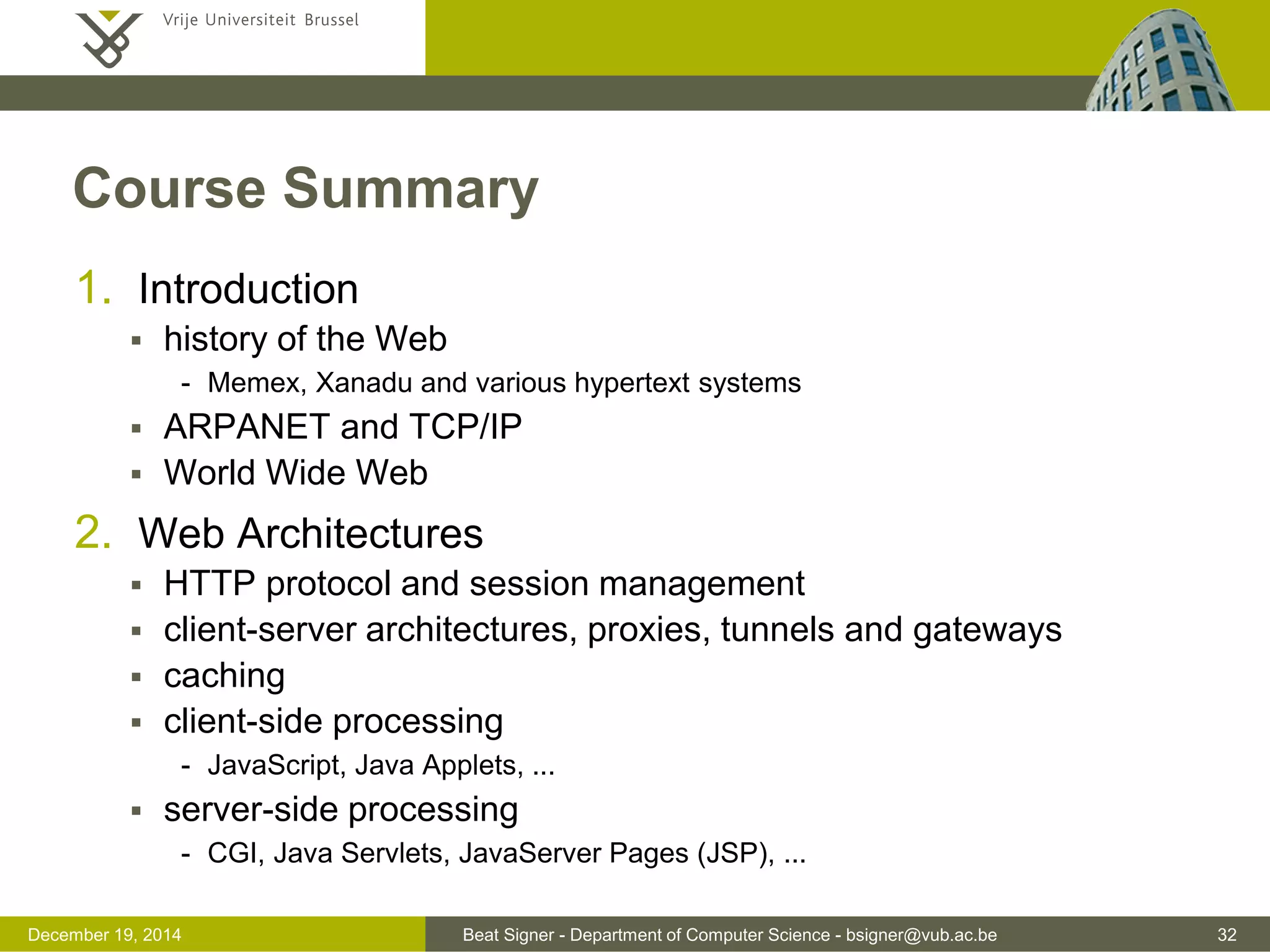
Course Summary
1. Introduction
 history of the Web
- Memex, Xanadu and various hypertext systems
 ARPANET and TCP/IP
 World Wide Web
2. Web Architectures
 HTTP protocol and session management
 client-server architectures, proxies, tunnels and gateways
 caching
 client-side processing
- JavaScript, Java Applets, ...
 server-side processing
- CGI, Java Servlets, JavaServer Pages (JSP), ...
Beat Signer - Department of Computer Science - bsigner@vub.ac.be 33December 19, 2014
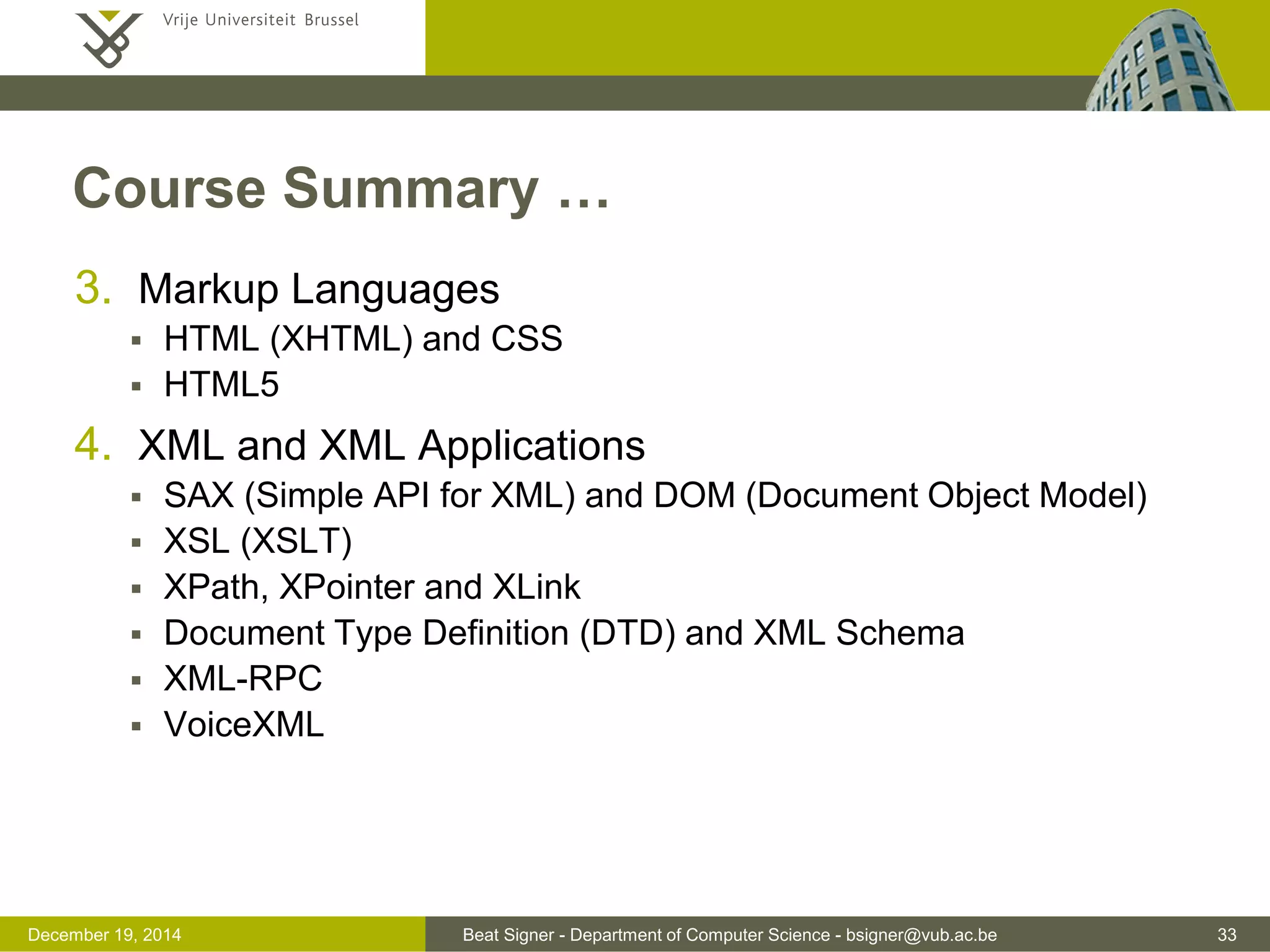
Course Summary …
3. Markup Languages
 HTML (XHTML) and CSS
 HTML5
4. XML and XML Applications
 SAX (Simple API for XML) and DOM (Document Object Model)
 XSL (XSLT)
 XPath, XPointer and XLink
 Document Type Definition (DTD) and XML Schema
 XML-RPC
 VoiceXML
Beat Signer - Department of Computer Science - bsigner@vub.ac.be 34December 19, 2014
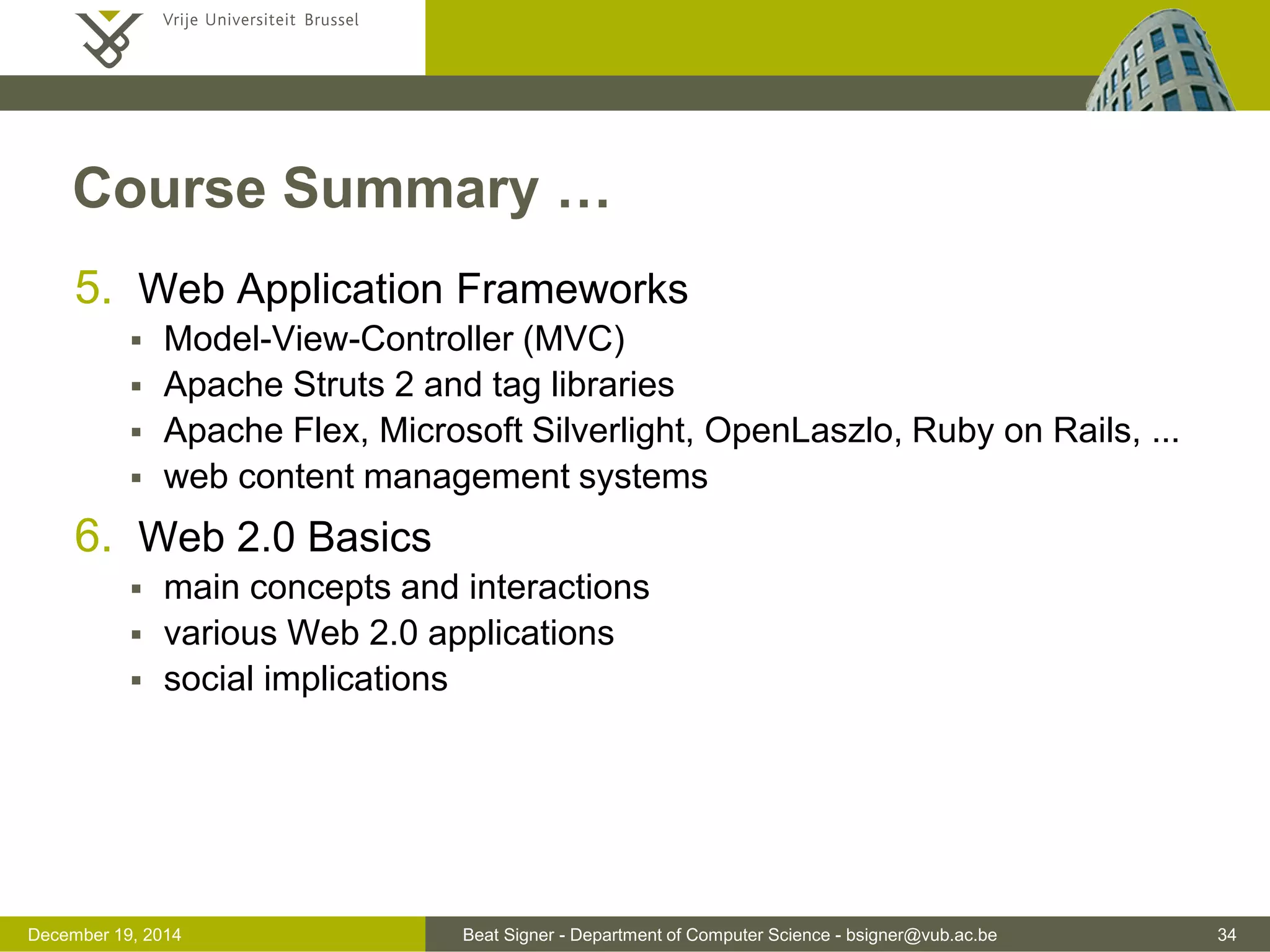
Course Summary …
5. Web Application Frameworks
 Model-View-Controller (MVC)
 Apache Struts 2 and tag libraries
 Apache Flex, Microsoft Silverlight, OpenLaszlo, Ruby on Rails, ...
 web content management systems
6. Web 2.0 Basics
 main concepts and interactions
 various Web 2.0 applications
 social implications
Beat Signer - Department of Computer Science - bsigner@vub.ac.be 35December 19, 2014
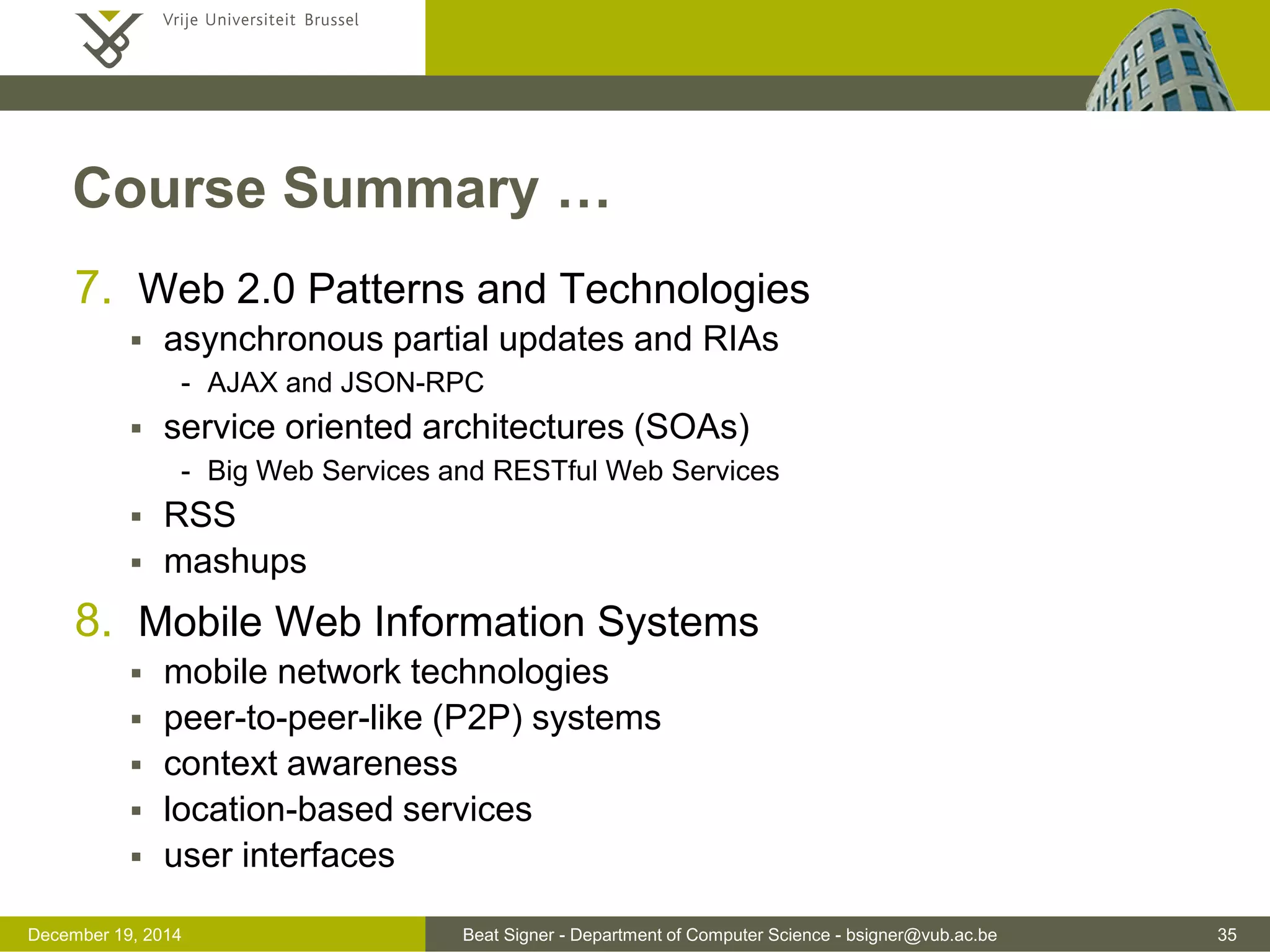
Course Summary …
7. Web 2.0 Patterns and Technologies
 asynchronous partial updates and RIAs
- AJAX and JSON-RPC
 service oriented architectures (SOAs)
- Big Web Services and RESTful Web Services
 RSS
 mashups
8. Mobile Web Information Systems
 mobile network technologies
 peer-to-peer-like (P2P) systems
 context awareness
 location-based services
 user interfaces
Beat Signer - Department of Computer Science - bsigner@vub.ac.be 36December 19, 2014
Course Summary …
9. Semantic Web
 semantic web stack
- RDF and RDFS, OWL, SPARQL, ...
 semantic web applications
 XHTML extensions
- microformats
- RDFa
10.Web Search
 web search engine architectures
 Google PageRank algorithm
 search engine optimisations (SEO)
- white hat and black hat optimisations
Beat Signer - Department of Computer Science - bsigner@vub.ac.be 37December 19, 2014
Course Summary …
11.Security, Privacy and Trust
 HTTP Authentication
- basic authentication, digest authentication and base64 encoding
 symmetric key and public key cryptography
- RSA cipher
 digital signatures and digital certificates
 TLS/SSL and HTTP Secure (HTTPS)
 privacy issues
12.Future Trends
 future of the Web
- cloud computing, social computing, personalisation, innovative user interfaces
 internet of things
 cross-media information spaces
Beat Signer - Department of Computer Science - bsigner@vub.ac.be 38December 19, 2014
Exam
 Exams on January 19, 26 and 27, 2015
 Each student will be assigned an examination slot
of 20 minutes
 5 minutes for questions about the assignment
 15 minutes oral exam about different topics that have been
covered in the course
- note that there will be no specific preparation time
 You will have to register for a specific examination via
PointCarré
 Overall grade = oral exam (60%) + assigment (40%)
 Submission of the assignment via PointCarré (dropbox)
 deadline: December 23, 24:00 (UTC)
Beat Signer - Department of Computer Science - bsigner@vub.ac.be 39December 19, 2014
Exam …
 You can bring the copies of your solutions for the
exercise with you as they might be used as a basis for
discussion during the oral exam
 The exam will cover all the content presented in the
lectures as well as any additional information from the
exercise sessions
 includes the videos shown in some of the lectures
 Remember to read the following two papers as they form
part of the course material
 Vannevar Bush, As We May Think, Atlanic Monthly, July 1945
 Mark Weiser, The Computer for the 21st Century, ACM Mobile
Computing and Communications Review, July 1999
Beat Signer - Department of Computer Science - bsigner@vub.ac.be 40December 19, 2014
Exam …
 Make sure that you can sketch basic architectures of
web information systems
 possible roles of different technologies
 know how the things presented in different lectures fit together
- e.g. security applied to varying architectures
- e.g. web search for RIAs
- …
 Make sure that you understand the basic concepts
 however, we might ask questions at any level of detail to evaluate
your knowledge
Beat Signer - Department of Computer Science - bsigner@vub.ac.be 41December 19, 2014
References
 Cross-Media Information Spaces
and Architectures
 http://wise.vub.ac.be/content/cross-media-
information-spaces-and-architectures
 Interactive Paper and Augmented Reality
 http://wise.vub.ac.be/content/interactive-paper-and-
augmented-reality
 Multimodal and Multi-Touch Interaction
 http://wise.vub.ac.be/content/multimodal-and-multi-
touch-interaction
Beat Signer - Department of Computer Science - bsigner@vub.ac.be 42December 19, 2014
References ...
 Beat Signer and Moira C. Norrie, As We May
Link: A General Metamodel for Hypermedia Systems, In
Proceedings of ER 2007, Auckland, New Zealand, 2007
 https://www.academia.edu/175425/
 Beat Signer, Fundamental Concepts for Interactive
Paper and Cross-Media Information Spaces,
ISBN 978-3-8370-2713-6, May 2008
 https://www.academia.edu/175442/
 Lode Hoste, Bruno Dumas and Beat Signer, Mudra: A
Unified Multimodal Interaction Framework, In Procee-
dings of ICMI 2011, Alicante, Spain, November 2011
 https://www.academia.edu/808762/
Beat Signer - Department of Computer Science - bsigner@vub.ac.be 43December 19, 2014
References ...
 Lode Hoste and Beat Signer, SpeeG2: A
Speech- and Gesture-based Interface for Efficient
Controller-free Text Entry, In Proceedings of ICMI 2013,
Sydney, Australia, December 2013
 https://www.academia.edu/4685517/
 Reinout Roels and Beat Signer, MindXpres: An
Extensible Content-driven Cross-Media Presentation
Platform, Proceedings of WISE 2014, Thessaloniki,
Greece, October, 2014
 https://www.academia.edu/7719770/
Beat Signer - Department of Computer Science - bsigner@vub.ac.be 44December 19, 2014
References ...
 Ahmed A.O. Tayeh and Beat Signer, Open
Cross-Document Linking and Browsing based on a
Visual Plug-in Architecture, Proceedings of WISE 2014,
Thessaloniki, Greece, October, 2014
 https://www.academia.edu/7757836/
 Sandra Trullemans and Beat Signer, Towards a
Conceptual Framework and Metamodel for Context-
Aware Personal Cross-Media Information Management
Systems, Proceedings of ER 2014, Atlanta, USA,
October, 2014
 https://www.academia.edu/7495430/
Beat Signer - Department of Computer Science - bsigner@vub.ac.be 45December 19, 2014 2 December 2005
Web Information Systems
The End
Good Luck with the Exam!

Future Trends - Lecture 12 - Web Information Systems (4011474FNR)

  • 1.
    Beat Signer -Department of Computer Science - bsigner@vub.ac.be 1December 19, 2014 2 December 2005 Web Information Systems Future Trends and Summary Prof. Beat Signer Department of Computer Science Vrije Universiteit Brussel http://www.beatsigner.com
  • 2.
    Beat Signer -Department of Computer Science - bsigner@vub.ac.be 2December 19, 2014 The Future of the Web  From a Web of documents (e.g. HTML pages) to a Web of structured data and services  semantic web and linked data  cloud computing  enabling technologies - URI, XML, XHTML, RDF and OWL  The Internet as one global machine  interoperability of services  automatic reasoning  The Mobile Web  access information and services offered by the global machine from everywhere at any time, feed the machine with new data and teach the machine new relationships between data
  • 3.
    Beat Signer -Department of Computer Science - bsigner@vub.ac.be 3December 19, 2014 The Future of the Web ...  Internet of Things  integration of physical objects with the global machine  physical world gets reflected in digital space via sensor input data - RFID, GPS, temperature, ...  information and services managed by the global machine get projected into the physical space via augmented reality  Personal data that is nowadays stored in folders on personal computers might move to the global machine  User interfaces for the global machine  personalised filtering and recommendation of related information based on user profiling and AI technologies  cross-media browsers
  • 4.
    Beat Signer -Department of Computer Science - bsigner@vub.ac.be 4December 19, 2014 The Future of the Web ...  How will documents look like in the future?  graph of linked data  documents as structural view of the linked data  will we still distinguish between data (document) and metadata?  How are the presented ideas related to approaches introduced earlier in the course?  e.g. Bush's Memex or Nelson's Xanadu  Do we need new publishing models for the creation of linked data to be managed by the global machine?  Finally, it is not only about connecting our data, services and machines but we are the machine
  • 5.
    Beat Signer -Department of Computer Science - bsigner@vub.ac.be 5December 19, 2014 Structured Data  Web of data instead of Web of documents  Semantic Web  linked data as part of the Semantic Web - based on URI, HTTP and RDF  various applications already make use of structured data on the Web - search engines start to process microformats (e.g. hproduct) or RDFa markup [http://upload.wikimedia.org/wikipedia/commons/2/23/Lod-datasets_2010-09-22_colored.png]
  • 6.
    Beat Signer -Department of Computer Science - bsigner@vub.ac.be 6December 19, 2014 Cloud Computing  The cloud hides technological details from the user  accessed over the Internet (e.g. via web browser)  customer no longer owns the physical infrastructure  different models including utility computing or subscription-based services Microsoft Google Yahoo Amazon Cloud
  • 7.
    Beat Signer -Department of Computer Science - bsigner@vub.ac.be 7December 19, 2014 Cloud Computing ...  Cloud computing providers offer different types of services  Infrastructure as a Service (IaaS) - rent virtual servers with unique IP and storage space on demand  Platform as a Service (PaaS) - access operating systems and associated services from the cloud - platform to create applications • e.g. Google App Engine  Software as a Service (SaaS) - end user applications • e.g. web-based email, Flickr or Delicious
  • 8.
    Beat Signer -Department of Computer Science - bsigner@vub.ac.be 8December 19, 2014 Social Computing  New forms of computations performed by groups of people based on networks of trust etc.  "The Wisdom of Crowds", James Surowiecki  e.g. Amazon Mechanical Turk (MTurk)  Instead of having a small group of collaborating users, in the future these social computations may be performed on the global machine  Applications with social computations include  social tagging  collaborative filtering
  • 9.
    Beat Signer -Department of Computer Science - bsigner@vub.ac.be 9December 19, 2014 Personalisation  To deal with the sheer amount of data, we will have to apply semantic filtering and recommedation on the web of data  The filtering and recommendation can be based on  personal profiling - monitoring a user's interaction with the global machine  social profiling - investigate a user's social network  item classication - find similar items based on intrinsic properties as well as collaborative annotations
  • 10.
    Beat Signer -Department of Computer Science - bsigner@vub.ac.be 10December 19, 2014 PIM Meets the Machine  Integration of personal information management (PIM) tools with the cloud  how much privacy will there be in the future?  will the cloud be able to forget information or will we end up with an "archive of our life" (total recall)? MyLifeBits, Microsoft Research
  • 11.
    Beat Signer -Department of Computer Science - bsigner@vub.ac.be 11December 19, 2014 Internet of Things  In the future we will see more and more network- or Internet-enabled physical objects  Physical objects get linked to digital information and services offered by the cloud  How many objects will there be?  estimates of 100'000 billion and more objects  Is simple object tagging via RFID tags enough?  what if only a part of an object should be linked to the cloud?  we need a flexible addressing mechanism for physical resources  Is the simple mapping to a web presence (URI) enough?
  • 12.
    Beat Signer -Department of Computer Science - bsigner@vub.ac.be 12December 19, 2014 New Forms of User Interfaces  Is the concept of a document still the right metaphor for accessing linked data?  What about interfaces with semantic zooming functionality to seamlessly dive into more details?  Will the increasing impact of social computing also be manifested in future interfaces for the global machine  e.g. filtering and ranking of information in Newsmap Microsoft's Photosynth interface for digital images
  • 13.
    Beat Signer -Department of Computer Science - bsigner@vub.ac.be 13December 19, 2014 New Forms of User Interfaces ...  In the future we will no longer just access information from the machine via a web browser but augment and use the physical environment as natural user interface  e.g. augmented reality interfaces as presented in one of the previous lectures  The use of linked data could help to overcome some the limitations of existing document-centric desktop interfaces  files as ultimate level of granularity  no links (associations) between files or parts of files  missing content annotation functionality
  • 14.
    Beat Signer -Department of Computer Science - bsigner@vub.ac.be 14December 19, 2014 New Forms of User Interfaces ... augmented contact lens augmented car windshield augmented phone display WikitudeWorldbrowser B.A.Parviz,UniversityofWashington augmentedrealitywindshield,GM
  • 15.
    Beat Signer -Department of Computer Science - bsigner@vub.ac.be 15December 19, 2014 Social Implications  What are the effects of the remediation of print on digital natives?  in longterm studies it has been shown that the frequent use of the Web has a negative impact on a person's deep reading skills  a recent study by King's College London (KCL) has shown the negative effects of information overload - "Information Overload Harms Concentration More than Marijuana"  What is the trade-off between personalisation and privacy?  will we still be able to control all the captured data or will we be continously monitored and profiled by smart objects?  Transparency and trust will become even more important issues!
  • 16.
    Beat Signer -Department of Computer Science - bsigner@vub.ac.be 16December 19, 2014 The Future of the Internet internet of things web of data self-organising cloud computing security and privacy mobile web social computing one global machine
  • 17.
    Beat Signer -Department of Computer Science - bsigner@vub.ac.be 17December 19, 2014 01001000100 0101001100010010100010010 0100100010010001000100001001000 100010001100001001000110010101010110 1100010010100010010010010100010101011001 101001100001100 101010100 00101000100 110101010101 00100 01010101000 1001 1111111111 111 0000000010 0 11111111 0101001011 010101010 111010101 001010010110 Fluid Cross-Media Information Spaces
  • 18.
    Beat Signer -Department of Computer Science - bsigner@vub.ac.be 18December 19, 2014 Prof. Dr. Beat Signer Interactive Paper, Cross-Media Information Architectures Sandra Trullemans Personal Cross-Media Information Management Lode Hoste Multimodal Interaction, Midas and Mudra Framework Reinout Roels MindXpres: Extensible Content- driven Presentation Tool CISA Human-Machine & Human-Information Interaction Information Systems & Management Information Visualisation & Navigation WEB & INFORMATION SYSTEMS ENGINEERING CROSS-MEDIA INFORMATION SPACES AND ARCHITECTURES (CISA)
  • 19.
    Beat Signer -Department of Computer Science - bsigner@vub.ac.be 19December 19, 2014 Ahmed A.O. Tayeh Open Cross-Media Authoring, Fluid Document Formats WEB & INFORMATION SYSTEMS ENGINEERING CISA Human-Machine & Human-Information Interaction Information Systems & Management Information Visualisation & Navigation CROSS-MEDIA INFORMATION SPACES AND ARCHITECTURES (CISA)
  • 20.
    Beat Signer -Department of Computer Science - bsigner@vub.ac.be 20December 19, 2014 Digital Documents as a Paper Simulator? Vannevar Bush Ted Nelson Most people don't understand the logic of the concept: "What You See Is What You Get" is based on printing the document out ("get" means "get WHEN YOU PRINT IT OUT"). And that means a metaphysical shift: a document can only consist of what can be printed! [...] No overlays [...] – PAPER UNDER GLASS. When data of any sort are placed in storage, they are filed alphabetically or numerically, and information is found (when it is) by tracing it down from subclass to subclass. It can be in only one place, unless duplicates are used [...] The human mind does not work that way. It operates by association. As We May Think, Atlantic Monthly, July 1945 Geeks Bearing Gifts: How the Computer World Got This Way, Mindful Press 2009
  • 21.
    Beat Signer -Department of Computer Science - bsigner@vub.ac.be 21December 19, 2014 What is Wrong with Digital Documents?  Existing document formats are based on the simulation of paper affordances on desktop computers  How to manage mixed-media "documents" in open and fluid cross-media information spaces?  on the data level - context-sensitive adapatation - cross-media transclusion  on the visualisation and navigation level - zoomable user interfaces  on the cross-media interaction level - fluid multimodal cross-media interfaces  Remediation of the "paper simulation" approach  WYSIWYG is only one out of many options!
  • 22.
    Beat Signer -Department of Computer Science - bsigner@vub.ac.be 22December 19, 2014 Bridging the Paper-Digital Divide
  • 23.
    Beat Signer -Department of Computer Science - bsigner@vub.ac.be 23December 19, 2014 What is Wrong with Slideware?  Simulation of physical slides  limited space due to the slide concept  linear navigation from slide to slide  difficult to reuse content and embed rich media types  Not easy to add/change content at presentation time  highlighting or annotation of content  Limited extensibility of existing slideware tools
  • 24.
    Beat Signer -Department of Computer Science - bsigner@vub.ac.be 24December 19, 2014 MindXpres Presentation Tool  Extensible prototyping platform for novel presen- tation concepts  content-based approach - separation of content and pre- sentation (automatic visualisation)  cross-media content reuse  non-linear navigation via zoomable user interface  connectivity and interactivity R. Roels and B. Signer, MindXpres: An Extensible Content-driven Cross-Media Presentation Platform, Proceedings of WISE 2014, Thessaloniki, Greece, October, 2014
  • 25.
    25 Multimodal User Interfaces EPOC,emotiv Echo Smartpen, Livescribe Kinect,Microsoft
  • 26.
    Beat Signer -Department of Computer Science - bsigner@vub.ac.be 26December 19, 2014  Midas/Mudra Framework  declarative definition of multimodal and multi-touch interactions  rule-based language approach  rapid protoyping and application development  iGesture Workbench  create and test gesture sets and algorithms  different modalities: digital pen, Wii remote, …  open source (www.igesture.org)  SpeeG  multimodal speech- and body gesture-based text input  real-time correction of recognised voice input Multimodal and Multi-Touch Interaction
  • 27.
    Beat Signer -Department of Computer Science - bsigner@vub.ac.be 27December 19, 2014 SpeeG2 User Speech recognition (Microsoft SAPI 5.4) Skeletal tracking (Microsoft Kinect) 5 4 2 3 SpeeG2 GUI 6 1 Sven De Kock
  • 28.
    Beat Signer -Department of Computer Science - bsigner@vub.ac.be 28December 19, 2014 Video: SpeeG2 Performance (21 WPM) Sven De Kock
  • 29.
    Beat Signer -Department of Computer Science - bsigner@vub.ac.be 29December 19, 2014 ArtVis
  • 30.
    Beat Signer -Department of Computer Science - bsigner@vub.ac.be 30December 19, 2014 WISE Student Projects  Cross-Media Information Spaces and Architectures  fluid cross-media document formats  personal information management (PIM)  MindXpres presentation tool, the office of the future, ...  Multimodal and Multi-touch Interaction  next generation text input devices (e.g. combine voice and Kinect)  multimodal mobile interaction  Interactive paper and augmented reality  If you should be interested in one of these topics (or if you have your own ideas) please contact us!  http://wise.vub.ac.be/thesis_proposals
  • 31.
    Beat Signer -Department of Computer Science - bsigner@vub.ac.be 31December 19, 2014 Other Courses  Advanced Topics in Information Systems  seminar about recent developments in information systems  information systems and information management  information visualisation and navigation  human-machine and human-information interaction  [http://wise.vub.ac.be/content/advanced-topics-information-systems]  Next Generation User Interfaces  interaction design  multimodal interaction (theoretical concepts, fusion and fission, ...)  interactive tabletops and surfaces  pen-based interaction and gesture-based interaction  tangible interaction, virtual reality and augmented reality  [http://wise.vub.ac.be/content/next-generation-user-interfaces]
  • 32.
    Beat Signer -Department of Computer Science - bsigner@vub.ac.be 32December 19, 2014 Course Summary 1. Introduction  history of the Web - Memex, Xanadu and various hypertext systems  ARPANET and TCP/IP  World Wide Web 2. Web Architectures  HTTP protocol and session management  client-server architectures, proxies, tunnels and gateways  caching  client-side processing - JavaScript, Java Applets, ...  server-side processing - CGI, Java Servlets, JavaServer Pages (JSP), ...
  • 33.
    Beat Signer -Department of Computer Science - bsigner@vub.ac.be 33December 19, 2014 Course Summary … 3. Markup Languages  HTML (XHTML) and CSS  HTML5 4. XML and XML Applications  SAX (Simple API for XML) and DOM (Document Object Model)  XSL (XSLT)  XPath, XPointer and XLink  Document Type Definition (DTD) and XML Schema  XML-RPC  VoiceXML
  • 34.
    Beat Signer -Department of Computer Science - bsigner@vub.ac.be 34December 19, 2014 Course Summary … 5. Web Application Frameworks  Model-View-Controller (MVC)  Apache Struts 2 and tag libraries  Apache Flex, Microsoft Silverlight, OpenLaszlo, Ruby on Rails, ...  web content management systems 6. Web 2.0 Basics  main concepts and interactions  various Web 2.0 applications  social implications
  • 35.
    Beat Signer -Department of Computer Science - bsigner@vub.ac.be 35December 19, 2014 Course Summary … 7. Web 2.0 Patterns and Technologies  asynchronous partial updates and RIAs - AJAX and JSON-RPC  service oriented architectures (SOAs) - Big Web Services and RESTful Web Services  RSS  mashups 8. Mobile Web Information Systems  mobile network technologies  peer-to-peer-like (P2P) systems  context awareness  location-based services  user interfaces
  • 36.
    Beat Signer -Department of Computer Science - bsigner@vub.ac.be 36December 19, 2014 Course Summary … 9. Semantic Web  semantic web stack - RDF and RDFS, OWL, SPARQL, ...  semantic web applications  XHTML extensions - microformats - RDFa 10.Web Search  web search engine architectures  Google PageRank algorithm  search engine optimisations (SEO) - white hat and black hat optimisations
  • 37.
    Beat Signer -Department of Computer Science - bsigner@vub.ac.be 37December 19, 2014 Course Summary … 11.Security, Privacy and Trust  HTTP Authentication - basic authentication, digest authentication and base64 encoding  symmetric key and public key cryptography - RSA cipher  digital signatures and digital certificates  TLS/SSL and HTTP Secure (HTTPS)  privacy issues 12.Future Trends  future of the Web - cloud computing, social computing, personalisation, innovative user interfaces  internet of things  cross-media information spaces
  • 38.
    Beat Signer -Department of Computer Science - bsigner@vub.ac.be 38December 19, 2014 Exam  Exams on January 19, 26 and 27, 2015  Each student will be assigned an examination slot of 20 minutes  5 minutes for questions about the assignment  15 minutes oral exam about different topics that have been covered in the course - note that there will be no specific preparation time  You will have to register for a specific examination via PointCarré  Overall grade = oral exam (60%) + assigment (40%)  Submission of the assignment via PointCarré (dropbox)  deadline: December 23, 24:00 (UTC)
  • 39.
    Beat Signer -Department of Computer Science - bsigner@vub.ac.be 39December 19, 2014 Exam …  You can bring the copies of your solutions for the exercise with you as they might be used as a basis for discussion during the oral exam  The exam will cover all the content presented in the lectures as well as any additional information from the exercise sessions  includes the videos shown in some of the lectures  Remember to read the following two papers as they form part of the course material  Vannevar Bush, As We May Think, Atlanic Monthly, July 1945  Mark Weiser, The Computer for the 21st Century, ACM Mobile Computing and Communications Review, July 1999
  • 40.
    Beat Signer -Department of Computer Science - bsigner@vub.ac.be 40December 19, 2014 Exam …  Make sure that you can sketch basic architectures of web information systems  possible roles of different technologies  know how the things presented in different lectures fit together - e.g. security applied to varying architectures - e.g. web search for RIAs - …  Make sure that you understand the basic concepts  however, we might ask questions at any level of detail to evaluate your knowledge
  • 41.
    Beat Signer -Department of Computer Science - bsigner@vub.ac.be 41December 19, 2014 References  Cross-Media Information Spaces and Architectures  http://wise.vub.ac.be/content/cross-media- information-spaces-and-architectures  Interactive Paper and Augmented Reality  http://wise.vub.ac.be/content/interactive-paper-and- augmented-reality  Multimodal and Multi-Touch Interaction  http://wise.vub.ac.be/content/multimodal-and-multi- touch-interaction
  • 42.
    Beat Signer -Department of Computer Science - bsigner@vub.ac.be 42December 19, 2014 References ...  Beat Signer and Moira C. Norrie, As We May Link: A General Metamodel for Hypermedia Systems, In Proceedings of ER 2007, Auckland, New Zealand, 2007  https://www.academia.edu/175425/  Beat Signer, Fundamental Concepts for Interactive Paper and Cross-Media Information Spaces, ISBN 978-3-8370-2713-6, May 2008  https://www.academia.edu/175442/  Lode Hoste, Bruno Dumas and Beat Signer, Mudra: A Unified Multimodal Interaction Framework, In Procee- dings of ICMI 2011, Alicante, Spain, November 2011  https://www.academia.edu/808762/
  • 43.
    Beat Signer -Department of Computer Science - bsigner@vub.ac.be 43December 19, 2014 References ...  Lode Hoste and Beat Signer, SpeeG2: A Speech- and Gesture-based Interface for Efficient Controller-free Text Entry, In Proceedings of ICMI 2013, Sydney, Australia, December 2013  https://www.academia.edu/4685517/  Reinout Roels and Beat Signer, MindXpres: An Extensible Content-driven Cross-Media Presentation Platform, Proceedings of WISE 2014, Thessaloniki, Greece, October, 2014  https://www.academia.edu/7719770/
  • 44.
    Beat Signer -Department of Computer Science - bsigner@vub.ac.be 44December 19, 2014 References ...  Ahmed A.O. Tayeh and Beat Signer, Open Cross-Document Linking and Browsing based on a Visual Plug-in Architecture, Proceedings of WISE 2014, Thessaloniki, Greece, October, 2014  https://www.academia.edu/7757836/  Sandra Trullemans and Beat Signer, Towards a Conceptual Framework and Metamodel for Context- Aware Personal Cross-Media Information Management Systems, Proceedings of ER 2014, Atlanta, USA, October, 2014  https://www.academia.edu/7495430/
  • 45.
    Beat Signer -Department of Computer Science - bsigner@vub.ac.be 45December 19, 2014 2 December 2005 Web Information Systems The End Good Luck with the Exam!