
Physical and embodied
   user interfaces


          Simone Mora
     simonem@idi.ntnu.no
     IDI, Sept. 17th, 2012
Agenda


• Definition of physical user interface

• Brief History

• Frameworks

• Research Showcase

• Conclusions
What is a physical user interface?


 “An interface that rely on embodied interaction,
tangible manipulation, physical representation of
    data and embeddedness in real space”
                (Hornecker&Buur, 2006)
What is a physical user interface?


 “An interface containing at least one interaction
technique not dependent on classical 2D widgets
            such as menu and icons”
                   (Van Dam, 1997)
History


• The emergence of physical interfaces is closely
 related to the adoption of ubiquitous computing
 technologies


• Instead of creating “Virtual Words” or building on
 the WIMP (Windows, Icons, Mouses, Pointers)
 paradigm, computation should enrich the real
 world with information from the digital domain
History


Marble Answering Machine, Durrell Bishop, 1992, RCA


         Video: https://vimeo.com/19930744
Frameworks
Frameworks

• GUIs are really flexible since they can represent a
 variety of information by decoupling representation
 from control


• The key idea of physical computing is to give physical
 form to digital information. However that makes the
 tangible part more specific and less flexible.


• So, the challenge is: how can you mix both?
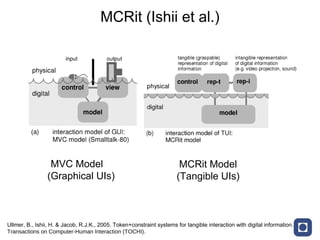
MCRit (Ishii et al.)


                 MVC Model                                              MCRit Model
                (Graphical UIs)                                        (Tangible UIs)


Ullmer, B., Ishii, H. & Jacob, R.J.K., 2005. Token+constraint systems for tangible interaction with digital information.
Transactions on Computer-Human Interaction (TOCHI).
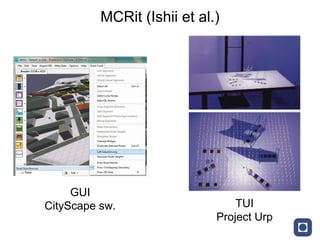
MCRit (Ishii et al.)


     GUI
CityScape sw.                    TUI
                             Project Urp
Reality Based Interaction (Jacob et al.)


• Descriptive framework

• Many new interaction styles are designed to take
 advantage of users’ skills and experience of
 interacting with the real non-digital world

• Interaction with information becomes from a
 segregated activity that takes places at a desk to
 a fluid free form activity that takes place into the
 real world
Reality Based Interaction (Jacob et al.)
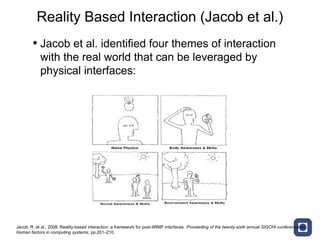
        • Jacob et al. identified four themes of interaction
            with the real world that can be leveraged by
            physical interfaces:


Jacob, R. et al., 2008. Reality-based interaction: a framework for post-WIMP interfaces. Proceeding of the twenty-sixth annual SIGCHI conference on
Human factors in computing systems, pp.201–210.
Research showcase
Application Domain


Technology
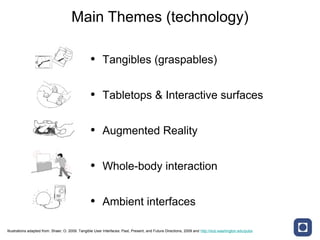
Main Themes (technology)

                                                 • Tangibles (graspables)

                                                 • Tabletops & Interactive surfaces

                                                 • Augmented Reality

                                                 • Whole-body interaction

                                                 • Ambient interfaces
Illustrations adapted from: Shaer, O. 2009. Tangible User Interfaces: Past, Present, and Future Directions, 2009 and http://dub.washington.edu/pubs
Application Domains

• Learning and Training*
• Social Communication*
• Problem Solving and Planning*
• Tangible Programming*
• Entertainment, Play, and Edutainment*
• Information Visualization*
• Music and Performance*
                                    * Collaborative
Project:    Sifteo Cubes
Category:   Tangibles
Domain:     Learning, Play
Authors:    Sifteo Inc., 2009 (former MIT Media Lab project)
Project: Chronotape
Category: Tangibles
Domain: Social Interaction
Authors: University of Bristol
Key Publication: Bennett et al. ChronoTape: tangible timelines for family history. In TEI '12: Proceedings of the Sixth
International Conference on Tangible, Embedded and Embodied Interaction.
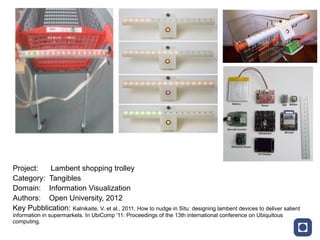
Project:   Lambent shopping trolley
Category: Tangibles
Domain: Information Visualization
Authors: Open University, 2012
Key Pubblication: Kalnikaite, V. et al., 2011. How to nudge in Situ: designing lambent devices to deliver salient
information in supermarkets. In UbiComp '11: Proceedings of the 13th international conference on Ubiquitous
computing.
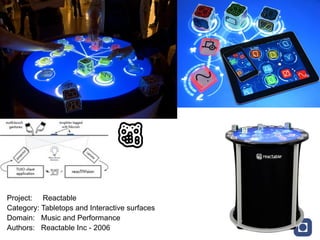
Project: Reactable
Category: Tabletops and Interactive surfaces
Domain: Music and Performance
Authors: Reactable Inc - 2006
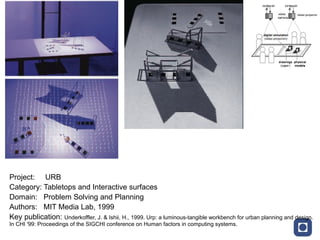
Project: URB
Category: Tabletops and Interactive surfaces
Domain: Problem Solving and Planning
Authors: MIT Media Lab, 1999
Key publication: Underkoffler, J. & Ishii, H., 1999. Urp: a luminous-tangible workbench for urban planning and design.
In CHI '99: Proceedings of the SIGCHI conference on Human factors in computing systems.
Project: The Sixth Sense
Category: Whole-Body Interaction
Domain: Social Communication, Information Visualization
Authors: MIT Media Lab, 2009
Key Publication: P. Mistry, P. Maes. SixthSense – A Wearable Gestural Interface. In the Proceedings of SIGGRAPH Asia
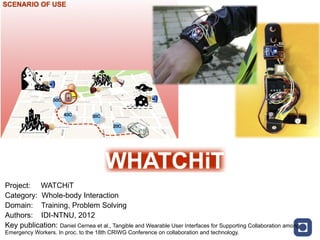
Project: WATCHiT
Category: Whole-body Interaction
Domain: Training, Problem Solving
Authors: IDI-NTNU, 2012
Key publication: Daniel Cernea et al., Tangible and Wearable User Interfaces for Supporting Collaboration among
Emergency Workers. In proc. to the 18th CRIWG Conference on collaboration and technology.
Project: CroMAR
Category: Augmented Reality
Domain: Training
Authors: IDI-NTNU, 2011
Key Publication: Mora, S., Boron, A. & Divitini, M.
CroMAR: Mobile Augmented Reality for Supporting
Reflection on Crowd Management, IGI Global.
Project:   Human PacMan
Category: Augmented Reality
Domain: Play, Enternatinment
Authors: Mixed Reality Lab Singapore, 2004
Key publication: Adrian David Cheok et al.; Human pacman: a wide area socio-physical interactive
entertainment system in mixed reality. In CHI '04 extended abstracts on Human factors in computing systems
Video:
http://www.mixedrealitylab.org/media/all
   %20videos/HP/human_pacman.mpg
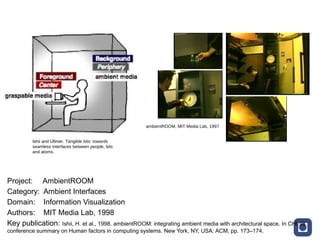
ambientROOM, MIT Media Lab, 1997


         Ishii and Ullmer. Tangible bits: towards
         seamless interfaces between people, bits
         and atoms.


Project: AmbientROOM
Category: Ambient Interfaces
Domain: Information Visualization
Authors: MIT Media Lab, 1998
Key publication: Ishii, H. et al., 1998. ambientROOM: integrating ambient media with architectural space. In CHI 98
conference summary on Human factors in computing systems. New York, NY, USA: ACM, pp. 173–174.
Video: https://vimeo.com/48815734
Project: Collaborative Mood Awareness
Category: Ambient Interfaces
Domain: Information Visualization
Authors: IDI-NTNU, 2011
Key publication: Mora, S. et al.. Supporting Mood Awareness in Collaborative Settings. Proceedings of the 7th
International Conference on Collaborative Computing (CollaborateCom)
Physical Interfaces - Pros


• May increase usability
• May increase enjoyment
• Allows for (user-side) multitasking
• Allows for interaction in the periphery
• Support face-to-face social interaction
  (Hornecker&Buur, 2006)


• Can leverage users’ knowledge and skills of
  interaction with the everyday, non-digital, work
  (Jacob et al., 2008)
Physical Interfaces - Pros

• (Almost) unexplored area of research, you can
 be a pioneer!
Physical Interfaces - Challenges

• Requires not only designing the digital (software)
  but also the physical (hardware) and the
  interrelations between the two (affordances)


• Physical interaction is socially and culturally
  situated (Hornecker, 2011)
Further readings
Thanks!
Simone Mora
simonem@idi.ntnu.no

Tangible User Interface Showcase

  • 1.
    Physical and embodied user interfaces Simone Mora simonem@idi.ntnu.no IDI, Sept. 17th, 2012
  • 2.
    Agenda • Definition ofphysical user interface • Brief History • Frameworks • Research Showcase • Conclusions
  • 3.
    What is aphysical user interface? “An interface that rely on embodied interaction, tangible manipulation, physical representation of data and embeddedness in real space” (Hornecker&Buur, 2006)
  • 4.
    What is aphysical user interface? “An interface containing at least one interaction technique not dependent on classical 2D widgets such as menu and icons” (Van Dam, 1997)
  • 5.
    History • The emergenceof physical interfaces is closely related to the adoption of ubiquitous computing technologies • Instead of creating “Virtual Words” or building on the WIMP (Windows, Icons, Mouses, Pointers) paradigm, computation should enrich the real world with information from the digital domain
  • 6.
    History Marble Answering Machine,Durrell Bishop, 1992, RCA Video: https://vimeo.com/19930744
  • 7.
  • 8.
    Frameworks • GUIs arereally flexible since they can represent a variety of information by decoupling representation from control • The key idea of physical computing is to give physical form to digital information. However that makes the tangible part more specific and less flexible. • So, the challenge is: how can you mix both?
  • 9.
    MCRit (Ishii etal.) MVC Model MCRit Model (Graphical UIs) (Tangible UIs) Ullmer, B., Ishii, H. & Jacob, R.J.K., 2005. Token+constraint systems for tangible interaction with digital information. Transactions on Computer-Human Interaction (TOCHI).
  • 10.
    MCRit (Ishii etal.) GUI CityScape sw. TUI Project Urp
  • 11.
    Reality Based Interaction(Jacob et al.) • Descriptive framework • Many new interaction styles are designed to take advantage of users’ skills and experience of interacting with the real non-digital world • Interaction with information becomes from a segregated activity that takes places at a desk to a fluid free form activity that takes place into the real world
  • 12.
    Reality Based Interaction(Jacob et al.) • Jacob et al. identified four themes of interaction with the real world that can be leveraged by physical interfaces: Jacob, R. et al., 2008. Reality-based interaction: a framework for post-WIMP interfaces. Proceeding of the twenty-sixth annual SIGCHI conference on Human factors in computing systems, pp.201–210.
  • 13.
  • 14.
  • 15.
    Main Themes (technology) • Tangibles (graspables) • Tabletops & Interactive surfaces • Augmented Reality • Whole-body interaction • Ambient interfaces Illustrations adapted from: Shaer, O. 2009. Tangible User Interfaces: Past, Present, and Future Directions, 2009 and http://dub.washington.edu/pubs
  • 16.
    Application Domains • Learningand Training* • Social Communication* • Problem Solving and Planning* • Tangible Programming* • Entertainment, Play, and Edutainment* • Information Visualization* • Music and Performance* * Collaborative
  • 17.
    Project: Sifteo Cubes Category: Tangibles Domain: Learning, Play Authors: Sifteo Inc., 2009 (former MIT Media Lab project)
  • 18.
    Project: Chronotape Category: Tangibles Domain:Social Interaction Authors: University of Bristol Key Publication: Bennett et al. ChronoTape: tangible timelines for family history. In TEI '12: Proceedings of the Sixth International Conference on Tangible, Embedded and Embodied Interaction.
  • 19.
    Project: Lambent shopping trolley Category: Tangibles Domain: Information Visualization Authors: Open University, 2012 Key Pubblication: Kalnikaite, V. et al., 2011. How to nudge in Situ: designing lambent devices to deliver salient information in supermarkets. In UbiComp '11: Proceedings of the 13th international conference on Ubiquitous computing.
  • 20.
    Project: Reactable Category: Tabletopsand Interactive surfaces Domain: Music and Performance Authors: Reactable Inc - 2006
  • 21.
    Project: URB Category: Tabletopsand Interactive surfaces Domain: Problem Solving and Planning Authors: MIT Media Lab, 1999 Key publication: Underkoffler, J. & Ishii, H., 1999. Urp: a luminous-tangible workbench for urban planning and design. In CHI '99: Proceedings of the SIGCHI conference on Human factors in computing systems.
  • 22.
    Project: The SixthSense Category: Whole-Body Interaction Domain: Social Communication, Information Visualization Authors: MIT Media Lab, 2009 Key Publication: P. Mistry, P. Maes. SixthSense – A Wearable Gestural Interface. In the Proceedings of SIGGRAPH Asia
  • 23.
    Project: WATCHiT Category: Whole-bodyInteraction Domain: Training, Problem Solving Authors: IDI-NTNU, 2012 Key publication: Daniel Cernea et al., Tangible and Wearable User Interfaces for Supporting Collaboration among Emergency Workers. In proc. to the 18th CRIWG Conference on collaboration and technology.
  • 24.
    Project: CroMAR Category: AugmentedReality Domain: Training Authors: IDI-NTNU, 2011 Key Publication: Mora, S., Boron, A. & Divitini, M. CroMAR: Mobile Augmented Reality for Supporting Reflection on Crowd Management, IGI Global.
  • 25.
    Project: Human PacMan Category: Augmented Reality Domain: Play, Enternatinment Authors: Mixed Reality Lab Singapore, 2004 Key publication: Adrian David Cheok et al.; Human pacman: a wide area socio-physical interactive entertainment system in mixed reality. In CHI '04 extended abstracts on Human factors in computing systems
  • 26.
  • 27.
    ambientROOM, MIT MediaLab, 1997 Ishii and Ullmer. Tangible bits: towards seamless interfaces between people, bits and atoms. Project: AmbientROOM Category: Ambient Interfaces Domain: Information Visualization Authors: MIT Media Lab, 1998 Key publication: Ishii, H. et al., 1998. ambientROOM: integrating ambient media with architectural space. In CHI 98 conference summary on Human factors in computing systems. New York, NY, USA: ACM, pp. 173–174.
  • 28.
  • 29.
    Project: Collaborative MoodAwareness Category: Ambient Interfaces Domain: Information Visualization Authors: IDI-NTNU, 2011 Key publication: Mora, S. et al.. Supporting Mood Awareness in Collaborative Settings. Proceedings of the 7th International Conference on Collaborative Computing (CollaborateCom)
  • 30.
    Physical Interfaces -Pros • May increase usability • May increase enjoyment • Allows for (user-side) multitasking • Allows for interaction in the periphery • Support face-to-face social interaction (Hornecker&Buur, 2006) • Can leverage users’ knowledge and skills of interaction with the everyday, non-digital, work (Jacob et al., 2008)
  • 31.
    Physical Interfaces -Pros • (Almost) unexplored area of research, you can be a pioneer!
  • 32.
    Physical Interfaces -Challenges • Requires not only designing the digital (software) but also the physical (hardware) and the interrelations between the two (affordances) • Physical interaction is socially and culturally situated (Hornecker, 2011)
  • 33.
  • 34.

Editor's Notes

  • #13 Näıve Physics: the common sense knowledge people have about the physical world. Body Awareness and Skills: the awareness people have of their own physical bodies and their skills of controlling and coordinating their bodies. Environment Awareness and Skills: the sense of surroundings people have for their environment and their skills of manip- ulating and navigating their environment. Social Awareness and Skills: the awareness people have that other people share their environment, their skills of interact- ing with each other verbally or non verbally, and their ability to work together to accomplish a common goal.
  • #15 Segmentation I made