History of CHI
Leuven, 19 March 2012


Erik Duval
http://erikduval.wordpress.com
@ErikDuval


                                 1
http://www.slideshare.net/erik.duval


2
HUGE                      thanks to...
      http://www.slideshare.net/mrettig/interaction-design-history


marc rettig
marcrettig.com
                    interaction
presented at
                    design history
                    in a teeny
carnegie
mellon
university


2 april 2004


mrettig@well.com
                    little nutshell
                    version 1.5
when? what?


• ???


             4
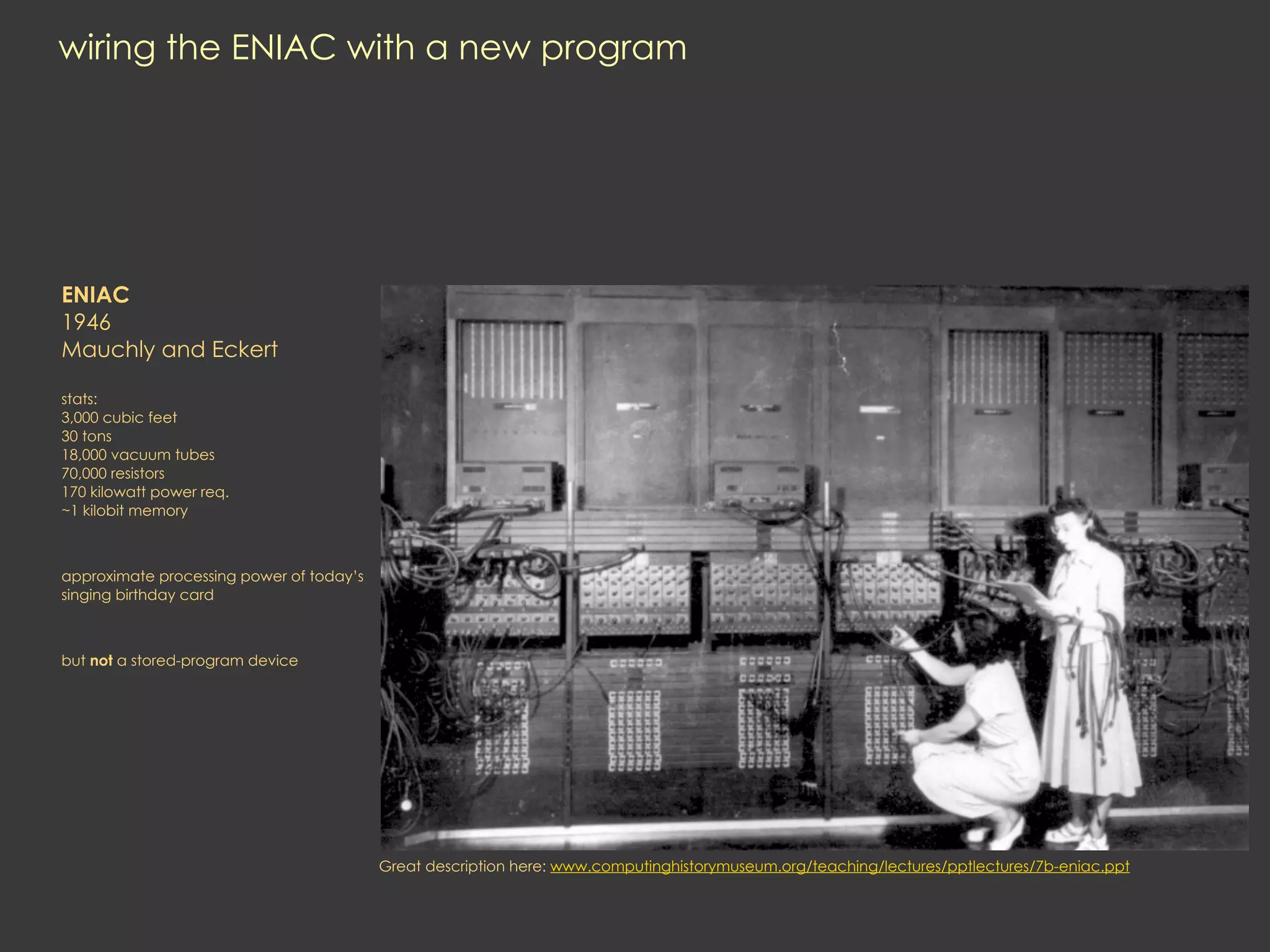
wiring the ENIAC with a new program


ENIAC
1946
Mauchly and Eckert

stats:
3,000 cubic feet
30 tons
18,000 vacuum tubes
70,000 resistors
170 kilowatt power req.
~1 kilobit memory


approximate processing power of today’s
singing birthday card


but not a stored-program device


                                          Great description here: www.computinghistorymuseum.org/teaching/lectures/pptlectures/7b-eniac.ppt
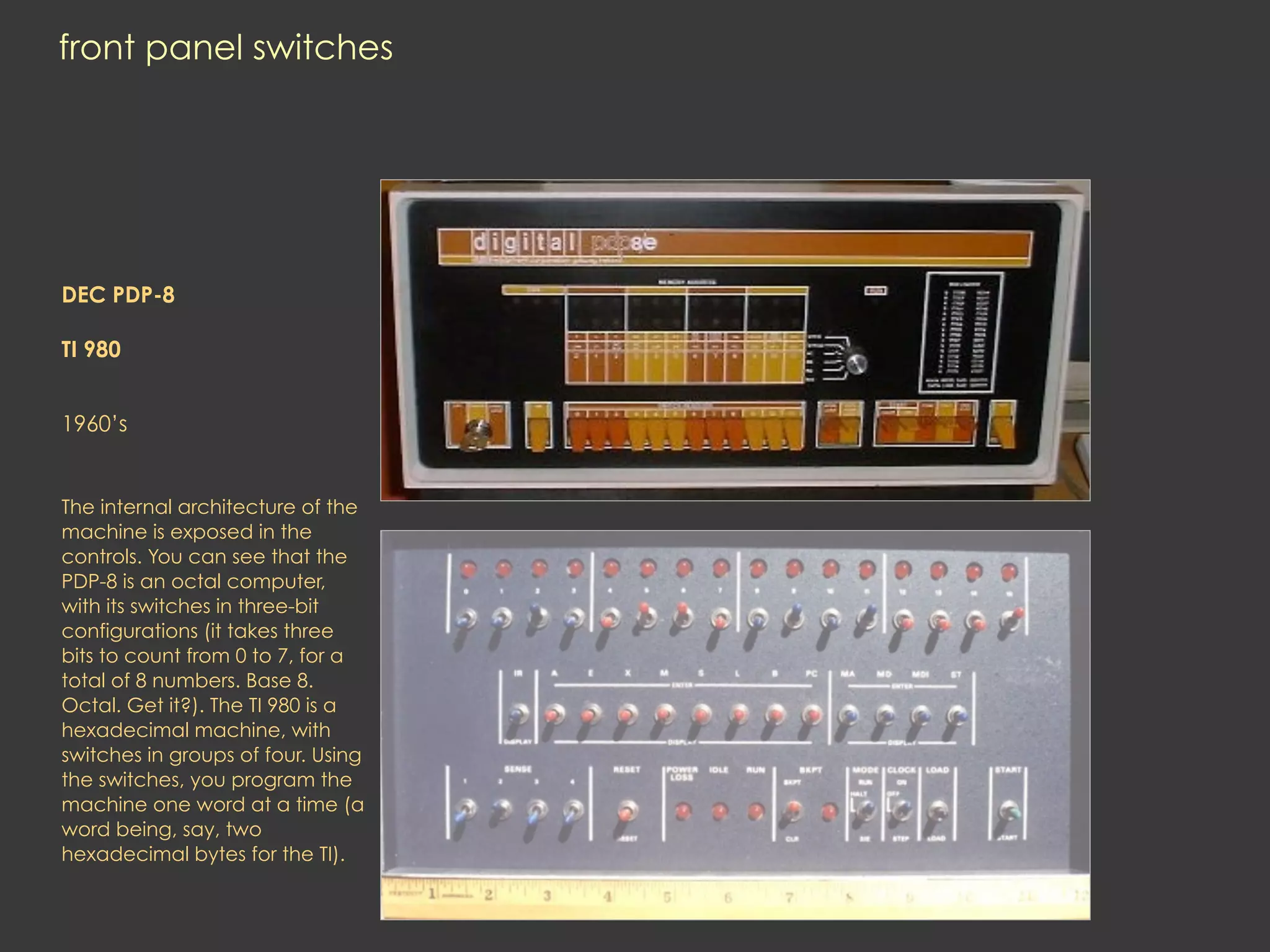
front panel switches


DEC PDP-8

TI 980


1960’s


The internal architecture of the
machine is exposed in the
controls. You can see that the
PDP-8 is an octal computer,
with its switches in three-bit
configurations (it takes three
bits to count from 0 to 7, for a
total of 8 numbers. Base 8.
Octal. Get it?). The TI 980 is a
hexadecimal machine, with
switches in groups of four. Using
the switches, you program the
machine one word at a time (a
word being, say, two
hexadecimal bytes for the TI).
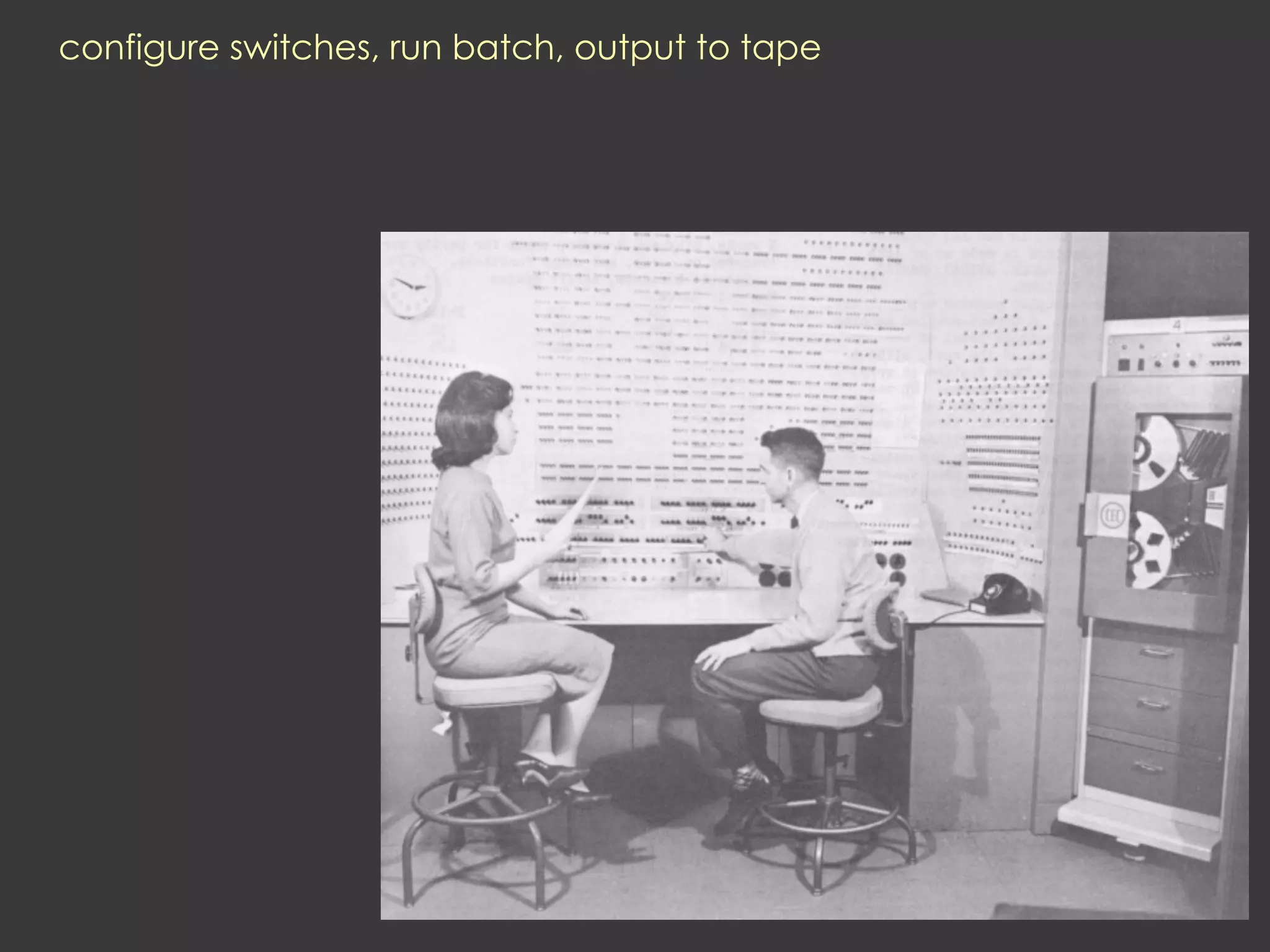
configure switches, run batch, output to tape
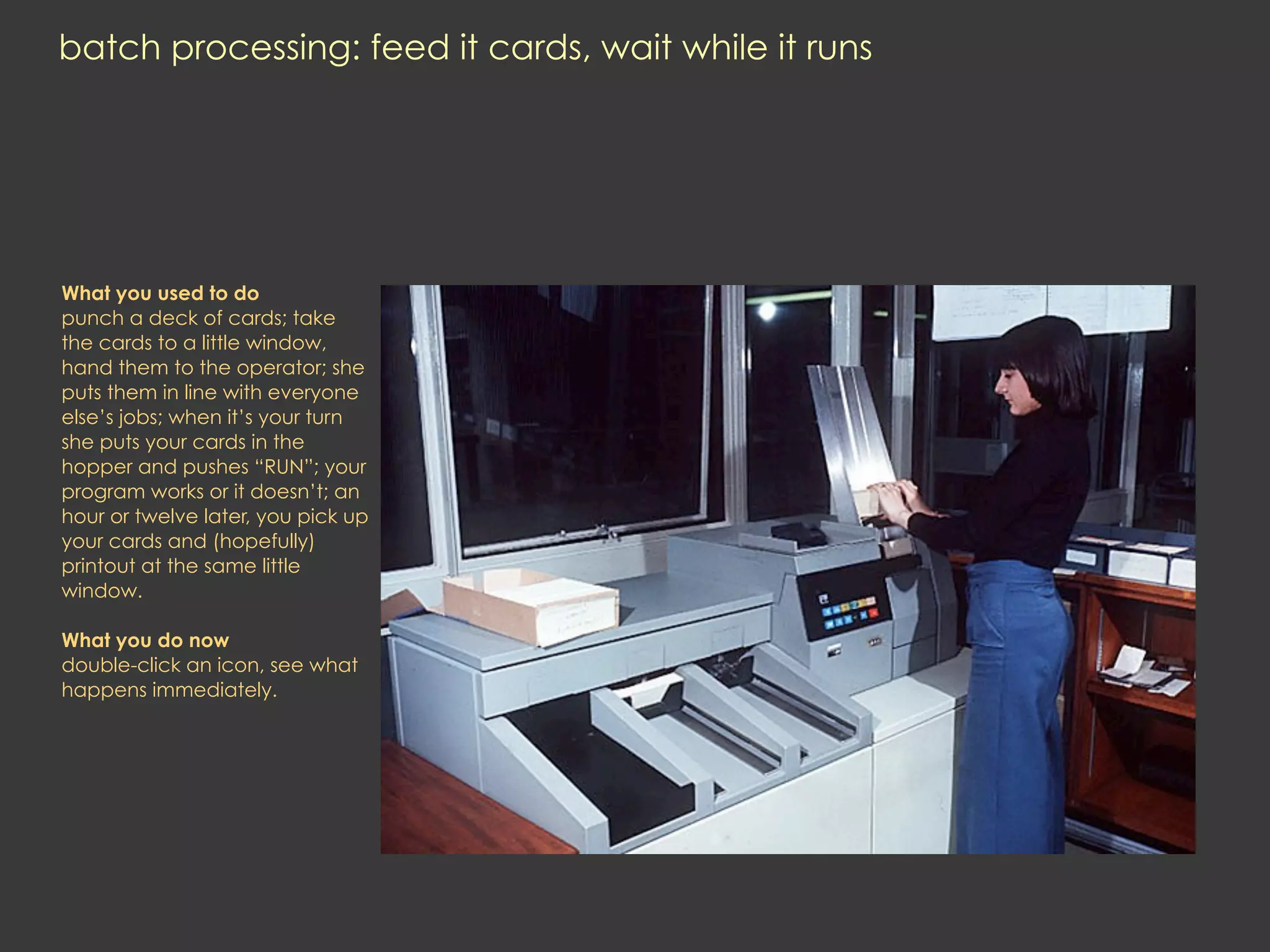
batch processing: feed it cards, wait while it runs


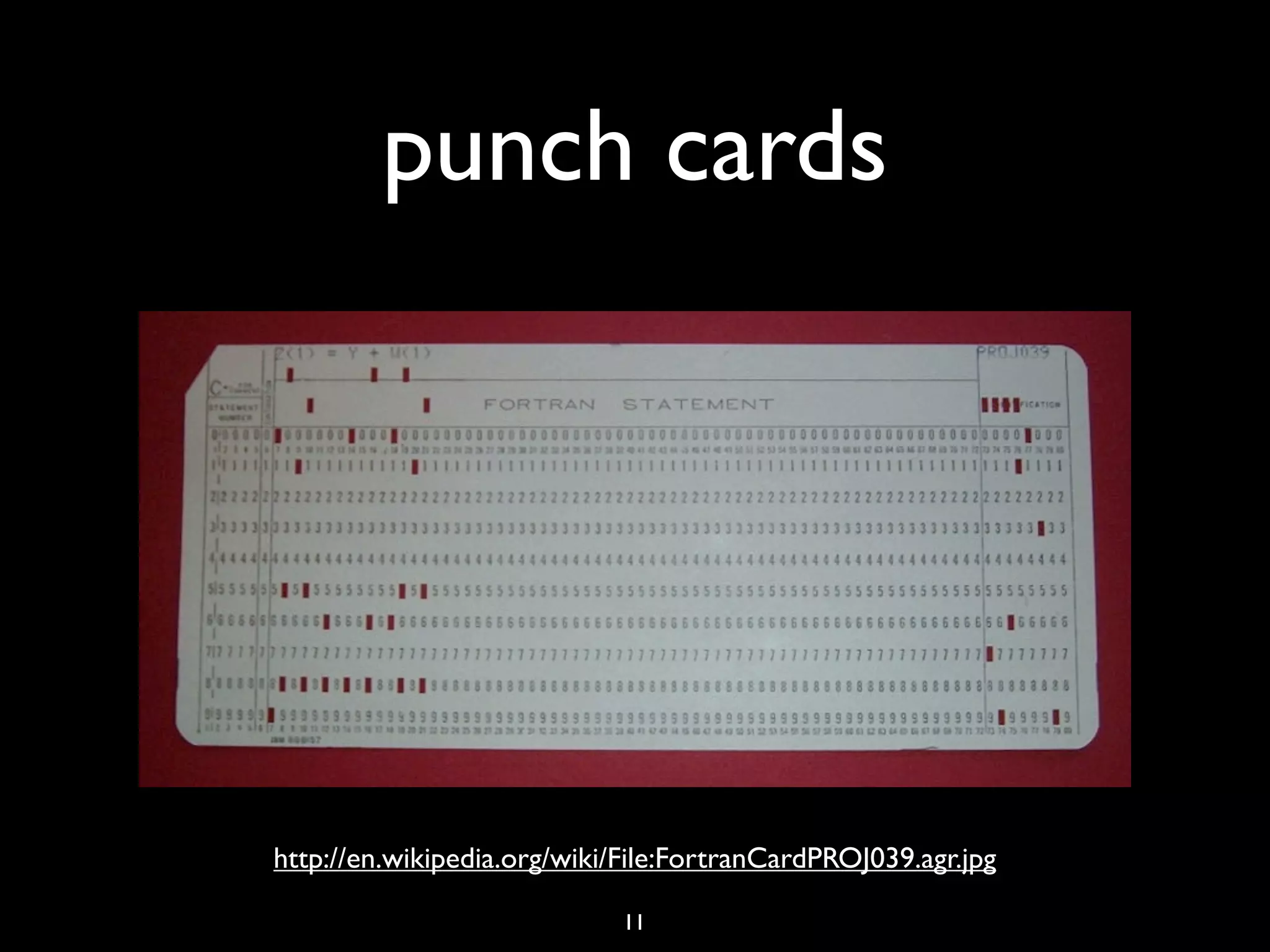
What you used to do
punch a deck of cards; take
the cards to a little window,
hand them to the operator; she
puts them in line with everyone
else’s jobs; when it’s your turn
she puts your cards in the
hopper and pushes “RUN”; your
program works or it doesn’t; an
hour or twelve later, you pick up
your cards and (hopefully)
printout at the same little
window.

What you do now
double-click an icon, see what
happens immediately.
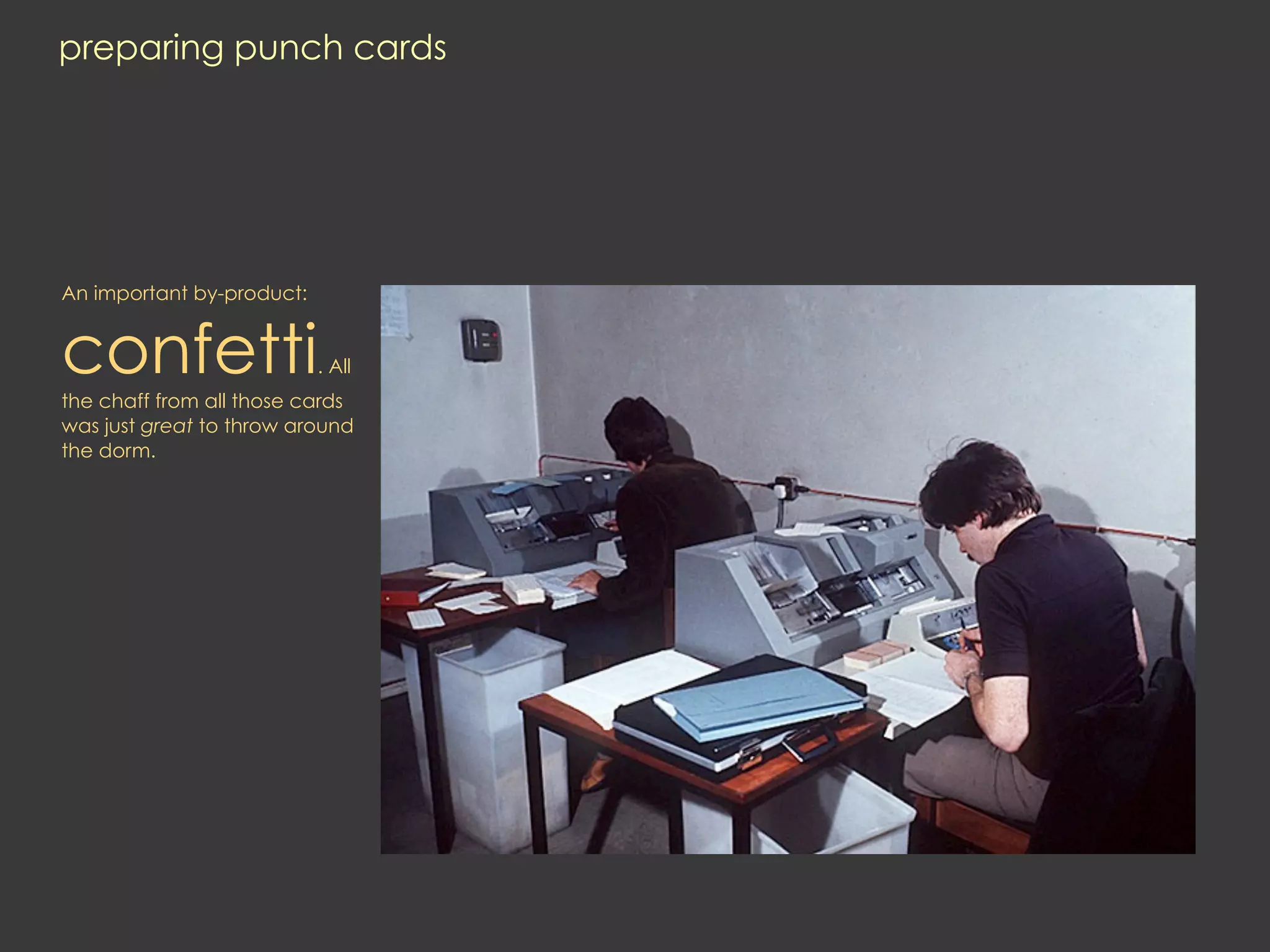
preparing punch cards


An important by-product:


confetti                   . All
the chaff from all those cards
was just great to throw around
the dorm.
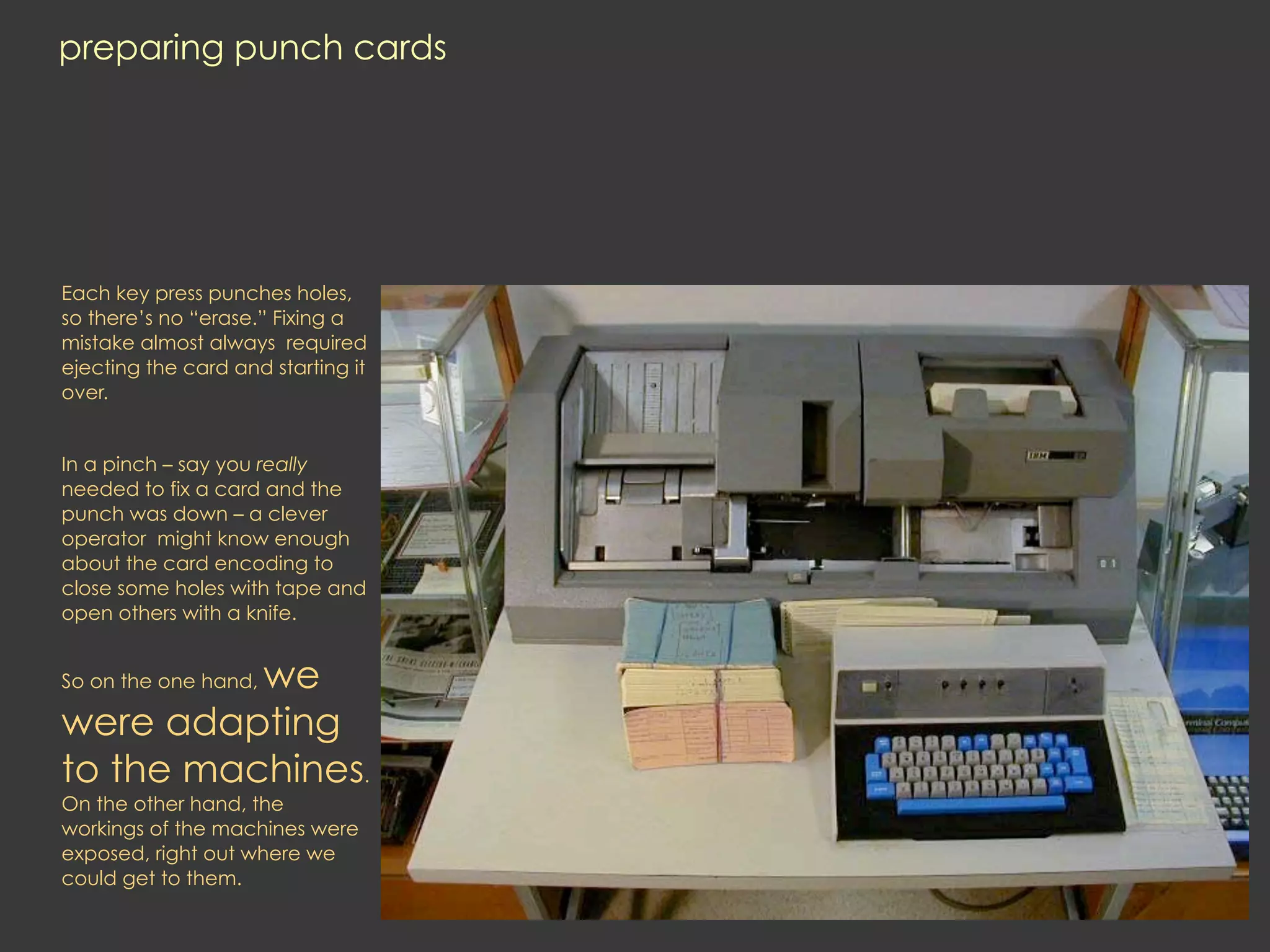
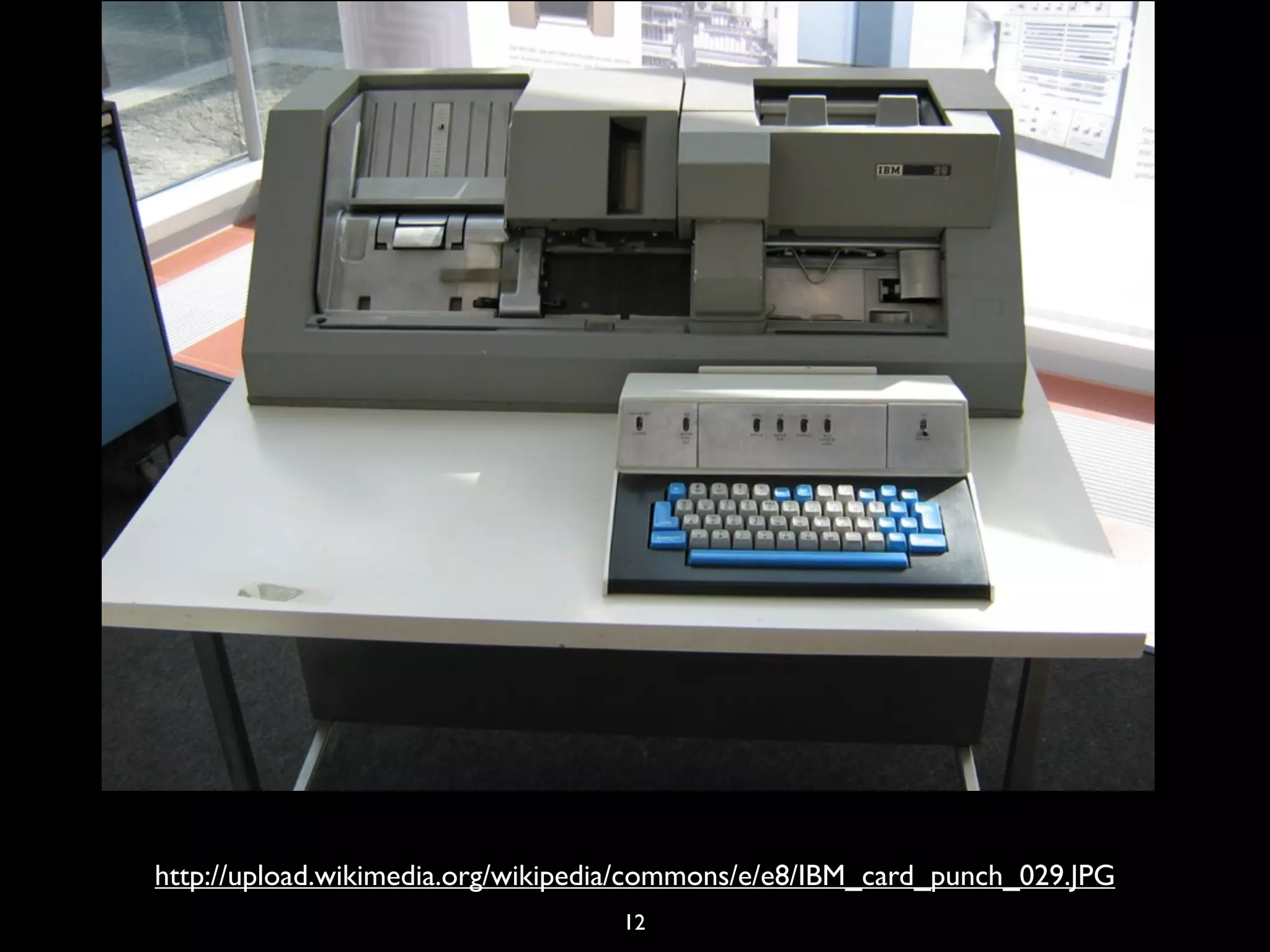
preparing punch cards


Each key press punches holes,
so there’s no “erase.” Fixing a
mistake almost always required
ejecting the card and starting it
over.


In a pinch – say you really
needed to fix a card and the
punch was down – a clever
operator might know enough
about the card encoding to
close some holes with tape and
open others with a knife.


          we
So on the one hand,

were adapting
to the machines.
On the other hand, the
workings of the machines were
exposed, right out where we
could get to them.
punch cards


http://en.wikipedia.org/wiki/File:FortranCardPROJ039.agr.jpg

                             11
http://upload.wikimedia.org/wikipedia/commons/e/e8/IBM_card_punch_029.JPG
                                   12
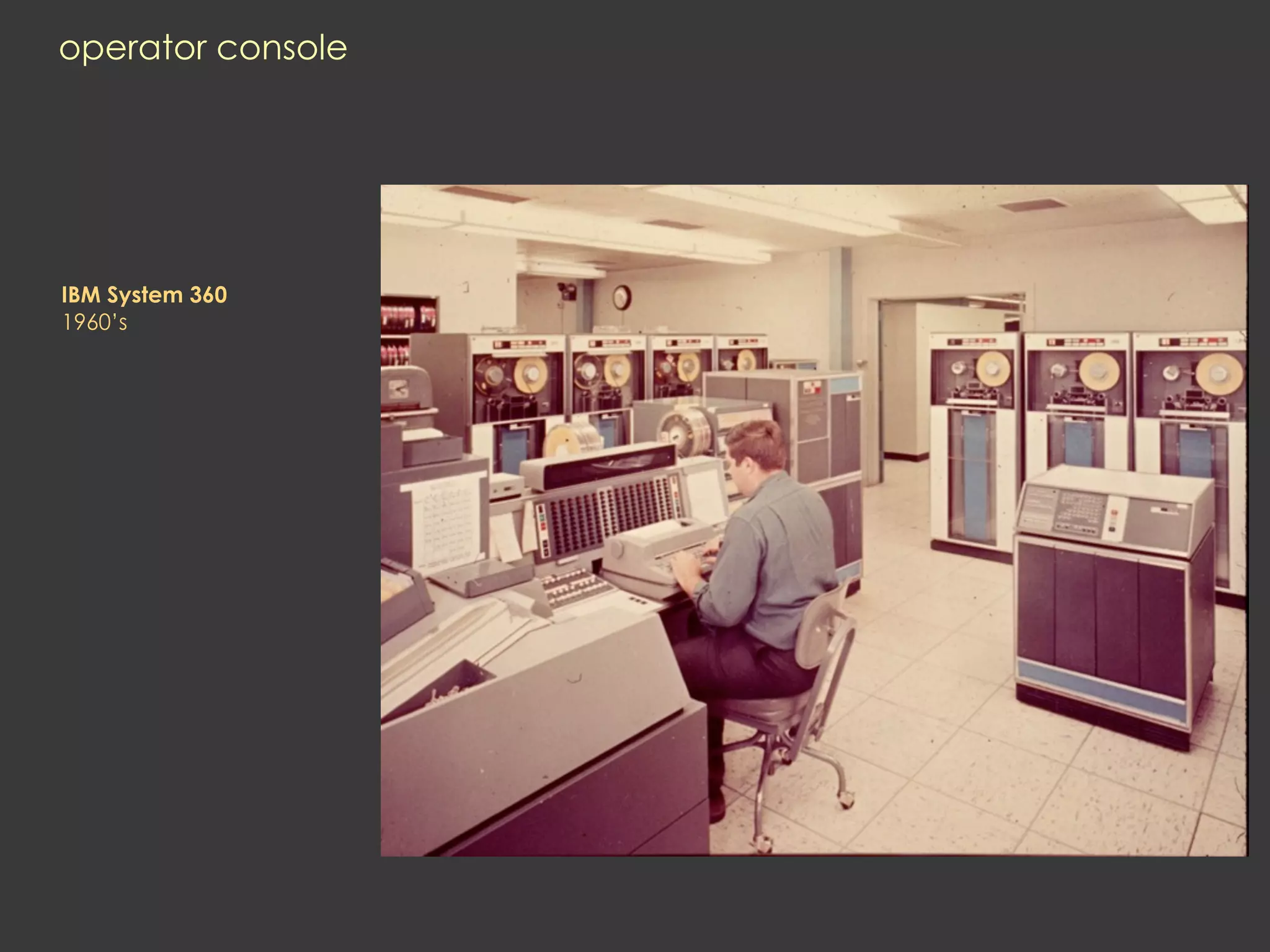
operator console


IBM System 360
1960’s
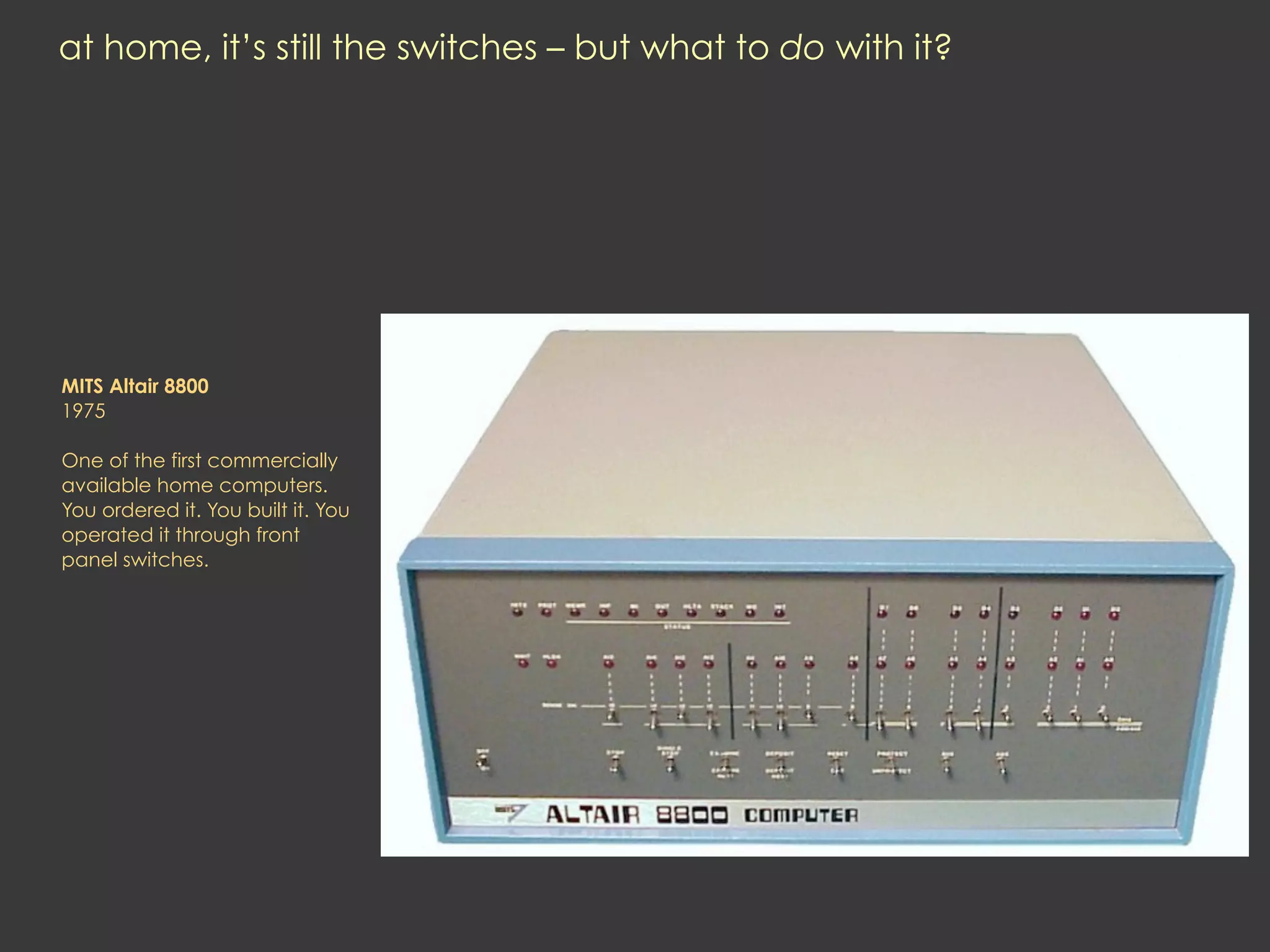
at home, it’s still the switches – but what to do with it?


MITS Altair 8800
1975

One of the first commercially
available home computers.
You ordered it. You built it. You
operated it through front
panel switches.
next?


 15
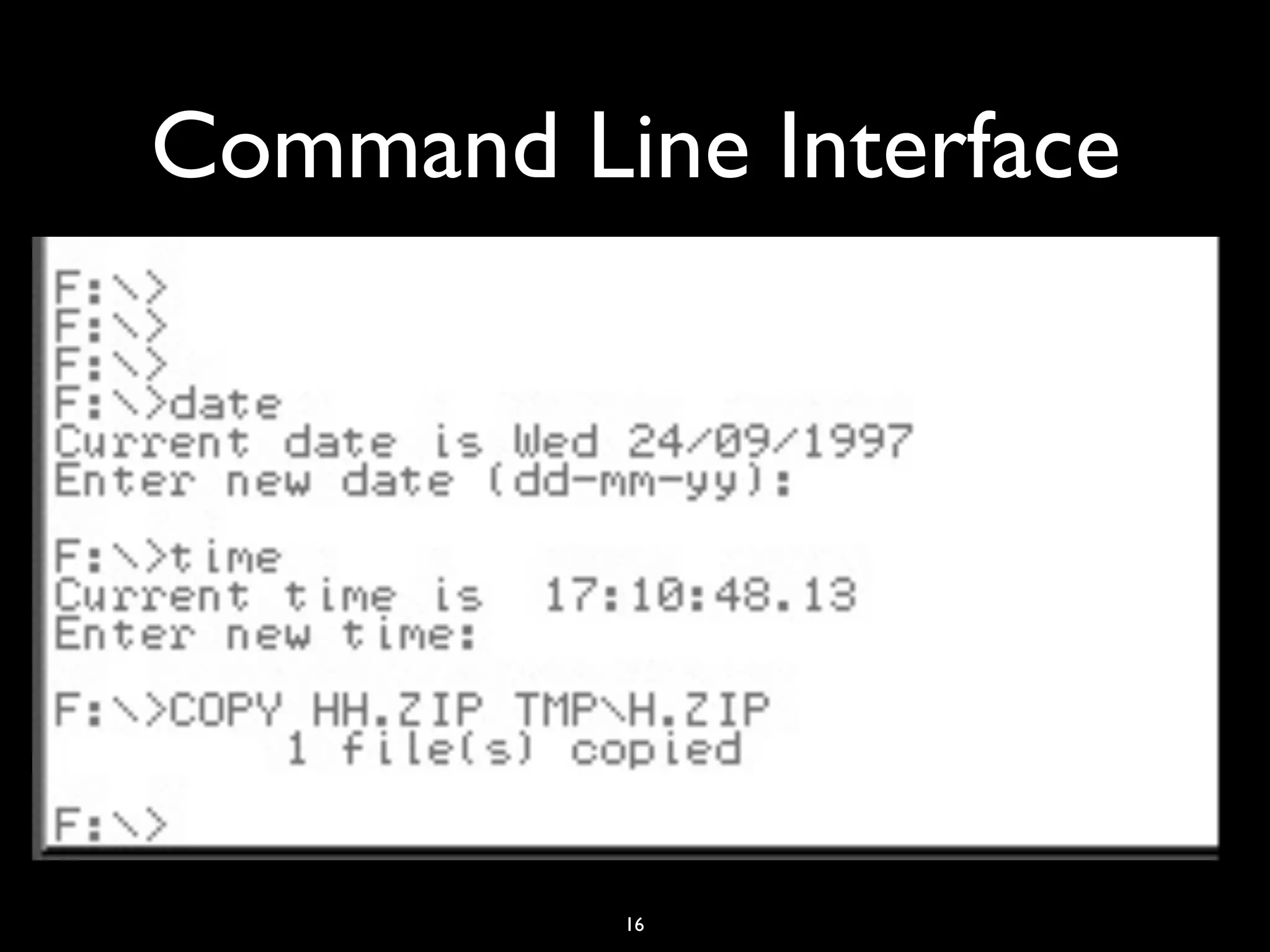
Command Line Interface


          16
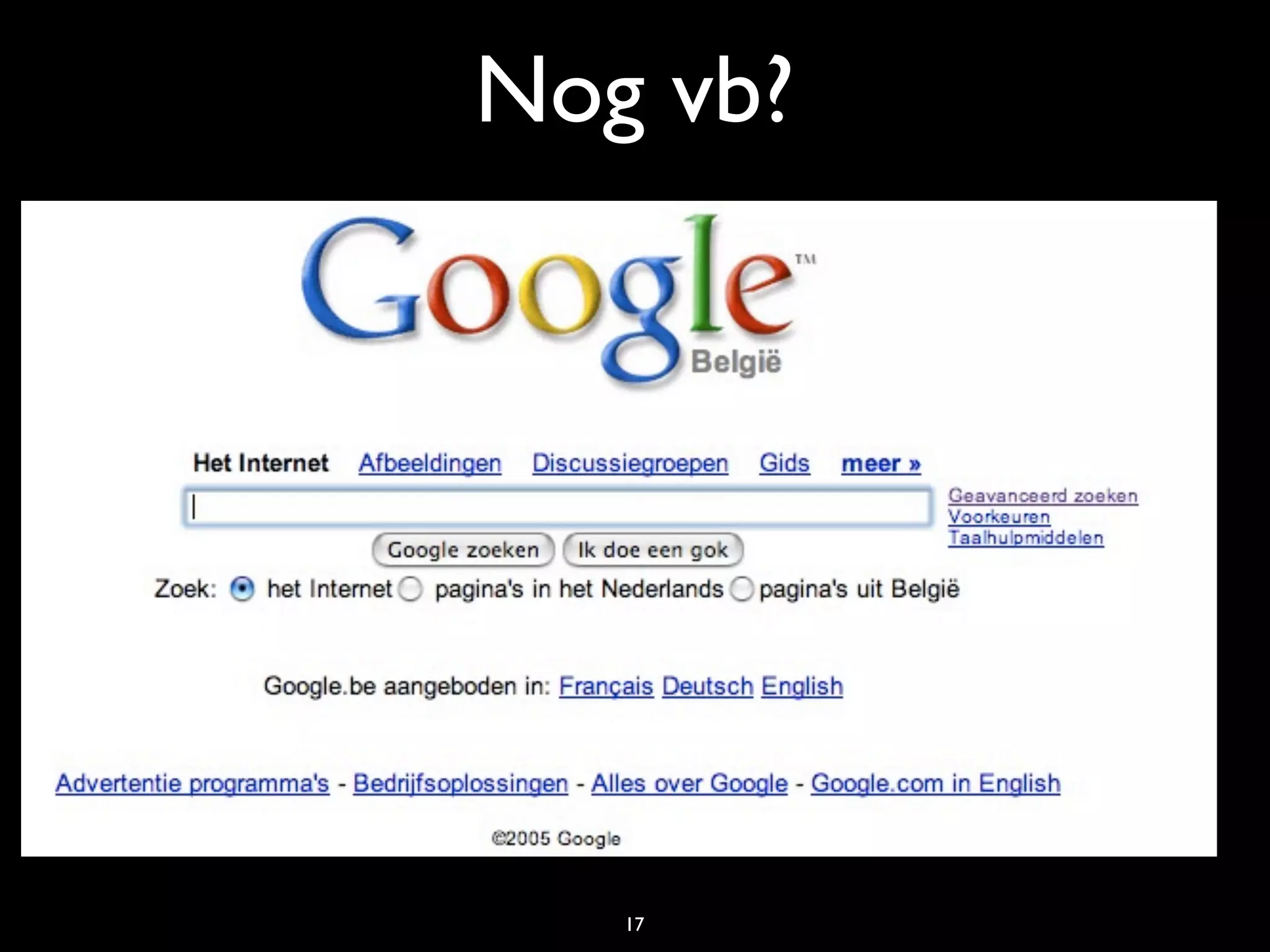
Nog vb?


   17
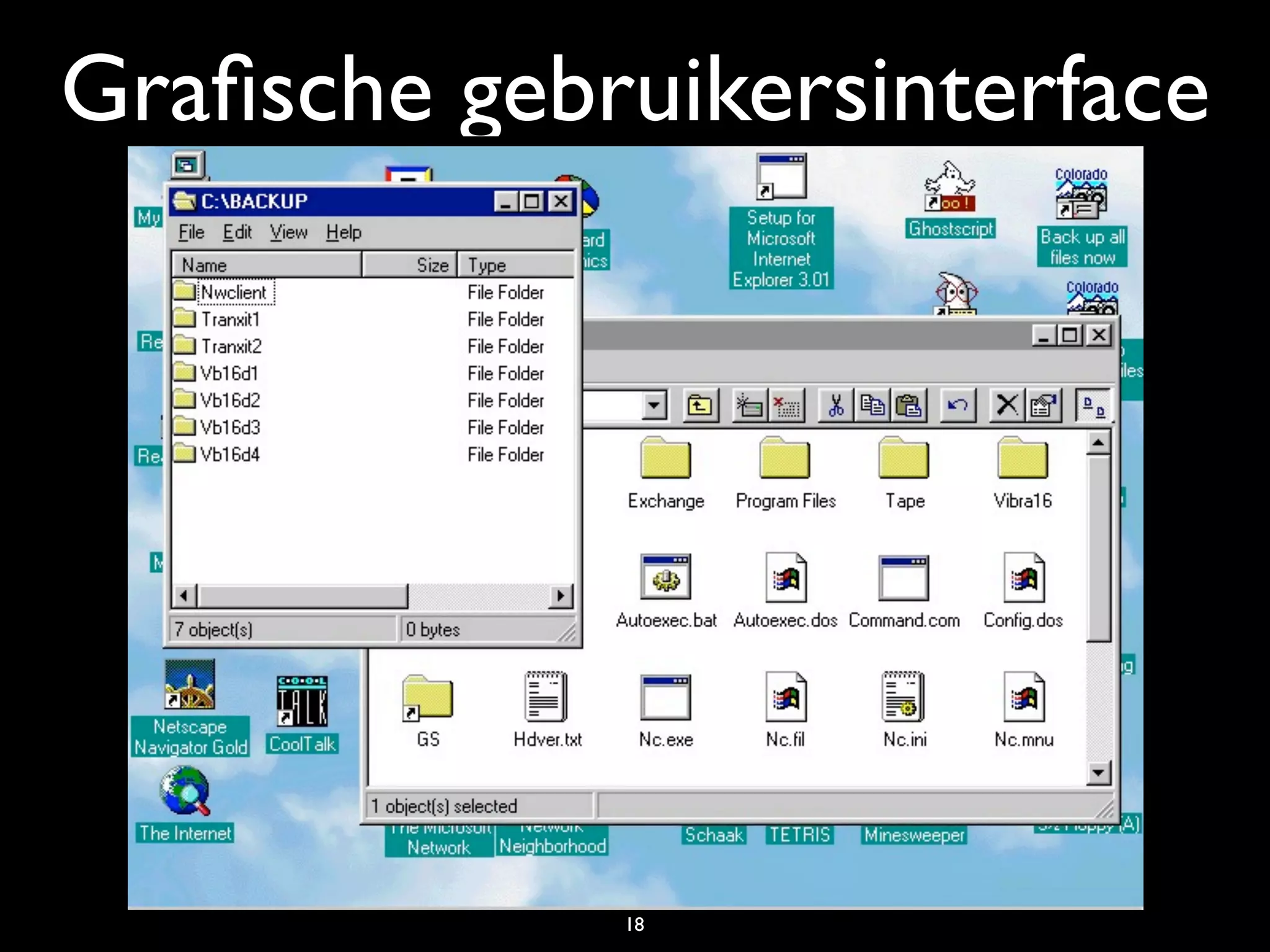
Grafische gebruikersinterface


             18
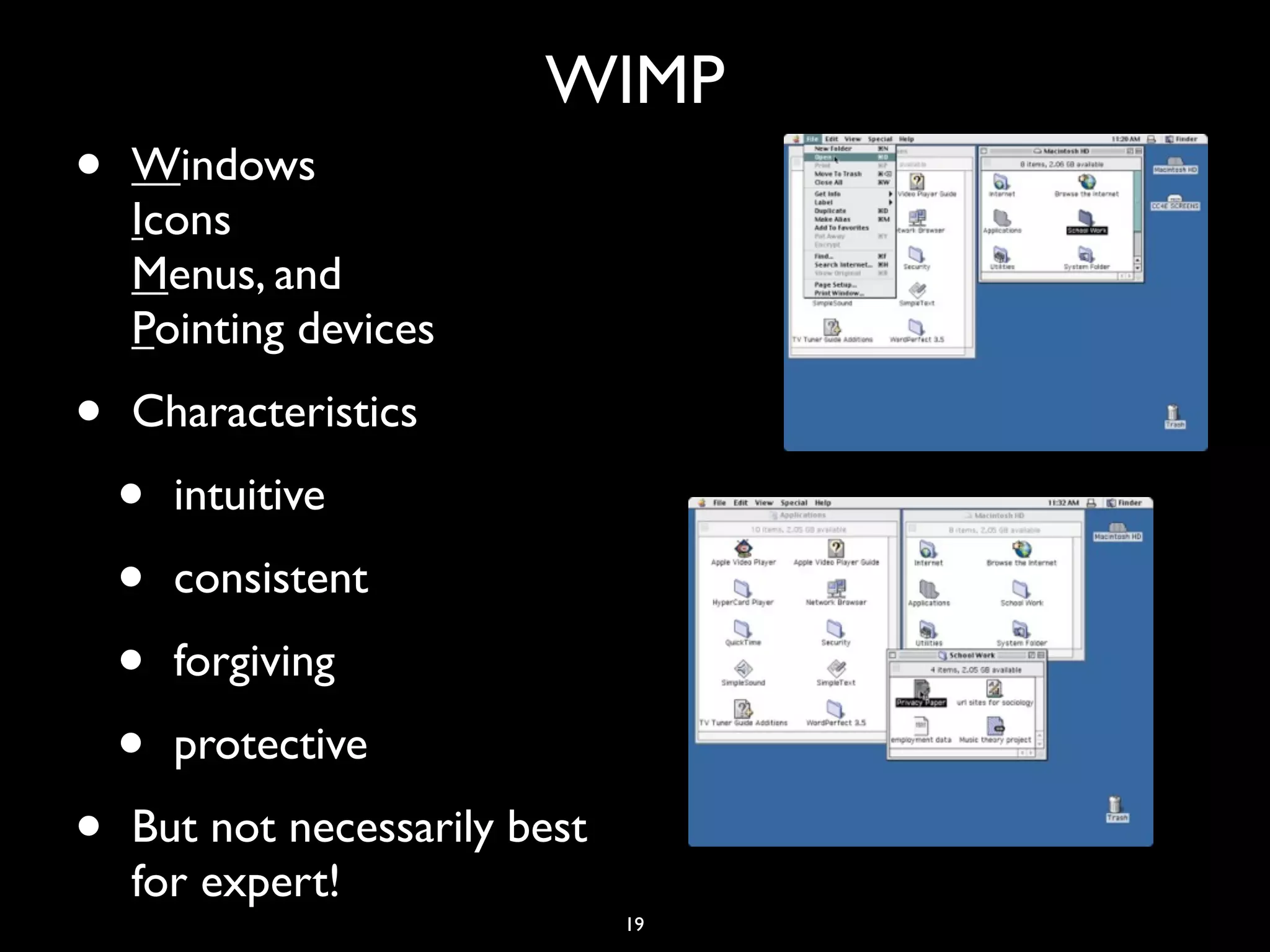
WIMP
•   Windows
    Icons
    Menus, and
    Pointing devices

•   Characteristics

    •   intuitive

    •   consistent

    •   forgiving

    •   protective

•   But not necessarily best
    for expert!
                               19
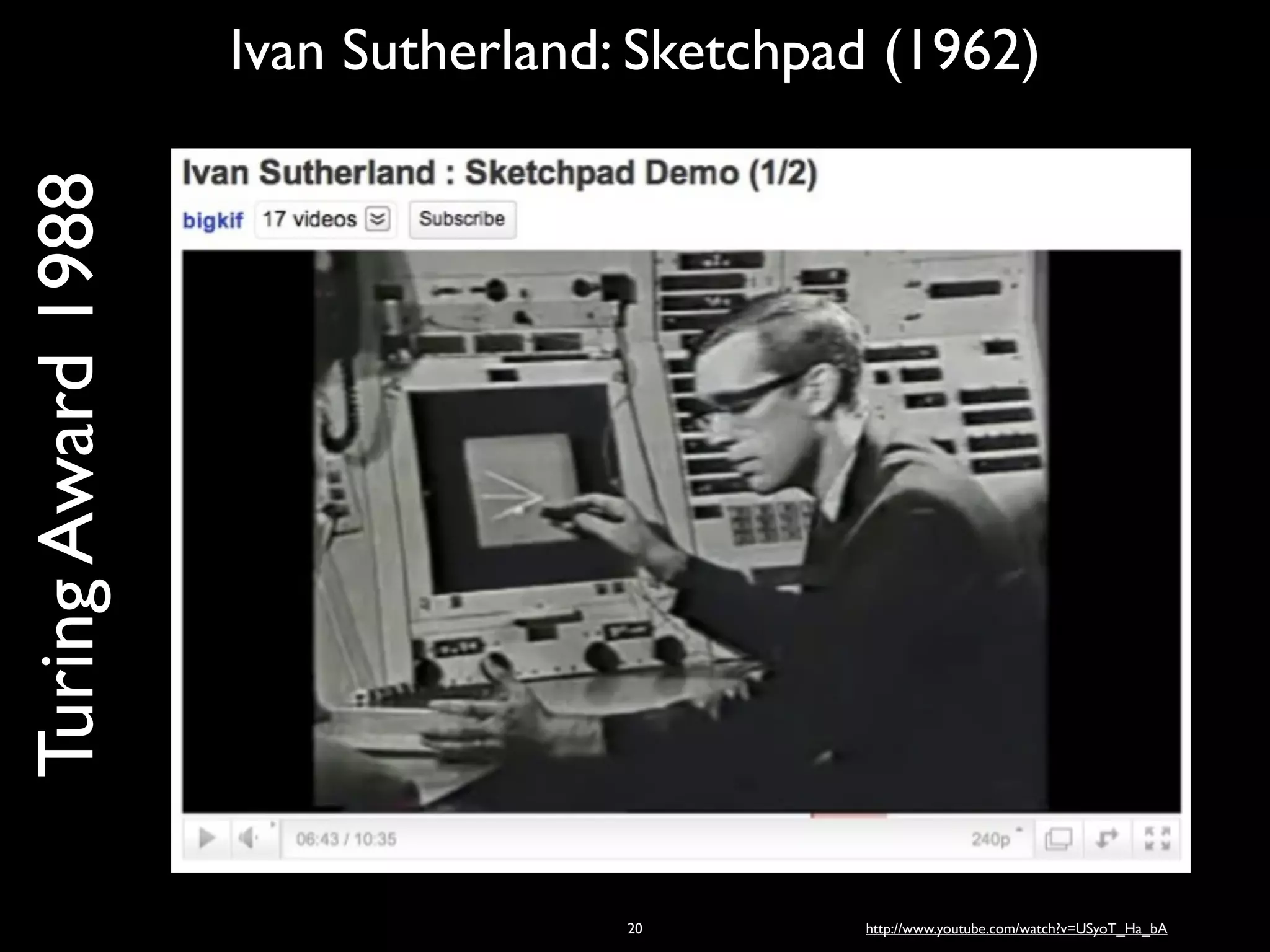
Turing Award 1988   Ivan Sutherland: Sketchpad (1962)


                                    20       http://www.youtube.com/watch?v=USyoT_Ha_bA
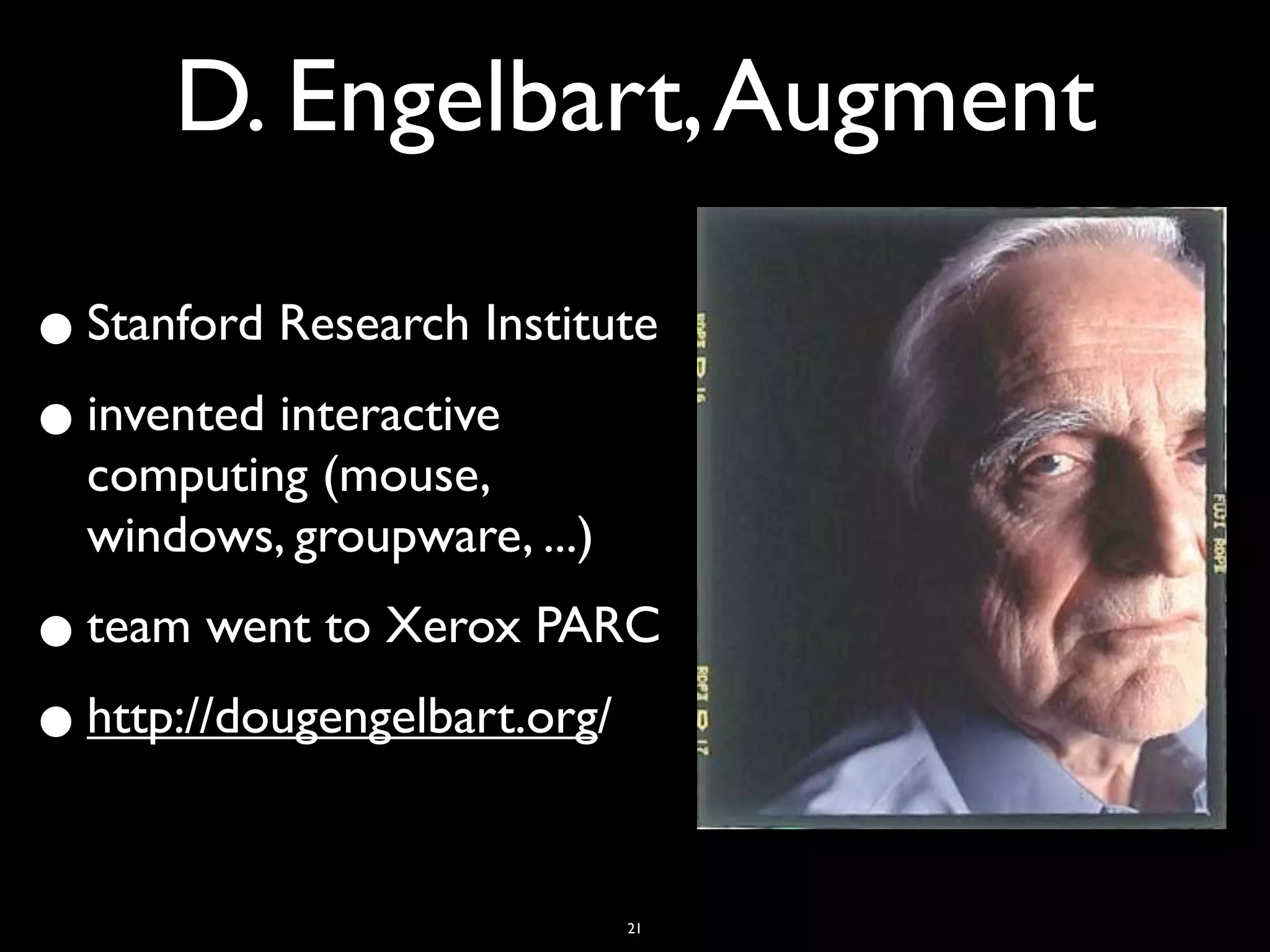
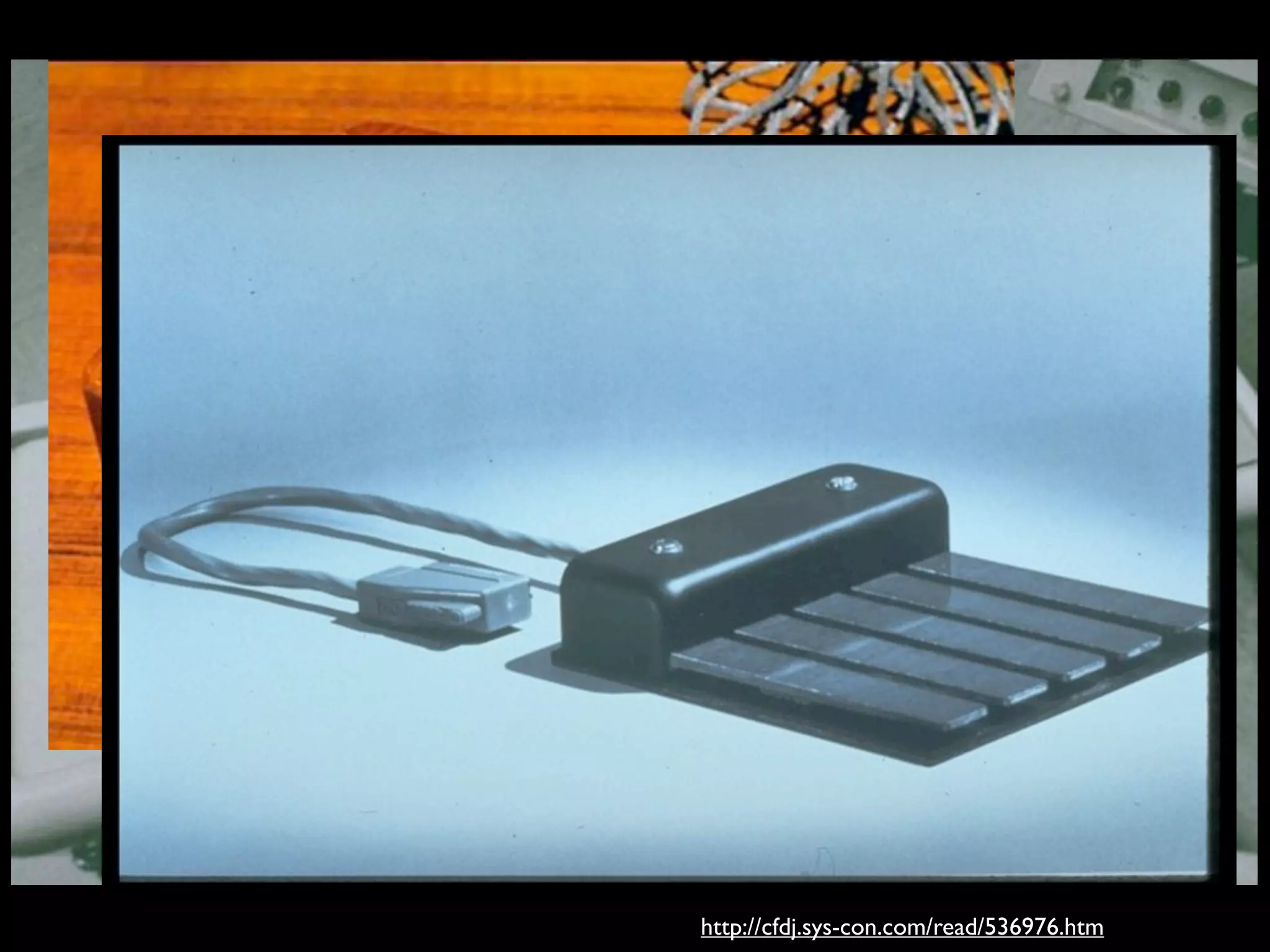
D. Engelbart, Augment

• Stanford Research Institute
• invented interactive
  computing (mouse,
  windows, groupware, ...)

• team went to Xerox PARC
• http://dougengelbart.org/

                             21
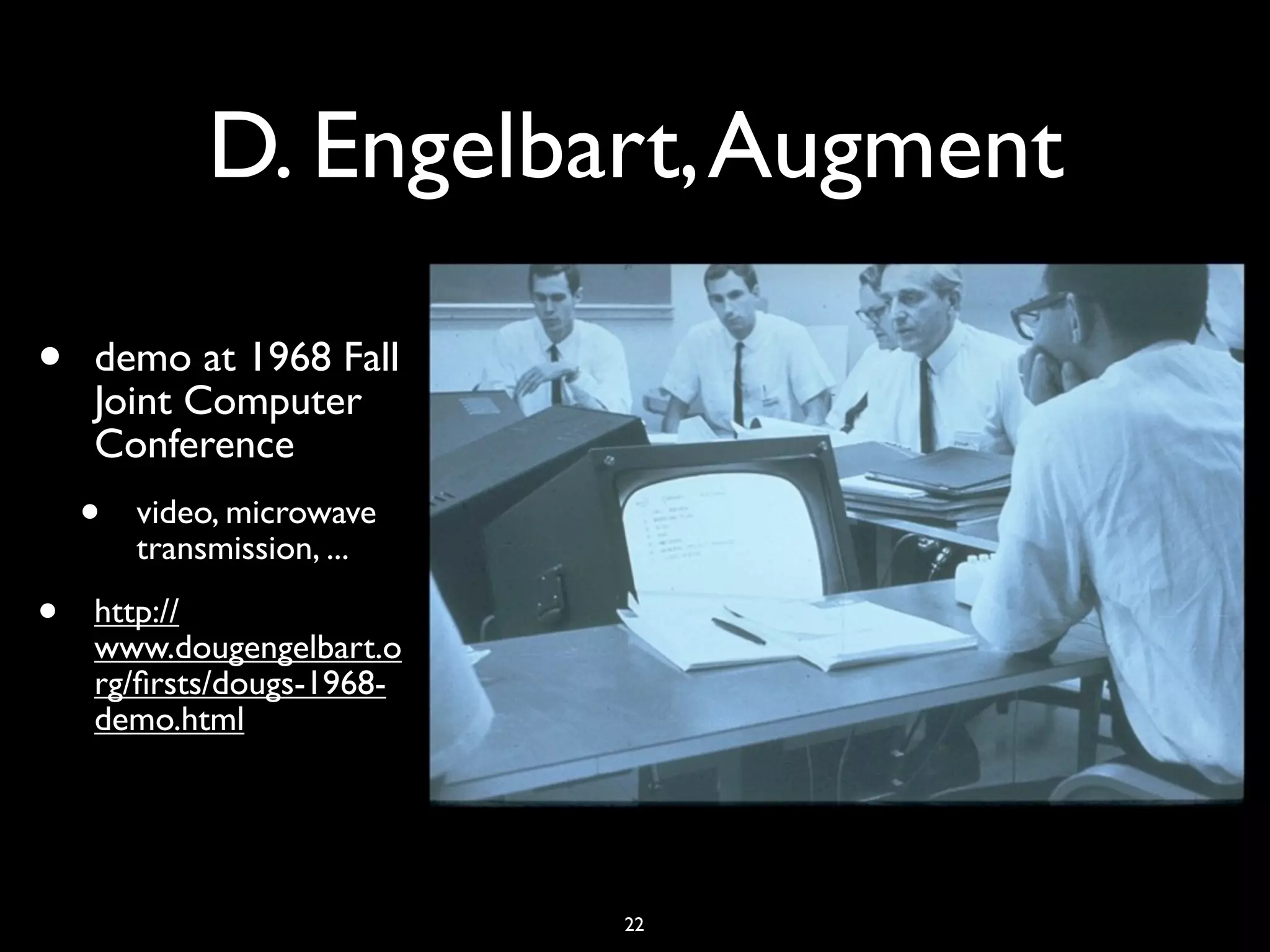
D. Engelbart, Augment

•   demo at 1968 Fall
    Joint Computer
    Conference
    •   video, microwave
        transmission, ...

•   http://
    www.dougengelbart.o
    rg/firsts/dougs-1968-
    demo.html


                            22
http://www.youtube.com/watch?v=X4kp9Ciy1nE
23
http://cfdj.sys-con.com/read/536976.htm
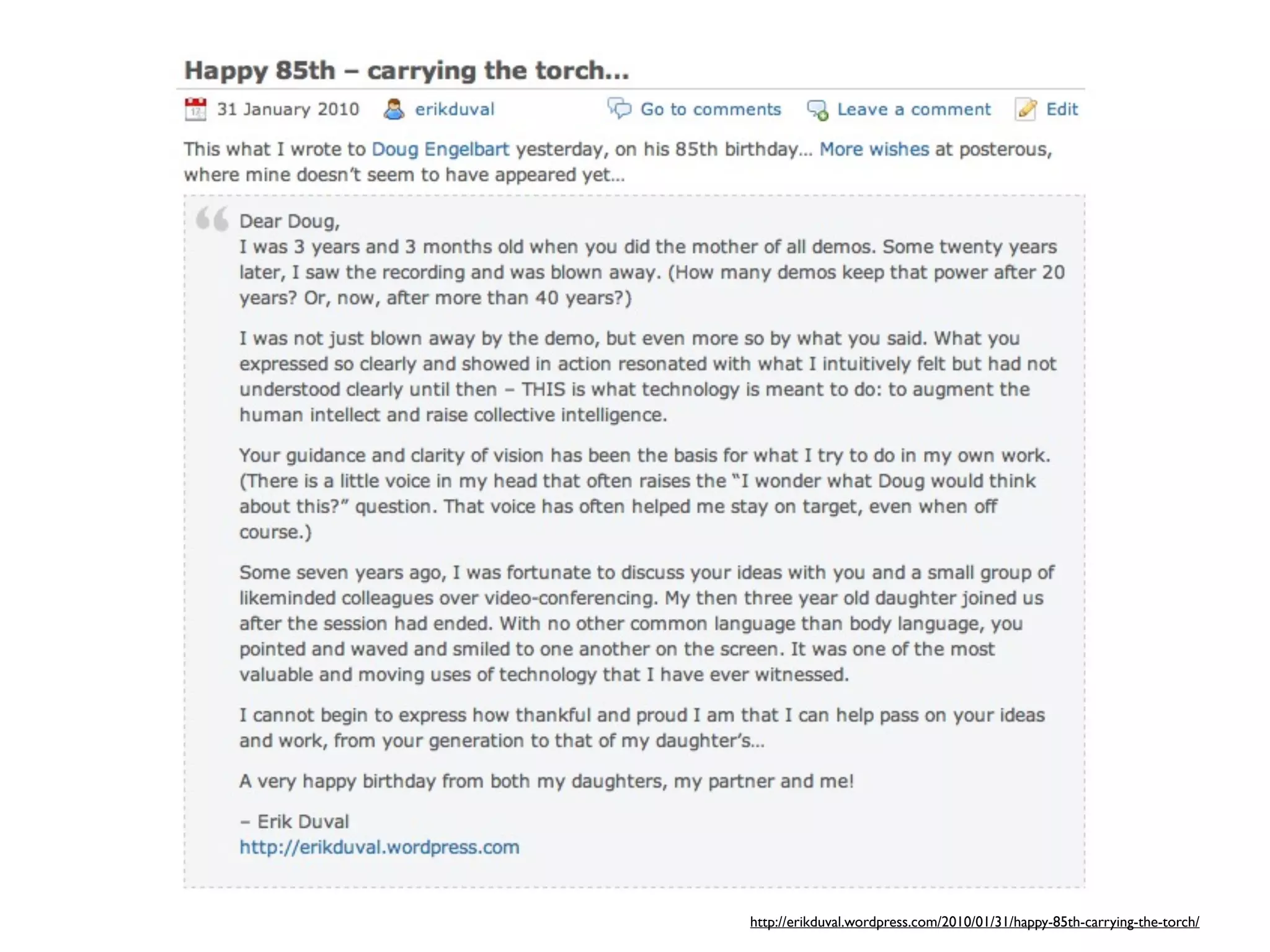
http://erikduval.wordpress.com/2010/01/31/happy-85th-carrying-the-torch/
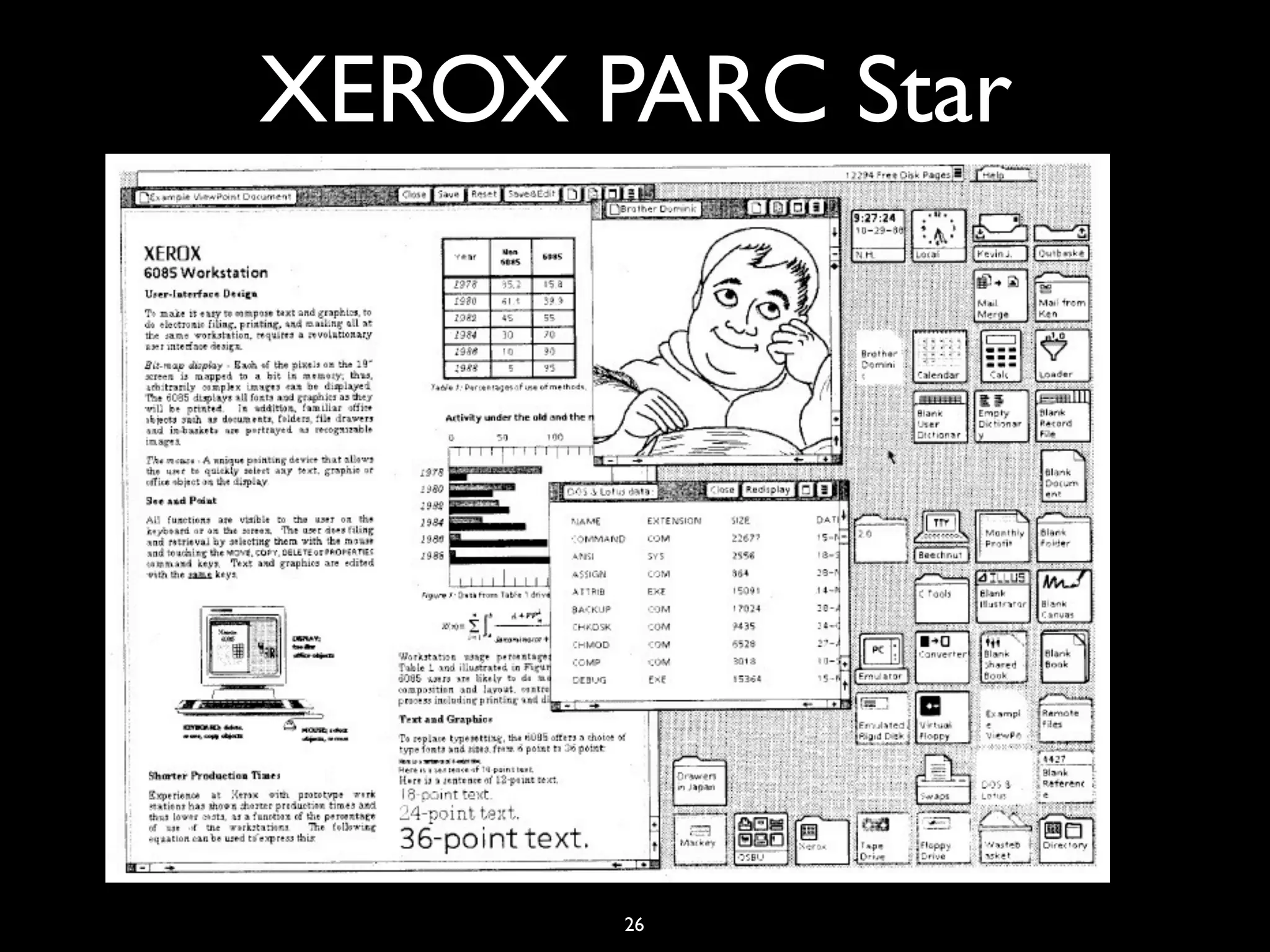
XEROX PARC Star
    (1981)


       26
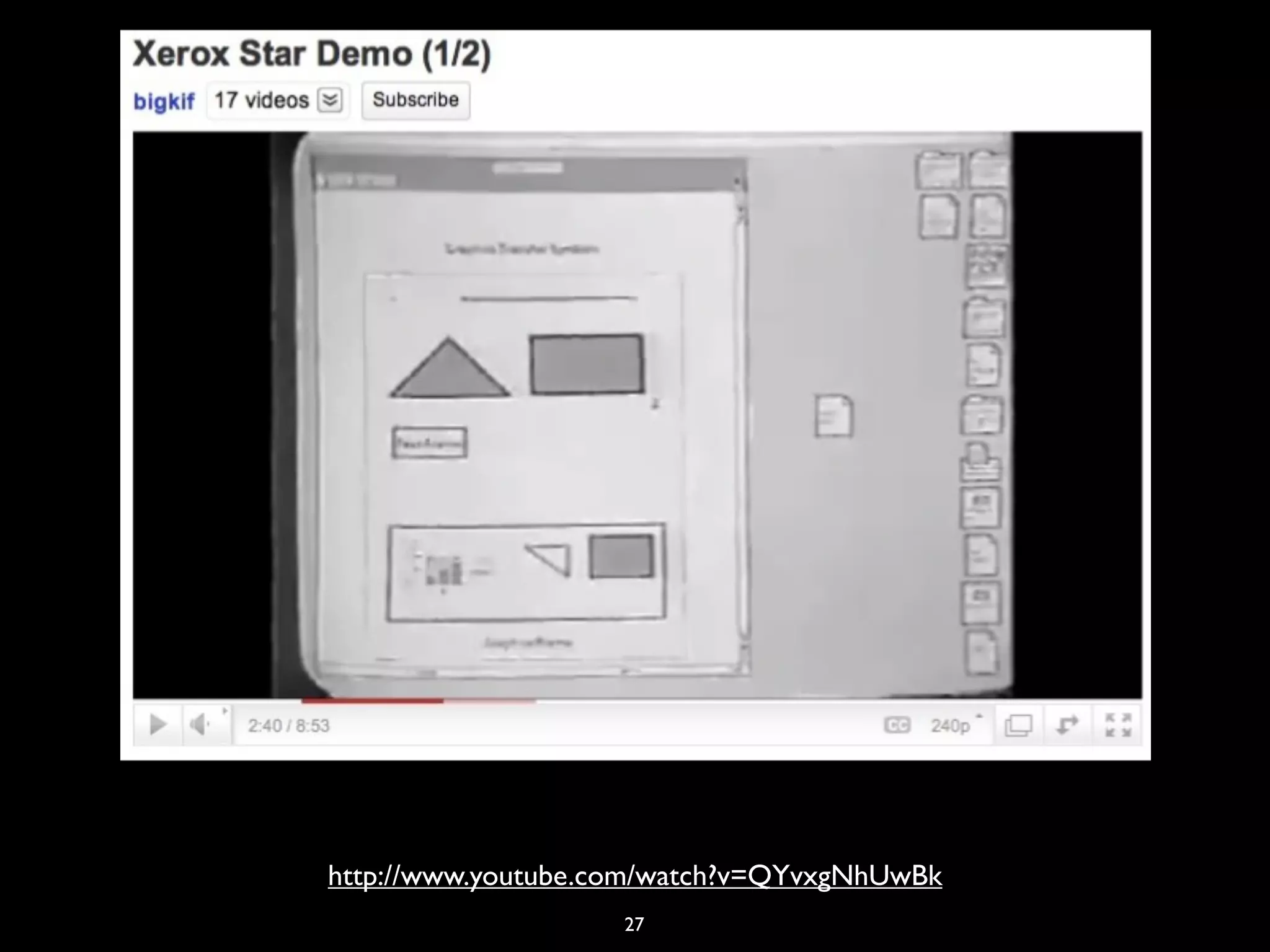
http://www.youtube.com/watch?v=QYvxgNhUwBk
                    27
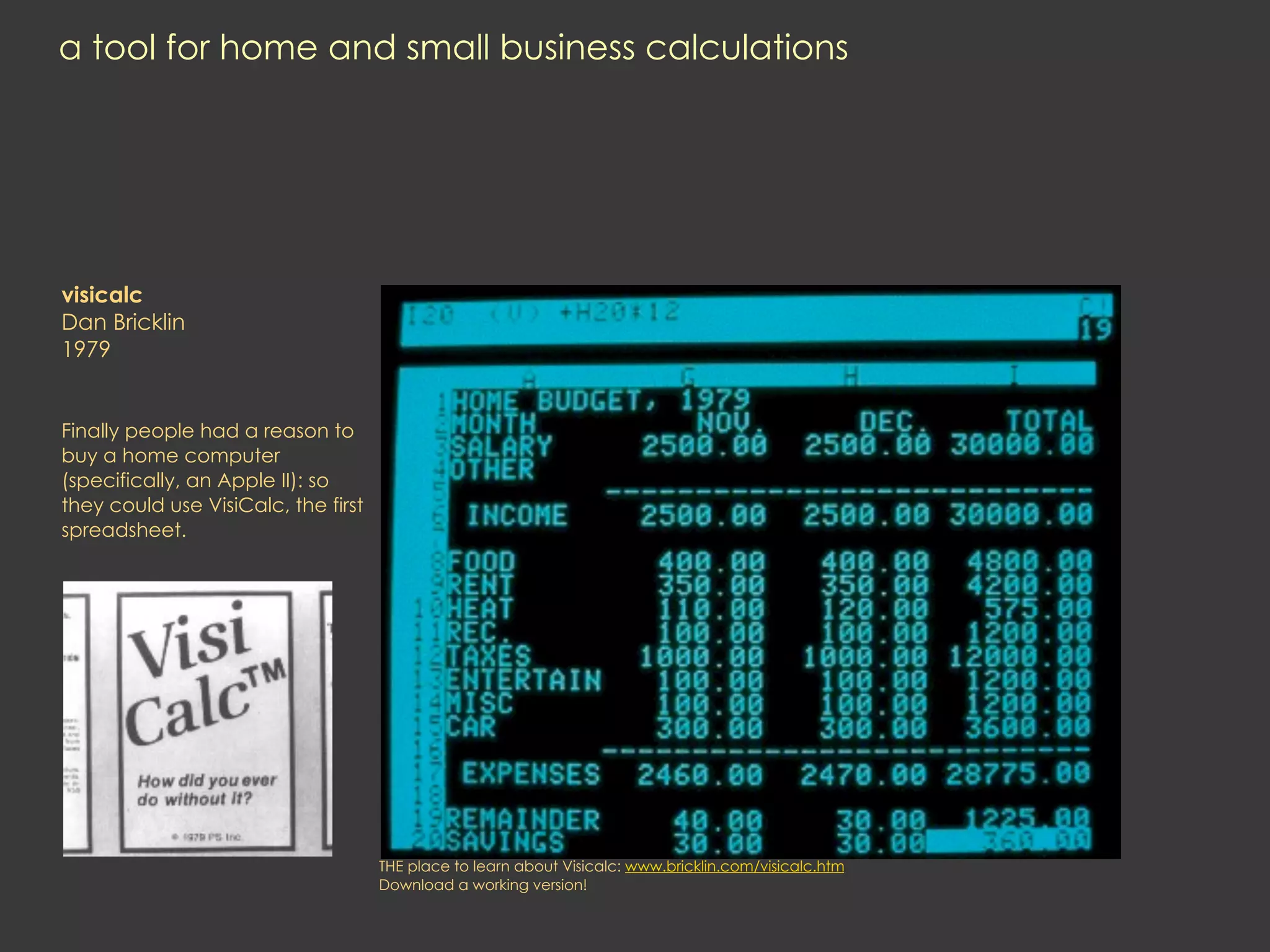
a tool for home and small business calculations


visicalc
Dan Bricklin
1979


Finally people had a reason to
buy a home computer
(specifically, an Apple II): so
they could use VisiCalc, the first
spreadsheet.


                                     THE place to learn about Visicalc: www.bricklin.com/visicalc.htm
                                     Download a working version!
Macintosh, 1984


       29   http://www.youtube.com/watch?v=G0FtgZNOD44
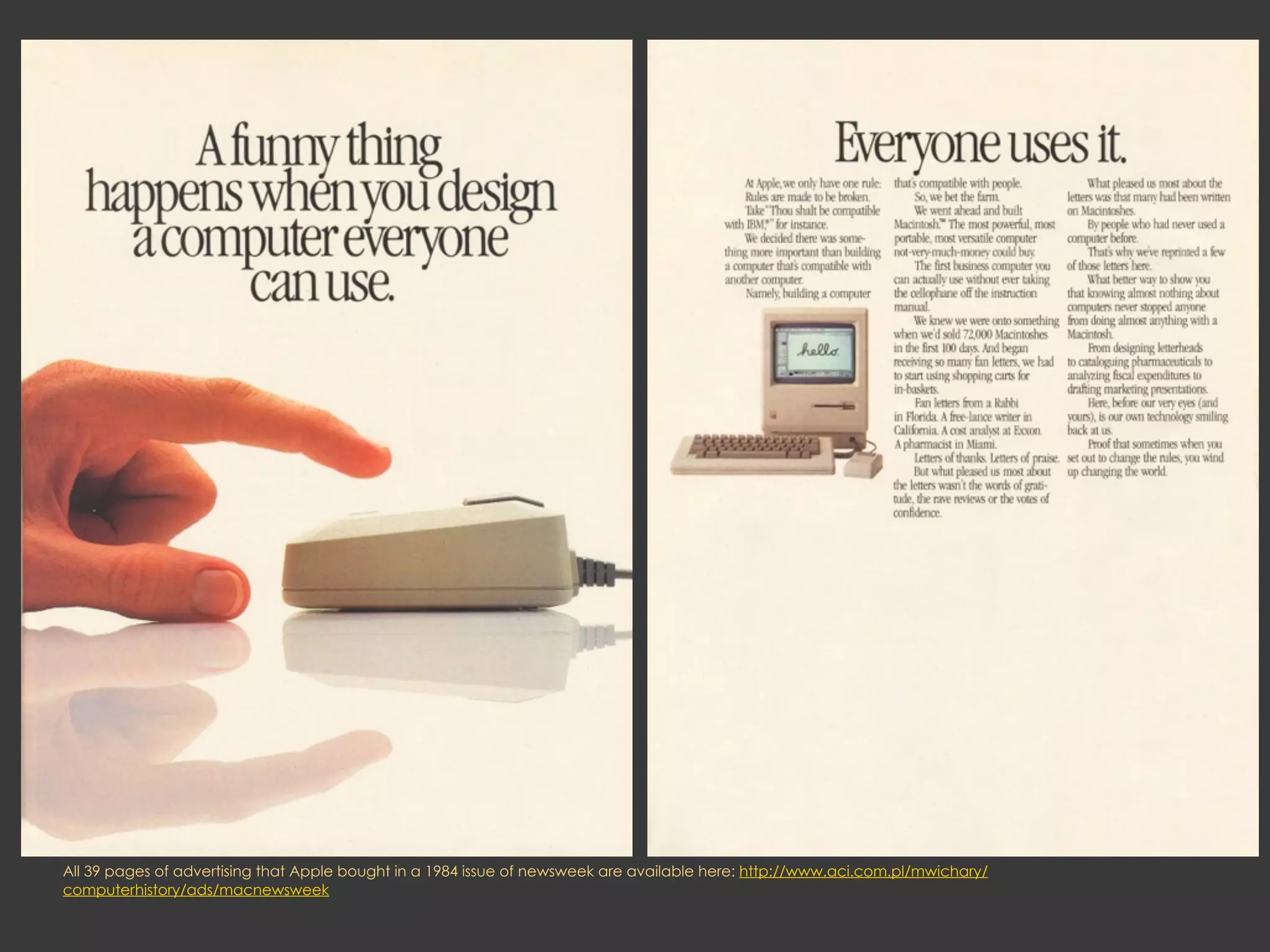
All 39 pages of advertising that Apple bought in a 1984 issue of newsweek are available here: http://www.aci.com.pl/mwichary/
computerhistory/ads/macnewsweek
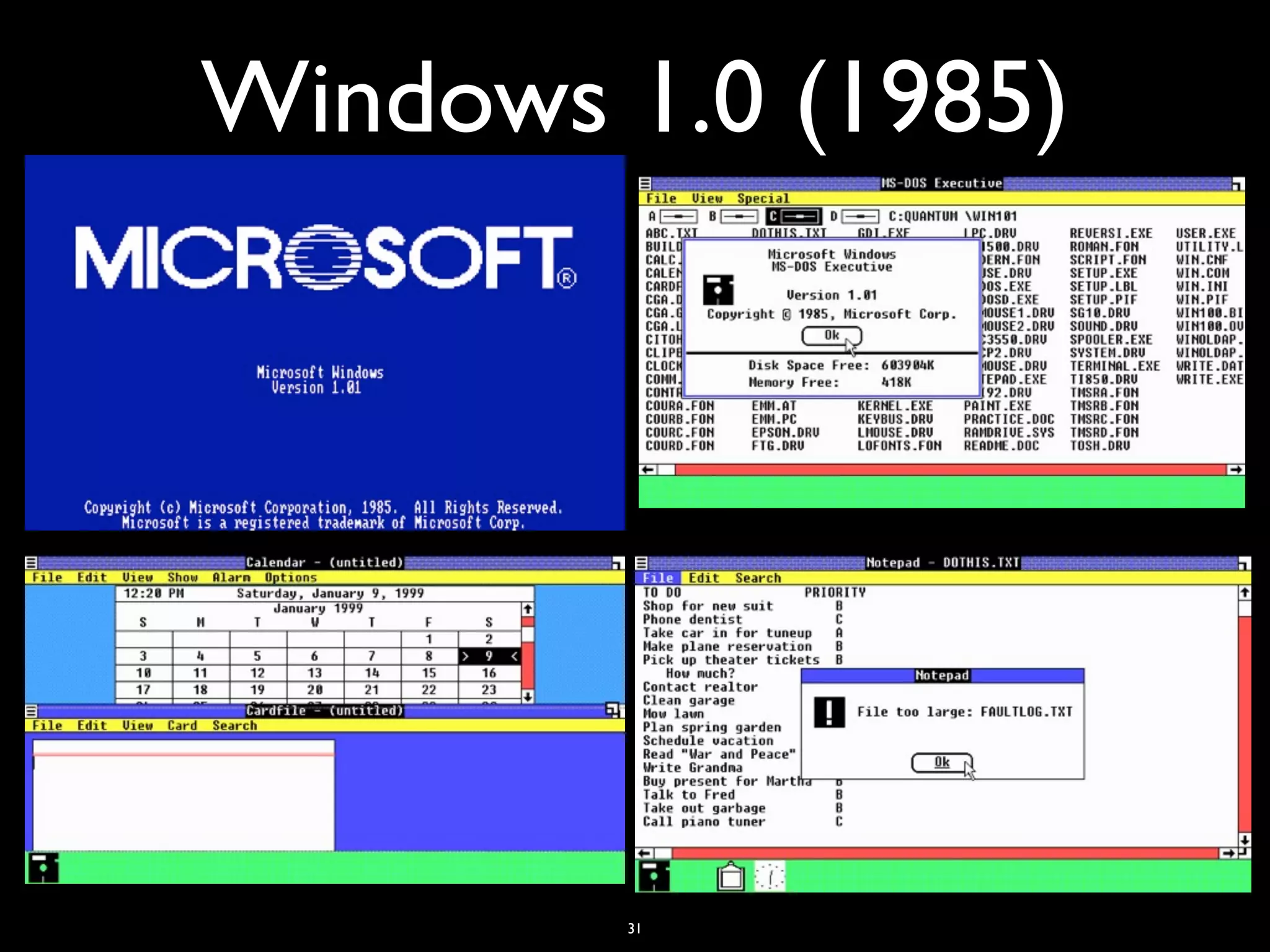
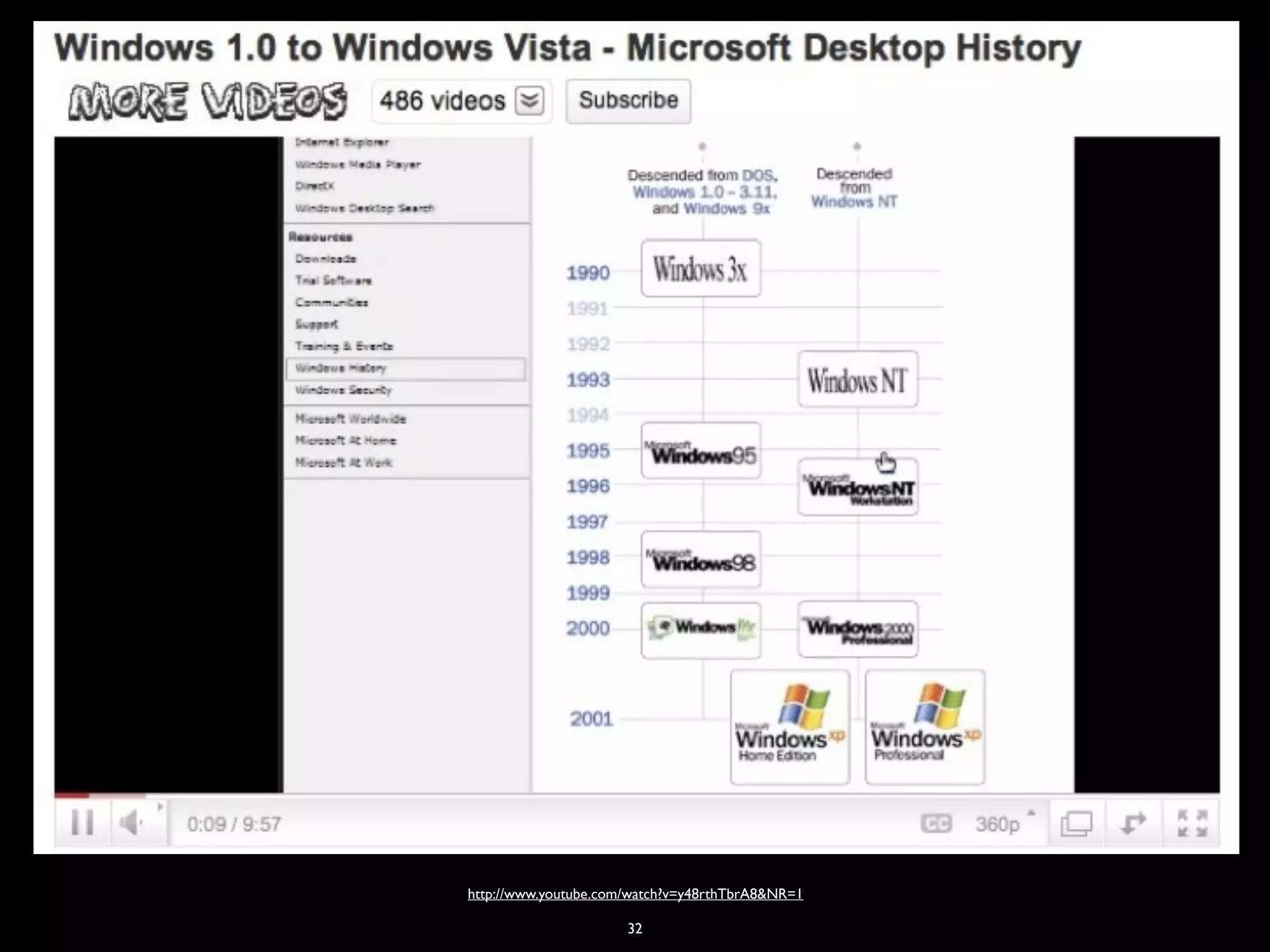
Windows 1.0 (1985)


        31
http://www.youtube.com/watch?v=y48rthTbrA8&NR=1

                      32
beyond then ...

       33
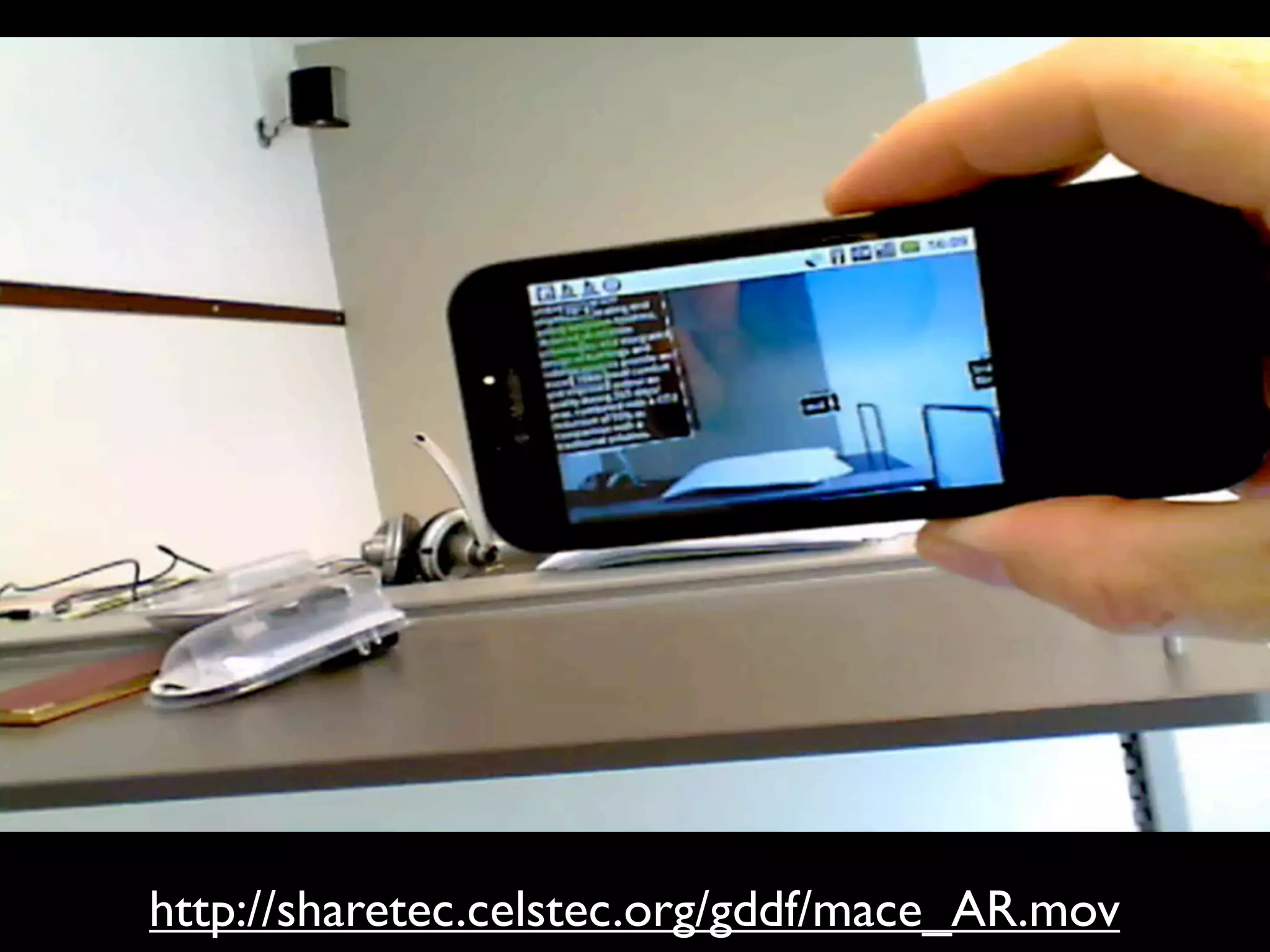
http://sharetec.celstec.org/gddf/mace_AR.mov
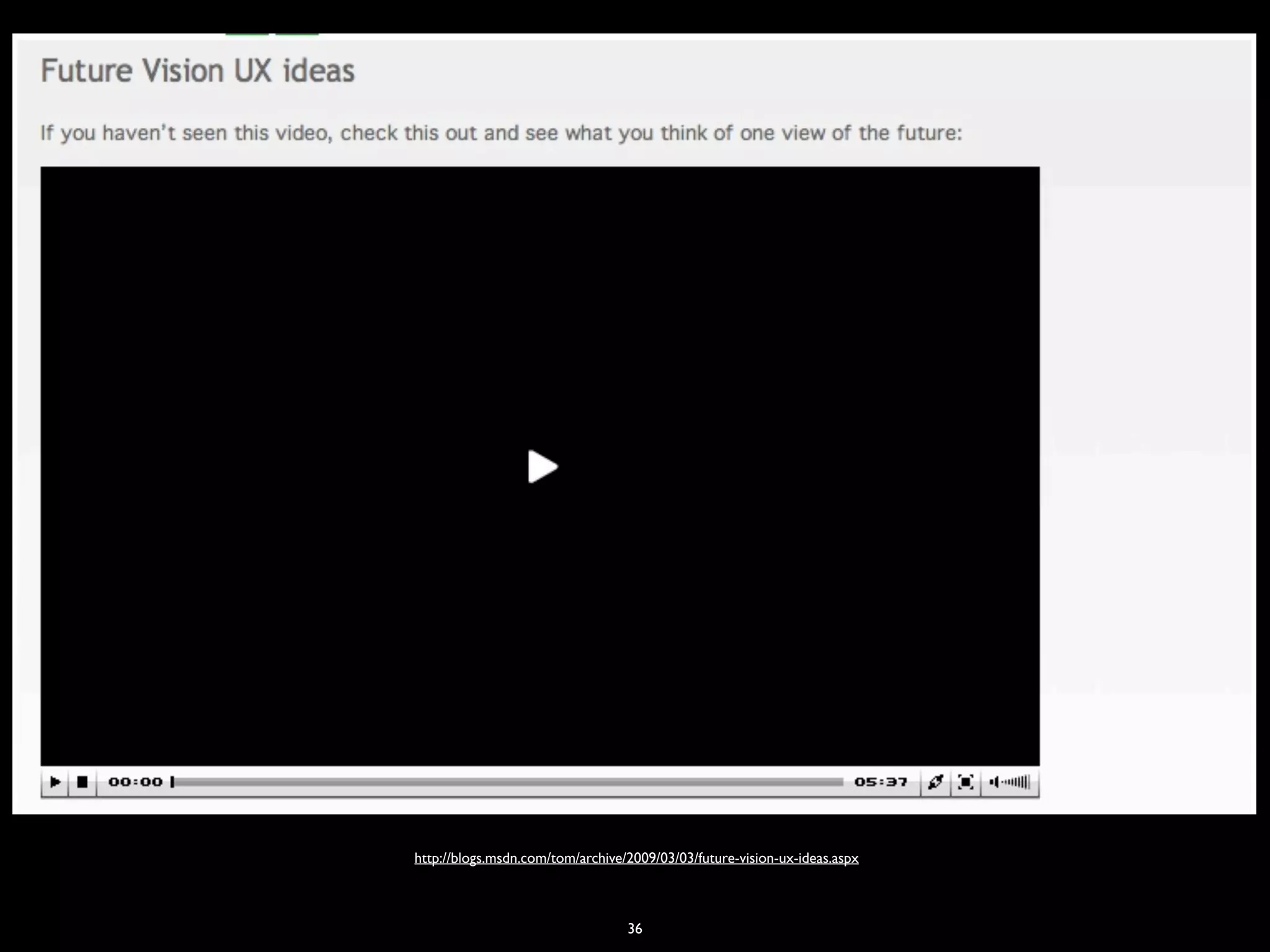
http://blogs.msdn.com/tom/archive/2009/03/03/future-vision-ux-ideas.aspx


                                  36
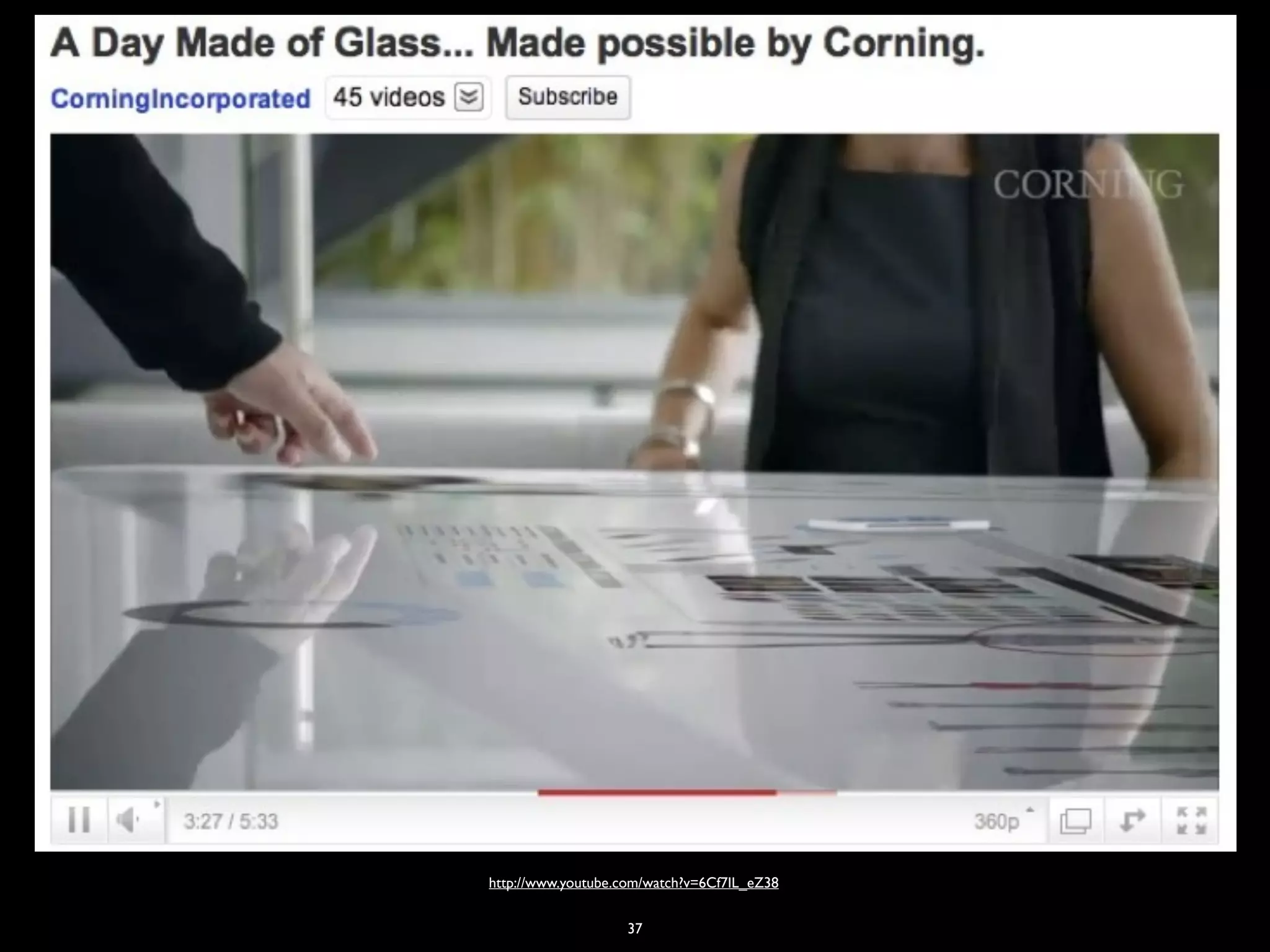
http://www.youtube.com/watch?v=6Cf7IL_eZ38


                    37
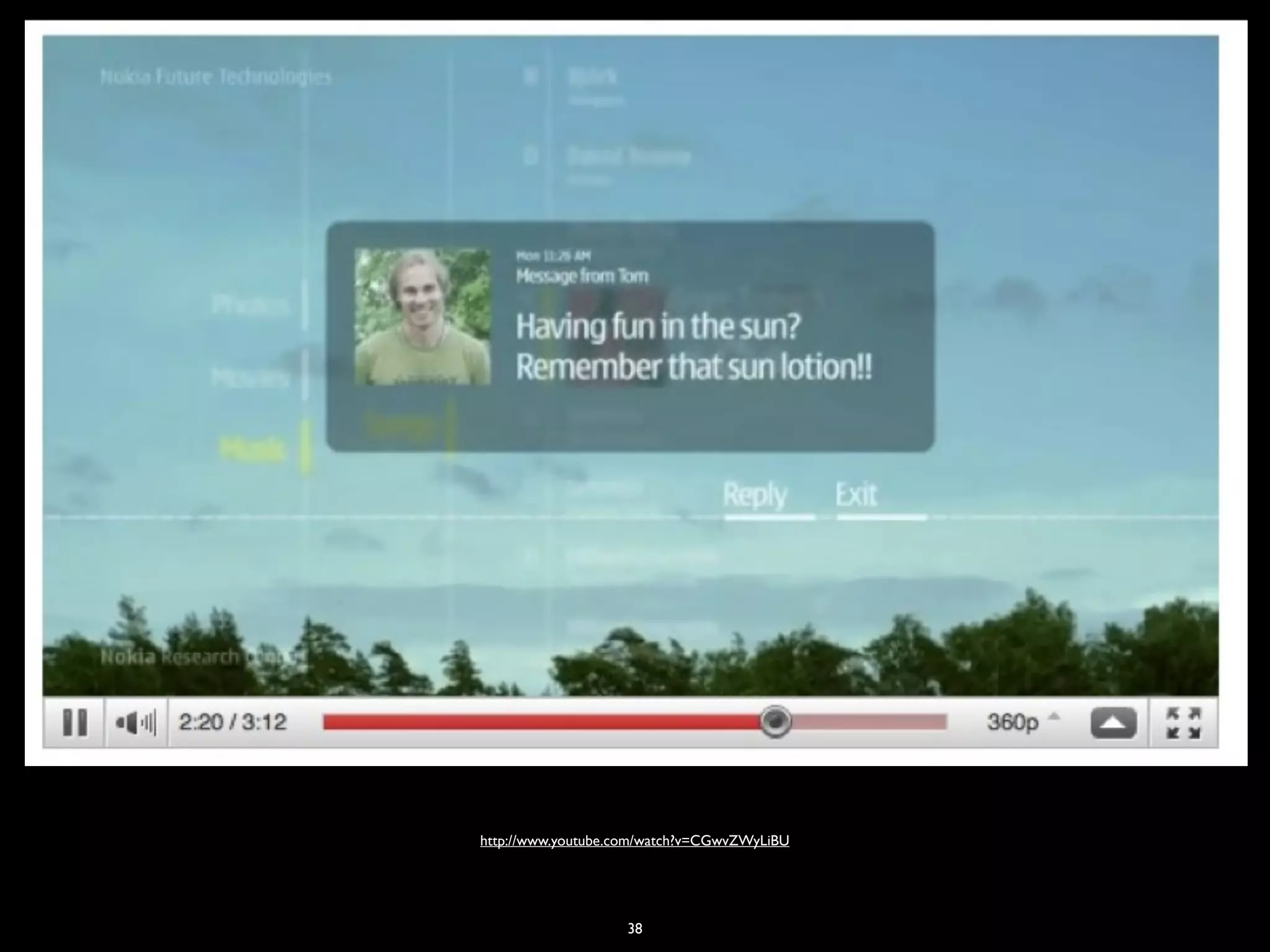
http://www.youtube.com/watch?v=CGwvZWyLiBU


                    38
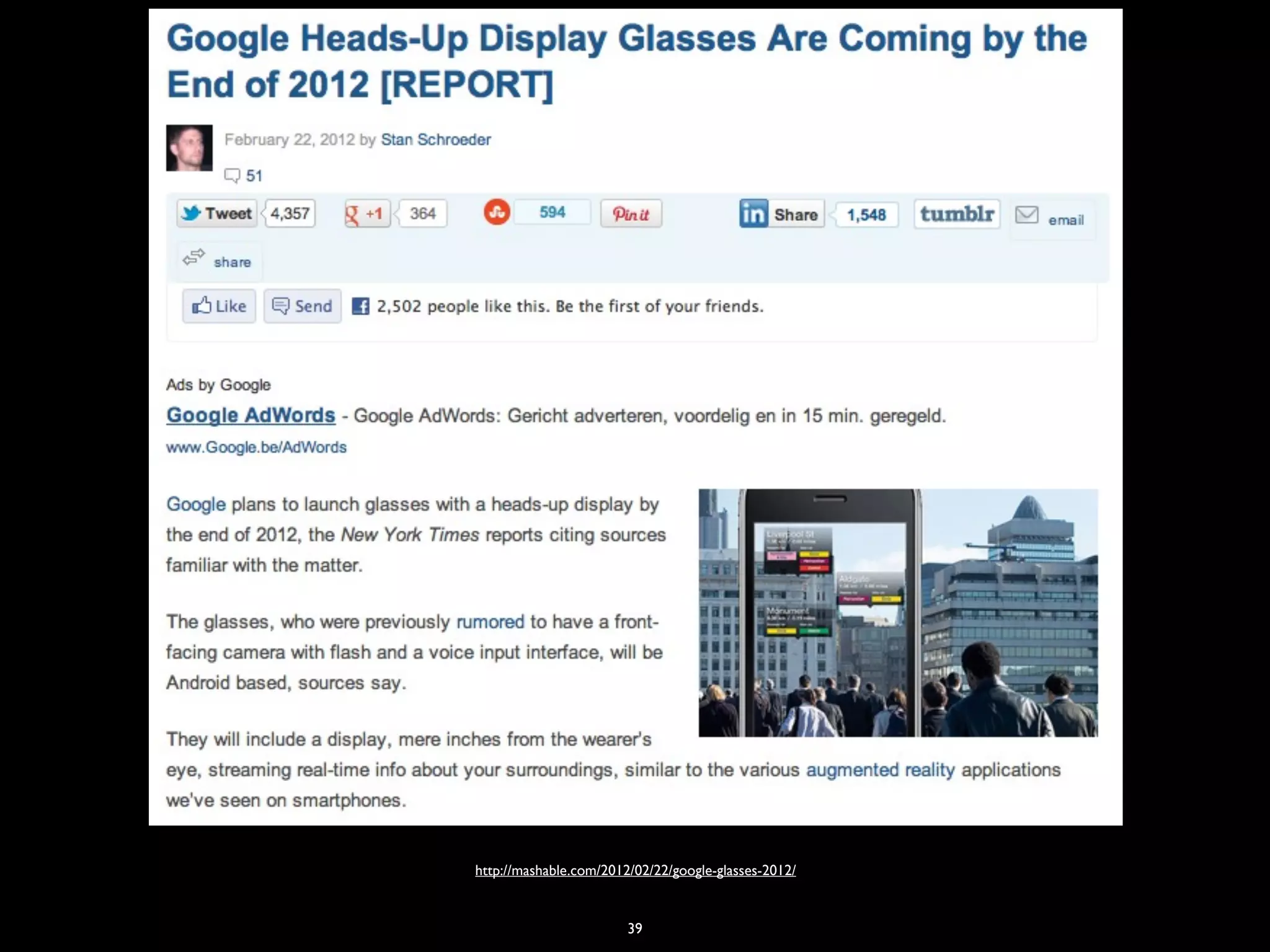
http://mashable.com/2012/02/22/google-glasses-2012/


                        39
http://www.ted.com/index.php/talks/pattie_maes_demos_the_sixth_sense.html


                                   40
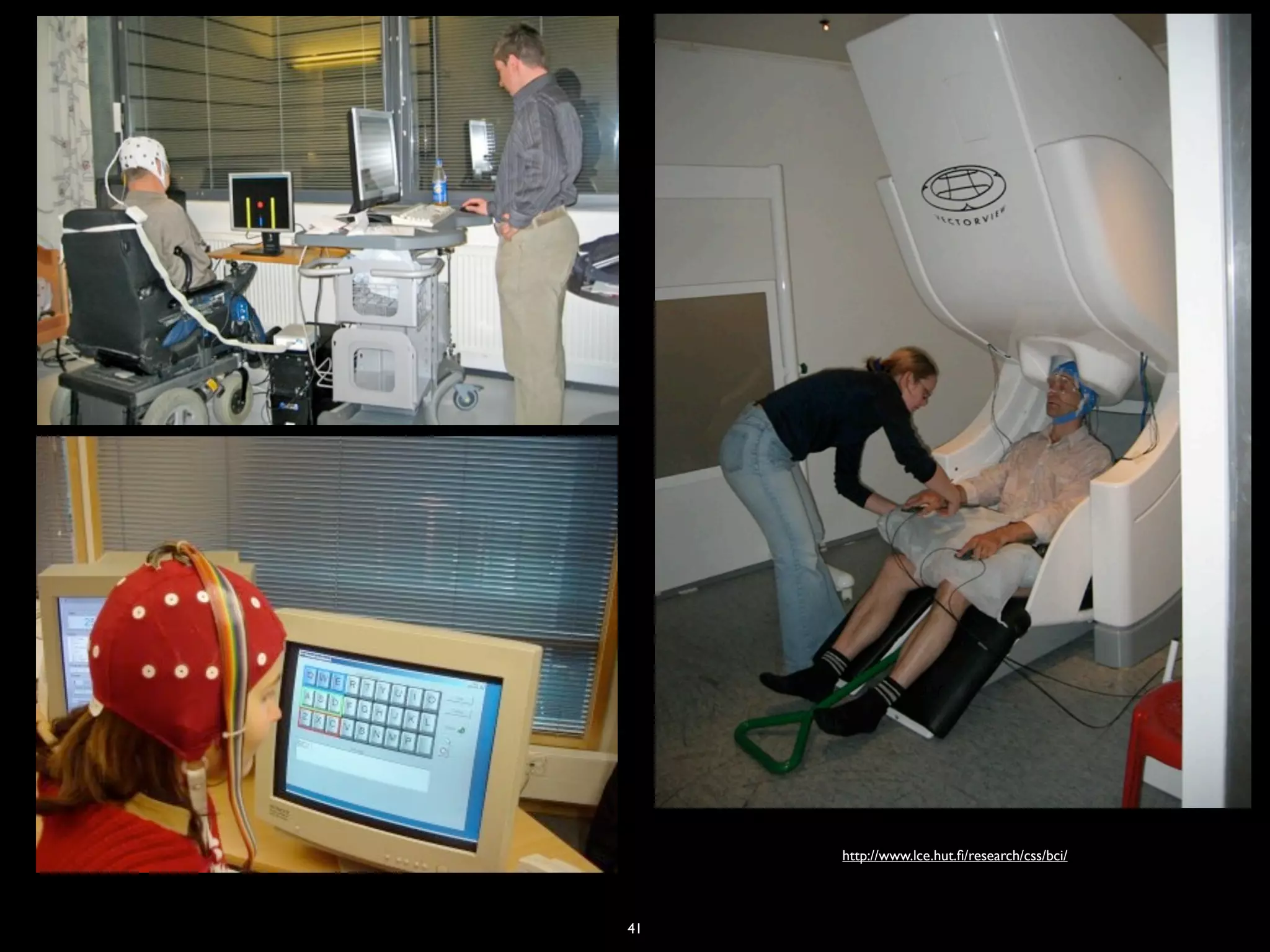
http://www.lce.hut.fi/research/css/bci/


41
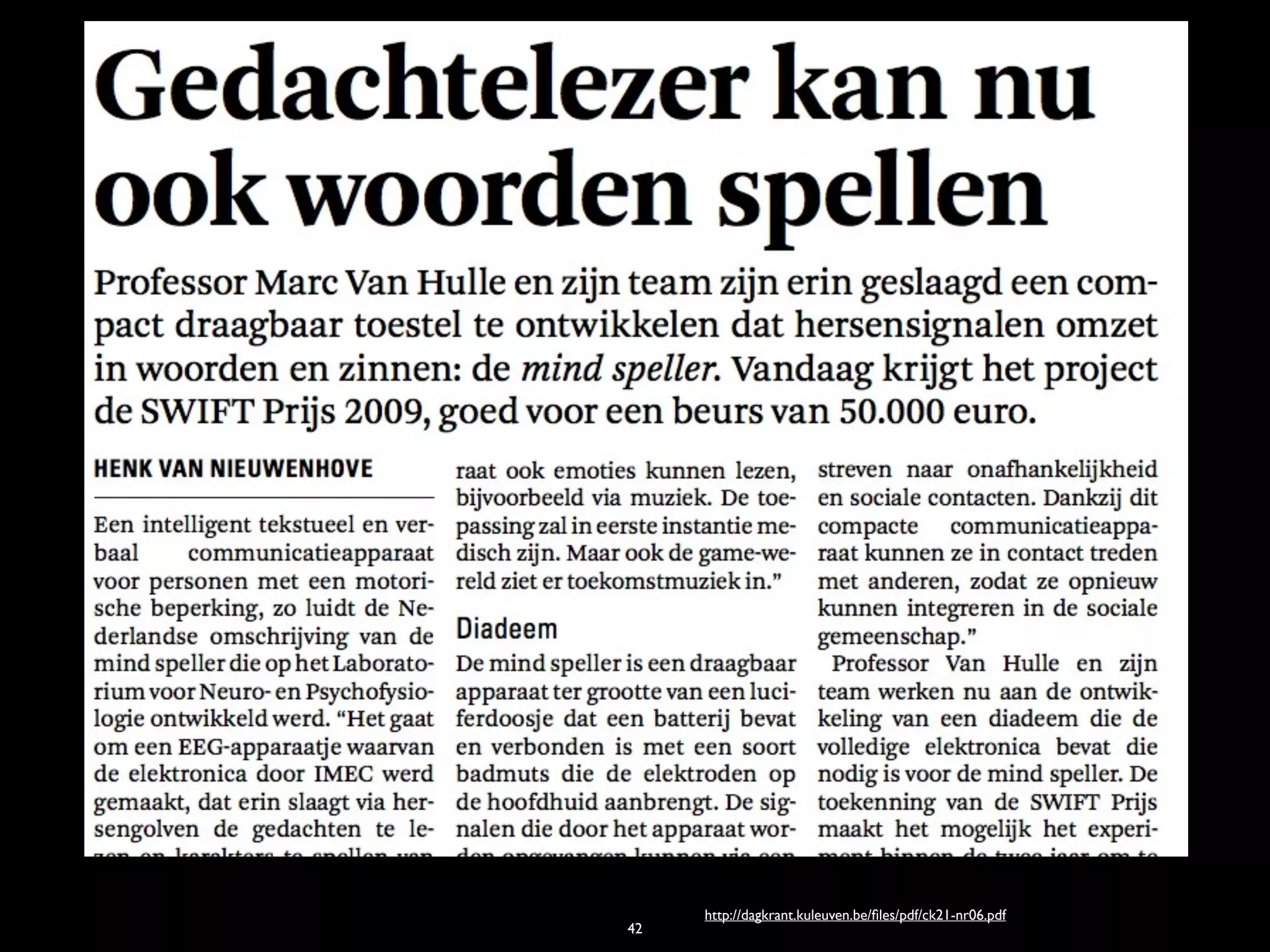
http://dagkrant.kuleuven.be/files/pdf/ck21-nr06.pdf
42
43   http://emotiv.com/
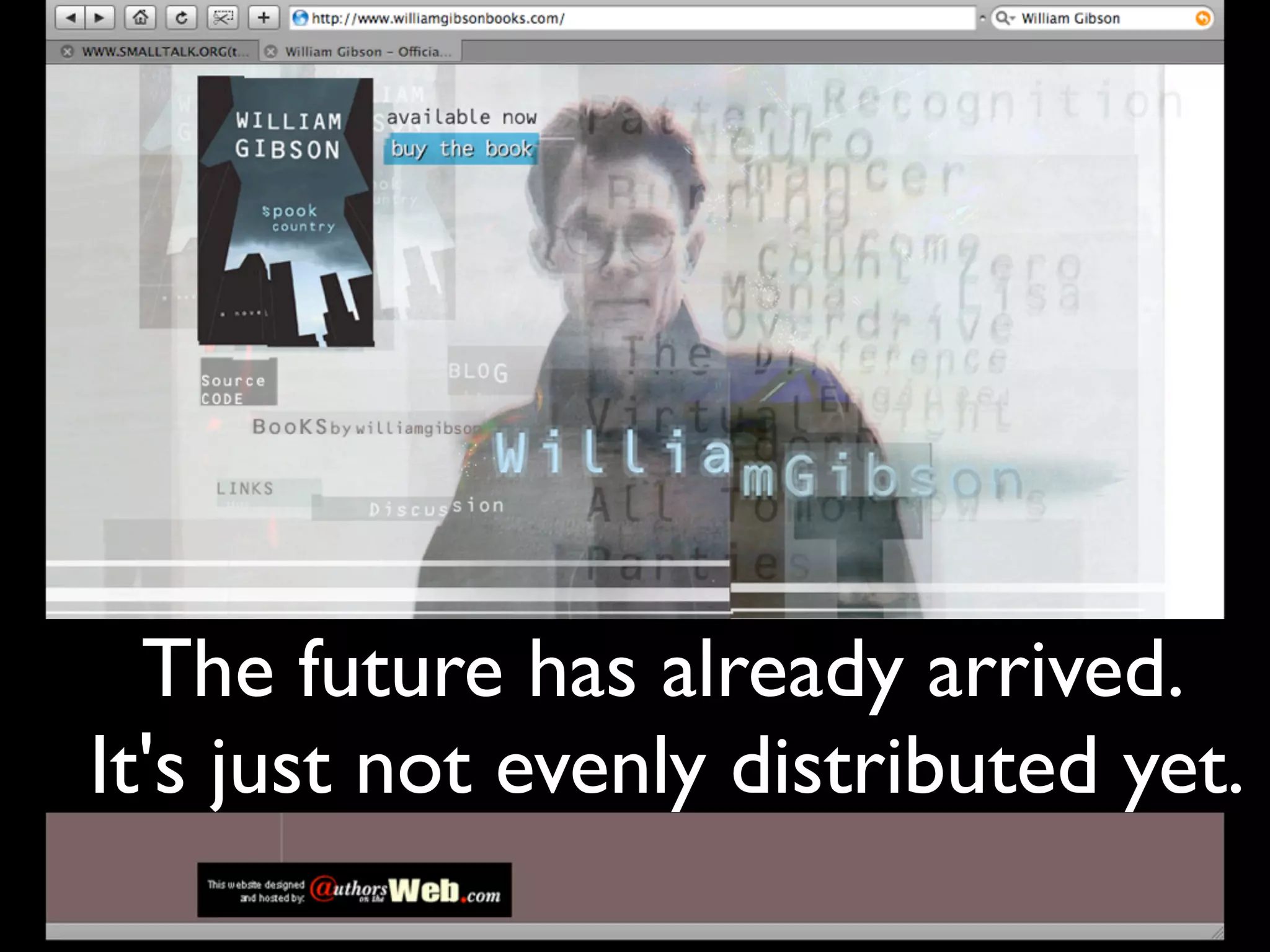
The future has already arrived.
It's just not evenly distributed yet.
                 44
what did you...
   • like most?
   • want most?
   • dislike most?
   • fear most?
   • ...?
  and why...
         45
• ???


        46
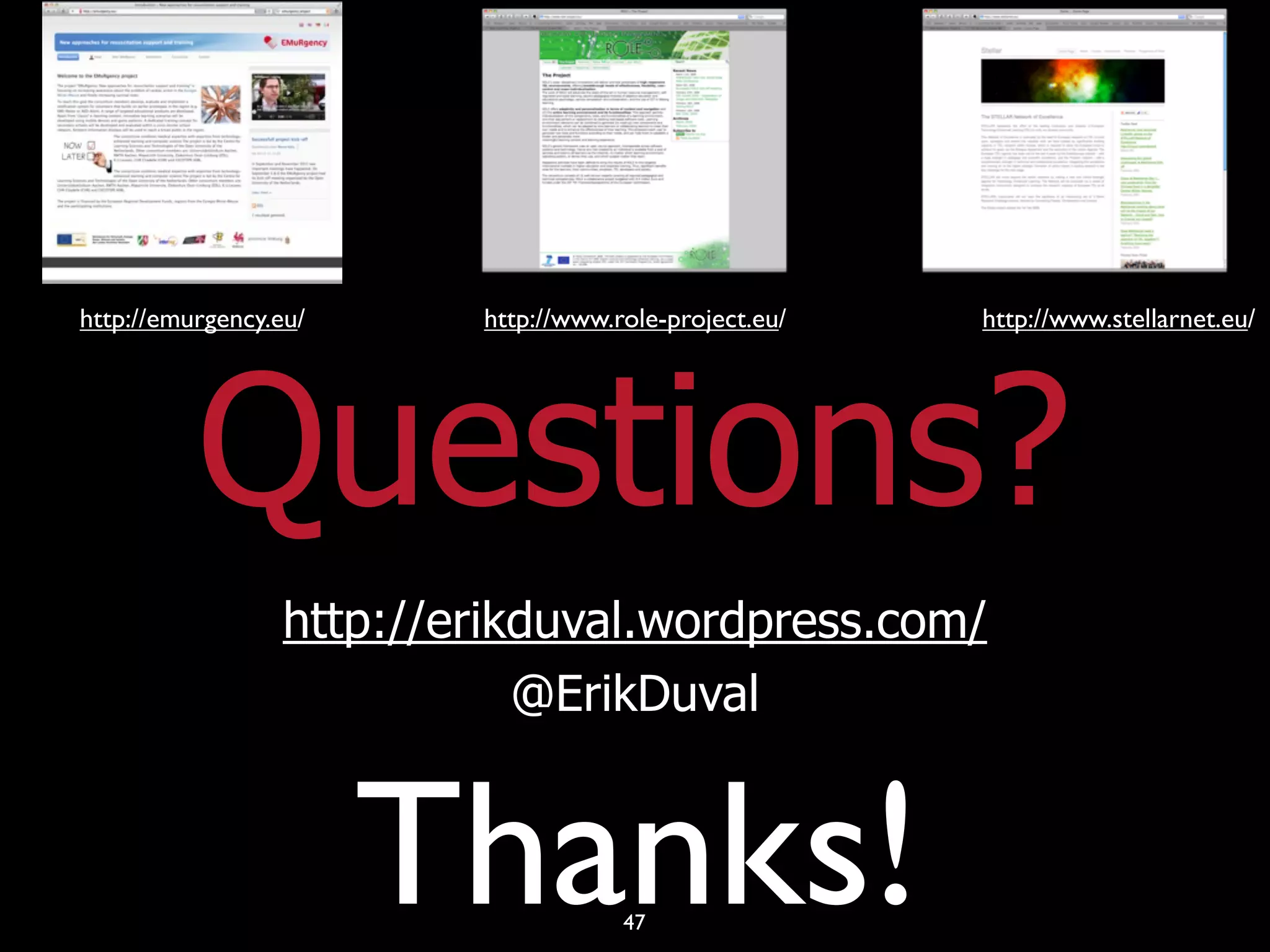
http://emurgency.eu/      http://www.role-project.eu/   http://www.stellarnet.eu/


          Questions?
                  http://erikduval.wordpress.com/
                             @ErikDuval


                       Thanks!        47

History of Human-Computer Interaction