2 December 2005
Advanced Topics in Information Systems
Introduction
Prof. Beat Signer
Department of Computer Science
Vrije Universiteit Brussel
http://www.beatsigner.com
Beat Signer - Department of Computer Science - bsigner@vub.ac.be 2February 14, 2017
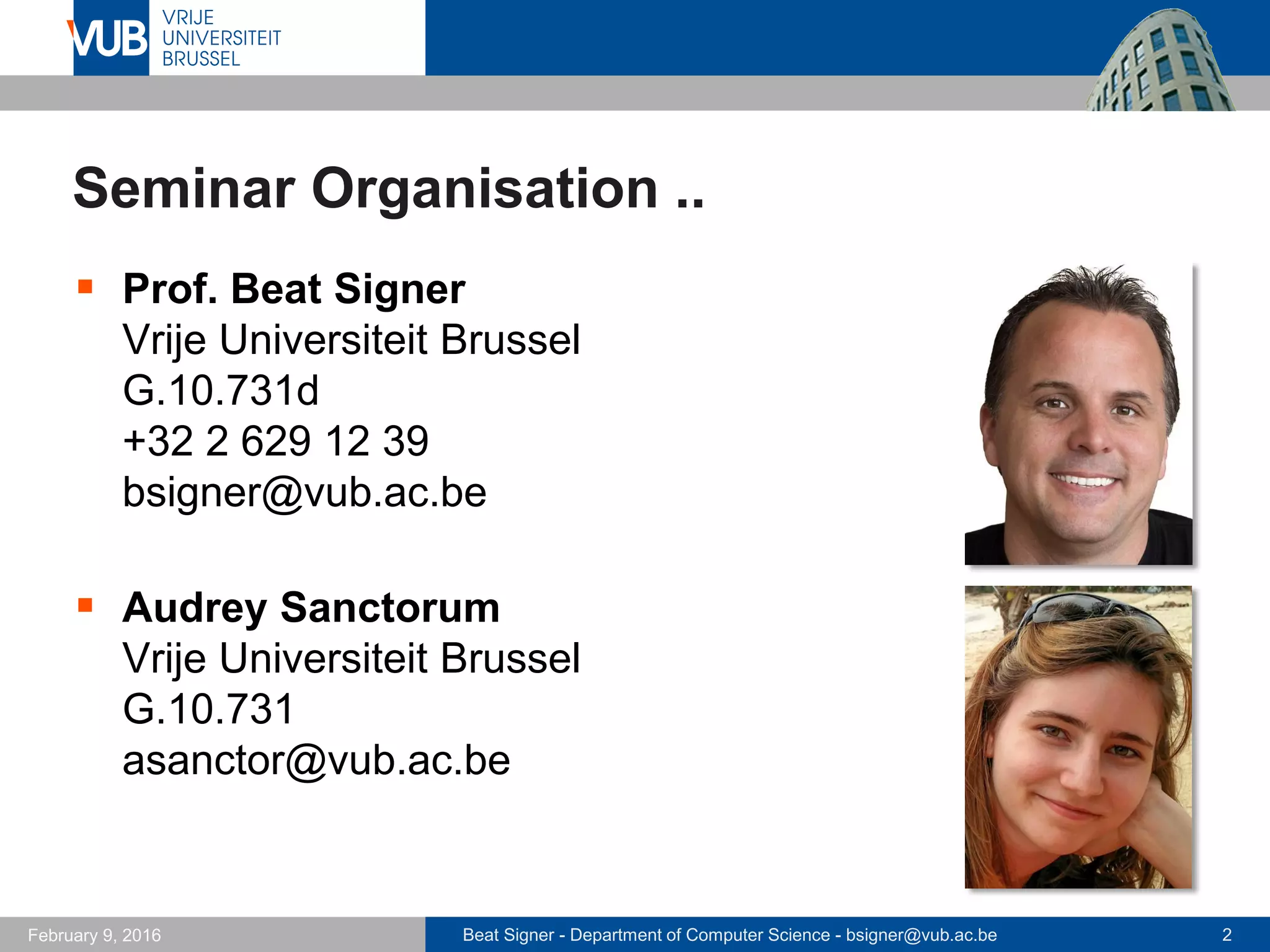
Seminar Organisation
 Prof. Beat Signer
Vrije Universiteit Brussel
G.10.731d
+32 2 629 12 39
bsigner@vub.ac.be
 Audrey Sanctorum
Vrije Universiteit Brussel
G.10.731
asanctor@vub.ac.be
Beat Signer - Department of Computer Science - bsigner@vub.ac.be 3February 14, 2017
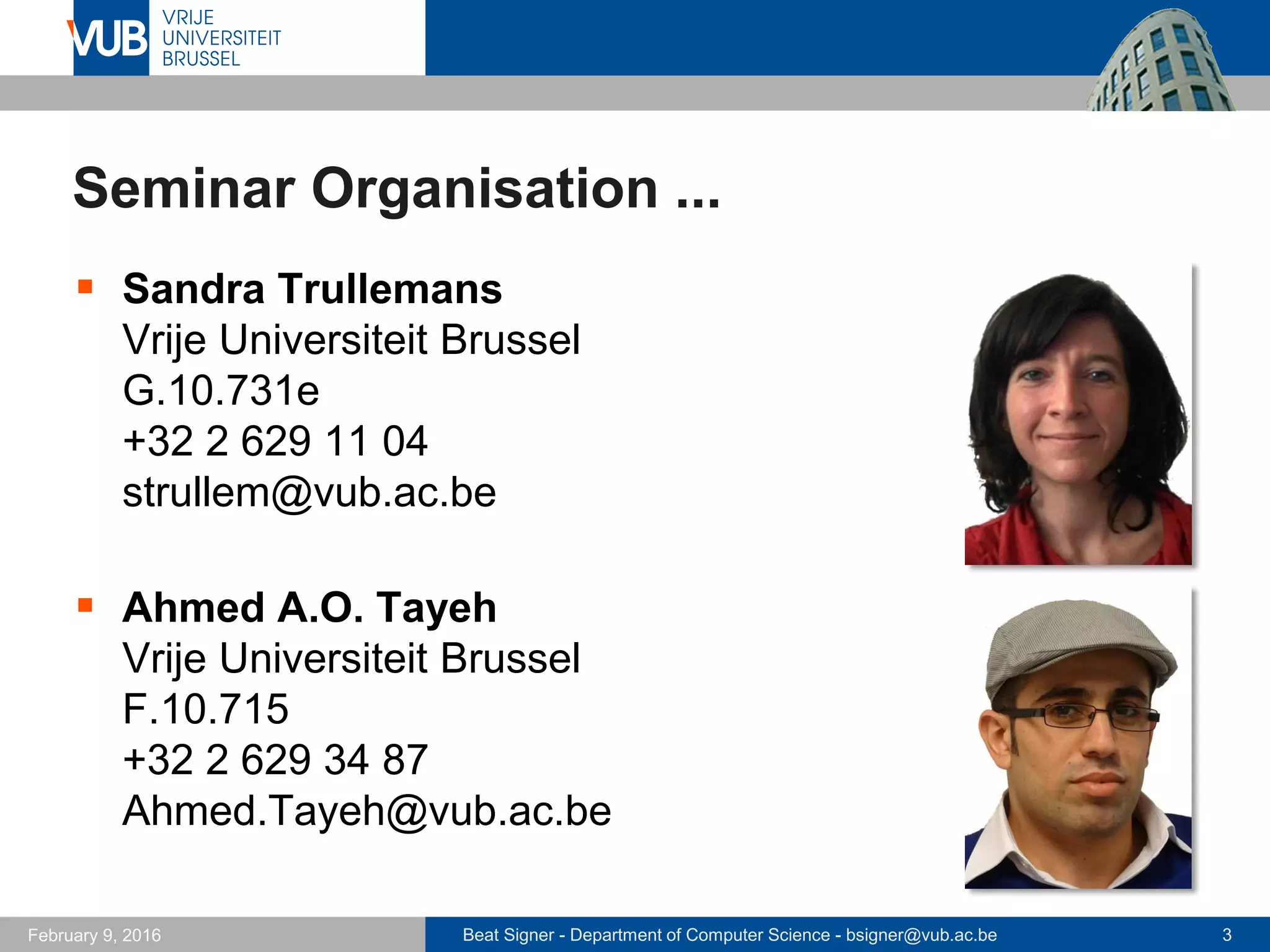
Seminar Organisation ...
 Sandra Trullemans
Vrije Universiteit Brussel
G.10.731e
+32 2 629 11 04
strullem@vub.ac.be
 Lars Van Holsbeeke
Vrije Universiteit Brussel
G.10.731
lavholsb@vub.ac.be
Beat Signer - Department of Computer Science - bsigner@vub.ac.be 4February 14, 2017
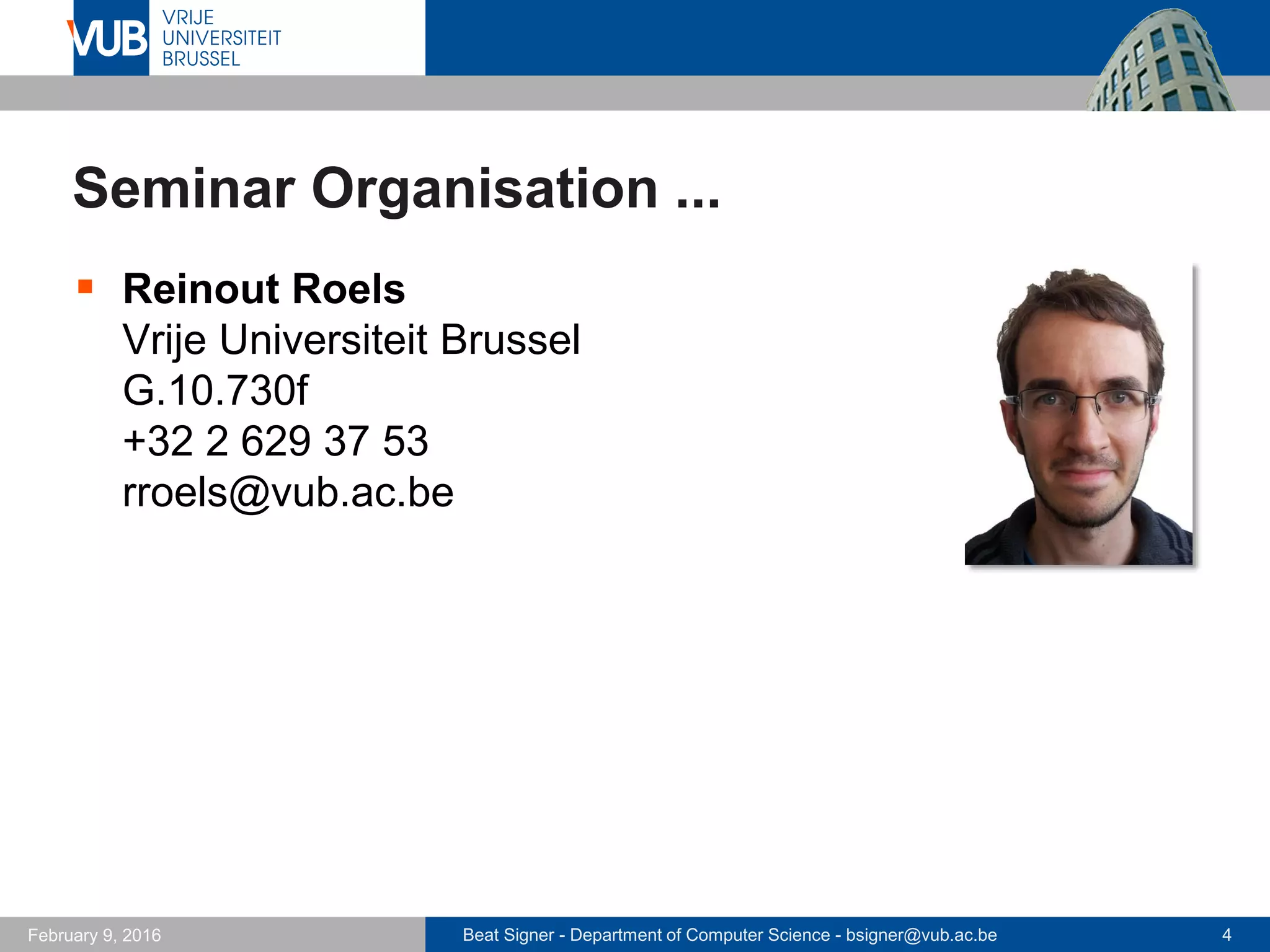
Seminar Organisation ...
 Reinout Roels
Vrije Universiteit Brussel
G.10.730f
+32 2 629 37 53
rroels@vub.ac.be
Beat Signer - Department of Computer Science - bsigner@vub.ac.be 5February 14, 2017
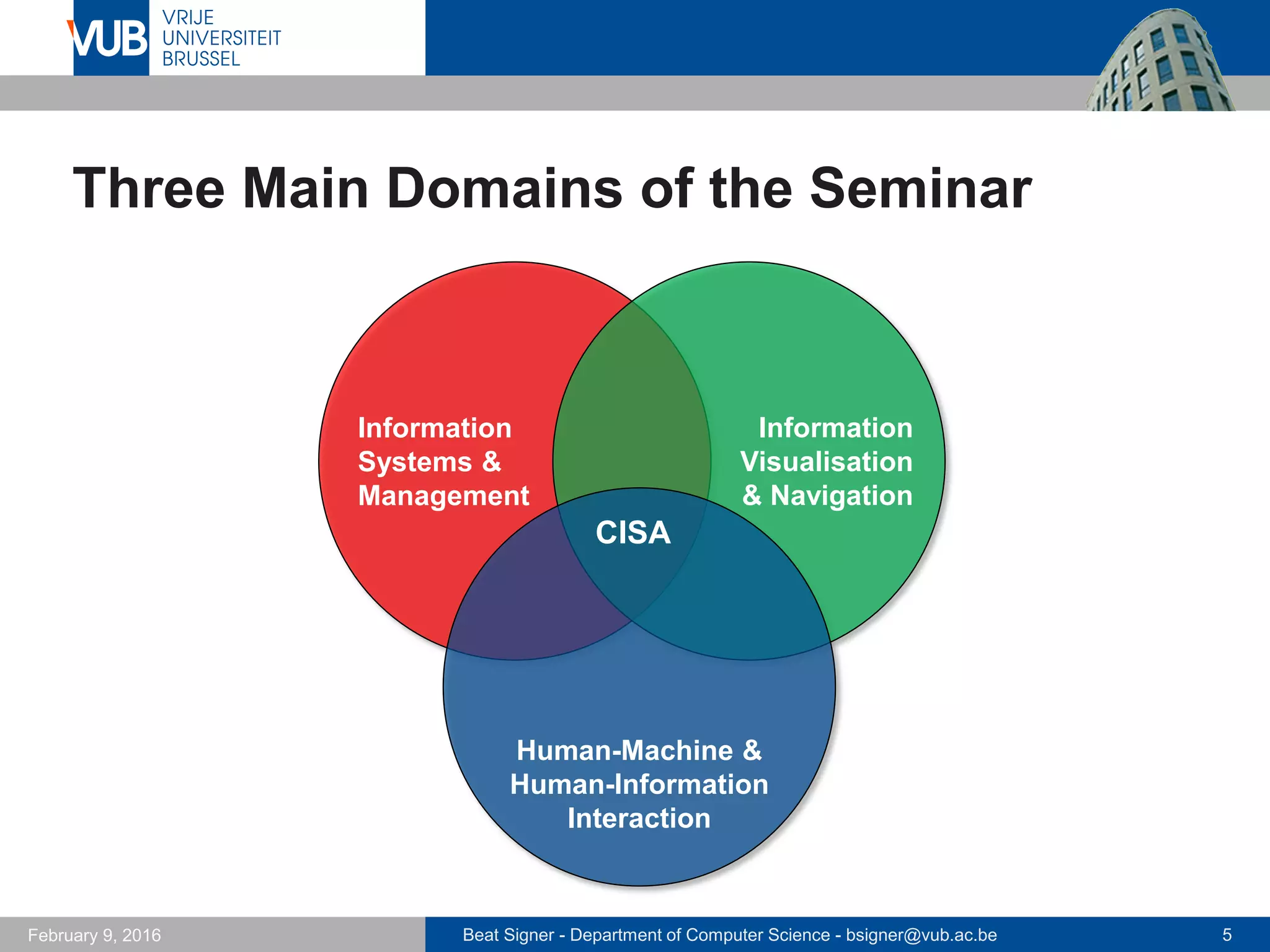
Three Main Domains of the Seminar
Information
Systems &
Management
Information
Visualisation
& Navigation
Information
Visualisation
nd NavigationHuman-Machine &
Human-Information
Interaction
CISA
Beat Signer - Department of Computer Science - bsigner@vub.ac.be 6February 14, 2017
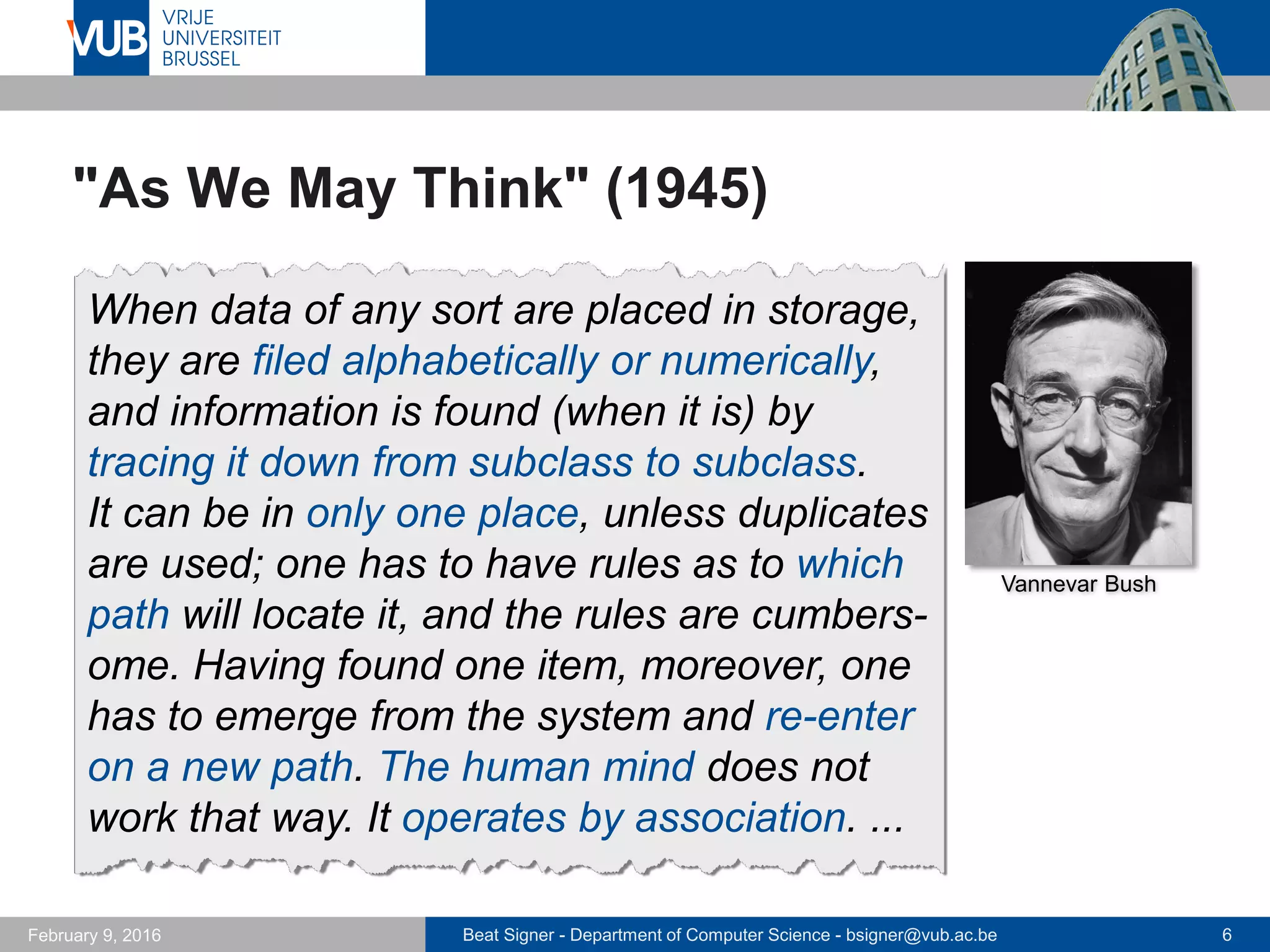
"As We May Think" (1945)
When data of any sort are placed in storage,
they are filed alphabetically or numerically,
and information is found (when it is) by
tracing it down from subclass to subclass.
It can be in only one place, unless duplicates
are used; one has to have rules as to which
path will locate it, and the rules are cumbers-
ome. Having found one item, moreover, one
has to emerge from the system and re-enter
on a new path. The human mind does not
work that way. It operates by association. ...
Vannevar Bush
Beat Signer - Department of Computer Science - bsigner@vub.ac.be 7February 14, 2017
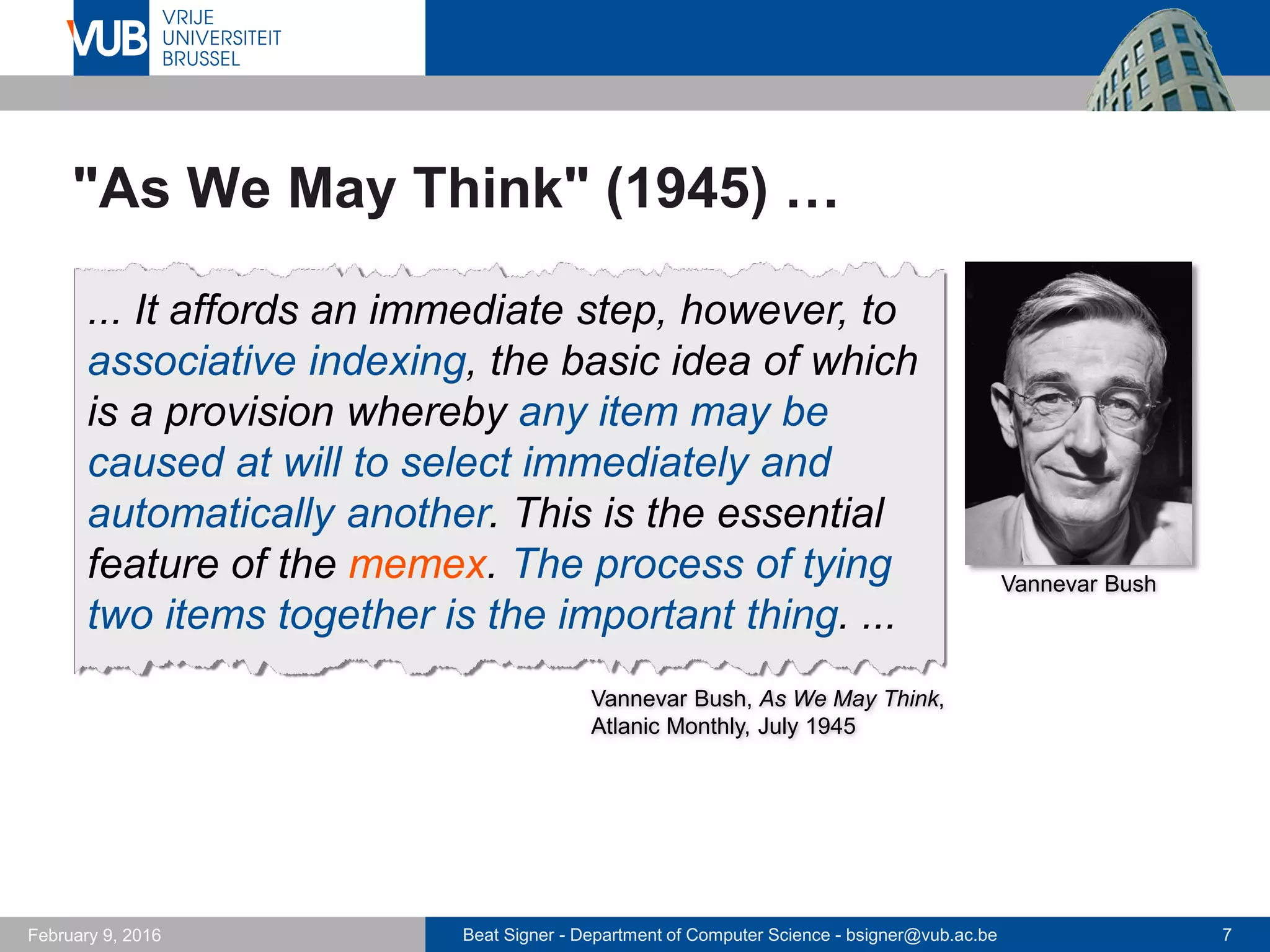
"As We May Think" (1945) …
... It affords an immediate step, however, to
associative indexing, the basic idea of which
is a provision whereby any item may be
caused at will to select immediately and
automatically another. This is the essential
feature of the memex. The process of tying
two items together is the important thing. ...
Vannevar Bush, As We May Think,
Atlanic Monthly, July 1945
Vannevar Bush
Beat Signer - Department of Computer Science - bsigner@vub.ac.be 8February 14, 2017
"As We May Think" (1945) …
 Bush's article 'As We May Think'
(1945) is often seen as
the "origin" of hypertext
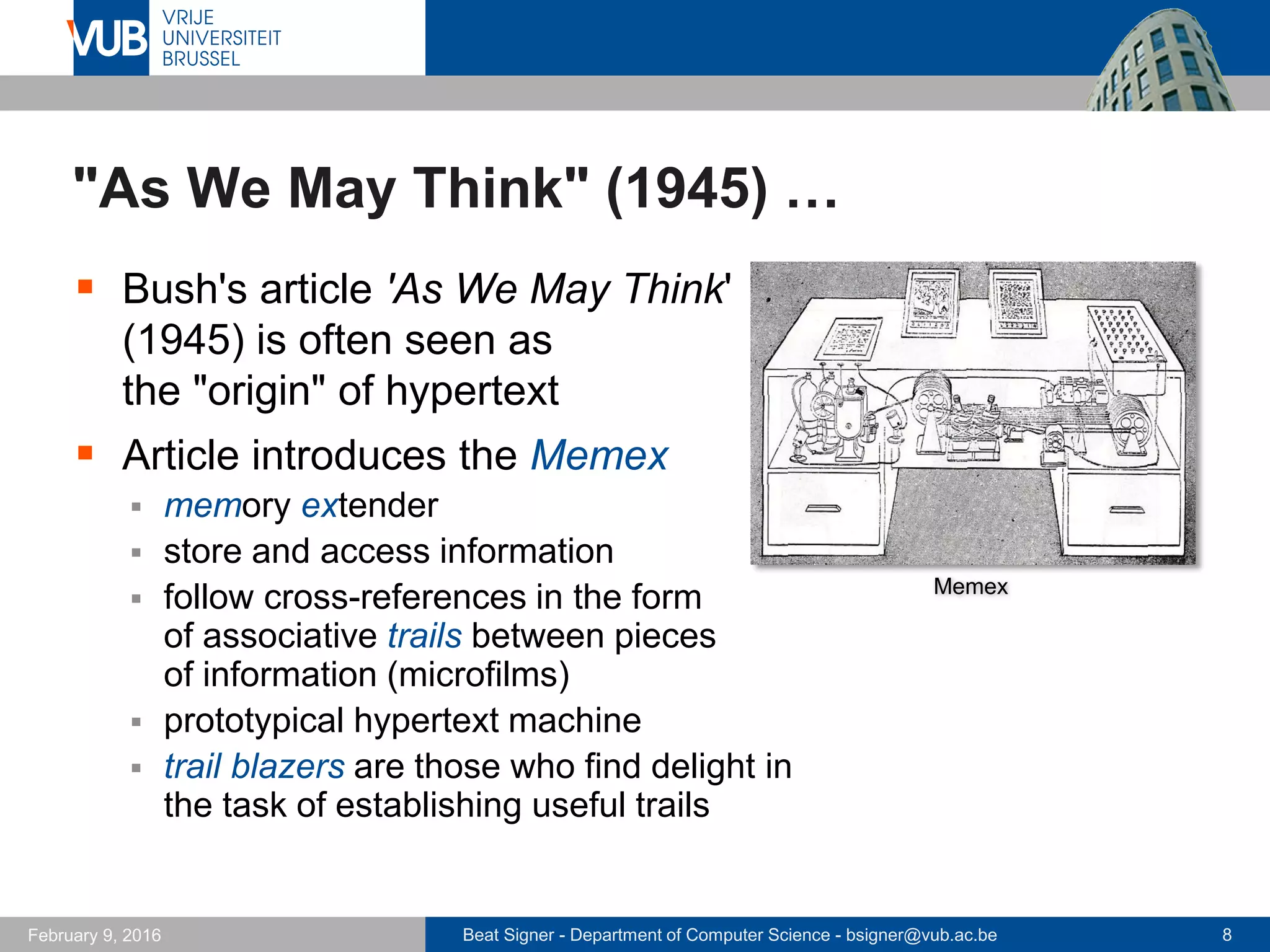
 Article introduces the Memex
 memory extender
 store and access information
 follow cross-references in the form
of associative trails between pieces
of information (microfilms)
 prototypical hypertext machine
 trail blazers are those who find delight in
the task of establishing useful trails
Memex
Beat Signer - Department of Computer Science - bsigner@vub.ac.be 9February 14, 2017
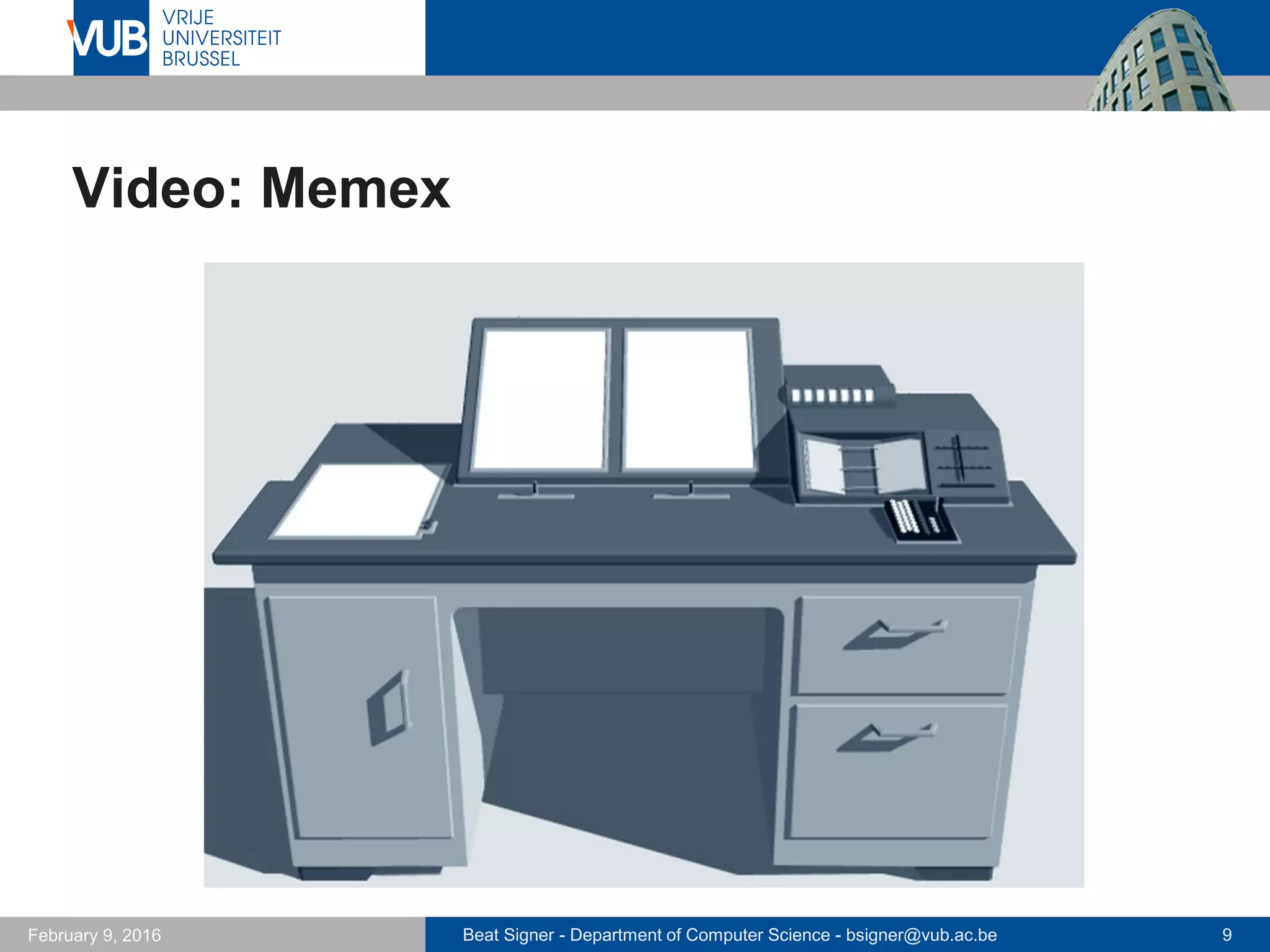
Video: Memex
Beat Signer - Department of Computer Science - bsigner@vub.ac.be 10February 14, 2017
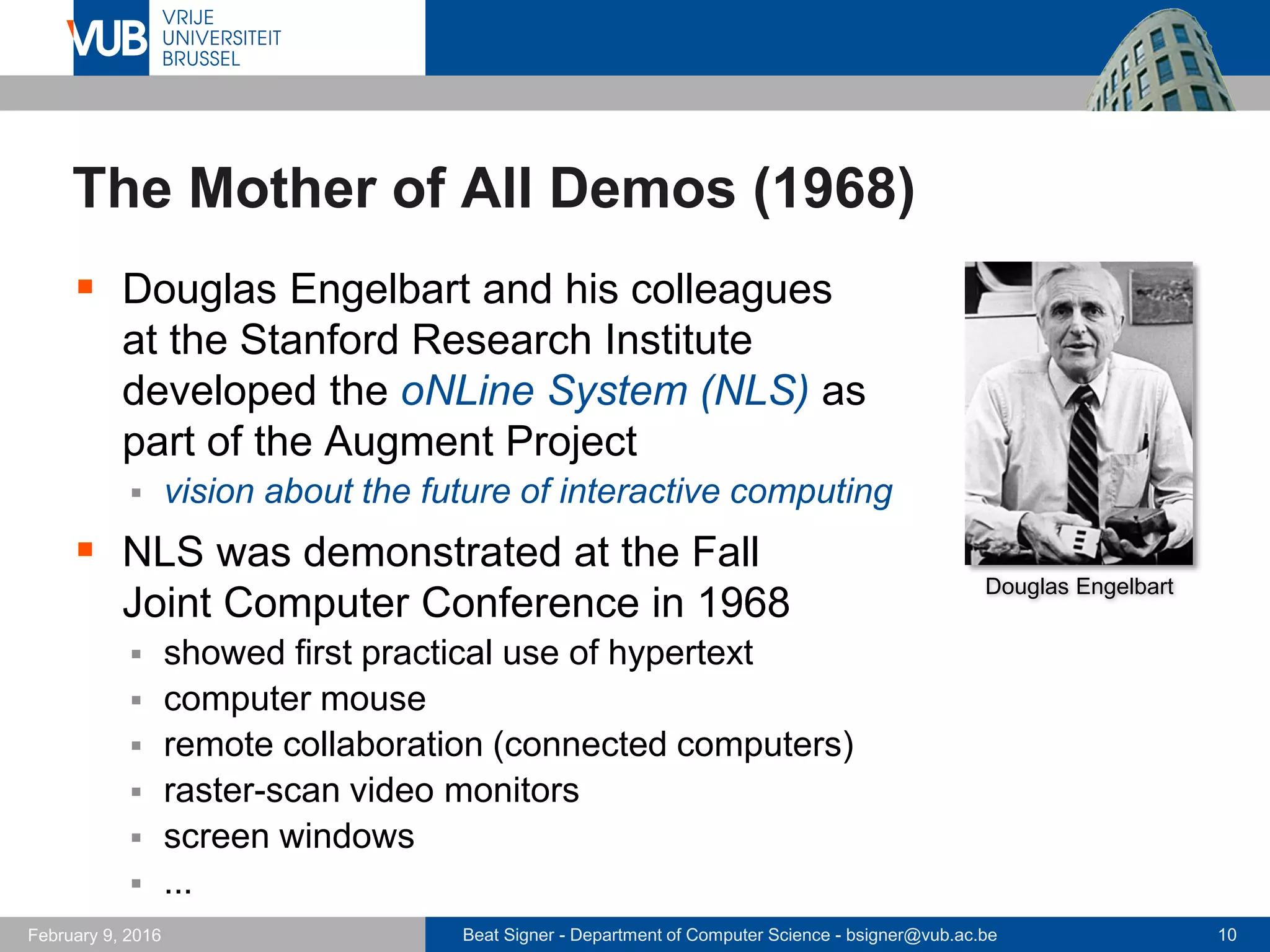
The Mother of All Demos (1968)
 Douglas Engelbart and his colleagues
at the Stanford Research Institute
developed the oNLine System (NLS) as
part of the Augment Project
 vision about the future of interactive computing
 NLS was demonstrated at the Fall
Joint Computer Conference in 1968
 showed first practical use of hypertext
 computer mouse
 remote collaboration (connected computers)
 raster-scan video monitors
 screen windows
 ...
Douglas Engelbart
Beat Signer - Department of Computer Science - bsigner@vub.ac.be 11February 14, 2017
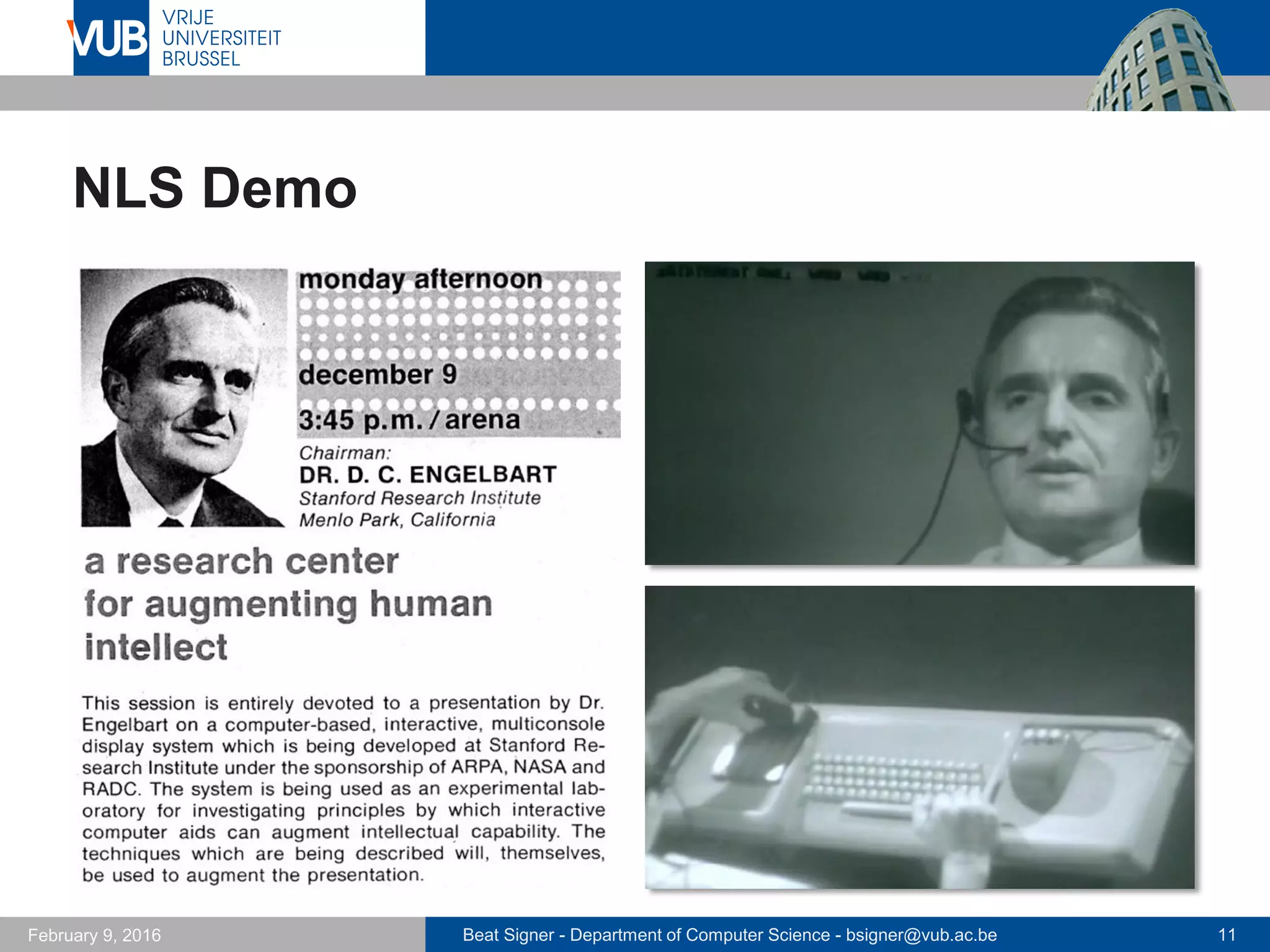
NLS Demo
Beat Signer - Department of Computer Science - bsigner@vub.ac.be 12February 14, 2017
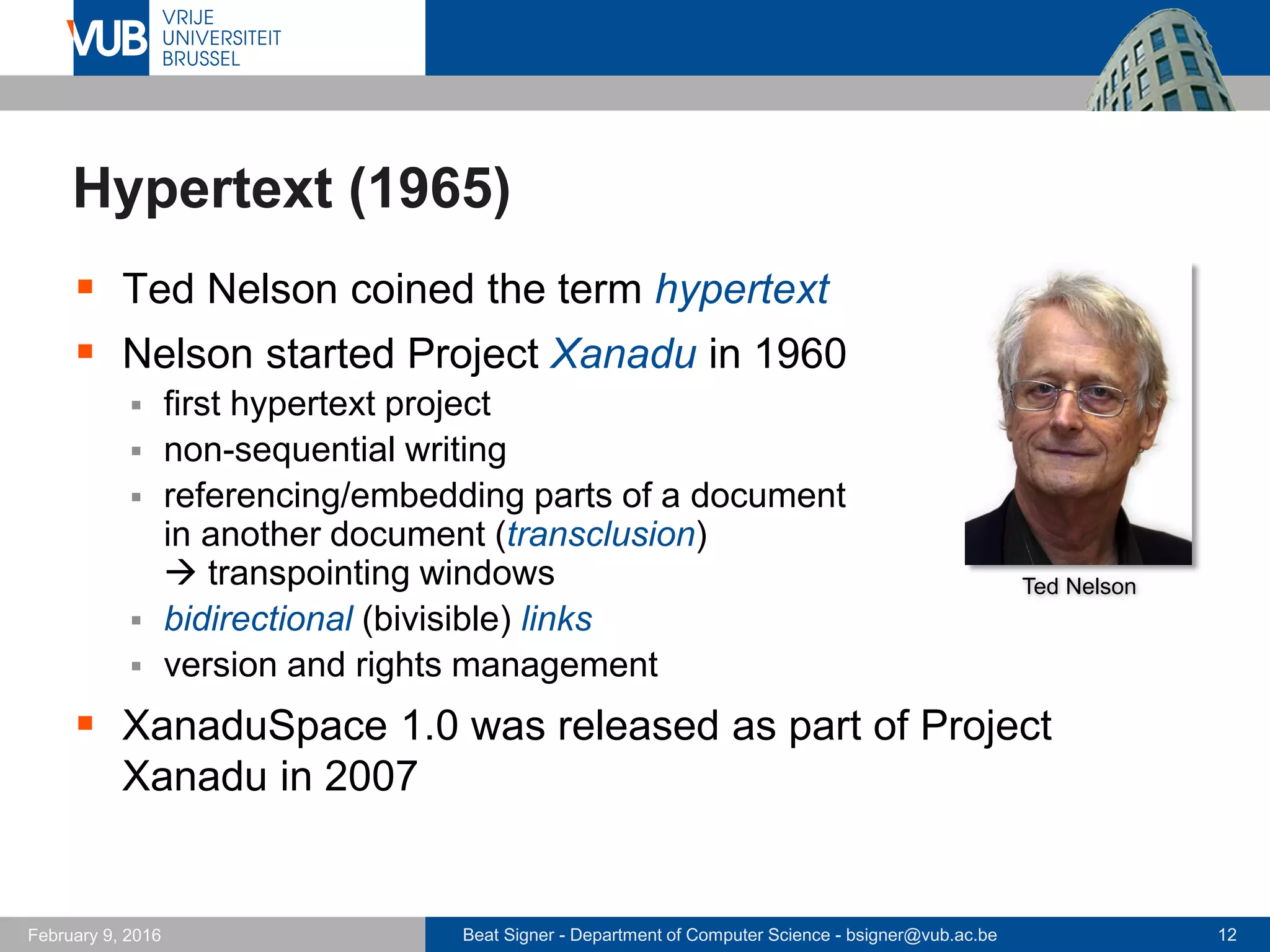
Hypertext (1965)
 Ted Nelson coined the term hypertext
 Nelson started Project Xanadu in 1960
 first hypertext project
 non-sequential writing
 referencing/embedding parts of a document
in another document (transclusion)
 transpointing windows
 bidirectional (bivisible) links
 version and rights management
 XanaduSpace 1.0 was released as part of Project
Xanadu in 2007
Ted Nelson
Beat Signer - Department of Computer Science - bsigner@vub.ac.be 13February 14, 2017
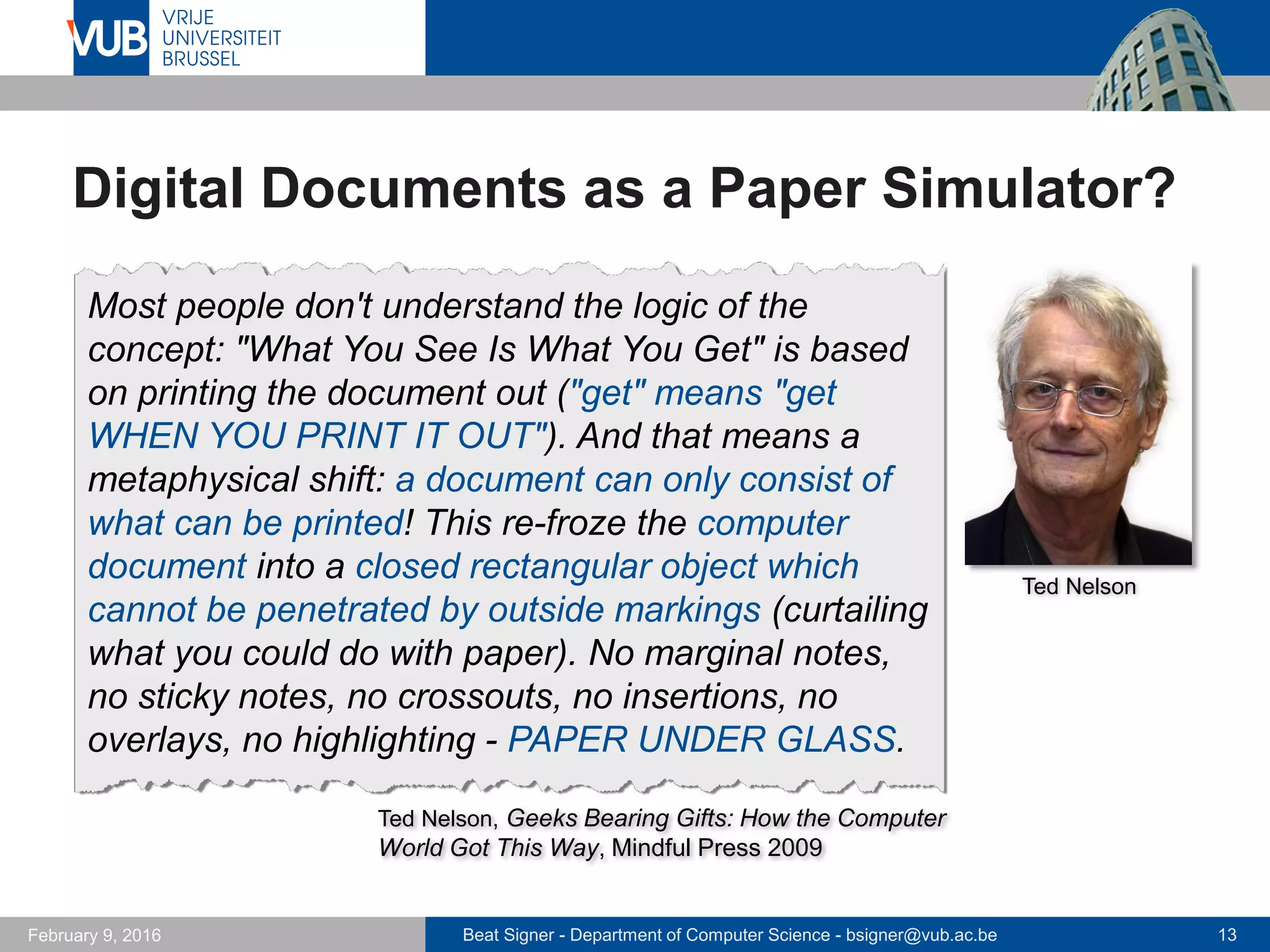
Digital Documents as a Paper Simulator?
Most people don't understand the logic of the
concept: "What You See Is What You Get" is based
on printing the document out ("get" means "get
WHEN YOU PRINT IT OUT"). And that means a
metaphysical shift: a document can only consist of
what can be printed! This re-froze the computer
document into a closed rectangular object which
cannot be penetrated by outside markings (curtailing
what you could do with paper). No marginal notes,
no sticky notes, no crossouts, no insertions, no
overlays, no highlighting - PAPER UNDER GLASS.
Ted Nelson, Geeks Bearing Gifts: How the Computer
World Got This Way, Mindful Press 2009
Ted Nelson
Beat Signer - Department of Computer Science - bsigner@vub.ac.be 14February 14, 2017
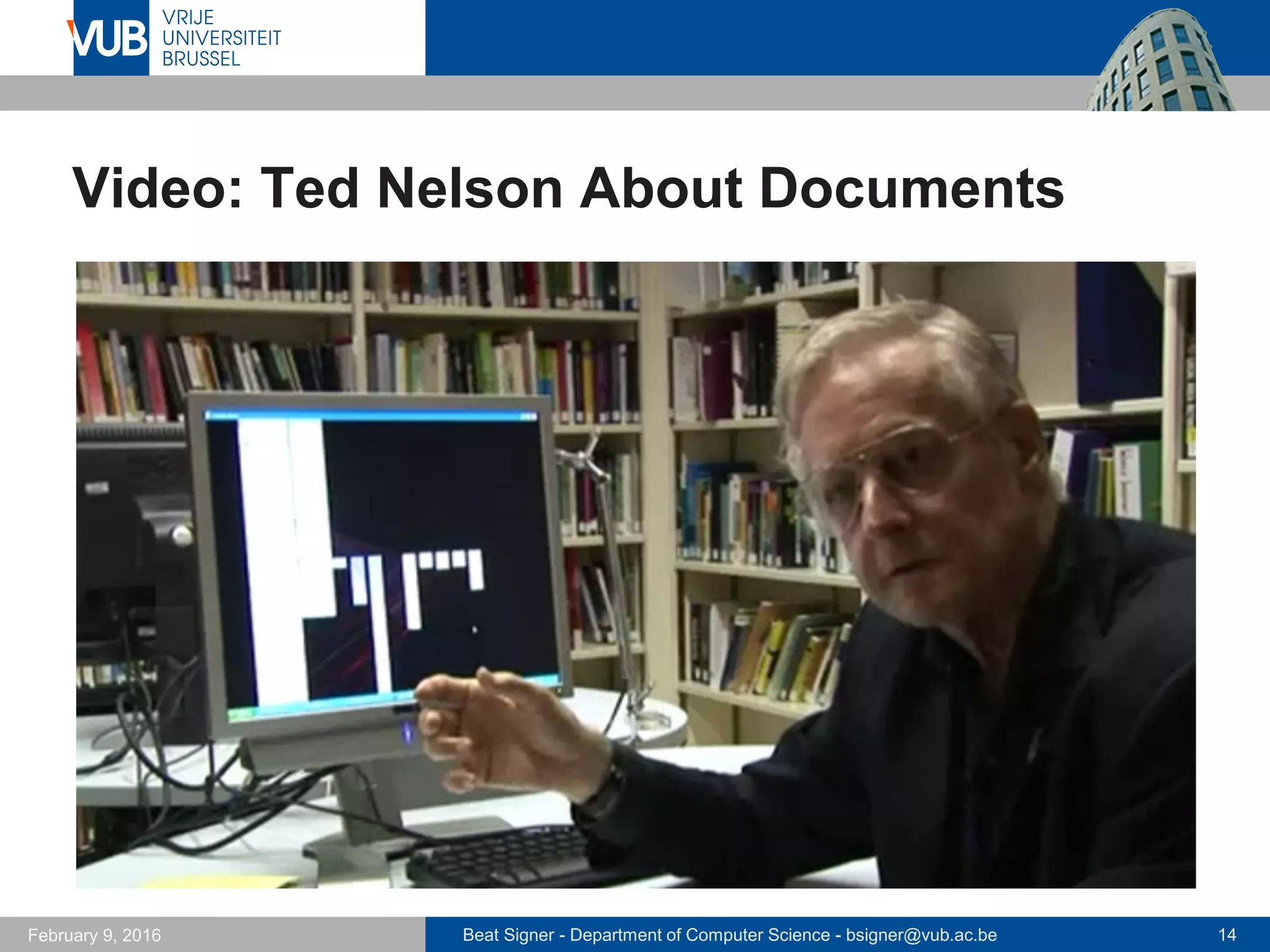
Video: Ted Nelson About Documents
Beat Signer - Department of Computer Science - bsigner@vub.ac.be 15February 14, 2017
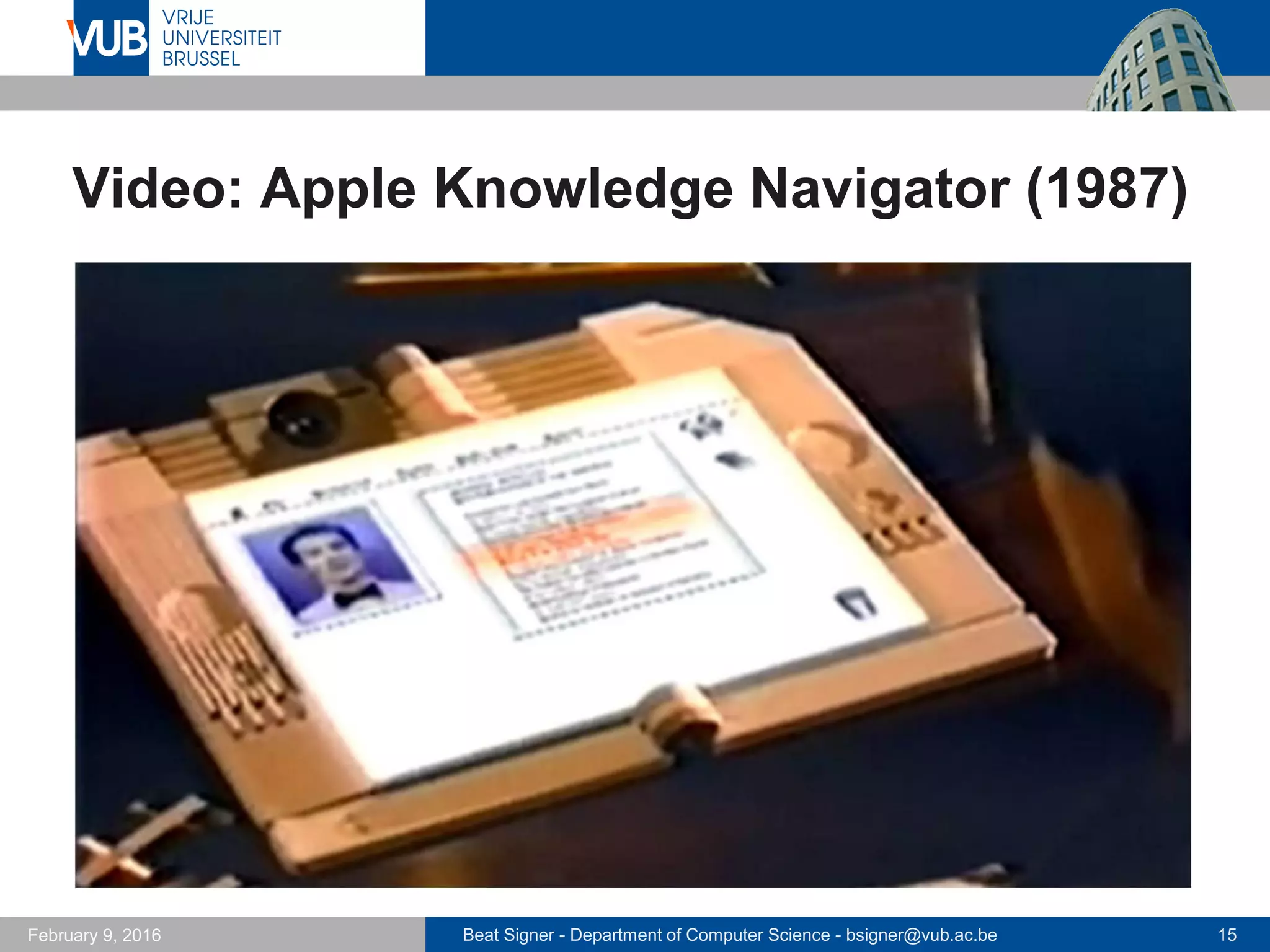
Video: Apple Knowledge Navigator (1987)
Beat Signer - Department of Computer Science - bsigner@vub.ac.be 16February 14, 2017
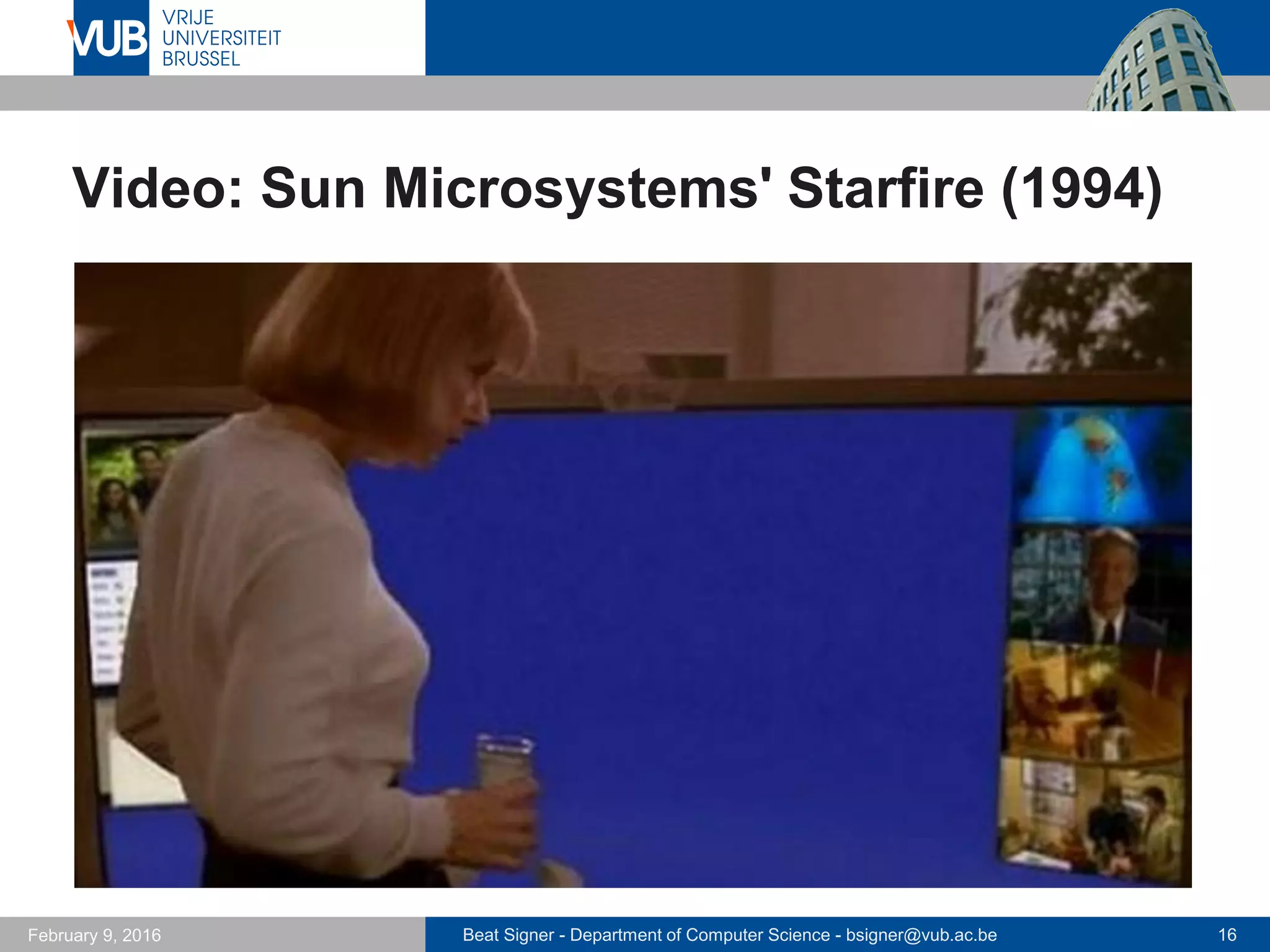
Video: Sun Microsystems' Starfire (1994)
Beat Signer - Department of Computer Science - bsigner@vub.ac.be 17February 14, 2017
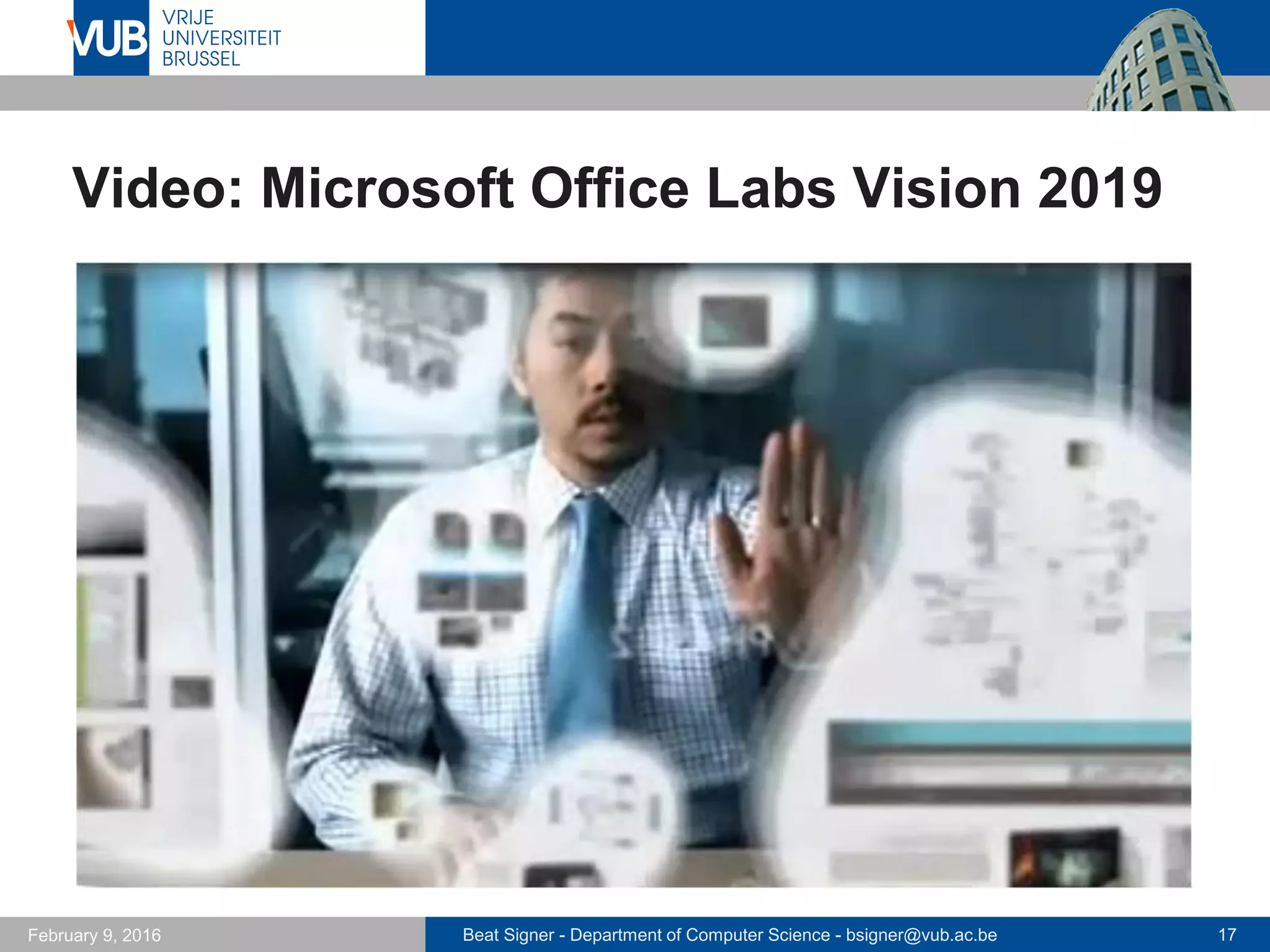
Video: Microsoft Office Labs Vision 2019
Beat Signer - Department of Computer Science - bsigner@vub.ac.be 18February 14, 2017
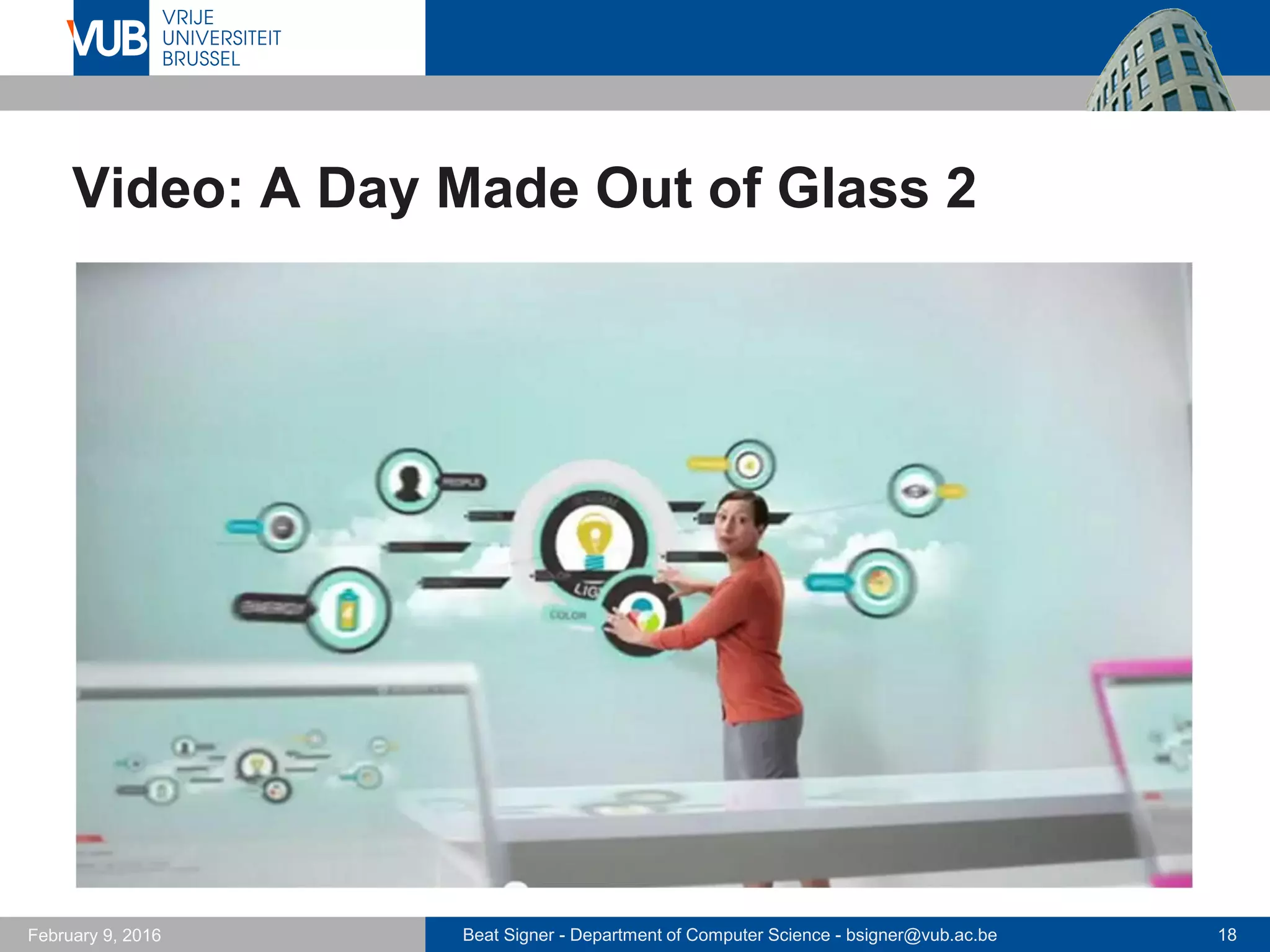
Video: A Day Made Out of Glass 2
Beat Signer - Department of Computer Science - bsigner@vub.ac.be 19February 14, 2017
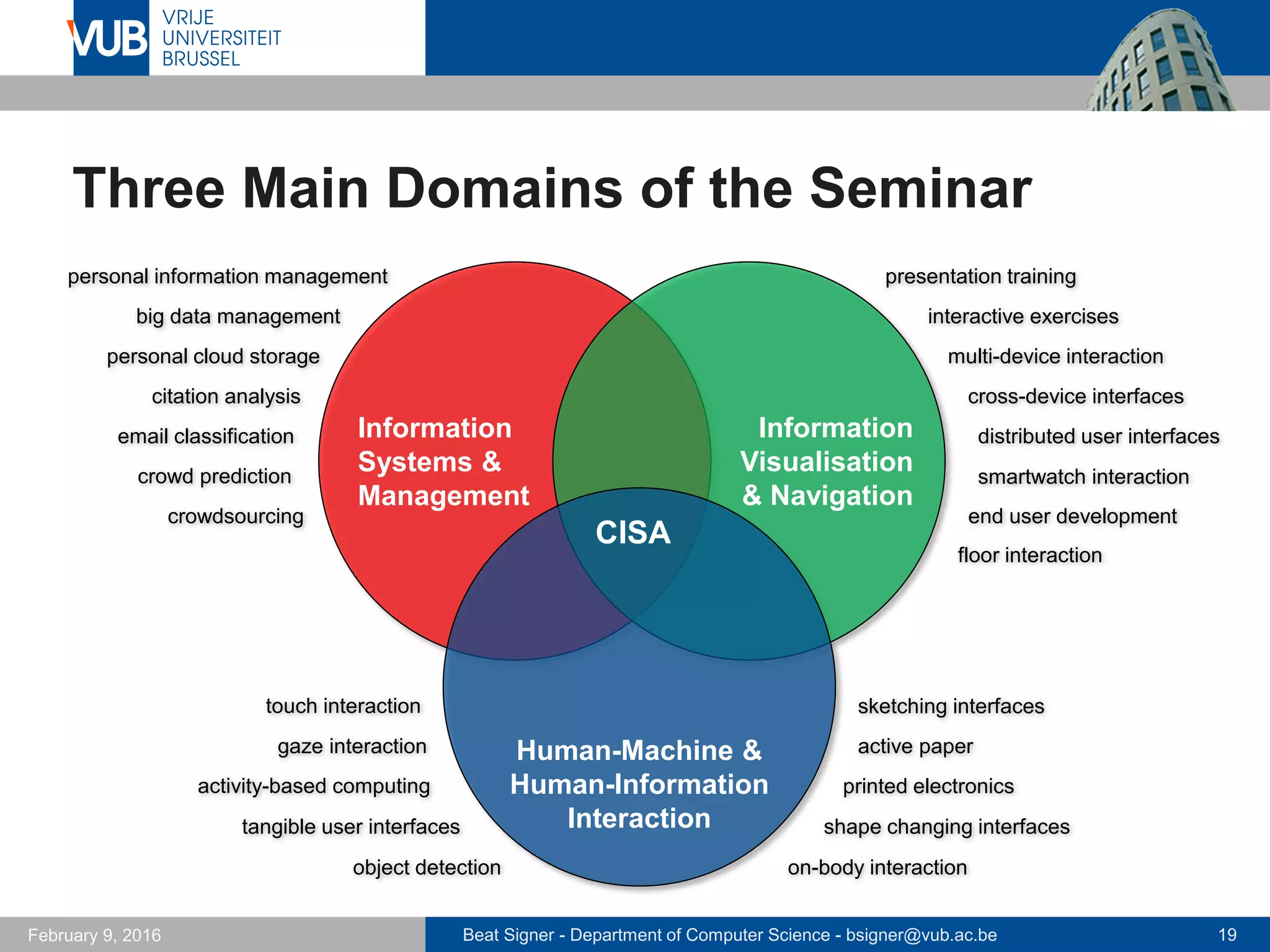
Three Main Domains of the Seminar
Information
Systems &
Management
Information
Visualisation
& Navigation
Information
Visualisation
nd NavigationHuman-Machine &
Human-Information
Interaction
CISA
knowledge management
internet of things
prosthetic memory
slow technology
data-driven storytelling
co-presentation
cross-device interaction
cross-device web design
augmented reality
data physicalisation
hypervideos
opportunistic device interaction
swarm user interfacesintelligent buildings
flexible displays
physical computing
bio-accoustic sensing
web interaction frameworks
on-body fabrication on-body interaction
haptic I/O
Beat Signer - Department of Computer Science - bsigner@vub.ac.be 20February 14, 2017
Seminar Topics
1. Co-Presentation
 DynamicDuo: Co-presenting with Virtual Agents, Ha Trinh, Lazlo Ring
and Timothy Bickmore. Proceedings of CHI 2015, 33rd Annual
ACM Conference on Human Factors in Computing Systems, Seoul,
Republic of Korea, April 2015. [Trinh2015.pdf]
2. Data-driven Storytelling
 SketchStory: Telling More Engaging Stories with Data Through Freeform
Sketching, Bongshin Lee, Rubaiat Habib Kazi and Greg Smith.
IEEE Transactions on Visualization and Computer Graphics 19(12),
December 2013. [Lee2013.pdf]
Beat Signer - Department of Computer Science - bsigner@vub.ac.be 21February 14, 2017
Seminar Topics ...
3. Knowledge Management
 TaskTracer: A Desktop Environment to Support Multi-tasking Knowledge
Workers, Anton N. Dragunov, Thomas G. Dietterich, Kevin Johnsrude,
Matthew McLaughlin, Lida Li and Jonathan L. Herlocker. Proceedings of
IUI 2005, 10th International Conference on Intelligent User Interfaces,
San Diego, USA, January 2005. [Dragunov2005.pdf]
4. Prosthetic Memory
 Software or Wetware?: Discovering when and Why People Use Digital
Prosthetic Memory, Vaiva Kalnikaitė and Steve Whittaker. Proceedings
of CHI 2007, Annual ACM Conference on Human Factors in Computing
Systems, San Jose, USA, April 2007. [Kalnikate2007.pdf]
Beat Signer - Department of Computer Science - bsigner@vub.ac.be 22February 14, 2017
Seminar Topics ...
5. Hypervideos
 Guiding Users Through Asynchronous Meeting Content with Hypervideo
Playback Plans, Andreas Girgensohn, Jennifer Marlow, Frank Shipman
and Lynn Wilcox. Proceedings of Hypertext 2016, 27th ACM Conference
on Hypertext and Social Media, Halifax, Canada, July 2016.
[Girgensohn2016.pdf]
6. Slow Technology
 Designing for Slowness, Anticipation and Re-visitation: A Long Term
Field Study of the Photobox, William T. Odom, Abigail J. Sellen, Richard
Banks, David S. Kirk, Tim Regan, Mark Selby, Jodi L Forlizzi and John
Zimmerman. Proceedings of CHI 2014, 32nd Annual ACM Conference
on Human Factors in Computing Systems, Toronto, Canada, April 2014.
[Odom2014.pdf]
Beat Signer - Department of Computer Science - bsigner@vub.ac.be 23February 14, 2017
Seminar Topics ...
7. Cross-Device Interaction
 Enhancing Cross-Device Interaction Scripting with Interactive
Illustrations, Pei-Yu (Peggy) Chi, Yang Li and Björn Hartmann.
Proceedings of CHI 2016, 34rd Annual ACM Conference on Human
Factors in Computing Systems, San Jose, USA, May 2016. [Chi2016.pdf]
8. Cross-Device Web Design
 XDBrowser: User-Defined Cross-Device Web Page Designs, Michael
Nebeling and Anind K. Dey. Proceedings of CHI 2016, 34rd Annual ACM
Conference on Human Factors in Computing Systems, San Jose, USA,
May 2016. [Nebeling2016.pdf]
Beat Signer - Department of Computer Science - bsigner@vub.ac.be 24February 14, 2017
Seminar Topics ...
9. Web Interaction Frameworks
 CTAT: Tilt-and-Tap Across Devices, Linda Di Geronimo, Maria
Husmann, Abhimanyu Patel, Can Tuerk and Moira C. Norrie.
Proceedings of ICWE 2016, 16th International Conference on Web
Engineering, Lugano, Switzerland, June 2016. [Geronimo2016.pdf]
10.Opportunistic Device Interaction
 Snap-To-It: A User-Inspired Platform for Opportunistic Device
Interactions, Adrian A. de Freitas, Michael Nebeling, Xiang 'Anthony'
Chen, Junrui Yang, Akshaye Shreenithi Kirupa Karthikeyan Ranithangam
and Anind K. Dey. Proceedings of CHI 2016, 34rd Annual ACM
Conference on Human Factors in Computing Systems, San Jose, USA,
May 2016. [DeFreitas2016.pdf]
Beat Signer - Department of Computer Science - bsigner@vub.ac.be 25February 14, 2017
Seminar Topics ...
11.Internet of Things
 Integration of Cloud Computing and Internet of Things: A Survey, Alessio
Botta, Walter de Donato, Valerio Persico and Antonio Pescapé. Future
Generation Computer Systems 56, March 2016. [Botta2016.pdf]
12.Intelligent Buildings
 Towards the Next Generation of Intelligent Building: An Assessment
Study of Current Automation and Future IoT Based Systems with a
Proposal for Transitional Design, Georgios Lilis, Gilbert Conus, Nastaran
Asadi and Maher Kayal. Sustainable Cities and Society, Volume 28,
January 2017. [Lilis2017.pdf]
Beat Signer - Department of Computer Science - bsigner@vub.ac.be 26February 14, 2017
Seminar Topics ...
13.Bio-Acoustic Sensing
 ViBand: High-Fidelity Bio-Acoustic Sensing Using Commodity
Smartwatch Accelerometers, Gierad Laput, Robert Xiao and Chris
Harrison. Proceedings of UIST 2016, 29th Annual Symposium on User
Interface Software and Technology, Tokyo, Japan, October 2016.
[Laput2016.pdf]
14.Haptic I/O
 NormalTouch and TextureTouch: High-fidelity 3D Haptic Shape
Rendering on Handheld Virtual Reality Controllers, Ha Trinh, Koji Yatani,
and Darren Edge. Proceedings of UIST 2016, 29th Annual Symposium
on User Interface Software and Technology, Tokyo, Japan, October
2016. [Benko2016.pdf]
Beat Signer - Department of Computer Science - bsigner@vub.ac.be 27February 14, 2017
Seminar Topics ...
15.Data Physicalisation
 Opportunities and Challenges for Data Physicalization, Yvonne Jansen,
Pierre Dragicevic, Petra Isenberg, Jason Alexander, Abhijit Karnik, Johan
Kildal, Sriram Subramanian and Kasper Hornbaek. Proceedings of CHI
2015, 33rd Annual ACM Conference on Human Factors in Computing
Systems, Seoul, Republic of Korea, April 2015. [Jansen2015.pdf]
16.Swarm User Interfaces
 Zooids: Building Blocks for Swarm User Interfaces, Mathieu Le Goc,
Lawrence H. Kim, Ali Parsaei, Jean-Daniel Fekete, Pierre Dragicevic and
Sean Follmer. Proceedings of UIST 2016, 29th Annual Symposium on
User Interface Software and Technology, Tokyo, Japan, October 2016.
[LeGoc2016.pdf]
Beat Signer - Department of Computer Science - bsigner@vub.ac.be 28February 14, 2017
Seminar Topics ...
17.Flexible Displays
 ReFlex: A Flexible Smartphone with Active Haptic Feedback for Bend
Input, Paul Strohmeier, Jesse Burstyn, Juan Pablo Carrascal, Vincent
Levesque and Roel Vertegaal. Proceedings of TEI 2016, Tenth
International Conference on Tangible, Embedded, and Embodied
Interaction, Eindhoven, The Netherlands, February 2016.
[Strohmeier2016.pdf]
18.Physical Computing
 What You Sculpt is What You Get: Modeling Physical Interactive Devices
with Clay and 3D Printed Widgets, Michael D. Jones, Kevin Seppi and
Dan R. Olsen. Proceedings of CHI 2016, 34rd Annual ACM Conference
on Human Factors in Computing Systems, San Jose, USA, May 2016.
[Jones2016.pdf]
Beat Signer - Department of Computer Science - bsigner@vub.ac.be 29February 14, 2017
Seminar Topics ...
19.On-Body Fabrication
 ExoSkin: On-Body Fabrication, Madeline Gannon, Tovi Grossman and
George Fitzmaurice. Proceedings of CHI 2016, 34rd Annual ACM
Conference on Human Factors in Computing Systems, San Jose, USA,
May 2016. [Gannon2016.pdf]
20.Augmented Reality
 SnapToReality: Aligning Augmented Reality to the Real World, Benjamin
Nuernberger, Eyal Ofek, Hrvoje Benko and Andrew D. Wilson.
Proceedings of CHI 2016, 34rd Annual ACM Conference on Human
Factors in Computing Systems, San Jose, USA, May 2016.
[Nuernberger2016.pdf]
Beat Signer - Department of Computer Science - bsigner@vub.ac.be 30February 14, 2017
Assignment of Topics
 Select 3 topics/papers from the presented list and mark
them (with A, B and C) according to your preferences
 Send an email with your choices (e.g. 6A, 8B, 14C) to
asanctor@vub.ac.be no later than February 17
 Each student will be assigned a paper that has to be
presented in the seminar and the final seminar schedule
will be made available by next week
Beat Signer - Department of Computer Science - bsigner@vub.ac.be 31February 14, 2017
Seminar Organisation
 Presentation should be 30 minutes long (not longer!)
 make use of the available time
 Structure of your presentation
 introduction of topic and problem statement (5-10 mins)
 proposed approach (15-20 mins)
 review (5 mins)
- critical analysis
- at least two positive and two negative points about the paper
 Send a draft of your presentation to your supervisor no
later than one week before the presentation and arrange
a meeting with your supervisor
 you will get feedback about the structure and content of your
presentation
Beat Signer - Department of Computer Science - bsigner@vub.ac.be 32February 14, 2017
Seminar Organisation …
 Immediately after your presentation, please send us
(asanctor@vub.ac.be) your slides in order that we can
make them available for your colleagues on PointCarré
Beat Signer - Department of Computer Science - bsigner@vub.ac.be 33February 14, 2017
Seminar Organisation …
 Each student has to write a report about their presented
paper/topic
 same structure as presentation
- introduction of topic and problem statement
- proposed approach
- review
 no longer than 5 pages
 send a draft to your supervisor to get some feedback
- arrange a meeting with your supervisor
 deadline for final report: 23.5.2017
Beat Signer - Department of Computer Science - bsigner@vub.ac.be 34February 14, 2017
Seminar Organisation …
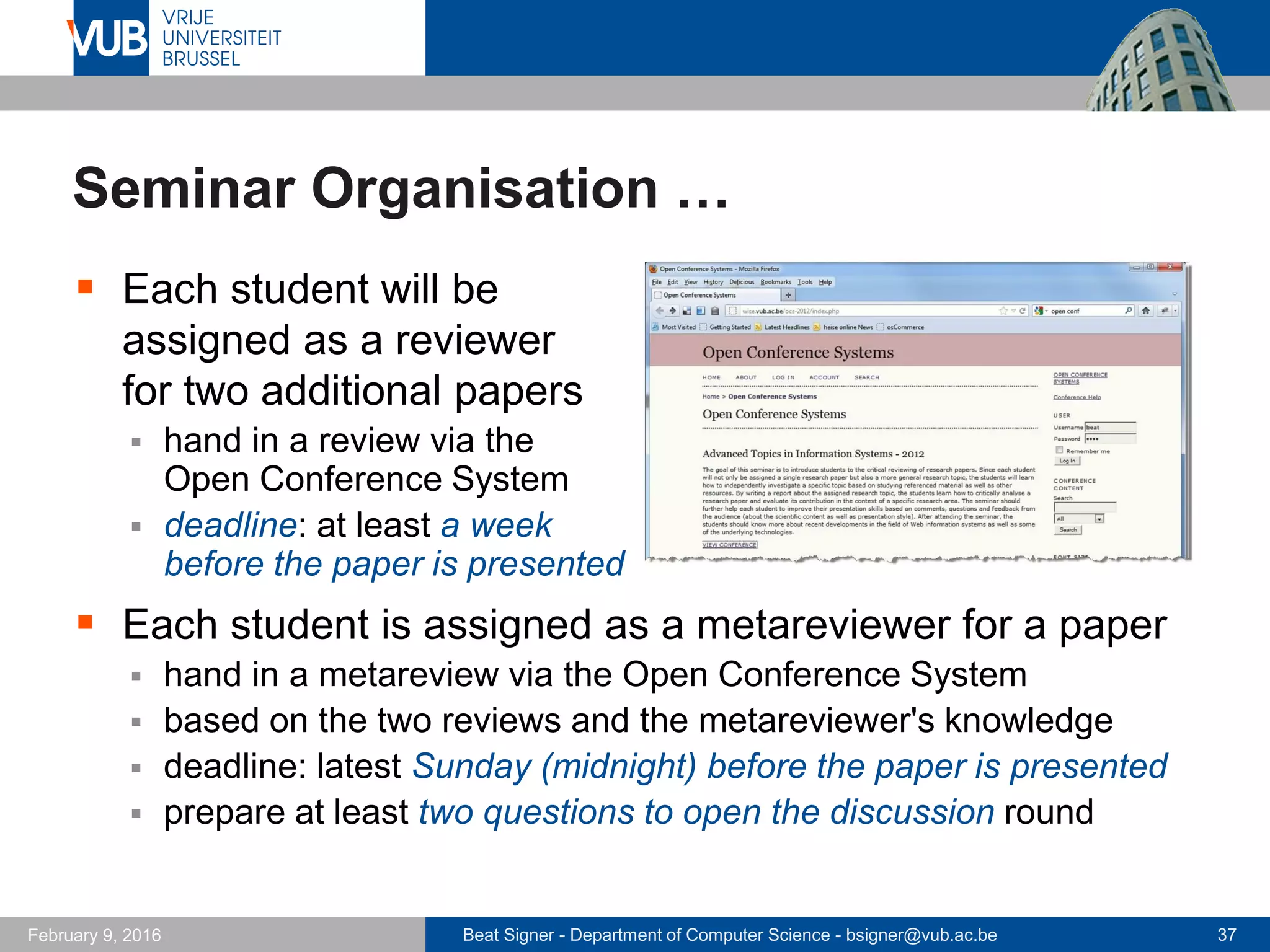
 Each student will be
assigned as a reviewer
for two additional papers
 hand in a review via the
Open Conference System
 deadline: at least a week
before the paper is presented
 Each student is assigned as a meta-reviewer for one paper
 hand in a metareview via the Open Conference System
 based on the two reviews and the metareviewer's knowledge
 deadline: latest Sunday (midnight) before the paper is presented
 prepare at least two questions to open the discussion round
 template and example (meta-)reviews are available on PointCarré
Beat Signer - Department of Computer Science - bsigner@vub.ac.be 35February 14, 2017
Seminar Organisation …
 Each student has to read the papers to be presented
every week before the seminar takes place and submit
two questions via an online form by latest Sunday
(midnight) before the lecture
 http://wise.vub.ac.be/atis/
Beat Signer - Department of Computer Science - bsigner@vub.ac.be 36February 14, 2017
Seminar Organisation …
 Final grade is based on
 presentation (70%)
 written report
 reviews and metareview
 active participation in the seminar and submitted questions
 Everybody is expected to read the papers before the
lecture takes place!
 after each presentation, there is enough time for questions and a
discussion about the topic and content of the paper
 Attendance to all presentations is mandatory!
 Schedule will be made available on PointCarré
 first presentations: 14.3.2017
Beat Signer - Department of Computer Science - bsigner@vub.ac.be 37February 14, 2017
References
 Vannevar Bush, As We May Think,
Atlanic Monthly, July 1945
 http://www.theatlantic.com/doc/194507/bush/
 http://sloan.stanford.edu/MouseSite/Secondary.html
 http://www.youtube.com/watch?v=c539cK58ees
 NLS demo
 http://sloan.stanford.edu/MouseSite/1968Demo.html
 Project Xanadu
 http://xanadu.com
 Ted Nelson demonstrates Xanadu Space
 http://www.youtube.com/watch?v=En_2T7KH6RA
Beat Signer - Department of Computer Science - bsigner@vub.ac.be 38February 14, 2017
References ...
 Apple Knowledge Navigator (1987)
 http://www.youtube.com/watch?v=xp4aRpcX5So
 Sun Microsystems' Starfire (1994)
 http://www.youtube.com/watch?v=h5LQgi15M1M
 Microsoft Office Labs Vision 2019
 http://www.youtube.com/watch?v=Zp-_oUwdSeY#!
 A Day Made Out of Glass 2, Corning Inc.
 http://www.youtube.com/watch?v=jZkHpNnXLB0
2 December 2005
Next Week
Assign Topics and Answer Questions
Some Tips for the Presentation
Open Conference System

Introduction - Lecture 1 - Advanced Topics in Information Systems (4016792ENR)

  • 1.
    2 December 2005 AdvancedTopics in Information Systems Introduction Prof. Beat Signer Department of Computer Science Vrije Universiteit Brussel http://www.beatsigner.com
  • 2.
    Beat Signer -Department of Computer Science - bsigner@vub.ac.be 2February 14, 2017 Seminar Organisation  Prof. Beat Signer Vrije Universiteit Brussel G.10.731d +32 2 629 12 39 bsigner@vub.ac.be  Audrey Sanctorum Vrije Universiteit Brussel G.10.731 asanctor@vub.ac.be
  • 3.
    Beat Signer -Department of Computer Science - bsigner@vub.ac.be 3February 14, 2017 Seminar Organisation ...  Sandra Trullemans Vrije Universiteit Brussel G.10.731e +32 2 629 11 04 strullem@vub.ac.be  Lars Van Holsbeeke Vrije Universiteit Brussel G.10.731 lavholsb@vub.ac.be
  • 4.
    Beat Signer -Department of Computer Science - bsigner@vub.ac.be 4February 14, 2017 Seminar Organisation ...  Reinout Roels Vrije Universiteit Brussel G.10.730f +32 2 629 37 53 rroels@vub.ac.be
  • 5.
    Beat Signer -Department of Computer Science - bsigner@vub.ac.be 5February 14, 2017 Three Main Domains of the Seminar Information Systems & Management Information Visualisation & Navigation Information Visualisation nd NavigationHuman-Machine & Human-Information Interaction CISA
  • 6.
    Beat Signer -Department of Computer Science - bsigner@vub.ac.be 6February 14, 2017 "As We May Think" (1945) When data of any sort are placed in storage, they are filed alphabetically or numerically, and information is found (when it is) by tracing it down from subclass to subclass. It can be in only one place, unless duplicates are used; one has to have rules as to which path will locate it, and the rules are cumbers- ome. Having found one item, moreover, one has to emerge from the system and re-enter on a new path. The human mind does not work that way. It operates by association. ... Vannevar Bush
  • 7.
    Beat Signer -Department of Computer Science - bsigner@vub.ac.be 7February 14, 2017 "As We May Think" (1945) … ... It affords an immediate step, however, to associative indexing, the basic idea of which is a provision whereby any item may be caused at will to select immediately and automatically another. This is the essential feature of the memex. The process of tying two items together is the important thing. ... Vannevar Bush, As We May Think, Atlanic Monthly, July 1945 Vannevar Bush
  • 8.
    Beat Signer -Department of Computer Science - bsigner@vub.ac.be 8February 14, 2017 "As We May Think" (1945) …  Bush's article 'As We May Think' (1945) is often seen as the "origin" of hypertext  Article introduces the Memex  memory extender  store and access information  follow cross-references in the form of associative trails between pieces of information (microfilms)  prototypical hypertext machine  trail blazers are those who find delight in the task of establishing useful trails Memex
  • 9.
    Beat Signer -Department of Computer Science - bsigner@vub.ac.be 9February 14, 2017 Video: Memex
  • 10.
    Beat Signer -Department of Computer Science - bsigner@vub.ac.be 10February 14, 2017 The Mother of All Demos (1968)  Douglas Engelbart and his colleagues at the Stanford Research Institute developed the oNLine System (NLS) as part of the Augment Project  vision about the future of interactive computing  NLS was demonstrated at the Fall Joint Computer Conference in 1968  showed first practical use of hypertext  computer mouse  remote collaboration (connected computers)  raster-scan video monitors  screen windows  ... Douglas Engelbart
  • 11.
    Beat Signer -Department of Computer Science - bsigner@vub.ac.be 11February 14, 2017 NLS Demo
  • 12.
    Beat Signer -Department of Computer Science - bsigner@vub.ac.be 12February 14, 2017 Hypertext (1965)  Ted Nelson coined the term hypertext  Nelson started Project Xanadu in 1960  first hypertext project  non-sequential writing  referencing/embedding parts of a document in another document (transclusion)  transpointing windows  bidirectional (bivisible) links  version and rights management  XanaduSpace 1.0 was released as part of Project Xanadu in 2007 Ted Nelson
  • 13.
    Beat Signer -Department of Computer Science - bsigner@vub.ac.be 13February 14, 2017 Digital Documents as a Paper Simulator? Most people don't understand the logic of the concept: "What You See Is What You Get" is based on printing the document out ("get" means "get WHEN YOU PRINT IT OUT"). And that means a metaphysical shift: a document can only consist of what can be printed! This re-froze the computer document into a closed rectangular object which cannot be penetrated by outside markings (curtailing what you could do with paper). No marginal notes, no sticky notes, no crossouts, no insertions, no overlays, no highlighting - PAPER UNDER GLASS. Ted Nelson, Geeks Bearing Gifts: How the Computer World Got This Way, Mindful Press 2009 Ted Nelson
  • 14.
    Beat Signer -Department of Computer Science - bsigner@vub.ac.be 14February 14, 2017 Video: Ted Nelson About Documents
  • 15.
    Beat Signer -Department of Computer Science - bsigner@vub.ac.be 15February 14, 2017 Video: Apple Knowledge Navigator (1987)
  • 16.
    Beat Signer -Department of Computer Science - bsigner@vub.ac.be 16February 14, 2017 Video: Sun Microsystems' Starfire (1994)
  • 17.
    Beat Signer -Department of Computer Science - bsigner@vub.ac.be 17February 14, 2017 Video: Microsoft Office Labs Vision 2019
  • 18.
    Beat Signer -Department of Computer Science - bsigner@vub.ac.be 18February 14, 2017 Video: A Day Made Out of Glass 2
  • 19.
    Beat Signer -Department of Computer Science - bsigner@vub.ac.be 19February 14, 2017 Three Main Domains of the Seminar Information Systems & Management Information Visualisation & Navigation Information Visualisation nd NavigationHuman-Machine & Human-Information Interaction CISA knowledge management internet of things prosthetic memory slow technology data-driven storytelling co-presentation cross-device interaction cross-device web design augmented reality data physicalisation hypervideos opportunistic device interaction swarm user interfacesintelligent buildings flexible displays physical computing bio-accoustic sensing web interaction frameworks on-body fabrication on-body interaction haptic I/O
  • 20.
    Beat Signer -Department of Computer Science - bsigner@vub.ac.be 20February 14, 2017 Seminar Topics 1. Co-Presentation  DynamicDuo: Co-presenting with Virtual Agents, Ha Trinh, Lazlo Ring and Timothy Bickmore. Proceedings of CHI 2015, 33rd Annual ACM Conference on Human Factors in Computing Systems, Seoul, Republic of Korea, April 2015. [Trinh2015.pdf] 2. Data-driven Storytelling  SketchStory: Telling More Engaging Stories with Data Through Freeform Sketching, Bongshin Lee, Rubaiat Habib Kazi and Greg Smith. IEEE Transactions on Visualization and Computer Graphics 19(12), December 2013. [Lee2013.pdf]
  • 21.
    Beat Signer -Department of Computer Science - bsigner@vub.ac.be 21February 14, 2017 Seminar Topics ... 3. Knowledge Management  TaskTracer: A Desktop Environment to Support Multi-tasking Knowledge Workers, Anton N. Dragunov, Thomas G. Dietterich, Kevin Johnsrude, Matthew McLaughlin, Lida Li and Jonathan L. Herlocker. Proceedings of IUI 2005, 10th International Conference on Intelligent User Interfaces, San Diego, USA, January 2005. [Dragunov2005.pdf] 4. Prosthetic Memory  Software or Wetware?: Discovering when and Why People Use Digital Prosthetic Memory, Vaiva Kalnikaitė and Steve Whittaker. Proceedings of CHI 2007, Annual ACM Conference on Human Factors in Computing Systems, San Jose, USA, April 2007. [Kalnikate2007.pdf]
  • 22.
    Beat Signer -Department of Computer Science - bsigner@vub.ac.be 22February 14, 2017 Seminar Topics ... 5. Hypervideos  Guiding Users Through Asynchronous Meeting Content with Hypervideo Playback Plans, Andreas Girgensohn, Jennifer Marlow, Frank Shipman and Lynn Wilcox. Proceedings of Hypertext 2016, 27th ACM Conference on Hypertext and Social Media, Halifax, Canada, July 2016. [Girgensohn2016.pdf] 6. Slow Technology  Designing for Slowness, Anticipation and Re-visitation: A Long Term Field Study of the Photobox, William T. Odom, Abigail J. Sellen, Richard Banks, David S. Kirk, Tim Regan, Mark Selby, Jodi L Forlizzi and John Zimmerman. Proceedings of CHI 2014, 32nd Annual ACM Conference on Human Factors in Computing Systems, Toronto, Canada, April 2014. [Odom2014.pdf]
  • 23.
    Beat Signer -Department of Computer Science - bsigner@vub.ac.be 23February 14, 2017 Seminar Topics ... 7. Cross-Device Interaction  Enhancing Cross-Device Interaction Scripting with Interactive Illustrations, Pei-Yu (Peggy) Chi, Yang Li and Björn Hartmann. Proceedings of CHI 2016, 34rd Annual ACM Conference on Human Factors in Computing Systems, San Jose, USA, May 2016. [Chi2016.pdf] 8. Cross-Device Web Design  XDBrowser: User-Defined Cross-Device Web Page Designs, Michael Nebeling and Anind K. Dey. Proceedings of CHI 2016, 34rd Annual ACM Conference on Human Factors in Computing Systems, San Jose, USA, May 2016. [Nebeling2016.pdf]
  • 24.
    Beat Signer -Department of Computer Science - bsigner@vub.ac.be 24February 14, 2017 Seminar Topics ... 9. Web Interaction Frameworks  CTAT: Tilt-and-Tap Across Devices, Linda Di Geronimo, Maria Husmann, Abhimanyu Patel, Can Tuerk and Moira C. Norrie. Proceedings of ICWE 2016, 16th International Conference on Web Engineering, Lugano, Switzerland, June 2016. [Geronimo2016.pdf] 10.Opportunistic Device Interaction  Snap-To-It: A User-Inspired Platform for Opportunistic Device Interactions, Adrian A. de Freitas, Michael Nebeling, Xiang 'Anthony' Chen, Junrui Yang, Akshaye Shreenithi Kirupa Karthikeyan Ranithangam and Anind K. Dey. Proceedings of CHI 2016, 34rd Annual ACM Conference on Human Factors in Computing Systems, San Jose, USA, May 2016. [DeFreitas2016.pdf]
  • 25.
    Beat Signer -Department of Computer Science - bsigner@vub.ac.be 25February 14, 2017 Seminar Topics ... 11.Internet of Things  Integration of Cloud Computing and Internet of Things: A Survey, Alessio Botta, Walter de Donato, Valerio Persico and Antonio Pescapé. Future Generation Computer Systems 56, March 2016. [Botta2016.pdf] 12.Intelligent Buildings  Towards the Next Generation of Intelligent Building: An Assessment Study of Current Automation and Future IoT Based Systems with a Proposal for Transitional Design, Georgios Lilis, Gilbert Conus, Nastaran Asadi and Maher Kayal. Sustainable Cities and Society, Volume 28, January 2017. [Lilis2017.pdf]
  • 26.
    Beat Signer -Department of Computer Science - bsigner@vub.ac.be 26February 14, 2017 Seminar Topics ... 13.Bio-Acoustic Sensing  ViBand: High-Fidelity Bio-Acoustic Sensing Using Commodity Smartwatch Accelerometers, Gierad Laput, Robert Xiao and Chris Harrison. Proceedings of UIST 2016, 29th Annual Symposium on User Interface Software and Technology, Tokyo, Japan, October 2016. [Laput2016.pdf] 14.Haptic I/O  NormalTouch and TextureTouch: High-fidelity 3D Haptic Shape Rendering on Handheld Virtual Reality Controllers, Ha Trinh, Koji Yatani, and Darren Edge. Proceedings of UIST 2016, 29th Annual Symposium on User Interface Software and Technology, Tokyo, Japan, October 2016. [Benko2016.pdf]
  • 27.
    Beat Signer -Department of Computer Science - bsigner@vub.ac.be 27February 14, 2017 Seminar Topics ... 15.Data Physicalisation  Opportunities and Challenges for Data Physicalization, Yvonne Jansen, Pierre Dragicevic, Petra Isenberg, Jason Alexander, Abhijit Karnik, Johan Kildal, Sriram Subramanian and Kasper Hornbaek. Proceedings of CHI 2015, 33rd Annual ACM Conference on Human Factors in Computing Systems, Seoul, Republic of Korea, April 2015. [Jansen2015.pdf] 16.Swarm User Interfaces  Zooids: Building Blocks for Swarm User Interfaces, Mathieu Le Goc, Lawrence H. Kim, Ali Parsaei, Jean-Daniel Fekete, Pierre Dragicevic and Sean Follmer. Proceedings of UIST 2016, 29th Annual Symposium on User Interface Software and Technology, Tokyo, Japan, October 2016. [LeGoc2016.pdf]
  • 28.
    Beat Signer -Department of Computer Science - bsigner@vub.ac.be 28February 14, 2017 Seminar Topics ... 17.Flexible Displays  ReFlex: A Flexible Smartphone with Active Haptic Feedback for Bend Input, Paul Strohmeier, Jesse Burstyn, Juan Pablo Carrascal, Vincent Levesque and Roel Vertegaal. Proceedings of TEI 2016, Tenth International Conference on Tangible, Embedded, and Embodied Interaction, Eindhoven, The Netherlands, February 2016. [Strohmeier2016.pdf] 18.Physical Computing  What You Sculpt is What You Get: Modeling Physical Interactive Devices with Clay and 3D Printed Widgets, Michael D. Jones, Kevin Seppi and Dan R. Olsen. Proceedings of CHI 2016, 34rd Annual ACM Conference on Human Factors in Computing Systems, San Jose, USA, May 2016. [Jones2016.pdf]
  • 29.
    Beat Signer -Department of Computer Science - bsigner@vub.ac.be 29February 14, 2017 Seminar Topics ... 19.On-Body Fabrication  ExoSkin: On-Body Fabrication, Madeline Gannon, Tovi Grossman and George Fitzmaurice. Proceedings of CHI 2016, 34rd Annual ACM Conference on Human Factors in Computing Systems, San Jose, USA, May 2016. [Gannon2016.pdf] 20.Augmented Reality  SnapToReality: Aligning Augmented Reality to the Real World, Benjamin Nuernberger, Eyal Ofek, Hrvoje Benko and Andrew D. Wilson. Proceedings of CHI 2016, 34rd Annual ACM Conference on Human Factors in Computing Systems, San Jose, USA, May 2016. [Nuernberger2016.pdf]
  • 30.
    Beat Signer -Department of Computer Science - bsigner@vub.ac.be 30February 14, 2017 Assignment of Topics  Select 3 topics/papers from the presented list and mark them (with A, B and C) according to your preferences  Send an email with your choices (e.g. 6A, 8B, 14C) to asanctor@vub.ac.be no later than February 17  Each student will be assigned a paper that has to be presented in the seminar and the final seminar schedule will be made available by next week
  • 31.
    Beat Signer -Department of Computer Science - bsigner@vub.ac.be 31February 14, 2017 Seminar Organisation  Presentation should be 30 minutes long (not longer!)  make use of the available time  Structure of your presentation  introduction of topic and problem statement (5-10 mins)  proposed approach (15-20 mins)  review (5 mins) - critical analysis - at least two positive and two negative points about the paper  Send a draft of your presentation to your supervisor no later than one week before the presentation and arrange a meeting with your supervisor  you will get feedback about the structure and content of your presentation
  • 32.
    Beat Signer -Department of Computer Science - bsigner@vub.ac.be 32February 14, 2017 Seminar Organisation …  Immediately after your presentation, please send us (asanctor@vub.ac.be) your slides in order that we can make them available for your colleagues on PointCarré
  • 33.
    Beat Signer -Department of Computer Science - bsigner@vub.ac.be 33February 14, 2017 Seminar Organisation …  Each student has to write a report about their presented paper/topic  same structure as presentation - introduction of topic and problem statement - proposed approach - review  no longer than 5 pages  send a draft to your supervisor to get some feedback - arrange a meeting with your supervisor  deadline for final report: 23.5.2017
  • 34.
    Beat Signer -Department of Computer Science - bsigner@vub.ac.be 34February 14, 2017 Seminar Organisation …  Each student will be assigned as a reviewer for two additional papers  hand in a review via the Open Conference System  deadline: at least a week before the paper is presented  Each student is assigned as a meta-reviewer for one paper  hand in a metareview via the Open Conference System  based on the two reviews and the metareviewer's knowledge  deadline: latest Sunday (midnight) before the paper is presented  prepare at least two questions to open the discussion round  template and example (meta-)reviews are available on PointCarré
  • 35.
    Beat Signer -Department of Computer Science - bsigner@vub.ac.be 35February 14, 2017 Seminar Organisation …  Each student has to read the papers to be presented every week before the seminar takes place and submit two questions via an online form by latest Sunday (midnight) before the lecture  http://wise.vub.ac.be/atis/
  • 36.
    Beat Signer -Department of Computer Science - bsigner@vub.ac.be 36February 14, 2017 Seminar Organisation …  Final grade is based on  presentation (70%)  written report  reviews and metareview  active participation in the seminar and submitted questions  Everybody is expected to read the papers before the lecture takes place!  after each presentation, there is enough time for questions and a discussion about the topic and content of the paper  Attendance to all presentations is mandatory!  Schedule will be made available on PointCarré  first presentations: 14.3.2017
  • 37.
    Beat Signer -Department of Computer Science - bsigner@vub.ac.be 37February 14, 2017 References  Vannevar Bush, As We May Think, Atlanic Monthly, July 1945  http://www.theatlantic.com/doc/194507/bush/  http://sloan.stanford.edu/MouseSite/Secondary.html  http://www.youtube.com/watch?v=c539cK58ees  NLS demo  http://sloan.stanford.edu/MouseSite/1968Demo.html  Project Xanadu  http://xanadu.com  Ted Nelson demonstrates Xanadu Space  http://www.youtube.com/watch?v=En_2T7KH6RA
  • 38.
    Beat Signer -Department of Computer Science - bsigner@vub.ac.be 38February 14, 2017 References ...  Apple Knowledge Navigator (1987)  http://www.youtube.com/watch?v=xp4aRpcX5So  Sun Microsystems' Starfire (1994)  http://www.youtube.com/watch?v=h5LQgi15M1M  Microsoft Office Labs Vision 2019  http://www.youtube.com/watch?v=Zp-_oUwdSeY#!  A Day Made Out of Glass 2, Corning Inc.  http://www.youtube.com/watch?v=jZkHpNnXLB0
  • 39.
    2 December 2005 NextWeek Assign Topics and Answer Questions Some Tips for the Presentation Open Conference System