Some Characteristics of Old English                                                      Page 1 of 3


                              Some Characteristics of Old English
Pronunciation:
      The pronunciation of Old English words commonly differs somewhat from that of their
      modern equivalents. The long vowels in particular have undergone considerable
      modification. Thus the Old English word stān is the same word as Modern English stone, but
      the vowel is different. Words like hēafod (head), fæger (fair), or sāwol (soul) show forms that
      have been contracted in later English. All of these cases represent genuine differences of
      pronunciation. However, some of the first look of strangeness that Old English has to the
      modern reader is due simply to differences of spelling. Old English made use of two
      characters to represent the sound of th: þ and ð, thorn and eth, respectively, as in the
      word wiþ (with) or ðā (then), which we no longer employ.
Vocabulary:
      The vocabulary of Old English is almost purely Germanic. A large part of this vocabulary,
      moreover, has disappeared from the language. An examination of the words in an Old
      English dictionary shows that about 85 percent of them are no longer in use. Those that
      survive, to be sure, are basic elements of our vocabulary and by the frequency with which
      they recur make up a large part of any English sentence. Apart from pronouns, prepositions,
      conjunctions, auxiliary verbs, and the like, they express fundamental concepts like mann
      (man), wīf (wife, woman), cild (child), hūs (house), weall (wall), mete (meat, food), gœrs
      (grass), lēaf (leaf), fugol (fowl, bird), gōd (good), hēah (high), strang (strong), etan (eat),
      drincan (drink). But the fact remains that a considerable part of the vocabulary of Old
      English is unfamiliar to the modern reader.
Grammar
      Inflectional languages fall into two classes: synthetic and analytic. A synthetic language is
      one that indicates the relation of words in a sentence largely by means of inflections: endings
      on the noun and pronoun, the adjective and the verb. Languages that make extensive use of
      prepositions and auxiliary verbs and depend upon word order to show other relationships are
      known as analytic languages.

      Modern English is an analytic, Old English a synthetic language. In its grammar Old English
      resembles modern German. Theoretically the noun and adjective are inflected for four cases
      in the singular and four in the plural, although the forms are not always distinctive, and in
      addition the adjective has separate forms for each of the three genders. The inflection of the
      verb is less elaborate than that of the Latin verb, but there are distinctive endings for the
      different persons, numbers, tenses, and moods.
The Noun
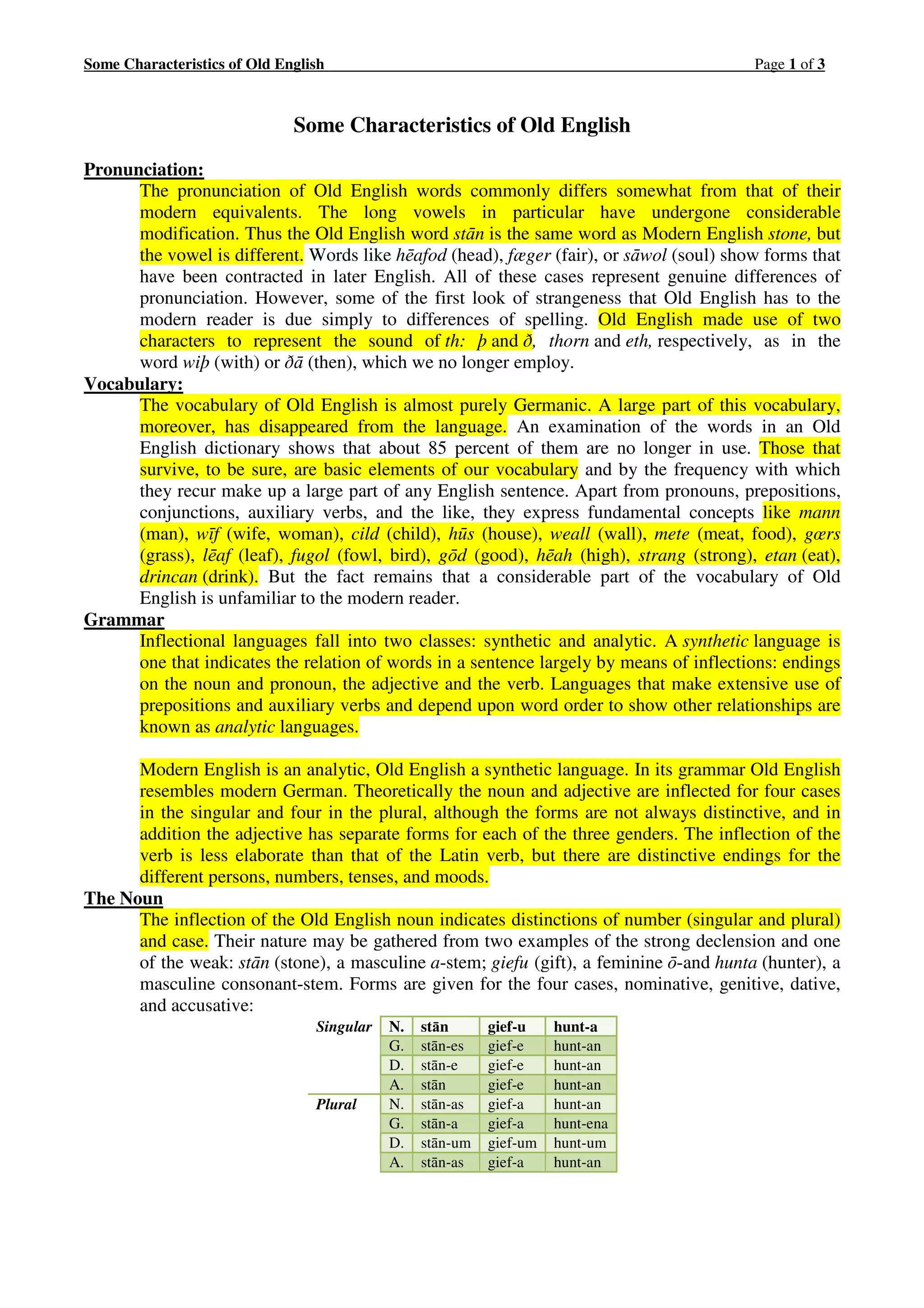
      The inflection of the Old English noun indicates distinctions of number (singular and plural)
      and case. Their nature may be gathered from two examples of the strong declension and one
      of the weak: stān (stone), a masculine a-stem; giefu (gift), a feminine ō-and hunta (hunter), a
      masculine consonant-stem. Forms are given for the four cases, nominative, genitive, dative,
      and accusative:
                                 Singular   N.   stān      gief-u    hunt-a
                                            G.   stān-es   gief-e    hunt-an
                                            D.   stān-e    gief-e    hunt-an
                                            A.   stān      gief-e    hunt-an
                                 Plural     N.   stān-as   gief-a    hunt-an
                                            G.   stān-a    gief-a    hunt-ena
                                            D.   stān-um   gief-um   hunt-um
                                            A.   stān-as   gief-a    hunt-an
Some Characteristics of Old English                                                                   Page 2 of 3


Grammatical Gender.
      As in Indo-European languages generally, the gender of Old English nouns is not dependent
      upon considerations of sex. Although nouns designating males are often masculine and those
      indicating females feminine, those indicating neuter objects are not necessarily neuter. Stān
      (stone) is masculine, mōna (moon) is masculine, but sunne (sun) is feminine, as in German.
The Adjective.
      An important feature of the Germanic languages is the development of a twofold declension
      of the adjective: one, the strong declension, used with nouns when not accompanied by a
      definite article or similar word (such as a demonstrative or possessive pronoun), the other, the
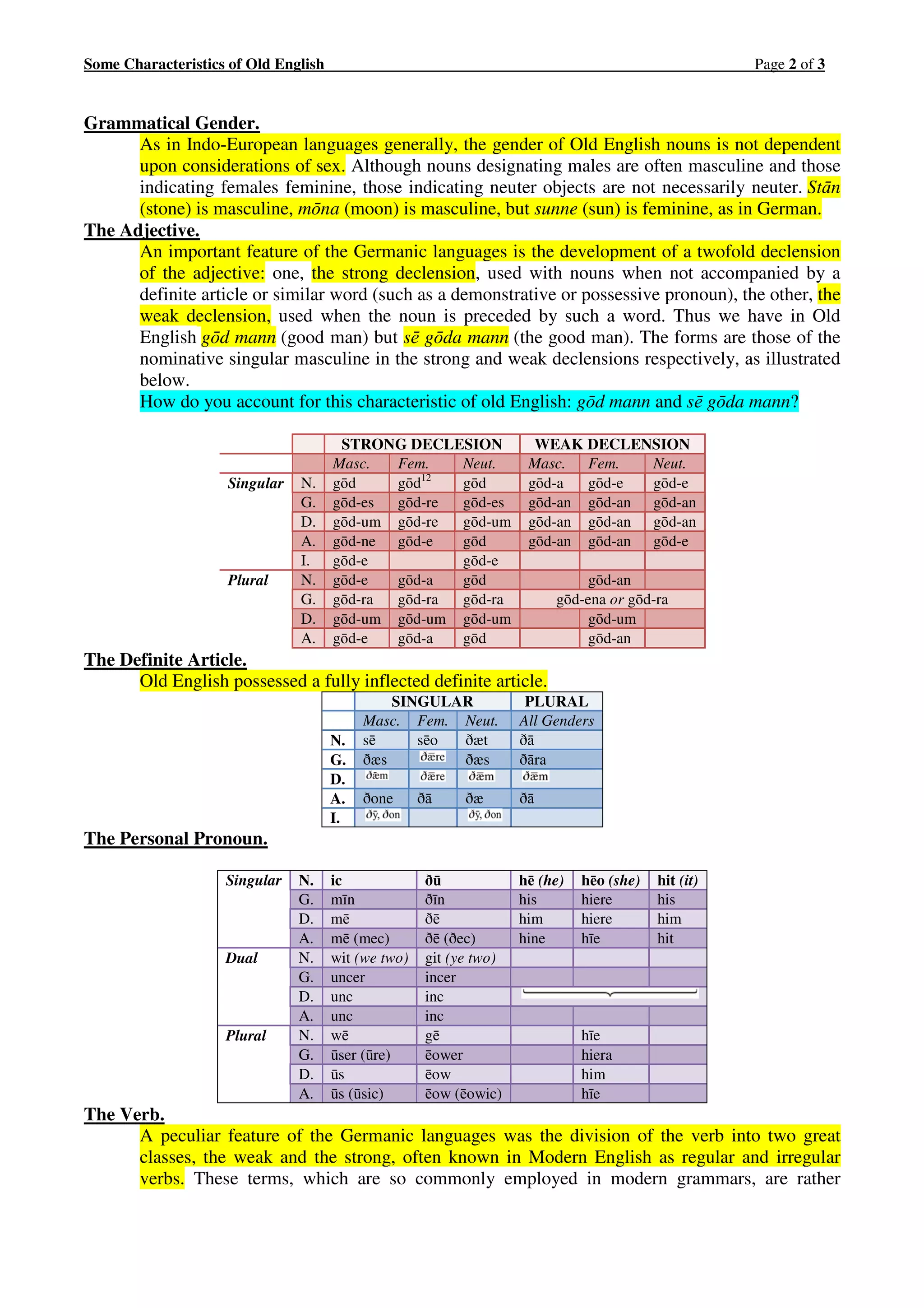
      weak declension, used when the noun is preceded by such a word. Thus we have in Old
      English gōd mann (good man) but sē gōda mann (the good man). The forms are those of the
      nominative singular masculine in the strong and weak declensions respectively, as illustrated
      below.
      How do you account for this characteristic of old English: gōd mann and sē gōda mann?

                                       STRONG DECLESION                WEAK DECLENSION
                                      Masc.  Fem.   Neut.             Masc. Fem.    Neut.
                    Singular   N.     gōd    gōd12  gōd               gōd-a  gōd-e  gōd-e
                               G.     gōd-es gōd-re gōd-es            gōd-an gōd-an gōd-an
                               D.     gōd-um gōd-re gōd-um            gōd-an gōd-an gōd-an
                               A.     gōd-ne gōd-e  gōd               gōd-an gōd-an gōd-e
                               I.     gōd-e         gōd-e
                    Plural     N.     gōd-e  gōd-a  gōd                        gōd-an
                               G.     gōd-ra gōd-ra gōd-ra                gōd-ena or gōd-ra
                               D.     gōd-um gōd-um gōd-um                     gōd-um
                               A.     gōd-e  gōd-a  gōd                        gōd-an
The Definite Article.
      Old English possessed a fully inflected definite article.
                                               SINGULAR               PLURAL
                                           Masc. Fem. Neut.          All Genders
                                      N.   sē     sēo ðæt            ðā
                                      G.   ðæs        ðæs            ðāra
                                      D.
                                      A.   ðone      ðā     ðæ       ðā
                                      I.
The Personal Pronoun.

                    Singular   N.     ic              ðū             hē (he)   hēo (she)   hit (it)
                               G.     mīn             ðīn            his       hiere       his
                               D.     mē              ðē             him       hiere       him
                               A.     mē (mec)        ðē (ðec)       hine      hīe         hit
                    Dual       N.     wit (we two)    git (ye two)
                               G.     uncer           incer
                               D.     unc             inc
                               A.     unc             inc
                    Plural     N.     wē              gē                       hīe
                               G.     ūser (ūre)      ēower                    hiera
                               D.     ūs              ēow                      him
                               A.     ūs (ūsic)       ēow (ēowic)              hīe
The Verb.
      A peculiar feature of the Germanic languages was the division of the verb into two great
      classes, the weak and the strong, often known in Modern English as regular and irregular
      verbs. These terms, which are so commonly employed in modern grammars, are rather
Some Characteristics of Old English                                                          Page 3 of 3


        unfortunate because they suggest an irregularity in the strong verbs that is more apparent than
        real. The strong verbs, like sing, sang, sung, which represent the basic Indo-European type,
        are so called because they have the power of indicating change of tense by a modification of
        their root vowel. In the weak verbs, such as walk, walked, walked, this change is effected by
        the addition of a “dental,” sometimes of an extra syllable.

        In Old English the vowel of the past tense often differs in the singular and the plural; or, to be
        more accurate, the first and third person singular have one vowel while the second person
        singular and all persons of the plural have another. In the principal parts of Old English
        strong verbs, therefore, we have four forms: the infmitive, the preterite singular (first and
        third person), the preterite plural, and the past participle. In Old English the strong verbs can
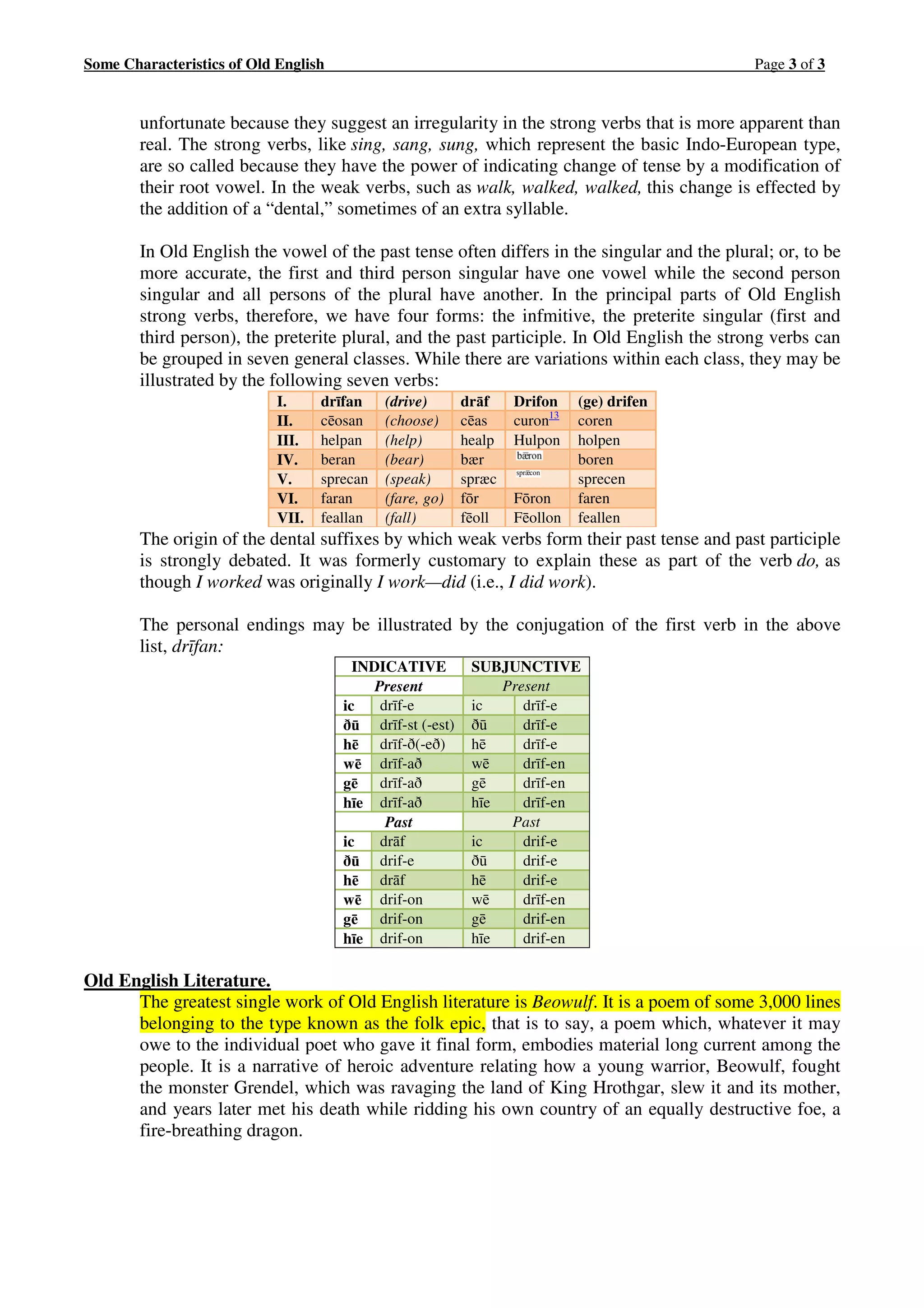
        be grouped in seven general classes. While there are variations within each class, they may be
        illustrated by the following seven verbs:
                            I.     drīfan    (drive)      drāf    Drifon    (ge) drifen
                            II.    cēosan    (choose)     cēas    curon13   coren
                            III.   helpan    (help)       healp   Hulpon    holpen
                            IV.    beran     (bear)       bær               boren
                            V.     sprecan   (speak)      spræc             sprecen
                            VI.    faran     (fare, go)   fōr     Fōron     faren
                            VII.   feallan   (fall)       fēoll   Fēollon   feallen
        The origin of the dental suffixes by which weak verbs form their past tense and past participle
        is strongly debated. It was formerly customary to explain these as part of the verb do, as
        though I worked was originally I work—did (i.e., I did work).

        The personal endings may be illustrated by the conjugation of the first verb in the above
        list, drīfan:
                                        INDICATIVE         SUBJUNCTIVE
                                           Present             Present
                                      ic    drīf-e         ic     drīf-e
                                      ðū drīf-st (-est)    ðū     drīf-e
                                      hē drīf-ð(-eð)       hē     drīf-e
                                      wē drīf-að           wē     drīf-en
                                      gē drīf-að           gē     drīf-en
                                      hīe drīf-að          hīe    drīf-en
                                             Past               Past
                                      ic    drāf           ic     drif-e
                                      ðū drif-e            ðū     drif-e
                                      hē drāf              hē     drif-e
                                      wē drif-on           wē     drīf-en
                                      gē drif-on           gē     drif-en
                                      hīe drif-on          hīe    drif-en

Old English Literature.
      The greatest single work of Old English literature is Beowulf. It is a poem of some 3,000 lines
      belonging to the type known as the folk epic, that is to say, a poem which, whatever it may
      owe to the individual poet who gave it final form, embodies material long current among the
      people. It is a narrative of heroic adventure relating how a young warrior, Beowulf, fought
      the monster Grendel, which was ravaging the land of King Hrothgar, slew it and its mother,
      and years later met his death while ridding his own country of an equally destructive foe, a
      fire-breathing dragon.

Some characteristics of old english

  • 1.
    Some Characteristics ofOld English Page 1 of 3 Some Characteristics of Old English Pronunciation: The pronunciation of Old English words commonly differs somewhat from that of their modern equivalents. The long vowels in particular have undergone considerable modification. Thus the Old English word stān is the same word as Modern English stone, but the vowel is different. Words like hēafod (head), fæger (fair), or sāwol (soul) show forms that have been contracted in later English. All of these cases represent genuine differences of pronunciation. However, some of the first look of strangeness that Old English has to the modern reader is due simply to differences of spelling. Old English made use of two characters to represent the sound of th: þ and ð, thorn and eth, respectively, as in the word wiþ (with) or ðā (then), which we no longer employ. Vocabulary: The vocabulary of Old English is almost purely Germanic. A large part of this vocabulary, moreover, has disappeared from the language. An examination of the words in an Old English dictionary shows that about 85 percent of them are no longer in use. Those that survive, to be sure, are basic elements of our vocabulary and by the frequency with which they recur make up a large part of any English sentence. Apart from pronouns, prepositions, conjunctions, auxiliary verbs, and the like, they express fundamental concepts like mann (man), wīf (wife, woman), cild (child), hūs (house), weall (wall), mete (meat, food), gœrs (grass), lēaf (leaf), fugol (fowl, bird), gōd (good), hēah (high), strang (strong), etan (eat), drincan (drink). But the fact remains that a considerable part of the vocabulary of Old English is unfamiliar to the modern reader. Grammar Inflectional languages fall into two classes: synthetic and analytic. A synthetic language is one that indicates the relation of words in a sentence largely by means of inflections: endings on the noun and pronoun, the adjective and the verb. Languages that make extensive use of prepositions and auxiliary verbs and depend upon word order to show other relationships are known as analytic languages. Modern English is an analytic, Old English a synthetic language. In its grammar Old English resembles modern German. Theoretically the noun and adjective are inflected for four cases in the singular and four in the plural, although the forms are not always distinctive, and in addition the adjective has separate forms for each of the three genders. The inflection of the verb is less elaborate than that of the Latin verb, but there are distinctive endings for the different persons, numbers, tenses, and moods. The Noun The inflection of the Old English noun indicates distinctions of number (singular and plural) and case. Their nature may be gathered from two examples of the strong declension and one of the weak: stān (stone), a masculine a-stem; giefu (gift), a feminine ō-and hunta (hunter), a masculine consonant-stem. Forms are given for the four cases, nominative, genitive, dative, and accusative: Singular N. stān gief-u hunt-a G. stān-es gief-e hunt-an D. stān-e gief-e hunt-an A. stān gief-e hunt-an Plural N. stān-as gief-a hunt-an G. stān-a gief-a hunt-ena D. stān-um gief-um hunt-um A. stān-as gief-a hunt-an
  • 2.
    Some Characteristics ofOld English Page 2 of 3 Grammatical Gender. As in Indo-European languages generally, the gender of Old English nouns is not dependent upon considerations of sex. Although nouns designating males are often masculine and those indicating females feminine, those indicating neuter objects are not necessarily neuter. Stān (stone) is masculine, mōna (moon) is masculine, but sunne (sun) is feminine, as in German. The Adjective. An important feature of the Germanic languages is the development of a twofold declension of the adjective: one, the strong declension, used with nouns when not accompanied by a definite article or similar word (such as a demonstrative or possessive pronoun), the other, the weak declension, used when the noun is preceded by such a word. Thus we have in Old English gōd mann (good man) but sē gōda mann (the good man). The forms are those of the nominative singular masculine in the strong and weak declensions respectively, as illustrated below. How do you account for this characteristic of old English: gōd mann and sē gōda mann? STRONG DECLESION WEAK DECLENSION Masc. Fem. Neut. Masc. Fem. Neut. Singular N. gōd gōd12 gōd gōd-a gōd-e gōd-e G. gōd-es gōd-re gōd-es gōd-an gōd-an gōd-an D. gōd-um gōd-re gōd-um gōd-an gōd-an gōd-an A. gōd-ne gōd-e gōd gōd-an gōd-an gōd-e I. gōd-e gōd-e Plural N. gōd-e gōd-a gōd gōd-an G. gōd-ra gōd-ra gōd-ra gōd-ena or gōd-ra D. gōd-um gōd-um gōd-um gōd-um A. gōd-e gōd-a gōd gōd-an The Definite Article. Old English possessed a fully inflected definite article. SINGULAR PLURAL Masc. Fem. Neut. All Genders N. sē sēo ðæt ðā G. ðæs ðæs ðāra D. A. ðone ðā ðæ ðā I. The Personal Pronoun. Singular N. ic ðū hē (he) hēo (she) hit (it) G. mīn ðīn his hiere his D. mē ðē him hiere him A. mē (mec) ðē (ðec) hine hīe hit Dual N. wit (we two) git (ye two) G. uncer incer D. unc inc A. unc inc Plural N. wē gē hīe G. ūser (ūre) ēower hiera D. ūs ēow him A. ūs (ūsic) ēow (ēowic) hīe The Verb. A peculiar feature of the Germanic languages was the division of the verb into two great classes, the weak and the strong, often known in Modern English as regular and irregular verbs. These terms, which are so commonly employed in modern grammars, are rather
  • 3.
    Some Characteristics ofOld English Page 3 of 3 unfortunate because they suggest an irregularity in the strong verbs that is more apparent than real. The strong verbs, like sing, sang, sung, which represent the basic Indo-European type, are so called because they have the power of indicating change of tense by a modification of their root vowel. In the weak verbs, such as walk, walked, walked, this change is effected by the addition of a “dental,” sometimes of an extra syllable. In Old English the vowel of the past tense often differs in the singular and the plural; or, to be more accurate, the first and third person singular have one vowel while the second person singular and all persons of the plural have another. In the principal parts of Old English strong verbs, therefore, we have four forms: the infmitive, the preterite singular (first and third person), the preterite plural, and the past participle. In Old English the strong verbs can be grouped in seven general classes. While there are variations within each class, they may be illustrated by the following seven verbs: I. drīfan (drive) drāf Drifon (ge) drifen II. cēosan (choose) cēas curon13 coren III. helpan (help) healp Hulpon holpen IV. beran (bear) bær boren V. sprecan (speak) spræc sprecen VI. faran (fare, go) fōr Fōron faren VII. feallan (fall) fēoll Fēollon feallen The origin of the dental suffixes by which weak verbs form their past tense and past participle is strongly debated. It was formerly customary to explain these as part of the verb do, as though I worked was originally I work—did (i.e., I did work). The personal endings may be illustrated by the conjugation of the first verb in the above list, drīfan: INDICATIVE SUBJUNCTIVE Present Present ic drīf-e ic drīf-e ðū drīf-st (-est) ðū drīf-e hē drīf-ð(-eð) hē drīf-e wē drīf-að wē drīf-en gē drīf-að gē drīf-en hīe drīf-að hīe drīf-en Past Past ic drāf ic drif-e ðū drif-e ðū drif-e hē drāf hē drif-e wē drif-on wē drīf-en gē drif-on gē drif-en hīe drif-on hīe drif-en Old English Literature. The greatest single work of Old English literature is Beowulf. It is a poem of some 3,000 lines belonging to the type known as the folk epic, that is to say, a poem which, whatever it may owe to the individual poet who gave it final form, embodies material long current among the people. It is a narrative of heroic adventure relating how a young warrior, Beowulf, fought the monster Grendel, which was ravaging the land of King Hrothgar, slew it and its mother, and years later met his death while ridding his own country of an equally destructive foe, a fire-breathing dragon.