Morphology
What is Morphophonemic?
Morphophonemic: Morphemes & allomorphs,
morphological processes
Morphophonemics
’
 In this chapter we will focus on these smaller
parts of words, generally called morphemes.
(The area of grammar concerned with the
structure of words and with relationships
between words involving the
morphemes that compose them is technically way
called morphology, from the Greek word morph
‘form, shape’; and morphemes can be thought
of as the minimal units of morphology.)
What is Morphology
?
 Morphology is the scientific study of word
formation.
 Minimal meaningful / grammatical unit of a
word.
 The study of patterns of word formation.
 How words are originated, grammatical forms,
on what basis the word class is formed etc.
Morpheme
 Minimal,meaningful unit of a word or in the
grammar of a language.
 Not further separable or analyzable into smaller
forms.
 The units of‘lowest’rank out of which words,the
units of next highest rank are composed.
 If we try to break up a morpheme,it loses its identity
and it left with meaningless noises.
 Semantically different from other phonemically
similar or identical linguistic forms.Eg.Speaker,deer,
faster
 A sound sequence is not always regarded as a
morpheme.Eg:man—*woman,unnatural,
unfaithful,*under,*sun
 It could be also termed as an abstract unit of meaning.
 A synonym for morpheme is glosseme
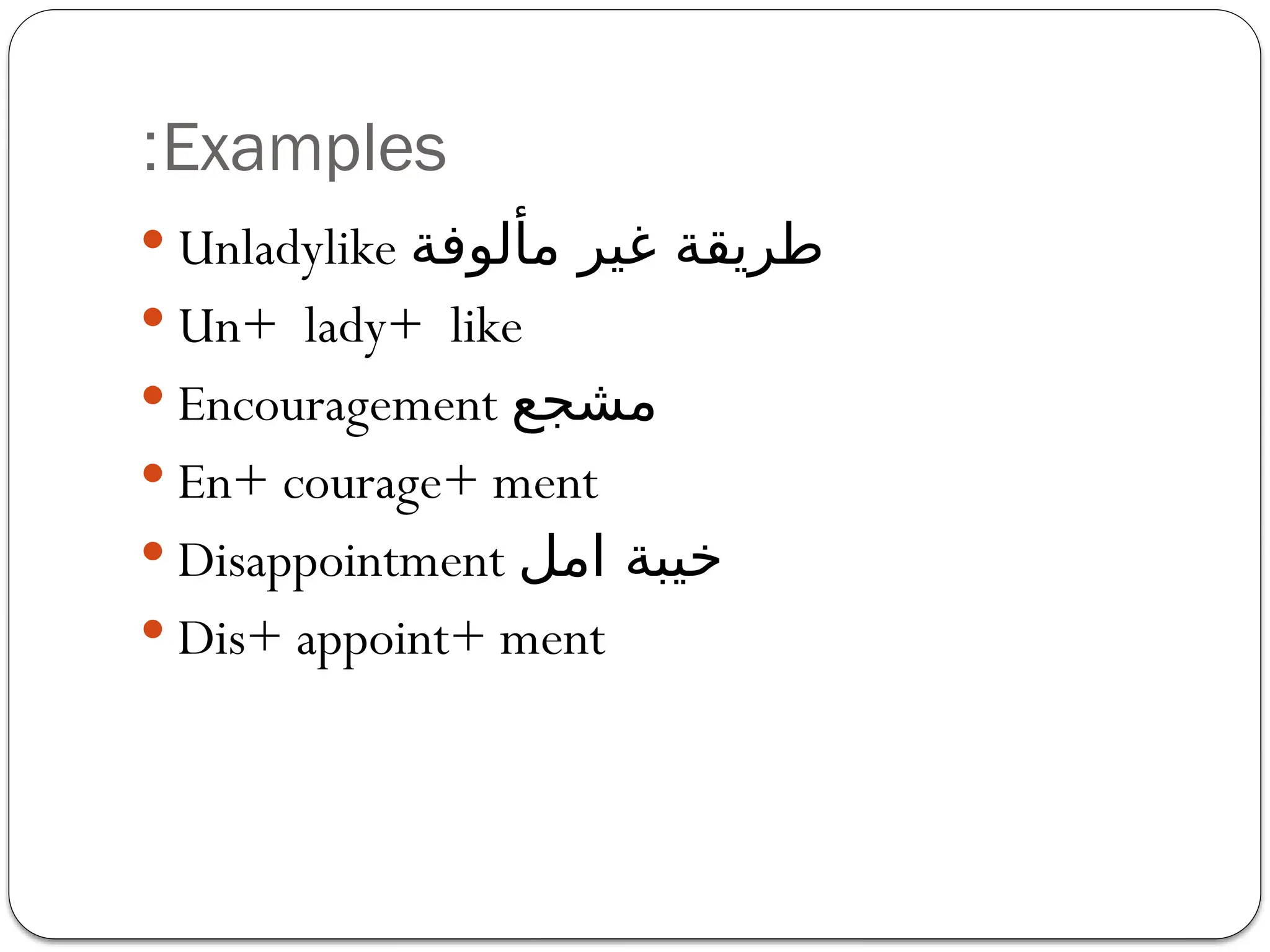
Examples
:
 Unladylike ‫مألوفة‬ ‫غير‬ ‫طريقة‬
 Un+ lady+ like
 Encouragement ‫مشجع‬
 En+ courage+ ment
 Disappointment ‫امل‬ ‫خيبة‬
 Dis+ appoint+ ment
What is morph then
?
 A morph is the phonetic realization of a
morpheme.The real form of the morpheme, the
actual utterance of the morpheme.
 A formal unit with a physical shape.
 This is similar to the concept called‘phone’ in
phonology
Allomorph
 Allomorph is phonologically distinct variants of the same
morpheme.
 Different realization, manifestation of the same
morpheme.
 They vary in shape or pronunciation according to their
condition of use.
 They are a class of morphs which are semantically
identical.
 They are derived from phonological and
morphophonemic rules.
Examples of Allomorph
 English plural morpheme [s]
 Phonologically conditioned-
 [-s] with morphs ending in /p, t, k/, etc. i.e. with
voiceless sounds such as cats,thanks etc.
 [-z] with morphs ending in /b, d, g, v, l/ etc. i.e. with
voiced morphs such as dogs (dogz),rims (rimz) etc..
 [-iz] with morphs ending in /z, / etc. i.e. with
affricates, fricatives such as buses,boxes,horses,classes
etc.
Classifications of morphemes
 Morphemes are classified as free or bound morphemes.
a free morpheme can occur in isolation (as a word on
its own).
E.g. dog, write, deserve and child
.
a bound morpheme cannot occur in isolation,
E.g. , the forms -ish, tin-, -ed, -1y, re-, -ing
 Any form that is used to represent a morpheme is called
a “morph’’.
E.g. the word Help, -ful has two morphs.

Morphophonemic: Morphemes & allomorphs, morphological processes.pptx.pptx

  • 1.
  • 2.
    What is Morphophonemic? Morphophonemic:Morphemes & allomorphs, morphological processes
  • 3.
    Morphophonemics ’  In thischapter we will focus on these smaller parts of words, generally called morphemes. (The area of grammar concerned with the structure of words and with relationships between words involving the morphemes that compose them is technically way called morphology, from the Greek word morph ‘form, shape’; and morphemes can be thought of as the minimal units of morphology.)
  • 4.
    What is Morphology ? Morphology is the scientific study of word formation.  Minimal meaningful / grammatical unit of a word.  The study of patterns of word formation.  How words are originated, grammatical forms, on what basis the word class is formed etc.
  • 5.
    Morpheme  Minimal,meaningful unitof a word or in the grammar of a language.  Not further separable or analyzable into smaller forms.  The units of‘lowest’rank out of which words,the units of next highest rank are composed.  If we try to break up a morpheme,it loses its identity and it left with meaningless noises.
  • 6.
     Semantically differentfrom other phonemically similar or identical linguistic forms.Eg.Speaker,deer, faster  A sound sequence is not always regarded as a morpheme.Eg:man—*woman,unnatural, unfaithful,*under,*sun  It could be also termed as an abstract unit of meaning.  A synonym for morpheme is glosseme
  • 7.
    Examples :  Unladylike ‫مألوفة‬‫غير‬ ‫طريقة‬  Un+ lady+ like  Encouragement ‫مشجع‬  En+ courage+ ment  Disappointment ‫امل‬ ‫خيبة‬  Dis+ appoint+ ment
  • 8.
    What is morphthen ?  A morph is the phonetic realization of a morpheme.The real form of the morpheme, the actual utterance of the morpheme.  A formal unit with a physical shape.  This is similar to the concept called‘phone’ in phonology
  • 9.
    Allomorph  Allomorph isphonologically distinct variants of the same morpheme.  Different realization, manifestation of the same morpheme.  They vary in shape or pronunciation according to their condition of use.  They are a class of morphs which are semantically identical.  They are derived from phonological and morphophonemic rules.
  • 10.
    Examples of Allomorph English plural morpheme [s]  Phonologically conditioned-  [-s] with morphs ending in /p, t, k/, etc. i.e. with voiceless sounds such as cats,thanks etc.  [-z] with morphs ending in /b, d, g, v, l/ etc. i.e. with voiced morphs such as dogs (dogz),rims (rimz) etc..  [-iz] with morphs ending in /z, / etc. i.e. with affricates, fricatives such as buses,boxes,horses,classes etc.
  • 11.
    Classifications of morphemes Morphemes are classified as free or bound morphemes. a free morpheme can occur in isolation (as a word on its own). E.g. dog, write, deserve and child . a bound morpheme cannot occur in isolation, E.g. , the forms -ish, tin-, -ed, -1y, re-, -ing  Any form that is used to represent a morpheme is called a “morph’’. E.g. the word Help, -ful has two morphs.