Lecture-3
Instructor Name:
Object Oriented Programming
Today’s Lecture
 Inheritance
 Polymorphism
2
Inheritance
What is Inheritance?
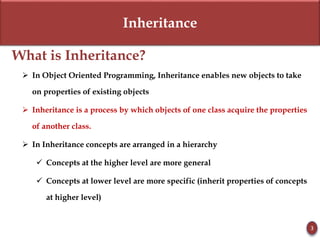
 In Object Oriented Programming, Inheritance enables new objects to take
on properties of existing objects
 Inheritance is a process by which objects of one class acquire the properties
of another class.
 In Inheritance concepts are arranged in a hierarchy
 Concepts at the higher level are more general
 Concepts at lower level are more specific (inherit properties of concepts
at higher level)
3
Inheritance
What is Inheritance?
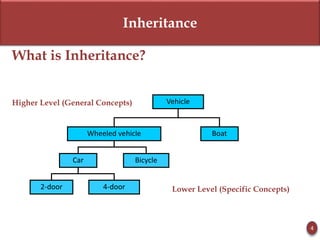
Higher Level (General Concepts)
Lower Level (Specific Concepts)
4
Vehicle
Wheeled vehicle Boat
Car Bicycle
4-door2-door
Inheritance
More Definitions of Inheritance
 A Parent – Child Relationship between classes is called inheritance.
 Allows sharing of the behavior of the parent class to child class
 Child class can add new behavior or override existing behavior of class.
Real world Example of Inheritance
1. A most recent form of Mobile Phone inherited from least recent models of
mobile phone
2. Least recent mobile inherited from Ordinary dial up phone
3. Automatic Car inherited from Manual Car
4. Laptop Inherited from Desktop Computers
5
Inheritance
Inheritance Terms
 Super Class
Super Class also referred as Base Class or Parent Class. These terms are
used to describe the parent in the relationship, which shares its
functionality.
 Sub Class
Sub Class also referred as Derived Class or Child Class. These terms are
used to describe the child in the relationship, which accepts /inherits
functionality from parent.
NOTE: one Sub Class may be parent of another sub class.
6
Inheritance
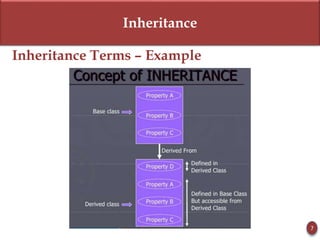
Inheritance Terms – Example
7
Inheritance
More on Inheritance
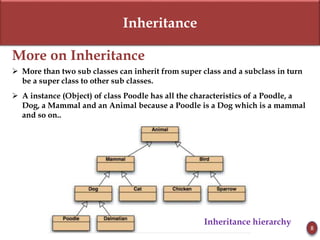
 More than two sub classes can inherit from super class and a subclass in turn
be a super class to other sub classes.
 A instance (Object) of class Poodle has all the characteristics of a Poodle, a
Dog, a Mammal and an Animal because a Poodle is a Dog which is a mammal
and so on..
Inheritance hierarchy
8
Inheritance
Class Activity
 Draw an Inheritance Hierarchy for the people in your place of study or work.
For example if you are a University Student, then your University probably
has students (first year students, Second year Students, Science Students,
Social Science Students, Graduates Students, Undergraduate Students, ….),
Professors, Administrative Officers, Clerical Staff and etc.
9
Inheritance
Relationship in Inheritance
 There may be two kinds of relationship in Inheritance
I. “IS A KIND OF” relationship
II. “IS A” relationship
10
Relationship
“IS A KIND OF ” Relationship
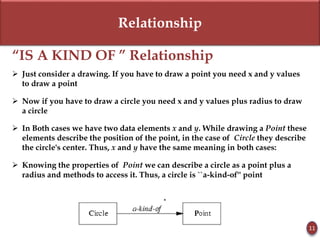
 Just consider a drawing. If you have to draw a point you need x and y values
to draw a point
 Now if you have to draw a circle you need x and y values plus radius to draw
a circle
 In Both cases we have two data elements x and y. While drawing a Point these
elements describe the position of the point, in the case of Circle they describe
the circle's center. Thus, x and y have the same meaning in both cases:
 Knowing the properties of Point we can describe a circle as a point plus a
radius and methods to access it. Thus, a circle is ``a-kind-of'' point
11
Relationship
“IS A” Relationship
 The previous relationship is used at the class level to describe relationships
between two similar classes.
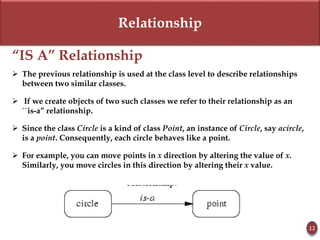
 If we create objects of two such classes we refer to their relationship as an
``is-a” relationship.
 Since the class Circle is a kind of class Point, an instance of Circle, say acircle,
is a point. Consequently, each circle behaves like a point.
 For example, you can move points in x direction by altering the value of x.
Similarly, you move circles in this direction by altering their x value.
12
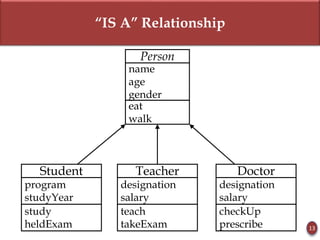
“IS A” Relationship
13
Person
name
age
gender
eat
walk
Teacher
designation
salary
teach
takeExam
Student
program
studyYear
study
heldExam
Doctor
designation
salary
checkUp
prescribe
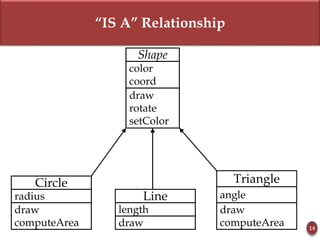
“IS A” Relationship
14
Shape
color
coord
draw
rotate
setColor
Circle
radius
draw
computeArea
Line
length
draw
Triangle
angle
draw
computeArea
Inheritance
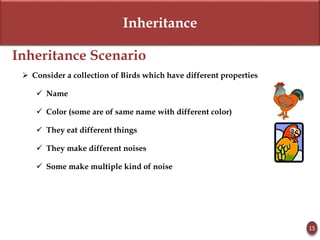
Inheritance Scenario
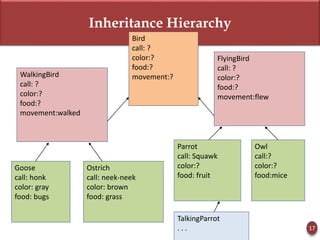
 Consider a collection of Birds which have different properties
 Name
 Color (some are of same name with different color)
 They eat different things
 They make different noises
 Some make multiple kind of noise
15
Inheritance
Design Sketch
 Key is to design a bird class hierarchy
 Strategy
 Design classes for objects
 Identify characteristics classes have in common
 Design super class to store common attributes
 Design sub classes
16
Inheritance Hierarchy
17
Bird
call: ?
color:?
food:?
movement:?WalkingBird
call: ?
color:?
food:?
movement:walked
FlyingBird
call: ?
color:?
food:?
movement:flew
Goose
call: honk
color: gray
food: bugs
Ostrich
call: neek-neek
color: brown
food: grass
Parrot
call: Squawk
color:?
food: fruit
Owl
call:?
color:?
food:mice
TalkingParrot
. . .
Levels of Inheritance
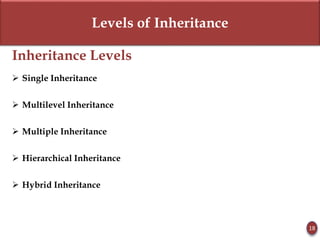
Inheritance Levels
 Single Inheritance
 Multilevel Inheritance
 Multiple Inheritance
 Hierarchical Inheritance
 Hybrid Inheritance
18
Levels of Inheritance
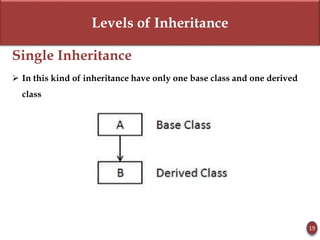
Single Inheritance
 In this kind of inheritance have only one base class and one derived
class
19
Levels of Inheritance
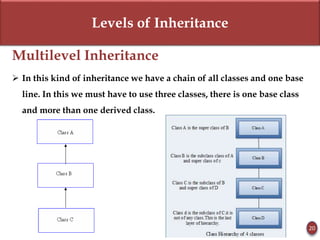
Multilevel Inheritance
 In this kind of inheritance we have a chain of all classes and one base
line. In this we must have to use three classes, there is one base class
and more than one derived class.
20
Levels of Inheritance
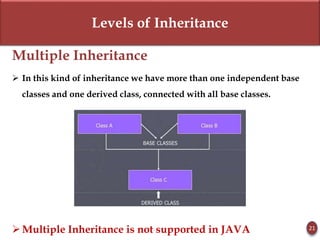
Multiple Inheritance
 In this kind of inheritance we have more than one independent base
classes and one derived class, connected with all base classes.
 Multiple Inheritance is not supported in JAVA 21
Levels of Inheritance
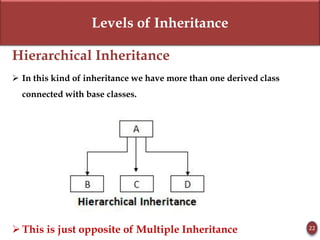
Hierarchical Inheritance
 In this kind of inheritance we have more than one derived class
connected with base classes.
 This is just opposite of Multiple Inheritance 22
Levels of Inheritance
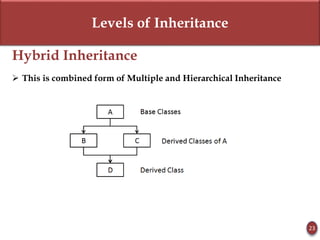
Hybrid Inheritance
 This is combined form of Multiple and Hierarchical Inheritance
23
Advantages of Inheritance
Three main advantages
 Reuse
 Less Redundancy
 Increased Maintainability
24
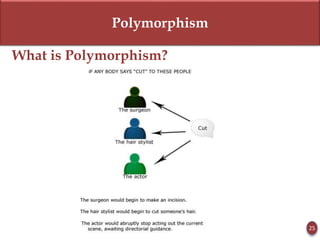
Polymorphism
What is Polymorphism?
25
Polymorphism
What is Polymorphism?
 Polymorphism is the ability of an object to take on many forms.
 Manipulate objects of various classes, and invoke different methods on an
object without knowing the type of object
 Any Java object that can pass more than one IS-A test is considered to be
polymorphic.
 In Java, all Java objects are polymorphic since any object will pass the IS-A
test for their own type and for the class Object.
 In general, polymorphism refers to existence of different forms of a single
entity
 For example, both Diamond and Coal are different forms of Carbon
26
Polymorphism
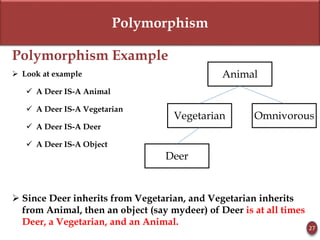
Polymorphism Example
 Look at example
 A Deer IS-A Animal
 A Deer IS-A Vegetarian
 A Deer IS-A Deer
 A Deer IS-A Object
 Since Deer inherits from Vegetarian, and Vegetarian inherits
from Animal, then an object (say mydeer) of Deer is at all times
Deer, a Vegetarian, and an Animal.
27
Animal
Vegetarian Omnivorous
Deer
Polymorphism
Polymorphism in OO Model
 In Object Oriented Model, Polymorphism means that different objects can
behave in different ways for the same message
 Consequently the sender of the message does not need to know exact class of
the receiver
28
Polymorphism
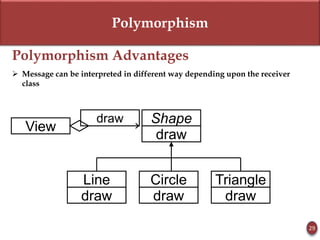
Polymorphism Advantages
 Message can be interpreted in different way depending upon the receiver
class
29
Shape
Line Circle Triangle
draw
draw
draw draw
draw
View
Polymorphism
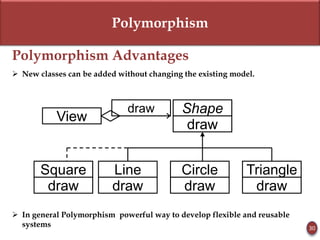
Polymorphism Advantages
 New classes can be added without changing the existing model.
 In general Polymorphism powerful way to develop flexible and reusable
systems 30
Shape
Line Circle Triangle
draw
draw
draw draw
draw
View
Square
draw
31

Lecture 3

  • 1.
  • 2.
  • 3.
    Inheritance What is Inheritance? In Object Oriented Programming, Inheritance enables new objects to take on properties of existing objects  Inheritance is a process by which objects of one class acquire the properties of another class.  In Inheritance concepts are arranged in a hierarchy  Concepts at the higher level are more general  Concepts at lower level are more specific (inherit properties of concepts at higher level) 3
  • 4.
    Inheritance What is Inheritance? HigherLevel (General Concepts) Lower Level (Specific Concepts) 4 Vehicle Wheeled vehicle Boat Car Bicycle 4-door2-door
  • 5.
    Inheritance More Definitions ofInheritance  A Parent – Child Relationship between classes is called inheritance.  Allows sharing of the behavior of the parent class to child class  Child class can add new behavior or override existing behavior of class. Real world Example of Inheritance 1. A most recent form of Mobile Phone inherited from least recent models of mobile phone 2. Least recent mobile inherited from Ordinary dial up phone 3. Automatic Car inherited from Manual Car 4. Laptop Inherited from Desktop Computers 5
  • 6.
    Inheritance Inheritance Terms  SuperClass Super Class also referred as Base Class or Parent Class. These terms are used to describe the parent in the relationship, which shares its functionality.  Sub Class Sub Class also referred as Derived Class or Child Class. These terms are used to describe the child in the relationship, which accepts /inherits functionality from parent. NOTE: one Sub Class may be parent of another sub class. 6
  • 7.
  • 8.
    Inheritance More on Inheritance More than two sub classes can inherit from super class and a subclass in turn be a super class to other sub classes.  A instance (Object) of class Poodle has all the characteristics of a Poodle, a Dog, a Mammal and an Animal because a Poodle is a Dog which is a mammal and so on.. Inheritance hierarchy 8
  • 9.
    Inheritance Class Activity  Drawan Inheritance Hierarchy for the people in your place of study or work. For example if you are a University Student, then your University probably has students (first year students, Second year Students, Science Students, Social Science Students, Graduates Students, Undergraduate Students, ….), Professors, Administrative Officers, Clerical Staff and etc. 9
  • 10.
    Inheritance Relationship in Inheritance There may be two kinds of relationship in Inheritance I. “IS A KIND OF” relationship II. “IS A” relationship 10
  • 11.
    Relationship “IS A KINDOF ” Relationship  Just consider a drawing. If you have to draw a point you need x and y values to draw a point  Now if you have to draw a circle you need x and y values plus radius to draw a circle  In Both cases we have two data elements x and y. While drawing a Point these elements describe the position of the point, in the case of Circle they describe the circle's center. Thus, x and y have the same meaning in both cases:  Knowing the properties of Point we can describe a circle as a point plus a radius and methods to access it. Thus, a circle is ``a-kind-of'' point 11
  • 12.
    Relationship “IS A” Relationship The previous relationship is used at the class level to describe relationships between two similar classes.  If we create objects of two such classes we refer to their relationship as an ``is-a” relationship.  Since the class Circle is a kind of class Point, an instance of Circle, say acircle, is a point. Consequently, each circle behaves like a point.  For example, you can move points in x direction by altering the value of x. Similarly, you move circles in this direction by altering their x value. 12
  • 13.
  • 14.
  • 15.
    Inheritance Inheritance Scenario  Considera collection of Birds which have different properties  Name  Color (some are of same name with different color)  They eat different things  They make different noises  Some make multiple kind of noise 15
  • 16.
    Inheritance Design Sketch  Keyis to design a bird class hierarchy  Strategy  Design classes for objects  Identify characteristics classes have in common  Design super class to store common attributes  Design sub classes 16
  • 17.
    Inheritance Hierarchy 17 Bird call: ? color:? food:? movement:?WalkingBird call:? color:? food:? movement:walked FlyingBird call: ? color:? food:? movement:flew Goose call: honk color: gray food: bugs Ostrich call: neek-neek color: brown food: grass Parrot call: Squawk color:? food: fruit Owl call:? color:? food:mice TalkingParrot . . .
  • 18.
    Levels of Inheritance InheritanceLevels  Single Inheritance  Multilevel Inheritance  Multiple Inheritance  Hierarchical Inheritance  Hybrid Inheritance 18
  • 19.
    Levels of Inheritance SingleInheritance  In this kind of inheritance have only one base class and one derived class 19
  • 20.
    Levels of Inheritance MultilevelInheritance  In this kind of inheritance we have a chain of all classes and one base line. In this we must have to use three classes, there is one base class and more than one derived class. 20
  • 21.
    Levels of Inheritance MultipleInheritance  In this kind of inheritance we have more than one independent base classes and one derived class, connected with all base classes.  Multiple Inheritance is not supported in JAVA 21
  • 22.
    Levels of Inheritance HierarchicalInheritance  In this kind of inheritance we have more than one derived class connected with base classes.  This is just opposite of Multiple Inheritance 22
  • 23.
    Levels of Inheritance HybridInheritance  This is combined form of Multiple and Hierarchical Inheritance 23
  • 24.
    Advantages of Inheritance Threemain advantages  Reuse  Less Redundancy  Increased Maintainability 24
  • 25.
  • 26.
    Polymorphism What is Polymorphism? Polymorphism is the ability of an object to take on many forms.  Manipulate objects of various classes, and invoke different methods on an object without knowing the type of object  Any Java object that can pass more than one IS-A test is considered to be polymorphic.  In Java, all Java objects are polymorphic since any object will pass the IS-A test for their own type and for the class Object.  In general, polymorphism refers to existence of different forms of a single entity  For example, both Diamond and Coal are different forms of Carbon 26
  • 27.
    Polymorphism Polymorphism Example  Lookat example  A Deer IS-A Animal  A Deer IS-A Vegetarian  A Deer IS-A Deer  A Deer IS-A Object  Since Deer inherits from Vegetarian, and Vegetarian inherits from Animal, then an object (say mydeer) of Deer is at all times Deer, a Vegetarian, and an Animal. 27 Animal Vegetarian Omnivorous Deer
  • 28.
    Polymorphism Polymorphism in OOModel  In Object Oriented Model, Polymorphism means that different objects can behave in different ways for the same message  Consequently the sender of the message does not need to know exact class of the receiver 28
  • 29.
    Polymorphism Polymorphism Advantages  Messagecan be interpreted in different way depending upon the receiver class 29 Shape Line Circle Triangle draw draw draw draw draw View
  • 30.
    Polymorphism Polymorphism Advantages  Newclasses can be added without changing the existing model.  In general Polymorphism powerful way to develop flexible and reusable systems 30 Shape Line Circle Triangle draw draw draw draw draw View Square draw
  • 31.