Lecture-4
Instructor Name:
Object Oriented Programming
Today’s Lecture
 What is a class?
 Class Composition
 Components of Class
 Fields
 Methods
 Main() Method, Setter Method, Getter Method, immutator.
Calling Method in same class Main method
Calling Method in other class.
 Creating Objects from class
2
Class
What is a class?
 Assume you want to model a traffic simulation. One kind of entity that you
have to deal with is cars.
 What is a car in our context : Is it a class or object?
 A few questions helps us to make decision
 What color is a car? How fast it go? Where is it right now?
 If I ask question about “My car parked in University Parking”
 Now I am talking about Object and before it was a class.
3
Class
What is a class?
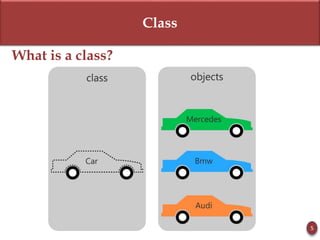
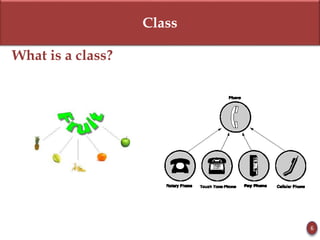
 In OOP we create general sketch for each kind of object and then we create
different instances using this sketch we call this sketch a class.
 All objects of same kind exhibit identical characteristics (information
structure and behavior) however they have data of their own.
 A class is a blueprint from which individual objects are created.
 A class is a concept
Class in OOP
 In object-oriented programming, a class is an extensible program-code-
template for creating objects, providing initial values for state (member
variables) and implementations of behavior (member functions or
methods).
4
Class
What is a class?
5
Class
What is a class?
6
Class
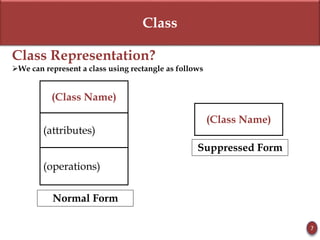
Class Representation?
We can represent a class using rectangle as follows
7
(Class Name)
(attributes)
(operations)
(Class Name)
Normal Form
Suppressed Form
Class
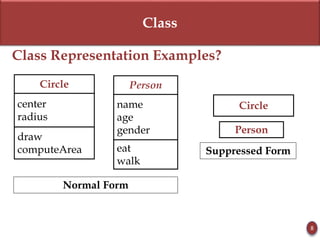
Class Representation Examples?
8
Circle
center
radius
draw
computeArea
Normal Form
Suppressed Form
Circle
Person
name
age
gender
eat
walk
Person
Class
Classes & Object
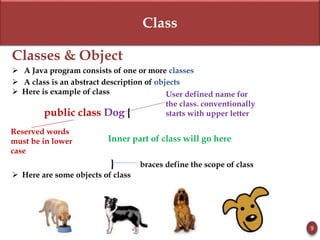
 A Java program consists of one or more classes
 A class is an abstract description of objects
 Here is example of class
public class Dog {
Inner part of class will go here
} braces define the scope of class
 Here are some objects of class
9
Reserved words
must be in lower
case
User defined name for
the class. conventionally
starts with upper letter
Class
Classes Header
 The text of classes can be broken down into two parts: a small outer wrapping
that simply names the class and the inner part that does all the work
(previous slide).
 the outer wrapping of different classes all look pretty much the same.
 The outer wrapping contains the class header, whose main purpose is to
provide a name for the class.
Class Activity
 Write out what you think the outer wrappers of the Student and LabClass
classes might look like; do not worry about the inner part.
10
Class
Components of a class?
 A class has following three components
1. Fields
2. Constructor
3. Methods
 Order is insignificant. We can write them in any order.
11
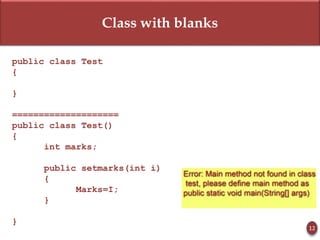
Class with blanks
public class Test
{
}
====================
public class Test()
{
int marks;
public setmarks(int i)
{
Marks=I;
}
}
12
13
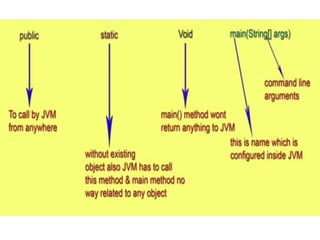
public class Welcome
{
public static void main(String[] args)
{
System.out.prinln("Welcome to GCU");
}
}
Writing First Program
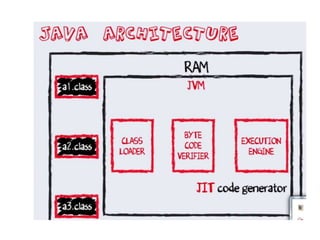
Java Virtual Machine (JVM)
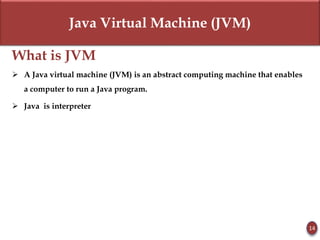
What is JVM
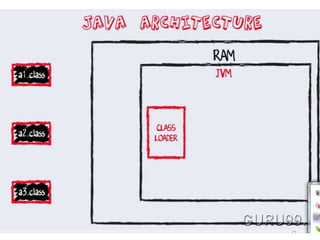
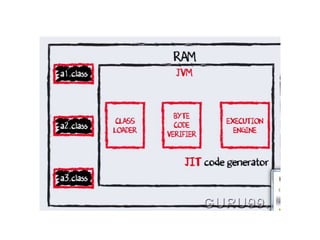
 A Java virtual machine (JVM) is an abstract computing machine that enables
a computer to run a Java program.
 Java is interpreter
14
Java Virtual Machine (JVM)
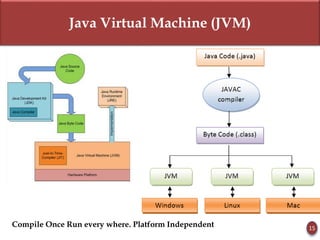
Compile Once Run every where. Platform Independent 15
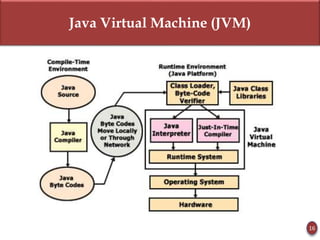
Java Virtual Machine (JVM)
16
Class
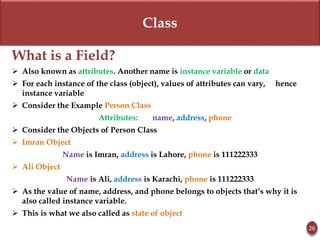
What is a Field?
 Also known as attributes. Another name is instance variable or data
 For each instance of the class (object), values of attributes can vary, hence
instance variable
 Consider the Example Person Class
Attributes: name, address, phone
 Consider the Objects of Person Class
 Imran Object
Name is Imran, address is Lahore, phone is 111222333
 Ali Object
Name is Ali, address is Karachi, phone is 111222333
 As the value of name, address, and phone belongs to objects that’s why it is
also called instance variable.
 This is what we also called as state of object
26
Class
Field Example
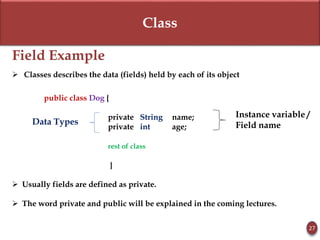
 Classes describes the data (fields) held by each of its object
public class Dog {
private String name;
private int age;
rest of class
}
 Usually fields are defined as private.
 The word private and public will be explained in the coming lectures.
27
Data Types
Instance variable /
Field name
Class
What is a Constructor?
 Constructor in java is a special type of method that is used to initialize the
object.
 Java constructor is invoked at the time of object creation.
 It constructs the values i.e. provides data for the object that is why it is
known as constructor.
 The constructors are responsible for ensuring that an object is set up properly
when it is first created.
 The construction process is also known as initialization.
 If a constructor is not defined in the class, Java will create a default
constructor that will invoke automatically when object is create. 28
Class
What is a Constructor?
 Constructor is called at the time of object creation.
 Once object has been created, the constructor plays no further role in that
object life and can not be called on it.
 One of the distinguished feature of constructor is that it has the same name as
the class in which they are defined.
 In the constructor the fields are initialized with default values or external
information passed into object at the time of creation.
29
Class
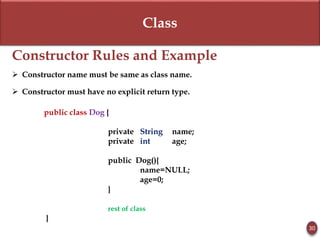
Constructor Rules and Example
 Constructor name must be same as class name.
 Constructor must have no explicit return type.
public class Dog {
private String name;
private int age;
public Dog(){
name=NULL;
age=0;
}
rest of class
}
30
Class
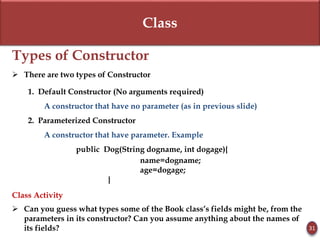
Types of Constructor
 There are two types of Constructor
1. Default Constructor (No arguments required)
A constructor that have no parameter (as in previous slide)
2. Parameterized Constructor
A constructor that have parameter. Example
public Dog(String dogname, int dogage){
name=dogname;
age=dogage;
}
Class Activity
 Can you guess what types some of the Book class’s fields might be, from the
parameters in its constructor? Can you assume anything about the names of
its fields? 31
Class
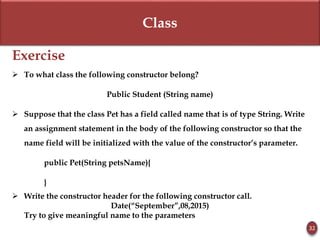
Exercise
 To what class the following constructor belong?
Public Student (String name)
 Suppose that the class Pet has a field called name that is of type String. Write
an assignment statement in the body of the following constructor so that the
name field will be initialized with the value of the constructor’s parameter.
public Pet(String petsName){
}
 Write the constructor header for the following constructor call.
Date(“September”,08,2015)
Try to give meaningful name to the parameters
32
Class
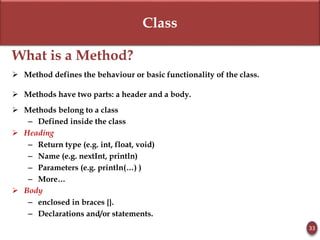
What is a Method?
 Method defines the behaviour or basic functionality of the class.
 Methods have two parts: a header and a body.
 Methods belong to a class
– Defined inside the class
 Heading
– Return type (e.g. int, float, void)
– Name (e.g. nextInt, println)
– Parameters (e.g. println(…) )
– More…
 Body
– enclosed in braces {}.
– Declarations and/or statements.
33
Class
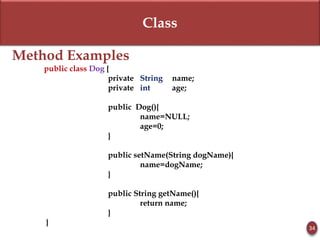
Method Examples
public class Dog {
private String name;
private int age;
public Dog(){
name=NULL;
age=0;
}
public setName(String dogName){
name=dogName;
}
public String getName(){
return name;
}
}
34
Program Structure
35
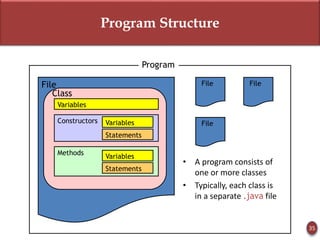
• A program consists of
one or more classes
• Typically, each class is
in a separate .java file
File File
File
File
Class
Variables
Constructors
Methods
Variables
Variables
Statements
Statements
Program
Class
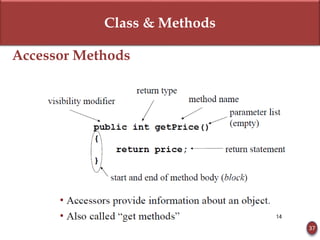
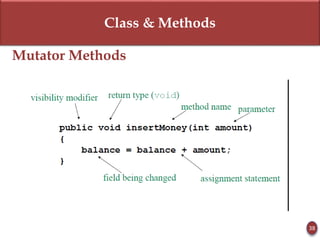
Accessor & Mutator Methods
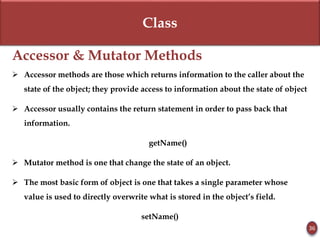
 Accessor methods are those which returns information to the caller about the
state of the object; they provide access to information about the state of object
 Accessor usually contains the return statement in order to pass back that
information.
getName()
 Mutator method is one that change the state of an object.
 The most basic form of object is one that takes a single parameter whose
value is used to directly overwrite what is stored in the object’s field.
setName()
36
Class & Methods
Accessor Methods
37
Class & Methods
Mutator Methods
38
Class & Objects
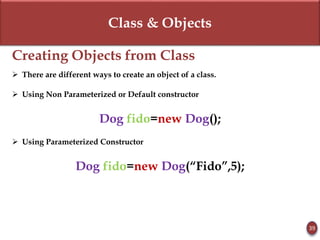
Creating Objects from Class
 There are different ways to create an object of a class.
 Using Non Parameterized or Default constructor
Dog fido=new Dog();
 Using Parameterized Constructor
Dog fido=new Dog(“Fido”,5);
39
Writing & Running a Program
40
 When you write a program, you are writing classes and all the things
that go into classes
 Your program typically contains commands to create objects (that is,
“calls” to constructors)
– Analogy: A class is like a cookie cutter, objects are like cookies.
 When you run a program, it creates objects, and those objects interact
with one another and do whatever they do to cause something to
happen
– Analogy: Writing a program is like writing the rules to a game;
running a program is like actually playing the game
 You never know how well the rules are going to work until you try
them out
Writing & Running a Program
41
Getting Started
 Question: Where do objects come from?
– Answer: They are created by other objects.
 Question: Where does the first object come from?
– Answer: Programs have a special main method, not part of any object,
that is executed in order to get things started
public static void main(String[ ] args) {
Dog fido=new Dog(“Fido”,5); // creates a Dog
}
 The special keyword static says that the main method belongs to the class
itself, not to objects of the class
– Hence, the main method can be “called” before any objects are created
– Usually, the main method gets things started by creating one or more
objects and telling them what to do
Writing & Running a Program
42
A Complete Program
class Dog {
String name;
int age;
Dog(String n, int age) {
name = n;
this.age = age;
}
void bark() {
System.out.println("Woof!");
}
void wakeTheNeighbors( ) {
int i = 50;
while (i > 0) {
bark( );
i = i – 1;
}
}
public static void main(String[ ] args) {
Dog fido = new Dog("Fido", 5);
fido.wakeTheNeighbors();
}
} // ends the class
Home Assignment/ Self Review Exericse
43
1. Write out a class Person. Write out a constructor that should take two
parameters.
 The first is of type String and is called myName.
 The second is of type int and is called myAge.
 The first parameter should be used to set the value of a field called
name, and the second should set a field called age. You don’t have to
include the definitions for the fields, just the text of the constructor.
2. Write an accessor method called getName that returns the value of a field
called name, whose type is String.
3. Write a mutator method called setAge that takes a single parameter of type
int and sets the value of a field called age.
4. Write a method called printDetails for a class that has a field of type
String called name. The printDetails method should print out a string of
the form “The name of this person is”, followed by the value of the name
field. For instance, if the value of the name field is “Ali”, then printDetails
would print:
The name of this person is Ali
44
45
Writing First Program
public class Welcome
{
public static void main(String[] args)
{
System.out.prinln("Welcome to GCU");
}
}
46
Compiling and execution o your First Java Application
 Save the program with java extenstion
 Welcome.java
 Class name and file name must be same
 Compile the program with
 Javac Welcome.java
 Execute the program
 Java Welcome
 Java is case sensitive
 Comment allowed in JAVA with
 // or /* */
47
Compiling and execution o your First Java Application
 Open the command prompt window
 Change the directory where the program is strored
 To compile javac Welcome.java
 Execute the program with java Welcome

Lecture 4

  • 1.
  • 2.
    Today’s Lecture  Whatis a class?  Class Composition  Components of Class  Fields  Methods  Main() Method, Setter Method, Getter Method, immutator. Calling Method in same class Main method Calling Method in other class.  Creating Objects from class 2
  • 3.
    Class What is aclass?  Assume you want to model a traffic simulation. One kind of entity that you have to deal with is cars.  What is a car in our context : Is it a class or object?  A few questions helps us to make decision  What color is a car? How fast it go? Where is it right now?  If I ask question about “My car parked in University Parking”  Now I am talking about Object and before it was a class. 3
  • 4.
    Class What is aclass?  In OOP we create general sketch for each kind of object and then we create different instances using this sketch we call this sketch a class.  All objects of same kind exhibit identical characteristics (information structure and behavior) however they have data of their own.  A class is a blueprint from which individual objects are created.  A class is a concept Class in OOP  In object-oriented programming, a class is an extensible program-code- template for creating objects, providing initial values for state (member variables) and implementations of behavior (member functions or methods). 4
  • 5.
  • 6.
  • 7.
    Class Class Representation? We canrepresent a class using rectangle as follows 7 (Class Name) (attributes) (operations) (Class Name) Normal Form Suppressed Form
  • 8.
    Class Class Representation Examples? 8 Circle center radius draw computeArea NormalForm Suppressed Form Circle Person name age gender eat walk Person
  • 9.
    Class Classes & Object A Java program consists of one or more classes  A class is an abstract description of objects  Here is example of class public class Dog { Inner part of class will go here } braces define the scope of class  Here are some objects of class 9 Reserved words must be in lower case User defined name for the class. conventionally starts with upper letter
  • 10.
    Class Classes Header  Thetext of classes can be broken down into two parts: a small outer wrapping that simply names the class and the inner part that does all the work (previous slide).  the outer wrapping of different classes all look pretty much the same.  The outer wrapping contains the class header, whose main purpose is to provide a name for the class. Class Activity  Write out what you think the outer wrappers of the Student and LabClass classes might look like; do not worry about the inner part. 10
  • 11.
    Class Components of aclass?  A class has following three components 1. Fields 2. Constructor 3. Methods  Order is insignificant. We can write them in any order. 11
  • 12.
    Class with blanks publicclass Test { } ==================== public class Test() { int marks; public setmarks(int i) { Marks=I; } } 12
  • 13.
    13 public class Welcome { publicstatic void main(String[] args) { System.out.prinln("Welcome to GCU"); } } Writing First Program
  • 14.
    Java Virtual Machine(JVM) What is JVM  A Java virtual machine (JVM) is an abstract computing machine that enables a computer to run a Java program.  Java is interpreter 14
  • 15.
    Java Virtual Machine(JVM) Compile Once Run every where. Platform Independent 15
  • 16.
  • 26.
    Class What is aField?  Also known as attributes. Another name is instance variable or data  For each instance of the class (object), values of attributes can vary, hence instance variable  Consider the Example Person Class Attributes: name, address, phone  Consider the Objects of Person Class  Imran Object Name is Imran, address is Lahore, phone is 111222333  Ali Object Name is Ali, address is Karachi, phone is 111222333  As the value of name, address, and phone belongs to objects that’s why it is also called instance variable.  This is what we also called as state of object 26
  • 27.
    Class Field Example  Classesdescribes the data (fields) held by each of its object public class Dog { private String name; private int age; rest of class }  Usually fields are defined as private.  The word private and public will be explained in the coming lectures. 27 Data Types Instance variable / Field name
  • 28.
    Class What is aConstructor?  Constructor in java is a special type of method that is used to initialize the object.  Java constructor is invoked at the time of object creation.  It constructs the values i.e. provides data for the object that is why it is known as constructor.  The constructors are responsible for ensuring that an object is set up properly when it is first created.  The construction process is also known as initialization.  If a constructor is not defined in the class, Java will create a default constructor that will invoke automatically when object is create. 28
  • 29.
    Class What is aConstructor?  Constructor is called at the time of object creation.  Once object has been created, the constructor plays no further role in that object life and can not be called on it.  One of the distinguished feature of constructor is that it has the same name as the class in which they are defined.  In the constructor the fields are initialized with default values or external information passed into object at the time of creation. 29
  • 30.
    Class Constructor Rules andExample  Constructor name must be same as class name.  Constructor must have no explicit return type. public class Dog { private String name; private int age; public Dog(){ name=NULL; age=0; } rest of class } 30
  • 31.
    Class Types of Constructor There are two types of Constructor 1. Default Constructor (No arguments required) A constructor that have no parameter (as in previous slide) 2. Parameterized Constructor A constructor that have parameter. Example public Dog(String dogname, int dogage){ name=dogname; age=dogage; } Class Activity  Can you guess what types some of the Book class’s fields might be, from the parameters in its constructor? Can you assume anything about the names of its fields? 31
  • 32.
    Class Exercise  To whatclass the following constructor belong? Public Student (String name)  Suppose that the class Pet has a field called name that is of type String. Write an assignment statement in the body of the following constructor so that the name field will be initialized with the value of the constructor’s parameter. public Pet(String petsName){ }  Write the constructor header for the following constructor call. Date(“September”,08,2015) Try to give meaningful name to the parameters 32
  • 33.
    Class What is aMethod?  Method defines the behaviour or basic functionality of the class.  Methods have two parts: a header and a body.  Methods belong to a class – Defined inside the class  Heading – Return type (e.g. int, float, void) – Name (e.g. nextInt, println) – Parameters (e.g. println(…) ) – More…  Body – enclosed in braces {}. – Declarations and/or statements. 33
  • 34.
    Class Method Examples public classDog { private String name; private int age; public Dog(){ name=NULL; age=0; } public setName(String dogName){ name=dogName; } public String getName(){ return name; } } 34
  • 35.
    Program Structure 35 • Aprogram consists of one or more classes • Typically, each class is in a separate .java file File File File File Class Variables Constructors Methods Variables Variables Statements Statements Program
  • 36.
    Class Accessor & MutatorMethods  Accessor methods are those which returns information to the caller about the state of the object; they provide access to information about the state of object  Accessor usually contains the return statement in order to pass back that information. getName()  Mutator method is one that change the state of an object.  The most basic form of object is one that takes a single parameter whose value is used to directly overwrite what is stored in the object’s field. setName() 36
  • 37.
  • 38.
  • 39.
    Class & Objects CreatingObjects from Class  There are different ways to create an object of a class.  Using Non Parameterized or Default constructor Dog fido=new Dog();  Using Parameterized Constructor Dog fido=new Dog(“Fido”,5); 39
  • 40.
    Writing & Runninga Program 40  When you write a program, you are writing classes and all the things that go into classes  Your program typically contains commands to create objects (that is, “calls” to constructors) – Analogy: A class is like a cookie cutter, objects are like cookies.  When you run a program, it creates objects, and those objects interact with one another and do whatever they do to cause something to happen – Analogy: Writing a program is like writing the rules to a game; running a program is like actually playing the game  You never know how well the rules are going to work until you try them out
  • 41.
    Writing & Runninga Program 41 Getting Started  Question: Where do objects come from? – Answer: They are created by other objects.  Question: Where does the first object come from? – Answer: Programs have a special main method, not part of any object, that is executed in order to get things started public static void main(String[ ] args) { Dog fido=new Dog(“Fido”,5); // creates a Dog }  The special keyword static says that the main method belongs to the class itself, not to objects of the class – Hence, the main method can be “called” before any objects are created – Usually, the main method gets things started by creating one or more objects and telling them what to do
  • 42.
    Writing & Runninga Program 42 A Complete Program class Dog { String name; int age; Dog(String n, int age) { name = n; this.age = age; } void bark() { System.out.println("Woof!"); } void wakeTheNeighbors( ) { int i = 50; while (i > 0) { bark( ); i = i – 1; } } public static void main(String[ ] args) { Dog fido = new Dog("Fido", 5); fido.wakeTheNeighbors(); } } // ends the class
  • 43.
    Home Assignment/ SelfReview Exericse 43 1. Write out a class Person. Write out a constructor that should take two parameters.  The first is of type String and is called myName.  The second is of type int and is called myAge.  The first parameter should be used to set the value of a field called name, and the second should set a field called age. You don’t have to include the definitions for the fields, just the text of the constructor. 2. Write an accessor method called getName that returns the value of a field called name, whose type is String. 3. Write a mutator method called setAge that takes a single parameter of type int and sets the value of a field called age. 4. Write a method called printDetails for a class that has a field of type String called name. The printDetails method should print out a string of the form “The name of this person is”, followed by the value of the name field. For instance, if the value of the name field is “Ali”, then printDetails would print: The name of this person is Ali
  • 44.
  • 45.
    45 Writing First Program publicclass Welcome { public static void main(String[] args) { System.out.prinln("Welcome to GCU"); } }
  • 46.
    46 Compiling and executiono your First Java Application  Save the program with java extenstion  Welcome.java  Class name and file name must be same  Compile the program with  Javac Welcome.java  Execute the program  Java Welcome  Java is case sensitive  Comment allowed in JAVA with  // or /* */
  • 47.
    47 Compiling and executiono your First Java Application  Open the command prompt window  Change the directory where the program is strored  To compile javac Welcome.java  Execute the program with java Welcome

Editor's Notes

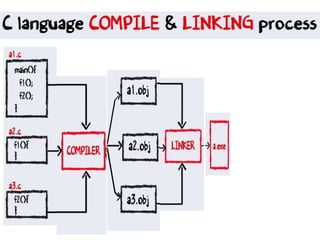
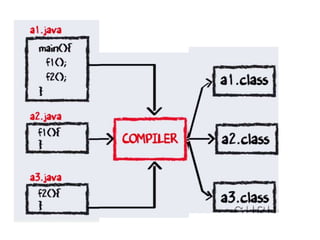
  • #19 No linking is done . Class file contain byte codoe