Fuzzy Logic and Adaptive Sampling Edwin Hernandez HCS - Lab
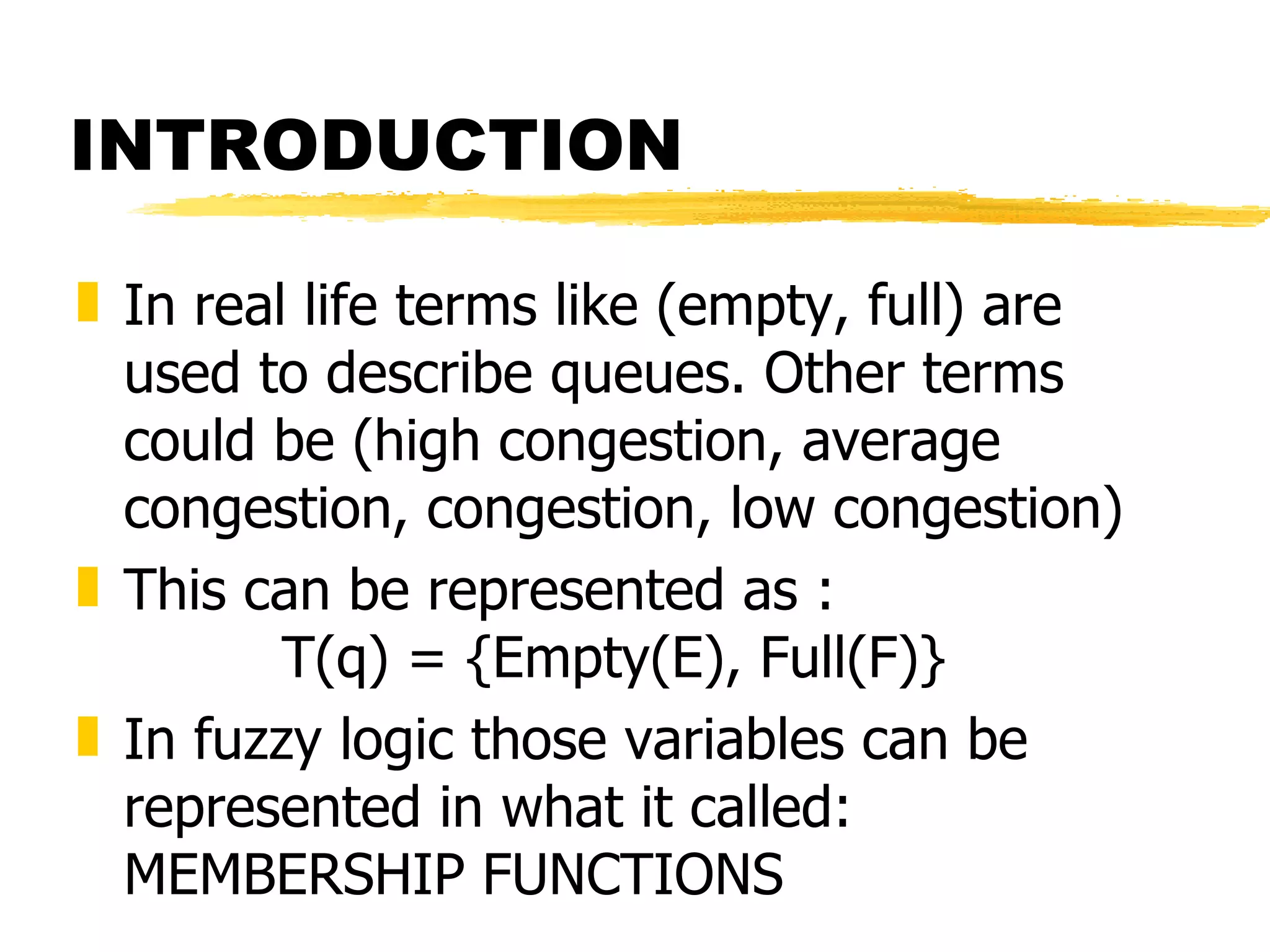
INTRODUCTION In real life terms like (empty, full) are used to describe queues. Other terms could be (high congestion, average congestion, congestion, low congestion) This can be represented as :    T(q) = {Empty(E), Full(F)} In fuzzy logic those variables can be represented in what it called: MEMBERSHIP FUNCTIONS
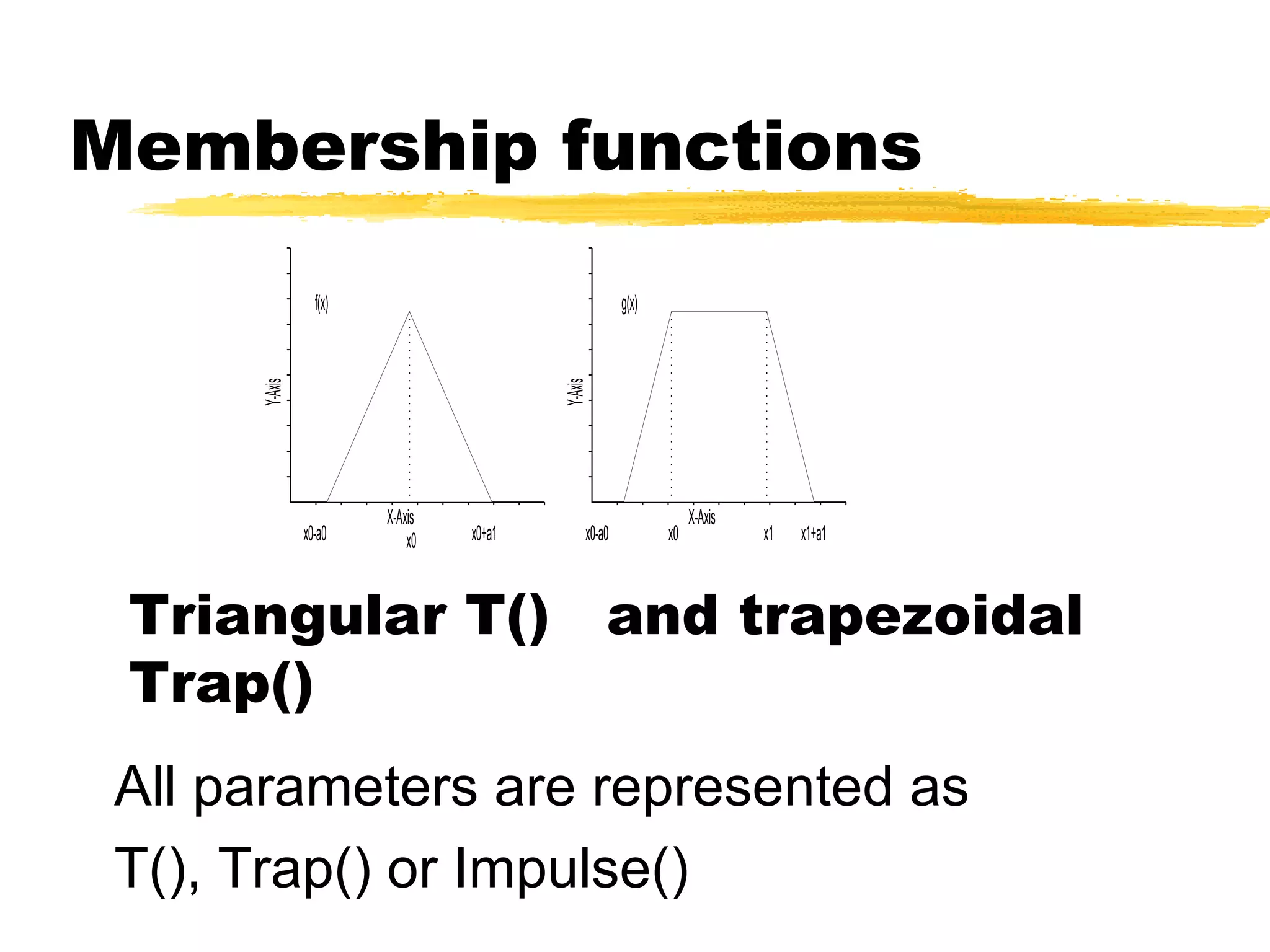
Membership functions Triangular T()  and trapezoidal Trap() All parameters are represented as  T(), Trap() or Impulse()
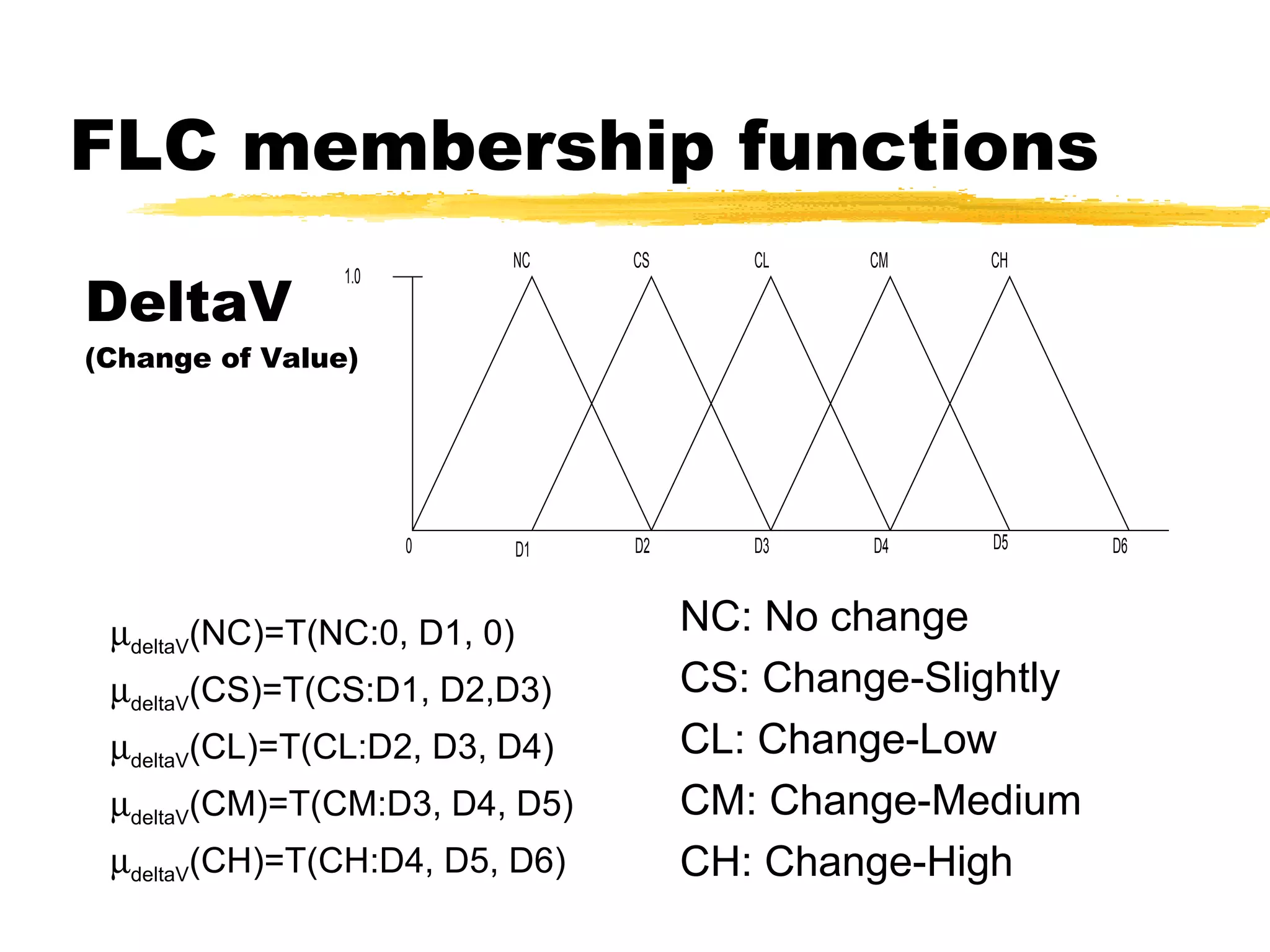
FLC membership functions  deltaV (NC)=T(NC:0, D1, 0)  deltaV (CS)=T(CS:D1, D2,D3)  deltaV (CL)=T(CL:D2, D3, D4)  deltaV (CM)=T(CM:D3, D4, D5)  deltaV (CH)=T(CH:D4, D5, D6) NC: No change CS: Change-Slightly CL: Change-Low CM: Change-Medium CH: Change-High DeltaV (Change of Value)
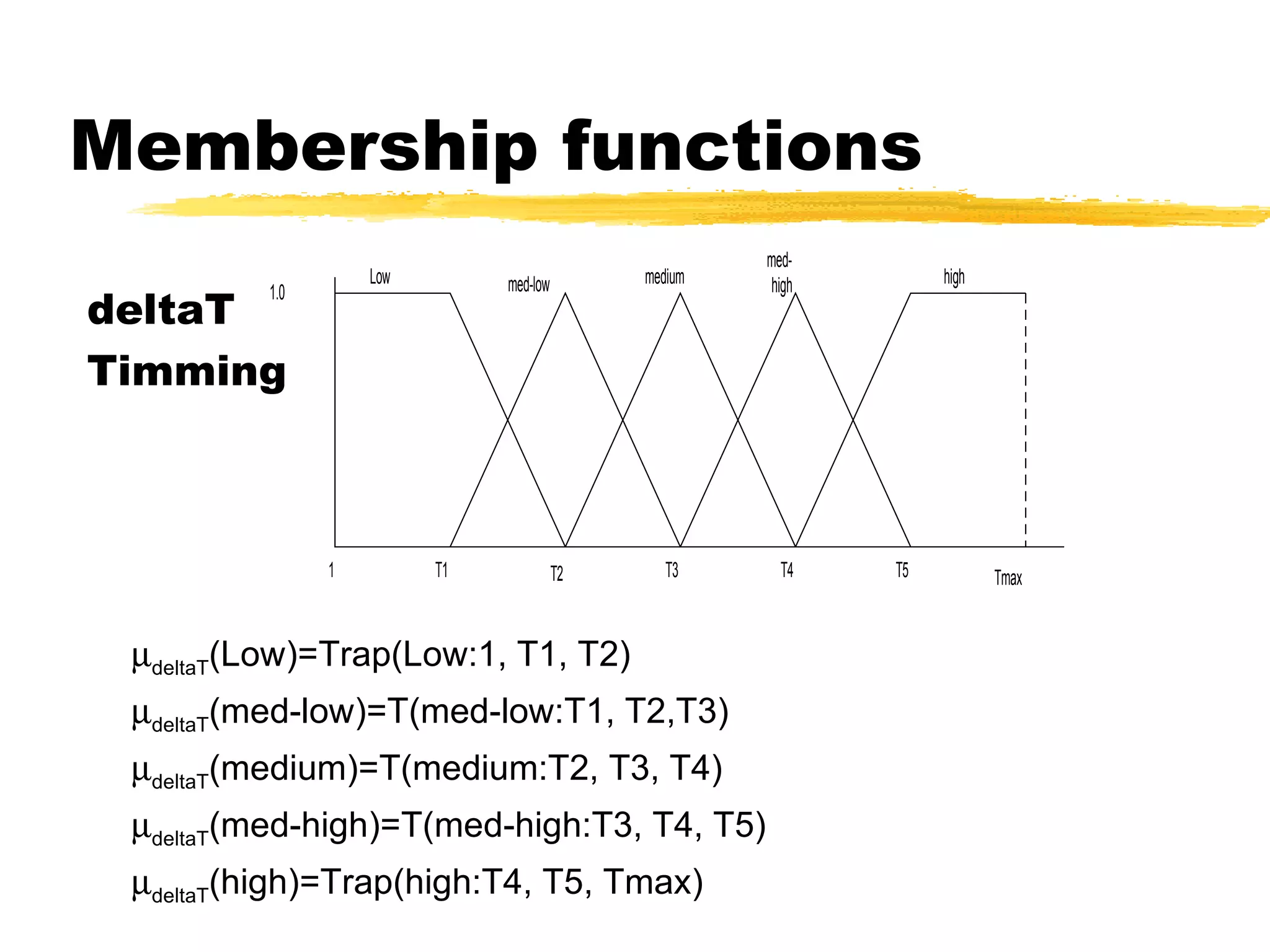
Membership functions  deltaT (Low)=Trap(Low:1, T1, T2)  deltaT (med-low)=T(med-low:T1, T2,T3)  deltaT (medium)=T(medium:T2, T3, T4)  deltaT (med-high)=T(med-high:T3, T4, T5)  deltaT (high)=Trap(high:T4, T5, Tmax) deltaT Timming
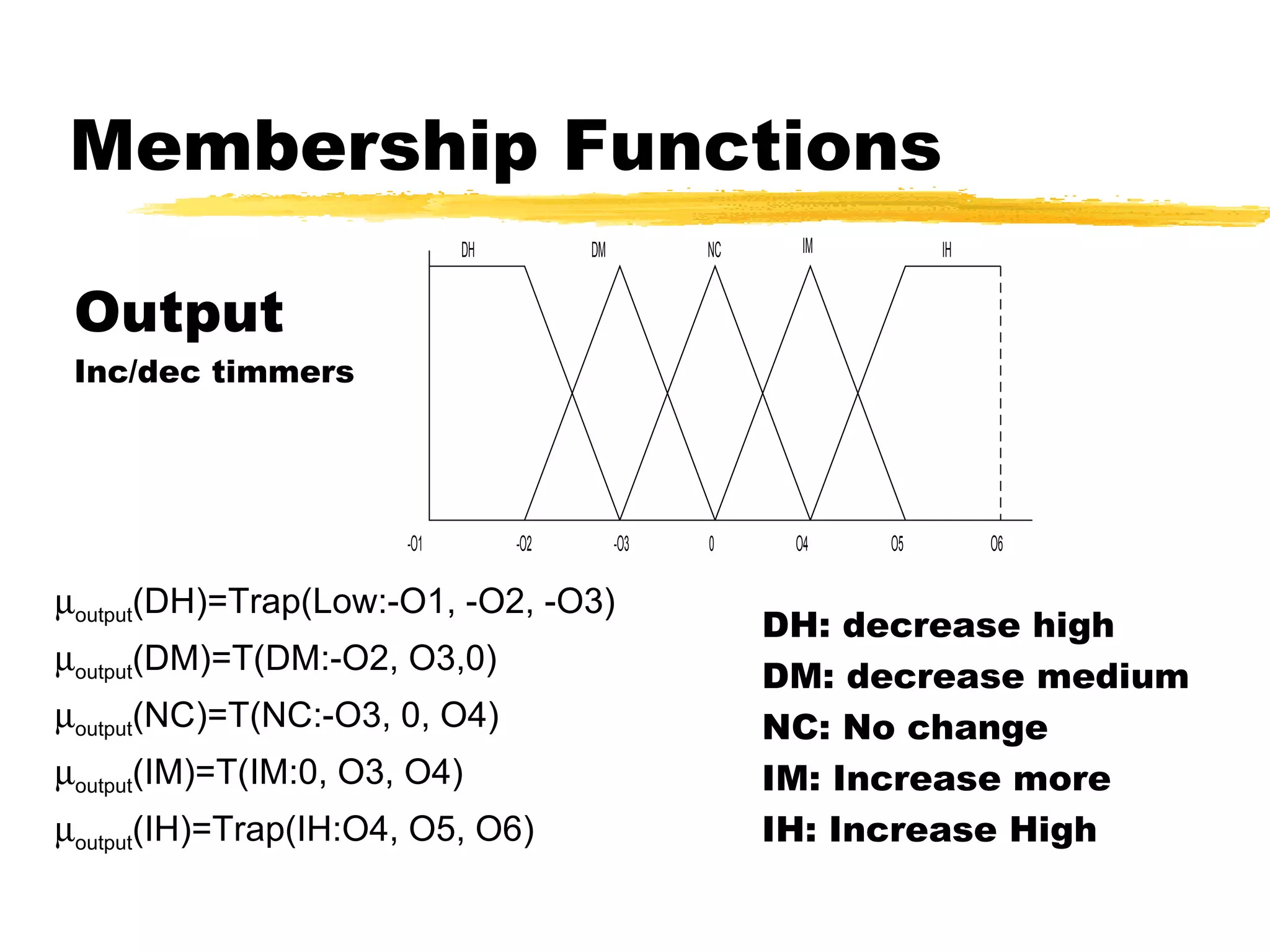
Membership Functions  output (DH)=Trap(Low:-O1, -O2, -O3)  output (DM)=T(DM:-O2, O3,0)  output (NC)=T(NC:-O3, 0, O4)  output (IM)=T(IM:0, O3, O4)  output (IH)=Trap(IH:O4, O5, O6) Output Inc/dec timmers DH: decrease high DM: decrease medium NC: No change IM: Increase more IH: Increase High
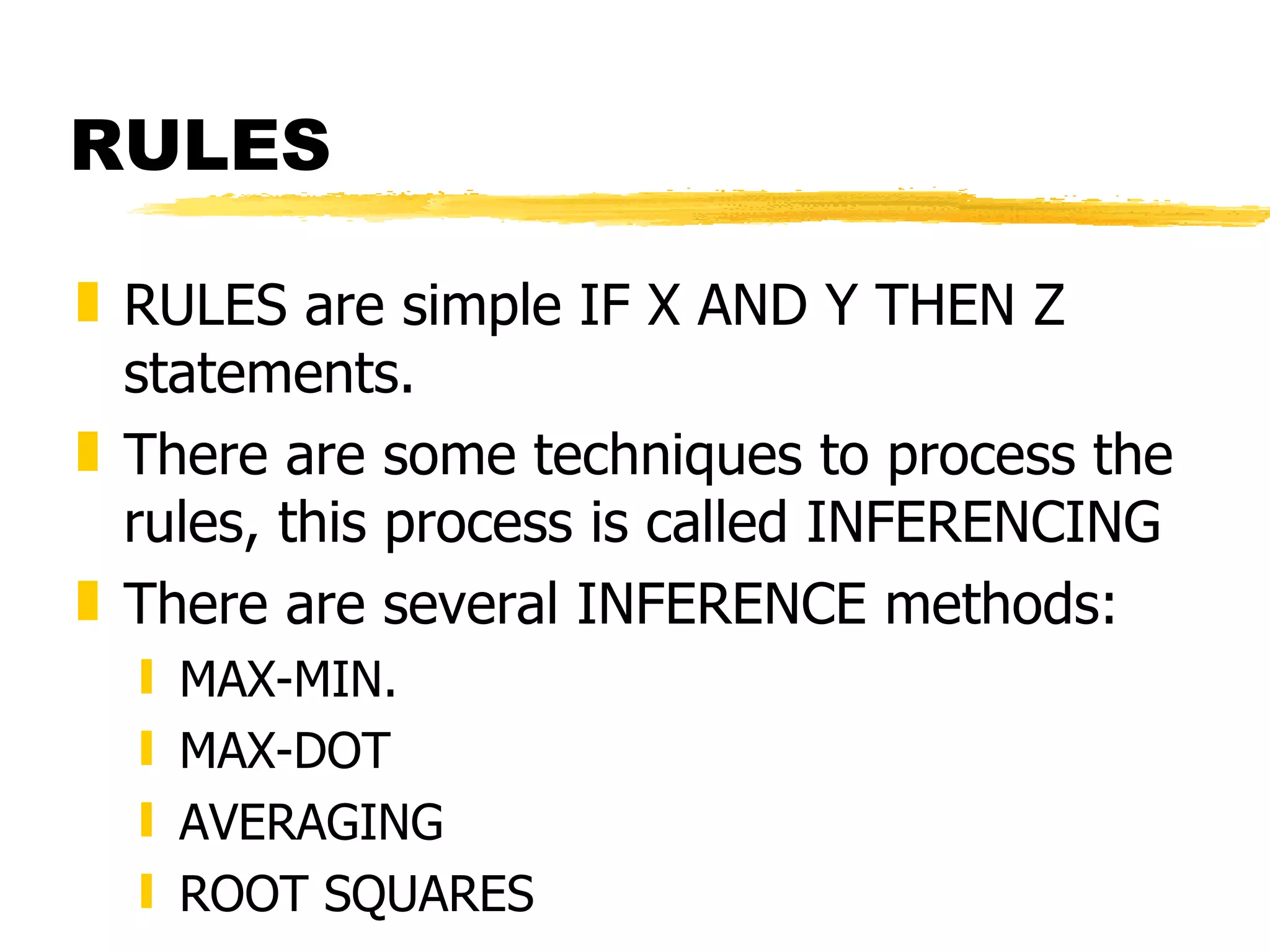
RULES RULES are simple IF X AND Y THEN Z statements. There are some techniques to process the rules, this process is called INFERENCING There are several INFERENCE methods: MAX-MIN. MAX-DOT AVERAGING ROOT SQUARES
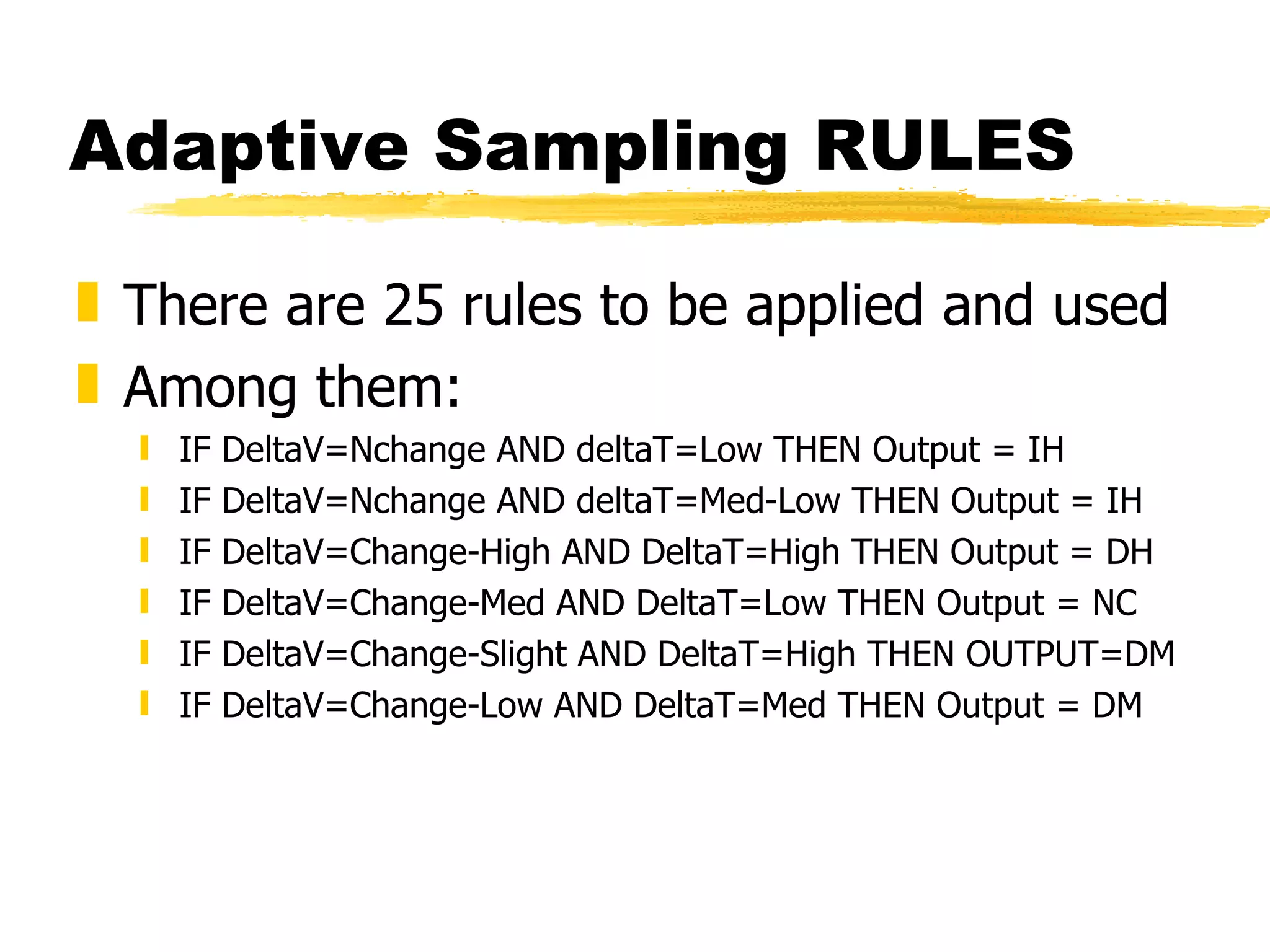
Adaptive Sampling RULES There are 25 rules to be applied and used Among them: IF DeltaV=Nchange AND deltaT=Low THEN Output = IH IF DeltaV=Nchange AND deltaT=Med-Low THEN Output = IH IF DeltaV=Change-High AND DeltaT=High THEN Output = DH IF DeltaV=Change-Med AND DeltaT=Low THEN Output = NC IF DeltaV=Change-Slight AND DeltaT=High THEN OUTPUT=DM IF DeltaV=Change-Low AND DeltaT=Med THEN Output = DM
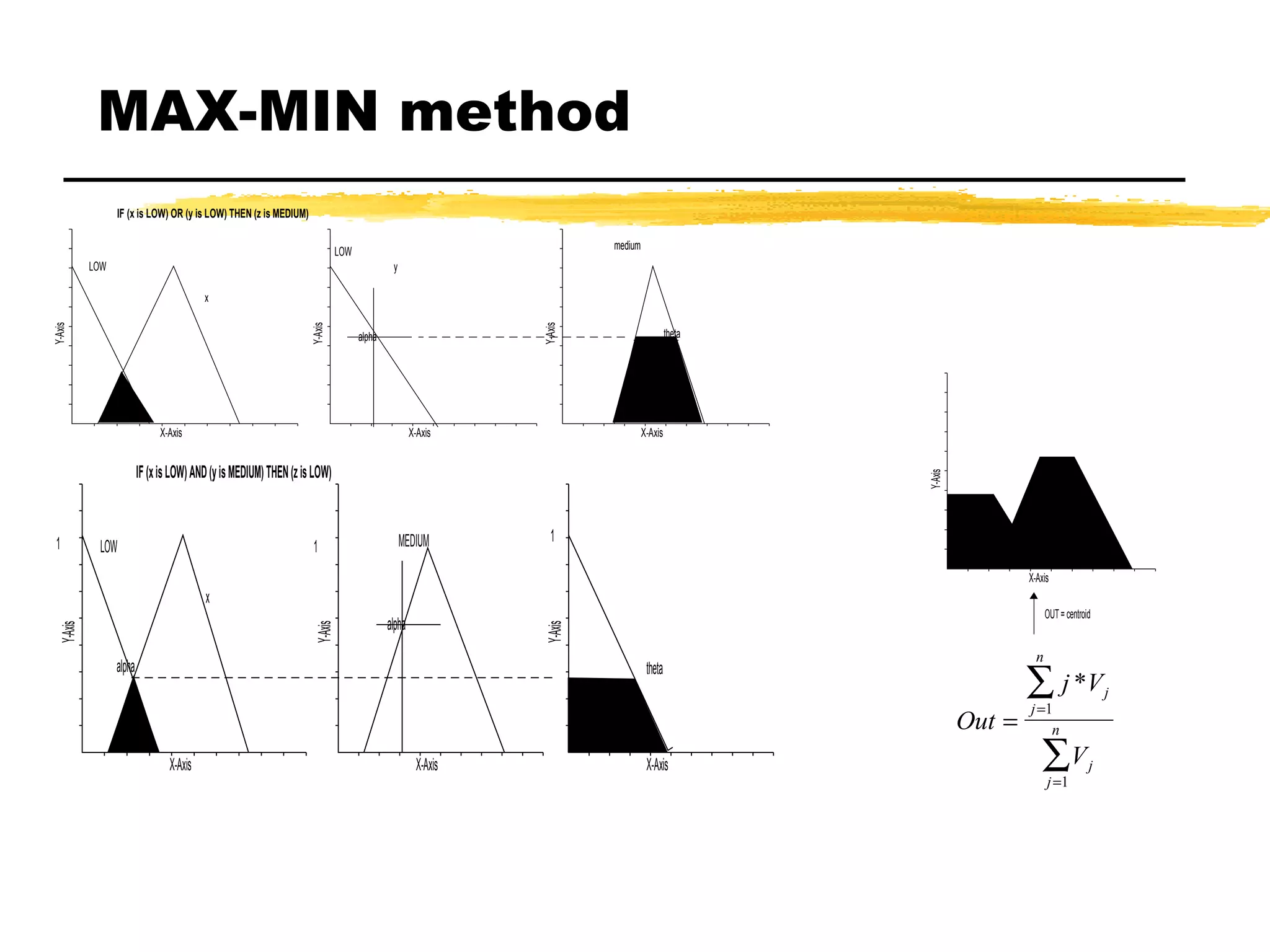
INFERENCING MAX-MIN: this method tests the magnitudes of each rule and selects the highest one. This method does not combine the effect of all applicable rules MAX-DOT or MAX-PRODUCT. Method scales each member function to fit under its respective peak value and takes the horizontal coordinate of the fuzzy centroid as output
INFERENCING AVERAGING: works but fails with contradictory rules, because it might average zero. Root Squares:it is very complicated mathematically. It combines all the applicable rules, scales the functions at their respective magnitudes and computes the fuzzy centroid of the composite area.
MAX-MIN method
MAX-DOT Pseudo-code float Output[]; Value[] = GetMembership(inputV, DeltaV[]); // returns a value for Value_chLow, Value_nochange, etc Timming[] = GetMembership(inputT, DeltaT[]); // returns a value for Timming_low, Timming_High, etc For each rule if rule[I] applies then // depending on the Rule Timming/Value applies // and are used in the array Output[] = MAX(Value[I]*Timming[I], Output[]); end; return Defuzzify(Output[])
Other Applications ATM Admission control and congestion control
FLC:ATM Switcher [1]
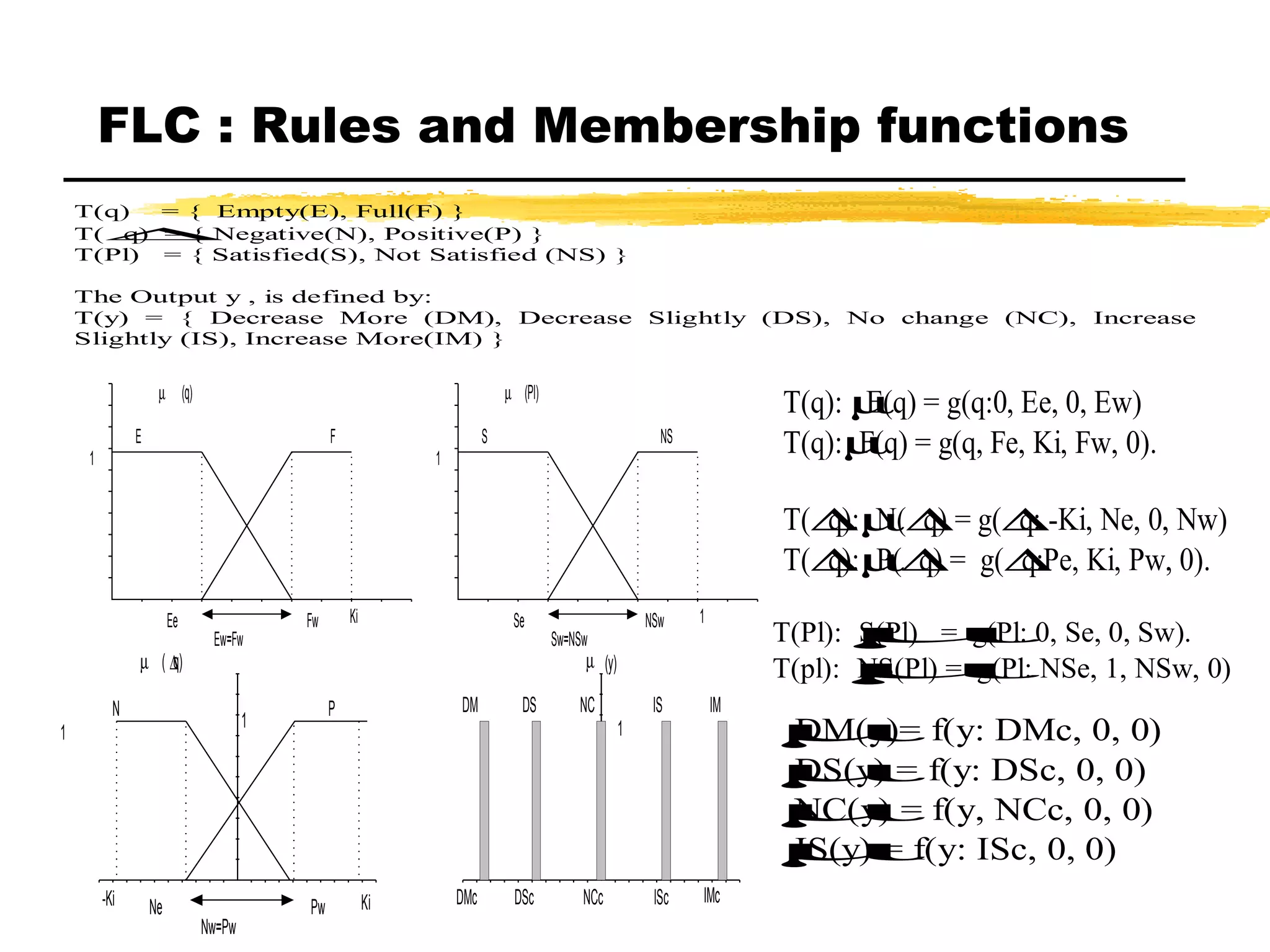
FLC : Rules and Membership functions
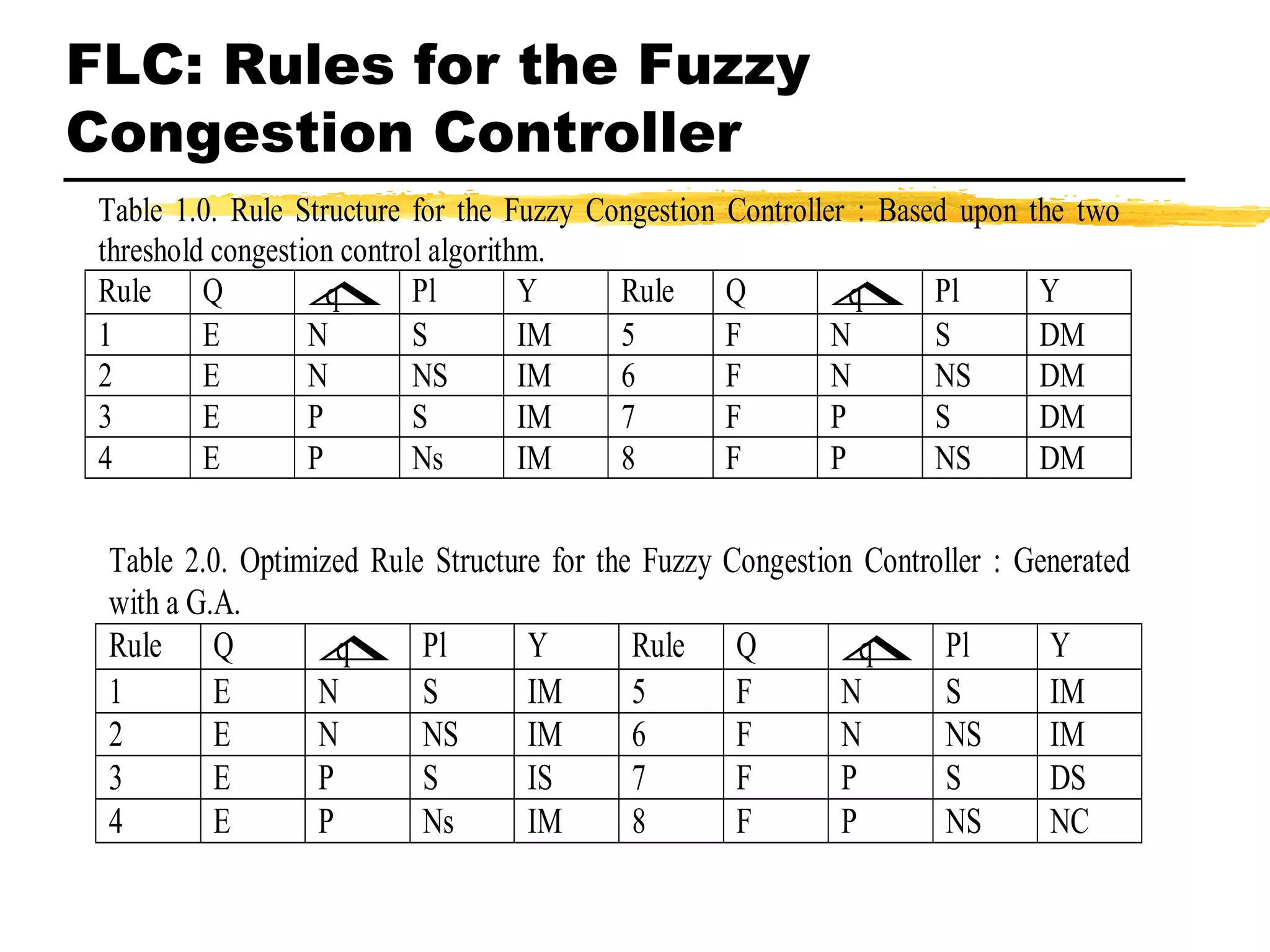
FLC: Rules for the Fuzzy Congestion Controller
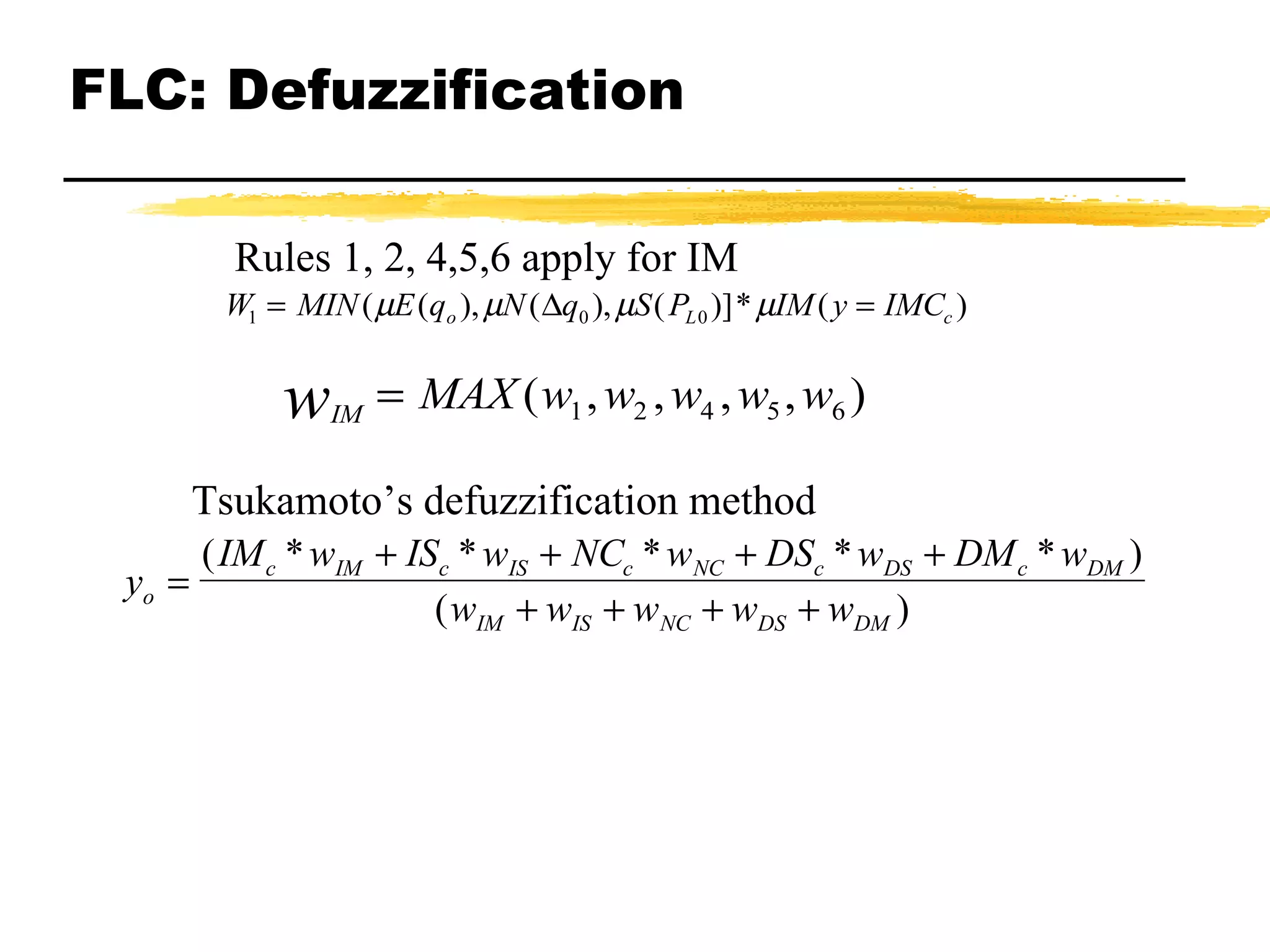
FLC: Defuzzification Rules 1, 2, 4,5,6 apply for IM Tsukamoto’s defuzzification method
References/Related Work [1]  R. Cheng, C. Chuang. "Design of a Fuzzy Traffic Controller for ATM Networks", IEEE/ACM Transactions on Networking, vol 4, No3., pp 460-469, June 1996. [2]  V. Catania, G. Ficili, S. Palazzo, D. Panno. "A Comparative Analysis of Fuzzy versus Conventional Policing Mechanisms for ATM networks", IEEE/ACM Transactions on Networking, vol. 4, No.3, June 1996. [3] H. Li, V. Yen "Fuzzy Sets and Fuzzy Decision Making", CRC-Press, 1995. [4] A. Bonde and S. Ghosh. “A comparative Study of Fuzzy versus “fixed” thresholds for robust queue management in cell-switching networks”, IEEE/ACM Transactions on Networking Vol. 2, No. 4, August 1994, pp 337-344 [5] R. Cheng, C. Chang, L. Ling. “A QoS Neural Fuzzy Connection Admission Controller for Multimedia High-Speed Networks”, IEEE/ACM Transactions on Networking”, Vo. 7, No. 1, February 1999. [6] L. Maguire, B. Roche, T. McGinnity, et. Al. “Predicting a chaotic time series using a fuzzy neural network” Elsevier- Information Sciences, No. 112, January 1998, 125-136 [7] WEB SITE : http://www.seattlerobotics.org/encoder/mar98/fuz/f1_part1.html

Introduction to Fuzzy Logic in Networks

  • 1.
    Fuzzy Logic andAdaptive Sampling Edwin Hernandez HCS - Lab
  • 2.
    INTRODUCTION In reallife terms like (empty, full) are used to describe queues. Other terms could be (high congestion, average congestion, congestion, low congestion) This can be represented as : T(q) = {Empty(E), Full(F)} In fuzzy logic those variables can be represented in what it called: MEMBERSHIP FUNCTIONS
  • 3.
    Membership functions TriangularT() and trapezoidal Trap() All parameters are represented as T(), Trap() or Impulse()
  • 4.
    FLC membership functions deltaV (NC)=T(NC:0, D1, 0)  deltaV (CS)=T(CS:D1, D2,D3)  deltaV (CL)=T(CL:D2, D3, D4)  deltaV (CM)=T(CM:D3, D4, D5)  deltaV (CH)=T(CH:D4, D5, D6) NC: No change CS: Change-Slightly CL: Change-Low CM: Change-Medium CH: Change-High DeltaV (Change of Value)
  • 5.
    Membership functions deltaT (Low)=Trap(Low:1, T1, T2)  deltaT (med-low)=T(med-low:T1, T2,T3)  deltaT (medium)=T(medium:T2, T3, T4)  deltaT (med-high)=T(med-high:T3, T4, T5)  deltaT (high)=Trap(high:T4, T5, Tmax) deltaT Timming
  • 6.
    Membership Functions output (DH)=Trap(Low:-O1, -O2, -O3)  output (DM)=T(DM:-O2, O3,0)  output (NC)=T(NC:-O3, 0, O4)  output (IM)=T(IM:0, O3, O4)  output (IH)=Trap(IH:O4, O5, O6) Output Inc/dec timmers DH: decrease high DM: decrease medium NC: No change IM: Increase more IH: Increase High
  • 7.
    RULES RULES aresimple IF X AND Y THEN Z statements. There are some techniques to process the rules, this process is called INFERENCING There are several INFERENCE methods: MAX-MIN. MAX-DOT AVERAGING ROOT SQUARES
  • 8.
    Adaptive Sampling RULESThere are 25 rules to be applied and used Among them: IF DeltaV=Nchange AND deltaT=Low THEN Output = IH IF DeltaV=Nchange AND deltaT=Med-Low THEN Output = IH IF DeltaV=Change-High AND DeltaT=High THEN Output = DH IF DeltaV=Change-Med AND DeltaT=Low THEN Output = NC IF DeltaV=Change-Slight AND DeltaT=High THEN OUTPUT=DM IF DeltaV=Change-Low AND DeltaT=Med THEN Output = DM
  • 9.
    INFERENCING MAX-MIN: thismethod tests the magnitudes of each rule and selects the highest one. This method does not combine the effect of all applicable rules MAX-DOT or MAX-PRODUCT. Method scales each member function to fit under its respective peak value and takes the horizontal coordinate of the fuzzy centroid as output
  • 10.
    INFERENCING AVERAGING: worksbut fails with contradictory rules, because it might average zero. Root Squares:it is very complicated mathematically. It combines all the applicable rules, scales the functions at their respective magnitudes and computes the fuzzy centroid of the composite area.
  • 11.
  • 12.
    MAX-DOT Pseudo-code floatOutput[]; Value[] = GetMembership(inputV, DeltaV[]); // returns a value for Value_chLow, Value_nochange, etc Timming[] = GetMembership(inputT, DeltaT[]); // returns a value for Timming_low, Timming_High, etc For each rule if rule[I] applies then // depending on the Rule Timming/Value applies // and are used in the array Output[] = MAX(Value[I]*Timming[I], Output[]); end; return Defuzzify(Output[])
  • 13.
    Other Applications ATMAdmission control and congestion control
  • 14.
  • 15.
    FLC : Rulesand Membership functions
  • 16.
    FLC: Rules forthe Fuzzy Congestion Controller
  • 17.
    FLC: Defuzzification Rules1, 2, 4,5,6 apply for IM Tsukamoto’s defuzzification method
  • 18.
    References/Related Work [1] R. Cheng, C. Chuang. "Design of a Fuzzy Traffic Controller for ATM Networks", IEEE/ACM Transactions on Networking, vol 4, No3., pp 460-469, June 1996. [2] V. Catania, G. Ficili, S. Palazzo, D. Panno. "A Comparative Analysis of Fuzzy versus Conventional Policing Mechanisms for ATM networks", IEEE/ACM Transactions on Networking, vol. 4, No.3, June 1996. [3] H. Li, V. Yen "Fuzzy Sets and Fuzzy Decision Making", CRC-Press, 1995. [4] A. Bonde and S. Ghosh. “A comparative Study of Fuzzy versus “fixed” thresholds for robust queue management in cell-switching networks”, IEEE/ACM Transactions on Networking Vol. 2, No. 4, August 1994, pp 337-344 [5] R. Cheng, C. Chang, L. Ling. “A QoS Neural Fuzzy Connection Admission Controller for Multimedia High-Speed Networks”, IEEE/ACM Transactions on Networking”, Vo. 7, No. 1, February 1999. [6] L. Maguire, B. Roche, T. McGinnity, et. Al. “Predicting a chaotic time series using a fuzzy neural network” Elsevier- Information Sciences, No. 112, January 1998, 125-136 [7] WEB SITE : http://www.seattlerobotics.org/encoder/mar98/fuz/f1_part1.html