Dynamic programming
M.SUJITHA,
II-M.SC (CS&IT),
Nadar Saraswathi College Of Arts and Science,
Theni.
• Dynamic programming is both a mathematical
optimization method and a computer programming
method.
• The method was developed by Richard Bellman in 1950s.
• It has found applications in numerous fields,
from Aerospace Engineering to economics.
• It refers to simplifying a complicated problem .
• While some decision problems cannot be taken apart this
way.
• Decisions that span several points in time do often break
apart recursively.
 A problem can be solved optimally by breaking it
into sub-problems.
 A recursive form for finding the optimal solutions
to the sub-problems, then it is said to have optimal
substructure.
 The sub-problems can be nested recursively
inside larger problems.
 The dynamic programming methods are
applicable.
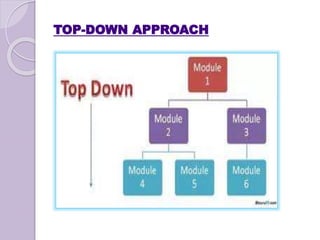
TOP-DOWN APPROACH
 This is the direct fall-out of the recursive
formulation of any problem.
 The solution to any problem can be formulated
recursively using the solution.
 To solve a new sub-problem, first check the table
to see if it is already solved.
 If a solution has been recorded, it may be used
directly, otherwise we solve the sub-problem and
add its solution to the table.
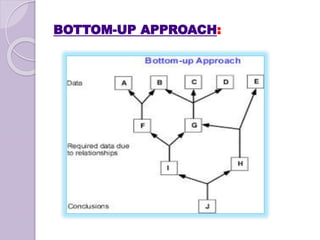
BOTTOM-UP APPROACH:
• The solution to a problem recursively as in terms
of its sub-problems.
• Solving the sub-problems first and use their
solutions to build-on and arrive at solutions to
bigger sub-problems.
• This is also usually done in a tabular form by
iteratively generating solutions.
EXAMPLE
If already know the values of F41 and F40, we
can directly calculate the value of F42.
MULTISTAGE GRAPH
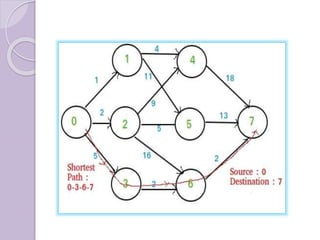
• A Multistage graph is a directed graph.
• The nodes can be divided into a set of stages.
• All edges from a stage to next stage .
• There is no edge between vertices of same stage .
• A vertex of current stage to previous stage
• A multistage graph, a source and a destination, we
need to find shortest path from source to
destination.
VARIOUS STRATEGIES
• The Brute force method of finding all possible
paths between Source and Destination.
• Dijkstra’s Algorithm has a Single Source shortest
paths.
• This method will find shortest paths from source
to all other nodes which is not required.
• It will take a lot of time and it doesn’t even use the
SPECIAL feature that this MULTI-STAGE graph.
Simple Greedy Method
• At each node, choose the shortest outgoing path.
• we apply this approach to the example graph give
above we get the solution as 1 + 4 + 18 = 23.
• But a quick look at the graph will show much
shorter paths available than 23. So the greedy
method fails.
• The best option is Dynamic Programming.
• To find Optimal Sub-structure, Recursive
Equations and Overlapping Sub-problems.
BASIC TRAVERSAL AND
SEARCH TECHNIQUES
• Traversal of a binary tree involves examining
every node in the tree.
• Search involves visiting nodes in a graph in a
systematic manner, and may or may not result into
a visit to all nodes.
• Different nodes of a graph may be visited,
possibly more than once, during traversal or
search.
• If search results into a visit to all the vertices, it is
called traversal.
TECHNIQUES FOR BINARY TREES
 Determine a vertex or a subset of vertices that
satisfy a specified property .
 Possible problem:
 Find all nodes in a binary tree with data value less
than some specified value .
 Solved by systematically examining all the
vertices
 Does searching for a specified item in a binary
search tree result into a traversal.
TECHNIQUES FOR GRAPHS
• Reachability problem in graph theory.
• Determine whether a vertex v is reachable from a
vertex u in a graph G = (V,E).
• Whether there exists a path from u to v.
• A more general form:
• Given a vertex u ∈ V , find all vertices vi ∈ V
such that there is a path from u to vi.
• Solved by starting at vertex u and systematically
searching the graph G for vertices reachable from
u.
• Breadth first search and traversal
 Explore all vertices adjacent from a starting
vertex.
 A vertex is said to be explored when the
algorithm has visited all the vertices adjacent
from it.
 As a vertex is reached or visited, it becomes a
new unexplored vertex.
 Explore unexplored vertices that are adjacent
to all the explored vertices.
 Breadth-first search operates using a queue to
maintain the list of unexplored vertices.
THANKYOU

DS ppt

  • 1.
    Dynamic programming M.SUJITHA, II-M.SC (CS&IT), NadarSaraswathi College Of Arts and Science, Theni.
  • 2.
    • Dynamic programmingis both a mathematical optimization method and a computer programming method. • The method was developed by Richard Bellman in 1950s. • It has found applications in numerous fields, from Aerospace Engineering to economics. • It refers to simplifying a complicated problem . • While some decision problems cannot be taken apart this way. • Decisions that span several points in time do often break apart recursively.
  • 4.
     A problemcan be solved optimally by breaking it into sub-problems.  A recursive form for finding the optimal solutions to the sub-problems, then it is said to have optimal substructure.  The sub-problems can be nested recursively inside larger problems.  The dynamic programming methods are applicable.
  • 5.
  • 6.
     This isthe direct fall-out of the recursive formulation of any problem.  The solution to any problem can be formulated recursively using the solution.  To solve a new sub-problem, first check the table to see if it is already solved.  If a solution has been recorded, it may be used directly, otherwise we solve the sub-problem and add its solution to the table.
  • 7.
  • 8.
    • The solutionto a problem recursively as in terms of its sub-problems. • Solving the sub-problems first and use their solutions to build-on and arrive at solutions to bigger sub-problems. • This is also usually done in a tabular form by iteratively generating solutions. EXAMPLE If already know the values of F41 and F40, we can directly calculate the value of F42.
  • 9.
  • 10.
    • A Multistagegraph is a directed graph. • The nodes can be divided into a set of stages. • All edges from a stage to next stage . • There is no edge between vertices of same stage . • A vertex of current stage to previous stage • A multistage graph, a source and a destination, we need to find shortest path from source to destination.
  • 12.
    VARIOUS STRATEGIES • TheBrute force method of finding all possible paths between Source and Destination. • Dijkstra’s Algorithm has a Single Source shortest paths. • This method will find shortest paths from source to all other nodes which is not required. • It will take a lot of time and it doesn’t even use the SPECIAL feature that this MULTI-STAGE graph.
  • 13.
    Simple Greedy Method •At each node, choose the shortest outgoing path. • we apply this approach to the example graph give above we get the solution as 1 + 4 + 18 = 23. • But a quick look at the graph will show much shorter paths available than 23. So the greedy method fails. • The best option is Dynamic Programming. • To find Optimal Sub-structure, Recursive Equations and Overlapping Sub-problems.
  • 14.
  • 15.
    • Traversal ofa binary tree involves examining every node in the tree. • Search involves visiting nodes in a graph in a systematic manner, and may or may not result into a visit to all nodes. • Different nodes of a graph may be visited, possibly more than once, during traversal or search. • If search results into a visit to all the vertices, it is called traversal.
  • 16.
    TECHNIQUES FOR BINARYTREES  Determine a vertex or a subset of vertices that satisfy a specified property .  Possible problem:  Find all nodes in a binary tree with data value less than some specified value .  Solved by systematically examining all the vertices  Does searching for a specified item in a binary search tree result into a traversal.
  • 17.
    TECHNIQUES FOR GRAPHS •Reachability problem in graph theory. • Determine whether a vertex v is reachable from a vertex u in a graph G = (V,E). • Whether there exists a path from u to v. • A more general form: • Given a vertex u ∈ V , find all vertices vi ∈ V such that there is a path from u to vi. • Solved by starting at vertex u and systematically searching the graph G for vertices reachable from u. • Breadth first search and traversal
  • 18.
     Explore allvertices adjacent from a starting vertex.  A vertex is said to be explored when the algorithm has visited all the vertices adjacent from it.  As a vertex is reached or visited, it becomes a new unexplored vertex.  Explore unexplored vertices that are adjacent to all the explored vertices.  Breadth-first search operates using a queue to maintain the list of unexplored vertices.
  • 19.