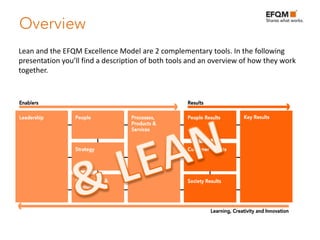
Lean and the EFQM Excellence Model are 2 complementary tools. In the following
presentation youโ€™ll find a description of both tools and an overview of how they work
together.
๏‚ง Return on investment
1. Shareholders   ๏‚ง Optimise profitability
                  ๏‚ง Sustainable financial growth


                  ๏‚ง Value-adding products & services
2. Customers      ๏‚ง Excellent service


                                                       Clearly defined long-term strategy

                                                       The right Partners & Suppliers
                                                       Robust internal processes
                                                       Leaders who inspire trust
                  ๏‚ง Opportunities to develop & grow
3. People         ๏‚ง Work / life balance
                  ๏‚ง Pride in Organisation


                  ๏‚ง Brand reputation
4. Society        ๏‚ง Ethical behaviour
                  ๏‚ง Transparent communication


                                                       ๏‚ง
                                                       ๏‚ง
                                                       ๏‚ง
                                                       ๏‚ง
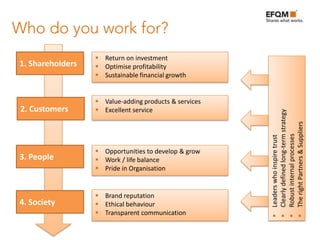
In sum, we work for all these stakeholders. Of course, we canโ€™t deliver everything that
everyone wants all at the time. We need a dialogue, we need to prioritise, we need to
continuously evolve. The EFQM Excellence Model is a framework organisations
implement to drive continuous improvement, bringing together all the components of
your management system (i.e. leadership, HR, Sustainability and customer results).


Through assessments against the EFQM Model, you focus on what really matters, on
what really is driving results. You will identify opportunities to grow and youโ€™ll make
sure to make the best strategic decisions. Finally, our framework is holistic. The Model
works as an embralla that covers a number of tools (such as ISO, balanced
scorecard, etc.) to ensure that all initiatives donโ€™t operate on a stand-alone basis, but
rather interlinked or parallel towards the same goal.
Lean is widely used as an approach for improving process performance and enhancing
the value added to the customer and other stakeholders, not just in manufacturing
but increasingly in the services sector.
Lean is a practice that considers the expenditure of resources for any goal other than
the creation of value for the end customer to be wasteful, and thus a target for
elimination. Working from the perspective of the customer who consumes a product
or service, "value" is defined as any action or process that a customer would be willing
to pay for.
The EFQM Model and Lean have a common background in Total Quality Management:
๏ฎ People centric: Not only are customers a primary consideration, but everyone
  connected with the organisation is a part of the equation.
๏ฎ Long term view: TQM is a long term process. It can take up to 5 years to fully
  convert a company to TQM methodology. Every year the mission statement is
  reviewed and revised.
๏ฎ Customer focus: An organisation needs to satisfy external but also internal
  customer needs (providing information, quickly responding to questions, creating
  surveys, etc.)
๏ฎ Performance oriented: Focus on proactive problem solving and continuous
  improvement.
๏ฎ Continuous improvement: TQM is mainly concerned with continuous
  improvement in all work, from high level strategic planning and decision-
  making, to detailed execution of work elements on the shop floor.
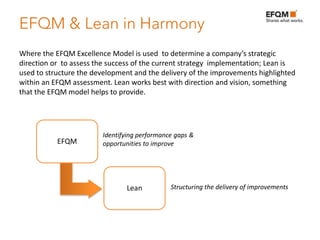
Where the EFQM Excellence Model is used to determine a companyโ€™s strategic
direction or to assess the success of the current strategy implementation; Lean is
used to structure the development and the delivery of the improvements highlighted
within an EFQM assessment. Lean works best with direction and vision, something
that the EFQM model helps to provide.


                        Identifying performance gaps &
           EFQM         opportunities to improve


                               Lean           Structuring the delivery of improvements
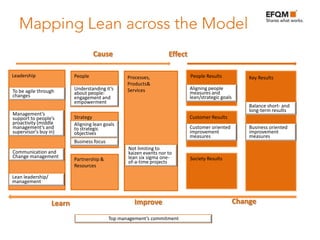
Cause                            Effect

Leadership                 People                  Processes,                 People Results             Key Results
                                                   Products&
                           Understanding itโ€™s      Services                   Aligning people
To be agile through        about people:                                      measures and
changes                    engagement and                                     lean/strategic goals
                           empowerment
                                                                                                         Balance short- and
                                                                                                         long-term results
Managementโ€™s
support to peopleโ€™s        Strategy                                           Customer Results
proactivity (middle        Aligning lean goals
managementโ€™s and           to strategic                                       Customer oriented          Business oriented
supervisor's buy in)       objectives                                         improvement                improvement
                                                                              measures                   measures
                           Business focus
                                                   Not limiting to
Communication and                                  kaizen events nor to
Change management                                  lean six sigma one-        Society Results
                           Partnership &           of-a-time projects
                           Resources

Lean leadership/
management


                   Learn                              Improve                                        Change

                                            Top managementโ€™s commitment
Avenue des Olympiades, 2
1140 Brussels, Belgium
T: +32 2 775 3511
@: info@efqm.org
www.efqm.org


Weโ€™d like to thank Prof. Vittorio Cesarotti, from the Universita degli Studi di
Roma, for his valuable contributions to this document.
EFQM is committed to help organisations drive improvement through the use of the
EFQM Excellence Model, a comprehensive management framework used by over
30 000 organisations in Europe. For the last 20 years, we manage the development of
this Model, incorporating the experiences and learning from these organisations to
ensure it reflects reality.
To help you implement our Model, we provide training, assessment tools and
recognition. But our real talent comes from gathering good practices and integrating
those within our portfolio. EFQM, a not-for-profit membership Foundation, aims to
share what works, through case studies, online seminars, working groups, conferences
and thematic events. We nurture a network of world-class organisations and their
leaders who share our passion for business excellence.
We believe that the EFQM Model is a common framework that helps us all to improve
our businesses. Sharing our memberโ€™s enthusiasm, their motivation and the results
they achieve; that is what we work for at EFQM.
The EFQM User Guide
Using Lean within the EFQM
Framework


Available free for members on
our Knowledge Base.
EFQM& Lean: Together in Harmony

EFQM& Lean: Together in Harmony

  • 2.
    Lean and theEFQM Excellence Model are 2 complementary tools. In the following presentation youโ€™ll find a description of both tools and an overview of how they work together.
  • 3.
    ๏‚ง Return oninvestment 1. Shareholders ๏‚ง Optimise profitability ๏‚ง Sustainable financial growth ๏‚ง Value-adding products & services 2. Customers ๏‚ง Excellent service Clearly defined long-term strategy The right Partners & Suppliers Robust internal processes Leaders who inspire trust ๏‚ง Opportunities to develop & grow 3. People ๏‚ง Work / life balance ๏‚ง Pride in Organisation ๏‚ง Brand reputation 4. Society ๏‚ง Ethical behaviour ๏‚ง Transparent communication ๏‚ง ๏‚ง ๏‚ง ๏‚ง
  • 4.
    In sum, wework for all these stakeholders. Of course, we canโ€™t deliver everything that everyone wants all at the time. We need a dialogue, we need to prioritise, we need to continuously evolve. The EFQM Excellence Model is a framework organisations implement to drive continuous improvement, bringing together all the components of your management system (i.e. leadership, HR, Sustainability and customer results). Through assessments against the EFQM Model, you focus on what really matters, on what really is driving results. You will identify opportunities to grow and youโ€™ll make sure to make the best strategic decisions. Finally, our framework is holistic. The Model works as an embralla that covers a number of tools (such as ISO, balanced scorecard, etc.) to ensure that all initiatives donโ€™t operate on a stand-alone basis, but rather interlinked or parallel towards the same goal.
  • 5.
    Lean is widelyused as an approach for improving process performance and enhancing the value added to the customer and other stakeholders, not just in manufacturing but increasingly in the services sector. Lean is a practice that considers the expenditure of resources for any goal other than the creation of value for the end customer to be wasteful, and thus a target for elimination. Working from the perspective of the customer who consumes a product or service, "value" is defined as any action or process that a customer would be willing to pay for.
  • 6.
    The EFQM Modeland Lean have a common background in Total Quality Management: ๏ฎ People centric: Not only are customers a primary consideration, but everyone connected with the organisation is a part of the equation. ๏ฎ Long term view: TQM is a long term process. It can take up to 5 years to fully convert a company to TQM methodology. Every year the mission statement is reviewed and revised. ๏ฎ Customer focus: An organisation needs to satisfy external but also internal customer needs (providing information, quickly responding to questions, creating surveys, etc.) ๏ฎ Performance oriented: Focus on proactive problem solving and continuous improvement. ๏ฎ Continuous improvement: TQM is mainly concerned with continuous improvement in all work, from high level strategic planning and decision- making, to detailed execution of work elements on the shop floor.
  • 7.
    Where the EFQMExcellence Model is used to determine a companyโ€™s strategic direction or to assess the success of the current strategy implementation; Lean is used to structure the development and the delivery of the improvements highlighted within an EFQM assessment. Lean works best with direction and vision, something that the EFQM model helps to provide. Identifying performance gaps & EFQM opportunities to improve Lean Structuring the delivery of improvements
  • 8.
    Cause Effect Leadership People Processes, People Results Key Results Products& Understanding itโ€™s Services Aligning people To be agile through about people: measures and changes engagement and lean/strategic goals empowerment Balance short- and long-term results Managementโ€™s support to peopleโ€™s Strategy Customer Results proactivity (middle Aligning lean goals managementโ€™s and to strategic Customer oriented Business oriented supervisor's buy in) objectives improvement improvement measures measures Business focus Not limiting to Communication and kaizen events nor to Change management lean six sigma one- Society Results Partnership & of-a-time projects Resources Lean leadership/ management Learn Improve Change Top managementโ€™s commitment
  • 9.
    Avenue des Olympiades,2 1140 Brussels, Belgium T: +32 2 775 3511 @: info@efqm.org www.efqm.org Weโ€™d like to thank Prof. Vittorio Cesarotti, from the Universita degli Studi di Roma, for his valuable contributions to this document.
  • 10.
    EFQM is committedto help organisations drive improvement through the use of the EFQM Excellence Model, a comprehensive management framework used by over 30 000 organisations in Europe. For the last 20 years, we manage the development of this Model, incorporating the experiences and learning from these organisations to ensure it reflects reality. To help you implement our Model, we provide training, assessment tools and recognition. But our real talent comes from gathering good practices and integrating those within our portfolio. EFQM, a not-for-profit membership Foundation, aims to share what works, through case studies, online seminars, working groups, conferences and thematic events. We nurture a network of world-class organisations and their leaders who share our passion for business excellence. We believe that the EFQM Model is a common framework that helps us all to improve our businesses. Sharing our memberโ€™s enthusiasm, their motivation and the results they achieve; that is what we work for at EFQM.
  • 11.
    The EFQM UserGuide Using Lean within the EFQM Framework Available free for members on our Knowledge Base.

Editor's Notes

  • #4ย The EFQM Excellence Model is a framework to drive and stimulate continuous improvement. It brings together all the different components of your management system (i.e. leadership, HR, Sustainability, customer results partnerships, etc.), giving you an overview of your current strengths and opportunities to grow. You will identify which actions are driving your results, and which areas need more attention.The EFQM Model guides you to take the best strategic decisions.The Model is pragmatic and practical: it is developed by organisations for organisations.It is notpre-scriptive: organisations have the freedomtochoosewhat is best fortheir company.It is holistic. The EFQM Model works as anumbrellathatcan cover a number of tools (such as ISO, balanced scorecard, etc.) toensurethatallinitiativesdonโ€™toperate on a stand-alone basis, but rather interlinked or parallel towards the same goal. More than 30,000 organisations around the globe use the Model to engage their stakeholders in their development and growth. 84% of our members say using the Model helps their organisation improve.