Employee Involvement & Participation Its all about power & control! How should the power & control be divided?
Perspectives Unitarist Pluralist Marxist
‘ Frontier of Control’  (Goodrich) What is the demand for control? - the demand not to be controlled  disagreeably? - the demand not to be controlled at  all? - the demand to take a hand in  controlling?
The Extent of Control Control that is allowed V’s that which is taken Negative V’s Positive control Customery V’s Contagious control
Three Levels of Control 1. Wages & conditions 2. Techiques related to everyday work 3. Wider trade policy & strategy  formulation
Salamon’s Forms (1998) Industrial Democracy:  worker control Employee Participation:  influence decision making Employee Involvement:  engage support, understanding, commitment & contribution
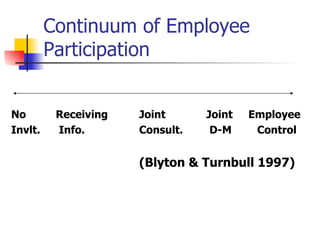
Continuum of Employee Participation No   Receiving Joint   Joint  Employee Invlt.   Info.   Consult.   D-M   Control (Blyton & Turnbull 1997)
Ramsey’s 4 Types 1. Task Involvement 2. Briefing Systems 3. Consultative Arrangements 4. Financial Participation
The ‘ P ush’ for  P articipation Ideological Institutional (EU) Higher expectations Attitudes towards authority Alienation & dissatisfaction at work Organisational change HRM
Issues Who initiates? Who determines the agenda? Extent (operational/strategic) Scope Form (direct/representative) Purpose
The Cynical View The rhetoric may be one of ‘worker empowerment’, ‘employee participation’ and ‘involvement’ , but the prime objectives remain – more efficient production and more effective management control.  Managers appear to support most employee involvement practices so long as these do not radically effect their control function within the firm.
Some Mechanisms Suggestion schemes Team working Attitude surveys Collective bargaining Quality circles Worker Directors Works councils
Direct Participation Team Working Quality Circles Attitude Surveys Suggestion Scheme
Indirect (representative) Participation Collective Bargaining Works Councils Worker Directors
Relevent  EU Directives Fifth Directive (1972) Vredling Directive (1980) Social Charter (1989) European Works Councils Directive (199 6 ) Directive on Information & Consultation (2002)
Existing Irish Provisions Transnational Information & Consultation Act (EWC) 1996 Worker Participation Acts 1977/88 Other pieces of employments law eg. Safety, Health & Welfare Act, 1989, Protection of Employment Act, 1977 etc.
Worker Directors Ireland – confined to the state sector Management View -  articulate employee views - ensure employee commitment - reduce conflict Union View - alternative power centre undermining ability to challenge - positive development
Evidence of Limited Impact  (Salamon 1998) Infrequency of board meetings Exclusion of worker directors from ‘side’ meetings Role of the board is to endorse decisions Rely heavily on senior management for information
Move to Works Councils 199 6  EU Directive –  All companies with over 1000 employees ,  operating in two or more member states ,  must establish a E uropean Works Council
Works Councils A method of providing formal employee representation at workplace level to facilitate consultation and discussion of enterprise related issues between workers and management. Operates alongside collective bargaining .
Works Councils - Features Joint Common interest Co-operative Representative Union & non-union Strategic & operational
Works Councils - Rights Right to be informed Right to be consulted Right to independent investigation Right to co-determination
Cycles or Waves of Participation Cycles: history of participation shows periods of development followed by periods of decay with little/no overall change (Ramsey 1983) Waves: interest in participation ‘ebbs & flows’ at both the micro and macro levels (Marchington 1992)
Four Common Problems Lack of continuity Lack of middle management support Adoption of inappropriate systems Employee scepticism
Trade Union Response Management emphasis on intrinsic rewards Primary motive = productivity Attempt to undermine existing arrangements 2 Strategies: Block Negotiate
Towards Partnership P2000 & PPF Definition NCP/NCPP Evidence of practice?
Partnership (P2000) … an active relationship based on recognition of a common interest to secure competitiveness, viability and prosperity of the enterprise. It involves a continuing commitment to improvements in quality and efficiency; and the acceptance by employers of employees as stakeholders with rights and interests to be considered in the context of major decisions effecting their employment.
Exploring partnership  (Irish local authority) -  what initiates partnership? - what does it mean? - what’s in it for the workers?
Exploring partnership… The findings: - their understanding of partnership - the unions and industrial relations - the issues addressed - the successes and the obstacles - the future
EU Information and Consultation Directive 2002 “ This is the best opportunity ever, to reform the Irish industrial relations system.” Prof Keith Sisson R ight to be informed and consulted on matters currently affecting their jobs and those likely to impact on their future work life .
More About the Directive Deadlines 20/50 Threshold (coverage) Definitions Scope, timing, method Representatives Penalties
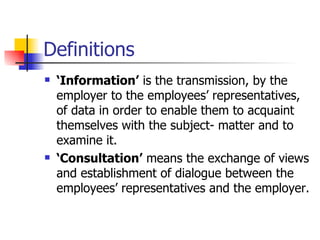
Definitions ‘ Information’  is the transmission, by the employer to the employees’ representatives, of data in order to enable them to acquaint themselves with the subject- matter and to examine it.  ‘ Consultation’  means the exchange of views and establishment of dialogue between the employees’ representatives and the employer.
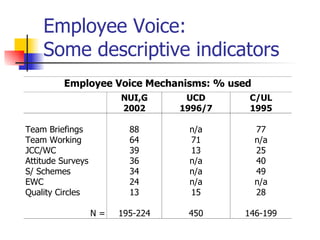
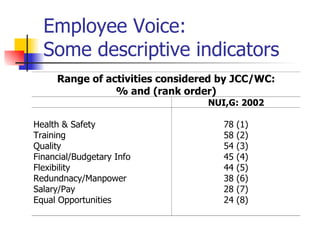
Employee Voice:  Some descriptive indicators
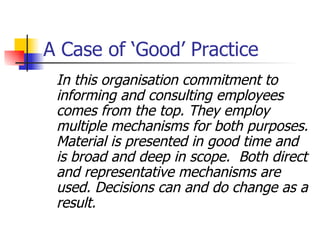
A Case of ‘Good’ Practice In this organisation commitment to informing and consulting employees comes from the top. They employ multiple mechanisms for both purposes. Material is presented in good time and is broad and deep in scope.  Both direct and representative mechanisms are used. Decisions can and do change as a result.
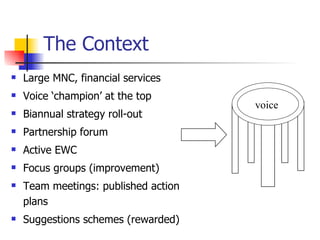
The Context Large MNC, financial services Voice ‘champion’ at the top Biannual strategy roll-out Partnership forum Active EWC Focus groups (improvement) Team meetings: published action plans Suggestions schemes (rewarded) voice
A Case of ‘Poor’ Practice There is no ‘real’ commitment to informing and consulting employees. The organisation pays ‘lip service’ by having mechanisms in place that are not active. Employee representatives are marginalised. The preference is for direct mechanisms to be used for informing (at short notice). Decisions should not and do not change.
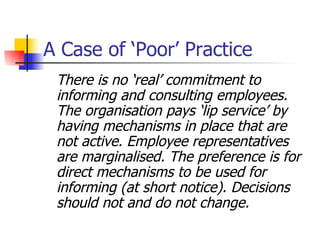
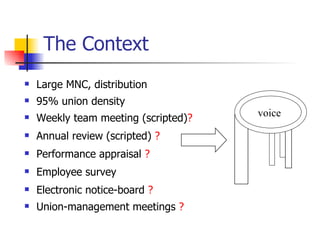
The Context Large MNC, distribution 95% union density Weekly team meeting (scripted) ? Annual review (scripted)  ? Performance appraisal  ? Employee survey Electronic notice-board  ? Union-management meetings  ? voice
Issues for moving forward Opportunity V’s threat Representatives Coverage (50/20) Framework / Model - direction Trigger Facilitation and Training (NCPP, LRC) Redress
Conclusions There is a move towards more EI/EP Reasons Underlying motives Voluntarism V’s regulation Is regulation enough?

Employee involvement participation

  • 1.
    Employee Involvement &Participation Its all about power & control! How should the power & control be divided?
  • 2.
  • 3.
    ‘ Frontier ofControl’ (Goodrich) What is the demand for control? - the demand not to be controlled disagreeably? - the demand not to be controlled at all? - the demand to take a hand in controlling?
  • 4.
    The Extent ofControl Control that is allowed V’s that which is taken Negative V’s Positive control Customery V’s Contagious control
  • 5.
    Three Levels ofControl 1. Wages & conditions 2. Techiques related to everyday work 3. Wider trade policy & strategy formulation
  • 6.
    Salamon’s Forms (1998)Industrial Democracy: worker control Employee Participation: influence decision making Employee Involvement: engage support, understanding, commitment & contribution
  • 7.
    Continuum of EmployeeParticipation No Receiving Joint Joint Employee Invlt. Info. Consult. D-M Control (Blyton & Turnbull 1997)
  • 8.
    Ramsey’s 4 Types1. Task Involvement 2. Briefing Systems 3. Consultative Arrangements 4. Financial Participation
  • 9.
    The ‘ Push’ for P articipation Ideological Institutional (EU) Higher expectations Attitudes towards authority Alienation & dissatisfaction at work Organisational change HRM
  • 10.
    Issues Who initiates?Who determines the agenda? Extent (operational/strategic) Scope Form (direct/representative) Purpose
  • 11.
    The Cynical ViewThe rhetoric may be one of ‘worker empowerment’, ‘employee participation’ and ‘involvement’ , but the prime objectives remain – more efficient production and more effective management control. Managers appear to support most employee involvement practices so long as these do not radically effect their control function within the firm.
  • 12.
    Some Mechanisms Suggestionschemes Team working Attitude surveys Collective bargaining Quality circles Worker Directors Works councils
  • 13.
    Direct Participation TeamWorking Quality Circles Attitude Surveys Suggestion Scheme
  • 14.
    Indirect (representative) ParticipationCollective Bargaining Works Councils Worker Directors
  • 15.
    Relevent EUDirectives Fifth Directive (1972) Vredling Directive (1980) Social Charter (1989) European Works Councils Directive (199 6 ) Directive on Information & Consultation (2002)
  • 16.
    Existing Irish ProvisionsTransnational Information & Consultation Act (EWC) 1996 Worker Participation Acts 1977/88 Other pieces of employments law eg. Safety, Health & Welfare Act, 1989, Protection of Employment Act, 1977 etc.
  • 17.
    Worker Directors Ireland– confined to the state sector Management View - articulate employee views - ensure employee commitment - reduce conflict Union View - alternative power centre undermining ability to challenge - positive development
  • 18.
    Evidence of LimitedImpact (Salamon 1998) Infrequency of board meetings Exclusion of worker directors from ‘side’ meetings Role of the board is to endorse decisions Rely heavily on senior management for information
  • 19.
    Move to WorksCouncils 199 6 EU Directive – All companies with over 1000 employees , operating in two or more member states , must establish a E uropean Works Council
  • 20.
    Works Councils Amethod of providing formal employee representation at workplace level to facilitate consultation and discussion of enterprise related issues between workers and management. Operates alongside collective bargaining .
  • 21.
    Works Councils -Features Joint Common interest Co-operative Representative Union & non-union Strategic & operational
  • 22.
    Works Councils -Rights Right to be informed Right to be consulted Right to independent investigation Right to co-determination
  • 23.
    Cycles or Wavesof Participation Cycles: history of participation shows periods of development followed by periods of decay with little/no overall change (Ramsey 1983) Waves: interest in participation ‘ebbs & flows’ at both the micro and macro levels (Marchington 1992)
  • 24.
    Four Common ProblemsLack of continuity Lack of middle management support Adoption of inappropriate systems Employee scepticism
  • 25.
    Trade Union ResponseManagement emphasis on intrinsic rewards Primary motive = productivity Attempt to undermine existing arrangements 2 Strategies: Block Negotiate
  • 26.
    Towards Partnership P2000& PPF Definition NCP/NCPP Evidence of practice?
  • 27.
    Partnership (P2000) …an active relationship based on recognition of a common interest to secure competitiveness, viability and prosperity of the enterprise. It involves a continuing commitment to improvements in quality and efficiency; and the acceptance by employers of employees as stakeholders with rights and interests to be considered in the context of major decisions effecting their employment.
  • 28.
    Exploring partnership (Irish local authority) - what initiates partnership? - what does it mean? - what’s in it for the workers?
  • 29.
    Exploring partnership… Thefindings: - their understanding of partnership - the unions and industrial relations - the issues addressed - the successes and the obstacles - the future
  • 30.
    EU Information andConsultation Directive 2002 “ This is the best opportunity ever, to reform the Irish industrial relations system.” Prof Keith Sisson R ight to be informed and consulted on matters currently affecting their jobs and those likely to impact on their future work life .
  • 31.
    More About theDirective Deadlines 20/50 Threshold (coverage) Definitions Scope, timing, method Representatives Penalties
  • 32.
    Definitions ‘ Information’ is the transmission, by the employer to the employees’ representatives, of data in order to enable them to acquaint themselves with the subject- matter and to examine it. ‘ Consultation’ means the exchange of views and establishment of dialogue between the employees’ representatives and the employer.
  • 33.
    Employee Voice: Some descriptive indicators
  • 34.
    Employee Voice: Some descriptive indicators
  • 35.
    A Case of‘Good’ Practice In this organisation commitment to informing and consulting employees comes from the top. They employ multiple mechanisms for both purposes. Material is presented in good time and is broad and deep in scope. Both direct and representative mechanisms are used. Decisions can and do change as a result.
  • 36.
    The Context LargeMNC, financial services Voice ‘champion’ at the top Biannual strategy roll-out Partnership forum Active EWC Focus groups (improvement) Team meetings: published action plans Suggestions schemes (rewarded) voice
  • 37.
    A Case of‘Poor’ Practice There is no ‘real’ commitment to informing and consulting employees. The organisation pays ‘lip service’ by having mechanisms in place that are not active. Employee representatives are marginalised. The preference is for direct mechanisms to be used for informing (at short notice). Decisions should not and do not change.
  • 38.
    The Context LargeMNC, distribution 95% union density Weekly team meeting (scripted) ? Annual review (scripted) ? Performance appraisal ? Employee survey Electronic notice-board ? Union-management meetings ? voice
  • 39.
    Issues for movingforward Opportunity V’s threat Representatives Coverage (50/20) Framework / Model - direction Trigger Facilitation and Training (NCPP, LRC) Redress
  • 40.
    Conclusions There isa move towards more EI/EP Reasons Underlying motives Voluntarism V’s regulation Is regulation enough?