Statistical Signal
Processing
Nadav Carmel
Discussion Overview:
• Bayesian vs frequentist approaches:
• Conceptual differences
• Frequentist approach:
• Least-Squares
• Maximum-Likelihood
• GLM:
• Gaussian regression example (and its identity with LS)
• Bernoulli regression example (Logistic regression)
• Poisson regression example
• Bayesian approach:
• MMSE
• MAP
• Online-learning algorithms:
• Kalman filter
• Perceptron
• Winnow
Bayesian vs frequentist approaches
• Frequentist:
• Understand probability as a frequency of a ‘repeatable’ events.
• Bayesian:
• Understand probability as a measure of a person’s degree of belief in an
event, given the information available.
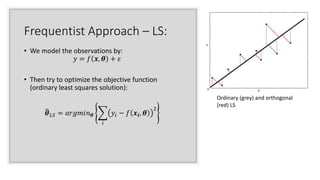
Frequentist Approach – LS:
• We model the observations by:
𝑦 = 𝑓 𝒙, 𝜽 + 𝜀
• Then try to optimize the objective function
(ordinary least squares solution):
𝜽 𝐿𝑆 = 𝑎𝑟𝑔𝑚𝑖𝑛 𝜽
𝑖
𝑦𝑖 − 𝑓 𝒙𝒊, 𝜽
2
Ordinary (grey) and orthogonal
(red) LS
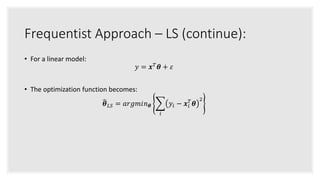
Frequentist Approach – LS (continue):
• For a linear model:
𝑦 = 𝒙 𝑇
𝜽 + 𝜀
• The optimization function becomes:
𝜽 𝐿𝑆 = 𝑎𝑟𝑔𝑚𝑖𝑛 𝜽
𝑖
𝑦𝑖 − 𝒙𝑖
𝑇
𝜽
2
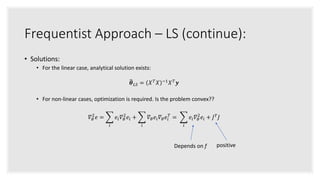
Frequentist Approach – LS (continue):
• Solutions:
• For the linear case, analytical solution exists:
𝜽 𝐿𝑆 = 𝑋 𝑇
𝑋 −1
𝑋 𝑇
𝒚
• For non-linear cases, optimization is required. Is the problem convex??
𝛻𝜃
2
𝑒 =
𝑖
𝑒𝑖 𝛻𝜃
2
𝑒𝑖 +
𝑖
𝛻𝜃 𝑒𝑖 𝛻𝜃 𝑒𝑖
𝑇
=
𝑖
𝑒𝑖 𝛻𝜃
2
𝑒𝑖 + 𝐽 𝑇 𝐽
positiveDepends on f
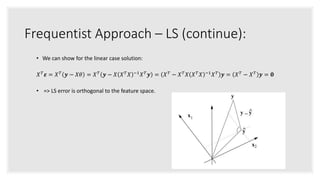
Frequentist Approach – LS (continue):
• We can show for the linear case solution:
𝑋 𝑇 𝜺 = 𝑋 𝑇 𝒚 − 𝑋𝜃 = 𝑋 𝑇 𝒚 − 𝑋 𝑋 𝑇 𝑋 −1 𝑋 𝑇 𝒚 = 𝑋 𝑇 − 𝑋 𝑇 𝑋 𝑋 𝑇 𝑋 −1 𝑋 𝑇 𝒚 = 𝑋 𝑇 − 𝑋 𝑇 𝒚 = 𝟎
• => LS error is orthogonal to the feature space.
Frequentist Approach – LS (continue):
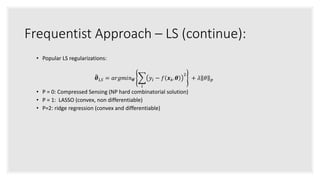
• Popular LS regularizations:
𝜽 𝐿𝑆 = 𝑎𝑟𝑔𝑚𝑖𝑛 𝜽
𝑖
𝑦𝑖 − 𝑓 𝒙𝒊, 𝜽
2
+ 𝜆 𝜃 𝑝
• P = 0: Compressed Sensing (NP hard combinatorial solution)
• P = 1: LASSO (convex, non differentiable)
• P=2: ridge regression (convex and differentiable)
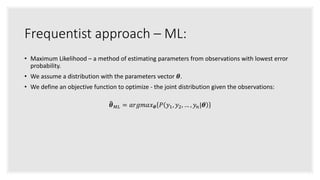
Frequentist approach – ML:
• Maximum Likelihood – a method of estimating parameters from observations with lowest error
probability.
• We assume a distribution with the parameters vector 𝜽.
• We define an objective function to optimize - the joint distribution given the observations:
𝜽 𝑀𝐿 = 𝑎𝑟𝑔𝑚𝑎𝑥 𝜽 𝑃 𝑦1, 𝑦2, … , 𝑦𝑛|𝜽
Frequentist approach – ML (continue):
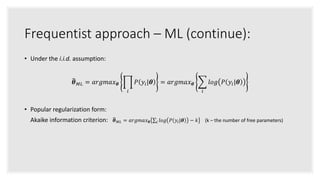
• Under the i.i.d. assumption:
𝜽 𝑀𝐿 = 𝑎𝑟𝑔𝑚𝑎𝑥 𝜽
𝑖
𝑃 𝑦𝑖|𝜽 = 𝑎𝑟𝑔𝑚𝑎𝑥 𝜽
𝑖
𝑙𝑜𝑔 𝑃 𝑦𝑖|𝜽
• Popular regularization form:
Akaike information criterion: 𝜽 𝑀𝐿 = 𝑎𝑟𝑔𝑚𝑎𝑥 𝜽 𝑖 𝑙𝑜𝑔 𝑃 𝑦𝑖|𝜽 − 𝑘 (k – the number of free parameters)
Frequentist approach - GLM:
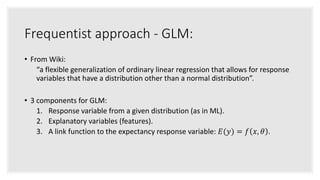
• From Wiki:
“a flexible generalization of ordinary linear regression that allows for response
variables that have a distribution other than a normal distribution”.
• 3 components for GLM:
1. Response variable from a given distribution (as in ML).
2. Explanatory variables (features).
3. A link function to the expectancy response variable: 𝐸(𝑦) = 𝑓 𝑥, 𝜃 .
Frequentist approach – GLM (continue):
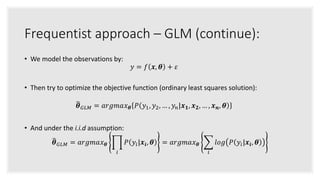
• We model the observations by:
𝑦 = 𝑓 𝒙, 𝜽 + 𝜀
• Then try to optimize the objective function (ordinary least squares solution):
𝜽 𝐺𝐿𝑀 = 𝑎𝑟𝑔𝑚𝑎𝑥 𝜽 𝑃 𝑦1, 𝑦2, … , 𝑦𝑛|𝒙 𝟏, 𝒙 𝟐, … , 𝒙 𝒏, 𝜽
• And under the i.i.d assumption:
𝜽 𝐺𝐿𝑀 = 𝑎𝑟𝑔𝑚𝑎𝑥 𝜽
𝑖
𝑃 𝑦𝑖|𝒙𝒊, 𝜽 = 𝑎𝑟𝑔𝑚𝑎𝑥 𝜽
𝑖
𝑙𝑜𝑔 𝑃 𝑦𝑖|𝒙𝒊, 𝜽
Frequentist approach – GLM (continue):
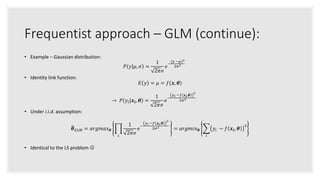
• Example – Gaussian distribution:
𝑃 𝑦|𝜇, 𝜎 =
1
2𝜋𝜎
𝑒
−
𝑦 −𝜇 2
2𝜎2
• Identity link function:
𝐸 𝑦 = 𝜇 = 𝑓 𝒙, 𝜽
→ 𝑃 𝑦𝑖|𝒙𝒊, 𝜽 =
1
2𝜋𝜎
𝑒
−
𝑦 𝑖 −𝑓 𝒙 𝒊,𝜽
2
2𝜎2
• Under i.i.d. assumption:
𝜽 𝐺𝐿𝑀 = 𝑎𝑟𝑔𝑚𝑎𝑥 𝜽
𝑖
1
2𝜋𝜎
𝑒
−
𝑦 𝑖 −𝑓 𝒙 𝒊,𝜽
2
2𝜎2
= 𝑎𝑟𝑔𝑚𝑖𝑛 𝜽
𝑖
𝑦𝑖 − 𝑓 𝒙𝒊, 𝜽
2
• Identical to the LS problem 
Frequentist approach – GLM (continue):
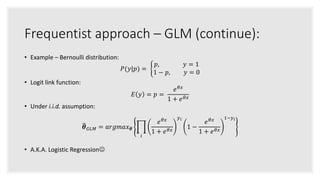
• Example – Bernoulli distribution:
𝑃(𝑦|𝑝) =
𝑝, 𝑦 = 1
1 − 𝑝, 𝑦 = 0
• Logit link function:
𝐸 𝑦 = 𝑝 =
𝑒 𝜃𝑥
1 + 𝑒 𝜃𝑥
• Under i.i.d. assumption:
𝜽 𝐺𝐿𝑀 = 𝑎𝑟𝑔𝑚𝑎𝑥 𝜽
𝑖
𝑒 𝜃𝑥
1 + 𝑒 𝜃𝑥
𝑦 𝑖
1 −
𝑒 𝜃𝑥
1 + 𝑒 𝜃𝑥
1−𝑦 𝑖
• A.K.A. Logistic Regression
Frequentist approach – GLM (continue):
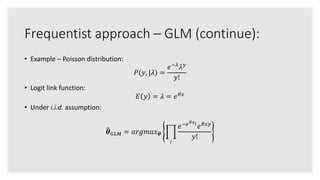
• Example – Poisson distribution:
𝑃(𝑦, |𝜆) =
𝑒−𝜆
𝜆 𝑦
𝑦!
• Logit link function:
𝐸 𝑦 = 𝜆 = 𝑒 𝜃𝑥
• Under i.i.d. assumption:
𝜽 𝐺𝐿𝑀 = 𝑎𝑟𝑔𝑚𝑎𝑥 𝜽
𝑖
𝑒−𝑒 𝜃𝑥 𝑖
𝑒 𝜃𝑥𝑦
𝑦!
Frequentist approach – GLM (continue):
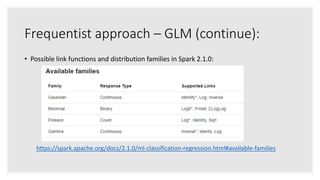
• Possible link functions and distribution families in Spark 2.1.0:
https://spark.apache.org/docs/2.1.0/ml-classification-regression.html#available-families
Bayesian approach - MMSE:
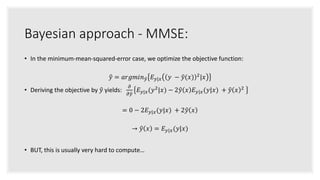
• In the minimum-mean-squared-error case, we optimize the objective function:
𝑦 = 𝑎𝑟𝑔𝑚𝑖𝑛 𝑦 𝐸 𝑦|𝑥 𝑦 − 𝑦(𝑥) 2|𝑥
• Deriving the objective by 𝑦 yields:
𝜕
𝜕 𝑦
𝐸 𝑦|𝑥(𝑦2
|𝑥) − 2 𝑦 𝑥 𝐸 𝑦|𝑥(𝑦|𝑥) + 𝑦 𝑥 2
= 0 − 2𝐸 𝑦|𝑥(𝑦|𝑥) + 2 𝑦 𝑥
→ 𝑦 𝑥 = 𝐸 𝑦|𝑥(𝑦|𝑥)
• BUT, this is usually very hard to compute…
Bayesian approach – MMSE (continue):
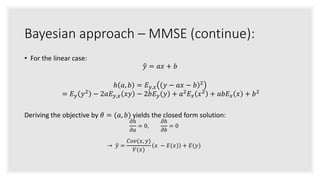
• For the linear case:
𝑦 = 𝑎𝑥 + 𝑏
ℎ 𝑎, 𝑏 = 𝐸 𝑦,𝑥 𝑦 − 𝑎𝑥 − 𝑏 2
= 𝐸 𝑦 𝑦2
− 2𝑎𝐸 𝑦,𝑥 𝑥𝑦 − 2𝑏𝐸 𝑦 𝑦 + 𝑎2
𝐸 𝑥 𝑥2
+ 𝑎𝑏𝐸 𝑥 𝑥 + 𝑏2
Deriving the objective by 𝜃 = (𝑎, 𝑏) yields the closed form solution:
𝜕ℎ
𝜕𝑎
= 0,
𝜕ℎ
𝜕𝑏
= 0
→ 𝑦 =
𝐶𝑜𝑣(𝑥, 𝑦)
𝑉(𝑥)
𝑥 − 𝐸(𝑥) + 𝐸(𝑦)
Bayesian approach - MMSE:
• By placing the general solution, we can see that:
𝐸 𝑦|𝑥 𝑦 − 𝑦 𝜃 ∗ 𝑥
= 𝐸 𝑦|𝑥 𝑦 − 𝐸 𝑦 𝑦 𝑥 ∗ 𝑥
= 𝐸 𝑦|𝑥 𝑦 ∗ 𝑥 − 𝐸 𝑦 𝑦 𝑥 ∗ 𝑥
= 0 (Bayes Law)
=> Orthogonality is preserved between the error and the features (similar to LS)
Bayesian approach - MAP:
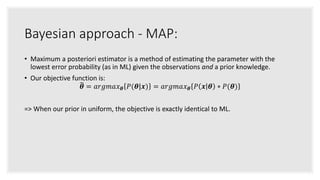
• Maximum a posteriori estimator is a method of estimating the parameter with the
lowest error probability (as in ML) given the observations and a prior knowledge.
• Our objective function is:
𝜽 = 𝑎𝑟𝑔𝑚𝑎𝑥 𝜽 𝑃(𝜽|𝒙) = 𝑎𝑟𝑔𝑚𝑎𝑥 𝜽 𝑃 𝒙 𝜽 ∗ 𝑃(𝜽)
=> When our prior in uniform, the objective is exactly identical to ML.

Intro to statistical signal processing

  • 1.
  • 2.
    Discussion Overview: • Bayesianvs frequentist approaches: • Conceptual differences • Frequentist approach: • Least-Squares • Maximum-Likelihood • GLM: • Gaussian regression example (and its identity with LS) • Bernoulli regression example (Logistic regression) • Poisson regression example • Bayesian approach: • MMSE • MAP • Online-learning algorithms: • Kalman filter • Perceptron • Winnow
  • 3.
    Bayesian vs frequentistapproaches • Frequentist: • Understand probability as a frequency of a ‘repeatable’ events. • Bayesian: • Understand probability as a measure of a person’s degree of belief in an event, given the information available.
  • 4.
    Frequentist Approach –LS: • We model the observations by: 𝑦 = 𝑓 𝒙, 𝜽 + 𝜀 • Then try to optimize the objective function (ordinary least squares solution): 𝜽 𝐿𝑆 = 𝑎𝑟𝑔𝑚𝑖𝑛 𝜽 𝑖 𝑦𝑖 − 𝑓 𝒙𝒊, 𝜽 2 Ordinary (grey) and orthogonal (red) LS
  • 5.
    Frequentist Approach –LS (continue): • For a linear model: 𝑦 = 𝒙 𝑇 𝜽 + 𝜀 • The optimization function becomes: 𝜽 𝐿𝑆 = 𝑎𝑟𝑔𝑚𝑖𝑛 𝜽 𝑖 𝑦𝑖 − 𝒙𝑖 𝑇 𝜽 2
  • 6.
    Frequentist Approach –LS (continue): • Solutions: • For the linear case, analytical solution exists: 𝜽 𝐿𝑆 = 𝑋 𝑇 𝑋 −1 𝑋 𝑇 𝒚 • For non-linear cases, optimization is required. Is the problem convex?? 𝛻𝜃 2 𝑒 = 𝑖 𝑒𝑖 𝛻𝜃 2 𝑒𝑖 + 𝑖 𝛻𝜃 𝑒𝑖 𝛻𝜃 𝑒𝑖 𝑇 = 𝑖 𝑒𝑖 𝛻𝜃 2 𝑒𝑖 + 𝐽 𝑇 𝐽 positiveDepends on f
  • 7.
    Frequentist Approach –LS (continue): • We can show for the linear case solution: 𝑋 𝑇 𝜺 = 𝑋 𝑇 𝒚 − 𝑋𝜃 = 𝑋 𝑇 𝒚 − 𝑋 𝑋 𝑇 𝑋 −1 𝑋 𝑇 𝒚 = 𝑋 𝑇 − 𝑋 𝑇 𝑋 𝑋 𝑇 𝑋 −1 𝑋 𝑇 𝒚 = 𝑋 𝑇 − 𝑋 𝑇 𝒚 = 𝟎 • => LS error is orthogonal to the feature space.
  • 8.
    Frequentist Approach –LS (continue): • Popular LS regularizations: 𝜽 𝐿𝑆 = 𝑎𝑟𝑔𝑚𝑖𝑛 𝜽 𝑖 𝑦𝑖 − 𝑓 𝒙𝒊, 𝜽 2 + 𝜆 𝜃 𝑝 • P = 0: Compressed Sensing (NP hard combinatorial solution) • P = 1: LASSO (convex, non differentiable) • P=2: ridge regression (convex and differentiable)
  • 9.
    Frequentist approach –ML: • Maximum Likelihood – a method of estimating parameters from observations with lowest error probability. • We assume a distribution with the parameters vector 𝜽. • We define an objective function to optimize - the joint distribution given the observations: 𝜽 𝑀𝐿 = 𝑎𝑟𝑔𝑚𝑎𝑥 𝜽 𝑃 𝑦1, 𝑦2, … , 𝑦𝑛|𝜽
  • 10.
    Frequentist approach –ML (continue): • Under the i.i.d. assumption: 𝜽 𝑀𝐿 = 𝑎𝑟𝑔𝑚𝑎𝑥 𝜽 𝑖 𝑃 𝑦𝑖|𝜽 = 𝑎𝑟𝑔𝑚𝑎𝑥 𝜽 𝑖 𝑙𝑜𝑔 𝑃 𝑦𝑖|𝜽 • Popular regularization form: Akaike information criterion: 𝜽 𝑀𝐿 = 𝑎𝑟𝑔𝑚𝑎𝑥 𝜽 𝑖 𝑙𝑜𝑔 𝑃 𝑦𝑖|𝜽 − 𝑘 (k – the number of free parameters)
  • 11.
    Frequentist approach -GLM: • From Wiki: “a flexible generalization of ordinary linear regression that allows for response variables that have a distribution other than a normal distribution”. • 3 components for GLM: 1. Response variable from a given distribution (as in ML). 2. Explanatory variables (features). 3. A link function to the expectancy response variable: 𝐸(𝑦) = 𝑓 𝑥, 𝜃 .
  • 12.
    Frequentist approach –GLM (continue): • We model the observations by: 𝑦 = 𝑓 𝒙, 𝜽 + 𝜀 • Then try to optimize the objective function (ordinary least squares solution): 𝜽 𝐺𝐿𝑀 = 𝑎𝑟𝑔𝑚𝑎𝑥 𝜽 𝑃 𝑦1, 𝑦2, … , 𝑦𝑛|𝒙 𝟏, 𝒙 𝟐, … , 𝒙 𝒏, 𝜽 • And under the i.i.d assumption: 𝜽 𝐺𝐿𝑀 = 𝑎𝑟𝑔𝑚𝑎𝑥 𝜽 𝑖 𝑃 𝑦𝑖|𝒙𝒊, 𝜽 = 𝑎𝑟𝑔𝑚𝑎𝑥 𝜽 𝑖 𝑙𝑜𝑔 𝑃 𝑦𝑖|𝒙𝒊, 𝜽
  • 13.
    Frequentist approach –GLM (continue): • Example – Gaussian distribution: 𝑃 𝑦|𝜇, 𝜎 = 1 2𝜋𝜎 𝑒 − 𝑦 −𝜇 2 2𝜎2 • Identity link function: 𝐸 𝑦 = 𝜇 = 𝑓 𝒙, 𝜽 → 𝑃 𝑦𝑖|𝒙𝒊, 𝜽 = 1 2𝜋𝜎 𝑒 − 𝑦 𝑖 −𝑓 𝒙 𝒊,𝜽 2 2𝜎2 • Under i.i.d. assumption: 𝜽 𝐺𝐿𝑀 = 𝑎𝑟𝑔𝑚𝑎𝑥 𝜽 𝑖 1 2𝜋𝜎 𝑒 − 𝑦 𝑖 −𝑓 𝒙 𝒊,𝜽 2 2𝜎2 = 𝑎𝑟𝑔𝑚𝑖𝑛 𝜽 𝑖 𝑦𝑖 − 𝑓 𝒙𝒊, 𝜽 2 • Identical to the LS problem 
  • 14.
    Frequentist approach –GLM (continue): • Example – Bernoulli distribution: 𝑃(𝑦|𝑝) = 𝑝, 𝑦 = 1 1 − 𝑝, 𝑦 = 0 • Logit link function: 𝐸 𝑦 = 𝑝 = 𝑒 𝜃𝑥 1 + 𝑒 𝜃𝑥 • Under i.i.d. assumption: 𝜽 𝐺𝐿𝑀 = 𝑎𝑟𝑔𝑚𝑎𝑥 𝜽 𝑖 𝑒 𝜃𝑥 1 + 𝑒 𝜃𝑥 𝑦 𝑖 1 − 𝑒 𝜃𝑥 1 + 𝑒 𝜃𝑥 1−𝑦 𝑖 • A.K.A. Logistic Regression
  • 15.
    Frequentist approach –GLM (continue): • Example – Poisson distribution: 𝑃(𝑦, |𝜆) = 𝑒−𝜆 𝜆 𝑦 𝑦! • Logit link function: 𝐸 𝑦 = 𝜆 = 𝑒 𝜃𝑥 • Under i.i.d. assumption: 𝜽 𝐺𝐿𝑀 = 𝑎𝑟𝑔𝑚𝑎𝑥 𝜽 𝑖 𝑒−𝑒 𝜃𝑥 𝑖 𝑒 𝜃𝑥𝑦 𝑦!
  • 16.
    Frequentist approach –GLM (continue): • Possible link functions and distribution families in Spark 2.1.0: https://spark.apache.org/docs/2.1.0/ml-classification-regression.html#available-families
  • 17.
    Bayesian approach -MMSE: • In the minimum-mean-squared-error case, we optimize the objective function: 𝑦 = 𝑎𝑟𝑔𝑚𝑖𝑛 𝑦 𝐸 𝑦|𝑥 𝑦 − 𝑦(𝑥) 2|𝑥 • Deriving the objective by 𝑦 yields: 𝜕 𝜕 𝑦 𝐸 𝑦|𝑥(𝑦2 |𝑥) − 2 𝑦 𝑥 𝐸 𝑦|𝑥(𝑦|𝑥) + 𝑦 𝑥 2 = 0 − 2𝐸 𝑦|𝑥(𝑦|𝑥) + 2 𝑦 𝑥 → 𝑦 𝑥 = 𝐸 𝑦|𝑥(𝑦|𝑥) • BUT, this is usually very hard to compute…
  • 18.
    Bayesian approach –MMSE (continue): • For the linear case: 𝑦 = 𝑎𝑥 + 𝑏 ℎ 𝑎, 𝑏 = 𝐸 𝑦,𝑥 𝑦 − 𝑎𝑥 − 𝑏 2 = 𝐸 𝑦 𝑦2 − 2𝑎𝐸 𝑦,𝑥 𝑥𝑦 − 2𝑏𝐸 𝑦 𝑦 + 𝑎2 𝐸 𝑥 𝑥2 + 𝑎𝑏𝐸 𝑥 𝑥 + 𝑏2 Deriving the objective by 𝜃 = (𝑎, 𝑏) yields the closed form solution: 𝜕ℎ 𝜕𝑎 = 0, 𝜕ℎ 𝜕𝑏 = 0 → 𝑦 = 𝐶𝑜𝑣(𝑥, 𝑦) 𝑉(𝑥) 𝑥 − 𝐸(𝑥) + 𝐸(𝑦)
  • 19.
    Bayesian approach -MMSE: • By placing the general solution, we can see that: 𝐸 𝑦|𝑥 𝑦 − 𝑦 𝜃 ∗ 𝑥 = 𝐸 𝑦|𝑥 𝑦 − 𝐸 𝑦 𝑦 𝑥 ∗ 𝑥 = 𝐸 𝑦|𝑥 𝑦 ∗ 𝑥 − 𝐸 𝑦 𝑦 𝑥 ∗ 𝑥 = 0 (Bayes Law) => Orthogonality is preserved between the error and the features (similar to LS)
  • 20.
    Bayesian approach -MAP: • Maximum a posteriori estimator is a method of estimating the parameter with the lowest error probability (as in ML) given the observations and a prior knowledge. • Our objective function is: 𝜽 = 𝑎𝑟𝑔𝑚𝑎𝑥 𝜽 𝑃(𝜽|𝒙) = 𝑎𝑟𝑔𝑚𝑎𝑥 𝜽 𝑃 𝒙 𝜽 ∗ 𝑃(𝜽) => When our prior in uniform, the objective is exactly identical to ML.

Editor's Notes

  • #4 Developed estimators / models based on a measurable frequency of events from repeated experiments. VS Develop estimators / models based on a state of knowledge held by an individual.
  • #10 Popular optimization of the objective is Expectation Maximization.
  • #11 Popular optimization of the objective is Expectation Maximization.
  • #12 Popular optimization of the objective is Expectation Maximization.