Ethics and
Accountability
Educ 611
MPA 617
Angelica T. Requina
CATEGORIES OF ETHICS
• DESCRIPTIVE ETHICS
-describing how people
behave/moral standards they claim
follow
What do people think is right?
• METAETHICS
-investigate where ethical principle
come from
What does "right" even mean?
• NORMATIVE ETHICS
-is concerned with classifying actions as
right and wrong without bias
How should people act?
• APPLIED ETHICS
-involves examining specifics
controversial issues
- most practical
How do we take moral knowledge and
put it into practice?
WHAT IS AN ETHICAL DILEMMA?
• Is a situation that requires
choosing a course of action.
• State of uncertainty or perplexity
especially as requiring a choice
between equally unfavourable
options
• How do you apply your ethics as a
teacher?
• How are the ethics of your
student?in your workplace?
• What are your good work ethics?
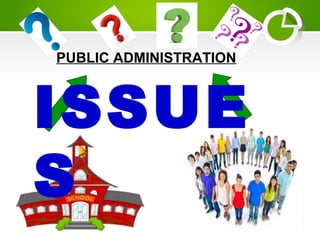
PUBLIC ADMINISTRATION
ISSUE
S
1987 Constitution; Article XI, Section 1
Public Office is a public trust. Public
officers and employees must at
all times be accountable to the people,
serve them with utmost responsibility,
integrity,
loyalty, and efficiency, act with
patriotism and justice, and lead modest
lives.
• Under a democracy such as in the
Philippines, the people’s fundamental faith
in the integrity of political institutions is
what holds the system together even under
the most difficult times.
• As Foster (1981) states: as the public
becomes better educated, they also become
more aware, more demanding, less
understanding, and less willing to accept
average performance
The Concept of Public Accountability
-The activities of civil servants and
public agencies must follow the will of
the people .
- The obligation of an individual/
organization to account for its
activities, accept responsibility for
them and to disclose the result in a
transparent manner
Eight norms of conduct
• Commitment to public interest
• Professionalism
• Justness and sincerity
• Political neutrality
• Responsiveness to the public
• Nationalism and patriotism
• Commitment to democracy
• Simple living
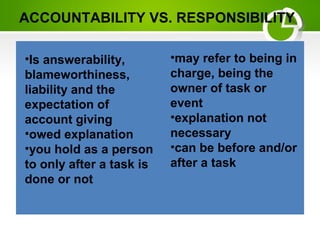
ACCOUNTABILITY VS. RESPONSIBILITY
•Is answerability,
blameworthiness,
liability and the
expectation of
account giving
•owed explanation
•you hold as a person
to only after a task is
done or not
•may refer to being in
charge, being the
owner of task or
event
•explanation not
necessary
•can be before and/or
after a task
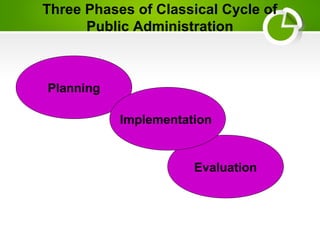
Three Phases of Classical Cycle of
Public Administration
–
Planning
Evaluation
Implementation
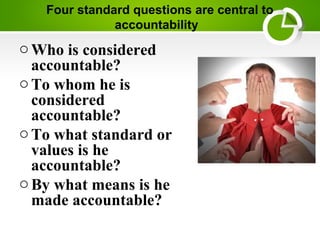
Four standard questions are central to
accountability
oWho is considered
accountable?
oTo whom he is
considered
accountable?
oTo what standard or
values is he
accountable?
oBy what means is he
made accountable?
Types of Accountability
Traditional Accountability
• Focuses on the regularity of fiscal
transactions and the faithful compliance to
legal requirements and administrative
policies (Mckinney1981:144 as cited by
Cariño 2003: 808)
• Concerns with efficiency and economy in
the use of public funds, property and
manpower (Tantuico 1982:8 as cited by
Cariño 2003:808);
• Determining if an act is within the
provisions of laws and regulations
Managerial Accountability
• These programs range from attempt at
work simplification and revision of forms
all the way to systems improvements and
agency reorganization;
2 Standards:
1. Economical operation -elimination or
reduction of needless costs.
2. Efficient operations-decreasing costs at a
lower rate than benefits
Program Accountability
• Whether the government unit is carrying
out only authorized activities or programs
in the manner contemplated and whether
they are accomplishing their objectives.
• Is concerned with the results of
government operations.
Social Accountability
• the main inquiry is whether the
administrative activities inspire general
confidence and secure what are widely
regarded as desirable social ends
(Normanton 1981:34 and cited by
Cariño 2003:911)
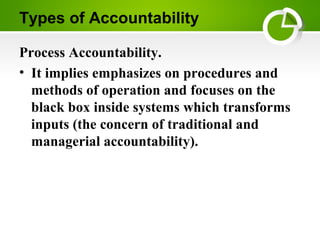
Types of Accountability
Process Accountability.
• It implies emphasizes on procedures and
methods of operation and focuses on the
black box inside systems which transforms
inputs (the concern of traditional and
managerial accountability).
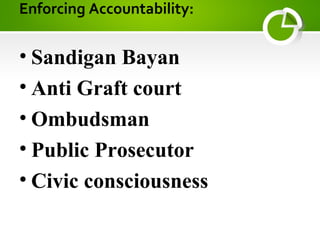
Enforcing Accountability:
• Sandigan Bayan
• Anti Graft court
• Ombudsman
• Public Prosecutor
• Civic consciousness
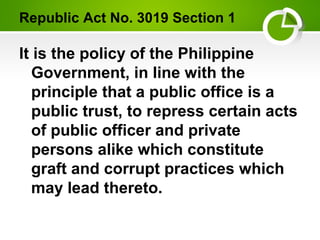
Republic Act No. 3019 Section 1
It is the policy of the Philippine
Government, in line with the
principle that a public office is a
public trust, to repress certain acts
of public officer and private
persons alike which constitute
graft and corrupt practices which
may lead thereto.
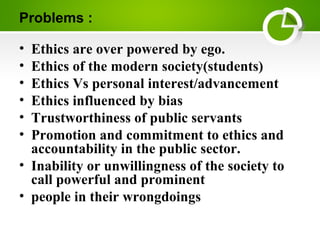
Problems :
• Ethics are over powered by ego.
• Ethics of the modern society(students)
• Ethics Vs personal interest/advancement
• Ethics influenced by bias
• Trustworthiness of public servants
• Promotion and commitment to ethics and
accountability in the public sector.
• Inability or unwillingness of the society to
call powerful and prominent
• people in their wrongdoings
Thank you!!

Ethics and Accountability

  • 1.
  • 3.
    CATEGORIES OF ETHICS •DESCRIPTIVE ETHICS -describing how people behave/moral standards they claim follow What do people think is right? • METAETHICS -investigate where ethical principle come from What does "right" even mean?
  • 4.
    • NORMATIVE ETHICS -isconcerned with classifying actions as right and wrong without bias How should people act? • APPLIED ETHICS -involves examining specifics controversial issues - most practical How do we take moral knowledge and put it into practice?
  • 5.
    WHAT IS ANETHICAL DILEMMA? • Is a situation that requires choosing a course of action. • State of uncertainty or perplexity especially as requiring a choice between equally unfavourable options
  • 6.
    • How doyou apply your ethics as a teacher? • How are the ethics of your student?in your workplace? • What are your good work ethics?
  • 7.
  • 8.
    1987 Constitution; ArticleXI, Section 1 Public Office is a public trust. Public officers and employees must at all times be accountable to the people, serve them with utmost responsibility, integrity, loyalty, and efficiency, act with patriotism and justice, and lead modest lives.
  • 9.
    • Under ademocracy such as in the Philippines, the people’s fundamental faith in the integrity of political institutions is what holds the system together even under the most difficult times. • As Foster (1981) states: as the public becomes better educated, they also become more aware, more demanding, less understanding, and less willing to accept average performance
  • 10.
    The Concept ofPublic Accountability -The activities of civil servants and public agencies must follow the will of the people . - The obligation of an individual/ organization to account for its activities, accept responsibility for them and to disclose the result in a transparent manner
  • 11.
    Eight norms ofconduct • Commitment to public interest • Professionalism • Justness and sincerity • Political neutrality • Responsiveness to the public • Nationalism and patriotism • Commitment to democracy • Simple living
  • 12.
    ACCOUNTABILITY VS. RESPONSIBILITY •Isanswerability, blameworthiness, liability and the expectation of account giving •owed explanation •you hold as a person to only after a task is done or not •may refer to being in charge, being the owner of task or event •explanation not necessary •can be before and/or after a task
  • 13.
    Three Phases ofClassical Cycle of Public Administration – Planning Evaluation Implementation
  • 14.
    Four standard questionsare central to accountability oWho is considered accountable? oTo whom he is considered accountable? oTo what standard or values is he accountable? oBy what means is he made accountable?
  • 15.
  • 16.
    Traditional Accountability • Focuseson the regularity of fiscal transactions and the faithful compliance to legal requirements and administrative policies (Mckinney1981:144 as cited by Cariño 2003: 808) • Concerns with efficiency and economy in the use of public funds, property and manpower (Tantuico 1982:8 as cited by Cariño 2003:808); • Determining if an act is within the provisions of laws and regulations
  • 17.
    Managerial Accountability • Theseprograms range from attempt at work simplification and revision of forms all the way to systems improvements and agency reorganization; 2 Standards: 1. Economical operation -elimination or reduction of needless costs. 2. Efficient operations-decreasing costs at a lower rate than benefits
  • 18.
    Program Accountability • Whetherthe government unit is carrying out only authorized activities or programs in the manner contemplated and whether they are accomplishing their objectives. • Is concerned with the results of government operations.
  • 19.
    Social Accountability • themain inquiry is whether the administrative activities inspire general confidence and secure what are widely regarded as desirable social ends (Normanton 1981:34 and cited by Cariño 2003:911)
  • 20.
    Types of Accountability ProcessAccountability. • It implies emphasizes on procedures and methods of operation and focuses on the black box inside systems which transforms inputs (the concern of traditional and managerial accountability).
  • 21.
    Enforcing Accountability: • SandiganBayan • Anti Graft court • Ombudsman • Public Prosecutor • Civic consciousness
  • 22.
    Republic Act No.3019 Section 1 It is the policy of the Philippine Government, in line with the principle that a public office is a public trust, to repress certain acts of public officer and private persons alike which constitute graft and corrupt practices which may lead thereto.
  • 23.
    Problems : • Ethicsare over powered by ego. • Ethics of the modern society(students) • Ethics Vs personal interest/advancement • Ethics influenced by bias • Trustworthiness of public servants • Promotion and commitment to ethics and accountability in the public sector. • Inability or unwillingness of the society to call powerful and prominent • people in their wrongdoings
  • 28.