Prof. Josefina B. Bitonio
PA 101 Local Governance and
Administration
Coun. Margiie Lou Humilde
Presenter
 Good governance
 Framework of Governance
 Overview of Decentralization in the
Philippines.
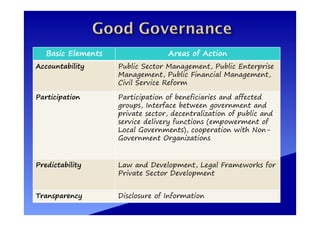
Basic Elements Areas of Action
Accountability Public Sector Management, Public Enterprise
Management, Public Financial Management,
Civil Service Reform
Participation Participation of beneficiaries and affected
groups, Interface between government and
private sector, decentralization of public and
service delivery functions (empowerment of
Local Governments), cooperation with Non-
Government Organizations
Predictability Law and Development, Legal Frameworks for
Private Sector Development
Transparency Disclosure of Information
GOOD
GOVERNANCE
Consensus
Oriented
Participatory
Follows the
rule of the
Law
Accountable
Effective and
Efficient
Transparent
Responsive
Equitable and
Inclusive
Status Quo is
UNACCEPTABLE!!!!!!
Need to be angry about injustice!
But also recognize that something can be
done about it that’s why we are all here
studying good governance
Need to be hopeful
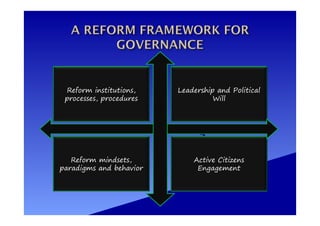
Need for REFORM
Reform institutions,
processes, procedures
Leadership and Political
Will
Reform mindsets,
paradigms and behavior
Active Citizens
Engagement
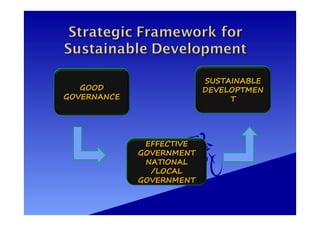
GOOD
GOVERNANCE
EFFECTIVE
GOVERNMENT
NATIONAL
/LOCAL
GOVERNMENT
SUSTAINABLE
DEVELOPTMEN
T
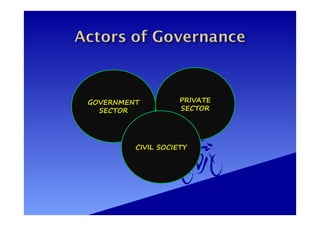
GOVERNMENT
SECTOR
PRIVATE
SECTOR
CIVIL SOCIETY
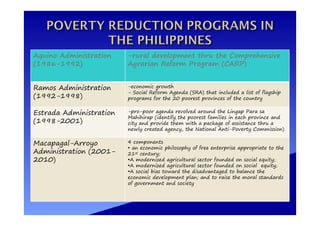
Aquino Administration
(1986-1992)
-rural development thru the Comprehensive
Agrarian Reform Program (CARP)
Ramos Administration
(1992-1998)
-economic growth
- Social Reform Agenda (SRA) that included a list of flagship
programs for the 20 poorest provinces of the country
Estrada Administration
(1998-2001)
-pro-poor agenda revolved around the Lingap Para sa
Mahihirap (identify the poorest families in each province and
city and provide them with a package of assistance thru a
newly created agency, the National Anti-Poverty Commission)
Macapagal-Arroyo
Administration (2001-
2010)
4 components
• an economic philosophy of free enterprise appropriate to the
21st century;
•A modernized agricultural sector founded on social equity;
•A social bias toward the disadvantaged to balance the
economic development plan; and to raise the moral standards
of government and society
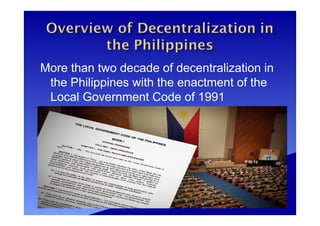
More than two decade of decentralization in
the Philippines with the enactment of the
Local Government Code of 1991
 Centralized set up unable to respond to
the demands
 Decentralization within the context of
overall efforts to democratize the polity
 LGC of 1991 brought about massive
changes at the local government level
 Dispersal of power and autonomy from
center to local
 Dispersal of power and autonomy from
center to local
 Access to government institutions
 Less government-engage private sector
and civil society in governance
 Recognize the key role of LGU in poverty
reduction and service delivery and the
attainment of the MDGs
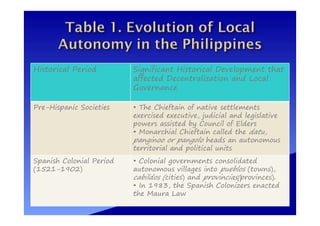
Historical Period Significant Historical Development that
affected Decentralization and Local
Governance
Pre-Hispanic Societies • The Chieftain of native settlements
exercised executive, judicial and legislative
powers assisted by Council of Elders
• Monarchial Chieftain called the datu,
panginoo or pangolo heads an autonomous
territorial and political units
Spanish Colonial Period
(1521-1902)
• Colonial governments consolidated
autonomous villages into pueblos (towns),
cabildos (cities) and provincias(provinces).
• In 1983, the Spanish Colonizers enacted
the Maura Law
 Access to government institutions
 Less government-engage private sector and
civil society in governance
 Recognize the key role of LGU in poverty
reduction and service delivery and the
attainment of the MDGs
 Enable local governments become competitive
in the international market
 Decentralization a basic pillar of good
governance
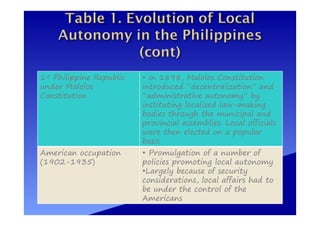
1st Philippine Republic
under Malolos
Constitution
• In 1898, Malolos Constitution
introduced “decentralization” and
“administrative autonomy” by
instituting localized law-making
bodies through the municipal and
provincial assemblies. Local officials
were then elected on a popular
basis
American occupation
(1902-1935)
• Promulgation of a number of
policies promoting local autonomy
•Largely because of security
considerations, local affairs had to
be under the control of the
Americans
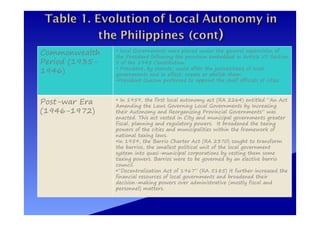
Commonwealth
Period (1935-
1946)
• local Governments were placed under the general supervision of
the President following the provision embedded in Article VII Section
II of the 1945 Constitution.
• President, by statute, could after the jurisdictions of local
governments and in effect, create or abolish them
•President Quezon preferred to appoint the chief officials of cities
Post-war Era
(1946-1972)
• In 1959, the first local autonomy act (RA 2264) entitled “An Act
Amending the Laws Governing Local Governments by Increasing
their Autonomy and Reorganizing Provincial Governments” was
enacted. This act vested in City and municipal governments greater
fiscal, planning and regulatory powers. It broadened the taxing
powers of the cities and municipalities within the framework of
national taxing laws.
•In 1959, the Barrio Charter Act (RA 2370) sought to transform
the barrios, the smallest political unit of the local government
system into quasi-municipal corporations by vesting them some
taxing powers. Barrios were to be governed by an elective barrio
council.
•“Decentralization Act of 1967” (RA 5185) It further increased the
financial resources of local governments and broadened their
decision-making powers over administrative (mostly fiscal and
personnel) matters.
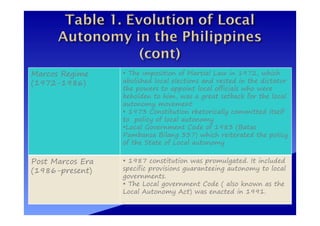
Marcos Regime
(1972-1986)
• The imposition of Martial Law in 1972, which
abolished local elections and vested in the dictator
the powers to appoint local officials who were
beholden to him, was a great setback for the local
autonomy movement
• 1973 Constitution rhetorically committed itself
to policy of local autonomy
•Local Government Code of 1983 (Batas
Pambansa Bilang 337) which reiterated the policy
of the State of Local autonomy
Post Marcos Era
(1986-present)
• 1987 constitution was promulgated. It included
specific provisions guaranteeing autonomy to local
governments.
• The Local government Code ( also known as the
Local Autonomy Act) was enacted in 1991.
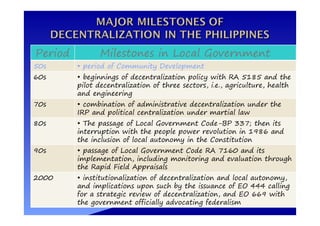
Period Milestones in Local Government
50s • period of Community Development
60s • beginnings of decentralization policy with RA 5185 and the
pilot decentralization of three sectors, i.e., agriculture, health
and engineering
70s • combination of administrative decentralization under the
IRP and political centralization under martial law
80s • The passage of Local Government Code-BP 337; then its
interruption with the people power revolution in 1986 and
the inclusion of local autonomy in the Constitution
90s • passage of Local Government Code RA 7160 and its
implementation, including monitoring and evaluation through
the Rapid Field Appraisals
2000 • institutionalization of decentralization and local autonomy,
and implications upon such by the issuance of EO 444 calling
for a strategic review of decentralization, and EO 669 with
the government officially advocating federalism
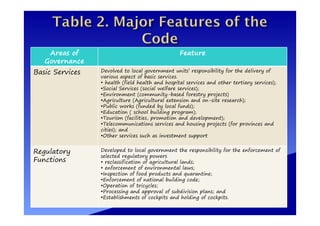
Areas of
Governance
Feature
Basic Services Devolved to local government units’ responsibility for the delivery of
various aspect of basic services.
• health (field health and hospital services and other tertiary services);
•Social Services (social welfare services);
•Environment (community-based forestry projects)
•Agriculture (Agricultural extension and on-site research);
•Public works (funded by local funds);
•Education ( school building program);
•Tourism (facilities, promotion and development);
•Telecommunications services and housing projects (for provinces and
cities); and
•Other services such as investment support
Regulatory
Functions
Developed to local government the responsibility for the enforcement of
selected regulatory powers
• reclassification of agricultural lands;
• enforcement of environmental laws;
•Inspection of food products and quarantine;
•Enforcement of national building code;
•Operation of tricycles;
•Processing and approval of subdivision plans; and
•Establishments of cockpits and holding of cockpits.
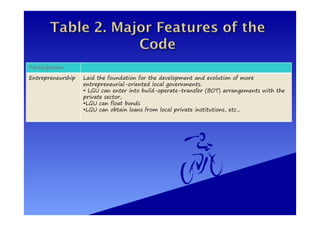
Participation
Entrepreneurship Laid the foundation for the development and evolution of more
entrepreneurial-oriented local governments.
• LGU can enter into build-operate-transfer (BOT) arrangements with the
private sector,
•LGU can float bonds
•LGU can obtain loans from local private institutions, etc.,
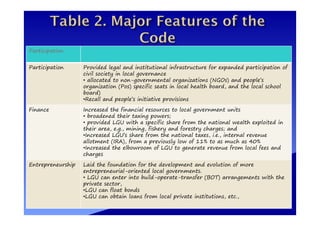
Participation
Participation Provided legal and institutional infrastructure for expanded participation of
civil society in local governance
• allocated to non-governmental organizations (NGOs) and people’s
organization (Pos) specific seats in local health board, and the local school
board)
•Recall and people’s initiative provisions
Finance Increased the financial resources to local government units
• broadened their taxing powers;
• provided LGU with a specific share from the national wealth exploited in
their area, e.g., mining, fishery and forestry charges; and
•Increased LGU’s share from the national taxes, i.e., internal revenue
allotment (IRA), from a previously low of 11% to as much as 40%
•Increased the elbowroom of LGU to generate revenue from local fees and
charges
Entrepreneurship Laid the foundation for the development and evolution of more
entrepreneurial-oriented local governments.
• LGU can enter into build-operate-transfer (BOT) arrangements with the
private sector,
•LGU can float bonds
•LGU can obtain loans from local private institutions, etc.,
Decentralization and Local Autonomy

Decentralization and Local Autonomy

  • 1.
    Prof. Josefina B.Bitonio PA 101 Local Governance and Administration Coun. Margiie Lou Humilde Presenter
  • 2.
     Good governance Framework of Governance  Overview of Decentralization in the Philippines.
  • 3.
    Basic Elements Areasof Action Accountability Public Sector Management, Public Enterprise Management, Public Financial Management, Civil Service Reform Participation Participation of beneficiaries and affected groups, Interface between government and private sector, decentralization of public and service delivery functions (empowerment of Local Governments), cooperation with Non- Government Organizations Predictability Law and Development, Legal Frameworks for Private Sector Development Transparency Disclosure of Information
  • 4.
    GOOD GOVERNANCE Consensus Oriented Participatory Follows the rule ofthe Law Accountable Effective and Efficient Transparent Responsive Equitable and Inclusive
  • 5.
    Status Quo is UNACCEPTABLE!!!!!! Needto be angry about injustice! But also recognize that something can be done about it that’s why we are all here studying good governance Need to be hopeful Need for REFORM
  • 6.
    Reform institutions, processes, procedures Leadershipand Political Will Reform mindsets, paradigms and behavior Active Citizens Engagement
  • 7.
  • 8.
  • 9.
    Aquino Administration (1986-1992) -rural developmentthru the Comprehensive Agrarian Reform Program (CARP) Ramos Administration (1992-1998) -economic growth - Social Reform Agenda (SRA) that included a list of flagship programs for the 20 poorest provinces of the country Estrada Administration (1998-2001) -pro-poor agenda revolved around the Lingap Para sa Mahihirap (identify the poorest families in each province and city and provide them with a package of assistance thru a newly created agency, the National Anti-Poverty Commission) Macapagal-Arroyo Administration (2001- 2010) 4 components • an economic philosophy of free enterprise appropriate to the 21st century; •A modernized agricultural sector founded on social equity; •A modernized agricultural sector founded on social equity; •A social bias toward the disadvantaged to balance the economic development plan; and to raise the moral standards of government and society
  • 11.
    More than twodecade of decentralization in the Philippines with the enactment of the Local Government Code of 1991
  • 12.
     Centralized setup unable to respond to the demands  Decentralization within the context of overall efforts to democratize the polity  LGC of 1991 brought about massive changes at the local government level  Dispersal of power and autonomy from center to local
  • 13.
     Dispersal ofpower and autonomy from center to local  Access to government institutions  Less government-engage private sector and civil society in governance  Recognize the key role of LGU in poverty reduction and service delivery and the attainment of the MDGs
  • 15.
    Historical Period SignificantHistorical Development that affected Decentralization and Local Governance Pre-Hispanic Societies • The Chieftain of native settlements exercised executive, judicial and legislative powers assisted by Council of Elders • Monarchial Chieftain called the datu, panginoo or pangolo heads an autonomous territorial and political units Spanish Colonial Period (1521-1902) • Colonial governments consolidated autonomous villages into pueblos (towns), cabildos (cities) and provincias(provinces). • In 1983, the Spanish Colonizers enacted the Maura Law
  • 16.
     Access togovernment institutions  Less government-engage private sector and civil society in governance  Recognize the key role of LGU in poverty reduction and service delivery and the attainment of the MDGs  Enable local governments become competitive in the international market  Decentralization a basic pillar of good governance
  • 17.
    1st Philippine Republic underMalolos Constitution • In 1898, Malolos Constitution introduced “decentralization” and “administrative autonomy” by instituting localized law-making bodies through the municipal and provincial assemblies. Local officials were then elected on a popular basis American occupation (1902-1935) • Promulgation of a number of policies promoting local autonomy •Largely because of security considerations, local affairs had to be under the control of the Americans
  • 18.
    Commonwealth Period (1935- 1946) • localGovernments were placed under the general supervision of the President following the provision embedded in Article VII Section II of the 1945 Constitution. • President, by statute, could after the jurisdictions of local governments and in effect, create or abolish them •President Quezon preferred to appoint the chief officials of cities Post-war Era (1946-1972) • In 1959, the first local autonomy act (RA 2264) entitled “An Act Amending the Laws Governing Local Governments by Increasing their Autonomy and Reorganizing Provincial Governments” was enacted. This act vested in City and municipal governments greater fiscal, planning and regulatory powers. It broadened the taxing powers of the cities and municipalities within the framework of national taxing laws. •In 1959, the Barrio Charter Act (RA 2370) sought to transform the barrios, the smallest political unit of the local government system into quasi-municipal corporations by vesting them some taxing powers. Barrios were to be governed by an elective barrio council. •“Decentralization Act of 1967” (RA 5185) It further increased the financial resources of local governments and broadened their decision-making powers over administrative (mostly fiscal and personnel) matters.
  • 19.
    Marcos Regime (1972-1986) • Theimposition of Martial Law in 1972, which abolished local elections and vested in the dictator the powers to appoint local officials who were beholden to him, was a great setback for the local autonomy movement • 1973 Constitution rhetorically committed itself to policy of local autonomy •Local Government Code of 1983 (Batas Pambansa Bilang 337) which reiterated the policy of the State of Local autonomy Post Marcos Era (1986-present) • 1987 constitution was promulgated. It included specific provisions guaranteeing autonomy to local governments. • The Local government Code ( also known as the Local Autonomy Act) was enacted in 1991.
  • 20.
    Period Milestones inLocal Government 50s • period of Community Development 60s • beginnings of decentralization policy with RA 5185 and the pilot decentralization of three sectors, i.e., agriculture, health and engineering 70s • combination of administrative decentralization under the IRP and political centralization under martial law 80s • The passage of Local Government Code-BP 337; then its interruption with the people power revolution in 1986 and the inclusion of local autonomy in the Constitution 90s • passage of Local Government Code RA 7160 and its implementation, including monitoring and evaluation through the Rapid Field Appraisals 2000 • institutionalization of decentralization and local autonomy, and implications upon such by the issuance of EO 444 calling for a strategic review of decentralization, and EO 669 with the government officially advocating federalism
  • 21.
    Areas of Governance Feature Basic ServicesDevolved to local government units’ responsibility for the delivery of various aspect of basic services. • health (field health and hospital services and other tertiary services); •Social Services (social welfare services); •Environment (community-based forestry projects) •Agriculture (Agricultural extension and on-site research); •Public works (funded by local funds); •Education ( school building program); •Tourism (facilities, promotion and development); •Telecommunications services and housing projects (for provinces and cities); and •Other services such as investment support Regulatory Functions Developed to local government the responsibility for the enforcement of selected regulatory powers • reclassification of agricultural lands; • enforcement of environmental laws; •Inspection of food products and quarantine; •Enforcement of national building code; •Operation of tricycles; •Processing and approval of subdivision plans; and •Establishments of cockpits and holding of cockpits.
  • 22.
    Participation Entrepreneurship Laid thefoundation for the development and evolution of more entrepreneurial-oriented local governments. • LGU can enter into build-operate-transfer (BOT) arrangements with the private sector, •LGU can float bonds •LGU can obtain loans from local private institutions, etc.,
  • 23.
    Participation Participation Provided legaland institutional infrastructure for expanded participation of civil society in local governance • allocated to non-governmental organizations (NGOs) and people’s organization (Pos) specific seats in local health board, and the local school board) •Recall and people’s initiative provisions Finance Increased the financial resources to local government units • broadened their taxing powers; • provided LGU with a specific share from the national wealth exploited in their area, e.g., mining, fishery and forestry charges; and •Increased LGU’s share from the national taxes, i.e., internal revenue allotment (IRA), from a previously low of 11% to as much as 40% •Increased the elbowroom of LGU to generate revenue from local fees and charges Entrepreneurship Laid the foundation for the development and evolution of more entrepreneurial-oriented local governments. • LGU can enter into build-operate-transfer (BOT) arrangements with the private sector, •LGU can float bonds •LGU can obtain loans from local private institutions, etc.,