Integrated Health Risk Management in Developing Areas GRF One Health Summit 2012 Davos, Switzerland  19 th  to 22 nd  February, 2012 Andrew Collins  Disaster and Development Centre (DDC) Northumbria University, UK [email_address] www.northumbria.ac.uk/ddc
Background Environment, Health and Population Displacement  -  hazard, vulnerability and context Infectious Disease Risk Management (IDRM) –  assessment of ecological and social indicators to guide intervention strategies Health Ecology for Health Security –  concept delivery Health Security for Disaster Resilience -  grounded  From Resilience to Wellbeing –  concept delivery UNICEF
Some key points Integration reveals complexity, uncertainty ... and opportunity Pathogens, People, Places, Political Economy, Processes, Perception, Personality (7 P’s +) ... and Intervention Strategies Emergent and unacceptable resurgent risks Heath risk reduction in disaster and development contexts – i.e. for global crises mitigation and during ‘normal’ life Caveat:  The variable ecologies of health security.
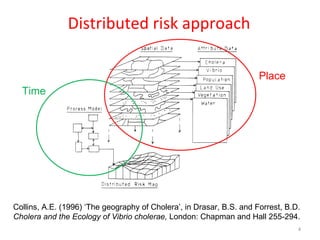
Distributed risk approach Collins, A.E. (1996) ‘The geography of Cholera’, in Drasar, B.S. and Forrest, B.D.  Cholera and the Ecology of Vibrio cholerae,  London: Chapman and Hall 255-294. Place Time
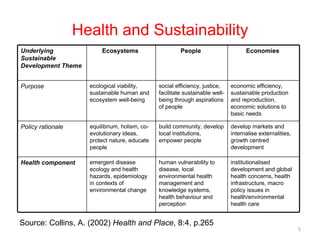
Health and Sustainability Source: Collins, A. (2002)  Health and Place , 8:4, p.265  Underlying Sustainable Development Theme Ecosystems   People   Economies   Purpose   ecological viability, sustainable human and ecosystem well-being  social efficiency, justice, facilitate sustainable well-being through aspirations of people  economic efficiency, sustainable production and reproduction, economic solutions to basic needs  Policy rationale   equilibrium, holism, co-evolutionary ideas, protect nature, educate people  build community, develop local institutions, empower people  develop markets and internalise externalities, growth centred development  Health component   emergent disease ecology and health hazards, epidemiology in contexts of environmental change  human vulnerability to disease, local environmental health management and knowledge systems, health behaviour and perception institutionalised development and global health concerns, health infrastructure, macro policy issues in health/environmental health care
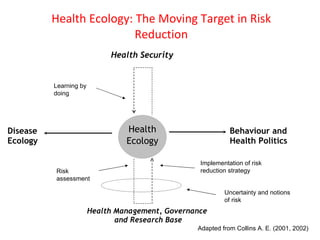
Health Ecology: The Moving Target in Risk Reduction Uncertainty and notions of risk Adapted from Collins A. E. (2001, 2002) Implementation of risk reduction strategy Risk assessment Learning by doing
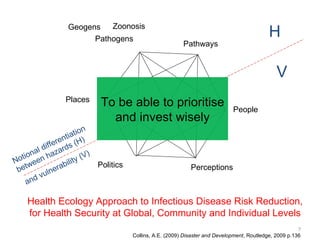
Pathogens People Perceptions Politics Places Pathways Health Ecology Approach to Infectious Disease Risk Reduction, for Health Security at Global, Community and Individual Levels Notional differentiation between hazards (H) and vulnerability (V) H V Geogens Collins, A.E. (2009)  Disaster and Development , Routledge, 2009 p.136 Zoonosis To be able to prioritise and invest wisely
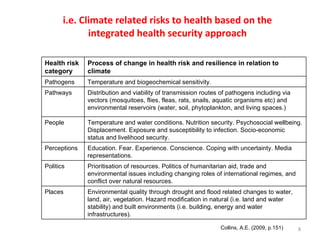
i.e. Climate related risks to health based on the integrated health security approach Collins, A.E. (2009, p.151) Health risk category Process of change in health risk and resilience in relation to climate Pathogens Temperature and biogeochemical sensitivity.  Pathways Distribution and viability of transmission routes of pathogens including via vectors (mosquitoes, flies, fleas, rats, snails, aquatic organisms etc) and environmental reservoirs (water, soil, phytoplankton, and living spaces.) People Temperature and water conditions. Nutrition security. Psychosocial wellbeing. Displacement. Exposure and susceptibility to infection. Socio-economic status and livelihood security. Perceptions Education. Fear. Experience. Conscience. Coping with uncertainty. Media representations. Politics Prioritisation of resources. Politics of humanitarian aid, trade and environmental issues including changing roles of international regimes, and conflict over natural resources. Places Environmental quality through drought and flood related changes to water, land, air, vegetation. Hazard modification in natural (i.e. land and water stability) and built environments (i.e. building, energy and water infrastructures).
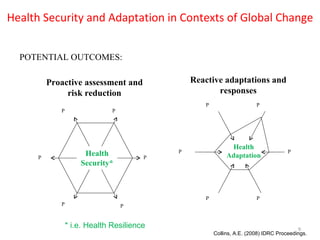
Health Security and Adaptation in Contexts of Global Change Collins, A.E. (2008) IDRC Proceedings. * i.e. Health Resilience  P P P P P P Health Security* Proactive assessment and risk reduction P P P P P P Health Adaptation Reactive adaptations and responses POTENTIAL OUTCOMES:
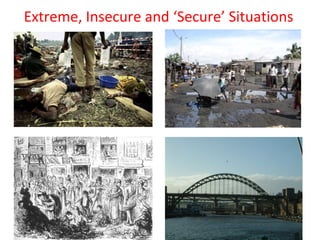
Extreme, Insecure and ‘Secure’ Situations
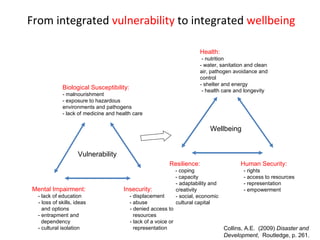
From integrated  vulnerability  to integrated  wellbeing   Collins, A.E.  (2009)  Disaster and Development ,  Routledge, p. 261. Biological Susceptibility: - malnourishment - exposure to hazardous environments and pathogens - lack of medicine and health care Vulnerability Wellbeing Insecurity: - displacement - abuse - denied access to resources - lack of a voice or representation Mental Impairment: - lack of education - loss of skills, ideas and options - entrapment and dependency - cultural isolation Health: - nutrition - water, sanitation and clean  air, pathogen avoidance and control - shelter and energy - health care and longevity Resilience: - coping - capacity - adaptability and creativity - social, economic cultural capital Human Security: - rights - access to resources - representation - empowerment
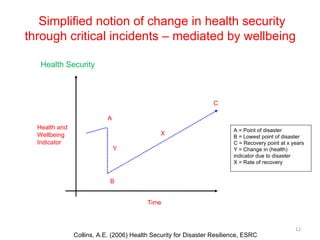
A = Point of disaster B = Lowest point of disaster C = Recovery point at x years Y = Change in (health) indicator due to disaster X = Rate of recovery A Y B X C Simplified notion of change in health security through critical incidents – mediated by wellbeing  Health Security Collins, A.E. (2006) Health Security for Disaster Resilience, ESRC Time Health and Wellbeing Indicator
Added Rationale Pathogenic adaptations in relation to global change are not fully understood and to a large extent still have to be regarded as unpredictable. It is therefore important to not neglect research into human vulnerability, coping and resilience, where more certain links to health risk may be understood and reduced. One Health, One Planet, One Future  provides an important framework of inter-related human, animal and ecosystem health against which this can be assessed and acted upon.
Health Security and Disaster Resilience: One Health? i.e. Health ecology for health security in disaster and development –  i.e.   Integration i.e. Health risk reduction –  i.e. Processes of change i.e. Health security through wellbeing –  i.e.   Offsetting
Common causes of health insecurity Resource competition Population and migration issues Inadequacy of the international health architecture Threats to the food supply from a variety of sources (including crop failure, over fishing, trade issues; armed conflict) Environmental degradation and pollutants Urbanisation/industrialisation It was noted that many of the drivers of health insecurity are closely linked.  RCUK Global Uncertainties Programme (2008)
Definition of Health Security People’s resilience to physical and mental stresses or shocks, reduction of poverty and ill-health and presence of basic rights.  (ESRC Health Security Project – Bangladesh) People being less likely to be overwhelmed by illness before, during and after a disruptive event. “ Protecting vital freedom. It means protecting people from critical and pervasive threats and situation and building on their strengths and aspirations. It also means creating systems that give people building blocks of survival, dignity and livelihood. Human security connects different types of freedom, freedom from want, freedom from fear and freedom to take actions on one’s own behalf.”  (Commission on Human Security, 2003)
Integrated (Community) Disease Risk Reduction (IDRR) Methodology Reduce uncertainty through comprehensive disease risk assessments Participation, appropriate frameworks, monitoring, evaluation of relative causality To know who, when, where, and the circumstances of changes in hazards, vulnerability and capacity Empirical verification of disease hazard Community engagement Empower people Sensitise institutions Delineate responsibilities of the state Legislate rights of individuals, and responsibilities of informal and private sectors
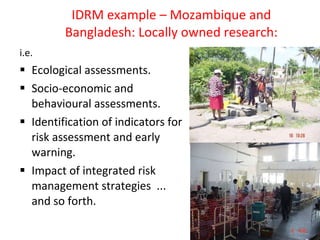
IDRM example – Mozambique and Bangladesh: Locally owned research: i.e. Ecological assessments.  Socio-economic and behavioural assessments. Identification of indicators for risk assessment and early warning. Impact of integrated risk management strategies  ... and so forth.
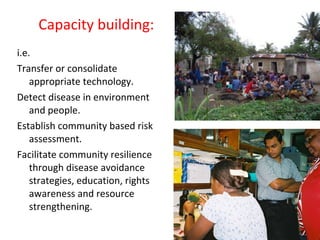
Capacity building: i.e. Transfer or consolidate appropriate technology. Detect disease in environment and people. Establish community based risk assessment. Facilitate community resilience through disease avoidance strategies, education, rights awareness and resource strengthening.
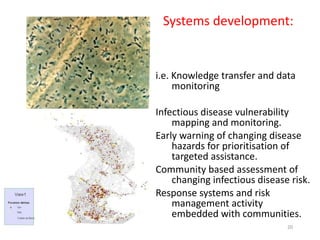
Systems development: i.e. Knowledge transfer and data monitoring Infectious disease vulnerability mapping and monitoring.  Early warning of changing disease hazards for prioritisation of targeted assistance.  Community based assessment of changing infectious disease risk. Response systems and risk management activity embedded with communities.
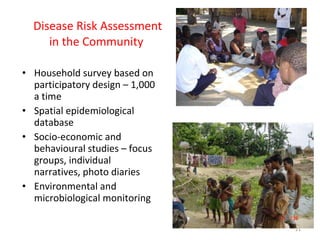
Disease Risk Assessment in the Community  Household survey based on participatory design – 1,000 a time Spatial epidemiological database Socio-economic and behavioural studies – focus groups, individual narratives, photo diaries Environmental and microbiological monitoring
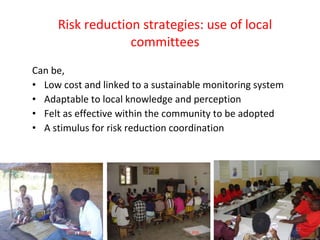
Risk reduction strategies: use of local committees Can be, Low cost and linked to a sustainable monitoring system Adaptable to local knowledge and perception Felt as effective within the community to be adopted A stimulus for risk reduction coordination
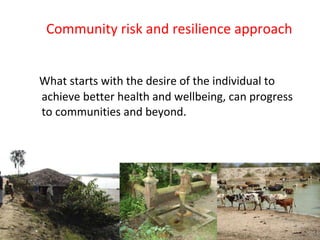
Community risk and resilience approach What starts with the desire of the individual to achieve better health and wellbeing, can progress to communities and beyond.
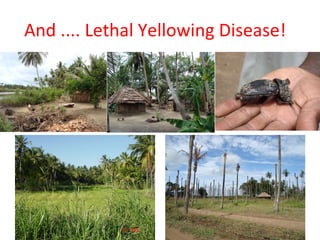
And .... Lethal Yellowing Disease!
Some further key points:  Health risks don’t just ‘spread’ - pathogens, people and places change Not possible to predict, but can risk assess to enable adjustments with uncertainty As prevention is cheaper than cure, fight for investment during ‘non-crises’ The predictable should not gain ‘acceptability’ – i.e. danger of entrenched ‘normalised’ health burdens  Behavioural interventions are also structural Offsetting of health impacts with investments in wellbeing  - human, animal, ecosystem
Challenge Health security for disaster resilience and sustainable development: One Health Integrated health risk reduction through  proactive human ecological perspectives . This progresses because people interact with and adapt to hazards, manage risks, demand rights, develop resilience and secure livelihood niches. However, supportive research and governance contexts are needed to harness this for avoidance of future health disasters. Invest in health to mitigate the impact of global change.
Added Value of One Health   Conceptually - suggests wholeness and strength, rather than defensive or minimalist.  Complements health ecology, sustainable development and disaster risk reduction paradigms. Forges additional hitherto under-represented interfaces of wellbeing for resilience of human, animal and ecosystem health, demanding higher standards.

Integrated Health Risk Management in Developing Areas

  • 1.
    Integrated Health RiskManagement in Developing Areas GRF One Health Summit 2012 Davos, Switzerland 19 th to 22 nd February, 2012 Andrew Collins Disaster and Development Centre (DDC) Northumbria University, UK [email_address] www.northumbria.ac.uk/ddc
  • 2.
    Background Environment, Healthand Population Displacement - hazard, vulnerability and context Infectious Disease Risk Management (IDRM) – assessment of ecological and social indicators to guide intervention strategies Health Ecology for Health Security – concept delivery Health Security for Disaster Resilience - grounded From Resilience to Wellbeing – concept delivery UNICEF
  • 3.
    Some key pointsIntegration reveals complexity, uncertainty ... and opportunity Pathogens, People, Places, Political Economy, Processes, Perception, Personality (7 P’s +) ... and Intervention Strategies Emergent and unacceptable resurgent risks Heath risk reduction in disaster and development contexts – i.e. for global crises mitigation and during ‘normal’ life Caveat: The variable ecologies of health security.
  • 4.
    Distributed risk approachCollins, A.E. (1996) ‘The geography of Cholera’, in Drasar, B.S. and Forrest, B.D. Cholera and the Ecology of Vibrio cholerae, London: Chapman and Hall 255-294. Place Time
  • 5.
    Health and SustainabilitySource: Collins, A. (2002) Health and Place , 8:4, p.265 Underlying Sustainable Development Theme Ecosystems People Economies Purpose ecological viability, sustainable human and ecosystem well-being social efficiency, justice, facilitate sustainable well-being through aspirations of people economic efficiency, sustainable production and reproduction, economic solutions to basic needs Policy rationale equilibrium, holism, co-evolutionary ideas, protect nature, educate people build community, develop local institutions, empower people develop markets and internalise externalities, growth centred development Health component emergent disease ecology and health hazards, epidemiology in contexts of environmental change human vulnerability to disease, local environmental health management and knowledge systems, health behaviour and perception institutionalised development and global health concerns, health infrastructure, macro policy issues in health/environmental health care
  • 6.
    Health Ecology: TheMoving Target in Risk Reduction Uncertainty and notions of risk Adapted from Collins A. E. (2001, 2002) Implementation of risk reduction strategy Risk assessment Learning by doing
  • 7.
    Pathogens People PerceptionsPolitics Places Pathways Health Ecology Approach to Infectious Disease Risk Reduction, for Health Security at Global, Community and Individual Levels Notional differentiation between hazards (H) and vulnerability (V) H V Geogens Collins, A.E. (2009) Disaster and Development , Routledge, 2009 p.136 Zoonosis To be able to prioritise and invest wisely
  • 8.
    i.e. Climate relatedrisks to health based on the integrated health security approach Collins, A.E. (2009, p.151) Health risk category Process of change in health risk and resilience in relation to climate Pathogens Temperature and biogeochemical sensitivity. Pathways Distribution and viability of transmission routes of pathogens including via vectors (mosquitoes, flies, fleas, rats, snails, aquatic organisms etc) and environmental reservoirs (water, soil, phytoplankton, and living spaces.) People Temperature and water conditions. Nutrition security. Psychosocial wellbeing. Displacement. Exposure and susceptibility to infection. Socio-economic status and livelihood security. Perceptions Education. Fear. Experience. Conscience. Coping with uncertainty. Media representations. Politics Prioritisation of resources. Politics of humanitarian aid, trade and environmental issues including changing roles of international regimes, and conflict over natural resources. Places Environmental quality through drought and flood related changes to water, land, air, vegetation. Hazard modification in natural (i.e. land and water stability) and built environments (i.e. building, energy and water infrastructures).
  • 9.
    Health Security andAdaptation in Contexts of Global Change Collins, A.E. (2008) IDRC Proceedings. * i.e. Health Resilience P P P P P P Health Security* Proactive assessment and risk reduction P P P P P P Health Adaptation Reactive adaptations and responses POTENTIAL OUTCOMES:
  • 10.
    Extreme, Insecure and‘Secure’ Situations
  • 11.
    From integrated vulnerability to integrated wellbeing Collins, A.E. (2009) Disaster and Development , Routledge, p. 261. Biological Susceptibility: - malnourishment - exposure to hazardous environments and pathogens - lack of medicine and health care Vulnerability Wellbeing Insecurity: - displacement - abuse - denied access to resources - lack of a voice or representation Mental Impairment: - lack of education - loss of skills, ideas and options - entrapment and dependency - cultural isolation Health: - nutrition - water, sanitation and clean air, pathogen avoidance and control - shelter and energy - health care and longevity Resilience: - coping - capacity - adaptability and creativity - social, economic cultural capital Human Security: - rights - access to resources - representation - empowerment
  • 12.
    A = Pointof disaster B = Lowest point of disaster C = Recovery point at x years Y = Change in (health) indicator due to disaster X = Rate of recovery A Y B X C Simplified notion of change in health security through critical incidents – mediated by wellbeing Health Security Collins, A.E. (2006) Health Security for Disaster Resilience, ESRC Time Health and Wellbeing Indicator
  • 13.
    Added Rationale Pathogenicadaptations in relation to global change are not fully understood and to a large extent still have to be regarded as unpredictable. It is therefore important to not neglect research into human vulnerability, coping and resilience, where more certain links to health risk may be understood and reduced. One Health, One Planet, One Future provides an important framework of inter-related human, animal and ecosystem health against which this can be assessed and acted upon.
  • 14.
    Health Security andDisaster Resilience: One Health? i.e. Health ecology for health security in disaster and development – i.e. Integration i.e. Health risk reduction – i.e. Processes of change i.e. Health security through wellbeing – i.e. Offsetting
  • 15.
    Common causes ofhealth insecurity Resource competition Population and migration issues Inadequacy of the international health architecture Threats to the food supply from a variety of sources (including crop failure, over fishing, trade issues; armed conflict) Environmental degradation and pollutants Urbanisation/industrialisation It was noted that many of the drivers of health insecurity are closely linked. RCUK Global Uncertainties Programme (2008)
  • 16.
    Definition of HealthSecurity People’s resilience to physical and mental stresses or shocks, reduction of poverty and ill-health and presence of basic rights. (ESRC Health Security Project – Bangladesh) People being less likely to be overwhelmed by illness before, during and after a disruptive event. “ Protecting vital freedom. It means protecting people from critical and pervasive threats and situation and building on their strengths and aspirations. It also means creating systems that give people building blocks of survival, dignity and livelihood. Human security connects different types of freedom, freedom from want, freedom from fear and freedom to take actions on one’s own behalf.” (Commission on Human Security, 2003)
  • 17.
    Integrated (Community) DiseaseRisk Reduction (IDRR) Methodology Reduce uncertainty through comprehensive disease risk assessments Participation, appropriate frameworks, monitoring, evaluation of relative causality To know who, when, where, and the circumstances of changes in hazards, vulnerability and capacity Empirical verification of disease hazard Community engagement Empower people Sensitise institutions Delineate responsibilities of the state Legislate rights of individuals, and responsibilities of informal and private sectors
  • 18.
    IDRM example –Mozambique and Bangladesh: Locally owned research: i.e. Ecological assessments. Socio-economic and behavioural assessments. Identification of indicators for risk assessment and early warning. Impact of integrated risk management strategies ... and so forth.
  • 19.
    Capacity building: i.e.Transfer or consolidate appropriate technology. Detect disease in environment and people. Establish community based risk assessment. Facilitate community resilience through disease avoidance strategies, education, rights awareness and resource strengthening.
  • 20.
    Systems development: i.e.Knowledge transfer and data monitoring Infectious disease vulnerability mapping and monitoring. Early warning of changing disease hazards for prioritisation of targeted assistance. Community based assessment of changing infectious disease risk. Response systems and risk management activity embedded with communities.
  • 21.
    Disease Risk Assessmentin the Community Household survey based on participatory design – 1,000 a time Spatial epidemiological database Socio-economic and behavioural studies – focus groups, individual narratives, photo diaries Environmental and microbiological monitoring
  • 22.
    Risk reduction strategies:use of local committees Can be, Low cost and linked to a sustainable monitoring system Adaptable to local knowledge and perception Felt as effective within the community to be adopted A stimulus for risk reduction coordination
  • 23.
    Community risk andresilience approach What starts with the desire of the individual to achieve better health and wellbeing, can progress to communities and beyond.
  • 24.
    And .... LethalYellowing Disease!
  • 25.
    Some further keypoints: Health risks don’t just ‘spread’ - pathogens, people and places change Not possible to predict, but can risk assess to enable adjustments with uncertainty As prevention is cheaper than cure, fight for investment during ‘non-crises’ The predictable should not gain ‘acceptability’ – i.e. danger of entrenched ‘normalised’ health burdens Behavioural interventions are also structural Offsetting of health impacts with investments in wellbeing - human, animal, ecosystem
  • 26.
    Challenge Health securityfor disaster resilience and sustainable development: One Health Integrated health risk reduction through proactive human ecological perspectives . This progresses because people interact with and adapt to hazards, manage risks, demand rights, develop resilience and secure livelihood niches. However, supportive research and governance contexts are needed to harness this for avoidance of future health disasters. Invest in health to mitigate the impact of global change.
  • 27.
    Added Value ofOne Health Conceptually - suggests wholeness and strength, rather than defensive or minimalist. Complements health ecology, sustainable development and disaster risk reduction paradigms. Forges additional hitherto under-represented interfaces of wellbeing for resilience of human, animal and ecosystem health, demanding higher standards.

Editor's Notes

  • #7 Approach acknowledges complexity and uncertainty encouraging individual strategies that are adjusted in space and time toward a moving target. Disease hazards and vulnerability are intrinsic to both ends of the health ecology spectrum. Objective of environmental health management is to achieve health security (opposite of vulnerability). Variation in notion of risk and differing perception of uncertainty influences understanding and process of decision making - potentially controls effectiveness in deciding how, who, and what to prioritise?
  • #18 Relative causality = pathogen, people, places, political economy and perception Identify who, when and where and the circumstances within which the balance between peoples vulnerability and a changing disease hazard collide. This informs when to use a particular type of intervention strategy. Extends to ‘a complete state of physical, mental and social wellbeing and not mearly the absence of disease or infirmity. (Constitution WHO 1948) Sustainability through appropriate governance of this process. Empower people to manage their own risks; requires people to be able to risk assess: - education and capacity building, but knowledge is often already there. Still a big role for microbiological and biomedical professions as part of this process, in confirming risks. But need to prioritise and combine different aspects of assessment and implementation. Sensitise institutional structures and people in authority as to how to create a context within which people can assess and manage their own risks. Delineate responsibilities and appropriate prioritisation in state institutions. ‘Participation’ should not let anyone off the hook. Legislate rights and responsibilities of individuals (household level – gender, age, other differences) and of informal and private sector.