ANÁLISIS ECONÓMICO
Dr. Héctor Ramón Ramírez Partida

FRAGOSO HERNÁNDEZ JAZMÍN ALEJANDRA
                      Diciembre 2012
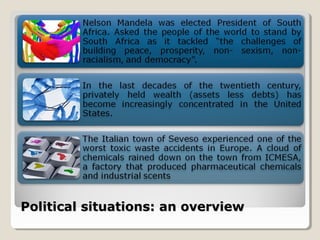
Political situations: an overview
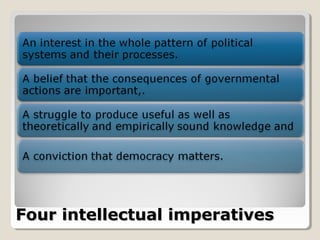
Four intellectual imperatives
   The field of public policy is American in intellectual origin in ways
    that are important to understanding its trajectory and
    contributions.
   During the same period, the study of political science in France
    and Germany focused on the proper administration of the state
    (Stein, 1995).
   In contrast, in Latin America, independent research units often
    provided advice and criticism direct at pressing problems, though
    their visibility- indeed their viability- waxed and waned with the
    rise and fall of democratic regimes.
   In contrast, in Latin America, independent research units often
    provided advice and criticism direct at pressing problems, though
    their visibility- indeed their viability- waxed and waned with the
    rise and fall of democratic regimes.
   The field of public policy has deep roots in this third tradition
    (virtuous popular democratic majorities) with all of its inherent
    contradictions over concentrated or diffuse political power


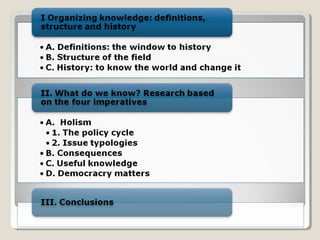
I Organizing knowledge: definitions, structure
and history
 Most   authors move straight to the question of defining
   public policy and the policy process.
  Lawrence Mead captured the scope and sense of the
   field when he wrote that public policy is an approach to
   the study of politics that analyzes government in the
   light of major public issues.
  James Anderson offered a representative definition
   when he wrote that a policy is a purposive course of
   action followed by an actor or set of actors in dealing
   with a matter of concern.
  Definitions of the policy process are moved varied.
   Some closely link public policy with all governmental
   action.
  B. Guy Peters wrote that public policy is the sum of
   activities of governments.
  Others in the problem- solving school draw their
   inspiration from systems theory with definitions based
   on inputs, transformations, and outputs.


A. Definitions: the window to history
 Allthe definitions emphasize a holistic view of
  policy- making, a belief that the whole is greater
  than the sum of its parts, those individuals,
  institutions, interactions, and ideology all matter,
  even if there is notable disagreement about the
  proportional important of each.
 In the language of the structure agency debate,
  most political scientists specializing in public
  policy see causation at and beyond the individual
  level.


Three definitional traditions
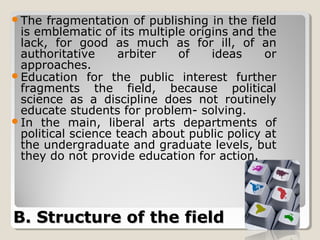
The  fragmentation of publishing in the field
 is emblematic of its multiple origins and the
 lack, for good as much as for ill, of an
 authoritative     arbiter   of    ideas     or
 approaches.
Education for the public interest further
 fragments the field, because political
 science as a discipline does not routinely
 educate students for problem- solving.
In the main, liberal arts departments of
 political science teach about public policy at
 the undergraduate and graduate levels, but
 they do not provide education for action.


B. Structure of the field
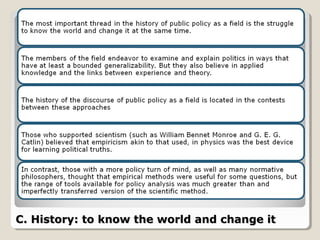
C. History: to know the world and change it
 Fields  with unity of method and well defined
   scope have a greather likelihood of creating
   cumulative knowledge and high theory than
   fields like public policy with its history or diffuse
   methods and subjects.
  Public policy has lacked a tradition of intellectual
   criticism, (that questions the deep structures of
   government and the state) a tradition that has
   helped the field of comparative politics develop
   normative and empirical theory in the face of
   similar problems of scope and methods.
  But within each of the four imperatives there is a
   richness of research that is both self- consciously
   about policy and contributes to theory and
   practice in the others fields as well.

II. What do we know? Research based on
the four imperatives
At as a field, public policy embraces modeling
 the whole, but public policy is not alone in
 this approach. Modeling the whole is an
 honorable and widespread traidition in the
 social sciences.
The holism of the policy field is distinctive
 because the research has more concrete and
 circumscribed aims- to develop a single, or
 even several, general theories of
 governmental processes into a leser extent,
 to embed these theories of governmental
 processes into a larger understandings of the
 relations between state and society.


A. Holism
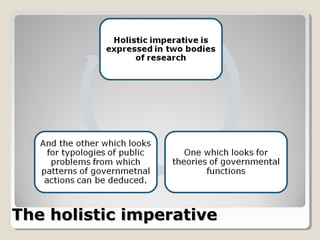
The holistic imperative
 Policy making rarely looks like the textbook
  discussions of the policy cycle.
 Sometimes a solution goes looking for a problem.
 Similarly, the content of policies is not merely
  determined in the decision making phase.
 Rather, policy content is negotiated over and
  over again, in problem definition, legislation,
  regulation, and court decisions, and again in the
  decisions made by street- level- bureaucrats.
 But even acknowledging the porous nature of the
  policy process, the stages of the policy process
  often have specific characteristics.


1. The policy cycle
The   scholarship on issue typologies exists
 side by side with the work on the policy
 cycle. The focus of the issue typologies
 literature is not patters of actions during
 stages of the policy cycles.
How could the typology literature and
 policy cycle literature be integrated? Some
 initials steps are clear.


2. Issue typologies
The  research in the field of public policy
 has also emphasized the consequences of
 governmental actions for people.
A large body of research seeks to answer
 the question “what happens to which
 people and why?.
This intellectual imperative has the scope
 and the limits of the field in general.
The what happens question is usually
 defined in behavioral not normative
 terms.


B. Consequences
The impulse to desing better systems for
 government is also part of the third
 imperative of the polici field: to produce
 useful knowledge.
This imperative recognizes the social
 responsabilities of social scientists.
The hard part of being useful is making
 sustained difference on the basis of
 scholarly research.


C. Useful knowledge
Stone’s concern about how much and what
  kind of governmental instrusion citizens
  experience is linked to the fourth imperative:
  democracy matters.
 Indeed, all of the other imperatives- holism,
  the importance of the consequences of
  governmental actions, and the drive for
  useful knowledge contribute to the
  democratic humanism that Lasswell felt best
  described the policy endeavor.
 Lasswell took a hopeful view of human
  nature, public participation, and political
  judgment.


D. Democracry matters
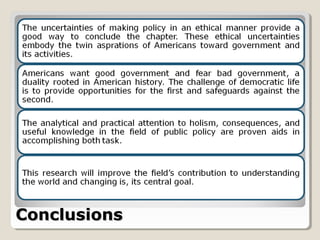
Conclusions

PUBLIC POLICY AND ADMINISTRATION: AND OVERVIEW

  • 1.
    ANÁLISIS ECONÓMICO Dr. HéctorRamón Ramírez Partida FRAGOSO HERNÁNDEZ JAZMÍN ALEJANDRA Diciembre 2012
  • 3.
  • 4.
  • 5.
    The field of public policy is American in intellectual origin in ways that are important to understanding its trajectory and contributions.  During the same period, the study of political science in France and Germany focused on the proper administration of the state (Stein, 1995).  In contrast, in Latin America, independent research units often provided advice and criticism direct at pressing problems, though their visibility- indeed their viability- waxed and waned with the rise and fall of democratic regimes.  In contrast, in Latin America, independent research units often provided advice and criticism direct at pressing problems, though their visibility- indeed their viability- waxed and waned with the rise and fall of democratic regimes.  The field of public policy has deep roots in this third tradition (virtuous popular democratic majorities) with all of its inherent contradictions over concentrated or diffuse political power I Organizing knowledge: definitions, structure and history
  • 6.
     Most authors move straight to the question of defining public policy and the policy process.  Lawrence Mead captured the scope and sense of the field when he wrote that public policy is an approach to the study of politics that analyzes government in the light of major public issues.  James Anderson offered a representative definition when he wrote that a policy is a purposive course of action followed by an actor or set of actors in dealing with a matter of concern.  Definitions of the policy process are moved varied. Some closely link public policy with all governmental action.  B. Guy Peters wrote that public policy is the sum of activities of governments.  Others in the problem- solving school draw their inspiration from systems theory with definitions based on inputs, transformations, and outputs. A. Definitions: the window to history
  • 7.
     Allthe definitionsemphasize a holistic view of policy- making, a belief that the whole is greater than the sum of its parts, those individuals, institutions, interactions, and ideology all matter, even if there is notable disagreement about the proportional important of each.  In the language of the structure agency debate, most political scientists specializing in public policy see causation at and beyond the individual level. Three definitional traditions
  • 8.
    The fragmentationof publishing in the field is emblematic of its multiple origins and the lack, for good as much as for ill, of an authoritative arbiter of ideas or approaches. Education for the public interest further fragments the field, because political science as a discipline does not routinely educate students for problem- solving. In the main, liberal arts departments of political science teach about public policy at the undergraduate and graduate levels, but they do not provide education for action. B. Structure of the field
  • 9.
    C. History: toknow the world and change it
  • 10.
     Fields with unity of method and well defined scope have a greather likelihood of creating cumulative knowledge and high theory than fields like public policy with its history or diffuse methods and subjects.  Public policy has lacked a tradition of intellectual criticism, (that questions the deep structures of government and the state) a tradition that has helped the field of comparative politics develop normative and empirical theory in the face of similar problems of scope and methods.  But within each of the four imperatives there is a richness of research that is both self- consciously about policy and contributes to theory and practice in the others fields as well. II. What do we know? Research based on the four imperatives
  • 11.
    At as afield, public policy embraces modeling the whole, but public policy is not alone in this approach. Modeling the whole is an honorable and widespread traidition in the social sciences. The holism of the policy field is distinctive because the research has more concrete and circumscribed aims- to develop a single, or even several, general theories of governmental processes into a leser extent, to embed these theories of governmental processes into a larger understandings of the relations between state and society. A. Holism
  • 12.
  • 13.
     Policy makingrarely looks like the textbook discussions of the policy cycle.  Sometimes a solution goes looking for a problem.  Similarly, the content of policies is not merely determined in the decision making phase.  Rather, policy content is negotiated over and over again, in problem definition, legislation, regulation, and court decisions, and again in the decisions made by street- level- bureaucrats.  But even acknowledging the porous nature of the policy process, the stages of the policy process often have specific characteristics. 1. The policy cycle
  • 14.
    The scholarship on issue typologies exists side by side with the work on the policy cycle. The focus of the issue typologies literature is not patters of actions during stages of the policy cycles. How could the typology literature and policy cycle literature be integrated? Some initials steps are clear. 2. Issue typologies
  • 15.
    The researchin the field of public policy has also emphasized the consequences of governmental actions for people. A large body of research seeks to answer the question “what happens to which people and why?. This intellectual imperative has the scope and the limits of the field in general. The what happens question is usually defined in behavioral not normative terms. B. Consequences
  • 16.
    The impulse todesing better systems for government is also part of the third imperative of the polici field: to produce useful knowledge. This imperative recognizes the social responsabilities of social scientists. The hard part of being useful is making sustained difference on the basis of scholarly research. C. Useful knowledge
  • 17.
    Stone’s concern abouthow much and what kind of governmental instrusion citizens experience is linked to the fourth imperative: democracy matters. Indeed, all of the other imperatives- holism, the importance of the consequences of governmental actions, and the drive for useful knowledge contribute to the democratic humanism that Lasswell felt best described the policy endeavor. Lasswell took a hopeful view of human nature, public participation, and political judgment. D. Democracry matters
  • 18.