UNDERLYING PRINCIPLES
OF PARALLELAND
DISTRIBUTED COMPUTING
WhatisParallelComputing?
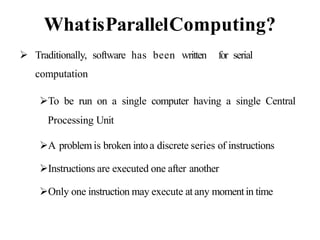
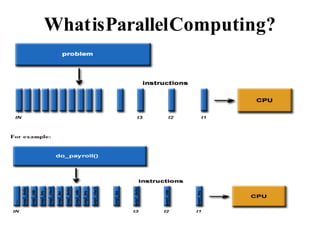
 Traditionally, software has been written for serial
computation
To be run on a single computer having a single Central
Processing Unit
A problemis broken intoa discrete series of instructions
Instructions are executed one after another
Only one instruction may execute at any momentin time
WhatisParallelComputing?
UsesforParallelComputing
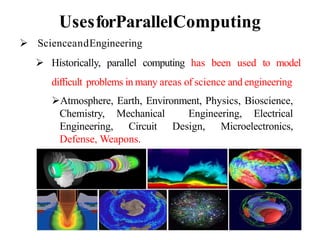
 ScienceandEngineering
 Historically, parallel computing has been used to model
difficult problems in many areas of science and engineering
Atmosphere, Earth, Environment, Physics, Bioscience,
Chemistry, Mechanical Engineering, Electrical
Engineering, Circuit Design, Microelectronics,
Defense, Weapons.
WhoisUsingParallelComputing?
ConceptsandTerminology
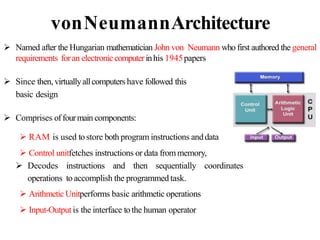
 Named after the Hungarian mathematician John von Neumann who first authored the general
requirements foran electroniccomputerinhis 1945papers
 Since then, virtuallyallcomputers have followed this
basic design
 Comprises offourmain components:
 RAM is used tostore both program instructions anddata
 Control unitfetches instructions or data frommemory,
 Decodes instructions and then sequentially coordinates
operations to accomplish the programmed task.
 Arithmetic Unitperforms basic arithmetic operations
 Input-Output is the interface tothe human operator
vonNeumannArchitecture
Flynn'sClassicalTaxonomy
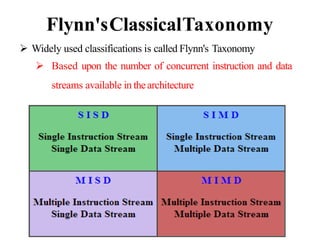
 Widely used classifications is called Flynn's Taxonomy
 Based upon the number of concurrent instruction and data
streams available in thearchitecture
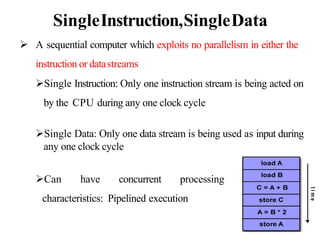
SingleInstruction,SingleData
 A sequential computer which exploits no parallelism in either the
instruction or datastreams
Single Instruction: Only one instruction stream is being acted on
by the CPU during any one clock cycle
Single Data: Only one data stream is being used as input during
any one clock cycle
Can have concurrent processing
characteristics: Pipelined execution
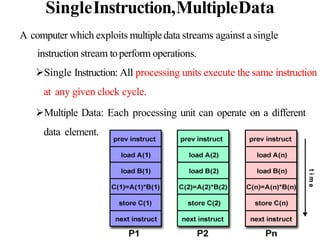
SingleInstruction,MultipleData
A computer which exploits multipledata streams against a single
instruction stream toperform operations.
Single Instruction: All processing units execute the same instruction
at any given clock cycle.
Multiple Data: Each processing unit can operate on a different
data element.
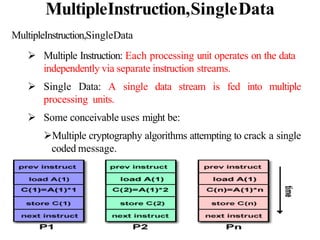
MultipleInstruction,SingleData
 Multiple Instruction: Each processing unit operates on the data
independently via separate instruction streams.
 Single Data: A single data stream is fed into multiple
processing units.
 Some conceivable uses might be:
Multiple cryptography algorithms attempting to crack a single
coded message.
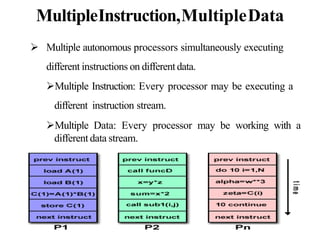
MultipleInstruction,MultipleData
 Multiple autonomous processors simultaneously executing
different instructions on differentdata.
Multiple Instruction: Every processor may be executing a
different instruction stream.
Multiple Data: Every processor may be working with a
differentdata stream.
SomeGeneralParallelTerminology
 Parallelcomputing
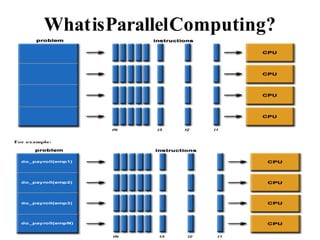
Using parallel computer tosolve single problems faster
 Parallelcomputer
Multiple-processor or multi-core system supporting parallel
programming
 Parallelprogramming
Programming in a language that supports concurrency
explicitly
 SupercomputingorHighPerformanceComputing
Using the world's fastest and largest computers to solve large
problems
LimitsandCostsof Parallel
Programming
• Introducing the number of processors N performing the parallel
fraction of work P, the relationship can be modeledby:
ParallelComputerMemory
Architectures
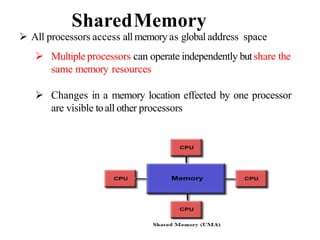
 All processors access all memory as global address space
 Multiple processors can operate independently butshare the
same memory resources
 Changes in a memory location effected by one processor
are visible toall other processors
SharedMemory
SharedMemory Classification
 UMAandNUMA,based uponmemoryaccesstimes
 UniformMemoryAccess(UMA)
Most commonly represented today by Symmetric Multiprocessor
(SMP) machines
Identical processors
Equal access and access times to memory
Sometimes called CC-UMA - Cache Coherent UMA
Cache coherent means if one processor updates a location in
shared memory, all the other processors know about the update.
Cache coherency is accomplished at the hardware level
SharedMemory
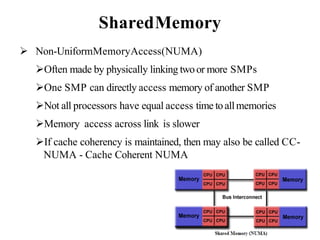
 Non-UniformMemoryAccess(NUMA)
Often made by physically linking twoor more SMPs
One SMP can directly access memory of another SMP
Not all processors have equal access time toallmemories
Memory access across link is slower
If cache coherency is maintained, then may also be called CC-
NUMA - Cache Coherent NUMA
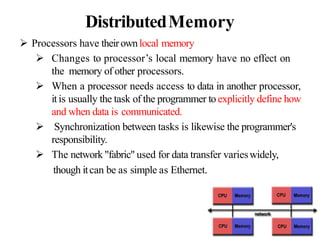
DistributedMemory
 Processors have theirownlocal memory
 Changes to processor’s local memory have no effect on
the memory of other processors.
 When a processor needs access to data in another processor,
it is usually the task of the programmer to explicitly define how
and when data is communicated.
 Synchronization between tasks is likewise the programmer's
responsibility.
 The network "fabric" used for data transfer varieswidely,
though itcan be as simple as Ethernet.
HybridDistributed-SharedMemory
 The largest and fastest computers in the world today employ both
shared and distributedmemory architectures
 The shared memory component can be a shared memory
machine or graphics processingunits.
 The distributed memory component is the networking of
multipleshared memory or GPU machines.
Distributed Systems
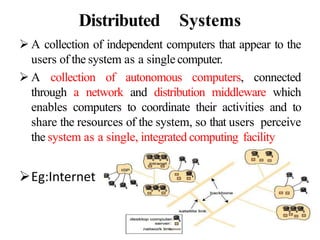
Distributed Systems
 A collection of independent computers that appear to the
users of the system as a single computer.
 A collection of autonomous computers, connected
through a network and distribution middleware which
enables computers to coordinate their activities and to
share the resources of the system, so that users perceive
the system as a single, integrated computing facility
Eg:Internet
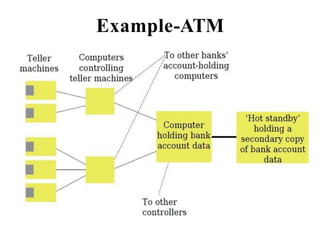
Example-ATM
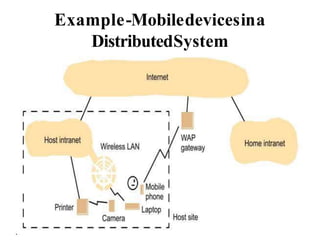
Example-Mobiledevicesina
DistributedSystem
Basic problems and challenges
Basic problem and challenges
 Transparency
 Scalability
 Fault tolerance
 Concurrency
 Openness
 These challenges can also be seen as the goals or desired
properties of a distributed system
REFERENCE
• Mastering Cloud computing foundation and
application programming rajkumar
buyya,christian vecchiola,s.Tamarai selvi
THANK YOU

Underlying principles of parallel and distributed computing

  • 1.
  • 2.
    WhatisParallelComputing?  Traditionally, softwarehas been written for serial computation To be run on a single computer having a single Central Processing Unit A problemis broken intoa discrete series of instructions Instructions are executed one after another Only one instruction may execute at any momentin time
  • 3.
  • 4.
  • 5.
    UsesforParallelComputing  ScienceandEngineering  Historically,parallel computing has been used to model difficult problems in many areas of science and engineering Atmosphere, Earth, Environment, Physics, Bioscience, Chemistry, Mechanical Engineering, Electrical Engineering, Circuit Design, Microelectronics, Defense, Weapons.
  • 6.
  • 8.
  • 9.
     Named afterthe Hungarian mathematician John von Neumann who first authored the general requirements foran electroniccomputerinhis 1945papers  Since then, virtuallyallcomputers have followed this basic design  Comprises offourmain components:  RAM is used tostore both program instructions anddata  Control unitfetches instructions or data frommemory,  Decodes instructions and then sequentially coordinates operations to accomplish the programmed task.  Arithmetic Unitperforms basic arithmetic operations  Input-Output is the interface tothe human operator vonNeumannArchitecture
  • 10.
    Flynn'sClassicalTaxonomy  Widely usedclassifications is called Flynn's Taxonomy  Based upon the number of concurrent instruction and data streams available in thearchitecture
  • 11.
    SingleInstruction,SingleData  A sequentialcomputer which exploits no parallelism in either the instruction or datastreams Single Instruction: Only one instruction stream is being acted on by the CPU during any one clock cycle Single Data: Only one data stream is being used as input during any one clock cycle Can have concurrent processing characteristics: Pipelined execution
  • 12.
    SingleInstruction,MultipleData A computer whichexploits multipledata streams against a single instruction stream toperform operations. Single Instruction: All processing units execute the same instruction at any given clock cycle. Multiple Data: Each processing unit can operate on a different data element.
  • 13.
    MultipleInstruction,SingleData MultipleInstruction,SingleData  Multiple Instruction:Each processing unit operates on the data independently via separate instruction streams.  Single Data: A single data stream is fed into multiple processing units.  Some conceivable uses might be: Multiple cryptography algorithms attempting to crack a single coded message.
  • 14.
    MultipleInstruction,MultipleData  Multiple autonomousprocessors simultaneously executing different instructions on differentdata. Multiple Instruction: Every processor may be executing a different instruction stream. Multiple Data: Every processor may be working with a differentdata stream.
  • 15.
    SomeGeneralParallelTerminology  Parallelcomputing Using parallelcomputer tosolve single problems faster  Parallelcomputer Multiple-processor or multi-core system supporting parallel programming  Parallelprogramming Programming in a language that supports concurrency explicitly  SupercomputingorHighPerformanceComputing Using the world's fastest and largest computers to solve large problems
  • 16.
    LimitsandCostsof Parallel Programming • Introducingthe number of processors N performing the parallel fraction of work P, the relationship can be modeledby:
  • 17.
  • 18.
     All processorsaccess all memory as global address space  Multiple processors can operate independently butshare the same memory resources  Changes in a memory location effected by one processor are visible toall other processors SharedMemory
  • 19.
    SharedMemory Classification  UMAandNUMA,baseduponmemoryaccesstimes  UniformMemoryAccess(UMA) Most commonly represented today by Symmetric Multiprocessor (SMP) machines Identical processors Equal access and access times to memory Sometimes called CC-UMA - Cache Coherent UMA Cache coherent means if one processor updates a location in shared memory, all the other processors know about the update. Cache coherency is accomplished at the hardware level
  • 20.
    SharedMemory  Non-UniformMemoryAccess(NUMA) Often madeby physically linking twoor more SMPs One SMP can directly access memory of another SMP Not all processors have equal access time toallmemories Memory access across link is slower If cache coherency is maintained, then may also be called CC- NUMA - Cache Coherent NUMA
  • 21.
    DistributedMemory  Processors havetheirownlocal memory  Changes to processor’s local memory have no effect on the memory of other processors.  When a processor needs access to data in another processor, it is usually the task of the programmer to explicitly define how and when data is communicated.  Synchronization between tasks is likewise the programmer's responsibility.  The network "fabric" used for data transfer varieswidely, though itcan be as simple as Ethernet.
  • 22.
    HybridDistributed-SharedMemory  The largestand fastest computers in the world today employ both shared and distributedmemory architectures  The shared memory component can be a shared memory machine or graphics processingunits.  The distributed memory component is the networking of multipleshared memory or GPU machines.
  • 23.
  • 24.
    Distributed Systems  Acollection of independent computers that appear to the users of the system as a single computer.  A collection of autonomous computers, connected through a network and distribution middleware which enables computers to coordinate their activities and to share the resources of the system, so that users perceive the system as a single, integrated computing facility Eg:Internet
  • 25.
  • 26.
  • 27.
    Basic problems andchallenges Basic problem and challenges  Transparency  Scalability  Fault tolerance  Concurrency  Openness  These challenges can also be seen as the goals or desired properties of a distributed system
  • 28.
    REFERENCE • Mastering Cloudcomputing foundation and application programming rajkumar buyya,christian vecchiola,s.Tamarai selvi
  • 29.