Addressing division within the
academy
A model of collaborative working for HE
SRHE Seminar ~ 29th April 2010
Lorraine Walsh, University of Dundee
Peter E. Kahn, University of Liverpool
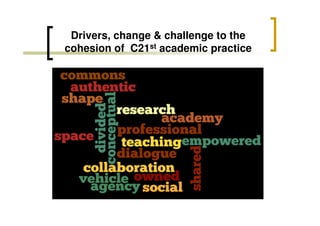
Drivers, change & challenge to the
cohesion of C21st academic practice
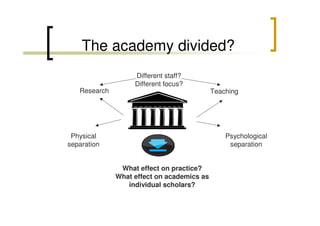
The academy divided?
Different staff?
Different focus?
Research

Teaching

Physical
separation

Psychological
separation

What effect on practice?
What effect on academics as
individual scholars?
‘Training the mind to go visiting’
(Arendt, 2003)

Teaching and research as increasingly
separate and ‘ideologised’ aspects of
practice (Barnett, 2003: 146-7)
Kinser’s (1998) concept of the
‘unbundling’ of traditional academic
work into specialist roles (MacFarlane in
Barnett, ed., 2005: 173).
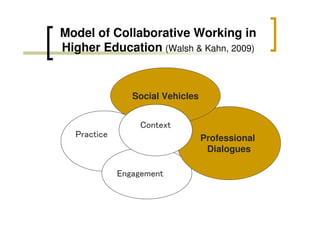
Model of Collaborative Working in
Higher Education (Walsh & Kahn, 2009)

Social Vehicles

Context
Professional
Dialogues

Practice

Engagement
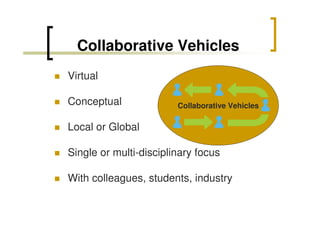
Collaborative Vehicles
Virtual
Conceptual

Collaborative Vehicles

Local or Global
Single or multi-disciplinary focus
With colleagues, students, industry
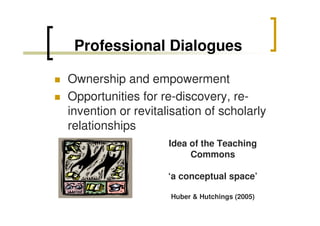
Professional Dialogues
Ownership and empowerment
Opportunities for re-discovery, reinvention or revitalisation of scholarly
relationships
Idea of the Teaching
Commons
‘a conceptual space’
Huber & Hutchings (2005)
Case studies – collaborative
spaces in action
Parker (2009)
Collaboration around writing in the disciplines.

Mackenzie (2009)
A learning community of university teachers.

How do collaborative vehicles and
professional dialogues open up space for
collaboration and ensure cohesion?
Collaboration centred around courses
for students within the discipline.
Underpinned by an institute, endowed
research student fellowships, roles linked
to establishing and teaching courses
within disciplines.
Contrasting perspectives from across
academic hierarchies, focusing attention
on the most significant questions.
A Learning Community
Understanding, and possibilities for common
action, emerge from dialogue.
Learning community, roles and small groups
focused on progressing projects.
Roles focused primarily on teaching may
sideline the collaborative space required to
engage in research.
Opportunities and Challenges of
Collaborative Working
Dealing with ‘supercomplexity’ (Barnett) or
‘troublesome activity’ (Walsh & Kahn)
Empowerment of the academy
Identity – ontological shift
Dunbar’s number
Collaboration and Empowerment
in Action
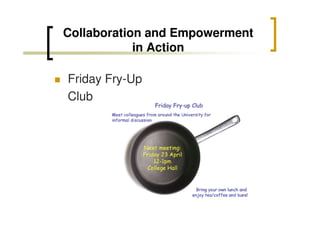
Friday Fry-Up
Club
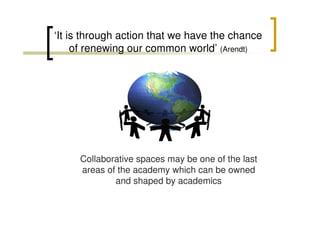
‘It is through action that we have the chance
of renewing our common world’ (Arendt)

Collaborative spaces may be one of the last
areas of the academy which can be owned
and shaped by academics
References
Arendt, Hannah. 2003. In Kreber, C. (2010). ‘Empowering the
scholarship of teaching & learning. Towards an authentic
practice.’ Presentation at the Developing Pedagogic Research
seminar, University of Dundee, 20.4.10
Barnett, Ron. 2003. Beyond all Reason. Living with ideology in
the university. Buckingham: SRHE/OUP.
Barnett, Ron. (ed.) 2005. Reshaping the University. New
relationships between research, scholarship and teaching.
Buckingham: SRHE/OUP.
Huber, Mary & Hutchings, Pat. 2005. The Advancement of
Learning. Building the teaching commons. Jossey-Bass.
References
Parker, Jan. 2009. ‘Collaborative academic work: writing in the
disciplines’. In Collaborative Working in Higher Education, L.
Walsh and P.E. Kahn, 157-62. London: Routledge.
MacKenzie, Jane. 2009. ‘A learning community of university
teachers: an exploration of the scholarship of learning and
teaching’. In Collaborative Working in Higher Education, L.
Walsh and P.E. Kahn, 20-5. London: Routledge.
Walsh, Lorraine. & Kahn, Peter E. 2009. Collaborative
Working in Higher Education. London: Routledge.
Further Reading
Collaborative Working in Higher
Education. The Social Academy
(Routledge, 2009)
Lorraine Walsh
l.walsh@dundee.ac.uk
Peter E. Kahn
peter.kahn@liverpool.ac.uk

A model of collaborative working for higher education

  • 1.
    Addressing division withinthe academy A model of collaborative working for HE SRHE Seminar ~ 29th April 2010 Lorraine Walsh, University of Dundee Peter E. Kahn, University of Liverpool
  • 2.
    Drivers, change &challenge to the cohesion of C21st academic practice
  • 3.
    The academy divided? Differentstaff? Different focus? Research Teaching Physical separation Psychological separation What effect on practice? What effect on academics as individual scholars?
  • 4.
    ‘Training the mindto go visiting’ (Arendt, 2003) Teaching and research as increasingly separate and ‘ideologised’ aspects of practice (Barnett, 2003: 146-7) Kinser’s (1998) concept of the ‘unbundling’ of traditional academic work into specialist roles (MacFarlane in Barnett, ed., 2005: 173).
  • 5.
    Model of CollaborativeWorking in Higher Education (Walsh & Kahn, 2009) Social Vehicles Context Professional Dialogues Practice Engagement
  • 6.
    Collaborative Vehicles Virtual Conceptual Collaborative Vehicles Localor Global Single or multi-disciplinary focus With colleagues, students, industry
  • 7.
    Professional Dialogues Ownership andempowerment Opportunities for re-discovery, reinvention or revitalisation of scholarly relationships Idea of the Teaching Commons ‘a conceptual space’ Huber & Hutchings (2005)
  • 8.
    Case studies –collaborative spaces in action Parker (2009) Collaboration around writing in the disciplines. Mackenzie (2009) A learning community of university teachers. How do collaborative vehicles and professional dialogues open up space for collaboration and ensure cohesion?
  • 9.
    Collaboration centred aroundcourses for students within the discipline. Underpinned by an institute, endowed research student fellowships, roles linked to establishing and teaching courses within disciplines. Contrasting perspectives from across academic hierarchies, focusing attention on the most significant questions.
  • 10.
    A Learning Community Understanding,and possibilities for common action, emerge from dialogue. Learning community, roles and small groups focused on progressing projects. Roles focused primarily on teaching may sideline the collaborative space required to engage in research.
  • 11.
    Opportunities and Challengesof Collaborative Working Dealing with ‘supercomplexity’ (Barnett) or ‘troublesome activity’ (Walsh & Kahn) Empowerment of the academy Identity – ontological shift Dunbar’s number
  • 12.
    Collaboration and Empowerment inAction Friday Fry-Up Club
  • 13.
    ‘It is throughaction that we have the chance of renewing our common world’ (Arendt) Collaborative spaces may be one of the last areas of the academy which can be owned and shaped by academics
  • 14.
    References Arendt, Hannah. 2003.In Kreber, C. (2010). ‘Empowering the scholarship of teaching & learning. Towards an authentic practice.’ Presentation at the Developing Pedagogic Research seminar, University of Dundee, 20.4.10 Barnett, Ron. 2003. Beyond all Reason. Living with ideology in the university. Buckingham: SRHE/OUP. Barnett, Ron. (ed.) 2005. Reshaping the University. New relationships between research, scholarship and teaching. Buckingham: SRHE/OUP. Huber, Mary & Hutchings, Pat. 2005. The Advancement of Learning. Building the teaching commons. Jossey-Bass.
  • 15.
    References Parker, Jan. 2009.‘Collaborative academic work: writing in the disciplines’. In Collaborative Working in Higher Education, L. Walsh and P.E. Kahn, 157-62. London: Routledge. MacKenzie, Jane. 2009. ‘A learning community of university teachers: an exploration of the scholarship of learning and teaching’. In Collaborative Working in Higher Education, L. Walsh and P.E. Kahn, 20-5. London: Routledge. Walsh, Lorraine. & Kahn, Peter E. 2009. Collaborative Working in Higher Education. London: Routledge.
  • 16.
    Further Reading Collaborative Workingin Higher Education. The Social Academy (Routledge, 2009) Lorraine Walsh l.walsh@dundee.ac.uk Peter E. Kahn peter.kahn@liverpool.ac.uk