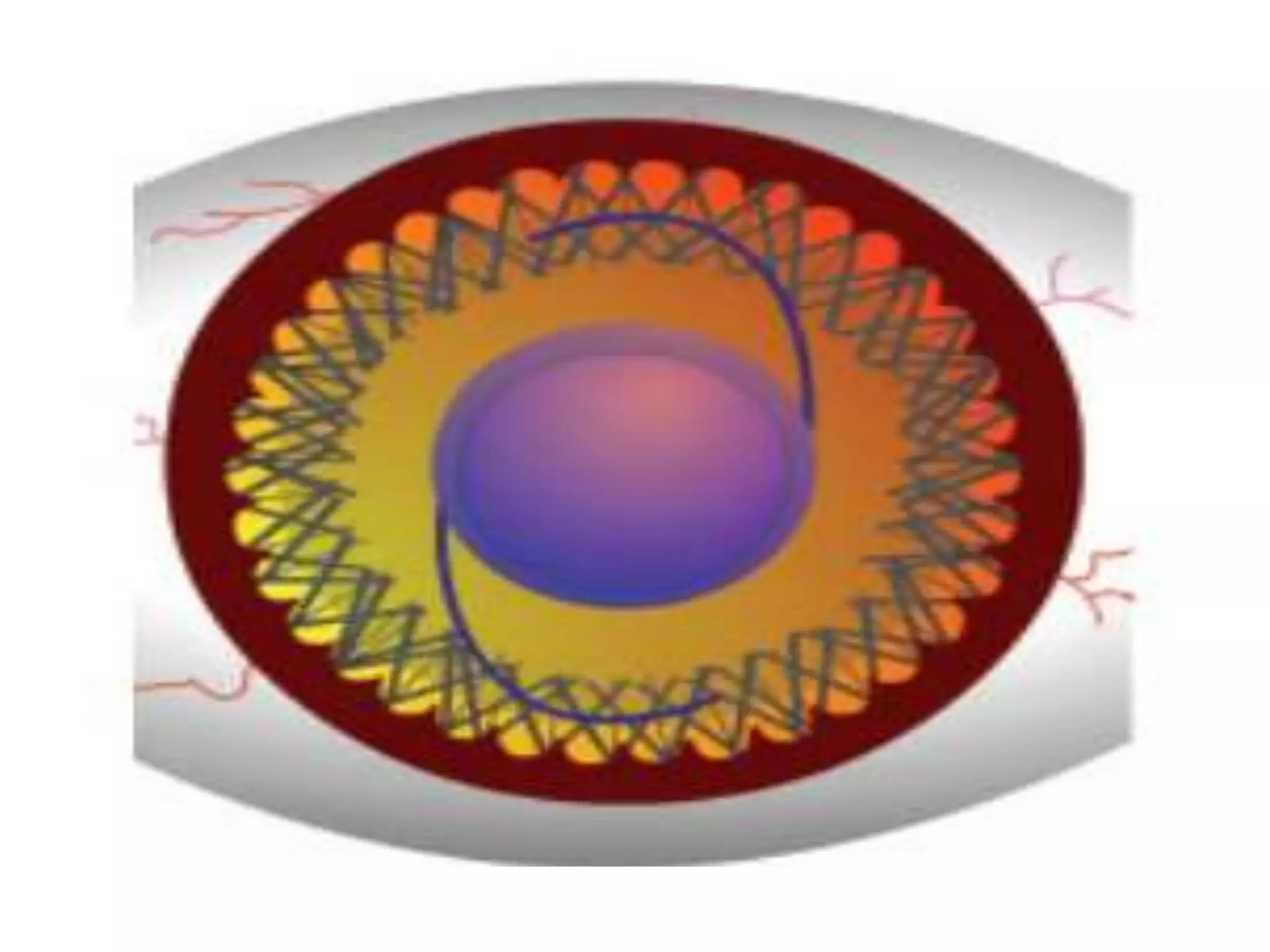
IOL
WHY ?
• Crystalline lens contributes approximately +15 to +20
diopters (D) to refractive power of human eye
• A further 43 diopters is provided by the cornea
• To restore refractive power of a normal clear lens after
removal of an opacified crystalline lens in cataract surgery
HOW ?
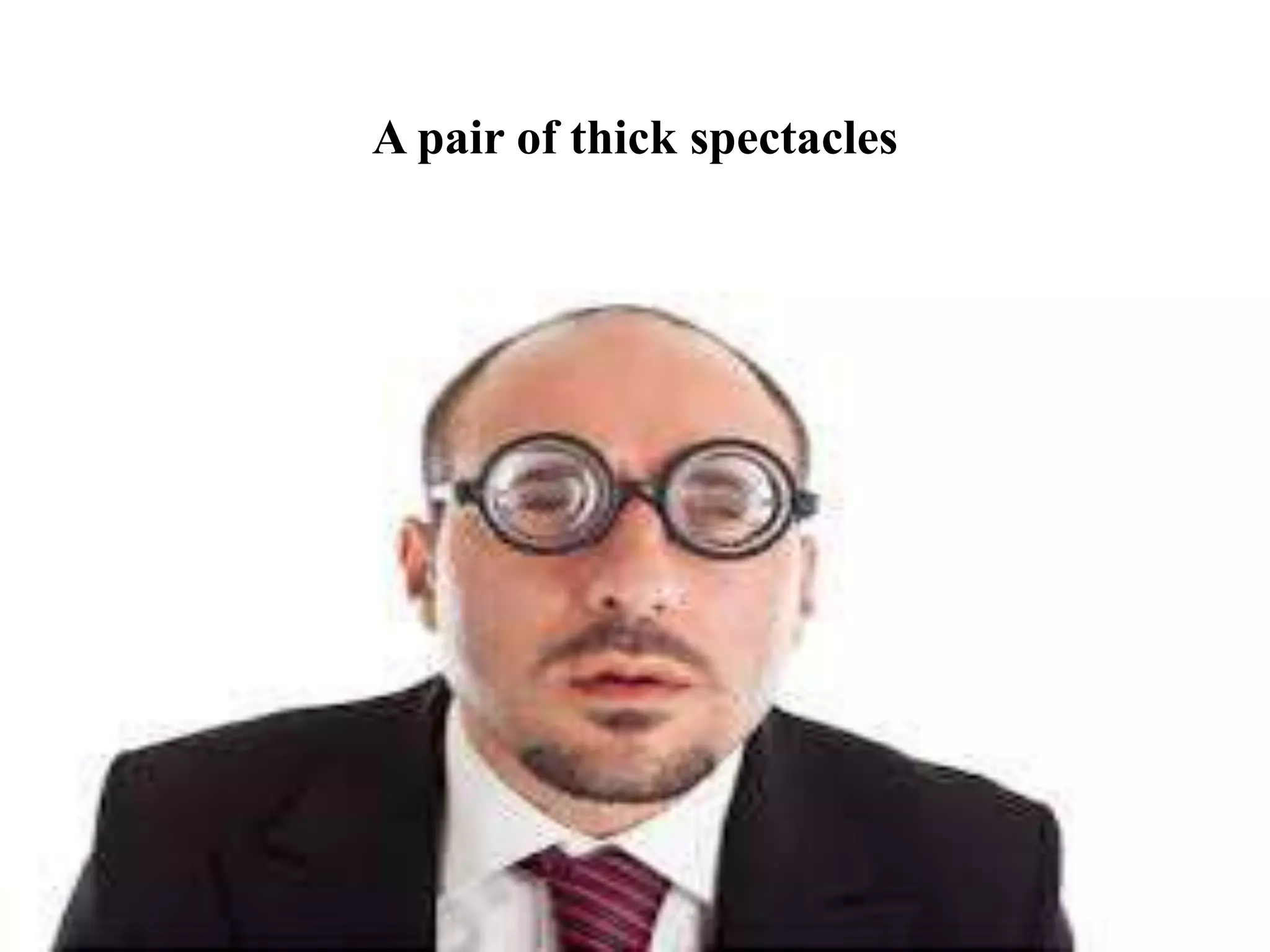
A pair of thick spectacles
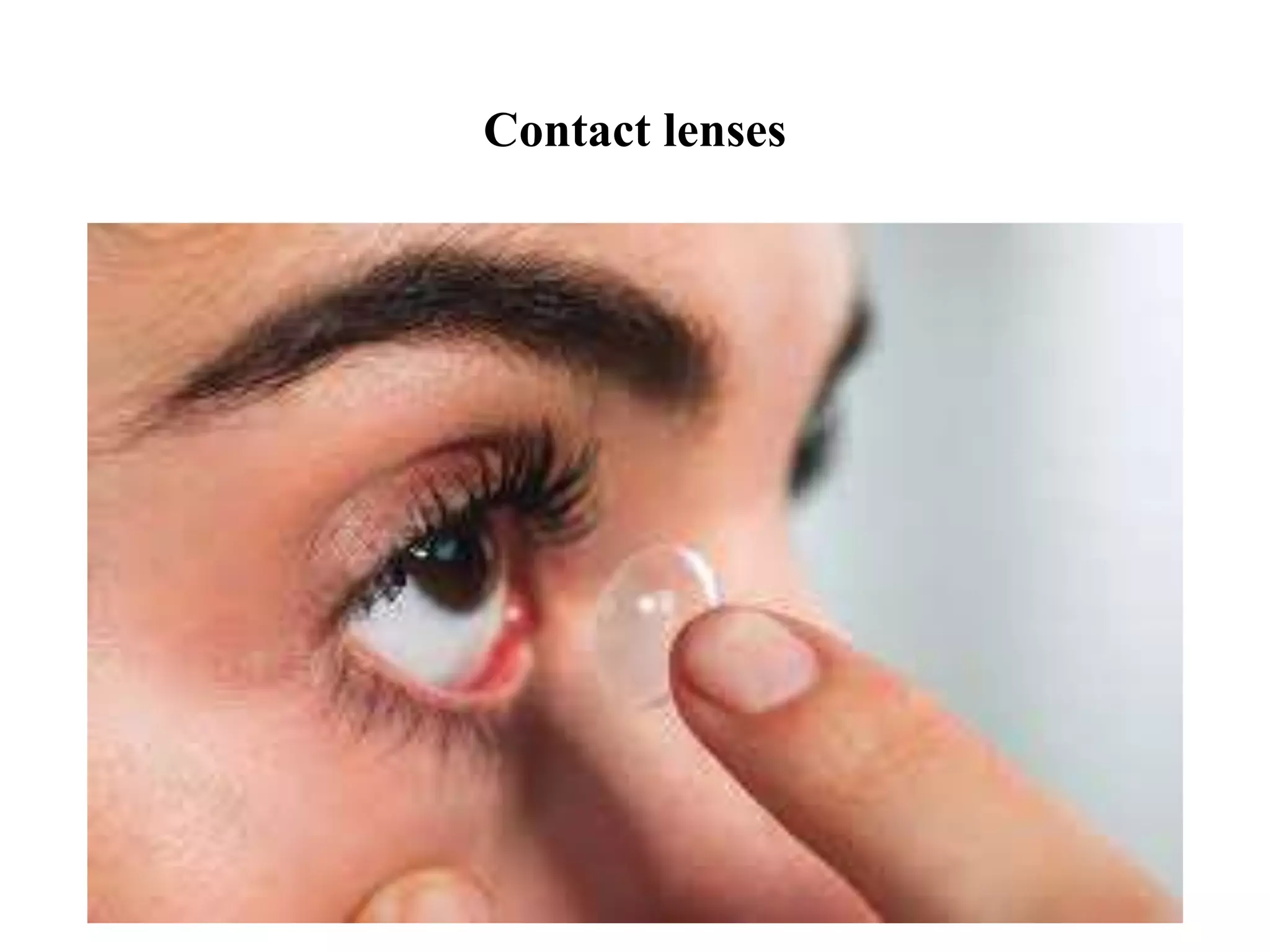
Contact lenses
Intraocular Lens implant
History / Mystery
• During World War II, Sir Harold Ridley, an ophthalmologist
in London,
 saw Royal Air Force casualties with eye injuries
 observed that splinters of acrylic plastic from aircraft
cockpit canopies became lodged in their eyes did not
trigger inflammatory rejection as did glass splinters.
 led him to propose the use of artificial lenses made of
polymethyl methacrylate - PMMA to treat cataracts
• Polymethyl methacrylate (PMMA) lenses were the first
lenses to be used in the human eye (in 1949)
Terminologies
• Phakic eye - An eye with a natural crystalline lens
• Pseudophakic eye - without a natural crystalline lens but
with an IOL
• chromophores - UV absorbing compounds, important
element of the IOL optic component.
 protect retina from UV radiation in the 300-400 nm
range, a feature normally provided by the normal
crystalline lens
• Optic - central part overlying the optic axis
• Haptics - peripheral arms used for placement & stabilization
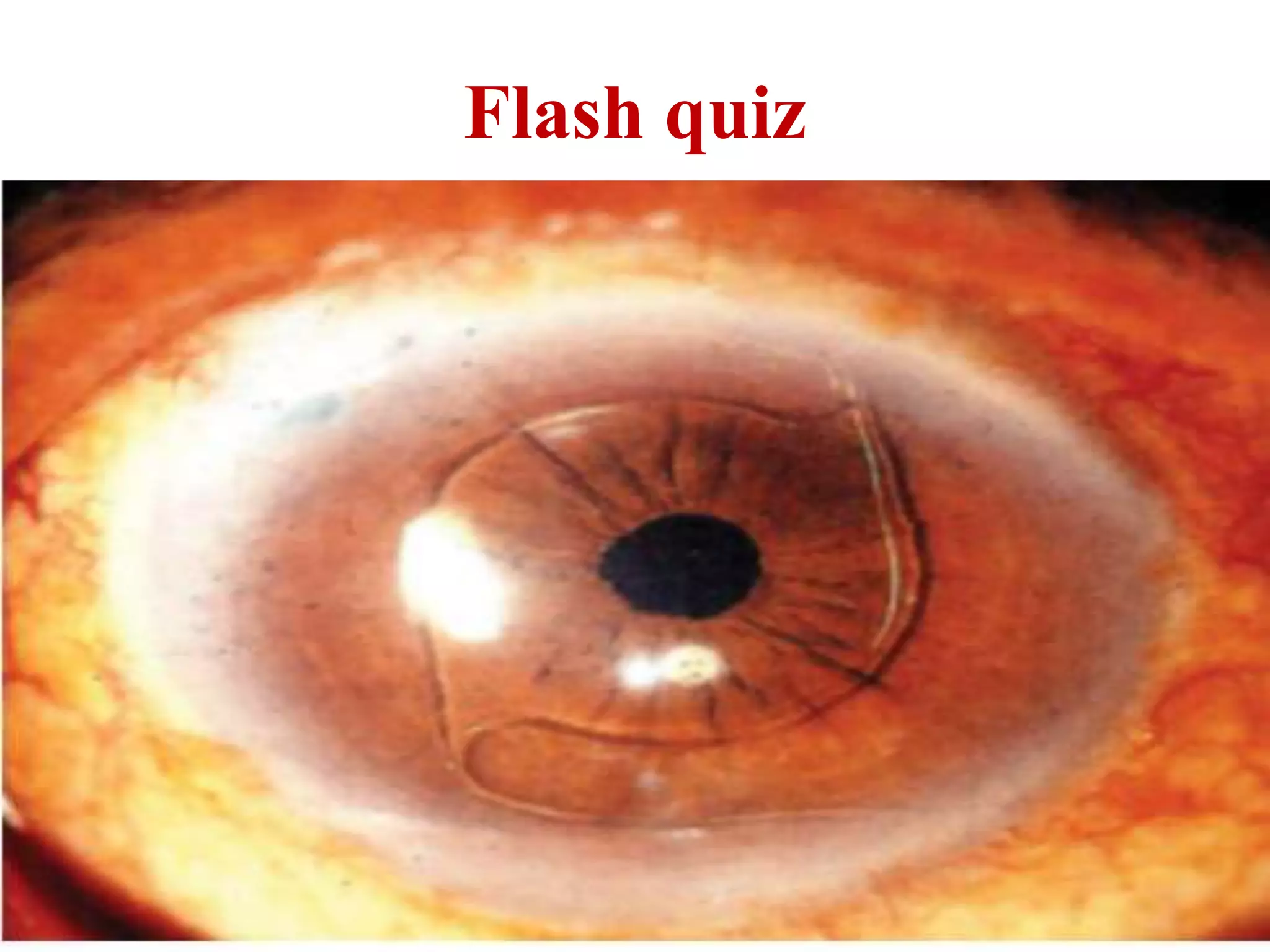
Flash quiz
Aphakic eye ?
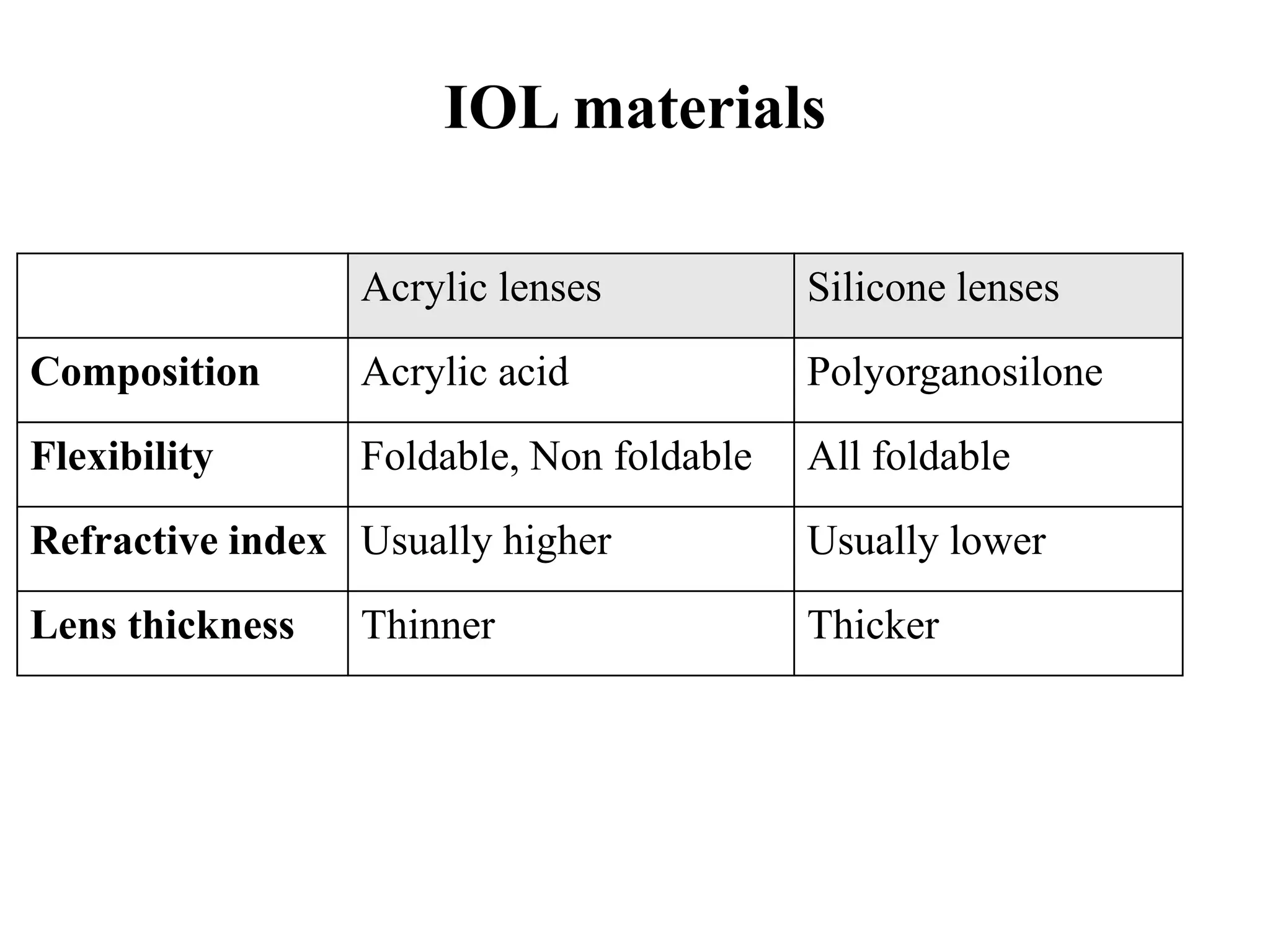
IOL materials
Acrylic lenses Silicone lenses
Composition Acrylic acid Polyorganosilone
Flexibility Foldable, Non foldable All foldable
Refractive index Usually higher Usually lower
Lens thickness Thinner Thicker
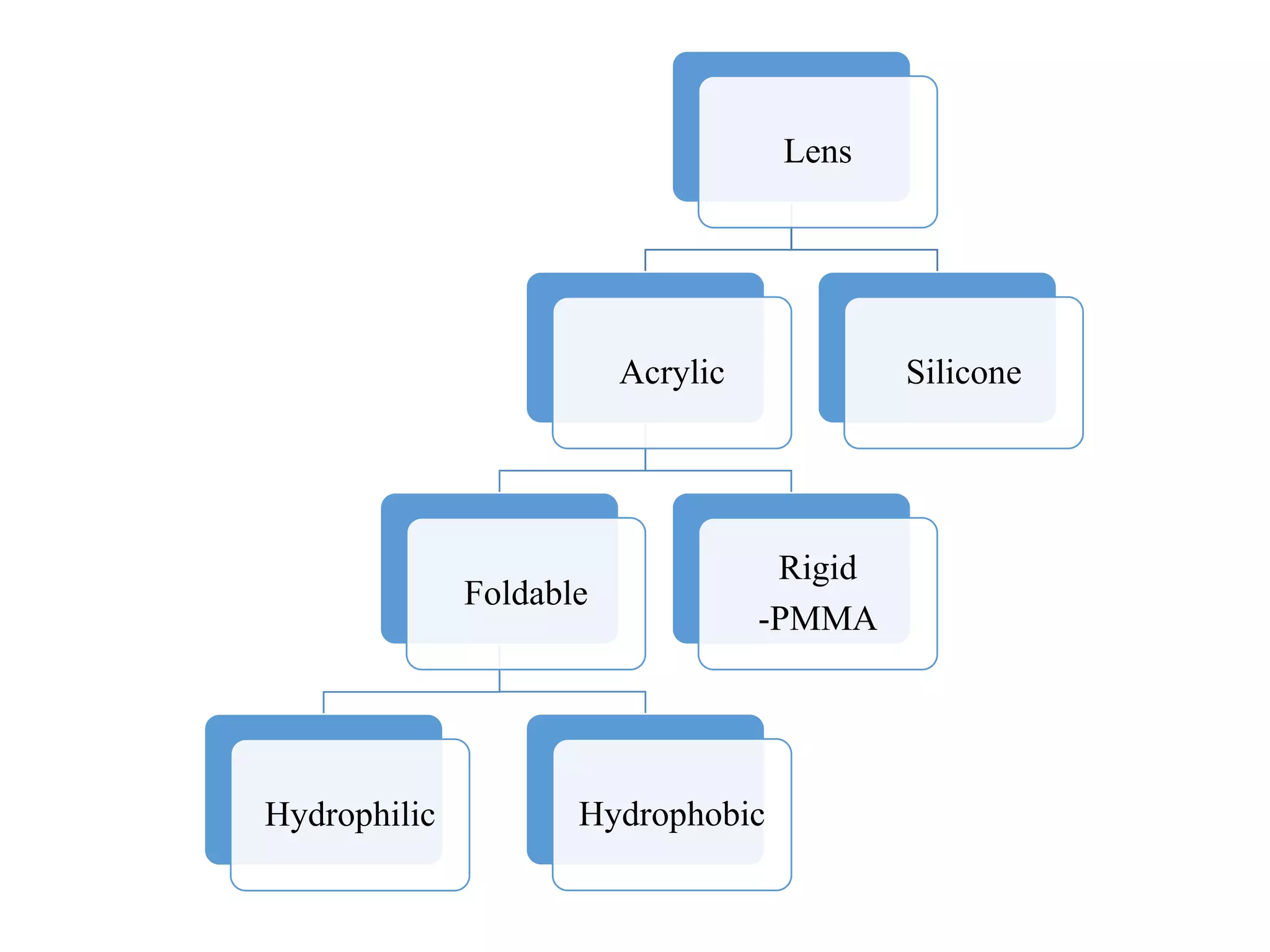
Lens
Acrylic
Foldable
Hydrophilic Hydrophobic
Rigid
-PMMA
Silicone
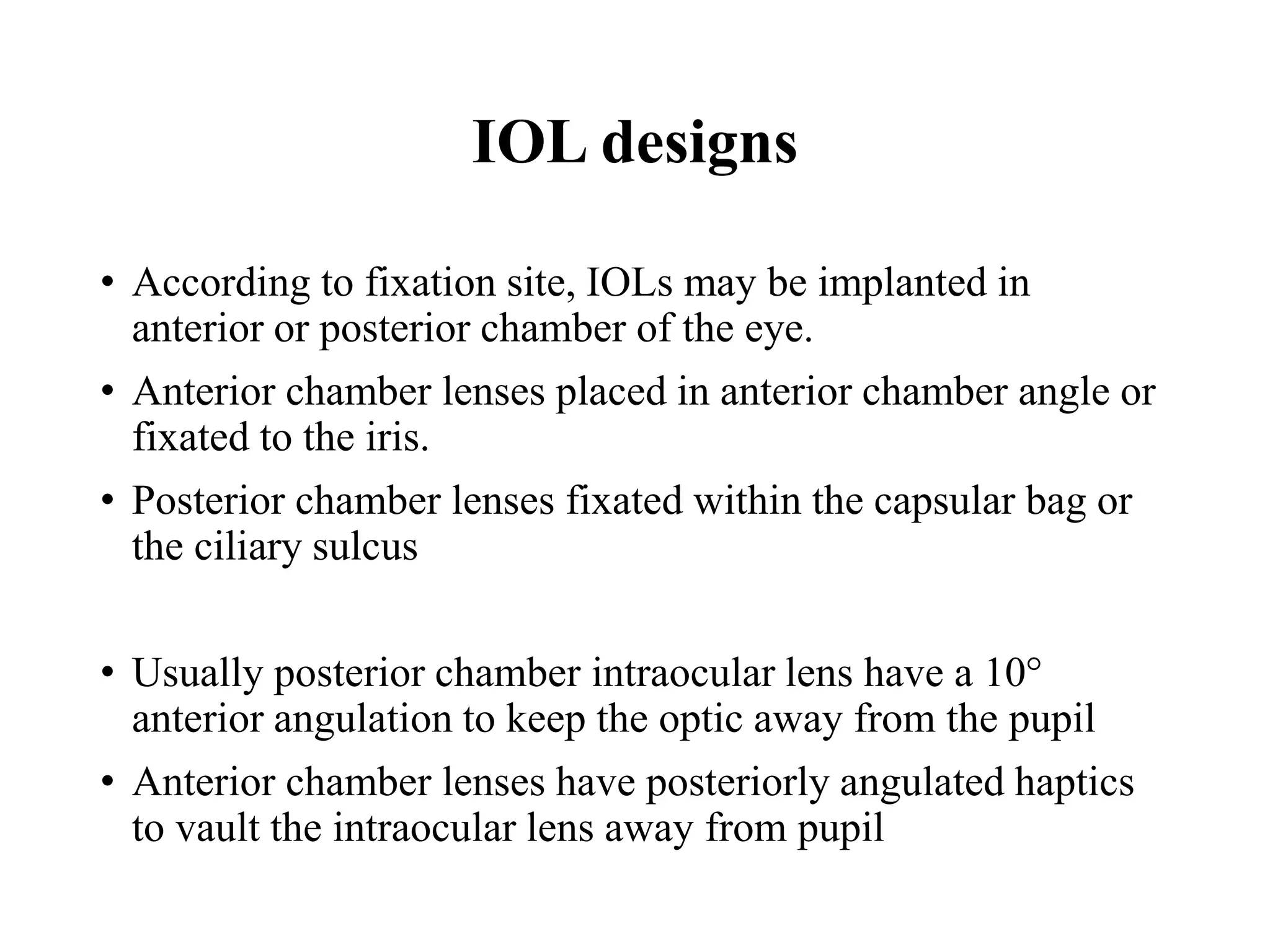
IOL designs
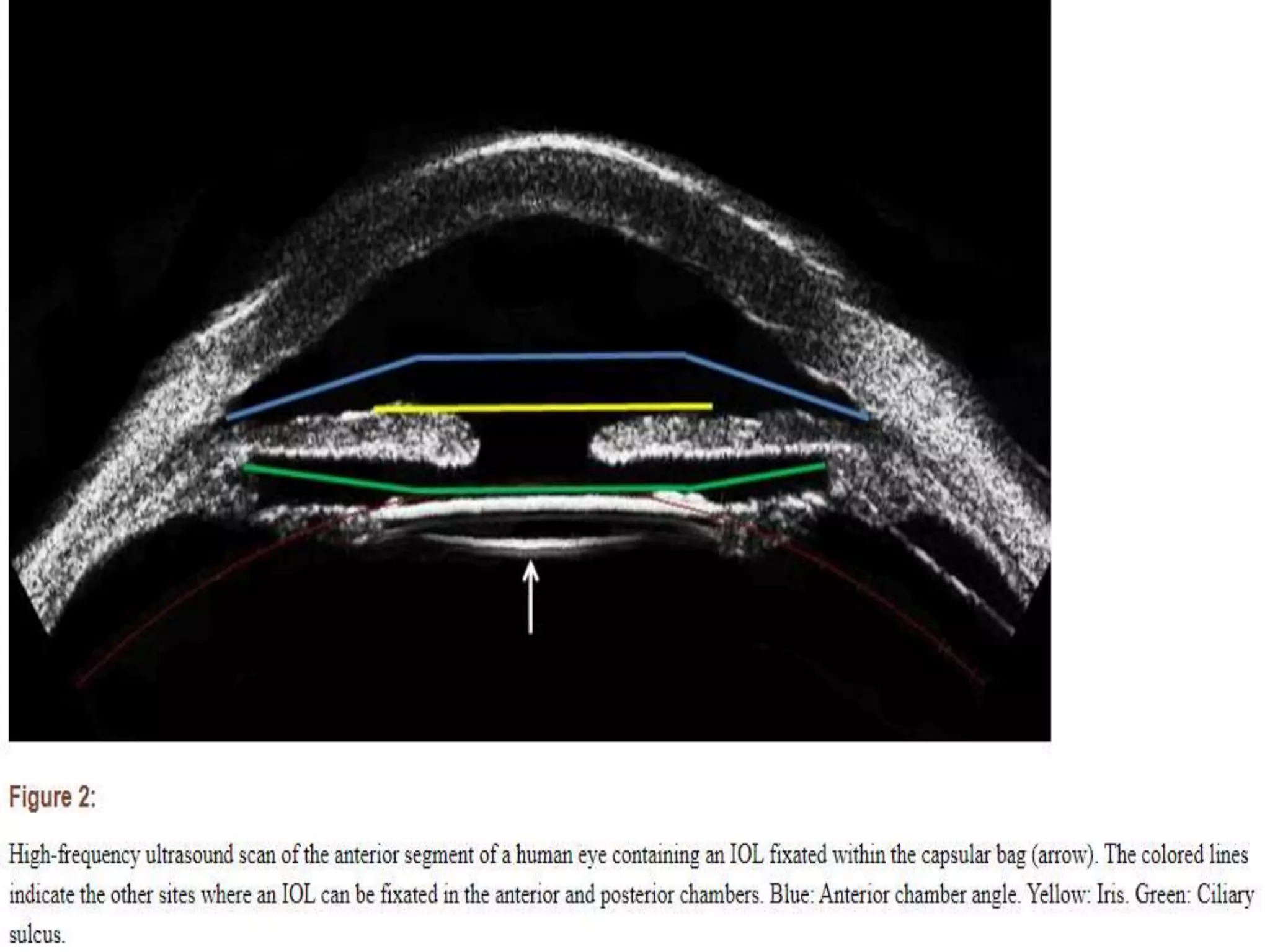
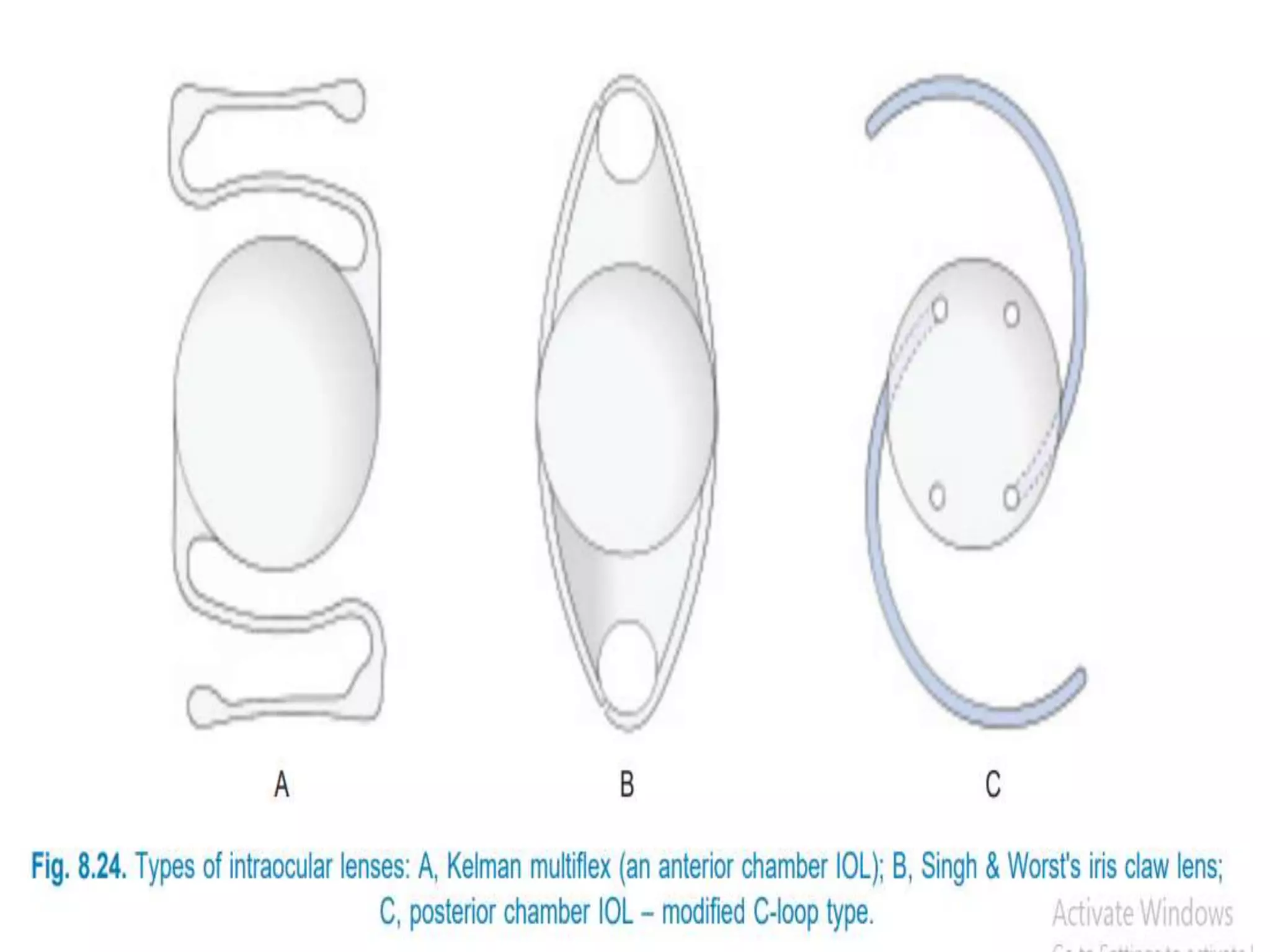
• According to fixation site, IOLs may be implanted in
anterior or posterior chamber of the eye.
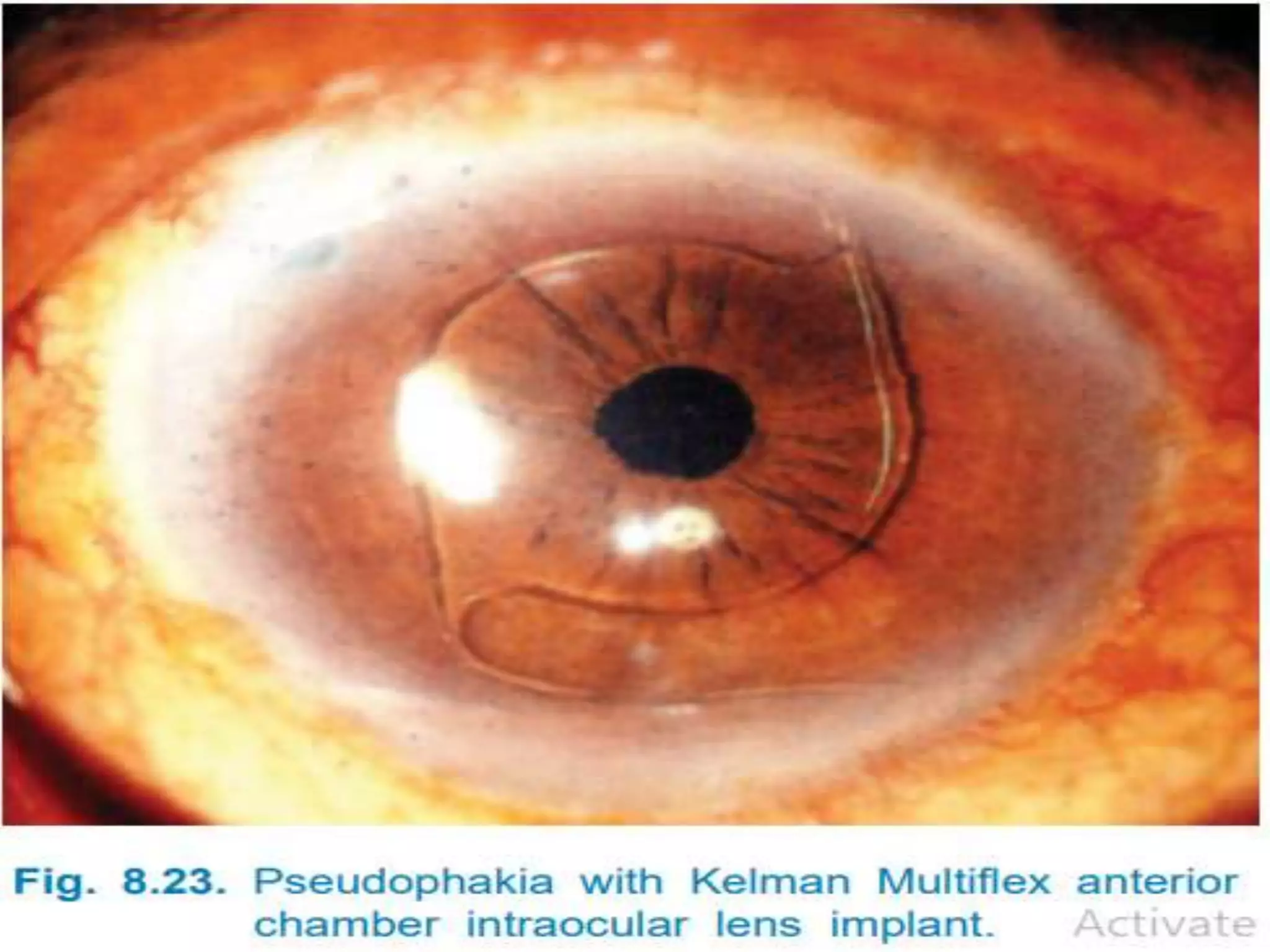
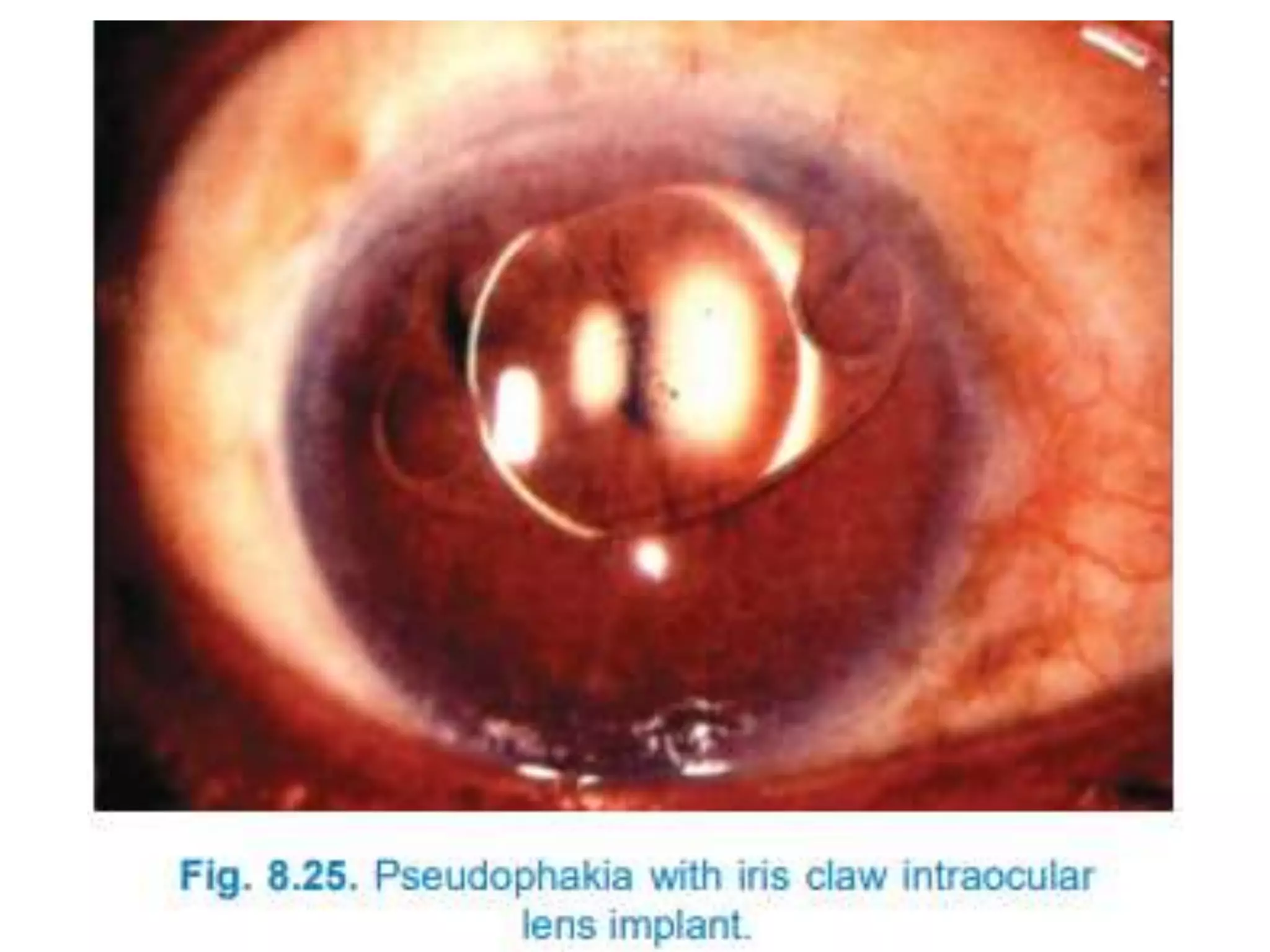
• Anterior chamber lenses placed in anterior chamber angle or
fixated to the iris.
• Posterior chamber lenses fixated within the capsular bag or
the ciliary sulcus
• Usually posterior chamber intraocular lens have a 10°
anterior angulation to keep the optic away from the pupil
• Anterior chamber lenses have posteriorly angulated haptics
to vault the intraocular lens away from pupil
IOL designs
IOLs can also be described as
• single-piece (entire lens manufactured from same material)
OR
• multi-piece (generally described as 3-piece lenses, optic lens
from one source and the loops manufactured from a different
material)
Intraocular lens optic may be
• monofocal
• multifocal
• toric
• accommodative
Flash quiz
SRK formula
Power of intraocular lens to be implanted calculated by modified
Sanders–Retzlaff–Kraff (SRK) formula
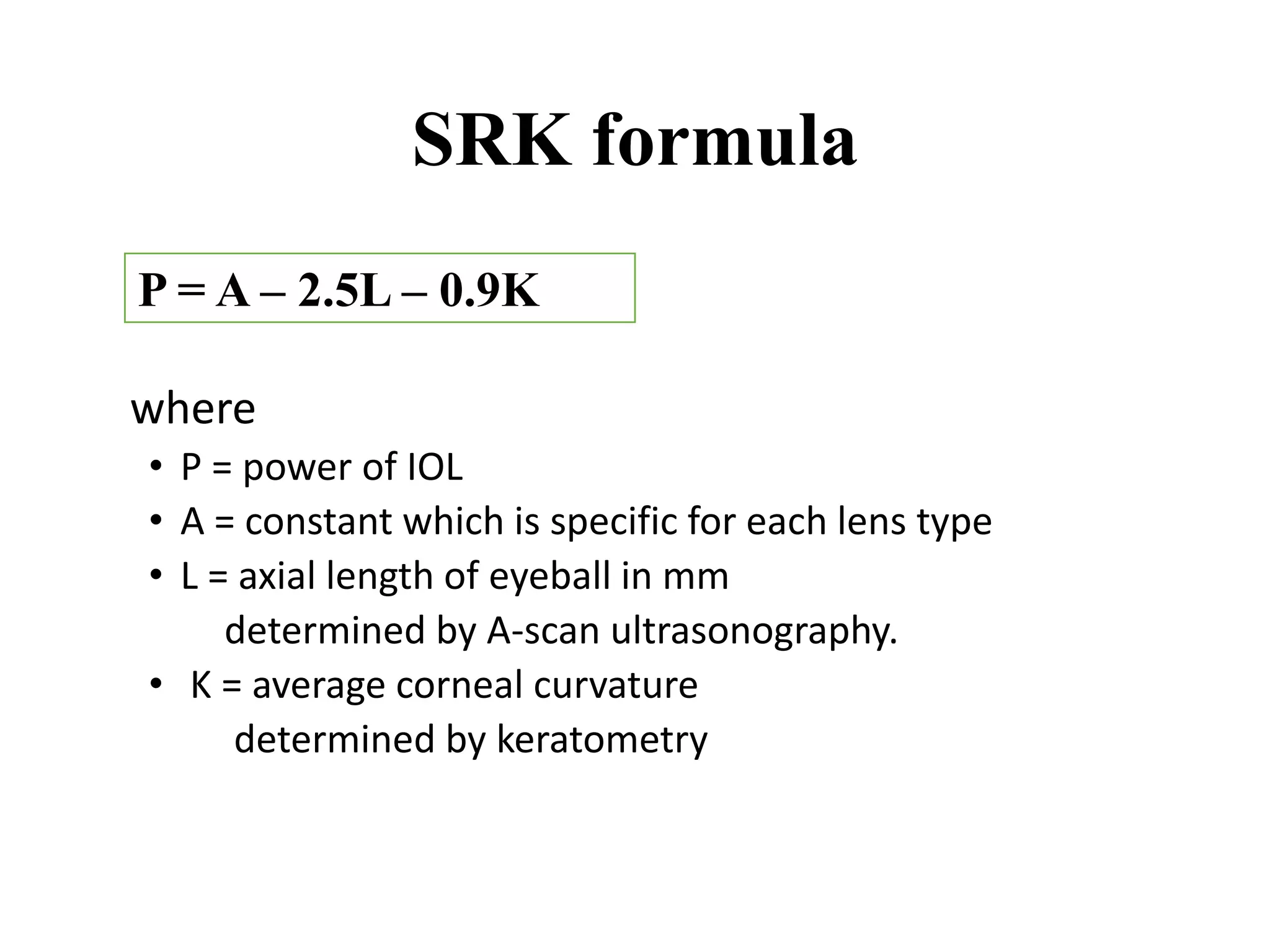
SRK formula
where
• P = power of IOL
• A = constant which is specific for each lens type
• L = axial length of eyeball in mm
determined by A-scan ultrasonography.
• K = average corneal curvature
determined by keratometry
P = A – 2.5L – 0.9K
Complications of IOL
• Initial IOLs had complications like uveitis, glaucoma,
hyphema.
• Posterior capsular opacification
 hydrophilic IOLs
 involve the use of intracameral gas
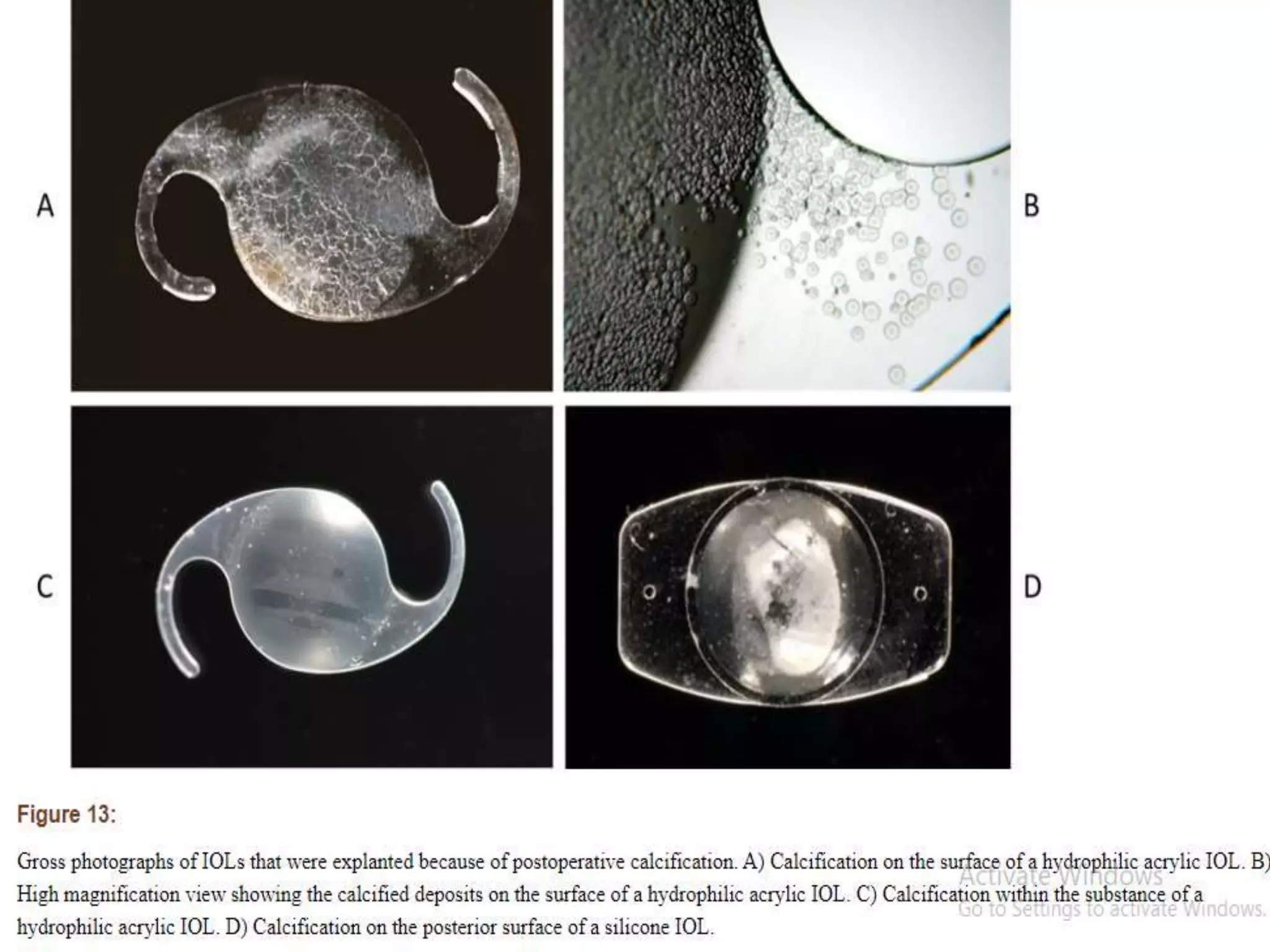
• Calcification
 Silicone lens
 presence of asteroid hyalosis (Ca deposits in vitreous)
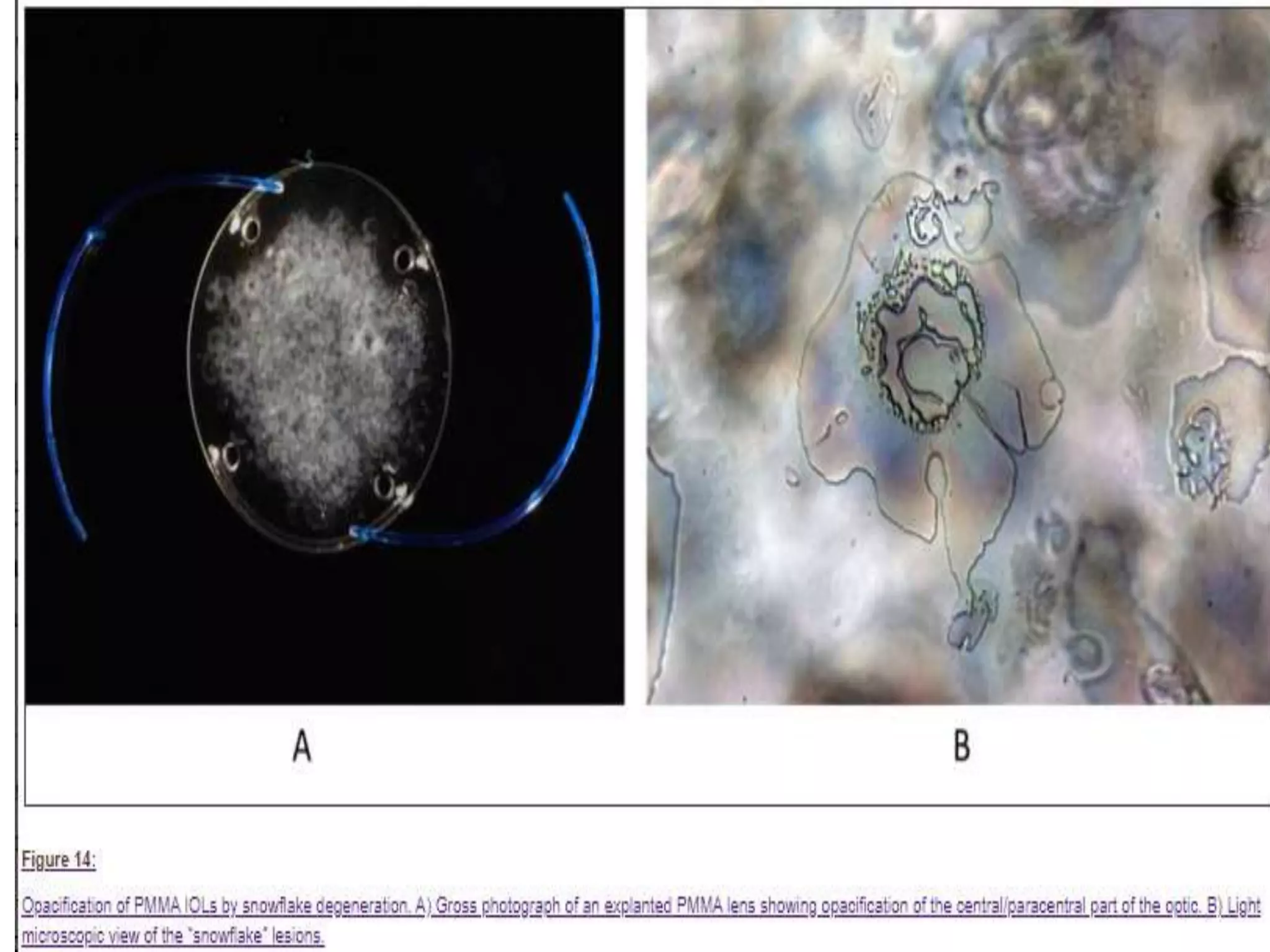
• Snow flake degeneration
 PMMA lens
 PMMA degradation slowly by long term UV exposure
Flash quiz
References
• https://www.ncbi.nlm.nih.gov/books/NBK481726/
• AK Khurana. Comprehensive Ophthalmology.
• Parsons' Diseases of the Eye
THANK YOU !

Intraocular lens (IOL)- cataract management

  • 1.
  • 2.
  • 3.
    • Crystalline lenscontributes approximately +15 to +20 diopters (D) to refractive power of human eye • A further 43 diopters is provided by the cornea
  • 4.
    • To restorerefractive power of a normal clear lens after removal of an opacified crystalline lens in cataract surgery
  • 5.
  • 6.
    A pair ofthick spectacles
  • 7.
  • 8.
  • 9.
    History / Mystery •During World War II, Sir Harold Ridley, an ophthalmologist in London,  saw Royal Air Force casualties with eye injuries  observed that splinters of acrylic plastic from aircraft cockpit canopies became lodged in their eyes did not trigger inflammatory rejection as did glass splinters.  led him to propose the use of artificial lenses made of polymethyl methacrylate - PMMA to treat cataracts • Polymethyl methacrylate (PMMA) lenses were the first lenses to be used in the human eye (in 1949)
  • 10.
    Terminologies • Phakic eye- An eye with a natural crystalline lens • Pseudophakic eye - without a natural crystalline lens but with an IOL • chromophores - UV absorbing compounds, important element of the IOL optic component.  protect retina from UV radiation in the 300-400 nm range, a feature normally provided by the normal crystalline lens • Optic - central part overlying the optic axis • Haptics - peripheral arms used for placement & stabilization
  • 11.
  • 12.
    IOL materials Acrylic lensesSilicone lenses Composition Acrylic acid Polyorganosilone Flexibility Foldable, Non foldable All foldable Refractive index Usually higher Usually lower Lens thickness Thinner Thicker
  • 13.
  • 15.
    IOL designs • Accordingto fixation site, IOLs may be implanted in anterior or posterior chamber of the eye. • Anterior chamber lenses placed in anterior chamber angle or fixated to the iris. • Posterior chamber lenses fixated within the capsular bag or the ciliary sulcus • Usually posterior chamber intraocular lens have a 10° anterior angulation to keep the optic away from the pupil • Anterior chamber lenses have posteriorly angulated haptics to vault the intraocular lens away from pupil
  • 18.
    IOL designs IOLs canalso be described as • single-piece (entire lens manufactured from same material) OR • multi-piece (generally described as 3-piece lenses, optic lens from one source and the loops manufactured from a different material)
  • 19.
    Intraocular lens opticmay be • monofocal • multifocal • toric • accommodative
  • 20.
  • 21.
    SRK formula Power ofintraocular lens to be implanted calculated by modified Sanders–Retzlaff–Kraff (SRK) formula
  • 22.
    SRK formula where • P= power of IOL • A = constant which is specific for each lens type • L = axial length of eyeball in mm determined by A-scan ultrasonography. • K = average corneal curvature determined by keratometry P = A – 2.5L – 0.9K
  • 23.
    Complications of IOL •Initial IOLs had complications like uveitis, glaucoma, hyphema. • Posterior capsular opacification  hydrophilic IOLs  involve the use of intracameral gas • Calcification  Silicone lens  presence of asteroid hyalosis (Ca deposits in vitreous) • Snow flake degeneration  PMMA lens  PMMA degradation slowly by long term UV exposure
  • 26.
  • 32.
    References • https://www.ncbi.nlm.nih.gov/books/NBK481726/ • AKKhurana. Comprehensive Ophthalmology. • Parsons' Diseases of the Eye
  • 33.