








Research Aptitude
Mr. S.Garret Raja Immanuel
Assistant Professor of English
Nazareth Margoschis College at Pillaiyanmanai
• June 2019
• December 2019
• September 2020
• December 2021
Unit-II Research Aptitude
Updated Syllabi of UGC-NET (Applicable from June 2019 UGC-NET Onwards)
• Research: Meaning, Types, and Characteristics, Positivism and Postpositivistic approach to research.
• Methods of Research: Experimental, Descriptive, Historical, Qualitative and Quantitative methods.
• Steps of Research.
• Thesis and Article writing: Format and styles of referencing.
• Application of ICT in research.
• Research ethics.
Meaning of Re+search
• Research is the careful, detailed and systematic process of studying
materials and sources by means of an organised investigation,
experimenting and fact finding with the aim of solving problems,
establishing facts and reaching new conclusions. It is a study into a
specific problem, concern, or issue using the scientific method or
experimentation aimed at the discovery/ revision/ interpretation of
facts, accepted theories or laws.
• Disha Experts. NTA UGC NET Paper 1 Topic-wise 52 Solved Papers
(2020 to 2004) 2nd Edition (p. 61). Kindle Edition.
Characteristics of Research
• Systematic
• Objective
• Accurate
• Logical
• Reliable
• Valid
• Controllable
• Verifiable
• Ethical
• Generalizable
• Relevant
Objectives of Research
• To review an existing body of knowledge/phenomenon
• To explore and analyse a problem/question/issue/cause
• To gain new insight into an existing body of knowledge/
phenomenon
• To investigate and understand a new phenomenon
• To suggest solution/answer to the research problem/question
• To produce/construct/generate new knowledge
• Discover hidden truths
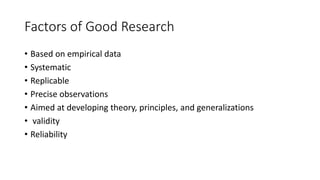
Factors of Good Research
• Based on empirical data
• Systematic
• Replicable
• Precise observations
• Aimed at developing theory, principles, and generalizations
• validity
• Reliability
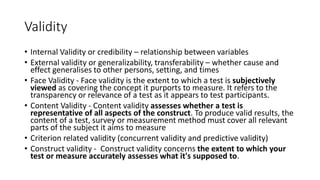
Validity
• Internal Validity or credibility – relationship between variables
• External validity or generalizability, transferability – whether cause and
effect generalises to other persons, setting, and times
• Face Validity - Face validity is the extent to which a test is subjectively
viewed as covering the concept it purports to measure. It refers to the
transparency or relevance of a test as it appears to test participants.
• Content Validity - Content validity assesses whether a test is
representative of all aspects of the construct. To produce valid results, the
content of a test, survey or measurement method must cover all relevant
parts of the subject it aims to measure
• Criterion related validity (concurrent validity and predictive validity)
• Construct validity - Construct validity concerns the extent to which your
test or measure accurately assesses what it's supposed to.
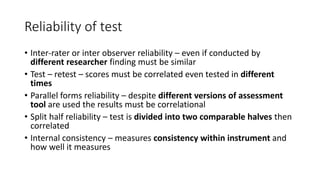
Reliability of test
• Inter-rater or inter observer reliability – even if conducted by
different researcher finding must be similar
• Test – retest – scores must be correlated even tested in different
times
• Parallel forms reliability – despite different versions of assessment
tool are used the results must be correlational
• Split half reliability – test is divided into two comparable halves then
correlated
• Internal consistency – measures consistency within instrument and
how well it measures
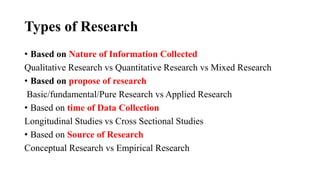
Types of Research
• Based on Nature of Information Collected
Qualitative Research vs Quantitative Research vs Mixed Research
• Based on propose of research
Basic/fundamental/Pure Research vs Applied Research
• Based on time of Data Collection
Longitudinal Studies vs Cross Sectional Studies
• Based on Source of Research
Conceptual Research vs Empirical Research
Basic/fundamental/Pure Research
• Not necessarily problem oriented
• Leads to either discovery of a new theory or refinement of an existing
theory
• Lays foundation for applied research
• Focusing on collecting knowledge without applying it
• Example: what are the components of DNA?
• Effects of alcohol on brain
• To what extent does caffeine consumption affect classroom
concentration?
Applied Research
• Focused on real life problems
• Tries to find practical and immediate result
• Needs to be an empirical study
• Leads to discovery of new facts or testing of theory or concept
• Example: A study searching for ways to encourage high school
graduates to attend college
• A study to build students' interests in Mathematics.
• Applied research to treat or cure a specific disease.
Action Research
• Concerned to analyse and explain phenomena
• It is type of applied research; result is applied on something later
• Research is joined with action
• Researcher becomes a participant
• Action research is a cyclical process of planning, acting, observing,
reflecting
• Example: Using music to stimulate creative writing.
• An example of using drawings to understand second language
learners' prior learning experiences.
Qualitative Research
• Relies on verbal narratives (spoken or written data)
• Provides understanding of problem setting
• Unstructured and exploratory
• Generates hypothesis for qualitative research
• Used normally to gain in-depth understanding of human behaviours,
experiences, attitudes, intentions and motivations by observing and
interpreting
• Researcher gives more weight to the participants’ view
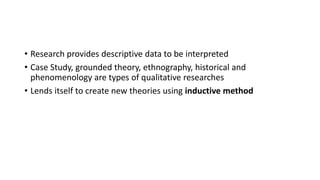
• Research provides descriptive data to be interpreted
• Case Study, grounded theory, ethnography, historical and
phenomenology are types of qualitative researches
• Lends itself to create new theories using inductive method
Types of Qualitative Researches
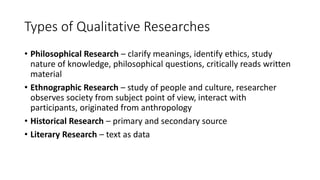
• Philosophical Research – clarify meanings, identify ethics, study
nature of knowledge, philosophical questions, critically reads written
material
• Ethnographic Research – study of people and culture, researcher
observes society from subject point of view, interact with
participants, originated from anthropology
• Historical Research – primary and secondary source
• Literary Research – text as data
Quantitative Research
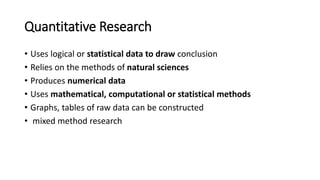
• Uses logical or statistical data to draw conclusion
• Relies on the methods of natural sciences
• Produces numerical data
• Uses mathematical, computational or statistical methods
• Graphs, tables of raw data can be constructed
• mixed method research
Difference
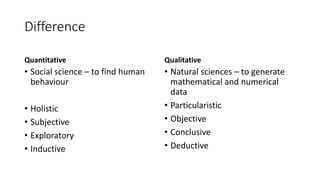
Quantitative
• Social science – to find human
behaviour
• Holistic
• Subjective
• Exploratory
• Inductive
Qualitative
• Natural sciences – to generate
mathematical and numerical
data
• Particularistic
• Objective
• Conclusive
• Deductive
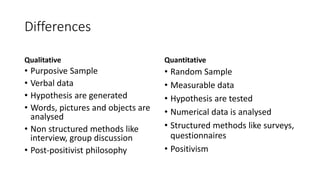
Differences
Qualitative
• Purposive Sample
• Verbal data
• Hypothesis are generated
• Words, pictures and objects are
analysed
• Non structured methods like
interview, group discussion
• Post-positivist philosophy
Quantitative
• Random Sample
• Measurable data
• Hypothesis are tested
• Numerical data is analysed
• Structured methods like surveys,
questionnaires
• Positivism
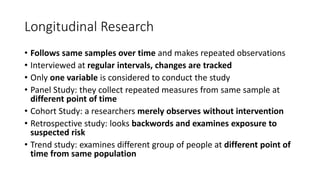
Longitudinal Research
• Follows same samples over time and makes repeated observations
• Interviewed at regular intervals, changes are tracked
• Only one variable is considered to conduct the study
• Panel Study: they collect repeated measures from same sample at
different point of time
• Cohort Study: a researchers merely observes without intervention
• Retrospective study: looks backwords and examines exposure to
suspected risk
• Trend study: examines different group of people at different point of
time from same population
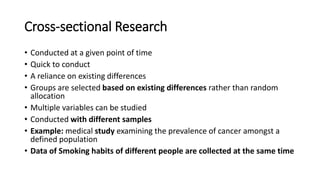
Cross-sectional Research
• Conducted at a given point of time
• Quick to conduct
• A reliance on existing differences
• Groups are selected based on existing differences rather than random
allocation
• Multiple variables can be studied
• Conducted with different samples
• Example: medical study examining the prevalence of cancer amongst a
defined population
• Data of Smoking habits of different people are collected at the same time
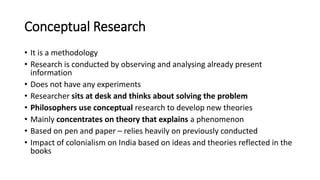
Conceptual Research
• It is a methodology
• Research is conducted by observing and analysing already present
information
• Does not have any experiments
• Researcher sits at desk and thinks about solving the problem
• Philosophers use conceptual research to develop new theories
• Mainly concentrates on theory that explains a phenomenon
• Based on pen and paper – relies heavily on previously conducted
• Impact of colonialism on India based on ideas and theories reflected in the
books
Empirical Research
• Empiricism is the theory that human knowledge comes
predominantly from experiences gathered through the five senses.
• Conducted through investigation
• It is practical and experimental
• Philosophically empiricism means way of gathering knowledge by
direct observation and experience
• Level of control in this research is high
Deductive vs Inductive Research
• Based on Intervention of Researcher
Experimental Research vs Ex-post Facto Research
• Based on Objectives of Research
Exploratory Research vs Explanatory Research vs Descriptive
Research vs Correlational Research
• Based on Method of Data Collection
Case Study Research vs Survey Research vs Observation Research
Experimental Research
• It is a scientific approach
• One or more independent variables are manipulated
• And applied to one or more dependent variables
• To measure their effect on the latter
• usually used in physical, social science, psychology and education.
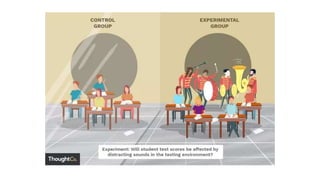
• Experimental group – the group that receives the independent
variable
• Control group – the group the does not receive independent variable
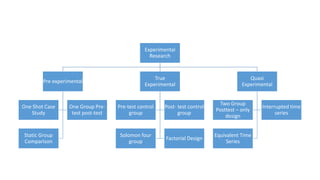
Experimental
Research
Pre experimental
One Shot Case
Study
One Group Pre-
test post-test
Static Group
Comparison
True
Experimental
Pre-test control
group
Post- test control
group
Solomon four
group
Factorial Design
Quasi
Experimental
Two Group
Posttest – only
design
Interrupted time
series
Equivalent Time
Series
Pre-experimental Research
• Treated with no control group
• One shot case study design – also known as ‘one group’ ‘post test’
only design – weak method
• One group pretest - posttest design – lacks control group
• Static group comparison (post test only)
True Experimental Research
• Relies on the statistical analysis – must contain a control group
• Pre test – measurement of dependent variable before introduction of
independent variable
• Post test -
• Solomon four group – Richard L Solomon developed a method – pre-test
sometimes sensitize the subjects to the treatment and improve their
performance - The Solomon four-group design is a type of experiment
where participants get randomly assigned to either 1 of 4 groups that
differ in whether the participants receive the treatment or not, and
whether the outcome of interest is measured once or twice in each group.
• Factorial designs – uses two or more independent variables in combination
Major Steps in Experimental Research
• Control
• Manipulation
• Randomisation
Quasi-experimental Research
• Participants are not randomly assigned
• Control and experiment group
Ex post facto research
• Also known as casual comparative research
• Definition of Ex Post Facto. Kerlinger (1964) defined ex Rost facto research
as: that research in which the independent variable or variables have
already occurred and in which the researcher starts with the observation
of a dependent variable or variables.
• Ex post facto is Latin for "from a thing done afterward". Approval for a
project that's given ex post facto—after the project already has been
begun or completed
• Researcher predict possible cause behind and effect already occurred
• Looking backward
• Researcher can not manipulate independent variable
Exploratory Research
• Explores research question
• Does not make to give final solutions
• Research is done in order to understand the problem
• Should be willing to change direction when new data arrives
• Hypothesis has not been formulated
• Review available material with possibility of developing hypothesis
• Example: A study into the role of social networking sites as an
effective marketing communication channel.
Explanatory Research
• Research the answers “why "questions
• Tries to identify cause and effect of the phenomenon
• Why do women of 60+ get affected by cancer in tamilnadu?
Descriptive Research
• Helps to provide answers to the questions of who, what, when,
where, and how of research problem
• Subject is observed in natural environment
• Precursor to other qualitative research design
• Methods of data collection: Questionnaire, observation, and
interview
• Example: a researcher researching the income of the employees in a
company, and the relationship with their performance
Correlational Research
• A correlational research design investigates relationships between
variables without the researcher controlling or manipulating any of
them. A correlation reflects the strength and/or direction of the
relationship between two (or more) variables.
• The aim of correlational research is to identify variables that have
some sort of relationship do the extent that a change in one creates
some change in the other.
• Example: You want to know if there's a correlation between how
much people earn and the number of children that they have.
Case Study
• A case study is a research approach that is used to generate an in-
depth, multi-faceted understanding of a complex issue in its real-life
context.
• The general purpose of a case study is to: → describe an individual
situation (case), e.g. a person, business, organisation, or institution, in
detail; → identify the key issues of the case (your assignment
question should tell you what to focus on); → analyse the case using
relevant theoretical concepts
• For example, a case study about the Mitsubishi car company might
be used to generalise about similar companies in the automobile
industry.
Survey Research
• Simply a data collection tool
• Quantitatively describes specific aspect of population
• Survey Research is defined as the process of conducting research
using surveys that researchers send to survey respondents. The data
collected from surveys is then statistically analysed to draw
meaningful research conclusions.
• The three most common types of sample surveys are mail surveys,
telephone surveys, and personal interview surveys.
Observational Research
• Observing the behavioural patterns of the people
• Exploratory Research, Explanatory Research, Descriptive Research,
Experimental/Causal Research, Ex-Post Facto Research,
• Observational Research,
• Clinical Research, Phenomenology, Ethnography, Grounded Theory
Research Philosophy
• Ontology
• Epistemology
• Axiology
Research Paradigms
• Positivism
• Constructivism
• Interpretivism
• Pragmatism
• Transformative Paradigm
• Critical Theory
Qualities of a Researcher
• Curiosity
• Analytical mind
• Intelligence
• Quick thinking
• Keen observation
• Critical thinking and reasoning
• Commitment
• Objectivity (unbiased)
• Focussed
• Calmness
• Congeniality with respondents
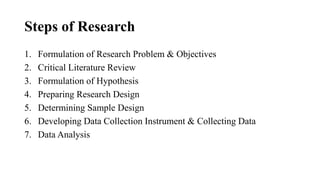
Steps of Research
1. Formulation of Research Problem & Objectives
2. Critical Literature Review
3. Formulation of Hypothesis
4. Preparing Research Design
5. Determining Sample Design
6. Developing Data Collection Instrument & Collecting Data
7. Data Analysis
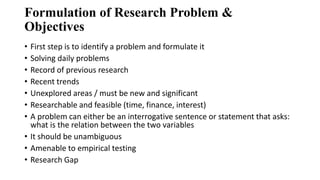
Formulation of Research Problem &
Objectives
• First step is to identify a problem and formulate it
• Solving daily problems
• Record of previous research
• Recent trends
• Unexplored areas / must be new and significant
• Researchable and feasible (time, finance, interest)
• A problem can either be an interrogative sentence or statement that asks:
what is the relation between the two variables
• It should be unambiguous
• Amenable to empirical testing
• Research Gap
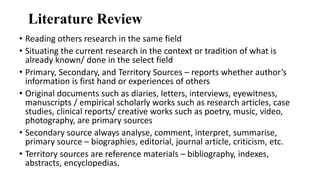
Literature Review
• Reading others research in the same field
• Situating the current research in the context or tradition of what is
already known/ done in the select field
• Primary, Secondary, and Territory Sources – reports whether author’s
information is first hand or experiences of others
• Original documents such as diaries, letters, interviews, eyewitness,
manuscripts / empirical scholarly works such as research articles, case
studies, clinical reports/ creative works such as poetry, music, video,
photography, are primary sources
• Secondary source always analyse, comment, interpret, summarise,
primary source – biographies, editorial, journal article, criticism, etc.
• Territory sources are reference materials – bibliography, indexes,
abstracts, encyclopedias.
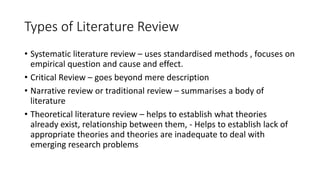
Types of Literature Review
• Systematic literature review – uses standardised methods , focuses on
empirical question and cause and effect.
• Critical Review – goes beyond mere description
• Narrative review or traditional review – summarises a body of
literature
• Theoretical literature review – helps to establish what theories
already exist, relationship between them, - Helps to establish lack of
appropriate theories and theories are inadequate to deal with
emerging research problems
• Scoping Review – its is conducted before the research begins –
highlighting the gaps – explains need for research – same as
systematic review – difference is there is no limit to the materials
resourced
• Mapping literature review – categorises existing literature
• State of the art review – addresses more current matters contrasts to
retrospective
• Gray literature – produced by individuals or organisations outside
academic or commercial publishers
Variable and Formulation of Hypothesis
• Variable is measurable
• There is no number of variable that can be used
• More variable makes the research complex
• Independent Variable – does not depend on variation of another
variable
• controlled only by researcher; it is believed to affect dependent
variable; stable and unaffected by other variables;
Types of Variables
• Predictor Variables
• Manipulated Variable
• Treatment Variable
• Exogenous Variable
• Dependent Variable
• Test Variable
• Outcome Variable
• Endogenous Variable
• Criterion Variable
• Extraneous Variable (Nuisance
Variable)
• Confounding Variable
• Intervening or Mediating
Variable
• Moderator Variable
• Control Variable
Other Variables
• Categorical Variable
• Continuous Variable
• Discrete Variable
• Nominal Variable
• Ordinal Variable
• Qualitative Variable
• Quantitative variable
• Ratio Variable
• Polychotomous Variable
• Attribute Variable
• Binary Variable
• Covariate Variable
• Collider Variable
• Dummy Variable
• Identifier Variable
• Indicator Variable
• Interval Variable
• Latent Variable
• Manifest Variable
Formulation of Hypothesis
• Means supposition about relationship between variables that is
testable
• Scientifically reasonable predictions
• Stated in terms of ‘if-then’ sentences
• Hypo – less certain ; thesis – main idea
• Tentative assumption
• Formulated as a possible answer to the question
• It delimits the research area
• Exploratory research does not aim at testing hypothesis
Characteristics of Good Hypothesis
• Should be simple, specific, precise and clear
• Should explain the relationship between variables
• Should be limited in scope
• Must be consistent with known facts and theory
• Permits application of deductive reasoning
• Capable of verification
• Must be related to existing body of knowledge
Types of Hypothesis
• Simple Hypothesis : predicts the relationship between single independent
variable and single dependent variable (sugar – diabetes )
• Complex Hypothesis
• Directional Hypothesis
• Non directional Hypothesis
• Associative Hypothesis
• Casual Hypothesis
• Null Hypothesis
• Alternate or Research Hypothesis
Preparing Research Design (strategy)
• It is a plan (systematic approach) to answer research question
• Method is a strategy to implement the plan
• It is a framework that includes methods and procedures to collect,
analyse and interpret the data
• It defines how the researcher is going to investigate the central
problem
• It is part of research proposal
• Design determines other constituents such as variables, hypothesis,
methodology, statistical analysis
• Methodology states how to implement the plan
Characteristics of good research design
• Identify and justify why it is a problem
• Review literature surrounding the problem
• Specify hypothesis
• Describe the data to test the hypothesis and how it will be collected
• Defines how this data will be interpreted and analysed
• Objectivity, Validity, Reliability, and Generalizability
Types of Common Research Methods
• Experiments
• Surveys
• Interviews
• Questionnaires
• Case Studies
• Observational Trials
Determining Sample Design
• Selecting a given number of subjects from a defined population as a
representative of that population
• First step is to define Target population (universe)
• Selecting few from bigger group
• Population can be finite or infinite
• Based on probability theory
• Sampling is useful which saves time and money.
Essentials of Ideal Sampling
• Homogeneity: the units in sample must be as likeness as other units
• Adequacy: samples having 10% of the whole data is adequate
• Representativeness
• Must be applicable to whole data
• High level of reliability
Characteristic of good sample
• Sample is called sub-aggregate of universe; population is called
aggregate of certain properties.
• Free from bias and prejudices
• Objective
• Accuracy
• Comprehensive
• Sampling Frame: list of all the items in the population (specific)
• Sample Space: collection of all such possible outcomes of the
experiment ; normally denoted as S
Types of Sampling: Probability or Random Sampling
• Simple Random Sampling: every case of population has a equal
probability of inclusion (2, 7, 13, 19, 22)
• Known as method of chance ; randomization
• Systematic sampling: starts with a random starting point but with the
fixed periodical interval; this sampling interval is determined by
dividing total population by desired sample size (5, 10, 15, 20,25)
• N/n
• Stratified Sampling : sampling frame is divided into homogeneous and non-
overlapping subgroups (called strata) and simple random sample is drawn
within each group.
• Different groups are based on some characteristics (age, income,
education)
• Cluster Sampling: whole population is classified into clusters or group of
homogenous characteristics
• Multi stage sampling: moving from broad to narrow sample using step by
step process – cluster sampling -
• Multiple or double repetitive sample – responded mails are interviewed
Non Probability Sampling
• Accidental or convenient sampling : Also known as grab or opportunity
sampling
• Drawn which is close to hand (convenient) readily available
• Judgemental or Purposive Sampling/authoritative sampling: selected based
on his own knowledge or judgement (highly risky and self evident)
• Quota Sampling: data is collected from homogeneous group then non-
random sample is taken; Observer is allowed to sample as he likes
• Snowball Sampling: asking your subject to nominate another person with
same trait as next subject ; only used when sample is very rare; like chain
referral
• Dimensional Sampling: researcher takes into account several
characteristics, age, gender, income, etc. researcher must ensure atleast
one person from each group
• Sample Size – number of individual samples , generally represented
by the variable ‘n’
• Sampling Error – occurs when he does not select required amount of
samples and when he selects unrepresentative sample
• Error can be reduced by ramdomizing sample selection or increasing
sample size
• Margin of Error (confidence interval) – no sample is perfect so you
can decide how much error can be allowed
• Confidence Level
• Standard of Deviation
Non Sampling Error
• Inadequate preparation (non response error) – error caused by
difference between those who participated in the survey and who did
not take part
• Error in the stage of data collection or observation (response error)
• Error resulting from data processing
Developing Data Collection Instrument &
Collecting Data
• It is a process of gathering, measuring and analysing information on
systematic approach
• Data: unorganised raw facts
• Information: Processed, organised data presented in a given context
• Primary Data: first hand information
• Secondary Data: already published in some reliable source
Quantitative Data Collection Method
• Quantitative survey (determined choice)
• Closed end Questionnaire – asked to pick from available options
• Dichotomy questions, rating scale (graphic, numeric,descriptive
phrase, comparative, , multiple choice, rank ordering , ratio data
• Questionnaire – open end
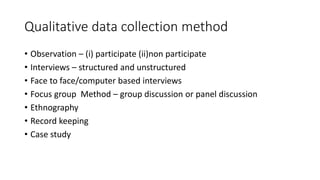
Qualitative data collection method
• Observation – (i) participate (ii)non participate
• Interviews – structured and unstructured
• Face to face/computer based interviews
• Focus group Method – group discussion or panel discussion
• Ethnography
• Record keeping
• Case study
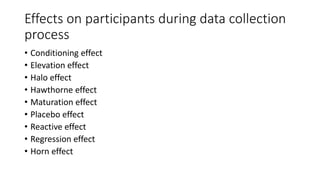
Effects on participants during data collection
process
• Conditioning effect
• Elevation effect
• Halo effect
• Hawthorne effect
• Maturation effect
• Placebo effect
• Reactive effect
• Regression effect
• Horn effect
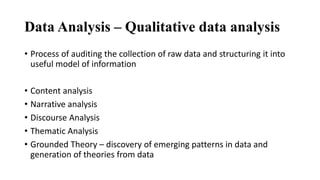
Data Analysis – Qualitative data analysis
• Process of auditing the collection of raw data and structuring it into
useful model of information
• Content analysis
• Narrative analysis
• Discourse Analysis
• Thematic Analysis
• Grounded Theory – discovery of emerging patterns in data and
generation of theories from data
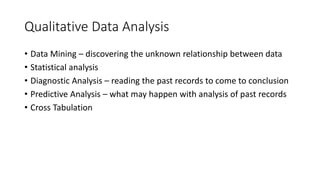
Qualitative Data Analysis
• Data Mining – discovering the unknown relationship between data
• Statistical analysis
• Diagnostic Analysis – reading the past records to come to conclusion
• Predictive Analysis – what may happen with analysis of past records
• Cross Tabulation
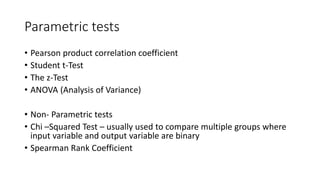
Parametric tests
• Pearson product correlation coefficient
• Student t-Test
• The z-Test
• ANOVA (Analysis of Variance)
• Non- Parametric tests
• Chi –Squared Test – usually used to compare multiple groups where
input variable and output variable are binary
• Spearman Rank Coefficient
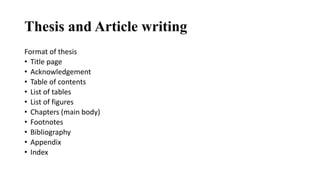
Thesis and Article writing
Format of thesis
• Title page
• Acknowledgement
• Table of contents
• List of tables
• List of figures
• Chapters (main body)
• Footnotes
• Bibliography
• Appendix
• Index
Main body
• Introduction
• Literature review
• Research Methods
• Results
• Discussion and Conclusion
Thesis and Article writing
Format and styles of referencing
• APA (EDUCATION, PSYCHOLOGY, SCIENCES)
• Chicago / Turabian (HISTORY, BUSINESS AND FINE ARTS
• MLA (HUMANITIES)
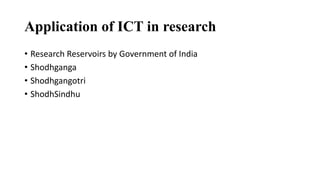
Application of ICT in research
• Research Reservoirs by Government of India
• Shodhganga
• Shodhgangotri
• ShodhSindhu
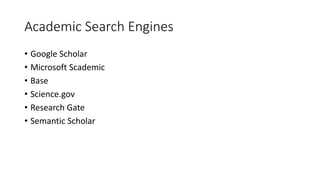
Academic Search Engines
• Google Scholar
• Microsoft Scademic
• Base
• Science.gov
• Research Gate
• Semantic Scholar
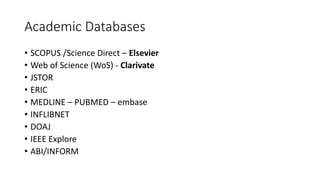
Academic Databases
• SCOPUS /Science Direct – Elsevier
• Web of Science (WoS) - Clarivate
• JSTOR
• ERIC
• MEDLINE – PUBMED – embase
• INFLIBNET
• DOAJ
• IEEE Explore
• ABI/INFORM
Reference/Bibliography Management
• EasyBib.com , Mendeley, Endnote, RefWorks, Zotero, Reference
Manager,
Data Management and Analysis
Plagirism Check
Language and Grammar Error Correction
Manuscript Submission and Publication
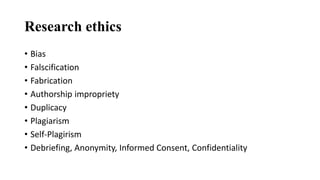
Research ethics
• Bias
• Falscification
• Fabrication
• Authorship impropriety
• Duplicacy
• Plagiarism
• Self-Plagirism
• Debriefing, Anonymity, Informed Consent, Confidentiality
Thank You