
INTONATION nagaRAJU
Say ‘Hello’ - to a friend you meet regularly - to a friend you haven't seen for 10 years - to a neighbor whom you don't like - to a 6 month old baby - to someone doing what he shouldn't - to know if someone is listening (phone)
Teacher: Sheela, say "Hello" to me. Student: "Hello"  ( neutral, polite tone )   Teacher: Sheela, now say "Hello" to a friend. Student: "Hello"  ( much more upbeat tone ) Teacher: Sheela, say "Hello" to an infant!!!  Student: “Hello"  ( exaggerated fall-rise tone ) Teacher: Sheela, say “Hello” to . . . . . .  Class Activity
INTONATION HOW   WE SAY THINGS rather than WHAT WE SAY Intonation exists in all languages.  Concept is neither new nor difficult. Native-speaker-level is not the goal.
The pattern of  rises and falls  in pitch. A device to indicate the meaning intended - the  emotional meaning . A tool to indicate the  feelings  of the speaker. INTONATION
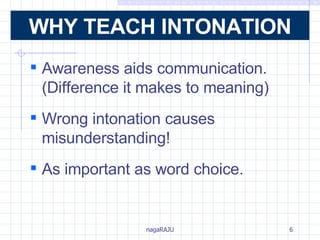
Awareness aids communication.  (Difference it makes to meaning)  Wrong intonation causes misunderstanding! As important as word choice. WHY TEACH INTONATION
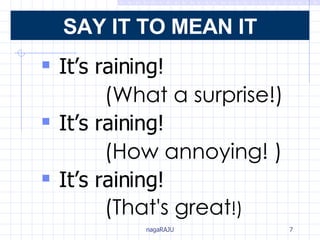
It’s raining! (What a surprise!) It’s raining! (How annoying! ) It’s raining! (That's great !) SAY IT TO MEAN IT
Say ‘Goodbye’ to a member of your family  departing at the airport. to someone who has been  annoying you. to a child starting his very first day  at school. to a boy/girl friend. to a colleague at the end of the  training programme. SAY ‘GOODBYE’
-  to someone you haven't seen for 20  years. - to someone who has recently lost a  member of the family. - to someone who is in hospital. to a colleague at the beginning of the  day. to the head of your institution SAY ‘HOW ARE YOU?
Do we have to speak English?  I never watch TV. I never go to pubs. What have you done? Hey, what is the problem?   SAY THESE IN DIFFERENT WAYS
Boy: Are you busy tonight? Girl: Not really. Why? Boy: I was thinking of going to a movie? Girl: Great! Let’s go! ROLE PLAY
Demonstrate models – try exaggerated intonation.  Compare examples of same phrase – varied  intonation. Try dialogue as 'robots' (flat) and then speak  'normally‘ to highlight the difference Let students imitate, but without words, just  humming.   AWARENESS RAISING
hot > boiling good > fantastic interesting > fascinating ‘ Is Hyderabad hot?'  'Hot? It was boiling!!!' (higher pitch) INTENSIFYING ADJECTIVES
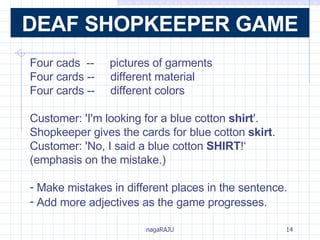
Four cads  --  pictures of garments Four cards --  different material Four cards --  different colors Customer: 'I'm looking for a blue cotton  shirt '.  Shopkeeper gives the cards for blue cotton  skirt . Customer: 'No, I said a blue cotton  SHIRT !‘ (emphasis on the mistake.) Make mistakes in different places in the sentence. Add more adjectives as the game progresses.   DEAF SHOPKEEPER GAME
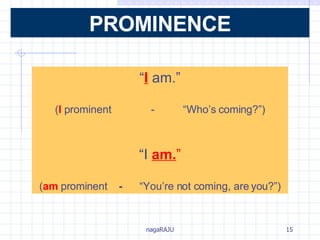
“ I   am.” ( I  prominent  - “Who’s coming?”) “ I  am. ” ( am  prominent  -  “You’re not coming, are you?”) PROMINENCE
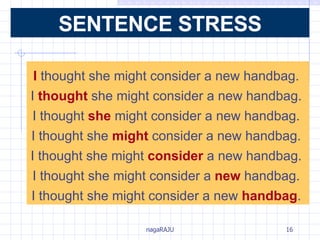
I  thought she might consider a new handbag.  I  thought  she might consider a new handbag.  I thought  she  might consider a new handbag.  I thought she  might  consider a new handbag.  I thought she might  consider  a new handbag.  I thought she might consider a  new  handbag.  I thought she might consider a new  handbag .   SENTENCE STRESS
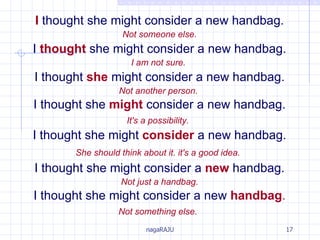
I   thought she might consider a new handbag. Not someone else. I   thought   she might consider a new handbag. I am not sure.   I thought   she   might consider a new handbag. Not another person.   I thought she   might   consider a new handbag. It's a possibility.   I thought she might   consider   a new handbag. She should think about it. it's a good idea.   I thought she might consider a   new   handbag. Not just a handbag. I thought she might consider a new   handbag . Not something else.
Where patterns associating intonation and grammar are predictable, highlight them.  See them as starting-points, rather than as rules. Some examples: Wh questions: falling intonation  Yes/No questions: rising intonation Statements: falling intonation INTONATION & GRAMMAR
Create awareness of the strong link between the two. Rules are difficult. Let learners recognize the effect of intonation changes.   Utter a word e.g., ‘coffee‘ -  'interested'  (varied tone);  'uninterested'  (flat).  Similarly, 'enthusiastic', 'bored', 'surprised', 'relieved'. Learners identify and describe the difference. Let students practise in pairs, guessing each other's attitude.  INTONATION & ATTITUDE
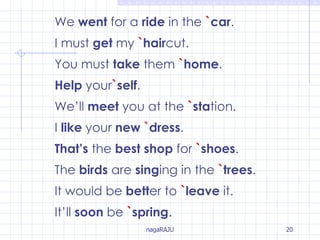
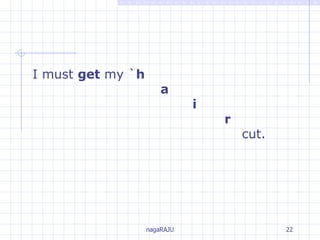
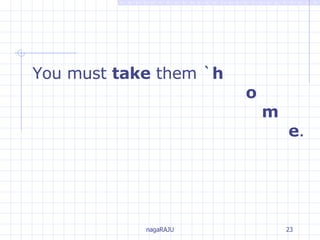
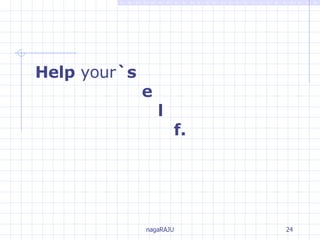
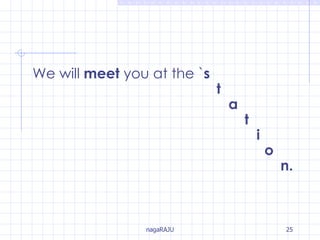
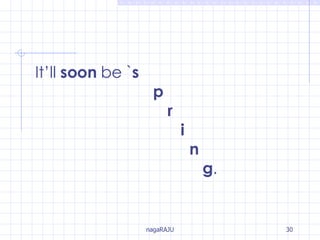
We  went  for a  ride  in the  ` car . I must  get  my  ` hair cut. You must  take  them  ` home . Help  your ` self . We’ll  meet  you at the  ` sta tion. I  like  your  new   ` dress . That’s  the  best   shop  for  ` shoes . The  birds  are  sing ing in the  ` trees . It would be  bett er to  ` leave  it. It’ll  soon  be  ` spring .
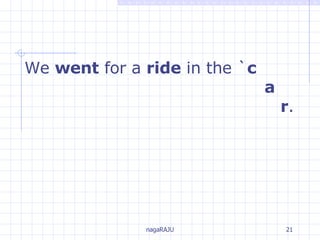
We  went  for a  ride  in the ` c   a   r .
I must  get  my ` h a i r   cut.
You must  take  them ` h     o       m e .
Help  your `s   e   l   f.
We will  meet  you at the ` s     t   a     t   i     o     n.
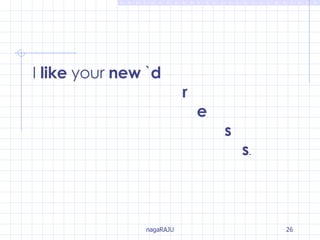
I  like  your  new  ` d   r   e s   s .
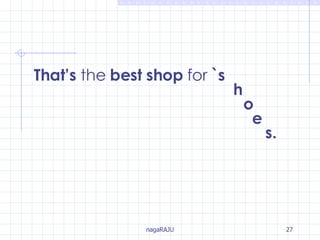
That’s  the  best   shop  for  `s   h   o     e     s.
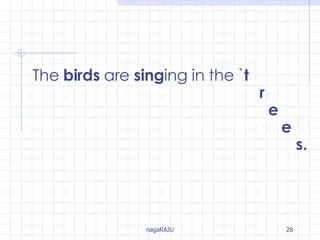
The  birds  are  sing ing in the ` t   r   e   e   s.
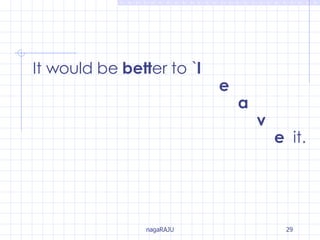
It would be  bett er to ` l   e   a v     e  it.
It’ll  soon  be ` s   p   r   i   n   g .
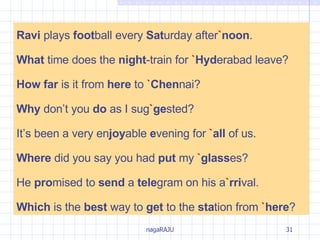
Ravi  plays  foot ball every  Sat urday after ` noon . What  time does the  night -train for  ` Hyd erabad leave? How   far  is it from  here  to  ` Chen nai? Why  don’t you  do  as I sug ` ge sted? It’s been a very en joy able  e vening for  ` all  of us. Where  did you say you had  put  my  ` glass es? He  pro mised to  send  a  tele gram on his a ` rri val. Which  is the  best  way to  get  to the  sta tion from  ` here ?
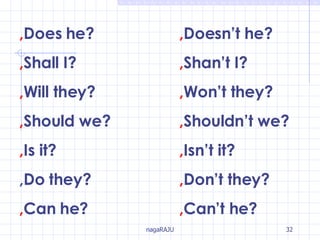
, Does he? , Doesn’t he? , Shall I? , Shan’t I? , Will they? , Won’t they? , Should we? , Shouldn’t we? , Is it? , Isn’t it? ,Do they? , Don’t they? , Can he? , Can’t he?
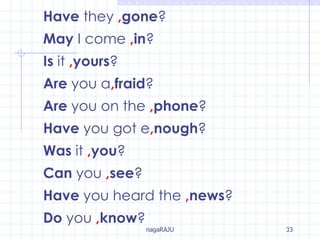
Have  they  , gone ? May  I come  , in ? Is  it  , yours ? Are  you a , fraid ? Are  you on the  , phone ? Have  you got e , nough ? Was  it  , you ? Can  you  , see ? Have  you heard the  , news ? Do  you  , know ?
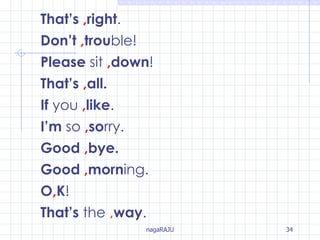
That’s   , right . Don’t   , trou ble! Please  sit  , down ! That’s  , all. If  you  , like . I’m  so  , so rry. Good  , bye. Good   , morn ing. O , K ! That’s  the  , way .
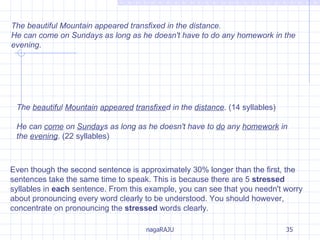
The  beautifu l  Mountain   appeared   transfixe d in the  distance . (14 syllables) He can  come  on  Sunday s as long as he doesn't have to  do  any  homework  in the  evening . (22 syllables)  The beautiful Mountain appeared transfixed in the distance. He can come on Sundays as long as he doesn't have to do any homework in the evening . Even though the second sentence is approximately 30% longer than the first, the sentences take the same time to speak. This is because there are 5  stressed  syllables in  each  sentence. From this example, you can see that you needn't worry about pronouncing every word clearly to be understood. You should however, concentrate on pronouncing the  stressed  words clearly.
 

Teaching Intonation

  • 1.
  • 2.
    Say ‘Hello’ -to a friend you meet regularly - to a friend you haven't seen for 10 years - to a neighbor whom you don't like - to a 6 month old baby - to someone doing what he shouldn't - to know if someone is listening (phone)
  • 3.
    Teacher: Sheela, say"Hello" to me. Student: "Hello" ( neutral, polite tone ) Teacher: Sheela, now say "Hello" to a friend. Student: "Hello" ( much more upbeat tone ) Teacher: Sheela, say "Hello" to an infant!!! Student: “Hello" ( exaggerated fall-rise tone ) Teacher: Sheela, say “Hello” to . . . . . . Class Activity
  • 4.
    INTONATION HOW WE SAY THINGS rather than WHAT WE SAY Intonation exists in all languages. Concept is neither new nor difficult. Native-speaker-level is not the goal.
  • 5.
    The pattern of rises and falls in pitch. A device to indicate the meaning intended - the emotional meaning . A tool to indicate the feelings of the speaker. INTONATION
  • 6.
    Awareness aids communication. (Difference it makes to meaning) Wrong intonation causes misunderstanding! As important as word choice. WHY TEACH INTONATION
  • 7.
    It’s raining! (Whata surprise!) It’s raining! (How annoying! ) It’s raining! (That's great !) SAY IT TO MEAN IT
  • 8.
    Say ‘Goodbye’ toa member of your family departing at the airport. to someone who has been annoying you. to a child starting his very first day at school. to a boy/girl friend. to a colleague at the end of the training programme. SAY ‘GOODBYE’
  • 9.
    - tosomeone you haven't seen for 20 years. - to someone who has recently lost a member of the family. - to someone who is in hospital. to a colleague at the beginning of the day. to the head of your institution SAY ‘HOW ARE YOU?
  • 10.
    Do we haveto speak English? I never watch TV. I never go to pubs. What have you done? Hey, what is the problem? SAY THESE IN DIFFERENT WAYS
  • 11.
    Boy: Are youbusy tonight? Girl: Not really. Why? Boy: I was thinking of going to a movie? Girl: Great! Let’s go! ROLE PLAY
  • 12.
    Demonstrate models –try exaggerated intonation. Compare examples of same phrase – varied intonation. Try dialogue as 'robots' (flat) and then speak 'normally‘ to highlight the difference Let students imitate, but without words, just humming. AWARENESS RAISING
  • 13.
    hot > boilinggood > fantastic interesting > fascinating ‘ Is Hyderabad hot?' 'Hot? It was boiling!!!' (higher pitch) INTENSIFYING ADJECTIVES
  • 14.
    Four cads -- pictures of garments Four cards -- different material Four cards -- different colors Customer: 'I'm looking for a blue cotton shirt '. Shopkeeper gives the cards for blue cotton skirt . Customer: 'No, I said a blue cotton SHIRT !‘ (emphasis on the mistake.) Make mistakes in different places in the sentence. Add more adjectives as the game progresses. DEAF SHOPKEEPER GAME
  • 15.
    “ I am.” ( I prominent - “Who’s coming?”) “ I am. ” ( am prominent - “You’re not coming, are you?”) PROMINENCE
  • 16.
    I thoughtshe might consider a new handbag. I thought she might consider a new handbag. I thought she might consider a new handbag. I thought she might consider a new handbag. I thought she might consider a new handbag. I thought she might consider a new handbag. I thought she might consider a new handbag . SENTENCE STRESS
  • 17.
    I thought she might consider a new handbag. Not someone else. I thought she might consider a new handbag. I am not sure. I thought she might consider a new handbag. Not another person. I thought she might consider a new handbag. It's a possibility. I thought she might consider a new handbag. She should think about it. it's a good idea. I thought she might consider a new handbag. Not just a handbag. I thought she might consider a new handbag . Not something else.
  • 18.
    Where patterns associatingintonation and grammar are predictable, highlight them. See them as starting-points, rather than as rules. Some examples: Wh questions: falling intonation Yes/No questions: rising intonation Statements: falling intonation INTONATION & GRAMMAR
  • 19.
    Create awareness ofthe strong link between the two. Rules are difficult. Let learners recognize the effect of intonation changes. Utter a word e.g., ‘coffee‘ - 'interested' (varied tone); 'uninterested' (flat). Similarly, 'enthusiastic', 'bored', 'surprised', 'relieved'. Learners identify and describe the difference. Let students practise in pairs, guessing each other's attitude. INTONATION & ATTITUDE
  • 20.
    We went for a ride in the ` car . I must get my ` hair cut. You must take them ` home . Help your ` self . We’ll meet you at the ` sta tion. I like your new ` dress . That’s the best shop for ` shoes . The birds are sing ing in the ` trees . It would be bett er to ` leave it. It’ll soon be ` spring .
  • 21.
    We went for a ride in the ` c a r .
  • 22.
    I must get my ` h a i r cut.
  • 23.
    You must take them ` h o m e .
  • 24.
    Help your`s e l f.
  • 25.
    We will meet you at the ` s t a t i o n.
  • 26.
    I like your new ` d r e s s .
  • 27.
    That’s the best shop for `s h o e s.
  • 28.
    The birds are sing ing in the ` t r e e s.
  • 29.
    It would be bett er to ` l e a v e it.
  • 30.
    It’ll soon be ` s p r i n g .
  • 31.
    Ravi plays foot ball every Sat urday after ` noon . What time does the night -train for ` Hyd erabad leave? How far is it from here to ` Chen nai? Why don’t you do as I sug ` ge sted? It’s been a very en joy able e vening for ` all of us. Where did you say you had put my ` glass es? He pro mised to send a tele gram on his a ` rri val. Which is the best way to get to the sta tion from ` here ?
  • 32.
    , Does he?, Doesn’t he? , Shall I? , Shan’t I? , Will they? , Won’t they? , Should we? , Shouldn’t we? , Is it? , Isn’t it? ,Do they? , Don’t they? , Can he? , Can’t he?
  • 33.
    Have they , gone ? May I come , in ? Is it , yours ? Are you a , fraid ? Are you on the , phone ? Have you got e , nough ? Was it , you ? Can you , see ? Have you heard the , news ? Do you , know ?
  • 34.
    That’s , right . Don’t , trou ble! Please sit , down ! That’s , all. If you , like . I’m so , so rry. Good , bye. Good , morn ing. O , K ! That’s the , way .
  • 35.
    The beautiful Mountain appeared transfixe d in the distance . (14 syllables) He can come on Sunday s as long as he doesn't have to do any homework in the evening . (22 syllables) The beautiful Mountain appeared transfixed in the distance. He can come on Sundays as long as he doesn't have to do any homework in the evening . Even though the second sentence is approximately 30% longer than the first, the sentences take the same time to speak. This is because there are 5 stressed syllables in each sentence. From this example, you can see that you needn't worry about pronouncing every word clearly to be understood. You should however, concentrate on pronouncing the stressed words clearly.
  • 36.