LEIDY SALAZAR
GABRIELA DUQUE
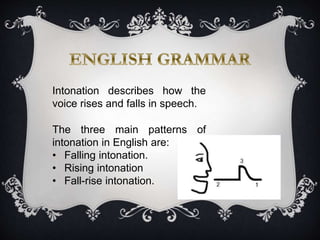
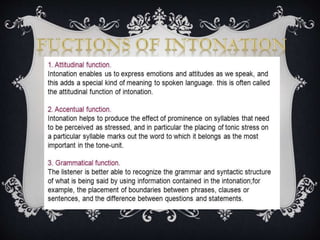
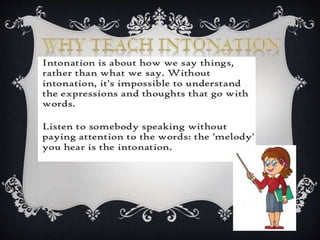
Intonation describes how the
voice rises and falls in speech.
The three main patterns of
intonation in English are:
• Falling intonation.
• Rising intonation
• Fall-rise intonation.
Falling intonation describes how the
voice falls on the final stressed syllable
of a phrase or a group of words.
A falling intonation is very common
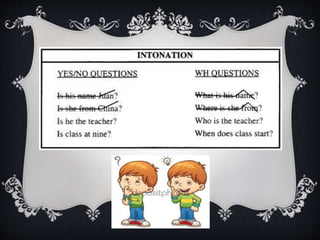
in wh-questions.
Example:
• Where’s the nearest p↘ost-office?
• What time does the film f↘inish?
We also use falling intonation when we
say something definite, or when we want
to be very clear about something:
Example:
• I think we are completely l↘ost.
• OK, here’s the magaz↘ine you
wanted.
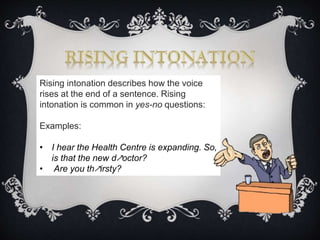
Rising intonation describes how the voice
rises at the end of a sentence. Rising
intonation is common in yes-no questions:
Examples:
• I hear the Health Centre is expanding. So,
is that the new d↗octor?
• Are you th↗irsty?
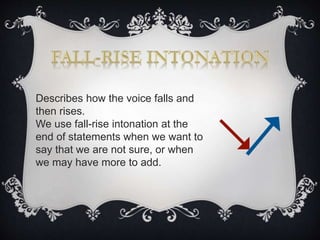
Describes how the voice falls and
then rises.
We use fall-rise intonation at the
end of statements when we want to
say that we are not sure, or when
we may have more to add.
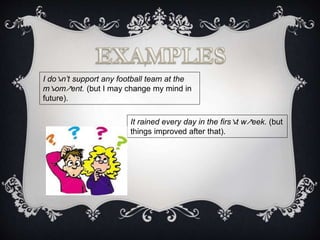
I do↘n’t support any football team at the
m↘om↗ent. (but I may change my mind in
future).
It rained every day in the firs↘t w↗eek. (but
things improved after that).
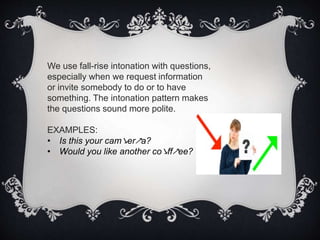
We use fall-rise intonation with questions,
especially when we request information
or invite somebody to do or to have
something. The intonation pattern makes
the questions sound more polite.
EXAMPLES:
• Is this your cam↘er↗a?
• Would you like another co↘ff↗ee?
Intonation
Intonation
Intonation
Intonation

Intonation

  • 1.
  • 2.
    Intonation describes howthe voice rises and falls in speech. The three main patterns of intonation in English are: • Falling intonation. • Rising intonation • Fall-rise intonation.
  • 3.
    Falling intonation describeshow the voice falls on the final stressed syllable of a phrase or a group of words. A falling intonation is very common in wh-questions. Example: • Where’s the nearest p↘ost-office? • What time does the film f↘inish?
  • 4.
    We also usefalling intonation when we say something definite, or when we want to be very clear about something: Example: • I think we are completely l↘ost. • OK, here’s the magaz↘ine you wanted.
  • 5.
    Rising intonation describeshow the voice rises at the end of a sentence. Rising intonation is common in yes-no questions: Examples: • I hear the Health Centre is expanding. So, is that the new d↗octor? • Are you th↗irsty?
  • 6.
    Describes how thevoice falls and then rises. We use fall-rise intonation at the end of statements when we want to say that we are not sure, or when we may have more to add.
  • 7.
    I do↘n’t supportany football team at the m↘om↗ent. (but I may change my mind in future). It rained every day in the firs↘t w↗eek. (but things improved after that).
  • 8.
    We use fall-riseintonation with questions, especially when we request information or invite somebody to do or to have something. The intonation pattern makes the questions sound more polite. EXAMPLES: • Is this your cam↘er↗a? • Would you like another co↘ff↗ee?