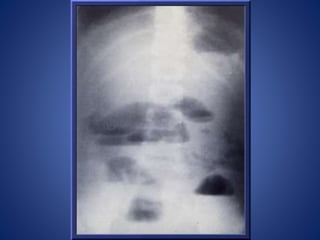
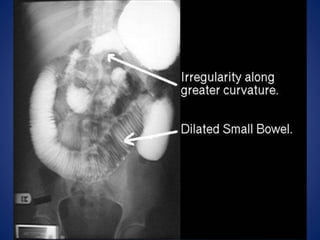
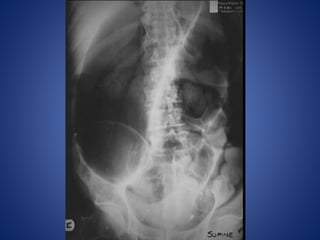
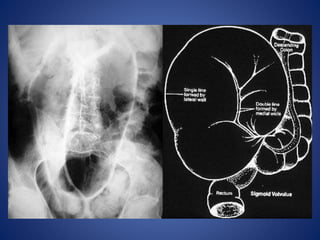
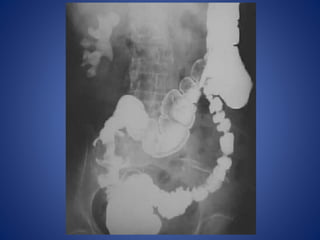
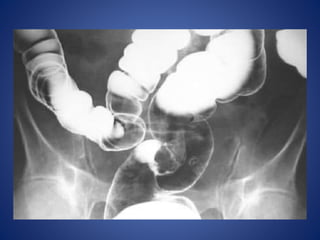
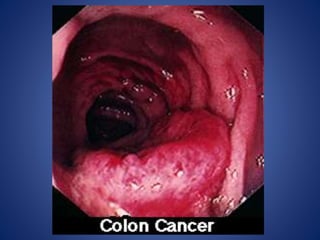
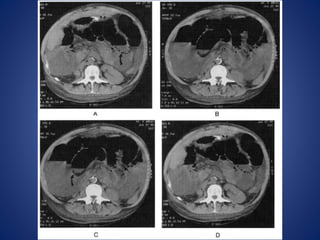
Intestinal obstruction
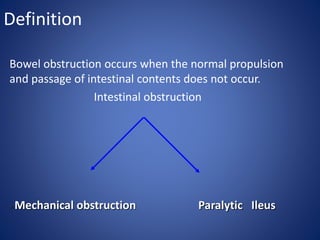
Bowel obstruction occurs when the normal propulsion
and passage of intestinal contents does not occur.
 Intestinal obstruction

Mechanical obstruction Paralytic Ileus
Definition
Intestinal obstruction
• This obstruction can involve only the small
intestine (small bowel obstruction), the large
intestine (large bowel obstruction), or via
systemic alterations, involving both the small and
large intestine (generalized ileus). The
"obstruction" can involve a mechanical
obstruction or, in contrast, may be related to
ineffective motility without any physical
obstruction, so-called functional obstruction,
"pseudo-obstruction," or paralytic ileus
CLASSIFICATION
 Dynamic/ Adynamic
 Small bowel obstruction [ high or low ]
 Large bowel obstruction
 Acute
 Chronic
 Acute on chronic
 Subacute
 Simple
 Strangulated
 Closed loop obstruction
INTESTINAL OBSTRUCTION IS
CLASSIFIED IN TWO TYPES
 DYNAMIC : where peristalsis is working against a
mechanical obstruction.
 ADYNAMIC: it may occur in two forms
1. 1st where peristalsis may be absent (paralytic
ileus,)occurring secondarily to neuromuscular failure
in the mesentery.
2. 2nd where peristalsis may be present in non-
propulsive form.(pseudo-obstruction)
IN BOTH FORMS MECHANICAL ELEMENT IS ABSENT.
Mechanical obstruction
• There is physical blockage of intestinal lumen which due to:
1. Intramural : congenital-tumor-hematoma-inflammatory
2. Extramural : adhesion-volvulus-hernia –abscess-hematoma
3. Lumen obstruction: stone-meconium-foreign body- impaction
(stool-worm-barium)
• This mechanical obstruction can be partial ( lumen narrowed
but allow transit some content) or complete ( lumen totally
obstruction) this classify to
A. simple obstruction (no vascular impairment)
B. closed loop ( both ends are obstructed e.g volvulus)
C. strangulation obstruction
ON THE BASIS OF NATURE IT IS
CLASSIFIED IN TO
ACUTE
CHRONIC
ACUTE ON CHRONIC
SUBACUTE
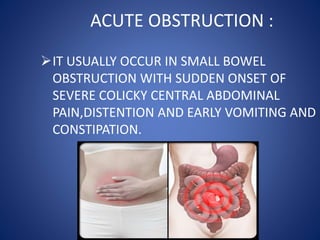
ACUTE OBSTRUCTION :
IT USUALLY OCCUR IN SMALL BOWEL
OBSTRUCTION WITH SUDDEN ONSET OF
SEVERE COLICKY CENTRAL ABDOMINAL
PAIN,DISTENTION AND EARLY VOMITING AND
CONSTIPATION.
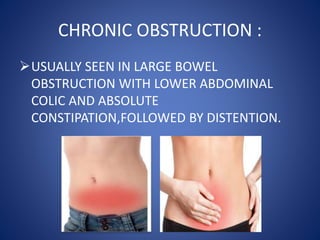
CHRONIC OBSTRUCTION :
USUALLY SEEN IN LARGE BOWEL
OBSTRUCTION WITH LOWER ABDOMINAL
COLIC AND ABSOLUTE
CONSTIPATION,FOLLOWED BY DISTENTION.
ACUTE ON CHRONIC
OBSTRUCTION :
IT SATRTS IN LARGE BOWEL BUT GRADUALLY
INVOLVES THE SMALL INTESTINE.
EARLY SYMPTOMS ARE PAIN AND
CONSTIPATION BUT WHEN SMALL INTESTINE
IS INVOLVED IT IS CHARACTERIZED BY
VOMITING AND GENERAL DSTENTION.
ON THE BASIS ,WHETHER THE
OBSTRUCTION IS
SIMPLE MECHANICAL
STARANGULATED
CLOSED LOOP
ETIOLOGY
CAUSES FROM OUTSIDE THE WALL (Extraluminal)
CAUSES FROM THE WALL (Intramural)
CAUSES IN THE LUMEN (Intraluminal)
• Adhesions- 40%
• Tumors -15%
• Inflamatory- 15%
• Obstructed hernia-12%
• Intraluminal-10%
• Miscellaneous -8%
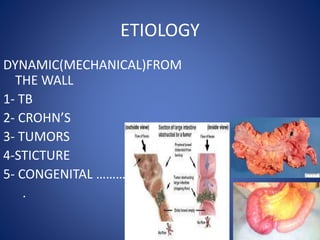
ETIOLOGY
DYNAMIC(MECHANICAL)FROM
THE WALL
1- TB
2- CROHN’S
3- TUMORS
4-STICTURE
5- CONGENITAL ……… .
.
ETIOLOGY
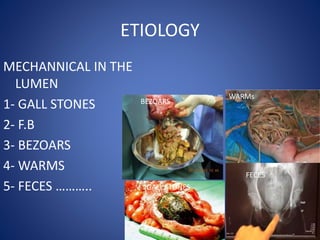
MECHANNICAL IN THE
LUMEN
1- GALL STONES
2- F.B
3- BEZOARS
4- WARMS
5- FECES ……….. GALL STONES
BEZOARS
WARMs
FECES
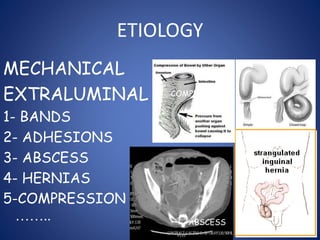
ETIOLOGY
MECHANICAL
EXTRALUMINAL
1- BANDS
2- ADHESIONS
3- ABSCESS
4- HERNIAS
5-COMPRESSION
……..
BANDS
ABSCESS
COMPRESSION
HERNIA
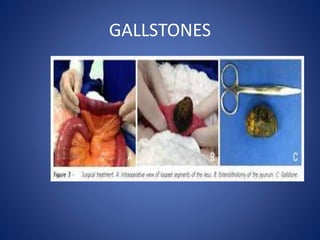
GALLSTONES
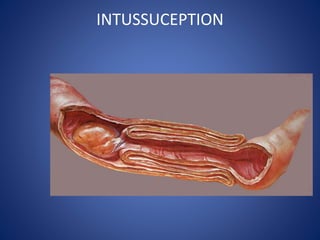
INTUSSUCEPTION
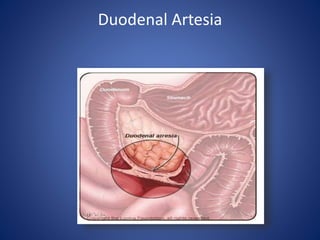
Duodenal Artesia
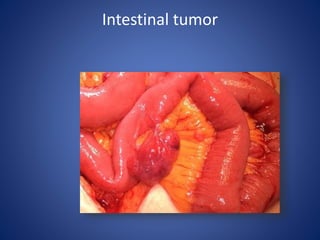
Intestinal tumor
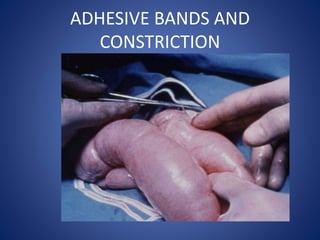
ADHESIVE BANDS AND
CONSTRICTION
ETIOLOGY
Adynamic Intestinal Obstruction.
1- Peritonitis
2- Electrolytes’ Imbalance
3- Postoperative
4- Ischemia
5- Drugs
6- Retroperitoneal causes...
MOST COMMON CAUSES
SMALL INTESTINE
-ADHESIONS &
- EXTERNAL HERNIAS (both are more than 75% of
cases)
- CROHN’S, TB, TUMORS, INTUS., CONGENITAL………
LARGE INTESTINE
- TUMORS &
- VOLVULUS (both are 90% of cases
- DIVERTIDULITIS (rare)
- ADHESIONS (extremely rare if at all)
CAUSES ACCORDING TO AGE
BIRTH : Atresia, Meconium, NE, Volvulus,Hirschsprung’s
3 WEEKS : Pyloric stenosis
6-9MONTHS : Intussusception
TEENAGE : Appendicitis , Meckel’s diverticulitis
YOUNG ADULT : Adhesions , Hernia
ADULT : Adhesions , Hernia, Appendicitis, Crohn’s,
Carcinoma
ELDERLY : Carcinoma, Diverticulitis, Sigmoid Volvulus ,
Feces
PATHOPHYSIOLOGY
THE OBSTRUCTION COULD BE :
- Simple
- Closed loop
- Strangulated
PATHOPYSIOLOGY
SIMPLE OBSTRUCTION :
1-ABOVE THE OBSTRUCTION
OBSTRUCTION  Peristalsis increases  Intstine
dilates  Reduction in peristaltic strength 
Flaccidity and paralysis (protective but late)
2- BELOW THE OBSTRUCTION
NORMAL PERISTALSIS & ABSORBTION  Until it
becomes empty  It contracts & becomes
immobile
PATHOPHYSIOLOGY
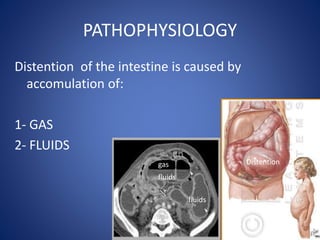
Distention of the intestine is caused by
accomulation of:
1- GAS
2- FLUIDS
gas
fluids
Distention
fluids
PATHPYSIOLOGY
Gas in the intestine is due to:
1. Swallowed air
2. Bacterial overgrowth
3. Diffusion from blood
PATHOPHYSILOGY
Fluids come from :
1. Ingested fluids
2. Saliva
3. Gastric and intestinal juice
4. Bile & Pancreatic secretions
PATHOPHYSIOLOGY
Dehydration caused by :
1. Reduced intake
2. Reduced absorption
3. Increased loss (Vomiting & sequesration)
PATHOPHYSIOLOGY
Systemic Effects of Obstruction :
1. Water and electrolyte losses (lead to hypovolemia)
2. Toxic materials and toxemia(lead to sepsis)
3. Cardiopulmonary dysfunction(atelectasis)
4. Renal failure
5. Shock and death
PATHOPHYSIOLOGY
Strangulation leads to impaired venous return
 Increased congestion 
-free peritoneal fluid
-edema of intestinal wall
-blood in the lumen
-impaired arterial blood supply
-ischemia and gangrene
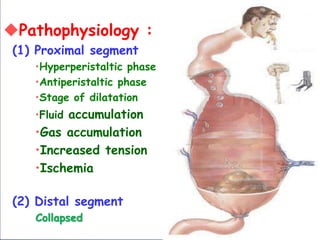
Pathophysiology :
(1) Proximal segment
•Hyperperistaltic phase
•Antiperistaltic phase
•Stage of dilatation
•Fluid accumulation
•Gas accumulation
•Increased tension
•Ischemia
(2) Distal segment
Collapsed
ADYNAMIC OBSTRUCTION causes
Either localized or generalized
Small intestine
- Postoperative
- Intra-abdominal abscess or peritonitis
- Mesenteric embolism or thrombosis
Large intestine
- Retroperitoneal hematoma
- Drugs
- Hypokalemia
- Idiopathic
STARANGULATED
OBSTRUCTION
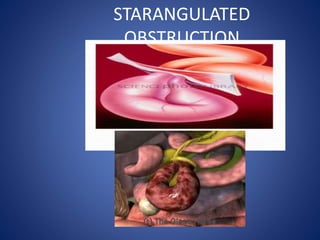
STARANGULATED OBSTRUCTION :
Strangulating obstruction is obstruction with
compromised blood flow; it occurs in nearly
25% of patients with small-bowel obstruction.
It is usually associated with hernia, volvulus,
and intussusceptions.
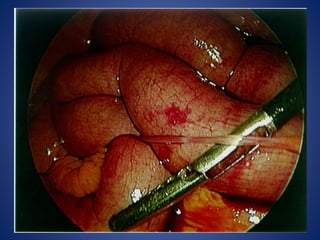
Strangulating obstruction can progress to
infarction and gangrene in as little as 6 h.
.
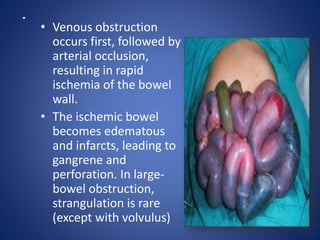
• Venous obstruction
occurs first, followed by
arterial occlusion,
resulting in rapid
ischemia of the bowel
wall.
• The ischemic bowel
becomes edematous
and infarcts, leading to
gangrene and
perforation. In large-
bowel obstruction,
strangulation is rare
(except with volvulus)
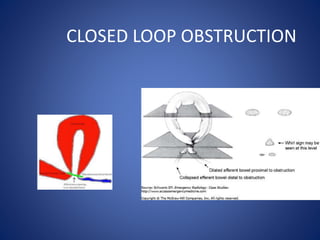
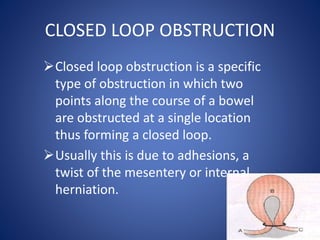
CLOSED LOOP OBSTRUCTION
Closed loop obstruction is a specific
type of obstruction in which two
points along the course of a bowel
are obstructed at a single location
thus forming a closed loop.
Usually this is due to adhesions, a
twist of the mesentery or internal
herniation.
• In the large bowel it is known as a
volvulus.
• In the small bowel it is simply known as
small bowel closed loop obstruction.
• Obstruction to the blood supply occur
either from the same mechanism which
caused obstruction or by the twist of
the bowel on mesentery.
DIAGNOSIS
History
Clinical examination
Investigations
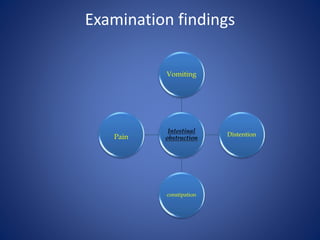
Examination findings
Intestinal
obstruction
Vomiting
Distention
constipation
Pain
CLINICAL FEATURE OF INTESTINAL
OBSTRUCTION
Clinical obstruction of intestinal obstruction
vary according to :
 The location of the obstruction;
 The age of the obstruction;
 The underlying pathology;
 The presence or the absence of the intestinal
obstruction;
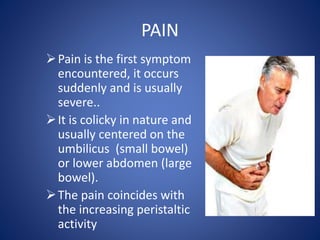
PAIN
Pain is the first symptom
encountered, it occurs
suddenly and is usually
severe..
It is colicky in nature and
usually centered on the
umbilicus (small bowel)
or lower abdomen (large
bowel).
The pain coincides with
the increasing peristaltic
activity
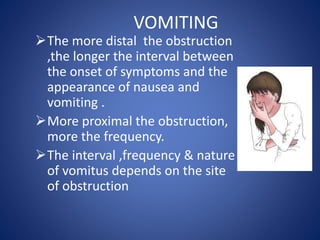
VOMITING
The more distal the obstruction
,the longer the interval between
the onset of symptoms and the
appearance of nausea and
vomiting .
More proximal the obstruction,
more the frequency.
The interval ,frequency & nature
of vomitus depends on the site
of obstruction
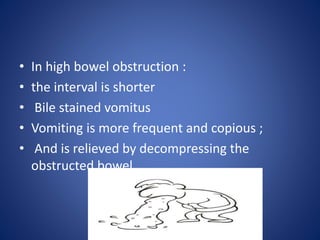
• In high bowel obstruction :
• the interval is shorter
• Bile stained vomitus
• Vomiting is more frequent and copious ;
• And is relieved by decompressing the
obstructed bowel
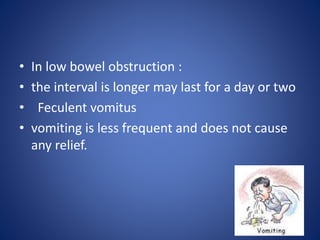
• In low bowel obstruction :
• the interval is longer may last for a day or two
• Feculent vomitus
• vomiting is less frequent and does not cause
any relief.
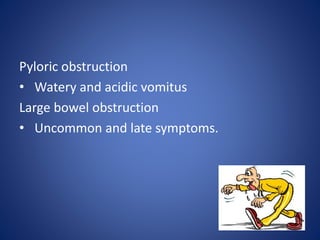
Pyloric obstruction
• Watery and acidic vomitus
Large bowel obstruction
• Uncommon and late symptoms.
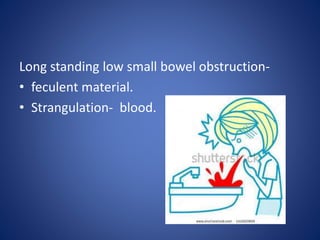
Long standing low small bowel obstruction-
• feculent material.
• Strangulation- blood.
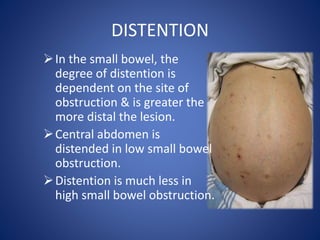
DISTENTION
In the small bowel, the
degree of distention is
dependent on the site of
obstruction & is greater the
more distal the lesion.
Central abdomen is
distended in low small bowel
obstruction.
Distention is much less in
high small bowel obstruction.
CONSTIPATION
• Failure to pass flatus or faeces through the
rectum is important symptom of bowel
obstruction.
• It may be classified as
1. ABSOLUTE
2. RELATIVE
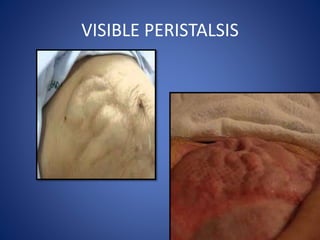
VISIBLE PERISTALSIS
Visible peristalsis may be present if the
abdomen is examined carefully.
Mostly seen in proximal loops.
Borborygmi is quite loud ,does not require
stethoscope to hear it .
In auscultation sound of hyper peristalsis
coinciding with attack of colic characteristic
feature f intestinal obstruction.
VISIBLE PERISTALSIS
BLOATING
• The accumulation of chyme and gas gives rise
to a feeling of fullness and causes bloating.
This may also give rise to high-pitched gurgling
sounds from the abdomen
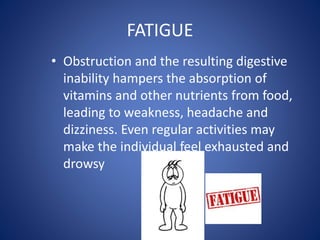
FATIGUE
• Obstruction and the resulting digestive
inability hampers the absorption of
vitamins and other nutrients from food,
leading to weakness, headache and
dizziness. Even regular activities may
make the individual feel exhausted and
drowsy
INFREQUENT URINATION
• Dehydration due to diarrhea and vomiting,
results in the loss of body fluids and
electrolytes. As a response to this, the body
tries to retain water through lowered urine
output.
OTHER MANIFESTATION
• Dehydration
• Hypokalamia
• Pyrexia
• Abdominal tenderness
• Bowel sound
PHYSICAL EXAMINATION
• Inspection
• Palpation
• Percussion
• Auscultation
• Rectal examination
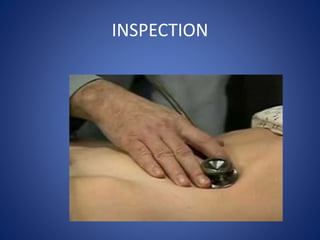
INSPECTION
INSPECTION
Shape of the abdomen
Movement of the abdomen wall
Umbilicus
Visible loop of bowel/visible peristalsis
Scar
Striae
Prominent veins
Pubic hair
Hernial orifices
PALPATION
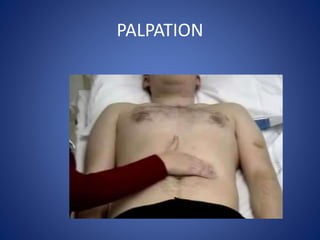
PALPATION
During colic there may be muscle guarding.
 Slight tenderness may be present between
attacks of pain.
Tenderness and rigidity at the sight of
obstruction usually indicate strangulation.
All the hernial orifices should be palpated to
exclude the presence of hernia.
PERCUSSION
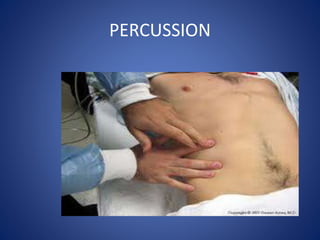
PERCUSSION
Percussion to hear any Dullness or Resonance
related to site of obstruction.
Tympanic node will be present.
Tenderness on light percussion suggest
strangulation.
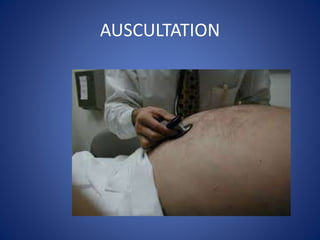
AUSCULTATION
AUSCULTATION
Bowel sounds are Initially Loud and frequent
Then as bowel distends the sounds become
more resonant and high pitched
Eventually becoming amphoric.
In strangulation bowel sound is completely
absent.
RECTAL EXAMINATION
Presence of mass on rectal examination within
or outside the lumen will give a clue to
diagnosis.
Presence or absence of feces in rectum should
be noted. Absence means obstruction is
higher up. If presence it should be studied for
presence of occult blood which include
mucosal lesion e.g.cancer,Intussuception or
infraction
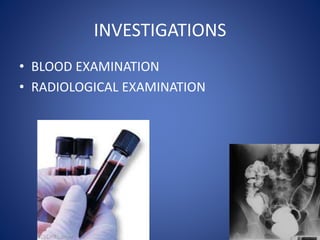
INVESTIGATIONS
• BLOOD EXAMINATION
• RADIOLOGICAL EXAMINATION
BLOOD EXAMINATION
• CBC
• Urea & electrolytes
• Serum amylase level
• Metabolic acidosis
CBC (Complete blood count)-
A rise white cell count will indicate an
infection.
Normal or slight rise in W.B.C count: simple
mechanical obstruction.
Moderate rise in W.B.C count(15000-
20000):strangulation.
Very high rise in W.B.C count(30000-
40000):primary mesenteric vascular occlusion.
Serum Urea & electrolytes-
Derangement may be seen with vomiting &
diarrhea.
Dehydration will be reflected in raised serum
urea and creatinine.
Serum Amylase-
• It is non specific test & may be raised in cases
of small intestinal obstruction.
Metabolic acidosis
It occurs due to combined effects of
dehydration ketosis and loss of alkaline
secretion.
Very common in distal intestinal obstruction.
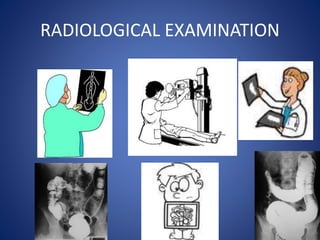
RADIOLOGICAL EXAMINATION
Bowel Obstruction
Radiologic Evaluation
• Xrays: ? AFLs, ? Free Air, ? Distal Gas
• UGI / SBFT: Identify mechanical obstruction
• Enteroclysis: Independent of gastric emptying
• CT Scan: ? Free Air, ? Pneumatosis, ? Tumor
RADIOLOGICAL EXAMINATION
Gas fluid levels are the most important criteria
of diagnosis of intestinal obstruction.
When obstruction occurs, both fluid and gas
collect in the intestine.
They produce a characteristic pattern called
"air-fluid levels". The air rises above the fluid
and there is a flat surface at the "air-fluid"
interface.
RADIOLOGICAL PICTURE
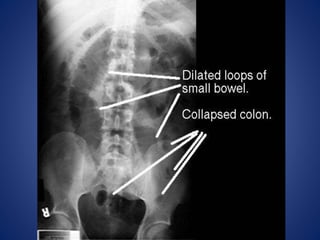
 Small Bowel Obstruction
- Central distention (GAS)
- Valvulae conniventes
- “Ladder-like dilatation”
- Small diameter
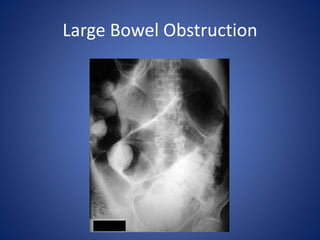
 Large Bowel Obstruction
- Peripheral distention “Picture frame”
- More gross distention
- Haustral indentation & large diameter
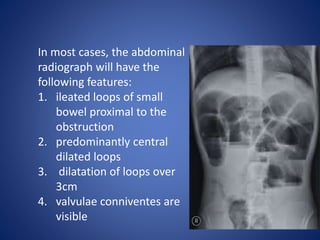
In most cases, the abdominal
radiograph will have the
following features:
1. ileated loops of small
bowel proximal to the
obstruction
2. predominantly central
dilated loops
3. dilatation of loops over
3cm
4. valvulae conniventes are
visible
Large Bowel Obstruction
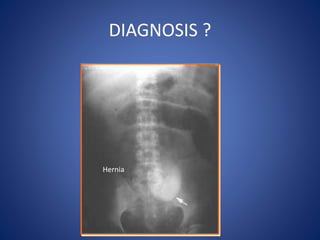
DIAGNOSIS ?
Hernia
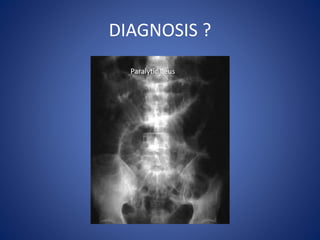
DIAGNOSIS ?
Paralytic Ileus
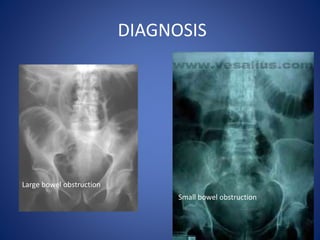
DIAGNOSIS
Small bowel obstruction
Large bowel obstruction
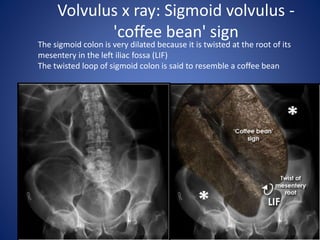
Volvulus x ray: Sigmoid volvulus -
'coffee bean' sign
The sigmoid colon is very dilated because it is twisted at the root of its
mesentery in the left iliac fossa (LIF)
The twisted loop of sigmoid colon is said to resemble a coffee bean
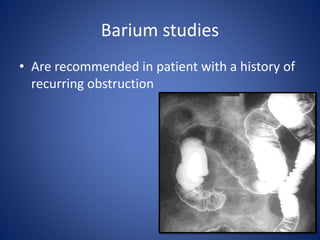
Barium studies
• Are recommended in patient with a history of
recurring obstruction
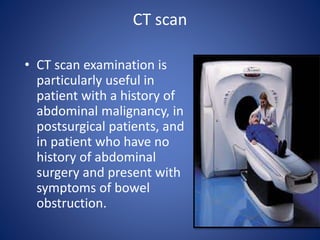
CT scan
• CT scan examination is
particularly useful in
patient with a history of
abdominal malignancy, in
postsurgical patients, and
in patient who have no
history of abdominal
surgery and present with
symptoms of bowel
obstruction.
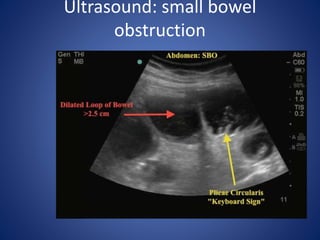
Ultrasound: small bowel
obstruction
DANGEROUS SIGNS
(Red Flags)
Constant pain
Absent bowel sounds
Tenderness with rigidity
Leukocytosis
Fever and tachycardia
Shock
Three main measures-
 GI drainage
 Fluid &Electrolyte replacement
 Relief of obstruction, usually surgical
Treatment
Conservative:
 Nasogastric aspiration by Ryles tube
 IV fluids- volume varies depending on
dehydration
 NPO
 urinary catheter
 check temp. and pulse 2 hourly
 abdominal examination 8 hourly
 Broad spectrum antibiotics initiated early-
reduce bacterial overgrowth.
 Some cases will settle by using this conservative regimen,
other need surgical intervention.
 Surgery should be delayed till resuscitation is complete unless
signs of strangulation and evidence of closed-loop
obstruction.
 Cases that show reasons for delay should be monitored
continuously for 72 hours in hope of spontaneous resolution
e.g. adhesions with radiological findings but no pain or
tenderness
 “The sun should not both rise and set” in cases of unrelieved
obstruction.
Indication for surgery:
- failure of conservative management
- tender, irreducible hernia
- strangulation
- virgin abdomen
• If the site of obstruction is unknown; laparotomy assessment
is directed to-
-The site of obstruction.
-The nature of obstruction.
-The viability of gut.
• The site of obstruction can be determined by caecum
Surgical treatment
Operative decompression required-if
dilatation of bowel loops prevent exposure,
bowel wall viability is compromised,
or if subsequent closure will be compromised.
Savage’s decompressor used within
seromuscular purse-string suture.
Or large-bore NG tube maybe used for milking
intestinal contents into stomach.
The type of surgical procedure depend upon the cause of
obstruction viz division of bands,adhesiolysis, excision ,or
bypass
*Once obstruction relieved, the bowel is inspected for
viability, and if non-viable, resection is required.
Indication of non-viability
1.absent peristalsis
2.loss of normal shine
3.loss of pulsation in mesentry
4.green or black color of bowel
5.absent mesentric pulsations
• If in doubt of viability, bowel is wrapped in
hot packs for 10 minutes with increased
oxygen and reassessed for viability.
• Resection of non viable gut should be done
followed by stoma.
• Sometimes a second look laprotomy is
required in 24-48 hours e.g. multiple
ischemic areas.
MANAGEMENT OF ACUTE CASE (Plan)
I.V Fluids and electrolytes rescusitation for all
N.G tube if repeated vomiting
Antibiotics for all
Hernia  Operation
Adhesions  Conservative first
Obstruction  Remove
Volvulus  Derotate and or Operate
Mesenteric ischemia  Operate
Abscess or Peritonitis  Drain and Treat
Intussusception  Pneumatic or Barium Reduction
or Operate
Do not take to OR if:
• Post-op
• Carcinomatosis
• Recurrent adhesive bowel obstruction
• Post radiotherapy
• Most common cause of intestinal obstruction.
• Peritoneal irritation results in local fibrin
production, which produce adhesions.
BANDS
• Congenital : obliterated vitellointestinal duct.
• A string band following previous bacterial
peritonitis.
• A portion of greater omentum adherent to
parietes.
Causes of adhesions :
• Abdominal operation : anastomosis, raw peritoneal
surfaces
• Foreign material: talc, starch, gauze, silk
• Infection: peritonitis, T.B.
• Inflammatory conditions: crohn’s disease.
• Radiation entritis.
Prevention
• Good surgical technique.
• Washing the peritoneal cavity with saline to remove the
clots.
• Minimizing contact with gauze.
• Covering the anastomosis & raw peritoneal surfaces.
• Usually conservative treatment is curative.
(i.v. rehydration & nasogastric decompression)
• It should not be prolonged beyond 72 hrs.
Surgery
• Division of band.
• Minimal adhisiolysis.
• Repeat adhesiolysis alone.
• Noble’s plication : adjacent intestinal coils
(15-20 cms) are sutured with serosal sutures.
• Charles-Phillips trans-mesenetric plication.
• Intestinal intubation : initraluminal tube
insertion via a WITZEL jejunostomy or
gastrostomy.
• When a portion of small intestine is entrapped
in one of retropritoneal fossae or in a
congenital mesentric defect.
Sites of internal herniation:
• Foramen of winslow.
• A hole in mesentry / transverse mesocolon.
• Defects in broad ligaments.
• Congenital/ acquired diaphragmatic hernia.
• Duodenal retroperitoneal fossae- Lt.
paraduodenal & rt. Duodenoojejunal.
• intersigmoid fossae.
• It is uncommon in the absence of adhesions.
• Treatment : to release the constricting agent
by division.
• It tends to occur in elderly.
• Erosion of large gallstone into duodenum.
• Present with recurrent obstruction.
• X-ray: small bowel obstruction with air in
billiary tree.
-may show a radio opaque gall stone.
• Treatment : laparotomy & removal /crushing
of stone.
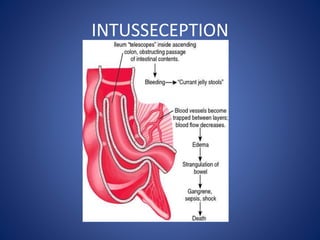
INTUSSECEPTION
INTUSSECEPTION
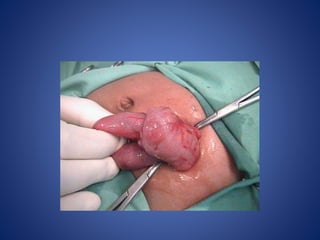
An intussusceptions is a medical condition in
which a part of the intestine
has invaginated into another section of
intestine.
Usually proximal loop invaginate in to the
distal bowel.
Rarely distal loop may invaginate into the
proximal loop this is called retrograde
intussusceptions.
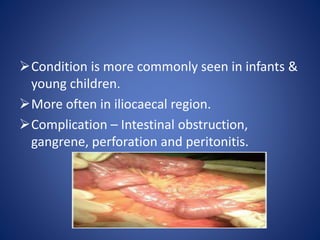
Condition is more commonly seen in infants &
young children.
More often in iliocaecal region.
Complication – Intestinal obstruction,
gangrene, perforation and peritonitis.
• One portion of gut becomes invaginated with
in adjacent segment.
• Most common in children(3-9 months.)
• Ideopathic-70%
• Associated gastroenteritis/UTI- 30%
• Hyperlpasia of Peyer’s patches in terminal
ileum can be initiating factor.
• In older children intussusception is usually
associated with a lead point – meckel’s
diverticulum, polyp, & appendix.
• Adults: always with a lead point.- polyp,
submucosal lipoma/ tumor.
• It is composed of three parts:
-Entering/ inner tube(Intussusceptum)
- Returning/ middle tube
-Sheath/ outer tube(intussuscipiens)
• It is an example of strangulating obstruction
with impaired blood supply of inner layer.
• It may be ileoileal(5%); ileocolic(77%); ileo-
ileo-colic(12%); colocolic (2%) & multiple.
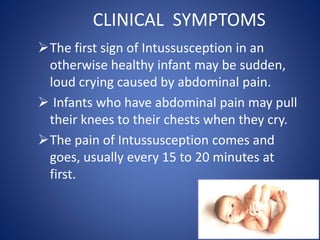
CLINICAL SYMPTOMS
The first sign of Intussusception in an
otherwise healthy infant may be sudden,
loud crying caused by abdominal pain.
 Infants who have abdominal pain may pull
their knees to their chests when they cry.
The pain of Intussusception comes and
goes, usually every 15 to 20 minutes at
first.
• Severe colic pain.
• vomitting as time progress
• blood & mucus (the ‘redcurrent’ jelly stool).
• Abdominal lump(sausage shaped)
• Emptiness in RIF(the sign of Dance).
• Death may occur from bowel obstruction or
peritonitis secondary to gangrene.
Other frequent signs and symptoms of
Intussusception include:
 Stool mixed with blood and mucus (also
known as “redcurrant jelly" stool because of
its appearance)
 Vomiting
 A "sausage-shaped" mass felt
upon palpation of the abdomen, with
concavity towards umbilicus
 Lethargy
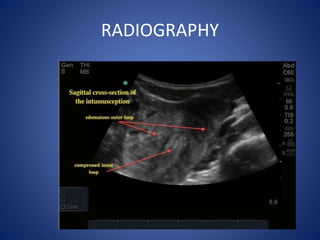
• Plain X-ray Abd.: Bowel obstruction with absent caecal
shadow gas in ileo-ileal & ileo-colic cases.
• Ba-enema: the claw sign in ileocolic & colocolic cases.
• CT scan in equivocal cases of ileo-ileal intussusception. (small
bowel mass may be revealed)
Differential Diagnosis
• Acute enterocolitis: faecal matter/ bile is always present.
• Henoch-schoenlein purpura.
• Rectal prolapse: projecting mucosa can be felt in continuity
with perianal skin
• Theraputic Ba-enema : -in infants.
- unlikely to succeed in lead points.
- contrindications: peritonism, prolonged
history (> 48 hrs.).
Operative
• After resuscitation ;Laparotmy with reduction.
• Cope’s method.
• Irreducible/ gangrenous intussusception:
excision of mass & anastomosis.
RADIOGRAPHY
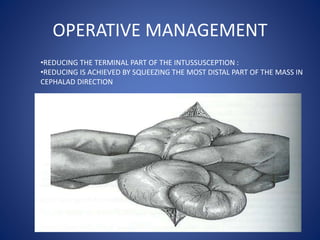
OPERATIVE MANAGEMENT
•REDUCING THE TERMINAL PART OF THE INTUSSUSCEPTION :
•REDUCING IS ACHIEVED BY SQUEEZING THE MOST DISTAL PART OF THE MASS IN
CEPHALAD DIRECTION
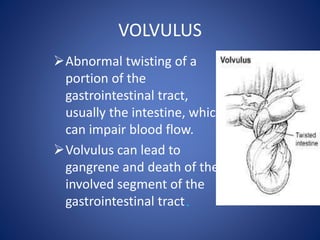
VOLVULUS
Abnormal twisting of a
portion of the
gastrointestinal tract,
usually the intestine, which
can impair blood flow.
Volvulus can lead to
gangrene and death of the
involved segment of the
gastrointestinal tract.
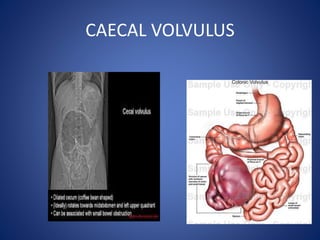
CAECAL VOLVULUS
• More common in female in fourth and fifth
decades and usually presents acutely with the
classic feature of obstruction.
• Rotation always occurs in clock wise direction.
• Ischemia is common.
CAECAL VOLVULUS
SIGMOID VOLVULUS
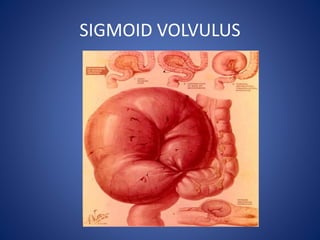
SIGMOID VOLVULUS
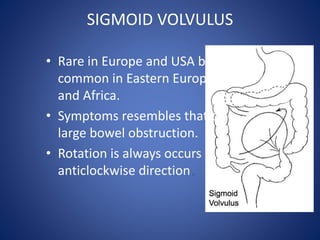
• Rare in Europe and USA but
common in Eastern Europe
and Africa.
• Symptoms resembles that of
large bowel obstruction.
• Rotation is always occurs in
anticlockwise direction.
Treatment
• Flexible sigmoidoscopy/ rigid sigmoidoscopy
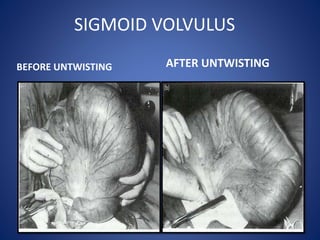
• Laparotomy- untwisting
SIGMOID VOLVULUS
BEFORE UNTWISTING AFTER UNTWISTING
• After partial /total gastrectomy.
• Unchewed food can cause obstruction.
• Treatment similar to gall stone.
BEZOARS
• Trichobezoars
• Phytobezoars
WORMS
• Ascaris lumbricoides
• Frequently follows initiation of antihelminthic therapy.
• Eosinophilia/worm with in gas filled bowel loops.
• Laparotomy.
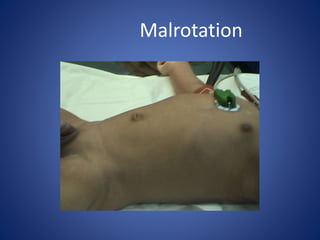
Malrotation
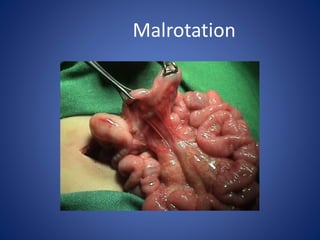
Malrotation
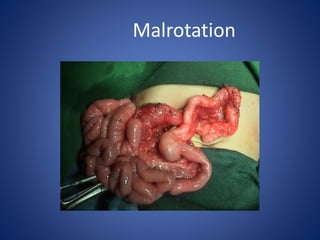
Malrotation
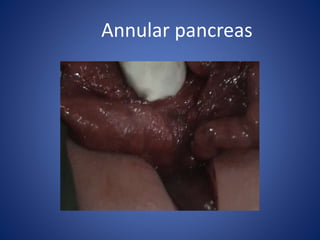
Annular pancreas
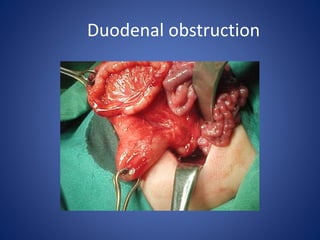
Duodenal obstruction
Mechanical intestinal obstruction
Sup. mesenteric
a. syndrome
(compression of
3rd part of
duodenum ).
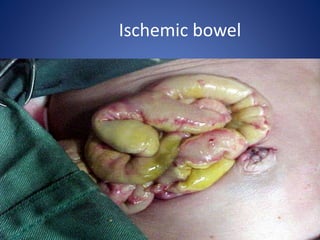
Ischemic bowel
Mechanical intestinal obstruction
Mural:
•Small
bowel
atresia.
• Imperforated
anus.
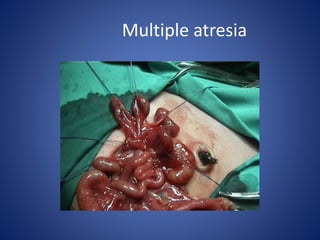
Multiple atresia
Mechanical intestinal obstruction
•Stenosis.
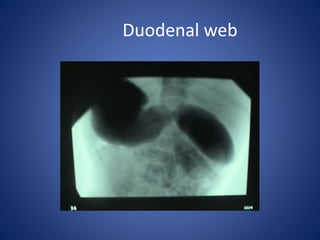
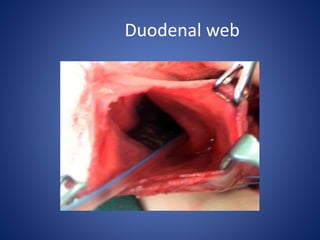
•Webs
(diaphragm).
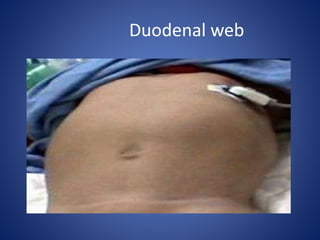
Duodenal web
Duodenal web
Duodenal web
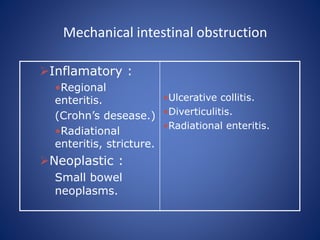
Mechanical intestinal obstruction
Inflamatory :
•Regional
enteritis.
(Crohn’s desease.)
•Radiational
enteritis, stricture.
Neoplastic :
Small bowel
neoplasms.
•Ulcerative collitis.
•Diverticulitis.
•Radiational enteritis.
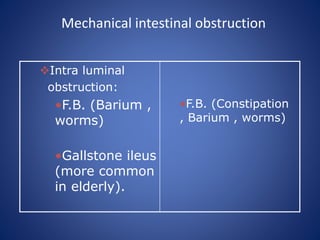
Mechanical intestinal obstruction
Intra luminal
obstruction:
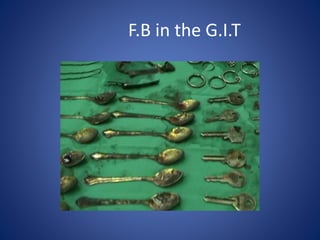
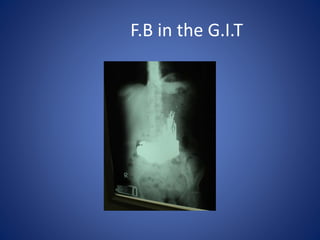
•F.B. (Barium ,
worms)
•Gallstone ileus
(more common
in elderly).
•F.B. (Constipation
, Barium , worms)
F.B in the G.I.T
F.B in the G.I.T
Intussusception
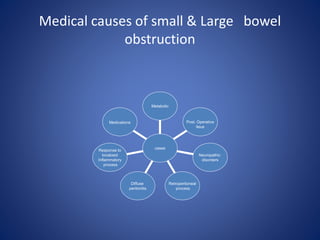
Medical causes of small & Large bowel
obstruction
Medications
Response to
localized
Inflammatory
process
Diffuse
peritonitis
Retroperitoneal
process
Neuropathic
disorders
Post. Operative
ileus
Metabolic
cases
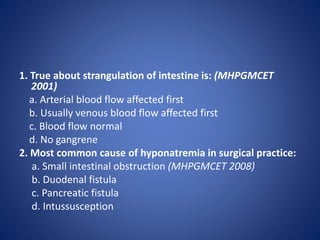
1. True about strangulation of intestine is: (MHPGMCET
2001)
a. Arterial blood flow affected first
b. Usually venous blood flow affected first
c. Blood flow normal
d. No gangrene
2. Most common cause of hyponatremia in surgical practice:
a. Small intestinal obstruction (MHPGMCET 2008)
b. Duodenal fistula
c. Pancreatic fistula
d. Intussusception
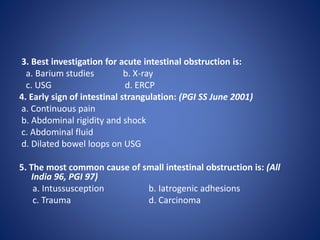
3. Best investigation for acute intestinal obstruction is:
a. Barium studies b. X-ray
c. USG d. ERCP
4. Early sign of intestinal strangulation: (PGI SS June 2001)
a. Continuous pain
b. Abdominal rigidity and shock
c. Abdominal fluid
d. Dilated bowel loops on USG
5. The most common cause of small intestinal obstruction is: (All
India 96, PGI 97)
a. Intussusception b. Iatrogenic adhesions
c. Trauma d. Carcinoma
THANK YOU 

intestinalobstruction-170323180308.pdf

  • 1.
  • 2.
    Bowel obstruction occurswhen the normal propulsion and passage of intestinal contents does not occur.  Intestinal obstruction  Mechanical obstruction Paralytic Ileus Definition
  • 3.
    Intestinal obstruction • Thisobstruction can involve only the small intestine (small bowel obstruction), the large intestine (large bowel obstruction), or via systemic alterations, involving both the small and large intestine (generalized ileus). The "obstruction" can involve a mechanical obstruction or, in contrast, may be related to ineffective motility without any physical obstruction, so-called functional obstruction, "pseudo-obstruction," or paralytic ileus
  • 4.
    CLASSIFICATION  Dynamic/ Adynamic Small bowel obstruction [ high or low ]  Large bowel obstruction  Acute  Chronic  Acute on chronic  Subacute  Simple  Strangulated  Closed loop obstruction
  • 5.
    INTESTINAL OBSTRUCTION IS CLASSIFIEDIN TWO TYPES  DYNAMIC : where peristalsis is working against a mechanical obstruction.  ADYNAMIC: it may occur in two forms 1. 1st where peristalsis may be absent (paralytic ileus,)occurring secondarily to neuromuscular failure in the mesentery. 2. 2nd where peristalsis may be present in non- propulsive form.(pseudo-obstruction) IN BOTH FORMS MECHANICAL ELEMENT IS ABSENT.
  • 6.
    Mechanical obstruction • Thereis physical blockage of intestinal lumen which due to: 1. Intramural : congenital-tumor-hematoma-inflammatory 2. Extramural : adhesion-volvulus-hernia –abscess-hematoma 3. Lumen obstruction: stone-meconium-foreign body- impaction (stool-worm-barium) • This mechanical obstruction can be partial ( lumen narrowed but allow transit some content) or complete ( lumen totally obstruction) this classify to A. simple obstruction (no vascular impairment) B. closed loop ( both ends are obstructed e.g volvulus) C. strangulation obstruction
  • 7.
    ON THE BASISOF NATURE IT IS CLASSIFIED IN TO ACUTE CHRONIC ACUTE ON CHRONIC SUBACUTE
  • 8.
    ACUTE OBSTRUCTION : ITUSUALLY OCCUR IN SMALL BOWEL OBSTRUCTION WITH SUDDEN ONSET OF SEVERE COLICKY CENTRAL ABDOMINAL PAIN,DISTENTION AND EARLY VOMITING AND CONSTIPATION.
  • 9.
    CHRONIC OBSTRUCTION : USUALLYSEEN IN LARGE BOWEL OBSTRUCTION WITH LOWER ABDOMINAL COLIC AND ABSOLUTE CONSTIPATION,FOLLOWED BY DISTENTION.
  • 10.
    ACUTE ON CHRONIC OBSTRUCTION: IT SATRTS IN LARGE BOWEL BUT GRADUALLY INVOLVES THE SMALL INTESTINE. EARLY SYMPTOMS ARE PAIN AND CONSTIPATION BUT WHEN SMALL INTESTINE IS INVOLVED IT IS CHARACTERIZED BY VOMITING AND GENERAL DSTENTION.
  • 11.
    ON THE BASIS,WHETHER THE OBSTRUCTION IS SIMPLE MECHANICAL STARANGULATED CLOSED LOOP
  • 12.
    ETIOLOGY CAUSES FROM OUTSIDETHE WALL (Extraluminal) CAUSES FROM THE WALL (Intramural) CAUSES IN THE LUMEN (Intraluminal)
  • 13.
    • Adhesions- 40% •Tumors -15% • Inflamatory- 15% • Obstructed hernia-12% • Intraluminal-10% • Miscellaneous -8%
  • 14.
    ETIOLOGY DYNAMIC(MECHANICAL)FROM THE WALL 1- TB 2-CROHN’S 3- TUMORS 4-STICTURE 5- CONGENITAL ……… . .
  • 15.
    ETIOLOGY MECHANNICAL IN THE LUMEN 1-GALL STONES 2- F.B 3- BEZOARS 4- WARMS 5- FECES ……….. GALL STONES BEZOARS WARMs FECES
  • 16.
    ETIOLOGY MECHANICAL EXTRALUMINAL 1- BANDS 2- ADHESIONS 3-ABSCESS 4- HERNIAS 5-COMPRESSION …….. BANDS ABSCESS COMPRESSION HERNIA
  • 17.
  • 18.
  • 19.
  • 20.
  • 21.
  • 22.
    ETIOLOGY Adynamic Intestinal Obstruction. 1-Peritonitis 2- Electrolytes’ Imbalance 3- Postoperative 4- Ischemia 5- Drugs 6- Retroperitoneal causes...
  • 23.
    MOST COMMON CAUSES SMALLINTESTINE -ADHESIONS & - EXTERNAL HERNIAS (both are more than 75% of cases) - CROHN’S, TB, TUMORS, INTUS., CONGENITAL……… LARGE INTESTINE - TUMORS & - VOLVULUS (both are 90% of cases - DIVERTIDULITIS (rare) - ADHESIONS (extremely rare if at all)
  • 24.
    CAUSES ACCORDING TOAGE BIRTH : Atresia, Meconium, NE, Volvulus,Hirschsprung’s 3 WEEKS : Pyloric stenosis 6-9MONTHS : Intussusception TEENAGE : Appendicitis , Meckel’s diverticulitis YOUNG ADULT : Adhesions , Hernia ADULT : Adhesions , Hernia, Appendicitis, Crohn’s, Carcinoma ELDERLY : Carcinoma, Diverticulitis, Sigmoid Volvulus , Feces
  • 25.
    PATHOPHYSIOLOGY THE OBSTRUCTION COULDBE : - Simple - Closed loop - Strangulated
  • 26.
    PATHOPYSIOLOGY SIMPLE OBSTRUCTION : 1-ABOVETHE OBSTRUCTION OBSTRUCTION  Peristalsis increases  Intstine dilates  Reduction in peristaltic strength  Flaccidity and paralysis (protective but late) 2- BELOW THE OBSTRUCTION NORMAL PERISTALSIS & ABSORBTION  Until it becomes empty  It contracts & becomes immobile
  • 27.
    PATHOPHYSIOLOGY Distention of theintestine is caused by accomulation of: 1- GAS 2- FLUIDS gas fluids Distention fluids
  • 28.
    PATHPYSIOLOGY Gas in theintestine is due to: 1. Swallowed air 2. Bacterial overgrowth 3. Diffusion from blood
  • 29.
    PATHOPHYSILOGY Fluids come from: 1. Ingested fluids 2. Saliva 3. Gastric and intestinal juice 4. Bile & Pancreatic secretions
  • 30.
    PATHOPHYSIOLOGY Dehydration caused by: 1. Reduced intake 2. Reduced absorption 3. Increased loss (Vomiting & sequesration)
  • 31.
    PATHOPHYSIOLOGY Systemic Effects ofObstruction : 1. Water and electrolyte losses (lead to hypovolemia) 2. Toxic materials and toxemia(lead to sepsis) 3. Cardiopulmonary dysfunction(atelectasis) 4. Renal failure 5. Shock and death
  • 32.
    PATHOPHYSIOLOGY Strangulation leads toimpaired venous return  Increased congestion  -free peritoneal fluid -edema of intestinal wall -blood in the lumen -impaired arterial blood supply -ischemia and gangrene
  • 33.
    Pathophysiology : (1) Proximalsegment •Hyperperistaltic phase •Antiperistaltic phase •Stage of dilatation •Fluid accumulation •Gas accumulation •Increased tension •Ischemia (2) Distal segment Collapsed
  • 34.
    ADYNAMIC OBSTRUCTION causes Eitherlocalized or generalized Small intestine - Postoperative - Intra-abdominal abscess or peritonitis - Mesenteric embolism or thrombosis Large intestine - Retroperitoneal hematoma - Drugs - Hypokalemia - Idiopathic
  • 35.
  • 36.
    STARANGULATED OBSTRUCTION : Strangulatingobstruction is obstruction with compromised blood flow; it occurs in nearly 25% of patients with small-bowel obstruction. It is usually associated with hernia, volvulus, and intussusceptions. Strangulating obstruction can progress to infarction and gangrene in as little as 6 h.
  • 37.
    . • Venous obstruction occursfirst, followed by arterial occlusion, resulting in rapid ischemia of the bowel wall. • The ischemic bowel becomes edematous and infarcts, leading to gangrene and perforation. In large- bowel obstruction, strangulation is rare (except with volvulus)
  • 38.
  • 39.
    CLOSED LOOP OBSTRUCTION Closedloop obstruction is a specific type of obstruction in which two points along the course of a bowel are obstructed at a single location thus forming a closed loop. Usually this is due to adhesions, a twist of the mesentery or internal herniation.
  • 40.
    • In thelarge bowel it is known as a volvulus. • In the small bowel it is simply known as small bowel closed loop obstruction. • Obstruction to the blood supply occur either from the same mechanism which caused obstruction or by the twist of the bowel on mesentery.
  • 41.
  • 42.
  • 43.
    CLINICAL FEATURE OFINTESTINAL OBSTRUCTION Clinical obstruction of intestinal obstruction vary according to :  The location of the obstruction;  The age of the obstruction;  The underlying pathology;  The presence or the absence of the intestinal obstruction;
  • 44.
    PAIN Pain is thefirst symptom encountered, it occurs suddenly and is usually severe.. It is colicky in nature and usually centered on the umbilicus (small bowel) or lower abdomen (large bowel). The pain coincides with the increasing peristaltic activity
  • 45.
    VOMITING The more distalthe obstruction ,the longer the interval between the onset of symptoms and the appearance of nausea and vomiting . More proximal the obstruction, more the frequency. The interval ,frequency & nature of vomitus depends on the site of obstruction
  • 46.
    • In highbowel obstruction : • the interval is shorter • Bile stained vomitus • Vomiting is more frequent and copious ; • And is relieved by decompressing the obstructed bowel
  • 47.
    • In lowbowel obstruction : • the interval is longer may last for a day or two • Feculent vomitus • vomiting is less frequent and does not cause any relief.
  • 48.
    Pyloric obstruction • Wateryand acidic vomitus Large bowel obstruction • Uncommon and late symptoms.
  • 49.
    Long standing lowsmall bowel obstruction- • feculent material. • Strangulation- blood.
  • 50.
    DISTENTION In the smallbowel, the degree of distention is dependent on the site of obstruction & is greater the more distal the lesion. Central abdomen is distended in low small bowel obstruction. Distention is much less in high small bowel obstruction.
  • 51.
    CONSTIPATION • Failure topass flatus or faeces through the rectum is important symptom of bowel obstruction. • It may be classified as 1. ABSOLUTE 2. RELATIVE
  • 52.
    VISIBLE PERISTALSIS Visible peristalsismay be present if the abdomen is examined carefully. Mostly seen in proximal loops. Borborygmi is quite loud ,does not require stethoscope to hear it . In auscultation sound of hyper peristalsis coinciding with attack of colic characteristic feature f intestinal obstruction.
  • 53.
  • 54.
    BLOATING • The accumulationof chyme and gas gives rise to a feeling of fullness and causes bloating. This may also give rise to high-pitched gurgling sounds from the abdomen
  • 55.
    FATIGUE • Obstruction andthe resulting digestive inability hampers the absorption of vitamins and other nutrients from food, leading to weakness, headache and dizziness. Even regular activities may make the individual feel exhausted and drowsy
  • 56.
    INFREQUENT URINATION • Dehydrationdue to diarrhea and vomiting, results in the loss of body fluids and electrolytes. As a response to this, the body tries to retain water through lowered urine output.
  • 57.
    OTHER MANIFESTATION • Dehydration •Hypokalamia • Pyrexia • Abdominal tenderness • Bowel sound
  • 58.
  • 59.
    PHYSICAL EXAMINATION • Inspection •Palpation • Percussion • Auscultation • Rectal examination
  • 60.
  • 61.
    INSPECTION Shape of theabdomen Movement of the abdomen wall Umbilicus Visible loop of bowel/visible peristalsis Scar Striae Prominent veins Pubic hair Hernial orifices
  • 62.
  • 63.
    PALPATION During colic theremay be muscle guarding.  Slight tenderness may be present between attacks of pain. Tenderness and rigidity at the sight of obstruction usually indicate strangulation. All the hernial orifices should be palpated to exclude the presence of hernia.
  • 64.
  • 65.
    PERCUSSION Percussion to hearany Dullness or Resonance related to site of obstruction. Tympanic node will be present. Tenderness on light percussion suggest strangulation.
  • 66.
  • 67.
    AUSCULTATION Bowel sounds areInitially Loud and frequent Then as bowel distends the sounds become more resonant and high pitched Eventually becoming amphoric. In strangulation bowel sound is completely absent.
  • 68.
    RECTAL EXAMINATION Presence ofmass on rectal examination within or outside the lumen will give a clue to diagnosis. Presence or absence of feces in rectum should be noted. Absence means obstruction is higher up. If presence it should be studied for presence of occult blood which include mucosal lesion e.g.cancer,Intussuception or infraction
  • 69.
  • 70.
    BLOOD EXAMINATION • CBC •Urea & electrolytes • Serum amylase level • Metabolic acidosis
  • 71.
    CBC (Complete bloodcount)- A rise white cell count will indicate an infection. Normal or slight rise in W.B.C count: simple mechanical obstruction. Moderate rise in W.B.C count(15000- 20000):strangulation. Very high rise in W.B.C count(30000- 40000):primary mesenteric vascular occlusion.
  • 72.
    Serum Urea &electrolytes- Derangement may be seen with vomiting & diarrhea. Dehydration will be reflected in raised serum urea and creatinine.
  • 73.
    Serum Amylase- • Itis non specific test & may be raised in cases of small intestinal obstruction.
  • 74.
    Metabolic acidosis It occursdue to combined effects of dehydration ketosis and loss of alkaline secretion. Very common in distal intestinal obstruction.
  • 75.
  • 76.
    Bowel Obstruction Radiologic Evaluation •Xrays: ? AFLs, ? Free Air, ? Distal Gas • UGI / SBFT: Identify mechanical obstruction • Enteroclysis: Independent of gastric emptying • CT Scan: ? Free Air, ? Pneumatosis, ? Tumor
  • 77.
    RADIOLOGICAL EXAMINATION Gas fluidlevels are the most important criteria of diagnosis of intestinal obstruction. When obstruction occurs, both fluid and gas collect in the intestine. They produce a characteristic pattern called "air-fluid levels". The air rises above the fluid and there is a flat surface at the "air-fluid" interface.
  • 78.
    RADIOLOGICAL PICTURE  SmallBowel Obstruction - Central distention (GAS) - Valvulae conniventes - “Ladder-like dilatation” - Small diameter  Large Bowel Obstruction - Peripheral distention “Picture frame” - More gross distention - Haustral indentation & large diameter
  • 79.
    In most cases,the abdominal radiograph will have the following features: 1. ileated loops of small bowel proximal to the obstruction 2. predominantly central dilated loops 3. dilatation of loops over 3cm 4. valvulae conniventes are visible
  • 88.
  • 90.
  • 91.
  • 92.
  • 93.
    Volvulus x ray:Sigmoid volvulus - 'coffee bean' sign The sigmoid colon is very dilated because it is twisted at the root of its mesentery in the left iliac fossa (LIF) The twisted loop of sigmoid colon is said to resemble a coffee bean
  • 94.
    Barium studies • Arerecommended in patient with a history of recurring obstruction
  • 95.
    CT scan • CTscan examination is particularly useful in patient with a history of abdominal malignancy, in postsurgical patients, and in patient who have no history of abdominal surgery and present with symptoms of bowel obstruction.
  • 96.
  • 99.
    DANGEROUS SIGNS (Red Flags) Constantpain Absent bowel sounds Tenderness with rigidity Leukocytosis Fever and tachycardia Shock
  • 100.
    Three main measures- GI drainage  Fluid &Electrolyte replacement  Relief of obstruction, usually surgical
  • 101.
    Treatment Conservative:  Nasogastric aspirationby Ryles tube  IV fluids- volume varies depending on dehydration  NPO  urinary catheter  check temp. and pulse 2 hourly  abdominal examination 8 hourly  Broad spectrum antibiotics initiated early- reduce bacterial overgrowth.
  • 102.
     Some caseswill settle by using this conservative regimen, other need surgical intervention.  Surgery should be delayed till resuscitation is complete unless signs of strangulation and evidence of closed-loop obstruction.  Cases that show reasons for delay should be monitored continuously for 72 hours in hope of spontaneous resolution e.g. adhesions with radiological findings but no pain or tenderness  “The sun should not both rise and set” in cases of unrelieved obstruction.
  • 103.
    Indication for surgery: -failure of conservative management - tender, irreducible hernia - strangulation - virgin abdomen • If the site of obstruction is unknown; laparotomy assessment is directed to- -The site of obstruction. -The nature of obstruction. -The viability of gut. • The site of obstruction can be determined by caecum
  • 104.
    Surgical treatment Operative decompressionrequired-if dilatation of bowel loops prevent exposure, bowel wall viability is compromised, or if subsequent closure will be compromised. Savage’s decompressor used within seromuscular purse-string suture. Or large-bore NG tube maybe used for milking intestinal contents into stomach.
  • 105.
    The type ofsurgical procedure depend upon the cause of obstruction viz division of bands,adhesiolysis, excision ,or bypass *Once obstruction relieved, the bowel is inspected for viability, and if non-viable, resection is required. Indication of non-viability 1.absent peristalsis 2.loss of normal shine 3.loss of pulsation in mesentry 4.green or black color of bowel 5.absent mesentric pulsations
  • 106.
    • If indoubt of viability, bowel is wrapped in hot packs for 10 minutes with increased oxygen and reassessed for viability. • Resection of non viable gut should be done followed by stoma. • Sometimes a second look laprotomy is required in 24-48 hours e.g. multiple ischemic areas.
  • 107.
    MANAGEMENT OF ACUTECASE (Plan) I.V Fluids and electrolytes rescusitation for all N.G tube if repeated vomiting Antibiotics for all Hernia  Operation Adhesions  Conservative first Obstruction  Remove Volvulus  Derotate and or Operate Mesenteric ischemia  Operate Abscess or Peritonitis  Drain and Treat Intussusception  Pneumatic or Barium Reduction or Operate
  • 108.
    Do not taketo OR if: • Post-op • Carcinomatosis • Recurrent adhesive bowel obstruction • Post radiotherapy
  • 109.
    • Most commoncause of intestinal obstruction. • Peritoneal irritation results in local fibrin production, which produce adhesions. BANDS • Congenital : obliterated vitellointestinal duct. • A string band following previous bacterial peritonitis. • A portion of greater omentum adherent to parietes.
  • 110.
    Causes of adhesions: • Abdominal operation : anastomosis, raw peritoneal surfaces • Foreign material: talc, starch, gauze, silk • Infection: peritonitis, T.B. • Inflammatory conditions: crohn’s disease. • Radiation entritis. Prevention • Good surgical technique. • Washing the peritoneal cavity with saline to remove the clots. • Minimizing contact with gauze. • Covering the anastomosis & raw peritoneal surfaces.
  • 111.
    • Usually conservativetreatment is curative. (i.v. rehydration & nasogastric decompression) • It should not be prolonged beyond 72 hrs. Surgery • Division of band. • Minimal adhisiolysis.
  • 112.
    • Repeat adhesiolysisalone. • Noble’s plication : adjacent intestinal coils (15-20 cms) are sutured with serosal sutures. • Charles-Phillips trans-mesenetric plication. • Intestinal intubation : initraluminal tube insertion via a WITZEL jejunostomy or gastrostomy.
  • 113.
    • When aportion of small intestine is entrapped in one of retropritoneal fossae or in a congenital mesentric defect. Sites of internal herniation: • Foramen of winslow. • A hole in mesentry / transverse mesocolon. • Defects in broad ligaments. • Congenital/ acquired diaphragmatic hernia. • Duodenal retroperitoneal fossae- Lt. paraduodenal & rt. Duodenoojejunal. • intersigmoid fossae.
  • 114.
    • It isuncommon in the absence of adhesions. • Treatment : to release the constricting agent by division.
  • 115.
    • It tendsto occur in elderly. • Erosion of large gallstone into duodenum. • Present with recurrent obstruction. • X-ray: small bowel obstruction with air in billiary tree. -may show a radio opaque gall stone. • Treatment : laparotomy & removal /crushing of stone.
  • 116.
  • 117.
    INTUSSECEPTION An intussusceptions isa medical condition in which a part of the intestine has invaginated into another section of intestine. Usually proximal loop invaginate in to the distal bowel. Rarely distal loop may invaginate into the proximal loop this is called retrograde intussusceptions.
  • 118.
    Condition is morecommonly seen in infants & young children. More often in iliocaecal region. Complication – Intestinal obstruction, gangrene, perforation and peritonitis.
  • 119.
    • One portionof gut becomes invaginated with in adjacent segment. • Most common in children(3-9 months.) • Ideopathic-70% • Associated gastroenteritis/UTI- 30% • Hyperlpasia of Peyer’s patches in terminal ileum can be initiating factor.
  • 120.
    • In olderchildren intussusception is usually associated with a lead point – meckel’s diverticulum, polyp, & appendix. • Adults: always with a lead point.- polyp, submucosal lipoma/ tumor. • It is composed of three parts: -Entering/ inner tube(Intussusceptum) - Returning/ middle tube -Sheath/ outer tube(intussuscipiens) • It is an example of strangulating obstruction with impaired blood supply of inner layer. • It may be ileoileal(5%); ileocolic(77%); ileo- ileo-colic(12%); colocolic (2%) & multiple.
  • 121.
    CLINICAL SYMPTOMS The firstsign of Intussusception in an otherwise healthy infant may be sudden, loud crying caused by abdominal pain.  Infants who have abdominal pain may pull their knees to their chests when they cry. The pain of Intussusception comes and goes, usually every 15 to 20 minutes at first.
  • 122.
    • Severe colicpain. • vomitting as time progress • blood & mucus (the ‘redcurrent’ jelly stool). • Abdominal lump(sausage shaped) • Emptiness in RIF(the sign of Dance). • Death may occur from bowel obstruction or peritonitis secondary to gangrene.
  • 123.
    Other frequent signsand symptoms of Intussusception include:  Stool mixed with blood and mucus (also known as “redcurrant jelly" stool because of its appearance)  Vomiting  A "sausage-shaped" mass felt upon palpation of the abdomen, with concavity towards umbilicus  Lethargy
  • 124.
    • Plain X-rayAbd.: Bowel obstruction with absent caecal shadow gas in ileo-ileal & ileo-colic cases. • Ba-enema: the claw sign in ileocolic & colocolic cases. • CT scan in equivocal cases of ileo-ileal intussusception. (small bowel mass may be revealed) Differential Diagnosis • Acute enterocolitis: faecal matter/ bile is always present. • Henoch-schoenlein purpura. • Rectal prolapse: projecting mucosa can be felt in continuity with perianal skin
  • 125.
    • Theraputic Ba-enema: -in infants. - unlikely to succeed in lead points. - contrindications: peritonism, prolonged history (> 48 hrs.). Operative • After resuscitation ;Laparotmy with reduction. • Cope’s method. • Irreducible/ gangrenous intussusception: excision of mass & anastomosis.
  • 126.
  • 127.
    OPERATIVE MANAGEMENT •REDUCING THETERMINAL PART OF THE INTUSSUSCEPTION : •REDUCING IS ACHIEVED BY SQUEEZING THE MOST DISTAL PART OF THE MASS IN CEPHALAD DIRECTION
  • 128.
    VOLVULUS Abnormal twisting ofa portion of the gastrointestinal tract, usually the intestine, which can impair blood flow. Volvulus can lead to gangrene and death of the involved segment of the gastrointestinal tract.
  • 129.
    CAECAL VOLVULUS • Morecommon in female in fourth and fifth decades and usually presents acutely with the classic feature of obstruction. • Rotation always occurs in clock wise direction. • Ischemia is common.
  • 130.
  • 131.
  • 132.
    SIGMOID VOLVULUS • Rarein Europe and USA but common in Eastern Europe and Africa. • Symptoms resembles that of large bowel obstruction. • Rotation is always occurs in anticlockwise direction.
  • 133.
    Treatment • Flexible sigmoidoscopy/rigid sigmoidoscopy • Laparotomy- untwisting
  • 134.
  • 135.
    • After partial/total gastrectomy. • Unchewed food can cause obstruction. • Treatment similar to gall stone. BEZOARS • Trichobezoars • Phytobezoars WORMS • Ascaris lumbricoides • Frequently follows initiation of antihelminthic therapy. • Eosinophilia/worm with in gas filled bowel loops. • Laparotomy.
  • 136.
  • 137.
  • 138.
  • 139.
  • 140.
  • 141.
    Mechanical intestinal obstruction Sup.mesenteric a. syndrome (compression of 3rd part of duodenum ).
  • 142.
  • 143.
  • 144.
  • 145.
  • 146.
  • 147.
  • 148.
  • 149.
    Mechanical intestinal obstruction Inflamatory: •Regional enteritis. (Crohn’s desease.) •Radiational enteritis, stricture. Neoplastic : Small bowel neoplasms. •Ulcerative collitis. •Diverticulitis. •Radiational enteritis.
  • 150.
    Mechanical intestinal obstruction Intraluminal obstruction: •F.B. (Barium , worms) •Gallstone ileus (more common in elderly). •F.B. (Constipation , Barium , worms)
  • 151.
  • 152.
  • 153.
  • 154.
    Medical causes ofsmall & Large bowel obstruction Medications Response to localized Inflammatory process Diffuse peritonitis Retroperitoneal process Neuropathic disorders Post. Operative ileus Metabolic cases
  • 155.
    1. True aboutstrangulation of intestine is: (MHPGMCET 2001) a. Arterial blood flow affected first b. Usually venous blood flow affected first c. Blood flow normal d. No gangrene 2. Most common cause of hyponatremia in surgical practice: a. Small intestinal obstruction (MHPGMCET 2008) b. Duodenal fistula c. Pancreatic fistula d. Intussusception
  • 156.
    3. Best investigationfor acute intestinal obstruction is: a. Barium studies b. X-ray c. USG d. ERCP 4. Early sign of intestinal strangulation: (PGI SS June 2001) a. Continuous pain b. Abdominal rigidity and shock c. Abdominal fluid d. Dilated bowel loops on USG 5. The most common cause of small intestinal obstruction is: (All India 96, PGI 97) a. Intussusception b. Iatrogenic adhesions c. Trauma d. Carcinoma
  • 157.